


Abstract
The aim of this study was to systematically review the evidence on the outcomes of using different intensities of static stretching on range of motion (ROM) and strength. PubMed, Web of Science and Cochrane controlled trials databases were searched between October 2021 and February 2022 for studies that examined the effects of different static stretching intensities on range of motion and strength. Out of 6285 identified records, 18 studies were included in the review. Sixteen studies examined outcomes on ROM and four on strength (two studies included outcomes on both ROM and strength). All studies demonstrated that static stretching increased ROM; however, eight studies demonstrated that higher static stretching intensities led to larger increases in ROM. Two of the four studies demonstrated that strength decreased more following higher intensity stretching versus lower intensity stretching. It appears that higher intensity static stretching above the point of discomfort and pain may lead to greater increases in ROM, but further research is needed to confirm this. It is unclear if high-intensity static stretching leads to a larger acute decrease in strength than lower intensity static stretching.
1. Introduction
Static stretching is a common technique purported to improve range of motion (ROM) within sporting and rehabilitation settings and it is a passive lengthening of a muscle which is then sustained [1]. The increase in ROM results from an increase in stretch tolerance and a decrease in passive stiffness of the musculotendinous unit (MTU) [2]. Completed before exercise, the effects on performance are unclear, with some studies observing positive effects [3] and others impaired performance [4]. As a result, the European College of Sports Sciences [5] and the American College of Sports Medicine [6] do not recommend the use of static stretching and instead promote dynamic stretching. Despite these recommendations, static stretching is still used in warm-ups and promoted by coaches [7,8,9,10].
Good ROM, or flexibility around a joint, is important for the performance and activities of daily living as it allows full usage of the functional range. There are also suggestions that poor flexibility [11] and higher MTU stiffness [12] are associated with a greater risk of muscular injury. This occurs because demands in energy absorption and release may rapidly exceed the stiffness capacity of the MTU [13]. As a result, there is a need to balance the associated benefits of increasing ROM to decrease injury risk, against reducing performance from a level of stiffness that contributes to force production during dynamic movements where the MTU stiffness is important. Furthermore, this balance is made following limited research on the intensity of stretching as a variable.
Four variables can impact the effectiveness of stretching: frequency, duration, the position held and the intensity [14,15]. Whilst the duration and frequency of stretching are simple for participants to understand and implement, the intensity of stretch and position held for each stretch is far more subjective. Due to their inherently subjective nature, the effects of different stretch intensities and positions on ROM and exercise performance are harder to control and research.
Stretching intensity does not have a single definition. Jacobs and Sciascia [16] defined it as “the magnitude of force or torque applied to the joint during a stretching exercise”, however, Freitas et al. [17] defined it as “degree of muscle-tendon lengthening induced by a change in joint range of motion that is controlled by an individual’s subjective tolerance to stretch”. Historical recommendations for stretching intensity were to elicit the maximal ROM without pain or discomfort [18]. However, subsequent investigations have then examined the influence of stretching intensity on ROM, with observations demonstrating stretching to a higher intensity (120% point of pain) compared to a lower intensity (80% with no pain) elicited a greater change in ROM [19]. Therefore, intensity may be an important consideration in eliciting greater changes in ROM. However, it is important to recognise that these investigations have limited ecological validity to athletic populations and practice within an applied environment, where stretching is included within warm-up routines.
Static stretching has been observed to decrease strength immediately following the stretching bout [20,21]. This is potentially caused by a more compliant MTU, a less stiff MTU [22] and lower motor unit activation [23]. Furthermore, the intensity of static stretching on strength has also been investigated with findings of both greater decreases in subsequent strength [19,24] and no changes [25,26], therefore the intensity of stretching may also be important on subsequent strength.
Stretching intensity is subjective, with studies investigating stretching intensity using the participant’s perception of the intensity, often using the terms ‘point of pain’ or ‘point of discomfort’ [19] or a numerical rating scale (NRS) for pain or discomfort (0 = no pain, 10 = worst imaginable discomfort or pain) [27]. As a result, this variability in methods makes stretching at different intensities difficult to define and implement within an applied setting. Furthermore, the outcomes are unclear and therefore it is difficult to determine if high-intensity stretching is more beneficial to increase ROM and strength. Multiple studies have examined the effects of intensity of static stretching on ROM and to the authors’ knowledge, no previous studies have systematically collated these together to identify if the intensity of static stretching is important for eliciting changes in ROM and strength. There is also a lack of systematic reviews on this topic and practical recommendations that contribute to the understanding on the effects of intensity on static stretching on subsequent range of motion and strength. Therefore, this study aimed to systematically review the effects of different static stretching intensities on ROM and strength.
2. Materials and Methods
2.1. Ethical Approval
The study was approved by the College of Business, Psychology and Sport Research Ethics Panel (Reference: CBPS21220019) and performed at the University of Worcester, UK.
2.2. Literature Search Strategy
An electronic database search was conducted of PubMed, Web of Science and Cochrane controlled trials databases between October 2021 and February 2022 and a follow-up search in March 2023. The following search terms were used to find relevant publications: “static stretching”, “static stretching intensity”, “exercise performance”, “range of motion”, “ROM”, “flexibility”, and “strength”. The search protocol used Boolean operators and required the title, abstract or keywords to include the search terms (“static stretching OR static stretching intensity) AND (“range of motion”, OR “ROM”, “flexibility”, OR “strength”).
For the search strategy, static stretching was defined as “taking one or multiple joints to the maximum range of motion the individual can tolerate as the muscle lengthens and is held in that position for 20 s or more.” To encompass multiple methods of inducing different intensities of stretching, static stretching intensity was defined as the “magnitude of force or torque applied to the joint during a stretching exercise [16]” and the “degree of muscle-tendon lengthening induced by a change in joint range of motion that is controlled by an individual’s subjective tolerance to stretch [17]”. The follow-up search added one additional article to the review.
2.3. Inclusion and Exclusion Criteria
The inclusion criteria were as follows: (1) participants: adults aged 18–50 with no history of serious injury or an ongoing injury, non-athletic and athlete population; (2) intervention: static stretching with the intensity variable measured; (3) comparisons: pre- or post-comparison of experimental conditions with static stretching intensity as an independent variable (e.g., high-intensity versus low-intensity static stretching); (4) outcomes; range of motion as measured by degrees (°) or flexibility or strength; (5) study design; randomised controlled trials, non-randomised controlled trials, parallel-group designs or single- and double-blinded to outcomes.
Studies were excluded if: they used injured participants; looked at the effects on injury prevention; intensity was not an independent variable; and no performance measures were used such as ROM or muscle force and strength. Studies examining passive stiffness or shear modulus following static stretching of different intensities were also excluded. No systematic reviews, meta-analyses, letters to the editors, book chapter and conference abstracts were included in this study. There were no limitations on joint angle, frequency, volume, or types of contraction, as it would have excessively narrowed the searches. In addition, the review did not limit the duration of the intervention (i.e., acute, or chronic) as it was primarily concerned with outcomes from static stretching at different intensities. The review utilised the guidelines for Preferred Reporting Items for Systematic Review and Meta-Analyses (PRISMA) [28] (Figure 1).
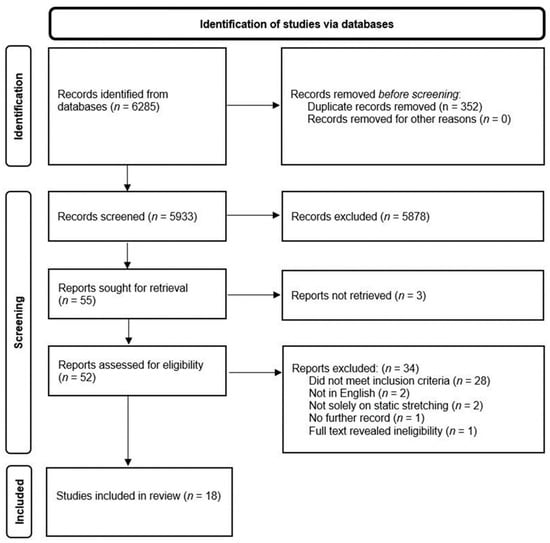
Figure 1.
The systematic process for including studies within the review.
2.4. Study Selection
Immediately following the exclusion of duplicates, study titles and abstracts were independently screened by two authors to determine relevant studies. Disagreements between the two authors screening the articles were discussed and resolved by a third author.
2.5. Data Extraction
The studies then underwent detailed analysis by the lead and last author to be included in the review. Studies with no data available, clinical trial registration, or data presented within conference proceedings were excluded from the review. The lead and last authors extracted the following information from the included studies: authors, date of publication, sample size (n), study design, participant characteristics (age, training status), stretching intervention, outcome measures (range of motion and strength) and results.
2.6. Quality Assessment
Risk of bias was assessed using the PEDro tool (https://pedro.org.au/english/resources/pedro-scale/ (1 November 2021)). The scales contain 11 items, of which 10 are scored as a Yes or No (i.e., 1 or 0). Item one, which questions eligibility criteria, identifies external validity, so it does not form the overall PEDro score. Studies with a PEDro score of 0 to 3 points were deemed “low quality”, 4 to 5 points as “moderate quality” and scores of 6 to 10 points as “high quality”.
3. Results
The database searches yielded 6285 articles of which 352 were then removed due to duplication. A subsequent 5878 articles were then excluded based on their titles and abstracts alone. The full texts of 52 articles were subsequently retrieved of which 18 studies were included in the review for meeting the inclusion criteria (Figure 1).
3.1. Studies Examining Effects of Static Stretching Intensities on Range of Motion
Sixteen studies examining static stretching intensities on range of motion are summarised in Table 1. These studies had a total of n = 316 participants, of which n = 260 were men and n = 56 were women.

Table 1.
Summary of studies included in the systematic review that investigated the effect of static stretching intensity on range of motion (ROM) outcomes.
All the studies included in the review found that static stretching increased ROM. However, eight studies demonstrated that higher intensity static stretching elicited greater changes in ROM [19,26,29,30,31,32,37,41] and the other eight studies demonstrated there was no benefit of higher intensity stretching to increase ROM [27,33,34,35,36,38,39,40].
The studies used a variety of different static stretching protocols, this included a percentage of pre-intervention ROM [37]; NRS [27]; verbal rating scale [36,41]; stretching to a point of discomfort and an added percentage past this point [19,26,32,33,35,38,39]; stretching at and past a ROM without pain [31], a percentage of the maximum passive resistive torque [34] and a percentage of maximum tolerated stretch torque without pain [30]. One study examined the cross-education effect of stretching on the dominant leg and then observed effects on the non-dominant leg [41].
3.2. Studies Examining the Effects of Static Stretching Intensities on Strength
Four studies examined the effects of static stretching intensities on strength and are summarised in Table 2 [19,24,25,26]. This had a total sample of n = 83 participants, with n = 70 men and n = 13 women. Two of the four studies demonstrated that high-intensity static stretching decreased strength more than lower intensity stretching [19,24]. Two studies measured both ROM and strength outcomes, therefore they appear in both Table 1 and Table 2.
Table 2.
Summary of studies included in the systematic review that investigated the effect of static stretching intensity on strength.
The studies demonstrated these findings in the hamstrings and quadriceps on an isokinetic dynamometer and stretched to 80, 100 and 120% of pre-intervention ROM [19] as well as up to 7/10 and 10/10 on a visual analogue scale [24]. One study measured the effects of different stretching intensities on strength immediately post eccentric muscle damage, with low-intensity stretching more beneficial in strength recovery than high-intensity stretching [25]. The last study compared stretching to 120% point of discomfort and the maximum point of discomfort and identified no change in peak torque; however, the angle at which this occurred was larger following the higher intensity of stretching [26].
3.3. Bias Assessment
The PEDro scores indicated that of the 18 studies included in this review, 15 studies were scored as high quality, three studies as moderate quality and zero studies as low quality (Table 3).
Table 3.
PEDro scale scores of studies included within the systematic review.
4. Discussion
This systematic review found that static stretching increases ROM, but it is inconclusive on whether high-intensity stretching leads to greater changes. Furthermore, the influence of static stretching intensity on strength outcomes are unclear. In this review, 18 studies were included. Of the 18 studies, 16 studies examined effects on ROM and four studies examining a strength outcome. Two studies measured both ROM and strength, therefore they were included in both sets of results in Table 1 and Table 2.
4.1. Static Stretching Intensity Effects on ROM
This review examined outcomes from fourteen studies on the effects of different static stretching intensities on ROM, all of which observed an increase in ROM, regardless of the intensity used. Eight of the studies within this review demonstrated that higher intensity static stretching resulted in larger increases in ROM [19,26,29,30,31,32,37,41], the other eight studies found that there was no difference in the magnitude of change across differing intensities of stretching [27,33,34,35,36,38,39,40].
Acute increases in ROM after stretching are attributed to an increase in tolerance to the stretch [42], a decrease in MTU stiffness [43], alterations in musculotendinous visco-elasticity [19] and reflex activity [44]. All the studies within this review observed that ROM increased after static stretching, but only eight studies observed a greater increase in ROM from high-intensity static stretching versus lower intensity stretching. The results demonstrating greater ROM changes following higher intensity stretching may have resulted from of a decrease in H-reflex activity, which has been observed to decrease during a static stretch [45]. Furthermore, the decrease in reflex activity is proportional to the intensity of the stretch [46,47], so a higher stretch intensity could lead to a greater decrease in reflex activity and in turn increase ROM more.
Within the results of this review, there is heterogeneity in the methods and the outcomes. This is a result of the different methods used to define the threshold. For example, studies instruct participants to identify the “point before discomfort”, “point of mild discomfort”, “point of discomfort” and “point of pain onset”. In turn, to assist in future comparisons of studies, it would help if studies identified absolute (i.e., degree) and relative changes from a standardised non-stretching reference point. Future research can compare outcomes of stretching intensity based upon comparison to a reference point and include the total change in degrees from this point. In addition, humans can perceive and rank sensation from mechanical stimuli [48,49], therefore blinding of participants to experimental conditions is difficult and in turn, influences the bias assessment of this review as no studies scored in item five of the PEDro scale (blinding of subjects). Furthermore, as the stretching is delivered by an investigator, often using an isokinetic dynamometer which they operate, investigators will also not be blinded, with all studies also scoring zero on item six of the PEDro scale (blinding of researchers). All the studies scored for random allocation to study conditions; however, there was inadequate information provided by the studies on the process of participant randomisation to the study conditions. Therefore, future studies should use unblinded operators and then blinded data analysts. There is also scope for undertaking studies examining stretching intensity with participant deception to the intensity being used to prevent participants’ preconceived conceptions of pain or discomfort.
Other differences may have resulted from the muscle group used. For example, some studies stretched the hamstring group within their experiment [19,26,27,29,30,31,33,35,36,38,39], the plantor flexors [32,34,41] or the quadriceps group [37,40]. As such, there are differences in contractile and non-contractile structures crossing the joint that will influence fascial length, pennation angle and elastic properties following different intensities of stretching. For example, the hamstrings muscle group comprises biarticular muscles, however the quadriceps muscle group comprises monoarticular (vastus lateralis, vastus medialis and vastus intermedialis) and biarticular muscles (rectus femoris). This might explain the differences, as Nakamura et al. [37] examined the effect of static stretching at 120, 100 and 80% ROM on the shear elastic modulus (i.e., stiffness) of the vastus lateralis, vastus medialis and rectus femoris and identified a decrease in the rectus femoris but no changes in the other muscles of the quadriceps group.
A lot of the studies are also cross over designs, whereby participants undertake both a high- and low-intensity condition. Therefore, the reliability of sensation of stretch and pain could influence the results. This is especially true as temperature [50], muscle damage [51], age [52], and menstrual hormonal effects (i.e., menstrual cycle) [53] are associated with reduced ROM and flexibility. There are some data demonstrating good reliability on intensity of stretching sensation and ROM [54]; however, this needs further examination over multiple visits to determine the reliability of perception of stretching intensity, especially at a range of intensities and ranges of motion. Furthermore, women only made up 17.7% of the total sample of participants included in this review on ROM. Therefore, with the known effects of the menstrual cycle effects on ROM [53], future research must examine the effects of static stretching intensity in women.
Based upon the findings from this review, it can be concluded that static stretching increases ROM. A higher intensity of stretching may increase ROM more so than lower intensity stretching; however, this is not consistent, and this review demonstrated no specific threshold for stretching intensity to induce greater changes.
4.2. Static Stretching Intensity Effects on Strength
Four studies examined the effect of stretching intensity on a strength outcome and were included in the review. Two of the four studies demonstrated that high-intensity static stretching decreased strength more than lower intensity stretching [19,24]. Similar to the results on ROM, a variety of muscles, including the hamstrings and quadriceps, were examined. As there were few results on this topic it is impossible to draw conclusions on the outcomes of stretching intensity on the effects of muscle to be able to produce force, and this is needed for future research.
Underlying mechanisms that attribute loss of maximal strength following static stretching includes increased compliance of the MTU that lowers MTU stiffness [22,54] and lower motor unit activation [55]. There are also suggestions that the duration of static stretching is an important factor for inducing acute strength loss [56]. Within this review, Takeuchi and Nakamura [26] used a single bout of 20 s of stretching and observed no effect in peak torque following all the stretching intensities. However, Rodrigues et al. [24] and Kataura et al. [19] used two sets of 30 s with a 30 s interval and 180 s of stretching, respectively, with both observing a decrease. Due to the limited number of studies, further research should be conducted examining the relationship between the duration of stretching, alongside the intensity of the stretching to identify which variable is more important for a subsequent strength decrease.
4.3. Strengths, Limitations, and Future Directions
To the authors’ knowledge, this is the first review to systematically review the effects of stretching intensity on ROM and strength. A further strength to this review is the inclusion of all studies without restricting sex, training status, muscles stretched, method of static stretching intensity and year. Despite the methods of this study, the authors recognise several limitations to this study. Firstly, there are a low number of studies examining the effects of static stretching intensity on ROM and strength. This likely reflects that this as a new topic of investigation as the oldest study included within this review was published in 2015. A meta-analysis was also not possible due to the inconsistencies in reporting a change in ROM (i.e., percentage change or degrees).
A key consideration of interpreting the results from this review is that many of the studies included have low ecological validity due to stretching on an isokinetic dynamometer. While available in specialist rehabilitation settings, the availability and access are limited for the majority of athletic populations. Therefore, stretching will typically be undertaken in static, dynamic and assisted formats with basic equipment. Isokinetic dynamometers will give detailed analysis of force and range of motion, measured at a high frequency (i.e., Hz) but this is against a loss in applicability to applied settings implementing strength and conditioning programmes.
5. Conclusions
In conclusion, static stretching increases range of motion, but it is not clear if higher intensity stretching leads to larger increases in range of motion. For strength, the effect of stretching intensity is also unclear due to the limited amount of research. There are various methods used to measure the intensity of stretching and these are not directly comparable without reference to a standard starting point.
Author Contributions
Conceptualization, J.B., D.J.C., D.M.P. and M.D.C.; methodology, J.B., D.J.C., D.M.P. and M.D.C.; formal analysis, J.B., D.J.C. and M.D.C.; data curation, J.B. and M.D.C.; writing—original draft preparation, J.B.; writing—review and editing, M.D.C.; supervision, D.J.C., D.M.P. and M.D.C. All authors have read and agreed to the published version of the manuscript.
Funding
This research received no external funding.
Institutional Review Board Statement
The study was approved by the College of Business, Psychology and Sport Research Ethics Panel (Reference: CBPS21220019) and performed at the University of Worcester, UK.
Informed Consent Statement
Not applicable.
Data Availability Statement
No new data was produced from this investigation.
Conflicts of Interest
The authors declare no conflict of interest.
References
- Magnusson, S.P.; Simonsen, E.B.; Aagaard, P.; Gleim, G.W.; McHugh, M.P.; Kjaer, M. Viscoelastic response to repeated static stretching in the human hamstring muscle. Scand. J. Med. Sci. Sport. 1995, 5, 342–347. [Google Scholar] [CrossRef]
- Behm, D.G.; Blazevich, A.J.; Kay, A.D.; McHugh, M. Acute effects of muscle stretching on physical performance, range of motion, and injury incidence in healthy active individuals: A systematic review. Appl. Physiol. Nutr. Metab. 2016, 41, 1–11. [Google Scholar] [CrossRef] [PubMed]
- Young, W.B. The use of static stretching in warm-up for training and competition. Int. J. Sport. Physiol. 2017, 2, 212–216. [Google Scholar] [CrossRef] [PubMed]
- Behm, D.G.; Chaouachi, A. A review of the acute effects of static and dynamic stretching on performance. Eur. J. Appl. Physiol. 2011, 111, 2633–2651 doiorg/101007/s00421. [Google Scholar] [CrossRef]
- Magnusson, P.; Renstrom, P. The European College of Sports Sciences Position Statement: The role of stretching exercises in sports. Eur. J. Sport. Sci. 2006, 6, 87–91. [Google Scholar] [CrossRef]
- Garber, C.E.; Blissmer, B.; Deschenes, M.R.; Franklin, B.A.; Lamonte, M.J.; Lee, I.M.; Nieman, D.C.; Swain, D.P.; American College of Sports Medicine. American College of Sports Medicine position stand. Quantity and quality of exercise for developing and maintaining cardiorespiratory, musculoskeletal, and neuromotor fitness in apparently healthy adults: Guidance for prescribing exercise. Med. Sci. Sport. Exerc. 2011, 43, 1334–1359. [Google Scholar] [CrossRef] [PubMed]
- Ebben, W.P.; Hintz, M.J.; Simenz, C.J. Strength and conditioning practices of Major League Baseball strength and conditioning coaches. J. Strength Cond. Res. 2005, 19, 538–546. [Google Scholar] [CrossRef]
- Judge, L.W.; Bellar, D.M.; Gilreath, E.L.; Petersen, J.C.; Craig, B.W.; Popp, J.K.; Hindawi, O.S.; Simon, L.S. An examination of preactivity and postactivity stretching practices of NCAA division I, NCAA division II, and NCAA division III track and field throws programs. J. Strength Cond. Res. 2013, 27, 2691–2699. [Google Scholar] [CrossRef]
- Judge, L.W.; Petersen, J.C.; Bellar, D.M.; Craig, B.W.; Wanless, E.A.; Benner, M.; Simon, L.S. An examination of preactivity and postactivity stretching practices of crosscountry and track and field distance coaches. J. Strength Cond. Res. 2013, 27, 2456–2464. [Google Scholar] [CrossRef]
- Popp, J.K.; Bellar, D.M.; Hoover, D.L.; Craig, B.W.; Leitzelar, B.N.; Wanless, E.A.; Judge, L.W. Pre- and Post-Activity Stretching Practices of Collegiate Athletic Trainers in the United States. J. Strength Cond. Res. 2017, 31, 2347–2354. [Google Scholar] [CrossRef]
- Witvrouw, E.; Danneels, L.; Asselman, P.; D’Have, T.; Cambier, D. Muscle flexibility as a risk factor for developing muscle injuries in male professional soccer players. A prospective study. Am. J. Sport. Med. 2003, 31, 41–46. [Google Scholar] [CrossRef]
- Watsford, M.L.; Murphy, A.J.; McLachlan, K.A.; Bryant, A.L.; Cameron, M.L.; Crossley, K.M.; Makdissi, M. A prospective study of the relationship between lower body stiffness and hamstring injury in professional Australian rules footballers. Am. J. Sport. Med. 2010, 38, 2058–2064. [Google Scholar] [CrossRef]
- Lorimer, A.V.; Hume, P.A. Stiffness as a risk factor for achilles tendon injury in running athletes. Sport. Med. 2016, 46, 1921–1938. [Google Scholar] [CrossRef]
- Marschall, F. Wie beinflussen unterschiedliche Dehnintensitaten kurzfristig die Veranderung der Bewegungsreichweite? (Effects of different stretch-intensity on the acute change of range of motion). Dtsch. Z. Sportmed. 1999, 50, 5–9. [Google Scholar]
- Wyon, M.; Felton, L.; Galloway, S. A comparison of 2 stretching modalities on lower-limb range of motion measurements in recreational dancers. J. Strength Cond. Res. 2009, 23, 2144–2148. [Google Scholar] [CrossRef] [PubMed]
- Jacobs, C.A.; Sciascia, A.D. Factors that influence the efficacy of stretching programs for patients with hypomobility. Sport. Health 2011, 3, 520–523. [Google Scholar] [CrossRef]
- Freitas, S.R.; Vaz, J.R.; Gomes, L.; Silvestre, R.; Hilário, E.; Cordeiro, N.; Carnide, F.; Pezarat-Correia, P.; Mil-Homens, P. A New Tool to Assess the Perception of Stretching Intensity. J. Strength Cond. Res. 2015, 29, 2666–2678. [Google Scholar] [CrossRef]
- Anderson, B.; Anderson, J. The Complete Book of Stretching; Shelter Publications Inc.: Bolinas, CA, USA, 1980. [Google Scholar]
- Kataura, S.; Suzuki, S.; Matsuo, S.; Hatano, G.; Iwata, M.; Yokoi, K.; Tsuchida, W.; Banno, Y.; Asai, Y. Acute Effects of the Different Intensity of Static Stretching on Flexibility and Isometric Muscle Force. J. Strength Cond. Res. 2017, 31, 3403–3410. [Google Scholar] [CrossRef]
- Behm, D.G.; Button, D.C.; Butt, J.C. Factors affecting force loss with prolonged stretching. Can. J. Appl. Physiol. 2001, 26, 262–272. [Google Scholar] [CrossRef]
- Kay, A.D.; Blazevich, A.J. Reductions in active plantarflexor moment are significantly correlated with static stretch duration. Eur. J. Sport. Sci. 2008, 8, 41–46. [Google Scholar] [CrossRef]
- Rubini, E.C.; Costa, A.L.; Gomes, P.S. The effects of stretching on strength performance. Sport. Med. 2007, 37, 213–224. [Google Scholar] [CrossRef]
- Trajano, G.S.; Seitz, L.; Nosaka, K.; Blazevich, A.J. Contribution of central vs. peripheral factors to the force loss induced by passive stretch of the human plantar flexors. J. Appl. Physiol. 2013, 115, 212–218. [Google Scholar] [CrossRef] [PubMed]
- Rodrigues, P.; Hernandez, S.G.; Salgueirosa, F.D.; Novack, L.F.; Wassmansdorf, R.; Wharton, L.; Osiecki, R. The influence of two static stretching protocols with different intensities on concentric knee extension strength. Isokinet. Exerc. Sci. 2017, 25, 41–46. [Google Scholar] [CrossRef]
- Apostolopoulos, N.C.; Lahart, I.M.; Plyley, M.J.; Taunton, J.; Nevill, A.M.; Koutedakis, Y.; Wyon, M.; Metsios, G.S. The effects of different passive static stretching intensities on recovery from unaccustomed eccentric exercise—A randomized controlled trial. Appl. Physiol. Nutr. Metab. 2018, 43, 806–815. [Google Scholar] [CrossRef] [PubMed]
- Takeuchi, K.; Nakamura, M. Influence of High Intensity 20-Second Static Stretching on the Flexibility and Strength of Hamstrings. J. Sport. Sci. Med. 2020, 19, 429–435. [Google Scholar]
- Santos, C.X.; Beltrão, N.B.; Pirauá, A.L.T.; Durigan, J.L.Q.; Behm, D.; de Araújo, R.C. Static Stretching Intensity Does Not Influence Acute Range of Motion, Passive Torque, and Muscle Architecture. J. Sport. Rehabil. 2020, 29, 1–6. [Google Scholar] [CrossRef]
- Page, M.J.; McKenzie, J.E.; Bossuyt, P.M.; Boutron, I.; Hoffmann, T.C.; Mulrow, C.D.; Shamseer, L.; Tetzlaff, J.M.; Akl, E.A.; Brennan, S.E.; et al. The PRISMA 2020 statement: An updated guideline for reporting systematic reviews. BMJ 2021, 372, n71. [Google Scholar] [CrossRef]
- Freitas, S.R.; Vaz, J.R.; Bruno, P.M.; Andrade, R.; Mil-Homens, P. Stretching Effects: High-intensity & Moderate-duration vs. Low-intensity & Long-duration. Int. J. Sport. Med. 2016, 37, 239–244. [Google Scholar] [CrossRef]
- Freitas, S.R.; Vilarinho, D.; Vaz, J.R.; Bruno, P.M.; Costa, P.B.; Mil-homens, P. Responses to static stretching are dependent on stretch intensity and duration. Clin. Physiol. Funct. Imaging 2015, 35, 478–484. [Google Scholar] [CrossRef]
- Fukaya, T.; Matsuo, S.; Iwata, M.; Yamanaka, E.; Tsuchida, W.; Asai, Y.; Suzuki, S. Acute and chronic effects of static stretching at 100% versus 120% intensity on flexibility. Eur. J. Appl. Physiol. 2021, 121, 513–523. [Google Scholar] [CrossRef] [PubMed]
- Fukaya, T.; Kiyono, R.; Sato, S.; Yahata, K.; Yasaka, K.; Onuma, R.; Nakamura, M. Effects of Static Stretching with High-Intensity and Short-Duration or Low-Intensity and Long-Duration on Range of Motion and Muscle Stiffness. Front. Physiol. 2020, 20, 601912. [Google Scholar] [CrossRef] [PubMed]
- Muanjai, P.; Jones, D.A.; Mickevicius, M.; Satkunskiene, D.; Snieckus, A.; Skurvydas, A.; Kamandulis, S. The acute benefits and risks of passive stretching to the point of pain. Eur. J. Appl. Physiol. 2017, 117, 1217–1226. [Google Scholar] [CrossRef] [PubMed]
- Oba, K.; Samukawa, M.; Nakamura, K.; Mikami, K.; Suzumori, Y.; Ishida, Y.; Keeler, N.; Saitoh, H.; Yamanaka, M.; Tohyama, H. Influence of Constant Torque Stretching at Different Stretching Intensities on Flexibility and Mechanical Properties of Plantar Flexors. J. Strength Cond. Res. 2021, 35, 709–714. [Google Scholar] [CrossRef] [PubMed]
- Marchetti, P.H.; Miyatake, M.M.S.; Magalhaes, R.A.; Gomes, W.A.; Da Silva, J.J.; Brigatto, F.A.; Zanini, T.C.C.; Behm, D.G. Different volumes and intensities of static stretching affect the range of motion and muscle force output in well-trained subjects. Sport. Biomech. 2022, 21, 155–164. [Google Scholar] [CrossRef]
- Melo, R.; Cerqueira, M.S.; Barbosa, G.M.; Laurentino, A.; França, I.M.; Souza, T.O.; Vieira, W.H. Static Stretching at Pain-Tolerated Intensity Is Not Necessary to Increase Knee Range of Motion in Amateur Soccer Players: A Randomized Trial. Muscles Ligaments Tendons J. 2021, 11, 536. [Google Scholar] [CrossRef]
- Nakamura, M.; Sato, S.; Murakami, Y.; Kiyono, R.; Yahata, K.; Sanuki, F.; Yoshida, R.; Fukaya, T.; Takeuchi, K. The Comparison of Different Stretching Intensities on the Range of Motion and Muscle Stiffness of the Quadriceps Muscles. Front. Physiol. 2021, 11, 628870. [Google Scholar] [CrossRef] [PubMed]
- Takeuchi, K.; Akizuki, K.; Nakamura, M. Association between static stretching load and changes in the flexibility of the hamstrings. Sci. Rep. 2021, 11, 21778. [Google Scholar] [CrossRef]
- Takeuchi, K.; Akizuki, K.; Nakamura, M. Time course of changes in the range of motion and muscle-tendon unit stiffness of the hamstrings after two different intensities of static stretching. PLoS ONE 2021, 16, e0257367. [Google Scholar] [CrossRef]
- Takeuchi, K.; Sato, S.; Kiyono, R.; Yahata, K.; Murakami, Y.; Sanuki, F.; Yoshida, R.; Nakamura, M. High-Intensity Static Stretching in Quadriceps Is Affected More by Its Intensity than Its Duration. Front. Physiol. 2021, 12, 709655. [Google Scholar] [CrossRef]
- Nakamura, M.; Yoshida, R.; Sato, S.; Yahata, K.; Murakami, Y.; Kasahara, K.; Fukaya, T.; Takeuchi, K.; Nunes, J.P.; Konrad, A. Cross-education effect of 4-week high- or low-intensity static stretching intervention programs on passive properties of plantar flexors. J. Biomech. 2022, 133, 110958. [Google Scholar] [CrossRef]
- Brusco, C.M.; Blazevich, A.J.; Pinto, R.S. The effects of 6 weeks of constant-angle muscle stretching training on flexibility and muscle function in men with limited hamstrings’ flexibility. Eur. J. Appl. Physiol. 2019, 119, 1691–1700. [Google Scholar] [CrossRef] [PubMed]
- Mizuno, T. Changes in joint range of motion and muscle–tendon unit stiffness after varying amounts of dynamic stretching. J. Sport. 2017, 35, 2157–2163. [Google Scholar] [CrossRef] [PubMed]
- Guissard, N.; Duchateau, J. Effect of static stretch training on neural and mechanical properties of the human plantar-flexor muscles. Muscle Nerve 2004, 29, 248–255. [Google Scholar] [CrossRef] [PubMed]
- Masugi, Y.; Obata, H.; Inoue, D.; Kawashima, N.; Nakazawa, K. Neural effects of muscle stretching on the spinal reflexes in multiple lower-limb muscles. PLoS ONE 2017, 12, e0180275. [Google Scholar] [CrossRef] [PubMed]
- Budini, F.; Christova, M.; Gallasch, E.; Rafolt, D.; Tilp, M. Soleus H-reflex inhibition decreases during 30 s static stretching of plantar flexors, showing two recovery steps. Front. Physiol. 2008, 9, 935. [Google Scholar] [CrossRef]
- Budini, F.; Tilp, M. Changes in H-reflex amplitude to muscle stretch and lengthening in humans. Rev. Neurosci. 2016, 27, 511–522. [Google Scholar] [CrossRef]
- Borg, G. Borg’s Perceived Exertion and Pain Scales, 1st ed.; Human Kinetics: Champaign, IL, USA, 1998. [Google Scholar]
- Sharman, M.; Cresswell, A.; Riek, S. Proprioceptive neuromuscular facilitation stretching: Mechanisms and clinical implications. Sport. Med. 2006, 36, 929–939. [Google Scholar] [CrossRef] [PubMed]
- Whelan, K.M.; Gass, E.M.; Moran, C.C. Warm up: Efficacy of a program designed for downhill skiing. Aust. J. Physiother. 1999, 45, 279–288. [Google Scholar] [CrossRef]
- Clarkson, P.M.; Nosaka, K.; Braun, B. Muscle function after exercise-induced muscle damage and rapid adaptation. Med. Sci. Sport. Exerc. 1992, 24, 512–520. [Google Scholar] [CrossRef]
- Eston, R.; Byrne, C.; Twist, C. Muscle function after exercise-induced muscle damage: Considerations for athletic performance in children and adults. J. Exerc. Sci. Fit. 2003, 1, 85–96. [Google Scholar]
- Miyazaki, M.; Maeda, S. Changes in hamstring flexibility and muscle strength during the menstrual cycle in healthy young females. J. Phys. Ther. Sci. 2022, 34, 92–98. [Google Scholar] [CrossRef] [PubMed]
- Avela, J.; Kyrolainen, H.; Komi, P.V. Altered reflex sensitivity after repeated and prolonged passive muscle stretching. J. Appl. Physiol. 1999, 86, 1283–1291. [Google Scholar] [CrossRef] [PubMed]
- Trajano, G.S.; Seitz, L.B.; Nosaka, K.; Blazevich, A.J. Can passive stretch inhibit motoneuron facilitation in the human plantar flexors? J. Appl. Physiol. 2014, 117, 1486–1492. [Google Scholar] [CrossRef] [PubMed]
- Kay, A.D.; Blazevich, A.J. Effect of acute static stretch on maximal muscle performance: A systematic review. Med. Sci. Sport. Exer. 2012, 44, 154–164. [Google Scholar] [CrossRef]
Disclaimer/Publisher’s Note: The statements, opinions and data contained in all publications are solely those of the individual author(s) and contributor(s) and not of MDPI and/or the editor(s). MDPI and/or the editor(s) disclaim responsibility for any injury to people or property resulting from any ideas, methods, instructions or products referred to in the content. |
© 2023 by the authors. Licensee MDPI, Basel, Switzerland. This article is an open access article distributed under the terms and conditions of the Creative Commons Attribution (CC BY) license (https://creativecommons.org/licenses/by/4.0/).