
Electron Correlation and High-Temperature Superconductivity


Abstract
1. Introduction
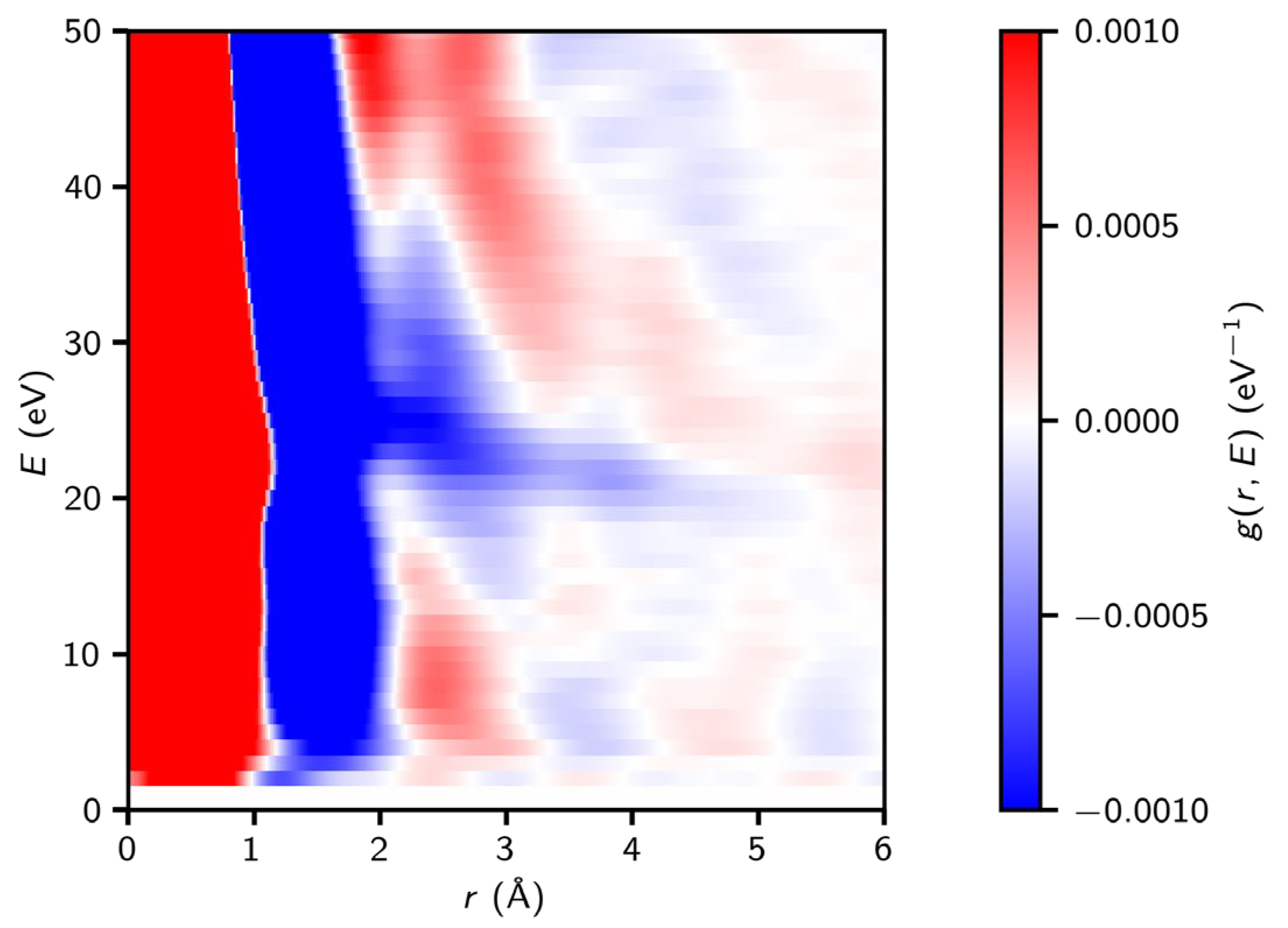
2. Direct Observation of Dynamic Electron Correlation
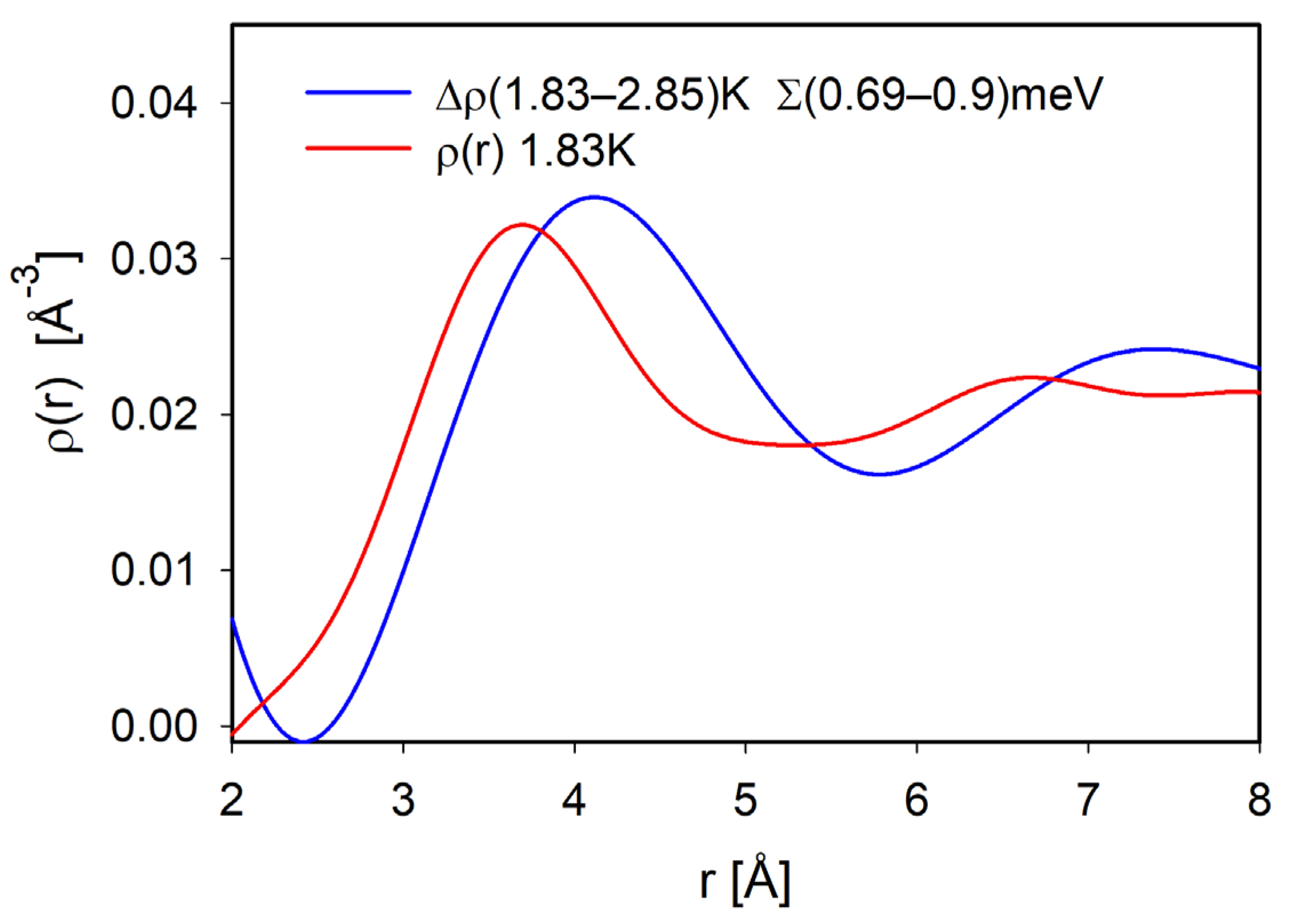
3. Bose–Einstein Condensation in 4He
4. Lattice Effects in the Cuprates
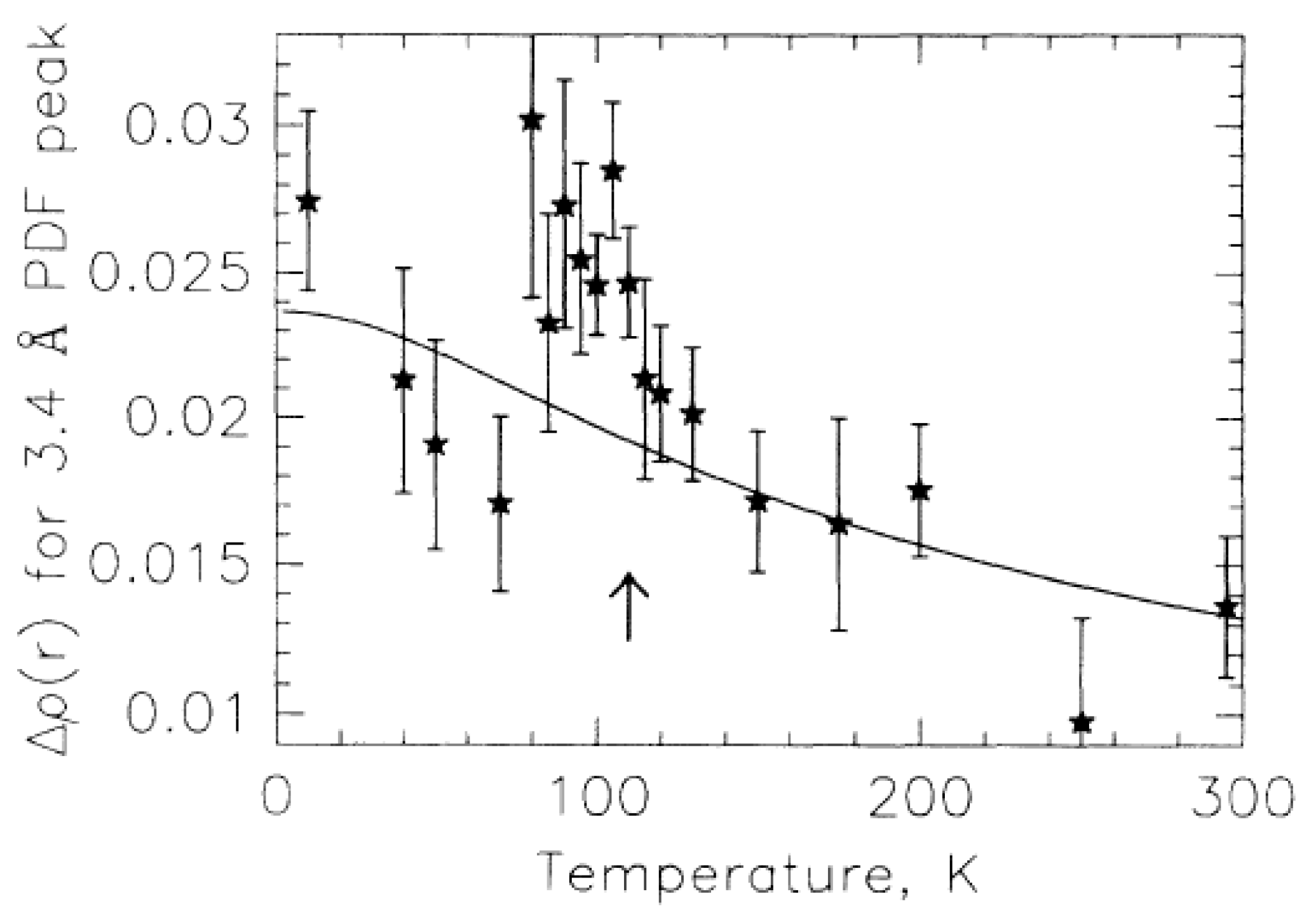
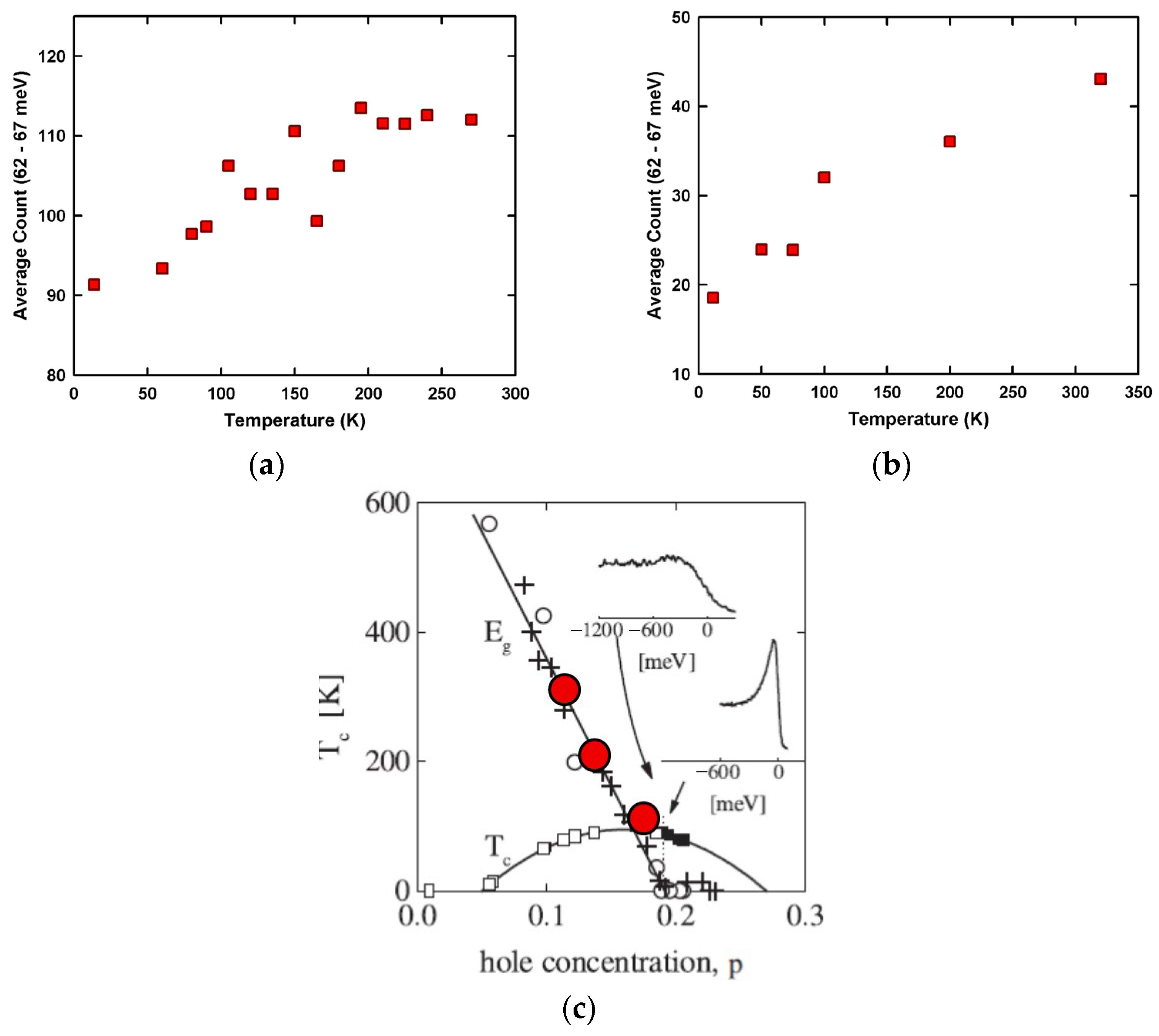
4.1. Lattice Effects at Tc
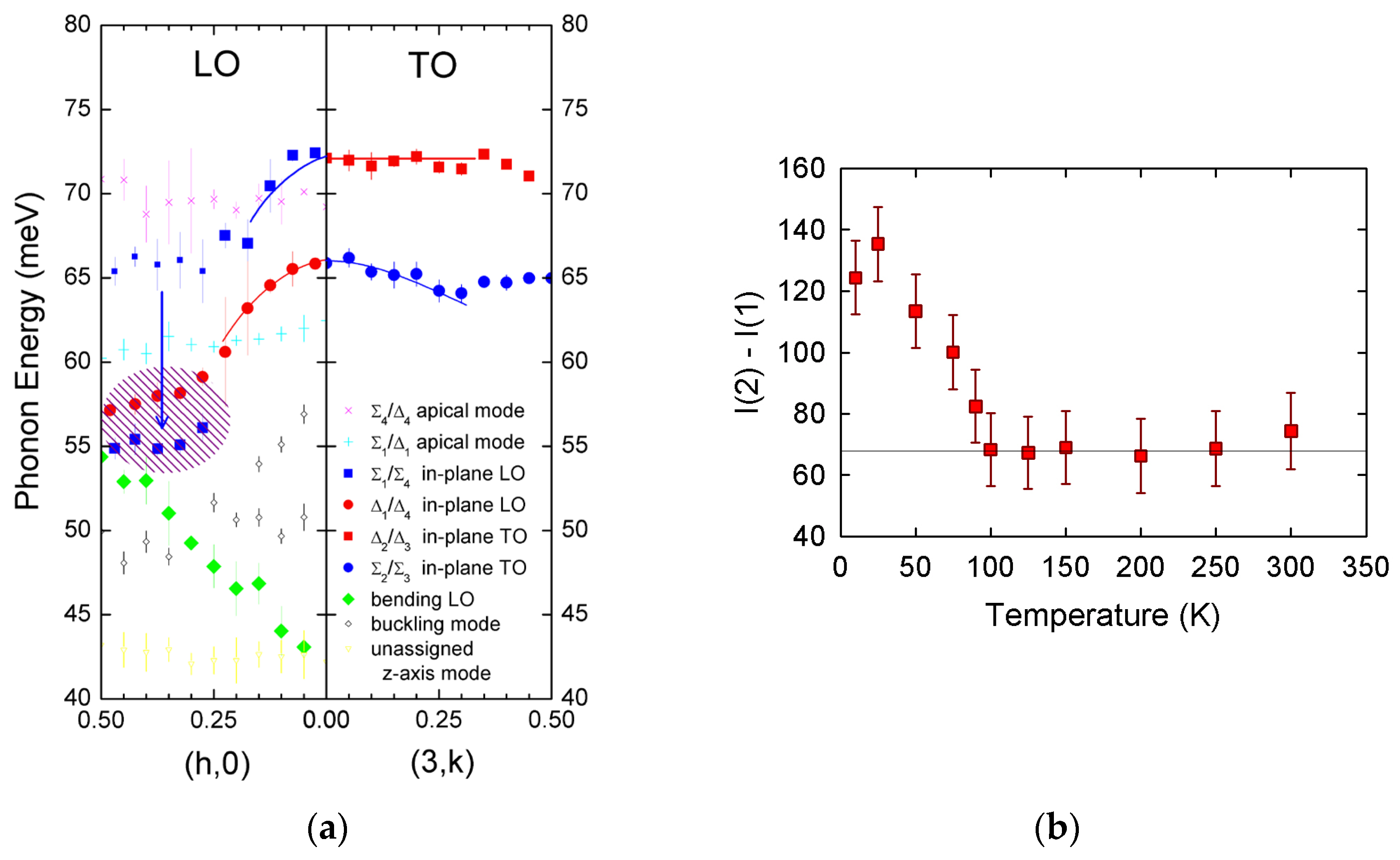
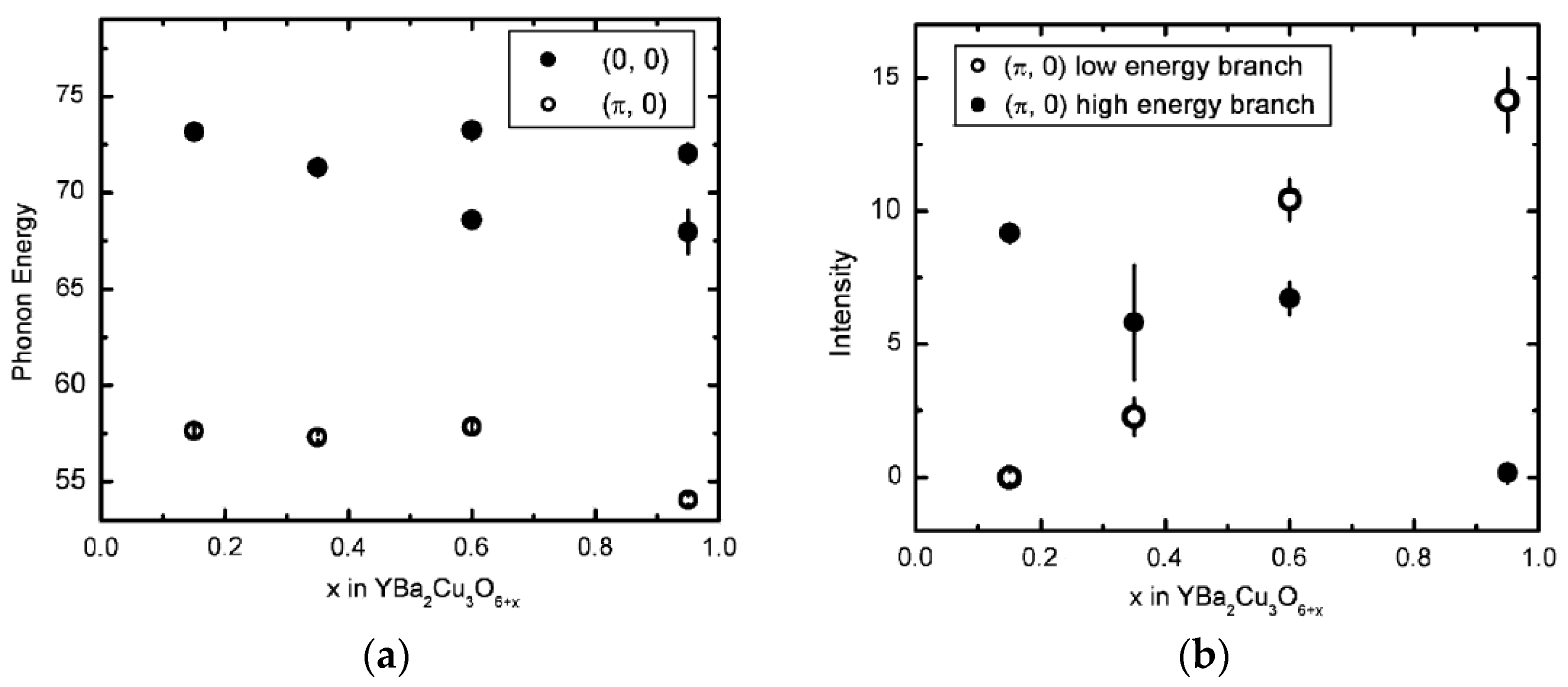
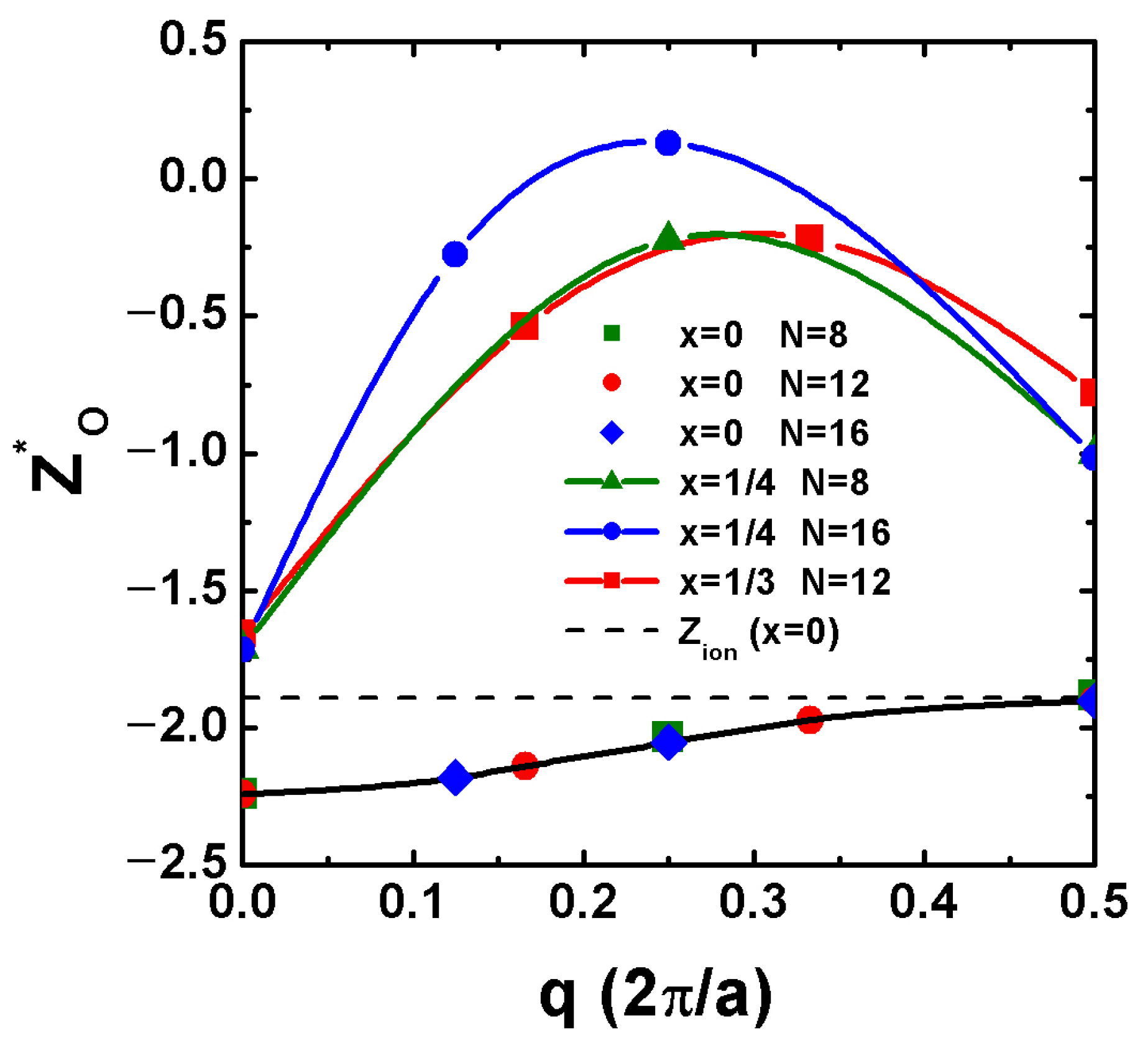
4.2. Phonon Anomalies
5. Electron Correlation and High-Temperature Superconductivity
6. Conclusions
Funding
Data Availability Statement
Acknowledgments
Conflicts of Interest
References
- Bednorz, J.G.; Müller, K.A. Possible High Tc Superconductivity in the Ba-La-Cu-O System. Z. Für Phys. B Condens. Matter. 1986, 64, 189–193. [Google Scholar]
- Matthias, B.T.; Geballe, T.H.; Compton, V.B. Superconductivity. Rev. Mod. Phys. 1963, 35, 414. [Google Scholar] [CrossRef]
- Schrieffer, J.R. Theory of Superconductivity; Benjamin: New York, NY, USA, 1964. [Google Scholar]
- Pickett, W.E. Electronic structure of the high-temperature oxide superconductors. Rev. Mod. Phys. 1989, 61, 433–512. [Google Scholar] [CrossRef]
- Kresin, V.Z.; Morawitz, H.; Wolf, S.A. Mechanism of Conventional and High Tc Superconductivity; Oxford University Press: New York, NY, USA; Oxford, UK, 1993. [Google Scholar]
- Anderson, P.W. The resonating valence bond state in La2CuO4 and superconductivity. Science 1987, 235, 1196–1198. [Google Scholar] [CrossRef]
- Anderson, P.W. The Theory of Superconductivity in the High-Tc Cuprates; Princeton University Press: Princeton, NJ, USA, 1997. [Google Scholar]
- Bar-Yam, Y.; Egami, T.; Mustre-de Leon, J.; Bishop, A.R. Lattice Effects in High-Tc Superconductors; World Scientific: Singapore, 1992. [Google Scholar]
- Mihailovic, D.; Ruani, G.; Kaldis, E.; Müller, K.A. Anharmonic Properties of High-Tc Cuprates; World Scientific: Singapore, 1994. [Google Scholar]
- Pintschovius, L.; Reichardt, W. Inelastic neutron scattering studies of the lattice vibrations of high Tc compounds. In Physical Properties of High Temperature Superconductors IV; Ginsberg, D.M., Ed.; World Scientific: Singapore, 1994; pp. 295–374. [Google Scholar]
- Egami, T.; Billinge, S.J.L. Lattice effects in high-TC superconductors. In Physical Properties of High Temperature Superconductors V; Ginsberg, D.M., Ed.; World Scientific: Singapore, 1996; pp. 265–373. [Google Scholar]
- Bianconi, A.; Saini, N.L. Stripes and Related Phenomena; Kluwar Academic/Plenum Publishers: New York, NY, USA, 2000. [Google Scholar]
- Oyanagi, H.; Bianconi, A. Physics in Local Lattice Distortions; AIP: New York, NY, USA, 2001; Volume 554. [Google Scholar]
- Bishop, A.R.; Shenoy, S.R.; Sridhar, S. Intrinsic Multiscale Structure and Dynamics in Complex Electronic Oxides; World Scientific: Singapore, 2002. [Google Scholar]
- Egami, T. Essential role of the lattice in the mechanism of high temperature superconductivity. In High TC Superconductors and Related Transition Metal Oxides: Special Contributions in Honor of K. Alex Müller and the Occasion of His 80th Birthday; Bussmann-Holder, A., Keller, H., Eds.; Springer: Berlin/Heidelberg, Germany, 2007; pp. 103–130. [Google Scholar]
- Mihailovic, D.; Kusar, P. Lattice and magnetic excitations in relation to pairing and the formation of Jahn-Teller polarons in cuprates. In High TC Superconductors and Related Transition Metal Oxides: Special Contributions in Honor of K. Alex Müller and the Occasion of His 80th Birthday; Bussmann-Holder, A., Keller, H., Eds.; Springer: Berlin/Heidelberg, Germany, 2007; pp. 243–252. [Google Scholar]
- Oyanagi, H. Lattice effects in high temperature superconductors revealed by X-ray absorption spectroscopy. In High TC Superconductors and Related Transition Metal Oxides: Special Contributions in Honor of K. Alex Müller and the Occasion of His 80th Birthday; Bussmann-Holder, A., Keller, H., Eds.; Springer: Berlin/Heidelberg, Germany, 2007; pp. 253–256. [Google Scholar]
- Shengelaya, A.; Kochelaev, B.I.; Conder, K.; Keller, H. Electronic phase separation and unusual isotope effects in La2-xSrxCuO4 observed by electron paramagnetic resonance. In High TC Superconductors and Related Transition Metal Oxides: Special Contributions in Honor of K. Alex Müller and the Occasion of His 80th Birthday; Bussmann-Holder, A., Keller, H., Eds.; Springer: Berlin/Heidelberg, Germany, 2007; pp. 287–302. [Google Scholar]
- Sharma, R.P.; Rehn, L.E.; Baldo, P.M.; Liu, J.Z. Direct Evidence of Anomalous Cu-O Vibrational Modes near Tc in ErBa2Cu3O7-δ. Phys. Rev. Lett. 1989, 62, 2869–2872. [Google Scholar] [CrossRef]
- Toby, B.H.; Egami, T.; Jorgensen, J.D.; Subramanian, M.A. Observation of a local structural change at Tc for Tl2Ba2CaCu2O8 by pulsed neutron diffraction. Phys. Rev. Lett. 1990, 64, 2414–2417. [Google Scholar] [CrossRef]
- Conradson, S.D.; Raistrick, I.D.; Bishop, A.R. Axial Oxygen-Centered Lattice Instabilities and High-Temperature Superconductivity. Science 1990, 248, 1394–1398. [Google Scholar] [CrossRef]
- Mustre de Leon, J.; Conradson, S.D.; Batistic, I.; Bishop, A.R. Evidence for an Axial Oxygen-Centered Lattice Fluctuation Associated with the Superconducting Transition in YBa2Cu3O7. Phys. Rev. Lett. 1990, 65, 1675–1678. [Google Scholar] [CrossRef]
- Arai, M.; Yamada, K.; Hidaka, Y.; Itoh, S.; Bowden, Z.A.; Taylor, A.D.; Endoh, Y. Anomaly of phonon state of superconducting YBa2Cu3O7 studied by inelastic neutron scattering. Phys. Rev. Lett. 1992, 69, 359–362. [Google Scholar] [CrossRef]
- Braden, M.; Reichardt, W.; Schmidtbauer, W.; Ivanov, A.S.; Yu Rumiantsev, A. Lattice-dynamics of (Ba/K)BiO3. J. Supercond. 1995, 8, 595–598. [Google Scholar] [CrossRef]
- Homes, C.C.; Timusk, T.; Bonn, D.A.; Liang, R.; Hardy, W.N. Optical phonons polarized along the c-axis of YBa2Cu3O6+x, for x = 0.5 → 0.95. Can. J. Phys. 1995, 73, 663–675. [Google Scholar] [CrossRef]
- Bianconi, A.; Saini, N.L.; Lanzara, A.; Missori, M.; Rossetti, T.; Oyanagi, H.; Yamaguchi, H.; Oka, K.; Ito, T. Determination of the local lattice distortions in the CuO2 plane of La1.85Sr0.15CuO4. Phys. Rev. Lett. 1996, 76, 3412–3415. [Google Scholar] [CrossRef] [PubMed]
- McQueeney, R.J.; Petrov, Y.; Egami, T.; Yethiraj, M.; Shirane, G.; Endoh, Y. Anomalous dispersion of LO phonons in La1.85Sr0.15CuO4 at low temperatures. Phys. Rev. Lett. 1999, 82, 628–631. [Google Scholar] [CrossRef]
- Chung, J.-H.; Egami, T.; McQueeney, R.J.; Yethiraj, M.; Arai, M.; Yokoo, T.; Petrov, Y.; Mook, H.A.; Endoh, Y.; Tajima, S.; et al. In-plane Aanisotropy and temperature dependence of oxygen phonon modes in YBa2Cu3O6.95. Phys. Rev. B 2003, 67, 014517. [Google Scholar] [CrossRef]
- Emin, D. Formation, motion, and high-temperature superconductivity of large bipolarons. Phys. Rev. Lett. 1989, 62, 1544–1547. [Google Scholar] [CrossRef]
- Micnas, R.; Ranninger, J.; Robaszkiewicz, S. Superconductivity in narrow-band systems with local nonretarded attractive interactions. Rev. Mod. Phys. 1990, 62, 113–171. [Google Scholar] [CrossRef]
- Mott, N.F. A polaron theory of high-temperature superconductors. In Polarons and Bipolarons in High Tc Superconductors and Related Materials; Cambridge University Press: Cambridge, UK, 1995; pp. 1–10. [Google Scholar]
- Alxandrov, A.S. A bipolaron Bose liquid in high-Tc superconductors. In Polarons and Bipolarons in High Tc Superconductors and Related Materials; Cambridge University Press: Cambridge, UK, 1995; pp. 26–44. [Google Scholar]
- Ranninger, J. The polaron scenario for high-Tc superconductors. In Polarons and Bipolarons in High Tc Superconductors and Related Materials; Cambridge University Press: Cambridge, UK, 1995; pp. 67–79. [Google Scholar]
- Emin, D. Formation, phase separation and superconductivity of large bipolarons. In Polarons and Bipolarons in High Tc Superconductors and Related Materials; Cambridge University Press: Cambridge, UK, 1995; pp. 80–109. [Google Scholar]
- Tachiki, M.; Machida, M.; Egami, T. Vibronic mechanism of Hhigh-TC superconductivity. Phys. Rev. B 2003, 67, 174506. [Google Scholar] [CrossRef]
- Piekarz, P.; Egami, T. Dynamic charge transfer and spin-phonon interaction in high-TC superconductors. Phys. Rev. B 2005, 72, 054530. [Google Scholar] [CrossRef]
- Qin, M.; Chung, C.-M.; Shi, H.; Vitali, E.; Hubig, C.; Schollwöck, U.; White, S.R.; Zhang, S. Absence of Superconductivity in the Pure Two-Dimensional Hubbard Model. Phys. Rev. X 2020, 10, 031016. [Google Scholar] [CrossRef]
- Zhang, C.; Sous, J.; Reichman, D.R.; Berciu, M.; Millis, A.J.; Prokof’ev, N.V.; Svistunov, B.V. Bipolaronic High-Temperature Superconductivity. Phys. Rev. X 2023, 13, 011010. [Google Scholar] [CrossRef]
- Landau, L. Theory of Fermi Liquids. Sov. Phys. JETP 1956, 3, 920–925. [Google Scholar]
- Kohn, W.; Sham, L.J. Self-Consistent Equations Including Exchange and Correlation Effects. Phys. Rev. 1965, 140, A1133–A1138. [Google Scholar] [CrossRef]
- Hubbard, J. The Description of Collective Motions in Terms of Many-Body Perturbation Theory. Proc. R. Soc. London. Ser. A. Math. Phys. Sci. 1958, 243, 336–352. [Google Scholar] [CrossRef]
- Eisenberger, P.; Marra, W.C.; Brown, G.S. Measurement of the Static Structure Factor for Conduction Electrons with Use of Synchrotron Radiation. Phys. Rev. Lett. 1980, 45, 1439–1442. [Google Scholar] [CrossRef]
- Contini, V.; Sacchetti, F. Electron-electron correlation in beryllium and related properties. J. Phys. F Met. Phys. 1981, 11, L1–L6. [Google Scholar] [CrossRef]
- Mazzone, G.; Sacchetti, F.; Contini, V. Static structure factor and electron-electron correlations in Be. A comparison of experiment with electron-gas theory. Phys. Rev. B 1983, 28, 1772–1780. [Google Scholar] [CrossRef]
- Schülke, W. Electron Dynamics by Inelastic X-Ray Scattering; Oxford Science Publications: Oxford, UK, 2007. [Google Scholar]
- Bista, R.B.; Shinohara, Y.; Dmowski, W.; Ryu, C.W.; Kim, J.H.; Upton, M.; Gretarsson, H.; Sundermann, M.; Egami, T. Observation of real space dynamic electron correlation in beryllium. arXiv 2026, 2601.20814. [Google Scholar] [CrossRef]
- Eisenberger, P.; Platzman, P.M.; Pandy, K.C. Investigation of X-Ray Plasmon Scattering in Single-Crystal Beryllium. Phys. Rev. Lett. 1973, 31, 311–314. [Google Scholar] [CrossRef]
- Platzman, P.M.; Eisenberger, P. Presence of an Incipient Wigner Electron Lattice in Solid-State Electron Gases. Phys. Rev. Lett. 1974, 33, 152–154. [Google Scholar] [CrossRef]
- Vradis, A.; Priftis, G.D. Dynamic structure factor S(k,ω) of beryllium by x-ray inelastic scattering experiments. Phys. Rev. B 1985, 32, 3556–3561. [Google Scholar] [CrossRef]
- Schülke, W.; Nagasawa, H.; Mourikis, S.; Lanzki, P. Dynamic structure of electrons in Li metal: Inelastic synchrotron x-ray scattering results and interpretation beyond the random-phase approximation. Phys. Rev. B 1986, 33, 6744–6757. [Google Scholar] [CrossRef] [PubMed]
- Schülke, W.; Nagasawa, H.; Mourikis, S.; Kaprolat, A. Dynamic structure of electrons in Be metal by inelastic x-ray scattering spectroscopy. Phys. Rev. B 1989, 40, 12215–12228. [Google Scholar] [CrossRef] [PubMed]
- Platzman, P.M.; Isaacs, E.D.; Williams, H.; Zschack, P.; Ice, G.E. X-ray-scattering determination of the dynamic structure factor of Al metal. Phys. Rev. B 1992, 46, 12943–12946. [Google Scholar] [CrossRef] [PubMed]
- Schülke, W.; Schulte-Schrepping, H.; Schmitz, J.R. Dynamic structure of electrons in Al metal studied by inelastic x-ray scattering. Phys. Rev. B 1993, 47, 12426–12436. [Google Scholar] [CrossRef]
- Platzman, P.M.; Tzor, N. X-ray scattering from electron gas. Phys. Rev. 1965, 139, A410–A413. [Google Scholar] [CrossRef]
- Van Hove, L. Correlations in Space and Time and Born Approximation Scattering in Systems of Interacting Particles. Phys. Rev. 1954, 95, 249–262. [Google Scholar] [CrossRef]
- Egami, T.; Dmowski, W. Dynamic pair-density function method for neutron and X-ray inelastic scattering. Z. Krist. 2012, 227, 233–237. [Google Scholar] [CrossRef]
- Perdew, J.P.; Wang, Y. Pair distribution function and its coupling-constant average for the spin-polarized electron gas. Phys. Rev. B 1992, 46, 12947–12954. [Google Scholar] [CrossRef]
- Glyde, H.R.; Azuah, R.T.; Stirling, W.G. Condensate, momentum distribution, and final-state effects in liquid 4He. Phys. Rev. B 2000, 62, 14337–14349. [Google Scholar] [CrossRef]
- Griffin, A. Excitations in Bose-Condensed Liquids; Cambridge University Press: Cambridge, UK, 1993. [Google Scholar]
- Glyde, H. Excitations in Liquid and Solid Helium; Oxford Science Publications: Oxford, UK, 1994. [Google Scholar]
- Leggett, A.J. Quantum Liquids; Oxford University Press: Oxford, UK, 2006. [Google Scholar]
- Svensson, E.C.; Sears, V.F.; Woods, A.D.B.; Martel, P. Neutron-diffraction study of the static structure factor and pair correlations in liquid 4He. Phys. Rev. B 1980, 21, 3538–3651. [Google Scholar] [CrossRef]
- Palevsky, H.; Otnes, K.; Larsson, K.E. Excitation of rotons in helium II by cold neutrons. Phys. Rev. 1958, 112, 11–18. [Google Scholar] [CrossRef]
- Dmowski, W.; Diallo, S.O.; Lokshin, K.; Ehlers, G.; Ferré, G.; Boronat, J.; Egami, T. Observation of dynamic atom-atom correlation in liquid helium in real space. Nat. Commun. 2017, 8, 15294. [Google Scholar] [CrossRef] [PubMed]
- Egami, T. Dynamic Correlations in Disordered Systems: Implications on High-Temperature Superconductivity. Condens. Matter 2024, 9, 12. [Google Scholar] [CrossRef]
- Lou, H.; Wang, X.; Cao, Q.; Zhang, D.; Zhang, J.; Hu, T.; Mao, H.; Jiang, J.-Z. Negative expansions of interatomic distances in metallic melts. Proc. Natl. Acad. Sci. USA 2013, 110, 10068–10072. [Google Scholar] [CrossRef] [PubMed]
- Wei, S.; Stolpe, M.; Gross, O.; Evenson, Z.; Gallino, I.; Hembree, W.; Bednarcik, J.; Kruzic, J.J.; Busch, R. Linking structure to fragility in bulk metallic glass-forming liquid. Appl. Phys. Lett. 2015, 106, 181901. [Google Scholar] [CrossRef]
- Emery, V.J.; Kivelson, S.A. Importance of phase fluctuations in superconductors with small superfluid density. Nature 1995, 374, 434–437. [Google Scholar] [CrossRef]
- Dagotto, E. Complexity in strongly correlated electron systems. Science 2005, 309, 257–262. [Google Scholar] [CrossRef]
- Tranquada, J.M. Cuprate superconductors as viewed through a striped lens. Adv. Phys. 2020, 69, 437–509. [Google Scholar] [CrossRef]
- Egami, T.; Toby, B.H.; Billinge, S.J.L.; Rosenfeld, H.D.; Jorgensen, J.D.; Hinks, D.G.; Dabrowski, B.; Subramanian, M.A.; Crawford, M.K.; Farneth, W.E.; et al. Local Structural Anomaly Near Tc Observed by Pulsed Neutron Scattering. Phys. C Supercond. 1991, 185–189, 867–868. [Google Scholar] [CrossRef]
- Egami, T. Lattice Effects in Superconducting Cuprates. J. Supercond. Nov. Magn. 2006, 19, 203–211. [Google Scholar] [CrossRef]
- Uemura, Y.J. Bose-Einstein to BCS crossover picture for high-Tc cuprates. Phys. C Supercond. 1997, 282–287, 194–197. [Google Scholar] [CrossRef]
- Xu, Z.A.; Ong, N.P.; Wang, Y.; Kakeshita, T.; Uchida, S. Vortex-like excitations and the onset of superconducting phase fluctuation in underdoped La2-xSrxCuO4. Nature 2000, 406, 486–488. [Google Scholar] [CrossRef] [PubMed]
- Uemura, Y. Dynamic superconductivity responses in photoexcited optical conductivity and Nernst effect. Phys. Rev. Mat. 2019, 3, 104801. [Google Scholar] [CrossRef]
- Tallon, J.L.; Lorum, J.W. The doping dependence of T*−What is the real Tc phase diagram? Phys. C Supercond. 2001, 349, 53–68. [Google Scholar] [CrossRef]
- Zhang, F.C.; Rice, T.M. Effective Hamiltonian for the superconducting Cu oxides. Phys. Rev. B 1988, 37, 3759–3761. [Google Scholar] [CrossRef]
- Goodenough, J.B.; Zhou, J. Correlation bag and high-Tc superconductivity. Phys. Rev. B 1990, 42, 4276–4287. [Google Scholar] [CrossRef]
- Egami, T. K. Alex Müller and Superconductivity. Phys. C Supercond. Its Appl. 2023, 613, 1354345. [Google Scholar] [CrossRef]
- Reagor, D.; Ahrens, E.; Cheong, S.-W.; Migliori, A.; Fisk, Z. Large dielectric constant and massive carriers in La2CuO4. Phys. Rev. Lett. 1989, 62, 2048–2051. [Google Scholar] [CrossRef]


Disclaimer/Publisher’s Note: The statements, opinions and data contained in all publications are solely those of the individual author(s) and contributor(s) and not of MDPI and/or the editor(s). MDPI and/or the editor(s) disclaim responsibility for any injury to people or property resulting from any ideas, methods, instructions or products referred to in the content. |
© 2026 by the author. Licensee MDPI, Basel, Switzerland. This article is an open access article distributed under the terms and conditions of the Creative Commons Attribution (CC BY) license.
Share and Cite
Egami, T. Electron Correlation and High-Temperature Superconductivity. Condens. Matter 2026, 11, 4. https://doi.org/10.3390/condmat11010004
Egami T. Electron Correlation and High-Temperature Superconductivity. Condensed Matter. 2026; 11(1):4. https://doi.org/10.3390/condmat11010004
Chicago/Turabian StyleEgami, Takeshi. 2026. "Electron Correlation and High-Temperature Superconductivity" Condensed Matter 11, no. 1: 4. https://doi.org/10.3390/condmat11010004
APA StyleEgami, T. (2026). Electron Correlation and High-Temperature Superconductivity. Condensed Matter, 11(1), 4. https://doi.org/10.3390/condmat11010004