
Article

Dietary Chia Seed Oil Enhances Growth, Immunological Response, and Disease Resistance Against Aeromonas hydrophila in Common Carp (Cyprinus carpio)

1
Bayramiç Vocational School, Çanakkale Onsekiz Mart University, Canakkale 17000, Türkiye
2
Faculty of Fisheries, Muğla Sıtkı Koçman University, Muggla 48000, Türkiye
3
Faculty of Veterinary Science, Kastamonu University, Kastamonu 37100, Türkiye
4
Department of Basic Science, Faculty of Veterinary Science, Balıkesir University, Balikesir 10145, Türkiye
5
Department of Biology, Faculty of Sciences, Muğla Sıtkı Koçman University, Mugla 48000, Türkiye
*
Authors to whom correspondence should be addressed.
Fishes 2026, 11(1), 18; https://doi.org/10.3390/fishes11010018
Submission received: 2 December 2025 / Revised: 23 December 2025 / Accepted: 28 December 2025 / Published: 28 December 2025
(This article belongs to the Special Issue Advances in the Immunology of Aquatic Animals)

Abstract

This study was conducted to evaluate the effects of chia seed oil (CSO; Salvia hispanica L.) on the growth performance, haematological-biochemical parameters, immune-related gene expression, and disease resistance to Aeromonas hydrophila in common carp (Cyprinus carpio). The fish were fed diets containing 0%, 0.5%, 1%, and 2% CSO for 60 days. The results showed a significant improvement in final weight, specific growth rate (SGR), and feed conversion ratio (FCR) in fish fed diets containing 1% and 2% CSO compared to the control group. Haematocrit (Hct) and haemoglobin (Hb) levels increased in the CSO groups, while serum triglyceride and cholesterol levels decreased significantly, particularly in the 1% CSO group. The observed decrease in liver enzyme activities (AST, ALT) suggested a hepatoprotective effect of CSO. In the stress test with A. hydrophila, the highest survival rate (80%) was recorded in the 2% CSO group. Furthermore, gene expression analyses performed on spleen tissue revealed an increase in the expression of pro-inflammatory cytokines such as TNF-α, IL-1β, and IL-8 in the groups fed with CSO, particularly at the 1% level. These findings indicate that adding 1–2% CSO to carp feed promotes growth, improves lipid metabolism, strengthens immune status, and increases resistance to bacterial infection. Consequently, the use of CSO as a sustainable and functional additive to fish oil in fish feed is suggested.
Key Contribution: This study demonstrates that dietary inclusion of 1–2% chia seed oil significantly enhances growth, improves lipid metabolism, modulates immune-related gene expression, and increases the resistance of common carp to Aeromonas hydrophila infection, highlighting chia seed oil as a functional and sustainable feed additive in aquaculture.

1. Introduction

Aquaculture plays a crucial role in meeting the growing demand for animal protein, which is increasing in parallel with the rapid growth of the global population. In this sense, ensuring the sustainability of aquaculture requires improving fish growth and health using renewable feed components [1]. Fish oil is a key feed ingredient [2], but the increasing demand and its extraction from fish species used for human consumption can cause a serious bottleneck in the use of fish oil in aquaculture feeds [3]. Therefore, in recent years, research has focused on the potential of vegetable oil sources such as peanut oil, soybean oil, rapeseed oil, and linseed oil that can be used in aquatic animal feed as alternatives to fish oil [4,5,6].
Chia (Salvia hispanica L.) is an annual herbaceous plant belonging to the Lamiaceae family and a seed that has been consumed by humans for thousands of years due to its high nutritional value and comprehensive health-promoting properties [7,8]. Chia seeds are a good source of plant lipids (30–40%), vitamins, minerals, amino acids, pigments, and unsaturated fatty acids [9,10]. They also contain numerous bioactive compounds with potent antioxidant activity. Numerous therapeutic bioactive components, including natural antioxidants such as tocopherols, polyphenols, carotenoids, phospholipids, and rosmarinic acid, caffeic acid, quercetin, myricetin, and others, have been reported in CSO [11]. These compounds are thought to play a crucial role in protecting organisms against reactive oxygen species (ROS) attack by exhibiting antioxidant, immune, and antimicrobial activities [12]. Indeed, several studies have indicated that CSO contains higher levels of n-3 polyunsaturated fatty acids than flaxseed, soybean, and canola oils [13]. Furthermore, it is known that the addition of α-tocopherol (vitamin E) to fish feed improves growth performance, antioxidant and immunological responses [14]. Chia seeds are also rich in pigments, particularly carotenoids. Previous studies have reported that the inclusion of carotenoids, especially astaxanthin, in aquatic feed plays a positive role in enhancing growth performance, strengthening antioxidant-immune status, and providing disease resistance in farmed fish [15]. Medicinal plants are used as natural additives in fish feeds due to their biodegradability and safety; they are effective in reducing oxidative stress and controlling bacterial infections by increasing growth, immunity, and antioxidant capacity [16,17].
Disease control in aquaculture is an important factor affecting production success, and this control is usually achieved with antibiotics or chemotherapeutics. However, disease control achieved through chemical methods leads to pathogens developing resistance over time and also presents an undesirable situation due to residue problems [18]. Kumar-Gupta [19] reported that CSO used at a rate of 1% in feed improved the haematological and immunological responses of rohu fish (Labeo rohita) while increasing the cytokine gene expression, IL-1β, IFN-γ, TNF-α, and TLR22. In another study, a 1% CSO supplement increased growth performance and positively modulated the gut microbiota in L. rohita fry [20]. In addition, research on Nile tilapia (Oreochromis niloticus) demonstrated that dietary supplementation with chia seed powder enhanced both its nutritional quality and disease resistance [21].
To the best of our knowledge, no prior research has examined the inclusion of CSO in the diet of common carp. Hence, the present study was designed to evaluate the effects of CSO supplementation on growth performance, haematological and biochemical indices, immune-related gene expression, and resistance against Aeromonas hydrophila infection in common carp.

2. Materials and Methods

2.1. Preparation of Experimental Feed and Fatty Acid Analyses

Fish meal and soy protein were used as the primary protein sources in the experimental feed, while fish oil was used as the fat source. The feed was prepared to be isonitrogenous and isolipidic, containing 35% crude protein and 10% crude fat (Table 1). Fish meal, soybean meal, corn starch, wheat flour, and a vitamin-mineral mixture were mixed in a laboratory beaker until homogeneous. Fish oil containing chia oil was added to the mixture at ratios of 0% (CSO0), 0.5% (CSO0.5), 1% (CSO1), and 2% (CSO2), respectively. The homogenised mixture was pelletised to suit the mouth size of the fish. The pellets obtained were dried in the shade and stored at −20 °C for use in the experiments. The extracted oil from the experimental feed proximate analysis established the fatty acid profile. The sample preparation entailed combining 20 mg of oil with 1 mL of 1 N NaOH in methanol. Subsequently, the mixture was heated to 110 °C for 15 min to accelerate the transesterification process, after which 1 mL of a solution of 14% BF3 in methanol was added. Subsequently, 1 mL of n-hexane was added, and the mixture was vigorously agitated for 1 min before the addition of 3 mL of saturated sodium chloride solution. The liquid obtained post-sedimentation was employed as the sample solution. The oil samples were analysed for fatty acid composition utilising a Shimadzu GC-MS QP 2010 ULTRA instrument, produced by Shimadzu in Kyoto, Japan. The carrier gas employed in the apparatus was helium with a purity of 99.99%. The apparatus utilised an RTX-2330 capillary column of 60 m in length, 0.25 mm in diameter, and with a particle size of 0.20 μm. The column furnace temperature was established at 100 °C, the injection temperature at 250 °C, the interface temperature at 250 °C, the ion source temperature at 200 °C, the pressure at 90 kPa, and the injection volume at 1 μL. Oven temperature protocol: 5 min at 100 °C, followed by a linear ascent from 100 °C to 240 °C at a rate of 4 °C per minute, concluding with 15 min at 240 °C.

2.2. Experimental Design and Feeding of Fish

In the feeding experiment, common carp with an average weight of 27.36 ± 0.21 g were used. The fish were placed in 100 L aquariums equipped with an aeration and filtration system, with 20 fish in each aquarium. The experiment was conducted with 4 experimental groups and 3 replicates (12 aquariums in total). The fish were fed control feed (CSO0) during a 10-day adaptation period prior to the experiment. Following adaptation, each group was fed its experimental feed twice daily (09:00 h and 16:00 h) to apparent satiation for 60 days. Throughout the experimental period, the mean water temperature was 24.1 ± 0.6 °C, dissolved oxygen was 7.2 ± 0.5 mg/L, and pH was 7.5 ± 0.3. Total ammonia nitrogen remained at 0.03 ± 0.01 mg/L, and the nitrite concentration was 0.01 ± 0.004 mg/L. All water quality parameters were maintained within acceptable limits for common carp.

2.3. Growth Performance and Feed Evaluation Parameters

The growth performance and feed evaluation parameters of the fish were calculated using the following formulas based on weighing conducted at the start and end of the experiment:
Relative growth rate (RGR, %): [(Final weight − Initial weight)/Initial weight] × 100
Specific growth rate (SGR, % day−1): [ln(Final average weight) − ln(Initial average
weight)]/Experiment duration × 100
Feed conversion ratio (FCR, %): [Weight gain/Feed consumption]

2.4. Blood Sampling and Analysis

At the end of the feeding trial, blood samples were taken from 5 randomly selected fish per tank, a total 15 fish per group. The fish were anaesthetised using clove oil, a natural anaesthetic. After disinfecting the anal fin region with alcohol, blood samples (2 mL) were collected from the caudal vein using a 5 mL sterile syringe. Samples were placed in tubes containing K3EDTA for haematological analysis and in tubes without anticoagulant for biochemical analysis.

2.5. Haematological Analyses

Red blood cell count (RBC): The blood sample was taken into a red blood cell pipette, diluted 1:200 with modified Dacie’s solution, and the red blood cell count was determined using a Thoma slide (ISOLAB Laborgeräte GmbH, Wertheim, Germany).
Haematocrit (Hct): Determined using the microhaematocrit method. Capillary tubes filled with blood were centrifuged at 10,500× g for 5 min (Universal 320 R, Hettich GmbH & Co. KG, Tuttlingen, Germany), and the haematocrit percentage was read.
Haemoglobin (Hb): The cyanmethaemoglobin method was applied. A 20 µL blood sample was mixed with 4 mL Drabkin’s solution, incubated for 10 min, and measured at a wavelength of 540 nm.
The erythrocyte indices were calculated as follows:
Mean corpuscular volume (MCV, fL): MCV = (Hct × 10)/RBC
Mean corpuscular haemoglobin (MCH, pg): MCH = (Hb × 10)/RBC
Mean corpuscular haemoglobin concentration (MCHC, g/dL): MCHC = (Hb × 100)/Hct

2.6. Serum Biochemical Analyses

Bioanalytic Diagnostic Industry (Istanbul, Türkiye) commercial test kits were used in the biochemical analyses. Measurements were performed using an Optizen POP UV/VIS spectrophotometer (K-Lab Co., Ltd., Daejeon, Republic of Korea). The parameters analysed included glucose (GLU), cholesterol (CHOL), triglycerides (TRIG), alkaline phosphatase (ALP), lactate dehydrogenase (LDH), alanine aminotransferase (ALT), and aspartate aminotransferase (AST) [22].

2.7. Bacterial Challenge Test with Aeromonas Hydrophila

A total of thirty common carp from both the control and experimental groups were used to assess resistance against A. hydrophila infection. After a 60-day feeding and blood sampling period, fish were intraperitoneally injected with 0.1 mL of a bacterial suspension containing 1.5 × 10⁶ CFU/mL A. hydrophila, prepared in phosphate-buffered saline (PBS). The challenge dose was selected as a sub-lethal concentration aiming to induce moderate mortality in control fish without causing acute lethality, thereby allowing for the evaluation of dietary effects on disease resistance rather than the determination of LD50. Fish were observed daily for clinical signs such as abnormal swimming or behaviour, and any mortalities were promptly removed to prevent additional stress within the tanks. Mortality was recorded over a 20-day period post-infection. The presence of A. hydrophila was verified through re-isolation from the tissues of dead fish. Bacterial identification was performed using conventional biochemical assays [23] and the API 20 Strep identification kit (Biomerieux, Craponne, France).

2.8. Gene Expression Analyses

For RNA extraction, spleen tissues were collected from six fish per group, with two fish selected from each tank. RNA was isolated using the GeneJET RNA Purification Kit (Thermo Fisher Scientific, Waltham, MA, USA). RNA concentration and integrity were measured with a Multiskan Go spectrophotometer (Thermo Fisher Scientific, Waltham, MA, USA). Purified RNA was treated with RNase-free DNase I and used for real-time PCR analysis. Real-time PCR reactions were performed using SYBR Green chemistry in a total volume of 20 μL. The amplification protocol consisted of an initial denaturation at 95 °C for 10 min, followed by 40 cycles of denaturation at 95 °C for 15 s, annealing at 60 °C for 30 s, and extension at 72 °C for 30 s. Melting curve analysis was performed to verify the specificity of amplification. Relative gene expression levels were calculated using the 2−ΔΔCt method, with β-actin used as the reference gene for normalisation. Specific primers were designed to the IL-1β (F TTACAGTAAGACCAGCCTGA; R AGGCTCGTCACTTAGTTTGT), IL-8 (F GTCTTAGAGGACTGGGTGTA; R ACAGTGTGAGCTTGGAGGGA), TNF-α (F GTGTCTACAGAAACCCTGGA; R AGTAAATGCCGTCAGTAGGA), and β-actin (F CTGGTATCGTGATGGACTCT; R CAGAGCTTCTCCTTGATGTC) genes. Complementary DNA (cDNA) was synthesised from 1 μg of total RNA using the RevertAid H Minus First Strand cDNA Synthesis Kit (Thermo Fisher Scientific, Waltham, MA, USA) and stored at −20 °C. Primers were generated with FastPCR 6.0 software [24], ensuring coverage of at least one exon-exon junction.

2.9. Statistical Analyses

Data are presented as the mean ± standard deviation (SD), and statistical analyses were performed using SPSS version 17.0 (SPSS Inc., Chicago, IL, USA). Differences among experimental groups were evaluated by One-Way Analysis of Variance (ANOVA), followed by Tukey’s post hoc test to identify significant pairwise comparisons. A p-value of less than 0.05 was considered statistically significant.

3. Results

3.1. Growth Performance

At the end of the experiment, a significant improvement in growth parameters was recorded in the groups fed diets containing CSO. In particular, in the groups receiving CSO1 and CSO2, both the relative growth rate (RGR) and specific growth rate (SGR) showed a significant increase compared to the CSO0 and CSO0.5 groups (p < 0.05). The highest growth performance was observed in the CSO2 group, where RGR reached 81.37% and SGR reached 0.99%. Parallel to this, the feed conversion ratio (FCR) also improved with increasing CSO levels, and the lowest FCR value was detected in the CSO2 group (Table 2).

3.2. Haematological and Serum Biochemical Parameters

The study determined that CSO supplementation had positive effects on the haematological and biochemical profiles of carp. Haematocrit (Hct) and haemoglobin (Hb) levels showed a significant increase in diets containing CSO compared to the control group (p < 0.05), with the highest values being reached in the CSO1 and CSO2 additions in particular. Although the red blood cell (RBC) count generally remained stable, a slight decrease was observed in the CSO0.5 group, while an increase similar to the control level was observed in the CSO1 group (Table 3).
When the biochemical parameters were examined, triglyceride and cholesterol levels were found to be significantly reduced, particularly in the CSO1 group, demonstrating the lipid metabolism-regulating potential of CSO (p < 0.05). A general downward trend was observed in AST and ALT activities, suggesting that CSO may have a protective role on liver function. No significant changes were observed in GLU and LDH levels, indicating that the stress response was not adversely affected. However, ALP activity showed an upward trend in the CSO2 group (Table 4).

3.3. Bacterial Challenge

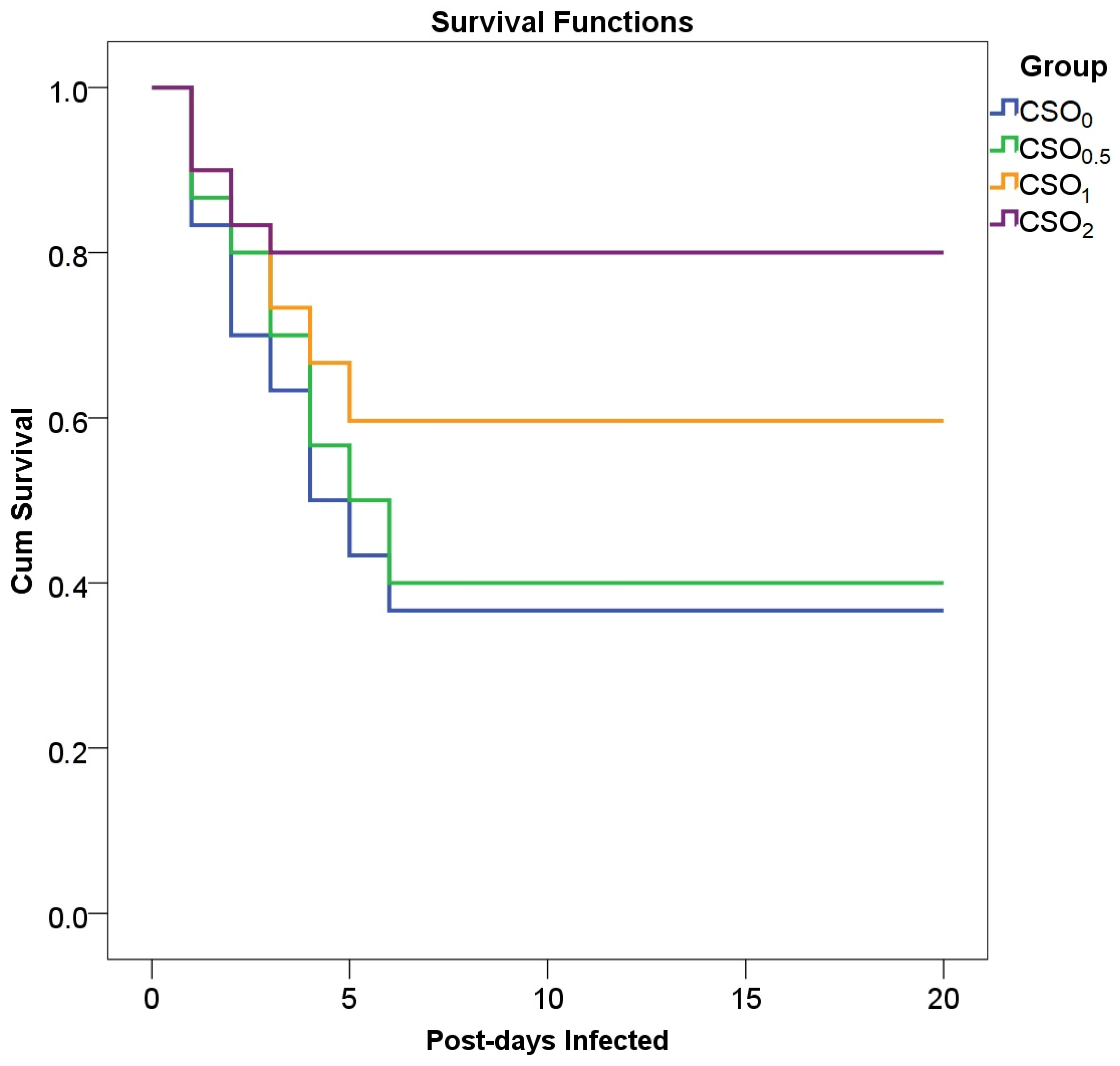
Following 60 days of feeding Cyprinus carpio diets supplemented with different levels of chia seed oil (CSO), the survival rates against A. hydrophila infection are shown in Figure 1. According to Kaplan–Meier survival analysis, a significant decrease in post-infection mortality rates was observed as the CSO levels increased. The survival rate in the control group was determined to be approximately 40%, while a similar rate was recorded in the group fed with CSO0.5. In contrast, the survival rate in the CSO1 group increased to 60%, with the highest value being approximately 80% in the CSO2 group (Figure 1).

3.4. Gene Expression

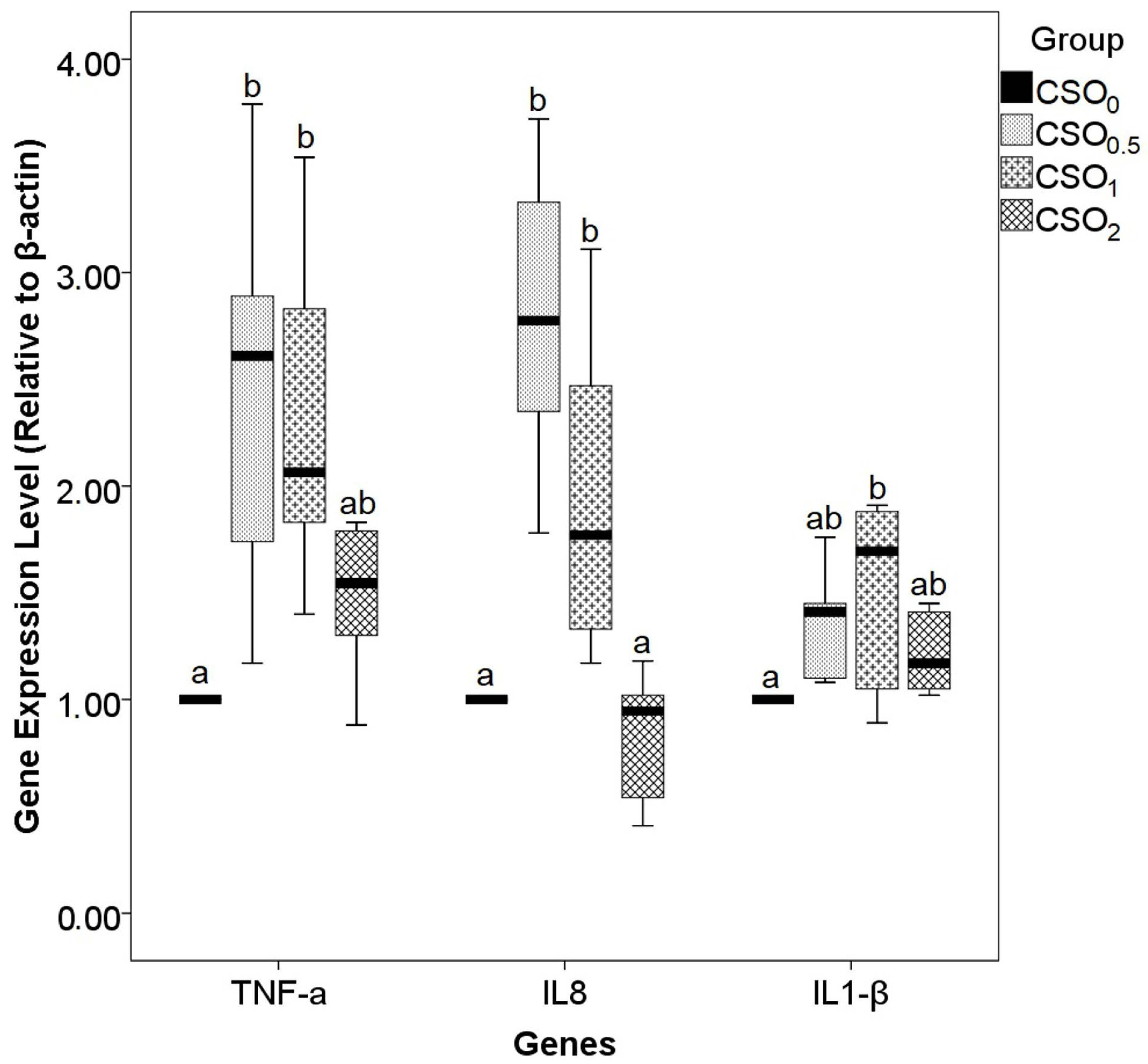
Gene expression analyses conducted in spleen tissue revealed that diets enriched with chia seed oil (CSO) significantly affected the transcriptional levels of proinflammatory cytokine genes (Figure 2). The expression levels of TNF-α, IL-8, and IL-1β genes generally increased in the groups supplemented with CSO compared to the control group. In particular, the expression levels of TNF-α and IL-8 genes were significantly higher in the groups fed diets containing CSO0.5 and CSO1 compared to the control group (p < 0.05). The most pronounced increase in the IL-1β gene was observed in the CSO0.5 and CSO1 groups, while a slight downward trend was observed at the 2% level. These differences suggest that anti-inflammatory mechanisms may limit the inflammatory response through feedback at high CSO levels.

4. Discussion

The rising interest in sustainable plant-based oil sources for fish feed requires the evaluation of sources rich in functional components. In this context, CSO is a promising additive due to its bioactive components. CSO offers a versatile nutritional profile that can support fish growth performance and immune system. The phenolic compounds it contains, such as chlorogenic acid, caffeic acid, myricetin, quercetin, and kaempferol, exhibit potent antioxidant [25] and anti-inflammatory effects, carrying the potential to reduce oxidative stress and protect against cellular damage in fish [26]. Furthermore, its high Omega-3 fatty acid content, particularly in the form of α-linolenic acid (ALA), is critical for supporting cardiovascular health, reducing inflammatory responses [27], and improving immune function [28]. Thanks to these properties, it can be considered as a versatile functional additive in fish feed that promotes growth, modulates immunity, and increases disease resistance.
This study aimed to comprehensively evaluate the effects of CSO, which possesses these versatile components, on growth performance, haematological-biochemical parameters, immune response, and disease resistance in carp. Fish fed with CSO-supplemented feed showed better growth performance compared to the control group. Consistent with these results, ref. [19] reported that CSO used at a rate of 1% promoted growth in Labeo rohita fry. Previous studies have also demonstrated that some plant oil supplements like grape seed oil [29], fennel (Foeniculum vulgare) seed oil [30], centaury (Hypericum perforatum) oil [31], and juniper berry oil [32] promote growth in common carp. In addition, earlier researchers testified that feed utilisation rates increase when the n-3 HUFA ratio in fish feed is increased [33,34]. Furthermore, the presence of bioactive compounds such as phenolic acids, tocopherols, phytosterols, and lignans in the CSO structure may increase feed palatability and digestive enzyme secretion, leading to increased feed intake and utilisation [35,36,37,38]. Feeding Nile tilapia (Oreochromis niloticus) diets containing chia seed powder were reported to increase the secretion of α-amylase, lipase, and total protease in the fish intestine. The observed performance improvement in Nile tilapia fed with chia seed powder may be related to marked improvements in the histomorphology of the anterior, middle, and posterior sections of the fish intestine and the resulting increase in feed digestion and nutrient absorption [21].
In this study, Hct and Hgb levels showed an increasing trend compared to the control group, while the RBC count did not differ significantly. Similar results were reported in O. niloticus, which showed increases in Hgb, RBC, and Hct when fed chia seed powder [21]. Likewise, a previous study on O. niloticus fed coriander oil also reported higher haematological parameters, including Hgb, Hct, and RBC [39]. Haematological parameters are important indicators for assessing the health status and physiological responses of fish [40]. Erythrocytes provide protection against infections, while haemoglobin regulates oxygen transport [21,41]. Phenolics, flavonoids, and other antioxidant compounds derived from CSO in the diet may protect RBC integrity by reducing oxidative stress [42,43]. Similarly, natural antioxidants have increased antioxidant defence and reduced haemolysis in fish [44].
Determining the effects of plant-based additives in fish feed on the liver is crucial [45]. In the present study, the inclusion of CSO at a concentration of 1% significantly reduced AST, ALT, LDH, and ALP values compared to the control group. Liver biomarker enzymes used in our study are essential indicators of the host’s health and physiological condition, functioning as key regulators in various nutrient metabolism processes [46]. Tea tree (Melaleuca aetheroleum) oil was reported to alleviate oxidative damage by triggering the NF-κB/NO pathway and reducing liver enzyme activities in O. niloticus, likely due to the antioxidant activity of plant oils [47,48].
An increase in serum glucose levels in response to varying feed ingredients can be considered a stress indicator [19]. In our study, CSO supplementation did not cause significant changes in serum glucose levels, although a slight but not statistically significant decrease was observed at a 1% inclusion level. Previous researchers have similarly shown that adding CSO to the diet of Labeo rohita fish reduced serum glucose levels [19]. Similarly, a study conducted with O. niloticus reported that chia seed flour decreased glucose concentrations in the serum of fish [49]. This diet-dependent glucose response highlights the metabolic flexibility of fish species and their ability to digest certain specific nutrients, which can modulate the expected effects of dietary components. It may also be linked to the capacity of fish to maintain glucose homeostasis when fish oil is partially replaced [20].
In this study, the addition of chia seed oil (CSO) significantly reduced serum triglyceride and cholesterol levels in Cyprinus carpio. Triglyceride levels were markedly lower in the 1% CSO group compared to the control group, and a similar decrease was observed in total cholesterol. Similar hypolipidemic effects have been reported in Nile tilapia and Labeo rohita supplemented with chia seeds [19,49]. This can be explained by the regulation of genes associated with lipid metabolism by the polyunsaturated fatty acids and phytosterols present in chia oil [50]. Furthermore, the serum lipid-lowering effects of chia oil have also been reported in mammalian models [51]. Our findings confirm that chia seed oil has the potential to regulate lipid metabolism.
This study also evaluated the effect of chia oil supplementation on the resistance of common carp to Aeromonas hydrophila infection. The findings revealed that the application of chia oil at 1% and 2% concentrations significantly increased the survival rate of fish against A. hydrophila. This antibacterial efficacy was previously reported in O. niloticus fed chia seed flour, which showed increased serum bactericidal activity [21]. This effect may stem from chia’s richness in flavonoids and phenolic acids, which neutralise free radicals and enhance antioxidant and immune system activity [12]. Furthermore, other biologically active compounds in chia, such as α-tocopherol [14,52] and carotenoids [15], have also been reported to enhance antioxidant and immune responses and improve disease resistance in farmed fish.
The response of common carp to A. hydrophila infection was further supported by the expression levels of immune genes. In the present study, dietary CSO supplementation exhibited immunoregulatory effects by increasing the expression of TNF-α, IL-1β, and IL-8, particularly in the CSO1 group. When gene expression profiles are considered alongside other immune parameters, dietary additives emerge as powerful tools for understanding their impact on fish health [53]. The proinflammatory cytokine IL-1β stimulates lymphocytes, increasing the release of other cytokines such as TNF-α [54]. Furthermore, TNF-α and IL-1β are proinflammatory cytokines expressed in the early stages and play an important role in initiating phagocytosis and the inflammatory process [55]. Several studies in the literature support the findings of the present work. For example, ref. [19] reported that CSO added to the feed of Labeo rohita fish increased the expression levels of TNF-α, IL-1β, and IL-8 genes in the liver, kidney, and intestinal tissues. Similarly, ref. [56] reported a significant increase in IL-1β and IL-8 expression in Nile tilapia supplemented with Coriandrum sativum seed powder and cinnamaldehyde. In addition, feeding turbot (Scophthalmus maximus) with 1 mL/kg of thyme oil was reported to significantly enhance the expression of IL-1β and TNF-α [57].

5. Conclusions

The findings of this study demonstrate that dietary supplementation with chia seed oil (CSO) exerts multiple beneficial effects on the health status and production efficiency of common carp. In particular, CSO inclusion at 1% and 2% levels improved growth performance and feed conversion efficiency, enhanced haematological indices, regulated lipid metabolism, and strengthened immune responses, resulting in increased resistance against Aeromonas hydrophila infection. Unlike previous CSO studies that primarily focused on isolated physiological or immunological parameters, the present study provides an integrated evaluation linking metabolic regulation, immune gene expression, and disease resistance, suggesting that CSO acts through interconnected antioxidant, metabolic, and immune-related pathways. Based on the integrated evaluation of growth performance, haematological stability, biochemical safety, immune gene expression, and disease resistance, dietary supplementation with 1% CSO is recommended as the optimal inclusion level for common carp. Although 2% CSO provided the highest growth and survival rates, the 1% level offered a more balanced and physiologically safe response, making it more suitable for routine aquaculture applications.

Author Contributions

Conceptualisation, Ü.A. and O.S.K.; methodology, Ü.A.; software, S.Y.; validation, Ü.A., O.S.K. and S.Y.; formal analysis, S.Y. and R.T.; investigation, Ü.A., R.T., O.S.K. and H.S.E.; resources, H.S.E., F.T. and B.D.; data curation, R.T. and G.B.; writing—original draft preparation, Ü.A.; writing—review and editing, Ü.A., O.S.K., D.G. and F.T.; visualisation, G.B. and B.D.; supervision, A.T. and K.G.; project administration, Ü.A. and O.S.K.; funding acquisition, D.G. All authors have read and agreed to the published version of the manuscript.

Funding

This research received no external funding.

Institutional Review Board Statement

All experimental procedures and the collection of samples were performed in compliance with the ethical considerations of the legislation on the protection of animals used for scientific purposes (Directive 2010/63). The current study was also conducted with the approval of the local ethics committee for animal experiments, Kastamonu University, Kastamonu, Turkey (Approval Number: 2020/05-20; Approval Date: 23 October 2020).

Data Availability Statement

All data generated or analysed during this study are included in this paper.

Conflicts of Interest

The authors declare no conflicts of interest.

References

  1. Tacon, A.G.J.; Metian, M.; McNevin, A.A. Future feeds: Suggested guidelines for sustainable development. Rev. Fish. Sci. Aquac. 2021, 30, 271–279. [Google Scholar] [CrossRef]
  2. Hodar, A.R.; Vasava, R.; Joshi, N.H.; Mahavadiya, D.R. Fish meal and fish oil replacement for alternative sources: A review. J. Exp. Zool. India 2020, 23, 13–21. [Google Scholar]
  3. Alhazzaa, R.; Nichols, P.D.; Carter, C.G. Sustainable alternatives to dietary fish oil in tropical fish aquaculture. Rev. Aquac. 2019, 11, 1195–1218. [Google Scholar] [CrossRef]
  4. Acar, Ü.; Türker, A. Response of Rainbow trout (Oncorhynchus mykiss) to unrefined peanut oil diets: Effect on growth performance, fish health and fillet fatty acid composition. Aquac. Nutr. 2018, 24, 292–299. [Google Scholar] [CrossRef]
  5. Turchini, G.M.; Trushenski, J.T.; Glencross, B.D. Thoughts for the future of aquaculture nutrition: Realigning perspectives to reflect contemporary issues related to judicious use of marine resources in aquafeeds. N. Am. J. Aquac. 2019, 81, 13–39. [Google Scholar] [CrossRef]
  6. Huyben, D.; Rimoldi, S.; Ceccotti, C.; Montero, D.; Betancor, M.; Iannini, F.; Terova, G. Effect of dietary oil from Camelina sativa on the growth performance, fillet fatty acid profile and gut microbiome of gilthead sea bream (Sparus aurata). PeerJ 2020, 8, e10430. [Google Scholar] [CrossRef]
  7. Munoz, L.A.; Cobos, A.; Diaz, O.; Aguilera, J.M. Chia seed (Salvia hispanica): An ancient grain and a new functional food. Food Rev. Int. 2013, 29, 394–408. [Google Scholar] [CrossRef]
  8. Suri, S.; Passi, S.J.; Goyat, J. Chia seed (Salvia hispanica L.)—A new age functional food. In 4th International Conference on Recent Innovations in Science Engineering and Management; IJATES: Uttar Pradesh, India, 2016; Volume 4, pp. 286–299. [Google Scholar]
  9. Jin, F.; Nieman, D.C.; Sha, W.; Xie, G.; Qiu, Y.; Jia, W. Supplementation of milled chia seeds increases plasma ALA and EPA in postmenopausal women. Plant Foods Hum. Nutr. 2012, 67, 105–110. [Google Scholar] [CrossRef]
  10. Grancieri, M.; Martino, H.S.D.; Gonzalez de Mejia, E. Chia seed (Salvia hispanica L.) as a source of proteins and bioactive peptides with health benefits: A review. Compr. Rev. Food Sci. Food Saf. 2019, 18, 480–499. [Google Scholar] [CrossRef]
  11. Bodoira, R.M.; Penci, M.C.; Ribotta, P.D.; Martínez, M.L. Chia (Salvia hispanica L.) oil stability: Study of the effect of natural antioxidants. LWT Food Sci. Technol. 2017, 75, 107–113. [Google Scholar] [CrossRef]
  12. Ahmadifar, E.; Yousefi, M.; Karimi, M.; Fadaei Raieni, R.; Dadar, M.; Yılmaz, S.; Dawood, M.A.O. Benefits of dietary polyphenols and polyphenol-rich additives to aquatic animal health: An overview. Rev. Fish. Sci. Aquac. 2021, 29, 478–511. [Google Scholar] [CrossRef]
  13. Petenuci, M.E.; Schneider, V.V.A.; Lopes, A.P.; Gonçalves, R.M.; Dos Santos, V.J.; Matsushita, M.; Visentainer, J.V. Effect of Alpha-Linolenic Acid Sources in Diets for Nile Tilapia on Fatty Acid Composition of Fish Fillet Using Principal Component Analysis. J. Aquat. Food Prod. Technol. 2018, 27, 464–476. [Google Scholar] [CrossRef]
  14. Saheli, M.; Islamia, H.R.; Mohsenib, M.; Soltani, M. Effects of dietary vitamin E on growth performance, body composition, antioxidant capacity, and some immune responses in Caspian trout (Salmo caspius). Aquac. Rep. 2021, 21, 100857. [Google Scholar] [CrossRef]
  15. Nakano, T.; Wiegertjes, G. Properties of carotenoids in fish fitness: A review. Mar. Drugs 2020, 18, 568. [Google Scholar] [CrossRef]
  16. Dawood, M.A.; Koshio, S.; Esteban, M.A. Beneficial roles of feed additives as immunostimulants in aquaculture: A review. Rev. Aquac. 2018, 10, 950–974. [Google Scholar] [CrossRef]
  17. Hoseinifar, S.H.; Sun, Y.-Z.; Zhou, Z.; Van Doan, H.; Davies, S.J.; Harikrishnan, R. Boosting immune function and disease biocontrol through environment-friendly and sustainable approaches in finfish aquaculture: Herbal therapy scenarios. Rev. Fish. Sci. Aquac. 2020, 28, 303–321. [Google Scholar] [CrossRef]
  18. Tadese, D.A.; Song, C.; Sun, C.; Liu, B.; Liu, B.; Zhou, Q.; Xu, P.; Ge, X.; Liu, M.; Xu, X.; et al. The role of currently used medicinal plants in aquaculture and their action mechanisms: A review. Rev. Aquac. 2022, 14, 816–847. [Google Scholar] [CrossRef]
  19. Gupta, S.K.; Gupta, R.; Gupta, A.; Foysal, M.J.; Krishnani, K.K. Chia (Salvia hispanica) Seed Oil Modulates the Haemato-Immunological Response, Antioxidative Status and Cytokine Gene Expression of Tropical Freshwater Teleost. Labeo rohita. Biol. 2025, 14, 95. [Google Scholar] [CrossRef] [PubMed]
  20. Gupta, S.K.; Gupta, A.; Choudhary, J.S.; Foysal, M.J.; Gupta, R.; Sarkar, B.; Krishnani, K.K. Dietary Chia (Salvia hispanica L.) seeds oil supplementation augments growth performance and gut microbial composition in Labeo rohita fingerlings. Sci. Rep. 2025, 15, 1866. [Google Scholar] [CrossRef]
  21. Abd El-Naby, A.S.; El Asely, A.M.; Hussein, M.N.; Fawzy, R.M.; Abdel-Tawwab, M. Stimulatory effects of dietary chia (Salvia hispanica) seeds on performance, antioxidant-immune indices, histopathological architecture, and disease resistance of Nile tilapia. Aquaculture 2023, 563, 738889. [Google Scholar] [CrossRef]
  22. Yılmaz, S.; Ergün, S. Effects of garlic and ginger oils on hematological and biochemical variables of sea bass Dicentrarchus labrax. J. Aquat. Anim. Health 2012, 24, 219–224. [Google Scholar] [CrossRef]
  23. Austin, B.; Austin, D.A. Bacterial Fish Pathogens: Diseases of Farmed and Wild Fish; Springer: Dordrecht, The Netherlands, 2007. [Google Scholar]
  24. Kalendar, R.; Lee, D.; Schulman, A.H. FastPCR software for PCR primer and probe design and repeat search. Genes Genomes Genom. 2009, 3, 1–14. [Google Scholar]
  25. Aversa, R.; Petrescu, R.V.; Apicella, A.; Petrescu, F.I. One can slow down the aging through antioxidants. Am. J. Eng. Appl. Sci. 2016, 9, 1112–1126. [Google Scholar] [CrossRef]
  26. Di Melo, D.; Machado, T.B.; Oliveira, M.B.P. Chia seeds: An ancient grain trending in modern human diets. Food Funct. 2019, 10, 3068–3089. [Google Scholar] [CrossRef]
  27. Saini, R.K.; Keum, Y.S. Omega-3 and omega-6 Polyunsaturated fatty acids: Dietary sources, metabolism, and significance—A review. Life Sci. 2018, 203, 255–267. [Google Scholar] [CrossRef]
  28. Lokhande, P.; Kharche, A.; Wagh, S.G.; Manithe, D.; Harke, S. Immune boosting super food supplement from natural resources. J. Pharmacogn. Phytochem. 2019, 8, 2108–2113. [Google Scholar]
  29. Zorlu, K.; Gümüş, E. Effect of dietary fish oil replacement with grape seed oil on growth performance, feed utilization and fatty acid profile of mirror carp, Cyprinus carpio, fingerlings. Aquac. Res. 2022, 53, 1755–1765. [Google Scholar] [CrossRef]
  30. Ahmadniaye Motlagh, H.; Horie, Y.; Rashid, H.; Banaee, M.; Multisanti, C.R.; Faggio, C. Unveiling the Effects of Fennel (Foeniculum vulgare) Seed Essential Oil as a Diet Supplement on the Biochemical Parameters and Reproductive Function in Female Common Carps (Cyprinus carpio). Water 2023, 15, 2978. [Google Scholar] [CrossRef]
  31. Acar, Ü. Sarı kantaron (Hypericum perforatum) yağının sazan yavrularının (Cyprinus carpio) büyüme performansı ve bazı kan parametreleri üzerine etkisi. Alinteri J. Agric. Sci. 2018, 33, 21–27. (In Turkish) [Google Scholar] [CrossRef]
  32. Kesbiç, O.S. Effects of juniper berry oil on growth performance and blood parameters in common carp (Cyprinus carpio). Aquac. Res. 2019, 50, 342–349. [Google Scholar] [CrossRef]
  33. Lochmann, R.T.; Gatlin, D.M. Essential fatty acid requirement of juvenile red drum (Sciaenops ocellatus). Fish Physiol. Biochem. 1993, 12, 221–235. [Google Scholar] [CrossRef]
  34. Ghena, M.M.; Amany, M.B. Chia (Salvia hispanica L.) seed oil a new source of omega 3. Plant Arch 2020, 20, 2678–2683. [Google Scholar]
  35. De Falco, B.; Incerti, G.; Bochicchio, R.; Phillips, T.D.; Amato, M.; Lanzotti, V. Metabolomic analysis of Salvia hispanica seeds using NMR spectroscopy and multivariate data analysis. Ind. Crop. Prod. 2017, 99, 86–96. [Google Scholar] [CrossRef]
  36. Sundar, S.; Singh, B.; Kaur, A. Influence of hot-air and infra-red pretreatments on oxidative stability, physicochemical properties, phenolic and fatty acid profile of white and black chia seed (Salvia hispanica L.) oil. J. Food Compos. Anal. 2023, 123, 105556. [Google Scholar] [CrossRef]
  37. Oteri, M.; Bartolomeo, G.; Rigano, F.; Aspromonte, J.; Trovato, E.; Purcaro, G.; Dugo, P.; Mondello, L.; Beccaria, M. Comprehensive Chemical Characterization of Chia (Salvia hispanica L.) Seed Oil with a Focus on Minor Lipid Components. Foods 2023, 12, 23. [Google Scholar] [CrossRef] [PubMed]
  38. Aslam, A.; Hassan, S.M.; Mughal, S.S.; Hassan, S.K.; Ibrahim, A.; Hassan, H.; Shafiq, S. Comprehensive review of structural components of Salvia hispanica & its biological applications. Int. J. Biochem. Biophys. Mol. Biol. 2020, 5, 1. [Google Scholar] [CrossRef]
  39. Das, S.; Pradhan, C.; Pillai, D. Dietary coriander (Coriandrum sativum L) oil improves antioxidant and anti-inflammatory activity, innate immune responses and resistance to Aeromonas hydrophila in Nile tilapia (Oreochromis niloticus). Fish. Shellfish Immunol. 2023, 132, 108486. [Google Scholar] [CrossRef]
  40. Reda, R.M.; El Asely, A.; Salah, A.S.; Mahmoud, M.A. Replacement of dietary fish oil with plant oils improves the immunological responses and the antioxidant status in Oreochromis niloticus exposed to suboptimal temperature. Fish Physiol. Biochem. 2020, 46, 2181–2196. [Google Scholar] [CrossRef] [PubMed]
  41. Jin, M.; Lu, Y.; Yuan, Y.E.; Li, Y.I.; Qiu, H.; Sun, P.; Ma, H.-N.; Ding, L.-Y.; Zhou, Q.C. Regulation of growth, antioxidant capacity, fatty acid profiles, hematological characteristics and expression of lipid related genes by different dietary n-3 highly unsaturated fatty acids in juvenile black seabream (Acanthopagrus schlegelii). Aquaculture 2017, 471, 55–65. [Google Scholar] [CrossRef]
  42. De Falco, B.; Amato, M.; Lanzotti, V. Chia seeds products: An overview. Phytochem. Rev. 2017, 16, 745–760. [Google Scholar] [CrossRef]
  43. Oliveira-Alves, S.C.; Vendramini-Costa, D.B.; Cazarin, C.B.B.; Júnior, M.R.M.; Ferreira, J.P.B.; Silva, A.B.; Prado, M.A.; Bronze, M.R. Characterization of phenolic compounds in chia (Salvia hispanica L.) seeds, fiber flour and oil. Food Chem. 2017, 232, 295–305. [Google Scholar] [CrossRef] [PubMed]
  44. Hoseini, S.M.; Hoseinifar, S.H.; Van Doan, H. Growth performance and hematological and antioxidant characteristics of rainbow trout, Oncorhynchus mykiss, fed diets supplemented with Roselle, Hibiscus sabdariffa. Aquaculture 2021, 530, 735827. [Google Scholar] [CrossRef]
  45. Bakhtiari, F.; Ahmadifar, E.; Moghadam, M.S.; Mohammadzadeh, S.; Mahboub, H.H. Dual effects of dietary Lactobacillus helveticus and chlorogenic acid on growth performance, digestibility, immune-antioxidant capacity and resistance against heat stress of juvenile common carp. Aquac. Int. 2024, 32, 7911–7927. [Google Scholar] [CrossRef]
  46. Xu, H.; Du, J.; Li, S.; Mai, K.; Xu, W.; Ai, Q. Effects of dietary n-3 long-chain unsaturated fatty acid on growth performance, lipid deposition, hepatic fatty acid composition and health-related serum enzyme activity of juvenile Japanese seabass Lateolabrax japonicus. Aquac. Nutr. 2017, 23, 1449–1457. [Google Scholar] [CrossRef]
  47. Shaalan, M.; Mahboub, H.H.; Abdelgawad, A.H.; Abdelwarith, A.A.; Younis, E.M.; Elnegiry, A.A.; Basher, A.W.; El-Houseiny, W.; Shawky, S.M.; Orabi, S.H.; et al. Dietary tea tree (Melaleucae aetheroleum) oil fortifies growth, biochemical, immune-antioxidant trait, gene function, tissue reaction, and Aeromonas sobria resistance in Nile tilapia (Oreochromis niloticus). BMC Vet. Res. 2025, 21, 1. [Google Scholar]
  48. Liu, M.; Sun, C.; Xu, P.; Liu, B.; Zheng, X.; Liu, B.; Zhou, Q. Effects of dietary tea tree (Melaleuca alternifolia) oil and feeding patterns on the zootechnical performance and nonspecific immune response of the giant freshwater prawn (Macrobrachium rosenbergii). J. World Aquac. Soc. 2022, 53, 542–557. [Google Scholar] [CrossRef]
  49. Mahmoud, H.K.; Reda, F.M.; Alagawany, M.; Farag, M.R.; El-Naggar, K. The role of dietary chia seed powder in modulating cold stress-related impacts in Nile tilapia, Oreochromis niloticus. Aquaculture 2023, 567, 739246. [Google Scholar] [CrossRef]
  50. Alagawany, M.; Nasr, M.; Al-Abdullatif, A.; Alhotan, R.A.; Azzam, M.M.; Reda, F.M. Impact of dietary cold-pressed chia oil on growth, blood chemistry, haematology, immunity and antioxidant status of growing Japanese quail. Ital. J. Anim. Sci. 2020, 19, 896–904. [Google Scholar] [CrossRef]
  51. Rossi, A.S.; Oliva, M.E.; Ferreira, M.R.; Chicco, A.; Lombardo, Y.B. Dietary chia seed induced changes in hepatic transcription factors and their target lipogenic and oxidative enzyme activities in dyslipidaemic insulin-resistant rats. Br. J. Nutr. 2013, 109, 1617–1627. [Google Scholar] [CrossRef]
  52. Atkinson, J.; Manor, D.; Parker, R. Vitamin E. In Encyclopedia of Biological Chemistry, 2nd ed.; Lennarz, W.J., Lane, M.D., Eds.; Academic Press: Waltham, MA, USA, 2013; pp. 545–550. [Google Scholar]
  53. Martin, S.A.; Król, E. Nutrigenomics and immune function in fish: New insights from omics technologies. Dev. Comp. Immunol. 2017, 75, 86–98. [Google Scholar] [CrossRef] [PubMed]
  54. Giri, S.S.; Sen, S.S.; Chi, C.; Kim, H.J.; Yun, S.; Park, S.C.; Sukumaran, V. Effect of guava leaves on the growth performance and cytokine gene expression of Labeo rohita and its susceptibility to Aeromonas hydrophila infection. Fish. Shellfish Immunol. 2015, 46, 217–224. [Google Scholar] [CrossRef]
  55. Dawood, M.A.; Zommara, M.; Eweedah, N.M.; Helal, A.I. The evaluation of growth performance, blood health, oxidative status and immune-related gene expression in Nile tilapia (Oreochromis niloticus) fed dietary nanoselenium spheres produced by lactic acid bacteria. Aquaculture 2020, 515, 734571. [Google Scholar] [CrossRef]
  56. Abd El-Hamid, M.I.; Ibrahim, S.M.; Eldemery, F.; El-Mandrawy, S.A.M.; Metwally, A.S.; Khalifa, E.; Elnahriry, S.S.; Ibrahim, D. Dietary Cinnamaldehyde Nanoemulsion Boosts Growth and Transcriptomes of Antioxidant and Immune Related Genes to Fight Streptococcus Agalactiae Infection in Nile tilapia (Oreochromis niloticus). Fish. Shellfish Immunol. 2021, 113, 96–105. [Google Scholar] [CrossRef] [PubMed]
  57. Guangxin, G.; Li, K.; Zhu, Q.; Zhao, C.; Li, C.; He, Z.; Hu, S.; Ren, Y. Improvements of immune genes and intestinal microbiota composition of turbot (Scophthalmus maximus) with dietary oregano oil and probiotics. Aquaculture 2021, 547, 737442. [Google Scholar] [CrossRef]
Figure 1. Kaplan–Meier survivorship curves (cumulative survival [%] over time [h]) for common carp after challenge with Aeromonas hydrophila; the fish were fed with CSO supplemented diets.
Fishes 11 00018 g001
Figure 2. Relative changes in mRNA expression levels of TNF-ɑ, IL-8, and IL1-ß in common carp (Cyprinus carpio) spleen tissues. Data represent the mean ± SD from three replicates for each analyses (n = 6). Values with different letters on the bar indicate significant differences between their groups (p < 0.05).
Fishes 11 00018 g002
Table 1. Experimental diet formulations and fatty acid profile of experimental diets.
Component (g/kg)CSO0CSO0.5CSO1CSO2
Fish Meal200200200200
Soybean Meal300300300300
Corn Starch180180180180
Wheat Flour200200200200
Anchovy Oil80757060
Vit. Min. 140404040
Chia Oil-51020
Total (g)1000100010001000
Crude Protein350.12351.2351.63351.71
Crude Lipid101.06104.13102.04101.17
Crude Ash43.342.441.443.3
Crude Cellulose32.3531.1431.2631.22
NFE 2473.16471.13473.67472.6
Fatty Acid Profile of Experimental Diets (g/100 g)
Fatty AcidCSO0CSO0.5CSO1CSO2
C10:00.010.010.010.01
C11:00.010.010.010.01
C12:00.040.030.030.04
C13:00.080.060.060.08
C14:06.935.715.757.86
C15:01.190.970.971.34
C16:020.4317.4117.4623.68
C16:1 n-75.314.424.46.05
C17:01.130.960.941.31
C17:10.010.010.010.01
C18:04.821.841.822.5
C18:1 n-90.915.365.37.23
C18:22.652.382.533.6
C18:3 n-60.20.160.160.22
C18:3 n-31.471.92.593.84
C20:00.670.560.550.77
C20:1 n-90.690.620.620.85
C20:2 n-60.310.250.240.34
C20:3 n-60.130.110.110.16
C20:3 n-30.240.190.20.25
C20:4 n-61.140.930.921.28
C20:5 n-30.130.110.110.15
C22:02.181.591.822.5
C22:1 n-90.10.080.10.13
C23:00.080.070.070.09
C24:00.130.110.110.15
C24:110.840.821.12
C22:6 n-349.6642.3142.6757.3
1 Vitamin Mineral Mixture: Fe 75.3 mg kg−1 feed; Cu 12.2 mg kg−1 feed; Mn 206 mg kg−1 feed; Zn. 85 mg kg−1 feed; I. 3 mg kg−1 feed; Se. 0.350 mg kg−1 feed; Co. 1 mg kg−1 feed; Vitamin A. 18,000 IU kg−1 feed; Vitamin D3. 2500 IU kg−1 feed; Vitamin E. 250 mg kg−1 feed; Vitamin K3. 12 mg kg−1 feed; Vitamin B1. 25 mg kg−1 feed; Vitamin B2. 50 mg kg−1 feed; Vitamin B3. 270 mg kg−1 feed; Vitamin B6. 20 mg kg−1 feed; Vitamin B12. 0.06 mg kg−1 feed; Vitamin C. 200 mg kg−1 feed; Folic acid. 10 mg kg−1 feed; Calcium D-pantothenate. 50 mg kg−1 feed; Biotin. 1 mg kg−1 feed; Inositol. 120 mg kg−1 feed; Choline chloride. 2000 mg kg−1 feed; 2 NFE = nitrogen free extract = 100 (crude protein + crude fat + crude ash).
Table 2. Growth performance of common carp (Cyprinus carpio) fed with experimental diets.
GroupCSO0CSO0.5CSO1CSO2p Value
Parameters
Initial Weight (g)27.18 ± 0.18 a27.49 ± 0.10 a27.47 ± 0.12 a27.32 ± 0.31 a0.257
Final Weight (g)43.07 ± 0.53 a44.16 ± 1.15 a47.36 ± 0.55 b49.55 ± 0.17 c0.000
RGR (%)58.48 ± 2.75 a60.67 ± 4.16 a72.42 ± 1.34 b81.37 ± 2.67 c0.001
SGR (%/day)0.77 ± 0.03 a0.79 ± 0.04 a0.91 ± 0.01 b0.99 ± 0.02 c0.001
FCR1.26 ± 0.05 b1.20 ± 0.08 b1.01 ± 0.02 a0.90 ± 0.02 a0.001
The values are given as the mean ± standard deviation (n = 3). Values with different letters in the same row indicate significant differences between the groups (p < 0.05). Note: RGR—relative growth rate; SGR—specific growth rate; FCR—feed conversion ratio.
Table 3. Haematological parameters of fish fed with experimental diets.
GroupCSO0CSO0.5CSO1CSO2p Value
Parameters
RBC (×106/μL)1.89 ± 0.12 b1.77 ± 0.08 a1.88 ± 0.12 b1.85 ± 0.18 ab0.025
Hct (%)30.21 ± 1.78 a32.73 ± 1.92 b33.27 ± 2.39 b33.04 ± 2.69 b0.001
Hb (g/dL)7.26 ± 0.40 a8.00 ± 0.44 b8.48 ± 0.51 c8.42 ± 0.43 bc0.001
MCV (fL)160.63 ± 14.61 a185.19 ± 16.14 b177.69 ± 18.52 ab179.87 ± 20.93 b0.002
MCH (pg/cell)38.56 ± 2.74 a45.17 ± 2.75 b45.23 ± 3.34 b45.80 ± 3.84 b0.001
MCHC (%)24.11 ± 1.96 a24.53 ± 2.23 a25.65 ± 2.55 a25.64 ± 2.27 a0.159
The values are given as mean ± standard deviation (n = 15). Values with different letters in the same row indicate significant differences between the groups (p < 0.05). Note: RBC—red blood cells; Hct—haematocrit; Hb—haemoglobin concentration; MCV—mean corpuscular volume; MCH—mean corpuscular haemoglobin; MCHC—mean corpuscular haemoglobin concentration.
Table 4. Serum biochemical parameters of fish fed with experimental diets.
GroupCSO0CSO0.5CSO1CSO2p Value
Parameters
GLU (mg/dL)77.50 ± 6.44 a80.12 ± 7.34 a72.87 ± 6.23 a75.85 ± 8.19 a0.051
TRIG (mg/dL) 133.25 ± 10.23 c114.65 ± 11.62 b93.89 ± 17.86 a111.41 ± 17.78 b0.001
CHOL (mg/dL)163.37 ± 17.73 b134.32 ± 11.58 a128.16 ± 16.37 a135.29 ± 12.27 a0.001
AST (U/L)92.46 ± 12.44 b87.43 ± 8.76 ab79.23 ± 13.25 a87.70 ± 11.28 ab0.024
ALT (U/L)26.12 ± 4.01 a23.60 ± 3.17 a21.57 ± 4.70 a24.69 ± 6.42 a0.072
LDH (U/L)340.81 ± 42.80 a337.39 ± 42.80 a328.95 ± 28.88 a358.27 ± 29.38 a0.192
ALP (U/L)87.12 ± 11.95 ab77.91 ± 6.53 a76.83 ± 11.99 a96.22 ± 14.92 b0.001
The values are given as mean ± standard deviation (n = 15). The values with different letters in the same row indicate significant differences between the groups (p < 0.05). Note: GLU—glucose; TRIG—triglycerides; CHOL—cholesterol; AST—aspartate aminotransferase; ALT—alanine aminotransferase; LDH—lactate dehydrogenase; ALP—alkaline phosphatase.
Disclaimer/Publisher’s Note: The statements, opinions and data contained in all publications are solely those of the individual author(s) and contributor(s) and not of MDPI and/or the editor(s). MDPI and/or the editor(s) disclaim responsibility for any injury to people or property resulting from any ideas, methods, instructions or products referred to in the content.