Skip to Content
CryptographyCryptography
  • Article
  • Open Access

19 September 2023

A Novel and Secure Fake-Modulus Based Rabin-Ӡ Cryptosystem

,
,
,
,
and
1
Department of Computer Science and Engineering, NMAM Institute of Technology, NITTE University, Karnataka 574110, India
2
Department of Master of Computer Applications, NMAM Institute of Technology, NITTE University, Karnataka 574110, India
3
Department of Computer Science and Engineering, SMVITM, Bantakal 574115, India
4
Amrita School of Computing Amaravati, Amrita Vishwa Vidyapeetham, Amaravati 522503, India

Abstract

Electronic commerce (E-commerce) transactions require secure communication to protect sensitive information such as credit card numbers, personal identification, and financial data from unauthorized access and fraud. Encryption using public key cryptography is essential to ensure secure electronic commerce transactions. RSA and Rabin cryptosystem algorithms are widely used public key cryptography techniques, and their security is based on the assumption that it is computationally infeasible to factorize the product of two large prime numbers into its constituent primes. However, existing variants of RSA and Rabin cryptosystems suffer from issues like high computational complexity, low speed, and vulnerability to factorization attacks. To overcome the issue, this article proposes a new method that introduces the concept of fake-modulus during encryption. The proposed method aims to increase the security of the Rabin cryptosystem by introducing a fake-modulus during encryption, which is used to confuse attackers who attempt to factorize the public key. The fake-modulus is added to the original modulus during encryption, and the attacker is unable to distinguish between the two. As a result, the attacker is unable to factorize the public key and cannot access the sensitive information transmitted during electronic commerce transactions. The proposed method’s performance is evaluated using qualitative and quantitative measures. Qualitative measures such as visual analysis and histogram analysis are used to evaluate the proposed system’s quality. To quantify the performance of the proposed method, the entropy of a number of occurrences for the pixels of cipher text and differential analysis of plaintext and cipher text is used. When the proposed method’s complexity is compared to a recent variant of the Rabin cryptosystem, it can be seen that it is more complex to break the proposed method—represented as O ( ɲ ×   τ )   which is higher than Rabin-P ( O ( ɲ ) ) algorithms.

1. Introduction

Secure transaction in e-commerce refers to the safe and secure exchange of information and money between buyers and sellers in an online marketplace. E-commerce has revolutionized the way people buy and sell goods and services, making it easy for customers to shop from anywhere in the world, at any time of the day. The convenience of online shopping has also led to the need for secure transactions to protect both buyers and sellers from online threats and fraud. However, with the growth of e-commerce, there have also been concerns about the security of online transactions. Here are some of the most common security issues of e-commerce:
  • Payment Security: One of the biggest concerns for consumers when shopping online is the security of their payment information. Cybercriminals may intercept and steal sensitive data such as credit card numbers, names, and addresses. To prevent this, it’s important for e-commerce websites to have strong encryption protocols to protect customer data.
  • Data Privacy: Customers share a lot of personal information when they make an online purchase. This data may include names, addresses, phone numbers, and email addresses. If this data falls into the wrong hands, it can be used for identity theft or other criminal activities. Businesses must ensure that they are handling this data securely, with proper encryption, storage, and access controls.
  • Phishing and Malware Attacks: Cybercriminals often use phishing and malware attacks to steal sensitive information from customers. Phishing attacks involve sending fake emails or websites that appear to be legitimate to trick customers into sharing their personal information. Malware attacks involve installing malicious software on a customer’s computer to steal data. E-commerce businesses should be vigilant in monitoring for these attacks and should have strong anti-malware and anti-phishing measures in place.
  • Website Security: The security of e-commerce websites is also critical to protect against hacking and data breaches. Businesses should ensure that their websites are secure with SSL/TLS encryption, firewalls, and other security measures. They should also monitor for suspicious activity, such as multiple failed login attempts.
Secure transactions in e-commerce are crucial to maintaining the trust of customers and ensuring the safety and security of online transactions. E-commerce platforms must employ various security measures to protect the sensitive information of buyers and sellers and prevent fraudulent activities. They are encryption, authentication, and secure payment systems.
Encryption ensures that sensitive information such as credit card details, passwords, and personal data are securely transmitted over the internet, making it difficult for hackers to intercept or steal such information. Authentication involves verifying the identity of users, ensuring that only authorized individuals have access to sensitive information. Secure payment systems ensure that the payment information is transmitted securely, preventing unauthorized access and fraudulent activities. This involves the use of secure payment gateways, which encrypt and process the payment information, ensuring that the transaction is secure and protected [1].
Encryption is the process of converting plaintext into a coded form, making it unreadable to unauthorized users. Public key cryptography, such as the RSA (Rivest, Shamir, and Adleman) and Rabin cryptosystems, are widely used encryption techniques that ensure electronic commerce transactions’ confidentiality, integrity, and authenticity.

3. Mathematical Preliminaries

This section gives the preliminaries required to support the proposed methodology, which makes the decryption process more unique and robust. Also, we suggest one more RSA variant by introducing the fake-modulus principle Ӡ , which improves the Rabin encryption process. This feature makes the proposed system hard to break using the factorization process.

3.1. Range of Plaintext

The proposed algorithm supports encryption and decryption functionality for a specific range of plaintext. If x is the plaintext that is to be encrypted, then the range of plaintext is defined as ӡ <   x < α 2 2 .
Theorem 1: 
Uniqueness of Solutions in Fake-Modulus Based Rabin-Ӡ Cryptosystem.
Let  x  denote the plaintext, and  α  and  β  represent the prime factors of  ɲ . For any plaintext  x  satisfying the condition  ӡ  < x < α 2 2 , a unique solution exists obtained through the computation of, C i x 2 m o d   ӡ .
Proof: 
Upper bound of x is α 2 2 then we should have x 1 + x 2 < α 2 , which leads to the contradiction x 1 + x 2 = α 2 . Suppose if x 1 and x 2 are greater than α 2 2 , which gives x 1 + x 2 > α 2 again which leads to a contradiction. Thus, one of x 1 or x 2 is always less than α 2 2 . Suppose x 1 < α 2 2 , then there exists a real number ψ 1 such that x 1 + ψ 1 = α 2 2 . Similarly, suppose x 2 > α 2 2 then there is a real number ψ 2   such that x 2 ψ 2 = α 2 2 .
( x 1 + ψ 1 ) + ( x 2 ψ 2 ) = α 2 2 + α 2 2 = α 2 .
But we have x 1 + x 2 = α 2
ψ 1 ψ 2 = 0
ψ 1 = ψ 2 .
Only one of x 1 or x 2 is always less than α 2 2 . Hence there exists a unique x < α 2 2 . □
Cipher values obtained from the proposed algorithm’s encryption functionality also fall within a specific range. If C i be the cipher value, then the range of cipher values restricted to fall within the range 0 < C i <   ɲ using Equation (3)
C i     x 2 ( m o d   ӡ )
The limitations specified in cases I, III, and IV can be eliminated using the fake-modulus concept, which is used to hide the public key ɲ during the time of encryption. The computation process to obtain a fake-modulus is explained as follows.

3.2. Fake-Modulus Principle

In the Rabin algorithm, let α and β are two large prime numbers, such that ( α + 1 )   mod   4 0 and ( β + 1 )   mod   4 0 . If ɲ   = α 2 β then, let Fake-modulus key ӡ   ϵ   + can be computed using the formula
Ӡ   =   ɲ + ( α 2 × τ ) ,  
where τ is the random integer that falls within the range 0 <   τ < α , and the range of ӡ should be α 2 2   <   ӡ   <   α 4 4 . Where τ is generated using a linear feedback shift register (LFSR) falls within the range 0   <   τ < ± α and range of ӡ should be α 2   2 <   ӡ   <   α 4 4 . The length of the key τ should be chosen to provide a sufficient level of security, while also ensuring that the encryption and decryption operations can be performed efficiently. A key length of 1024 bits is commonly used for the Rabin cryptosystem.
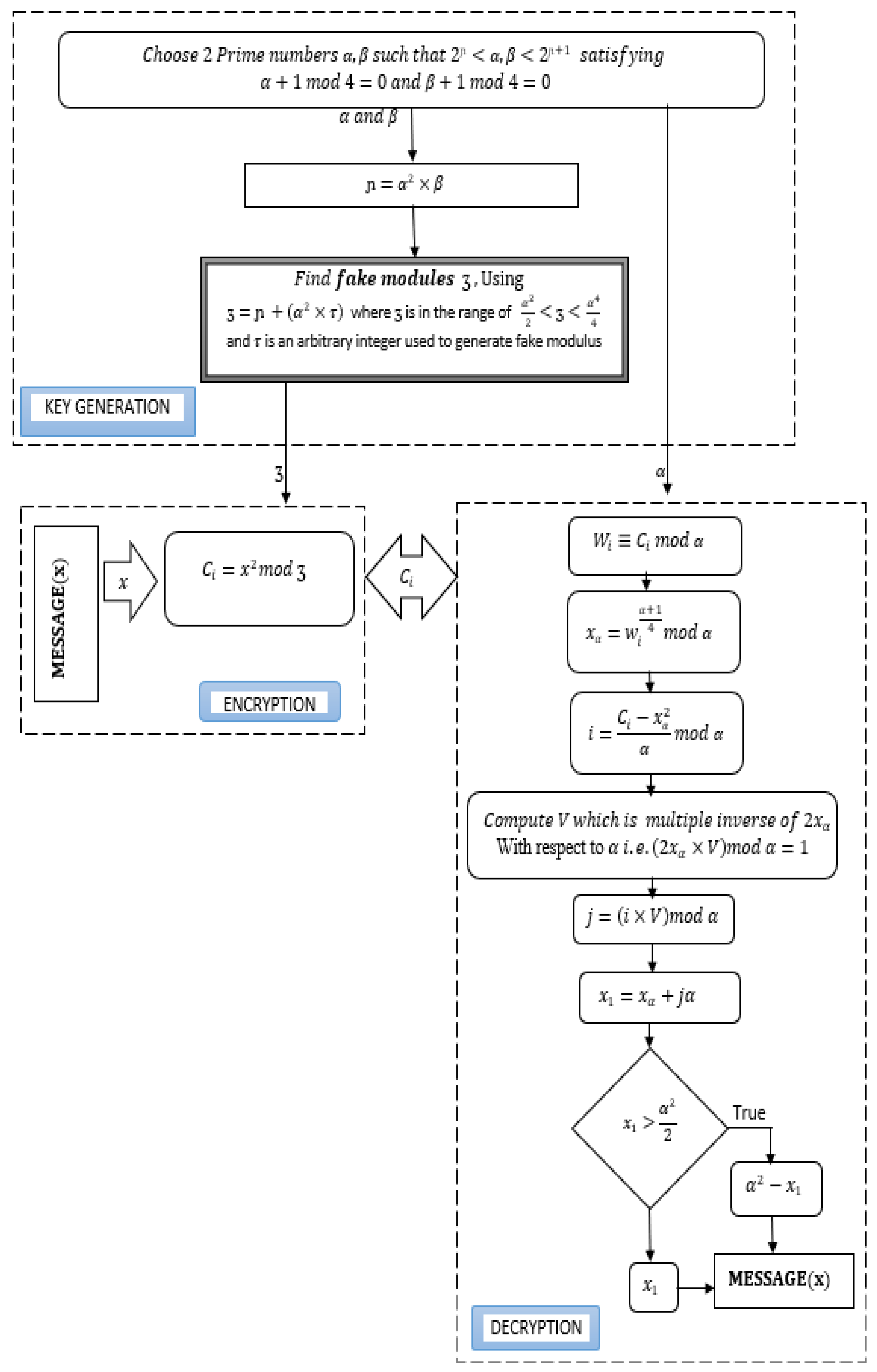
A PRNG [22,23] with a suitable seed value can be used to generate the secret key. Any integer value қ   ± α   is considered for initial seed values of LFSR. In this generation of key sequence is based on the initial seed values қ 1 , қ 2 , қ 3 қ i   are considered. As shown in the Figure 1, to randomize the key sequence it uses a function f ( қ 1 , қ 2 , қ 3 қ i )   m o d   α . To get more randomized results, prime values is taken as the initial seed values of LFSR.
Figure 1. Block diagram of Key generation, encryption, and decryption process of Rabin- ӡ encryption with fake modules.
The decryption algorithm in the proposed methodology requires a single prime number as its key and performs with a single modular exponentiation process. This has more impact on the computational complexity of the proposed method over other variants. The following proof gives the justification for the methods used in decryption.
Theorem 2: 
Let  C i x 2 m o d   Ӡ   i s  the cipher text of Rabin. Then decryption algorithm produces a unique solution.
Proof: 
Let C i be the cipher value and α be the prime factor which is used as the private key at the decryption side. Suppose C i x 2 m o d   Ӡ   is the cipher text, and we obtain modulus ɲ   = α 2 β . We can write C i x 2 m o d   Ӡ   as C i x 2 0   m o d   Ӡ . Then, α 2 Ӡ   α 2 C i x 2 . Therefore x < α 2 , only solving is sufficient for C i x 2 m o d   α 2 which is effectively solved. Furthermore, there are exactly two separate x 1 and x 2 solutions that satisfy C i x 2 m o d   α 2 . The decryption algorithm produces only a unique solution for x < 2 2 k 1 . Note that the upper limit of x < α 2 2 . Then either x 1 or x 2 is less than α 2 so x 1 + x 2 = α 2 satisfies x < 2 2 k 1 . Lastly, we conclude that the decryption algorithm will produce only one unique x < 2 2 k 1 .
The discussed preliminaries can be readily adapted to the proposed method, which will be briefly discussed in the next section. This will encompass key generation, encryption, decryption, and will be supported by an illustrative experimental example. □

4. Methodology Proposed

The Rabin-ӡ cryptosystem is a variant of the Rabin cryptosystem that uses a fake modulus to reduce the computational cost of the decryption process.
This section proposes the methodology using Rabin- ӡ cryptosystem using the fake-modulus concept that is divided into three stages: key generation, encryption, and decryption. Specifically, the fake-modulus is chosen in the key generation step according to the selected large prime number. By this operation, we can keep α as a secret key and thus increase security. To design an efficient Rabin-ӡ lighter weight cryptosystem, we can consider the following steps:

4.1. Key Generation

In the process of key generation the fake modulus key ӡ   ϵ   + can be computed using the formula specified in Equation (4). The Algorithm 1 describes the process of obtaining fake modulus.
Algorithm 1: Key Generation
Input: 2 large prime numbers α and β by satisfying ( α + 1 )   m o d   4 = = 0 and ( β + 1 )   m o d   4 = = 0 .
Output: Fake-modulus ӡ .
Steps:
  • Select 2 large prime numbers α and β by satisfying ( α + 1 )   m o d   4 = = 0 and ( β + 1 )   m o d   4 = = 0 .
  • Calculate the modulus ɲ   = α 2 β . To hide the public key, compute fake-modulus ӡ using function ӡ   =   ɲ + ( α 2 × τ )   where ӡ is in the range of α 2 2 <   ӡ   <   α 4 4 and τ is an arbitrary integer used to generate fake-modulus.
  • Share fake-modulus ӡ as the public key to the encryption side and use α as a secret key on the decryption end.

4.2. Encryption

The encryption operation involves computing the ciphertext as the square of the plaintext modulo the fake modulus. This operation can be performed efficiently using standard modular exponentiation algorithms in Algorithm 2.
Algorithm 2: Encryption
Input: Plaintext x i and fake-modulus Ӡ .
Output: Cipher text C i .
Steps:
Encrypt the plaintext x i , where the range of x i is 0 < x i < α 2 2 using
C i     x 2 ( m o d   ӡ )

4.3. Decryption

The decryption operation involves computing the square roots of the ciphertext modulo, both the true and fake moduli in Algorithm 3. The square root modulo the fake modulus, can be computed efficiently using the LFSR, while the square root modulo, the true modulus, can be calculated using standard modular exponentiation algorithms. The correct plaintext can be obtained by combining the results of these computations using the Chinese remainder theorem.
Algorithm 3: Decryption
Input: Cipher text C i and secret key α
Output: Plaintext x i .
Steps:
  • Compute
    w i = C i   ( m o d   α )
  • Find
    x α = w i α + 1 4   ( m o d   α )
  • Obtain
    i = C i x α 2 α   m o d   α
  • Compute v which is multiple inverses of 2xα for α, i.e.,
    ( 2 x α v ) m o d   α = ( 2 x α v )   m o d   α = 1
  • Obtain
    j = ( i v ) ( m o d   α )
  • Compute
    x 1 = x α + j α
  • If x 1 > α 2 2  
    then plaintext  x = α 2 x 1   otherwise  x = x 1

4.4. Example

In this section, we study a case of problem by assuming two prime numbers α   = 263, β = 283 and plaintext x = 21,017   and use the proposed algorithm to encrypt and decrypt this plaintext.

4.4.1. Key Generation

Let α = 263 and β = 283 are the two prime numbers selected by satisfying ( α + 1 )   m o d   4 = = 0 and ( β + 1 )   m o d   4 = = 0 . Compute modulus ɲ   = α 2 β = 19,574,827 . Select arbitrary integer τ within the range 0 <   τ < α and compute the fake-modulus using Equation (4). In this example, we selected τ = 5   and obtained ӡ   = 19,920,672 . Share fake-modulus ӡ as the public key and keep α = 263   as secret.

4.4.2. Encryption

Using the fake-modulus ӡ   = 19,920,672   perform encryption operation on plaintext x = 21 , 017 . Using equation C i     x 2 ( m o d   ӡ )   obtain the cipher text C i = 3,459,505 .

4.4.3. Decryption

Upon receiving the cipher value C i = 3,459,505 from the sender using private key α = 263 , the receiver follows the following steps. Compute w using Equation (5) and obtain w = 3 . Compute x α = 23 using Equation (6). The value i = 2 was obtained using Equation (7). Compute v which is multiple inverses of 2 x α with respect to α is computed using Equation (8) and obtained v = 227 . Using Equation (9) calculate j = 183 . Compute x 1 = 48,152 using Equation (10). According to Equation (11), the value of x 1 > α 2 2 then plaintext x = α 2 x 1 . In this case α 2 = 69,169 and x 1 = 48,152 . The difference between α 2 x 1 = 21,017, which is plaintext x .
The flow diagram of the Rabin- ӡ algorithm for key generation, encryption, and decryption is explored in Figure 1.

5. Cryptanalysis

In all the versions of the Rabin cryptography algorithms stated in [11,14,15,19], the public key component   n is shared publicly. Hence the hacker can crack the system very easily using the following two cryptanalysis methods:
  • By factoring the prime numbers using Fermat’s Factorization method [24]
  • Breaking the plaintext using cipher value and shared public key by brute force.
The following subsections shows that Rabin-ӡ with fake-modulus is secure for the above two hacking strategies.

5.1. Obtaining Private Keys from Fermat’s Factorization Method

Fermat factorization method known as Fermat’s Difference of Squares Methods, which uses the concept of quadratic disputes.
Let n be the composite number, which is written as n = α 2 β ; where 1 < β < n , hence α > β ,
n = [ α + β 2 ] 2 [ α β 2 ] 2 Where 𝒮 = α + β 2 ,   𝒯 = α β 2 then α = 𝒮 + 𝒯 and β = 𝒮 𝒯 , it can also written as,
n = 𝒮 2 𝒯 2
where,
n = ( 𝒮 + 𝒯 ) ( 𝒮 𝒯 ) = α · β
In the strategy of Fermat factorization, the algorithm searches for the value of Ƴ 2 n until it discovers an ideal root value. The search process begins from | n | + 1 ,   | n | + 2 , and so on. The above explanation demonstrates that this algorithm is guaranteed to eventually succeed in finding the factor value associated with the discovered root value. Let’s utilize the Fermat method to factorize n = 21,473. After determining Ƴ i which is the ideal root value of n , we find n = 21,473   = 146.536 rounded to the nearest integer gives | n | = 146 Ƴ 0 . We initiate the process by incrementing from the initial root Ƴ 0 until we find an integer. The progression of obtaining an integer from the ideal root value is presented in Table 1. By employing Equation (12), the factorization process can be expressed as n = ( 153 + 44 ) × ( 153 44 ) . Therefore, the factors of the given n are α = 197   and β = 109 .
Table 1. Fermat’s Factorization Process.
Table 2 presents the outcomes of the Fermat’s factorization process applied in the Rabin p algorithm, while Table 3 illustrates the utilization of Rabin ӡ with the fake-modulus approach. A comparison was conducted using prime factors of various key sizes, showcasing the steps taken to factor the given modulus (n), the processing time required for factorization, and the obtained factors through Fermat’s factorization. The results depicted in Table 2 and Table 3 demonstrate that the Rabin ӡ with fake-modulus algorithms involve more steps and time to factorize the modulus (n), and the resulting factors are not perfect. This observation highlights the robustness of the proposed algorithm and its ability to conceal the private key utilized in the decryption process.
Table 2. Use of Fermat’s Factorization Process in Rabin-P algorithm.
Table 3. Use of Fermat’s Factorization Process in Rabin- ӡ algorithm.

5.2. Obtaining Plaintext from Cipher Text and Modulus in Rabin Cryptosystem Using Brute Force Method

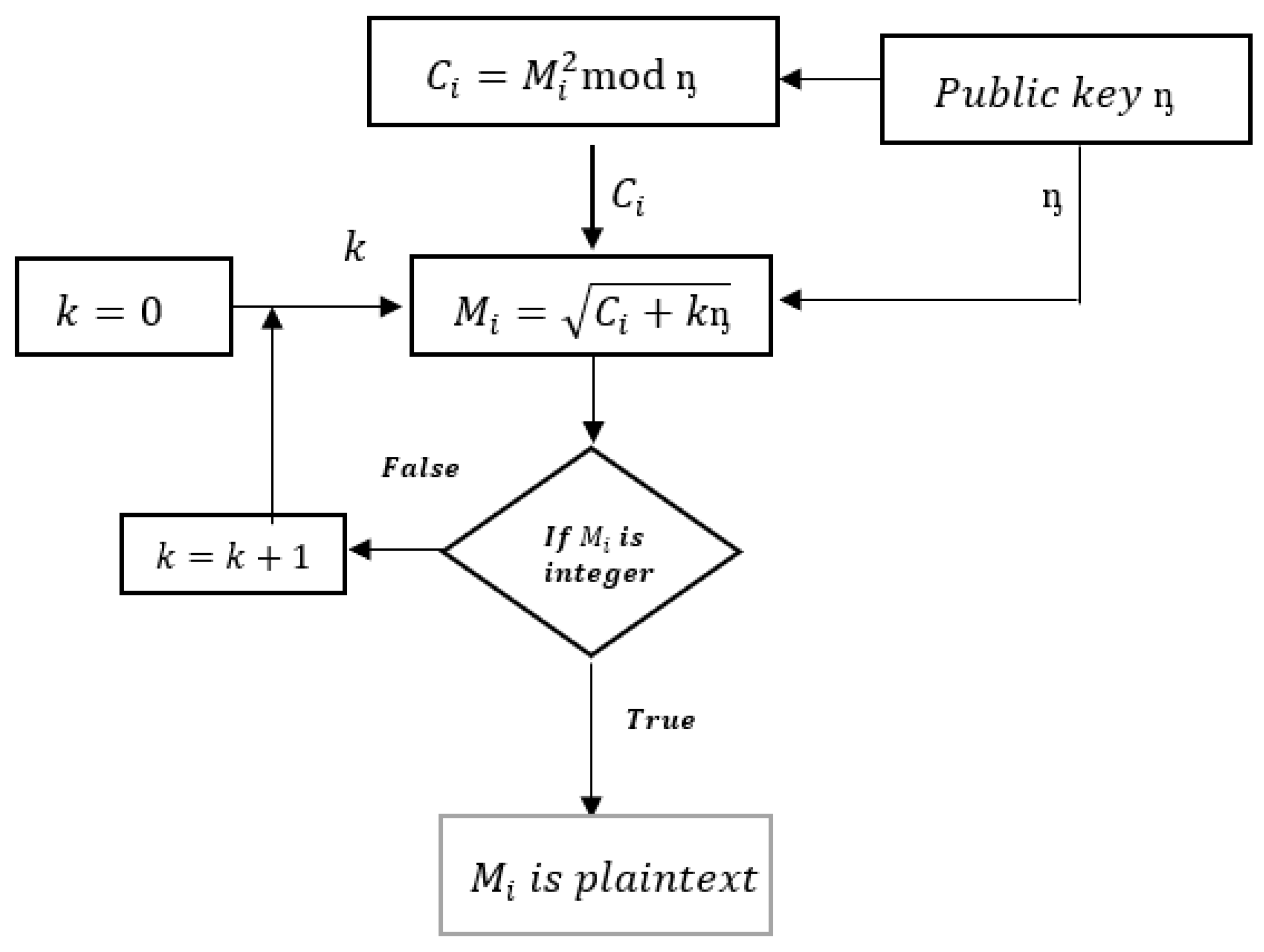
Consider M i   as the plaintext to be encrypted using the encryption function C i =   M i 2 m o d   n , where C i represents the ciphertext, and n i p q serves as the modulus used as a public key in this function. Let қ   be an integer that is iteratively incremented until the resulting M i   becomes an integer, using the function M i   = C i   + қ ×   n . The following case studies provide illustrations of the process involved in recovering a message M i from the ciphertext C i and modulus n through a brute force attack on the Rabin cryptosystem. Figure 2 visually presents the step-by-step procedure for recovering the message M i   using the ciphertext C i and modulus n through the brute force attack on the Rabin cryptosystem.
Figure 2. Flow diagram of brute-force attack on Rabin cryptosystem.

5.3. Case Study

Let C = 11,544,473   represent the cipher value, and the public key component n = 19,574,827 . The eavesdropper, using these parameters, performs the following operation using the equation M i   = C i + қ × n , where қ is the integer value that indicates the number of iterations or steps required to break the cipher. We initiate the incrementing process from 0 until we obtain an integer value for M i . In this example, when қ = 8, the equation yields an integer value of 12,967. Since this integer value, 12,967, corresponds to the plaintext for the given cipher value, Table 4 displays the step-by-step process of obtaining the plaintext from the given cipher value.
Table 4. Process of obtaining Plaintext from the given cipher text.
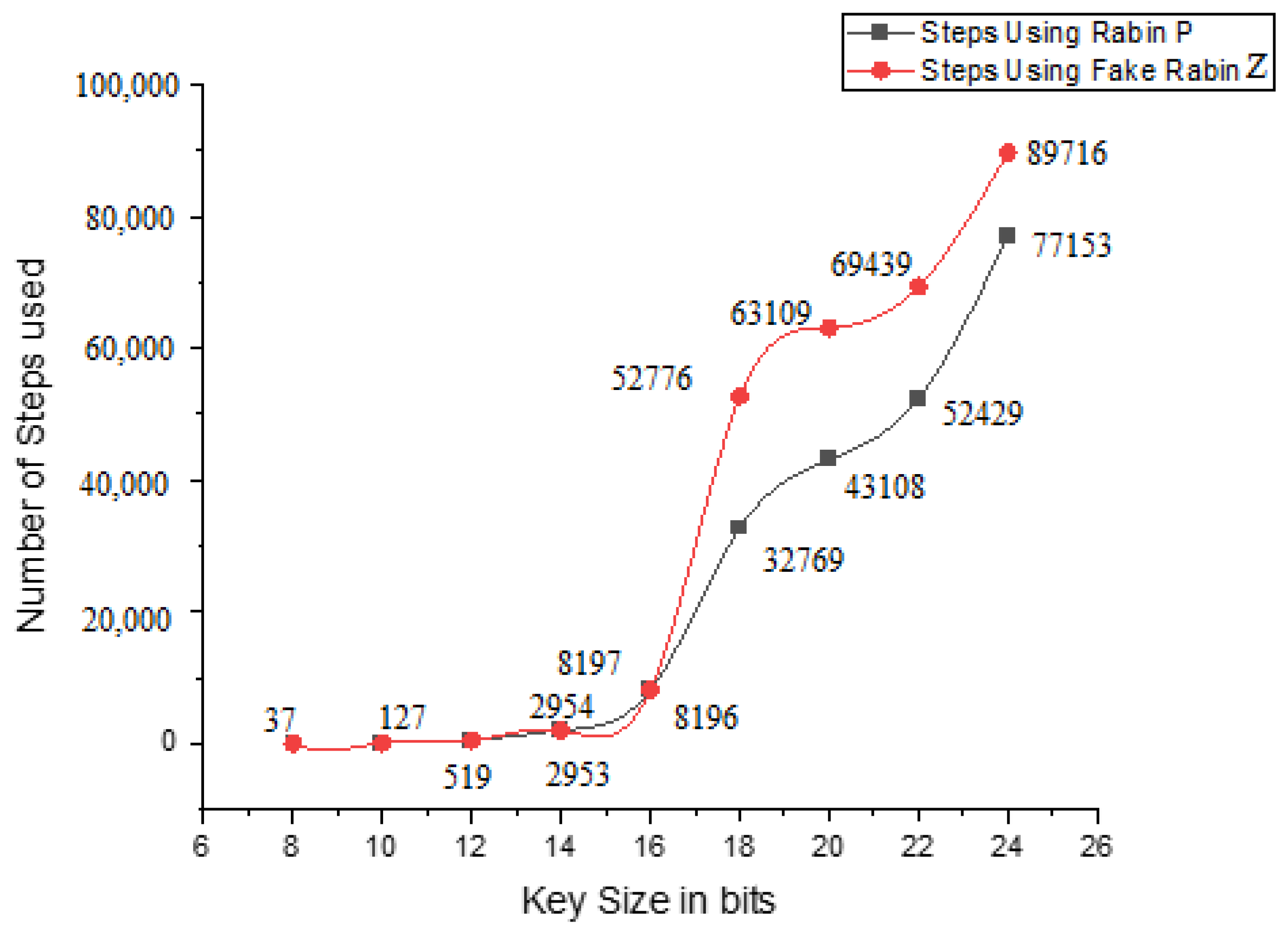
The number of steps needed to break the plaintext using Rabin p versus Rabin ӡ with fake-modulus for various key sizes is presented in Figure 3. The figure illustrates the comparison of the number of steps required to break the plaintext between Rabin p and Rabin ӡ with fake-modulus for different key sizes.
Figure 3. Number of steps required to break the plaintext using Rabin p v/s Rabin ӡ using fake-modulus for different Key size.
Observations:
  • It is observed that Rabin-P, with the fake-modulus approach, denoted as fake Rabin-P, requires a higher number of steps to crack the plaintext from the given ciphertext.
  • The time consumption for Rabin-P and Rabin-P with the fake-modulus is approximately equivalent for prime numbers with lower bit lengths (e.g., 8, 10, and 12 bits). However, as the bit length increases beyond 16 bits, the gap between the time curves widens significantly.
  • Based on the statistical comparison, it is evident that breaking the code using the proposed fake-modulus approach, demands more time and steps compared to the traditional Rabin-P algorithm.

6. Results and Analysis

In this section, we aim to highlight the significance of the Rabin ӡ cryptosystem in relation to the Rabin P cryptosystem, particularly regarding its robustness. We thoroughly examine the investigations conducted on the security provided by the proposed algorithms, comparing them to the Rabin P cryptosystem through performance and complexity analysis. Our objective is to showcase the importance of the proposed method in terms of its robustness compared to the Rabin P cryptosystems. To assess the significance of the proposed systems, we establish an experimental setup utilizing an existing Intel P4 CPU 1.7 GHz, 1.24 GB RAM, and the Windows 10 platform. To showcase the performance of the proposed algorithms, we applied them to a variety of test images, including Lena, and Baboon. These test images have dimensions of (512 × 512 × 3) pixels. By using these representative images, we aim to demonstrate the effectiveness and capabilities of the algorithms in different scenarios. The subsequent metrics defined herein effectively articulate the comparisons.

6.1. Visual Analysis

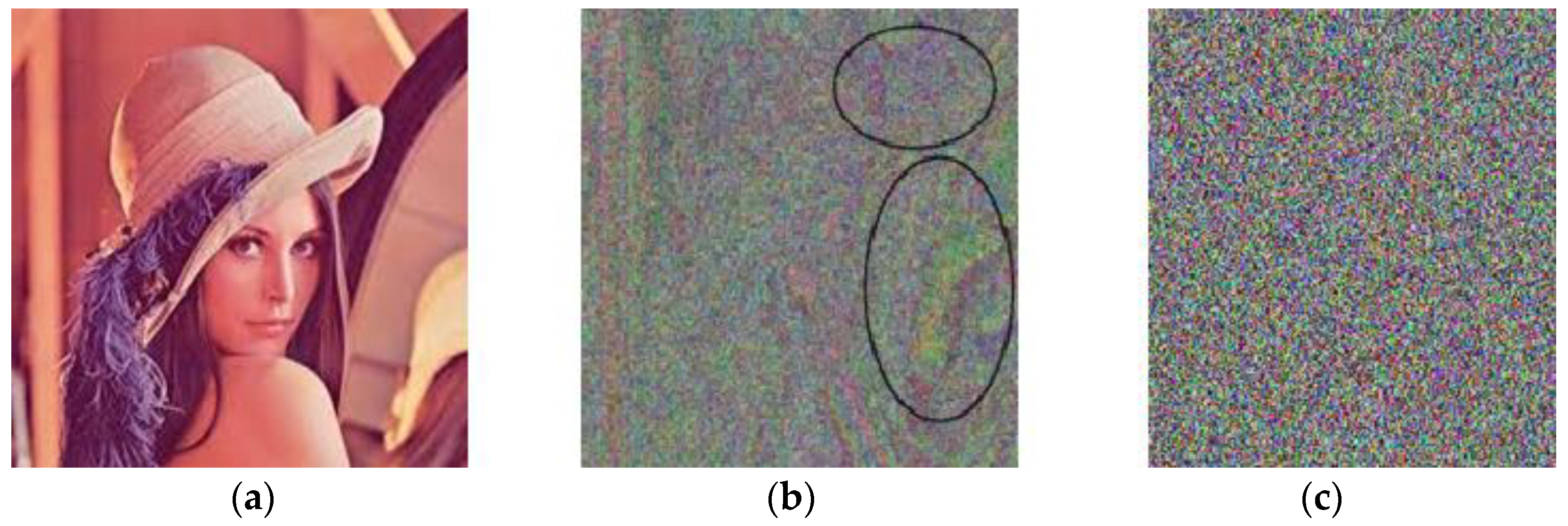
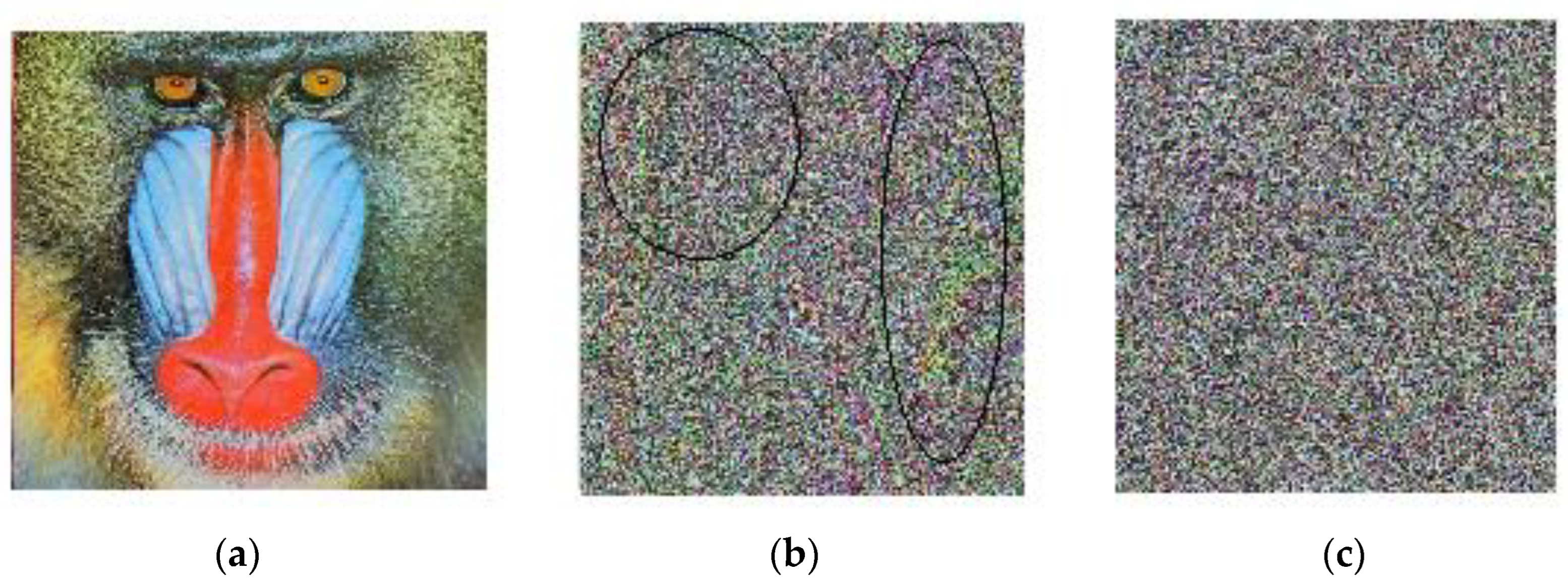
To evaluate the extent of distortion or degradation introduced during the encryption process, a visual comparison was performed between the plaintext and encrypted images. This allowed us to gauge the impact of encryption on the visual quality and fidelity of the images. If the encrypted image contains many unidentified pixels from the original image, it can be deemed secure. Figure 4b and Figure 5b displays the encrypted image generated by the Rabin-P algorithm, wherein certain areas still exhibit evidence of the original image. However, upon employing the proposed Rabin-ӡ algorithm, the encrypted image (as depicted in Figure 4c and Figure 5c) exhibited no discernible traces of the original image. This demonstrates the algorithm’s resilience against statistical attacks.
Figure 4. (a) Test Lena image, (b) Encrypted image using Rabin-P, (c) Encrypted image using Rabin- ӡ .
Figure 5. (a) Test Baboon image, (b) Encrypted image using Rabin-P, (c) Encrypted image using Rabin- ӡ .

6.2. Histogram Analysis

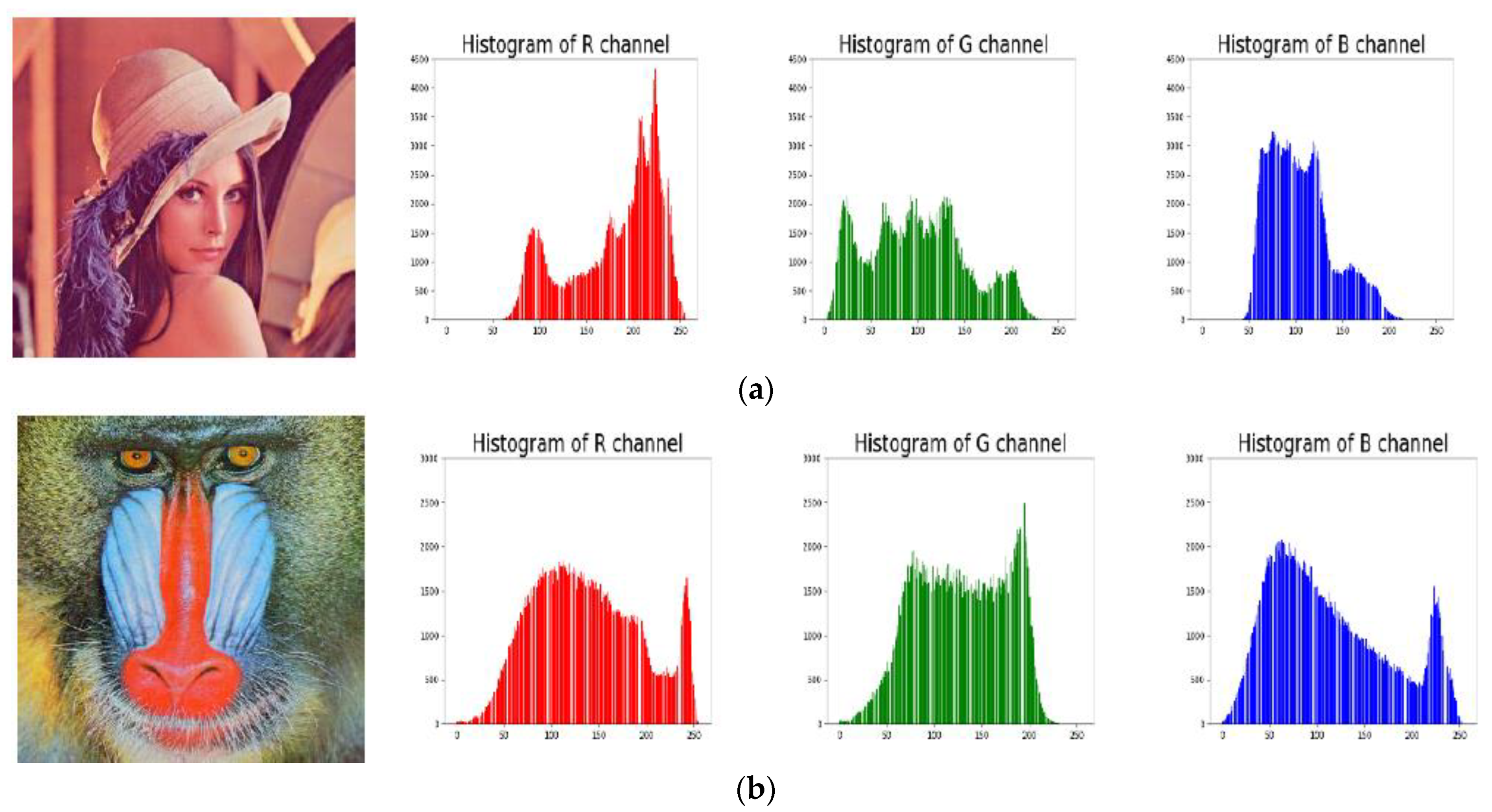
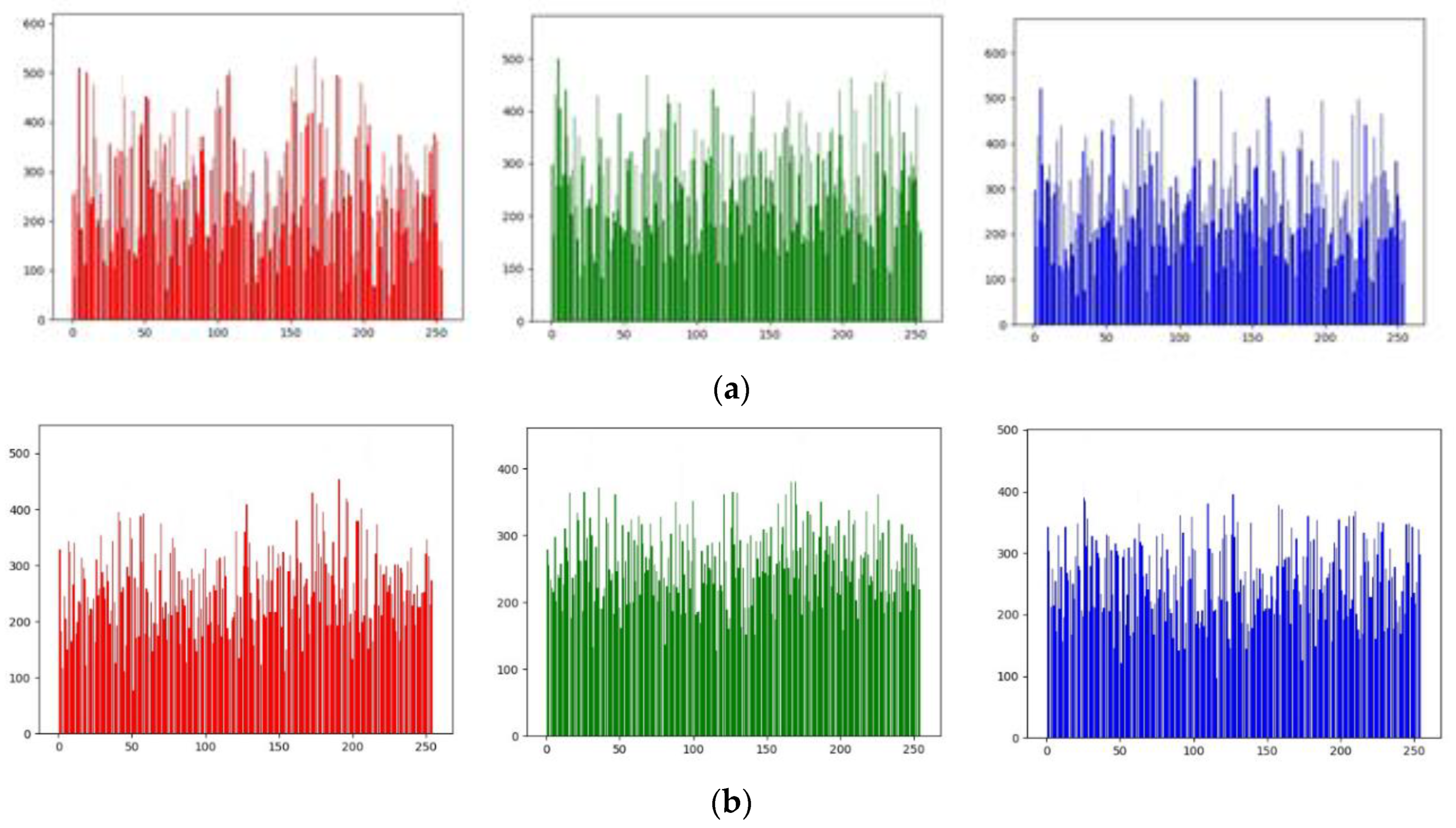
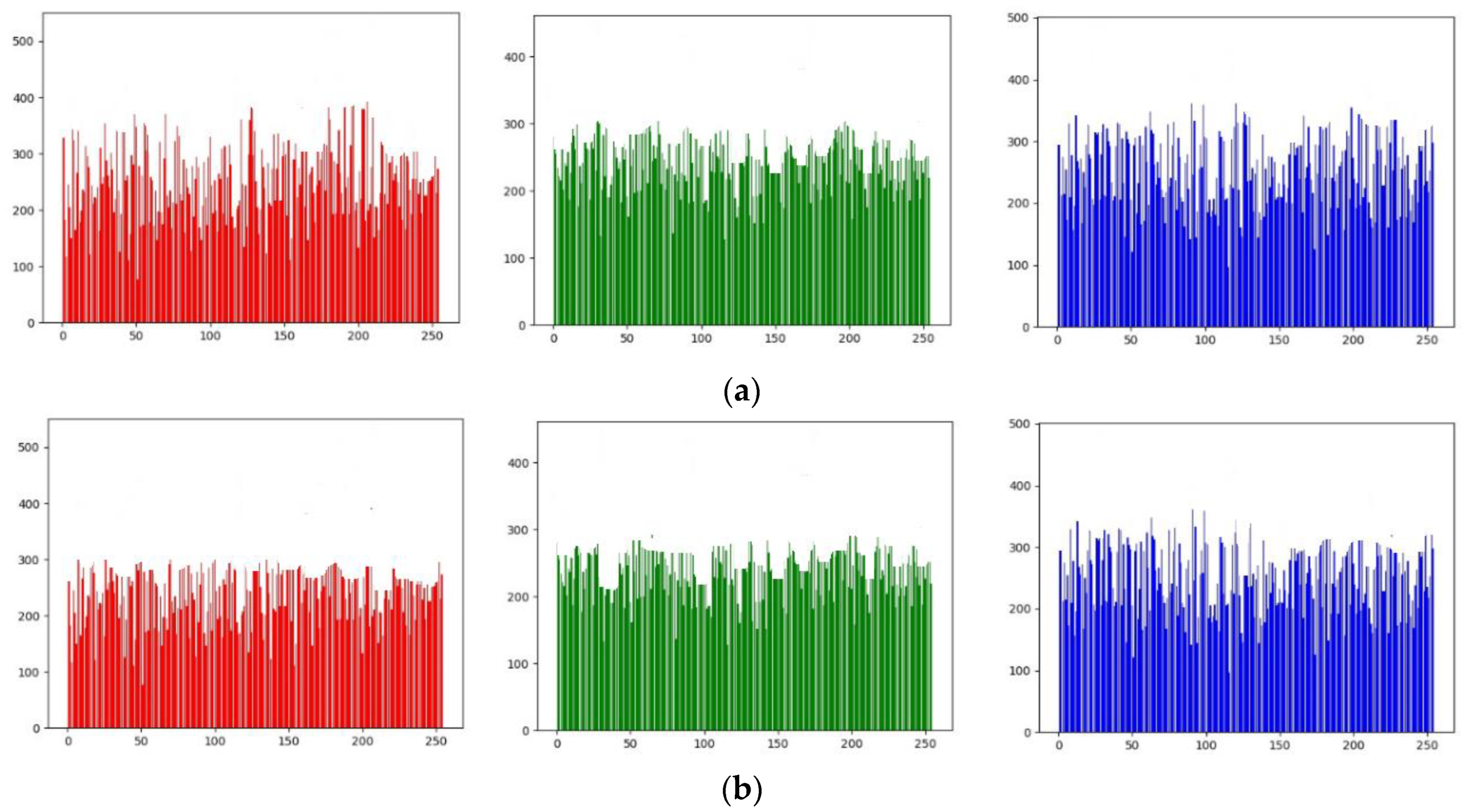
A histogram is the schematic representation of the number of occurrences of the value of each pixel. In this work, the Lena color image shown in Figure 4a has been considered for evaluation. i.e., the numbers of occurrences of each pixel value are expressed separately for Red, Green, and Blue in the histogram. Figure 6a,b shows the histogram for the distribution of the occurrences of RGB components of the original image. From the visual analysis shown in the histogram of Figure 7 and Figure 8, the histogram results of the Rabin- ӡ cryptosystem have flat and uniform pixel distribution compared to Rabin P. In the figure the x-axis represents the range of pixel values, while the y-axis represents the number of pixels in the image that fall within that range. These histogram results are significant enough to suggest that the proposed approach is cryptographically secure pixel distribution.
Figure 6. Number of occurrences of pixel values (Y-axis) vs. pixel values (X-axis) of (a) Lena image and (b) Baboon image with RGB components respectively.
Figure 7. Number of occurrences of pixel values (Y-axis) v/s pixel values (X-axis) of cipher image of Rabin- P algorithm for (a) Lena image with RGB components, (b) Baboon image with RGB components.
Figure 8. Number of occurrences of pixel values (Y-axis) v/s pixel values (X-axis) of cipher image of Rabin- ӡ algorithm for (a) Lena image with RGB components, (b) Baboon image with RGB components respectively.

6.3. Entropy Analysis

The degree of uncertainty in the system is defined as the entropy of information. The greater the entropy, the greater the image’s randomness or uniformity [25]. Entropy can be mathematically defined using Equations (13) and (14). Let p i be the probability of occurrence of pixel i in the cipher image of length N   number of pixels, where i = 0 , 1 , 2 , , M 1 .
p i = lim N N i N
Entropy ( ԩ ) = lim N i = 0 M 1 p i log 2 ( 1 p i )
In the experimentation the entropy (ԩ) of the cipher image is calculated separately for RGB components of the color image using the equation i = 0 25 p i log 2 ( 1 p i ) , where p i   is the probability of occurrence of the cipher values and is given by p i N i N , where N i is the number of events of p i in N different pixels of an image.
A comparison between the proposed algorithm and existing Rabin algorithms is conducted, and the resulting entropy values are presented in Table 5. The entropy values of the encrypted images generated by the proposed Rabin-ӡ algorithm are found to be in close proximity to 8. This signifies that the cipher image exhibits exceptional uncertainty and a significant degree of permutation and substitution effects. Consequently, it can be concluded that the proposed algorithm is highly resistant to attacks and provides a secure defense against statistical entropy attacks.
Table 5. Entropy result comparison of the number of occurrences of pixel values of proposed Rabin- Ӡ with Rabin-P algorithm.

6.4. Differential Analysis

Differential analysis is a metric used in differential attack analysis to check the cipher resistance. When an attacker makes little changes to the original image (flipping one bit), notice the difference in the cipher image [26]. Such disparity can be calculated using two criteria: the Number of Pixel Change Rate (NPCR) [27] and the Unified Average Pixel Change Intensity (UACI) [28]. The proposed cryptosystem will guarantee two separate ciphered images, although there is only one bit of difference between them. The NPCR focuses on the total number of pixels that affect the value of differential attacks, and to evaluate the impact of the pixel change on the encrypted image using NPCR is given in (15)
N C P R = ( 1 W i H i i , j = 1 n , m D ( i , j ) ) × 100  
w i t h   D ( i , j ) = 1   i f   C 1 ( i , j ) C 2 ( i , j )   a n d   D ( i , j ) = 0   i f   C 1 ( i , j ) = C 2 ( i , j )
where W i is the image width and H i be the height. C 1 ( i , j ) is the image before the change in one-bit pixel position and C 2 ( i , j ) are the ciphered images after the change in one pixel of the plain image. For the pixel at the position ( i , j ) calculation was made   i f   C 1 ( i , j ) C 2 ( i , j ) , then set D ( i , j ) = 1   else set D ( i , j ) = 0 .
UACI focuses on the average difference between two paired ciphertext images. UACI is specified in Equation (16)
A C I = ( 1 L i i , j = 1 n , m | C 1 ( i , j ) C 2 ( i , j ) | 255 ) × 100
where L i = length of the image, which contains the total number of pixels.
The outcomes of the NPCR and UACI equations are presented in Table 6. The analysis reveals that the encryption scheme exhibits a remarkable sensitivity to even minor modifications in the plaintext. For the proposed method, the NPCR values exceed 99%, while the UACI values surpass 33%. All measured values fall within the confidence interval of [98–99%]. While the NPCR results are comparable to those of existing Rabin algorithms, the UACI results significantly surpass them. These findings provide compelling evidence that our cryptosystem effectively safeguards against differential attacks.
Table 6. This is a table. Comparison of NPCR vs. UACI between plaintext and Cipher of Rabin-P and- ӡ .

6.5. Complexityl Analysis

Time complexity is a statistical framework that determines the amount of time it takes to execute an algorithm. The complexity of the algorithms specified in this section is based on the number of mathematical operations involved in the function using the Newton-Raphson iteration method [29]. Table 7 summarizes the time the proposed methods took to prove the robustness in each step compared with the Rabin-P cryptosystem. To calculate modulus   ɲ   = α 2 β required   O ( 2 ɲ ) since ɲ uses multiplication operation on 3 integers twice. The equation used for computing fake-modulus ӡ   = ɲ + ( α 2 × τ ) also uses O ( 2 ɲ ) for computing fake-modulus.
Table 7. Time complexity involved during Key generation, Encryption and Decryption phase of Rabin P And Rabin- Ӡ   algorithms.
The proposed method Rabin-ӡ has a complexity of O ( ɲ 2   log 2 ɲ ) for encryption, which involves exponentiation and multiplication operations. The decryption process requires O ( n 2 ) and O ( n 2   log 2 n ) , operations to compute w and x α , respectively. The complexity for computing v ‘s multiplicative inverse is O ( M × 2 n 2 ) , where M is the number of iterations required. The complexity for computing j is O ( 2 n 2 ) iterations, and computing x 1 requires O ( log n ) iterations. To break the Rabin algorithm using the equation M i = C i + k i × n , the complexity involved relies on taking the square root in each iteration ( O ( 2 ɲ ) ) and multiplying key k i with ɲ requires ( O ( ɲ ) ) can be specified as O ( 3 ɲ ) . The equation ӡ   = ɲ + ( α 2 × τ ) used for breaking the fake-modulus relies on the complexity of breaking ɲ and the key generated for the value τ using LFSR. Therefore, the complexity of breaking the Rabin algorithm using a Fake-modulus can be stated as O ( ɲ × τ ) . The complexity of breaking ɲ and τ would depend on the specific techniques used to perform the attack, but in general, they would involve searching for a factor of the modulus or finding a linear relationship between the LFSR output and the fake-modulus.
Comparing the above statistics, it is observed that breaking Rabin-ӡ using the fake-modulus is more complex than breaking Rabin-P algorithms. This makes the proposed Rabin-ӡ with a fake-modulus more secure than the standard Rabin-P algorithm against attacks.

6.6. Randomness Analysis

In cryptographic applications that involve encrypting images, it is essential that the resulting encrypted images be immune to statistical attacks. Statistical attacks are a type of cryptanalysis technique that involves analyzing the statistical properties of the encrypted data to try to uncover information about the plaintext. The NIST statistical randomness test suite is a widely used tool for evaluating the randomness of encrypted images and other cryptographic outputs [30].
The significance level of the test should be higher than 0.01 in order to eliminate or accept the randomness of bit sequences. The results of the NIST randomness test for a 512 × 512 Lena and Baboon image are displayed in Table 8.
Table 8. NIST Encryption Test Results of proposed algorithm.
According to tabulation results shown in Table 8, the proposed method passed (✓) the randomness test when put through various tests as part of the NIST test suite. It suggests that the bit sequences generated by the method were able to pass the various statistical tests for randomness with a p-value greater than 0.01. This would indicate that the generated bit sequences are likely to be truly random [31,32,33,34,35,36].

7. Discussions

The proposed work aims to enhance the security and performance of existing Rabin cryptosystems by introducing a fake-modulus technique. The results specified that the proposed technique provides better immunity against differential attacks compared to existing Rabin type cryptosystems. It also mentions that the complexity involved in breaking the Rabin algorithm using the fake-modulus technique is higher than existing Rabin-P algorithms, making it difficult to break.
The proposed algorithm also produces a flat and uniform pixel distribution compared to existing Rabin cryptosystems, as demonstrated by the visual analysis of encrypted images and histograms. It highlights the paper’s use of entropy and differential analysis to quantify the performance of the proposed method, which is considered a valuable contribution to the field of electronic commerce and cryptography, as it offers a solution for ensuring secure communication in electronic commerce transactions.

8. Conclusions

Encryption using public key cryptography is widely used to ensure secure communication and protect sensitive information from unauthorized access. The proposed work aims to address the issues with existing Rabin cryptosystems by introducing a fake-modulus technique to enhance its security and performance against differential attacks. The paper presents a detailed analysis of the weaknesses of existing Rabin cryptosystems and proposes a solution that is validated through qualitative and quantitative studies. The proposed technique is shown to provide better immunity against differential attacks compared to existing Rabin cryptosystems. The complexity involved in breaking the Rabin algorithm using the fake-modulus technique is higher than existing Rabin-P algorithms, making it difficult to break. The proposed algorithm also produces flat and uniform pixel distribution compared to existing Rabin cryptosystems, as demonstrated by the visual analysis of encrypted images and histograms. The paper’s use of entropy and differential analysis to quantify the performance of the proposed method is a valuable contribution to the field. The results show that the proposed algorithm provides excellent uncertainty, and its performance against differential attacks is superior to existing Rabin cryptosystems.
The proposed technique is supported by both visual and quantitative analysis, and its complexity makes it difficult to break. This work is relevant to the field of electronic commerce and cryptography, as it provides a solution for ensuring secure communication in electronic commerce transactions.

Author Contributions

Conceptualization, methodology: R.K.R. Validation, and investigation.: R.D. Resources & data curation; S.S. Writing—original draft preparation: G.A. Review and editing: M.S. supervision: M.S. and A.K.S. All authors have read and agreed to the published version of the manuscript.

Funding

This research received no external funding.

Data Availability Statement

Data available on request from the authors.

Conflicts of Interest

The authors declare no conflict of interest.

References

  1. Cebeci, S.E.; Nari, K.; Ozdemir, E. Secure E-Commerce Scheme. IEEE Access 2022, 10, 10359–10370. [Google Scholar] [CrossRef]
  2. Rivest, R.L.; Shamir, A.; Adleman, L. A method for obtaining digital signatures and public-key cryptosystems. Commun. ACM 1978, 21, 120–126. [Google Scholar] [CrossRef]
  3. Rabin, M.O. Digitalized Signatures and Public-Key Functions as Intractable as Factorization; Tech. Report MIT/LCS/TR-212; MIT Laboratory for Computer Science: Cambridge, MA, USA, 1979. [Google Scholar]
  4. Imam, R.; Areeb, Q.M.; Alturki, A.; Anwer, F. Systematic and Critical Review of RSA Based Public Key Cryptographic Schemes: Past and Present Status. IEEE Access 2021, 9, 155949–155976. [Google Scholar] [CrossRef]
  5. Williams, H. A modification of the RSA public-key encryption procedure (Corresp.). IEEE Trans. Inf. Theory 1980, 26, 726–729. [Google Scholar] [CrossRef]
  6. Singh, D.; Kumar, B.; Singh, S.; Chand, S.; Singh, P.K. RCBE-AS: Rabin cryptosystem–based efficient authentication scheme for wireless sensor networks. Pers. Ubiquitous Comput. 2021. [Google Scholar] [CrossRef]
  7. Jain, M.; Lenka, S.K. Diagonal queue medical image steganography with Rabin cryptosystem. Brain Inf. 2016, 3, 39–51. [Google Scholar] [CrossRef]
  8. Jain, M.; Kumar, A.; Choudhary, R.C. Improved diagonal queue medical image steganography using Chaos theory, LFSR, and Rabin cryptosystem. Brain Inf. 2017, 4, 95–106. [Google Scholar] [CrossRef]
  9. Rachmawati, D.; Budiman, M.A. An implementation of the H-rabin algorithm in the shamir three-pass protocol. In Proceedings of the 2017 2nd International Conference on Automation, Cognitive Science, Optics, Micro Electro—Mechanical System, and Information Technology (ICACOMIT), Jakarta, Indonesia, 23–24 October 2017; pp. 28–33. [Google Scholar] [CrossRef]
  10. Kurosawa, K.; Ogata, W. Efficient Rabin-type digital signature scheme. Des. Codes Cryptogr. 1999, 16, 53–64. [Google Scholar] [CrossRef]
  11. Batten, L.M.; Williams, H.C. Unique Rabin-Williams Signature Scheme Decryption; Report 2019/915; Cryptology ePrint Archive: 2019. Available online: https://eprint.iacr.org/2019/915 (accessed on 30 July 2023).
  12. Takagi, T. Fast RSA-type cryptosystems using n-adic expansion. In Advances in Cryptology—CRYPTO ‘97; CRYPTO 1997; Lecture Notes in Computer Science; Kaliski, B.S., Ed.; Springer: Berlin/Heidelberg, Germany, 1997; Volume 1294. [Google Scholar]
  13. Schmidt-Samoa, K. A New Rabin-Type Trapdoor Permutation Equivalent To Factoring. Electron. Notes Theor. Comput. Sci. 2006, 157, 79–94. [Google Scholar] [CrossRef]
  14. Elia, M.; Piva, M.; Schipani, D. The Rabin Cryptosystem Revisited. Appl. Algebra Eng. Commun. Comput. 2015, 26, 251–275. [Google Scholar] [CrossRef]
  15. Kaminaga, M.; Yoshikawa, H.; Shikoda, A.; Suzuki, T. Crashing Modulus Attack on Modular Squaring for Rabin Cryptosystem. IEEE Trans. Dependable Secur. Comput. 2018, 15, 723–728. [Google Scholar] [CrossRef]
  16. Asbullah, M.A.; Ariffin, M.R.K. Analysis on the AAβ cryptosystem. In Proceedings of the 5th International Cryptology and Information Security Conference 2016, CRYPTOLOGY 2016, Aksaray, Turkey, 21–22 September 2016; pp. 41–48. [Google Scholar]
  17. Ariffin, M.R.K.; Asbullah, M.A.; Abu, N.A.; Mahad, Z. A New Efficient Asymmetric Cryptosystem Based on the Integer Factorization Problem. Malays. J. Math. Sci. 2013, 7, 19–37. [Google Scholar]
  18. Zahari, M.; Ariffin, K.; Rezal, M. Rabin-RZ: A new efficient method to overcome Rabin cryptosystem decryption failure problem. Int. J. Cryptol. Res. 2015, 5, 11–20. [Google Scholar]
  19. Zahari, M.; Muhammad Asyraf, A.; Ariffin, M.R.K. Efficient methods to overcome Rabin cryptosystem decryption failure. Malays. J. Math. Sci. 2017, 11, 9–20. [Google Scholar]
  20. Asyraf, A.M.; Ariffin, K.; Rezal, M. Design of Rabin-like cryptosystem without decryption failure. Malays. J. Math. Sci. 2016, 10, 1–18. [Google Scholar]
  21. Mazlisham, M.H.; Adnan, S.F.S.; Isa, M.A.M.; Mahad, Z.; Asbullah, M.A. Analysis of Rabin-P and RSA-OAEP Encryption Scheme on Microprocessor Platform. In Proceedings of the 2020 IEEE 10th Symposium on Computer Applications & Industrial Electronics (ISCAIE), Penang, Malaysia, 18–19 April 2020; pp. 292–296. [Google Scholar] [CrossRef]
  22. Tutueva, A.V.; Nepomuceno, E.G.; Karimov, A.I.; Andreev, V.S.; Butusov, D.N. Adaptive chaotic maps and their application to pseudo-random numbers generation. Chaos Solitons Fractals 2020, 133, 109615. [Google Scholar] [CrossRef]
  23. Bhattacharjee, K.; Das, S. A search for good pseudo-random number generators: Survey and empirical studies. Comput. Sci. Rev. 2022, 45, 100471. [Google Scholar] [CrossRef]
  24. Kaur, M.; Kumar, V. A Comprehensive Review on Image Encryption Techniques. Arch. Computat. Methods Eng. 2020, 27, 15–43. [Google Scholar] [CrossRef]
  25. Ruzai, W.N.A.; Ariffin, M.R.K.; Asbullah, M.A.; Mahad, Z.; Nawawi, A. On the Improvement Attack Upon Some Variants of RSA Cryptosystem via the Continued Fractions Method. IEEE Access 2020, 8, 80997–81006. [Google Scholar] [CrossRef]
  26. Raghunandan, K.R.; Shetty, R.; Aithal, G. Key generation and security analysis of text cryptography using cubic power of Pell’s equation. In Proceedings of the 2017 International Conference on Intelligent Computing, Instrumentation and Control Technologies (ICICICT), Kerala, India, 6–7 July 2017; pp. 1496–1500. [Google Scholar] [CrossRef]
  27. Raghunandan, K.R.; Dodmane, R.; Bhavya, K.; Rao, N.S.K.; Sahu, A.K. Chaotic-Map Based Encryption for 3D Point and 3D Mesh Fog Data in Edge Computing. IEEE Access 2023, 11, 3545–3554. [Google Scholar] [CrossRef]
  28. Dodmane, R.; Rao, R.K.; Krishnaraj Rao, N.S.; Kallapu, B.; Shetty, S.; Aslam, M.; Jilani, S.F. Blockchain-Based Automated Market Makers for a Decentralized Stock Exchange. Information 2023, 14, 280. [Google Scholar] [CrossRef]
  29. Zhou, N.-R.; Tong, L.-J.; Zou, W.-P. Multi-image encryption scheme with quaternion discrete fractional Tchebyshev moment transform and cross-coupling operation. Signal Process. 2023, 211, 109107, ISSN 0165-1684. [Google Scholar] [CrossRef]
  30. Afolabi, A.O.; Oshinubi, K.I. Derivation of a Numerical Scheme to find any Root of any Real Number k using Newton Raphson Iterative Method. In Proceedings of the 13th iSTEAMS Multidisciplinary Conference, Accra, Ghana, 11 August 2018; pp. 107–112. [Google Scholar]
  31. Sahu, A.K.; Sahu, M. Digital image steganography techniques in spatial domain: A study. Int. J. Pharm. Technol. 2016, 8, 5205–5217. [Google Scholar]
  32. Hemalatha, J.; Sekar, M.; Kumar, C.; Gutub, A.; Sahu, A.K. Towards improving the performance of blind image steganalyzer using third-order SPAM features and ensemble classifier. J. Inf. Secur. Appl. 2023, 76, 103541. [Google Scholar] [CrossRef]
  33. Sahu, A.K. A logistic map based blind and fragile watermarking for tamper detection and localization in images. J. Ambient. Intell. Humaniz. Comput. 2022, 13, 3869–3881. [Google Scholar] [CrossRef]
  34. Rukhin, A.; Soto, J.; Nechvatal, J.; Smid, M.; Barker, E. Test Suite for Random and Pseudorandom Number Generators for Cryptographic Applications; U.S. Department of Commerce: Washington, DC, USA, 2010.
  35. Puneeth, B.R.; Raghunandan, K.R.; Bhavya, K.; Shetty, S.; Krishnaraj Rao, N.S.; Dodmane, R.; Ramya; Sarda, M.N.I. Preserving Confidentiality against Factorization Attacks using Fake-modulus (ζ) Approach in RSA and its Security Analysis. In Proceedings of the 2022 IEEE 9th Uttar Pradesh Section International Conference on Electrical, Electronics and Computer Engineering (UPCON), Prayagraj, India, 2–4 December 2022; pp. 1–6. [Google Scholar] [CrossRef]
  36. Wang, X.; Liu, P. A New Full Chaos Coupled Mapping Lattice and Its Application in Privacy Image Encryption. IEEE Trans. Circuits Syst. I Regul. Pap. 2022, 69, 1291–1301. [Google Scholar] [CrossRef]
Disclaimer/Publisher’s Note: The statements, opinions and data contained in all publications are solely those of the individual author(s) and contributor(s) and not of MDPI and/or the editor(s). MDPI and/or the editor(s) disclaim responsibility for any injury to people or property resulting from any ideas, methods, instructions or products referred to in the content.

Article Metrics

Citations

Article Access Statistics

Multiple requests from the same IP address are counted as one view.