Skip to Content

Cryptography, Volume 8, Issue 1

2024 March - 11 articles

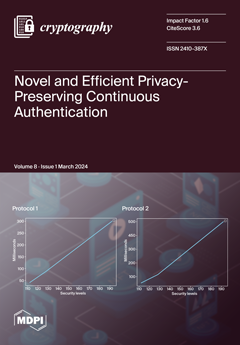
Cover Story: Continuous authentication enhances security by re-verifying a user’s validity during an active session. It utilizes data about users’ behavioral actions and contextual information to continuously authenticate them. Such data contain information about user-sensitive attributes, such as gender, age, and contextual information, and may also provide information about a user’s emotional states. In this paper, we propose two efficient protocols that enable privacy-preserving continuous authentication. This contribution aims to prevent the disclosure of user-sensitive attributes using partial homomorphic cryptographic primitives and to reveal an aggregated result without the explicit use of decryption. The protocols complete an authentication decision in a single, unidirectional transmission and have very low communication and computation costs with no degradation in biometric performance. View this paper
  • Issues are regarded as officially published after their release is announced to the table of contents alert mailing list .
  • You may sign up for email alerts to receive table of contents of newly released issues.
  • PDF is the official format for papers published in both, html and pdf forms. To view the papers in pdf format, click on the "PDF Full-text" link, and use the free Adobe Reader to open them.

Articles (11)

  • Article
  • Open Access
4 Citations
3,784 Views
16 Pages

Lookup Table-Based Design of Scalar Multiplication for Elliptic Curve Cryptography

  • Yan-Duan Ning,
  • Yan-Haw Chen,
  • Cheng-Sin Shih and
  • Shao-I Chu

This paper is aimed at using a lookup table method to improve the scalar multiplication performance of elliptic curve cryptography. The lookup table must be divided into two polynomials and requires two iterations of point doubling operation, for whi...

  • Article
  • Open Access
3 Citations
2,677 Views
10 Pages

Priced oblivious transfer (POT) is a cryptographic protocol designed for privacy-preserving e-commerce of digital content. It involves two parties: the merchant, who provides a set of priced items as input, and a customer, who acquires one of them. A...

  • Article
  • Open Access
3 Citations
3,762 Views
15 Pages

Cryptographic primitives nowadays are not only implemented in high-performance systems but also in small-scale systems, which are increasingly powered by open-source processors, such as RISC-V. In this work, we leverage RISC-V’s modular base in...

(This article belongs to the Special Issue Feature Papers in Hardware Security II)
  • Article
  • Open Access
12 Citations
6,005 Views
28 Pages

The suggested solution in this work makes use of the parallel processing capability of FPGA to enhance the efficiency of the K-Nearest Neighbor (KNN) algorithm on encrypted data. The suggested technique was assessed utilizing the breast cancer datase...

  • Article
  • Open Access
25 Citations
9,550 Views
24 Pages

Critical Infrastructures (CIs), such as healthcare facilities, power grids, transportation systems, and financial institutions, are vital components of a functioning society, with the economy and safety being dependent on them. Nevertheless, they hav...

  • Article
  • Open Access
10 Citations
7,253 Views
22 Pages

Privacy-Preserving Multi-Party Cross-Chain Transaction Protocols

  • Chang Chen,
  • Guoyu Yang,
  • Zhihao Li,
  • Fuan Xiao,
  • Qi Chen and
  • Jin Li

Cross-chain transaction technologies have greatly promoted the scalability of cryptocurrencies, which then facilitates the development of Metaverse applications. However, existing solutions rely heavily on centralized middleware (notary) or smart con...

(This article belongs to the Section Blockchain Security)
  • Review
  • Open Access
11 Citations
12,218 Views
25 Pages

Pervasive User Data Collection from Cyberspace: Privacy Concerns and Countermeasures

  • Yinhao Jiang,
  • Mir Ali Rezazadeh Baee,
  • Leonie Ruth Simpson,
  • Praveen Gauravaram,
  • Josef Pieprzyk,
  • Tanveer Zia,
  • Zhen Zhao and
  • Zung Le

The increasing use of technologies, particularly computing and communication paradigms, has significantly influenced our daily lives. Interconnecting devices and networks provides convenient platforms for information exchange and facilitates pervasiv...

  • Article
  • Open Access
4 Citations
3,864 Views
20 Pages

Conditional Privacy Preserving Authentication (CPPA) schemes are an effective way of securing communications in vehicular ad hoc networks (VANETs), as well as ensuring user privacy and accountability. Cryptanalysis plays a crucial role in pointing ou...

(This article belongs to the Special Issue Advances in Authentication, Authorization and Privacy for Securing Smart Communications)
  • Article
  • Open Access
10 Citations
5,076 Views
14 Pages

Novel and Efficient Privacy-Preserving Continuous Authentication

  • Ahmed Fraz Baig,
  • Sigurd Eskeland and
  • Bian Yang

Continuous authentication enhances security by re-verifying a user’s validity during the active session. It utilizes data about users’ behavioral actions and contextual information to authenticate them continuously. Such data contain info...

  • Article
  • Open Access
2 Citations
4,626 Views
25 Pages

Locking-Enabled Security Analysis of Cryptographic Circuits

  • Devanshi Upadhyaya,
  • Maël Gay and
  • Ilia Polian

Hardware implementations of cryptographic primitives require protection against physical attacks and supply chain threats. This raises the question of secure composability of different attack countermeasures, i.e., whether protecting a circuit agains...

(This article belongs to the Special Issue Feature Papers in Hardware Security II)
  • Article
  • Open Access
2 Citations
4,004 Views
22 Pages

Over the past decade, significant research has been performed on power side-channel mitigation techniques. Logic families based on secret sharing schemes, such as t-private logic, that serve to secure cryptographic implementations against power side-...

(This article belongs to the Special Issue Feature Papers in Hardware Security II)
XFacebookLinkedIn
Cryptography - ISSN 2410-387X