


Abstract
As we become more and more enhanced with cyborg technology, significant issues of law and policy are raised. For example, as cyborg devices implanted within the body create a class of people with enhanced motor and computational abilities, how should the law and policy respond when the abilities of such people surpass those of the general population? And what basic human and legal rights should be afforded to people equipped with cyborg technology as they become more machine and less biology? As other issues of importance, if a neuroprosthetic device is accessed by a third party and done to edit one’s memory or to plant a new memory in one’s mind, or even to place an ad for a commercial product in one’s consciousness, should there be a law of cognitive liberty or of “neuro-advertising” that applies? This paper discusses laws and statutes enacted across several jurisdictions which apply to cyborg technologies with a particular emphasis on legal doctrine which relates to neuroprosthetic devices.
1. Cyborgs, Prostheses, and Law
We are currently undergoing a “technological revolution” in the design and use of “cyborg devices” integrated into the human body. Worldwide there are millions of people equipped with “cyborg technology” ranging from prosthetic limb replacements and prosthetic hands controlled by thought [1,2], to neuroprosthetic devices implanted within the brain [3], and additionally to people equipped with heart pacers or defibrillators, retinal prosthesis and cochlear implants [4]. As people become more and more equipped with “cyborg/prosthetic” devices, important issues of law and policy are raised which result in significant challenges to established legal doctrine. As an example, what law applies to people who hack an implanted medical device, or interfere with the transmission of the wireless signals of devices worn by cyborgs [1,5]? And in an “age of cyborgs”, if third parties access another person’s neuroprosthetic device, should there be a legal cause of action for individuals suffering harm under a theory of cognitive liberty, freedom of thought, or, in some cases, privacy law? In addition, what is the relationship between legal doctrine and cyborg technologies with regard to our very sense of being; that is, as we continue to enhance ourselves with technology, should laws and statutes be enacted to safeguard our humanity, and our sense of being and identity as homo sapiens? While the focus of this paper is on the laws and statutes of the U.S., there are numerous examples of law from other jurisdictions included in the paper. We include this body of law not only for comparative purposes, but also because we view the issues of integrating cyborg technologies into the human body and mind as so important and challenging for humanity that an international response is required. On this point, it is becoming more common for a particular jurisdiction to show deference to the law(s) of other jurisdictions in dispute resolution thus adopting more of a comparative, or international, law perspective.
Interestingly, the law and policy being challenged by the use of cyborg technology has already attracted the attention of national governments; for example, in the U.S., the White House Presidential Commission for the Study of Bioethics has produced a white paper summarizing ethical, policy, and legal issues associated with advances in neuroscience [6] and in Great Britain, the Nuffield Council on Bioethics has produced a similar comprehensive paper, discussing among others, brain–computer interfaces [7]. In comparison, this paper focuses more specifically on the machine technologies used to create “cyborgs” with a discussion of major legal issues associated with emerging combinations of human and machine. Additionally, the technology used to create cyborgs as discussed in this paper are reviewed in more detail by Kevin Warwick [8] and by Woodrow Barfield and Alexander Williams [9] as part of the special edition on Cyberphenemonology: Technominds Revolution published by this journal [10].
As stated previously by the authors, the term “cyborg technology” is used to refer to technology that is integrated into the human body which not only restores lost function, but enhances the anatomical, physiological, and information processing abilities of the body [1,9]. These include anything from medical implants, such as pacemakers, to near-future brain implants modifying memory and cognitive capability. Further, we use the term “cyborg prosthesis” to refer to artificial enhancements to the body providing computational capability, which operate as a closed-loop feedback system, are upgradeable, and in some cases controllable by thought and/or implanted directly into the body itself (see generally [11]).
Any person could be considered enhanced to the degree that their implant or prosthetic device increases, by computation and/or physical augmentation, their capabilities—it is with cognitive enhancements that we are most interested and our discussion most tied. As an example of the computational capabilities provided to a human-machine combination as a function of “cyborg prosthetic devices,” consider a cochlear implant which contains a speech processor and a receiver/stimulator that sits just beneath the skin and sends signals to an electrode array positioned deep in the inner ear (this aspect of the prosthesis performs various computations). Sound in the environment is picked up by a microphone, analyzed and converted to electrical signals by the processor (again, by performing computations), and sent through the skin by a transmitter. Further, a receiver picks up the sound signals and sends them to an electrode array, which is positioned such that it can deliver patterns of electrical activity to the auditory nerve, similar to those delivered by healthy hair cells. From the perspective of increasing the information processing abilities of the person equipped with cyborg technology, there are several levels of computations occurring in this system resulting in the human sensory state of “becoming enhanced”—namely, that they can detect frequencies of sound that were the same as, or in some cases beyond, their normal range before the prosthesis.
While this paper does not include a discussion of artificially intelligent machines that gain sentience as an example of a cyborg, given the trend for artificial intelligence to become more human-like, perhaps this is another viable cyborg category. Finally, while devices such as the Cheetah prosthetic legs (which does not compute and is only externally attached) are considered by some to be a cyborg enhancement, the focus of this paper is more on devices integrated into the human body which compute, as we see such devices as the direction of our cyborg future. Additionally, given the complexity of integrating “computing devices” within the body, there are currently more non-cognitive than cognitive augmentation devices available as enhancements. We note, however, that the enhancement of cognitive functions is not only a major area of current research, but perhaps the most important aspect of the cyborg of the future.
2. Enter the Law
Current cyborgs are becoming equipped with prosthetic devices attached to their body, or even implanted within their body, for purposes which range from medical necessity to voluntary self-enhancement. Generally, we have begun to see a trend in “cyborgs” not only choosing to become equipped with implants and devices in order to restore lost functions but to, in some cases, enhance performance—be it cognitive, sensory or physical. In fact, already researchers are working to develop an artificial hippocampus to aid in memory recall and other researchers are using the technique of deep brain stimulation as an effective treatment of Parkinson’s disease [1,6,7]. Figure 1 illustrates that cyborg technology to enhance one’s body or mind, insofar as this represents the seat of a person’s “sense of being,” creates a human–machine combination which together implicate legal doctrine—an interest of this paper particularly is the area of constitutional law on freedom of thought and also more generally on privacy law. In addition, this paper provides a focused discussion of some of the main areas of law which relate to cyborg enhancement technology, with reference to our sense of being included, using the law and statutes from several jurisdictions to indicate the scope and importance of the issues implicated by the coming cyborg age.
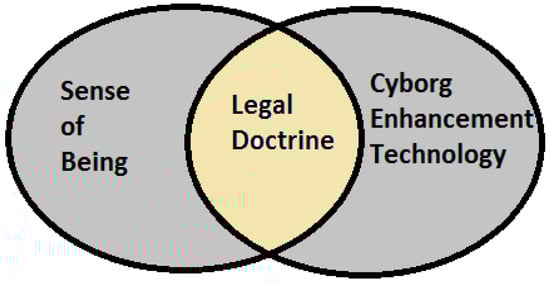
Figure 1.
As cyborg enhancement technology becomes more widespread, these technologies will influence our sense of being in that they will begin to change how we function and who we hold ourselves out to be. In response, issues of patent, copyright, and constitutional law that relates to freedom of speech and thought are particularly relevant.
As we become more equipped with cyborg technology, it is relevant to ask: What legal rights are implicated by technology that is being used to repair, upgrade, and enhance the human body and mind? As examples, consider a prosthetic device attached to the body or consider a neuroprosthetic device implanted in the brain. From the perspective of the law, such devices receive intellectual property protection under patent statutes, and the software associated with such devices receive copyright protection (see generally [1]). Further, it may be illegal to interfere with the wireless communication from such devices, and products liability law applies to prosthesis that are defective. Within most jurisdictions, products liability law is applicable in the case of a design or manufacturing defect in a product, but if a third party purposively changes a product after it has left the manufacturer, the manufacturer may not be liable for harm resulting from a product that has been altered- this has implications for the do-it-yourself movement to self-enhance the body. Similar logic would apply to a neuroprosthetic device implanted within the brain, although it seems less likely that someone would change the physical design of the device, although the software controlling the device could be wirelessly accessed and edited. At any rate, once cyborg devices are viewed by a person as part of their body and very being, the distinction between rights for property versus rights for humans becomes blurred and thus doubly important.
Additionally, regarding the procedures to attach cyborg devices to the body or to implant them within the body, if there is negligence which results in harm to the person, medical malpractice may be a valid cause of action. But what if the issue of negligence involves software, and if so, is there still a viable cause of action to pursue under tort law? And for purposes of public safety, a government agency may regulate the use of cyborg technology and decide whether it can be introduced to the public as a consumer product or medical device. Furthermore, constitutional law issues, such as the right to privacy and search and seizure law, may be implicated if the government tracks, without acquiring a warrant, a person by accessing their prosthesis to collect private information or tracking data. It should be clear from the above list, which is certainly incomplete, that there are a host of timely and challenging legal issues which apply to cyborg devices—especially when they begin to intimately influence our most personal spheres of mind and body.
Interestingly, this emerging area of “cyborg law” (the regulation of technology relating to the body) has recently become a topic of interest for legislators, courts, and judges. For example, in Riley v. California [12], Supreme Court justices in the U.S. unanimously ruled that police officers may not, without a warrant, search the data on a cell phone seized incident to an arrest. The case had an interesting connection to cyborg law in that the Chief Justice declared that “modern cell phones…are now such a pervasive and insistent part of daily life that the proverbial visitor from Mars might conclude they were an important feature of human anatomy” [12]. In the U.S., this may be the first time the Supreme Court has contemplated the concept of a cyborg in case law, although as dicta. But the idea that the law will have to accommodate the integration of technology into the human body has actually been considered for some time—one example being disability law in employment settings.
2.1 Enter Regulatory Agencies
Based on medical necessity, which is a main factor motivating the need for cyborg technology, much of the current legal code regarding prostheses and implants are those that regulate medical products to ensure public safety—in several jurisdictions these laws are usually nested under disability, public welfare acts, or government agencies which regulate the design and use of medical devices. For example, in the U.S., under the Federal Food, Drug, and Cosmetic Act, the Food and Drug Administration (FDA) exercises regulatory authority over medical devices, including prostheses and implants [13]. Under this act, devices are divided into classes based on their potential health risk and level of involvement in maintaining patient health. The least restrictive of these classes require little or no formal FDA approval while the most restrictive require clinical safety studies before the product can be sold on the market. Of course, we should point out the do-it-yourself hackers self-implant technology under their skin, with no medical professional involved, completely circumventing the legal scheme for insuring public safety.
South Korean legislation on “cyborg-like” devices is similar to that of the U.S. in that it has a tiered classification system for regulating medical devices but in addition, regulates the use of “good manufacturing practices”. Supervisory control is through the Ministry of Health and Welfare, which has overall authority and specifically enacts regulations for prostheses under the Disabled Persons Welfare Act. Additionally, another South Korean agency, the Ministry of Food and Drug Safety, regulates pharmaceuticals and medical devices (including implants) through the Medical Devices Law and the Pharmaceutical Affairs Law [14]. Similarly, the Japanese system, under the aegis of the Pharmaceutical and Medical Device Agency, classifies medical devices by risk level as well as by imposing certain manufacturing standards in order to protect the public health. And in the European Union (EU), a directive on Active Implantable Medical Devices along with directives on Machinery and Medical Devices provide the framework for ensuring public safety in regards to prostheses [15]. Among some jurisdictions, prostheses and non-medical implants may not be directly mentioned in the legal code and when they are, they are often considered reconstructive and not elective enhancements.
It may be useful to relate the discussion of regulating cyborg technologies to the regulation of robotics which are gaining in intelligence and in some cases becoming more human-like in appearance. Thus far, as with cyborg medical devices, many issues of law which relate to robotics, such as safety and products liability are litigated successfully under tort law. But as robots gain in intelligence, the law is far more challenged, for example, determining liability when a person is harmed by a robot operating autonomously from a human begs the question of who is responsible for the injury? And as the robot becomes more “human-like” and as humans become more “cyborg-like” it become more difficult to think of the machine-parts integrated into the body of a cyborg as separate from the biological-parts—this distinction has implications, among others, for the law of property, bodily integrity, and criminal law. Given that robotic and cyborg components are in some cases similar in design and function, it is relevant in a discussion of cyborgs and law to examine the approach being undertaken by governments to regulate emerging robotic technologies (which in some cases can be thought of as the “robotics part” of a cyborg) to gain insight into how cyborgs (with “robotic abilities”) may be regulated by governments. Thus, while robotics and cyborgs may be considered as two different entities under the law, the technologies associated with each are in some cases similar, so laws and regulations regarding robotics may be helpful in developing the legal framework for cyborgs enhanced with similar technology (and vica verse). For example, improvements in the algorithms for robot computer vision and problem solving abilities will also assist those receiving cyborg technology suffering from brain injuries, Alzheimer’s disease, or loss of vision.
At the very least, discussions on robotics open the door for discussions on cyborgs and can illustrate official, national dispositions towards future technologies and their support within the government, both financial, ethical, and legal. For example, in the U.S., the Presidential Commission for the Study of Bioethical Issues advises the U.S. executive branch on the ethics and current direction of biotechnology, artificial intelligence, and neuroscience research [16]. Additionally, the EU finished a related project regarding the law and ethics of emergent robotics in 2014 entitled Regulating Emerging Robotic Technologies in Europe: Robotics Facing Law and Ethics (RoboLaw) [17]. This comprehensive document explores the current legal state, ethical implications, and industry impact of robotics and other technologies and their future development [18]; in our view, the same approach and level of government interest should be employed for cyborg technologies which are creating various human-machine combinations.
“RoboLaw” recommends, among other things, that the EU relax and make more transparent its regularity conditions in order to promote competitive growth in the field [15,17]; a similar approach may be used to spur investments in cyborg technology. Additionally, South Korea has implemented a strong push towards future (robot) technological development in the Intelligent Robots Development and Distribution Promotion Act [19]. In this Act, South Korea has established building an intelligent robot industry as a national strategic goal. Measures include financial incentives for research and development, and the founding of the Robot Industry Promotion Institute to act as policy support, and even the creation of a hi-tech robot-centered theme park. We postulate that governments will also view the creation of cyborgs as an essential national strategy for competitiveness, and regulate to spur research in this area.
As the above discussion indicates, issues of emerging technologies development are being considered by government regulatory agencies in different jurisdictions, but often as discussions on related, but non-cyborg technologies. The conclusions and recommendations of high-level governmental committees, even when not specifically applied to this topic, can be helpful in anticipating national inclinations towards cyborg development and acceptance. However, other legal doctrine, as discussed below, offer more specific laws relating to cyborg technology.
3. Legal Protection for Enhanced Brains
We begin this section of the article with the law that applies to the computing technology that is just beginning to be used to enhance minds, that is, the chips and software comprising neuroprosthetic devices and other implants. We note that the chips implanted in one’s mind, and the software associated with such technology, represents the state-of-the-art in the technology being developed to enhance the cognitive capabilities of a cyborg. As an example, consider the development of a neuroprosthesis, such as an artificial hippocampus which is being designed to restore and enhance one’s memory (see generally [6,9,16]). A neuroprosthesis has strong potential to not only alleviate the damage to the brain from disease or injury, but to enhance the brain with superior abilities, such as to download information from the internet, to engage in thought-to-thought communication, and edit memories [1,9]. When computer chips are integrated into a neuroprosthesis, in our view they become a component of the architecture of a “cyborg brain” (which represents the integration of human–machine parts) and thus assist the brain in performing information processing which contributes to the functions of a technologically enhanced mind.
Of particular importance to our cyborg future, and particularly for technologically enhanced minds, is that copyright law extends to programs stored on chips. This means that programs stored on a chip implanted into a cyborg0enhanced brain have rights under copyright law that are not afforded to the architecture of natural brains; that is, individual neurons or groups of neurons and their synaptic connections are not copyright protected, yet software (controlling an implant) is. Generally, under intellectual property law, objects that are considered “utilitarian” are not the subject of copyright protection and chips are clearly utilitarian in function. But in the U.S., the issue of copyright protection for software encoded on chips was decided in the case of Apple Computer, Inc. v. Franklin Computer Corp. [20]. In this case, the court rejected the argument that software encoded on chips was to be considered “utilitarian” and thus not copyright protected noting the medium on which the program is encoded (for our discussion the medium could be a neuroprosthesis) should not determine whether the program itself is protected under copyright law [20]. This case has immense implications for a law of cyborgs, as it was the first time an appellate level court in the U.S. held that a computer’s operating system could be protected by copyright. As a second area of importance for a law of cyborgs, the ruling clarified that binary code, the machine-readable form of software, was copyrightable too (as is the human-readable source code form of software). Thus, the software aspects of a neuroprosthesis receives copyright protection. This allows for the possibility of legally protected thought or modes of thinking, if thoughts pass through and are stored on these chips and their programs make substantive impact on the brain’s though process.
To provide legal protection for the hardware components of the cyborg brain, we could look to rights under patent law to grant a limited monopoly to the designer of these architectures. This notion has interesting implications for our future as cyborgs. Would an artificial hippocampus which stores memory be patent protected and thus be “under the control” of the inventor(s) of the neuroprosthesis, or would the rights to such devices attach to the cyborg equipped with the device? Additionally, would a person with a neuroprosthesis need to agree to the terms of a license to receive software upgrades to their prosthesis (which is an artificial surrogate for the mind) and how would potential service contracts be drawn? As a public policy question—should any aspect of the brain be protected by a patent, copyright, or license to a third party, or would this, the loss of control over one’s memories and thought processes to a third party, not only be bad policy but an egregious human rights violation? In our view, any laws limiting one’s freedom of thought or granting a third party a limited monopoly over the “artificial” structures of the mind, should receive the highest scrutiny by courts.
We next consider in more detail integrated circuits as components of the technology integrated into a cyborg brain. Given that integrated circuits create microprocessors and sensors, and at the chip level process algorithms, they play a significant role in technologies to enhance the mind. Provided that the design of integrated circuits display satisfactory inventiveness and meets the required standard of uniqueness, at first glance, patent protection is a viable option for the protection of these devices. However, in actuality, the lion’s share of integrated circuit design is considered obvious under most patent systems given that they lack any improvement (inventive step) over their predecessors (prior art) [21]. Further, integrated circuits are comprised of numerous building blocks, and each “building block could potentially be patentable. However, since an integrated circuit contains literally thousands of semiconductor devices, a patent claim to an integrated circuit would have to cover many individual elements—this would be the equivalent of trying to write a patent on the neuronal circuits of one structure of a natural brain; extremely tedious to say the least. Consequently, a patent claim that attempts to describe an entire integrated circuit would be hundreds of pages long. Clearly, such a narrow claim under patent law would provide almost no protection for the architecture of a cyborg brain at the semiconductor level.
As indicated by attorney Rajkumar Dubey, it could take several years to obtain an integrated circuit patent from most patent offices worldwide. This is unacceptable given that an integrated circuit’s useful commercial life may be “less than one year” [22]. To place this comment in context for this article, what if the same principle of obsolescence (e.g., consider the cycle time for new smart phones and other information technologies) applied to the human brain such that every one to two years a patent had to be filed to protect the neuronal circuitry of their brain? (This comment is included to spur the discussion, obviously, neurons form new synaptic connections constantly as the brain learns.) Imagine that in the coming cyborg age, the human brain is equipped with neuroprosthesis with billions of integrated circuits. That is, the architecture of enhanced brains could become obsolete every two years or so due to the necessity of having to integrate (or update) new technology within the brain. The time-consuming nature of patent filing combined with narrow protection would seem to make patent law an insufficient form of protection for the integrated circuit components of a cyborg’s brain (actually, the essential issue may be providing intellectual property protection for the algorithms performing computations “in the mind”). But surely, providing legal protection for the physical components comprising the architecture of a cyborg-enhanced brain is a necessary part of an emerging law of cyborgs. It is congruent to the idea of protecting “bodily integrity” for humans—an idea already established in some jurisdictions [23] and reasonable to assume.
In the U.S. and other jurisdictions, there is another type of legal protection which applies to brains enhanced with computing technology—legislation specifically applied to integrated circuits, which in the U.S. is the Semiconductor Chip Protection Act [24]. Given the importance of protecting integrated circuits from piracy, several nations, including Japan and the European Community have followed the example set in the U.S. and endorsed their own similar statutes and directives recognizing and protecting integrated circuit designs (also referred to as the “topography of semiconductor chips”). In 1989, a Diplomatic Conference among nations was held, at which the Treaty on Intellectual Property in Respect of Integrated Circuits (IPIC Treaty) was partially integrated by reference into the Agreement on Trade-Related Aspects of Intellectual Property Rights (TRIPS) of the World Trade Organization (WTO) [25]. TRIPS is an area of intellectual property law that covers, in summation: copyright and related rights (i.e., the rights of performers, producers of sound recordings and broadcasting organizations); trademarks including service marks; geographical indications, including appellations of origin; industrial design; patents including the protection of new varieties of plants; the layout-designs of integrated circuits; and undisclosed information including trade secrets and test data [26].
As noted, the main purpose of semiconductor chip protection Acts is to prohibit “chip piracy”—the unauthorized copying and distribution of semiconductor chip products copied from the original creators of such works. But such Acts could also provide protection for the architecture of a brain enhanced with cyborg technology given that it is constructed with, among other things, integrated circuits. The use of computer chips in heart pacers, brain–computer interfaces, and neuroprosthetic devices allows computing resources to be directed at activities such as the use of thought to control prosthetic devices, and, ultimately, to restore and enhance memories and other cognitive performance. Protecting such devices from piracy will be an important aspect of any legal scheme directed at cyborg enhanced brains.
According to the U.S. Semiconductor Chip Protection Act, integrated circuit design rights exist when they are created, just like copyright protection, which unlike patents, can only confer rights after application, examination, and issuance of the patent. This aspect of protection—rights conferring upon creation of the integrated circuit architecture of a neuroprosthesis, combined with copyright protection for software—means that the architecture and software of cyborg brains receives protection under current legal schemes. However, just considering chip protection acts, the exclusive rights afforded to the owners of integrated circuit designs are more restricted than those afforded to both copyright and patent holders. Modification (derivative works), for example, is not an exclusive right for owners of integrated circuit designs (this has implications for mind uploads). Furthermore, the exclusive right granted to a patentee to “use” an invention, cannot be used to exclude an independently produced identical integrated circuit design. Thus, reproduction for reverse engineering of an integrated circuit design is specifically permitted by most jurisdictions; does this suggest one can reverse engineer the synaptic structure of another person’s “cyborg brain” without consequences under the law?
Legal schemes must also consider the issue of protecting a cyborgs’ active memories as programs are stored and loaded on different physical devices implanted within the brain. Memory chips such as an EPROM chip (erasable reprogrammable read only memory), are chips that retain their data when its power supply is switched off. EPROM chip topographies are protectable under the U.S. Semiconductor Chip Protection Act, but such protection does not extend to the information stored on the chips, such as computer programs. Such information is protected, to the extent that it is, by copyright law. Interestingly, in the U.S. the Court of Appeals for the Ninth Circuit in MAI Systems Corp. v. Peak Computer, Inc., [27] held that loading software into a computer’s random access memory (RAM) created a “copy’” and a potentially infringing “reproduction” under the U.S. Copyright Act. What that holding meant is that even if no hardcopy was made, temporally storing a program in RAM was a reproduction and potentially infringing act. So turning on a computer constitutes a reproduction of the operating system programs because they are automatically stored in RAM whenever the computer is activated, or for that matter whenever a file is transferred from one computer network user to another. However, while the MAI court held that the program temporarily stored in RAM represents a reproduction, the U.S. Congress subsequently enacted an amendment to the Copyright Act to specifically carve out exceptions to this court decision in several circumstances [27,28].
Privacy and protection-of-self issues may arise if a cyborg chip’s program involves loading a thought, or some other aspect of cognition, into memory hardware, especially if proper legal considerations are not in place. Laws which establish that loading a program can indeed infringe copyright place into question thought-to-thought communication wherein files protected by copyright are copied when stored within another’s mind; these and other issues will need to be resolved in the near future.
4. Towards Cognitive Liberty for Enhanced Minds
The potential that brain implant technology used to enhance the capabilities of the brain, could be hacked raises the question of what rights people have to the veracity of the sensory information transmitted to their brain and the memories stored within the structures of their brain. Restructuring, editing, or modifying memories are aspects of cyborg enhancements awaiting future cyborgs. If third parties were able to hack the technology of brain implants, the possibility of a dystopian future for humanity cannot be underestimated. For example, a retinal prosthesis could be hacked to place images on the back of the retina that a person never saw; or in the case of cochlear implants, sounds could be transmitted to the auditory nerve that a person never actually heard [1]. Further, an artificial hippocampus could be hacked to place memories in a person’s mind for events they never experienced. What law and policy might apply to these scenarios? If the First Amendment to the U.S. Constitution blocks the government from putting words in a person’s mouth, surely it would also block the government from putting thoughts, sounds, or memories in a person’s head. Based on this observation, it is relevant to ask—if the technological ability to hack the mind is in the hands of governments and corporations, will the mind remain a bastion of privacy, safe from the preying eyes of technology? Further, if the government or a corporation can access our thoughts and edit the content of our minds, will the integrity of our mind remain under our individual control, and, if not, who then as a person are we [1,9]?
Once third parties can access a neuroprosthetic device implanted within another person’s brain, what are the implications and what could go wrong? For the latter question, not surprisingly, lots of things. For example, if a person committed a crime, and did so because someone had remotely accessed their brain and “influenced their mind” (the mens rea of a crime), would they be absolved of responsibility? Already according to law professor Jeffrey Rosen and Owen Jones, lawyers routinely order scans of convicted defendant’s brains and argue that a neurological impairment prevented the accused from controlling their actions [29,30]. In the coming cyborg age, would a software expert be called upon to examine the programming language and algorithms controlling a neuroprosthetic device to see if they had been tampered with? If so, then the mens rea for a crime could have been supplied remotely by a third party. Tampering with the software could, under some circumstances, be actionable under tort law, but also under the criminal law and possibly the statutes which regulate interfering with the transmission of an electronic communication. But the use of neuroprosthetic devices could lead to other important issues of law and policy. For example, third party access to brain implant technology could allow advertising agencies to place pop-up ads into our consciousness or allow our thoughts to be searched by the government without our even knowing it [9,29,30]. Could there be any more egregious violation of a person’s privacy than if a government or corporation scanned a person’s brain and recorded their unspoken thoughts or changed the content of their memory? Recording unspoken thoughts should be a privacy violation, an unconstitutional search and seizure, and changing the content of the mind should be a fundamental human rights violation. Table 1, which follows, summarizes some major legal schemes which relate to the concept of cognitive liberty and the use of prosthesis, both evolving areas of law for cyborgs.

Table 1.
Legal Protection of Cognitive Liberty and Prosthetic Devices for Selected Jurisdictions. In some cases, these protections apply to cyborgs with attached prosthetic devices and only in a limited manner to “cyborg minds,” but hold the potential to be leveraged to use in that arena.
It is not currently possible to directly recover the visual or auditory information stored in a person’s brain, that is, their resultant neuroactivity from perceiving the world. However, this could become a future possibility given the capabilities of cyborg technology, because once equipped with a technology to sense the world, a cyborg will have an electronic (or digital) record of what they viewed and heard; this conclusion is based on current trends in cyborg (and bran scanning) technology [9]. And with further developments in technology the recording of sensory experiences could extend to olfactory, gustatory, and tactile information sensed by the person. But interestingly, according to the U.S. Presidential Commissions on Bioethics [6,16] and the Nuffield report [7] the ability to record thoughts in a distinct possibility in the foreseeable future. In the context of cyborgs equipped with neuroprosthesis to sense the world, would courts be able to subpoena the data stored on the prosthesis to use as evidence in court (see generally [29,30])? This question implicates rights afforded to individuals by constitutional law in several jurisdictions, not the least of which in the U.S. is the Fifth Amendment’s right against self-incrimination in a criminal proceeding.
Interestingly, future cyborgs could have the capability to have “non-human” senses, such as ultra-sonic hearing or infrared vision (see [1,9]). For example, Professor Warwick, using an implanted chip hooked to an ultrasonic detector, was able to determine when objects were getting closer or further away by feel [31]. Applying established law to disputes involving senses which provide beyond human capabilities will surely be an interesting challenge for courts. However, there is some established law that has been used in the limited number of cases appearing before the court involving sensors. For example, in Kyllo v. United States, the U.S. Supreme Court held that the use of thermal imaging or forward looking infrared (FLIR) device from a public vantage point to monitor the radiation of heat from a person’s home was a “search” within the meaning of the Fourth Amendment, and thus required a warrant; these days, thermal sensors are standard commercial products and one’s heat signature is accessible to anyone once they are in public [32].
In the U.S., the most basic Fourth Amendment (search and seizure) question in computer cases asks whether an individual enjoys a reasonable expectation of privacy for electronic information stored within those computers (or other electronic storage devices) under the individual’s control. Under Katz. v. United States [33], the test used by the Court to determine privacy rights when a government actor is involved is whether the person exhibited a reasonable expectation of privacy and whether the expectation of privacy was one society was prepared to recognize. For example, do individuals have a reasonable expectation of privacy for the contents of their computers and disk storage devices, and, by analogy, for data stored on a neuroprosthetic device? If “yes”, then the government ordinarily must obtain a search warrant based on probable cause before it can access the information stored inside. Because individuals generally retain a reasonable expectation of privacy in the contents of closed containers, they also have an expectation of privacy in data held within electronic storage devices (which is any medium that can be used to record information electronically) (see generally [29,30,32,33]). Would the same conclusion hold for cyborgs equipped with neuroprosthetic devices storing data in the form of memories; clearly, the answer should be yes. Further, would it make a difference if the information was in the form of software or algorithms (and not neural circuits), and comprised part of the actual structure of the mind?
In our view, the “privacy of the mind”, whether enhanced with technology or not, should receive the highest protection by the courts. If confronted with the issue of determining whether a cyborg has a reasonable expectation of privacy for the information stored on a neuroprosthetic device, based on precedence as discussed above, U.S. courts may (at the minimum) analogize the neuroprosthetic device to that of a closed container such as a briefcase or file cabinet [34,35]. However, as prosthetics are more and more accessible by the internet, this analogy may “break down” and new law will need to be enacted to protect the “privacy of a mind” wirelessly connected to a network. Additionally, future cyborgs may be able to link their minds together which will further erode the “closed container” analogy for a neuroprosthetic device; however, this example just illustrates the need for solid policy and appropriate law to handle such situations. Clearly a mind cannot be opened in the physical sense, but in the future, its contents could be accessed with the appropriate sensor technology. While we argue for stronger protection, it seems reasonable that at minimum courts view the act of scanning files stored on a neuroprosthetic device with the metaphor of a file cabinet, closed to the outside world, and that in the U.S. the Fourth Amendment would protect (i.e., require a search warrant) the content stored on a neuroprosthetic device [29,30].
As the technology to access the mind matures, governments could punish a person not only for the actual spoken expression of their thoughts, but just for formulating a thought contrary to enforced dogma. On this point, law scholar Jeffrey Rosen of George Washington University, wonders whether punishing someone for their thoughts rather than their actions would be a violation of the U.S. Constitutions Eight Amendments ban on cruel and unusual punishment [29]? This is not an observation relevant only to the plot of a science fiction novel, because before centuries end, futurists and others argue that it will be technologically possible for governments and corporations to access brain-implants to edit the long-term memories representing a person’s life experiences. Surely, using technology to access and edit a person’s memory of an actual lived experience would be actionable under the law—a trespass, an assault and battery, or even extortion [1]. On this last point, former Secret Service agent Marc Goodman worries that holding people’s memory hostage could in the future be a form of extortion [5]. Therefore, for reasons of ensuring freedom of the mind in the coming cyborg age, it is imperative that the human body and mind be considered sacrosanct; to invade a person’s mind without their consent should be an egregious human rights violation and punishable under criminal law statutes.
5. Freedom of Thought for Technologically Enhanced Minds
Cognitive liberty (see Table 1), or the “right to mental self-determination”, is a vital part of international human rights law and is especially relevant in an age of technologically enhanced minds. For example, in the Universal Declaration of Human Rights, which is followed by member states of the International Covenant on Civil and Political Rights, freedom of thought is protected under Article 18 which states: “Everyone has the right to freedom of thought, conscience and religion…” [36]. Clearly, maintaining cognitive liberty in an age of brain implants should be a major societal objective as humanity moves closer to a cyborg future and eventual human–machine merger [1,37]. In fact, a growing number of legal theorists see cognitive liberty as an important basic human right and argue that cognitive liberty is the principle underlying a number of recognized rights within the constitutions of most industrialized nations; freedom of speech being an example [37].
Interestingly, from a jurisprudence perspective, the definition of what constitutes speech is not straight forward; clearly “cyborg telepathic communication” will raise a host of issues which will stress current law. In fact, the courts have identified different types of speech often protected with different levels of scrutiny by the courts. This means that depending on the type of speech, the government is more or less empowered to restrict that speech. However, numerous jurisdictions offer their citizens freedom of speech as a constitutional right. For example, in Japan, freedom of speech is guaranteed by Chapter III, Article 21 of the Japanese Constitution [38]. In Europe, the European Convention on Humans Rights guarantees a broad range of human rights to inhabitants of member countries of the Council of Europe, which includes almost all European nations. These rights include Article 10, which entitles all citizens to free expression [39]. Echoing the language of the Universal Declaration of Human Rights, Article 10 provides that: “Everyone has the right to freedom of expression. This right shall include freedom to hold opinions and to receive and impart information and ideas without interference by public authority and regardless of frontiers” [39]. Freedom of speech is not total, however, and often comes with qualification barring certain subjects of speech, such as sedition.
In the U.S., one type of speech recognized by courts is symbolic speech which is a legal term used to describe actions (not spoken language) that purposefully and discernibly convey a particular message or statement to those viewing it. Of particular relevance for cyborg technology is the category of “pure speech” which is the communication of ideas through spoken or written words or through conduct limited in form to that necessary to convey the idea. In the U.S., the prior restraint of speech is prohibited under the First Amendment so the prior restraint of thought would be more egregious as thought is a precursor to spoken speech The courts have generally provided strong protection of pure speech from government regulation; and past cases in this area could serve as legal precedence for “cyborg speech’ consisting of wireless telepathic communication. In the future, perhaps the court should recognize a new form of speech—cyber speech, the conveyance of ideas using thought alone; if so, what level of scrutiny by courts would it receive?
Neuroprosthetic devices may enhance the process of thinking, and in numerous cases, the U.S. Supreme Court has recognized freedom of thought as a fundamental right, describing freedom of thought as: “... the matrix, the indispensable condition, of nearly every other form of freedom…” [40]. Without freedom of thought, the First Amendment right to freedom of speech is moot, because you can only express what you can think. Constraining or censoring how a person thinks (i.e., cognitive censorship) is the most fundamental kind of censorship, and is contrary to some of our most cherished constitutional principles. Supporters of cognitive liberty seek to impose both a negative and a positive obligation on states: to refrain from non-consensually interfering with an individual’s cognitive processes, and to allow individuals to self-determine their own “inner realm” and control of their own mental functions [41].
The above mentioned first obligation on a state to protect cognitive liberty directly applies to government access to neuroprosthetic devices, and would also seek to protect individuals from having their mental processes altered or monitored without their consent or knowledge. Though cognitive liberty is often defined as an individual’s freedom from state interference with their cognition, Jan Bublitz and Reinhard Merkel of the University of Hamburg, suggest that cognitive liberty should also prevent other non-state entities from interfering with an individual’s mental “inner realm” [42]. Of relevance for an emerging law of cyborgs, Bublitz and Merkel propose the introduction of a new criminal offense punishing interventions interfering with another’s mental integrity by undermining mental control or exploiting pre-existing mental weakness [41]. And that “…direct interventions that reduce or impair cognitive capacities such as memory, concentration, and willpower; alter preferences, beliefs, or behavioral dispositions; elicit inappropriate emotions; or inflict clinically identifiable mental injuries would all be prima facie impermissible and subject to criminal prosecution” [41]. Weighing in, Wyre Sententia of the Center for Cognitive Liberty and Ethics also expressed concern that corporations and other non-state entities might utilize emerging neurotechnologies to alter individuals’ mental processes without their consent [42].
While one obligation of a state is to refrain from non-consensually interfering with an individual’s cognitive processes, another right, to think however a person wants, seeks to ensure that individuals have the freedom to alter or enhance their own consciousness; one way to do this, perhaps controversially, would be by stimulating the pleasure centers of the brain by accessing a neuroprosthetic device. An individual who enjoys this aspect of cognitive liberty has the freedom to alter their mental processes in any way they wish to; whether through indirect methods such as meditation or yoga, or more directly through neurotechnology. This element of cognitive liberty is of great importance to proponents of the transhumanist movement, a key tenet of which is the enhancement of human mental function.
6. Litigating Cognitive Liberty
The U.S. Supreme Court heard arguments on an important case that dealt directly with issues related to the cognitive liberty of the mind. Even though the means to alter the mind in the seminal case was not the type of “cyborg technology” we describe in this paper, the effect was similar: a modification of the mind- in this case, the chemistry of the mind. As background, the defendant, Dr. Charles Sell, was charged in a U.S. federal court with submitting false claims to health insurance companies resulting in counts of fraud and money-laundering [43]. Dr. Sell had previously sought psychiatric help and had voluntarily taken antipsychotic drugs; however, he found the side effects intolerable. After the initial charge, Dr. Sell was declared incompetent to stand trial (but not dangerous), as a result, an administrative hearing was held and it was decided that Dr. Sell could be forcibly drugged to regain mental competence; a decision Dr. Sell challenged. The decision by the government to force Dr. Sell to take medication which would change his mental processes raised significant Constitutional law issues. On this point, Professor Lawrence Tribe of Harvard University had previously commented, “whether the government decides to interfere with our mental autonomy by confiscating books and films or by denying us psychiatric medications; ‘the offense’ is ultimately the same: government invasion and usurpation of the choices that together constitute an individual’s psyche” [44].
Could a person who did not pose a danger to another be forcibly injected with antipsychotic medication solely to render him competent to be tried for crimes that were described as “nonviolent and purely economic” by Judge Kermit Bye of the U.S. 8th Circuit Court? If so, by extension, could the government “edit” the information on a prosthesis to restore a person to a level of competency to stand trial? In Dr. Sell’s case, the government sought to directly manipulate and modify Dr. Sell’s thought processes by forcing him to take mind-altering antipsychotic drugs. Generally, the government can forcibly administer drugs only “in limited circumstances.” In Dr. Sell’s holding, the Court imposed stringent limits on the right of a lower court to order the forcible administration of antipsychotic medication to a criminal defendant who had been determined to be incompetent, if for the sole purpose of making him competent and able to be tried. Thus, since the lower court had failed to determine that all the appropriate criteria for court-ordered forcible treatment had been met, the order to forcibly medicate the defendant was reversed. Several aspects of the case are worrisome in the context of cyborg technology, namely that the court did not hold that giving the defendant medication to influence the functioning of his mind was inappropriate under all circumstance. Thus the question: could the same be true for manipulating the components of a neuroprosthesis, or altering its software if the defendant was a cyborg? If so, then we have opened up the possibility that the government could have sweeping powers over the functioning and by extension contents of our mind. Our view is that, in the backdrop of constitutional rights to free thought, this outcome is unacceptable and furthermore should be a basic human rights violation.
A similar case in the U.K., R v. Hardison, involved a defendant who was charged with violating the Misuse of Drugs Act 1971 [45]. Hardison claimed that his cognitive liberty was safeguarded by Article 9 of the European Convention on Human Rights. Specifically, the defendant argued that “individual sovereignty over one’s interior environment constitutes the very core of what it means to be free,” and that because psychotropic drugs are a method of altering an individual’s mental process, prohibition of them under the Misuse of Drugs Act was in opposition to Article 9. The court however disagreed, and denied Hardison’s right to appeal to a superior court.
Marc Blitz of the Oklahoma City University School of Law has written extensively on the subject of freedom of thought and emergent technologies. In his paper Freedom of Thought for the Extended Mind: Cognitive Enhancement and the Constitution [46], professor Blitz explores the philosophical and constitutional framework for emerging laws governing neuroprosthesis, psychopharmacology, and other forms of elective mental self-modification:
“In sum, these arguments indicate that freedom of thought should not only protect our (naturally protected) ability to engage in reflection. It should also lead courts to identify and protect technologies and resources that support mental autonomy and externalized thought. In this respect, free thought should parallel free speech”.[46]
Summarizing the discussion in this section of the paper, freedom of speech is a protected right in the United States and other jurisdictions and if strong philosophical and phenomenological parallels can be drawn between it and freedom of thought and cognitive liberty, then there will be a constitutional basis from which to build a legal framework for our cyborg future. With that in mind, the Figure 2 highlights major issues of cognitive liberty in an age of technological enhancements to one’s mind.
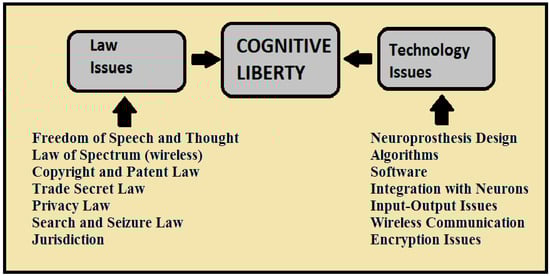
Figure 2.
Some legal and technical issues which relate to the concept of “cognitive liberty”.
7. Conclusions
From the discussion presented in this paper on “cyborg law”, we consider existing laws and statutes to be less than fully adequate to regulate and guide the development of cyborg technologies—it is clear that further legislative and judicial work is required. Some countries have taken a proactive approach and strategized for a technological future while others have debated the ethical issues created when modifying the human body and its capabilities. The existing structures of intellectual property and constitutional law provide a framework around which new cyborg technologies and their legal implications may be developed; however, when these technologies affect the core of a person’s mind, they become elevated from a procedural to an ethical and civil importance (see Figure 2 for some examples of the various factors involved). For example, neuroprosthesis—a technology deeply integrated into the body which can change the working of the mind—should be considered core to an individual’s mental functioning, and thus of great legal import. A legal and policy discussion on these topics should happen sooner rather than later.
As we move deeper into the 21st century, the speed of technological advances is undoubtedly accelerating. Efforts to reverse engineer the neural circuitry of the brain are opening the door for the development of cyborg devices which may be used to enhance the brain’s capabilities. In fact, neuroprosthetic devices are being created now which can serve to restore lost cognitive function or, in the case of techniques such as transcranial brain stimulation to provide therapeutic help for those with depression [40]; within a few decades, even more cyborg technology will exist to enhance cognitive functioning. That is to say, we are on the cusp of creating a class of people which would resemble sci-fi versions of cyborgs in popular media, people with “computer-like” brains connected to the internet communicating wirelessly by thought. Such developments will surely challenge current legal doctrine and established public policy [39,40]. Based on these observations, we need a “law of the cyborg” because without it, constitutional laws, the broad intellectual property laws, and civil protections will not cover the intricacies of this new technology—especially because it creates a new way of being and sense of self [1]. On that point, as discussed in this article, there is a current body of law which applies (albeit indirectly in many cases) to cyborg technologies. However, this body of law is insufficient and near-future cyborg technologies will surely create great challenges for established legal doctrine. In conclusion, we recommend that much more be done in the area of law and policy for cyborg technology while we still have time to chart our future in the coming cyborg age.
Author Contributions
Both authors contributed equally to this paper.
Conflicts of Interest
The authors declare no conflict of interest.
References
- Barfield, W. Cyber Humans: Our Future with Machines; Springer: New York, NY, USA, 2016. [Google Scholar]
- Ziegler-Graham, K.; MacKenzie, E.J.; Ephraim, P.L.; Travison, T.G.; Brookmeyer, R. Estimating the Prevalence of Limb Loss in the United States: 2005 to 2050. Arch. Phys. Med. Rehabil. 2008, 89, 422–429. [Google Scholar] [CrossRef] [PubMed]
- Carey, B. Chip Implanted in Brain, Helps Paralyzed Man Regain Control of Hand. 2016. Available online: http://www.nytimes.com/2016/04/14/health/paralysis-limb-reanimation-brain-chip.html?_r=0 (accessed on 14 September 2016).
- Greenspon, A.; Patel, J.; Lau, E.; Ochoa, J.; Frisch, D.; Ho, R.; Pavri, B.; Kurtz, S. Trends in Permanent Pacemaker Implantation in the United States From 1993 to 2009. J. Am. Coll. Cardiol. 2012, 60, 1540–1545. [Google Scholar] [CrossRef] [PubMed]
- Goodman, M. Future Crimes: Everything Is Connected, Everyone Is Vulnerable and What We Can Do About It; Doubleday Press: New York, NY, USA, 2015. [Google Scholar]
- Gutmann, A. Gray Matters, Topics at the Intersection of Neuroscience, Ethics, and Society. Presidential Commission for the Study of Bioethical Issues, March 2015; Volume 2. Available online: https://bioethicsarchive.georgetown.edu/pcsbi/sites/default/files/GrayMatter_V2_508.pdf (accessed on 4 September 2016). [Google Scholar]
- Nuffield Council on Bioethics. Novel Neurotechnologies: Intervening in the Brain. Available online: http://nuffieldbioethics.org/ (accessed on 23 August 2016).
- Warwick, K. Homo technologicus: Threat or opportunity? Philosophies 2016, 1, 199–208. [Google Scholar] [CrossRef]
- Barfield, W.; Williams, A. Cyborgs and Enhancement Technology. Philosophies 2017, 2, 4. [Google Scholar] [CrossRef]
- Vallverdú, J. Cyberphenomenology: Technominds Revolution. Special Issue. 2016. Available online: http://www.mdpi.com/journal/philosophies/special_isssues/cyberphenomenology (accessed on 15 September 2016).
- Manfred, E.C.; Nathan, S.K. Cyborgs and Space. Astronautics, September 1960. Reprinted in the Cyborg Handbook. Available online: Cyberneticzoo.com/wp-content/uploads/2012/01/cyborgs-Astronautics-sep1960.pdf (accessed on 2 October 2016).
- Riley v. California 573 U.S. ___ (2014). No 13-132. Available online: https://supreme.justia.com/cases/federal/us/573/13-132/ (accessed on 14 February 2017).
- 21 USC Ch.9. Federal Food, Drug, and Cosmetic Act. 360c. Classification of devices intended for human use. Available online: http://uscode.house.gov/view.xhtml?path=/prelim@title21/chapter9&edition=prelim (accessed on 14 September 2016).
- South Korea, Welfare Laws for Persons with Disabilities. Available online: https://dredf.org/legal-advocacy/international-disability-rights/international-laws/south-korea-welfare-law-for-persons-with-disabilities/ (accessed on 22 September 2016).
- European Commission. Active Implantable Medical Devices. Available online: http://ec.europa.eu/growth/single-market/european-standards/harmonised-standards/implantable-medical-devices_en (accessed on 2 September 2016).
- Presidential Commission for the Study of Bioethical Issues. US Department of Health and Human Services. Available online: https://bioethicsarchive.georgetown.edu/pcsbi/node/851.html (accessed on 3 October 2016).
- RoboLaw. Available online: http://www.robolaw.eu/ (accessed on 4 October 2016).
- European Commission. Regulating Emerging Robotic Technologies in Europe: Robotics Facing Law and Ethics. Available online: http://cordis.europa.eu/project/rcn/102044_en.html (accessed on 14 September 2016).
- Korea Legislation Research Institute. Intelligent Robots Development and Distribution Promotion Act. Available online: http://elaw.klri.re.kr/eng_mobile/viewer.do?hseq=17399&type=sogan&key=13 (accessed on 8 October 2016).
- Apple Computer, Inc. v. Franklin Computer Corp. 714 F.2d 1240 (3rd Cir. 1983). Available online: https://casetext.com/case/apple-computer-inc-v-franklin-computer-corp#! (accessed on 14 February 2017).
- Patent Statutes, U.S. Code: Title 35. Available online: https://www.gpo.gov/fdsys/pkg/USCODE-2011-title35/pdf/USCODE-2011-title35.pdf (accessed on 10 September 2016).
- Dubey, R. Semiconductor Integrated Circuits Layout Design in Indian IP Regime. 2004. Available online: http://www.mondaq.com/india/x/28601/technology/Semiconductor+Integrated+Circuits+Layout+Design+In+Indian+IP+Regime (accessed on 14 September 2016).
- Ramachandran, G. Against the Right to Bodily Integrity: Of Cyborgs and Human Rights. Denver Univ. Law Rev. 2009, 87, 1. [Google Scholar]
- Wikipedia. Semiconductor Chip Protection Act of 1984. Available online: https://en.wikipedia.org/wiki/Semiconductor_Chip_Protection_Act_of_1984 (accessed on 24 August 2016).
- Overview: The TRIPS Agreement. World Trade Organization. Available online: https://www.wto.org/english/tratop_e/trips_e/intel2_e.htm (accessed on 17 September 2016).
- Relation to the IIC Treaty. Available online: http://booksandjournals.brillonline.com/content/books/10.1163/ej.9789004145672.i-910.229 (accessed on 14 September 2016).
- MAI Systems Corp. v. Peak Computer, Inc. 991 F.2d 511 (9th Cir. 1993). Available online: https://www.law.cornell.edu/copyright/cases/991_F2d_511.htm (accessed 14 February 2017).
- 17 United States Code. § 117—Limitations on Exclusive Rights: Computer Programs. Available online: https://www.gpo.gov/fdsys/pkg/USCODE-2011-title17/html/USCODE-2011-title17.htm (accessed on 10 September 2016).
- Rosen, J. The Brain on the Stand. New York Times. 11 March 2007. Available online: http://www.nytimes.com/2007/03/11/magazine/11Neurolaw.t.html?pagewanted=all&_r=0 (accessed on 4 October 2016).
- Jones, O.D.; Wagner, A.D.; Faigman, D.L.; Raichle, M.E. Neuroscientists in Court. Nat. Rev. Neurosci. 2013, 14, 730–736. [Google Scholar] [CrossRef] [PubMed]
- Physics Central. The Cyborg Scientist. Available online: http://www.physicscentral.com/explore/action/project-cyborg.cfm (accessed on 24 August 2016).
- Kyllo v. United States. 533 U.S. 27 (2001). Available online: https://supreme.justia.com/cases/federal/us/533/27/case.html (accessed 14 February 2017).
- Katz v. U.S. 347 (1967). Available online: https://supreme.justia.com/cases/federal/us/389/347/case.html (accessed 14 February 2017).
- Cornell Law School, Legal Information Institute. Fourth Amendment Law. Available online: https://www.law.cornell.edu/anncon/html/amdt4frag3_user.html (accessed on 14 December 2016).
- U.S. Const. amend V. Available online: https://www.gpo.gov/fdsys/pkg/GPO-CONAN-1992/pdf/GPO-CONAN-1992-7.pdf (Accessed on 15 September 2016).
- The Universal Declaration of Humans Rights. Article 18. Available online: http://claiminghumanrights.org/udhr_article_18.html (accessed on 16 September 2016).
- Boire, R.G. On Cognitive Liberty: Parts I, II, III, Center for Cognitive Liberty and Ethics. Available online: http://www.cognitiveliberty.org/curriculum/oncoglib_123.htm (accessed on 18 October 2016).
- Prime Minister of Japan and His Cabinet. The Constitution of Japan. Available online: http://japan.kantei.go.jp/constitution_and_government_of_japan/constitution_e.html (accessed on 16 September 2016).
- European Union Agency for Fundamental Rights. Article 10—Free of Expression. Available online: http://fra.europa.eu/en/echr-article/article-10-freedom-expression (accessed on 3 September 2016).
- Palko v. Connecticut 302 U.S. 319 (1937). Available online: https://supreme.justia.com/cases/federal/us/302/319/case.html (accessed 14 February 2017).
- Bublitz, J.C.; Merkel, R. Crime against Minds: On Mental Manipulation, Harms, and Human Right to Mental Self-Determination. Crim. Law Philos. 2014, 8, 61. [Google Scholar] [CrossRef]
- Sententia, W. Neuroethical Considerations: Cognitive Liberty and Converging Technologies for Improving Human Cognition. Ann. N. Y. Acad. Sci. 2004, 1013, 221–228. [Google Scholar] [CrossRef] [PubMed]
- Sell v. United States 539 U.S. 166 (2003). Available online: https://supreme.justia.com/cases/federal/us/539/166/case.html (accessed on 14 February 2017).
- Tribe, L. Rights of Privacy and Personhood. Am. Constitutional Law 1988, Sec. 15–7, 1322. [Google Scholar]
- R v Hardison. 2006, EWCA Crim. 1502; [2007] 1 Cr App. R. (S) 37. Available online: http://court-appeal.vlex.co.uk/vid/200504343-c4-52563715 (accessed on 14 February 2017).
- Blitz, M.J. Freedom of Thought for the extended mind: Cognitive enhancement and the constitution. Wis. Law Rev. 2010, 1049–1118. Available online: http://works.bepress.com/marc_jonathan_blitz/17 (accessed on 10 September 2016). [Google Scholar]
© 2017 by the authors; licensee MDPI, Basel, Switzerland. This article is an open access article distributed under the terms and conditions of the Creative Commons Attribution (CC BY) license (http://creativecommons.org/licenses/by/4.0/).