
Comparing Business, Innovation, and Platform Ecosystems: A Systematic Review of the Literature

 ,
,  , , and
Abstract
1. Introduction
- RQ 1: Over the past few decades, what have been the predominant research hotspots, historical evolution trajectories, and emerging trends in the study of ecosystems?
- RQ 2: What are the defined characteristics of business, innovation, and platform ecosystems, as proposed by scholars and researchers?
- RQ 3: What shared features and distinctions can be identified among business, innovation, and platform ecosystems, and how do these aspects contribute to understanding their unique dynamics?
- RQ 4: What interconnections can be found within the realms of business, innovation, and platform ecosystems, and what are the anticipated future research issues that warrant exploration in these interconnected domains?
2. Theoretical Background
2.1. Concept of Ecosystem
2.2. The Emergence of Business, Innovation, and Platform Ecosystem
3. Methodology and Data
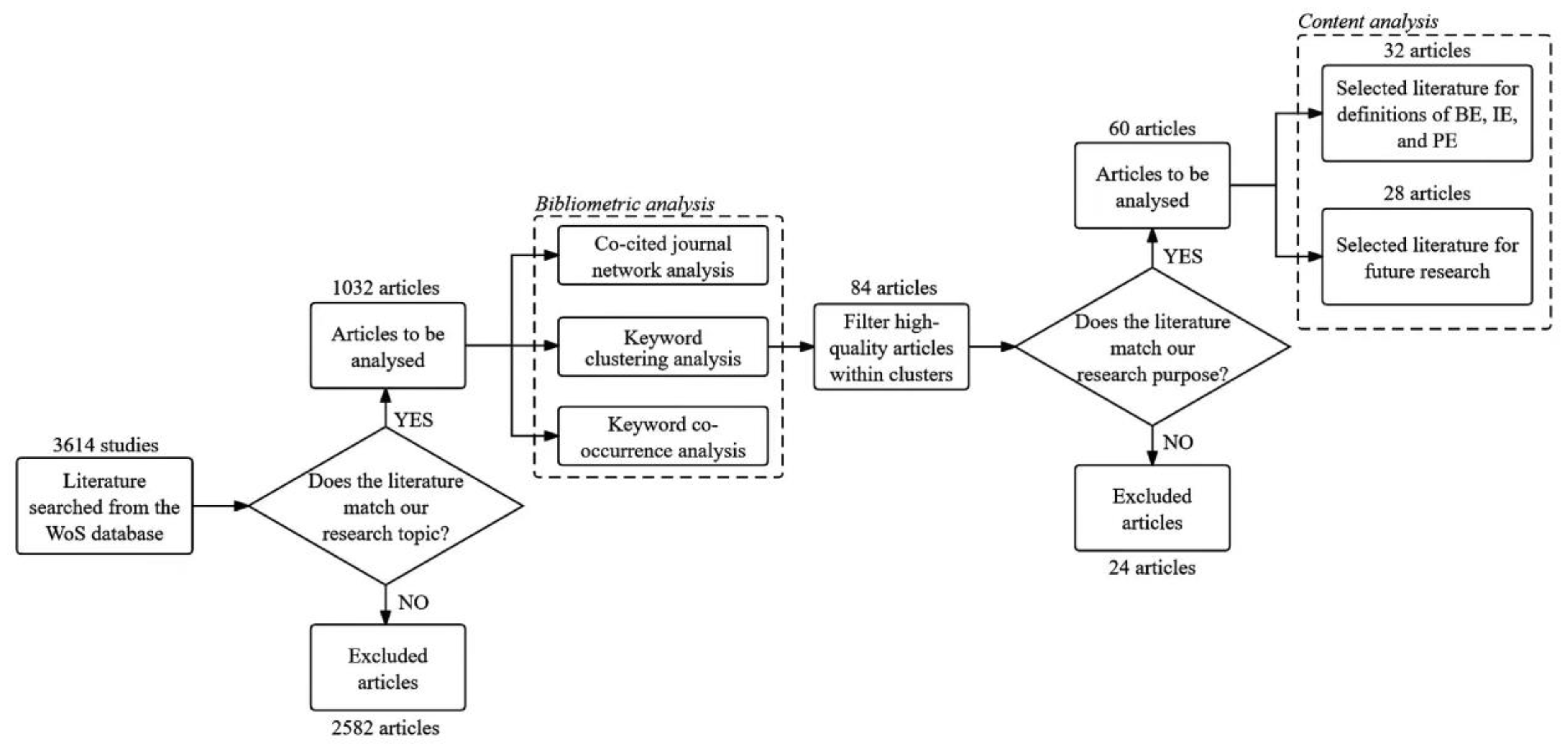
3.1. Description of the Sample
3.2. Bibliometric Analysis Procedures
3.3. Content Analysis Procedures
4. Analysis and Results
4.1. Bibliometric Analysis
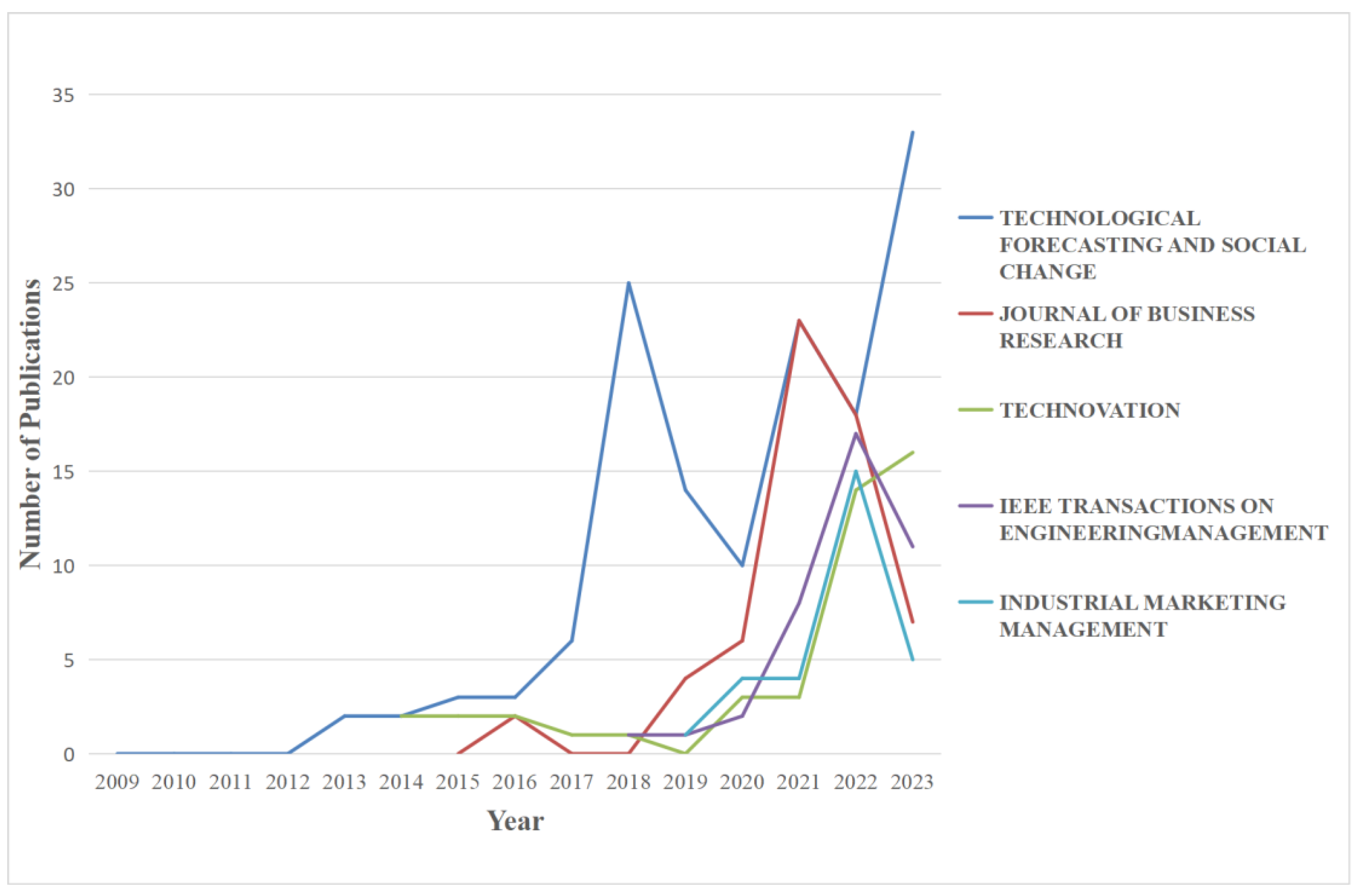
4.1.1. Current Status of Ecosystem Research
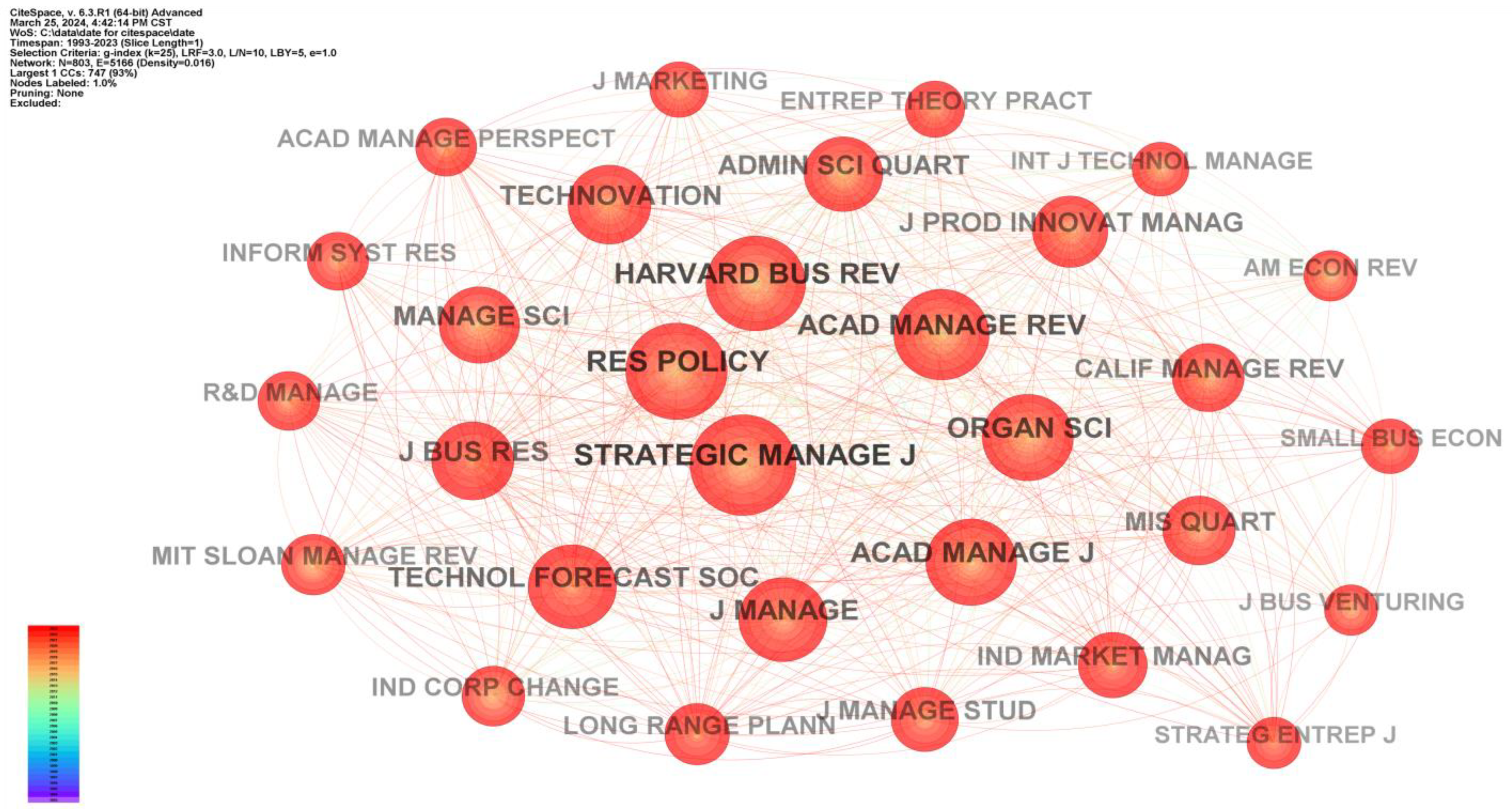
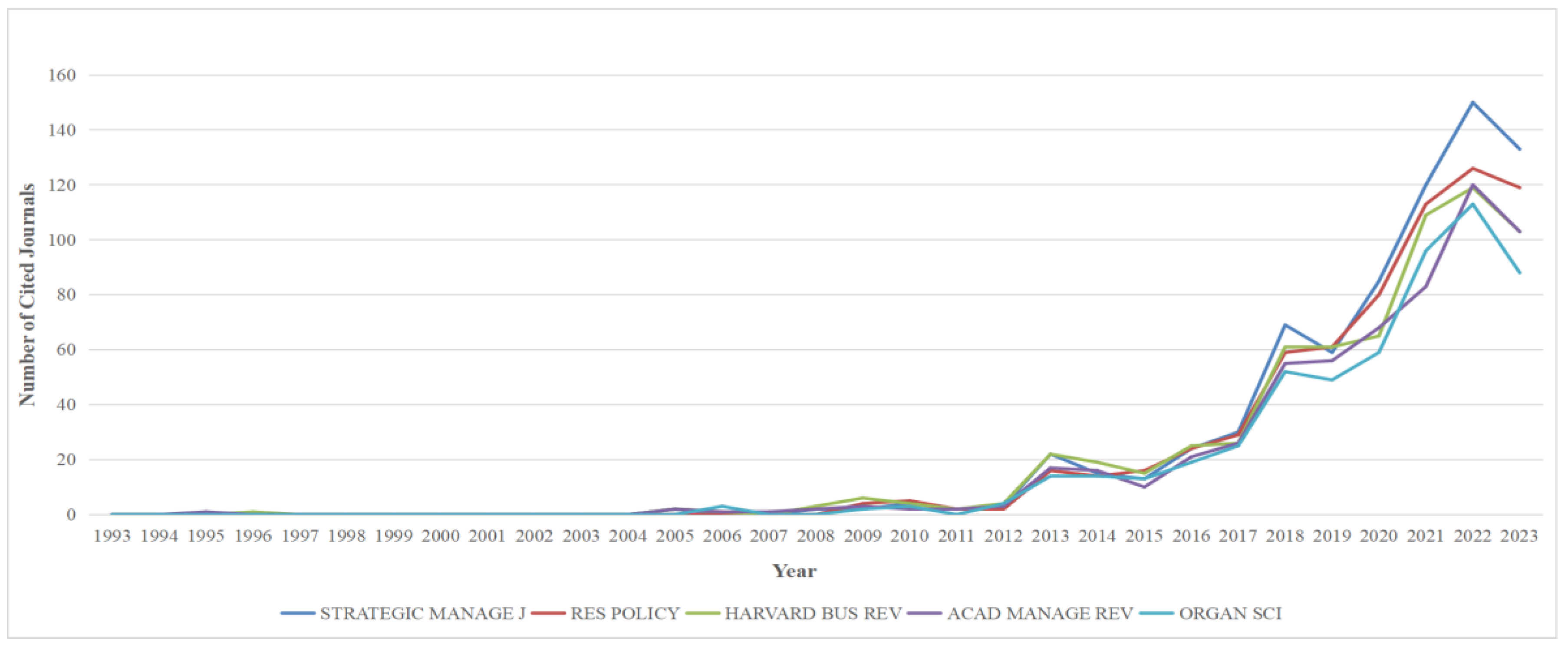
4.1.2. Co-Cited Journal Network Analysis
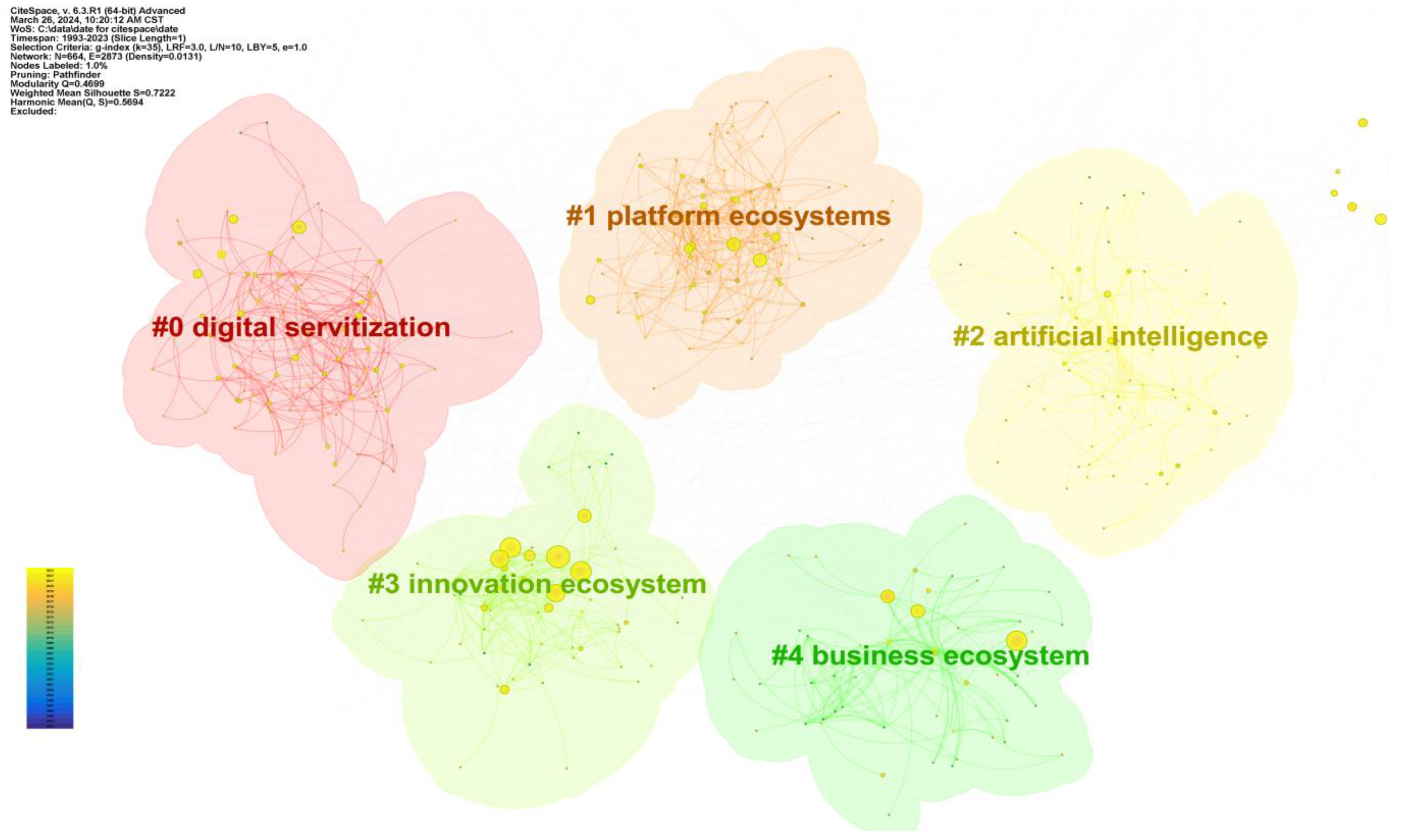
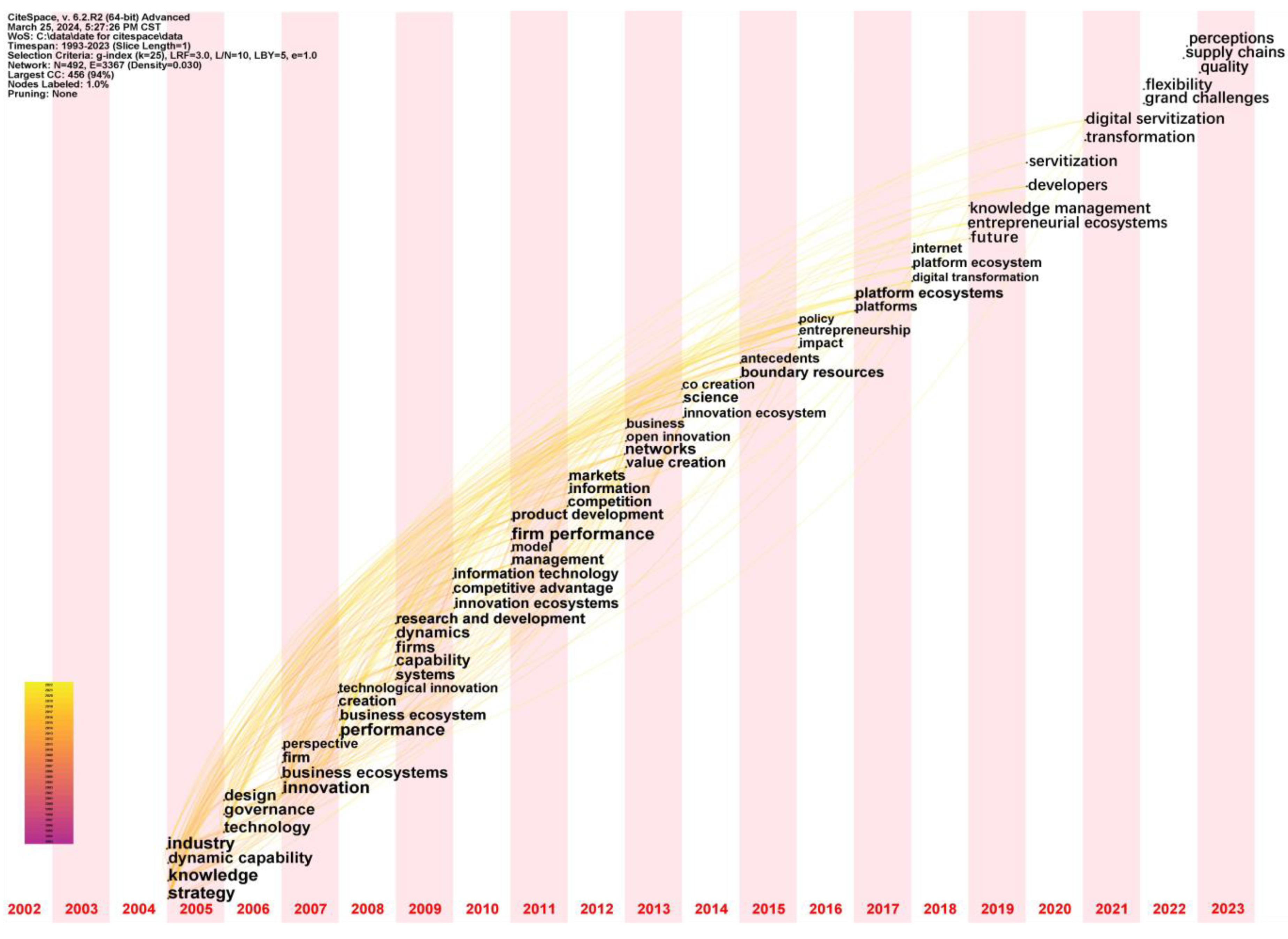
4.1.3. Keywords Cluster Analysis
Cluster#0—Digital Servitization
Cluster#1—Platform Ecosystems
Cluster#2—Artificial Intelligence
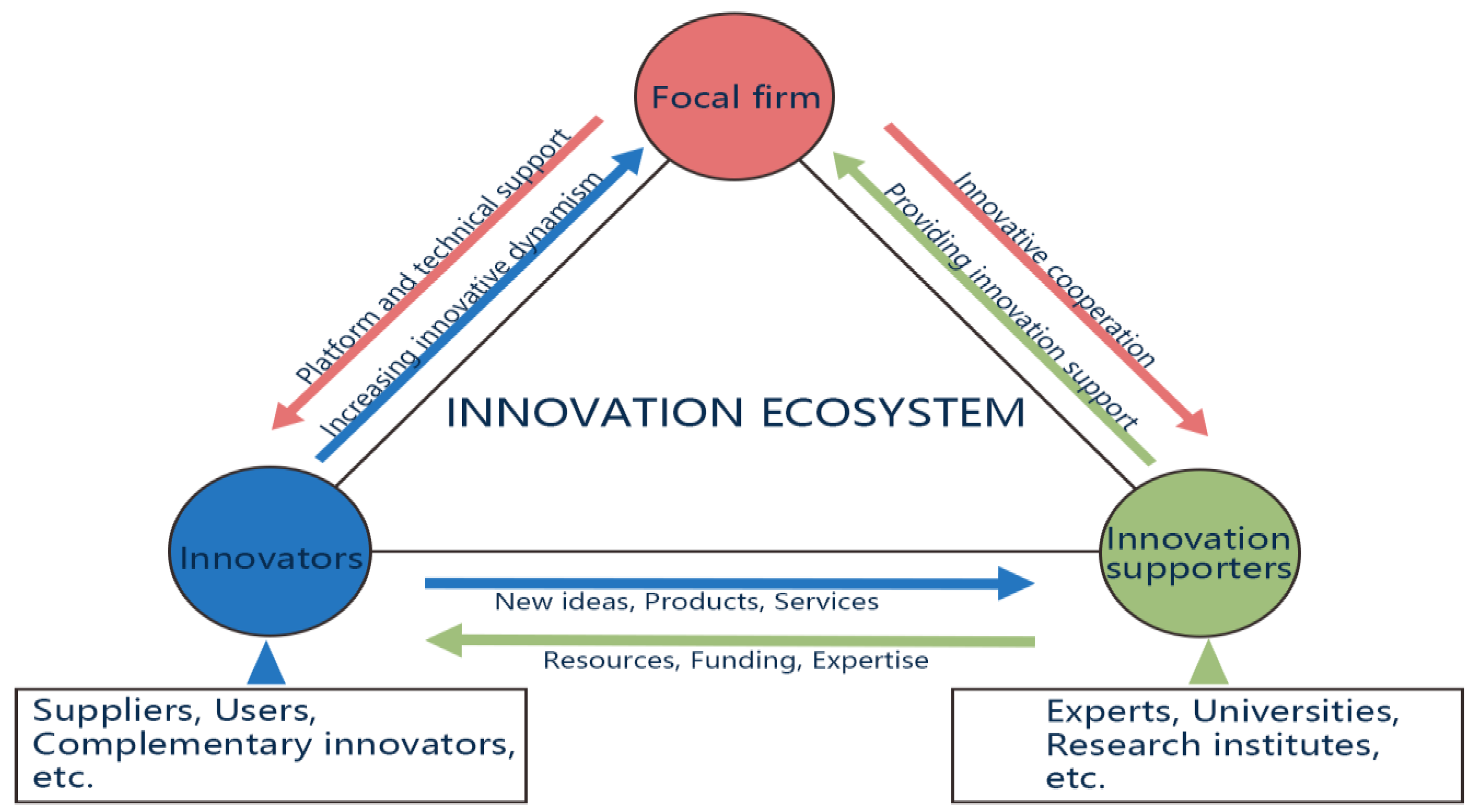
Cluster#3—Innovation Ecosystems
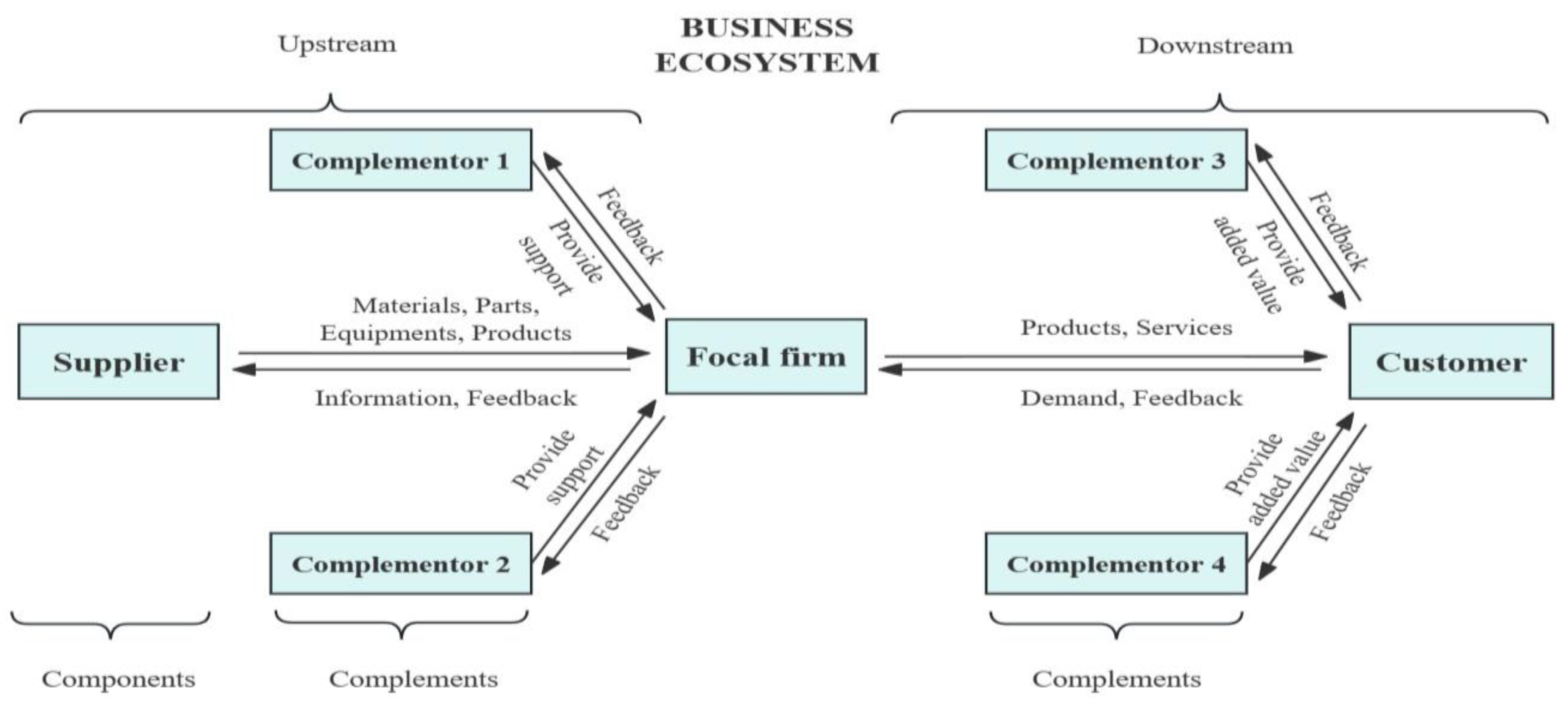
Cluster#4—Business Ecosystem
4.1.4. Keyword Co-Occurrence Analysis
4.2. Content Analysis
4.2.1. Definitions
- 1.
- Business Ecosystem
- 2.
- Innovation Ecosystem
- 3.
- Platform Ecosystem
4.2.2. Common Features
- 4.
- Multi-Participant and Complex Network Structures
- 5.
- Coordination and Cooperation for Value Creation
- 6.
- Digital Transformation and Technology Integration
- 7.
- Continuous Innovation and Effective Governance
4.2.3. Differentiating the Related Ecosystems
5. Discussion and Implications
5.1. Business Ecosystem
5.2. Innovation Ecosystem
5.3. Platform Ecosystem
5.4. Future Research
6. Conclusions
6.1. Contributions
- 8.
- Types of Participants
- 9.
- Goals
- 10.
- Value Co-Creation
6.2. Limitations
Author Contributions
Funding
Institutional Review Board Statement
Data Availability Statement
Acknowledgments
Conflicts of Interest
Abbreviations
| AI | Artificial Intelligence |
| BE | Business Ecosystem |
| IE | Innovation Ecosystem |
| PE | Platform Ecosystem |
| WoS | Web of Science |
References
- Verbrugghe, N.; Rubinacci, E.; Khan, A.Z. Biomimicry in Architecture: A Review of Definitions, Case Studies, and Design Methods. Biomimetics 2023, 8, 107. [Google Scholar] [CrossRef] [PubMed]
- Sa, A.A.M.d.; Viana, D.M. Design and Biomimicry: A Review of Interconnections and Creative Potentials. Biomimetics 2023, 8, 61. [Google Scholar] [CrossRef] [PubMed]
- Rowland, R. Biomimicry step-by-step. Bioinspired Biomim. Nanobiomater. 2017, 6, 102–112. [Google Scholar] [CrossRef]
- Kunte, K.; Kizhakke, A.G.; Nawge, V. Evolution of Mimicry Rings as a Window into Community Dynamics. Annu. Rev. Ecol. Evol. Syst. 2021, 52, 315–341. [Google Scholar] [CrossRef]
- Temmink, R.J.M.; Christianen, M.J.A.; Fivash, G.S.; Angelini, C.; Bostrom, C.; Didderen, K.; Engel, S.M.; Esteban, N.; Gaeckle, J.L.; Gagnon, K.; et al. Mimicry of emergent traits amplifies coastal restoration success. Nat. Commun. 2020, 11, 3668. [Google Scholar] [CrossRef] [PubMed]
- Moore, J.F. Predators and prey: A new ecology of competition. Harv. Bus. Rev. 1993, 71, 75–86. [Google Scholar] [PubMed]
- Adner, R. Match your innovation strategy to your innovation ecosystem. Harv. Bus. Rev. 2006, 84, 98. [Google Scholar] [PubMed]
- Teece, D.J. Explicating dynamic capabilities: The nature and microfoundations of (sustainable) enterprise performance. Strateg. Manag. J. 2007, 28, 1319–1350. [Google Scholar] [CrossRef]
- Adner, R. Ecosystem as structure: An actionable construct for strategy. J. Manag. 2017, 43, 39–58. [Google Scholar] [CrossRef]
- Jacobides, M.G.; Cennamo, C.; Gawer, A. Towards a theory of ecosystems. Strateg. Manag. J. 2018, 39, 2255–2276. [Google Scholar] [CrossRef]
- Seppänen, M.; Hyrynsalmi, S.; Manikas, K.; Suominen, A. Yet another ecosystem literature review: 10+ 1 research communities. In Proceedings of the 2017 IEEE European Technology and Engineering Management Summit (E-TEMS), Munich, Germany, 17–19 October 2017; pp. 1–8. [Google Scholar]
- Tsujimoto, M.; Kajikawa, Y.; Tomita, J.; Matsumoto, Y. A review of the ecosystem concept—Towards coherent ecosystem design. Technol. Forecast. Soc. Chang. 2018, 136, 49–58. [Google Scholar] [CrossRef]
- Peltoniemi, M.; Vuori, E. Business ecosystem as the new approach to complex adaptive business environments. In Proceedings of the Frontiers of e-Business Research, Tampere, Finland, 22 September 2004; pp. 267–281. [Google Scholar]
- Pierce, L. Big losses in ecosystem niches: How core firm decisions drive complementary product shakeouts. Strateg. Manag. J. 2009, 30, 323–347. [Google Scholar] [CrossRef]
- Adner, R.; Kapoor, R. Value creation in innovation ecosystems: How the structure of technological interdependence affects firm performance in new technology generations. Strateg. Manag. J. 2010, 31, 306–333. [Google Scholar] [CrossRef]
- Granstrand, O.; Holgersson, M. Innovation ecosystems: A conceptual review and a new definition. Technovation 2020, 90, 102098. [Google Scholar] [CrossRef]
- Dedehayir, O.; Mäkinen, S.J.; Ortt, J.R. Roles during innovation ecosystem genesis: A literature review. Technol. Forecast. Soc. Chang. 2018, 136, 18–29. [Google Scholar] [CrossRef]
- Thomas, L.D.; Autio, E.; Gann, D.M. Architectural leverage: Putting platforms in context. Acad. Manag. Perspect. 2014, 28, 198–219. [Google Scholar] [CrossRef]
- Murthy, R.K.; Madhok, A. Overcoming the early-stage conundrum of digital platform ecosystem emergence: A problem-solving perspective. J. Manag. Stud. 2021, 58, 1899–1932. [Google Scholar] [CrossRef]
- Schmeiss, J.; Hoelzle, K.; Tech, R.P. Designing governance mechanisms in platform ecosystems: Addressing the paradox of openness through blockchain technology. Calif. Manag. Rev. 2019, 62, 121–143. [Google Scholar] [CrossRef]
- Ceccagnoli, M.; Forman, C.; Huang, P.; Wu, D. Cocreation of value in a platform ecosystem! The case of enterprise software. MIS Q. 2012, 36, 263–290. [Google Scholar] [CrossRef]
- von Haeckel, E. Allgemeine Anatomie der Organismen: Erster Band; De Gruyter: Berlin, Germany, 1988. [Google Scholar]
- McIntosh, R.P. The Background of Ecology: Concept and Theory; Cambridge University Press: Cambridge, UK, 1986. [Google Scholar]
- Britton, N. Proceedings of the Madison Botanical Congress. Bull. Torrey Bot. Club 1893, 20, 368–373. [Google Scholar] [CrossRef]
- Tansley, A.G. The use and abuse of vegetational concepts and terms. Ecology 1935, 16, 284–307. [Google Scholar] [CrossRef]
- Lindeman, R.L. The trophic-dynamic aspect of ecology. Ecology 1942, 23, 399–417. [Google Scholar] [CrossRef]
- Stevenson, A. Oxford Dictionary of English; Oxford University Press: New York, NY, USA, 2010. [Google Scholar]
- Willis, A.J. The ecosystem: An evolving concept viewed historically. Funct. Ecol. 1997, 11, 268–271. [Google Scholar] [CrossRef]
- Iansiti, M.; Levien, R. Strategy as ecology. Harv. Bus. Rev. 2004, 82, 68–78, 126. [Google Scholar] [PubMed]
- Lusch, R.F.; Nambisan, S. Service innovation. MIS Q. 2015, 39, 155–176. [Google Scholar] [CrossRef]
- Benedict, M. Modelling ecosystems in information systems—A typology approach. In Proceedings of the Multikonferenz Wirtschaftsinformatik, Luneburg, Germany, 6–9 March 2018; pp. 453–464. [Google Scholar]
- Moore, J.F. The Death of Competition: Leadership and Strategy in the Age of Business Ecosystems; HarperCollins Publishers: New York, NY, USA, 1996. [Google Scholar]
- Barnett, M.L. The Keystone Advantage: What the New Dynamics of Business Ecosystems Mean for Strategy, Innovation, and Sustainability. Acad. Manag. Perspect. 2006, 20, 88–90. [Google Scholar] [CrossRef]
- Peltoniemi, M. Preliminary theoretical framework for the study of business ecosystems. Emerg. Complex. Organ. 2006, 8, 10. [Google Scholar]
- Porter, M.E. Competitive Strategy: Creating and Sustaining Superior Performance; Free Press: New York, NY, USA, 1985. [Google Scholar]
- Brandenburger, A.M.; Stuart, H.W., Jr. Value-based business strategy. J. Econ. Manag. Strategy 1996, 5, 5–24. [Google Scholar] [CrossRef]
- de Vasconcelos Gomes, L.A.; Facin, A.L.F.; Salerno, M.S.; Ikenami, R.K. Unpacking the innovation ecosystem construct: Evolution, gaps and trends. Technol. Forecast. Soc. Chang. 2018, 136, 30–48. [Google Scholar] [CrossRef]
- Schindelin, J.; Rueden, C.T.; Hiner, M.C.; Eliceiri, K.W. The ImageJ ecosystem: An open platform for biomedical image analysis. Mol. Reprod. Dev. 2015, 82, 518–529. [Google Scholar] [CrossRef]
- Li, Y.-R. The technological roadmap of Cisco’s business ecosystem. Technovation 2009, 29, 379–386. [Google Scholar] [CrossRef]
- Cusumano, M.A. How companies become platform leaders. MIT Sloan Manag. Rev. 2008, 49, 28–35. [Google Scholar]
- Kapoor, K.; Bigdeli, A.Z.; Schroeder, A.; Baines, T. A platform ecosystem view of servitization in manufacturing. Technovation 2022, 118, 102248. [Google Scholar] [CrossRef]
- Tiwana, A. Platform desertion by app developers. J. Manag. Inf. Syst. 2015, 32, 40–77. [Google Scholar] [CrossRef]
- Boudreau, K.J. Platform Boundary Choices & Governance: Opening-Up While Still Coordinating and Orchestrating. In Entrepreneurship, Innovation, and Platforms; Jeffrey, F., Annabelle, G., Eds.; Emerald Publishing Limited: Leeds, UK, 2017; pp. 227–297. [Google Scholar]
- Gawer, A. Digital platforms’ boundaries: The interplay of firm scope, platform sides, and digital interfaces. Long Range Plan. 2021, 54, 102045. [Google Scholar] [CrossRef]
- McIntyre, D.P.; Srinivasan, A. Networks, platforms, and strategy: Emerging views and next steps. Strateg. Manag. J. 2017, 38, 141–160. [Google Scholar] [CrossRef]
- Cenamor, J. Complementor competitive advantage: A framework for strategic decisions. J. Bus. Res. 2021, 122, 335–343. [Google Scholar] [CrossRef]
- Ikpaahindi, L. An overview of bibliometrics: Its measurements, laws and their applications. Libri 1985, 35, 163. [Google Scholar]
- Chai, K.-H.; Xiao, X. Understanding design research: A bibliometric analysis of Design Studies (1996–2010). Des. Stud. 2012, 33, 24–43. [Google Scholar] [CrossRef]
- Pranckutė, R. Web of Science (WoS) and Scopus: The titans of bibliographic information in today’s academic world. Publications 2021, 9, 12. [Google Scholar] [CrossRef]
- Donthu, N.; Kumar, S.; Mukherjee, D.; Pandey, N.; Lim, W.M. How to conduct a bibliometric analysis: An overview and guidelines. J. Bus. Res. 2021, 133, 285–296. [Google Scholar] [CrossRef]
- Moral-Muñoz, J.A.; Herrera-Viedma, E.; Santisteban-Espejo, A.; Cobo, M.J. Software tools for conducting bibliometric analysis in science: An up-to-date review. Prof. Inf. 2020, 29, e290103. [Google Scholar] [CrossRef]
- Huang, L.; Zhou, M.; Lv, J.; Chen, K. Trends in global research in forest carbon sequestration: A bibliometric analysis. J. Clean. Prod. 2020, 252, 119908. [Google Scholar] [CrossRef]
- Zhang, Y.; Zhang, M.; Li, J.; Liu, G.; Yang, M.M.; Liu, S. A bibliometric review of a decade of research: Big data in business research–Setting a research agenda. J. Bus. Res. 2021, 131, 374–390. [Google Scholar] [CrossRef]
- Rong, K.; Wu, J.; Shi, Y.; Guo, L. Nurturing business ecosystems for growth in a foreign market: Incubating, identifying and integrating stakeholders. J. Int. Manag. 2015, 21, 293–308. [Google Scholar] [CrossRef]
- Yi, Y.; Chen, Y.; Li, D. Stakeholder ties, organizational learning, and business model innovation: A business ecosystem perspective. Technovation 2022, 114, 102445. [Google Scholar] [CrossRef]
- Kapoor, R.; Lee, J.M. Coordinating and competing in ecosystems: How organizational forms shape new technology investments. Strateg. Manag. J. 2013, 34, 274–296. [Google Scholar] [CrossRef]
- Scaringella, L.; Radziwon, A. Innovation, entrepreneurial, knowledge, and business ecosystems: Old wine in new bottles? Technol. Forecast. Soc. Chang. 2018, 136, 59–87. [Google Scholar] [CrossRef]
- Clarysse, B.; Wright, M.; Bruneel, J.; Mahajan, A. Creating value in ecosystems: Crossing the chasm between knowledge and business ecosystems. Res. Policy 2014, 43, 1164–1176. [Google Scholar] [CrossRef]
- Battistella, C.; Colucci, K.; De Toni, A.F.; Nonino, F. Methodology of business ecosystems network analysis: A case study in Telecom Italia Future Centre. Technol. Forecast. Soc. Chang. 2013, 80, 1194–1210. [Google Scholar] [CrossRef]
- Gupta, R.; Mejia, C.; Kajikawa, Y. Business, innovation and digital ecosystems landscape survey and knowledge cross sharing. Technol. Forecast. Soc. Chang. 2019, 147, 100–109. [Google Scholar] [CrossRef]
- Graça, P.; Camarinha-Matos, L.M. Performance indicators for collaborative business ecosystems—Literature review and trends. Technol. Forecast. Soc. Chang. 2017, 116, 237–255. [Google Scholar] [CrossRef]
- Hakala, H.; O’Shea, G.; Farny, S.; Luoto, S. Re-storying the business, innovation and entrepreneurial ecosystem concepts: The model-narrative review method. Int. J. Manag. Rev. 2020, 22, 10–32. [Google Scholar] [CrossRef]
- Ma, Y.; Rong, K.; Mangalagiu, D.; Thornton, T.F.; Zhu, D. Co-evolution between urban sustainability and business ecosystem innovation: Evidence from the sharing mobility sector in Shanghai. J. Clean. Prod. 2018, 188, 942–953. [Google Scholar] [CrossRef]
- Adner, R.; Kapoor, R. Innovation ecosystems and the pace of substitution: Re-examining technology S-curves. Strateg. Manag. J. 2016, 37, 625–648. [Google Scholar] [CrossRef]
- Xie, X.; Wang, H. How can open innovation ecosystem modes push product innovation forward? An fsQCA analysis. J. Bus. Res. 2020, 108, 29–41. [Google Scholar] [CrossRef]
- Walrave, B.; Talmar, M.; Podoynitsyna, K.S.; Romme, A.G.L.; Verbong, G.P. A multi-level perspective on innovation ecosystems for path-breaking innovation. Technol. Forecast. Soc. Chang. 2018, 136, 103–113. [Google Scholar] [CrossRef]
- Shaw, D.R.; Allen, T. Studying innovation ecosystems using ecology theory. Technol. Forecast. Soc. Chang. 2018, 136, 88–102. [Google Scholar] [CrossRef]
- Robertson, J.; Caruana, A.; Ferreira, C. Innovation performance: The effect of knowledge-based dynamic capabilities in cross-country innovation ecosystems. Int. Bus. Rev. 2021, 32, 101866. [Google Scholar] [CrossRef]
- Kretschmer, T.; Leiponen, A.; Schilling, M.; Vasudeva, G. Platform ecosystems as meta-organizations: Implications for platform strategies. Strateg. Manag. J. 2022, 43, 405–424. [Google Scholar] [CrossRef]
- Cenamor, J.; Frishammar, J. Openness in platform ecosystems: Innovation strategies for complementary products. Res. Policy 2021, 50, 104148. [Google Scholar] [CrossRef]
- Cennamo, C.; Santaló, J. Generativity tension and value creation in platform ecosystems. Organ. Sci. 2019, 30, 617–641. [Google Scholar] [CrossRef]
- Tavalaei, M.M.; Cennamo, C. In search of complementarities within and across platform ecosystems: Complementors’ relative standing and performance in mobile apps ecosystems. Long Range Plan. 2021, 54, 101994. [Google Scholar] [CrossRef]
- Inoue, Y. Indirect innovation management by platform ecosystem governance and positioning: Toward collective ambidexterity in the ecosystems. Technol. Forecast. Soc. Chang. 2021, 166, 120652. [Google Scholar] [CrossRef]
- McCain, K.W. Mapping economics through the journal literature: An experiment in journal cocitation analysis. J. Am. Soc. Inf. Sci. 1991, 42, 290. [Google Scholar] [CrossRef]
- Leydesdorff, L. Visualization of the citation impact environments of scientific journals: An online mapping exercise. J. Am. Soc. Inf. Sci. Technol. 2007, 58, 25–38. [Google Scholar] [CrossRef]
- Small, H. Co-citation in the scientific literature: A new measure of the relationship between two documents. J. Am. Soc. Inf. Sci. 1973, 24, 265–269. [Google Scholar] [CrossRef]
- Su, H.-N.; Lee, P.-C. Mapping knowledge structure by keyword co-occurrence: A first look at journal papers in Technology Foresight. Scientometrics 2010, 85, 65–79. [Google Scholar] [CrossRef]
- Perianes-Rodriguez, A.; Waltman, L.; Van Eck, N.J. Constructing bibliometric networks: A comparison between full and fractional counting. J. Informetr. 2016, 10, 1178–1195. [Google Scholar] [CrossRef]
- Li, H.; An, H.; Wang, Y.; Huang, J.; Gao, X. Evolutionary features of academic articles co-keyword network and keywords co-occurrence network: Based on two-mode affiliation network. Phys. A Stat. Mech. Appl. 2016, 450, 657–669. [Google Scholar] [CrossRef]
- Shi, Y.; Liu, X. Research on the literature of green building based on the Web of Science: A scientometric analysis in CiteSpace (2002–2018). Sustainability 2019, 11, 3716. [Google Scholar] [CrossRef]
- Chen, C.; Ibekwe-SanJuan, F.; Hou, J. The structure and dynamics of cocitation clusters: A multiple-perspective cocitation analysis. J. Am. Soc. Inf. Sci. Technol. 2010, 61, 1386–1409. [Google Scholar] [CrossRef]
- Jovanovic, M.; Sjödin, D.; Parida, V. Co-evolution of platform architecture, platform services, and platform governance: Expanding the platform value of industrial digital platforms. Technovation 2022, 118, 102218. [Google Scholar] [CrossRef]
- Sjödin, D.; Parida, V.; Visnjic, I. How can large manufacturers digitalize their business models? A framework for orchestrating industrial ecosystems. Calif. Manag. Rev. 2022, 64, 49–77. [Google Scholar] [CrossRef]
- Kohtamäki, M.; Parida, V.; Oghazi, P.; Gebauer, H.; Baines, T. Digital servitization business models in ecosystems: A theory of the firm. J. Bus. Res. 2019, 104, 380–392. [Google Scholar] [CrossRef]
- Sklyar, A.; Kowalkowski, C.; Tronvoll, B.; Sörhammar, D. Organizing for digital servitization: A service ecosystem perspective. J. Bus. Res. 2019, 104, 450–460. [Google Scholar] [CrossRef]
- Hilbolling, S.; Berends, H.; Deken, F.; Tuertscher, P. Sustaining complement quality for digital product platforms: A case study of the Philips Hue ecosystem. J. Prod. Innov. Manag. 2021, 38, 21–48. [Google Scholar] [CrossRef]
- Khanagha, S.; Ansari, S.; Paroutis, S.; Oviedo, L. Mutualism and the dynamics of new platform creation: A study of Cisco and fog computing. Strateg. Manag. J. 2022, 43, 476–506. [Google Scholar] [CrossRef]
- Gawer, A.; Cusumano, M.A. Industry platforms and ecosystem innovation. J. Prod. Innov. Manag. 2014, 31, 417–433. [Google Scholar] [CrossRef]
- Floetgen, R.J.; Strauss, J.; Weking, J.; Hein, A.; Urmetzer, F.; Böhm, M.; Krcmar, H. Introducing platform ecosystem resilience: Leveraging mobility platforms and their ecosystems for the new normal during COVID-19. Eur. J. Inf. Syst. 2021, 30, 304–321. [Google Scholar] [CrossRef]
- Panico, C.; Cennamo, C. User preferences and strategic interactions in platform ecosystems. Strateg. Manag. J. 2022, 43, 507–529. [Google Scholar] [CrossRef]
- Schreieck, M.; Wiesche, M.; Krcmar, H. Capabilities for value co-creation and value capture in emergent platform ecosystems: A longitudinal case study of SAP’s cloud platform. J. Inf. Technol. 2021, 36, 365–390. [Google Scholar] [CrossRef]
- Sandberg, J.; Holmström, J.; Lyytinen, K. Digitization and phase transitions in platform organizing logics: Evidence from the process automation industry. Manag. Inf. Syst. Q. 2020, 44, 129–153. [Google Scholar] [CrossRef]
- Burström, T.; Parida, V.; Lahti, T.; Wincent, J. AI-enabled business-model innovation and transformation in industrial ecosystems: A framework, model and outline for further research. J. Bus. Res. 2021, 127, 85–95. [Google Scholar]
- Leone, D.; Schiavone, F.; Appio, F.P.; Chiao, B. How does artificial intelligence enable and enhance value co-creation in industrial markets? An exploratory case study in the healthcare ecosystem. J. Bus. Res. 2021, 129, 849–859. [Google Scholar] [CrossRef]
- Manser Payne, E.H.; Dahl, A.J.; Peltier, J. Digital servitization value co-creation framework for AI services: A research agenda for digital transformation in financial service ecosystems. J. Res. Interact. Mark. 2021, 15, 200–222. [Google Scholar]
- Elia, G.; Margherita, A.; Passiante, G. Digital entrepreneurship ecosystem: How digital technologies and collective intelligence are reshaping the entrepreneurial process. Technol. Forecast. Soc. Chang. 2020, 150, 119791. [Google Scholar]
- Ehret, M.; Wirtz, J. Unlocking value from machines: Business models and the industrial internet of things. J. Mark. Manag. 2017, 33, 111–130. [Google Scholar]
- Clough, D.R.; Wu, A. Artificial intelligence, data-driven learning, and the decentralized structure of platform ecosystems. Acad. Manag. Rev. 2022, 47, 184–189. [Google Scholar] [CrossRef]
- Mollenkopf, D.A.; Ozanne, L.K.; Stolze, H.J. A transformative supply chain response to COVID-19. J. Serv. Manag. 2021, 32, 190–202. [Google Scholar] [CrossRef]
- Oh, D.-S.; Phillips, F.; Park, S.; Lee, E. Innovation ecosystems: A critical examination. Technovation 2016, 54, 1–6. [Google Scholar] [CrossRef]
- Wagner, S.M. Startups in the supply chain ecosystem: An organizing framework and research opportunities. Int. J. Phys. Distrib. Logist. Manag. 2021, 51, 1130–1157. [Google Scholar] [CrossRef]
- Ben Letaifa, S. The uneasy transition from supply chains to ecosystems: The value-creation/value-capture dilemma. Manag. Decis. 2014, 52, 278–295. [Google Scholar] [CrossRef]
- Beltagui, A.; Rosli, A.; Candi, M. Exaptation in a digital innovation ecosystem: The disruptive impacts of 3D printing. Res. Policy 2020, 49, 103833. [Google Scholar] [CrossRef]
- Kahle, J.H.; Marcon, É.; Ghezzi, A.; Frank, A.G. Smart Products value creation in SMEs innovation ecosystems. Technol. Forecast. Soc. Chang. 2020, 156, 120024. [Google Scholar] [CrossRef]
- Benitez, G.B.; Ayala, N.F.; Frank, A.G. Industry 4.0 innovation ecosystems: An evolutionary perspective on value cocreation. Int. J. Prod. Econ. 2020, 228, 107735. [Google Scholar] [CrossRef]
- Stahl, B.C. Responsible innovation ecosystems: Ethical implications of the application of the ecosystem concept to artificial intelligence. Int. J. Inf. Manag. 2022, 62, 102441. [Google Scholar]
- Liang, L.; Li, Y. How does government support promote digital economy development in China? The mediating role of regional innovation ecosystem resilience. Technol. Forecast. Soc. Chang. 2023, 188, 122328. [Google Scholar] [CrossRef]
- Linde, L.; Sjödin, D.; Parida, V.; Wincent, J. Dynamic capabilities for ecosystem orchestration A capability-based framework for smart city innovation initiatives. Technol. Forecast. Soc. Chang. 2021, 166, 120614. [Google Scholar] [CrossRef]
- Audretsch, D.B.; Eichler, G.M.; Schwarz, E.J. Emerging needs of social innovators and social innovation ecosystems. Int. Entrep. Manag. J. 2022, 18, 217–254. [Google Scholar]
- Yang, Z.; Chen, H.; Du, L.; Lin, C.; Lu, W. How does alliance-based government-university-industry foster cleantech innovation in a green innovation ecosystem? J. Clean. Prod. 2021, 283, 124559. [Google Scholar]
- Yin, D.; Ming, X.; Zhang, X. Sustainable and smart product innovation ecosystem: An integrative status review and future perspectives. J. Clean. Prod. 2020, 274, 123005. [Google Scholar] [CrossRef]
- Nylund, P.A.; Brem, A.; Agarwal, N. Innovation ecosystems for meeting sustainable development goals: The evolving roles of multinational enterprises. J. Clean. Prod. 2021, 281, 125329. [Google Scholar] [CrossRef]
- Kamalaldin, A.; Sjödin, D.; Hullova, D.; Parida, V. Configuring ecosystem strategies for digitally enabled process innovation: A framework for equipment suppliers in the process industries. Technovation 2021, 105, 102250. [Google Scholar]
- Masucci, M.; Brusoni, S.; Cennamo, C. Removing bottlenecks in business ecosystems: The strategic role of outbound open innovation. Res. Policy 2020, 49, 103823. [Google Scholar] [CrossRef]
- Rohrbeck, R.; Hölzle, K.; Gemünden, H.G. Opening up for competitive advantage–How Deutsche Telekom creates an open innovation ecosystem. RD Manag. 2009, 39, 420–430. [Google Scholar] [CrossRef]
- Radziwon, A.; Bogers, M. Open innovation in SMEs: Exploring inter-organizational relationships in an ecosystem. Technol. Forecast. Soc. Chang. 2019, 146, 573–587. [Google Scholar] [CrossRef]
- Chesbrough, H.; Kim, S.; Agogino, A. Chez Panisse: Building an open innovation ecosystem. Calif. Manag. Rev. 2014, 56, 144–171. [Google Scholar] [CrossRef]
- Ramezani, J.; Camarinha-Matos, L.M. Approaches for resilience and antifragility in collaborative business ecosystems. Technol. Forecast. Soc. Chang. 2020, 151, 119846. [Google Scholar]
- Riquelme-Medina, M.; Stevenson, M.; Barrales-Molina, V.; Llorens-Montes, F.J. Coopetition in business Ecosystems: The key role of absorptive capacity and supply chain agility. J. Bus. Res. 2022, 146, 464–476. [Google Scholar]
- Audretsch, D.B.; Cunningham, J.A.; Kuratko, D.F.; Lehmann, E.E.; Menter, M. Entrepreneurial ecosystems: Economic, technological, and societal impacts. J. Technol. Transf. 2019, 44, 313–325. [Google Scholar] [CrossRef] [PubMed]
- Ketchen Jr, D.J.; Crook, T.R.; Craighead, C.W. From supply chains to supply ecosystems: Implications for strategic sourcing research and practice. J. Bus. Logist. 2014, 35, 165–171. [Google Scholar] [CrossRef]
- Best, M.H. Greater Boston’s industrial ecosystem: A manufactory of sectors. Technovation 2015, 39, 4–13. [Google Scholar] [CrossRef]
- Song, A.K. The Digital Entrepreneurial Ecosystem—A critique and reconfiguration. Small Bus. Econ. 2019, 53, 569–590. [Google Scholar]
- Nieuwenhuis, L.J.; Ehrenhard, M.L.; Prause, L. The shift to Cloud Computing: The impact of disruptive technology on the enterprise software business ecosystem. Technol. Forecast. Soc. Chang. 2018, 129, 308–313. [Google Scholar] [CrossRef]
- Bals, C. Toward a supply chain finance (SCF) ecosystem–Proposing a framework and agenda for future research. J. Purch. Supply Manag. 2019, 25, 105–117. [Google Scholar] [CrossRef]
- Lee, M.-J.; Roh, T. Unpacking the sustainable performance in the business ecosystem: Coopetition strategy, open innovation, and digitalization capability. J. Clean. Prod. 2023, 412, 137433. [Google Scholar] [CrossRef]
- Burford, N.; Shipilov, A.V.; Furr, N.R. How ecosystem structure affects firm performance in response to a negative shock to interdependencies. Strateg. Manag. J. 2022, 43, 30–57. [Google Scholar] [CrossRef]
- Hanelt, A.; Bohnsack, R.; Marz, D.; Antunes Marante, C. A systematic review of the literature on digital transformation: Insights and implications for strategy and organizational change. J. Manag. Stud. 2021, 58, 1159–1197. [Google Scholar]
- Palmié, M.; Miehé, L.; Oghazi, P.; Parida, V.; Wincent, J. The evolution of the digital service ecosystem and digital business model innovation in retail: The emergence of meta-ecosystems and the value of physical interactions. Technol. Forecast. Soc. Chang. 2022, 177, 121496. [Google Scholar] [CrossRef]
- Battisti, S.; Agarwal, N.; Brem, A. Creating new tech entrepreneurs with digital platforms: Meta-organizations for shared value in data-driven retail ecosystems. Technol. Forecast. Soc. Chang. 2022, 175, 121392. [Google Scholar] [CrossRef]
- Chen, A.; Lin, Y.; Mariani, M.; Shou, Y.; Zhang, Y. Entrepreneurial growth in digital business ecosystems: An integrated framework blending the knowledge-based view of the firm and business ecosystems. J. Technol. Transf. 2023, 48, 1628–1653. [Google Scholar]
- Sun, Q.; Wang, C.; Zhou, Y.; Zuo, L.; Tang, J. Dominant platform capability, symbiotic strategy and the construction of “Internet+ WEEE collection” business ecosystem: A comparative study of two typical cases in China. J. Clean. Prod. 2020, 254, 120074. [Google Scholar] [CrossRef]
- Sun, Q.; Wang, C.; Zuo, L.-s.; Lu, F.-h. Digital empowerment in a WEEE collection business ecosystem: A comparative study of two typical cases in China. J. Clean. Prod. 2018, 184, 414–422. [Google Scholar] [CrossRef]
- Hsuan, J.; Jovanovic, M.; Clemente, D.H. Exploring digital servitization trajectories within product–service–software space. Int. J. Oper. Prod. Manag. 2021, 41, 598–621. [Google Scholar]
- Nerbel, J.F.; Kreutzer, M. Digital platform ecosystems in flux: From proprietary digital platforms to wide-spanning ecosystems. Electron. Mark. 2023, 33, 1–20. [Google Scholar]
- Chen, C. CiteSpace II: Detecting and visualizing emerging trends and transient patterns in scientific literature. J. Am. Soc. Inf. Sci. Technol. 2006, 57, 359–377. [Google Scholar] [CrossRef]
- Morris, S.A.; Yen, G.; Wu, Z.; Asnake, B. Time line visualization of research fronts. J. Am. Soc. Inf. Sci. Technol. 2003, 54, 413–422. [Google Scholar] [CrossRef]
- Chertow, M.R. “Uncovering” industrial symbiosis. J. Ind. Ecol. 2007, 11, 11–30. [Google Scholar] [CrossRef]
- Lin, Y.; Tseng, M.-L.; Chen, C.-C.; Chiu, A.S. Positioning strategic competitiveness of green business innovation capabilities using hybrid method. Expert. Syst. Appl. 2011, 38, 1839–1849. [Google Scholar] [CrossRef]
- Lazarević Moravčević, M.; Brnjas, Z.; Belopavlović, G. Research & development and marketing–the business functions of strategic importance for SMEs in creating competitive advantages. Metal. Int. 2013, 18, 250–255. [Google Scholar]
- Rong, K.; Shi, Y.; Yu, J. Nurturing business ecosystems to deal with industry uncertainties. Ind. Manag. Data Syst. 2013, 113, 385–402. [Google Scholar] [CrossRef]
- Ritala, P.; Agouridas, V.; Assimakopoulos, D.; Gies, O. Value creation and capture mechanisms in innovation ecosystems: A comparative case study. Int. J. Technol. Manag. 2013, 63, 244–267. [Google Scholar] [CrossRef]
- Alexy, O.; George, G.; Salter, A.J. Cui bono? The selective revealing of knowledge and its implications for innovative activity. Acad. Manag. Rev. 2013, 38, 270–291. [Google Scholar] [CrossRef]
- Schaffers, H.; Komninos, N.; Pallot, M.; Trousse, B.; Nilsson, M.; Oliveira, A. Smart cities and the future internet: Towards cooperation frameworks for open innovation. In The Future Internet: Future Internet Assembly 2011: Achievements and Technological Promises; Domingue, J., Galis, A., Eds.; Springer: Berlin/Heidelberg, Germany, 2011; pp. 431–446. [Google Scholar]
- Nambisan, S.; Baron, R.A. Entrepreneurship in innovation ecosystems: Entrepreneurs’ self–regulatory processes and their implications for new venture success. Entrep. Theory Pract. 2013, 37, 1071–1097. [Google Scholar] [CrossRef]
- Schreieck, M.; Wiesche, M.; Krcmar, H. From product platform ecosystem to innovation platform ecosystem: An institutional perspective on the governance of ecosystem transformations. J. Assoc. Inf. Syst. 2022, 23, 1354. [Google Scholar] [CrossRef]
- Herman, H.; Grobbelaar, S.S.; Pistorius, C. The design and development of technology platforms in a developing country healthcare context from an ecosystem perspective. BMC Med. Inform. Decis. Mak. 2020, 20, 1–24. [Google Scholar] [CrossRef]
- Choi, G.; Nam, C.; Kim, S. The impacts of technology platform openness on application developers’ intention to continuously use a platform: From an ecosystem perspective. Telecommun. Policy 2019, 43, 140–153. [Google Scholar] [CrossRef]
- Venter, S.; Grobbelaar, S. A Technology Management Capabilities Framework for Technology Platforms. IEEE Trans. Eng. Manag. 2022, 70, 2558–2573. [Google Scholar] [CrossRef]
- Hein, A.; Schreieck, M.; Riasanow, T.; Setzke, D.S.; Wiesche, M.; Böhm, M.; Krcmar, H. Digital platform ecosystems. Electron. Mark. 2020, 30, 87–98. [Google Scholar] [CrossRef]
- Huber, T.L.; Kude, T.; Dibbern, J. Governance practices in platform ecosystems: Navigating tensions between cocreated value and governance costs. Inf. Syst. Res. 2017, 28, 563–584. [Google Scholar] [CrossRef]
- Rietveld, J.; Schilling, M.A.; Bellavitis, C. Platform strategy: Managing ecosystem value through selective promotion of complements. Organ. Sci. 2019, 30, 1232–1251. [Google Scholar] [CrossRef]
- Hansen, M.T. The search-transfer problem: The role of weak ties in sharing knowledge across organization subunits. Adm. Sci. Q. 1999, 44, 82–111. [Google Scholar] [CrossRef]
- Fuller, J.; Jacobides, M.G.; Reeves, M. The myths and realities of business ecosystems. MIT Sloan Manag. Rev. 2019, 60, 1–9. [Google Scholar]
- Hannah, D.P.; Eisenhardt, K.M. How firms navigate cooperation and competition in nascent ecosystems. Strateg. Manag. J. 2018, 39, 3163–3192. [Google Scholar] [CrossRef]
- Barile, S.; Lusch, R.; Reynoso, J.; Saviano, M.; Spohrer, J. Systems, networks, and ecosystems in service research. J. Serv. Manag. 2016, 27, 652–674. [Google Scholar] [CrossRef]
- Holgersson, M.; Granstrand, O.; Bogers, M. The evolution of intellectual property strategy in innovation ecosystems: Uncovering complementary and substitute appropriability regimes. Long Range Plan. 2018, 51, 303–319. [Google Scholar] [CrossRef]
- Cassiman, B.; Valentini, G. Open innovation: Are inbound and outbound knowledge flows really complementary? Strateg. Manag. J. 2016, 37, 1034–1046. [Google Scholar] [CrossRef]
- Lin, H.; Zeng, S.; Liu, H.; Li, C. Bridging the gaps or fecklessness? A moderated mediating examination of intermediaries’ effects on corporate innovation. Technovation 2020, 94, 102018. [Google Scholar] [CrossRef]
- Reynolds, E.B.; Uygun, Y. Strengthening advanced manufacturing innovation ecosystems: The case of Massachusetts. Technol. Forecast. Soc. Chang. 2018, 136, 178–191. [Google Scholar] [CrossRef]
- Sun, S.L.; Zhang, Y.; Cao, Y.; Dong, J.; Cantwell, J. Enriching innovation ecosystems: The role of government in a university science park. Glob. Transit. 2019, 1, 104–119. [Google Scholar] [CrossRef]
- Hughes, T.P. Networks of Power: Electrification in Western Society, 1880–1930; JHU Press: Baltimore, ML, USA, 1993. [Google Scholar]
- Rosenberg, N. Perspectives on Technology; ME Sharpe: New York, NY, USA, 1984. [Google Scholar]
- Adner, R. When are technologies disruptive? A demand-based view of the emergence of competition. Strateg. Manag. J. 2002, 23, 667–688. [Google Scholar] [CrossRef]
- Christensen, C.M. The Innovator’s Dilemma: When New Technologies Cause Great Firms to Fail; Harvard Business Review Press: Boston, MA, USA, 2013. [Google Scholar]
- Otto, E.R. Innovation: The Attacker’s Advantage. Acad. Manag. Rev. 1987, 12, 571–573. [Google Scholar] [CrossRef]
- Nelson, R.R. An Evolutionary Theory of Economic Change; Harvard University Press: Cambridge, MA, USA, 1985. [Google Scholar]
- Raven, R. Niche accumulation and hybridisation strategies in transition processes towards a sustainable energy system: An assessment of differences and pitfalls. Energy Policy 2007, 35, 2390–2400. [Google Scholar] [CrossRef]
- Robaczewska, J.; Vanhaverbeke, W.; Lorenz, A. Applying open innovation strategies in the context of a regional innovation ecosystem: The case of Janssen Pharmaceuticals. Glob. Transit. 2019, 1, 120–131. [Google Scholar] [CrossRef]
- Aaltonen, A.; Tempini, N. Everything counts in large amounts: A critical realist case study on data-based production. J. Inf. Technol. 2014, 29, 97–110. [Google Scholar] [CrossRef]
- Chesbrough, H.W.; Appleyard, M.M. Open innovation and strategy. Calif. Manag. Rev. 2007, 50, 57–76. [Google Scholar] [CrossRef]
- Chesbrough, H.W. Open Innovation: The New Imperative for Creating and Profiting from Technology; Harvard Business Press: Boston, MA, USA, 2003. [Google Scholar]
- Appleyard, M.M.; Chesbrough, H.W. The dynamics of open strategy: From adoption to reversion. Long Range Plan. 2017, 50, 310–321. [Google Scholar] [CrossRef]
- Armstrong, M. Competition in two-sided markets. RAND J. Econ. 2006, 37, 668–691. [Google Scholar] [CrossRef]
- Mann, G.; Karanasios, S.; Breidbach, C.F. Orchestrating the digital transformation of a business ecosystem. J. Strateg. Inf. Syst. 2022, 31, 101733. [Google Scholar] [CrossRef]
- Rong, K.; Hu, G.; Lin, Y.; Shi, Y.; Guo, L. Understanding business ecosystem using a 6C framework in Internet-of-Things-based sectors. Int. J. Prod. Econ. 2015, 159, 41–55. [Google Scholar] [CrossRef]
- Carayannis, E.G.; Campbell, D.F. ‘Mode 3′ and ‘Quadruple Helix’: Toward a 21st century fractal innovation ecosystem. Int. J. Technol. Manag. 2009, 46, 201–234. [Google Scholar] [CrossRef]
- Autio, E.; Thomas, L. Innovation Ecosystems. In The Oxford Handbook of Innovation Management; University of Oxford: Oxford, UK, 2014. [Google Scholar]
- Guerrero, M.; Urbano, D.; Fayolle, A.; Klofsten, M.; Mian, S. Entrepreneurial universities: Emerging models in the new social and economic landscape. Small Bus. Econ. 2016, 47, 551–563. [Google Scholar] [CrossRef]
- Han, J.; Zhou, H.; Löwik, S.; de Weerd-Nederhof, P. Building and sustaining emerging ecosystems through new focal ventures: Evidence from China’s bike-sharing industry. Technol. Forecast. Soc. Chang. 2022, 174, 121261. [Google Scholar] [CrossRef]
- Helfat, C.E.; Raubitschek, R.S. Dynamic and integrative capabilities for profiting from innovation in digital platform-based ecosystems. Res. Policy 2018, 47, 1391–1399. [Google Scholar] [CrossRef]
- Gulati, R.; Puranam, P.; Tushman, M. Meta-organization design: Rethinking design in interorganizational and community contexts. Strateg. Manag. J. 2012, 33, 571–586. [Google Scholar] [CrossRef]
- Venkatraman, N.; Lee, C.-H. Preferential linkage and network evolution: A conceptual model and empirical test in the US video game sector. Acad. Manag. J. 2004, 47, 876–892. [Google Scholar] [CrossRef]
- Pettit, T.J.; Croxton, K.L.; Fiksel, J. Ensuring supply chain resilience: Development and implementation of an assessment tool. J. Bus. Logist. 2013, 34, 46–76. [Google Scholar] [CrossRef]
- Taleb, N.N. Antifragile: Things That Gain from Disorder; Random House Trade Paperbacks: New York, NY, USA, 2014. [Google Scholar]
- Kinay, M. Biomimicry: An Innovation Strategy for Green Economy Entrepreneurship. Eur. J. Manag. Res. (EUJMR) 2023, 7, 49–60. [Google Scholar]
- Volkmer Martins, B.; Faccin, K.; Espindula, E.; Balestrin, A. Understanding innovation ecosystems: A biomimetic approach. Rev. Int. D’intelligence Économique 2019, 11, 11–29. [Google Scholar]
- Barthlott, W.; Rafiqpoor, M.D.; Erdelen, W.R. Bionics and biodiversity–bio-inspired technical innovation for a sustainable future. In Biomimetic Research for Architecture and Building Construction; Springer: Berlin/Heidelberg, Germany, 2016; pp. 11–55. [Google Scholar]
- Rotondi, C. How the informed relations between physical, digital and biological dimensions are changing the design practice, as well as the sustainability paradigm. Front. Bioeng. Biotechnol. 2023, 11, 1193353. [Google Scholar] [CrossRef] [PubMed]

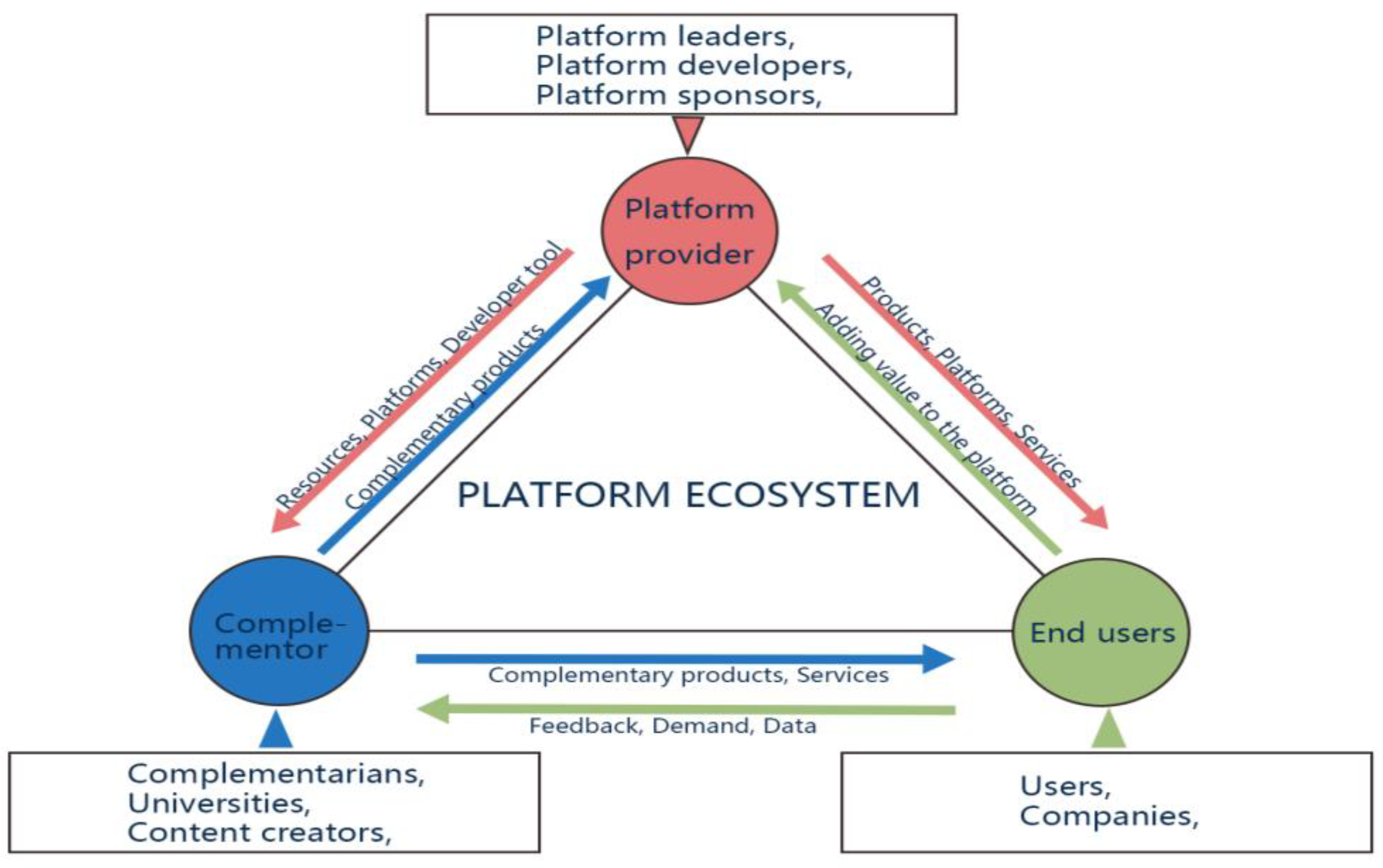
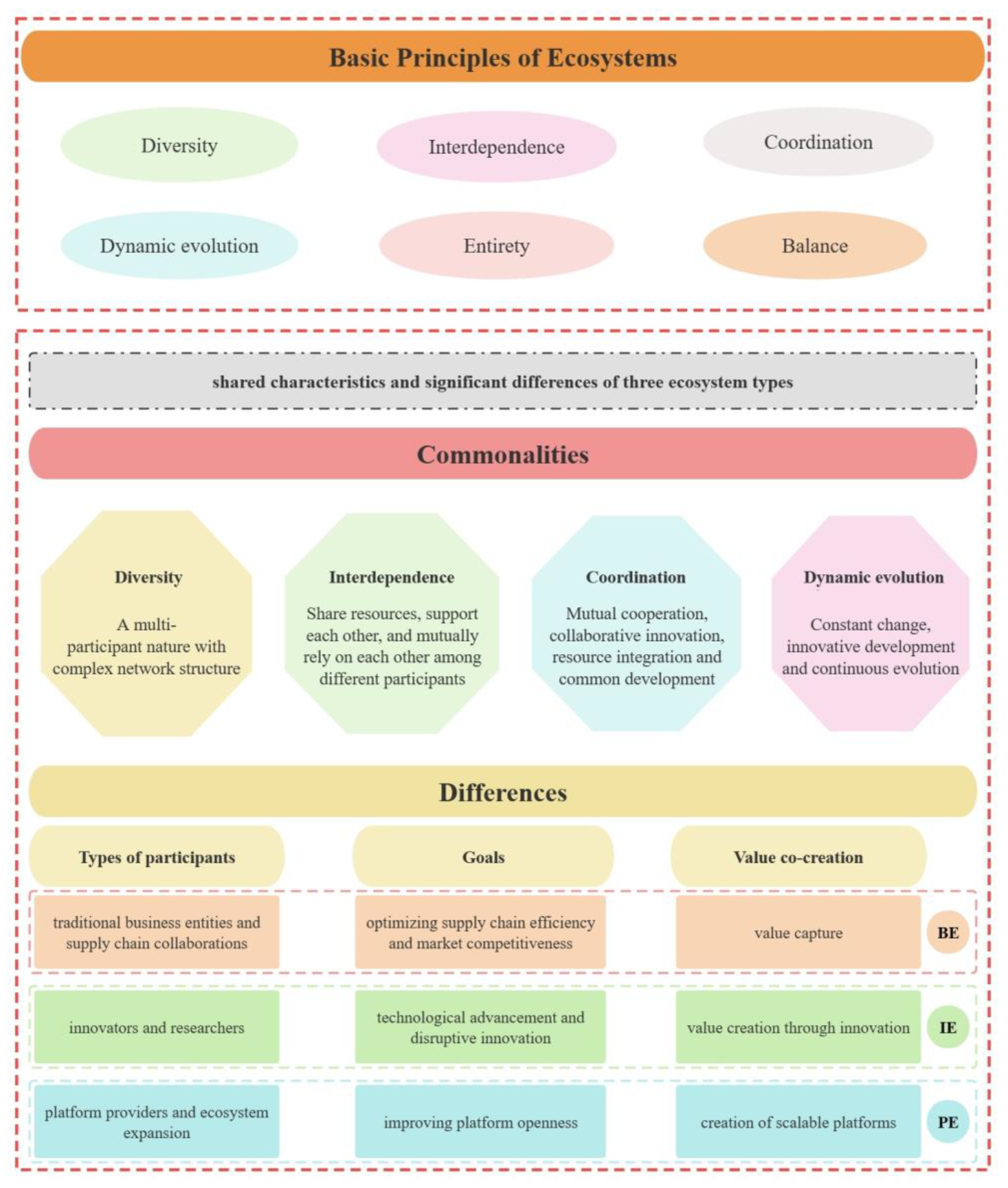

| Definition | Element | Role | Source | Literature |
|---|---|---|---|---|
| Business ecosystem (BE) | Focal firm | Product or service maker | The BE has a loose network of suppliers, distributors, outsourcing firms, makers of related products or services, technology providers, and a host of other organizations. | [39] |
| Architect | A focal firm needs not only to develop linkages with its potential direct partners but also to create an entire ecosystem involving indirect partners. | [54] | ||
| Supplier | Provider | …interdependent stakeholders, encompassing users, rivals, providers, community groups, and various entities… | [55] | |
| Complementor | Complementary partner | Different stakeholders include direct industrial players, government agencies, industry associations, competitors, and customers. | [54,56] | |
| Customer | Demand | The main difference between business and innovation ecosystems seems to be a lack on the demand side (customer/ user) in the latter. | [57] | |
| Principles | Diversity | …the combination of all the efforts of all players of the community (large and small–medium manufacturers, retailers, government, technological parks, universities, consultants, etc.) guarantees the survival and the success of the BE. | [58,59] | |
| Interdependence | …highlights the interdependence of all actors in the business environment, who co-evolve their capabilities and roles. | [14,60,61] | ||
| Coordination | …showing a business ecosystem which is seen as a class of CN (collaborative network), more specifically as a sub-class of a long-term strategic network. | [12,61] | ||
| Dynamic evolution | In a business ecosystem, companies co-evolve capabilities around a new innovation: they work cooperatively and competitively to support new products, satisfy customer needs, and eventually incorporate the next round of innovations. | [6,62,63] | ||
| Innovation ecosystem (IE) | Focal firm | Advocate | The main driver is the differences in innovation incentives and strategies among the different focal firms. | [15,64] |
| Innovators | Supplier | Underlying a technology’s advance are not only efforts by producers of the focal technology but also systemic efforts by component and complement providers from a range of interdependent industries. | [64] | |
| Complementary innovator | …leading to a dynamic innovation ecosystem in which complementary innovators were continuously providing new value to customers… | [16] | ||
| User | Developing and modifying new products with users; adopting innovative solutions provided by users. | [65] | ||
| Innovation supporters | Expert | This role of ‘entrepreneur’ may be assumed in response to the partnership-forging activities of the ecosystem leader or as a result of seeing opportunities to commercialize the discoveries and inventions of experts. | [17] | |
| Research institute | Through cooperation with universities and research institutes, the firm acquires and utilizes innovative resources and commercializes cooperative R&D results to promote innovation. | [65] | ||
| Principles | Diversity | The innovation ecosystem is composed of interconnected and interdependent networked actors, which include the focal firm, customers, suppliers, complementary innovators, and other agents as regulators. | [37] | |
| Interdependence | There is an understanding that both BEs and IEs are composed of interconnected and interdependent network actors. | [37,66] | ||
| Coordination | An innovation ecosystem is set for the co-creation or the joint creation of value. | [37,67] | ||
| Dynamic evolution | The evolving relationships between the wide range of innovation partners in an innovation ecosystem highlight the degree to which their interaction contributes to knowledge creation… | [68] | ||
| Platform ecosystem (PE) | Platform provider | Sponsor | Platform leaders craft governance mechanisms that are inherent in the platform’s technical architecture. | [20,69,70] |
| Complementor | Complementary partner | Platform owners often seek to encourage complementary third-party innovation from sources external to the organization, including customers, research firms, business partners, and universities. | [19,21] | |
| End users | Consumer | The platform leader, complementors, and users who consume these products or services collectively comprise the ecosystem surrounding the platform. | [20] | |
| Company | Startups’ technology commercialization can be facilitated by joining a platform ecosystem. | [21] | ||
| Principles | Diversity | The platform ecosystem exhibits a diversity of ownership and control, of both complementary assets and the components that make up the platform. | [18] | |
| Interdependence | …through their participation in the ecosystem, complementors constantly reshape the platform’s user value through the variety of complements they create and, in doing so, also affect the value for other complementors to participate in the ecosystem. | [71] | ||
| Coordination | The platform can leverage these relationships to foster, for instance, tighter collaboration and provide “rewards” … | [72,73] | ||
| Dynamic evolution | Platform ecosystems have been discussed as complex ecologies of firms with individual and collective intertwined interests, whose evolution follows some emergent self-organizing patterns based on complementarities and the coevolution of participants’ activities and capabilities. | [71,72] | ||
| Balance | The platform owner should strive for a balance between incremental and radical innovation by complementors as well as the success of complementors’ innovation in terms of the performance of goods. | [18] |
| Topic | Keyword | Author(s) | Journal | |
|---|---|---|---|---|
| #0 Digital servitization | Digital servitization Internet Opportunity Organizations Servitization | Jovanovic et al., 2022 [82] | 1 | Technovation |
| Sjödin et al., 2022 [83] | 2 | California Management Review | ||
| Kohtamaki et al., 2019 [84] | 3 | Journal of Business Research | ||
| Sklyar et al., 2019 [85] | 4 | Journal of Business Research | ||
| #1 Platform ecosystems | Competition Impact Business Architecture Digital transformation Platform ecosystem Boundary resources Markets | Hilbolling et al., 2021 [86] | 5 | Journal of Product Innovation Management |
| Ceccagnoli et al., 2012 [21] | 6 | Mis Quarterly | ||
| Schmeiss et al., 2019 [20] | 7 | California Management Review | ||
| Khanagha et al., 2022 [87] | 8 | Strategic Management Journal | ||
| Cennamo et al., 2019 [71] | 9 | Organization Science | ||
| Tavalaei and Cennamo, 2021 [72] | 10 | Long Range Planning | ||
| Inoue, 2021 [73] | 11 | Technological Forecasting and Social Change | ||
| Gawer and Cusumano, 2014 [88] | 12 | Journal of Product Innovation Management | ||
| Floetgen et al., 2021 [89] | 13 | European Journal of Information Systems | ||
| Murthy and Madhok, 2021 [19] | 14 | Journal of Management Studies | ||
| Kretschmer et al., 2022 [69] | 15 | Strategic Management Journal | ||
| Panico and Cennamo, 2022 [90] | 16 | Strategic Management Journal | ||
| Schreieck et al., 2021 [91] | 17 | Journal of Information Technology | ||
| Sandberg et al., 2020 [92] | 18 | Management Information Systems Quarterly | ||
| Thomas et al., 2014 [18] | 19 | Academy of management perspectives | ||
| Cenamor and Frishammar, 2021 [70] | 20 | Research Policy | ||
| #2 Artificial intelligence | Business models Perspective Science Knowledge management Big data | Burström et al., 2021 [93] | 21 | Journal of Business Research |
| Leone et al., 2021 [94] | 22 | Journal of Business Research | ||
| Manser et al., 2021 [95] | 23 | Journal of Research in Interactive Marketing | ||
| Elia et al., 2020 [96] | 24 | Technological Forecasting and Social Change | ||
| Ehret and Wirtz, 2017 [97] | 25 | Journal of Marketing Management | ||
| Clough and Wu, 2022 [98] | 26 | Academy of Management Review | ||
| #3 Innovation ecosystem | Innovation Performance Strategy Technology Knowledge Innovation ecosystem Framework Platforms Creation Design | Walrave et al., 2018 [66] | 27 | Technological Forecasting & Social Change |
| Mollenkopf et al., 2021 [99] | 28 | Journal of Service Management | ||
| Bart Clarysse et al., 2014 [58] | 29 | Research Policy | ||
| Granstrand and Holgersson, 2020 [16] | 30 | Technovation | ||
| Adner and Kapoor, 2016 [64] | 31 | Strategic Management Journal | ||
| Robertson et al., 2021 [68] | 32 | International Business Review | ||
| Oh et al., 2016 [100] | 33 | Technovation | ||
| Dedehayir et al., 2018 [17] | 34 | Technological Forecasting and Social Change | ||
| Wagner, 2021 [101] | 35 | International Journal of Physical Distribution & Logistics Management | ||
| Ben Letaifa, 2014 [102] | 36 | Management Decision | ||
| de Vasconcelos Gomes et al., 2018 [37] | 37 | Technological Forecasting and Social Change | ||
| Beltagui et al., 2020 [103] | 38 | Research policy | ||
| Kahle et al., 2020 [104] | 39 | Technological Forecasting and Social Change | ||
| Benitez et al., 2020 [105] | 40 | International Journal of Production Economics | ||
| Stahl, 2022 [106] | 41 | International Journal of Information Management | ||
| Liang and Li, 2023 [107] | 42 | Technological Forecasting and Social Change | ||
| Linde et al., 2021 [108] | 43 | Technological Forecasting and Social Change | ||
| Audretsch et al., 2022 [109] | 44 | International Entrepreneurship and Management Journal | ||
| Yang et al., 2021 [110] | 45 | Journal of Cleaner Production | ||
| Yin et al., 2020 [111] | 46 | Journal of Cleaner Production | ||
| Nylund al., 2021 [112] | 47 | Journal of Cleaner Production | ||
| Kamalaldin et al., 2021 [113] | 48 | Technovation | ||
| Shaw and Allen, 2018 [67] | 49 | Technological Forecasting and Social Change | ||
| Ander and Kapoor, 2010 [15] | 50 | Strategic Management Journal | ||
| Xie and Wang, 2020 [65] | 51 | Journal of Business Research | ||
| Masucci et al., 2020 [114] | 52 | Research Policy | ||
| Rohrbeck et al., 2009 [115] | 53 | R & D Management | ||
| Radziwon and Bogers, 2019 [116] | 54 | Technological Forecasting and Social Change | ||
| Chesbrough et al., 2014 [117] | 55 | California Management Review | ||
| #4 Business ecosystem | Value creation Management Model Business ecosystem Evolution Firm performance Competitive advantage Business model | Moore, 1993 [6] | 56 | Harvard Business Review |
| Ramezani and Camarinha-Matos, 2020 [118] | 57 | Technological Forecasting & Social Change | ||
| Gupta et al., 2019 [60] | 58 | Technological Forecasting & Social Change | ||
| Riquelme-Medina et al., 2022 [119] | 59 | Journal of Business Research | ||
| Audretsch et al., 2019 [120] | 60 | Journal of Technology Transfer | ||
| Ketchen Jr et al., 2014 [121] | 61 | Journal of Business Logistics | ||
| Best, 2015 [122] | 62 | Technovation | ||
| Scaringella and Radziwon, 2018 [57] | 63 | Technological Forecasting and Social Change | ||
| Hakala et al., 2020 [62] | 64 | International Journal of Management Reviews | ||
| Rong et al., 2015 [54] | 65 | Journal of International Management | ||
| Graça and Camarinha-Matos, 2017 [61] | 66 | Technological Forecasting and Social Change | ||
| Song, 2019 [123] | 67 | Small Business Economics | ||
| Nieuwenhuis et al., 2018 [124] | 68 | Technological Forecasting and Social Change | ||
| Bals, 2019 [125] | 69 | Journal of Purchasing and Supply Management | ||
| Kapoor and Li, 2013 [56] | 70 | Strategic Management Journal | ||
| Tsujimoto et al., 2018 [12] | 71 | Technological Forecasting and Social Change | ||
| Li, 2009 [39] | 72 | Technovation | ||
| Pierce, 2009 [14] | 73 | Strategic Management Journal | ||
| Battistella et al., 2013 [59] | 74 | Technological Forecasting and Social Change | ||
| Ma et al., 2018 [63] | 75 | Journal of Cleaner Production | ||
| Lee and Roh, 2023 [126] | 76 | Journal of Cleaner Production | ||
| Burford et al., 2022 [127] | 77 | Strategic Management Journal | ||
| Hanelt et al., 2021 [128] | 78 | Journal of Management Studies | ||
| Palmié et al., 2022 [129] | 79 | Technological Forecasting and Social Change | ||
| Battisti et al., 2022 [130] | 80 | Technological Forecasting and Social Change | ||
| Chen et al., 2023 [131] | 81 | The Journal of Technology Transfer | ||
| Sun et al., 2020 [132] | 82 | Journal of Cleaner Production | ||
| Sun et al., 2018 [133] | 83 | Journal of Cleaner Production | ||
| Yi et al., 2022 [55] | 84 | Technovation | ||
| Literature | Definition of BE | Research Objective | Methodology | Research Finding(s) |
|---|---|---|---|---|
| Moore (1993) [6] | BEs, in contrast to co-evolving organisms in biological communities, are social systems sustained through an intricate network of choices made by participants. | Dominant company | Metaphor method | A BE comprises stages of birth, expansion, leadership, and self-renewal. |
| Li (2009) [39] | A BE is a group of organizations such as suppliers, distributors, manufacturers, and tech providers. They are connected through platforms, making their collaborative efforts more valuable than what each can achieve alone. | Business ecosystem M&A strategy | Case study | The M&A strategy provides an accelerated approach to complement the company’s core technology portfolio. |
| Pierce (2009) [14] | BEs occupy a continuous space consisting of closely related suppliers, customers, complementors, and core companies. Together, they shape the technological architecture for creating products and services. | The impact of core enterprise decision-making on complementary enterprise performance | Quantitative analysis | The dynamic product design strategies of major enterprises and the entrance of niche players have generated turbulent ecosystems, leading to financial setbacks and exits for independent niche market firms. |
| Kapoor and Lee (2013) [56] | BE is a complex network composed of companies and their customers, complementors, and suppliers with interdependent relationships. | The impact of organizational differences in complementary aspects of enterprises on investment in new technologies within the BE | Quantitative analysis | In addition to affecting incentives and costs, the way a firm and its complementors are organized plays a crucial role in the firm’s ability to coordinate changes related to complementary activities. This coordination is key to reaping the benefits of early investments in new technologies. |
| Battistella et al. (2013) [59] | A complex system with multiple interconnected loops, both within and between them, featuring mutual cross-feed relationships and inhibitory connections. It also involves preferential reactions depending on varying substrate concentrations. | The arrangement and flow within a BE | Case study | The initial proposition of a systematic approach for examining both the static and dynamic structures of a business ecosystem is called the methodology of business ecosystem network analysis (MOBENA). |
| Clarysse et al. (2014) [58] | BE can be viewed as a collective of companies collaborating to create value by leveraging their skills and assets concurrently. | The connection between knowledge ecosystems and BEs | Social network analysis | In knowledge ecosystems, there is a tendency to concentration around a few central actors, while business ecosystems exhibit limited presence at the local level. This highlights fundamental distinctions in the processes of value creation between the two. |
| Rong et al. (2015) [54] | The BE functions as a self-contained economic community comprising diverse stakeholders, such as direct industry participants, government agencies, industry associations, competitors, and customers. These entities mutually benefit from each other and share similar outcomes. | Cultivating BE for enterprises | Case study | To develop a BE in a new foreign market, go through three stages: begin by nurturing complementary partners, then identify leadership partners, and finally integrate ecosystem partners. Key activities involve sharing vision, identifying leaders, and connecting partners throughout this process. |
| Graça and Camarinha-Matos (2017) [61] | BE is an economic community made up of interacting organizations and individuals. | An indicator system for evaluating performance in a collaborative business ecosystem | Literature review | The digital BE can be comprehended as consisting of digitization, commerce, and ecosystem, with attributes such as economy, commerce, population, community, multi-agent system, dynamics, evolution, and network. |
| Scaringella and Radziwon (2018) [57] | BE is described as a network of closely related companies, either interconnected or situated in close geographical proximity. | The invariant terminology used in various studies of ecosystems | Literature review | Innovation, value acquisition, and competitive advantage are the goals of the business ecosystem. |
| Ma et al. (2018) [63] | BE is an economic community comprising diverse stakeholders, such as industry participants, governments, industry associations, competitors, customers, and others, coexisting in the same economic landscape and evolving collectively. | The interplay between social-ecological innovation and the sustainable development of urban systems within the sharing economy | Case study | A robust co-evolution mechanism exists between the macro-level transformation towards a more sustainable city and the meso-level innovation in the BE, particularly in the development of greener and smarter transport. |
| Tsujimoto et al. (2018) [12] | BE is an organizational structure centered on value acquisition and creation, composed of a business environment and numerous private enterprises. | The research direction of ecosystems within technology management and innovation | Literature review | Four major research streams include an industrial ecology lens, a business ecosystem viewpoint, platform management, and a multi-actor network approach. |
| Gupta et al. (2019) [60] | The fundamental concept of a BE revolves around three keywords: business participants, network, and strategy. | Boundaries of BEs, IEs, and digital ecosystems | Bibliometric analysis | A BE typically emphasizes actors, networks, and strategies. |
| Hakala et al. (2020) [62] | The key themes of the BE are internationalized, worldwide rivalry, and collaboration, moving towards collaborative competition and co-evolution within the interconnected system. | Concept of ecosystem terminology | Literature review | In the BE, only companies that adapt to the environment, innovate continuously, and collaborate for mutual benefit can survive and achieve success. |
| Yi et al. (2022) [55] | BEs consist of interdependent stakeholders, encompassing users, rivals, providers, community groups, and various entities, along with the relationships among them. | The influence of interactions with stakeholders on the business model innovation of focal enterprises | Quantitative analysis | The association among industry stakeholders exhibits an inverted U-shaped correlation with business model innovation, whereas the connection with stakeholders outside the industry positively influences business model innovation. |
| Literature | Definition of IE | Research Objective | Methodology | Research Finding(s) |
|---|---|---|---|---|
| Ander and Kapoor (2010) [15] | The IE consists of the focal actors and the external environment (upstream components and downstream complements) with interdependence. | External innovation challenges | Case study | A universal structure of an ecosystem comprises upstream components, focal actors, downstream complements, and customers. Challenges in upstream innovation will strengthen the leading edge of focal actors, while challenges in downstream innovation will weaken it. |
| Granstrand and Holgersson (2020) [16] | IE is the evolving combination of participants, actions, elements, establishments, connections, and mutually supportive elements. It is essential for the innovative performance of an individual actor or a population of actors. | Concept of IE | Literature review | Participants, artifacts, and activities constitute the components of the IE, with elements interconnected through complementary and substitutive relationships. The IE exhibits a characteristic of continuous development. |
| Ander and Kapoor (2016) [64] | IEs are made up of interdependent constituents and supplements, within which essential technologies are embedded. | Key technologies | Case study | The rate at which the new technology replaces the current technology will hinge on the combined levels of the ecosystem emergence challenge for the new technology and the ecosystem expansion opportunity for the existing technology. |
| Dedehayir et al. (2018) [17] | IE describes the collaborative efforts of different actors for innovation and follows the evolution of the four stages of the ecosystem life cycle—creation, growth, dominance, and revitalization. | IE actors | Literature review | Based on the specific activities of the actors in the birth stage of the IE, participants are categorized into four roles: guiding roles, direct value creation roles, supporting roles, and contributing roles. The roles played by actors will shift as the IE develops, and participants enter or exit at different times during the birth stage, affecting the dynamics of the IE. |
| Walrave et al. (2018) [66] | IE functions as a network of interdependent actors who pool specialized yet complementary resources and capabilities to collaboratively co-create and deliver a comprehensive value proposition to end-users while also appropriating the gains obtained in the process. | Path-breaking innovation | Literature review | Four approaches are suggested to enhance external viability: (1) develop the value proposition and ecosystem model by learning from socio-technical experimentation feedback; (2) learn from organizations pioneering innovations to shape the value proposition and ecosystem model; (3) align the value proposition and ecosystem model with the evolving development trajectory in socio-technical niches; (4) implement niche protection schemes and maintain sufficient resource slack. |
| de Vasconcelos Gomes et al. (2018) [37] | IE takes co-creation or joint creation of value as its main goal and follows the process of ecosystem co-evolution. It is composed of interrelated and interdependent participants who face cooperation and competition. | Concept of IE | Bibliometric, content analysis | Like BEs, IEs involve interconnected players led by key figures or platform leaders. Participants in IEs engage in both cooperation and competition, driving co-evolution. However, IEs focus on value co-creation, while BEs prioritize value capture. |
| Xie and Wang (2020) [65] | IE is a loosely interlinked community of companies and other entities that coevolve strengths around a shared set of technologies, insights, or expertise. They collaborate and compete to innovate new products and services. | Modes of open IE | Grounded theory, FSQCA (fuzzy set qualitative comparative analysis) | Relying only on isolated open innovation is insufficient for improving enterprise product innovation. To enhance innovation capabilities, consider three model combinations involving interfirm cooperation, firm-intermediary collaboration, technology transfer, and collaborative efforts with other entities. |
| Robertson et al. (2021) [68] | IE is an evolving collection of participants, activities, and artifacts with complementary and substitutive relationships. It delivers value by facilitating the exchange of information and ensuring access to resources, all grounded in knowledge and related practices to achieve innovative results. | Innovation performance | Partial least squares path analysis | Knowledge creation strongly influences innovation performance in advanced and emerging economies. Knowledge diffusion is crucial for emerging markets, while knowledge absorption is key for transitioning economies. Knowledge impact is also vital for innovation performance in transitioning and emerging economies. |
| Shaw and Allen (2018) [67] | IEs are interconnected business model pathways. | Natural ecosystems | Case Study | IEs involve the serial recycling of scarce resources through ecosystem pathways. |
| Literature | Definition of PE | Research Objective | Methodology | Research Finding(s) |
|---|---|---|---|---|
| Ceccagnoli et al. (2012) [21] | PEs are comprised of interconnected technology platform owners collaborating with other companies to generate business value. | Small independent software developers | Quantitative analysis | Complementary innovation networks make platforms more valuable. |
| Schmeiss et al. (2019) [20] | PEs encompass leaders responsible for designing and overseeing technical architectures, as well as collaborators and consumers of the offered products or services. | Building a new PE for startups | Case study | Blockchain technology can solve the paradox of platform ecosystem openness by standardizing and automating interactions between multiple participants. |
| Cennamo and Santaló (2019) [71] | PE is a complex ecosystem of businesses where individual and collective interests are intertwined. | Electronic game platform system | Quantitative analysis | Coordinators play a pivotal role in shaping the success of the PE and exerting influence on its competitive position in the marketplace. |
| Tavalaei and Cennamo (2021) [72] | PE is a new structure of economic relationships between firms formed through the provision of resources by platform leaders to create value for complementarities. | Mobile application ecosystem | Quantitative analysis | PE members must ensure that they have a unique position in relation to their competitors. |
| Inoue (2021) [73] | PE is a system or architecture consisting of collections of complementary assets. | Incremental and radical innovation | Quantitative analysis | PEs can benefit from unlimited innovation through a variety of complementary and potentially unlimited pools of external resources. |
| Cenamor and Frishammar (2021) [70] | PE consists of incompletely designed product and technology “platforms” and complements. | Complementary products | Empirical analysis | The delineation of firm boundaries within PEs is shaped not only by the allocation of tasks among ecosystem players but is also impacted by the innovation strategies pursued by the firms involved. |
| Murthy and Madhok (2021) [19] | PE is a digital collaboration platform for sponsors and autonomous complementary parties to create value together. | Platform sponsor | FQCA (fuzzy qualitative comparative analysis) | The structure of the platform ecosystem, how participants interact, how it functions, and the opportunities it offers are influenced by the activities of the platform’s sponsors. |
| Kretschmer et al. (2022) [69] | PE is derived from the interdependence between platforms and complementary component sets. | Platform competition | Literature analysis | The key to competition in the platform ecosystem is to coordinate and manage the various players on the platform. |
| Thomas et al. (2014) [18] | In a PE, control over the entire product system is released, allowing the integration of different products. The ecosystem introduces market dynamics such as network effects and coordinated dominance through interactions between buyers and sellers. | Concept of architectural leverage and platform | Literature review | The PE is a versatile architectural approach that combines production, innovation, and transactional elements in a many-to-many structure. It harnesses the logic of open systems to create and distribute value through production, innovation, and transactions. |
| Field | Article | Research Theme |
|---|---|---|
| Business Ecosystem | [118] | Elucidating concepts and methods for improving BE resilience and antifragility. |
| [130] | Elucidating how meta-organizations coordinate user engagement and use advanced AI technology to help businesses create social and economic value. | |
| [132] | Studying the relationship between a strong platform, cooperative strategies, and building a BE in “Internet+ WEEE collection” means looking at how a powerful platform, teamwork, and the overall system work together to make electronic waste collection more effective in the internet context. | |
| [127] | Investigating how the structure of BEs influences a company’s performance after facing setbacks. | |
| [114] | Describing how companies collaborate on open innovation strategies to speed up the technological advancement of their partners, removing obstacles in the BE. | |
| [129] | Investigating how retailers incorporate digital technologies into their business models to generate value through connections with external partners. | |
| [126] | Studying how open innovation acts as a mediator and how digitalization capabilities serve as a moderator in the connection between coopetition strategy and sustainable performance within the context of the Belt and Road Initiative. | |
| [128] | Clarifying the boundary conditions of digital transformation from an organizational change perspective. | |
| [131] | Exploring entrepreneurial growth in the digital business ecosystem requires examining how enterprises can reconfigure their knowledge base to achieve this objective within the dynamic digital landscape. | |
| Innovation Ecosystem | [108] | Showing how companies cultivate dynamic capabilities to effectively coordinate and manage their IEs. |
| [109] | Investigating the evolving requirements of social innovators and the interplay between social IEs and traditional entrepreneurial ecosystems. | |
| [103] | Examining the formation, evolution, and role of digital IEs in facilitating disruptive innovation through processes such as exaptation. | |
| [110] | Investigating the critical factors contributing to the stability of green IEs and evaluating the influence of policies on collaborative innovation among multiple agents within the green IEs. | |
| [107] | Investigating how government support influences the growth of China’s digital economy and the significant role played by the resilience of regional IEs in this development. | |
| [105] | Examining the consolidation and evolution of Industry 4.0-oriented IEs and how value co-creation occurs within these ecosystems to deliver solutions for the market. | |
| [112] | Investigating the evolution of the role of multinational corporations in attaining sustainable development goals, particularly as the IE and corporate responsible research and innovation mature over time. | |
| [106] | Applying the principles of IE and responsible research and innovation to ethical discussions in artificial intelligence (AI) to explore ways of establishing a responsible AI innovation ecosystem. | |
| [104] | Examining the potential configurations and characteristics of IEs for small and medium-sized enterprises (SMEs) that enable the development and delivery of industrial Smart Products. | |
| [111] | Exploring the innovation of sustainable and smart products from the standpoint of an IE, considering the collaborative relationships and dynamics among various entities involved in the development and delivery of such products. | |
| [113] | Examining how equipment suppliers develop suitable ecosystem strategies to achieve digitally enabled process innovation in different industrial customer contexts. | |
| [96] | Investigating the impact of digital technologies and knowledge digitalization on the broader landscape of technology entrepreneurship and the processes involved in creating new ventures. | |
| Platform Ecosystem | [82] | Examining the strategies through which industrial manufacturers can enhance the value of their platforms by evolving and advancing industrial digital platforms. |
| [92] | Investigating the ongoing integration of digital capabilities and how they transform the scale and scope of product platform functions, resulting in a shift in the organizational logic of the firm. | |
| [89] | Investigating the strategies and mechanisms for developing resilience in digital PEs. | |
| [87] | Analyzing how a firm in a peripheral role in a PE can redefine its position through a dynamic mix of tangible, representative, and structural initiatives to create and establish an alternative platform. | |
| [86] | Elaborating on the mechanisms and reasons behind the enduring quality of complementary products within digital PEs. | |
| [90] | Investigating how users’ preferences for the size and innovativeness of an ecosystem impact the co-creation of value and the strategic dynamics within the PE. | |
| [91] | Examining the capabilities that companies require to facilitate and balance the processes of value co-creation and value capture within emerging digital PEs. |
Disclaimer/Publisher’s Note: The statements, opinions and data contained in all publications are solely those of the individual author(s) and contributor(s) and not of MDPI and/or the editor(s). MDPI and/or the editor(s) disclaim responsibility for any injury to people or property resulting from any ideas, methods, instructions or products referred to in the content. |
© 2024 by the authors. Licensee MDPI, Basel, Switzerland. This article is an open access article distributed under the terms and conditions of the Creative Commons Attribution (CC BY) license (https://creativecommons.org/licenses/by/4.0/).
Share and Cite
Liu, Z.; Li, Z.; Zhang, Y.; Mutukumira, A.N.; Feng, Y.; Cui, Y.; Wang, S.; Wang, J.; Wang, S. Comparing Business, Innovation, and Platform Ecosystems: A Systematic Review of the Literature. Biomimetics 2024, 9, 216. https://doi.org/10.3390/biomimetics9040216
Liu Z, Li Z, Zhang Y, Mutukumira AN, Feng Y, Cui Y, Wang S, Wang J, Wang S. Comparing Business, Innovation, and Platform Ecosystems: A Systematic Review of the Literature. Biomimetics. 2024; 9(4):216. https://doi.org/10.3390/biomimetics9040216
Chicago/Turabian StyleLiu, Zhe, Zichen Li, Yudong Zhang, Anthony N. Mutukumira, Yichen Feng, Yangjie Cui, Shuzhe Wang, Jiaji Wang, and Shuihua Wang. 2024. "Comparing Business, Innovation, and Platform Ecosystems: A Systematic Review of the Literature" Biomimetics 9, no. 4: 216. https://doi.org/10.3390/biomimetics9040216
APA StyleLiu, Z., Li, Z., Zhang, Y., Mutukumira, A. N., Feng, Y., Cui, Y., Wang, S., Wang, J., & Wang, S. (2024). Comparing Business, Innovation, and Platform Ecosystems: A Systematic Review of the Literature. Biomimetics, 9(4), 216. https://doi.org/10.3390/biomimetics9040216