
Bio-Stimulated Lower Limb Rehabilitation Robot Semantic Analogy Fit Design
Abstract
1. Introduction
2. Requirement Extraction and Reasoning Methods
2.1. Patent Knowledge Mining of Functional Requirements
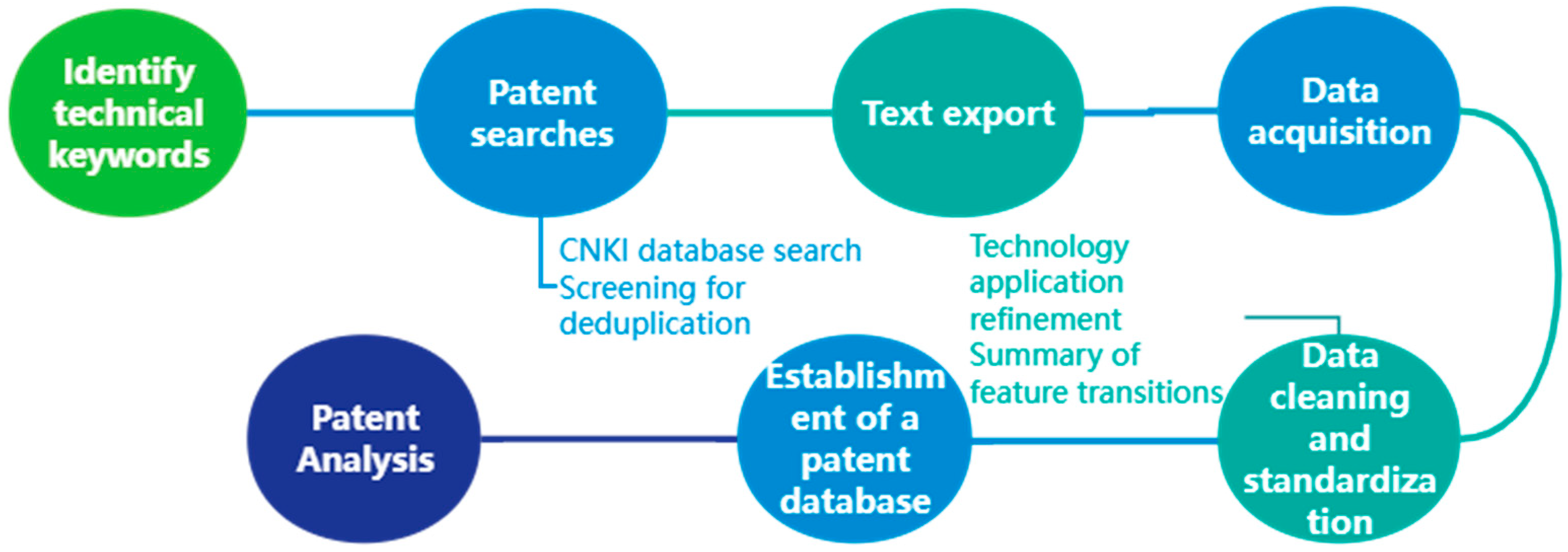
2.1.1. Patent Knowledge Mining
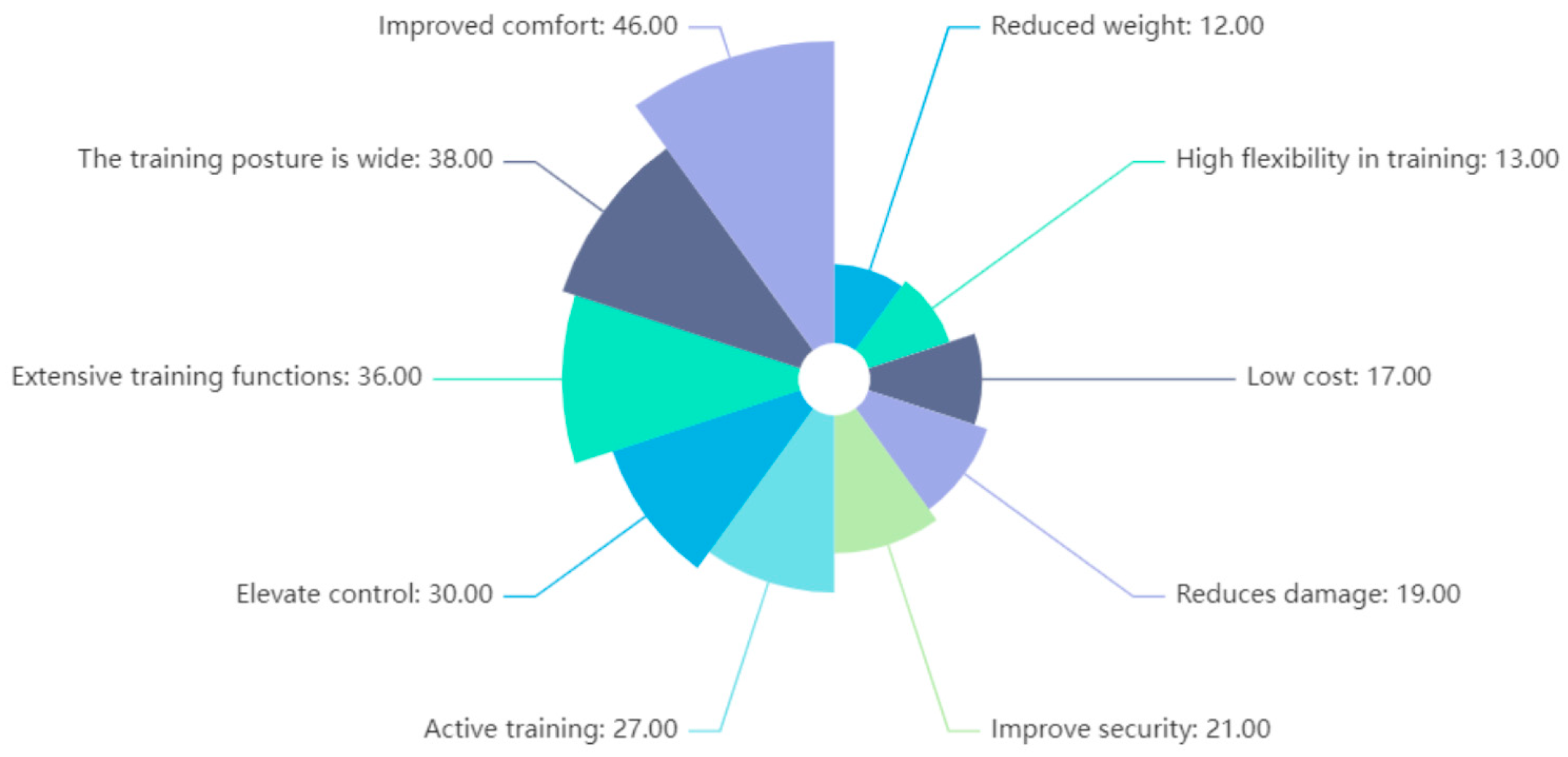
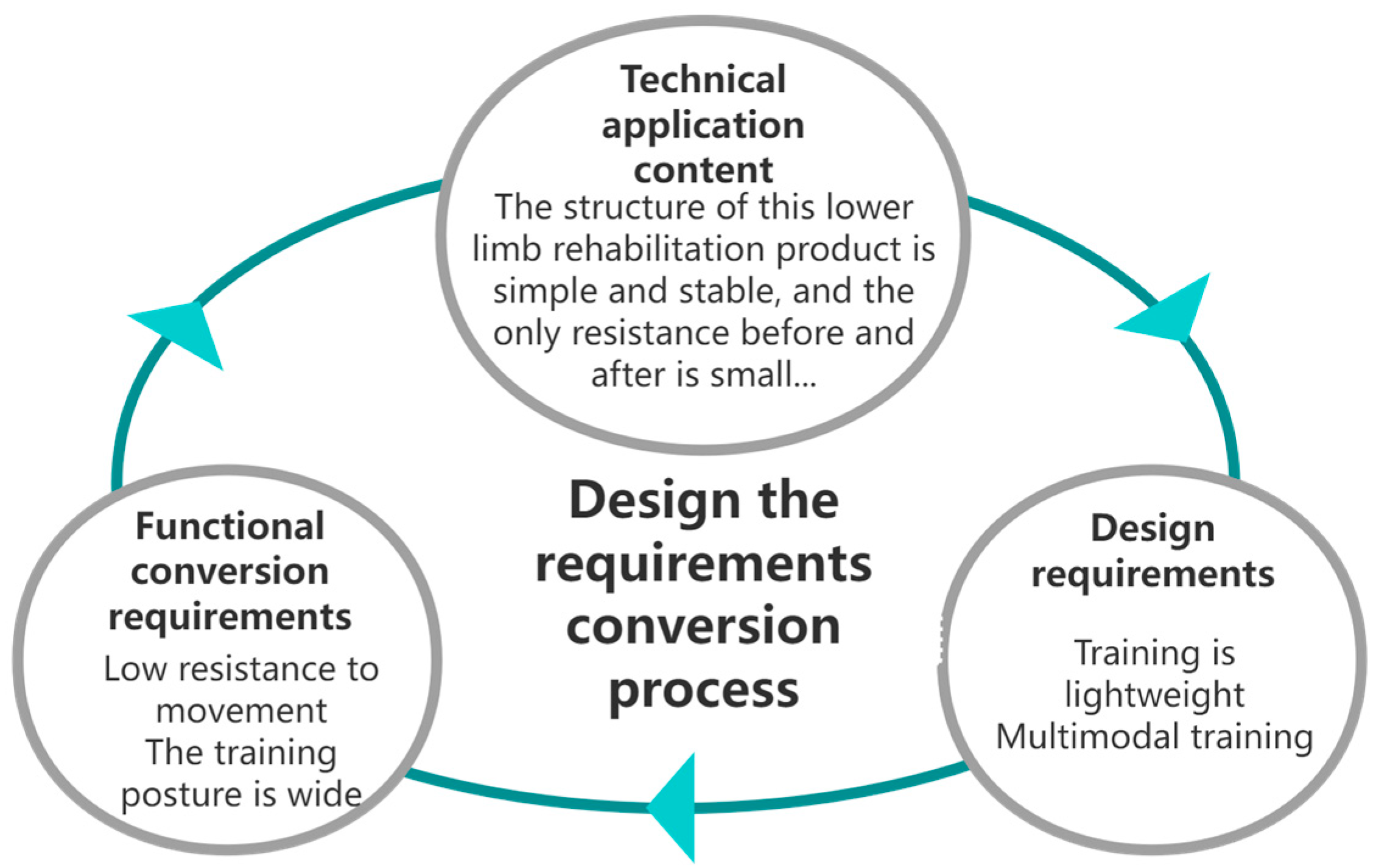
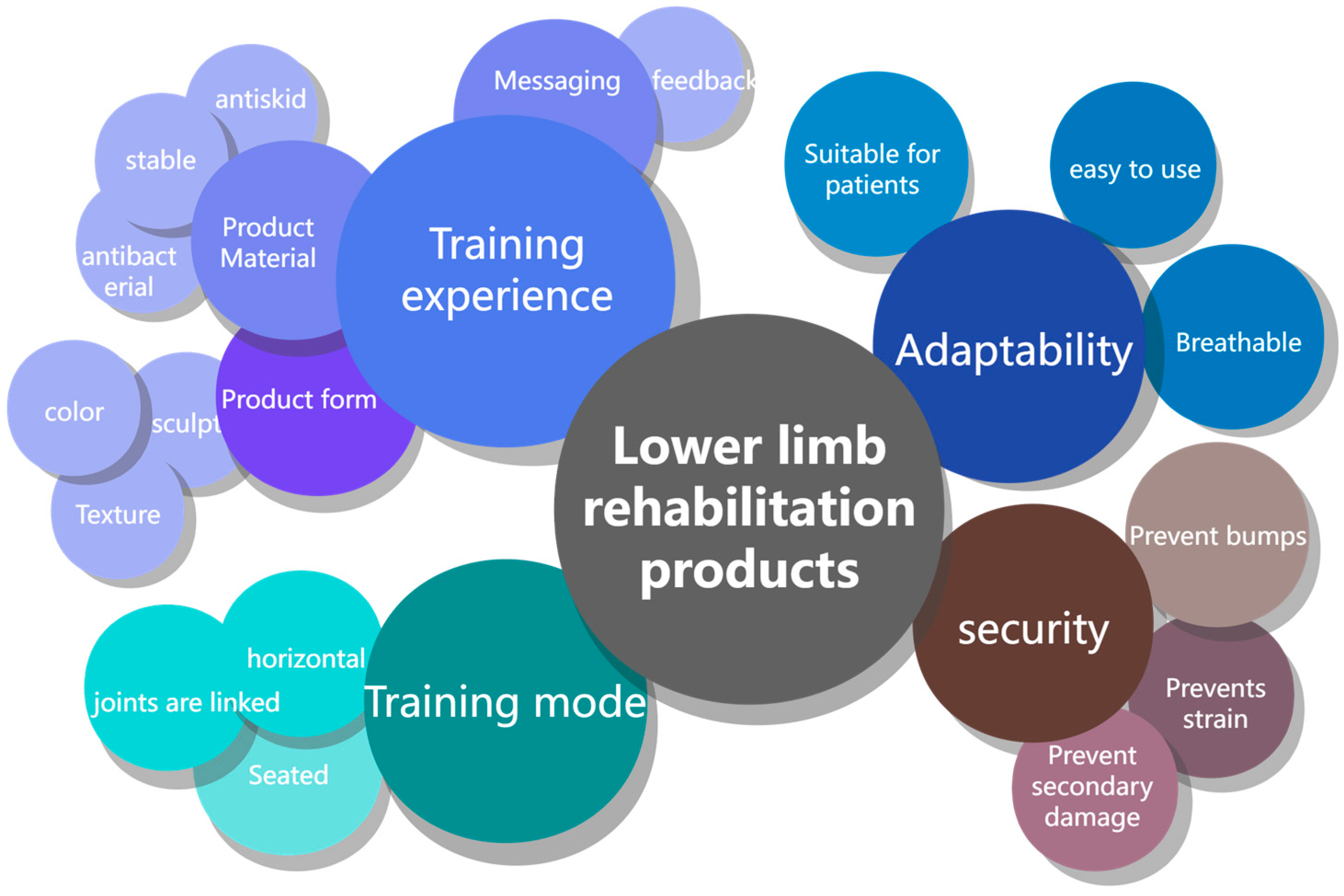
2.1.2. Product Demand Extraction
2.2. Analogy Source Reasoning and Similarity Calculation
3. Results
3.1. Biological Incentive System–Product Model and Transformation
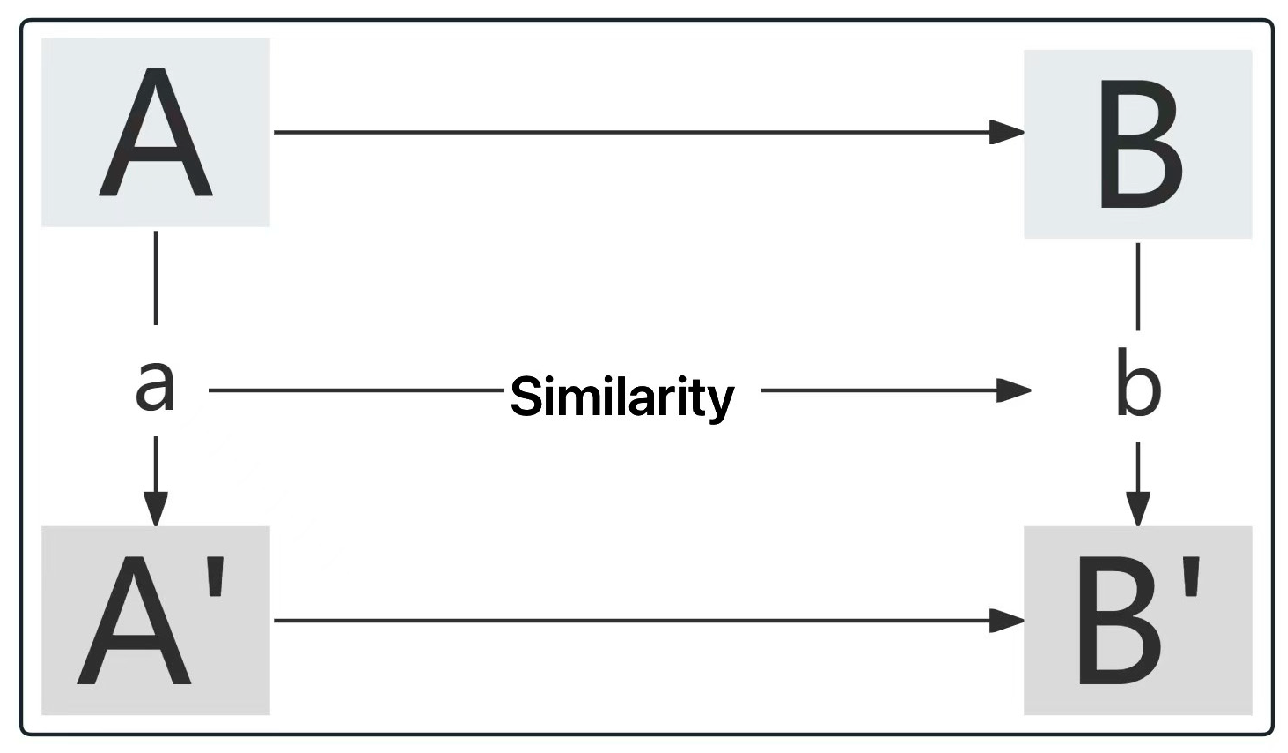
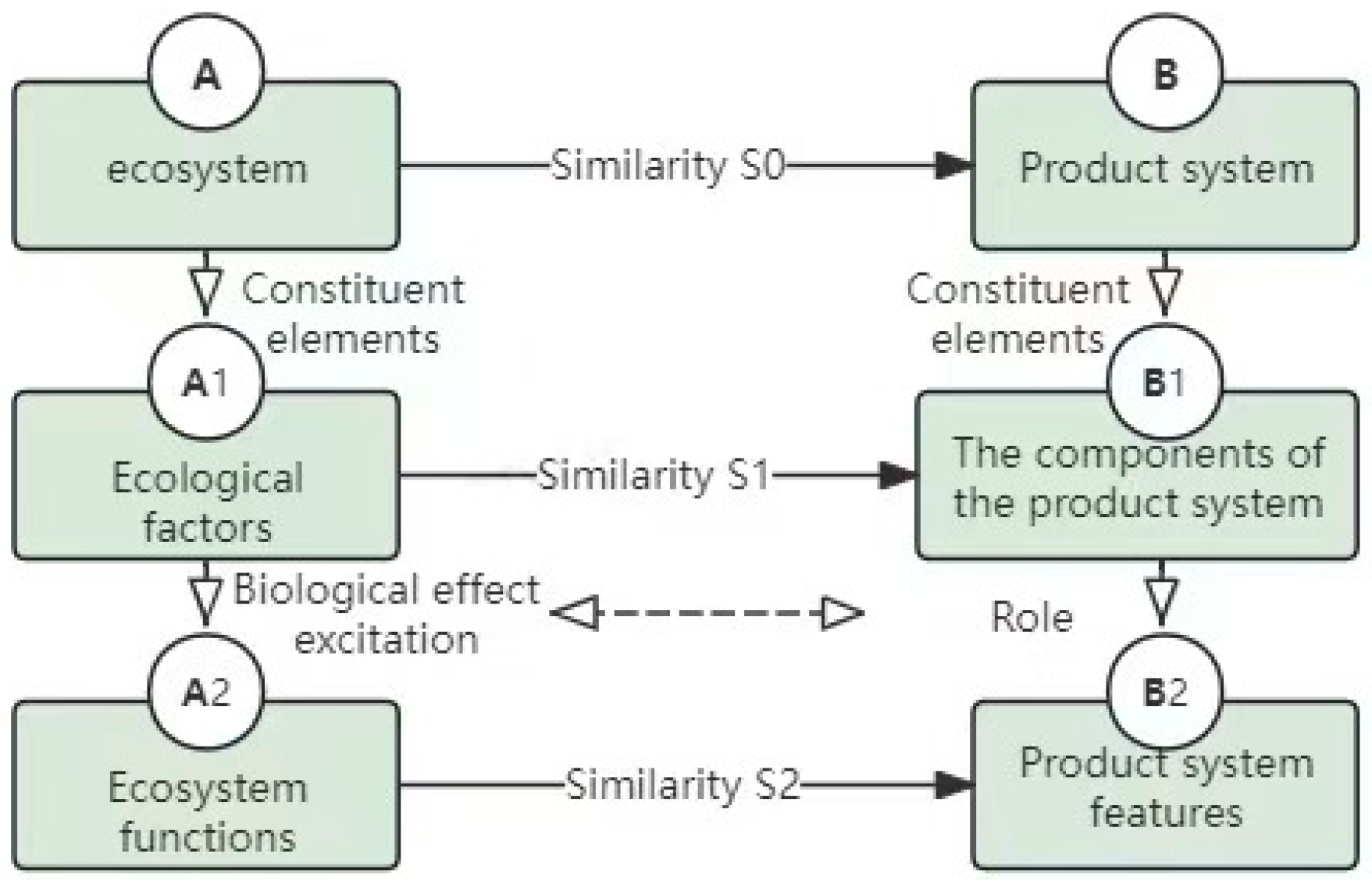
3.1.1. Derivation of Analogous Models Between Systems
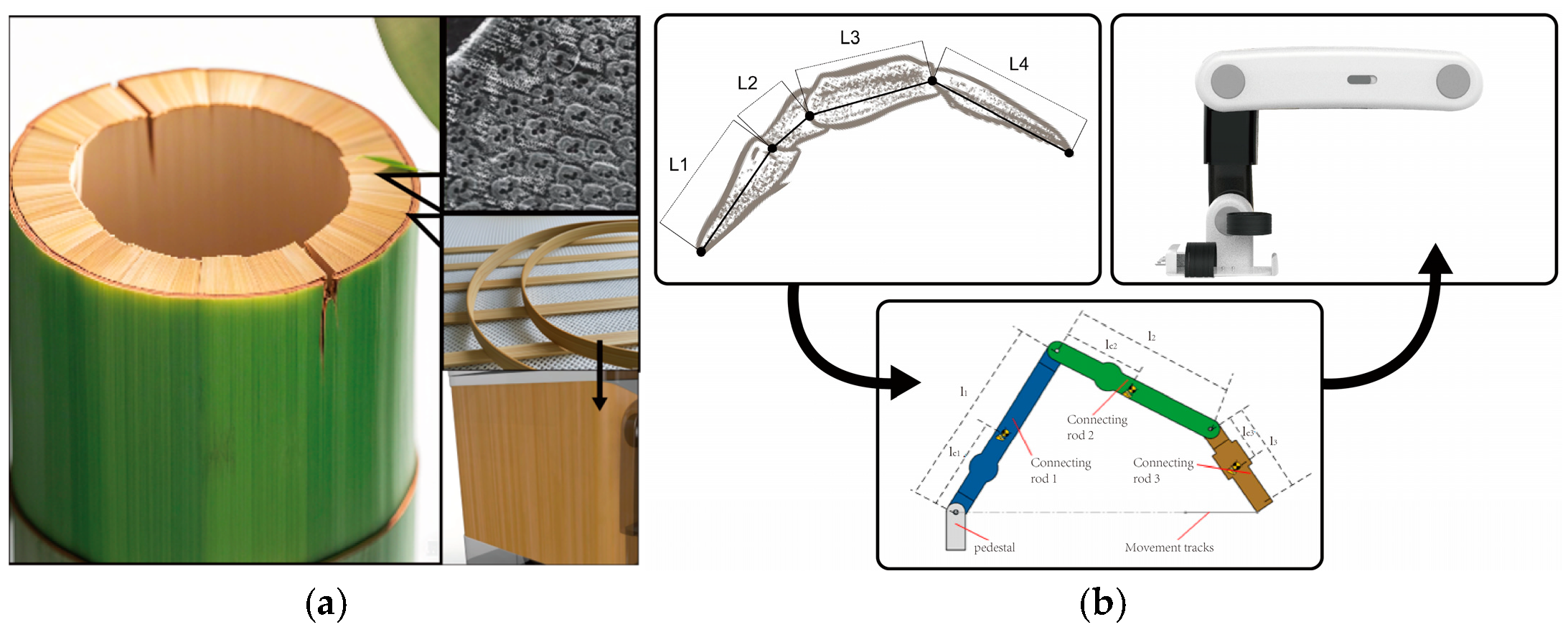
3.1.2. Engineering Transformation of Multi-Biological Effect Prototypes
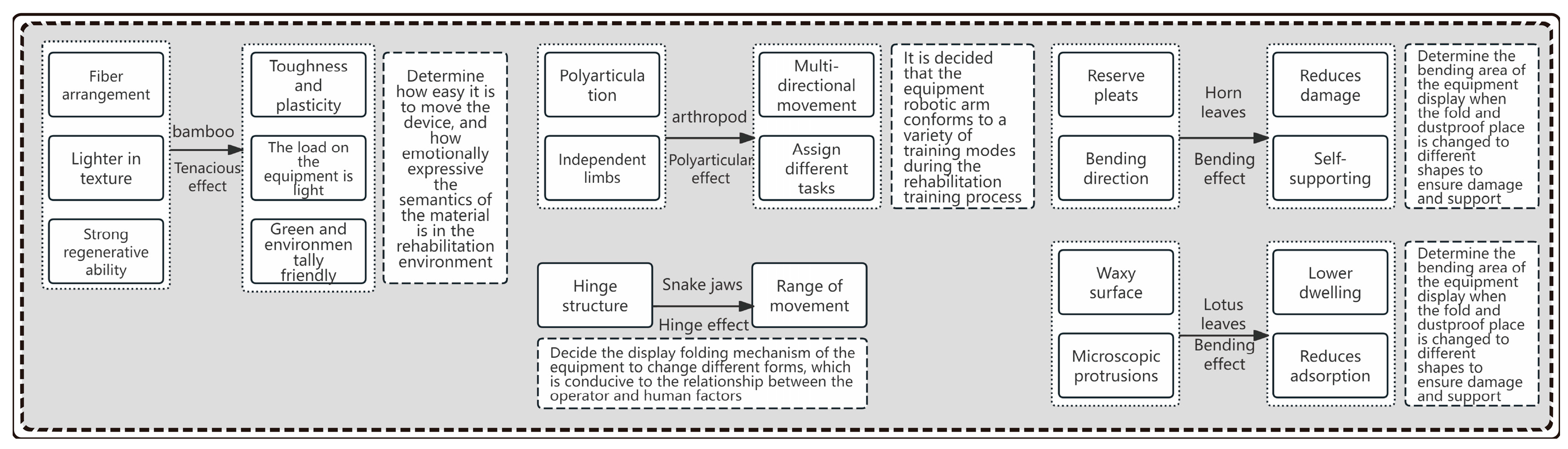
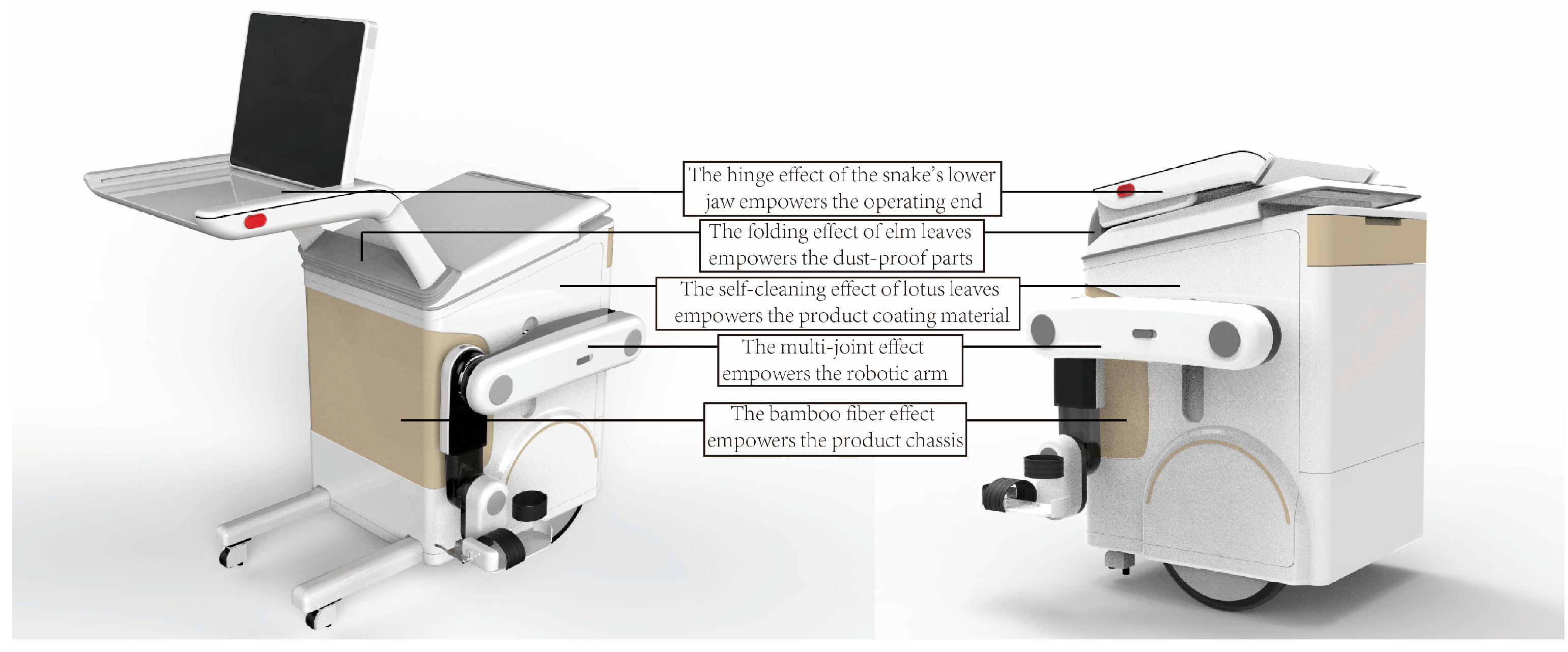
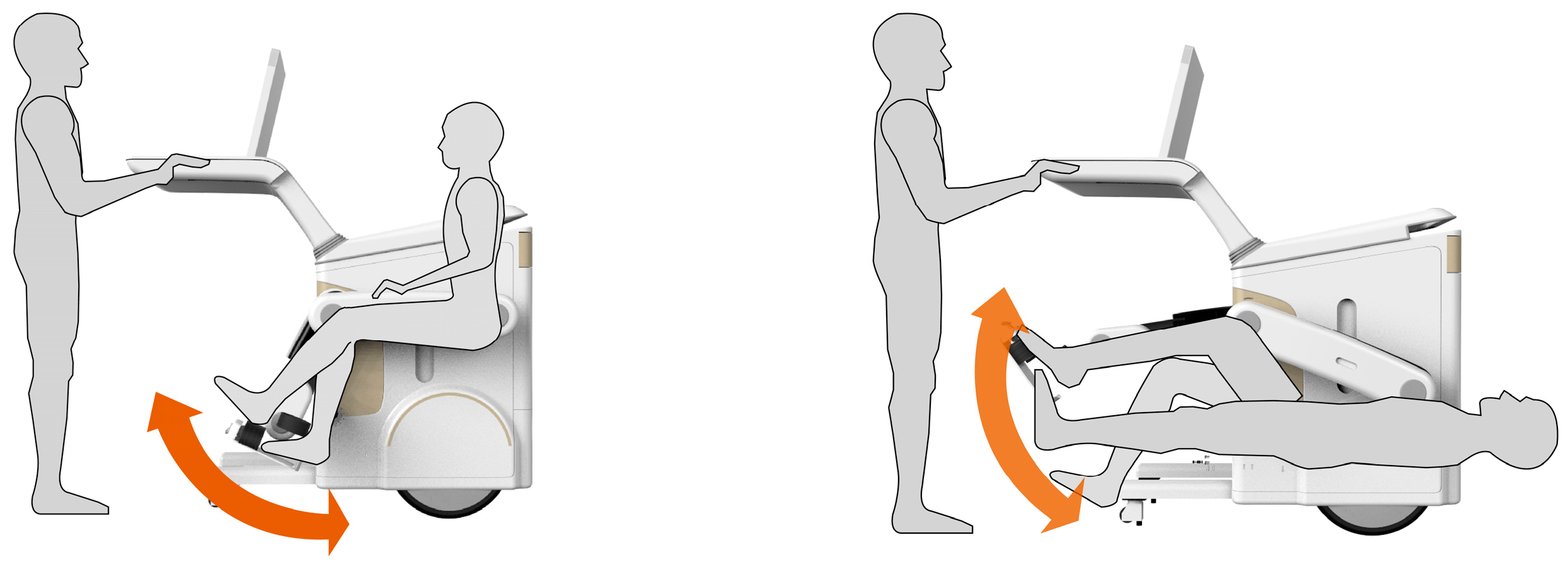
3.1.3. Biological Analogy Fit Product Scheme Design
4. Discussion and Conclusions
4.1. Key Objectives and Outcomes
4.2. Conclusions and Prospects
Author Contributions
Funding
Institutional Review Board Statement
Data Availability Statement
Conflicts of Interest
Appendix A

| Search Term: Lower Limb Rehabilitation Robot | ||||
|---|---|---|---|---|
| Order Number | Patent Publication Number | Patent Name | Applied Technology | Function Conversion |
| 001 | CN112451320A | Weight-loss support mechanism and lower limb rehabilitation robot containing it | Supporting assembly, support member, rope assembly | The resistance is reduced |
| 002 | CN109009885B | An easy-to-use exoskeleton lower limb rehabilitation robot | Drive device, movable device | Adjustable height |
| 003 | CN112386871A | A rehabilitation robot for lower limb gait rehabilitation training that is easy to move | Motor, threaded shaft | Adjustable auxiliary structure |
| 004 | CN112370305A | A lower limb rehabilitation training exoskeleton robot and its control method | Control components, drive components | Lightweight, active training |
| 005 | CN212490661U | An intelligent medical robot for lower limb rehabilitation treatment | Human sensory system | Reduced injury |
| 006 | CN212466522U | A back connection device for a lower limb rehabilitation robot | Motion blocks | Adjustable structure |
| 007 | CN212466516U | A lower limb rehabilitation robot with an ankle motion mechanism | Pole assembly, fastening assembly | Reduced damage, adjusted lightness |
| 008 | CN212466517U | An intelligent rehabilitation robot for lower limb gait training | Crossbeam and posts | The training functions are extensive |
| 009 | CN109381325B | A five-degree-of-freedom hybrid lower limb rehabilitation robot with strong continuity | Rudder gear teeth, shock-absorber spring | High flexibility in training |
| 010 | CN112294602A | A pneumatic muscle-driven lower limb rehabilitation robot | Air-operated controller | Enhanced training flexibility |
| 011 | CN212439291U | A lower limb rehabilitation robot for exoskeleton | Pavilion, turntable | High flexibility of adjustment |
| 012 | CN112274865A | On-demand adaptive control method and system for lower limb rehabilitation robot | Interactive control system | Active training |
| 013 | CN212416290U | Rehabilitation robots | Mechanical arm, drive component | High flexibility in training |
| 014 | CN212416291U | Rehabilitation robot system | Mechanical arm, drive component | High flexibility in training |
| 015 | CN212416293U | A lower limb rehabilitation training robot | Cross shaft, electric push rod | High flexibility in training |
| 016 | CN212395746U | Lower limb rehabilitation training robot deformation assembly | Lifting assembly, cushion drive | Training postures are extensive |
| 017 | CN110507322B | A quantitative state evaluation system and method based on virtual induced electromyography | Evaluation system, evaluation method | Active training, training postures are extensive |
| 018 | CN112237523A | Lower limb rehabilitation training robot | Weight-loss device, roller skates | Reduced injury |
| 019 | CN109394476B | Automatic intention recognition of brain muscle information and intelligent control method and system of upper limb | Intelligent control method, automatic identification | Enhanced control |
| 020 | CN212347108U | A lower limb rehabilitation robot and control system based on a parallel mechanism | Three degrees of freedom | Training postures are extensive |
| 021 | CN112221072A | A lower limb rehabilitation training robot | Input mechanism, adjustment mechanism | Improved accuracy |
| 022 | CN108785997B | A flexible control method for lower limb rehabilitation robot based on variable inductance | Delsys system, motion capture equipment | Enhanced control |
| 023 | CN106333830B | A lower limb rehabilitation robot walking mechanism | Crank rocker mechanism, five-bar mechanism | Training postures are extensive |
| 024 | CN212282104U | Multi-degree-of-freedom lower limb rehabilitation robot | Six degrees of freedom | Training postures are extensive |
| 025 | CN109875848B | A horizontal lower limb rehabilitation robot training mechanism and system | Drive device, turntable mechanism | Training postures are extensive |
| 026 | CN212166113U | Lower limb rehabilitation robot | Base, support rod | Training postures are extensive |
| 027 | CN112089580A | A kind of lower limb bone rehabilitation robot motion control method based on interference compensation | Dry resistance compensation | Enhanced control |
| 028 | CN112076067A | A weight reduction mechanism for a rehabilitation robot | Regulating platform, motion drive assembly | Reduced weight |
| 029 | CN112057806A | Foot pedal lower limb rehabilitation robot control system and its method | DSP control board, permanent magnet synchronous motor | Enhanced control |
| 030 | CN112043558A | A lower limb exoskeleton rehabilitation robot that combines rehabilitation training and walking assistance | Modularity | The training functions are extensive |
| 031 | CN212038162U | A lower limb rehabilitation device | Support base, adjustment assembly | Reduced weight, active training |
| 032 | CN111973409A | A kind of adaptable lower limb rehabilitation robot | Cylinder, slider | Adjustable height |
| 033 | CN111956448A | A lower limb rehabilitation robot and its kinesthetic control method | Kinesthetic control | Enhanced control |
| 034 | CN211934790U | An exoskeleton device for a lower limb rehabilitation robot | Actuator, massager | The training functions are extensive, active training and comfort improvement |
| 035 | CN111938989A | A method for evaluating the motion stability of a robot for lower limb gait rehabilitation training with a combination of rigidity and flexibility | Rope drive element | Reduced injury |
| 036 | CN111939003A | Lower limb rehabilitation robot | Walking mechanism, ceiling bracket | The training functions are extensive |
| 037 | CN211912150U | A new type of seated Chinese medicine fumigation lower limb rehabilitation robot device | Fumigation control box, rehabilitation cabin | Chinese medicine as an adjuvant therapy |
| 038 | CN111920635A | A modular spinal cord injury rehabilitation robot with multiple positions and mechanical structures | Electric push rod, modular | The training functions are extensive and can be used by multiple patients |
| 039 | CN111920654A | A self-regulating system of wearable rehabilitation walking robots | Navar | Improved adaptability |
| 040 | CN111904793A | A lower limb rehabilitation robot and control system based on a parallel mechanism | Pillar mechanism, parallel mechanism | The training functions are extensive |
| 041 | CN107273611B | A gait-planning method for a lower limb rehabilitation robot based on the characteristics of lower limb walking | Parameter modeling and gait planning | Improved adaptability |
| 042 | CN111888719A | A rehabilitation robot to assist in physical therapy | Deceleration block, balance rod | Reduced injury |
| 043 | CN111888186A | A three-degree-of-freedom bedside exoskeleton lower limb rehabilitation robot and its use method | Three degrees of freedom | The training postures are extensive and the training flexibility is high |
| 044 | CN111888193A | Multi-posture lower limb rehabilitation robot | Weight-loss device, elevator | The training functions are extensive |
| 045 | CN111821143A | Lower limb rehabilitation robot and its control method based on a semi-direct driver | Regulation device, parameterization | Self-training, training functions are extensive, and adaptability is improved |
| 046 | CN211723889U | A lower limb rehabilitation robot | Rotator | Training postures are extensive |
| 047 | CN111789739A | A lower limb rehabilitation robot ankle motion mechanism | An ankle motion mechanism | Reduced injury |
| 048 | CN111789742A | A dynamic feedback automatic lower limb rehabilitation robot | Double-axis machine, lightweight seat cushion | Train in a wide range of postures and reduce weight |
| 049 | CN111789746A | A back connection device for a lower limb rehabilitation robot | Back connection device | High training flexibility and reduced misoperation |
| 050 | CN211705248U | Lower limb rehabilitation robot | L-shaped plate and vertical rod | Low cost, family use |
| 051 | CN211675171U | A lower limb hybrid rehabilitation robot | Joint rehabilitation facility | Training functions are extensive, improving adaptability and safety |
| 052 | CN111773037A | Single lower limb rehabilitation exoskeleton device and its control method | Controller, lower limb assembly | Self-training, improved control |
| 053 | CN111773038A | A new type of lower limb rehabilitation exoskeleton robot and control method | Soft shaft transmission, spherical joint | Improved adaptability and training flexibility |
| 054 | CN111759669A | An intelligent rehabilitation robot system for upper and lower limb coordination based on electrical stimulation and its working method | Electrical stimulation and auxiliary transportation | Self-training and training functions are extensive |
| 055 | CN111759672A | A lower limb rehabilitation mirror training method based on a lower limb rehabilitation robot | Dynamic data, industrial control computer | Enhanced control |
| 056 | CN111759681A | A fixed flexible lower limb rehabilitation training robot | Separate line boxes, flexible wearables | Train a wide range of postures to improve adaptability |
| 057 | CN110464601B | A wearable biological lower limb rehabilitation robot | Joint connection device, decoupled parallel mechanism | Reduced damage and improved adaptability |
| 058 | CN211584112U | A foot mechanism of a lower limb rehabilitation robot | Foot structures | Low cost, family use |
| 059 | CN111419644B | Operation method of rehabilitation robot, rehabilitation robot, and readable storage medium | Readable storage medium | Reduced damage and improved adaptability |
| 060 | CN211560958U | A lower limb rehabilitation robot | Three degrees of freedom | Training postures are extensive |
| 061 | CN111700767A | A multi-functional rehabilitation robot training institution and method | Door frame, rope winch | Training postures are extensive, active training and adaptability are improved |
| 062 | CN211560957U | A length-adjustable structure and a lower limb rehabilitation robot | Fixed rod, adjustable rod | Simple structure |
| 063 | CN111658438A | A lower limb rehabilitation training robot | Front and rear flexion device, cross shaft | Simple structure, improved safety, training functions are extensive |
| 064 | CN111658434A | A knee hyperextension flexible exoskeleton rehabilitation robot and rehabilitation method based on pneumatic muscle | Sensory perceptual system | Improved safety, low cost |
| 065 | CN111658445A | Hip joint structure and passive gait coordination control method for lower limb rehabilitation training | Extender plate | Improved safety and simple structure |
| 066 | CN111631914A | A method for predicting the state interval response domain of a flexible cable-driven lumbar rehabilitation robot | Interval response prediction | Improved security and control |
| 067 | CN111603171A | A method and system for determining gait parameters for lower limb rehabilitation | Parameterization | Improved control and low cost |
| 068 | CN110238863B | Control method and system of lower limb rehabilitation robot based on EEG muscle signals | Electromyography, electroencephalography | Improved adaptability |
| 069 | CN111603172A | A general gait measurement method and system based on lidar | Radar surveying | Enhanced control |
| 070 | CN211382491U | A new type of Chinese medicine sit bath lower limb rehabilitation robot device | Water bath, lift | Chinese medicine as an adjuvant treatment |
| 071 | CN211383658U | A lower limb closed-chain movement rehabilitation robot | Closed chain device | Training functions are extensive and the cost is low |
| 072 | CN111588595A | An intelligent rehabilitation robot for lower limb gait training | Weight-loss agencies | Improved adaptability and training functions are extensive |
| 073 | CN111588587A | A lower limb rehabilitation robot with balanced self-weight and its application method | Balance components | Convenient operation, improved security |
| 074 | CN111568692A | A multi-degree-of-freedom lower limb rehabilitation robot | Six-degree-of-freedom mechanism | Training postures are extensive |
| 075 | CN211326602U | Lower limb rehabilitation robot | Drive sprocket | Improved adaptability and comfort |
| 076 | CN111557828A | Control method of active lower limb rehabilitation robot for stroke based on patient-side coupling | Multi-sensor information | Improved accuracy |
| 077 | CN211300956U | A horizontal lower limb rehabilitation robot | Thigh rod, slide rail | Improved adaptability |
| 078 | CN211301942U | A lower limb joint rehabilitation robot | Foot support | Active training, simulated real training |
| 079 | CN211300961U | A suspended lower limb rehabilitation training robot | Hip joint abduction driver | Training functions are extensive |
| 080 | CN2113009530 | A mobile lower limb exoskeleton rehabilitation robot and its control system | Control system, data terminal | Improved accuracy and control |
| 081 | CN111544846A | A method for training and mode switching of pure intention control rehabilitation robot | EEG acquisition | Active training |
| 082 | CN211272090U | A lower limb exoskeleton rehabilitation robot | Adaptive compensation | Reduced injury |
| 083 | C111529301A | A force position hybrid control method and vertical control of a limb rehabilitation robot | Force position hybrid control | Reduced injury |
| 084 | CX2111880830 | Lower limb rehabilitation exercise robot | Roller skate | The training states are extensive and the training degree is high |
| 085 | C32111938770 | A wearable lower limb rehabilitation exoskeleton robot | Two-stage deceleration | The training functions are extensive |
| 086 | CN111481400A | A lower limb rehabilitation training robot | A compression device | The autonomous adjustment and adjustment functions are extensive, and the adaptability is improved |
| 087 | CN105596018B | Human motion and potential detection device and detection method based on force sensor | Six-dimensional sensor | Training postures are extensive |
| 088 | CX2110957470 | A rehabilitation robot lower limb joint structure | Torque sensor, limit | Reduced injury |
| 089 | CX2110957611 | Sitting joint drive lower limb rehabilitation robot | Big and small yang swing | The posture can be widely adjusted and the weight reduced |
| 090 | CN110353952B | An assistance vehicle and rehabilitation training method for lower limb rehabilitation training | Driving frame | High training flexibility, reduced misoperation |
| 091 | CX111419632A | Redundant constraint flexible cable-driven lower limb conditioning parallel rehabilitation robot and its control method | Soft cable drive device | Low cost and family use |
| 092 | C111419644A | Operation method of rehabilitation robot, rehabilitation robot, and readable storage medium | Signal feedback | The adjustment functions are extensive, improving adaptability and security |
| 093 | CXI11407601A | A lower limb rehabilitation training robot | Vibration device, step belt | Self-adjustment and control |
| 094 | cN2109629080 | A seated lower limb rehabilitation robot | Bed body, lifting mechanism | Improved adaptability and high training flexibility |
| 095 | CS2109629090 | A multi-posture lower limb rehabilitation robot | Bed body, lifting mechanism | The autonomous adjustment and training functions are extensive |
| 096 | X210962914 | A lower limb rehabilitation robot with multiple motion modes | The middle and leg joints | Enhanced control |
| 097 | C2109629150 | Rehabilitation robots | Upper and lower rehabilitation structures | Train a wide range of states and improve adaptability |
| 098 | cX111388948A | A lower limb rehabilitation training system and method under the multi-adjustment mode | Controllable motor | Reduced damage and improved adaptability |
| 099 | CN111358659A | A robot-assisted control method, system, and lower limb rehabilitation robot | Force calculation | Low cost, family use |
| 100 | cX111359161A | Lower limb rehabilitation training robot deformation components | Always adjust the moving parts | Reduced damage and improved adaptability |
| 101 | c1135965A | Parallel-drive lower limb rehabilitation training robot | Always pad the moving part | Training postures are extensive |
| 102 | c2109037600 | A step training rehabilitation robot and partial degree adjustment locking mechanism | Pole, foot support | The training postures are extensive and active, and the adaptability is improved |
| 103 | CX111297629A | Rehabilitation training method for simulating climbing stairs and lower limb rehabilitation robot | Step miller | Simple structure |
| 104 | C2106737160 | A new type of seated Chinese medicine water bath lower limb rehabilitation robot device | Water bath | Simple structure, improved safety Training functions are extensive |
| 105 | X111214363A | A wearable mobile robot for lower limb rehabilitation training | Perception system | Improved safety and low cost |
| 106 | C2106314690 | A rehabilitation robot based on the external bone of the lower limb | Yan Zhongban | Improved safety, simple structure |
| 107 | 210612481t | The room degree of the lower limb pupillary robot is adjustable | Adjustment lever | Improved security and control |
| 108 | C210108912 | The inner foot mechanism based on rope motion is used for the lower limb rehabilitation robot | A contraction device | Improved control, low cost |
| 109 | CX111053674A | A flexible cable-driven blade lower limb rehabilitation robot | Rope drive device | Improved adaptability |
| 110 | N111035536A | Lower limb rehabilitation robot | Radar measurement | Enhanced control |
| 111 | C111035538A | A kind of joint module direct drive sitting and lying lower limb rehabilitation robot | Joint assembly | Chinese medicine as an adjuvant therapy |
| 112 | CX2103552990 | Rehabilitation system | Operating system | Enhanced control |
| 113 | cX210301640 | A counterweight lower limb rehabilitation robot | Weight-loss agencies | Improved adaptability The adjustment functions are extensive |
| 114 | cX110974621A | A foot mechanism of a lower limb rehabilitation robot | Balance components | Convenient operation, improved security |
| 115 | X110974635A | An external osteo device for a lower limb rehabilitation robot | External osteocalcification | The training functions are extensive |
| 116 | CX110993057A | Rehabilitation training system and method based on a cloud platform and lower limb rehabilitation robot | Operating system | Improved compatibility and comfort of the robot |
| 117 | C110946742A | A device and method for transferring the center of gravity of a weight-loss vehicle-assisted lower limb robot | Weight-loss equipment | Reduced weight |
| 118 | C2102052870 | A four-gel external bone chondrocyte rehabilitation robot | Large and small limb rods, slides | Improved proximity |
| 119 | CX210205291t | A kind of motion-separated lower limb gait training rehabilitation robot system | Scapular support | Active adjustment |
| 120 | CX110931715A | A control system and method for realizing the coordinated motion of lower limb robot and weight-loss vehicle | Carrying a message | Reduced weight |
| 121 | CX107149539B | A lower limb rehabilitation walking robot and control method that supports omnidirectional movement | Control system, data acquisition | Enhanced control |
| 122 | X110882131A | A lower limb rehabilitation robot | EEG acquisition | Active adjustment |
| 123 | CX1070881398 | A horizontal rehabilitation robot for patients with lower limb movement disorders | Adaptive compensation | Reduced injury |
| 124 | CN1108407098 | An intelligent medical robot for rehabilitation treatment of lower gum | Deceleration block, balance rod | The training functions are extensive |
| 125 | N110840712A | A lower limb rehabilitation robot system based on human–computer interaction | Interactive systems | Improved travel experience |
| 126 | CX110812122A | A method and system for sitting and standing training of a lower limb rehabilitation robot | Mobile chairs, elevators | Training postures are extensive |
| 127 | CN1086069073 | A mobile, well-connected, flexible drive rubber rehabilitation robot and its implementation method | Mobile device | Self-regulated practice Training functions are extensive |
| 128 | CN110743134A | A lower limb joint rehabilitation robot | Joint angle positioner | Training postures are extensive |
| 129 | CN110711115A | Hanging lower limb rehabilitation robot | Foot source motion mechanism | Reduce weight |
| 130 | CN110680676A | The mechanical leg of the lower limb rehabilitation robot | Double-axis machine, lightweight seat cushion | Train in a wide range of postures and reduce weight |
| 131 | CN110680679A | An interactive lower limb rehabilitation training system | Official department’s continuous pressing device | High training flexibility and reduced misoperation |
| 132 | CN20991656600 | A rope-driven “4 + 2” lower limb rehabilitation robot | L-shaped plate, vertical rod | Training postures are extensive |
| 133 | CN110623816A | A suspended lower limb rehabilitation training robot | Joint rehabilitation facility | Training functions are extensive, adaptability is improved, and weight is reduced |
| 134 | CX110559164 | The pulling system of the lower limb seat robot | Drawing machine, lower rubber assembly | Enhanced control |
| 135 | N110570916A | A method for evaluating the rehabilitation of lower limb rehabilitation robot to rehabilitate and exercise motor function | Soft shaft transmission, spherical joint | Improved adaptability Train to be flexible |
| 136 | N110517947A | A lower limb rehabilitation training robot | Electrical stimulation, auxiliary transportation | Self-training, training functions are extensive |
| 137 | CN110164601A | A wearable biological verification lower limb rehabilitation robot | Dynamic counter, industrial control computer | Enhanced control |
| 138 | C110353944A | Sitting joint drive under the condition of rehabilitation robots | Separate line boxes, flexible wearables | Train a wide range of postures and improve adaptability |
| 139 | CN110353945A | A multi-mode lower limb rehabilitation robot | Joint connection device, disassembly parallel mechanism | Reduced damage and improved adaptability |
| 140 | X110353952A | A crash prevention vehicle and rehabilitation training method for lower limb rehabilitation training | Foot structures | Low cost, family use |
| 141 | N110339023A | A lower limb rehabilitation robot that stimulates acupoints to produce reflexes | Readable storage medium | Reduced injury and improved adaptability |
| 142 | CN110327186A | Weight reduction control method, system, equipment, and storage medium for lower limb rehabilitation robot | Three degrees of freedom | Training postures are extensive |
| 143 | CN1103020338 | A seated Chinese medicine water bath lower limb rehabilitation robot system | Door-type cabinet frame, rope roller | The training postures are extensive, active training, and adaptability is improved |
| 144 | CN110302034A | A kind of Chinese medicine dust bath lower limb rehabilitation robot system | Fixed rod, adjustable rod | Simple structure |
| 145 | CX110279557A | A lower limb rehabilitation robot control system and control method | Front- and rear-layer extension device, cross shaft | Simple structure, improved safety, training functions are extensive |
| 146 | N110279560A | A rehabilitation robot that uses the contralateral upper limb to control the lower limb | Perception system | Improved safety, low cost |
| 147 | CN1074119396 | A single case of lower limb disability dedicated to an assistive rehabilitation robot | Extender plate | Improved safety, structural separation is easy |
| 148 | CN1066932848 | A lower limb rehabilitation and adjustment medical robot with the function of transportation | Interval response prediction | Improved security, improved control |
| 149 | CN110265112A | A three-dimensional gait rehabilitation training method for a lower limb rehabilitation robot | Parameterization | Improved control and low cost |
| 150 | CN110238863A | Control method and system of lower limb rehabilitation robot based on EEG muscle signals | Electromyography, electroencephalography | Improved adaptability |
| 151 | CN110200785A | A seated Chinese medicine re-vaporization lower limb rehabilitation robot system | Measure the movement | Enhanced control |
| 152 | CN110169992 | A multi-functional upper and lower glue rehabilitation robot | Remove the rehabilitation components from top to bottom | The training functions are extensive |
| 153 | CX110169893A | A lower limb rehabilitation training robot | Three degrees of freedom | The training functions are extensive and the cost is low |
| 154 | N110151496A | A multi-position lower limb rehabilitation robot and its use method | Weight-loss agencies | Improved adaptability and the function of wide migration can be adjusted |
| 155 | CN2092039560 | A multi-degree-of-freedom dynamic lower limb rehabilitation robot | Balance components | Training postures are extensive |
| 156 | CK2092039610 | A lower limb rehabilitation robot sugar hanging weight-loss device | Weight-loss suspension equipment | Reduced weight |
| 157 | N110037893A | A flexible cable for a dynamic wearable lower limb rehabilitation robot | Need-driven | Improved adaptability and comfort |
| 158 | N110025454 | A counterweight lower limb rehabilitation robot | Multi-sensor information | Improved adaptability |
| 159 | CX110025455A | A limb exoskeleton rehabilitation robot | Thigh rod, slippery | Improved adaptability |
| 160 | CN20912279600 | A lower limb rehabilitation robot for seven-degree-of-freedom movement | The feet are supporting | Active training Simulation of real training |
| 161 | CX209123286J | A full-body rehabilitation robot | Hip joint abduction driver | The training functions are extensive |
| 162 | N110013648A | A human–computer interaction system and method for a lower limb rehabilitation training robot | Control system, final data compilation | Improved accuracy and control materials |
| 163 | C2000608840 | A wearable lower limb rehabilitation robot | Corrosion current collection | Active adjustment |
| 164 | CN109953761A | A lower limb rehabilitation robot perception system and motion intention reasoning method | The reasoning method | Improved accuracy |
References
- Vandevenne, D.; Pieters, T.; Vanneste, C.; Duflou, J. Case-dependence of Level-based Idea Space Variety for Systematic Biologically-Inspired Design. Procedia CIRP 2016, 39, 173–178. [Google Scholar] [CrossRef]
- Deldin, J.M.; Schuknecht, M. The AskNature database: Enabling solutions in biomimetic design. In Biologically Inspired Design; Springer: London, UK, 2014; pp. 17–27. [Google Scholar]
- Liu, W.; Cao, G.; Tan, R.; Yu, F. Research on the realization method of multi-biological effect technology. J. Mech. Eng. 2016, 52, 129–140. [Google Scholar] [CrossRef]
- Cao, X.; Cao, G.; Xu, Y. Research on Biomimetic Design Process of Products Based on Multiple Biological Effects. Design 2015, 13, 60–61. [Google Scholar]
- Hou, X.; Liu, W.; Cao, G.; Wu, Z.; Guo, Z. Research on Design Method of Functional Combination Product Based on Multi-biological Effects. Chin. J. Eng. Des. 2017, 24, 18–26. [Google Scholar]
- Cao, G.; Wang, H.; Zhang, S. Hierarchical Biofeature-Driven Product Emotional Design Method. Packag. Eng. 2017, 38, 142–151. [Google Scholar]
- Wu, X. Research on Protective Tennis Clothing Based on Biomechanics. Master’s Thesis, Shanghai University of Engineering Science, Shanghai, China, 2014. [Google Scholar]
- Shi, D. Research on the Solution Process of Function-Based Conceptual Design; Harbin Engineering University: Harbin, China, 2006. [Google Scholar]
- Cao, G.; Tan, R.; Zhang, R.; Jiang, P. Research on Effect-based Conceptual Design Process Model. China Mech. Eng. 2005, 09, 823–827. [Google Scholar]
- Cohen, Y.H.; Reich, Y.; Greenberg, S. Sustainability strategies in nature. Int. J. Des. Nat. Ecodynamics 2014, 9, 285–295. [Google Scholar] [CrossRef]
- Pauw, I.D. Nature-Inspired Design: Strategies for Sustainable Product Development; Delft University of Technology: Delft, The Netherlands, 2015. [Google Scholar]
- Sara, K.; Noureddine, Z. A bio problem-solver for supporting the design, towards the optimization of the energy efficiency. In Proceedings of the 2015 6th International Conference on Modeling, Simulation, and Applied Optimization (ICMSAO), Istanbul, Turkey, 27–29 May 2015; IEEE: Piscataway, NJ, USA, 2015; pp. 1–6. [Google Scholar]
- Hoeller, N.; Farnsworth, M.; Jacobs, S.; Chirazi, J.; Mead, T.; Goel, A.; Salustri, F. A Systems View of Bio-Inspiration: Bridging the Gaps. Insight 2016, 19, 36–40. [Google Scholar] [CrossRef]
- Kanwal, A.; Fazal, S.; Bhatti, A.I.; Ullah, M.; Khalid, M.A. PubMedInfo Crawler: An innovative extraction process that leads towards biological information mining. Meta Gene 2019, 20, 100550. [Google Scholar] [CrossRef]
- Sadava, D.E.; Hillis, D.M.; Heller, H.C. Life: The Science of Biology, 9th ed.; Sinauer Associates Inc.: Sunderland, MA, USA, 2011. [Google Scholar]
- Lu, Y. The Significance and Development of Biomimicry. Sci. Chin. 2004, 4, 22–24. [Google Scholar]
- Cen, H.; Chen, W. The Concept of Biomimicry and Its Evolution. Mech. Des. 2007, 24, 66. [Google Scholar]
- Sigov, A.S.; Nechaev, V.V.; Baranyuk, V.V.; Smirnova, O.S.; Melikhov, A.A.; Koshkarev, M.I.; Bogoradnikova, A.V. Bionic-Oriented Information System for Innovation Activities. Indian J. Sci. Technol. 2016, 9, 6. [Google Scholar] [CrossRef]
- Shu, L.H.; Ueda, K.; Chiu, I.; Cheong, H. Biologically Inspired Design. CIRP Annals. 2011, 60, 673–693. [Google Scholar] [CrossRef]
- Volstad, N.L.; Boks, C. On the use of Biomimicry as a Useful Tool for the Industrial Designer. Sustain. Dev. 2012, 360, 159–173. [Google Scholar] [CrossRef]
- Egan, P.; Cagan, J.; Schunn, C.; Chiu, F.; Moore, J.; LeDuc, P. The D3 Methodology: Bridging Science and Design for Bio-Based Product Development. J. Mech. Des. 2016, 138, 081101. [Google Scholar] [CrossRef]
- Hu, J.; Ma, J.; Qi, J.; Peng, Y. Knowledge Modeling and Innovation Analogy Method for Biological Incentives. J. Mech. Eng. 2017, 21–31. [Google Scholar] [CrossRef]
- Massimoa, G.; Ilariab, M.; Borisc, E. Bio-inspired Design: Explicating the Value of Bio-Inspiration. In Proceedings of the Conference proceedings of the Design Management Academy: Research Perspectives on Creative Intersections, Hong Kong, China, 7–9 June 2017; Volume 1, pp. 23–41. [Google Scholar]
- van Houten, F.; Wertheim, R.; Ayali, A.; Poverenov, E.; Mechraz, G.; Eckert, U.; Rentzsch, H.; Dani, I.; Willocx, M.; Duflou, J.R. Bio-based design methodologies for products, processes, machine tools and production systems. CIRP J. Manuf. Sci. Technol. 2021, 32, 46–60. [Google Scholar] [CrossRef]
- Willocx, M.; Ayali, A.; Duflou, J.R. Where and how to find bio-inspiration? A comparison of search approaches for bio-inspired design. CIRP J. Manuf. Sci. Technol. 2020, 31, 61–67. [Google Scholar] [CrossRef]
- Gejdoš, M.; Tončíková, Z.; Němec, M.; Chovan, M.; Gergeľ, T. Balcony cultivator: New biomimicry design approach in the sustainable device. Futures 2018, 98, 32–40. [Google Scholar] [CrossRef]
- Graeff, E.; Letard, A.; Raskin, K.; Maranzana, N.; Aoussat, A. Biomimetics from practical feedback to an interdisciplinary process. Res. Eng. Des. 2021, 32, 349–375. [Google Scholar] [CrossRef]
- Ripley, R.L.; Bhushan, B. Bioarchitecture: Bioinspired art and architecture—A perspective. Philos. Trans. R. Soc. A Math. Phys. Eng. Sci. 2016, 374, 20160192. [Google Scholar] [CrossRef] [PubMed]
- Sachsenmeier, P. Industry 5.0—The Relevance and Implications of Bionics and Synthetic Biology. Engineering 2016, 2, 225–229. [Google Scholar] [CrossRef]
- Linsey, J.S.; Viswanathan, V.K. Overcoming cognitive challenges in bioinspired design and analogy. In Biologically Inspired Design; Springer: London, UK, 2014; pp. 221–244. [Google Scholar]
- Kennedy, E.B.; Miller, D.J.; Niewiarowski, P.H. Industrial and Biological Analogies Used Creatively by Business Professionals. Creat. Res. J. 2018, 30, 54–66. [Google Scholar] [CrossRef]
- Vandevenne, D.; Pieters, T.; Duflou, J. Enhancing novelty with knowledge-based support for Biologically-Inspired Design. Des. Stud. 2016, 46, 152–173. [Google Scholar] [CrossRef]
- Vandevenne, D.; Verhaegen, P.-A.; Dewulf, S.; Duflou, J.R. A scalable approach for ideation in biologically inspired design. Artif. Intell. Eng. Des. Anal. Manuf. 2015, 29, 19–31. [Google Scholar] [CrossRef]
- Chiu, I.; Shu, L.H. Natural language analysis for biomimetic design. In Proceedings of the International Design Engineering Technical Conferences and Computers and Information in Engineering Conference, Salt Lake City, UT, USA, 28 September–2 October 2004; American Society of Mechanical Engineers. Volume 46962, pp. 99–107. [Google Scholar]
- Fellbaum, C. WordNet: An Electronic Lexical Database; MIT Press: Cambridge, MA, USA, 1998. [Google Scholar]
- Shu, L.H.; Cheong, H. A natural language approach to biomimetic design. In Biologically Inspired Design: Computational Methods and Tools; Springer: London, UK, 2013. [Google Scholar]
- Goel, A.K.; Mcadams, D.A.; Stone, R.B. (Eds.) Inspired Design; Springer: London, UK, 2014; pp. 29–61. [Google Scholar]
- Kipper, K.; Korhonen, A.; Ryant, N.; Palmer, M. A large-scale classification of English verbs. Lang. Resour. Eval. 2008, 42, 21–40. [Google Scholar] [CrossRef]
- Lenau, T.; Dentel, A.; Ingvarsdóttir, Þ.; Guđlaugsson, T. Engineering design of an adaptive leg prosthesis using biological principles. In Proceedings of the DS 60: Proceedings of DESIGN 2010, the 11th International Design Conference, Dubrovnik, Croatia, 17 May 2010. [Google Scholar]
- Vincent, J.F.V. TRIZ as a Primary Tool for Biomimetics. In Research and Practice on the Theory of Inventive Problem Solving (TRIZ); Springer: Cham, Switzerland, 2016; pp. 225–235. [Google Scholar]
- Brahmia, A.; Kelaiaia, R. Design of a Human Knee Reeducation Mechanism. Acta Univ. Sapientiae Electr. Mech. Eng. 2019, 11, 42–53. [Google Scholar] [CrossRef]
- Ma, S.; Fan, Y.; Yu, H.; Guo, F.; Zhang, N. Weight Loss Support Mechanism and Lower Limb Rehabilitation Robot Including It. CN202011338311.0, 29 December 2023. [Google Scholar]
- Chen, X.; He, W.; Xiong, W. An Easy-To-Use Exoskeleton Type Lower Limb Rehabilitation Robot. CN201810523085, 9 March 2021. [Google Scholar]
- Liu, T. A Rehabilitation Robot for Lower Limb Gait Rehabilitation Training That Is Convenient for Moving. CN202011183999, X, 23 February 2021. [Google Scholar]



| Patent Publication Number | Patent Name | Application | Functional Conversion |
|---|---|---|---|
| CN112451320A | Weight-loss support mechanism and lower limb rehabilitation robot including it | Bracket assembly, support, rope assembly | Reduced resistance and a wide range of training postures |
| CN109009885B | An easy-to-use exoskeleton-type lower limb rehabilitation robot | Drives, movable devices | Adjustable height |
| CN112386871A | A rehabilitation robot for gait rehabilitation training of lower limbs that is convenient for moving | Motors, threaded shafts | Adjustable auxiliary structure |
| Sij | Meaning |
|---|---|
| 0~0.2 | The two features are extremely closely related |
| 0.2~0.4 | The two features are less closely related |
| 0.4~0.6 | The two features are moderately close |
| 0.6~0.8 | The two features are more closely related |
| 0.8~1.0 | The two features are extremely closely related |
| Name of the Effect | Presentation Diagram | Model Analysis |
|---|---|---|
| Bamboo fiber effect |  | The cross-section of the tube wall shows that the vascular bundles are arranged in a density gradient. On the inner surface of the tube wall, the bamboo tissue is mainly the matrix, while the proportion of strong vascular bundles increases towards the outer edge |
| Arthropod effect |  | Arthropod limbs allow for multiple degrees of freedom of movement by clustering two or three joints in one limb |
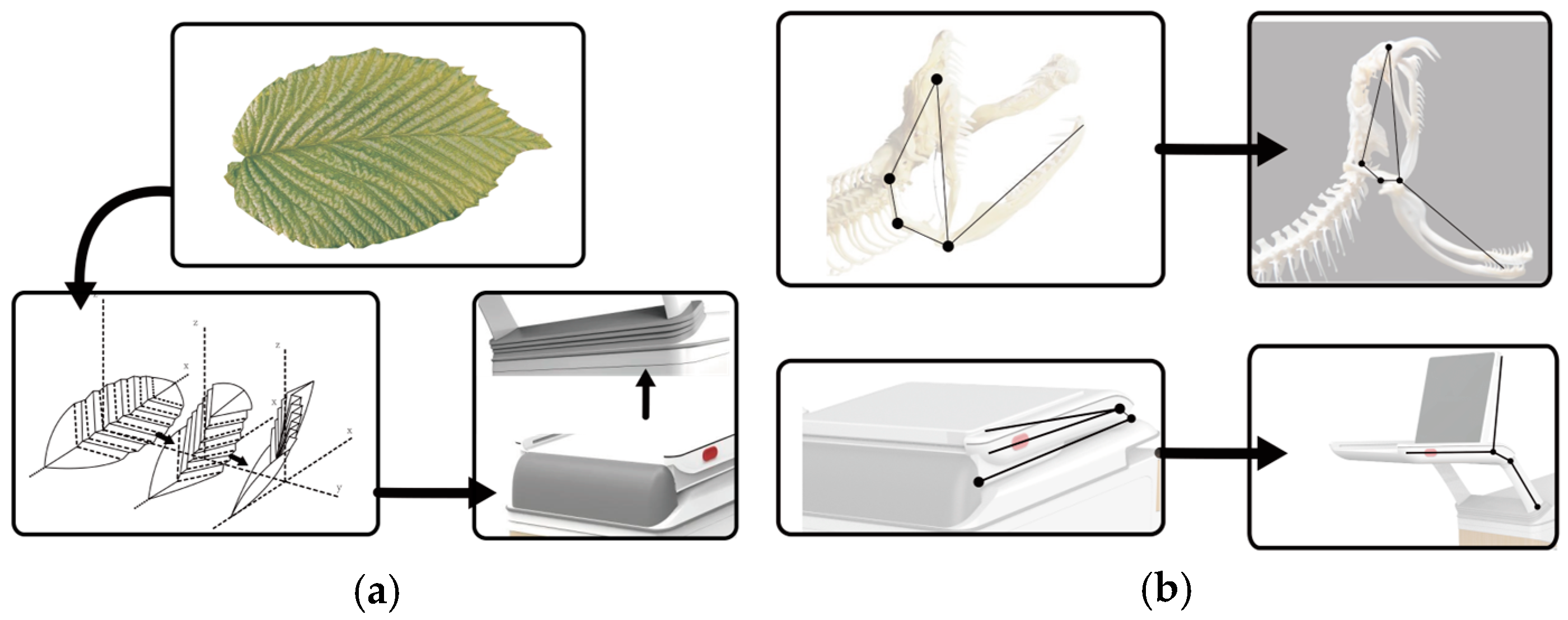
| Elm leaf folding effect |  | The folds leave room for the leaves to bend inward when needed. When required for photosynthesis, the crown folds keep the leaves in a hard shape |
| Snake jaw hinge effect |  | The bones on each side of the snake’s jaw are joined together by three hinge points, which promote the flexible epidermis to which the bones are attached by the force of the muscles |
| Self-cleaning effect of lotus leaves |  | The tiny angles on the surface of the lotus leaves (e.g., caused by passing breezes) cause water balls to roll down due to gravity, carrying away the attached dust particles and cleaning the leaves without the use of detergents or the consumption of energy |
| Living Prototype | Application Area | Advantages | Disadvantages | Improvements from This Study |
|---|---|---|---|---|
| Bamboo fiber | Lightweight structure | Environmentally friendly, high toughness, renewable | Single morphological mapping, without combining motor function | Multi-level mapping (form + motion + environment) to improve lightweightness and durability |
| Arthropod joint | Multi-degree-of-freedom motion | Flexible and adaptable to complex movements | Lack of quantitative screening criteria, the design is subjective | A similarity matrix is used to screen the optimal prototype and optimize the diversity of joint motion |
| Lotus leaves clean themselves | Surfacing | Good anti-pollution performance, reducing maintenance costs | Not combined with rehabilitation scenario requirements | Targeted optimization of dust-proof coating materials to improve the cleaning performance of products |
| The hinge of the snake’s lower jaw | Joint structure | Large opening angle, strong adaptability | The matching degree with rehabilitation needs was not quantitatively analyzed | Similarity calculation verifies its adaptability and optimizes the storage and angle adjustment of the operation platform |
| The elm leaves fold | Flexible construction | Reserving bending space to extend service life | The specific application scenarios of rehabilitation equipment are not combined | Applied to design dust-proof parts and improve the durability and adaptability of products |
Disclaimer/Publisher’s Note: The statements, opinions and data contained in all publications are solely those of the individual author(s) and contributor(s) and not of MDPI and/or the editor(s). MDPI and/or the editor(s) disclaim responsibility for any injury to people or property resulting from any ideas, methods, instructions or products referred to in the content. |
© 2025 by the authors. Licensee MDPI, Basel, Switzerland. This article is an open access article distributed under the terms and conditions of the Creative Commons Attribution (CC BY) license (https://creativecommons.org/licenses/by/4.0/).
Share and Cite
Yao, T.; Yu, H.; Qin, Z.; Sun, L.; Wu, J. Bio-Stimulated Lower Limb Rehabilitation Robot Semantic Analogy Fit Design. Biomimetics 2025, 10, 134. https://doi.org/10.3390/biomimetics10030134
Yao T, Yu H, Qin Z, Sun L, Wu J. Bio-Stimulated Lower Limb Rehabilitation Robot Semantic Analogy Fit Design. Biomimetics. 2025; 10(3):134. https://doi.org/10.3390/biomimetics10030134
Chicago/Turabian StyleYao, Tianyi, Hongfei Yu, Zhongzhi Qin, Li Sun, and Jiantao Wu. 2025. "Bio-Stimulated Lower Limb Rehabilitation Robot Semantic Analogy Fit Design" Biomimetics 10, no. 3: 134. https://doi.org/10.3390/biomimetics10030134
APA StyleYao, T., Yu, H., Qin, Z., Sun, L., & Wu, J. (2025). Bio-Stimulated Lower Limb Rehabilitation Robot Semantic Analogy Fit Design. Biomimetics, 10(3), 134. https://doi.org/10.3390/biomimetics10030134