
A Robust Skeletonization Method for High-Density Fringe Patterns in Holographic Interferometry Based on Parametric Modeling and Strip Integration


Abstract
1. Introduction
- Phase-based techniques (phase-shifting/unwrapping) (e.g., [6,7,8]) achieve high precision but operate in a different paradigm: they typically analyze projected fringe patterns for 3D shape measurement and require multiple phase-stepped frames, making them unsuitable for single-shot analysis of intrinsic holographic interference patterns encoding nanoscale displacements.
- Edge and ridge detection algorithms (e.g., Marr-Hildreth [9], Canny [10], Shen–Castan [11]) can localize fringes under moderate noise. However, their output is inherently a fragmented map of pixels or short edge segments. For dense patterns corrupted by strong speckle noise, this map becomes a scattered point cloud. The subsequent critical step—reassembling these fragments into topologically correct, smooth, and closed analytical curves—is a complex and often unreliable post-processing challenge.
- Active contour models (snakes) and their variants (e.g., Gradient Vector Flow snakes [12,13]) formulate fringe extraction as an energy minimization problem, offering a continuous curve representation [14,15,16,17,18]. Despite their flexibility, they exhibit two key limitations for our target conditions: (1) high sensitivity to initial position, often causing convergence to an adjacent fringe or leakage in high-density patterns; and (2) an inherent tension/rigidity regularization that acts as a low-pass filter, potentially oversmoothing the contour and introducing systematic localization bias in the presence of high-frequency speckle noise.
- 1.
- Physics-informed parametric modeling: We constrain the search for fringes to a purpose-built, finite-dimensional functional subspace , which is defined by specific parametric curves (e.g., trigonometric polynomials or splines). This subspace is constructed in such a way as to endow its elements with the required properties, such as smoothness, closure, and specific shape, guaranteeing that the identified fringes are physically plausible, connected curves.
- 2.
- A robust strip integration functional with local smoothing: For fringe localization we consider the specific functional in the form of a Gaussian-weighted integral of intensity over a narrow strip surrounding the candidate curve. This formulation allows for the use of efficient gradient-based optimization techniques. To compute this functional, a continuously differentiable intensity field is first obtained by local bicubic interpolation, described in Section 3.1. The resulting functional is smooth with respect to the curve parameters , ensuring stable convergence.
- 3.
- A recursive quasi-optimization algorithm: Exploiting the geometric similarity of adjacent fringes, the identification process proceeds recursively outward (or inward). The optimal parameters for an identified fringe seed the initial guess for the next, via a simple scaling transformation (quasi-optimization), followed by a full local refinement of all parameters. This strategy dramatically improves computational efficiency and reliability.
2. The Proposed Skeletonization Method
2.1. Physical Origins of Imperfections in Interferograms
- Non-uniform background intensity : This is caused by uneven illumination, varying surface reflectivity, and polarization effects (). This leads to slow intensity variations across the image.
- Visibility term and contrast variation : The coherence noisy factor (dependent on laser temporal/spectral properties and surface roughness) modulates the overall fringe contrast. The visibility term induced by polarization and speckle decorrelation can further reduce contrast, even to zero.
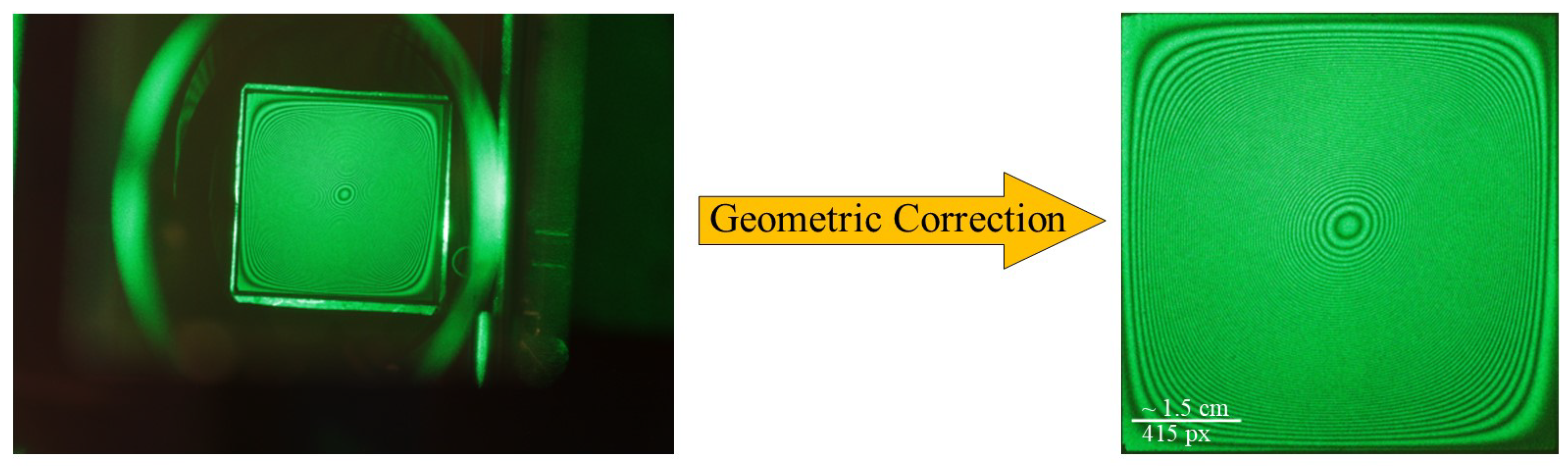
- Geometric distortion: The non-coaxiality of reference and object beams in off-axis schemes, combined with lens imperfections, introduces a projective distortion between the object plane and the image sensor.
2.2. Parametric Modeling and Problem Formulation
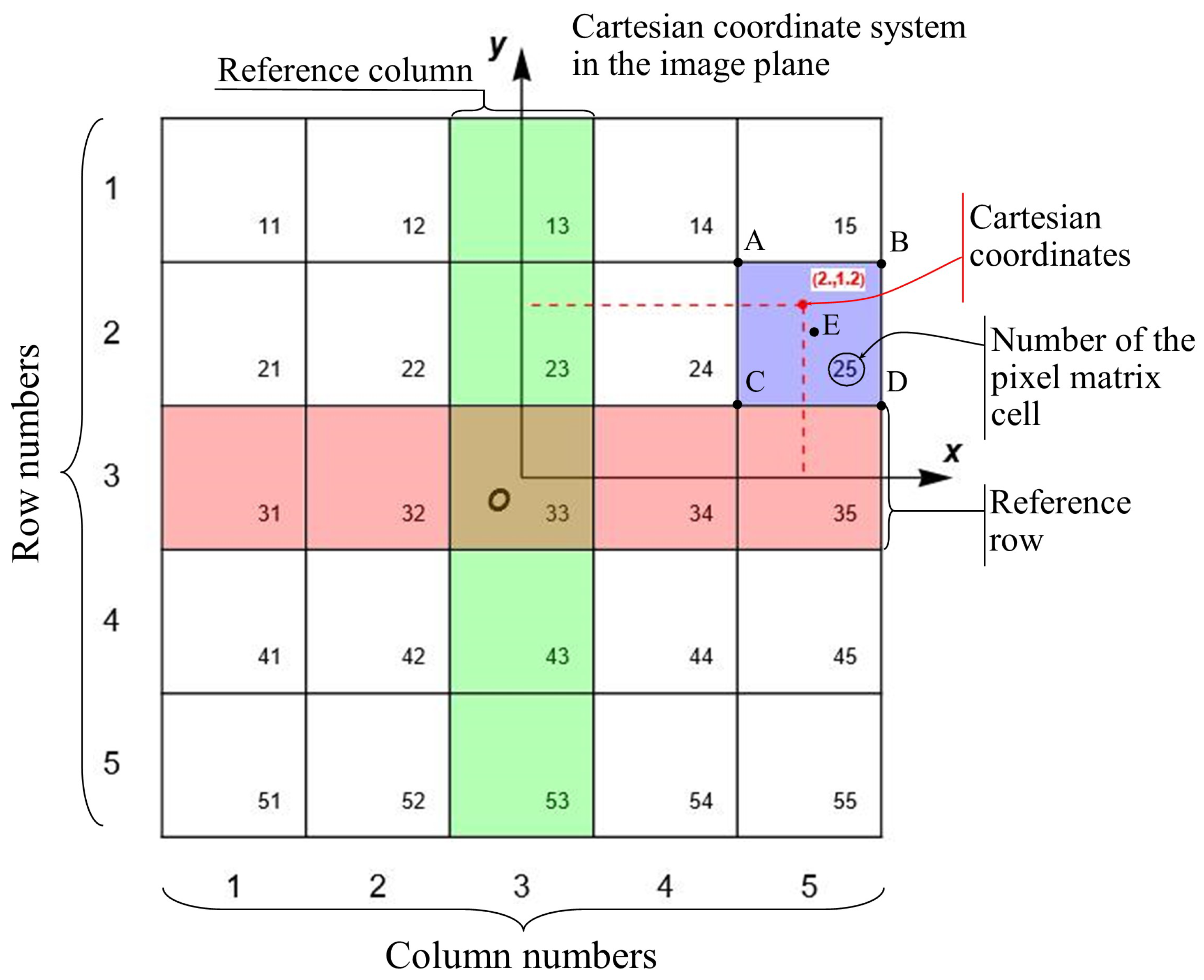
2.3. Discretization and Coordinate System
2.4. Variants of the Functional
2.4.1. Point-Sampling Along the Curve
2.4.2. Line-Integration with Interpolation
2.4.3. Point-Sampling over a Strip
2.4.4. Strip-Integration with Interpolation
3. Numerical Implementation
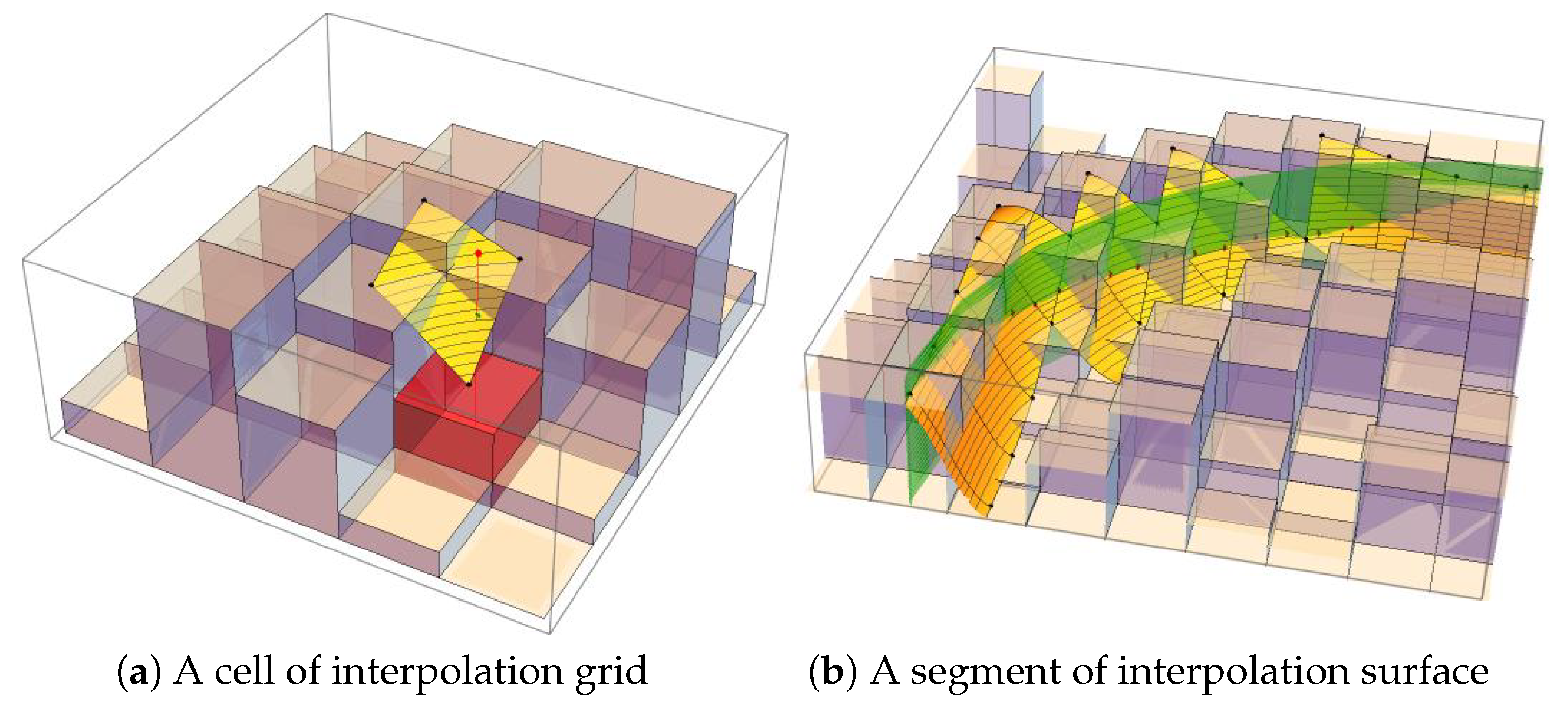
3.1. Bicubic Interpolation Scheme
3.2. Numerical Quadrature
3.3. Discrete Differential Operators for Accurate Rasterization
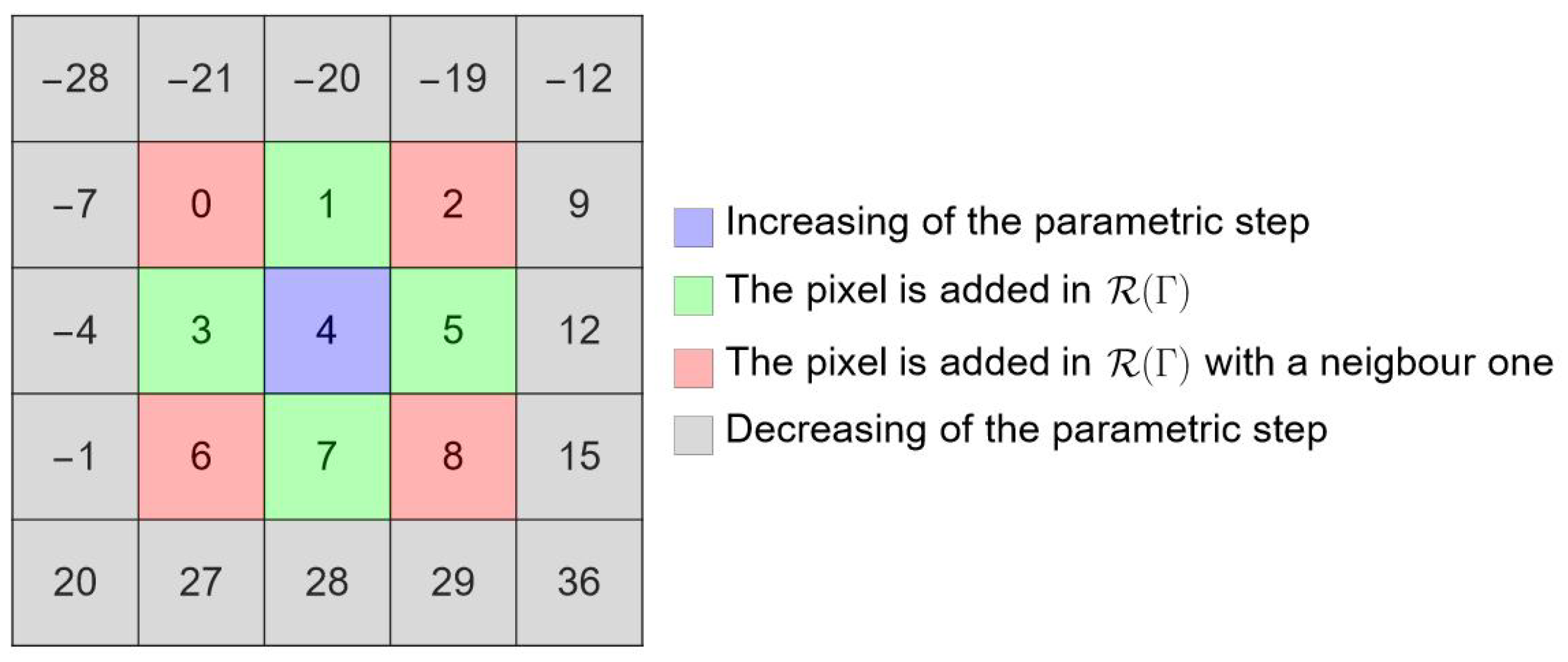
3.3.1. First-Order Operator: Tangent Direction and Curve Rasterization
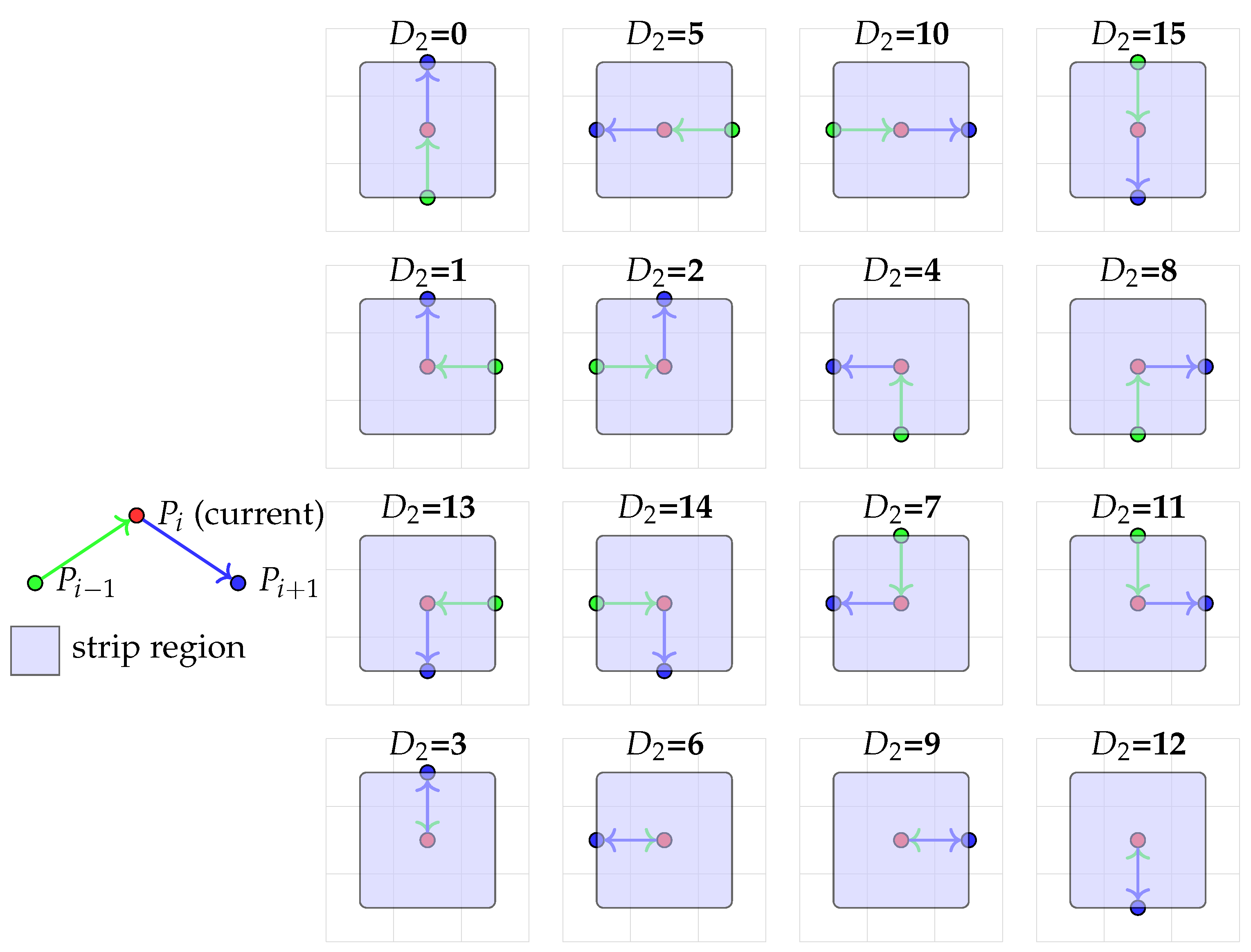
- Direction defining: It maps the 9 possible neighbor vectors to unique integers in the range . This mapping is shown in Figure 3.
- Neighborhood filter: The sum of the cubic terms, acts as a filter because for , the identity holds, while if a parameter step is too large and causes a jump to a non-adjacent pixel, the sum makes (within 2 pixels from ), flagging an invalid “skip”.
- Adaptive step control: This flag triggers an adaptive adjustment of the parametric step : if a skip is detected; if (meaning the parameter advanced but the pixel did not change). Crucially, we use asymmetric coefficients (, ) to prevent resonant cycling near stationary points, ensuring robust convergence.
3.3.2. Second-Order Operator: Local Curvature and Strip Rasterization
- indicates nearly linear motion (up, left, right, down), warranting a simple rectangular strip fill.
- indicates a smooth turn, requiring a circular sector fill to cover the curved corner of the strip without gaps.
- corresponds to inflection or “return” points, necessitating a combined fill (e.g., a half-circle plus strips).
3.4. Parametric Models for Fringe Contours
3.4.1. Perturbed Circle Model
- 1.
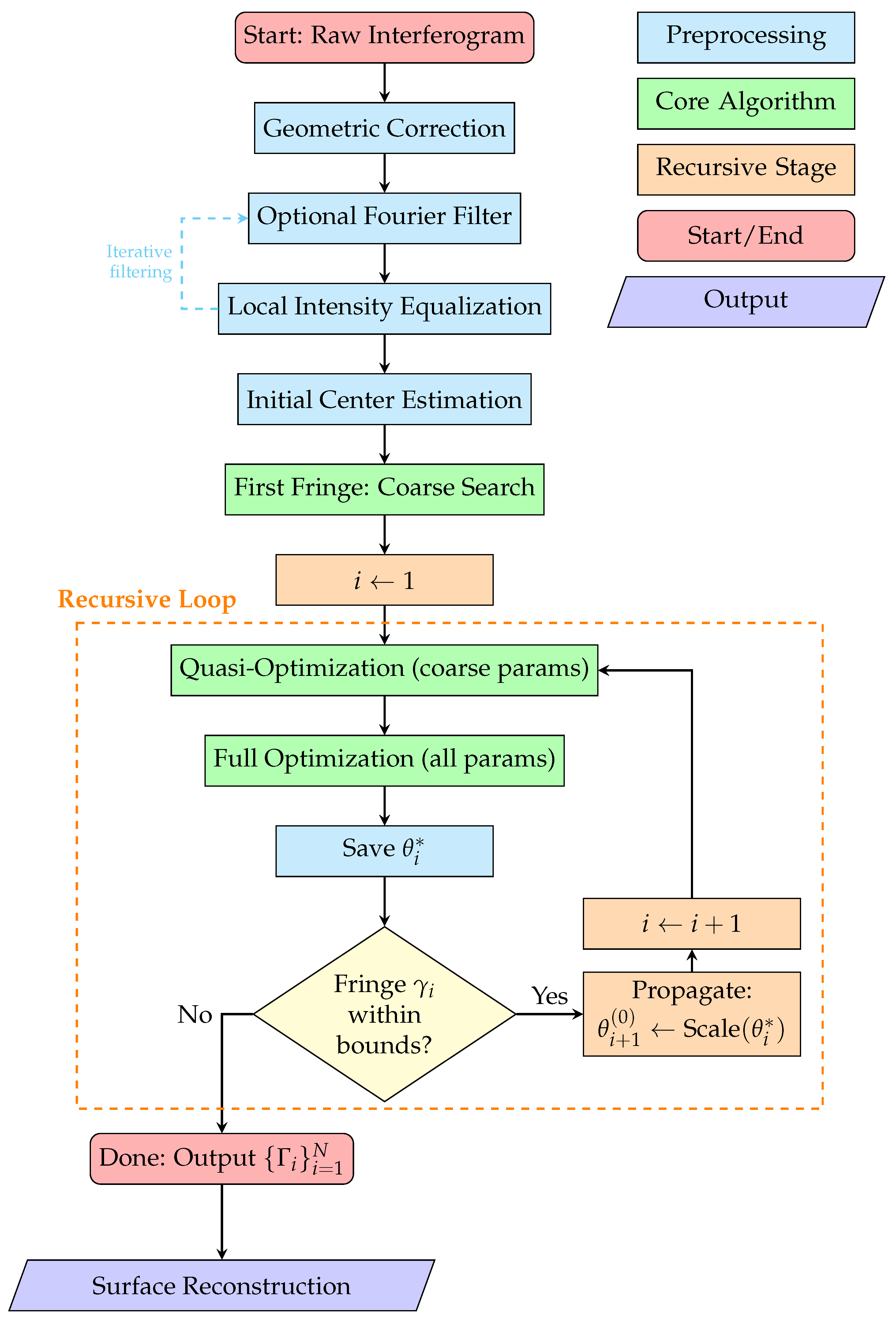
- Quasi-optimization: vary only the coarse parameters to quickly locate the approximate position and scale of the fringe.
- 2.
- Full optimization: refine all parameters to capture fine shape details.
3.4.2. Perturbed Ellipse Model
3.4.3. Parameter Constraints and Initialization
3.5. Local Intensity Equalization Algorithm
3.5.1. Local Quantile Computation
3.5.2. Interpolation and Normalization
3.5.3. Parameter Selection
3.6. Complete Skeletonization Algorithm
- The last computed intensity integral is equal to zero;
- The last identified fringe lies outside the image boundaries;
- The required (or preset) number of fringes has been identified.
3.7. Synthetic Interferogram Generation
3.7.1. Ideal Fringe Geometry via Morphing
3.7.2. Physically Motivated Noise Model
3.7.3. Calibration of Noise Models
3.7.4. Spatial Correlation of Speckle Noise
- 1.
- An initial uncorrelated random field is sampled from an appropriate distribution.
- 2.
- This field is convolved with a Gaussian kernel of width :
3.7.5. Error Metrics
3.8. Implementation Details
- 1.
- Geometric correction;
- 2.
- Filtering in the frequency domain with different kernels;
- 3.
- Intensity equalization, as described in Section 3.5;
- 4.
- Localization of the image center;
- 5.
- Recursive identification of fringes, which includes the following aspects:
- (a)
- Initializing the parametric curve (Section 3.4.1 and Section 3.4.2);
- (b)
- Computing the intensity integral (Section 2.4) using numerical quadratures (Section 3.2);
- (c)
- Defining the approximation curve’s parameters.
- 1.
- Coarse quasi-optimization: A modified coordinate descent algorithm with adaptive step sizing and momentum (e.g., [28]) accelerates the initial search for the fringe’s approximate position and scale, varying only the geometric parameters (center coordinates and base radius/axes).
- 2.
- Fine refinement: A conjugate gradient method with dynamic parameter scaling performs the full optimization of all parameters, including the higher-order Fourier perturbation coefficients. Analytic gradients of the strip integration functional are computed via automatic differentiation.
- Plateau detection: if the objective function shows negligible improvement (<) over 20 consecutive iterations, stagnation is flagged.
- “Shaking” recovery: upon stagnation, parameters receive a small random perturbation (5–10% of the current step size), and optimization restarts from this perturbed state.
- Dynamic variable prioritization: the algorithm tracks parameter sensitivity and temporarily focuses the search on the most influential variables when progress slows.
- Fringe density k (number of fringes across the field);
- Speckle noise, dependent on surface roughness parameter and the laser spectral linewidth;
- Noise models the influence of non-uniform illumination.
4. Validation on Synthetic Interferograms
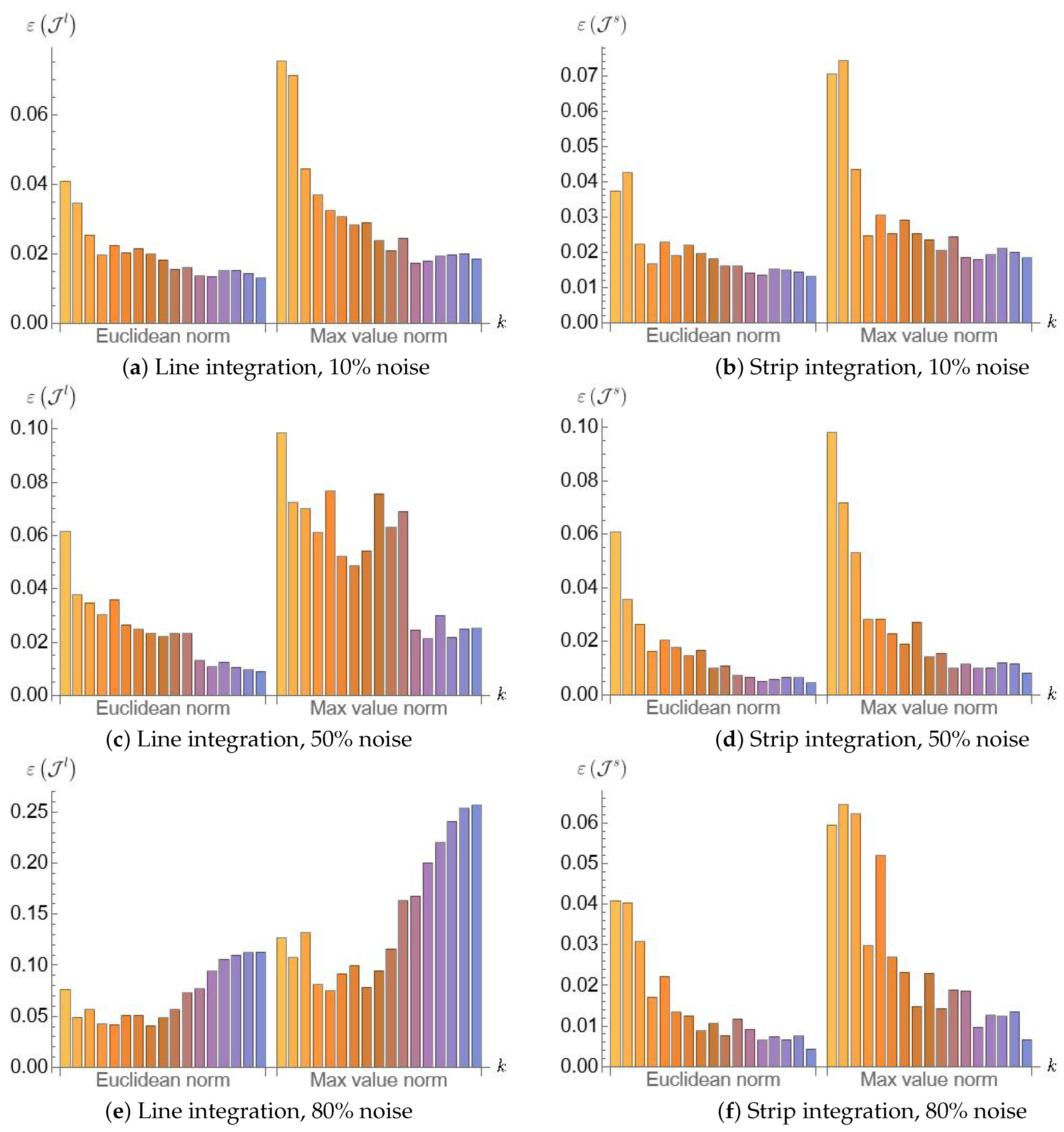
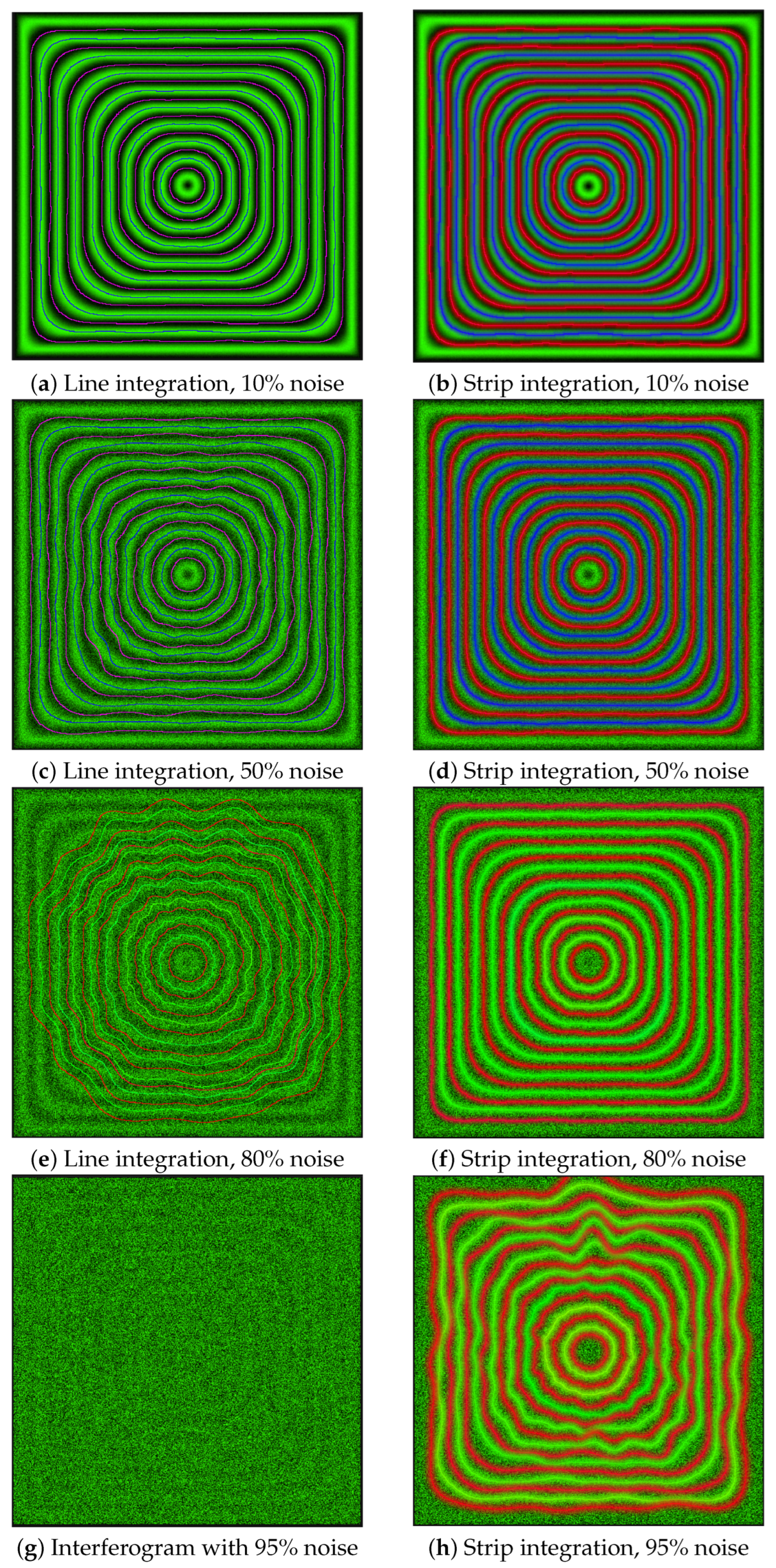
4.1. The Efficiency of Fringe Identification with Different Variants of the Intensity Integral
4.2. Why General-Purpose Methods Fail: A Fundamental Analysis
4.2.1. Edge and Ridge Detection (Canny, Shen–Castan)
4.2.2. Active Contour Models (Snakes)
- 1.
- Redefine to target intensity extrema rather than gradients.
- 2.
- Replace pointwise gradient computation with a strip integration functional for noise robustness.
- 3.
- Ensure functional smoothness via bicubic interpolation to enable gradient-based optimization.
- 4.
- Constrain the snake to a parametric subspace (e.g., Fourier-based curves) to guarantee correct topology.
- 5.
- Implement recursive initialization leveraging fringe similarity for efficiency.
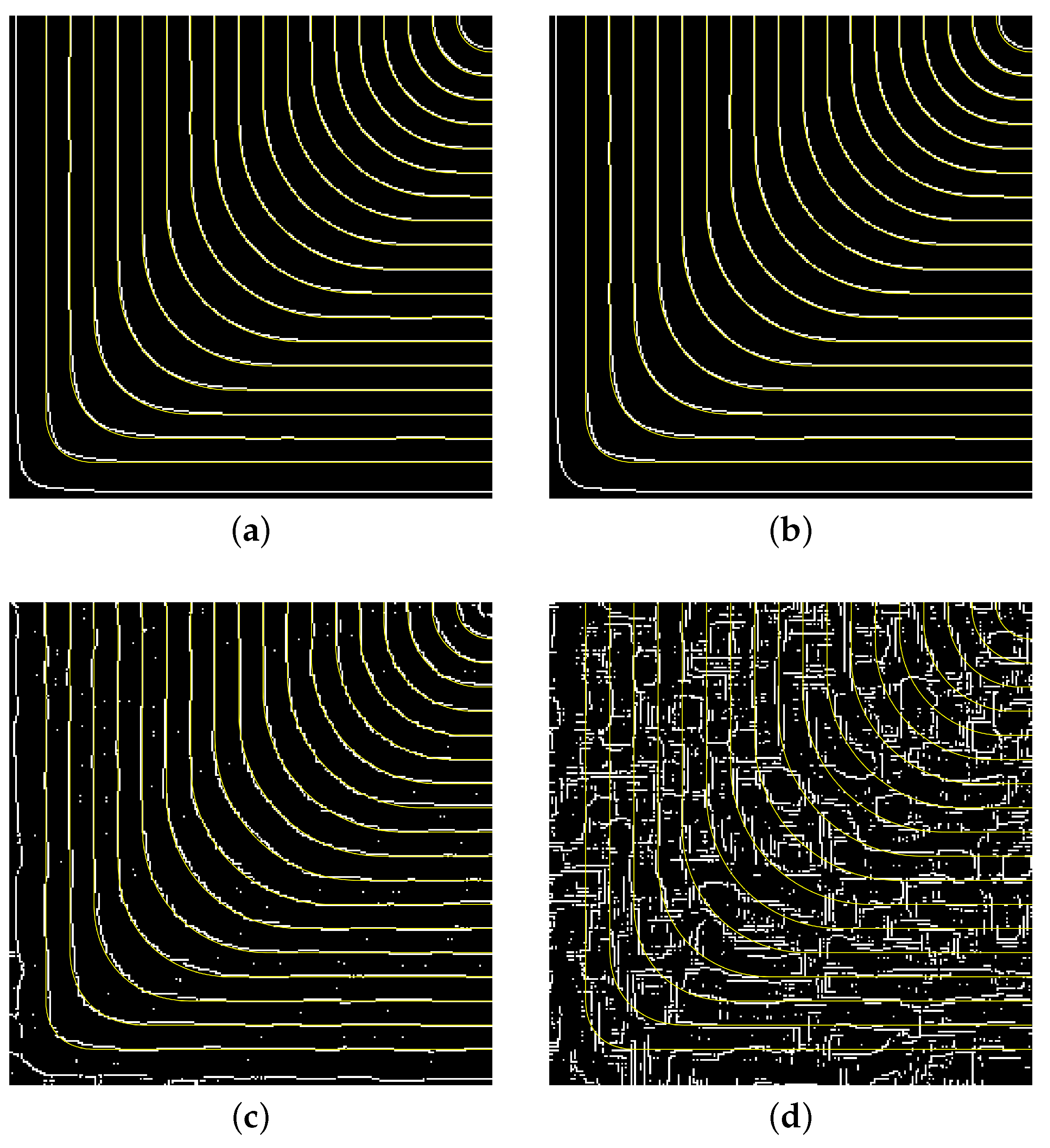
4.2.3. Quantitative Assessment of Edge Detection
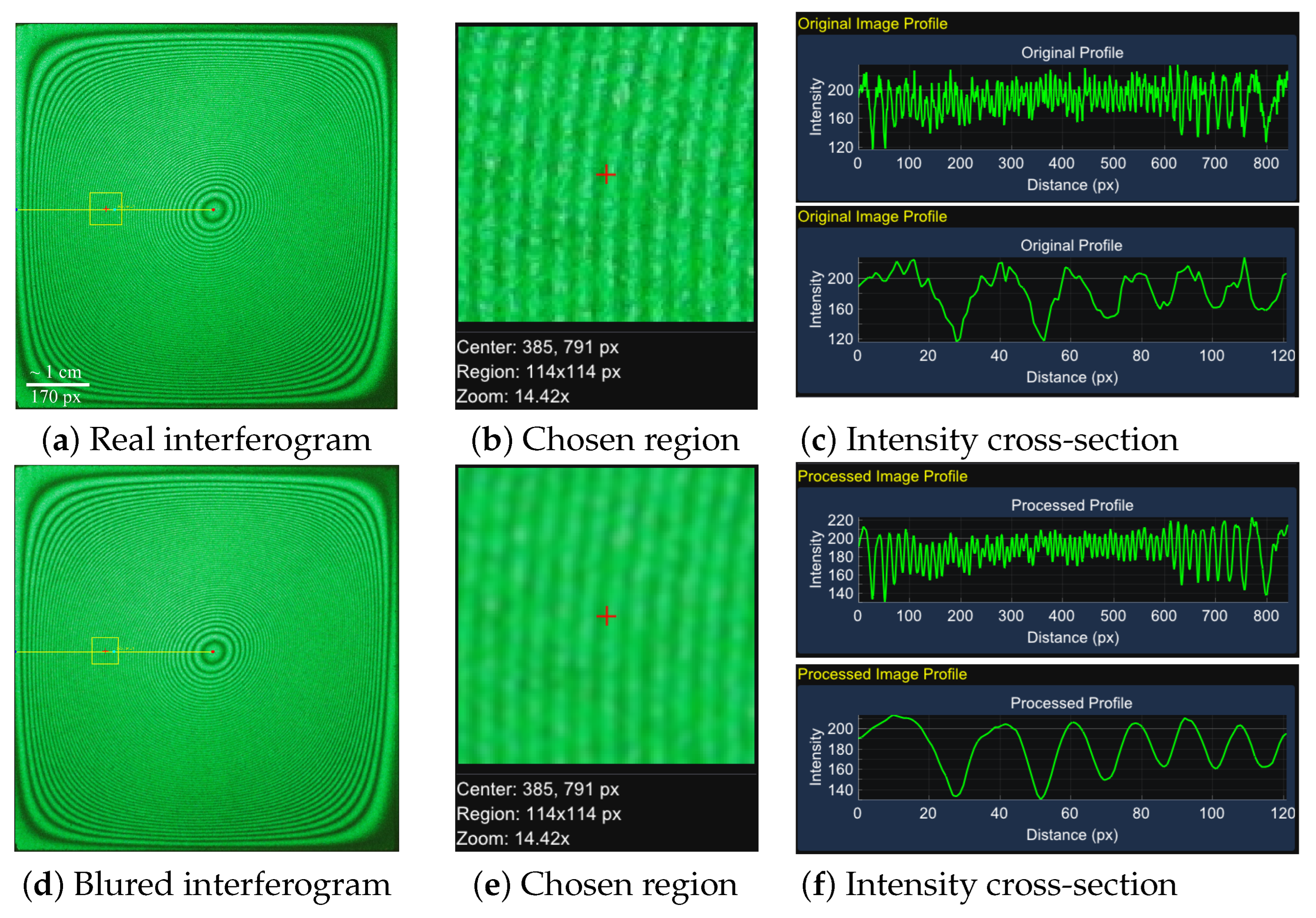
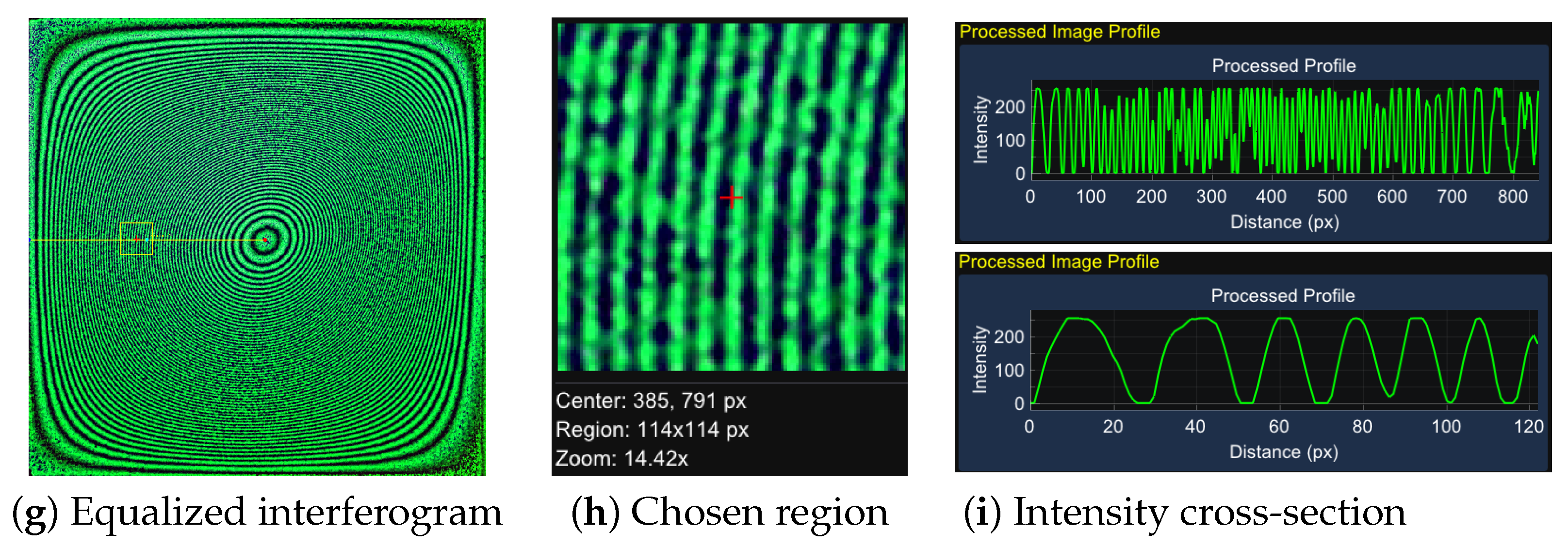
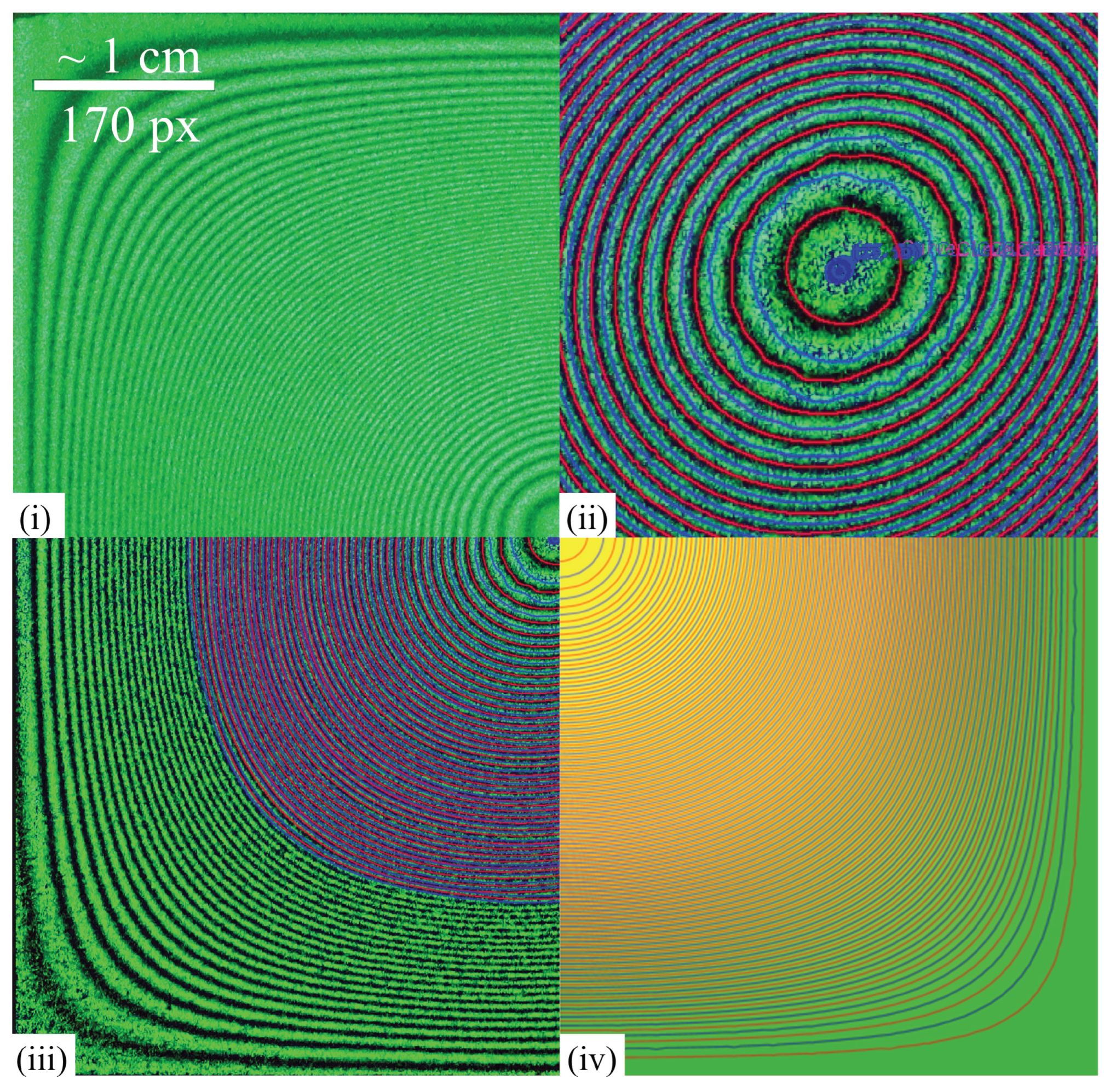
5. Application to Real High-Density Interferograms
6. Conclusions
Applicability, Limitations, and Future Work
- Topological constraints: The algorithm is most effective when the fringe topology is known a priori to consist of nested, simply connected curves. It may encounter difficulties or produce suboptimal results for patterns featuring fringe bifurcations (e.g., wrinkling patterns [30]), interruptions (e.g., near cracks or holes), or multiple disconnected families without a single dominant center.
- Initialization dependency: The recursive propagation strategy requires a reasonable initial guess for the innermost fringe (coarse center estimation). While the algorithm includes a robust coarse search, a severely erroneous initialization (e.g., outside the fringe field) may prevent convergence.
- Quasi-similarity assumption: The recursive search relies on the geometric similarity of adjacent fringes. A drastic, abrupt change in fringe shape between consecutive contours violates this assumption and could cause the propagation to fail or jump to an incorrect fringe.
- 1.
- Handling complex topologies: For patterns with bifurcations or multiple centers, a pre-processing segmentation step could partition the image into regions, each containing a fringe family with simple topology. The proposed algorithm could then be applied independently within each region.
- 2.
- Robustness enhancement via functional modification: The risk of the algorithm “jumping” to an adjacent fringe or failing on complex patterns could be mitigated by augmenting the strip integration functional with additional regularization terms. For instance, terms that penalize excessive variation in intensity along the strip centerline could help detect anomalies and prevent incorrect convergence.
- 3.
- Automated model selection: Future developments could include a preliminary analysis stage to automatically infer the appropriate parametric model (e.g., circle vs. ellipse, required Fourier order) and topology from the raw interferogram, reducing the need for manual parameter selection.
Author Contributions
Funding
Institutional Review Board Statement
Informed Consent Statement
Data Availability Statement
Conflicts of Interest
Appendix A. Rasterization Algorithms Pseudocode
| Algorithm A1: Adaptive Curve Rasterization using First-Order Operator |
 |
| Algorithm A2: Strip Rasterization using Second-Order Operator |
 |
References
- Kobayashi, A. Handbook on Experimental Mechanics; Prentice-Hall: Englewood Cliffs, NJ, USA, 1987. [Google Scholar]
- Vest, C. Holographic Interferometry; Wiley: Hoboken, NJ, USA, 1979. [Google Scholar]
- Malacara, D.; Servin, M.; Malacara, Z. Interferogram Analysis for Optical Testing; Taylor & Francis: Abingdon, UK, 2005. [Google Scholar]
- Kreis, T. Handbook of Holographic Interferometry: Optical and Digital Methods; John Wiley & Sons: Hoboken, NJ, USA, 2006. [Google Scholar]
- Distante, A.; Distante, C. Handbook of Image Processing and Computer Vision: Volume 1: From Energy to Image; Springer International Publishing: Berlin/Heidelberg, Germany, 2020. [Google Scholar]
- Schwider, J.; Falkenstoerfer, O.R.; Schreiber, H.; Zoeller, A.; Streibl, N. New compensating four-phase algorithm for phase-shift interferometry. Opt. Eng. 1993, 32, 1883–1885. [Google Scholar] [CrossRef]
- Zuo, C.; Feng, S.; Huang, L.; Tao, T.; Yin, W.; Chen, Q. Phase shifting algorithms for fringe projection profilometry: A review. Opt. Lasers Eng. 2018, 109, 23–59. [Google Scholar] [CrossRef]
- Tabata, S.; Maruyama, M.; Watanabe, Y.; Ishikawa, M. Pixelwise Phase Unwrapping Based on Ordered Periods Phase Shift. Sensors 2019, 19, 377. [Google Scholar] [CrossRef] [PubMed]
- Marr, D.; Hildreth, E. Theory of edge detection. Proc. R. Soc. Lond. Ser. B Biol. Sci. 1980, 207, 187–217. [Google Scholar] [CrossRef] [PubMed]
- Canny, J. A computational approach to edge detection. IEEE Trans. Pattern Anal. Mach. Intell. 2009, PAMI-8, 679–698. [Google Scholar] [CrossRef]
- Shen, J.; Castan, S. An optimal linear operator for step edge detection. CVGIP Graph. Model. Image Process. 1992, 54, 112–133. [Google Scholar] [CrossRef]
- Xu, C.; Prince, J.L. Gradient vector flow: A new external force for snakes. In Proceedings of the IEEE Computer Society Conference on Computer Vision and Pattern Recognition; IEEE: Piscataway, NJ, USA, 1997; pp. 66–71. [Google Scholar]
- Xu, C.; Prince, J.L. Snakes, shapes, and gradient vector flow. IEEE Trans. Image Process. 1998, 7, 359–369. [Google Scholar] [CrossRef] [PubMed]
- Kass, M.; Witkin, A.; Terzopoulos, D. Snakes: Active contour models. Int. J. Comput. Vis. 1988, 1, 321–331. [Google Scholar] [CrossRef]
- Li, B.; Acton, S.T. Active contour external force using vector field convolution for image segmentation. IEEE Trans. Image Process. 2007, 16, 2096–2106. [Google Scholar] [CrossRef] [PubMed]
- Tang, C.; Lu, W.; Cai, Y.; Han, L.; Wang, G. Nearly preprocessing-free method for skeletonization of gray-scale electronic speckle pattern interferometry fringe patterns via partial differential equations. Opt. Lett. 2008, 33, 183–185. [Google Scholar] [CrossRef] [PubMed]
- Tang, C.; Ren, H.; Wang, L.; Wang, Z.; Han, L.; Gao, T. Oriented couple gradient vector fields for skeletonization of gray-scale optical fringe patterns with high density. Appl. Opt. 2010, 49, 2979–2984. [Google Scholar] [CrossRef] [PubMed]
- Li, Y.H.; Chen, X.J.; Qu, S.L.; Luo, Z.Y. Algorithm for skeletonization of gray-scale optical fringe patterns with high density. Opt. Eng. 2011, 50, 087003. [Google Scholar] [CrossRef]
- Jiang, W.; Ren, T.; Fu, Q. Deep learning in the phase extraction of electronic speckle pattern interferometry. Electronics 2024, 13, 418. [Google Scholar] [CrossRef]
- Feng, S.; Chen, Q.; Gu, G.; Tao, T.; Zhang, L.; Hu, Y.; Yin, W.; Zuo, C. Fringe pattern analysis using deep learning. Adv. Photonics 2019, 1, 025001. [Google Scholar] [CrossRef]
- Liu, C.; Tang, C.; Xu, M.; Hao, F.; Lei, Z. Skeleton extraction and inpainting from poor, broken ESPI fringe with an M-net convolutional neural network. Appl. Opt. 2020, 59, 5300–5308. [Google Scholar] [CrossRef] [PubMed]
- Lychev, S.; Digilov, A.; Djuzhev, N. Galerkin-Type Solution of the Föppl–von Kármán Equations for Square Plates. Symmetry 2024, 17, 32. [Google Scholar] [CrossRef]
- Eichhorn, N.; Osten, W. An algorithm for the fast derivation of line structures from interferograms. J. Mod. Opt. 1988, 35, 1717–1725. [Google Scholar] [CrossRef]
- Ciarlet, P.G. Linear and Nonlinear Functional Analysis with Applications, 2nd ed.; Society for Industrial and Applied Mathematics: Philadelphia, PA, USA, 2025. [Google Scholar]
- Mittelstedt, C. Theory of Plates and Shells; Springer: Berlin/Heidelberg, Germany, 2023. [Google Scholar]
- Goodman, J.W. Speckle Phenomena in Optics: Theory and Applications; Roberts and Company Publishers: Greenwood Village, CO, USA, 2007. [Google Scholar]
- Dainty, J.C. Laser Speckle and Related Phenomena; Springer Science & Business Media: New York, NY, USA, 2013; Volume 9. [Google Scholar]
- Wang, Q.; Li, W.; Bao, W.; Zhang, F. Accelerated randomized coordinate descent for solving linear systems. Mathematics 2022, 10, 4379. [Google Scholar] [CrossRef]
- Lychev, S.; Digilov, A.; Demin, G.; Gusev, E.; Kushnarev, I.; Djuzhev, N.; Bespalov, V. Deformations of Single-Crystal Silicon Circular Plate: Theory and Experiment. Symmetry 2024, 16, 137. [Google Scholar] [CrossRef]
- Bychkov, P.S.; Lychev, S.A.; Bout, D.K. Experimental technique for determining the evolution of the bending shape of thin substrate by the copper electrocrystallization in areas of complex shapes. Vestn. Samara Univ. Nat. Sci. Ser. 2019, 25, 48–73. [Google Scholar] [CrossRef]




Disclaimer/Publisher’s Note: The statements, opinions and data contained in all publications are solely those of the individual author(s) and contributor(s) and not of MDPI and/or the editor(s). MDPI and/or the editor(s) disclaim responsibility for any injury to people or property resulting from any ideas, methods, instructions or products referred to in the content. |
© 2026 by the authors. Licensee MDPI, Basel, Switzerland. This article is an open access article distributed under the terms and conditions of the Creative Commons Attribution (CC BY) license.
Share and Cite
Lychev, S.; Digilov, A. A Robust Skeletonization Method for High-Density Fringe Patterns in Holographic Interferometry Based on Parametric Modeling and Strip Integration. J. Imaging 2026, 12, 54. https://doi.org/10.3390/jimaging12020054
Lychev S, Digilov A. A Robust Skeletonization Method for High-Density Fringe Patterns in Holographic Interferometry Based on Parametric Modeling and Strip Integration. Journal of Imaging. 2026; 12(2):54. https://doi.org/10.3390/jimaging12020054
Chicago/Turabian StyleLychev, Sergey, and Alexander Digilov. 2026. "A Robust Skeletonization Method for High-Density Fringe Patterns in Holographic Interferometry Based on Parametric Modeling and Strip Integration" Journal of Imaging 12, no. 2: 54. https://doi.org/10.3390/jimaging12020054
APA StyleLychev, S., & Digilov, A. (2026). A Robust Skeletonization Method for High-Density Fringe Patterns in Holographic Interferometry Based on Parametric Modeling and Strip Integration. Journal of Imaging, 12(2), 54. https://doi.org/10.3390/jimaging12020054