


Abstract
Because of the recent global crises and lifestyle trends, anthocyanin-rich fruits are receiving more attention due to their medicinal qualities. Many studies have concluded that higher anthocyanin consumption tends to correlate with health benefits. Furthermore, research has shown great promise for anthocyanin application in treating fever and neurodegenerative processes. Once the industrial application difficulties are solved, anthocyanins might prove to be a crucial component in helping to treat the diseases that are becoming more common—viral infections and illnesses associated with aging. Fruit extracts that contain large quantities of anthocyanins have antimicrobial and antiviral (against SARS-CoV-2 virus) properties. Most of the synthesized anthocyanins in the fruit-bearing fruits are stored in the fruits. The aim of this review article is to indicate the fruit species that have the most potential for anthocyanin extraction from fruits, to overview the antimicrobial and antiviral capabilities of anthocyanin and the main sample preparation and extraction methods that preserve polyphenolic compounds and reduce the time expenditure.
1. Introduction
Due to global social and economic developments, the world’s population is aging and according to the UN’s data, in the next 25 years the part of the population that is 65 years and older will almost double [1]. With the rising population of senior citizens, the disorders and illnesses associated with old age are likely to increase accordingly. This is likely to be even more prevalent in economically developed countries where significant portions of the population lead a sedentary lifestyle, which is linked with various chronic damages, cardiovascular changes, metabolic disorders, and other conditions that lower the life quality and even expectancy. Illnesses that are linked with old age include ischemic heart diseases, cognitive decline disorders such as dementia and Alzheimer’s disease—all of which have an extreme impact on the patient’s the quality of life [2].
To mitigate the negative impact of poor lifestyle choices and minimize the discomforts that come with natural human aging, the trend of striving to live a healthier life has received more attention worldwide in recent decades. One aspect of this is an increased interest in nutraceuticals [3,4]. This growing interest results in higher production—according to research by the BBC [5], the global nutraceutical market is expected to increase from the current 2021 market value of USD 289.8 to USD 438.9 by 2026.
Phenolic compounds are a common ingredient in various nutraceutical supplements due to their positive effects on human body [6]. Phenolics are divided into two main groups, flavonoids and non-flavonoids. Research studies have shown that flavonoids have anti-inflammatory and antibacterial properties. Flavonoid subclasses consist of anthocyanins, flavonols, flavonones, and isoflavones [7]. Anthocyanins are water-soluble pigments and are stored in plant cell vacuoles. Most vascular plant species contain these compounds in various quantities in most of the organs, but mainly fruits, flowers, and leaves [8,9].
Anthocyanins are found in nature as anthocyanidin–glycosides. The most common types of anthocyanidins are pelargonidin, cyaniding, delphinidin, peonidin, petunidin, and malvidin. Different anthocyanidins determine the color of the plant and range from orange to red, blue, and purple colors [10] (Figure 1).
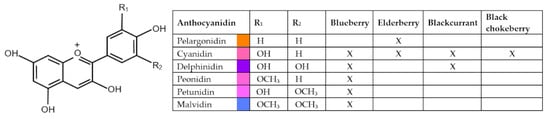
Figure 1.
The structural formula of six anthocyanidins commonly synthesized in the fruits that accumulate the most anthocyanins from the Ericaceae, Caprifoliaceae, Grossulariaceae, and Rosaceae families. Adapted from [11]. Highlighted are the colors of each anthocyanidin.
Because the intensity of the anthocyanin colors increases with increasing anthocyanin concentration, fruits, vegetables, and flowers that are rich in anthocyanins tend to be deep red or dark purple—such as raspberries, blueberries, elderberries, eggplants, red cabbages, and flowers such as Centaurea cyanus and et al. [12,13,14,15,16]. Anthocyanin color and hue varies depending on the pH—in an acidic environment anthocyanins are red, in a basic pH they become blue [17]. In a basic pH anthocyanins become less stable than in the acidic environment. Anthocyanins are sensitive not only to acidity but are also easily oxidized and are vulnerable to acylation with organic acids and complexation with metal ions. Because of this, anthocyanins are hard to use as food colorants without additional treatment or specific food technologies [18,19]. However, anthocyanins have a wide range of applications in both the food and pharmaceutical industry and also phytotherapy. They are used as an ingredient in various medicaments and supplements because they have strong anti-inflammatory, antimicrobial, and antioxidative properties and research results have linked dietary enrichment with anthocyanins to a reduced risk of gastrointestinal cancers and the inhibition of neurodegenerative diseases and cognitive decline [20]. Anthocyanins also increase the endurance and elasticity of capillaries and reduce their permeability. Additionally, they increase visual acuity and are used for some eye diseases, especially the anthocyan glycosides in bilberry [21]. It is important to note that some anthocyanins have radioprotective effects and are used for the treatment and prophylaxis of radiation sickness [22,23].
Because the proportion of senior citizens around the world is likely to increase and health-friendly consumer trends are on the rise, the positive impact of anthocyanins on human health will boost the demand for more cost-efficient anthocyanin sources. This review aims to identify the fruits that accumulate the largest quantities in their fruits and as such could be used as an efficient anthocyanin source for extraction. The data have been collected from different databases including SpringerLink, PubMed, NCBI, and Science Direct.
2. Anthocyanins in Fruits
The amount of accumulated anthocyanins varies greatly depending on the source. Anthocyanin contents vary not only between plant species, cultivar, or plant organs but are also dependent on various environmental factors, plant maturity, and fruit ripeness at the time of anthocyanin content evaluation [24,25]. Accumulated anthocyanin content can vary within the species as much as between different plant species (Table 1). In the reviewed literature the common method to quantify total anthocyanin content (TAC) was by using spectrophotometry—the pH differential method. Using this method before anthocyanin determination, the samples are incubated at room temperature, in the dark. A typical wavelength set for anthocyanin determination is 520–700 nm.

Table 1.
Total anthocyanin content in various fruits, expressed in mg/100 g fresh weight (FW).
From the reviewed literature in Prunus avium, Aronia melanocarpa Sambucus nigra, and Vaccinium myrtillus the largest potential total anthocyanin count was determined—up to 680, 690, 810, 1000 mg/100 g FW, respectively. Ribes nigrum and Vaccinium corymbosum accumulated slightly fewer anthocyanins—up to 380 and 430 mg/100 g FW, respectively (Table 1). Anthocyanin accumulation varies greatly even within the same species because of climate, soil, environment conditions, and different cultivars [30,49,62,63].
Among the commonly synthesized anthocyanins in plants and one that was found in large quantities in the analyzed literature in both V. myrtillus and V. vitis-idaea was cyanidin-3-O-galactoside (Cy-3-Gal) (Table 2). It is a compound that, similar to other anthocyanins, acts as a key antioxidant in plants. It has been found that it is capable of DPPH• and ABTS•+ radical scavenging. Researchers also found that Cy-3-Gal can scavenge hydrogen peroxide and absorb radical oxygen. In the research studies it was found that Cy-3-Gal can perform its physiological functions without the presence of other compounds [60].
Table 2.
Specific anthocyanin contents found in the fruits of Ericaceae family.
Cyanidin-3-O-β-glucoside (Cy-3-Glu) is found in abundance in V. myrtillus (Table 2). Experiments with rats showed that Cy-3-Glu can prevent cardiac hypertrophy and diastolic dysfunction in hypertensive rats [65]. However, even though V. myrtillus is known for its hypertension-relieving properties, the results of the experiment showed that Cy-3-Glu supplements alone do not lower blood pressure in rats. Meanwhile experiments with V. myrtillus supplements did in fact ease symptoms of hypertension in rodents [66]. This could mean that the Cy-3-Glu anti-hypertensive effect is achieved only when other synergistic compounds are added.
Additionally, anthocyanins seem to be effective at inhibiting the proliferation of various human pathogens—mainly Gram-positive and Gram-negative bacteria, including E. coli, S. aureus, and B. cereus [15]. Anthocyanins damage bacteria by destroying the cell walls, cell membranes, and intercellular matrices of the affected pathogens [67].
2.1. Ericaceae
Even though the Ericaceae family has many species that grow edible fruit, not many of them accumulate large amounts of anthocyanins. For example, Arbutus unedo (Ericaceae) fruits are a popular research subject, known for their high accumulation of arbutin—a compound with medicinal applications, but the fruit possesses a very low anthocyanin content [68], when compared with Vaccinium genus species (Table 2). Species of the Vaccinium genus are widely known to have beneficial health properties and have commonly been used as an ingredient in traditional medicine throughout Europe because of their healing properties—Vaccinium berries and leaves have been used to treat fever, diabetes, respiratory inflammations, common cold, and gastrointestinal disorders [65,69]. These properties are likely a result of a high polyphenolic compound, anthocyanin, and flavonoid content. Due to the accumulation of high concentrations of compounds that have relevant medicinal properties and are likely to increase in demand, it is not surprising why the species of Vaccinium genus are among the most researched berries in tests of plants that can be used in nutraceuticals.
European blueberries V. myrtillus are one of the richest natural anthocyanin sources—studies have shown that these berries contain 15 different anthocyanins, of which the most abundant are anthocyanidin- and delphinidin-based (Table 2 and Table 3). V. corymbosum also accumulates the same 15 anthocyanins, but in lesser quantities. According to the experiment results of Burdulis et al. [70], some blueberry V. corymbosum cultivars such as ‘Coville’ and ‘Northland’ accumulated slightly higher percentages of anthocyanin in the fruit skins than V. myrtillus—1.24% and 1.09%, respectively. Despite that, V. myrtillus fruit samples contained a larger percentage of anthocyanin in the fruit overall when compared with V. corymbosum cultivars. The results of this article and European Medicines Agency data [71] show that the most abundant anthocyanins in bilberries are delphinidin-3-O-galactoside (Del-3-Gal), constituting up to 14.9% of total anthocyanin, delphinidin-3-O-arabinoside (Del-3-Ara), up to 15.3%, delphinidin-3-O-glucoside (Del-3-Glu)—up to 14.0%, cyanidin-3-O-arabinoside Cy-3-Ara)—13.6% and cyanidin-3-O-glucoside (Cy-3-Glu), comprising up to 10.1% of the total anthocyanin in bilberry fruit (Table 3). This high concentration of anthocyanins and other polyphenols is likely a result of an adaptation to store increased amounts of defensive phytochemicals as a response to high levels of environmental stress. While it is common for anthocyanins to mostly be stored in the exocarp, in V. myrtillus they are accumulated throughout the fruit [70]. However, a larger percentage of anthocyanins was detected in the skins of the fruit, rather than the entire fruit.
Table 3.
Anthocyanin composition of bilberry (Vaccinium myrtillus) [64,71].
2.2. Caprifoliaceae
Much like berries from Vaccinium genus, berries from the Caprifoliaceae family have historically been utilized as an ingredient of traditional medicinal remedies because of their properties. Commonly known as elderberries, Sambucus sp. are rich sugars, organic acids, and polyphenols—anthocyanins [12]. Because of this polyphenolic compound accumulation, they also show antioxidant activity, anti-inflammatory, and immune-stimulating properties [72]. Berries from the Caprifoliaceae family do not contain as many anthocyanins when compared with Vaccinium sp. berries; however, the anthocyanin composition that is accumulated differs considerably in comparison. Caprifoliaceae family plants synthesize anthocyanins that are not found in previously mentioned Vaccinium species. Most abundantly accumulated anthocyanins in Sambucus nigra, S. caerulea, and S. ebulus were ones that are cyanidin-based (Table 3). In research conducted by Wu and others [47] anthocyanins were extracted by using a methanol/water/acid extraction system because it was found that the use of acetone, a reagent that is commonly used in anthocyanin extraction, may cause anthocyanin conversions to pyranoanthocyanins. In total, seven anthocyanins were found in S. nigra. Four of them were the most abundant and commonly found in this species—cyanidin-O-3-sambubiosil-5-O-glucoside, cyanidin-3,5-O-diglucoside, cyanidin-3-O-sambubioside, and cyanidin-3-O-glucoside. The other three anthocyanins were cyanidin-3-O-rutinoside, pelargonidin-3-O-glucoside, and pelargonidin-3-O-sambubioside. According to the researchers, it was the first time pelargonidin-based anthocyanins were detected in S. nigra at the time. Oancea and other researchers confirmed it and identified pelargonidin anthocyanins in S. nigra and found that pelargonidin and delphinidin-based anthocyanins were among the major anthocyanins in the fruit [73]. However most other authors listed cyanidin anthocyanins as the most found major anthocyanins in this species [12,41,47]. However, interspecies hybrids of Sambucus genus might have a different anthocyanin profile entirely, containing anthocyanins that are not found in a non-hybrid specimen, for example cyanidin-xylosyl-dihexoside [74].
Lonicera caerulea is another species of anthocyanin-accumulating berries that has potential to become an efficient ingredient for super foods. These berries accumulate large amounts of secondary metabolites—among them tannins, saponins, phenolics, ascorbic acid, and other compounds that have many health benefits [74,75]. Anthocyanins are the predominant compounds and constitute from 38 up to 91% of total identified phenolic compounds. The total amount of identified anthocyanins varies widely within cultivars. The highest average amounts are found in Amphora (401 mg/100 g FW), Indigo Gem, Nimfa, Tundra, Leningradskij Velikan, and the lowest—in the fruits of Tola, Wojtek, and Iga varieties—3.83, 13.58, and 44,92 mg/100 g FW, respectively [39]. In the experiment conducted by Senica and others [76] anthocyanins were extracted from Lonicera caerulea using ultrasound-assisted methanolic extraction. It was found that the main anthocyanin in L. caerulea was cyanidin-3-O-glucoside (56.93 mg/100 g FW) (Table 4). In the analysis conducted by Khattab and others [38] it was found that there can be a considerable variation in Cy-3-Glu accumulation depending on the cultivar—Indigo gem cultivar accumulated up to 649 mg/100 g of Cy-3-glu while Berry blue only accumulated 342 mg/100 g FW. Peonidin-based anthocyanins were also among the major anthocyanins, while others were only found in small quantities—0.15–16.39 mg/100 g FW [39]. These findings are in line with other researchers’ work—cyanidin-3-O-glucoside is a major anthocyanin while the most abundant minor anthocyanins are rutinosides [36,39] (Table 5).
Table 4.
Specific anthocyanin contents found in the fruits of the Caprifoliaceae family.
Table 5.
Anthocyanin composition of Lonicera caerulea fruits [38,39,76,77].
2.3. Grossulariaceae
The Grossulariaceae family only consists of a single genus—Ribes [78]. In Europe the most widely grown species from this genus are blackcurrant (Ribes nigrum) and redcurrant (Ribes rubrum) and are among the most grown berries in the region [79]. Currants, both red and black, are commonly used to make jams, syrups, and juices. In the United States of America, the cultivation of blackcurrants used to be banned until around 1980 due to fears of spreading fungal pathogen Cronartium ribicola which caused financial losses to lumber industry sector. Since then, new cultivars were selected that do not spread this pathogen and as such the restrictions were lifted, granting more opportunities to research the species more widely [80]. Black currants especially are very rich in anthocyanins as indicated by their saturated dark color [48]. Ribes rubrum, however, accumulates different anthocyanins in comparison (Table 6), and lesser quantities of said anthocyanins which can also be determined by the difference in the color. The total anthocyanins content of Ribes rubrum in the study in [23] was 63 mg/100 g FW, much higher than that reported by the authors of [36,37,41]. Significant differences in total anthocyanin content can be attributed to the variety of wild red currants. The major anthocyanins in Ribes nigrum are both rutinosides with different anthocyanidins—cyanidin-3-O-rutinoside and delphinidin-3-O-rutinoside, accumulated up to 138.81 mg/100 g FW and 311.42 mg/100 g FW, respectively. A similar anthocyanin composition can be found in other researchers’ work as well [81]. However, in red currant R. rubrum delphinidin-based anthocyanin delphinidin-3-O-sambubioside is only a minor anthocyanin and all major anthocyanins are cyanidin-based, the most abundant being cyanidin-3-O-xylosylrutinoside and cyanidin-3-sambubioside, neither of which were detected in R. nigrum. Other researchers have also detected cyanidin-3-O-xylosylrutinoside as a major anthocyanin in R. rubrum; this anthocyanin was not present in R. nigrum or any other analyzed fruit in that research, including blueberries, bilberries, and cranberries [82].
Table 6.
Specific anthocyanin contents found in fruits from Grossulariaceae family.
2.4. Rosaceae
Fruits from the Rosaceae family are a valuable addition to the daily diet not only because of their high nutritional value, but also because of their antioxidative properties [86]. The beneficial health effects are not only physical—other researchers also found that Rubus sp. fruits can have neuroprotective effects as well—the ingestion of blackberry metabolites in rodents reduced brain neurodegenerative processes and injections of Prunus avium extracts had positive results in reducing learning impairments and memory deficits in mice [87,88]. These effects are in line with other high anthocyanin concentration-accumulating fruit health impacts. One of the fruits in this family—Aronia melanocarpa, which originates from North America but is widely spread in Europe nowadays—is one of the richest fruits in polyphenolic compounds and most of these accumulated compounds are anthocyanins [89]. Aronia melanocarpa accumulates lower amounts of cyanidin-3-O-glucoside when compared with Rubus fruticosus and Rubus idaeus but is rich in cyanidin-3-O-galactoside, and cyanidin-3-arabinoside which are not commonly found in fruits of other species from Rosaceae family (Table 7). Blackberry (Rubus fruticosus) also contains high levels of anthocyanins—especially cyanidin-3-O-glucoside (111.3–122.54 mg/100 g FW), which makes up around 89% of the total anthocyanin content in the fruit (Table 8). This anthocyanin has been detected in comparable concentrations in V. myrtillus. The other major anthocyanin in blackberry is cyanidin-3-O-sophoroside and some researchers have also found cyanidin-3-O-rutinoside, neither of which is present in V. myrtillus. Major anthocyanins in red raspberry (Rubus idaeus) are mostly cyanidin- or pelargonidin-based. The main anthocyanin in R. idaeus is cyanidin-3-O-sophoroside, which was found in concentrations up to 63.86 mg/100 g FW. Red raspberry accumulates less anthocyanins than blackberry overall, which is also indicated by the reduced color saturation of the fruit. Sweet cherry (Prunus avium) accumulates only a small amount of anthocyanins, the major one being peonidin-3-O-rutinoside, only making up 16.2 mg of 100 g of fresh fruit weight. However, sour cherry (Prunus cerasus), while not accumulating large amounts of most anthocyanins—concentrations reaching up to 13 or 16 mg/100 g of FW— was found in some cases to accumulate substantial amounts of cyanidin-3-O-glucosylrutinsoide—up to 235.1 mg/100 g FW during the analysis conducted in Italy. The only other major anthocyanin in Prunus cerasus that was found in the analyzed research was peonidin-3-O-rutinoside, which was noted in concentrations reaching up to 68.1 mg/100 g FW.
Table 7.
Specific anthocyanin contents found in the fruits of Caprifoliaceae family.
Table 8.
Anthocyanin composition of blackberry (Rubus fruticosus) [54,91,99].
4. Effects of Processing and Extraction on Anthocyanins
An improvement in processing and extraction methods is of increasingly high importance due to the growing focus on ecology and sustainability. Adapting extraction and processing methodologies to anthocyanins can be challenging because, as mentioned before, anthocyanins are highly unstable, and their color and structure can be affected by various factors including light, acidity, and temperature [17]. Because of this instability, the processing of anthocyanin-rich material is an extremely important step that influences the anthocyanin extraction rate and output. The traditional way to extract anthocyanins is by using acidified organic solvents for example acetone, ethanol, or methanol and long extraction times to ensure that anthocyanins and other phenolics transfer from the plant cells into the solvent [114,115]. Scientists have come up with many ways to improve upon the classical method to reduce the waste, toxicity, and time required for the procedure. An alternative method that is more ecological than the traditional organic solvent extraction is utilizing the supercritical carbon dioxide technology (SC-CO2). The use of the SC-CO2 results in extracts that do not contain any hazardous solvents and preserves the bioactive compounds—both hydrophilic and hydrophobic [116,117]. Additionally, when fruit industrial byproducts are used as raw materials, it was observed that SCE-CO2 has a high selectivity for high-value compound extraction [118]. Consequently, this method is both safe and suited to use for creating functional food products.
Proper material preparation can be highly beneficial to optimize the extraction—reducing particle size by using homogenizers to crush and chop raw material hulls/pomace/fruits is one of the simplest and effective ways to increase the extraction rate [119]. Using an ultrasound to damage the plant cell walls is also an effective way to reduce the overall extraction time as found by various researchers and reduce the use of toxic solvents, since ultrasonic-assisted extraction can be performed using water extraction [98,120]. However, using ultrasonic waves may generate free radicals and as such degrade the anthocyanins, requiring the ultrasonication process to be optimized beforehand to avoid negative consequences. Freeze drying is among the newer methods used in phenolic compound material preparation and was found to be highly beneficial because it does not damage phenolics and anthocyanins since the use of water, high pressure, and temperatures are avoided [110]. Raising temperatures above 35 °C can degrade the anthocyanins [119] but raising the temperatures to 80–140 °C can decrease the total extraction time and using pressurized liquid extraction (PLE or accelerated solvent extraction ASE) resulted in both faster extraction and extracts with higher antioxidant capacity, though anthocyanin degradation to chalcone was also observed. A possible explanation for the increased antioxidant capacity could be the formation of Maillard reaction products which possess high antioxidant capacity [121]. Another innovative method of fruit pretreatment is the application of pulsed electric fields (PEF). The researchers found that by using the PEF technology it is possible to improve the anthocyanin content in both juices and the byproduct—press cake. The main principle of this method is utilization of square wave high-voltage pulse generator to soften the fruit tissue by making the cell membranes more permeable. Such a pre-treatment has an additional positive effect of increasing the juice yield in blueberries—by 32% [122]; comparable results were observed by another team of scientists with raspberries—juice yields increased up to 25% [123]. In the experiments conducted with the blueberry juice and press cakes it was concluded that the use of low field strength and high energy input enhanced the antioxidant activity in blueberry juice, while further increases in the field strength improved the antioxidant activity in the blueberry press cakes [122,124]. PEF pretreated samples with 10 kJ/kg at 3 kV/cm energy input resulted in a 55–60% anthocyanin content increase and antioxidant capacity increase up to 41% when compared with untreated samples [122,124]. Similar results were observed in raspberries where even the lowest intensity pulsed electric field treatment set to 6 kJ/kg at 1 kV/cm increased the total anthocyanin content by more than 25% [123].
5. Conclusions
In a world plagued by illnesses caused by unhealthy lifestyle, and aging societies burdened by diseases associated with old age, fruits that accumulate large amounts of anthocyanins are often called super foods for their nutritional value and potential as a food supplement or even possible medicament for such conditions. From the reviewed articles studying fruit species from various families, several fruits stand out for their high anthocyanin content. In the Ericaceae family it is Vaccinium myrtillus, which has historically been widely studied in anthocyanin-related studies and is highly regarded for accumulating anthocyanins that are associated with health benefits—mostly cyanidin- and delphinidin-based anthocyanins. Sambucus nigra (Caprifoliaceae) was also found to accumulate large quantities of anthocyanins and appears to be an especially promising fruit for Cy-3-Glu extraction because of its vast capability to accumulate this particular anthocyanin. In the Rosaceae family two species appear to have great potential for anthocyanin extraction—Aronia melanocarpa and Prunus avium. Fruit species from Grossulariaceae family appear to have noticeably lower anthocyanin accumulation.
The severe consequences of the COVID-19 pandemic, lack of effective prevention methods, and medicine forced researchers to investigate alternatives. The studies of anthocyanins as elements in viral infection prevention or even treatment have shown promising results for the prospect that anthocyanins can be a healthy alternative to, or a component in antiviral medication—even commonly occurring anthocyanins such as Cy-3-Glu and Pel-3-Glu can be effective at suppressing the harmful inflammatory reaction during viral infections. Because the recently published research on anthocyanin antiviral effects is not very numerous, more research will be required to formulate definite conclusions.
Different anthocyanins are dominant in different families, and this appears to have an effect on the antimicrobial properties of the fruit. In the reviewed articles the conclusions about anthocyanin extract effects were varied—both Gram-positive and Gram-negative bacteria appear to be affected by anthocyanins, but more research is needed to draw strong conclusions about Gram-positive and Gram-negative bacteria sensitivity. E. coli appeared to be resistant to the anthocyanin extracts; none of the anthocyanin-rich extracts had a significant effect against the fungi. Variation of antibacterial effectiveness is attributed to the ease of transport through the cell membrane—hydrophobic anthocyanins such as malvidin should be more effective than more hydrophilic ones. This, however, is hard to prove due to a lack of research on individual anthocyanin antimicrobial effects. Most of the researchers consider anthocyanins as a crucial fragment that requires a complex mixture of bioactive compounds and their synergy to maximize the beneficial properties.
Traditional anthocyanin extraction requires lots of chemical solvents and takes a very long time to complete. To minimize the environmental impact and production cost and for anthocyanin extracts to be suitable for dietary or medical implementation, the use of toxic solvents and extraction duration should be reduced as much as possible. For this purpose, innovative extraction methods are employed, such as accelerated solvent extraction (ASE) and supercritical carbon dioxide technology (SC-CO2). Many pretreatment methods are utilized to damage cell walls and membranes without negatively affecting the sensitive anthocyanin compounds. Among the successfully implemented ones are lyophilization, ultrasonication, and pulsed electric fields (PEF). However, these pretreatment methods require optimization for specific fruit species to be effective and must be combined with innovative extraction methods to have the highest positive effect on extraction yield.
Author Contributions
Conceptualization, A.P. and P.V.; methodology, J.V. and D.U.; software, J.V.; validation, P.V. and J.V.; formal analysis D.U.; investigation, A.P.; resources, P.V. and J.V.; data curation, J.V.; writing—original draft preparation, A.P. and P.V.; writing—review and editing, P.V., D.U. and J.V.; visualization, A.P.; supervision, P.V.; project administration, P.V.; funding acquisition, J.V. All authors have read and agreed to the published version of the manuscript.
Funding
This research received no external funding.
Institutional Review Board Statement
Not applicable.
Informed Consent Statement
Not applicable.
Data Availability Statement
Not applicable.
Acknowledgments
The authors wish to thank the Lithuanian Research Centre for Agriculture and Forestry for the support of this study. The work is partly attributed to the long-term research program “Horticulture: agrobiological foundations and technologies”.
Conflicts of Interest
The authors declare no conflict of interest.
References
- United Nations Department of Economic and Social Affairs, Population Division. World Population Prospects 2022: Summary of Results; United Nations Department of Economic and Social Affairs, Population Division: New York, NY, USA, 2022; UN DESA/POP/2022/TR/No. 3; 54p. [Google Scholar]
- Bacigalupo, I.; Mayer, F.; Lacorte, E.; Di Pucchio, A.; Marzolini, F.; Canevelli, M.; Di Fiandra, T.; Vanacore, N. A Systematic Review and Meta-Analysis on the Prevalence of Dementia in Europe: Estimates from the Highest-Quality Studies Adopting the DSM IV Diagnostic Criteria. J. Alzheimer’s Dis. 2018, 66, 1471–1481. [Google Scholar] [CrossRef] [PubMed]
- Streimikyte, P.; Viskelis, P.; Viskelis, J. Enzymes-Assisted Extraction of Plants for Sustainable and Functional Applications. Int. J. Mol. Sci. 2022, 23, 2359. [Google Scholar] [CrossRef] [PubMed]
- Liubertas, T.; Kairaitis, R.; Stasiule, L.; Capkauskiene, S.; Stasiulis, A.; Viskelis, P.; Viškelis, J.; Urbonaviciene, D. The Influence of Amaranth (Amaranthus Hypochondriacus) Dietary Nitrates on the Aerobic Capacity of Physically Active Young Persons. J. Int. Soc. Sports Nutr. 2020, 17, 37. [Google Scholar] [CrossRef] [PubMed]
- BCC Research Staff. Nutraceuticals: Global Markets to 2023; BBC: London, UK, 2018. [Google Scholar]
- Gutiérrez-del-Río, I.; Fernández, J.; Lombó, F. Plant Nutraceuticals as Antimicrobial Agents in Food Preservation: Terpenoids, Polyphenols and Thiols. Int. J. Antimicrob. Agents 2018, 52, 309–315. [Google Scholar] [CrossRef]
- Jakobek, L.; Drenjančević, M.; Jukić, V.; Šeruga, M. Phenolic Acids, Flavonols, Anthocyanins and Antiradical Activity of “Nero”, “Viking”, “Galicianka” and Wild Chokeberries. Sci. Hortic. 2012, 147, 56–63. [Google Scholar] [CrossRef]
- Horbowicz, M.; Kosson, R.; Grzesiuk, A.; Dębski, H. Anthocyanins of Fruits and Vegetables - Their Occurrence, Analysis and Role in Human Nutrition. J. Fruit Ornam. Plant Res. 2008, 68, 5–22. [Google Scholar] [CrossRef]
- Viskelis, P.; Rubinskienė, M.; Bobinaitė, R.; Dambrauskienė, E. Bioactive Compounds and Antioxidant Activity of Small Fruits in Lithuania. J. Food Agric. Environ. 2010, 8, 259–263. [Google Scholar]
- Achterfeldt, S.; Traka, M.; Martin, C.; Vauzour, D.; Kroon, P.A. Do Anthocyanins in Purple Tomatoes Reduce the Risk of Cardiovascular Disease? Proc. Nutr. Soc. 2015, 78, 591. [Google Scholar] [CrossRef]
- Kamiloglu, S.; Capanoglu, E.; Grootaert, C.; Van Camp, J. Anthocyanin Absorption and Metabolism by Human Intestinal Caco-2 Cells—A Review. Int. J. Mol. Sci. 2015, 16, 21555–21574. [Google Scholar] [CrossRef]
- Veberic, R.; Jakopic, J.; Stampar, F.; Schmitzer, V. European Elderberry (Sambucus nigra L.) Rich in Sugars, Organic Acids, Anthocyanins and Selected Polyphenols. Food Chem. 2009, 114, 511–515. [Google Scholar] [CrossRef]
- Müller, D.; Schantz, M.; Richling, E. High Performance Liquid Chromatography Analysis of Anthocyanins in Bilberries (Vaccinium myrtillus L.), Blueberries (Vaccinium corymbosum L.), and Corresponding Juices. J. Food Sci. 2012, 77, C340–C345. [Google Scholar] [CrossRef] [PubMed]
- Aaby, K.; Grimmer, S.; Holtung, L. Extraction of Phenolic Compounds from Bilberry (Vaccinium myrtillus L.) Press Residue: Effects on Phenolic Composition and Cell Proliferation. LWT-Food Sci. Technol. 2013, 54, 257–264. [Google Scholar] [CrossRef]
- Abdel-Shafi, S.; Al-Mohammadi, A.-R.; Sitohy, M.; Mosa, B.; Ismaiel, A.; Enan, G.; Osman, A. Antimicrobial Activity and Chemical Constitution of the Crude, Phenolic-Rich Extracts of Hibiscus Sabdariffa, Brassica Oleracea and Beta Vulgaris. Molecules 2019, 24, 4280. [Google Scholar] [CrossRef] [PubMed]
- Sharonova, N.; Nikitin, E.; Terenzhev, D.; Lyubina, A.; Amerhanova, S.; Bushmeleva, K.; Rakhmaeva, A.; Fitsev, I.; Sinyashin, K. Comparative Assessment of the Phytochemical Composition and Biological Activity of Extracts of Flowering Plants of Centaurea cyanus L., Centaurea jacea L. and Centaurea scabiosa L. Plants 2021, 10, 1279. [Google Scholar] [CrossRef]
- Khoo, H.E.; Azlan, A.; Tang, S.T.; Lim, S.M. Anthocyanidins and Anthocyanins: Colored Pigments as Food, Pharmaceutical Ingredients, and the Potential Health Benefits. Food Nutr. Res. 2017, 61, 1361779. [Google Scholar] [CrossRef]
- Bobinaitė, R.; Viskelis, P.; Bobinas, Č.; Mieželienė, A.; Alenčikienė, G.; Venskutonis, P.R. Raspberry Marc Extracts Increase Antioxidative Potential, Ellagic Acid, Ellagitannin and Anthocyanin Concentrations in Fruit Purees. LWT-Food Sci. Technol. 2016, 66, 460–467. [Google Scholar] [CrossRef]
- Alappat, B.; Alappat, J. Anthocyanin Pigments: Beyond Aesthetics. Molecules 2020, 25, 5500. [Google Scholar] [CrossRef]
- Isaak, C.K.; Petkau, J.C.O.K.; Debnath, S.C.; Siow, Y.L. Manitoba Lingonberry (Vaccinium vitis-idaea ) Bioactivities in Ischemia-Reperfusion Injury. J. Agric. Food Chem. 2015, 63, 5660–5669. [Google Scholar] [CrossRef]
- Chehri, A.; Yarani, R.; Yousefi, Z.; Shakouri, S.K.; Ostadrahimi, A.; Mobasseri, M.; Araj-Khodaei, M. Phytochemical and Pharmacological Anti-Diabetic Properties of Bilberries (Vaccinium myrtillus), Recommendations for Future Studies. Prim. Care Diabetes 2022, 16, 27–33. [Google Scholar] [CrossRef] [PubMed]
- Kim, H.M.; Kim, S.H.; Kang, B.S. Radioprotective Effects of Delphinidin on Normal Human Lung Cells against Proton Beam Exposure. Nutr. Res. Pract. 2018, 12, 41–46. [Google Scholar] [CrossRef] [PubMed]
- Sharma, K.V.; Sisodia, R. Evaluation of the Free Radical Scavenging Activity and Radioprotective Efficacy of Grewia asiatica Fruit. J. Radiol. Prot. 2009, 29, 429–443. [Google Scholar] [CrossRef] [PubMed]
- Pedisić, S.; Dragović-Uzelac, V.; Levaj, B.; Škevin, D. Effect of Maturity and Geographical Region on Anthocyanin Content of Sour Cherries (Prunus cerasus var. marasca). Food Technol. Biotechnol. 2010, 48, 86–93. [Google Scholar]
- Viskelis, P.; Rubinskienė, M.; Jasutienė, I.; Šarkinas, A.; Daubaras, R.; Česonienė, L. Anthocyanins, Antioxidative, and Antimicrobial Properties of American Cranberry (Vaccinium macrocarpon Ait.) and Their Press Cakes. J. Food Sci. 2009, 74, C157–C161. [Google Scholar] [CrossRef]
- Rimpapa, Z.; Toromanović, J.; Tahirović, I.; Sapcanin, A.; Sofić, E. Total Content of Phenols and Anthocyanins in Edible Fruits from Bosnia. Bosn. J. Basic Med. Sci. 2007, 7, 117–120. [Google Scholar] [CrossRef] [PubMed]
- Dróżdż, P.; Šėžienė, V.; Pyrzynska, K. Phytochemical Properties and Antioxidant Activities of Extracts from Wild Blueberries and Lingonberries. Plant Foods Hum. Nutr. 2017, 72, 360–364. [Google Scholar] [CrossRef] [PubMed]
- Urbonaviciene, D.; Bobinaite, R.; Viskelis, P.; Bobinas, C.; Petruskevicius, A.; Klavins, L.; Viskelis, J. Geographic Variability of Biologically Active Compounds, Antioxidant Activity and Physico-Chemical Properties in Wild Bilberries (Vaccinium myrtillus L.). Antioxidants 2022, 11, 588. [Google Scholar] [CrossRef]
- Benvenuti, S.; Brighenti, V.; Pellati, F. High-Performance Liquid Chromatography for the Analytical Characterization of Anthocyanins in Vaccinium myrtillus L. (Bilberry) Fruit and Food Products. Anal. Bioanal. Chem. 2018, 410, 3559–3571. [Google Scholar] [CrossRef]
- Aguilera, J.M.; Toledo, T. Wild Berries and Related Wild Small Fruits as Traditional Healthy Foods. Crit. Rev. Food Sci. Nutr. 2022, 1–15. [Google Scholar] [CrossRef] [PubMed]
- Može, Š.; Polak, T.; Gašperlin, L.; Koron, D.; Vanzo, A.; Poklar Ulrih, N.; Abram, V. Phenolics in Slovenian Bilberries (Vaccinium myrtillus L.) and Blueberries (Vaccinium corymbosum L.). J. Agric. Food Chem. 2011, 59, 6998–7004. [Google Scholar] [CrossRef]
- Zheng, W.; Wang, S.Y. Oxygen Radical Absorbing Capacity of Phenolics in Blueberries, Cranberries, Chokeberries, and Lingonberries. J. Agric. Food Chem. 2003, 51, 502–509. [Google Scholar] [CrossRef]
- Narwojsz, A.; Tańska, M.; Mazur, B.; Borowska, E.J. Fruit Physical Features, Phenolic Compounds Profile and Inhibition Activities of Cranberry Cultivars (Vaccinium macrocarpon) Compared to Wild-Grown Cranberry (Vaccinium oxycoccus). Plant Foods Hum. Nutr. 2019, 74, 300–306. [Google Scholar] [CrossRef] [PubMed]
- Vvedenskaya, I.O.; Vorsa, N. Flavonoid Composition over Fruit Development and Maturation in American Cranberry, Vaccinium macrocarpon Ait. Plant Sci. 2004, 167, 1043–1054. [Google Scholar] [CrossRef]
- Lee, J.; Finn, C.E. Lingonberry (Vaccinium vitis-idaea L.) Grown in the Pacific Northwest of North America: Anthocyanin and Free Amino Acid Composition. J. Funct. Foods 2012, 4, 213–218. [Google Scholar] [CrossRef]
- Celli, G.B.; Ghanem, A.; Brooks, M.S.-L. Optimization of Ultrasound-Assisted Extraction of Anthocyanins from Haskap Berries (Lonicera caerulea L.) Using Response Surface Methodology. Ultrason. Sonochem. 2015, 27, 449–455. [Google Scholar] [CrossRef] [PubMed]
- De Silva, A.B.K.H.; Rupasinghe, H.P.V. Polyphenols Composition and Anti-Diabetic Properties in Vitro of Haskap (Lonicera caerulea L.) Berries in Relation to Cultivar and Harvesting Date. J. Food Compos. Anal. 2020, 88, 103402. [Google Scholar] [CrossRef]
- Khattab, R.; Brooks, M.S.-L.; Ghanem, A. Phenolic Analyses of Haskap Berries (Lonicera caerulea L.): Spectrophotometry Versus High Performance Liquid Chromatography. Int. J. Food Prop. 2016, 19, 1708–1725. [Google Scholar] [CrossRef]
- Raudonė, L.; Liaudanskas, M.; Vilkickytė, G.; Kviklys, D.; Žvikas, V.; Viškelis, J.; Viškelis, P. Phenolic Profiles, Antioxidant Activity and Phenotypic Characterization of Lonicera caerulea L. Berries, Cultivated in Lithuania. Antioxidants 2021, 10, 115. [Google Scholar] [CrossRef]
- Deineka, V.I.; Sorokopudov, V.N.; Deineka, L.A.; Shaposhnik, E.I.; Kol’tsov, S.V. Anthocyans from Fruit of Some Plants of the Caprifoliaceae Family. Chem. Nat. Compd. 2005, 41, 162–164. [Google Scholar] [CrossRef]
- Mikulic-Petkovsek, M.; Schmitzer, V.; Slatnar, A.; Todorovic, B.; Veberic, R.; Stampar, F.; Ivancic, A. Investigation of Anthocyanin Profile of Four Elderberry Species and Interspecific Hybrids. J. Agric. Food Chem. 2014, 62, 5573–5580. [Google Scholar] [CrossRef]
- Silva, P.; Ferreira, S.; Nunes, F.M. Elderberry (Sambucus nigra L.) by-Products a Source of Anthocyanins and Antioxidant Polyphenols. Ind. Crops Prod. 2017, 95, 227–234. [Google Scholar] [CrossRef]
- Dimkova, S.; Svetla, M.; Koleva, L. Content of Antioxidants in Sambucus ebulus L. and in Different Plum Cultivars Prunus domestica L. Journal of Mountain Agriculture on the Balkans. J. Mt. Agric. Balk. 2017, 20, 326–334. [Google Scholar]
- Feng, C.; Su, S.; Wang, L.; Wu, J.; Tang, Z.; Xu, Y.; Shu, Q.; Wang, L. Antioxidant Capacities and Anthocyanin Characteristics of the Black–Red Wild Berries Obtained in Northeast China. Food Chem. 2016, 204, 150–158. [Google Scholar] [CrossRef] [PubMed]
- Benvenuti, S.; Pellati, F.; Melegari, M.; Bertelli, D. Polyphenols, Anthocyanins, Ascorbic Acid, and Radical Scavenging Activity of Rubus, Ribes, and Aronia. J. Food Sci. 2006, 69, FCT164–FCT169. [Google Scholar] [CrossRef]
- Koponen, J.M.; Happonen, A.M.; Mattila, P.H.; Törrönen, A.R. Contents of Anthocyanins and Ellagitannins in Selected Foods Consumed in Finland. J. Agric. Food Chem. 2007, 55, 1612–1619. [Google Scholar] [CrossRef]
- Wu, X.; Gu, L.; Prior, R.L.; McKay, S. Characterization of Anthocyanins and Proanthocyanidins in Some Cultivars of Ribes, Aronia, and Sambucus and Their Antioxidant Capacity. J. Agric. Food Chem. 2004, 52, 7846–7856. [Google Scholar] [CrossRef]
- Zheng, J.; Yang, B.; Ruusunen, V.; Laaksonen, O.; Tahvonen, R.; Hellsten, J.; Kallio, H. Compositional Differences of Phenolic Compounds between Black Currant (Ribes nigrum L.) Cultivars and Their Response to Latitude and Weather Conditions. J. Agric. Food Chem. 2012, 60, 6581–6593. [Google Scholar] [CrossRef]
- Sasnauskas, A.; Viskelis, P.; Rubinskienė, M.; Rugienius, R.; Bobinas, C. Productivity and small fruit quality of blackcurrant cultivars. Acta Hortic. 2014, 289–293. [Google Scholar] [CrossRef]
- Viskelis, P.; Anisimovienė, N.; Rubinskienė, M.; Jankovska, E.; Sasnauskas, A. Physical Properties, Anthocyanins and Antioxidant Activity of Blackcurrant Berries of Different Maturities. J. Food Agric. Environ. 2010, 8, 159–162. [Google Scholar]
- Bobinaitė, R.; Viškelis, P.; Venskutonis, P.R. Variation of Total Phenolics, Anthocyanins, Ellagic Acid and Radical Scavenging Capacity in Various Raspberry (Rubus Spp.) Cultivars. Food Chem. 2012, 132, 1495–1501. [Google Scholar] [CrossRef]
- Mazur, S.P.; Nes, A.; Wold, A.-B.; Remberg, S.F.; Aaby, K. Quality and Chemical Composition of Ten Red Raspberry (Rubus idaeus L.) Genotypes during Three Harvest Seasons. Food Chem. 2014, 160, 233–240. [Google Scholar] [CrossRef] [PubMed]
- Zia-Ul-Haq, M.; Riaz, M.; De Feo, V.; Jaafar, H.; Moga, M. Rubus Fruticosus L.: Constituents, Biological Activities and Health Related Uses. Molecules 2014, 19, 10998–11029. [Google Scholar] [CrossRef]
- Scalzo, J.; Currie, A.; Stephens, J.; Alspach, P.; McGhie, T. The Anthocyanin Composition of Different Vaccinium, Ribes and Rubus Genotypes. BioFactors 2008, 34, 13–21. [Google Scholar] [CrossRef] [PubMed]
- Usenik, V.; Fabčič, J.; Štampar, F. Sugars, Organic Acids, Phenolic Composition and Antioxidant Activity of Sweet Cherry (Prunus avium L.). Food Chem. 2008, 107, 185–192. [Google Scholar] [CrossRef]
- Blackhall, M.L.; Berry, R.; Davies, N.W.; Walls, J.T. Optimized Extraction of Anthocyanins from Reid Fruits’ Prunus avium ‘Lapins’ Cherries. Food Chem. 2018, 256, 280–285. [Google Scholar] [CrossRef] [PubMed]
- Kelebek, H.; Selli, S. Evaluation of Chemical Constituents and Antioxidant Activity of Sweet Cherry (Prunus avium L.) Cultivars: Chemical Constituents of Sweet Cherry. Int. J. Food Sci. Technol. 2011, 46, 2530–2537. [Google Scholar] [CrossRef]
- Šimunić, V.; Kovač, S.; Gašo-Sokač, D.; Pfannhauser, W.; Murkovic, M. Determination of Anthocyanins in Four Croatian Cultivars of Sour Cherries (Prunus cerasus). Eur. Food Res. Technol. 2005, 220, 575–578. [Google Scholar] [CrossRef]
- Jurikova, T.; Mlcek, J.; Skrovankova, S.; Sumczynski, D.; Sochor, J.; Hlavacova, I.; Snopek, L.; Orsavova, J. Fruits of Black Chokeberry Aronia melanocarpa in the Prevention of Chronic Diseases. Molecules 2017, 22, 944. [Google Scholar] [CrossRef]
- Meng, L.; Zhu, J.; Ma, Y.; Sun, X.; Li, D.; Li, L.; Bai, H.; Xin, G.; Meng, X. Composition and Antioxidant Activity of Anthocyanins from Aronia melanocarpa Cultivated in Haicheng, Liaoning, China. Food Biosci. 2019, 30, 100413. [Google Scholar] [CrossRef]
- Denev, P.; Kratchanova, M.; Petrova, I.; Klisurova, D.; Georgiev, Y.; Ognyanov, M.; Yanakieva, I. Black Chokeberry (Aronia melanocarpa (Michx.) Elliot) Fruits and Functional Drinks Differ Significantly in Their Chemical Composition and Antioxidant Activity. J. Chem. 2018, 2018, 1–11. [Google Scholar] [CrossRef]
- Zhou, L.; Xie, M.; Yang, F.; Liu, J. Antioxidant Activity of High Purity Blueberry Anthocyanins and the Effects on Human Intestinal Microbiota. LWT 2020, 117, 108621. [Google Scholar] [CrossRef]
- Bobinaitė, R.; Bobinas, Č.; Viškelis, P.; Venskutonis, P.R. Total Phenolics, Anthocyanins, Ellagitannins Content and Radical Scavenging Activity of Raspberries During Ripening. Rural. Dev. 2013, 6, 44–48. [Google Scholar]
- Kähkönen, M.P.; Heinämäki, J.; Ollilainen, V.; Heinonen, M. Berry Anthocyanins: Isolation, Identification and Antioxidant Activities: Berry Anthocyanins. J. Sci. Food Agric. 2003, 83, 1403–1411. [Google Scholar] [CrossRef]
- Aloud, B.M.; Raj, P.; McCallum, J.; Kirby, C.; Louis, X.L.; Jahan, F.; Yu, L.; Hiebert, B.; Duhamel, T.A.; Wigle, J.T.; et al. Cyanidin 3- O -Glucoside Prevents the Development of Maladaptive Cardiac Hypertrophy and Diastolic Heart Dysfunction in 20-Week-Old Spontaneously Hypertensive Rats. Food Funct. 2018, 9, 3466–3480. [Google Scholar] [CrossRef]
- Shi, M.; Mathai, M.L.; Xu, G.; McAinch, A.J.; Su, X.Q. The Effects of Supplementation with Blueberry, Cyanidin-3-O-β-Glucoside, Yoghurt and Its Peptides on Obesity and Related Comorbidities in a Diet-Induced Obese Mouse Model. J. Funct. Foods 2019, 56, 92–101. [Google Scholar] [CrossRef]
- Pojer, E.; Mattivi, F.; Johnson, D.; Stockley, C.S. The Case for Anthocyanin Consumption to Promote Human Health: A Review. Compr. Rev. Food Sci. Food Saf. 2013, 12, 483–508. [Google Scholar] [CrossRef] [PubMed]
- Pawlowska, A.M.; De Leo, M.; Braca, A. Phenolics of Arbutus Unedo L. (Ericaceae) Fruits: Identification of Anthocyanins and Gallic Acid Derivatives. J. Agric. Food Chem. 2006, 54, 10234–10238. [Google Scholar] [CrossRef]
- Kalt, W.; Cassidy, A.; Howard, L.R.; Krikorian, R.; Stull, A.J.; Tremblay, F.; Zamora-Ros, R. Recent Research on the Health Benefits of Blueberries and Their Anthocyanins. Adv. Nutr. 2020, 11, 224–236. [Google Scholar] [CrossRef]
- Burdulis, D.; Šarkinas, A.; Jasutiene, I.; Stackevičiene, E.; Nikolajevas, L.; Janulis, V. Comparative Study of Anthocyanin Composition, Antimicrobial and Antioxidant Activity in Bilberry (Vaccinium myrtillus L.) and Blueberry (Vaccinium corymbosum L.) Fruits. Acta Pol. Pharm. 2009, 66, 399–408. [Google Scholar]
- Werner, R.D.C.; & Merz, A.D.B. European Medicines Agency (EMA)—Committee on Herbal Medicinal Products (HMPC) Assessment Report on Vaccinium myrtillus L. Fructus Recens and Vaccinium myrtillus L., Fructus Siccus. HMPC Monogr. 2015, 555161, 1–83. [Google Scholar]
- Duymuş, H.G.; Göger, F.; Başer, K.H.C. In Vitro Antioxidant Properties and Anthocyanin Compositions of Elderberry Extracts. Food Chem. 2014, 155, 112–119. [Google Scholar] [CrossRef]
- Oancea, A.-M.; Onofrei, C.; Turturică, M.; Bahrim, G.; Râpeanu, G.; Stănciuc, N. The Kinetics of Thermal Degradation of Polyphenolic Compounds from Elderberry (Sambucus nigra L.) Extract. Food Sci. Technol. Int. 2018, 24, 361–369. [Google Scholar] [CrossRef] [PubMed]
- Becker, R.; Pączkowski, C.; Szakiel, A. Triterpenoid Profile of Fruit and Leaf Cuticular Waxes of Edible Honeysuckle Lonicera caerulea Var. Kamtschatica. Acta Soc. Bot. Pol. 2017, 86. [Google Scholar] [CrossRef]
- Oszmiański, J.; Kucharska, A.Z. Effect of Pre-Treatment of Blue Honeysuckle Berries on Bioactive Iridoid Content. Food Chem. 2018, 240, 1087–1091. [Google Scholar] [CrossRef]
- Senica, M.; Bavec, M.; Stampar, F.; Mikulic-Petkovsek, M. Blue Honeysuckle (Lonicera caerulea Subsp. Edulis (Turcz. Ex Herder) Hultén.) Berries and Changes in Their Ingredients across Different Locations. J. Sci. Food Agric. 2018, 98, 3333–3342. [Google Scholar] [CrossRef] [PubMed]
- Wojdyło, A.; Jáuregui, P.N.N.; Carbonell-Barrachina, Á.A.; Oszmiański, J.; Golis, T. Variability of Phytochemical Properties and Content of Bioactive Compounds in Lonicera caerulea L. Var. Kamtschatica Berries. J. Agric. Food Chem. 2013, 61, 12072–12084. [Google Scholar] [CrossRef] [PubMed]
- Senters, A.E.; Soltis, D.E. Phylogenetic Relationships in Ribes (Grossulariaceae) Inferred from ITS Sequence Data. TAXON 2003, 52, 51–66. [Google Scholar] [CrossRef]
- Eurostat Regional Yearbook 2014: Agriculture. Available online: Https://Ec.Europa.Eu/Eurostat/Documents/3217494/5786409/KS-HA-14-001-11-EN.PDF.Pdf/2def3682-3ceb-4bdd-9cea-5e1a61bab98b?T=1414777838000 (accessed on 16 February 2023).
- Munck, I.A.; Tanguay, P.; Weimer, J.; Villani, S.M.; Cox, K.D. Impact of White Pine Blister Rust on Resistant Cultivated Ribes and Neighboring Eastern White Pine in New Hampshire. Plant Dis. 2015, 99, 1374–1382. [Google Scholar] [CrossRef]
- Lee, S.G.; Vance, T.M.; Nam, T.-G.; Kim, D.-O.; Koo, S.I.; Chun, O.K. Contribution of Anthocyanin Composition to Total Antioxidant Capacity of Berries. Plant Foods Hum. Nutr. 2015, 70, 427–432. [Google Scholar] [CrossRef]
- Ogawa, K.; Sakakibara, H.; Iwata, R.; Ishii, T.; Sato, T.; Goda, T.; Shimoi, K.; Kumazawa, S. Anthocyanin Composition and Antioxidant Activity of the Crowberry (Empetrum Nigrum ) and Other Berries. J. Agric. Food Chem. 2008, 56, 4457–4462. [Google Scholar] [CrossRef]
- Rachtan-Janicka, J.; Ponder, A.; Hallmann, E. The Effect of Organic and Conventional Cultivations on Antioxidants Content in Blackcurrant (Ribes nigrum L.) Species. Appl. Sci. 2021, 11, 5113. [Google Scholar] [CrossRef]
- Bakowska-Barczak, A.M.; Kolodziejczyk, P.P. Black Currant Polyphenols: Their Storage Stability and Microencapsulation. Ind. Crops Prod. 2011, 34, 1301–1309. [Google Scholar] [CrossRef]
- Ponder, A.; Hallmann, E.; Kwolek, M.; Średnicka-Tober, D.; Kazimierczak, R. Genetic Differentiation in Anthocyanin Content among Berry Fruits. Curr. Issues Mol. Biol. 2021, 43, 36–51. [Google Scholar] [CrossRef] [PubMed]
- Ivanovic, J.; Tadic, V.; Dimitrijevic, S.; Stamenic, M.; Petrovic, S.; Zizovic, I. Antioxidant Properties of the Anthocyanin-Containing Ultrasonic Extract from Blackberry Cultivar “Čačanska Bestrna". Ind. Crops Prod. 2014, 53, 274–281. [Google Scholar] [CrossRef]
- Jesus, F.; Gonçalves, A.C.; Alves, G.; Silva, L.R. Health Benefits of Prunus avium Plant Parts: An Unexplored Source Rich in Phenolic Compounds. Food Rev. Int. 2022, 38, 118–146. [Google Scholar] [CrossRef]
- Tavares, L.; Figueira, I.; Macedo, D.; McDougall, G.J.; Leitão, M.C.; Vieira, H.L.A.; Stewart, D.; Alves, P.M.; Ferreira, R.B.; Santos, C.N. Neuroprotective Effect of Blackberry (Rubus Sp.) Polyphenols Is Potentiated after Simulated Gastrointestinal Digestion. Food Chem. 2012, 131, 1443–1452. [Google Scholar] [CrossRef]
- Denev, P.N.; Kratchanov, C.G.; Ciz, M.; Lojek, A.; Kratchanova, M.G. Bioavailability and Antioxidant Activity of Black Chokeberry (Aronia melanocarpa) Polyphenols: In Vitro and in Vivo Evidences and Possible Mechanisms of Action: A Re-View. Compr. Rev. Food Sci. Food Saf. 2012, 11, 471–489. [Google Scholar] [CrossRef]
- de Ancos, B.; Gonzalez, E.; Cano, M.P. Differentiation of Raspberry Varieties According to Anthocyanin Composition. Z. Lebensm. Forsch. A 1999, 208, 33–38. [Google Scholar] [CrossRef]
- Kolniak-Ostek, J.; Kucharska, A.Z.; Sokół-Łętowska, A.; Fecka, I. Characterization of Phenolic Compounds of Thorny and Thornless Blackberries. J. Agric. Food Chem. 2015, 63, 3012–3021. [Google Scholar] [CrossRef]
- Hayaloglu, A.A.; Demir, N. Phenolic Compounds, Volatiles, and Sensory Characteristics of Twelve Sweet Cherry (Prunus avium L.) Cultivars Grown in Turkey. J. Food Sci. 2016, 81, C7–C18. [Google Scholar] [CrossRef]
- Cao, J.; Jiang, Q.; Lin, J.; Li, X.; Sun, C.; Chen, K. Physicochemical Characterisation of Four Cherry Species (Prunus Spp.) Grown in China. Food Chem. 2015, 173, 855–863. [Google Scholar] [CrossRef]
- Usenik, V.; Stampar, F.; Petkovsek, M.M.; Kastelec, D. The Effect of Fruit Size and Fruit Colour on Chemical Composition in ‘Kordia’ Sweet Cherry (Prunus avium L.). J. Food Compos. Anal. 2015, 38, 121–130. [Google Scholar] [CrossRef]
- Proietti, S.; Moscatello, S.; Villani, F.; Mecucci, F.; Walker, R.P.; Famiani, F.; Battistelli, A. Quality and Nutritional Compounds of Prunus cerasus L. Var. Austera Fruit Grown in Central Italy. HortScience 2019, 54, 1005–1012. [Google Scholar] [CrossRef]
- Mihailović, N.R.; Ćirić, A.R.; Cvijović, M.R.; Joksović, L.G.; Mihailović, V.B.; Srećković, N.Z. Analysis of Wild Raspberries (Rubus idaeus L.): Optimization of the Ultrasonic-Assisted Extraction of Phenolics and a New Insight in Phenolics Bioacces-Sibility. Plant Foods Hum. Nutr. 2019, 74, 399–404. [Google Scholar] [CrossRef]
- Blando, F.; Scardino, A.P.; De Bellis, L.; Nicoletti, I.; Giovinazzo, G. Characterization of in Vitro Anthocyanin-Producing Sour Cherry (Prunus cerasus L.) Callus Cultures. Food Res. Int. 2005, 38, 937–942. [Google Scholar] [CrossRef]
- Jang, Y.; Koh, E. Sustainable Water Extraction of Anthocyanins in Aronia (Aronia melanocarpa L.) Using Conventional and Ultrasonic-Assisted Method. Korean J. Food Sci. Technol. 2021, 53, 527–534. [Google Scholar] [CrossRef]
- Ştefănuţ, M.N.; Căta, A.; Pop, R.; Tănasie, C.; Boc, D.; Ienaşcu, I.; Ordodi, V. Anti-Hyperglycemic Effect of Bilberry, Blackberry and Mulberry Ultrasonic Extracts on Diabetic Rats. Plant Foods Hum. Nutr. 2013, 68, 378–384. [Google Scholar] [CrossRef]
- Chen, G.; Wu, D.; Guo, W.; Cao, Y.; Huang, D.; Wang, H.; Wang, T.; Zhang, X.; Chen, H.; Yu, H.; et al. Clinical and Immunological Features of Severe and Moderate Coronavirus Disease 2019. J. Clin. Investig. 2020, 130, 2620–2629. [Google Scholar] [CrossRef]
- Zhang, Y.; Geng, X.; Tan, Y.; Li, Q.; Xu, C.; Xu, J.; Hao, L.; Zeng, Z.; Luo, X.; Liu, F.; et al. New Understanding of the Damage of SARS-CoV-2 Infection Outside the Respiratory System. Biomed. Pharmacother. 2020, 127, 110195. [Google Scholar] [CrossRef]
- Vaillancourt, M.; Jorth, P. The Unrecognized Threat of Secondary Bacterial Infections with COVID-19. mBio 2020, 11, e01806-20. [Google Scholar] [CrossRef]
- Bottan, N.; Hoffmann, B.; Vera-Cossio, D. The Unequal Impact of the Coronavirus Pandemic: Evidence from Seventeen Developing Countries. PLoS ONE 2020, 15, e0239797. [Google Scholar] [CrossRef]
- Akinnusi, P.A.; Olubode, S.O.; Salaudeen, W.A. Molecular Binding Studies of Anthocyanins with Multiple Antiviral Activities against SARS-CoV-2. Bull. Natl. Res. Cent. 2022, 46, 102. [Google Scholar] [CrossRef]
- Messaoudi, O.; Gouzi, H.; El-Hoshoudy, A.N.; Benaceur, F.; Patel, C.; Goswami, D.; Boukerouis, D.; Bendahou, M. Berries Anthocyanins as Potential SARS-CoV–2 Inhibitors Targeting the Viral Attachment and Replication; Molecular Docking Simulation. Egypt. J. Pet. 2021, 30, 33–43. [Google Scholar] [CrossRef]
- Semmarath, W.; Mapoung, S.; Umsumarng, S.; Arjsri, P.; Srisawad, K.; Thippraphan, P.; Yodkeeree, S.; Dejkriengkraikul, P. Cyanidin-3-O-Glucoside and Peonidin-3-O-Glucoside-Rich Fraction of Black Rice Germ and Bran Suppresses Inflammatory Responses from SARS-CoV-2 Spike Glycoprotein S1-Induction In Vitro in A549 Lung Cells and THP-1 Macrophages via Inhibition of the NLRP3 Inflammasome Pathway. Nutrients 2022, 14, 2738. [Google Scholar] [CrossRef]
- Raudsepp, P.; Anton, D.; Roasto, M.; Meremäe, K.; Pedastsaar, P.; Mäesaar, M.; Raal, A.; Laikoja, K.; Püssa, T. The Antioxidative and Antimicrobial Properties of the Blue Honeysuckle (Lonicera caerulea L.), Siberian Rhubarb (Rheum Rhaponticum L.) and Some Other Plants, Compared to Ascorbic Acid and Sodium Nitrite. Food Control 2013, 31, 129–135. [Google Scholar] [CrossRef]
- Junqueira-Gonçalves, M.; Yáñez, L.; Morales, C.; Navarro, M.; Contreras, R.A.; Zúñiga, G. Isolation and Characterization of Phenolic Compounds and Anthocyanins from Murta (Ugni Molinae Turcz.) Fruits. Assessment of Antioxidant and Antibacterial Activity. Molecules 2015, 20, 5698–5713. [Google Scholar] [CrossRef]
- Cisowska, A.; Wojnicz, D.; Hendrich, A.B. Anthocyanins as Antimicrobial Agents of Natural Plant Origin. Nat. Prod. Commun. 2011, 6, 149–156. [Google Scholar] [CrossRef]
- Salamon, I.; Şimşek Sezer, E.N.; Kryvtsova, M.; Labun, P. Antiproliferative and Antimicrobial Activity of Anthocyanins from Berry Fruits after Their Isolation and Freeze-Drying. Appl. Sci. 2021, 11, 2096. [Google Scholar] [CrossRef]
- Puupponen-Pimia; Nohynek, L.; Meier, C.; Kahkonen, M.; Hopia, A.; Oksman-Caldentey, K. Antimicrobial Properties of Phenolic Compounds from Berries. J. Appl. Microbiol. 2001, 1500, 494–507. [Google Scholar] [CrossRef]
- Bobinaitė, R.; Viškelis, P.; Šarkinas, A.; Venskutonis, P.R. Phytochemical composition, antioxidant and antimicrobial properties of raspberry fruit, pulp, and marc extracts. CyTA-J. Food 2013, 11, 334–342. [Google Scholar] [CrossRef]
- Nohynek, L.J.; Alakomi, H.-L.; Kähkönen, M.P.; Heinonen, M.; Helander, I.M.; Oksman-Caldentey, K.-M.; Puupponen-Pimiä, R.H. Berry Phenolics: Antimicrobial Properties and Mechanisms of Action Against Severe Human Pathogens. Nutr. Cancer 2006, 54, 18–32. [Google Scholar] [CrossRef]
- Liang, Z.; Liang, H.; Guo, Y.; Yang, D. Cyanidin 3-O-Galactoside: A Natural Compound with Multiple Health Benefits. Int. J. Mol. Sci. 2021, 22, 2261. [Google Scholar] [CrossRef]
- Yousuf, B.; Gul, K.; Wani, A.A.; Singh, P. Health Benefits of Anthocyanins and Their Encapsulation for Potential Use in Food Systems: A Review. Crit. Rev. Food Sci. Nutr. 2016, 56, 2223–2230. [Google Scholar] [CrossRef]
- Kerbstadt, S.; Eliasson, L.; Mustafa, A.; Ahrné, L. Effect of Novel Drying Techniques on the Extraction of Anthocyanins from Bilberry Press Cake Using Supercritical Carbon Dioxide. Innov. Food Sci. Emerg. Technol. 2015, 29, 209–214. [Google Scholar] [CrossRef]
- Bobinaitė, R.; Kraujalis, P.; Tamkutė, L.; Urbonavičienė, D.; Viškelis, P.; Venskutonis, P.R. Recovery of Bioactive Substances from Rowanberry Pomace by Consecutive Extraction with Supercritical Carbon Dioxide and Pressurized Solvents. J. Ind. Eng. Chem. 2020, 85, 152–160. [Google Scholar] [CrossRef]
- Urbonavičienė, D.; Bobinaitė, R.; Trumbeckaitė, S.; Raudonė, L.; Janulis, V.; Bobinas, Č.; Viškelis, P. Agro-Industrial Tomato by-Products and Extraction of Functional Food Ingredients. Zemdirb.-Agric. 2018, 105, 63–70. [Google Scholar] [CrossRef]
- Cacace, J.E.; Mazza, G. Extraction of Anthocyanins and Other Phenolics from Black Currants with Sulfured Water. J. Agric. Food Chem. 2002, 50, 5939–5946. [Google Scholar] [CrossRef]
- Cheok, C.Y.; Chin, N.L.; Yusof, Y.A.; Talib, R.A.; Law, C.L. Optimization of Total Monomeric Anthocyanin (TMA) and Total Phenolic Content (TPC) Extractions from Mangosteen (Garcinia mangostana Linn.) Hull Using Ultrasonic Treatments. Ind. Crops Prod. 2013, 50, 1–7. [Google Scholar] [CrossRef]
- Monrad, J.K.; Howard, L.R.; King, J.W.; Srinivas, K.; Mauromoustakos, A. Subcritical Solvent Extraction of Anthocyanins from Dried Red Grape Pomace. J. Agric. Food Chem. 2010, 58, 2862–2868. [Google Scholar] [CrossRef]
- Pataro, G.; Bobinaitė, R.; Bobinas, Č.; Šatkauskas, S.; Raudonis, R.; Visockis, M.; Ferrari, G.; Viškelis, P. Improving the Extraction of Juice and Anthocyanins from Blueberry Fruits and Their By-Products by Application of Pulsed Electric Fields. Food Bioprocess Technol. 2017, 10, 1595–1605. [Google Scholar] [CrossRef]
- Lamanauskas, N.; Pataro, G.; Bobinas, Č.; Šatkauskas, S.; Viškelis, P.; Bobinaitė, R.; Ferrari, G. Impact of Pulsed Electric Field Treatment on Juice Yield and Recovery of Bioactive Compounds from Raspberries and Their By-Products. Zemdirb.-Agric. 2016, 103, 83–90. [Google Scholar] [CrossRef]
- Bobinaitė, R.; Pataro, G.; Lamanauskas, N.; Šatkauskas, S.; Viškelis, P.; Ferrari, G. Application of Pulsed Electric Field in the Production of Juice and Extraction of Bioactive Compounds from Blueberry Fruits and Their By-Products. J. Food Sci. Technol. 2015, 52, 5898–5905. [Google Scholar] [CrossRef]
Disclaimer/Publisher’s Note: The statements, opinions and data contained in all publications are solely those of the individual author(s) and contributor(s) and not of MDPI and/or the editor(s). MDPI and/or the editor(s) disclaim responsibility for any injury to people or property resulting from any ideas, methods, instructions or products referred to in the content. |
© 2023 by the authors. Licensee MDPI, Basel, Switzerland. This article is an open access article distributed under the terms and conditions of the Creative Commons Attribution (CC BY) license (https://creativecommons.org/licenses/by/4.0/).