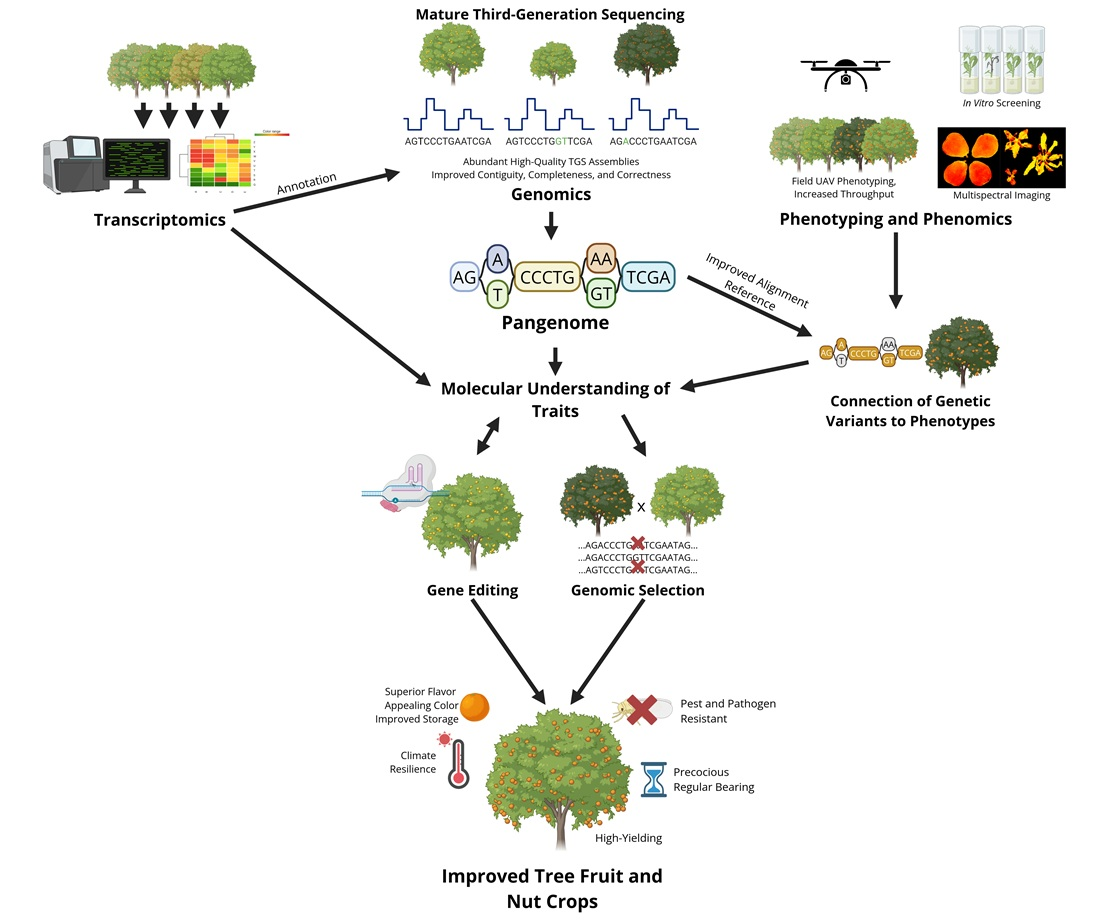
Tree Fruit and Nut Crops at the Dawn of the Pangenomic Era

Abstract
1. Introduction
2. Understanding Genomes
3. First and Second-Generation Sequencing: From Model Species to Reference Genomes
4. Third Generation Sequencing: High-Quality Reference Genomes to Pangenomes
5. Pangenomic Analysis
6. Transcriptomics: A Tool for Identifying Function and Gene-Linked Variation
7. Phenomics
8. Conclusions
Author Contributions
Funding
Data Availability Statement
Conflicts of Interest
References
- Gschwantner, T.; Schadauer, K.; Vidal, C.; Lanz, A.; Tomppo, E.; Di Cosmo, L.; Robert, N.; Duursma, D.E.; Lawrence, M. Common Tree Definitions for National Forest Inventories in Europe. Silva Fenn. 2009, 43, 463. [Google Scholar] [CrossRef]
- Spiegel-Roy, P. Domestication of Fruit Trees. In Developments in Agricultural and Managed Forest Ecology; Barigozzi, C., Ed.; Elsevier: Amsterdam, The Netherlands, 1986; Volume 16, pp. 201–211. ISBN 0166-2287. [Google Scholar]
- McMullin, S.; Njogu, K.; Wekesa, B.; Gachuiri, A.; Ngethe, E.; Stadlmayr, B.; Jamnadass, R.; Kehlenbeck, K. Developing Fruit Tree Portfolios That Link Agriculture More Effectively with Nutrition and Health: A New Approach for Providing Year-Round Micronutrients to Smallholder Farmers. Food Secur. 2019, 11, 1355–1372. [Google Scholar] [CrossRef]
- FAO; IFAD; UNICEF; WFP; WHO. The State of Food Security and Nutrition in the World; Food and Agriculture Organization (FAO): Rome, Italy, 2024. [Google Scholar]
- Liu, S.; Manson, J.E.; Lee, I.-M.; Cole, S.R.; Hennekens, C.H.; Willett, W.C.; Buring, J.E. Fruit and Vegetable Intake and Risk of Cardiovascular Disease: The Women’s Health Study. Am. J. Clin. Nutr. 2000, 72, 922–928. [Google Scholar] [CrossRef] [PubMed]
- Cano-Marquina, A.; Tarín, J.J.; Cano, A. The Impact of Coffee on Health. Maturitas 2013, 75, 7–21. [Google Scholar] [CrossRef]
- Luo, C.; Zhang, Y.; Ding, Y.; Shan, Z.; Chen, S.; Yu, M.; Hu, F.B.; Liu, L. Nut Consumption and Risk of Type 2 Diabetes, Cardiovascular Disease, and All-Cause Mortality: A Systematic Review and Meta-Analysis. Am. J. Clin. Nutr. 2014, 100, 256–269. [Google Scholar] [CrossRef]
- Buil-Cosiales, P.; Martinez-Gonzalez, M.A.; Ruiz-Canela, M.; Díez-Espino, J.; García-Arellano, A.; Toledo, E. Consumption of Fruit or Fiber-Fruit Decreases the Risk of Cardiovascular Disease in a Mediterranean Young Cohort. Nutrients 2017, 9, 295. [Google Scholar] [CrossRef]
- Veronese, N.; Demurtas, J.; Celotto, S.; Caruso, M.G.; Maggi, S.; Bolzetta, F.; Firth, J.; Smith, L.; Schofield, P.; Koyanagi, A.; et al. Is Chocolate Consumption Associated with Health Outcomes? An Umbrella Review of Systematic Reviews and Meta-Analyses. Clin. Nutr. 2019, 38, 1101–1108. [Google Scholar] [CrossRef]
- Evenson, R.E.; Gollin, D. Assessing the Impact of the Green Revolution, 1960 to 2000. Science 2003, 300, 758–762. [Google Scholar] [CrossRef]
- Gómez, M.I.; Barrett, C.B.; Raney, T.; Pinstrup-Andersen, P.; Meerman, J.; Croppenstedt, A.; Carisma, B.; Thompson, B. Post-Green Revolution Food Systems and the Triple Burden of Malnutrition. Food Policy 2013, 42, 129–138. [Google Scholar] [CrossRef]
- United Nations General Assembly. Transforming Our World: The 2030 Agenda for Sustainable Development. 2015. Available online: https://www.un.org/en/development/desa/population/migration/generalassembly/docs/globalcompact/A_RES_70_1_E.pdf (accessed on 1 August 2025).
- Chastre, C.; Duffield, A.; Kindness, H.; LeJeune, S.; Taylor, A. The Minimum Cost of a Healthy Diet: Findings from Piloting a New Methodology in Four Study Locations; Save the Children UK: London, UK, 2007. Available online: https://resourcecentre.savethechildren.net/document/minimum-cost-healthy-diet-findings-piloting-new-methodology-four-study-locations (accessed on 6 June 2025).
- Temple, N.J.; Steyn, N.P. The Cost of a Healthy Diet: A South African Perspective. Nutrition 2011, 27, 505–508. [Google Scholar] [CrossRef]
- Barosh, L.; Friel, S.; Engelhardt, K.; Chan, L. The Cost of a Healthy and Sustainable Diet—Who Can Afford It? Aust. N. Z. J. Public. Health 2014, 38, 7–12. [Google Scholar] [CrossRef]
- Jansen, M.; Guariguata, M.R.; Raneri, J.E.; Ickowitz, A.; Chiriboga-Arroyo, F.; Quaedvlieg, J.; Kettle, C.J. Food for Thought: The Underutilized Potential of Tropical Tree-Sourced Foods for 21st Century Sustainable Food Systems. People Nat. 2020, 2, 1006–1020. [Google Scholar] [CrossRef]
- Passarelli, S.; Free, C.M.; Shepon, A.; Beal, T.; Batis, C.; Golden, C.D. Global Estimation of Dietary Micronutrient Inadequacies: A Modelling Analysis. Lancet Glob. Health 2024, 12, e1590–e1599. [Google Scholar] [CrossRef] [PubMed]
- Herforth, A.; Bai, Y.; Venkat, A.; Mahrt, K.; Ebel, A.; Masters, W.A. Background Paper for The State of Food Security and Nutrition in the World 2020. FAO Agricultural Development Economics Technical Study No. 9. In Cost and Affordability of Healthy Diets Across and Within Countries; Food and Agriculture Organization (FAO): Rome, Italy, 2020; Volume 9, ISBN 925133725X. [Google Scholar]
- Fuglie, K.O.; Morgan, S.; Jelliffe, J. World Agricultural Production, Resource Use, and Productivity 1961–2020. 2024. Available online: https://www.ers.usda.gov/publications/pub-details?pubid=108649 (accessed on 1 August 2025).
- Roy, D.; Thorat, A. Success in High Value Horticultural Export Markets for the Small Farmers: The Case of Mahagrapes in India. World Dev. 2008, 36, 1874–1890. [Google Scholar] [CrossRef]
- Nomura, H.; Fikadu, A.A.; Gebre, G.G.; Shah, P. Analysis of the Smallholder Horticulture Empowerment and Promotion (“SHEP”): Intervention on Income and Food Security in Ethiopia. JICA Ogata Sadako Research Institute for Peace and Development, 2024. Available online: https://www.jica.go.jp/english/jica_ri/publication/discussion/__icsFiles/afieldfile/2024/11/14/Discussion_Paper_No27.pdf (accessed on 3 June 2025).
- Do, V.H.; La, N.; Mulia, R.; Bergkvist, G.; Sigrun Dahlin, A.; Nguyen, V.T.; Pham, H.T.; Öborn, I. Fruit Tree-Based Agroforestry Systems for Smallholder Farmers in Northwest Vietnam—A Quantitative and Qualitative Assessment. Land. 2020, 9, 451. [Google Scholar] [CrossRef]
- Kennedy, G.; Lee, W.T.K.; Termote, C.; Charrondiere, R.; Yen, J.; Tung, A. Guidelines on Assessing Biodiverse Foods in Dietary Intake Surveys; Food and Agriculture Organization (FAO): Rome, Italy, 2017. [Google Scholar]
- Dawson, I.D.; Hendre, P.; Powell, W.; Sila, D.; McMullin, S.; Simons, T.; Revoredo-Giha, C.; Odeny, D.A.; Barnes, A.P.; Graudal, L. Supporting Human Nutrition in Africa through the Integration of New and Orphan Crops into Food Systems: Placing the Work of the African Orphan Crops Consortium in Context. 2018. Available online: https://africanorphancrops.org/publications/supporting-human-nutrition-in-africa-through-the-integration-of-new-and-orphan-crops-into-food-systems/ (accessed on 2 June 2025).
- Miller, A.J.; Gross, B.L. From Forest to Field: Perennial Fruit Crop Domestication. Am. J. Bot. 2011, 98, 1389–1414. [Google Scholar] [CrossRef] [PubMed]
- Fuller, D.Q. Long and Attenuated: Comparative Trends in the Domestication of Tree Fruits. Veg. Hist. Archaeobot 2018, 27, 165–176. [Google Scholar] [CrossRef]
- Monselise, S.P.; Goldschmidt, E.E. Alternate Bearing in Fruit Trees. Hortic. Rev. (Am. Soc. Hortic. Sci.) 1982, 4, 128–173. [Google Scholar]
- Conner, P.J.; Worley, R.E. Alternate Bearing Intensity of Pecan Cultivars. HortScience 2000, 6, 1067–1069. [Google Scholar] [CrossRef]
- Yue, C.; Gallardo, R.K.; Luby, J.; Rihn, A.; McFerson, J.R.; McCracken, V.; Bedford, D.; Brown, S.; Evans, K.; Weebadde, C.; et al. An Investigation of U.S. An Investigation of U.S. Apple Producers’ Trait Prioritization—Evidence from Audience Surveys. HortScience 2013, 48, 1378–1384. [Google Scholar] [CrossRef]
- Yue, C.; Gallardo, R.K.; Luby, J.J.; Rihn, A.L.; McFerson, J.R.; McCracken, V.; Oraguzie, N.; Weebadde, C.; Sebolt, A.; Iezzoni, A. An Evaluation of US Tart and Sweet Cherry Producers Trait Prioritization: Evidence from Audience Surveys. HortScience 2014, 49, 931–937. [Google Scholar] [CrossRef]
- Naji, Z.; Sattam, R.; Alsalihi, M. The Effect of Pesticides on Public Health: A Review. South. Asian Res. J. Biol. Appl. Biosci. 2024, 6, 43–55. [Google Scholar] [CrossRef]
- EU. Joint Research Center. New Genomic Techniques Can Help Cut Pesticides Use or Shield from Celiac Disease. The Joint Research Centre: EU Science Hub. 2023. Available online: https://joint-research-centre.ec.europa.eu/jrc-news-and-updates/new-genomic-techniques-can-help-cut-pesticides-use-or-shield-celiac-disease-2023-07-05_en (accessed on 2 June 2025).
- UN FAO/WHO. Report of the 17th FAO/WHO Joint Meeting on Pesticide Management, Rome, Italy, 8–11 October 2024. Available online: https://www.who.int/publications/i/item/9789240107823 (accessed on 2 June 2025).
- Song, X.; Xi, S.; Zhang, J.; Ma, Q.; Zhou, Y.; Pei, D.; Xu, H.; Zhang, J. ‘Zhong Ning Sheng’: A New Distant Hybrid Cultivar of Walnut. HortScience 2019, 54, 2257–2259. [Google Scholar] [CrossRef]
- Mahmoud, L.M.; Dutt, M.; Vincent, C.I.; Grosser, J.W. Salinity-Induced Physiological Responses of Three Putative Salt Tolerant Citrus Rootstocks. Horticulturae 2020, 6, 90. [Google Scholar] [CrossRef]
- Autio, W.; Robinson, T.; Blatt, S.; Cochran, D.; Francescato, P.; Hoover, E.; Kushad, M.; Lang, G.; Lordan, J.; Miller, D. Budagovsky, Geneva, Pillnitz, and Malling Apple Rootstocks Affect ‘Honeycrisp’ Performance over Eight Years in the 2010 NC-140 ‘Honeycrisp’ Apple Rootstock Trial. J. Amer. Pomol. Soc 2020, 74, 182–195. [Google Scholar]
- Pang, H.; Yan, Q.; Zhao, S.; He, F.; Xu, J.; Qi, B.; Zhang, Y. Knockout of the S-Acyltransferase Gene, PbPAT14, Confers the Dwarf Yellowing Phenotype in First Generation Pear by ABA Accumulation. Int. J. Mol. Sci. 2019, 20, 6347. [Google Scholar] [CrossRef]
- Gonsalves, D. Transgenic Papaya: Development, Release, Impact and Challenges. Adv. Virus Res. 2006, 67, 317–354. [Google Scholar]
- Grosser, J.W.; Gmitter, F.G.; Louzada, E.S.; Chandler, J.L. Production of Somatic Hybrid and Autotetraploid Breeding Parents for Seedless Citrus Development. HortScience 1992, 27, 1125–1127. [Google Scholar] [CrossRef]
- Yadollahi, A.; Arzani, K.; Ebadi, A.; Wirthensohn, M.; Karimi, S. The Response of Different Almond Genotypes to Moderate and Severe Water Stress in Order to Screen for Drought Tolerance. Sci. Hortic. 2011, 129, 403–413. [Google Scholar] [CrossRef]
- Qin, S.; Xu, G.; He, J.; Li, L.; Ma, H.; Lyu, D. A Chromosome-Scale Genome Assembly of Malus Domestica, a Multi-Stress Resistant Apple Variety. Genomics 2023, 115, 110627. [Google Scholar] [CrossRef]
- Serra, S.; Sheick, R.; Roeder, S.; Musacchi, S. WA 38 Abscission and Fruit Development in an Open Pollination Scenario. In Proceedings of the XII International Symposium on Integrating Canopy, Rootstock and Environmental Physiology in Orchard Systems, Wenatchee, WA, USA, 26–30 July 2021; pp. 129–138. [Google Scholar]
- Sandefur, P.; Oraguzie, N.; Peace, C. A DNA Test for Routine Prediction in Breeding of Sweet Cherry Fruit Color, Pav-Rf-SSR. Mol. Breed. 2016, 36, 33. [Google Scholar] [CrossRef]
- Machida, Y.; Kajiura, I.; Sato, Y.; Kotobuki, K.; Kozono, T. Genetic Information on Flesh Firmness and the Characteristics of Selected Clones of Japanese Pear. Results of the Fifth Japanese Pear Breeding Programme. Bull. Fruit. Tree Res. Stn. 1984, 11, 35–42. [Google Scholar]
- Souleyre, E.J.F.; Chagné, D.; Chen, X.; Tomes, S.; Turner, R.M.; Wang, M.Y.; Maddumage, R.; Hunt, M.B.; Winz, R.A.; Wiedow, C.; et al. The AAT1 Locus Is Critical for the Biosynthesis of Esters Contributing to “ripe Apple” Flavour in “Royal Gala” and “Granny Smith” Apples. Plant J. 2014, 78, 903–915. [Google Scholar] [CrossRef] [PubMed]
- Yang, S.; Yu, J.; Yang, H.; Zhao, Z. Genetic Analysis and QTL Mapping of Aroma Volatile Compounds in the Apple Progeny ‘Fuji’ × ‘Cripps Pink’. Front. Plant. Sci. 2023, 14, 1048846. [Google Scholar] [CrossRef]
- Guellaoui, I.; Ben Amar, F.; Triki, M.A.; Ayadi, M.; Boubaker, M. Chemlali Mhassen: New Olive Cultivar Derived from Crossbreeding Program in Tunisia with High Oil Quality and Productivity. J. Sci. Agric. 2021, 5, 32–35. [Google Scholar] [CrossRef]
- Carter, N. Petition for Determination of Nonregulated Status: ArcticTM Apple (Malus x Domestica) Events GD743 and GS784. United States Department of Agriculture—Animal and Plant Health Inspection Service 2012. Available online: https://www.isaaa.org/gmapprovaldatabase/crop/default.asp?CropID=28 (accessed on 4 June 2025).
- Revord, R.S.; Miller, G.; Meier, N.A.; Webber, J.B.; Romero-Severson, J.; Gold, M.A.; Lovell, S.T. A Roadmap for Participatory Chestnut Breeding for Nut Production in the Eastern United States. Front. Plant. Sci. 2022, 12, 735597. [Google Scholar] [CrossRef]
- Mase, N.; Sawamura, Y.; Yamamoto, T.; Takada, N.; Nishio, S.; Saito, T.; Iketani, H. A Segmental Duplication Encompassing S-Haplotype Triggers Pollen-Part Self-Compatibility in Japanese Pear (Pyrus pyrifolia). Mol. Breed. 2014, 33, 117–128. [Google Scholar] [CrossRef][Green Version]
- Nishio, S.; Shirasawa, K.; Nishimura, R.; Takeuchi, Y.; Imai, A.; Mase, N.; Takada, N. A Self-Compatible Pear Mutant Derived from γ-Irradiated Pollen Carries an 11-Mb Duplication in Chromosome 17. Front. Plant Sci. 2024, 15, 1360185. [Google Scholar] [CrossRef]
- Reid, W.; Hunt, K.L. Pecan Production in the Northern United States. Horttechnology 2000, 2, 298–301. [Google Scholar] [CrossRef]
- da Silva Linge, C.; Ciacciulli, A.; Baccichet, I.; Chiozzotto, R.; Calastri, E.; Tagliabue, A.G.; Rossini, L.; Bassi, D.; Cirilli, M. A Novel Trait to Reduce the Mechanical Damage of Peach Fruits at Harvest: The First Genetic Dissection Study for Peduncle Length. Mol. Breed. 2025, 45, 29. [Google Scholar] [CrossRef]
- Barritt, B.H. The Necessity of Adopting New Apple Varieties to Meet Consumer Needs. Compact. Fruit. Tree 1999, 32, 38–43. [Google Scholar]
- Thompson, T.E.; Grauke, L.J.; Reid, W. “Lakota” Pecan. HortScience 2008, 43, 250–251. [Google Scholar] [CrossRef]
- Evans, K.M.; Barritt, B.H.; Konishi, B.S.; Brutcher, L.J.; Ross, C.F. ‘WA 38’ Apple. HortScience 2012, 47, 1177–1179. [Google Scholar] [CrossRef]
- Zhang, H.; Ko, I.; Eaker, A.; Haney, S.; Khuu, N.; Ryan, K.; Appleby, A.B.; Hoffmann, B.; Landis, H.; Pierro, K.A.; et al. A Haplotype-Resolved, Chromosome-Scale Genome for Malus Domestica Borkh. ‘WA 38’. G3 Genes|Genomes|Genet. 2024, 14, jkae222. [Google Scholar] [CrossRef]
- Ru, S.; Main, D.; Evans, K.; Peace, C. Current Applications, Challenges, and Perspectives of Marker-Assisted Seedling Selection in Rosaceae Tree Fruit Breeding. Tree Genet. Genomes 2015, 11, 8. [Google Scholar] [CrossRef]
- De Mori, G.; Cipriani, G. Marker-Assisted Selection in Breeding for Fruit Trait Improvement: A Review. Int. J. Mol. Sci. 2023, 24, 8984. [Google Scholar] [CrossRef]
- Collard, B.C.Y.; Mackill, D.J. Marker-Assisted Selection: An Approach for Precision Plant Breeding in the Twenty-First Century. Philos. Trans. R. Soc. B Biol. Sci. 2007, 363, 557–572. [Google Scholar] [CrossRef]
- Heffner, E.L.; Sorrells, M.E.; Jannink, J. Genomic Selection for Crop Improvement. Crop Sci. 2009, 49, 1–12. [Google Scholar] [CrossRef]
- Meuwissen, T.H.E.; Hayes, B.J.; Goddard, M. Prediction of Total Genetic Value Using Genome-Wide Dense Marker Maps. Genetics 2001, 157, 1819–1829. [Google Scholar] [CrossRef]
- Wang, Y.; Mette, M.F.; Miedaner, T.; Gottwald, M.; Wilde, P.; Reif, J.C.; Zhao, Y. The Accuracy of Prediction of Genomic Selection in Elite Hybrid Rye Populations Surpasses the Accuracy of Marker-Assisted Selection and Is Equally Augmented by Multiple Field Evaluation Locations and Test Years. BMC Genom. 2014, 15, 556. [Google Scholar] [CrossRef]
- Cerrudo, D.; Cao, S.; Yuan, Y.; Martinez, C.; Suarez, E.A.; Babu, R.; Zhang, X.; Trachsel, S. Genomic Selection Outperforms Marker Assisted Selection for Grain Yield and Physiological Traits in a Maize Doubled Haploid Population across Water Treatments. Front. Plant Sci. 2018, 9, 366. [Google Scholar] [CrossRef] [PubMed]
- Degen, B.; Müller, N.A. A Simulation Study Comparing Advanced Marker-Assisted Selection with Genomic Selection in Tree Breeding Programs. G3 Genes|Genomes|Genet. 2023, 13, jkad164. [Google Scholar] [CrossRef] [PubMed]
- Boyle, E.A.; Li, Y.I.; Pritchard, J.K. An Expanded View of Complex Traits: From Polygenic to Omnigenic. Cell 2017, 169, 1177–1186. [Google Scholar] [CrossRef] [PubMed]
- Mathieson, I. The Omnigenic Model and Polygenic Prediction of Complex Traits. Am. J. Hum. Genet. 2021, 108, 1558–1563. [Google Scholar] [CrossRef]
- Merrick, L.F.; Burke, A.B.; Chen, X.; Carter, A.H. Breeding With Major and Minor Genes: Genomic Selection for Quantitative Disease Resistance. Front. Plant. Sci. 2021, 12, 713667. [Google Scholar] [CrossRef]
- Pilet-Nayel, M.L.; Moury, B.; Caffier, V.; Montarry, J.; Kerlan, M.C.; Fournet, S.; Durel, C.E.; Delourme, R. Quantitative Resistance to Plant Pathogens in Pyramiding Strategies for Durable Crop Protection. Front. Plant. Sci. 2017, 8, 1838. [Google Scholar] [CrossRef]
- Clair, D. Quantitative Disease Resistance and Quantitative Resistance Loci in Breeding. Annu. Rev. Phytopathol. 2009, 48, 247–268. [Google Scholar] [CrossRef]
- Reid, M.; Buisson, D. Factors Influencing Adoption of New Apple and Pear Varieties in Europe and the UK. Int. J. Retail. Distrib. Manag. 2001, 29, 315–327. [Google Scholar] [CrossRef]
- Ullah, A.; Khan, D.; Zheng, S.; Ali, U. Factors Influencing the Adoption of Improved Cultivars: A Case of Peach Farmers in Pakistan. Ciência Rural. 2018, 48, e20180342. [Google Scholar] [CrossRef]
- Gallardo, R.K.; Galinato, S.P. 2019 Cost Estimates of Establishing, Producing, and Packing Honeycrisp Apples in Washington; Washington State University Extension: Pullman, WA, USA, 2020. [Google Scholar]
- Geffroy, O.; Cheriet, F.; Chervin, C.; Hannin, H.; Olivier-Salvagnac, V.; Samson, A.; Vanden Heuvel, J. Opportunities and Challenges in the Adoption of New Grape Varieties by Producers: A Case Study from the Northeastern United. In Proceedings of the OIV 2024, Dijon, France, 18 November 2024; International Viticulture and Enology Society: Bordeaux, France, 2024. [Google Scholar]
- Northwest Horticultural Council. Pacific Northwest Pears Pear Fact Sheet. Available online: https://nwhort.org/industry-facts/pear-fact-sheet/ (accessed on 22 September 2025).
- Bjerga, A. Gala Outpaces Red Delicious to Become Most Popular Apple. The Seattle Times. 2018. Available online: https://www.seattletimes.com/business/gala-outpaces-red-delicious-to-become-most-popular-apple/ (accessed on 2 June 2025).
- Zakari, S.; Manda, J.; Germaine, I.; Moussa, B.; Abdoulaye, T. Evaluating the Impact of Improved Crop Varieties in the Sahelian Farming Systems of Niger. J. Agric. Food Res. 2023, 14, 100897. [Google Scholar] [CrossRef]
- Ho, S.-T.; Gonzalez Nieto, L.; Rickard, B.J.; Reig, G.; Lordan, J.; Lawrence, B.T.; Fazio, G.; Hoying, S.A.; Fargione, M.J.; Sazo, M.M.; et al. Effects of Cultivar, Planting Density and Rootstock on Long-Term Economic Performance of Apple Orchards in the Northeastern U.S. Sci. Hortic. 2024, 332, 113194. [Google Scholar] [CrossRef]
- Baldos, U.L.C.; Cisneros-Pineda, A.; Fuglie, K.O.; Hertel, T.W. Adoption of Improved Crop Varieties Limited Biodiversity Losses, Terrestrial Carbon Emissions, and Cropland Expansion in the Tropics. Proc. Natl. Acad. Sci. USA 2025, 122, e2404839122. [Google Scholar] [CrossRef] [PubMed]
- Coupel-Ledru, A.; Pallas, B.; Delalande, M.; Boudon, F.; Carrié, E.; Martinez, S.; Regnard, J.-L.; Costes, E. Multi-Scale High-Throughput Phenotyping of Apple Architectural and Functional Traits in Orchard Reveals Genotypic Variability under Contrasted Watering Regimes. Hortic. Res. 2019, 6, 52. [Google Scholar] [CrossRef] [PubMed]
- Mir, R.R.; Reynolds, M.; Pinto, F.; Khan, M.A.; Bhat, M.A. High-Throughput Phenotyping for Crop Improvement in the Genomics Era. Plant Sci. 2019, 282, 60–72. [Google Scholar] [CrossRef] [PubMed]
- Sun, C.; Hu, H.; Cheng, Y.; Yang, X.; Qiao, Q.; Wang, C.; Zhang, L.; Chen, D.; Zhao, S.; Dong, Z.; et al. Genomics-Assisted Breeding: The next-Generation Wheat Breeding Era. Plant Breed. 2023, 142, 259–268. [Google Scholar] [CrossRef]
- Bado, S.; Yamba, N.G.G.; Sesay, J.V.; Laimer, M.; Forster, B.P. Plant Mutation Breeding for the Improvement of Vegetatively Propagated Crops: Successes and Challenges. CAB Rev. Perspect. Agric. Vet. Sci. Nutr. Nat. Resour. 2017, 12, 259–268. [Google Scholar] [CrossRef]
- Taheri, S.; Abdullah, T.; Jain, S.; Sahebi, M.; Azizi, P. TILLING, High-Resolution Melting (HRM), and next-Generation Sequencing (NGS) Techniques in Plant Mutation Breeding. Mol. Breed. 2017, 37, 40. [Google Scholar] [CrossRef]
- Kosugi, S.; Terao, C. Comparative Evaluation of SNVs, Indels, and Structural Variations Detected with Short- and Long-Read Sequencing Data. Hum. Genome Var. 2024, 11, 18. [Google Scholar] [CrossRef]
- Guan, J.; Xu, Y.; Yu, Y.; Fu, J.; Ren, F.; Guo, J.; Zhao, J.; Jiang, Q.; Wei, J.; Xie, H. Genome Structure Variation Analyses of Peach Reveal Population Dynamics and a 1.67 Mb Causal Inversion for Fruit Shape. Genome Biol. 2021, 22, 13. [Google Scholar] [CrossRef]
- Ruigrok, M.; Xue, B.; Catanach, A.; Zhang, M.; Jesson, L.; Davy, M.; Wellenreuther, M. The Relative Power of Structural Genomic Variation versus SNPs in Explaining the Quantitative Trait Growth in the Marine Teleost Chrysophrys auratus. Genes 2022, 13, 1129. [Google Scholar] [CrossRef]
- Jia, H.; Wang, N. Targeted Genome Editing of Sweet Orange Using Cas9/SgRNA. PLoS ONE 2014, 9, e93806-. [Google Scholar] [CrossRef] [PubMed]
- Tsanova, T.; Stefanova, L.; Topalova, L.; Atanasov, A.; Pantchev, I. DNA-Free Gene Editing in Plants: A Brief Overview. Biotechnol. Biotechnol. Equip. 2021, 35, 131–138. [Google Scholar] [CrossRef]
- Martín-Valmaseda, M.; Devin, S.R.; Ortuño-Hernández, G.; Pérez-Caselles, C.; Mahdavi, S.M.E.; Bujdoso, G.; Salazar, J.A.; Martínez-Gómez, P.; Alburquerque, N. CRISPR/Cas as a Genome-Editing Technique in Fruit Tree Breeding. Int. J. Mol. Sci. 2023, 24, 16656. [Google Scholar] [CrossRef] [PubMed]
- Weiss, T.; Kamalu, M.; Shi, H.; Li, Z.; Amerasekera, J.; Zhong, Z.; Adler, B.A.; Song, M.M.; Vohra, K.; Wirnowski, G. Viral Delivery of an RNA-Guided Genome Editor for Transgene-Free Germline Editing in Arabidopsis. Nat. Plants 2025, 11, 967–976. [Google Scholar] [CrossRef]
- Vora, Z.; Pandya, J.; Sangh, C.; Vaikuntapu, P.R. The Evolving Landscape of Global Regulations on Genome-Edited Crops. J. Plant Biochem. Biotechnol. 2023, 32, 831–845. [Google Scholar] [CrossRef]
- Duarte Sagawa, C.H.; Assis, R.d.A.B.; Zaini, P.A. Chapter 8—Regulatory Framework of CRISPR-Edited Crops in the United States. In Global Regulatory Outlook for CRISPRized Plants; Abd-Elsalam, K.A., Ahmad, A., Eds.; Academic Press: Cambridge, MA, USA, 2024; pp. 167–195. ISBN 978-0-443-18444-4. [Google Scholar]
- Stokstad, E. European Parliament Votes to Ease Regulation of Gene-Edited Crops. Science. 2024. Available online: https://www.science.org/content/article/european-parliament-votes-ease-regulation-gene-edited-crops (accessed on 2 June 2025).
- Penna, S.; Jain, S.M. Fruit Crop Improvement with Genome Editing, in Vitro and Transgenic Approaches. Horticulturae 2023, 9, 58. [Google Scholar] [CrossRef]
- Yuan, Z.; Li, B.; Zhao, Y. Advances in Developmental Biology in Tree Fruit and Nut Crops. Horticulturae 2025, 11, 327. [Google Scholar] [CrossRef]
- Bradnam, K.R.; Fass, J.N.; Alexandrov, A.; Baranay, P.; Bechner, M.; Birol, I.; Boisvert, S.; Chapman, J.A.; Chapuis, G.; Chikhi, R. Assemblathon 2: Evaluating de Novo Methods of Genome Assembly in Three Vertebrate Species. Gigascience 2013, 2, 2047–2217X. [Google Scholar] [CrossRef]
- Thrash, A.; Hoffmann, F.; Perkins, A. Toward a More Holistic Method of Genome Assembly Assessment. BMC Bioinform. 2020, 21, 249. [Google Scholar] [CrossRef]
- Wang, P.; Wang, F. A Proposed Metric Set for Evaluation of Genome Assembly Quality. Trends Genet. 2023, 39, 175–186. [Google Scholar] [CrossRef]
- Ekblom, R.; Wolf, J.B.W. A Field Guide to Whole-Genome Sequencing, Assembly and Annotation. Evol. Appl. 2014, 7, 1026–1042. [Google Scholar] [CrossRef] [PubMed]
- Wu, B.; Yu, Q.; Deng, Z.; Duan, Y.; Luo, F.; Gmitter, F., Jr. A Chromosome-Level Phased Genome Enabling Allele-Level Studies in Sweet Orange: A Case Study on Citrus Huanglongbing Tolerance. Hortic. Res. 2023, 10, uhac247. [Google Scholar] [CrossRef] [PubMed]
- Leggett, R.M.; MacLean, D. Reference-Free SNP Detection: Dealing with the Data Deluge. BMC Genom. 2014, 15, S10. [Google Scholar] [CrossRef] [PubMed][Green Version]
- Uricaru, R.; Rizk, G.; Lacroix, V.; Quillery, E.; Plantard, O.; Chikhi, R.; Lemaitre, C.; Peterlongo, P. Reference-Free Detection of Isolated SNPs. Nucleic Acids Res. 2015, 43, e11. [Google Scholar] [CrossRef]
- Guo, L.; Gao, Z.; Qian, Q. Application of Resequencing to Rice Genomics, Functional Genomics and Evolutionary Analysis. Rice 2014, 7, 4. [Google Scholar] [CrossRef]
- Kumawat, S.; Raturi, G.; Dhiman, P.; Sudhakarn, S.; Rajora, N.; Thakral, V.; Yadav, H.; Padalkar, G.; Sharma, Y.; Rachappanavar, V. Opportunity and Challenges for Whole-genome Resequencing-based Genotyping in Plants. In Genotyping by Sequencing for Crop Improvement; Wiley: Hoboken, NJ, USA, 2022; pp. 38–51. [Google Scholar]
- Song, B.; Ning, W.; Wei, D.; Jiang, M.; Zhu, K.; Wang, X.; Edwards, D.; Odeny, D.A.; Cheng, S. Plant Genome Resequencing and Population Genomics: Current Status and Future Prospects. Mol. Plant 2023, 16, 1252–1268. [Google Scholar] [CrossRef]
- Silva, G.G.Z.; Dutilh, B.E.; Matthews, T.D.; Elkins, K.; Schmieder, R.; Dinsdale, E.A.; Edwards, R.A. Combining de Novo and Reference-Guided Assembly with Scaffold_builder. Source Code Biol. Med. 2013, 8, 23. [Google Scholar] [CrossRef]
- Hach, F.; Numanagic, I.; Sahinalp, S.C. DeeZ: Reference-Based Compression by Local Assembly. Nat. Methods 2014, 11, 1082–1084. [Google Scholar] [CrossRef]
- Scheunert, A.; Dorfner, M.; Lingl, T.; Oberprieler, C. Can We Use It? On the Utility of de Novo and Reference-Based Assembly of Nanopore Data for Plant Plastome Sequencing. PLoS ONE 2020, 15, e0226234. [Google Scholar] [CrossRef]
- Degner, J.F.; Marioni, J.C.; Pai, A.A.; Pickrell, J.K.; Nkadori, E.; Gilad, Y.; Pritchard, J.K. Effect of Read-Mapping Biases on Detecting Allele-Specific Expression from RNA-Sequencing Data. Bioinformatics 2009, 25, 3207–3212. [Google Scholar] [CrossRef]
- Brandt, D.Y.C.; Aguiar, V.R.C.; Bitarello, B.D.; Nunes, K.; Goudet, J.; Meyer, D. Mapping Bias Overestimates Reference Allele Frequencies at the HLA Genes in the 1000 Genomes Project Phase I Data. G3 Genes|Genomes|Genet. 2015, 5, 931–941. [Google Scholar] [CrossRef]
- Chen, N.-C.; Solomon, B.; Mun, T.; Iyer, S.; Langmead, B. Reference Flow: Reducing Reference Bias Using Multiple Population Genomes. Genome Biol. 2021, 22, 8. [Google Scholar] [CrossRef]
- The Arabidopsis Genome Initiative. Analysis of the Genome Sequence of the Flowering Plant Arabidopsis Thaliana. Nature 2000, 408, 796–815. [Google Scholar] [CrossRef] [PubMed]
- Ming, R.; Hou, S.; Feng, Y.; Yu, Q.; Dionne-Laporte, A.; Saw, J.H.; Senin, P.; Wang, W.; Ly, B.V.; Lewis, K.L.T.; et al. The Draft Genome of the Transgenic Tropical Fruit Tree Papaya (Carica papaya Linnaeus). Nature 2008, 452, 991–996. [Google Scholar] [CrossRef] [PubMed]
- Wetterstrand, K. DNA Sequencing Costs: Data from the NHGRI Genome Sequencing Program (GSP). Available online: https://www.genome.gov/about-genomics/fact-sheets/DNA-Sequencing-Costs-Data (accessed on 3 June 2025).
- Velasco, R.; Zharkikh, A.; Affourtit, J.; Dhingra, A.; Cestaro, A.; Kalyanaraman, A.; Fontana, P.; Bhatnagar, S.K.; Troggio, M.; Pruss, D.; et al. The Genome of the Domesticated Apple (Malus × Domestica Borkh.). Nat. Genet. 2010, 42, 833–839. [Google Scholar] [CrossRef] [PubMed]
- Ahmad, R.; Parfitt, D.E.; Fass, J.; Ogundiwin, E.; Dhingra, A.; Gradziel, T.M.; Lin, D.; Joshi, N.A.; Martinez-Garcia, P.J.; Crisosto, C.H. Whole Genome Sequencing of Peach (Prunus persica L.) for SNP Identification and Selection. BMC Genom. 2011, 12, 569. [Google Scholar] [CrossRef]
- Denoeud, F.; Carretero-Paulet, L.; Dereeper, A.; Droc, G.; Guyot, R.; Pietrella, M.; Zheng, C.; Alberti, A.; Anthony, F.; Aprea, G. The Coffee Genome Provides Insight into the Convergent Evolution of Caffeine Biosynthesis. Science 2014, 345, 1181–1184. [Google Scholar] [CrossRef]
- Huang, Y.; Xiao, L.; Zhang, Z.; Zhang, R.; Wang, Z.; Huang, C.; Huang, R.; Luan, Y.; Fan, T.; Wang, J. The Genomes of Pecan and Chinese Hickory Provide Insights into Carya Evolution and Nut Nutrition. Gigascience 2019, 8, giz036. [Google Scholar] [CrossRef]
- Xing, Y.; Liu, Y.; Zhang, Q.; Nie, X.; Sun, Y.; Zhang, Z.; Li, H.; Fang, K.; Wang, G.; Huang, H. Hybrid de Novo Genome Assembly of Chinese Chestnut (Castanea mollissima). Gigascience 2019, 8, giz112. [Google Scholar] [CrossRef]
- Thakur, S.; Yadav, I.S.; Jindal, M.; Sharma, P.K.; Dhillon, G.S.; Boora, R.S.; Arora, N.K.; Gill, M.I.S.; Chhuneja, P.; Mittal, A. Development of Genome-Wide Functional Markers Using Draft Genome Assembly of Guava (Psidium guajava L.) Cv. Allahabad Safeda to Expedite Molecular Breeding. Front. Plant Sci. 2021, 12, 708332. [Google Scholar] [CrossRef]
- Chagné, D.; Crowhurst, R.N.; Pindo, M.; Thrimawithana, A.; Deng, C.; Ireland, H.; Fiers, M.; Dzierzon, H.; Cestaro, A.; Fontana, P. The Draft Genome Sequence of European Pear (Pyrus communis L.‘Bartlett’). PLoS ONE 2014, 9, e92644. [Google Scholar] [CrossRef] [PubMed]
- Argout, X.; Salse, J.; Aury, J.-M.; Guiltinan, M.J.; Droc, G.; Gouzy, J.; Allegre, M.; Chaparro, C.; Legavre, T.; Maximova, S.N. The Genome of Theobroma cacao. Nat. Genet. 2011, 43, 101–108. [Google Scholar] [CrossRef] [PubMed]
- Verde, I.; Abbott, A.G.; Scalabrin, S.; Jung, S.; Shu, S.; Marroni, F.; Zhebentyayeva, T.; Dettori, M.T.; Grimwood, J.; Cattonaro, F.; et al. The High-Quality Draft Genome of Peach (Prunus persica) Identifies Unique Patterns of Genetic Diversity, Domestication and Genome Evolution. Nat. Genet. 2013, 45, 487–494. [Google Scholar] [CrossRef] [PubMed]
- Xu, Q.; Chen, L.-L.; Ruan, X.; Chen, D.; Zhu, A.; Chen, C.; Bertrand, D.; Jiao, W.-B.; Hao, B.-H.; Lyon, M.P. The Draft Genome of Sweet Orange (Citrus sinensis). Nat. Genet. 2013, 45, 59–66. [Google Scholar] [CrossRef]
- Wu, J.; Wang, Z.; Shi, Z.; Zhang, S.; Ming, R.; Zhu, S.; Khan, M.A.; Tao, S.; Korban, S.S.; Wang, H. The Genome of the Pear (Pyrus bretschneideri Rehd.). Genome Res. 2013, 23, 396–408. [Google Scholar] [CrossRef]
- Cruz, F.; Julca, I.; Gómez-Garrido, J.; Loska, D.; Marcet-Houben, M.; Cano, E.; Galán, B.; Frias, L.; Ribeca, P.; Derdak, S. Genome Sequence of the Olive Tree, Olea europaea. Gigascience 2016, 5, s13742-016. [Google Scholar] [CrossRef]
- Nock, C.J.; Baten, A.; Barkla, B.J.; Furtado, A.; Henry, R.J.; King, G.J. Genome and Transcriptome Sequencing Characterises the Gene Space of Macadamia integrifolia (Proteaceae). BMC Genom. 2016, 17, 937. [Google Scholar] [CrossRef]
- Martínez-García, P.J.; Crepeau, M.W.; Puiu, D.; Gonzalez-Ibeas, D.; Whalen, J.; Stevens, K.A.; Paul, R.; Butterfield, T.S.; Britton, M.T.; Reagan, R.L. The Walnut (Juglans regia) Genome Sequence Reveals Diversity in Genes Coding for the Biosynthesis of Non-structural Polyphenols. Plant J. 2016, 87, 507–532. [Google Scholar] [CrossRef]
- Mori, K.; Shirasawa, K.; Nogata, H.; Hirata, C.; Tashiro, K.; Habu, T.; Kim, S.; Himeno, S.; Kuhara, S.; Ikegami, H. Identification of RAN1 Orthologue Associated with Sex Determination through Whole Genome Sequencing Analysis in Fig (Ficus carica L.). Sci. Rep. 2017, 7, 41124. [Google Scholar] [CrossRef]
- Teh, B.T.; Lim, K.; Yong, C.H.; Ng, C.C.Y.; Rao, S.R.; Rajasegaran, V.; Lim, W.K.; Ong, C.K.; Chan, K.; Cheng, V.K.Y. The Draft Genome of Tropical Fruit Durian (Durio zibethinus). Nat. Genet. 2017, 49, 1633–1641. [Google Scholar] [CrossRef]
- Zeng, L.; Tu, X.-L.; Dai, H.; Han, F.-M.; Lu, B.-S.; Wang, M.-S.; Nanaei, H.A.; Tajabadipour, A.; Mansouri, M.; Li, X.-L. Whole Genomes and Transcriptomes Reveal Adaptation and Domestication of Pistachio. Genome Biol. 2019, 20, 79. [Google Scholar] [CrossRef]
- Zhu, Q.; Xu, Y.; Yang, Y.; Guan, C.; Zhang, Q.; Huang, J.; Grierson, D.; Chen, K.; Gong, B.; Yin, X. The Persimmon (Diospyros oleifera Cheng) Genome Provides New Insights into the Inheritance of Astringency and Ancestral Evolution. Hortic Res. 2019, 6, 138. [Google Scholar] [CrossRef]
- Sahu, S.K.; Liu, M.; Yssel, A.; Kariba, R.; Muthemba, S.; Jiang, S.; Song, B.; Hendre, P.S.; Muchugi, A.; Jamnadass, R. Draft Genomes of Two Artocarpus Plants, Jackfruit (A. heterophyllus) and Breadfruit (A. altilis). Genes 2019, 11, 27. [Google Scholar] [CrossRef] [PubMed]
- Jiang, S.; An, H.; Xu, F.; Zhang, X. Chromosome-Level Genome Assembly and Annotation of the Loquat (Eriobotrya japonica) Genome. Gigascience 2020, 9, giaa015. [Google Scholar] [CrossRef] [PubMed]
- Soyturk, A.; Sen, F.; Uncu, A.T.; Celik, I.; De Uncu, A.O. Novo Assembly and Characterization of the First Draft Genome of Quince (Cydonia oblonga Mill.). Sci. Rep. 2021, 11, 3818. [Google Scholar] [CrossRef] [PubMed]
- Feng, C.; Feng, C.; Lin, X.; Liu, S.; Li, Y.; Kang, M. A Chromosome-Level Genome Assembly Provides Insights into Ascorbic Acid Accumulation and Fruit Softening in Guava (Psidium guajava). Plant Biotechnol. J. 2021, 19, 717–730. [Google Scholar] [CrossRef]
- Li, Y.; Sun, P.; Lu, Z.; Chen, J.; Wang, Z.; Du, X.; Zheng, Z.; Wu, Y.; Hu, H.; Yang, J. The Corylus mandshurica Genome Provides Insights into the Evolution of Betulaceae Genomes and Hazelnut Breeding. Hortic Res. 2021, 8, 54. [Google Scholar] [CrossRef]
- Savadi, S.; Muralidhara, B.M.; Godwin, J.; Adiga, J.D.; Mohana, G.S.; Eradasappa, E.; Shamsudheen, M.; Karun, A. De novo Assembly and Characterization of the Draft Genome of the Cashew (Anacardium occidentale L.). Sci. Rep. 2022, 12, 18187. [Google Scholar] [CrossRef]
- Worley, K.C.; Richards, S.; Rogers, J. The Value of New Genome References. Exp. Cell Res. 2017, 358, 433–438. [Google Scholar] [CrossRef]
- Chagné, D.; Crowhurst, R.N.; Troggio, M.; Davey, M.W.; Gilmore, B.; Lawley, C.; Vanderzande, S.; Hellens, R.P.; Kumar, S.; Cestaro, A. Genome-Wide SNP Detection, Validation, and Development of an 8K SNP Array for Apple. PLoS ONE 2012, 7, e31745. [Google Scholar] [CrossRef]
- Bianco, L.; Cestaro, A.; Sargent, D.J.; Banchi, E.; Derdak, S.; Di Guardo, M.; Salvi, S.; Jansen, J.; Viola, R.; Gut, I.; et al. Development and Validation of a 20K Single Nucleotide Polymorphism (SNP) Whole Genome Genotyping Array for Apple (Malus × Domestica Borkh). PLoS ONE 2014, 9, e110377. [Google Scholar] [CrossRef] [PubMed]
- Kunihisa, M.; Moriya, S.; Abe, K.; Okada, K.; Haji, T.; Hayashi, T.; Kawahara, Y.; Itoh, R.; Itoh, T.; Katayose, Y. Genomic Dissection of a ‘Fuji’ Apple Cultivar: Re-Sequencing, SNP Marker Development, Definition of Haplotypes, and QTL Detection. Breed. Sci. 2016, 66, 499–515. [Google Scholar] [CrossRef] [PubMed]
- Lee, H.S.; Kim, G.H.; Kwon, S.I.; Kim, J.H.; Kwon, Y.S.; Choi, C. Analysis of ‘Fuji’Apple Somatic Variants from next-Generation Sequencing. Genet. Mol. Res. 2016, 15, 17–36. [Google Scholar] [CrossRef]
- De Franceschi, P.; Bianco, L.; Cestaro, A.; Dondini, L.; Velasco, R. Data Mining for Apple S-RNase Alleles in Resequencing Datasets. In Proceedings of the II International Workshop on Floral Biology and S-Incompatibility in Fruit Species, Murcia, Spain, 23 May 2016; pp. 135–152. [Google Scholar]
- Larsen, B.; Ørgaard, M.; Toldam-Andersen, T.B.; Pedersen, C. A High-Throughput Method for Genotyping S-RNase Alleles in Apple. Mol. Breed. 2016, 36, 24. [Google Scholar] [CrossRef] [PubMed]
- Kerschbamer, E. Identification of Selective Sweeps in Domesticated Apple (Malus × Domestica Borkh.); University of Padua: Padua, Italy, 2015. [Google Scholar]
- Kumar, S.; Garrick, D.J.; Bink, M.C.A.M.; Whitworth, C.; Chagné, D.; Volz, R.K. Novel Genomic Approaches Unravel Genetic Architecture of Complex Traits in Apple. BMC Genom. 2013, 14, 393. [Google Scholar] [CrossRef]
- Zhang, S.; Chen, W.; Xin, L.; Gao, Z.; Hou, Y.; Yu, X.; Zhang, Z.; Qu, S. Genomic Variants of Genes Associated with Three Horticultural Traits in Apple Revealed by Genome Re-Sequencing. Hortic. Res. 2014, 1, 14045. [Google Scholar] [CrossRef]
- Marx, V. Method of the Year: Long-Read Sequencing. Nat. Methods 2023, 20, 6–11. [Google Scholar] [CrossRef]
- Jayakodi, M.; Shim, H.; Mascher, M. What Are We Learning from Plant Pangenomes? Annu. Rev. Plant Biol. 2024, 76, 663–686. [Google Scholar] [CrossRef]
- Li, H.; Durbin, R. Genome Assembly in the Telomere-to-Telomere Era. Nat. Rev. Genet. 2024, 25, 658–670. [Google Scholar] [CrossRef]
- Eid, J.; Fehr, A.; Gray, J.; Luong, K.; Lyle, J.; Otto, G.; Peluso, P.; Rank, D.; Baybayan, P.; Bettman, B. Real-Time DNA Sequencing from Single Polymerase Molecules. Science 2009, 323, 133–138. [Google Scholar] [CrossRef]
- Travers, K.J.; Chin, C.-S.; Rank, D.R.; Eid, J.S.; Turner, S.W. A Flexible and Efficient Template Format for Circular Consensus Sequencing and SNP Detection. Nucleic Acids Res. 2010, 38, e159. [Google Scholar] [CrossRef] [PubMed]
- Wenger, A.M.; Peluso, P.; Rowell, W.J.; Chang, P.-C.; Hall, R.J.; Concepcion, G.T.; Ebler, J.; Fungtammasan, A.; Kolesnikov, A.; Olson, N.D.; et al. Accurate Circular Consensus Long-Read Sequencing Improves Variant Detection and Assembly of a Human Genome. Nat. Biotechnol. 2019, 37, 1155–1162. [Google Scholar] [CrossRef] [PubMed]
- Clarke, J.; Wu, H.-C.; Jayasinghe, L.; Patel, A.; Reid, S.; Bayley, H. Continuous Base Identification for Single-Molecule Nanopore DNA Sequencing. Nat. Nanotechnol. 2009, 4, 265–270. [Google Scholar] [CrossRef] [PubMed]
- Xiao, T.; Zhou, W. The Third Generation Sequencing: The Advanced Approach to Genetic Diseases. Transl. Pediatr. 2020, 9, 163–173. [Google Scholar] [CrossRef]
- Hu, T.; Chitnis, N.; Monos, D.; Dinh, A. Next-Generation Sequencing Technologies: An Overview. Hum. Immunol. 2021, 82, 801–811. [Google Scholar] [CrossRef]
- Korlach, J. Understanding Accuracy in SMRT Sequencing. Pac. Biosci. 2013, 2013, 1–9. [Google Scholar]
- Weirather, J.L.; de Cesare, M.; Wang, Y.; Piazza, P.; Sebastiano, V.; Wang, X.-J.; Buck, D.; Au, K.F. Comprehensive Comparison of Pacific Biosciences and Oxford Nanopore Technologies and Their Applications to Transcriptome Analysis. F1000Research 2017, 6, 100. [Google Scholar] [CrossRef]
- Bashir, A.; Klammer, A.A.; Robins, W.P.; Chin, C.-S.; Webster, D.; Paxinos, E.; Hsu, D.; Ashby, M.; Wang, S.; Peluso, P. A Hybrid Approach for the Automated Finishing of Bacterial Genomes. Nat. Biotechnol. 2012, 30, 701–707. [Google Scholar] [CrossRef]
- Koren, S.; Schatz, M.C.; Walenz, B.P.; Martin, J.; Howard, J.T.; Ganapathy, G.; Wang, Z.; Rasko, D.A.; McCombie, W.R.; Jarvis, E.D. Hybrid Error Correction and de Novo Assembly of Single-Molecule Sequencing Reads. Nat. Biotechnol. 2012, 30, 693–700. [Google Scholar] [CrossRef]
- Cheng, H.; Concepcion, G.T.; Feng, X.; Zhang, H.; Li, H. Haplotype-Resolved de Novo Assembly Using Phased Assembly Graphs with Hifiasm. Nat. Methods 2021, 18, 170–175. [Google Scholar] [CrossRef]
- Espinosa, E.; Bautista, R.; Fernandez, I.; Larrosa, R.; Zapata, E.L.; Plata, O. Comparing Assembly Strategies for Third-Generation Sequencing Technologies across Different Genomes. Genomics 2023, 115, 110700. [Google Scholar] [CrossRef] [PubMed]
- Rautiainen, M.; Nurk, S.; Walenz, B.P.; Logsdon, G.A.; Porubsky, D.; Rhie, A.; Eichler, E.E.; Phillippy, A.M.; Koren, S. Telomere-to-Telomere Assembly of Diploid Chromosomes with Verkko. Nat. Biotechnol. 2023, 41, 1474–1482. [Google Scholar] [CrossRef] [PubMed]
- Belton, J.-M.; McCord, R.P.; Gibcus, J.H.; Naumova, N.; Zhan, Y.; Dekker, J. Hi–C: A Comprehensive Technique to Capture the Conformation of Genomes. Methods 2012, 58, 268–276. [Google Scholar] [CrossRef] [PubMed]
- Pal, K.; Forcato, M.; Ferrari, F. Hi-C Analysis: From Data Generation to Integration. Biophys. Rev. 2019, 11, 67–78. [Google Scholar] [CrossRef]
- Koren, S.; Walenz, B.P.; Berlin, K.; Miller, J.R.; Bergman, N.H.; Phillippy, A.M. Canu: Scalable and Accurate Long-Read Assembly via Adaptive k-Mer Weighting and Repeat Separation. Genome Res. 2017, 27, 722–736. [Google Scholar] [CrossRef]
- Amarasinghe, S.L.; Ritchie, M.E.; Gouil, Q. Long-Read-Tools. Org: An Interactive Catalogue of Analysis Methods for Long-Read Sequencing Data. Gigascience 2021, 10, giab003. [Google Scholar] [CrossRef]
- Terp, M.; Nyitrai, M.; Rusbjerg-Weberskov, C.E.; Sondergaard, T.E.; Lübeck, M. Gapless near Telomer-to-Telomer Assembly of Neurospora intermedia, Aspergillus oryzae, and Trichoderma asperellum from Nanopore Simplex Reads. J. Fungi 2025, 11, 701. [Google Scholar] [CrossRef]
- Stanojević, D.; Lin, D.; Nurk, S.; Florez de Sessions, P.; Šikić, M. Telomere-to-Telomere Phased Genome Assembly Using HERRO-Corrected Simplex Nanopore Reads. bioRxiv 2024. [Google Scholar]
- Koren, S.; Bao, Z.; Guarracino, A.; Ou, S.; Goodwin, S.; Jenike, K.M.; Lucas, J.; McNulty, B.; Park, J.; Rautiainen, M. Gapless Assembly of Complete Human and Plant Chromosomes Using Only Nanopore Sequencing. Genome Res. 2024, 34, 1919–1930. [Google Scholar] [CrossRef]
- Amarasinghe, S.L.; Su, S.; Dong, X.; Zappia, L.; Ritchie, M.E.; Gouil, Q. Opportunities and Challenges in Long-Read Sequencing Data Analysis. Genome Biol. 2020, 21, 30. [Google Scholar] [CrossRef]
- Li, X.; Kui, L.; Zhang, J.; Xie, Y.; Wang, L.; Yan, Y.; Wang, N.; Xu, J.; Li, C.; Wang, W.; et al. Improved Hybrid de Novo Genome Assembly of Domesticated Apple (Malus × Domestica). Gigascience 2016, 5, 35. [Google Scholar] [CrossRef] [PubMed]
- Su, Y.; Yang, X.; Wang, Y.; Li, J.; Long, Q.; Cao, S.; Wang, X.; Liu, Z.; Huang, S.; Chen, Z.; et al. Phased Telomere-to-Telomere Reference Genome and Pangenome Reveal an Expansion of Resistance Genes during Apple Domestication. Plant Physiol. 2024, 195, 2799–2814. [Google Scholar] [CrossRef] [PubMed]
- De Coster, W.; Van Broeckhoven, C. Newest Methods for Detecting Structural Variations. Trends Biotechnol. 2019, 37, 973–982. [Google Scholar] [CrossRef] [PubMed]
- Tettelin, H.; Masignani, V.; Cieslewicz, M.J.; Donati, C.; Medini, D.; Ward, N.L.; Angiuoli, S.V.; Crabtree, J.; Jones, A.L.; Durkin, A.S. Genome Analysis of Multiple Pathogenic Isolates of Streptococcus agalactiae: Implications for the Microbial “Pan-Genome”. Proc. Natl. Acad. Sci. USA 2005, 102, 13950–13955. [Google Scholar] [CrossRef]
- Vernikos, G.; Medini, D.; Riley, D.R.; Tettelin, H. Ten Years of Pan-Genome Analyses. Curr. Opin. Microbiol. 2015, 23, 148–154. [Google Scholar] [CrossRef]
- Hu, H.; Wang, J.; Nie, S.; Zhao, J.; Batley, J.; Edwards, D. Plant Pangenomics, Current Practice and Future Direction. Agric. Commun. 2024, 2, 100039. [Google Scholar] [CrossRef]
- Huang, Y.; He, J.; Xu, Y.; Zheng, W.; Wang, S.; Chen, P.; Zeng, B.; Yang, S.; Jiang, X.; Liu, Z.; et al. Pangenome Analysis Provides Insight into the Evolution of the Orange Subfamily and a Key Gene for Citric Acid Accumulation in Citrus Fruits. Nat. Genet. 2023, 55, 1964–1975. [Google Scholar] [CrossRef]
- Li, W.; Chu, C.; Zhang, T.; Sun, H.; Wang, S.; Liu, Z.; Wang, Z.; Li, H.; Li, Y.; Zhang, X. Pan-Genome Analysis Reveals the Evolution and Diversity of Malus. Nat. Genet. 2025, 57, 1274–1286. [Google Scholar] [CrossRef]
- Chen, W.; Xie, Q.; Fu, J.; Li, S.; Shi, Y.; Lu, J.; Zhang, Y.; Zhao, Y.; Ma, R.; Li, B.; et al. Graph Pangenome Reveals the Regulation of Malate Content in Blood-Fleshed Peach by NAC Transcription Factors. Genome Biol. 2025, 26, 7. [Google Scholar] [CrossRef]
- Andreace, F.; Lechat, P.; Dufresne, Y.; Chikhi, R. Comparing Methods for Constructing and Representing Human Pangenome Graphs. Genome Biol. 2023, 24, 274. [Google Scholar] [CrossRef]
- Li, H.; Feng, X.; Chu, C. The Design and Construction of Reference Pangenome Graphs with Minigraph. Genome Biol. 2020, 21, 265. [Google Scholar] [CrossRef] [PubMed]
- Hickey, G.; Monlong, J.; Ebler, J.; Novak, A.M.; Eizenga, J.M.; Gao, Y.; Marschall, T.; Li, H.; Paten, B. Pangenome Graph Construction from Genome Alignments with Minigraph-Cactus. Nat. Biotechnol. 2024, 42, 663–673. [Google Scholar] [CrossRef] [PubMed]
- Garrison, E.; Guarracino, A.; Heumos, S.; Villani, F.; Bao, Z.; Tattini, L.; Hagmann, J.; Vorbrugg, S.; Marco-Sola, S.; Kubica, C.; et al. Building Pangenome Graphs. Nat. Methods 2024, 21, 2008–2012. [Google Scholar] [CrossRef] [PubMed]
- Li, W.; Liu, J.; Zhang, H.; Liu, Z.; Wang, Y.; Xing, L.; He, Q.; Du, H. Plant Pan-Genomics: Recent Advances, New Challenges, and Roads Ahead. J. Genet. Genom. 2022, 49, 833–846. [Google Scholar] [CrossRef]
- Qin, P.; Lu, H.; Du, H.; Wang, H.; Chen, W.; Chen, Z.; He, Q.; Ou, S.; Zhang, H.; Li, X.; et al. Pan-Genome Analysis of 33 Genetically Diverse Rice Accessions Reveals Hidden Genomic Variations. Cell 2021, 184, 3542–3558.e16. [Google Scholar] [CrossRef]
- Miga, K.H.; Wang, T. The Need for a Human Pangenome Reference Sequence. Annu. Rev. Genom. Hum. Genet. 2021, 22, 81–102. [Google Scholar] [CrossRef]
- Groza, C.; Schwendinger-Schreck, C.; Cheung, W.A.; Farrow, E.G.; Thiffault, I.; Lake, J.; Rizzo, W.B.; Evrony, G.; Curran, T.; Bourque, G.; et al. Pangenome Graphs Improve the Analysis of Structural Variants in Rare Genetic Diseases. Nat. Commun. 2024, 15, 657. [Google Scholar] [CrossRef]
- Zhou, Y.; Zhang, Z.; Bao, Z.; Li, H.; Lyu, Y.; Zan, Y.; Wu, Y.; Cheng, L.; Fang, Y.; Wu, K.; et al. Graph Pangenome Captures Missing Heritability and Empowers Tomato Breeding. Nature 2022, 606, 527–534. [Google Scholar] [CrossRef]
- Du, Z.Z.; He, J.B.; Jiao, W.B. A Comprehensive Benchmark of Graph-Based Genetic Variant Genotyping Algorithms on Plant Genomes for Creating an Accurate Ensemble Pipeline. Genome Biol. 2024, 25, 91. [Google Scholar] [CrossRef]
- Chapman, M.A.; He, Y.; Zhou, M. Beyond a Reference Genome: Pangenomes and Population Genomics of Underutilized and Orphan Crops for Future Food and Nutrition Security. New Phytol. 2022, 234, 1583–1597. [Google Scholar] [CrossRef]
- Petereit, J.; Bayer, P.E.; Thomas, W.J.W.; Tay Fernandez, C.G.; Amas, J.; Zhang, Y.; Batley, J.; Edwards, D. Pangenomics and Crop Genome Adaptation in a Changing Climate. Plants 2022, 11, 1949. [Google Scholar] [CrossRef] [PubMed]
- MacNish, T.R.; Danilevicz, M.F.; Bayer, P.E.; Bestry, M.S.; Edwards, D. Application of Machine Learning and Genomics for Orphan Crop Improvement. Nat. Commun. 2025, 16, 982. [Google Scholar] [CrossRef] [PubMed]
- Tay Fernandez, C.G.; Nestor, B.J.; Danilevicz, M.F.; Marsh, J.I.; Petereit, J.; Bayer, P.E.; Batley, J.; Edwards, D. Expanding Gene-Editing Potential in Crop Improvement with Pangenomes. Int. J. Mol. Sci. 2022, 23, 2276. [Google Scholar] [CrossRef] [PubMed]
- Chen, S.; Wang, P.; Kong, W.; Chai, K.; Zhang, S.; Yu, J.; Wang, Y.; Jiang, M.; Lei, W.; Chen, X. Gene Mining and Genomics-Assisted Breeding Empowered by the Pangenome of Tea Plant Camellia Sinensis. Nat. Plants 2023, 9, 1986–1999. [Google Scholar] [CrossRef]
- Yoshikawa, T.; Sato, Y. Usage of Wild Oryza Germplasms for Breeding in Pan-Genomics Era. Breed. Sci. 2025, 75, 51–60. [Google Scholar] [CrossRef]
- Chen, G.; Shi, T.; Shi, L. Characterizing and Annotating the Genome Using RNA-Seq Data. Sci. China Life Sci. 2017, 60, 116–125. [Google Scholar] [CrossRef]
- Kukurba, K.R.; Montgomery, S.B. RNA Sequencing and Analysis. Cold Spring Harb. Protoc. 2015, 2015, pdb-top084970. [Google Scholar] [CrossRef]
- Jaramillo Oquendo, C.; Wai, H.A.; Rich, W.I.; Bunyan, D.J.; Thomas, N.S.; Hunt, D.; Lord, J.; Douglas, A.G.L.; Baralle, D. Identification of Diagnostic Candidates in Mendelian Disorders Using an RNA Sequencing-Centric Approach. Genome Med. 2024, 16, 110. [Google Scholar] [CrossRef]
- Zhao, Y.; Wang, K.; Wang, W.; Yin, T.; Dong, W.; Xu, C. A High-Throughput SNP Discovery Strategy for RNA-Seq Data. BMC Genom. 2019, 20, 160. [Google Scholar] [CrossRef]
- Williamson-Benavides, B.A.; Sharpe, R.M.; Nelson, G.; Bodah, E.T.; Porter, L.D.; Dhingra, A. Identification of Fusarium Solani f. Sp. Pisi (Fsp) Responsive Genes in Pisum Sativum. Front. Genet. 2020, 11, 950. [Google Scholar] [CrossRef]
- Schena, M.; Shalon, D.; Davis, R.W.; Brown, P.O. Quantitative Monitoring of Gene Expression Patterns with a Complementary DNA Microarray. Science 1995, 270, 467–470. [Google Scholar] [CrossRef] [PubMed]
- Heid, C.A.; Stevens, J.; Livak, K.J.; Williams, P.M. Real Time Quantitative PCR. Genome Res. 1996, 6, 986–994. [Google Scholar] [CrossRef] [PubMed]
- Weber, A.P.M.; Weber, K.L.; Carr, K.; Wilkerson, C.; Ohlrogge, J.B. Sampling the Arabidopsis Transcriptome with Massively Parallel Pyrosequencing. Plant Physiol. 2007, 144, 32–42. [Google Scholar] [CrossRef] [PubMed]
- Délano-Frier, J.P.; Avilés-Arnaut, H.; Casarrubias-Castillo, K.; Casique-Arroyo, G.; Castrillón-Arbeláez, P.A.; Herrera-Estrella, L.; Massange-Sánchez, J.; Martínez-Gallardo, N.A.; Parra-Cota, F.I.; Vargas-Ortiz, E.; et al. Transcriptomic Analysis of Grain Amaranth (Amaranthus hypochondriacus) Using 454 Pyrosequencing: Comparison with A. tuberculatus, Expression Profiling in Stems and in Response to Biotic and Abiotic Stress. BMC Genom. 2011, 12, 363. [Google Scholar] [CrossRef]
- Bazakos, C.; Manioudaki, M.E.; Sarropoulou, E.; Spano, T.; Kalaitzis, P. 454 Pyrosequencing of Olive (Olea europaea L.) Transcriptome in Response to Salinity. PLoS ONE 2015, 10, e0143000-. [Google Scholar] [CrossRef]
- Schliesky, S.; Gowik, U.; Weber, A.P.M.; Bräutigam, A. RNA-Seq Assembly—Are We There Yet? Front. Plant Sci. 2012, 3, e00220. [Google Scholar]
- Raghavan, V.; Kraft, L.; Mesny, F.; Rigerte, L. A Simple Guide to de Novo Transcriptome Assembly and Annotation. Brief. Bioinform. 2022, 23, bbab563. [Google Scholar] [CrossRef]
- Liu, G.; Li, W.; Zheng, P.; Xu, T.; Chen, L.; Liu, D.; Hussain, S.; Teng, Y. Transcriptomic Analysis of ‘Suli’ Pear (Pyrus pyrifolia White Pear Group) Buds during the Dormancy by RNA-Seq. BMC Genom. 2012, 13, 700. [Google Scholar] [CrossRef]
- Karimi, M.; Ghazanfari, F.; Fadaei, A.; Ahmadi, L.; Shiran, B.; Rabei, M.; Fallahi, H. The Small-RNA Profiles of Almond (Prunus dulcis Mill.) Reproductive Tissues in Response to Cold Stress. PLoS ONE 2016, 11, e0156519. [Google Scholar] [CrossRef]
- Orcheski, B.; Brown, S. High-Throughput Sequencing Reveals That Pale Green Lethal Disorder in Apple (Malus) Stimulates Stress Responses and Affects Senescence. Tree Genet. Genomes 2017, 13, 9. [Google Scholar] [CrossRef]
- Bielsa, B.; Hewitt, S.; Reyes-Chin-Wo, S.; Dhingra, A.; Rubio-Cabetas, M.J. Identification of Water Use Efficiency Related Genes in ‘Garnem’ Almond-Peach Rootstock Using Time-Course Transcriptome Analysis. PLoS ONE 2018, 13, e0205493. [Google Scholar] [CrossRef] [PubMed]
- Ye, J.; Wang, G.; Tan, J.; Zheng, J.; Zhang, X.; Xu, F.; Cheng, S.; Chen, Z.; Zhang, W.; Liao, Y. Identification of Candidate Genes Involved in Anthocyanin Accumulation Using Illmuina-Based RNA-Seq in Peach Skin. Sci. Hortic. 2019, 250, 184–198. [Google Scholar] [CrossRef]
- Hewitt, S.L.; Hendrickson, C.A.; Dhingra, A. Evidence for the Involvement of Vernalization-Related Genes in the Regulation of Cold-Induced Ripening in ‘D’Anjou’ and ‘Bartlett’ Pear Fruit. Sci. Rep. 2020, 10, 8478. [Google Scholar] [CrossRef] [PubMed]
- Hewitt, S.; Kilian, B.; Koepke, T.; Abarca, J.; Whiting, M.; Dhingra, A. Transcriptome Analysis Reveals Potential Mechanisms for Ethylene-Inducible Pedicel–Fruit Abscission Zone Activation in Non-Climacteric Sweet Cherry (Prunus avium L.). Horticulturae 2021, 7, 270. [Google Scholar] [CrossRef]
- Wang, G.; Gao, X.; Wang, X.; Liu, P.; Guan, S.L.; Qi, K.; Zhang, S.; Gu, C. Transcriptome Analysis Reveals Gene Associated with Fruit Size during Fruit Development in Pear. Sci. Hortic. 2022, 305, 111367. [Google Scholar] [CrossRef]
- Oikonomopoulos, S.; Wang, Y.C.; Djambazian, H.; Badescu, D.; Ragoussis, J. Benchmarking of the Oxford Nanopore MinION Sequencing for Quantitative and Qualitative Assessment of CDNA Populations. Sci. Rep. 2016, 6, 31602. [Google Scholar] [CrossRef]
- Workman, R.E.; Tang, A.D.; Tang, P.S.; Jain, M.; Tyson, J.R.; Razaghi, R.; Zuzarte, P.C.; Gilpatrick, T.; Payne, A.; Quick, J. Nanopore Native RNA Sequencing of a Human Poly (A) Transcriptome. Nat. Methods 2019, 16, 1297–1305. [Google Scholar] [CrossRef]
- Pardo-Palacios, F.J.; Wang, D.; Reese, F.; Diekhans, M.; Carbonell-Sala, S.; Williams, B.; Loveland, J.E.; De María, M.; Adams, M.S.; Balderrama-Gutierrez, G.; et al. Systematic Assessment of Long-Read RNA-Seq Methods for Transcript Identification and Quantification. Nat. Methods 2024, 21, 1349–1363. [Google Scholar] [CrossRef]
- Athanasopoulou, K.; Boti, M.A.; Adamopoulos, P.G.; Skourou, P.C.; Scorilas, A. Third-Generation Sequencing: The Spearhead towards the Radical Transformation of Modern Genomics. Life 2021, 12, 30. [Google Scholar] [CrossRef]
- Song, Z.; Yang, Q.; Dong, B.; Wang, S.; Xue, J.; Liu, N.; Zhou, X.; Li, N.; Dandekar, A.M.; Cheng, L.; et al. Nanopore RNA Direct Sequencing Identifies That M6A Modification Is Essential for Sorbitol-Controlled Resistance to Alternaria alternata in Apple. Dev. Cell 2025, 60, 1439–1453.e5. [Google Scholar] [CrossRef]
- Hu, X.-L.; You, C.; Zhu, K.; Li, X.; Gong, J.; Ma, H.; Sun, X. Nanopore Long-Read RNAseq Reveals Transcriptional Variations in Citrus Species. Front. Plant Sci. 2023, 13, 1077797. [Google Scholar] [CrossRef] [PubMed]
- Stark, R.; Grzelak, M.; Hadfield, J. RNA Sequencing: The Teenage Years. Nat. Rev. Genet. 2019, 20, 631–656. [Google Scholar] [CrossRef] [PubMed]
- Hirsch, C.N.; Foerster, J.M.; Johnson, J.M.; Sekhon, R.S.; Muttoni, G.; Vaillancourt, B.; Peñagaricano, F.; Lindquist, E.; Pedraza, M.A.; Barry, K. Insights into the Maize Pan-Genome and Pan-Transcriptome. Plant Cell 2014, 26, 121–135. [Google Scholar] [CrossRef] [PubMed]
- Sun, C.; Wang, R.; Li, J.; Li, X.; Song, B.; Edwards, D.; Wu, J. Pan-Transcriptome Analysis Provides Insights into Resistance and Fruit Quality Breeding of Pear (Pyrus pyrifolia). J. Integr. Agric. 2025, 24, 1813–1830. [Google Scholar] [CrossRef]
- Watt, M.; Fiorani, F.; Usadel, B.; Rascher, U.; Muller, O.; Schurr, U. Phenotyping: New Windows into the Plant for Breeders. Annu. Rev. Plant Biol. 2020, 71, 689–712. [Google Scholar] [CrossRef]
- Xu, Y.; Zhang, X.; Li, H.; Zheng, H.; Zhang, J.; Olsen, M.S.; Varshney, R.K.; Prasanna, B.M.; Qian, Q. Smart Breeding Driven by Big Data, Artificial Intelligence, and Integrated Genomic-Enviromic Prediction. Mol. Plant 2022, 15, 1664–1695. [Google Scholar] [CrossRef]
- Furbank, R.T.; Tester, M. Phenomics—Technologies to Relieve the Phenotyping Bottleneck. Trends Plant Sci. 2011, 16, 635–644. [Google Scholar] [CrossRef]
- Jones, H.G. Application of Thermal Imaging and Infrared Sensing in Plant Physiology and Ecophysiology. In Advances in Botanical Research; Elsevier: Amsterdam, The Netherlands, 2004; Volume 41, pp. 107–163. ISBN 0065-2296. [Google Scholar]
- Chaerle, L.; Leinonen, I.; Jones, H.G.; Van Der Straeten, D. Monitoring and Screening Plant Populations with Combined Thermal and Chlorophyll Fluorescence Imaging. J. Exp. Bot. 2007, 58, 773–784. [Google Scholar] [CrossRef]
- Liew, O.W.; Chong, P.C.J.; Li, B.; Asundi, A.K. Signature Optical Cues: Emerging Technologies for Monitoring Plant Health. Sensors 2008, 8, 3205–3239. [Google Scholar] [CrossRef]
- Jones, H.G.; Serraj, R.; Loveys, B.R.; Xiong, L.; Wheaton, A.; Price, A.H. Thermal Infrared Imaging of Crop Canopies for the Remote Diagnosis and Quantification of Plant Responses to Water Stress in the Field. Funct. Plant Biol. 2009, 36, 978–989. [Google Scholar] [CrossRef]
- Ibaraki, Y.; Murakami, J. Distribution of Chlorophyll Fluorescence Parameter Fv/Fm within Individual Plants under Various Stress Conditions. Acta Hortic. 2007, 761, 255–260. [Google Scholar] [CrossRef]
- Hütt, C.; Bolten, A.; Hüging, H.; Bareth, G. UAV LiDAR Metrics for Monitoring Crop Height, Biomass and Nitrogen Uptake: A Case Study on a Winter Wheat Field Trial. PFG–J. Photogramm. Remote Sens. Geoinf. Sci. 2023, 91, 65–76. [Google Scholar] [CrossRef]
- Cristescu, S.M.; Mandon, J.; Arslanov, D.; De Pessemier, J.; Hermans, C.; Harren, F.J.M. Current Methods for Detecting Ethylene in Plants. Ann. Bot. 2013, 111, 347–360. [Google Scholar] [CrossRef] [PubMed]
- Busch, F.A.; Ainsworth, E.A.; Amtmann, A.; Cavanagh, A.P.; Driever, S.M.; Ferguson, J.N.; Kromdijk, J.; Lawson, T.; Leakey, A.D.B.; Matthews, J.S.A. A Guide to Photosynthetic Gas Exchange Measurements: Fundamental Principles, Best Practice and Potential Pitfalls. Plant Cell Environ. 2024, 47, 3344–3364. [Google Scholar] [CrossRef] [PubMed]
- Zhang, C.; Kong, J.; Wu, D.; Guan, Z.; Ding, B.; Chen, F. Wearable Sensor: An Emerging Data Collection Tool for Plant Phenotyping. Plant Phenomics 2023, 5, 0051. [Google Scholar] [CrossRef]
- Metzner, R.; Eggert, A.; van Dusschoten, D.; Pflugfelder, D.; Gerth, S.; Schurr, U.; Uhlmann, N.; Jahnke, S. Direct Comparison of MRI and X-Ray CT Technologies for 3D Imaging of Root Systems in Soil: Potential and Challenges for Root Trait Quantification. Plant Methods 2015, 11, 17. [Google Scholar] [CrossRef]
- Van Dusschoten, D.; Metzner, R.; Kochs, J.; Postma, J.A.; Pflugfelder, D.; Bühler, J.; Schurr, U.; Jahnke, S. Quantitative 3D Analysis of Plant Roots Growing in Soil Using Magnetic Resonance Imaging. Plant Physiol. 2016, 170, 1176–1188. [Google Scholar] [CrossRef]
- Zaman-Allah, M.; Vergara, O.; Araus, J.L.; Tarekegne, A.; Magorokosho, C.; Zarco-Tejada, P.J.; Hornero, A.; Albà, A.H.; Das, B.; Craufurd, P. Unmanned Aerial Platform-Based Multi-Spectral Imaging for Field Phenotyping of Maize. Plant Methods 2015, 11, 35. [Google Scholar] [CrossRef]
- Madec, S.; Baret, F.; De Solan, B.; Thomas, S.; Dutartre, D.; Jezequel, S.; Hemmerlé, M.; Colombeau, G.; Comar, A. High-Throughput Phenotyping of Plant Height: Comparing Unmanned Aerial Vehicles and Ground LiDAR Estimates. Front. Plant Sci. 2017, 8, 2002. [Google Scholar] [CrossRef]
- D’Odorico, P.; Besik, A.; Wong, C.Y.S.; Isabel, N.; Ensminger, I. High-Throughput Drone-Based Remote Sensing Reliably Tracks Phenology in Thousands of Conifer Seedlings. New Phytol. 2020, 226, 1667–1681. [Google Scholar] [CrossRef]
- DeBruin, J.; Aref, T.; Tirado Tolosa, S.; Hensley, R.; Underwood, H.; McGuire, M.; Soman, C.; Nystrom, G.; Parkinson, E.; Li, C.; et al. Breaking the Field Phenotyping Bottleneck in Maize with Autonomous Robots. Commun. Biol. 2025, 8, 467. [Google Scholar] [CrossRef]
- Basu, P.S.; Srivastava, M.; Singh, P.; Porwal, P.; Kant, R.; Singh, J. High-Precision Phenotyping Under Controlled Versus Natural Environments. In Phenomics in Crop Plants: Trends, Options and Limitations; Kumar, J., Pratap, A., Kumar, S., Eds.; Springer India: New Delhi, India, 2015; pp. 27–40. ISBN 978-81-322-2226-2. [Google Scholar]
- Langstroff, A.; Heuermann, M.C.; Stahl, A.; Junker, A. Opportunities and Limits of Controlled-Environment Plant Phenotyping for Climate Response Traits. Theor. Appl. Genet. 2022, 135, 1–16. [Google Scholar] [CrossRef]
- Czedik-Eysenberg, A.; Seitner, S.; Güldener, U.; Koemeda, S.; Jez, J.; Colombini, M.; Djamei, A. The ‘PhenoBox’, a Flexible, Automated, Open-Source Plant Phenotyping Solution. New Phytol. 2018, 219, 808–823. [Google Scholar] [CrossRef] [PubMed]
- Kim, J.Y.; Abdel-Haleem, H.; Luo, Z.; Szczepanek, A. Open-Source Electronics for Plant Phenotyping and Irrigation in Controlled Environment. Smart Agric. Technol. 2023, 3, 100093. [Google Scholar] [CrossRef]
- Hassan, M.A.; Chang, C.Y.-Y. PhenoGazer: A High-Throughput Phenotyping System to Track Plant Stress Responses Using Hyperspectral Reflectance, Nighttime Chlorophyll Fluorescence and RGB Imaging in Controlled Environments. Plant Phenomics 2025, 7, 100047. [Google Scholar] [CrossRef]
- Montoliu, A.; López-Climent, M.F.; Arbona, V.; Pérez-Clemente, R.M.; Gómez-Cadenas, A. A Novel in Vitro Tissue Culture Approach to Study Salt Stress Responses in Citrus. Plant Growth Regul. 2009, 59, 179–187. [Google Scholar] [CrossRef]
- Pérez-Jiménez, M.; Pérez-Tornero, O. In Vitro Plant Evaluation Trial: Reliability Test of Salinity Assays in Citrus Plants. Plants 2020, 9, 1352. [Google Scholar] [CrossRef]
- Bunnag, S.; Dolcet-Sanjuan, R.; Mok, D.W.S.; Mok, M.C. Responses of Two Somaclonal Variants of Quince (Cydonia Oblonga) to Iron Deficiency in the Greenhouse and Field. J. Am. Soc. Hortic. Sci. 1996, 121, 1054–1058. [Google Scholar] [CrossRef]
- Hammerschlag, F.A.; Ognjanov, V. Somaclonal Variation in Peach: Screening for Resistance to Xanthomonas campestris Pv. Pruni and Pseudomonas Syringae Pv. Syringae. In Proceedings of the I International Symposium on In Vitro Culture and Horticultural Breeding, Bologna, Italy, 1 July 1990; pp. 403–408. [Google Scholar]
- Ochatt, S.J.; Power, J.B. Selection for Salt and Drought Tolerance in Protoplast- and Explant-Derived Tissue Cultures of Colt Cherry (Prunus avium × Pseudocerasus). Tree Physiol. 1989, 5, 259–266. [Google Scholar] [CrossRef]
- da Câmara Machado, M.L.; da Câmara Machado, A.; Hanzer, V.; Weiss, H.; Regner, F.; Steinkellner, H.; Mattanovich, D.; Plail, R.; Knapp, E.; Kalthoff, B.; et al. Regeneration of Transgenic Plants of Prunus armeniaca Containing the Coat Protein Gene of Plum Pox Virus. Plant Cell Rep. 1992, 11, 25–29. [Google Scholar] [CrossRef]
- Norelli, J.L.; Brandl, M.T. Survival and Growth of Erwinia Amylovora on Apple Leaves. In Proceedings of the X International Workshop on Fire Blight, Portland, OR, USA, 12–17 August 2007; pp. 127–130. [Google Scholar]
- Yao, J.-L.; Cohen, D.; Atkinson, R.; Richardson, K.; Morris, B. Regeneration of Transgenic Plants from the Commercial Apple Cultivar Royal Gala. Plant Cell Rep. 1995, 14, 407–412. [Google Scholar] [CrossRef]
- Ghadirzadeh-Khorzoghi, E.; Jahanbakhshian-Davaran, Z.; Seyedi, S.M. Direct Somatic Embryogenesis of Drought Resistance Pistachio (Pistacia vera L.) and Expression Analysis of Somatic Embryogenesis-Related Genes. South. Afr. J. Bot. 2019, 121, 558–567. [Google Scholar] [CrossRef]
- Papoutsoglou, E.A.; Athanasiadis, I.N.; Visser, R.G.F.; Finkers, R. The Benefits and Struggles of FAIR Data: The Case of Reusing Plant Phenotyping Data. Sci. Data 2023, 10, 457. [Google Scholar] [CrossRef] [PubMed]
- Krajewski, P.; Chen, D.; Ćwiek, H.; Van Dijk, A.D.J.; Fiorani, F.; Kersey, P.; Klukas, C.; Lange, M.; Markiewicz, A.; Nap, J.P.; et al. Towards Recommendations for Metadata and Data Handling in Plant Phenotyping. J. Exp. Bot. 2015, 66, 5417–5427. [Google Scholar] [CrossRef] [PubMed]
- Ćwiek-Kupczyńska, H.; Altmann, T.; Arend, D.; Arnaud, E.; Chen, D.; Cornut, G.; Fiorani, F.; Frohmberg, W.; Junker, A.; Klukas, C.; et al. Measures for Interoperability of Phenotypic Data: Minimum Information Requirements and Formatting. Plant Methods 2016, 12, 44. [Google Scholar] [CrossRef]
- Papoutsoglou, E.A.; Faria, D.; Arend, D.; Arnaud, E.; Athanasiadis, I.N.; Chaves, I.; Coppens, F.; Cornut, G.; Costa, B.V.; Ćwiek-Kupczyńska, H.; et al. Enabling Reusability of Plant Phenomic Datasets with MIAPPE 1.1. New Phytol. 2020, 227, 260–273. [Google Scholar] [CrossRef]
- Dumschott, K.; Dörpholz, H.; Laporte, M.A.; Brilhaus, D.; Schrader, A.; Usadel, B.; Neumann, S.; Arnaud, E.; Kranz, A. Ontologies for Increasing the FAIRness of Plant Research Data. Front. Plant Sci. 2023, 14, 1279694. [Google Scholar] [CrossRef]

| Trait | Goal | Example | Reference |
|---|---|---|---|
| Precocity | Developing trees that bear fruit in fewer years, and developing rootstocks that encourage early fruit bearing | Hybridization between Juglans regia and Juglans hindsii resulted in a highly precocious walnut cultivar that enters full nut production within 6 years | [34] |
| Salinity Stress Tolerance | Developing trees that can grow on saline soil without loss of yield | Citrus rootstocks, which showed enhanced production of proline and phenolic compounds, were capable of surviving on 100 mM NaCl soil | [35] |
| Rootstock Vigor Control | Developing rootstocks that limit the vegetative growth of grafted scions | Vigor-controlling Malus domestica rootstocks allow for planting densities over 4000 trees/ha | [36] |
| Dwarfing | Developing trees with a shorter stature to improve tree manageability and decrease unnecessary vegetative growth | Pyrus bretschneideri with a knockout mutation of PAT14 displayed dwarfism with shorter, thinner stems and elevated abscisic acid levels | [37] |
| Disease and Pest Resistance | Developing trees that require fewer pesticide applications, naturally resist existing and emerging diseases | Carica papaya expressing transgenic Papaya Ring Spot Virus (PRSV) coat proteins is resistant to PRSV, allowing for the recovery of the Hawaii papaya industry | [38] |
| Parthenocarpy | Developing trees that can produce fruit of consistent yield and quality, even in the absence of pollination, and developing trees which can produce seedless fruits | Tetraploid Citrus lines for the breeding of seedless triploid orange cultivars have been achieved via protoplast fusion | [39] |
| Heat and Drought Tolerance | Developing trees that can maintain yield through exceptionally high temperatures and maintain yield through exceptionally dry periods in rainfed systems | Screening for drought tolerance is essential in Prunus dulcis; bitter cultivars show superior qualities as drought-tolerant rootstocks | [40] |
| Cold Hardiness | Developing trees that can handle exceptionally low temperatures, and developing trees that do not break dormancy prematurely | Whole genome sequencing of the new cold-hardy Malus domestica cv. ‘Hanfu’ showed alterations in oligosaccharide metabolism and galactinol synthesis, which may contribute to resilience | [41] |
| Self-Thinning/Decreased Fruit Set | Developing trees that will drop immature fruit in excess of their ability to develop properly | Malus domestica cv. ‘WA 38’ is self-thinning, with most fruitlets abscising following a profuse bloom | [42] |
| Regular Bearing | Developing trees which produce a consistent quantity of fruit year to year | Most recommended Carya illinoinensis cultivars have lower than average alternate bearing indices; selection of new cultivars based on alternate bearing index is recommended | [28] |
| Fruit Color | Developing trees that reliably produce fruit with colors that appeal to consumer expectations | Prunus avium coloration is essential for the marketability of new cultivars; in response, a PCR-based assay has been developed, which can predict fruit coloration | [43] |
| Fruit Texture | Developing trees that bear fruit with an enjoyable eating texture, soft in some fruit and crisp in others | In the breeding of Pyrus pyrifolia, flesh firmness under 23 newtons was used as a selection criterion for new cultivars | [44] |
| Fruit Flavor | Developing fruit which have an appealing balance of sugars, acids, and secondary metabolites which contribute to aroma and other elements of taste | In Malus domestica, genes responsible for volatile compounds that produce apple aroma have been identified in multiple cultivars, aiding the development of new aroma profiles | [45,46] |
| Healthful Compounds | Developing trees with fruit that produce metabolites known to have positive effects on human health, such as unsaturated fats, antioxidants, vitamins, and minerals | Self-pollination of the Tunisian Olea europaea cultivar ‘Chemlali Sfax’ resulted in a cultivar with a greater proportion of unsaturated fats relative to saturated fats | [47] |
| Fruit Storage | Developing trees with fruit that can be stored long-term, processed, and transported long distances without loss in quality | Reduction in fruit browning in Malus domestica through the silencing of Polyphenol Oxidase via transgenic RNA silencing | [48] |
| Fruit Size | Developing trees that produce large fruits and nuts | A decentralized program for the breeding of Castanea in the United States makes nuts over 10 g an objective for new selections | [49] |
| Self-Compatibility | Developing trees that can pollinate/fertilize themselves, reducing the risk of poor fruit set | Self-compatible Pyrus pyrifolia resulting from a gamma irradiation-induced 17 Mb duplication including S-RNAse genes | [50,51] |
| Early Ripening | Developing trees which ripen early in the season to expand potential growing range and decreasing the risk of crop damage | Selection of early ripening Carya illinoinensis cultivars increases commercial viability in cooler growing regions, expanding the range of pecan cultivation | [52] |
| Mechanical Harvestability | Developing trees that are more suitable for automated harvesting mechanisms | Candidate genes with functional annotations including cell expansion and hormone response were found to be associated with peduncle length in Prunus persica, with greater length being associated with lower mechanical damage during harvest | [53] |
| Family | Genus | Species | Year | Sequencing Platform | Reference |
|---|---|---|---|---|---|
| Caricaceae | Carica | papaya | 2008 | Sanger | [114] |
| Rosaceae | Malus | domestica | 2010 | Illumina, 454 | [116] |
| Malvaceae | Theobroma | cacao | 2011 | Illumina, 454 | [123] |
| Rosaceae | Prunus | persica | 2013 | Sanger, Illumina | [124] |
| Rutaceae | Citrus | sinensis | 2013 | Illumina | [125] |
| Rosaceae | Pyrus | bretschneideri | 2013 | Illumina | [126] |
| Rubiaceae | Coffea | canephora | 2014 | Sanger, 454 | [118] |
| Oleaceae | Olea | europaea | 2016 | Illumina | [127] |
| Proteaeceae | Macadamia | integrifolia | 2016 | Illumina | [128] |
| Juglandaceae | Juglans | regia | 2016 | Illumina | [129] |
| Moraceae | Ficus | carica | 2017 | Illumina | [130] |
| Malvaceae | Durio | zibethinus | 2017 | Illumina, PacBio | [131] |
| Juglandaceae | Carya | illinoinensis | 2019 | Illumina, PacBio | [119] |
| Anacardiaceae | Pistacia | vera | 2019 | Illumina, PacBio | [132] |
| Ebenaceae | Diospyros | oleifera | 2019 | Illumina, PacBio | [133] |
| Fagaceae | Castanea | mollissima | 2019 | Illumina, 454 | [120] |
| Moraceae | Artocarpus | heterophyllus | 2019 | Illumina | [134] |
| Rosaceae | Eriobotrya | japonica | 2020 | Illumina, Nanopore | [135] |
| Rosaceae | Cydonia | oblonga | 2021 | Illumina | [136] |
| Myrtaceae | Psidium | guajava | 2021 | Illumina | [137] |
| Betulaceae | Corylus | mandshurica | 2021 | Illumina, Nanopore | [138] |
| Anacardiaceae | Anacardium | occidentale | 2022 | Illumina, Nanopore | [139] |
Disclaimer/Publisher’s Note: The statements, opinions and data contained in all publications are solely those of the individual author(s) and contributor(s) and not of MDPI and/or the editor(s). MDPI and/or the editor(s) disclaim responsibility for any injury to people or property resulting from any ideas, methods, instructions or products referred to in the content. |
© 2025 by the authors. Licensee MDPI, Basel, Switzerland. This article is an open access article distributed under the terms and conditions of the Creative Commons Attribution (CC BY) license (https://creativecommons.org/licenses/by/4.0/).
Share and Cite
Labbancz, J.; Dhingra, A. Tree Fruit and Nut Crops at the Dawn of the Pangenomic Era. Horticulturae 2025, 11, 1537. https://doi.org/10.3390/horticulturae11121537
Labbancz J, Dhingra A. Tree Fruit and Nut Crops at the Dawn of the Pangenomic Era. Horticulturae. 2025; 11(12):1537. https://doi.org/10.3390/horticulturae11121537
Chicago/Turabian StyleLabbancz, June, and Amit Dhingra. 2025. "Tree Fruit and Nut Crops at the Dawn of the Pangenomic Era" Horticulturae 11, no. 12: 1537. https://doi.org/10.3390/horticulturae11121537
APA StyleLabbancz, J., & Dhingra, A. (2025). Tree Fruit and Nut Crops at the Dawn of the Pangenomic Era. Horticulturae, 11(12), 1537. https://doi.org/10.3390/horticulturae11121537