


Abstract
Hydroponic systems enable constant and high-quality crop yields while avoiding soil-borne diseases and significant pedoclimatic limitations. Recycling nutrient solutions (NSs) makes these systems more environmentally friendly, but long-term cultivation often leads to a decline in the quality and quantity of final products. Biochar and compost tea (CT) are an emerging nature-based solution known to improve both soil and plant health. This study investigates whether biochar or CT treatments can counteract the physiological and productive decline observed in recycled hydroponic systems. We established a closed floating raft system in a controlled-environment greenhouse, cultivated basil (Ocimum basilicum L. cv. Eleonora) over five cycles (conditioning phase), and then performed a last cycle (recovery phase) with the application of either compost tea or biochar filtration. Plant physiology and growth parameters were monitored. As expected, basil plants grown in untreated recycled NS showed significantly lower yields and dry matter content and reduced physiological values compared to controls (fresh NS). Among the applied treatments, biochar did not show any recovery function, whereas CT treatments fully restored physiological parameters and growth performance in a concentration-dependent manner. Recycled hydroponic systems often lead to physiological decline in plants, which can be effectively counteracted by CT treatments.
1. Introduction
Soilless cultivation systems have emerged as a promising strategy for food production, especially in areas facing agronomic or environmental constraints. Unlike traditional agriculture, which mainly depends on soil fertility and climatic conditions, soilless techniques—including hydroponics, aeroponics, and aquaponics—allow cultivation in a wide range of geographical conditions, overcoming traditional soil-related limitations and allowing for high-quality yields even in regions subject to land degradation, urbanization, or climate-induced stress. Hydroponic systems are gaining increasing attention for their efficiency in producing high-value crops such as basil, strawberries, and chives [1,2,3]. One of the most interesting aspects of hydroponics lies in its capacity to maintain comparable agronomic performances while potentially reducing inputs such as water, fertilizers, and fuel. As a sustainable alternative to soil-based agriculture, hydroponics is adaptable to urban environments and scarce or intensively exploited areas. The flexibility of this system, combined with its low labor requirements and ease of replication, appears particularly relevant in the current global scenario marked by climate change, water scarcity, and the need to reduce the environmental impact of industrial practices. On the other hand, it requires high initial investments and greater technical knowledge of the system, as well as careful maintenance of the equipment and a good supply of electricity, which appears now more easily obtainable from renewable resources than in the past [4].
Closed-loop systems represent a further step forward by partially recycling NS, optimizing resource-use efficiency [5], and minimizing losses due to leaching, volatilization, or immobilization in the soil, thus lowering production costs while increasing the sustainability of the system [6]. However, over cycles, companies often report a decline in yield and crop quality [7], and the causes of this decline remain debated. The various hypotheses include (1) nutrients shortage [8,9,10] related, in particular, to the dynamics of pH, electrical conductivity, accumulation of inert ions, and flocculation dynamics that lead to resource unavailability; (2) pathogen buildup [6,11,12,13], especially waterborne pathogens that can directly attack plants, thereby reducing their biomass and growth performance; and (3) accumulation of phytotoxic compounds [14,15,16,17] originating from leaf or root exudates that gradually build up in the nutrient solution and contaminate it. These compounds are often, in fact, autopathic in nature, meaning they are released by the plant itself and, in turn, cause damage to the same plant. A related and promising explanation for this is the accumulation of autotoxic compounds [18,19]. In particular, it was found that hydroponically grown strawberries (Fragaria ananassa L.) plants release phenolic acids, mainly benzoic acid, into the NS, leading to growth inhibition. As a result, electrolyte levels in cells and root lipid peroxidation increase, while the scavenging activity of roots decreases [20]. Growing taro (Calocasia esculenta L.) hydroponically, Asao et al. [21] found benzoic and adipic acids, concluding that the decline appeared to be related to such allelochemicals exuded by plants themselves. Similarly, beans (Phaseolus vulgaris L.) grown in non-renewed culture solutions without activated charcoal showed a significant reduction in growth associated with the accumulation of benzoic, salicylic, and malonic acids [22]. Moreover, a review from Asao et al. [23] also describes root exudates of some ornamental plants as powerful growth inhibitors, such as o-hydroxyphenylacetic acid in rocket larkspur, lactic acid in pot marigold, benzoic and p-hydroxybenzoic acids in lily, benzoic and p-hydroxybenzoic acids in sweet pea, and maleic and benzoic acids in prairie gentian. Despite the presence of benzoic acid, bioassays of the aforementioned experiments showed phytotoxicity starting from 50 to 400 μM L−1 [20,21,22]. Han et al. [24] confirmed the inhibition of benzoic acid on seed germination and root growth starting from ~ 800 to 1000 μM L−1. Considering how the observed effects depend on concentration, experimental conditions, and plant species, it is difficult to unambiguously clarify the role of phenolic acids in production decline. In addition, given the high metabolic cost of producing these acids, it is plausible that they are not the only factor contributing to yield reduction in hydroponic systems.
Recently, Mazzoleni et al. [19] demonstrated how extracellular conspecific DNA (self-DNA) inhibits the growth of individuals of the same species and studied the molecular mechanisms that might be responsible for such observations [25]. Their work provided strong evidence that self-DNA can act as a driver of negative plant–soil feedback (NPSF), contributing to growth inhibition in a species-specific way. In plant ecology, NPSF describes how a plant’s activity creates conditions in the soil that hinder its own performance or the performance of its offspring, a phenomenon that is also well known in agriculture since ancient times and often reported as soil sickness or specific replant disease [26,27,28,29]. The same questions that are now posed for the growth decline in hydroponics have been raised for this species-specific agronomical decline or succession dynamics in ecology. Just as it is difficult to eliminate the possibility of nutritional deficiencies or pathogen buildup in the soil, in hydroponics, it is possible to perform specific actions to reduce these risks. Continuous nutrient supplementation or water filtration for pathogens, as mentioned above, can be applied, but nevertheless, production continues to decline in recycled nutrient solutions [8]. The missing link was later provided by Bonanomi et al. [30], with the evidence that homologous plant waste (e.g., decomposed leaf litter or root turnover) accumulation is responsible for the impairment in functionality of aquatic roots. This poses the basis for the occurrence of the same phenomenon in aquatic environments as well. These findings provide an additional putative mechanism for yield decline in closed-loop hydroponic systems, a phenomenon analogous to the problem of specific replant disease in soil. Here, we refer to this as water sickness in analogy with soil sickness in traditional agriculture [31,32].
The efficacy of organic hydroponics (or bioponics) systems has been extensively studied, reporting higher yields and dry matter, lower incidence of diseases, and higher physiological quality of the final products [33]. Organic hydroponics refers to the use of organic nutrient sources and, sometimes, microorganism consortia in hydroponics. In particular, Vernieri et al. [34] described how hydroponic cultivation of rocket (Eruca vesicaria L.) with the addition of a commercial biostimulant improved nutrient uptake and use efficiency, with yields comparable to the inorganic control; in addition, this cultivation reduced foliar nitrates and increased chlorophyll and carotenoids contents. Similar results from Fang and Chung [35] found that nitrate levels in bioponics-grown lettuce were reduced from 5000 to 5500 ppm to 800–2000 ppm in conventionally fertilized lettuce. Moreover, some studies highlight the role of microbial activity in differential fixation processes and transformation of phenols into benzoic acids, influencing the intensity and duration of phytotoxicity of the individual acids themselves [36]. These dynamics are already known for soil, for which organic farming techniques and systems are well established. For example, the application of organic fertilizers in continuous legume cropping systems increases nutrient availability, enzyme activity, and the abundance of beneficial microorganisms, with a mitigating effect on growth decline superior to chemical fertilizers [37].
Biochar is a material obtained from the pyrolysis of biomass under oxygen-deficient conditions and represents a potential soil amendment for improving the chemical and physical properties of soil, promoting nutrient cycling and carbon sequestration [38]. Thanks to its porous and nutrient-rich structure, biochar positively influences the abundance and composition of soil microbial communities [39]. It has also been extensively used as a sorbent for heavy metals and phytotoxins [32,40]. In soil, biochar also promotes the transformation and detoxification of environmental pollutants through the presence of persistent free radicals (PFRs) formed during thermal decomposition [39]. Moreover, extensive work by Asao et al. [23,41] showed how biochar can be effective in adsorbing various phytotoxins, thus restoring the NS of various crops and hydroponics conditions.
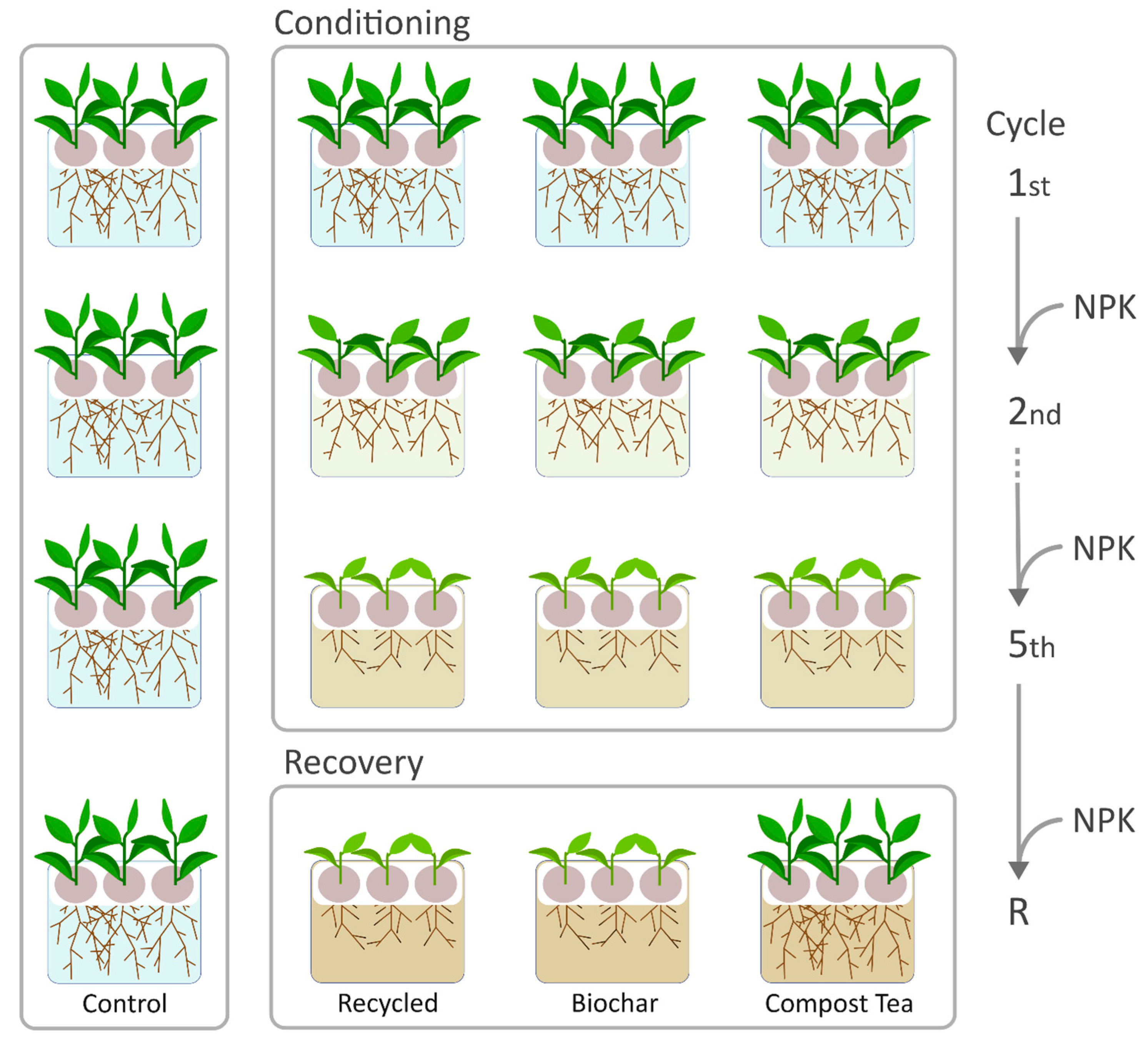
The main aim of this study is to test whether CT infusion or biochar filtering can mitigate or reverse the discussed physiological and productivity decline associated with recycled hydroponic systems. To test those hypotheses, we designed a closed-loop raft floating system growing basil for five consecutive cycles (“conditioning phase”) until water sickness started to build up. The NS was recycled and adjusted at the end of every growth cycle of ~32 days. After this conditioning phase, a new growth cycle was performed (called the “recovery phase”) where the NS was treated with either biochar filtering or compost tea infusion at different concentrations as proposed methods of mitigating production decline. Plant physiology, NS chemistry, and growth parameters were monitored weekly. The experimental design is presented in Figure 1.
Figure 1.
Graphical summary of the experimental design, designed to investigate autotoxicity in recycled hydroponic systems and evaluate methods for nutrient solution recovery. To simulate yield and quality reduction after repeated production cycles, basil was grown in a closed floating system through five “conditioning” cycles. A final “recovery” (R) cycle was performed to test biochar filtration and compost tea infusion to mitigate “water sickness” and restore productivity.
2. Materials and Methods
2.1. Conditioning and Recovery Phases
The experiment was structured into a conditioning phase and a recovery phase. During the conditioning phase, lasting 5 cycles of 32 days each, the same recycled NS was used and replenished with nutrients to original values, while retaining the original water, until a substantial decline in yield was observed. The recovery phase was then performed as final cycle with the objective of mitigating the observed yield decline. The following two NS recovery strategies were evaluated. (1) Biochar filtering was evaluated as follows: recycled NS was filtered through a plant-derived biochar obtained from pruning residues of Mediterranean broadleaved woody species. The biochar was produced by high-temperature pyrolysis (1000–1200 °C) and exhibited a declared specific surface area of approximately 400–425 m2 g−1. Filtration was conducted using 100 g of biochar per 40 L of nutrient solution [23], with continuous recirculation through the biochar filter for 1 h. The biochar was characterized by its total nitrogen, phosphorus, potassium content, pH, EC, ash content, H/C ratio, pyrolysis temperature, and specific surface area (Table S1). (2) Compost tea was evaluated as follows: a commercial compost (Stimol-C®, G-AGRO part of GWA—Gima Water & Air s.r.l., Anagni, Italy), comprising mixed plant materials, straw, and mature cow manure from organic farms, was used to prepare a compost tea. The solid fraction was characterized for water content, pH, organic carbon, humic and fulvic acids, total nitrogen, C/N ratio, and electrical conductivity prior to aerobic brewing (Table S2 as reported in [42]). Compost tea bags were placed into 150 µm mesh filter bag and infused directly into recycled NS sinks for 48 h, with continuous (identical) oxygenation provided to plants (2.5 mg L−1). After the infusion, the compost bags were removed. Three infusion rates (0.1, 1, and 10 g L−1 W:V) were tested to evaluate possible concentration-dependent effects.
2.2. Experimental Site
To host the experiment, one closed floating hydroponic raft system was designed and constructed (Figure S1); it was equipped with air pumps to maintain a stable dissolved oxygen concentration of 2.5 mg L−1 and operated without water filters to induce water sickness [43]. The system was subdivided into 15 isolated compartments, each designed to accommodate plants grown in a polystyrene tray (Figure S2) containing an inert rockwool substrate (Rockwool GRODAN™, Hedehusene, Denmark). Seedlings were provided by the nursery CO.VI.MER. Soc. Coop. Agr. (Battipaglia, Italy). Germination was conducted in a sterile germination room at 25 °C and 100% relative humidity in darkness for 3 days. Subsequently, the trays were transferred in the greenhouse to grow plants from the cotyledonary stage to the emergence of the first true leaves over a two-week period. The system itself was placed and kept in the same greenhouse at 25 ± 10 °C under an unaltered photoperiod for the whole growth cycle to minimize transplant stress.
2.3. Nutrient Solution
A modified Hoagland NS (Table S3) was used throughout both conditioning and recovery growth cycle, each lasting 32 days [3]. The NS was adjusted to its initial values (to prevent nutrient-related growth declines) by retaining the water and adding nutrients at the end of each cycle, whereas controls received a completely fresh NS (both water and nutrients). Weekly supplementation with decarbonated fresh water was performed as necessary to compensate for evaporation. Key parameters—pH (measured using HI98192, HANNA® Instruments, Limbiate, Italy) and electrical conductivity (EC; measured using HI98191, HANNA® Instruments, Italy)—were maintained at average values of 6.5 and 1800 µS cm−1, respectively. The mineral composition of cations (K+, Na+;, Mg2+;, Ca2+, NH4+) and anions (Cl−, NO3−, NO2−, PO43−, SO42−, C2O42−, C6H5O73−, C4H5O5−) in the nutrient solution was analyzed weekly by liquid ion chromatography (IC) (Dionex ICS-3000, Thermo Fisher Scientific, Waltham, MA, USA) with conductimetric detection, following a slightly modified protocol from Pannico et al. [44]. The nutrient solution samples were stored at −80 °C until the analysis. Aliquots of the thawed solution (4 mL) were filtered through a 0.45 µm nylon syringe filter (Phenomenex, Torrance, CA, USA) into 5 mL PolyVials and injected via an autosampler (Dionex™ AS-DV Autosampler Vial Adapters) onto the IC system. An IonPac AG11-HC guard column (4 × 50 mm, Dionex Sunnyvale, Sunnyvale, CA, USA) coupled with an IonPac AS11-HC analytical column (4 × 250 mm, Dionex Sunnyvale, CA, USA) was employed for anion separation. Elution was performed at a flow rate of 1.5 mL min−1 using a KOH gradient from 1 to 34 mM over 25 min. For cation analysis, an IonPac CG12A guard column (4 × 50 mm, Dionex Sunnyvale, CA, USA) and an IonPac CS12A analytical column (4 × 250 mm, Dionex Sunnyvale, CA, USA) were used, with elution carried out at a flow rate of 1.0 mL min−1 using an MSA gradient from 1 to 30 mM over 25 min. Calibration curves for each standard were established within the linearity range of 0.01–50 mg L−1 (r2 > 0.99). As described in detail by Formisano et al. [45], ion concentrations were quantified by comparing peak areas of the samples with reference standards.
2.4. Plant Yield and Measurements
The experiment was conducted using basil (Ocimum basilicum L. cv. Eleonora) at a density of 100 plants m−2 (60 seeds × polystyrene tray). At the end of each cycle, trays were harvested individually, and the following parameters were measured: number of living plants and total fresh weight. Subsequently, the biomass was dried for 4 days at 60 °C to measure the dry weight.
2.5. Gas Exchange and Chl a Fluorescence Emission
Gas exchange measurements were performed at 7 and 21 days after transplanting (DAT) on 1 fully expanded leaf from 6 plants × 3 replicates × treatment using a photosynthesis system (LCi T, ADC Bioscientific Ltd., Hoddesdon, UK); measurements were performed at noon in ambient CO2 (434 ppm) at an average temperature of 23.7 °C, relative humidity of 65%, and photosynthetic photon flux density (PPFD) of 334 µmol m−2 s−1. Average growing degree days (calculated with 10 °C < T °C < 35 °C) was 14.5 °C, and the mean light was 23 K lumens m−2. Intrinsic water use efficiency (WUEi) and instant water use efficiency (WUEinst) were calculated as Pn/gs and Pn/E, respectively.
Chlorophyll a fluorescence emission was determined using a portable fluorimeter kit (Plant stress Kit, Opti-Sciences, Hudson, NY, USA). Measurements in the light were performed with a Y(II) meter by applying a saturating pulse of 4286 µmol m−2 s−1 for 1.1 s to obtain the maximum light-adapted fluorescence (Fm’) and steady-state fluorescence (Fs’). For measurements in the dark, leaves were dark-adapted for 30 min with a dark leaf clip (Opti-Sciences Inc., Hudson, NY, USA); then, using an Fv/Fm meter (Opti-Sciences Inc., Hudson, NY, USA), a 1.0 s saturating pulse light (3429 µmol m−2 s−1) was used to obtain the Fm and F0 values. The PSII maximum photochemical efficiency (Fv/Fm) was calculated as Fv/Fm = (Fm − F0)/Fm. The quantum yield of PSII electron transport (Y(PSII)) was calculated as Y(PSII) = (Fm’ − Fs)/ Fm’ following [46]. The SPAD index was measured using MPM-100/S Multi Pigment Meter (ADC BioScientific Ltd., Hoddesdon, UK).
2.6. Statistical Analysis
All statistical analyses were conducted using RStudio software (version 2025.09.2 Build 418). Analysis of variance (ANOVA) was employed to understand the general significance; treatments means were compared using Fischer’s LSD post hoc test with at least p < 0.05 and labeled with letters from a to f based on their difference. Moreover, to compare every treatment with control, we used Dunnett’s post hoc test with ns, *, **, and *** indicating non-significant and significant effects at p < 0.05, 0.01, and 0.001, respectively. Figures were generated using ggplot package of RStudio.
3. Results
3.1. Conditioning Phase
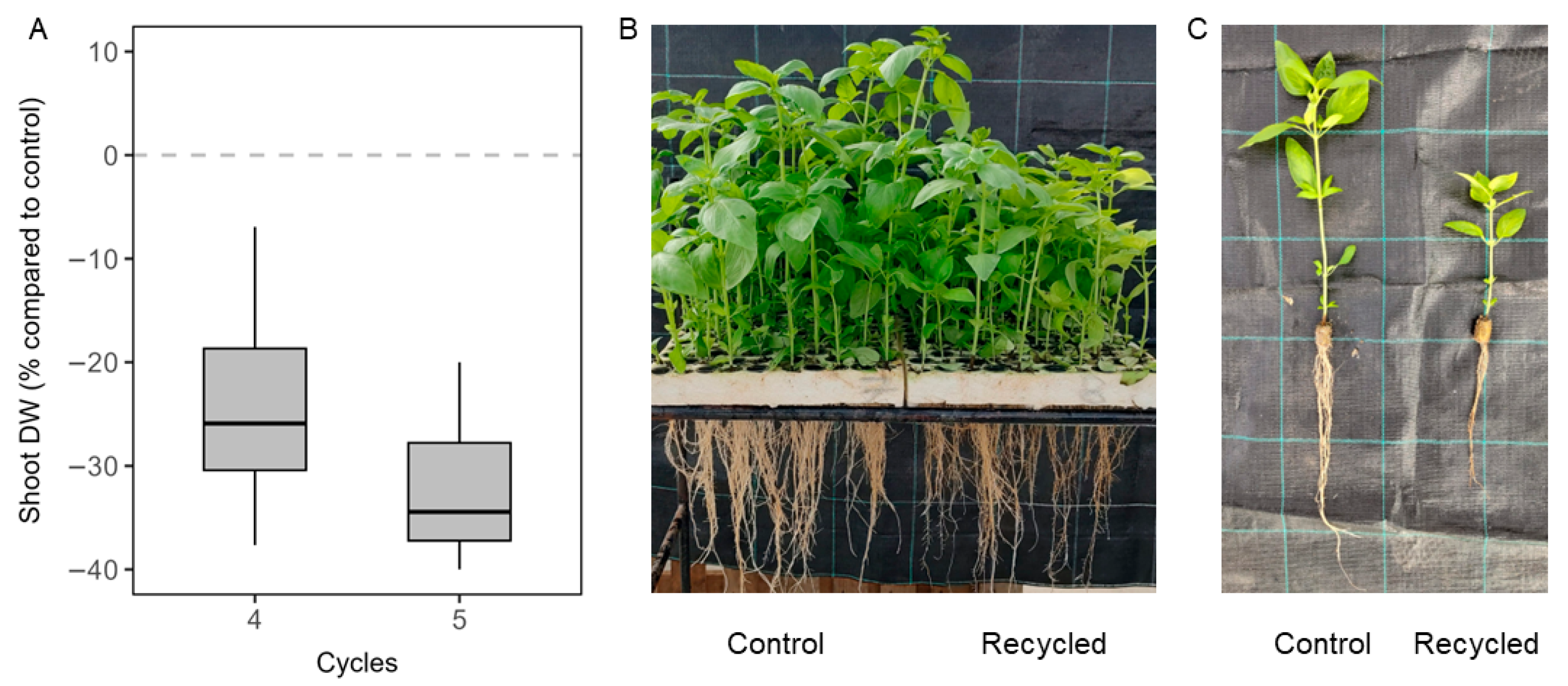
At the beginning of the conditioning phase, all the test plants were provided with fresh NS. Growth decline compared to controls (fresh NS) on the recycled NS became evident after the third cycle, reaching a reduction of −25% and −35% for shoot dry weight (DW) during the fourth and fifth cycle, respectively (Figure 2). The conditioning phase successfully reproduced the onset of water sickness, allowing us to proceed to the recovery phase. The aim was to evaluate whether a closed-loop hydroponic system could further optimize NS recycling. To this end, we tested biochar filtration and organic enrichment through CT infusion.
Figure 2.
Effects of recycled hydroponic cycles on basil growth. Growth decline started to become evident after the third cycle; recycled hydroponics reduced fresh and dry biomass of both leaves and roots compared to control. (A) Shoot dry weight of the fourth and fifth cycles expressed as % of control. (B) Photo of basil plants during the 4th conditioning cycle. (C) Individual plants from the same cycle.
3.2. Recovery Phase
3.2.1. Plant Growth
After the above-described conditioning phase, a last growth cycle was performed where two NS recovery strategies were evaluated: (1) biochar filtering and (2) compost tea at three infusion rates (0.1, 1, and 10 g L−1 W:V, named CT 0.1, CT 1, and CT 10, respectively). In parallel, two new growth cycles were performed, one with fresh NS (CTRL) and one with untreated recycled NS (RECYCLED).
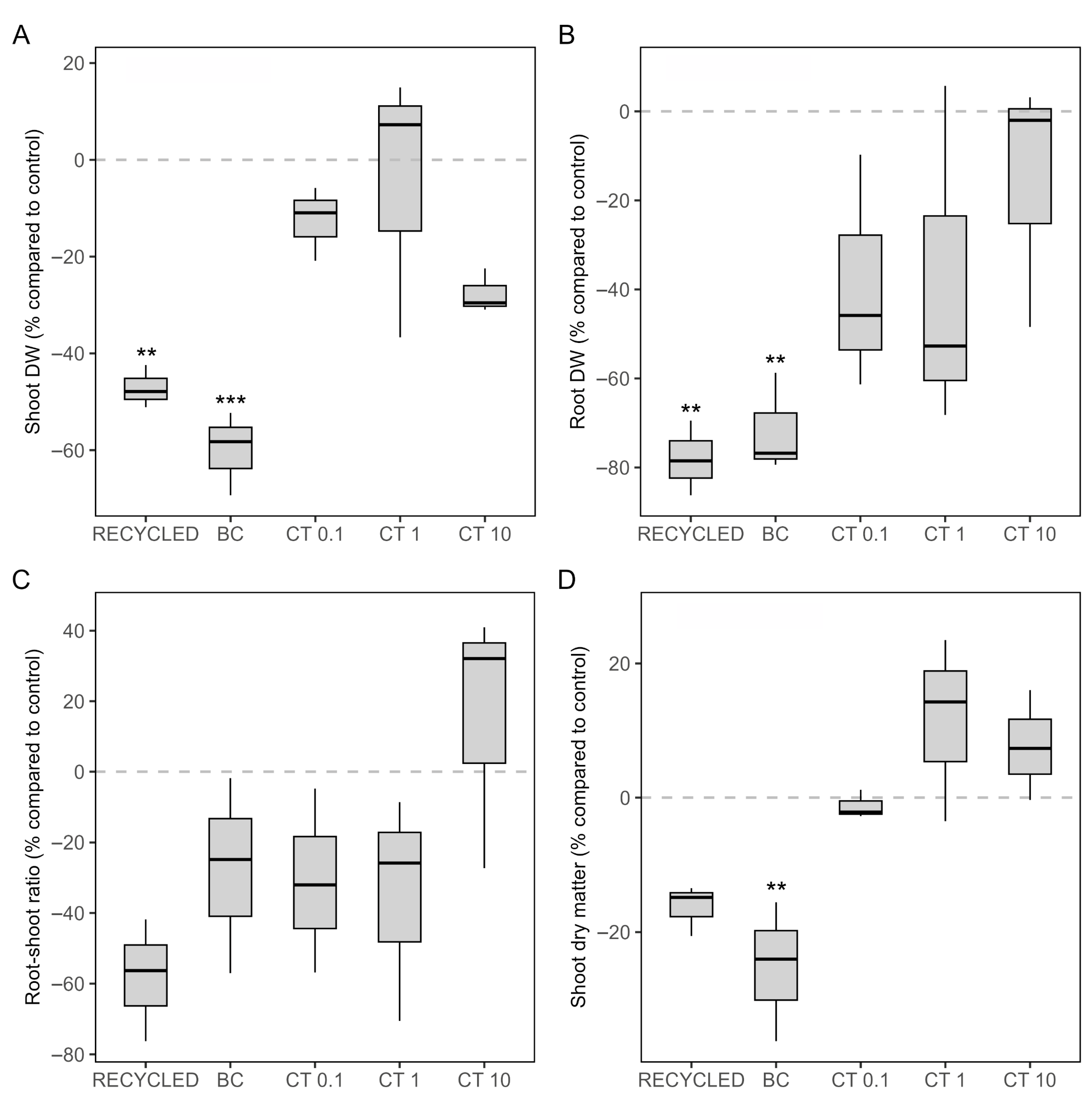
At the end of recovery phase, a destructive phenotypical characterization was conducted, and significant differences in growth parameters emerged between the treatments as described below (Table 1 and Figure 3).
Table 1.
Biomass growth in terms of shoot dry weight (DW), root dry weight, dry weights root-to-shoot ratio (RSR DW), shoot dry matter (DM) and mortality percentage. Values are mean ± S.E. (n = 3). Different letters indicate differences based on Fisher’s LSD post hoc test. Last row reports ANOVA results: ns, **, and *** indicate non-significant and significant effects at p < 0.01, and 0.001, respectively.
Figure 3.
Biomass-related parameters across treatments, expressed as % of controls. (A) Shoot dry weight; (B) root dry weight; (C) dry weights root-to-shoot ratio; (D) dry matter percentage. Asterisks indicate significant differences from controls based on Dunnett’s post hoc test (**, and *** indicate significant effects at p < 0.01, and 0.001, respectively) (dotted line = control with fresh nutrient solution; RECYCLED = untreated recycled nutrient solution; BC = biochar-filtered recycled nutrient solution; CT 0.1, CT1, CT10 = direct infusion of compost into recycled nutrient solution at different dilutions).
The shoot DW in recycled NS (RECYCLED) and in biochar-filtered NS (BC) was significantly reduced, by 47% and 60%, respectively, compared to the control (Figure 3A). Although both groups of test plants showed compromised growth, BC performed even worse than RECYCLED, suggesting that biochar did not mitigate water sickness accentuating biomass loss. Root DW followed the same trend: both RECYCLED (−78%) and BC (−72%) recorded values much lower than CTRL, although BC maintained a slight advantage over RECYCLED, showing more developed roots despite a deterioration in the epigeal part (Figure 3B). In contrast, CT treatments showed clear concentration-dependent behavior. CT 0.1 and CT 1 kept shoot DW values very close to those of CTRL (12% and −5%, respectively) and significantly higher than RECYCLED and BC (Figure 3A). Root DW also improved with CT 0.1 and CT 1 (−39% and −38% compared to CTRL), clearly surpassing both RECYCLED and BC (Figure 3B). At the highest concentration, CT 10, shoot DW showed a reduction of −27% compared to CTRL, while root DW increased significantly (+189% compared to RECYCLED and +197% compared to BC), surpassing even CT 0.1 and CT 1 and indicating a clear shift of resources allocation towards roots (Figure 3A,B).
The root-to-shoot ratio (RSR), although generally not showing significant differences between treatments, further highlighted the observed trends (Table 1 and Figure 3C). Plants in RECYCLED showed a severe reduction (−58% compared to CTRL), indicating compromised root development. BC, while maintaining low above-ground biomass, showed a relatively higher RSR (+72% compared to RECYCLED), although still lower than CTRL. In the CT, CT 0.1, and CT 1 treatments, the RSR ratio was more balanced (−31% and −35% compared to CTRL, respectively), while CT 10 not only recovered but exceeded the control value (+15%), confirming the shift towards greater root investment, in line with the balanced-growth hypothesis [47].
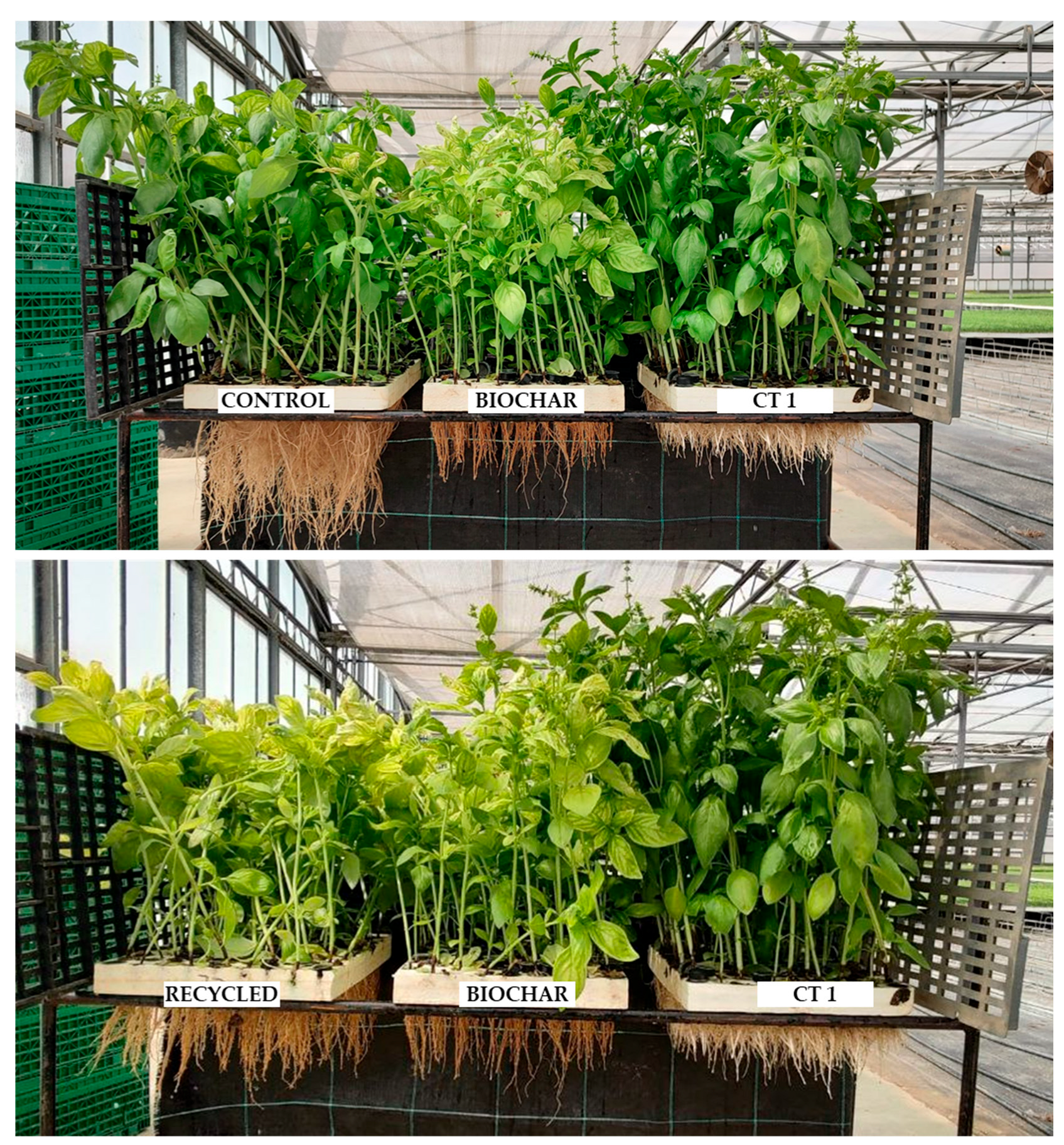
The shoot dry matter (DM) content confirmed these patterns, with RECYCLED (−16%) and BC (−25%) showing a marked decrease in tissue density compared to CTRL while, in contrast, all CT treatments were similar to or exceeded the control values (−1% in CT 0.1, +11% in CT 1, and +7.7% in CT 10) (Figure 3D). In particular, CT 1 showed the highest value among all treatments, outweighing not only RECYCLED and BC but also CTRL, proving a positive effect of CT at moderate concentration on biomass quality (Figure 4).
Figure 4.
Comparative photo of the test plants at the end of the recovery cycle (31 DAT). In the picture above, the fresh nutrient solution (CTRL) is compared with the two test groups of plants provided with biochar-filtered recycled nutrient solution and compost tea-infused recycled nutrient solution (BC and CT 1). In the picture below, a comparison between recycled nutrient solution (RECYCLED), BC, and CT 1.
Although values were not significantly different, mortality rates also reflected the general trend (Table 1). RECYCLED reported the highest plant loss (+89% compared to CTRL), while BC slightly reduced mortality compared to RECYCLED, but remained high (+43%). The CT treatments once again showed a concentration-dependent trend: CT 0.1 recorded values similar to BC (+43%), while CT 1 and CT 10 reduced mortality (−14% and −3% compared to CTRL), far exceeding both RECYCLED and BC. The same pattern can also be found in other parameters such as shoot and root fresh weights (FWs). In the RSR on FW, the difference between RECYCLED, BC, and the CTRL is even more marked, with an evident significant difference in the subgroup in CTs with CT 10 and CTRL compared to all the others (Table S4).
Residual nutrient concentrations (Figure S3) confirm that the observed decline cannot be attributed to nutrient deficiency but, rather, to impaired nutrient uptake under specific treatments. RECYCLED and BC showed higher residual nitrogen than the control (+187% and +58%, respectively), together with elevated potassium (+77% and +55%), indicating reduced plant uptake consistent with their lower biomass production. In contrast, CT treatments displayed residual nitrogen levels comparable to the control (−22 to −2%), suggesting efficient nutrient uptake. Phosphate remained largely stable across treatments, except for BC (−36%) and CT1 (+24%). Potassium under CT 0.1 and CT 1 showed values comparable to the control, while CT10 showed a reduced uptake (+133%).
Overall, these results indicate that CT was able not only to restore plant performance compared to recycled NS but also, at optimal concentrations (CT 1), to improve tissue quality and survival beyond control levels. At high doses (CT 10), however, compost tea altered biomass distribution, favoring root development.
3.2.2. Gas Exchanges and Chl Fluorescence Emission
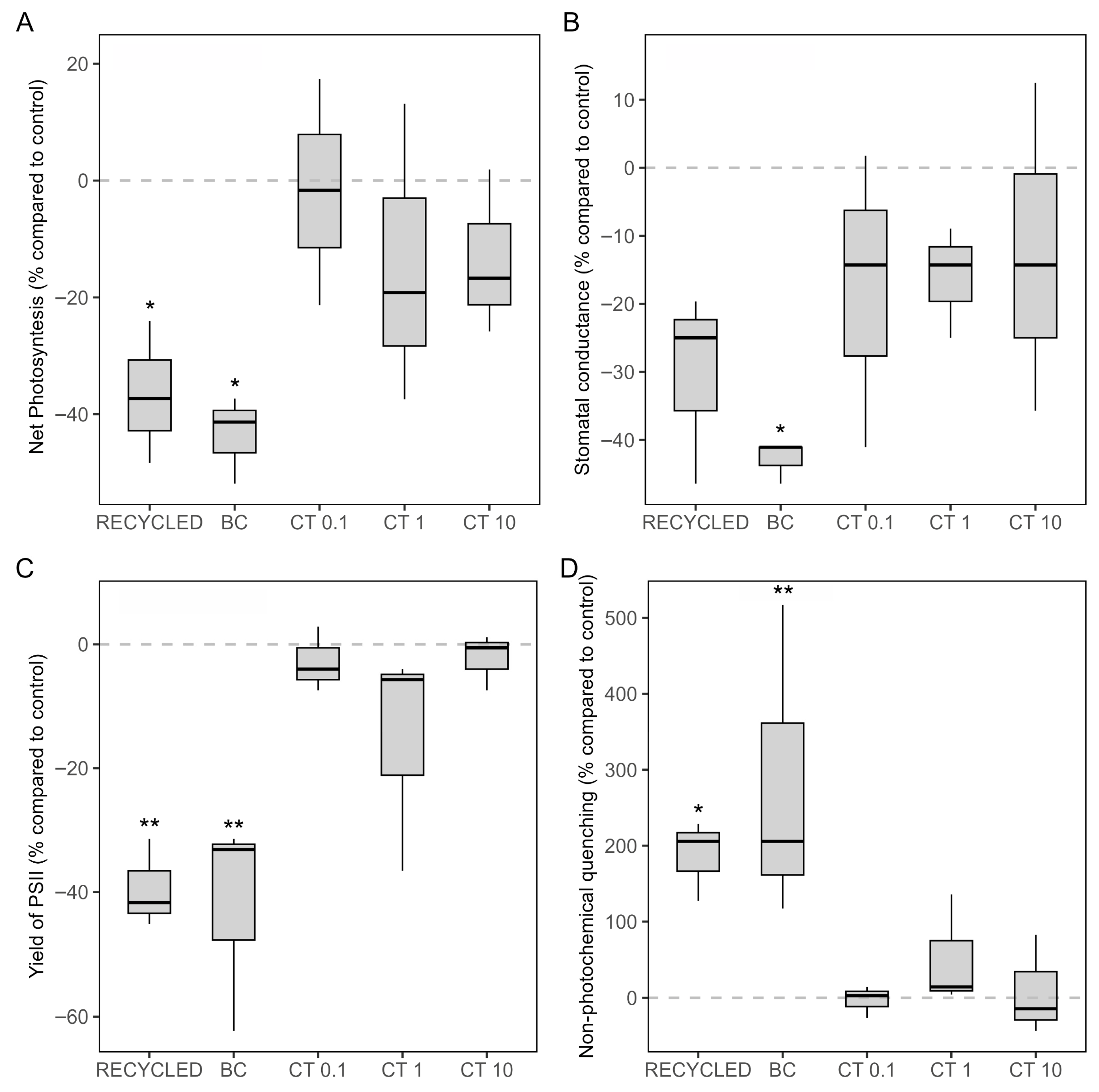
Net photosynthesis (Pn) was reduced by 37% and 43% compared to CTRL in RECYCLED and BC, respectively, indicating marked photosynthetic stress (Table 2 and Figure 5A). Conversely, CT 0.1 did not differ from CTRL (−2%), remaining significantly higher than RECYCLED and BC, while CT 1 and CT 10 showed a slightly higher reduction (−14% and −13% compared to control, respectively).
Table 2.
Gas exchange and chlorophyll fluorescence parameters across treatments in terms of net photosynthesis (Pn), stomatal conductance (gs), sub-stomatal CO2 concentration (ci), leaf net transpiration (E), and SPAD values. Values are mean ± S.E. (n = 3). Different letters indicate differences based on Fisher’s LSD post hoc test. Last row reports ANOVA results: ns, and * indicate non-significant and significant effects at p < 0.05, respectively.
Figure 5.
Gas exchange and chlorophyll fluorescence parameters across treatments, expressed as % of controls. (A) Net photosynthesis (Pn); (B) stomatal conductance (gs); (C) quantum yield of photosystem II (Y(PSII)); (D) non-photochemical quenching (NPQ). Asterisks indicate significant differences from controls based on Dunnett’s post hoc test (*, and ** indicate significant effects at p < 0.05, and 0.01, respectively) (dotted line = control with fresh nutrient solution; RECYCLED = untreated recycled nutrient solution; BC = biochar-filtered recycled nutrient solution; CT 0.1/CT1/CT10 = direct infusion of compost into recycled nutrient solution at different dilutions).
Stomatal conductance (gs) did not show statistically significant differences, although BC reported a 43% reduction compared to CTRL, lower than both RECYCLED and CTs, suggesting that the lower Pn of BC can be partly attributed to stomatal limitation (Table 2 and Figure 5B). In the CT treatments, the gs values are intermediate and comparable to each other, indicating that the variation in Pn is not attributable to marked stomatal closure (Table 2 and Figure 5B).
The sub-stomatal CO2 concentration (ci) showed no significant differences between the treatments, showing that photosynthetic limitations do not result from internal CO2 deficiencies (Table 2). Similarly, leaf transpiration (E) presented no significant differences, although there was a marked decrease in BC (−28%), consistent with the lower stomatal opening measured (Table 2). The SPAD index (Table 2) showed a pronounced and significant decline in both RECYCLED (−32%) and BC (−42%) compared to controls. In the CT treatments, SPAD values remained significantly higher (−10% in CT 0.1, −14% in CT 1, −8% in CT 10) and statistically similar to each other, but were always higher than RECYCLED and BC.
The differences were even more evident at the chloroplast level (Table 3). The quantum yield of photosystem II (Y(PSII)), as expected, followed the same trend as Pn, with reductions of −39% and −42% in RECYCLED and BC, respectively, while CT 0.1 and CT 10 maintained values comparable to the control (−3% and −2%), and the value of CT 1 was slightly lower (−15%) (Figure 5C). No significant differences emerged between RECYCLED and BC, but both performed worse than all CT treatments.
Table 3.
Gas exchange and chlorophyll fluorescence parameters across treatments in terms of quantum yield of photosystem II (Y(PSII)), linear electron transport rate (ETR), non-photochemical quenching (NPQ), yield of regulated quenching (Y(NPQ)), and yield of non-regulated quenching (Y(NO)). Values are mean ± S.E (n = 3). Different letters indicate differences based on Fisher’s LSD post hoc test. Last row reports ANOVA results: ns, *, and ** indicate non-significant and significant effects at p < 0.05, and 0.01, respectively.
The linear electron transport rate (ETR), although treatments generally did not show significant effects, showed a reduction of 29% in RECYCLED and as much as 59% in BC, while CT 0.1 reported a more moderate decline (−18%). CT 1 and CT 10, on the other hand, maintained values a bit higher than CTRL (+7% and +3%).
In contrast, non-photochemical quenching (NPQ) showed the opposite behavior: RECYCLED and BC showed a sharp increase compared to the control (+187% and +280%, respectively), with BC significantly worse than RECYCLED. In the CT treatments, NPQ remained small in CT 0.1 and CT 10 (–3% and +9% compared to control, respectively) and slightly increased in CT 1 (+51%) (Table 3 and Figure 5D). The higher values of NPQ in the BC and RECYCLED derive almost exclusively from the regulated heat dissipation component Y(NPQ), while all other “passive” mechanisms expressed by the Y(NO) component showed no significant changes (Table 3). This indicates that the plants in RECYCLED and BC, despite receiving comparable amounts of exciting energy in the thylakoids, had to divert a much larger share to activate the metabolic pathways for photo-protective (non-productive) defense mechanisms [48].
Moreover, early measurements at 7 DAT are described in Tables S5–S7 and illustrated in Figure S3. In RECYCLED and BC, there was already a reduction in Y(PSII) (−7% and −3% compared to CTRL) accompanied by higher NPQ values (+21% and +16%) not yet resulting in lower Pn (not yet significant). Only in BC, Pn was lower (−16% compared to both CTRL and RECYCLED), with reduced E values (−12%). In the CT treatments, Pn and SPAD values were intermediate, except for CT 1 showing lower Pn values (−24% compared to CTRL) and a reduction in instant water use efficiency (WUEinst, −34%) caused by an increment of the leaf net transpiration (E). In other words, Pn was comparable to control at 7 DAT, confirming that plants were initially healthy. By 22 DAT, prolonged exposure to the recycled nutrient solution caused the observed changes in physiological parameters, i.e., the decrease in Pn and consequently Y(PSII). In particular, gs remained comparable across all treatments at both 7 and 22 DAT confirming a non-significant stomatal limitation to photosynthesis, while NPQ increased from 7 DAT to 22 DAT suggesting the activation of stress-related pathways by the plants.
Overall, the presented data reveal severe photosynthetic stress with low photosynthetic efficiency and high NPQ for RECYCLED and, even more so, for BC. The plants that received CT treatments, on the other hand, recovered photosynthetic functionality, presenting values closer to the CTRL and clearly differentiating themselves from RECYCLED and BC. Among the CT treatments, the intermediate concentration (CT 1) showed a balance between maintaining photosynthesis and containing energy dissipation, while CT 0.1 almost completely restored photosynthetic yield.
3.2.3. Principal Components Analysis (PCA)
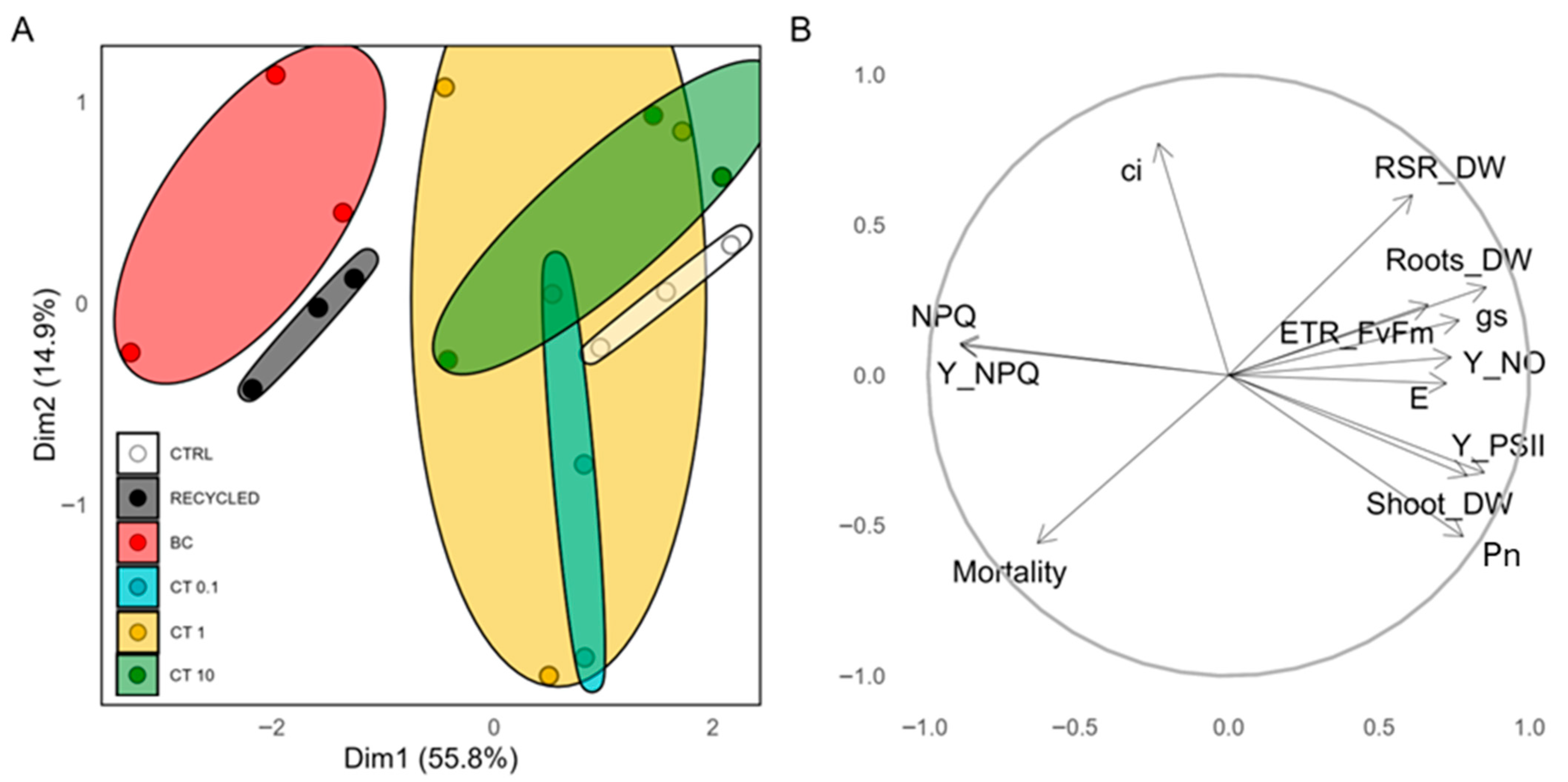
To have a better understanding of what influenced basil biomass and to integrate data from plant growth, gas exchanges, and fluorescence emission, principal component analysis (PCA) was performed. As shown in Figure 6, the biplot was represented by the loadings and scores plots. The score plot shows a clear separation between the treatments, based on all the previously discussed and significative variables. It returns to a strong model explaining most of the total variance (PC1: 55.8%, and PC2: 14.9%). The fresh NS (CTRL) and the CT treatments (CT 0.1, CT1, and CT10) cluster together based on most of the variables, including shoot and root DW, ETR, gs, Pn, Y(PSII), and Y(NO). It is significant that the CT 0.1, despite its cluster being less defined, almost completely encompasses the other three treatments, suggesting an intermediate character. Conversely, RECYCLED and BC treatments clustered together on the opposite side of the principal axis. The latter are associated with increased mortality rate and higher substomatal CO2 concentration (ci) and non-photochemical quenching values (NPQ)—in particular, its regulated component Y(NPQ)—pointing to plant physiological stress. The latter two treatments do not completely overlap; thus, BC managed to change the recycled NS parameters, but not as much as previously reported [49].
Figure 6.
Decoupled biplot of the principal components analysis (PCA). (A) Loadings map showing treatment separation along the first two dimensions (Dim1 = 55.8%, Dim2 = 14.9%). Treatments clustered distinctly, with recycled hydroponics (RECYCLED) and biochar-filtered (BC) test plants (left) separated from control (CTRL) and compost tea (CT 0.1, CT 1, CT 10) recovery test plants (center-right). Ellipses represent 95% confidence regions. (B) Scores plot integrating biomass, gas-exchange, and chlorophyll fluorescence parameters.
4. Discussion
Recycling the nutrient solution is essential to enhance the sustainability of hydroponic systems by reducing water use and fertilizer inputs [6]. However, the progressive decline in yield and quality represents a critical bottleneck. Our results demonstrate that compost tea, particularly at low to moderate concentrations (0.1 and 1 mg L−1), effectively restored the recycled NS, promoting plant growth and photosynthetic efficiency and aligning treated plants with the control.
Plants grown in untreated recycled NS showed a clear decline in biomass associated with marked reductions in net photosynthesis (−37%) and photosystem II yield (−39%). These results, together with the increase in non-photochemical quenching (NPQ, +187%), indicate that much of the energy was not converted into biomass but dispersed in defense pathways, resulting in a loss of efficiency and productivity.
In contrast, plants grown in CT-infused recycled NS maintained high levels of Pn and biomass: CT 1 (1 g L−1) stood out for its ability to restore biomass and physiological parameters to levels comparable to the control and for its ability to reduce general mortality (−14% ns). This trend suggests that at intermediate doses, compost tea not only counteracts the water sickness observed in plants grown on recycled NS but also increases photosynthetic efficiency throughout the cycle. Interestingly, the highest CT concentration (10 g L−1) induced a shift in biomass allocation towards roots, consistent with the balanced-growth hypothesis proposed by Shipley et al. [47]. Namely, plants tend to invest relatively more in root growth when nutrient uptake per unit of root mass becomes limiting, as larger root systems can rapidly deplete nutrients to catch up with aerial biomass. Such a response reflects an adaptive adjustment aimed at maximizing access to the limiting resource, even at the expense of shoot development. Probably, in the long run, by extending the growth period, CT 10 would likely have outperformed the other test plants with higher biomass values. This confirms a concentration-dependent response where moderate doses of CT stimulate recovery, but higher amounts alter allocation strategies. Similar effects of compost teas have been already reported [50]. A further possible explanation is the presence of phytohormones and low-molecular-weight bioactive compounds of microbial origin that are extracted from compost in the water during the brewing process [51]. Arancon et al. [52] showed how the presence of small amounts of gibberellin (GA24) in a chicken manure-based vermicompost tea increased tomato seed germination. Later, they also found that a lower concentration NS with concentration-dependent supplementation of vermicompost tea provided similar yield results compared to full-power NS [53]. Similarly, Canellas et al. [54] identified auxin in cattle manure vermicompost and suggested its role in promoting lateral root emergence and elongation and plasma Hþ-ATPase activity. These dynamics warrant further investigation to optimize CT application according to the specific crop needs, including possibly infusing it from the beginning of the cycle to prevent the gradual buildup of water sickness.
Biochar is widely known for its ability, both in soil and soilless contexts, to absorb heavy metals, organic pollutants, and phytotoxins [32,40], particularly low-molecular-weight compounds, thus removing their inhibitory effects; these findings were reported in previous studies [6,55,56]. Its inefficacy, in our experimental system, might indicate that while it can adsorb a wide range of potentially phytotoxic compounds, it was not able to remove the buildup of negative conditions induced by continuous recycling of the nutrient solution, possibly pointing to other explanations for the observed growth decline. Alternatively, the observed behavior of biochar can be explained by differences in adsorption kinetics provided by the context itself. Phenolic adsorption onto biochar and activated carbon is commonly described by Langmuir-type isotherms and pseudo-second-order kinetic models, indicating a strong dependence on contact time, sorbent dose, and initial concentration of phytotoxins [57,58]. In our experimental system and at the specific dosage and filtration conditions adopted, biochar was not effective in counteracting the negative effects induced by nutrient solution recycling, indicating a condition-dependent inefficacy rather than a general limitation of biochar itself. This suggests that higher dosages, longer contact times, or more frequent filtration cycles—also during the conditioning phase—might be required to enhance adsorption performance [59]. Therefore, adsorption isotherms and kinetics should be measured directly in the nutrient solution using representative phenolics for the specific biochar used [60] and, to clarify whether the observed failure is due to kinetic limitations, competitive adsorption or incomplete removal of the causative phytotoxic factors. This aligns with the hypothesis that water sickness in hydroponics is probably not caused by a general chemical phytotoxicity by allelopathic compounds [61], mainly phenols and aromatics of low molecular weight (e.g., see [62]) which are easily absorbed by biochar, but by something else requiring microbial degradation or organic dilution, rather than passive adsorption, to be eliminated.
The decline observed in untreated recycled solutions is consistent with previous reports of water sickness in closed hydroponic systems [15,16,18,63]. While nutrient imbalances and pathogen accumulation have been suggested, recent findings highlight extracellular self-DNA as an autotoxin inhibiting root growth in a species-specific way [19,30]. Although basil is known for its high allelopathic potential, according to Islam et al. [64], the largest amount of phytotoxic residues is released by the aerial parts that are not in contact with the nutrient solution. This can hardly explain the marked decline that was observed in this work from the third repeated cycle of the conditioning phase. There is a possibility that root turnover and/or root exudates contribute to extracellular self-DNA accumulation in the NS. In this respect, the microbial composition of the CT used in the present study was previously characterized by Bonanomi et al. [42], showing a stable and reproducible microbiome across independent brewing processes dominated by Pseudomonas, together with Massilia, Sphingomonas, and Bacillus, taxa which contain species widely associated with pathogen suppression and plant growth promotion. A further study also investigated microbiome changes in bulk soil, the rhizosphere, and the phyllosphere of vineyards after applications of the same CT used in this work [65]. The ability of CT to counteract the observed effects suggests a role of microbial consortia in either degrading allelopathic compounds or diluting/degrading self-DNA. Another possibility is that the abovementioned microbial populations present in the CT are capable of metabolizing organic residues and improving root health as previous studies confirmed [66,67] or that the biostimulant capacity of CT [42,50,68,69] can counteract the root inhibition. However, available evidence also indicates that CT effects are strongly crop- and context-dependent, although positive responses have been reported for various crops such as lettuce and strawberry. Outcomes vary widely with CT type and feedstock, application method, and species sensitivity, and thus, specific concentrations cannot be assumed to be universally valid [70,71]. More studies are necessary to assess if the dosage optimized here for basil should also be considered applicable to a wider range of horticultural species.
In terms of the economic impact of CT applications, considering that we identified 1 g L−1 as the optimal dosage for a 1 m2 system that is 30 cm deep (i.e., 300 L), and considering that we identified the price of compost as 0.012 EUR g−1, this implies 3.60 EUR m−2 per application. If a production of ~10 kg m−2 of fresh basil per cycle is assumed [72], the cost of the CT treatment is ~0.36 EUR kg−1 of product; with typical European wholesales ranges of 4–15 EUR kg−1 (for the Genovese cultivar), this is an increase of roughly 2–9% of the final price. The figures presented consider only the material costs for a single application and exclude labor and other factors. When accounting for avoided costs (less frequent nutrient replacement, reduced losses, or increased biomass/shelf-life as reported for the same compost in [42]) the net economic impact can be substantially more favorable.
Our findings reinforce the potential of CT as another nature-based solution [73] for recycled hydroponic systems [74,75,76] despite the fact that the mechanisms behind the aforementioned production decline need to be further investigated. From a practical standpoint, our findings show that basil can be cultivated for three cycles, recycling the water solution while reintegrating the necessary nutrients. Under water sickness conditions, the root system of plants develops poorly and struggles to absorb nutrients and water. Vigor, growth, and productivity all decrease, while sensitivity to biotic and abiotic stresses increases [77]. Under closed hydroponics, when CT is integrated, the productivity decline typically observed is not simply counteracted: the quality of plants also increases. As previously reported, the use of organic NS [78] and compost tea in particular [71] can enhance the functions of inorganic NS, improving the quality and quantity of hydroponics production while avoiding wastes. This provides a promising avenue for reducing water and nutrient waste while sustaining yields. Furthermore, the integration of CT supports the transition toward nature-based solutions in controlled-environment agriculture, contributing to both sustainability goals and food security. Nevertheless, optimization of dosage and timing remains crucial, and further research should address long-term microbial dynamics, phytotoxicity dynamics, and cross-species applicability.
5. Conclusions
The present study demonstrates that repeated recycling of nutrient solution in basil hydroponics leads to a progressive general decline, consistent with our definition of water sickness. Compost tea application effectively counteracted this decline, restoring photosynthetic efficiency, biomass accumulation, and plant quality in a concentration-dependent manner. Low-to-moderate CT concentrations (0.1–1 g L−1) were more effective, whereas the highest concentration (10 g L−1) slightly altered biomass allocation. Conversely, biochar filtration under the specific operating conditions did not mitigate the observed decline, indicating a conditional inefficacy of this approach for controlling water sickness in closed hydroponic systems. This highlights the necessity to better investigate the effects of biochar, e.g., using different filtering methods or the addition of microbial consortia to activate the biochar.
Overall, compost tea emerges as a promising biotechnological approach and sustainable strategy to extend the productivity of closed-loop hydroponics, reduce environmental impact, and enhance the resilience of controlled-environment agriculture. Further studies should focus on (i) monitoring microbial population dynamics in the nutrient solution following compost tea application, (ii) in-depth analysis of the causal mechanisms underlying the phenomenon of water sickness and the recovery effect of CT, (iii) evaluating the application of CT from the first cycle to avoid/delay the buildup of water sickness itself, (iv) devising long-term experiments to assess the persistence of the observed CT recovery effects on successive cycles and the necessity of cyclical application, and (v) testing the applicability across different crop species and hydroponic systems. Understanding the role of compost tea in this context opens new ways for managing soilless cultivations.
Supplementary Materials
The following supporting information can be downloaded at: https://www.mdpi.com/article/10.3390/horticulturae11121493/s1, Figure S1: Photo of floating hydroponic raft system; Figure S2: Plants arranged in polystyrene trays; Figure S3: Residual nutrient concentrations at the end of recovery phase for each treatment; Figure S4: Gas exchange and chlorophyll fluorescence parameters across treatments, expressed as % of controls at 7 and 22 days after transplanting; Table S1: Chemical and physical analysis of biochar used; Table S2: Chemical and physical analysis of compost used (Stimol-C®); Table S3: Modified Hoagland nutrient solution used in in the floating raft system; Table S4: All measured biomass growth parameters; Table S5: Leaf-level gas exchange e chlorophyll fluorescence parameters at 7 days after transplanting (DAT); Table S6: Chloroplast-level gas exchange and chlorophyll fluorescence parameters at 7 days after transplanting (DAT); Table S7: Water use efficiency measured at 7 and 22 days after transplanting (DAT).
Author Contributions
Conceptualization, A.D.S., S.M., M.M., G.B., and F.C.; formal analysis, A.D.S.; investigation, A.D.S., C.C., G.C., S.C., and F.C.; resources, P.C. and M.M.; data curation, A.D.S.; writing—original draft preparation, A.D.S. and F.C.; writing—review and editing, A.D.S., S.M., M.M., C.C., S.C., G.B., and F.C.; visualization, A.D.S.; supervision, G.B., F.C., and C.C. All authors have read and agreed to the published version of the manuscript.
Funding
This research received no external funding.
Data Availability Statement
The original contributions presented in the study are included in the article/Supplementary Material, further inquiries can be directed to the corresponding author.
Conflicts of Interest
The authors declare no conflicts of interest.
References
- da Silva Júnior, F.J.; Santos Júnior, J.A.; da Silva, M.M.; Silva, Ê.F.D.F.; de Souza, E.R. Water Relations of Chives in Function of Salinity and Circulation Frequency of Nutrient Solutions. Rev. Bras. Eng. Agrícola Ambient. 2019, 23, 359–365. [Google Scholar] [CrossRef] [Scilit]
- Ćavar Zeljković, S.; Komzáková, K.; Šišková, J.; Karalija, E.; Smékalová, K.; Tarkowski, P. Phytochemical Variability of Selected Basil Genotypes. Ind. Crops Prod. 2020, 157, 112910. [Google Scholar] [CrossRef] [Scilit]
- Modarelli, G.C.; Vanacore, L.; Rouphael, Y.; Langellotti, A.L.; Masi, P.; De Pascale, S.; Cirillo, C. Hydroponic and Aquaponic Floating Raft Systems Elicit Differential Growth and Quality Responses to Consecutive Cuts of Basil Crop. Plants 2023, 12, 1355. [Google Scholar] [CrossRef] [Scilit]
- Khatri, L.; Kunwar, A.; Bist, D.R. Hydroponics: Advantages And Challenges in Soilless Farming. Big Data Agric. 2024, 6, 98–105. [Google Scholar] [CrossRef] [Scilit]
- Saha, S.; Monroe, A.; Day, M.R. Growth, Yield, Plant Quality and Nutrition of Basil (Ocimum basilicum L.) under Soilless Agricultural Systems. Ann. Agric. Sci. 2016, 61, 181–186. [Google Scholar] [CrossRef] [Scilit]
- Asaduzzaman, M.; Niu, G.; Asao, T. Editorial: Nutrients Recycling in Hydroponics: Opportunities and Challenges Toward Sustainable Crop Production Under Controlled Environment Agriculture. Front. Plant Sci. 2022, 13, 845472. [Google Scholar] [CrossRef] [Scilit] [PubMed]
- Moreno-Pérez, E.C.; Sánchez-Del Castillo, F.; Gutiérrez-Tlahque, J.; González-Molina, L.; Pineda-Pineda, J. Greenhouse lettuce production with and without nutrient solution recyclingProducción de Lechuga En Invernadero Con y Sin Recirculación de La Solución Nutritiva. Rev. Chapingo Ser. Hortic. 2015, 21, 43–55. [Google Scholar] [CrossRef] [Scilit]
- Miller, A.; Adhikari, R.; Nemali, K. Recycling Nutrient Solution Can Reduce Growth Due to Nutrient Deficiencies in Hydroponic Production. Front. Plant Sci. 2020, 11, 607643. [Google Scholar] [CrossRef] [Scilit] [PubMed]
- Petrazzini, L.L.; Souza, G.A.; Rodas, C.L.; Emrich, E.B.; Carvalho, J.G.; Souza, R.J. Deficiências de Nutrientes Em Alface Americana Cultivada Em Hidroponia. Hortic. Bras. 2014, 32, 310–313. [Google Scholar] [CrossRef] [Scilit]
- Neocleous, D.; Savvas, D. Validating a Smart Nutrient Solution Replenishment Strategy to Save Water and Nutrients in Hydroponic Crops. Front. Environ. Sci. 2022, 10, 965964. [Google Scholar] [CrossRef] [Scilit]
- Prenafeta-Boldú, F.X.; Trillas, I.; Viñas, M.; Guivernau, M.; Cáceres, R.; Marfà, O. Effectiveness of a Full-Scale Horizontal Slow Sand Filter for Controlling Phytopathogens in Recirculating Hydroponics: From Microbial Isolation to Full Microbiome Assessment. Sci. Total Environ. 2017, 599–600, 780–788. [Google Scholar] [CrossRef] [Scilit]
- Ehret, D.; Alsanius, B.; Wohanka, W.; Menzies, J.; Utkhede, R.; Ehret, D.; Alsanius, B.; Wohanka, W.; Menzies, J.; Utkhede, R. Disinfestation of Recirculating Nutrient Solutions in Greenhouse Horticulture. Agronomie 2001, 21, 323–339. [Google Scholar] [CrossRef] [Scilit]
- Raudales, R.E.; Parke, J.L.; Guy, C.L.; Fisher, P.R. Control of Waterborne Microbes in Irrigation: A Review. Agric. Water Manag. 2014, 143, 9–28. [Google Scholar] [CrossRef] [Scilit]
- Yu, J.Q.; Matsui, Y. Extraction and Identification of Phytotoxic Substances Accumulated in Nutrient Solution for the Hydroponic Culture of Tomato. Soil Sci. Plant Nutr. 1993, 39, 691–700. [Google Scholar] [CrossRef] [Scilit]
- Lee, J.G.; Lee, B.Y.; Lee, H.J. Accumulation of Phytotoxic Organic Acids in Reused Nutrient Solution during Hydroponic Cultivation of Lettuce (Lactuca sativa L.). Sci. Hortic. 2006, 110, 119–128. [Google Scholar] [CrossRef] [Scilit]
- Corrado, G.; Chiaiese, P.; Lucini, L.; Miras-Moreno, B.; Colla, G.; Rouphael, Y. Successive Harvests Affect Yield, Quality and Metabolic Profile of Sweet Basil (Ocimum basilicum L.). Agronomy 2020, 10, 830. [Google Scholar] [CrossRef] [Scilit]
- Yu, J.Q.; Matsui, Y. Phytotoxic Substances in Root Exudates of Cucumber (Cucumis sativus L.). J. Chem. Ecol. 1994, 20, 21–31. [Google Scholar] [CrossRef] [Scilit] [PubMed]
- Asaduzzaman, M.; Asao, T. Autotoxicity in Strawberry under Recycled Hydroponics and Its Mitigation Methods. Hortic. J. 2020, 89, 124–137. [Google Scholar] [CrossRef] [Scilit]
- Mazzoleni, S.; Bonanomi, G.; Incerti, G.; Chiusano, M.L.; Termolino, P.; Mingo, A.; Senatore, M.; Giannino, F.; Cartenì, F.; Rietkerk, M.; et al. Inhibitory and Toxic Effects of Extracellular Self-DNA in Litter: A Mechanism for Negative Plant-Soil Feedbacks? New Phytol. 2015, 205, 1195–1210. [Google Scholar] [CrossRef] [Scilit]
- Kitazawa, H.; Asao, T.; Ban, T.; Pramanik, M.H.R.; Hosoki, T. Autotoxicity of Root Exudates from Strawberry in Hydroponic Culture. J. Hortic. Sci. Biotechnol. 2005, 80, 677–680. [Google Scholar] [CrossRef] [Scilit]
- Asao, T.; Hasegawa, K.; Sueda, Y.; Tomita, K.; Taniguchi, K.; Hosoki, T.; Pramanik, M.H.R.; Matsui, Y. Autotoxicity of Root Exudates from Taro. Sci. Hortic. 2003, 97, 389–396. [Google Scholar] [CrossRef] [Scilit]
- Asaduzzaman, M.; Asao, T. Autotoxicity in Beans and Their Allelochemicals. Sci. Hortic. 2012, 134, 26–31. [Google Scholar] [CrossRef] [Scilit]
- Asao, T.; Asaduzzaman, M.; Mondal, F.M. Horticultural Research in Japan. Production of Vegetables and Ornamentals in Hydroponics, Constraints and Control Measures. Adv. Hortic. Sci. 2014, 28, 167–178. [Google Scholar] [CrossRef] [Scilit]
- Han, U.; Lee, Y.-G.; Byeon, J.; Chon, K.; Cho, S.-K. Mitigation of Benzoic Acid-Driven Autotoxicity in Waste Nutrient Solution Using O3 and O3/H2O2 Treatments: Seed Germination and Root Growth of Lactuca sativa L. Environ. Pollut. 2023, 331, 121930. [Google Scholar] [CrossRef] [Scilit]
- Chiusano, M.L.; Incerti, G.; Colantuono, C.; Termolino, P.; Palomba, E.; Monticolo, F.; Benvenuto, G.; Foscari, A.; Esposito, A.; Marti, L.; et al. Arabidopsis Thaliana Response to Extracellular Dna: Self versus Nonself Exposure. Plants 2021, 10, 1744. [Google Scholar] [CrossRef] [Scilit]
- Bonanomi, G.; Giannino, F.; Mazzoleni, S. Negative Plant-Soil Feedback and Species Coexistence. Oikos 2005, 111, 311–321. [Google Scholar] [CrossRef] [Scilit]
- Winkelmann, T.; Smalla, K.; Amelung, W.; Baab, G.; Grunewaldt-Stöcker, G.; Kanfra, X.; Meyhöfer, R.; Reim, S.; Schmitz, M.; Vetterlein, D.; et al. Apple Replant Disease: Causes and Mitigation Strategies. Curr. Issues Mol. Biol. 2019, 30, 89–106. [Google Scholar] [CrossRef] [Scilit]
- De Long, J.R.; Heinen, R.; Heinze, J.; Morriën, E.; Png, G.K.; Sapsford, S.J.; Teste, F.P.; Fry, E.L. Plant-Soil Feedback: Incorporating Untested Influential Drivers and Reconciling Terminology. Plant Soil 2023, 485, 7–43. [Google Scholar] [CrossRef] [Scilit]
- Huang, L.F.; Song, L.X.; Xia, X.J.; Mao, W.H.; Shi, K.; Zhou, Y.H.; Yu, J.Q. Plant-Soil Feedbacks and Soil Sickness: From Mechanisms to Application in Agriculture. J. Chem. Ecol. 2013, 39, 232–242. [Google Scholar] [CrossRef] [Scilit]
- Bonanomi, G.; Zotti, M.; Idbella, M.; Termolino, P.; De Micco, V.; Mazzoleni, S. Field Evidence for Litter and Self-DNA Inhibitory Effects on Alnus glutinosa Roots. New Phytol. 2022, 236, 399–412. [Google Scholar] [CrossRef] [Scilit] [PubMed]
- Zucconi, F. Allelopathies and Biological Degradation in Agricultural Soils: An Introduction to the Problem of Soil Sickness and Other Soil-Born Diseases. In Symposium on Soil Sickness and Replant Diseases in Fruit Trees; ISHS: Korbeek-Lo, Belgium, 1993; pp. 11–21. [Google Scholar]
- Cesarano, G.; Zotti, M.; Antignani, V.; Marra, R.; Scala, F.; Bonanomi, G. Soil Sickness and Negative Plant-Soil Feedback: A Reappraisal of Hypotheses. J. Plant Pathol. 2017, 99, 545–570. [Google Scholar]
- Park, Y.; Williams, K.A. Organic Hydroponics: A Review. Sci. Hortic. 2024, 324, 112604. [Google Scholar] [CrossRef] [Scilit]
- Vernieri, P.; Borghesi, E.; Tognoni, F.; Serra, G.; Ferrante, A.; Piaggesi, A. Use of Biostimulants for Reducing Nutrient Solution Concentration in Floating System. Acta Hortic. 2006, 718, 477–484. [Google Scholar] [CrossRef] [Scilit]
- Fang, W.; Chung, H. Bioponics for Lettuce Production in a Plant Factory with Artificial Lighting. Acta Hortic. 2018, 1227, 593–598. [Google Scholar] [CrossRef] [Scilit]
- Blum, U. Effects of Microbial Utilization of Phenolic Acids and Their Phenolic Acid Breakdown Products on Allelopathic Interactions. J. Chem. Ecol. 1998, 24, 685–708. [Google Scholar] [CrossRef] [Scilit]
- Ma, L.; Ma, S.; Chen, G.; Lu, X.; Chai, Q.; Li, S. Mechanisms and Mitigation Strategies for the Occurrence of Continuous Cropping Obstacles of Legumes in China. Agronomy 2024, 14, 104. [Google Scholar] [CrossRef] [Scilit]
- Yang, Y.; Chen, T.; Xiao, R.; Chen, X.; Zhang, T. A Quantitative Evaluation of the Biochar’s Influence on Plant Disease Suppress: A Global Meta-Analysis. Biochar 2022, 4, 43. [Google Scholar] [CrossRef] [Scilit]
- Zhu, X.; Chen, B.; Zhu, L.; Xing, B. Effects and Mechanisms of Biochar-Microbe Interactions in Soil Improvement and Pollution Remediation: A Review. Environ. Pollut. 2017, 227, 98–115. [Google Scholar] [CrossRef] [Scilit] [PubMed]
- Beesley, L.; Moreno-Jiménez, E.; Gomez-Eyles, J.L.; Harris, E.; Robinson, B.; Sizmur, T. A Review of Biochars’ Potential Role in the Remediation, Revegetation and Restoration of Contaminated Soils. Environ. Pollut. 2011, 159, 3269–3282. [Google Scholar] [CrossRef] [Scilit]
- Asao, T. Autotoxicity in Vegetables and Ornamentals and Its Control; Asao, T., Ed.; IntechOpen: London, UK, 2012. [Google Scholar]
- Bonanomi, G.; Idbella, A.; Amoroso, G.; Iacomino, G.; Gherardelli, M.; De Sio, A.; Saccocci, F.; Abd-elgawad, A.M.; Moreno, M. Agronomic Impacts of Chemically and Microbiologically Characterized Compost Tea in Mediterranean Volcanic Soils. Front. Plant Sci. 2025, 16, 1524884. [Google Scholar] [CrossRef] [Scilit]
- Jones, J.B., Jr. Hydroponics: A Practical Guide for the Soilless Grower, 2nd ed.; CRC Press: Boca Raton, FL, USA, 2004; Volume 33, ISBN 0849331676. [Google Scholar]
- Pannico, A.; El-Nakhel, C.; Kyriacou, M.C.; Giordano, M.; Stazi, S.R.; De Pascale, S.; Rouphael, Y. Combating Micronutrient Deficiency and Enhancing Food Functional Quality Through Selenium Fortification of Select Lettuce Genotypes Grown in a Closed Soilless System. Front. Plant Sci. 2019, 10, 01495. [Google Scholar] [CrossRef] [Scilit] [PubMed]
- Formisano, L.; Ciriello, M.; El-Nakhel, C.; De Pascale, S.; Rouphael, Y. Dataset on the Effects of Anti-Insect Nets of Different Porosity on Mineral and Organic Acids Profile of Cucurbita pepo L. Fruits and Leaves. Data 2021, 6, 50. [Google Scholar] [CrossRef] [Scilit]
- Genty, B.; Briantais, J.M.; Baker, N.R. The Relationship between the Quantum Yield of Photosynthetic Electron Transport and Quenching of Chlorophyll Fluorescence. Biochim. Biophys. Acta (BBA)-Gen. Subj. 1989, 990, 87–92. [Google Scholar] [CrossRef] [Scilit]
- Shipley, B.; Meziane, D. The Balanced-Growth Hypothesis and the Allometry of Leaf and Root Biomass Allocation. Funct. Ecol. 2002, 16, 326–331. [Google Scholar] [CrossRef] [Scilit]
- Salvatori, N.; Carteni, F.; Giannino, F.; Alberti, G.; Mazzoleni, S.; Peressotti, A. A System Dynamics Approach to Model Photosynthesis at Leaf Level Under Fluctuating Light. Front. Plant Sci. 2022, 12, 787877. [Google Scholar] [CrossRef] [Scilit]
- Bonanomi, G.; Ippolito, F.; Cesarano, G.; Nanni, B.; Lombardi, N.; Rita, A.; Saracino, A.; Scala, F. Biochar as Plant Growth Promoter: Better off Alone or Mixed with Organic Amendments? Front. Plant Sci. 2017, 8, 01570. [Google Scholar] [CrossRef] [Scilit]
- Pilla, N.; Tranchida-Lombardo, V.; Gabrielli, P.; Aguzzi, A.; Caputo, M.; Lucarini, M.; Durazzo, A.; Zaccardelli, M. Effect of Compost Tea in Horticulture. Horticulturae 2023, 9, 984. [Google Scholar] [CrossRef] [Scilit]
- Spaccini, R.; Baiano, S.; Gigliotti, G.; Piccolo, A. Molecular Characterization of a Compost and Its Water-Soluble Fractions. J. Agric. Food Chem. 2008, 56, 1017–1024. [Google Scholar] [CrossRef] [Scilit]
- Arancon, N.Q.; Pant, A.; Radovich, T.; Hue, N.V.; Potter, J.K.; Converse, C.E. Seed Germination and Seedling Growth of Tomato and Lettuce as Affected by Vermicompost Water Extracts (Teas). HortScience 2012, 47, 1722–1728. [Google Scholar] [CrossRef] [Scilit]
- Arancon, N.Q.; Owens, J.D.; Converse, C. The Effects of Vermicompost Tea on the Growth and Yield of Lettuce and Tomato in a Non-Circulating Hydroponics System. J. Plant Nutr. 2019, 42, 2447–2458. [Google Scholar] [CrossRef] [Scilit]
- Canellas, L.P.; Olivares, F.L.; Okorokova-Façanha, A.L.; Façanha, A.R. Humic Acids Isolated from Earthworm Compost Enhance Root Elongation, Lateral Root Emergence, and Plasma Membrane H+-ATPase Activity in Maize Roots. Plant Physiol. 2002, 130, 1951–1957. [Google Scholar] [CrossRef] [Scilit] [PubMed]
- Nilsson, M.C. Separation of Allelopathy and Resource Competition by the Boreal Dwarf Shrub Empetrum hermaphroditum Hagerup. Oecologia 1994, 98, 1–7. [Google Scholar] [CrossRef] [Scilit]
- Hille, M.; Ouden, J. Charcoal and Activated Carbon as Adsorbate of Phytotoxic Compounds—A Comparative Study. Oikos 2005, 108, 202–207. [Google Scholar] [CrossRef] [Scilit]
- Juang, R.-S.; Wu, F.-C.; Tseng, R.-L. Adsorption Isotherms of Phenolic Compounds from Aqueous Solutions onto Activated Carbon Fibers. J. Chem. Eng. Data 1996, 41, 487–492. [Google Scholar] [CrossRef] [Scilit]
- Ahmed, M.J.; Hameed, B.H. Adsorption Behavior of Salicylic Acid on Biochar as Derived from the Thermal Pyrolysis of Barley Straws. J. Clean. Prod. 2018, 195, 1162–1169. [Google Scholar] [CrossRef] [Scilit]
- Teweldebrihan, M.D.; Gnaro, M.A.; Dinka, M.O. Adsorption of Phenol from Aqueous Solution Utilizing Activated Carbon Prepared from Catha Edulis Stem. Environments 2025, 12, 314. [Google Scholar] [CrossRef] [Scilit]
- Komnitsas, K.A.; Zaharaki, D. Morphology of Modified Biochar and Its Potential for Phenol Removal from Aqueous Solutions. Front. Environ. Sci. 2016, 4, 26. [Google Scholar] [CrossRef] [Scilit]
- Blair, A.C.; Nissen, S.J.; Brunk, G.R.; Hufbauer, R.A. A Lack of Evidence for an Ecological Role of the Putative Allelochemical (±)-Catechin in Spotted Knapweed Invasion Success. J. Chem. Ecol. 2006, 32, 2327–2331. [Google Scholar] [CrossRef] [Scilit]
- Rice, E.L. Allelopathy—An Overview. In Chemically Mediated Interactions between Plants and Other Organisms; Recent Advances in Phytochemistry; Cooper-Driver, G.A., Swain, T., Conn, E.E., Eds.; Springer: Boston, MA, USA, 1985; Volume 19. [Google Scholar] [CrossRef] [Scilit]
- Fuad Mondal, M.; Asaduzzaman, M.; Kobayashi, Y.; Ban, T.; Asao, T. Recovery from Autotoxicity in Strawberry by Supplementation of Amino Acids. Sci. Hortic. 2013, 164, 137–144. [Google Scholar] [CrossRef] [Scilit]
- Islam, A.K.M.M.; Suttiyut, T.; Anwar, M.P.; Juraimi, A.S.; Kato-Noguchi, H. Allelopathic Properties of Lamiaceae Species: Prospects and Challenges to Use in Agriculture. Plants 2022, 11, 1478. [Google Scholar] [CrossRef] [Scilit]
- Bonanomi, G.; Iacomino, G.; Idbella, A.; Amoroso, G.; Staropoli, A.; De Sio, A.; Saccocci, F.; Abd-elgawad, A.M.; Moreno, M.; Idbella, M. Compost Tea Combined with Fungicides Modulates Grapevine Bacteriome and Metabolome to Suppress Downy Mildew. J. Fungi 2025, 11, 527. [Google Scholar] [CrossRef] [Scilit] [PubMed]
- Pane, C.; Palese, A.M.; Celano, G.; Zaccardelli, M. Effects of Compost Tea Treatments on Productivity of Lettuce and Kohlrabi Systems under Organic Cropping Management. Ital. J. Agron. 2014, 9, 153–156. [Google Scholar] [CrossRef] [Scilit]
- Ingham, E.R. The Compost Tea Brewing Manual; Soil Foodweb Incorporated: Corvallis, OR, USA, 2005. [Google Scholar]
- González-Hernández, A.I.; Pérez-Sánchez, R.; Gómez-Sánchez, M.Á.; Morales-Corts, M.R. Compost Tea as Biostimulant: Promoting Tomato Root Development. Chem. Proc. 2022, 10, 57. [Google Scholar] [CrossRef] [Scilit]
- Zaccardelli, M.; Pane, C.; Scotti, R.; Palese, M.A.; Celano, G. Impiego Di Compost-Tea Come Bioagrofarmaci e Biostimolanti in Ortofrutticoltura. Italus Hortus 2012, 19, 17–28. [Google Scholar]
- Hargreaves, J.; Adl, S.; Warman, P. The Effects of Municipal Solid Waste CompostAnd Compost Tea on Mineral Element UptakeAnd Fruit Quality of Strawberries. Compost Sci. Util. 2009, 17, 85. [Google Scholar] [CrossRef] [Scilit]
- Giménez, A.; Fernández, J.A.; Pascual, J.A.; Ros, M.; Egea-Gilabert, C. Application of Directly Brewed Compost Extract Improves Yield and Quality in Baby Leaf Lettuce Grown Hydroponically. Agronomy 2020, 10, 370. [Google Scholar] [CrossRef] [Scilit]
- Ferrarezi, R.S.; Bailey, D.S. Basil Performance Evaluation in Aquaponics. Horttechnology 2019, 29, 85–93. [Google Scholar] [CrossRef] [Scilit]
- Garg, J.; Rakshit, A. Compost Tea: An Emerging Nature-Based Supplement Strengthening Options for Durable Agriculture. J. Soil Sci. Plant Nutr. 2024, 24, 8075–8098. [Google Scholar] [CrossRef] [Scilit]
- Mu, D.; Zhu, H.; Limon Nocelo, C.; Melendez, D.; Cruz, B. Advancing Sustainable Production in Hydroponic Systems through the Integration of Compost-Based Liquid Extracts as a Sustainable Nutrient Source. J. Clean. Prod. 2025, 525, 146464. [Google Scholar] [CrossRef] [Scilit]
- Allahyari, S.; Honarmand, S.J.; Khoramivafa, M. Effect of Vermicompost Extracts (Compost Tea and Vermiwash) on the Vegetative Growth of Tomato (Lycopersicon Esculentum Mill) Under Hydroponic Conditions. Int. J. Biosci. 2014, 6655, 171–181. [Google Scholar] [CrossRef] [Scilit]
- Hartadiyati, E.; Wiyanto; Rusilowati, A. The Compost Tea on Hydroponics System Used to Increase Understanding of Sustainable Development for High School Student in Adiwiyata Program. J. Phys. Conf. Ser. 2020, 1567, 022060. [Google Scholar] [CrossRef] [Scilit]
- Zucconi, F. Declino del Suolo e Stanchezza del Terreno; Pitagora Editrice: Bologna, Italy, 2003. [Google Scholar]
- Bilalis, D.; Kanatas, P.; Patsiali, S.; Konstantas, A.; Akoumianakis, K. Comparison between Conventional and Organic Floating Systems for Lettuce and Tomato (Lactuca sativa and Lycopersicon esculentum) Seedling Production. J. Food Agric. Environ. 2009, 7, 623–628. [Google Scholar]







Disclaimer/Publisher’s Note: The statements, opinions and data contained in all publications are solely those of the individual author(s) and contributor(s) and not of MDPI and/or the editor(s). MDPI and/or the editor(s) disclaim responsibility for any injury to people or property resulting from any ideas, methods, instructions or products referred to in the content. |
© 2025 by the authors. Licensee MDPI, Basel, Switzerland. This article is an open access article distributed under the terms and conditions of the Creative Commons Attribution (CC BY) license (https://creativecommons.org/licenses/by/4.0/).