


Figures: In Section 5, we aligned Figures 14–18 by consistently adding all the modelling parameters inside the labels [1]. We also revised the captions for Figures 14–18 to clearly state what they represent [1]. The correct Figure 14, Figure 15, Figure 16, Figure 17, Figure 18 appears below.
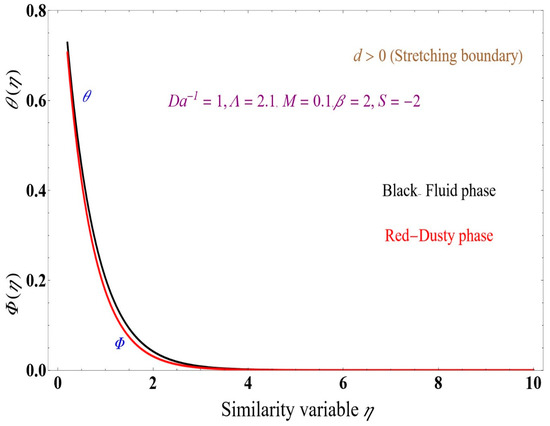
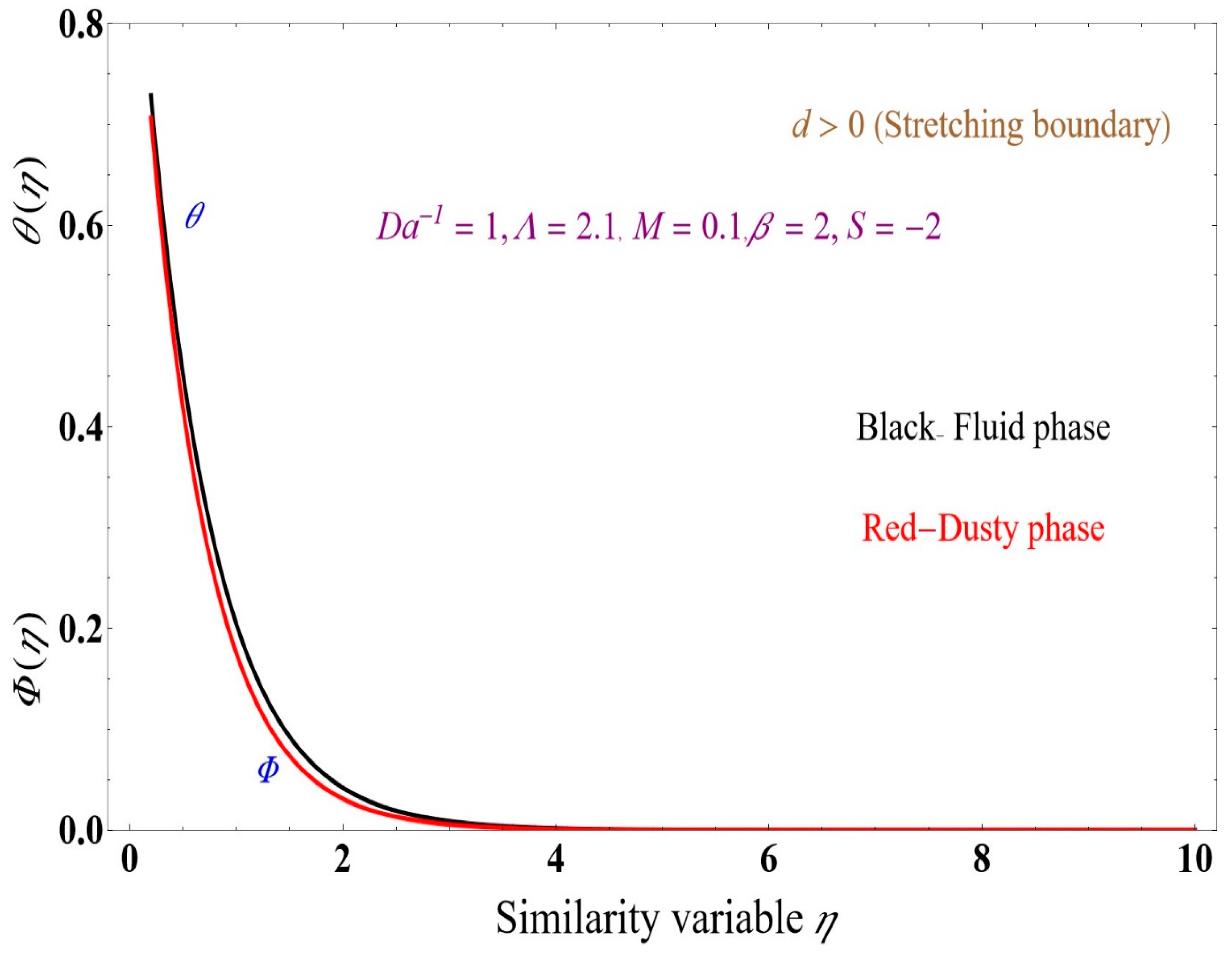
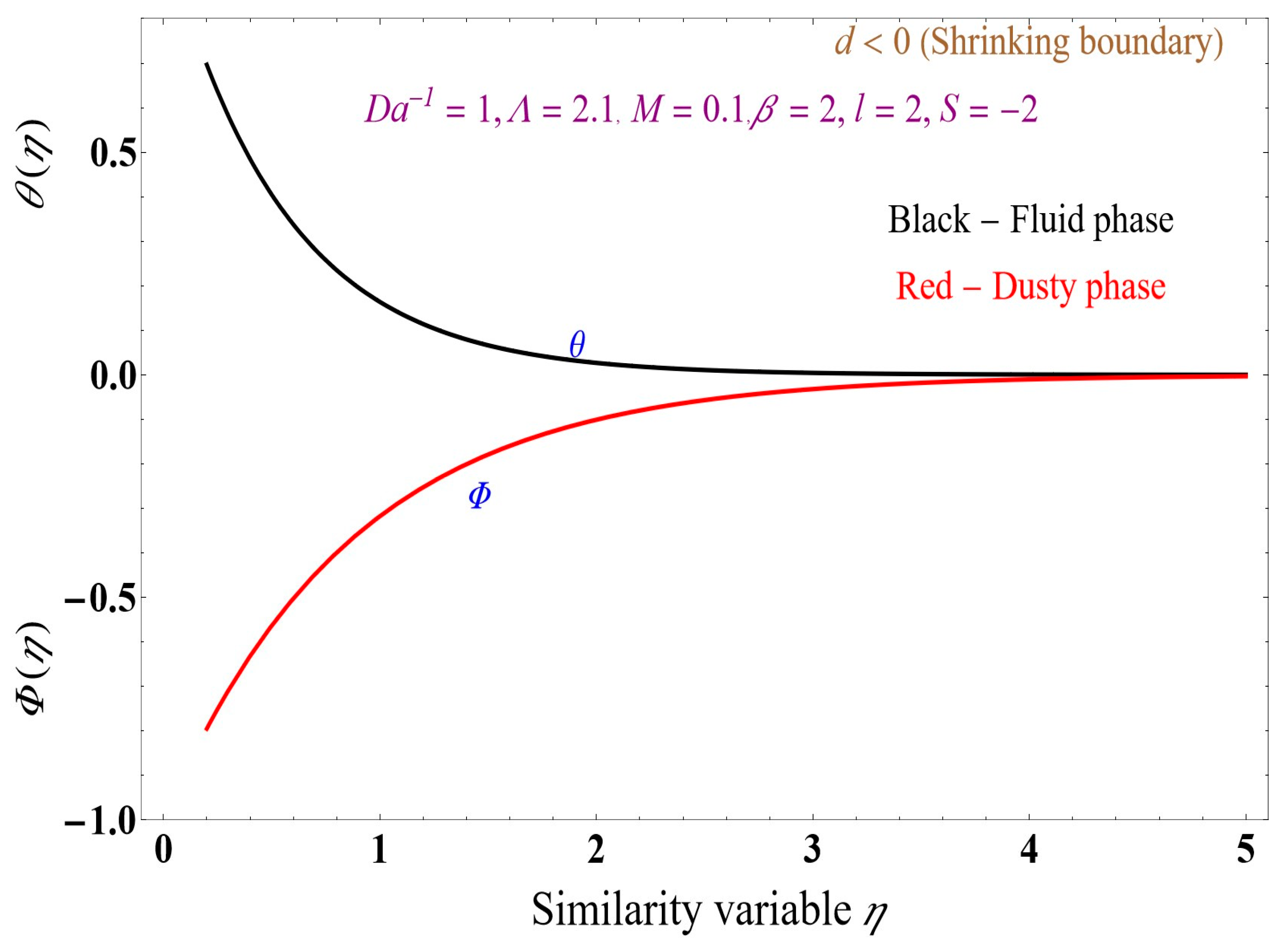
Figure 14.
Temperature profiles for the dusty and fluid phases versus similarity variable for S = −2.
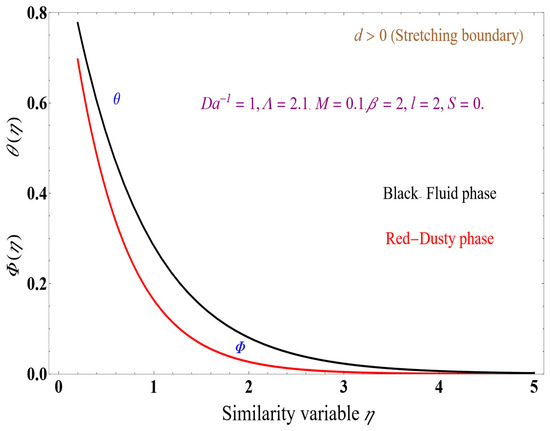
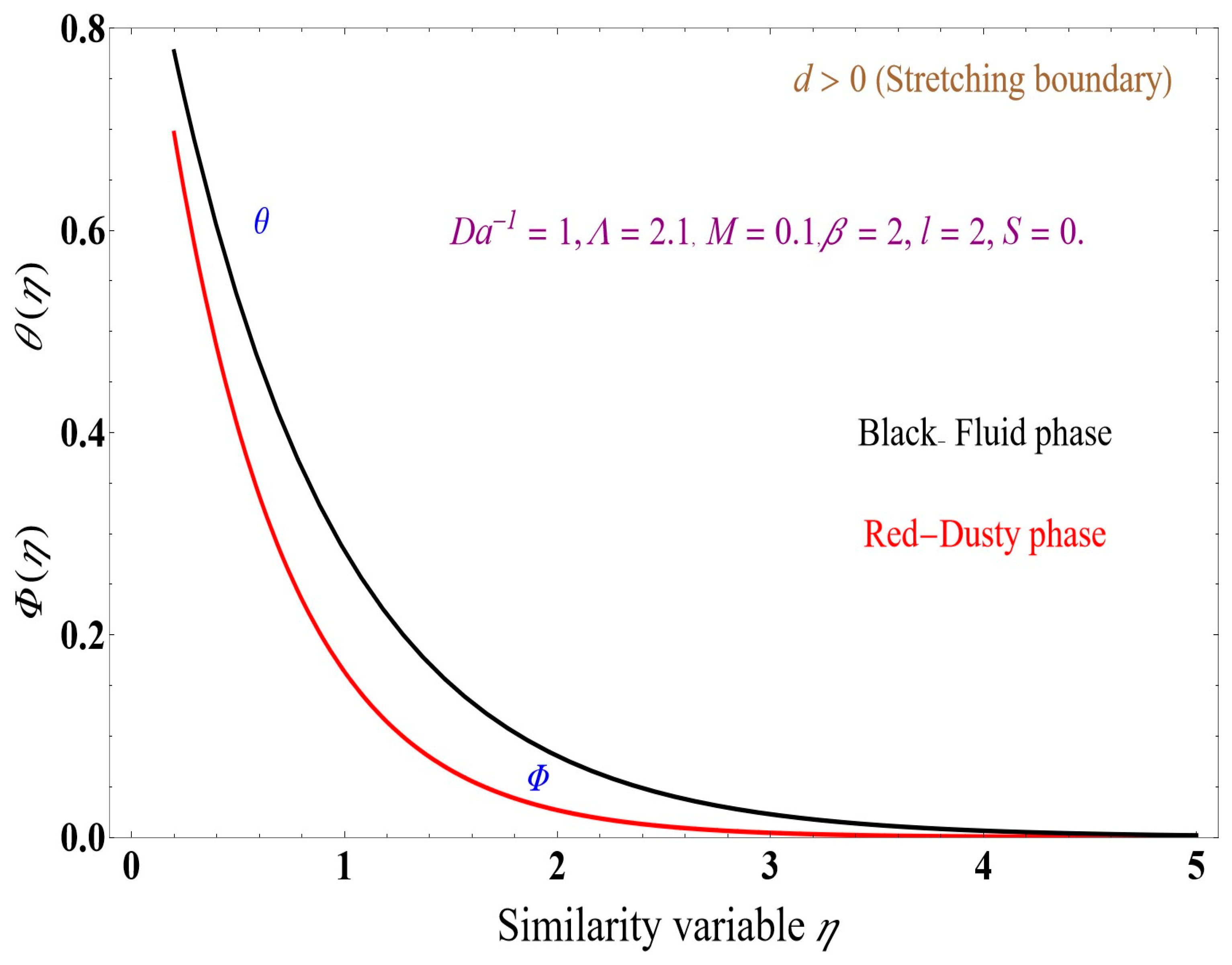
Figure 15.
Temperature profiles for the dusty and fluid phases versus similarity variable for S = 0.
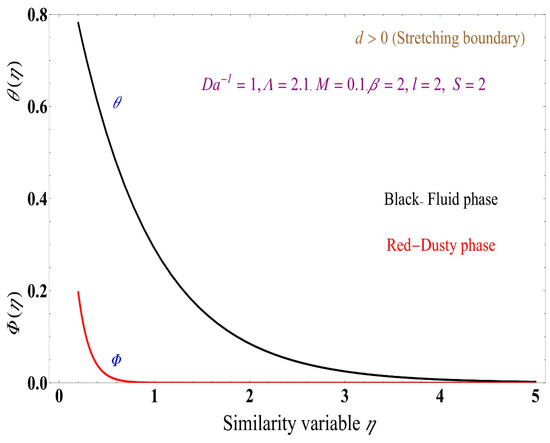
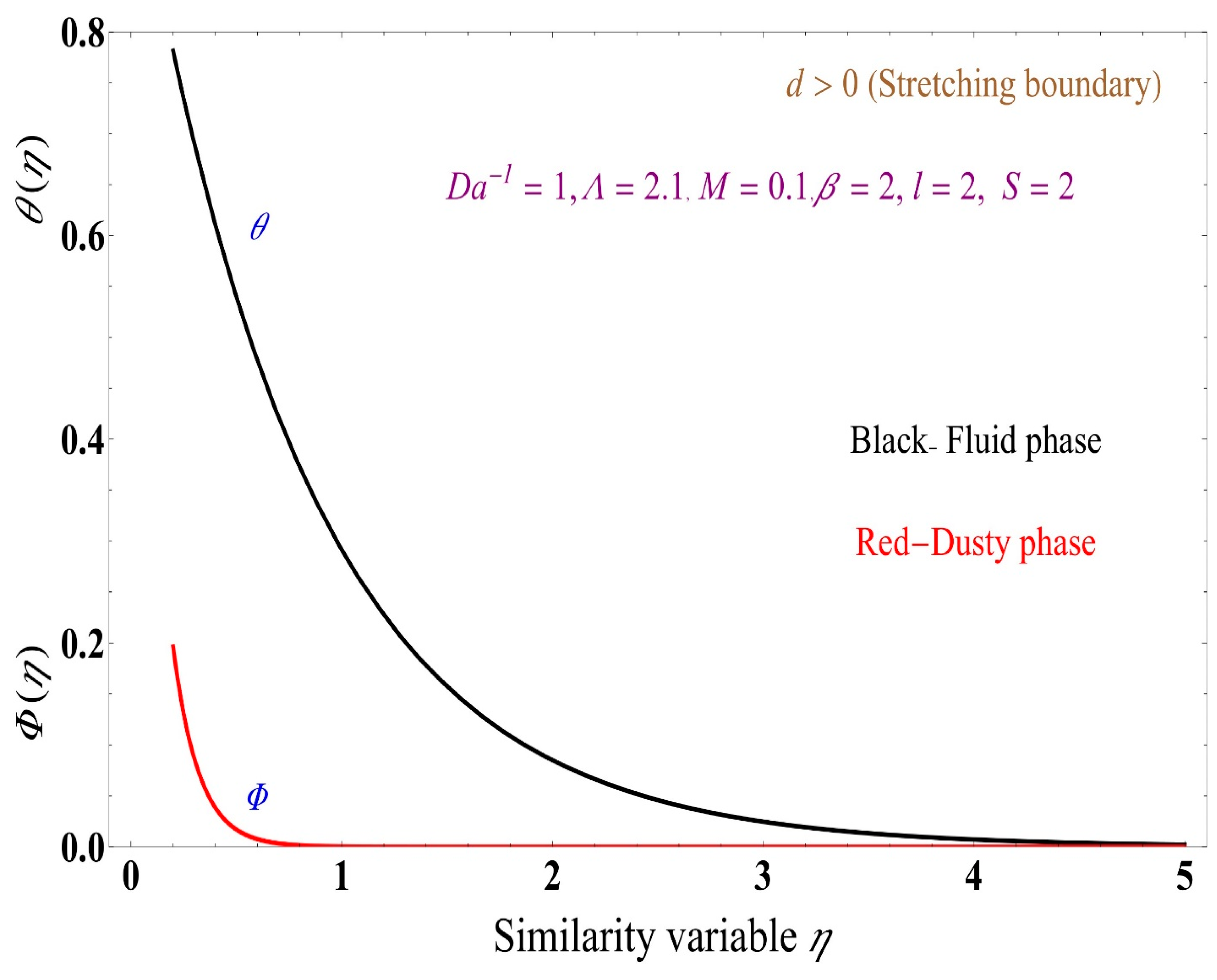
Figure 16.
Temperature profiles for the dusty and fluid phases versus similarity variable for S = 2.
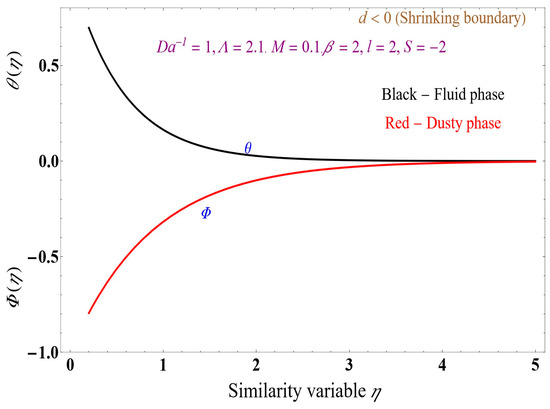
Figure 17.
Temperature profile versus similarity variable for a shrinking boundary.
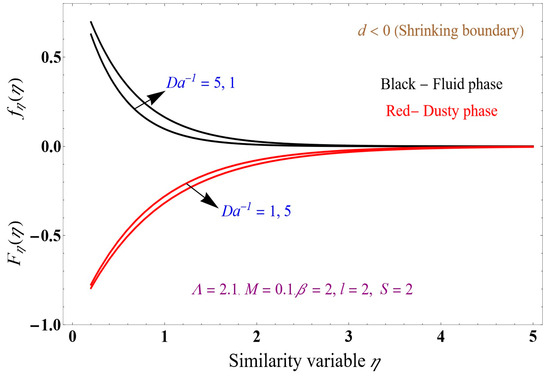
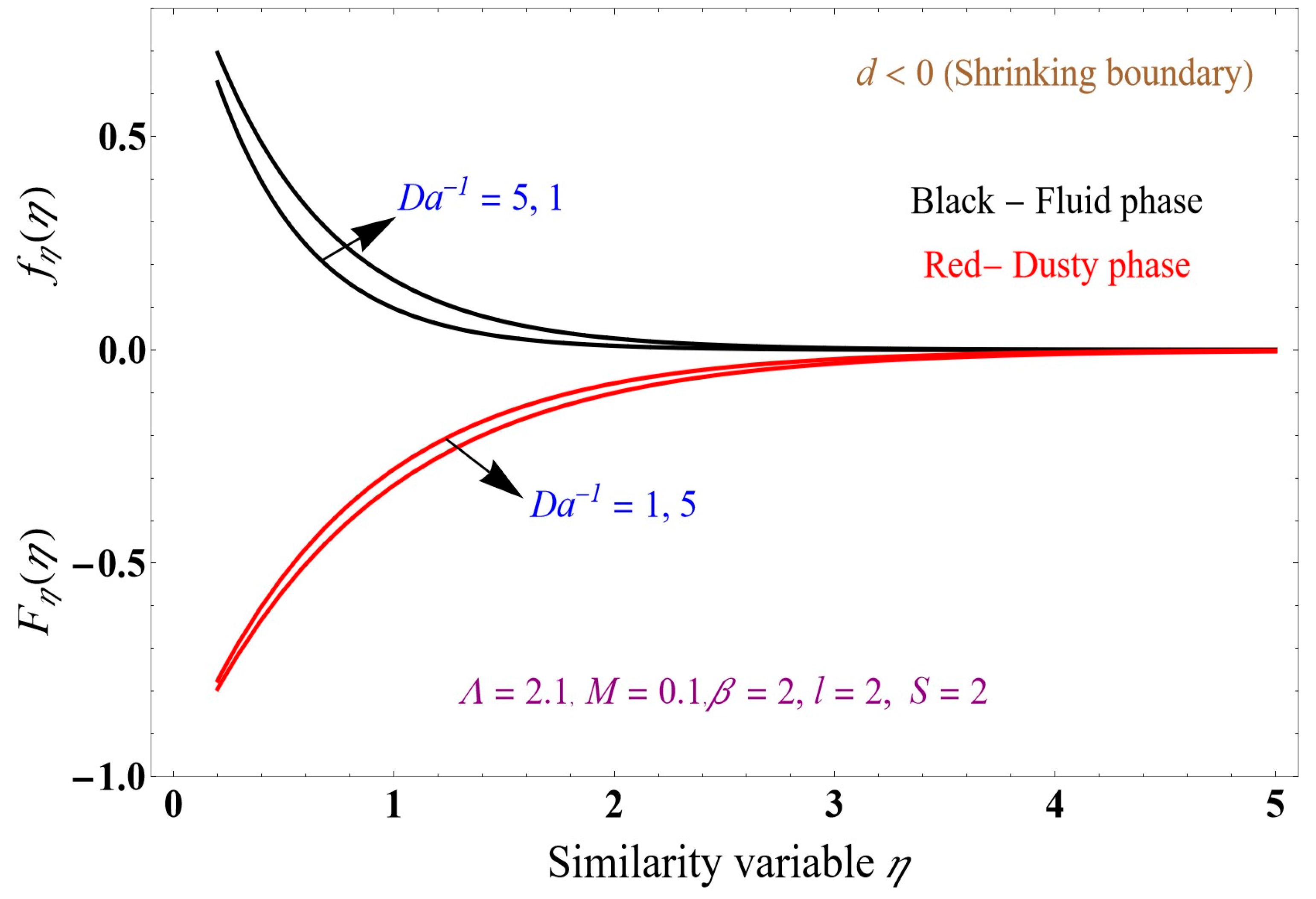
Figure 18.
Velocity profile versus similarity variable variation in .
Text Correction: In Section 2, the following text was added: “Similar to previous studies [2]”, “b is a parameter that is b > 0 for heated and b < 0 for cooled plate”. The correct text appears below.
Similar to previous studies [2], here, , and are the velocity components of a fluid and dusty fluid phase along the x- and y-directions, respectively; the dusty and fluid phase temperatures are Tp and T; is the dynamic viscosity; is the effective density; is the thermal conductivity; b is a parameter that is b > 0 for heated and b < 0 for cooled plate; is the electrical conductivity; and are the specific heat coefficients; is the heat equilibrium time; is the Stokes drag/resistance term; is the kinematic viscosity of nanoparticles N; is the flow permeability; and is a relaxation time parameter, where m denotes the mass of dusty particles [2].
In Section 2, we corrected the typographical error in the definition of the Prandtl number. The correct one is .
In Section 5, we revised the text to avoid ambiguity regarding the results of Figure 14, Figure 15, Figure 16 [1]. The correct text appears below.
Figure 14, Figure 15, Figure 16 show the temperatures for the fluid and dusty phases for different values of S = −2, 0 and 2, respectively. Increasing S value increases the thermal boundary layer thickness of the fluid phase. The dusty phase exhibits an increase in the thermal boundary layer when S increases from −2 to 0, while decreases for S = 2.
Equations: In Equations (35)–(39), there are typographical errors. We revised the subscript thnf to tnf. In Equation (38), we also revised the κnf to κf. The correct equations appears below:
Nomenclature: We added the units that were missing in several parameters and corrected the typographical errors in some of the parameters [1]. The correct Nomenclature appears below.
The authors state that the scientific conclusions are unaffected. These corrections were approved by the Academic Editor. The original publication has also been updated.
Nomenclature
| Constants | |
| a | Stretching coefficient |
| Magnetic parameter (Tesla) | |
| Specific heat coefficient | |
| d | Stretching/shrinking parameter |
| Inverse Darcy number | |
| Eckert number | |
| Velocity function fluid phase | |
| Velocity function dusty phase | |
| Permeability of porous medium | |
| Mass number | |
| Stokes drag term (kg/s) | |
| Mass of the dusty particles | |
| M | dimensionless magnetic parameter |
| Heat source/sink parameter | |
| Thermal radiation parameter | |
| Quantity of nanoparticles | |
| Prandtl number | |
| p | Pressure |
| Radiative heat flux | |
| Heat source/sink | |
| S | Dimensionless mass suction/injection parameter |
| Mass suction parameter | |
| No permeability | |
| Dusty-phase temperature | |
| Surface temperature | |
| T | Fluid temperature |
| Ambient temperature | |
| x, y-axis velocity of fluid phase | |
| x, y-axis velocity of dusty phase | |
| Wall velocity | |
| Wall mass transfer velocity | |
| x | Coordinate along the plate |
| y | Coordinate normal to the plate |
| Greek symbols | |
| Stretching speed of dust particles | |
| Fluid–particle interaction parameters | |
| Solution parameters | |
| , , | Solution roots |
| Constants | |
| Similarity variable | |
| Heat coefficient | |
| Brinkman number | |
| Thermal conductivity | |
| Absorption coefficient | |
| Effective dynamic viscosity | |
| Dynamic viscosity of the fluid and dusty phase | |
| Kinematic viscosity of fluid and dusty phase | |
| Fluid density | |
| Particle phase density | |
| Stream function | |
| Electrical conductivity | |
| Stephen–Boltzmann constant | |
| Heat equilibrium time | |
| Relaxation time parameter | |
| Fluid nanoparticle volume fraction ratio | |
| Dimensionless temperature of fluid phase | |
| Dimensionless temperature of dusty phase | |
| Abbreviations | |
| HNF | Hybrid nanofluid |
| ODE | Ordinary differential equation |
| PDE | Partial differential equation |
| MHD | Magnetohydrodynamics |
| BCs | Boundary conditions |
| TNF | Ternary nanofluid |
Reference
- Sachhin, S.M.; Mahabaleshwar, U.S.; Laroze, D.; Drikakis, D. Darcy–Brinkman Model for Ternary Dusty Nanofluid Flow across Stretching/Shrinking Surface with Suction/Injection. Fluids 2024, 9, 94. [Google Scholar] [CrossRef]
Disclaimer/Publisher’s Note: The statements, opinions and data contained in all publications are solely those of the individual author(s) and contributor(s) and not of MDPI and/or the editor(s). MDPI and/or the editor(s) disclaim responsibility for any injury to people or property resulting from any ideas, methods, instructions or products referred to in the content. |
© 2024 by the authors. Licensee MDPI, Basel, Switzerland. This article is an open access article distributed under the terms and conditions of the Creative Commons Attribution (CC BY) license (https://creativecommons.org/licenses/by/4.0/).