Article

Sound Wave Propagation in Binary Gas Mixtures Flowing Through Microchannels According to a BGK-Type Kinetic Model for General Intermolecular Potentials and Maxwell Boundary Conditions

Dipartimento di Matematica, Politecnico di Milano, Piazza Leonardo da Vinci 32, 20133 Milan, Italy
Fluids 2026, 11(4), 89; https://doi.org/10.3390/fluids11040089
Submission received: 5 January 2026 / Revised: 1 March 2026 / Accepted: 26 March 2026 / Published: 28 March 2026
(This article belongs to the Special Issue 10th Anniversary of Fluids—Recent Advances in Fluid Mechanics)

Abstract

In this work, we assess the reliability of a new Bhatnagar–Gross–Krook (BGK)-type model of the linearized Boltzmann equation for binary gas mixtures by investigating the propagation of high-frequency sound waves in microchannels. In order to take into account the different gas–wall interaction properties experienced by the mixture components, we solve the kinetic equations assuming Maxwell boundary conditions, with different accommodation coefficients for the two species. Unlike other BGK models existing in the literature, the newly proposed model can describe general intermolecular forces. Therefore, in order to test this ability, we specialize our computations to mixtures with two components of very different masses (disparate-mass gas mixtures like He-Xe), since, in this case, the intermolecular forces play a more significant role compared to mixtures with species of similar masses. Then, we compare the results with those obtained by the McCormack model, which has been shown to correctly reproduce many experimental data.

1. Introduction

Most fluids of practical interest are represented by multicomponent mixtures. In particular, gas mixtures have several applications in fluid dynamics, in areas such as combustion, atmospheric modeling, pollutant dispersion, and chemical processing [1]. For many purposes, at the continuum macroscopic level, fluid mixtures can be described like pure fluids using very similar equations, derived by imposing the conservation of mass, momentum, and energy. However, deeper inspection reveals that pure fluids and mixtures also exhibit some essential differences that can be better highlighted through a microscopic approach [2]. Indeed, a more complete and advanced description of a mixture of gases relies on kinetic theory and the Boltzmann equation [3]. In general, the Boltzmann collision operator is an integral term characterizing the binary interactions between molecules. In the case of non-reacting mixtures, it describes the exchange of momentum and energy between the gas components. Due to the complex structure of this collision kernel, simplified kinetic models have been derived over the years in order to numerically or even analytically solve the Boltzmann equation [4,5,6,7,8,9,10,11,12,13,14,15,16]. In 1954, Bhatnagar, Gross, and Krook proposed a simplified model for monatomic gases (BGK model), able to accurately describe the behavior of a gas under different conditions [17]. In 1956, Gross and Krook derived the first BGK-type model for mixtures [4], which was later generalized by several authors in order to improve the descriptions offered by these simplified kinetic models with respect to the full Boltzmann collision kernel [5,6,7]. All these models have a common feature: the interactions between the mixture components are described by different relaxation operators to mimic the form of the true Boltzmann operator. In 2002, Andries, Aoki, and Perthame [9] derived a BGK model for gas mixtures with only one global relaxation operator for each species (representing the interaction of this species with all other components of the mixture), so as to reduce the number of free parameters. These authors proved the mathematical consistency of the model: the correct collision invariants are obtained, the equilibrium is described by a Maxwellian distribution, the H-theorem holds, and, finally, the indifferentiability principle can be established (when the masses of all species and the cross-sections are identical, the total distribution function of the mixture obeys the single-species Boltzmann equation). In spite of this, this BGK model has two important drawbacks that cannot be overlooked: it has been formulated in closed form for Maxwell molecules (which represents an unrealistic interaction potential) and it does not provide the correct expressions for all transport coefficients. On the other hand, within the framework of linearized analysis, McCormack proposed, in 1973, a consistent kinetic model for gas mixtures [8], which allows one to correctly compute all transport coefficients (i.e., viscosity, thermal conductivity, diffusion, and thermal diffusion ratio) and to take into account general intermolecular forces between the species. While the McCormack model greatly simplifies the structure of the true Boltzmann collision kernel, it is still too complex to be amenable to analytical or semi-analytical solutions. Therefore, in this work, following the approach suggested by McCormack, we propose to modify the linearized version of the BGK model derived by Andries, Aoki, and Perthame, so as to retain its simplicity but, at the same time, allow for general collision kernels other than Maxwell molecules [18,19]. Indeed, the experimental results highlight that an accurate description of the behavior of a gas mixture requires proper characterization of the intermolecular forces [20]. Particular attention should also be paid to the description of the interactions with solid walls (which greatly affect the transport properties of a gas in rarefied conditions), especially in the case of a disparate-mass gas mixture (composed of very heavy plus very light molecules), since theoretical and experimental investigations have shown that the accommodation coefficients depend on the molecular mass of the species [21]. In order to properly account for these aspects, in the current investigation, we extend a previous analysis on sound wave propagation in binary gas mixtures [18,22] by considering the hard-sphere intermolecular potential and the Maxwell model of boundary conditions. In the scattering kernel proposed by Maxwell [23], a fraction α of molecules is assumed to be reflected with a Maxwellian velocity distribution corresponding to the surface properties, while the remaining fraction ( 1 α ) is specularly reflected [3]. We consider different values of the accommodation coefficient α for each species of the mixture: α 1 for the lighter component and α 2 for the heavier component.

2. Kinetic Description of Gas Mixtures

2.1. Boltzmann Equation

A binary mixture of monatomic non-reacting gases can be analyzed at the microscopic level by the Boltzmann equation, which describes the evolution of the species distribution function f s ( t , x , ξ ) ( s = 1 , 2 ) [3,24],
f s t + ξ · x f s = r = 1 2 Q s r ( f s , f r )
where the collision operator Q s r is given by
Q s r ( f s , f r ) = R 3 B f s ( ξ ) f r ( ξ * ) f s ( ξ ) f r ( ξ * ) B s r ( n · V , | V | ) d ξ * d n .
In Equation (2), B s r represents the scattering cross-section (related to the collisional process of two particles), V = ξ ξ * is the relative velocity of the sth species molecule with respect to the rth species molecule, n is a unit vector, and B is the semisphere defined by n · V 0 . The postcollisional velocities ξ and ξ * are computed from the laws of elastic scattering, imposing the conservation of the total momentum and total kinetic energy:
ξ = ξ 2 μ s r m s n [ ( ξ ξ * ) · n ]
ξ * = ξ * + 2 μ s r m r n [ ( ξ ξ * ) · n ]
with μ s r = m s m r ( m s + m r ) being the reduced mass. In the framework of linearized analysis, the distribution function of each species is commonly represented as a small deviation from the basic equilibrium state,
f s = f s , 0 ( 1 + h s ) | h s | < < 1 ,
where f s , 0 is the Maxwellian configuration
f s , 0 = n s , 0 m s 2 π k B T 0 3 / 2 exp m s 2 k B T 0 ξ 2 .
In (4), k B is the Boltzmann constant; m s and n s , 0 are the mass and equilibrium density of the sth species, respectively; and T 0 is a reference temperature. Inserting (3) into (1) and (2), we get the evolution equation for the small perturbation h s :
h s t + ξ · x h s = r = 1 2 L s r h s
where the linearized collision operator L s r h s can be written as
L s r h s = n r , 0 m r 2 π k B T 0 3 / 2 R 3 B h s ( ξ ) + h r ( ξ * ) h s ( ξ ) h r ( ξ * ) exp m r 2 k B T 0 ξ * 2 · B s r ( n · V , | V | ) d ξ * d n .
In general, one can obtain a closed-form expression for L s r h s only for Maxwell molecules (since, in this case, the cross-section is independent of the relative velocity), which is characterized by an unrealistic interaction potential. For this reason, over the years, several kinetic models have been proposed in order to simplify the Boltzmann collision integral, making it amenable to computations for generic and more realistic interatomic potentials.

2.2. McCormack Model

In 1973, McCormack presented a systematic procedure for constructing linearized kinetic models for mixtures [8]. For the kth-order model, the method consists of writing the collision term, which appears on the right-hand side of Equation (5), as follows:
L ^ ( k ) s r h s = γ s r h s ( t , x , ξ ) + j k A j ( t , x ) ψ j ( ξ )
where γ s r is a constant collision frequency and ψ j is a suitably chosen complete orthonormal set of functions (e.g., the Maxwell molecule eigenfunction). The expansion coefficients A j are determined by equating some relevant moments of the model
( Δ ϕ ) s r = ϕ ( ξ ) f s , 0 L ^ ( k ) s r h s d ξ
to the corresponding moments of the full collision operator (6), evaluated with the kth-order approximation to the distribution function. One of the most appealing features of this method is that it allows us to obtain, in the continuum limit, the correct behavior of the kth-order moment of the distribution function. Moreover, the model derived through this procedure is not restricted to Maxwell molecules, but general intermolecular force laws can be taken into account. For a third-order model, which is the lowest order that gives a correct hydrodynamic description, the collision term moments corresponding to the species density ( ϕ = 1 ), drift velocity ( ϕ = ξ i ), energy ( ϕ = 1 2 ξ 2 ), stress ( ϕ = ξ i ξ j 1 3 ξ 2 δ i j ), and heat flux ( ϕ = 1 2 ξ i ( ξ 2 5 2 ) ) have been computed using a third-order, thirteen-moment approximation to the distribution function. Thus, the McCormack model for a binary gas mixture can be explicitly written as follows:
L h ( 1 ) M C = γ 1 ρ ( 1 ) + 2 ( 1 η 1 , 2 ( 1 ) ) c · v ( 1 ) 2 η 1 , 2 ( 2 ) c · q ( 1 ) + 1 2 η 1 , 2 ( 1 ) M 12 ( 1 + M 12 ) | c | 2 3 2 τ ( 1 ) + 2 ( 1 + η 1 , 1 ( 4 ) η 1 , 1 ( 3 ) η 1 , 2 ( 3 ) ) c i c j P ˜ i j ( 1 ) + 8 5 ( 1 + η 1 , 1 ( 6 ) η 1 , 1 ( 5 ) η 1 , 2 ( 5 ) ) | c | 2 5 2 c · q ( 1 ) η 1 , 2 ( 2 ) | c | 2 5 2 c · v ( 1 ) + 2 η 1 , 2 ( 1 ) c · v ( 2 ) + 2 M 12 η 1 , 2 ( 2 ) c · q ( 2 ) + η 1 , 2 ( 2 ) | c | 2 5 2 c · v ( 2 ) + 2 η 1 , 2 ( 1 ) M 12 ( 1 + M 12 ) | c | 2 3 2 τ ( 2 ) + 2 η 1 , 2 ( 4 ) M 12 c i c j P ˜ i j ( 2 ) + 8 η 1 , 2 ( 6 ) 5 M 12 | c | 2 5 2 c · q ( 2 ) h 1
L h ( 2 ) M C = γ 2 { ρ ( 2 ) + 2 M 12 ( 1 η 2 , 1 ( 1 ) ) c · v ( 2 ) 2 η 2 , 1 ( 2 ) M 12 c · q ( 2 ) + 1 2 η 2 , 1 ( 1 ) ( 1 + M 12 ) | c | 2 M 12 3 2 τ ( 2 ) + 2 M 12 2 ( 1 + η 2 , 2 ( 4 ) η 2 , 2 ( 3 ) η 2 , 1 ( 3 ) ) c i c j P ˜ i j ( 2 ) + 8 5 M 12 ( 1 + η 2 , 2 ( 6 ) η 2 , 2 ( 5 ) η 2 , 1 ( 5 ) ) | c | 2 M 12 5 2 c · q ( 2 ) η 2 , 1 ( 2 ) M 12 | c | 2 M 12 5 2 c · v ( 2 ) + 2 η 2 , 1 ( 1 ) M 12 c · v ( 1 ) + 2 η 2 , 1 ( 2 ) M 12 2 c · q ( 1 ) + η 2 , 1 ( 2 ) M 12 | c | 2 M 12 5 2 c · v ( 1 ) + 2 η 2 , 1 ( 1 ) ( 1 + M 12 ) | c | 2 M 12 3 2 τ ( 1 ) + 2 η 2 , 1 ( 4 ) M 12 c i c j P ˜ i j ( 1 ) + 8 η 2 , 1 ( 6 ) 5 M 12 | c | 2 M 12 5 2 c · q ( 1 ) h 2 }
where, joining together the self- and cross-collision terms in (5), with the scattering operators given by (7), γ s appear only in the combinations γ 1 = γ 11 + γ 12 and γ 2 = γ 21 + γ 22 . In deriving (9) and (10), we have considered the following normalizations:
c = ξ 2 k B m 1 T 0 , f ^ 1 , 0 = f 1 , 0 n 1 , 0 = e | c | 2 π 3 / 2 , f ^ 2 , 0 = f 2 , 0 n 2 , 0 = e | c | 2 M 12 ( π M 12 ) 3 / 2
where M 12 = m 1 / m 2 is the mass ratio of the two components of the mixture. We have chosen to normalize the molecular velocities with respect to the thermal velocity of the species 1, since, in this way, we are able to identify the deviations from the single-gas behavior (as already highlighted in [22]). The other symbols appearing in (9) and (10) are defined as follows:
η s , r ( k ) = ν s , r ( k ) γ s ( s , r = 1 , 2 k = 1 , , 6 )
where the collision frequencies γ s   ( s = 1 , 2 ) are given by
γ 1 = ( ψ 1 ψ 2 ν 1 , 2 ( 4 ) ν 2 , 1 ( 4 ) ) ( ψ 2 + ν 1 , 2 ( 4 ) ) 1 , γ 2 = ( ψ 1 ψ 2 ν 1 , 2 ( 4 ) ν 2 , 1 ( 4 ) ) ( ψ 1 + ν 2 , 1 ( 4 ) ) 1
with
ψ 1 = ν 1 , 1 ( 3 ) + ν 1 , 2 ( 3 ) ν 1 , 1 ( 4 ) , ψ 2 = ν 2 , 2 ( 3 ) + ν 2 , 1 ( 3 ) ν 2 , 2 ( 4 )
and
ν s , r ( 1 ) = 16 3 μ s r m s n r Ω s , r 11 , ν s , r ( 2 ) = 64 15 μ s r m s 2 n r Ω s , r 12 5 2 Ω s , r 11 ,
ν s , r ( 3 ) = 16 5 μ s r m s 2 m s m r n r 10 3 Ω s , r 11 + m r m s Ω s , r 22 ,
ν s , r ( 4 ) = 16 5 μ s r m s 2 m s m r n r 10 3 Ω s , r 11 Ω s , r 22 ,
ν s , r ( 5 ) = 64 15 μ s r m s 3 m s m r n r Γ s , r ( 5 ) , ν s , r ( 6 ) = 64 15 μ s r m s 3 m s m r 3 / 2 n r Γ s , r ( 6 )
with
Γ s , r ( 5 ) = Ω s , r 22 + 15 m s 4 m r + 25 m r 8 m s Ω s , r 11 m r 2 m s ( 5 Ω s , r 12 Ω s , r 13 ) ,
Γ s , r ( 6 ) = Ω s , r 22 + 55 8 Ω s , r 11 5 2 Ω s , r 12 + 1 2 Ω s , r 13 .
The form of the Chapman–Cowling integrals Ω s , r i j depends on the intermolecular force law considered [24]. In this work, we focus on hard-sphere molecules. In Appendix A, we report the explicit expressions of these integrals and the method of computation. The dimensionless macroscopic perturbed density ( ρ ( s ) ), velocity ( v ( s ) ), temperature ( τ ( s ) ), stress tensor ( P ˜ i j ( s ) ), and heat flux ( q ( s ) ), appearing in (9) and (10), are defined below:
ρ ( 1 ) = 1 π 3 / 2 R 3 h 1 e | c | 2 d c , ρ ( 2 ) = 1 ( π M 12 ) 3 / 2 R 3 h 2 e | c | 2 M 12 d c
v ( 1 ) = 1 π 3 / 2 R 3 c h 1 e | c | 2 d c , v ( 2 ) = 1 ( π M 12 ) 3 / 2 R 3 c h 2 e | c | 2 M 12 d c
τ ( 1 ) = 1 π 3 / 2 R 3 2 3 | c | 2 1 h 1 e | c | 2 d c
τ ( 2 ) = 1 ( π M 12 ) 3 / 2 R 3 2 3 M 12 | c | 2 1 h 2 e | c | 2 M 12 d c
P ˜ i j ( 1 ) = 1 π 3 / 2 R 3 c i c j 1 3 | c | 2 δ i j h 1 e | c | 2 d c
P ˜ i j ( 2 ) = 1 ( π M 12 ) 3 / 2 R 3 c i c j 1 3 | c | 2 δ i j h 2 e | c | 2 M 12 d c
q ( 1 ) = 1 π 3 / 2 R 3 1 2 c | c | 2 5 2 h 1 e | c | 2 d c
q ( 2 ) = 1 ( π M 12 ) 3 / 2 R 3 1 2 c | c | 2 M 12 5 2 h 2 e | c | 2 M 12 d c .

2.3. BGK-Type Models

In 2002, Andries, Aoki, and Perthame proposed, in [9], a consistent BGK model for gas mixtures satisfying several fundamental properties: the correct Boltzmann collision invariants and Maxwellian equilibria are properly recovered, the H-theorem is fulfilled, and the indifferentiability principle holds. The main idea behind the derivation of this model is to define only one global relaxation operator for each species s, instead of approximating each binary collision operator Q s r ( f s , f r ) (which appears on the right-hand side of (1)) by a BGK-type equation. For a binary gas mixture, this BGK model reads [9,25]
f s t + ξ · x f s = ν s ( M s f s ) s = 1 , 2
where ν s are suitable collision frequencies that are independent of the molecular velocity ξ (but possibly dependent on the macroscopic fields) and M s are Maxwellian attractors:
M s = n s m s 2 π k B T s 3 / 2 exp m s 2 k B T s | ξ v s | 2 .
In (27), v s and T s (with subscript s) are auxiliary parameters to be computed in terms of the moments of the distribution functions f s , namely the number density n s , the mass velocity v ( s ) , and the temperature T ( s ) (with superscript s), by imposing that the exchange rates for species momenta and energies given by the BGK operator match the exact corresponding rates calculated by the Boltzmann true collision operator Q s r ( f s , f r ) for Maxwell molecules (since, in this case, such rates can be made explicit in closed analytical form):
ν s m s R 3 ξ M s ( ξ ) f s ( ξ ) d ξ = r = 1 2 m s R 3 ξ Q s r ( f s , f r ) d ξ ,
ν s m s 2 R 3 | ξ | 2 M s ( ξ ) f s ( ξ ) d ξ = r = 1 2 m s 2 R 3 | ξ | 2 Q s r ( f s , f r ) d ξ .
Although this model has been successfully applied to describe different phenomena, recent works [18,19] have pointed out that, in a certain number of physical problems, there is only qualitative agreement with the McCormack model, namely when collision kernels other than Maxwell molecules are considered. Therefore, in the present paper, we propose to modify the linearized version of the BGK model derived in [9] by computing the integrals on the right-hand side of Equations (28) and (29), for general intermolecular forces, with a thirteen-moment approximation to the distribution function. Then, imposing the equality constraints (28) and (29) and taking into account the results
ν s m s R 3 ξ M s ( ξ ) f s ( ξ ) d ξ = ν s m s n s v s n s v ( s )
m s R 3 ξ Q s r ( f s , f r ) d ξ = v ( r ) v ( s ) ν s , r ( 1 ) q ( s ) q ( r ) ν s , r ( 2 )
ν s m s 2 R 3 | ξ | 2 M s ( ξ ) f s ( ξ ) d ξ = 3 2 ν s n s k B T s T ( s ) + 1 2 ν s m s n s | v s | 2 | v ( s ) | 2
m s 2 R 3 | ξ | 2 Q s r ( f s , f r ) d ξ = 3 2 μ s r m r T ( r ) T ( s ) ν s , r ( 1 )
within the framework of a linearized analysis, we get the following relationships:
v 1 = v ( 1 ) + η 1 , 2 ( 1 ) ( v ( 2 ) v ( 1 ) )
v 2 = v ( 2 ) + η 2 , 1 ( 1 ) ( v ( 1 ) v ( 2 ) )
T 1 = T ( 1 ) + 2 m 1 ( m 1 + m 2 ) η 1 , 2 ( 1 ) ( T ( 2 ) T ( 1 ) )
T 2 = T ( 2 ) + 2 m 2 ( m 1 + m 2 ) η 2 , 1 ( 1 ) ( T ( 1 ) T ( 2 ) ) .
In the expressions (34)–(37), the symbols are identical to those reported in (12)–(17) after the identification of ν s = γ s ( s = 1 , 2 ) . Moreover, we have neglected the heat flux vectors, appearing on the right-hand side of (31), since, for the problem studied in Section 3, these fields play only a negligible role. In this way, the following BGK-type model can be derived, which is no longer restricted to Maxwell molecules but able to describe more realistic intermolecular forces:
L h ( 1 ) B G K = γ 1 ρ ( 1 ) + 2 ( 1 η 1 , 2 ( 1 ) ) c · v ( 1 ) + 2 η 1 , 2 ( 1 ) c · v ( 2 ) + 1 2 η 1 , 2 ( 1 ) M 12 ( 1 + M 12 ) | c | 2 3 2 τ ( 1 ) + 2 η 1 , 2 ( 1 ) M 12 ( 1 + M 12 ) | c | 2 3 2 τ ( 2 ) h 1
L h ( 2 ) B G K = γ 2 ρ ( 2 ) + 2 ( 1 η 2 , 1 ( 1 ) ) c M 12 · v ( 2 ) + 2 η 2 , 1 ( 1 ) c M 12 · v ( 1 ) + 1 2 η 2 , 1 ( 1 ) ( 1 + M 12 ) | c | 2 M 12 3 2 τ ( 2 ) + 2 η 2 , 1 ( 1 ) ( 1 + M 12 ) | c | 2 M 12 3 2 τ ( 1 ) h 2
In Equations (38) and (39), we use the same normalizations introduced in (11) and the definitions of the dimensionless macroscopic perturbed density ρ ( s ) , velocity v ( s ) , and temperature τ ( s ) reported in (18)–(21). The advantage of this BGK-type model, compared to the true linearized Boltzmann equation or the McCormack model, is its simplicity, consequently leading to a semi-analytical representation of the solution [19,22,26].

3. Sound Wave Propagation in Microchannels

In the following, we study the flow of a binary gas mixture between two flat, infinite, and parallel plates. Both boundaries, located at z = d / 2 and z = d / 2 , are held at the same constant temperature. The upper wall of the channel is fixed, while the lower one harmonically oscillates normal to the wall itself (in the z -direction) with velocity
U w ( t ) = U 0 sin ( ω t ) .
In (40), ω represents the angular frequency, so that the corresponding period of oscillation is given by T = 2 π / ω . We assume that the amplitude U 0 of the wall velocity is very small compared to the characteristic molecular velocity of the mixture,
v 0 = 2 k B T 0 / m ,
with m being the mean molecular mass of the mixture and T 0 being the equilibrium temperature of the mixture. This hypothesis is not restrictive but is perfectly compatible with the high-frequency oscillations that we analyze in this paper. A discussion of the physical applications of the model proposed here is given in Section 5. Under these conditions, the Boltzmann equation modeling the flow of the gas mixture inside the channel can be linearized as in (5). When the lower plate oscillates at a high frequency, sound wave propagation takes place only in the z -direction; therefore, we obtain a one-dimensional problem in space:
h s t + c z h s z = L h B G K ( s ) s = 1 , 2
where L h B G K ( s ) is the linearized BGK-type collision operator given by Equations (38) and (39). It is convenient now to rescale all variables appearing in (42) as follows: t = t / θ 1 , z = z / ( v 0 1 θ 1 ) , with θ 1 = 1 / γ 1 , v 0 1 = 2 k B T 0 / m 1 . Furthermore, we define Θ 12 = θ 1 / θ 2 = γ 2 / γ 1 and δ = d / ( v 0 1 θ 1 ) , which is the dimensionless distance between the channel walls, as well as the rarefaction parameter (inverse Knudsen number) of the species s = 1 . In order to solve the Boltzmann–BGK Equation (42), appropriate boundary conditions need to be imposed. We refer to the Maxwell model, according to which a fraction α of molecules is re-emitted with a Maxwellian distribution corresponding to the wall properties, while the remaining fraction ( 1 α ) is specularly reflected [3,23]. Since experimental results have revealed that the accommodation coefficients depend on the molecular mass of the species, we indicate with α 1 the accommodation coefficient of the lighter component of the mixture, while, with α 2 , we denote the accommodation coefficient of the heavier component. Therefore, the Maxwell boundary conditions read
h 1 ( z = δ 2 , c , t ) = α 1 ( π + 2 c z ) U w + 4 ( 1 α 1 ) U w c z + ( 1 α 1 ) h 1 ( z = δ 2 , c x , c y , ( c z + 2 U w ) , t ) 2 α 1 π + + d c ˜ x d c ˜ y c ˜ z < 0 d c ˜ z c ˜ z e c ˜ 2 h 1 ( z = δ 2 , c ˜ , t ) c z > 0
h 1 ( z = δ 2 , c , t ) = ( 1 α 1 ) h 1 ( z = δ 2 , c x , c y , c z , t ) + 2 α 1 π + + d c ˜ x d c ˜ y c ˜ z > 0 d c ˜ z c ˜ z e c ˜ 2 h 1 ( z = δ 2 , c ˜ , t ) c z < 0
h 2 ( z = δ 2 , c , t ) = α 2 π M 12 + 2 c z M 12 U w + 4 ( 1 α 2 ) U w c z M 12 + ( 1 α 2 ) h 2 ( z = δ 2 , c x , c y , ( c z + 2 U w ) , t ) 2 α 2 π M 12 2 + + d c ˜ x d c ˜ y c ˜ z < 0 d c ˜ z c ˜ z e c ˜ 2 M 12 h 2 ( z = δ 2 , c ˜ , t ) c z > 0
h 2 ( z = δ 2 , c , t ) = ( 1 α 2 ) h 2 ( z = δ 2 , c x , c y , c z , t ) + 2 α 2 π M 12 2 + + d c ˜ x d c ˜ y c ˜ z > 0 d c ˜ z c ˜ z e c ˜ 2 M 12 h 2 ( z = δ 2 , c ˜ , t ) c z < 0
In Equations (43) and (45), U w is the dimensionless wall velocity given by
U w ( t ) = U 0 sin ( ω t )
with U w = U w / v 0 1 , U 0 = U 0 / v 0 1 , ω = θ 1 ω , T = 2 π ω = T θ 1 . Since the problem is one-dimensional in space, we can reduce also the dimensionality of the molecular velocity space by introducing the following projection procedure [27,28]. First, we multiply Equation (42) by 1 π e ( c x 2 + c y 2 ) when s = 1 and by 1 ( π M 12 ) e ( c x 2 + c y 2 ) M 12 when s = 2 , and we integrate over all c x and c y . Then, we multiply Equation (42) by 1 π ( c x 2 + c y 2 1 ) e ( c x 2 + c y 2 ) when s = 1 and by 1 ( π M 12 ) ( c x 2 + c y 2 M 12 1 ) e ( c x 2 + c y 2 ) M 12 when s = 2 , and we integrate again over all c x and c y . The resulting equations read
H ( 1 ) t + c z H ( 1 ) z + H ( 1 ) = ρ ( 1 ) + 2 ( 1 η 1 , 2 ( 1 ) ) c z v z ( 1 ) + 2 η 1 , 2 ( 1 ) c z v z ( 2 ) + 1 2 η 1 , 2 ( 1 ) M 12 ( 1 + M 12 ) ( c z 2 1 2 ) τ ( 1 ) + 2 η 1 , 2 ( 1 ) M 12 ( 1 + M 12 ) ( c z 2 1 2 ) τ ( 2 )
H ( 2 ) t + c z H ( 2 ) z + Θ 12 H ( 2 ) = Θ 12 { ρ ( 2 ) + 2 ( 1 η 2 , 1 ( 1 ) ) M 12 c z v z ( 2 ) + 2 η 2 , 1 ( 1 ) M 12 c z v z ( 1 ) + 1 2 η 2 , 1 ( 1 ) ( 1 + M 12 ) c z 2 M 12 1 2 τ ( 2 ) + 2 η 2 , 1 ( 1 ) ( 1 + M 12 ) c z 2 M 12 1 2 τ ( 1 ) }
Ψ ( 1 ) t + c z Ψ ( 1 ) z + Ψ ( 1 ) = 1 2 η 1 , 2 ( 1 ) M 12 ( 1 + M 12 ) τ ( 1 ) + 2 η 1 , 2 ( 1 ) M 12 ( 1 + M 12 ) τ ( 2 )
Ψ ( 2 ) t + c z Ψ ( 2 ) z + Θ 12 Ψ ( 2 ) = Θ 12 1 2 η 2 , 1 ( 1 ) ( 1 + M 12 ) τ ( 2 ) + 2 η 2 , 1 ( 1 ) ( 1 + M 12 ) τ ( 1 )
where the reduced unknown distribution functions H ( s ) and Ψ ( s ) are defined as
H ( 1 ) ( z , c z , t ) = 1 π + + h 1 ( z , c , t ) e ( c x 2 + c y 2 ) d c x d c y
H ( 2 ) ( z , c z , t ) = 1 π M 12 + + h 2 ( z , c , t ) e ( c x 2 + c y 2 ) / M 12 d c x d c y
Ψ ( 1 ) ( z , c z , t ) = 1 π + + ( c x 2 + c y 2 1 ) h 1 ( z , c , t ) e ( c x 2 + c y 2 ) d c x d c y
Ψ ( 2 ) ( z , c z , t ) = 1 π M 12 + + c x 2 + c y 2 M 12 1 h 2 ( z , c , t ) e ( c x 2 + c y 2 ) / M 12 d c x d c y .
The macroscopic fields appearing on the right-hand sides of Equations (48)–(51) are given by
ρ ( 1 ) ( z , t ) = 1 π + H ( 1 ) ( z , c z , t ) e c z 2 d c z
ρ ( 2 ) ( z , t ) = 1 π M 12 + H ( 2 ) ( z , c z , t ) e c z 2 / M 12 d c z
v z ( 1 ) ( z , t ) = 1 π + c z H ( 1 ) ( z , c z , t ) e c z 2 d c z
v z ( 2 ) ( z , t ) = 1 π M 12 + c z H ( 2 ) ( z , c z , t ) e c z 2 / M 12 d c z
τ ( 1 ) ( z , t ) = 1 π + 2 3 ( c z 2 1 2 ) H ( 1 ) ( z , c z , t ) + Ψ ( 1 ) ( z , c z , t ) e c z 2 d c z
τ ( 2 ) ( z , t ) = 1 π M 12 + 2 3 ( c z 2 M 12 1 2 ) H ( 2 ) ( z , c z , t ) + Ψ ( 2 ) ( z , c z , t ) e c z 2 / M 12 d c z
Applying the same projection procedure to the linearized boundary conditions (43)–(46), we obtain
H ( 1 ) ( z = δ 2 , c z , t ) = α 1 ( π + 2 c z ) U w + 4 ( 1 α 1 ) U w c z + ( 1 α 1 ) H ( 1 ) ( z = δ 2 , ( c z + 2 U w ) , t ) 2 α 1 c ˜ z < 0 d c ˜ z c ˜ z e c ˜ z 2 H ( 1 ) ( z = δ 2 , c ˜ z , t ) c z > 0
H ( 1 ) ( z = δ 2 , c z , t ) = ( 1 α 1 ) H ( 1 ) ( z = δ 2 , c z , t ) + 2 α 1 c ˜ z > 0 d c ˜ z c ˜ z e c ˜ z 2 H ( 1 ) ( z = δ 2 , c ˜ z , t ) c z < 0
H ( 2 ) ( z = δ 2 , c z , t ) = α 2 π M 12 + 2 c z M 12 U w + 4 ( 1 α 2 ) U w c z M 12 + ( 1 α 2 ) H ( 2 ) ( z = δ 2 , ( c z + 2 U w ) , t ) 2 α 2 M 12 c ˜ z < 0 d c ˜ z c ˜ z e c ˜ z 2 M 12 H ( 2 ) ( z = δ 2 , c ˜ z , t ) c z > 0
H ( 2 ) ( z = δ 2 , c z , t ) = ( 1 α 2 ) H ( 2 ) ( z = δ 2 , c z , t ) + 2 α 2 M 12 c ˜ z > 0 d c ˜ z c ˜ z e c ˜ z 2 M 12 H ( 2 ) ( z = δ 2 , c ˜ z , t ) c z < 0
Ψ ( 1 ) ( z = δ 2 , c z , t ) = ( 1 α 1 ) Ψ ( 1 ) ( z = δ 2 , ( c z + 2 U w ) , t ) c z > 0
Ψ ( 1 ) ( z = δ 2 , c z , t ) = ( 1 α 1 ) Ψ ( 1 ) ( z = δ 2 , c z , t ) c z < 0
Ψ ( 2 ) ( z = δ 2 , c z , t ) = ( 1 α 2 ) Ψ ( 2 ) ( z = δ 2 , ( c z + 2 U w ) , t ) c z > 0
Ψ ( 2 ) ( z = δ 2 , c z , t ) = ( 1 α 2 ) Ψ ( 2 ) ( z = δ 2 , c z , t ) c z < 0
The time-dependent problem described by Equations (48)–(51), with boundary conditions given by Equations (62)–(69), has been numerically solved by a deterministic finite difference method [29,30]. Further details of the numerical scheme are reported in Appendix B.
In the current investigation, a macroscopic field of great relevance is represented by the perturbation of the global normal stress P z z evaluated at z = δ / 2 , since it gives the force exerted by the gaseous mixture on the moving wall of the channel. In the framework of linearized analysis, this field can be written as
P z z = P z z ( 1 ) + P z z ( 2 )
where
P z z ( 1 ) ( z , t ) = 1 π + c z 2 H ( 1 ) ( z , c z , t ) e c z 2 d c z
P z z ( 2 ) ( z , t ) = 1 π M 12 + c z 2 H ( 2 ) ( z , c z , t ) e c z 2 / M 12 d c z .
The normal stress time dependence is given by | P z z | sin ( ω t + ϕ ) , with | P z z | being the amplitude and ϕ the phase. In particular, the amplitude is extracted from our numerical results as half the vertical distance between a maximum and the nearest minimum appearing in the temporal evolution of this macroscopic quantity.

4. Results and Discussion

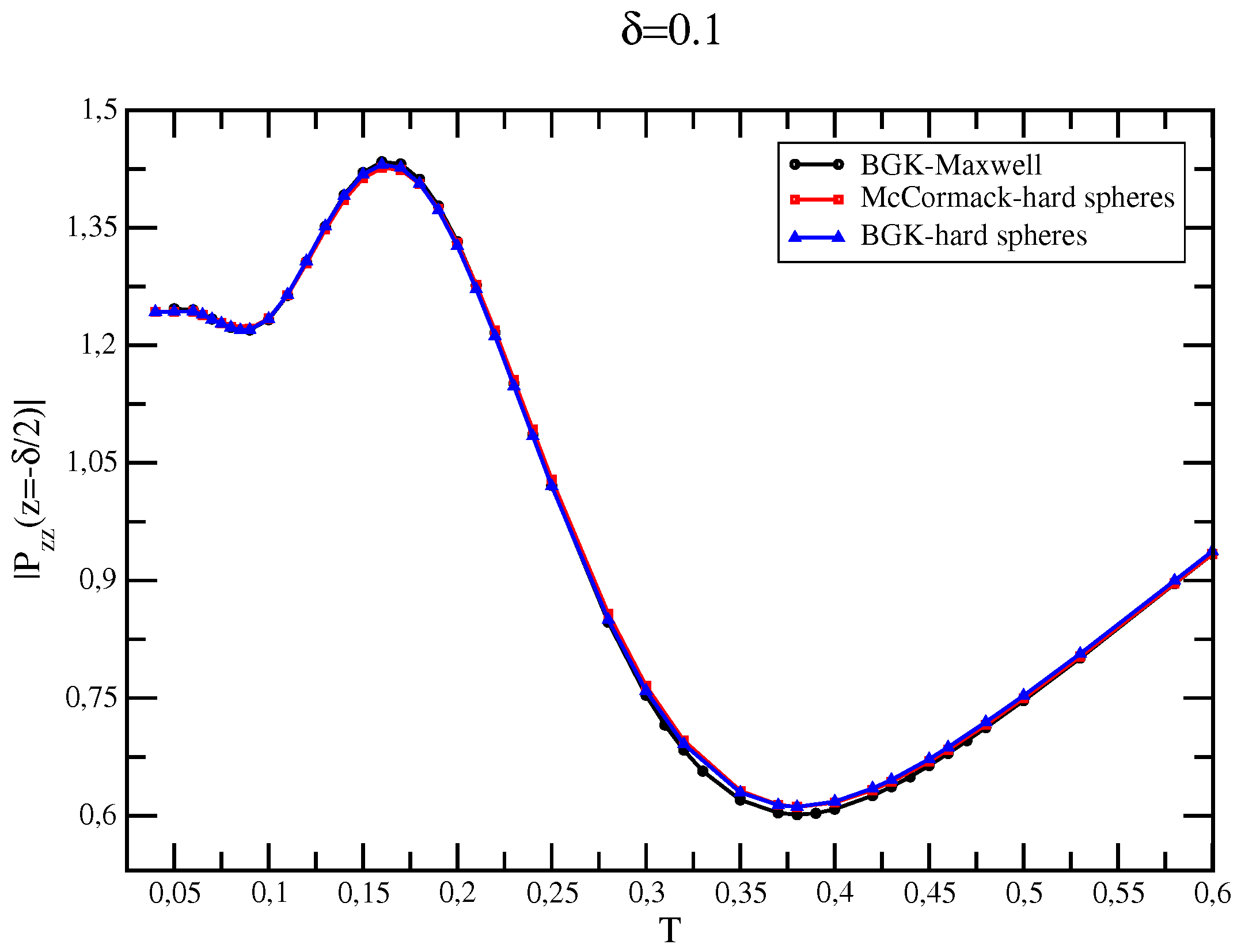
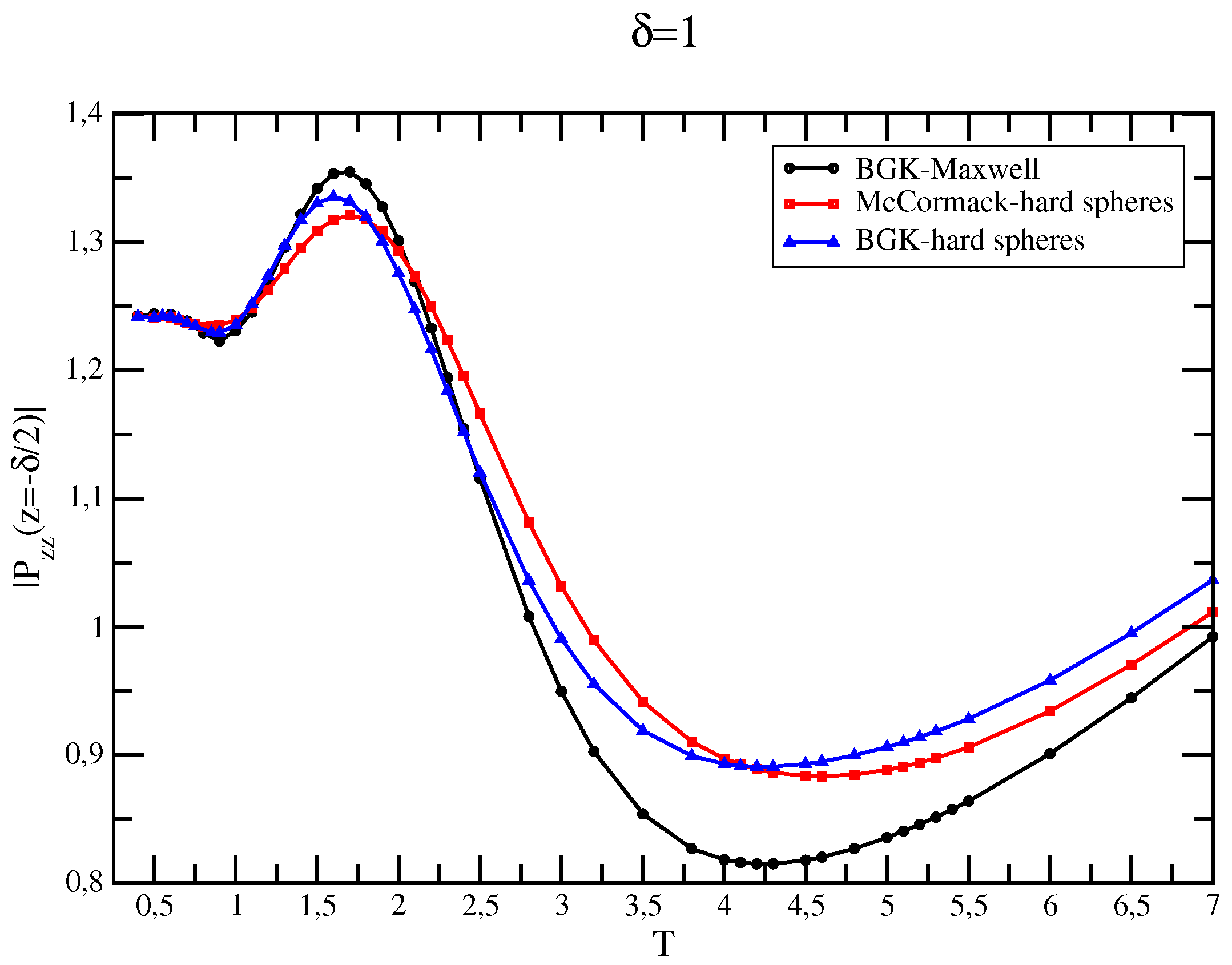
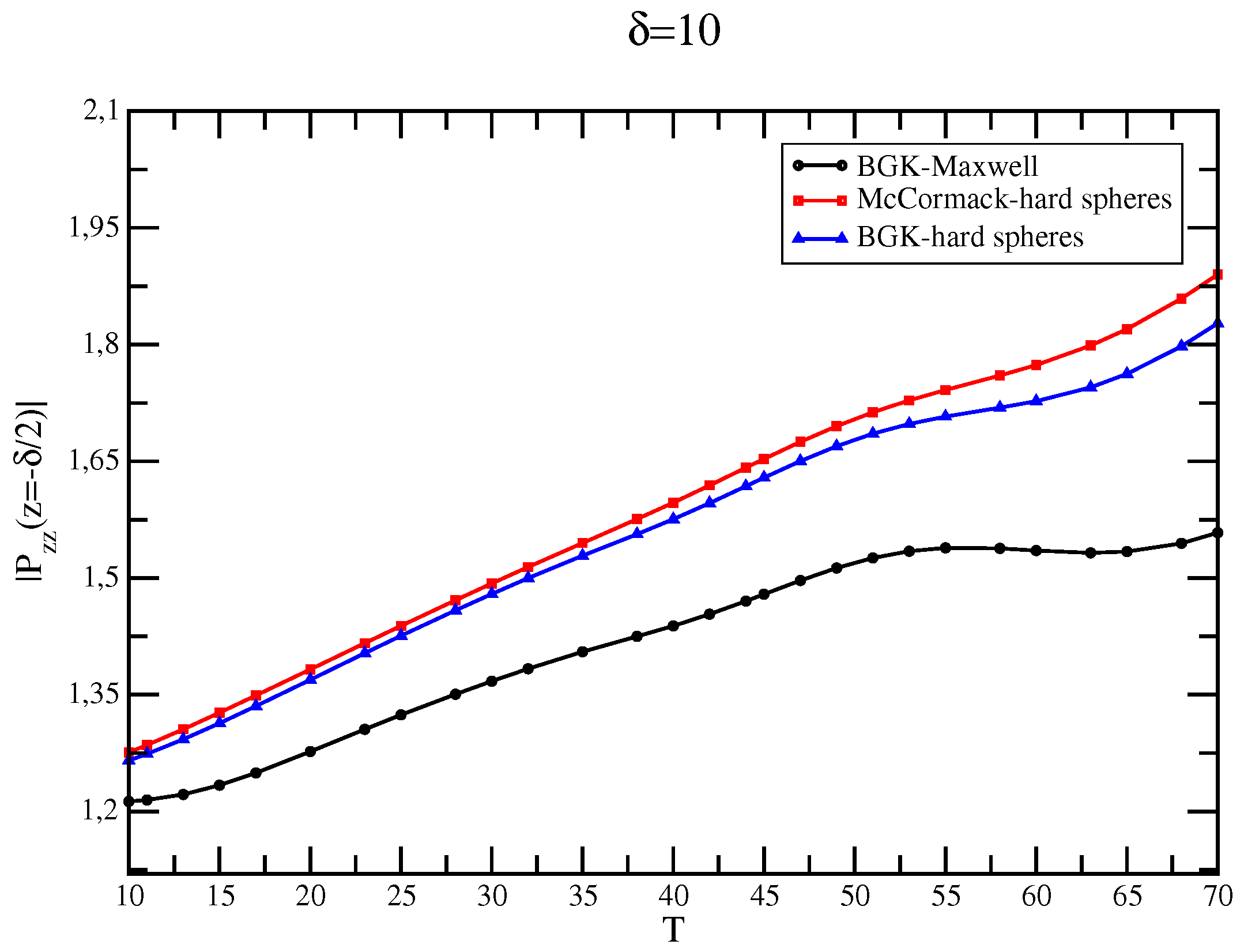
In order to assess the reliability of the BGK-type model introduced in the previous section, we present here the results related to the noble gaseous mixture of He-Xe (that is, helium with molecular mass m 1 = 4.0026 au and xenon with molecular mass m 2 = 131.29 au ), since the behavior of disparate-mass gas mixtures (composed of very heavy plus very light molecules) is more challenging to describe compared with that of mixtures whose constituents have similar molecular masses. In Figure 1, Figure 2 and Figure 3, we report the profiles of the global normal stress amplitude at the oscillating wall, | P z z ( z = δ / 2 ) | (Equations (70)–(72)), obtained by numerical integration of Equations (48)–(51) for hard-sphere molecules with boundary conditions (62)–(69), as a function of the period T, for three values of the rarefaction parameter δ , ranging from the near free-molecular flow ( δ = 0.1 ), through the transition region ( δ = 1 ), up to the near-continuum regime ( δ = 10 ). For the sake of comparison, we also include in these figures the results obtained by numerical integration of the McCormack model with intermolecular rigid-sphere interactions (Equations (41)–(44) in [18]) and those derived from the BGK model proposed by Andries–Aoki–Perthame in [9] for Maxwell molecules. In all cases, we have considered a mixture with the same molar concentrations of the two components, N 12 = n 1 , 0 n 2 , 0 = 1 , and an incomplete wall accommodation, different for the two species. Indeed, recent theoretical and experimental investigations have pointed out that the accommodation coefficients depend strongly on the molecular masses of the gas components [21]. Therefore, following the findings presented in [31], we have chosen α 1 = 0.53 (for the lighter species) and α 2 = 0.86 (for the heavier component), corresponding to aluminum surfaces. In our computations, the rigid-sphere diameters d s ( s = 1 , 2 ) of every species s are determined as indicated in Appendix A. Thus, the diameter ratio D 12 = d 1 / d 2 is taken equal to 0.4492 for the He-Xe mixture. Figure 1, Figure 2 and Figure 3 reveal that there is good agreement between the outcomes of the BGK and McCormack models based on the hard-sphere interaction potential for all values of the rarefaction parameter, while the discrepancy with the results obtained from the BGK model for Maxwell molecules becomes larger with increasing δ . Similar to the case of diffuse reflection boundary conditions ( α 1 = α 2 = 1 ) studied in [22], these figures show that, in the near-free molecular flow regime ( δ = 0.1 ) and in the transitional region ( δ = 1 ), the system exhibits a resonant response (when the amplitude of P z z at z = δ / 2 reaches its maximum value) or an antiresonant response (when the amplitude of P z z at z = δ / 2 reaches its minimum value) due to the constructive/destructive interference occurring between the incident and reflected sound waves generated by the oscillating wall of the channel. On the contrary, in the near-continuum regime ( δ = 10 ), this phenomenon does not appear, as long as the molar concentrations of the two species are the same. This issue has been studied in great detail for complete diffusion in [22], and a comparison with single-component gas behavior [32] has revealed that the lack of resonance in a disparate-mass gas mixture is due to the fact that, in the near-continuum regime, when there is a large number of collisions between the two species, if the molar concentration is nearly the same ( N 12 1 ), the particles of the heaviest component of the mixture slow down those of the lightest species and no sound waves can reach the fixed wall of the channel, generating interference. However, when n 1 , 0 > > n 2 , 0 (that is, N 12 > > 1 ), the two species behave almost independently of each other (as is always the case when δ = 0.1 and δ = 1 for each value of N 12 ), so that the sound waves associated with the He component of the mixture can again interfere to produce resonances. This still remains true for an incomplete wall accommodation when α 1 α 2 1 . It is worth noting that, beyond the first-order resonant/antiresonant response of the system (corresponding to the main maxima and minima in Figure 1 and Figure 2), higher-order resonances appear for smaller values of T.
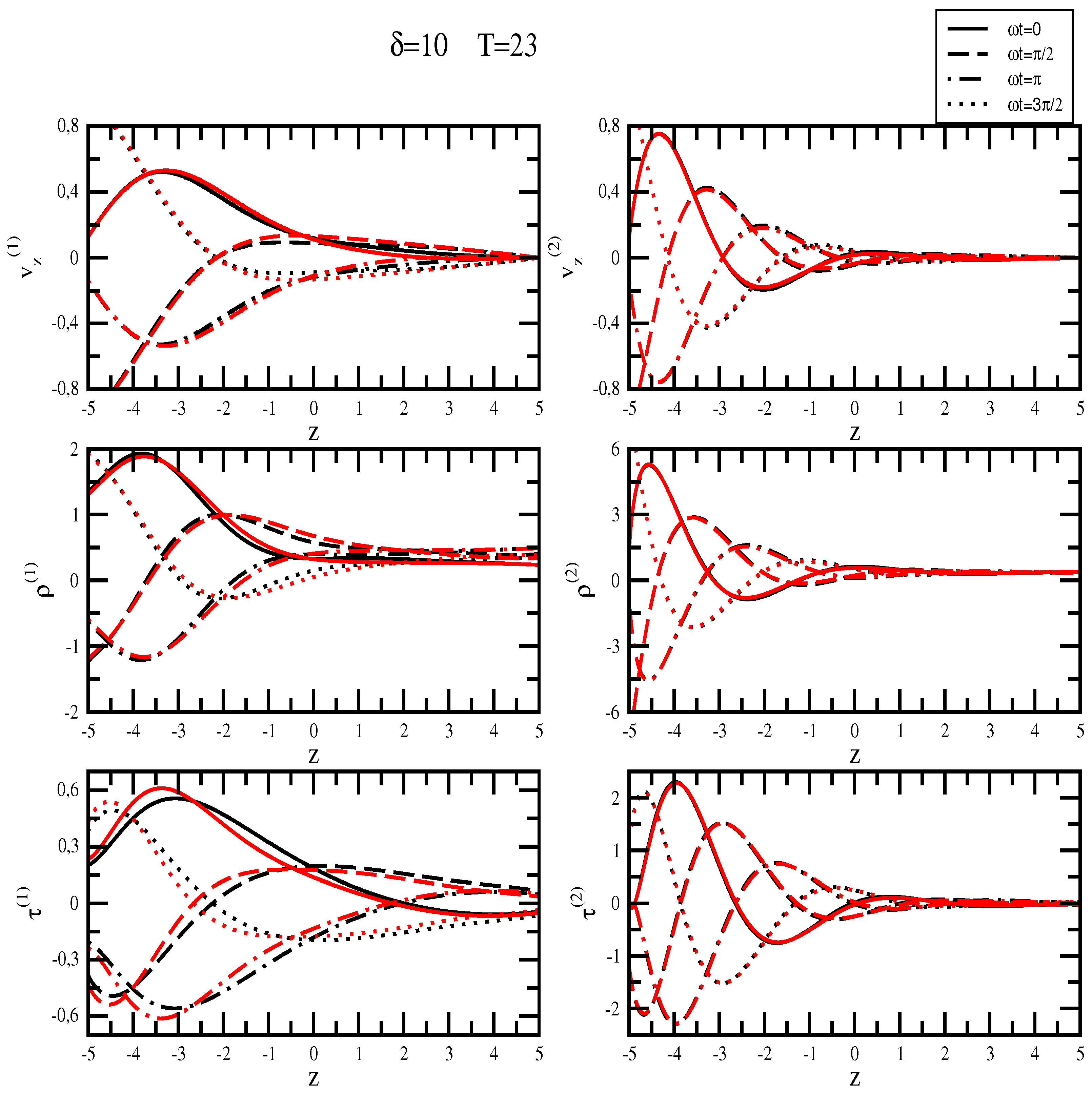
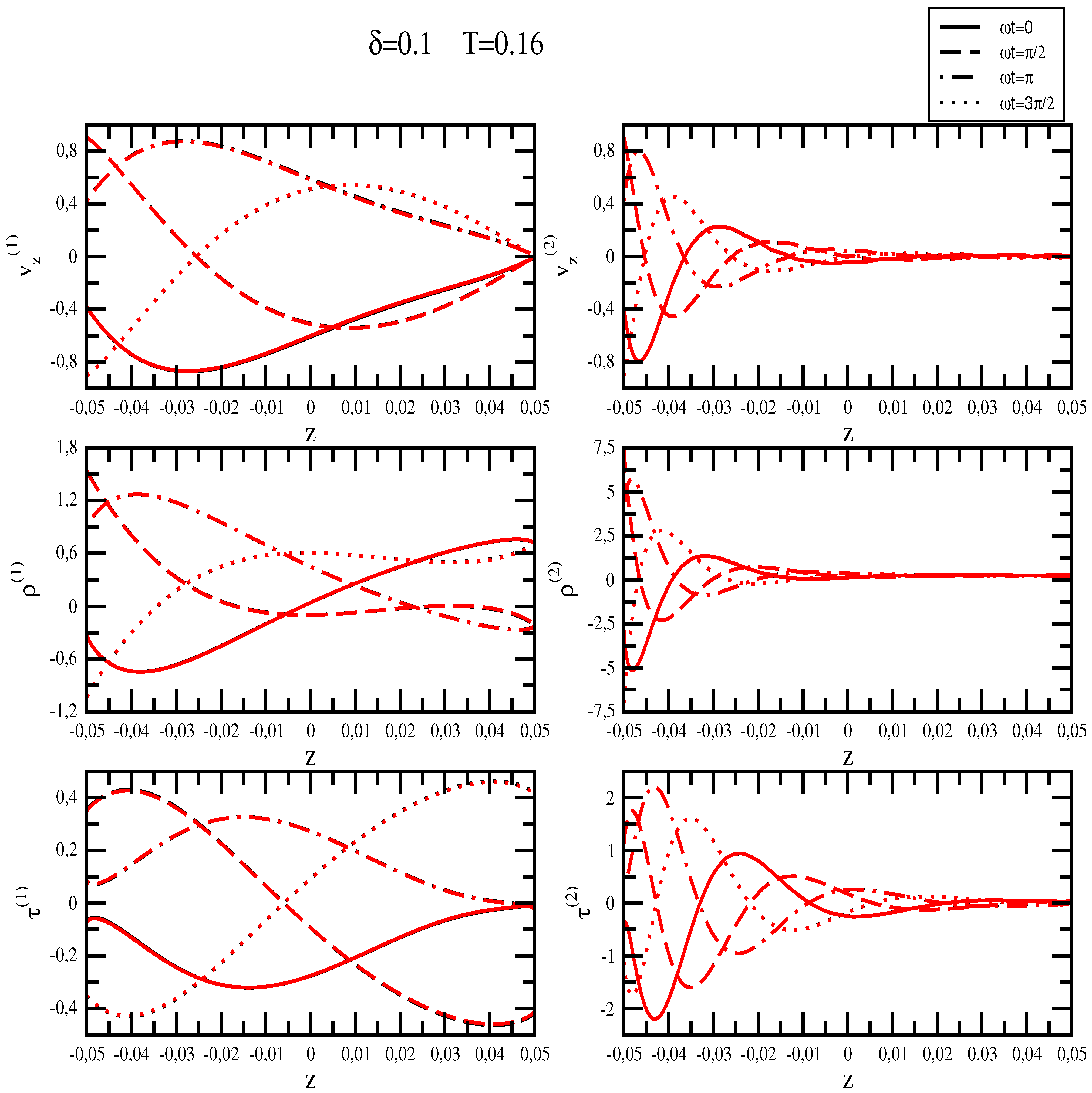
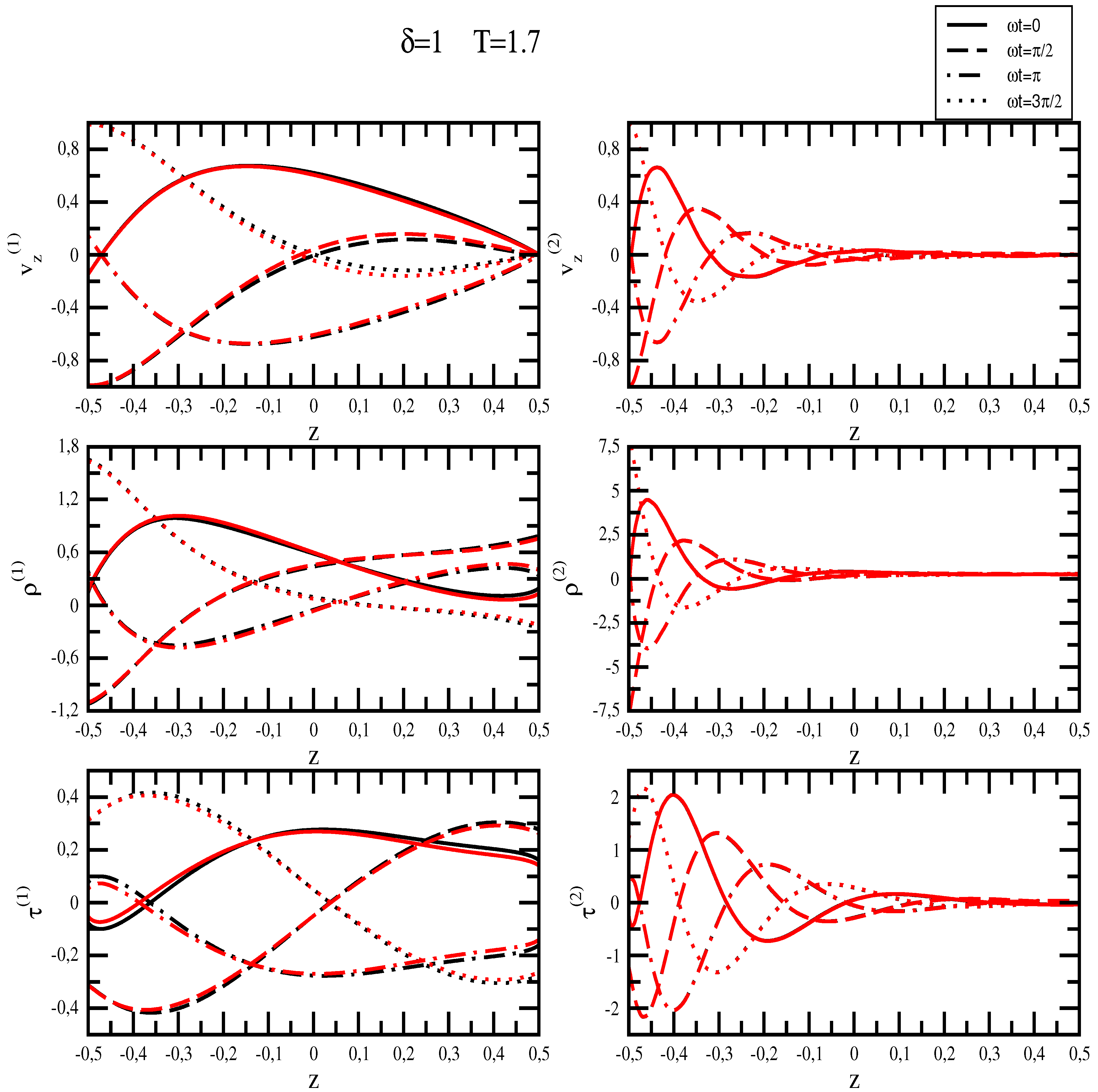
The physical processes underlying the behavior of the mixture can be better investigated by examining the macroscopic fields associated with each species. To this end, we report in Figure 4, Figure 5 and Figure 6 the velocity, density, and temperature profiles of the mixture components, v z ( s ) , ρ ( s ) , τ ( s ) ( s = 1 , 2 ) , as a function of the distance z across the gap of the channel (at different stages during a period of oscillation) for different values of the rarefaction parameter. We include in these figures the results obtained by numerical integration of the BGK and McCormack models for hard-sphere molecules and equal molar concentrations ( N 12 = 1 ). For δ = 0.1 and δ = 1 , we have chosen a period T matching the resonant response of the system, while, for δ = 10 (since, in this case, no resonances appear), we have considered a period T corresponding to the occurrence of the resonance for a single-component gas [32]. In all figures presented, the lightest component of the mixture is labeled with superscipt 1, while the heaviest one is labeled with superscript 2. These figures again reveal very good agreement between the two models for each value of the rarefaction parameter and show a unique feature of disparate-mass gas mixtures, as already highlighted by theoretical studies with complete diffusion and experimental data [22,33,34,35,36]. Specifically, two different forced-sound modes are simultaneously present: a fast wave associated with the He component and a damped slow wave carried by the Xe. Therefore, the appearance of resonances/antiresonances is linked only to the constructive/destructive interference occurring between the incident and reflected sound waves associated with the lightest species (He). Indeed, Figure 4 and Figure 5, obtained for δ = 0.1 and δ = 1 when the period T matches the resonant response of the system, show that, under these conditions, the velocity field of the lighter species ( v z ( 1 ) ) assumes a form characteristic of a standing wave, which can be considered a signature of the occurrence of the interference phenomenon. Moreover, these figures show that the two components of the gas mixture present very different variations in the perturbed temperature field, even in the near-continuum regime ( δ = 10 ). Indeed, Grad already conjectured in 1960 [37] that, in disparate-mass gas mixtures, the slow exchange of kinetic energy between the two species should lead to two temperatures: one associated with the lightest component and the other with the heaviest component. Later on, this conjecture was verified experimentally and theoretically, and two-temperature hydrodynamics was proposed as an extension of classical fluid mechanics. Two-temperature equations, necessary to replace those of classical hydrodynamics (which provide a description at the Navier–Stokes level) in part of the continuum regime, have been developed by a number of authors [38,39]. Unfortunately, all these models rely on unjustified assumptions, so that they cannot provide quantitatively accurate results. Therefore, kinetic theory can be a useful tool in order to derive new and more realistic model equations describing the two-temperature regime at the continuum level.
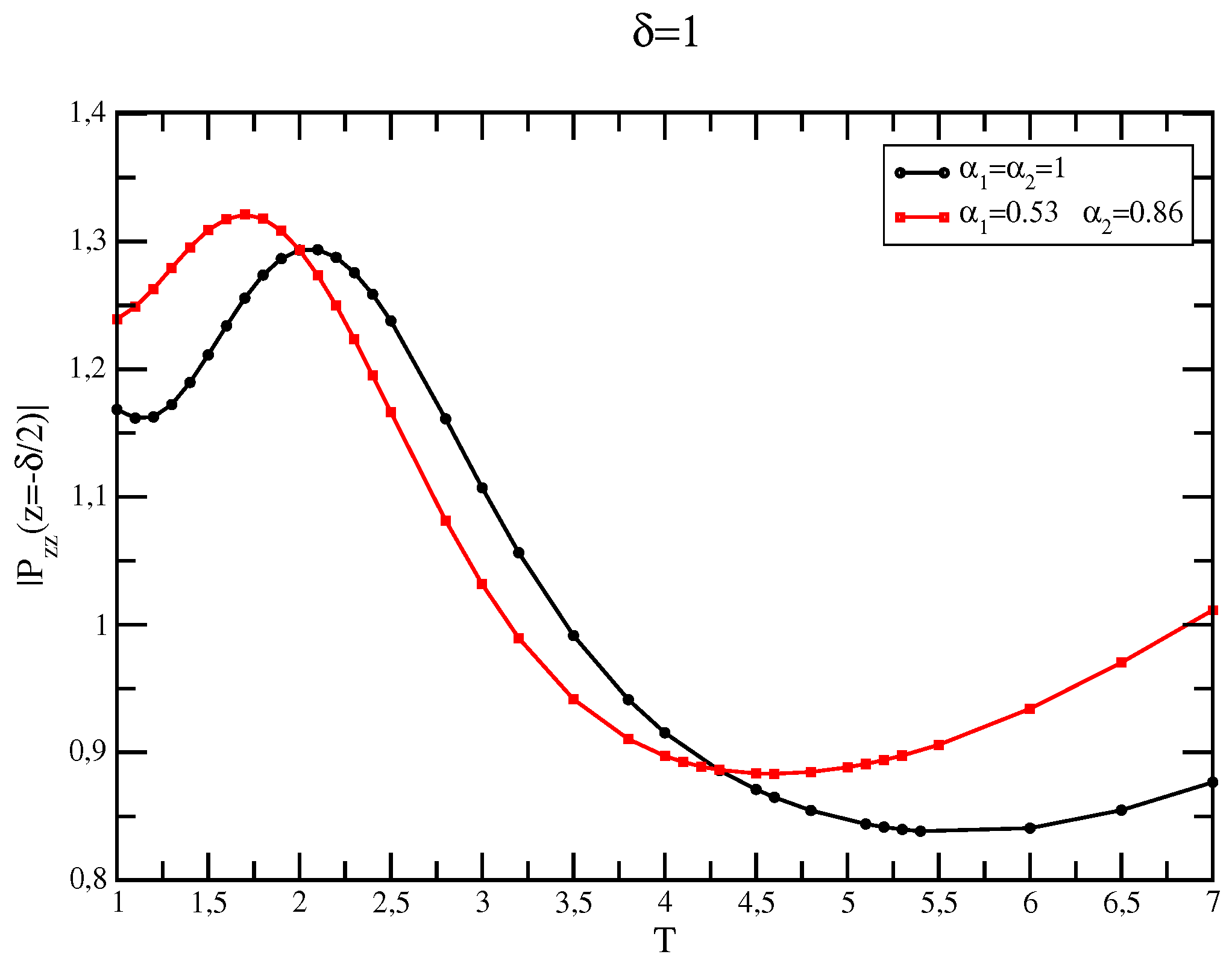
To conclude, we can observe that, assuming an incomplete wall accommodation instead of diffuse reflection boundary conditions, the qualitative behavior of a disparate-mass gas mixture does not undergo significant changes, but some quantitative differences arise. As an example, we present in Figure 7 a comparison between the profiles of the global normal stress amplitude at the oscillating wall, | P z z ( z = δ / 2 ) | , for δ = 1 and hard-sphere interactions, computed by taking different pairs of accommodation coefficients for the two species: α 1 = α 2 = 1 (circles) and α 1 = 0.53 , α 2 = 0.86 (squares). The figure shows that, when the gas–wall interaction properties differ from those in complete diffusion, the period T for the occurrence of the resonant and antiresonant responses of the system decreases. This finding remains valid in general for all values of δ .

5. Concluding Remarks

In this paper, we have generalized a linearized BGK-type collision operator for binary gas mixtures, originally derived in non-linear form for Maxwell molecules, in order to take into account more realistic intermolecular forces between the species. To evaluate the accuracy of this modified BGK model, we have analyzed high-frequency sound wave propagation in a disparate-mass gas mixture (He-Xe), flowing through a microchannel, by assuming Maxwell boundary conditions. The results for hard-sphere molecules confirm that the new model provides outputs that are very close to those obtained by more refined kinetic descriptions (like the McCormack model) in all rarefaction regimes. It is worth noting that while, in this work, we have presented the linearized version of this new BGK-type model, a general non-linear form could also be derived by following the same strategy reported in Section 2.3 but imposing the equality constraints (28) and (29), without neglecting higher-order terms. It is still challenging to further generalize the model in such a way that heat flux vectors can be successfully described. This should be the subject of future study.
From a physical point of view, the results reported in the present paper are significant in addressing two main issues. On the one hand, the findings presented here can be used to address the long-standing open question about the exact nature of the interfering sound modes excited in disparate-mass gas mixtures by high-frequency wall oscillations [33,34,35,36]. Indeed, Figure 4, Figure 5 and Figure 6 show that two distinct forced-sound modes exist simultaneously: a fast and a slow wave. The slow wave is a damped sound-like mode carried by the heaviest component of the mixture (Xe), while the fast wave is associated with the lightest species (He). These outcomes are in agreement with the theoretical investigations and experiments reported in [33,34,35,36]. Furthermore, the phenomenon of double sound propagation could be exploited to design microseparators of gas mixtures based on a new, innovative technology. Nowadays, porous membranes are widely used in gas mixture separation processes. Indeed, under appropriate conditions, a membrane acts as a selective barrier that allows the passage of certain components and retains others. Unfortunately, this technology faces significant disadvantages, which include material durability, low separation efficiency, and high manufacturing costs. By exploiting the results presented in this work, one could propose an alternative method to separate gas mixtures that relies on the different propagation speeds of the sound waves associated with the two species.
On the other hand, the findings reported in the previous sections can be considered particularly relevant in the manufacturing processes of a new generation of radio-frequency micro-electro-mechanical system (RF-MEMS) devices, vibrating at high frequencies (ranging from 1 MHz to 60 GHz). During the wafer-bonding process, when different materials are integrated to create a multilayer structure, specific gas mixtures are introduced to set the working pressure of the device (backfilling process). Indeed, when a MEMS device vibrates at a low frequency, the damping forces exerted by the surrounding gas (typically air), due to its internal friction, can be reduced only by realizing vacuum packaging (viscous damping). Instead, RF-MEMS devices can work well also at atmospheric pressure, since they experience an entirely different damping mechanism related to the sound waves generated by the movable plates of the microdevice vibrating at a high frequency. Indeed, we have proven that, when sound waves propagate between the microchannel walls, they can interfere in such a way as to considerably reduce the amplitude of the normal stress tensor on the oscillating plate (damping force). Since antiresonances can arise for each value of the rarefaction parameter δ (provided that the concentration of the species in the gas mixture is properly calibrated), RF-MEMS devices can perform well also at atmospheric pressure, without any additional cost to create the vacuum.

Funding

This research received no external funding.

Institutional Review Board Statement

Not applicable.

Informed Consent Statement

Not applicable.

Data Availability Statement

The original contributions presented in this study are included in the article. Further inquiries can be directed to the corresponding author.

Acknowledgments

S.L. was supported by the GNFM of INdAM (Istituto Nazionale di Alta Matematica “F. Severi”), Italy.

Conflicts of Interest

The author declares no conflicts of interest.

Appendix A. Chapman–Cowling Integrals

In the following, we report the explicit expressions of the Chapman–Cowling integrals Ω s , r i j for different intermolecular potentials [24], and we discuss the procedure for their computation. For generic collision cross-sections, these integrals are defined as follows:
Ω s , r i j = 2 π k B T μ s r 1 / 2 0 + d g e g 2 g 2 j + 3 0 + ( 1 cos i χ ) b d b
where g = μ s r / ( 2 k B T ) | ξ ξ * | , b is the collision parameter (representing the shortest distance at which the center of the r-particle would pass the center of the s-particle), and χ is the angle between V = ( ξ ξ * ) and V = ( ξ ξ * ) . The remaining nomenclature is the same as reported in the main body of the paper.

Appendix A.1. Maxwell Molecules

Maxwell molecules refer to a particular model of inverse power-law interaction potential
U s r = K s r r ν 1
with ν = 5 . In (A2), r is the distance between the centers of the molecules and K s r is the interparticle force law constant. In this case, the Chapman–Cowling integrals (A1) can be written in terms of the gamma function Γ :
Ω s , r i j = A i ( 5 ) 2 π K s r μ s r Γ ( j + 3 2 )
In (A3), the constants A i ( 5 ) , which represent dimensionless collision cross-sections, assume the values
A 1 ( 5 ) = 0.422 , A 2 ( 5 ) = 0.436 ,
while the constants K 11 and K 22 can be computed using the first approximation to the single-gas viscosity coefficient η s ( s = 1 , 2 ) , as reported by Chapman and Enskog:
η s = 1 3 π 2 m s K s s 1 / 2 ( k B T ) A 2 ( 5 ) .
In (A4), we have taken into account the experimental data on the viscosities η s at the temperature T = 300 K given in [40]:
η He = 20.04 μ P a s ; η Xe = 23.16 μ P a s .
Finally, the last constant K 12 is determined by the method of the combination rule:
K 12 = ( K 11 K 22 ) 1 / 2 .

Appendix A.2. Hard-Sphere Molecules

When the molecules are represented by rigid elastic spheres, the apse line coincides with the line joining their centers at the moment of collision. In this case, the distance σ s r between the centers of the spheres is connected with their diameters d s and d r by the relation σ s r = ( d s + d r ) / 2 , and the impact parameter can be expressed as follows: b = σ s r cos ( χ / 2 ) . Thus, the Chapman–Cowling integrals (A1) read
Ω s , r i j = ( j + 1 ) ! 8 1 ( 1 + ( 1 ) i ) 2 ( i + 1 ) π k B T 0 2 μ s r 1 / 2 ( d s + d r ) 2
Following ref. [41], the rigid-sphere diameters d s ( s = 1 , 2 ) of every species s are computed by the fourth degree of approximation to the single-gas viscosity coefficient:
η s = 1.016034 · 5 16 m s k B T π d s 2
In (A6), we have used the experimental data on the viscosities η s at the temperature T = 300 K reported in [40].

Appendix B. Numerical Method of Solution

The time-dependent problem described by Equations (48)–(51) with boundary conditions (62)–(69) and initial conditions
H ( 1 ) ( z , c z , t = 0 ) = H ( 2 ) ( z , c z , t = 0 ) = Ψ ( 1 ) ( z , c z , t = 0 ) = Ψ ( 2 ) ( z , c z , t = 0 ) = 0 ,
has been numerically solved using a standard upwind implicit finite difference scheme [22,29]. Due to the simple geometry, the region between the parallel plates of the channel has been divided into a number of cells of uniform size, and the distribution functions H ( s ) and Ψ ( s ) ( s = 1 , 2 ) have been assumed to be constant within each cell. Following previous numerical studies [22,29], emitter plate displacement is not taken into account. The gas experiences the plate motion only through the boundary conditions. Similarly, a regular net of nodes has been arranged into a finite domain of the one-dimensional velocity space, large enough to contain a significant number of the distribution functions (taken to be constant within each cell) at any spatial location. We have restricted the range of the molecular velocity to the finite domain [ 5.5 , 5.5 ] , since the results of the computations confirmed that, outside this domain, the integrands occurring in the definitions of the macroscopic fields (56)–(61) are negligibly small. The following first-order implicit scheme has been considered:
G j ( s ) ( n + 1 ) ( l ) = [ 1 + r j ( l ) + Δ t ] 1 × G j ( s ) ( n ) ( l ) + r j ( l ) G j w ( s ) ( n + 1 ) ( l ) + Δ t L j ( s ) ( n ) ( l )
where
w = sgn ( c z ( l ) ) , r j ( l ) = Δ t | c z ( l ) | Δ z j .
In Equation (A7), the notation G j ( s ) ( n ) ( l ) ( s = 1 , 2 ) indicates each of the distribution functions ( H ( 1 ) ( z , c z , t ) , H ( 2 ) ( z , c z , t ) , Ψ ( 1 ) ( z , c z , t ) , Ψ ( 2 ) ( z , c z , t ) ) evaluated in z = z j , t = n Δ t , c z = c z ( l ) , with z j being the spatial coordinate of the center of the j-th cell, whose width is Δ z j , Δ t is the time step, and c z ( l ) is the coordinate of the center of the cell l in the velocity space. Furthermore, the term L j ( s ) ( n ) ( l ) represents the discretization of the right-hand sides of Equations (48)–(51), containing the macroscopic fields ( ρ ( 1 ) , ρ ( 2 ) , v z ( 1 ) , v z ( 2 ) , τ ( 1 ) , τ ( 2 ) ). The grid parameters have been chosen so as to keep the computational error on the macroscopic fields within 0.5 % . The variation in the macroscopic profiles due to the increase in the grid parameters has been used as the criterion for the calculation accuracy. In Table A1, we summarize the values of the parameters employed in the numerical simulations. We note that the time step ( Δ t ) is related to the period of oscillation (T) of the moving wall through the relationship Δ t 10 2 T .
Table A1. The values of the grid parameters employed in the numerical simulations. The symbols M and n v z indicate the number of spatial points and the nodes in the velocity space, respectively.
δ M nvz
0.1 20003500
130002500
1040002500
For a single monoatomic gas, this numerical scheme has been validated in [32] by comparing the values of the amplitude and the phase of P z z at the oscillating wall with those obtained in [28] via a discrete velocity method of solution. Furthermore, the same numerical discretization technique employed in the present paper has been considered in [22] to analyze sound wave propagation in binary gas mixtures, using a BGK model derived in closed form for Maxwell molecules. In [22], the velocity profiles of the gas components, v z ( 1 ) and v z ( 2 ) , computed through the definitions (58) and (59) after numerical integration of the kinetic Equations (48)–(51), have been compared with the semi-analytical solutions of integral equations for the same macroscopic fields, derived by integrating Equations (48)–(51) along the trajectories of the molecules (Equations (47) and (48) in [22]). The comparison reveals very good agreement between the two methods of solution. All these analyses show the reliability of our numerical technique, albeit still lacking a complete experimental data set.

References

  1. Downie, N.A. Industrial Gases; Kluwer Academic Publishers: Dordrecht, The Netherlands, 2002. [Google Scholar]
  2. Tabeling, P. Introduction to Microfluidics; Oxford University Press: Oxford, UK, 2011. [Google Scholar]
  3. Cercignani, C. The Boltzmann Equation and Its Applications; Springer: New York, NY, USA, 1988. [Google Scholar]
  4. Gross, E.P.; Krook, M. Model for collision processes in gases: Small-amplitude oscillations of charged two-component systems. Phys. Rev. 1956, 102, 593. [Google Scholar] [CrossRef]
  5. Sirovich, L. Kinetic modeling of gas mixtures. Phys. Fluids 1962, 5, 908. [Google Scholar] [CrossRef]
  6. Hamel, B.B. Kinetic model for binary gas mixtures. Phys. Fluids 1965, 8, 418. [Google Scholar] [CrossRef]
  7. Goldman, E.; Sirovich, L. Equations for gas mixtures. Phys. Fluids 1967, 10, 1928. [Google Scholar] [CrossRef]
  8. McCormack, F.J. Construction of linearized kinetic models for gaseous mixtures and molecular gases. Phys. Fluids 1973, 16, 2095. [Google Scholar] [CrossRef]
  9. Andries, P.; Aoki, K.; Perthame, B. A consistent BGK-type model for gas mixtures. J. Stat. Phys. 2002, 106, 993. [Google Scholar] [CrossRef]
  10. Gupta, V.K.; Struchtrup, H.; Torrilhon, M. Regularized moment equations for binary gas mixtures: Derivation and linear analysis. Phys. Fluids 2016, 28, 042003. [Google Scholar] [CrossRef]
  11. Gatignol, R.; Croizet, C. Asymptotic modeling of thermal binary monatomic gas flows in plane microchannels-Comparison with DSMC simulations. Phys. Fluids 2017, 29, 042001. [Google Scholar] [CrossRef]
  12. Bobylev, A.V.; Bisi, M.; Groppi, M.; Spiga, G.; Potapenko, I.F. A general consistent BGK model for gas mixtures. Kinet. Relat. Models 2018, 11, 1377. [Google Scholar] [CrossRef]
  13. Sabouri, M.; Darbandi, M. Numerical study of species separation in rarefied gas mixture flow through micronozzles using DSMC. Phys. Fluids 2019, 31, 042004. [Google Scholar] [CrossRef]
  14. Pirner, M. A review on BGK models for gas mixtures of mono and polyatomic molecules. Fluids 2021, 6, 393. [Google Scholar] [CrossRef]
  15. Sharma, B.; Kumar, R.; Pareek, S. Bulk viscosity of dilute gases and their mixtures. Fluids 2023, 8, 28. [Google Scholar] [CrossRef]
  16. Ho, M.; Tucny, J.M.; Ammar, S.; Leclaire, S.; Reggio, M.; Trepanier, J.Y. Lattice Boltzmann model for rarefied gaseous mixture flows in three-dimensional porous media including Knudsen diffusion. Fluids 2024, 9, 237. [Google Scholar] [CrossRef]
  17. Bhatnagar, P.L.; Gross, E.P.; Krook, M. A model for collision processes in gases. I. Small amplitude processes in charged and neutral one-component systems. Phys. Rev. 1954, 94, 511. [Google Scholar] [CrossRef]
  18. Lorenzani, S. Kinetic modeling for the time-dependent behavior of binary gas mixtures. In Proceedings of the Rarefied Gas Dynamics: 31st International Symposium, Glasgow, UK, 23–27 July 2018. [Google Scholar]
  19. Lorenzani, S. A microchannel flow application of a linearized kinetic Bhatnagar-Gross-Krook-type model for inert gas mixtures with general intermolecular forces. Phys. Fluids 2019, 31, 072001. [Google Scholar] [CrossRef]
  20. Szalmas, L.; Pitakarnnop, J.; Geoffroy, S.; Colin, S.; Valougeorgis, D. Comparative study between computational and experimental results for binary rarefied gas flows through long microchannels. Microfluid. Nanofluidics 2010, 9, 1103. [Google Scholar] [CrossRef]
  21. Prabha, S.K.; Sathian, S.P. Determination of accommodation coefficients of a gas mixture in a nanochannel with molecular dynamics. Microfluid. Nanofluidics 2012, 13, 883. [Google Scholar] [CrossRef]
  22. Bisi, M.; Lorenzani, S. High-frequency sound wave propagation in binary gas mixtures flowing through microchannels. Phys. Fluids 2016, 28, 052003. [Google Scholar] [CrossRef]
  23. Mxwell, J.C. On stress in rarefied gases arising from inequalities of temperature. Phil. Trans. R. Soc. Lond. 1879, 170, 231. [Google Scholar]
  24. Chapman, S.; Cowling, T.G. The Mathematical Theory of Non-Uniform Gases; Cambridge University Press: Cambridge, UK, 1970. [Google Scholar]
  25. Groppi, M.; Spiga, G. A Bhatnagar-Gross-Krook-type approach for chemically reacting gas mixtures. Phys. Fluids 2004, 16, 4273. [Google Scholar] [CrossRef]
  26. Lorenzani, S. Semi-analytical methods of solution for the BGK-Boltzmann equation describing sound wave propagation in binary gas mixtures. In Innovative Algorithms and Analysis; Gosse, L., Natalini, R., Eds.; Springer Indam Series 16; Springer: Cham, Switzerland, 2017; pp. 289–311. [Google Scholar]
  27. Naris, S.; Valougeorgis, D. Rarefaction effects in the driven cavity flow over the whole range of the Knudsen number. Phys. Fluids 2005, 17, 097106. [Google Scholar] [CrossRef]
  28. Kalempa, D.; Sharipov, F. Sound propagation through a rarefied gas confined between source and receptor at arbitrary Knudsen number and sound frequency. Phys. Fluids 2009, 21, 103601. [Google Scholar] [CrossRef]
  29. Lorenzani, S.; Gibelli, L.; Frezzotti, A.; Frangi, A.; Cercignani, C. Kinetic approach to gas flows in microchannels. Nanoscale Microscale Thermophys. Eng. 2007, 11, 211. [Google Scholar] [CrossRef]
  30. Bisi, M.; Lorenzani, S. Damping forces exerted by rarefied gas mixtures in micro-electro-mechanical system devices vibrating at high frequencies. Interfacial Phenom. Heat Transf. 2014, 2, 253. [Google Scholar] [CrossRef]
  31. Selden, N.; Gimelshein, N.; Gimeshein, S.; Ketsdever, A. Analysis of accommodation coefficients of noble gases on aluminum surface with an experimental/computational method. Phys. Fluids 2009, 21, 073101. [Google Scholar] [CrossRef]
  32. Desvillettes, L.; Lorenzani, S. Sound wave resonances in micro-electro-mechanical systems devices vibrating at high frequencies according to the kinetic theory of gases. Phys. Fluids 2012, 24, 092001. [Google Scholar] [CrossRef]
  33. Huck, R.J.; Johnson, E.A. Possibility of double sound propagation in disparate-mass gas mixtures. Phys. Rev. Lett. 1980, 44, 142. [Google Scholar] [CrossRef]
  34. Huck, R.J.; Johnson, E.A. Physical properties of double-sound modes in disparate-mass gas mixtures. In Rarefied Gas Dynamics; Fisher, S.S., Ed.; American Institute of Astronautics and Aeronautics: New York, NY, USA, 1981; pp. 452–463. [Google Scholar]
  35. Bowler, J.R.; Johnson, E.A. Anomalous dispersion in disparate-mass gas mixtures. Phys. Rev. Lett. 1985, 54, 329. [Google Scholar] [CrossRef]
  36. Bowler, J.R.; Johnson, E.A. Anomalous sound propagation and mode degeneracy in noble gas mixtures. Proc. R. Soc. Lond. A 1986, 408, 79. [Google Scholar] [CrossRef]
  37. Grad, H. Theory of rarefied gas dynamics. In Rarefied Gas Dynamics; Deviene, F.M., Ed.; Pergamon: New York, NY, USA, 1960; p. 100. [Google Scholar]
  38. Johnson, E.A. Two-temperature hydrodynamics and multiple sound modes in disparate-mass gas mixtures. J. Stat. Phys. 1989, 57, 647. [Google Scholar] [CrossRef]
  39. Goebel, C.J.; Harris, S.M.; Johnson, E.A. Two-temperature disparate-mass gas mixtures: A thirteen moment description. Phys. Fluids 1976, 19, 627. [Google Scholar] [CrossRef]
  40. Kestin, J.; Knierim, K.; Mason, E.A.; Najafi, B.; Ro, S.T.; Waldman, M. Equilibrium and transport properties of the noble gases and their mixtures at low density. J. Phys. Chem. Ref. Data 1984, 13, 229. [Google Scholar] [CrossRef]
  41. Naris, S.; Valougeorgis, D.; Kalempa, D.; Sharipov, F. Gaseous mixture flow between two parallel plates in the whole range of the gas rarefaction. Phys. A Stat. Mech. Appl. 2004, 336, 294–318. [Google Scholar] [CrossRef]
Figure 1. Amplitude of the normal stress tensor P z z at the oscillating wall versus T for δ = 0.1 . Comparison of the results obtained by the BGK model for Maxwell molecules (circles), the McCormack model (squares), and the new BGK model (triangles) for hard-sphere interactions, with N 12 = 1 .
Fluids 11 00089 g001
Figure 2. Amplitude of the normal stress tensor P z z at the oscillating wall versus T for δ = 1 . Comparison of the results obtained by the BGK model for Maxwell molecules (circles), the McCormack model (squares), and the new BGK model (triangles) for hard-sphere interactions, with N 12 = 1 .
Fluids 11 00089 g002
Figure 3. Amplitude of the normal stress tensor P z z at the oscillating wall versus T for δ = 10 . Comparison of the results obtained by the BGK model for Maxwell molecules (circles), the McCormack model (squares), and the new BGK model (triangles) for hard-sphere interactions, with N 12 = 1 .
Fluids 11 00089 g003
Figure 4. Variations in the macroscopic velocity, density, and temperature of the mixture components (with the same molar concentrations) in the z-direction across the gap of the channel for δ = 0.1 and T = 0.16 . Comparison of the results obtained by the McCormack model (red lines) and the new BGK model (black lines) for hard-sphere interactions. In each panel, the profiles of the macroscopic fields are shown at different stages during a period of oscillation of the moving wall.
Fluids 11 00089 g004
Figure 5. Variations in the macroscopic velocity, density, and temperature of the mixture components (with the same molar concentrations) in the z-direction across the gap of the channel for δ = 1 and T = 1.7 . Comparison of the results obtained by the McCormack model (red lines) and the new BGK model (black lines) for hard-sphere interactions. In each panel, the profiles of the macroscopic fields are shown at different stages during a period of oscillation of the moving wall.
Fluids 11 00089 g005
Figure 6. Variations in the macroscopic velocity, density, and temperature of the mixture components (with the same molar concentrations) in the z-direction across the gap of the channel for δ = 10 and T = 23 . Comparison of the results obtained by the McCormack model (red lines) and the new BGK model (black lines) for hard-sphere interactions. In each panel, the profiles of the macroscopic fields are shown at different stages during a period of oscillation of the moving wall.
Fluids 11 00089 g006
Figure 7. Amplitude of the normal stress tensor P z z at the oscillating wall versus T for δ = 1 . Comparison of the results obtained by the McCormack model for hard-sphere interactions and N 12 = 1 with different accommodation coefficients: α 1 = α 2 = 1 (circles), α 1 = 0.53 α 2 = 0.86 (squares).
Fluids 11 00089 g007
Disclaimer/Publisher’s Note: The statements, opinions and data contained in all publications are solely those of the individual author(s) and contributor(s) and not of MDPI and/or the editor(s). MDPI and/or the editor(s) disclaim responsibility for any injury to people or property resulting from any ideas, methods, instructions or products referred to in the content.