
Rational Design of High-Performance Viscosifying Polymers in Confined Systems via a Machine-Learning-Accelerated Multiscale Framework for Enhanced Hydrocarbon Recovery

 , and
, and
Abstract
1. Introduction
2. Models and Methodology
2.1. DPD-ML-Enhanced Strategy Integration for Thickener Design
2.2. Integrated Mesoscale Methodology for Viscosifier Design Flow Simulation via DPD
- (1)
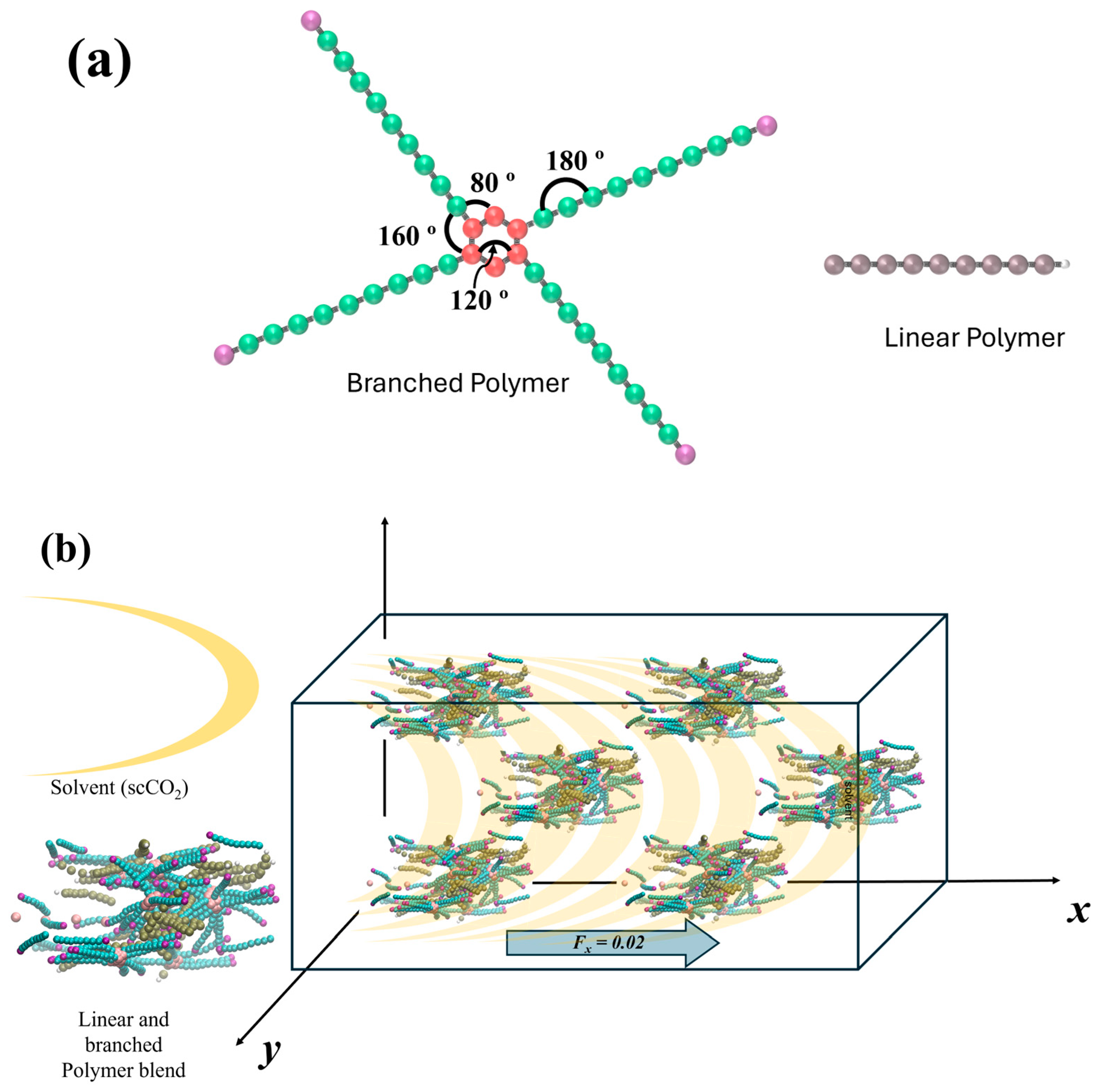
- Six central “A” beads exhibiting attractive interactions (mimicking π-π stacking).
- (2)
- Four “B” arm beads in good solvent conditions (scCO2 solvent).
- (3)
- Chain stiffness controlled via harmonic angular potential:
2.3. Confined Flow Setup and Simulation Parameters

2.4. Shear Viscosity Calculation via Poiseuille Flow Simulations
2.5. Machine Learning Surrogate Model
- ○
- Input Features: Molecular descriptors (topology index, kθ, aij (χij) matrix, concentration [Lm] and [Bm]).
- ○
- Target Output: Computed shear viscosity η at specified shear rates.
- ○
- Algorithms: Our methodological pipeline integrates three core computational techniques: Principal Component Analysis (PCA) for preliminary data exploration and feature analysis, Deep Neural Networks (DNNs) to construct accurate, nonlinear surrogate models linking molecular descriptors to macroscopic viscosity, and the Gradient Ascent optimization algorithm to solve the inverse design problem by navigating the DNN’s parameter space towards optimal formulations.
- ○
- Validation: Models are validated on hold-out simulation data and tested for extrapolation to unseen parameter combinations.
2.6. Optimization and Reinforcement Loop Design
3. Results
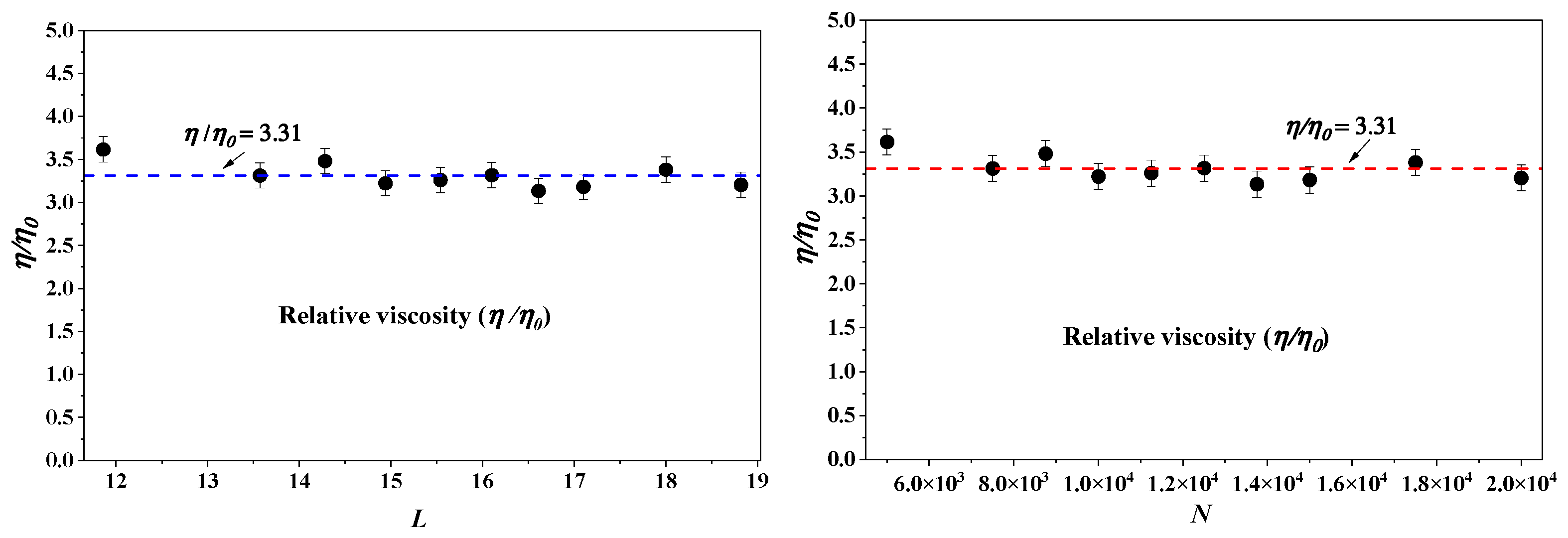
3.1. Finite Size Effect Study and Database Generation
- (a)
- The number of molecules of linear [Lm] and branched [Bm] polymers in an interval of [0, 100];
- (b)
- The flexibility of the linear polymer chain via the spring constant kθ in an interval of [5, 500];
- (c)
- The affinity (aij) between the branched and the linear polymers in an interval of [10, 200].
3.2. Principal Component Analysis (PCA)
3.3. Training Supervised Machine Learning Models for Viscosity Prediction
3.4. Virtual Screening and Inverse Design Framework
3.4.1. Virtual High-Throughput Screening
3.4.2. Analysis of Composition–Flexibility Interplay
3.5. Inverse Design via Gradient-Based Optimization
3.6. Validation and Active Learning
3.7. Study of the Synergistic Effect of a Mixture of Branched and Linear Polymers
4. Conclusions
Author Contributions
Funding
Data Availability Statement
Acknowledgments
Conflicts of Interest
References
- Cummings, S.; Xing, D.; Enick, R.; Rogers, S.; Heenan, R.; Grillo, I.; Eastoe, J. Design principles for supercritical CO2 viscosifiers. Soft Matter 2012, 8, 7044–7055. [Google Scholar] [CrossRef]
- Orr, F.M.; Taber, J.J. Use of Carbon Dioxide in Enhanced Oil Recovery. Science 1984, 224, 563–569. [Google Scholar] [CrossRef] [PubMed]
- Enick, R.M.; Klara, S.M. Effects Of CO2 Solubility in Brine on the Compositional Simulation Of CO2 Floods. SPE Reserv. Eng. 1992, 7, 253–258. [Google Scholar] [CrossRef]
- Mayoral, E.; Goicochea, A.G. Modeling of Branched Thickening Polymers under Poiseuille Flow Gives Clues as to How to Increase a Solvent’s Viscosity. J. Phys. Chem. B 2021, 125, 1692–1704. [Google Scholar] [CrossRef]
- Mayoral, E.; Arcos-Casarrubias, J.; Goicochea, A.G. Self–assembly of model surfactants as reverse micelles in nonpolar solvents and their role as interfacial tension modifiers. Colloids Surf. A Physicochem. Eng. Asp. 2021, 615, 126244. [Google Scholar] [CrossRef]
- Mayoral, E.; Velázquez, J.D.H.; Goicochea, A.G. The viscosity of polyelectrolyte solutions and its dependence on their persistence length, concentration and solvent quality. RSC Adv. 2022, 12, 35494. [Google Scholar] [CrossRef]
- Iskandarov, J.; Ahmed, S.; Fanourgakis, G.S.; Alameri, W.; Froudakis, G.E.; Karanikolos, G.N. Predicting and optimizing CO2 foam performance for enhanced oil recovery: A machine learning approach to foam formulation focusing on apparent viscosity and interfacial tension. Mar. Pet. Geol. 2024, 170, 107108. [Google Scholar] [CrossRef]
- Cheraghi, Y.; Kord, S.; Mashayekhizadeh, V. Application of machine learning techniques for selecting the most suitable enhanced oil recovery method; challenges and opportunities. J. Pet. Sci. Eng. 2021, 205, 108761. [Google Scholar] [CrossRef]
- Shakeel, M.; Pourafshary, P.; Hashmet, M.R.; Muneer, R. Application of machine learning techniques to predict viscosity of polymer solutions for enhanced oil recovery. Energy Syst. 2023, 1–24. [Google Scholar] [CrossRef]
- Ali, J.; Ansari, U.; Ali, F.; Javed, T.; Hullio, I.A. Application of machine learning for effective screening of enhanced oil recovery methods. Reserv. Sci. 2026, 2, 65–80. [Google Scholar] [CrossRef]
- Xu, N.; Wang, Y. Effect of nanomaterials on improving the apparent viscosity of heavy oil and the environmental evaluation of reservoir environment. Reserv. Sci. 2026, 2, 1–15. [Google Scholar] [CrossRef]
- Hu, Y.; Yang, Y. A comparative study on drag reduction methods for continental shale drilling in the Fuxing Block, southeastern Sichuan Basin. Reserv. Sci. 2026, 2, 81–96. [Google Scholar] [CrossRef]
- Gama Goicochea, A.; Mayoral, E.; Klapp, J.; Pastorino, C. Nanotribology of biopolymer brushes in aqueous solution using dissipative particle dynamics simulations: An application to PEG covered liposomes in a theta solvent. Soft Matter 2014, 10, 166–174. [Google Scholar] [CrossRef] [PubMed]
- Hoogerbrugge, P.J.; Koelman, J.M.V.A. Simulating Microscopic Hydrodynamic Phenomena with Dissipative Particle Dynamics. Europhys. Lett. 1992, 19, 155–160. [Google Scholar] [CrossRef]
- Español, P.; Warren, P. Statistical Mechanics of Dissipative Particle Dynamics. Europhys. Lett. 1995, 30, 191–196. [Google Scholar] [CrossRef]
- Groot, R.D.; Warren, P.B. Dissipative Particle Dynamics: Bridging the Gap Between Atomistic and Mesoscopic Simulation. J. Chem. Phys. 1997, 107, 4423–4435. [Google Scholar] [CrossRef]
- Maiti, A.; McGrother, S. Bead–bead interaction parameters in dissipative particle dynamics: Relation to bead-size, solubility parameter, and surface tension. J. Chem. Phys. 2004, 120, 1594–1601. [Google Scholar] [CrossRef]
- Grest, G.S.; Kremer, K. Molecular Dynamics Simulation for Polymers in the Presence of a Heat Bath. Phys. Rev. A 1986, 33, 3628–3631. [Google Scholar] [CrossRef]
- Hernández-Fragoso, J.S.; Alas, S.d.J.; Goicochea, A.G. Polymer Chains of a Large Persistence Length in a Polymer Brush Require a Lower Force to Be Compressed Than Chains with a Short Persistence Length. ACS Appl. Polym. Mater. 2020, 2, 5006–5013. [Google Scholar] [CrossRef]
- Humphrey, W.; Dalke, A.; Schulten, K. VMD-Visual Molecular Dynamics. J. Molec. Graph. 1996, 14, 33–38. [Google Scholar] [CrossRef]
- Sigalotti, L.D.G.; Klapp, J.; Sira, E.; Meleán, Y.; Hasmy, A. SPH simulations on time-dependent Poiseuille flow al low Reynols numbers. J. Comp. Phys. 2003, 191, 622–638. [Google Scholar]
- Origin 2026 (Academic), version 2026; OriginLab Corporation: Northampton, MA, USA, 2026.



| [Bm] | [Lm] | kθ | aij | wt% | η Prediction | η DPD Simulation | Error % | η/η0 |
|---|---|---|---|---|---|---|---|---|
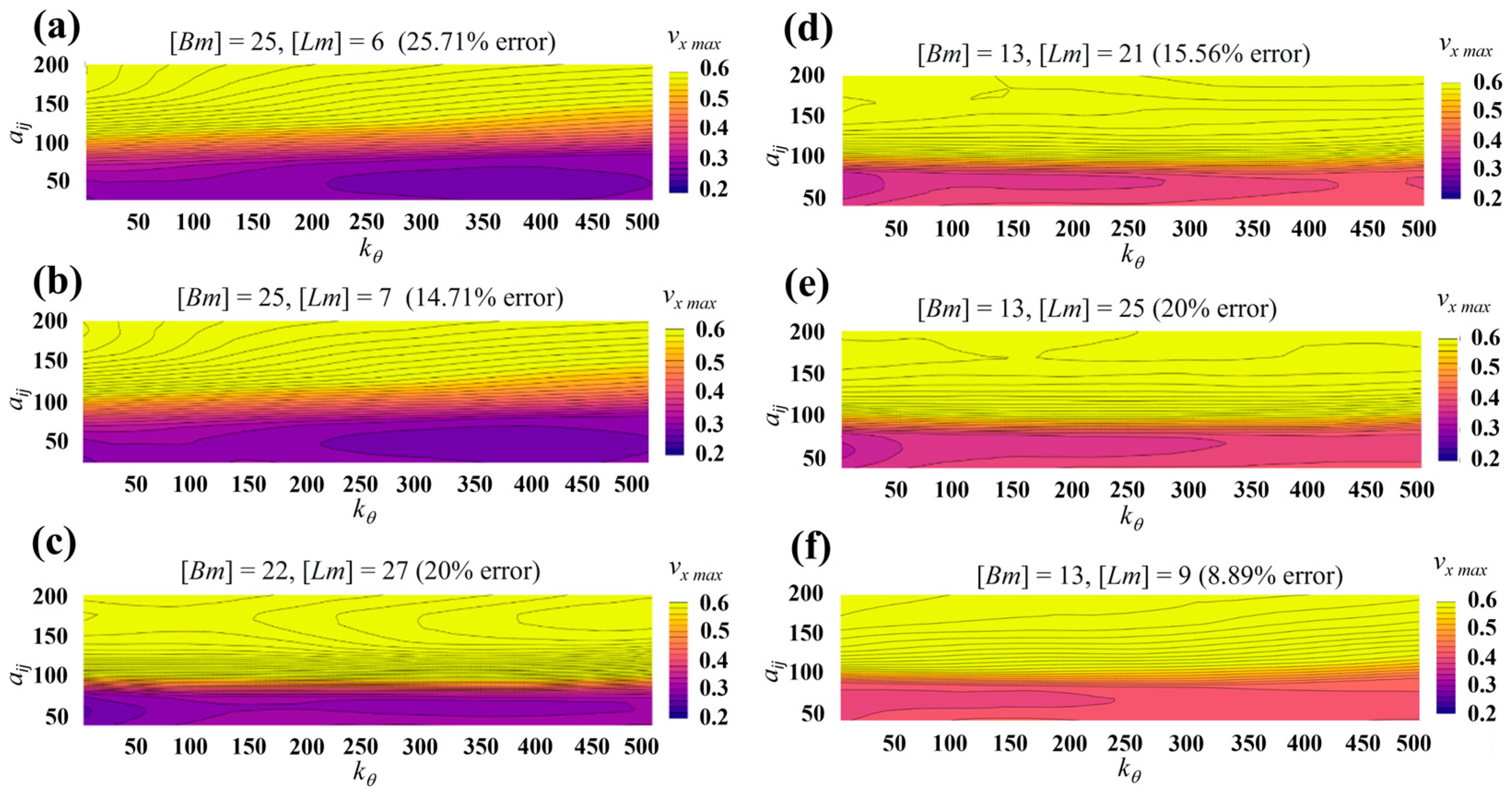
| 25 | 6 | 132 | 195 | 24.2 | 4.0561 | 3.0131 | 25.71 | 1.97 |
| 22 | 27 | 56 | 143 | 25.64 | 3.7664 | 3.0131 | 20.00 | 1.97 |
| 24 | 24 | 50 | 70 | 26.88 | 4.0618 | 3.0131 | 25.81 | 1.97 |
| 13 | 21 | 126 | 23 | 16.16 | 2.7752 | 2.3435 | 15.56 | 1.54 |
| 13 | 25 | 136 | 49 | 16.16 | 2.7041 | 2.3968 | 11.36 | 1.57 |
| 13 | 9 | 123 | 100 | 13.76 | 2.5722 | 2.3435 | 8.89 | 1.54 |
| 30 | 30 | 190 | 150 | 33.6 | 1.4647 | 1.4251 | 2.70 | 0.93 |
| [Bm] | [Lm] | kθ | aij | wt% | η Prediction | η DPD Simulation | Error % | η/η0 |
|---|---|---|---|---|---|---|---|---|
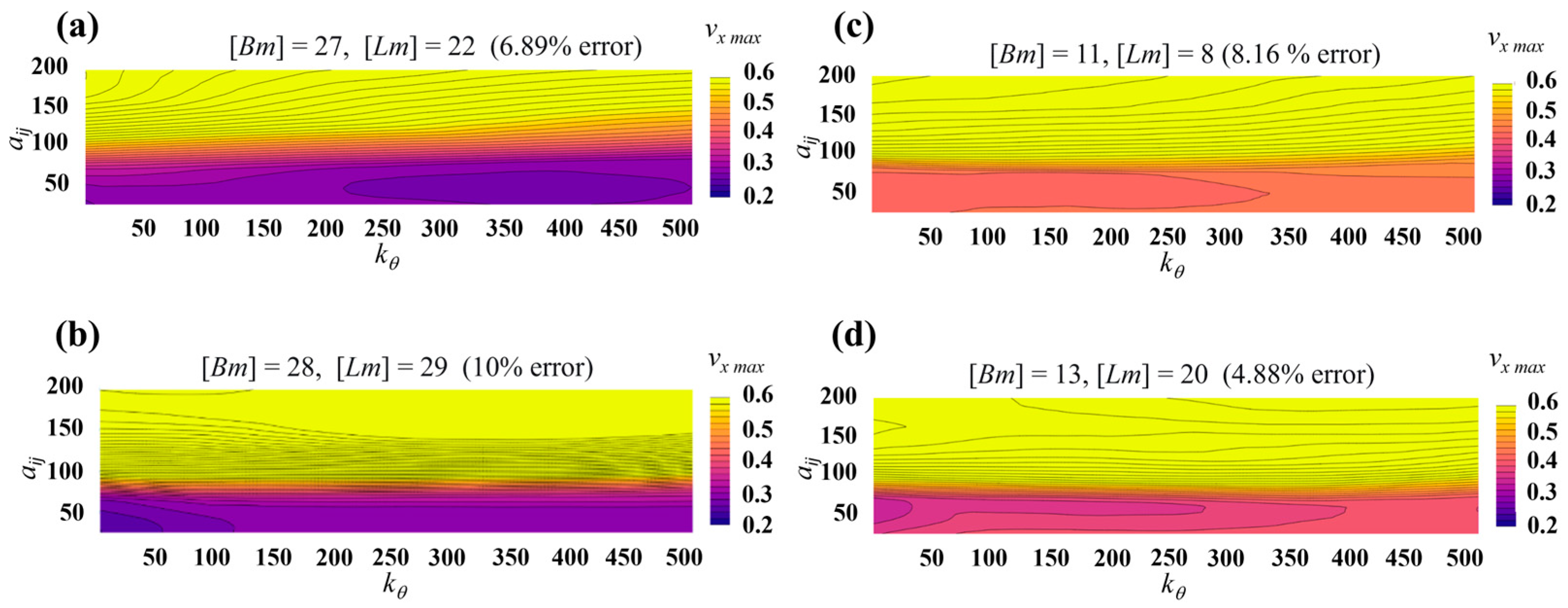
| 27 | 22 | 58 | 141 | 29.24 | 3.9059 | 3.6365 | 6.90 | 2.38 |
| 28 | 29 | 32 | 104 | 31.56 | 3.9059 | 3.5153 | 10.00 | 2.30 |
| 25 | 7 | 57 | 103 | 24.4 | 3.6365 | 3.01 | 14.71 | 2.03 |
| 13 | 20 | 114 | 92 | 15.96 | 2.7041 | 2.5722 | 4.88 | 1.69 |
| 11 | 8 | 77 | 63 | 11.72 | 2.3435 | 2.1522 | 8.16 | 1.41 |
| 5 | 30 | 50 | 50 | 10.6 | 2.0328 | 2.0394 | 0.33 | 1.34 |
| 1 | 1 | 10 | 130 | 1.12 | 1.5420 | 1.5587 | 1.08 | 1.02 |
| [Bm] | [Lm] | kθ | aij | wt% | η Prediction | η DPD Simulation | Error % | η/η0 |
|---|---|---|---|---|---|---|---|---|
| 27 | 8 | 58 | 203 | 26.44 | 4.12 | 3.28 | 20.49 | 2.15 |
| 30 | 15 | 61 | 226 | 30.6 | 4.47 | 3.46 | 22.53 | 2.27 |
| 30 | 35 | 10 | 147 | 34.6 | 4.54 | 3.65 | 19.64 | 2.39 |
| 38 | 5 | 8 | 137 | 35.96 | 5.24 | 3.96 | 24.35 | 2.60 |
| 39 | 24 | 4 | 216 | 40.68 | 5.16 | 4.04 | 21.77 | 2.64 |
| kθ | aij | wt% | [Bm] | [Lm] | η (N = 15,000) DPD Simulation | η/η0 (N = 15,000) |
|---|---|---|---|---|---|---|
| 50 | 70 | 26.88 | 72 | 72 | 2.65 | 3.18 |
| 58 | 203 | 26.44 | 81 | 24 | 2.82 | 3.38 |
| 61 | 226 | 30.6 | 90 | 45 | 2.95 | 3.54 |
| 10 | 147 | 34.6 | 90 | 105 | 3.41 | 4.08 |
Disclaimer/Publisher’s Note: The statements, opinions and data contained in all publications are solely those of the individual author(s) and contributor(s) and not of MDPI and/or the editor(s). MDPI and/or the editor(s) disclaim responsibility for any injury to people or property resulting from any ideas, methods, instructions or products referred to in the content. |
© 2026 by the authors. Licensee MDPI, Basel, Switzerland. This article is an open access article distributed under the terms and conditions of the Creative Commons Attribution (CC BY) license.
Share and Cite
Alvarez-Cruz, A.; Mayoral-Villa, E.; García-Márquez, A.R.; Klapp, J. Rational Design of High-Performance Viscosifying Polymers in Confined Systems via a Machine-Learning-Accelerated Multiscale Framework for Enhanced Hydrocarbon Recovery. Fluids 2026, 11, 86. https://doi.org/10.3390/fluids11040086
Alvarez-Cruz A, Mayoral-Villa E, García-Márquez AR, Klapp J. Rational Design of High-Performance Viscosifying Polymers in Confined Systems via a Machine-Learning-Accelerated Multiscale Framework for Enhanced Hydrocarbon Recovery. Fluids. 2026; 11(4):86. https://doi.org/10.3390/fluids11040086
Chicago/Turabian StyleAlvarez-Cruz, Arturo, Estela Mayoral-Villa, Alfonso Ramón García-Márquez, and Jaime Klapp. 2026. "Rational Design of High-Performance Viscosifying Polymers in Confined Systems via a Machine-Learning-Accelerated Multiscale Framework for Enhanced Hydrocarbon Recovery" Fluids 11, no. 4: 86. https://doi.org/10.3390/fluids11040086
APA StyleAlvarez-Cruz, A., Mayoral-Villa, E., García-Márquez, A. R., & Klapp, J. (2026). Rational Design of High-Performance Viscosifying Polymers in Confined Systems via a Machine-Learning-Accelerated Multiscale Framework for Enhanced Hydrocarbon Recovery. Fluids, 11(4), 86. https://doi.org/10.3390/fluids11040086