
Clinical and Microbiological Characteristics of Culture-Positive, Influenza-Associated Pulmonary Aspergillosis: A Single-Center Study in Southern Taiwan, 2016–2019
 , , , , ,
Abstract
1. Introduction
2. Materials and Methods
3. Results
4. Discussion
5. Conclusions
Supplementary Materials
Author Contributions
Funding
Institutional Review Board Statement
Informed Consent Statement
Data Availability Statement
Acknowledgments
Conflicts of Interest
References
- Schauwvlieghe, A.; Rijnders, B.J.A.; Philips, N.; Verwijs, R.; Vanderbeke, L.; Van Tienen, C.; Lagrou, K.; Verweij, P.E.; Van de Veerdonk, F.L.; Gommers, D.; et al. Invasive aspergillosis in patients admitted to the intensive care unit with severe influenza: A retrospective cohort study. Lancet Respir. Med. 2018, 6, 782–792. [Google Scholar] [CrossRef]
- Van de Veerdonk, F.L.; Kolwijck, E.; Lestrade, P.P.; Hodiamont, C.J.; Rijnders, B.J.; van Paassen, J.; Haas, P.J.; Oliveira Dos Santos, C.; Kampinga, G.A.; Bergmans, D.C.; et al. Influenza-associated aspergillosis in critically ill patients. Am. J. Respir. Crit. Care Med. 2017, 196, 524–527. [Google Scholar] [CrossRef]
- Wauters, J.; Baar, I.; Meersseman, P.; Meersseman, W.; Dams, K.; De Paep, R.; Lagrou, K.; Wilmer, A.; Jorens, P.; Hermans, G. Invasive pulmonary aspergillosis is a frequent complication of critically ill H1N1 patients: A retrospective study. Intensive Care Med. 2012, 38, 1761–1768. [Google Scholar] [CrossRef]
- Ku, Y.H.; Chan, K.S.; Yang, C.C.; Tan, C.K.; Chuang, Y.C.; Yu, W.L. Higher mortality of severe influenza patients with probable aspergillosis than those with and without other coinfections. J. Formos. Med. Assoc. 2017, 116, 660–670. [Google Scholar] [CrossRef]
- Donnelly, J.P.; Chen, S.C.; Kauffman, C.A.; Steinbach, W.J.; Baddley, J.W.; Verweij, P.E.; Clancy, C.J.; Wingard, J.R.; Lockhart, S.R.; Groll, A.H.; et al. Revision and update of the consensus definitions of invasive fungal disease from the European Organization for Research and Treatment of Cancer and the Mycoses Study Group Education and Research Consortium. Clin. Infect. Dis. 2020, 71, 1367–1376. [Google Scholar] [CrossRef]
- Blot, S.I.; Taccone, F.S.; Van den Abeele, A.M.; Bulpa, P.; Meersseman, W.; Brusselaers, N.; Dimopoulos, G.; Paiva, J.A.; Misset, B.; Rello, J.; et al. A clinical algorithm to diagnose invasive pulmonary aspergillosis in critically ill patients. Am. J. Respir. Crit. Care Med. 2012, 186, 56–64. [Google Scholar] [CrossRef]
- Verweij, P.E.; Rijnders, B.J.; Brüggemann, R.J.; Azoulay, E.; Bassetti, M.; Blot, S.; Calandra, T.; Clancy, C.J.; Cornely, O.A.; Chiller, T. Review of influenza-associated pulmonary aspergillosis in ICU patients and proposal for a case definition: An expert opinion. Intensive Care Med. 2020, 46, 1524–1535. [Google Scholar] [CrossRef]
- Nyga, R.; Maizel, J.; Nseir, S.; Chouaki, T.; Milic, I.; Roger, P.A.; Van Grunderbeeck, N.; Lemyze, M.; Totet, A.; Castelain, S.; et al. Invasive tracheobronchial aspergillosis in critically ill patients with severe influenza. A clinical trial. Am. J. Respir. Crit. Care Med. 2020, 202, 708–716. [Google Scholar] [CrossRef]
- Patterson, T.F.; Thompson, G.R., 3rd; Denning, D.W.; Fishman, J.A.; Hadley, S.; Herbrecht, R.; Kontoyiannis, D.P.; Marr, K.A.; Morrison, V.A.; Nguyen, M.H.; et al. Practice Guidelines for the Diagnosis and Management of Aspergillosis: 2016 Update by the Infectious Diseases Society of America. Clin. Infect. Dis. 2016, 63, e1–e60. [Google Scholar] [CrossRef]
- World Health Organization (WHO) Information for Molecular Diagnosis of Influenza Virus. Available online: https://www.who.int/influenza/gisrs_laboratory/WHO_information_for_the_molecular_detection_of_influenza_viruses_20171023_Final.pdf (accessed on 1 December 2021).
- Clinical and Laboratory Standards Institute. Reference Method for Broth Dilution Antifungal Susceptibility Testing of Filamentous Fungi. Aproved Standard-Second Edition; CLSI document M38-A2; Clinical and Laboratory Standards Institute: Wayne, PA, USA, 2008. [Google Scholar]
- Balajee, S.A.; Houbraken, J.; Verweij, P.E.; Hong, S.B.; Yaghuchi, T.; Varga, J.; Samson, R.A. Aspergillus species identification in the clinical setting. Stud. Mycol. 2007, 59, 39–46. [Google Scholar] [CrossRef]
- Snelders, E.; Karawajczyk, A.; Schaftenaar, G.; Verweij, P.E.; Melchers, W.J. Azole resistance profile of amino acid changes in Aspergillus fumigatus CYP51A based on protein homology modeling. Antimicrob. Agents Chemother. 2010, 54, 2425–2430. [Google Scholar] [CrossRef]
- De Valk, H.A.; Meis, J.F.; Curfs, I.M.; Muehlethaler, K.; Mouton, J.W.; Klaassen, C.H. Use of a novel panel of nine short tandem repeats for exact and high-resolution fingerprinting of Aspergillus fumigatus isolates. J. Clin. Microbiol. 2005, 43, 4112–4120. [Google Scholar] [CrossRef]
- Rudramurthy, S.M.; de Valk, H.A.; Chakrabarti, A.; Meis, J.F.; Klaassen, C.H. High resolution genotyping of clinical Aspergillus flavus isolates from India using microsatellites. PLoS ONE 2011, 6, e16086. [Google Scholar] [CrossRef]
- Rougeron, A.; Giraud, S.; Razafimandimby, B.; Meis, J.F.; Bouchara, J.P.; Klaassen, C.H. Different colonization patterns of Aspergillus terreus in patients with cystic fibrosis. Clin. Microbiol. Infect. 2014, 20, 327–333. [Google Scholar] [CrossRef][Green Version]
- Waldeck, F.; Boroli, F.; Suh, N.; Wendel Garcia, P.D.; Flury, D.; Notter, J.; Iten, A.; Kaiser, L.; Schrenzel, J.; Boggian, K.; et al. Influenza-associated aspergillosis in critically-ill patients-a retrospective bicentric cohort study. Eur. J. Clin. Microbiol. Infect. Dis. 2020, 39, 1915–1923. [Google Scholar] [CrossRef]
- Martin-Loeches, I.; Schultz, M.J.; Vincent, J.-L.; Alvarez-Lerma, F.; Bos, L.D.; Solé-Violán, J.; Torres, A.; Rodriguez, A. Increased incidence of co-infection in critically ill patients with influenza. Intensive Care Med. 2017, 43, 48–58. [Google Scholar] [CrossRef]
- Schwartz, I.S.; Friedman, D.Z.; Zapernick, L.; Dingle, T.C.; Lee, N.; Sligl, W.; Zelyas, N.; Smith, S.W. High rates of influenza-associated invasive pulmonary aspergillosis may not be universal: A retrospective cohort study from Alberta, Canada. Clin. Infect. Dis. 2020, 71, 1760–1763. [Google Scholar] [CrossRef]
- Zou, P.; Wang, C.; Zheng, S.; Guo, F.; Yang, L.; Zhang, Y.; Liu, P.; Shen, Y.; Wang, Y.; Zhang, X.; et al. Invasive pulmonary aspergillosis in adults with avian influenza a (H7N9) pneumonia in China: A retrospective study. J. Infect. Dis. 2020, 221, S193–S197. [Google Scholar] [CrossRef]
- Chao, C.M.; Lai, C.C.; Ou, H.F.; Ho, C.H.; Chan, K.S.; Yang, C.C.; Chen, C.M.; Yu, W.L. The Impacts of aspergillosis on outcome, burden and risks for mortality in influenza patients with critical illness. J. Fungi 2021, 7, 922. [Google Scholar] [CrossRef]
- Crum-Cianflone, N.F. Invasive aspergillosis associated with severe influenza infections. Open Forum Infect. Dis. 2016, 3, ofw171. [Google Scholar] [CrossRef]
- Rudramurthy, S.M.; Paul, R.A.; Chakrabarti, A.; Mouton, J.W.; Meis, J.F. Invasive aspergillosis by Aspergillus flavus: Epidemiology, diagnosis, antifungal resistance, and management. J. Fungi 2019, 5, 55. [Google Scholar] [CrossRef]
- Huang, L.; Zhang, N.; Huang, X.; Xiong, S.; Feng, Y.; Zhang, Y.; Li, M.; Zhan, Q. Invasive pulmonary aspergillosis in patients with influenza infection: A retrospective study and review of the literature. Clin. Respir. J. 2019, 13, 202–211. [Google Scholar] [CrossRef]
- Risslegger, B.; Zoran, T.; Lackner, M.; Aigner, M.; Sanchez-Reus, F.; Rezusta, A.; Chowdhary, A.; Taj-Aldeen, S.J.; Arendrup, M.C.; Oliveri, S.; et al. A prospective international Aspergillus terreus survey: An EFISG, ISHAM and ECMM joint study. Clin. Microbiol. Infect. 2017, 23, 776-e1. [Google Scholar] [CrossRef]
- Salah, H.; Lackner, M.; Houbraken, J.; Theelen, B.; Lass-Florl, C.; Boekhout, T.; Almaslamani, M.; Taj-Aldeen, S.J. The emergence of rare clinical Aspergillus species in Qatar: Molecular characterization and antifungal susceptibility profiles. Front. Microbiol. 2019, 10, 1677. [Google Scholar] [CrossRef]
- Ullmann, A.J.; Aguado, J.M.; Arikan-Akdagli, S.; Denning, D.W.; Groll, A.H.; Lagrou, K.; Lass-Florl, C.; Lewis, R.E.; Munoz, P.; Verweij, P.E.; et al. Diagnosis and management of Aspergillus diseases: Executive summary of the 2017 ESCMID-ECMM-ERS guideline. Clin. Microbiol. Infect. 2018, 24 (Suppl. 1), e1–e38. [Google Scholar] [CrossRef]
- Schoen, K.; Horvat, N.; Guerreiro, N.F.C.; de Castro, I.; de Giassi, K.S. Spectrum of clinical and radiographic findings in patients with diagnosis of H1N1 and correlation with clinical severity. BMC Infect. Dis. 2019, 19, 964. [Google Scholar] [CrossRef]
- Capitano, B.; Potoski, B.A.; Husain, S.; Zhang, S.; Paterson, D.L.; Studer, S.M.; McCurry, K.R.; Venkataramanan, R. Intrapulmonary penetration of voriconazole in patients receiving an oral prophylactic regimen. Antimicrob. Agents Chemother. 2006, 50, 1878–1880. [Google Scholar] [CrossRef]


| Clinical Variables | Case No. (%) or Mean ± Standard Deviation | Univariate, p Value | ||
|---|---|---|---|---|
| All, n = 24 | Survivors, n = 14 | Non-Survivors, n = 10 | ||
| Baseline characteristics | ||||
| Age (years) | 67.6 ± 14.5 | 69.2 ± 14.2 | 65.3 ± 15.2 | 0.526 |
| Male sex | 13 (54.2) | 7 (50) | 6 (60) | 0.697 |
| Body mass index > 25 kg/m2 | 11 (45.8) | 5 (35.7) | 6 (60) | 0.408 |
| Active smoking | 5 (20.8) | 3 (21.4) | 2 (20) | >0.999 |
| Chronic heart failure | 4 (16.7) | 2 (14.3) | 2 (20) | >0.999 |
| Chronic kidney disease a | 6 (25.0) | 3 (21.4) | 3 (30) | 0.665 |
| Diabetes mellitus | 11 (45.8) | 6 (42.9) | 5 (50) | >0.999 |
| Known risk factors for invasive aspergillosis | ||||
| Chronic obstructive pulmonary disease | 4 (16.7) | 3 (21.4) | 1 (10) | 0.615 |
| Liver cirrhosis | 1 (4.2) | 1 (7.1) | 0 (0) | >0.999 |
| EORTC/MSG host factor | 4 (16.7) | 1 (7.1) | 3 (30) | 0.272 |
| Hematological malignancy | 3 (12.5) | 1 (7.1) | 2 (20) | 0.550 |
| Active solid tumor | 2 (8.3) | 1 (7.1) | 1 (10) | >0.999 |
| Steroids use before Aspergillus growth | ||||
| ≥10 mg/day for ≥3 days in the past 14 days | 8 (33.3) | 4 (28.6) | 4 (40) | 0.673 |
| ≥0.3 mg/kg/day for ≥3 weeks in the past 60 days b | 3 (12.5) | 1 (7.1) | 2 (20) | 0.550 |
| Influenza | ||||
| Influenza A | 18 (75) | 10 (71.4) | 8 (80) | >0.999 |
| A (H1) | 11 (45.8) | 6 (42.9) | 5 (50) | - |
| A (H3) | 7 (29.2) | 4 (28.6) | 3 (30) | - |
| Influenza B | 6 (25.0) | 4 (28.6) | 2 (20) | >0.999 |
| Aspergillus | ||||
| Aspergillus only in respiratory samples | 17 (70.8) | 9 (64.3) | 8 (80.0) | 0.653 |
| A. fumigatus | 15 (62.5) | 9 (64.3) | 6 (60) | >0.999 |
| A. flavus | 6 (25.0) | 4 (28.6) | 2 (20) | >0.999 |
| A. terreus | 4 (16.7) | 2 (14.3) | 2 (20) | >0.999 |
| A. pseudonomius | 1 (4.2) | 0 (0) | 1 (10) | 0.833 |
| A. allahabadii | 1 (4.2) | 1 (7.1) | 0 (0) | >0.999 |
| Diagnostics | ||||
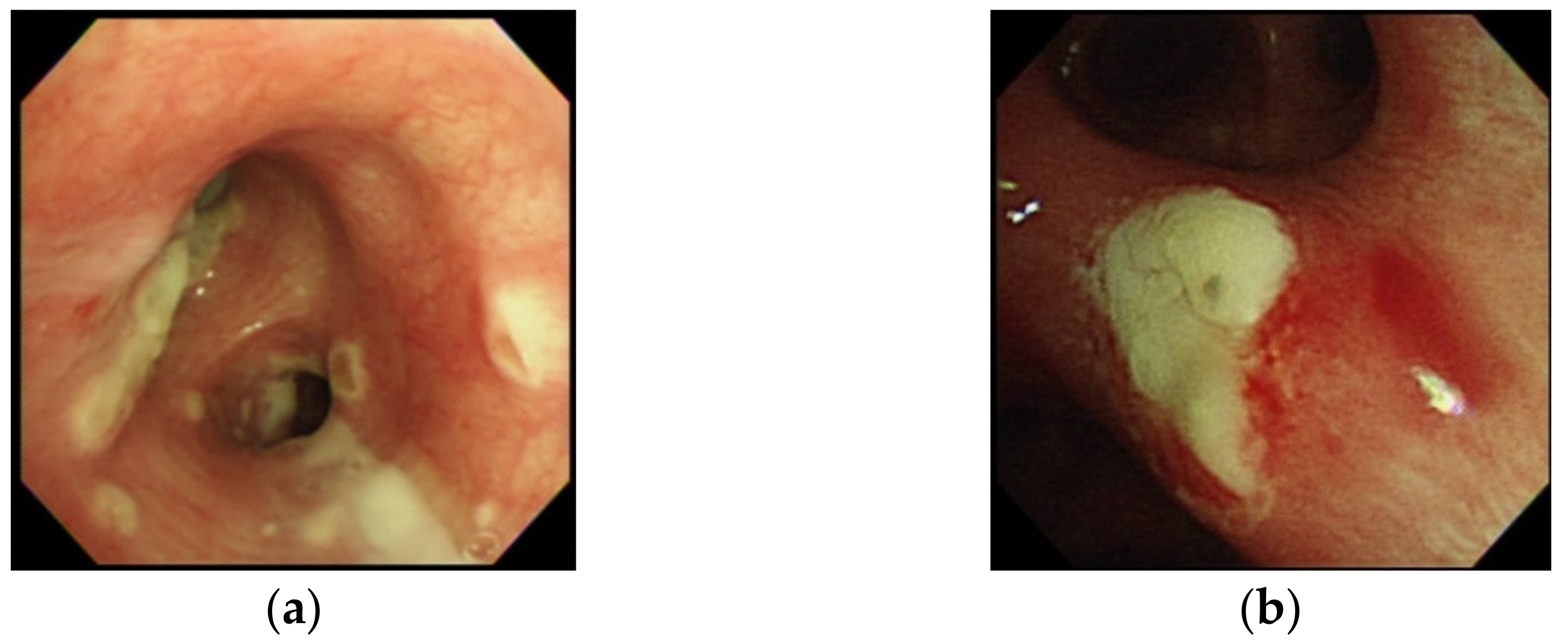
| Tracheobronchitis by bronchoscopy | 6/19 (31.6) | 2/10 (20.0) | 4/9 (44.4) | 0.517 |
| Serum galactomannan index >0.5 | 20 (83.3) | 11 (78.6) | 9 (90) | 0.615 |
| BAL galactomannan index ≥ 1.0 | 14/19 (73.7) | 8/10 (80) | 6/9 (66.7) | 0.889 |
| Proven/probable by EORTC/MSG definition | 5 (20.8) | 2 (14.3) | 3 (30) | 0.615 |
| Proven/probable by AspICU definition | 10 (41.7) | 5 (35.7) | 5 (50) | 0.678 |
| Clinical and laboratory data | ||||
| Early onset IAPA | 20 (83.3) | 12 (85.7) | 8 (80.0) | >0.999 |
| APACHE II score d | 16.8 ± 9.6 | 13.8 ± 8.6 | 21.0 ± 9.7 | 0.064 |
| Neutropenia (neutrophil < 500/μL) | 0 (0) | 0 (0) | 0 (0) | n/a |
| Lymphopenia (lymphocyte < 1000/μL) | 22 (91.7) | 13 (92.9) | 9 (90%) | >0.999 |
| Lymphocyte count (/μL) | 518.8 ± 278.2 | 538.0 ± 252.8 | 491.9 ± 322.7 | 0.698 |
| Bacterial co-infection | 10 (41.7) | 5 (35.7) | 5 (50) | 0.678 |
| Days from influenza diagnosis to Aspergillus growth, n =19 (11, 8) e | 4.4 ± 4.0 | 3.3 ± 3.6 | 5.9 ± 4.2 | 0.163 |
| Steroids use 0–10 days after Aspergillus | 12 (50) | 6 (42.9) | 6 (60) | 0.680 |
| Steroids doses (mg) 0–10 days after Aspergillus, n = 12 (6, 6) | 303.8 ± 130.9 | 271.3 ± 179.8 | 336.3 ± 53.5 | 0.416 |
| Hemodialysis | 7 (29.2%) | 2 (14.3%) | 5 (50%) | 0.085 |
| Mechanical ventilation | 23 (95.8) | 13 (92.9) | 10 (100) | >0.999 |
| Mechanical ventilation days after Aspergillus, n = 23 (13,10) | 16.5 ± 11.0 | 14.0 ± 10.5 | 20.1 ± 11.3 | n/a |
| Antimicrobial therapy | ||||
| Anti-influenza agent before Aspergillus | 14 (58.3) | 7 (50) | 7 (70) | 0.421 |
| Use of anti-Aspergillus antifungal agent | 24 (100) | 14 (100) | 10 (100) | n/a |
| Days from Aspergillus growth to initiation of antifungals | 4.0 ± 5.7 | 3.4 ± 2.3 | 4.9 ± 8.5 | 0.523 |
| Duration of antifungal treatment (days) | 31.7 ± 15.9 | 40.5 ± 12.8 | 19.3 ± 10.7 | n/a |
| All-cause in-hospital mortality | 10 (41.7) | n/a | n/a | n/a |
| IAPA-attributable mortality | 9 (37.5) | n/a | n/a | n/a |
| Case | Age (y)/Sex | Underlying Conditions | Flu Type | Days from Influenza Diagnosis to Aspergillus Growth | Serum GM | BAL GM/ATB | Aspergillus spp. | Bacterial Co-Isolation | CT (CXR) Findings | Sequential Antifungals (Days) | Outcome (Days after Aspergillus) |
|---|---|---|---|---|---|---|---|---|---|---|---|
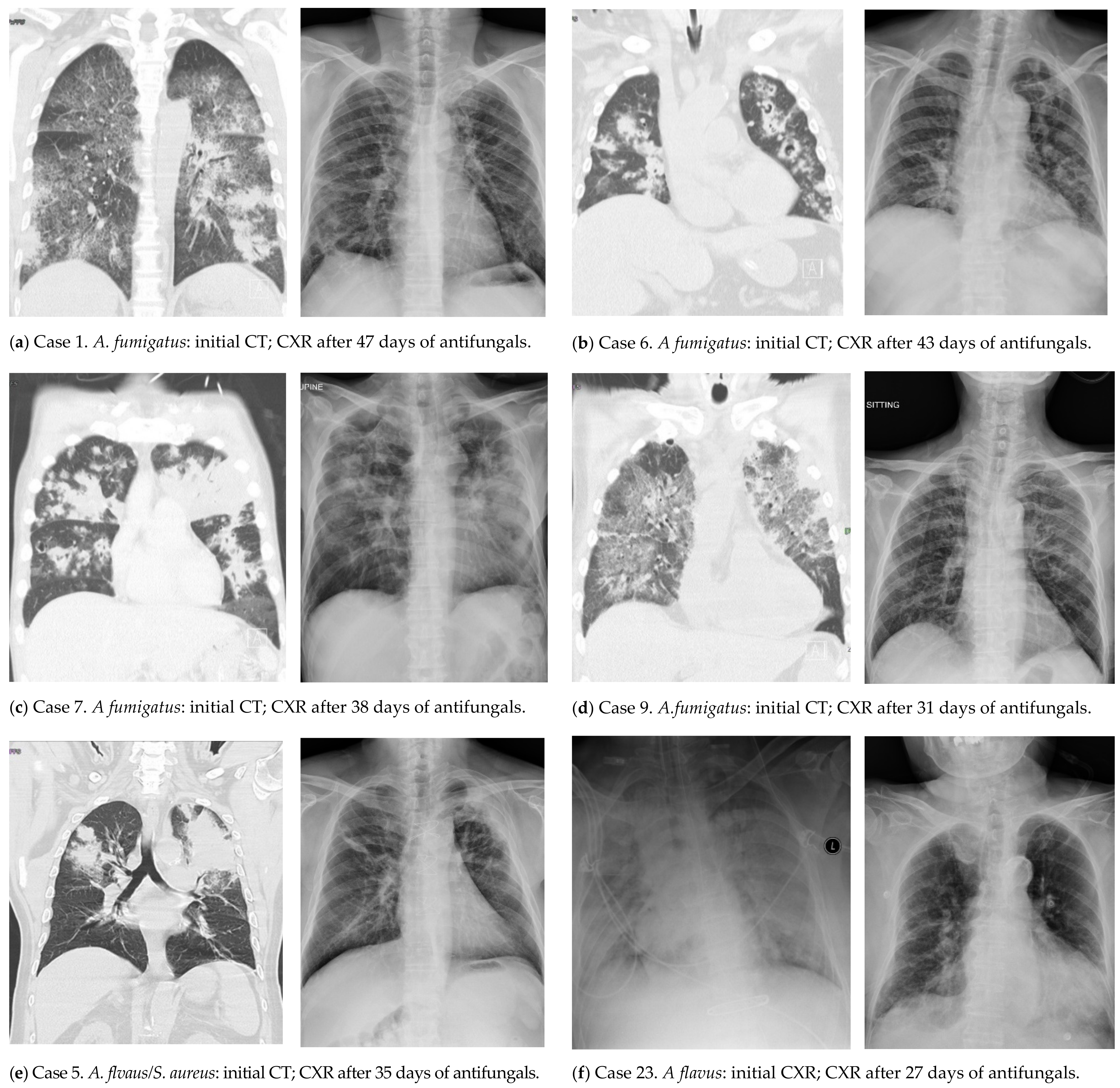
| 1 | 40+/M | CS, pancreatitis | B | 6 | 2.13 | nd | A. fumigatus | no | GGO, PBI, N, ws-C | VRC (5), CPF (5), VRC (36) | alive |
| 2 | 60+/F | CAD, DM, ESRD on HD | A (H1) | 1 | 7.89 | 0.18/n | A. fumigatus | NF | GGO, PBI, C | VRC (63) | alive |
| 3 | 70+/M | PPU | B | 5 | 0.19 | 2.99/y | A. fumigatus | no | P | VRC (12), LAmB (15) | died (30) |
| 4 | 40+/M | no | A (H1) | 0 | 2.83 | 6.72/n | A. terreus | no | (N, C) | VRC (34) | alive |
| 5 | 70+/M | CAD, CHF, DM | A (H1) | 0 | 0.36 | 3.16/n | A. flavus | SA | PBI, N, ws-C | VRC (51) | alive |
| 6 | 70+/M | CKD, COPD, MGUS | B | 4 | 4.26 | 5.07/n | A. fumigatus | no | PBI, N, cavities | VRC (51) | alive |
| 7 | 50+/M | DM | A (H3) | 6 | 0.71 | 5.25/n | A. fumigatus | no | GGO, PBI, N, cavities, ws-C | VRC (42) | alive |
| 8 | 70+/F | CAD, DM, HTN | A (H3) | 5 | 0.55 | 0.32/n | A. fumigatus | no | PBI, C | VRC (17) | died (44) |
| 9 | 70+/M | CHF, CS-E, HBV/LC, HCC, lymphoma | A (H3) | 1 | 0.09 | 2.44/n | A. fumigatus | no | GGO, PBI, N, ws-C | VRC (28) | alive |
| 10 | 80+/M | Old TB | B | 5 | 1.09 | 1.07/y | A. fumigatus, A. pseudonomius | no | GGO, PBI, N, cavities, ws-C | VRC (27) | died (34) |
| 11 | 70+/F | DM, HTN | B | 0 | 1.63 | nd | A. fumigatus | KP | (P) | VRC (32) | alive |
| 12 | 80+/F | COPD, CS, old TB, HCV | B | 5 | 3.55 | nd | A. fumigatus | no | (P) | VRC (18) | alive |
| 13 | 70+/F | CKD | A (H3) | 2 | 6.26 | 6.18/n | A. fumigatus, A. flavus | no | GGO, PBI, N, ws-C | VRC (59) | alive |
| 14 | 40+/M | ALL s/p HSCT, HBV | A (H3) | 13 | 4.13 | 5.17/y | A. fumigatus | no | PBI, N, ws-C | VRC (2), VRC+CPF (6) | died (7) |
| 15 | 60+/F | Sarcoma s/p doxorubicin, CS-E | A (H1) | 1 | 5.57 | 6.53/n | A. terreus | no | (P) | VRC (21) | died (21) |
| 16 | 80+/F | COPD, HTN | A (H1) | 10 | 0.56 | 4.98/y | A. terreus, A. allahabadii | PA | (P) | VRC (42) | alive |
| 17 | 70+/M | COPD, CHF, CS, DM, HTN | A (H1) | 11 | 4.40 | 5.04/y | azole-S, -R A. fumigatus | no | PBI, N, cavities | VRC (18), LAmB (12) | died (31) |
| 18 | 90+/F | DM, HTN | A (H3) | 1 | 4.57 | nd | A. flavus | NF | (P) | VRC (35) | alive |
| 19 | 30+/M | DM, ESRD on HD | A (H1) | 6 | 1.01 | 0.09/n | A. terreus | no | (P) | VRC (7) | died (8) |
| 20 | 70+/F | CHF, CKD, CS, DM, HTN, RA | A (H3) | 4 | 2.87 | 0.51/n | A. flavus | PA | (N, P) | VRC (5), LAmB (4), VRC (13), AmB (14) | died (37), unrelated |
| 21 | 60+/M | CS, DM, HTN | A (H1) | 8 | 0.56 | 0.19/n | azole-S, -R A. fumigatus | no | GGO, PBI, N, C | VRC (25) | alive |
| 22 | 50+/M | HBV | A (H1) | 0 | 5.78 | nd | A. fumigatus | no | (P, C) | VRC (3) | died (4) |
| 23 | 80+/F | HTN | A (H1) | 4 | 0.35 | 6.65/y | A. flavus | no | (P, N, ws-C) | VRC (42) | alive |
| 24 | 80+/F | DM, MM, CS-E | A (H1) | 3 | 3.63 | 2.16/n | A. flavus | AB | (N, C) | VRC (18) | died (22) |
| Aspergillus spp. (No. of Isolate) | MIC or MIC Range (Geometric Mean) (μg/mL) | ||||
|---|---|---|---|---|---|
| Amphotericin B | Itraconazole | Voriconazole | Posaconazole | Isavuconazole | |
| Aspergillus section Fumigati | |||||
| A. fumigatus (33) | 0.25–1 (0.62) | 0.12->16 (0.57) | 0.25–4 (0.64) | 0.03–1 (0.12) | nd |
| azole-susceptible (31) | 0.25–1 (0.63) | 0.12–0.5 (0.44) | 0.25–1 (0.59) | 0.03–0.25 (0.11) | nd |
| azole-resistant (2) | |||||
| cyp51A (wild-type) (1) a | 0.5 | >16 | 2 | 1 | 16 |
| cyp51A (TR34/L98H) (1) b | 0.5 | >16 | 4 | 1 | 8 |
| Aspergillus section Flavi | |||||
| A. flavus (11) | 1–2 (1.12) | 0.12–0.5 (0.20) | 0.5–1 (0.50) | 0.06–0.25 (0.12) | nd |
| A. pseudonomius (2) | 1 (1) | 0.5 (0.5) | 1 (1) | 0.25 (0.25) | 1 (1) |
| Aspergillus section Terrei | |||||
| A. terreus (5) | 1 (1) | 0.12 (0.12) | 0.43 (0.25–0.5) | 0.08 (0.03–0.12) | nd |
| A. allahabadii (1) | 2 | 0.5 | 2 | 0.12 | 2 |
| Case | Year of Isolation | Day of Culture | Sample | Species | Microsatellite Genotype | No. of Genotype/No. of Isolate | ||||||||
|---|---|---|---|---|---|---|---|---|---|---|---|---|---|---|
| 2A | 2B | 2C | 3A | 3B | 3C | 4A | 4B | 4C | ||||||
| IAPA due to A. fumigatus | ||||||||||||||
| 1 | 2016 | D0 | sputum | A. fumigatus | 23 | 20 | 25 | 30 | 13 | 50 | 5 | 11 | 5 | 1/2 |
| D0 | lung | A. fumigatus | 23 | 20 | 25 | 30 | 13 | 50 | 5 | 11 | 5 | |||
| 2 | 2016 | D0 | ETA | A. fumigatus | 24 | 9 | 8 | 0 | 12 | 7 | 10 | 11 | 10 | 1/1 |
| 3 | 2016 | D0 | ETA | A. fumigatus | 22 | 20 | 18 | 23 | 11 | 26 | 12 | 10 | 10 | 2/2 |
| D5 | BAL | A. fumigatus | 18 | 22 | 13 | 43 | 12 | 14 | 14 | 9 | 10 | |||
| 6 | 2017 | D0 | sputum | A. fumigatus | 22 | 12 | 17 | 34 | 20 | 16 | 10 | 9 | 5 | 4/4 |
| D1 | sputum | A. fumigatus | 15 | 21 | 17 | 8 | 19 | 16 | 11 | 8 | 5 | |||
| D2 | ETA | A. fumigatus | 25 | 20 | 14 | 11 | 7 | 18 | 12 | 7 | 5 | |||
| D6 | BAL | A. fumigatus | 15 | 21 | 17 | 35 | 19 | 16 | 12 | 8 | 0 | |||
| 7 | 2017 | D0 | sputum | A. fumigatus | 20 | 27 | 18 | 29 | 12 | 30 | 22 | 11 | 5 | 1/3 |
| D1 | ETA | A. fumigatus | 20 | 27 | 18 | 29 | 12 | 30 | 22 | 11 | 5 | |||
| D4 | ETA | A. fumigatus | 20 | 27 | 18 | 29 | 12 | 30 | 22 | 11 | 5 | |||
| 8 | 2017 | D0 | ETA | A. fumigatus | 26 | 22 | 11 | 31 | 11 | 23 | 13 | 11 | 8 | 1/3 |
| D7 | ETA | A. fumigatus | 26 | 22 | 11 | 31 | 11 | 23 | 13 | 11 | 8 | |||
| D16 | ETA | A. fumigatus | 26 | 22 | 11 | 31 | 11 | 23 | 13 | 11 | 8 | |||
| 9 | 2017 | D0 | ETA | A. fumigatus | 23 | 19 | 20 | 19 | 11 | 17 | 17 | 17 | 10 | 1/2 |
| D1 | BAL | A. fumigatus | 23 | 19 | 20 | 19 | 11 | 17 | 17 | 17 | 10 | |||
| 10 | 2018 | D4 | BAL | A. fumigatus | 13 | 19 | 11 | 35 | 24 | 8 | 10 | 9 | 8 | 1/1 |
| D4 | ETA | A. pseudonomius | ||||||||||||
| D4 | ETA | A. pseudonomius | ||||||||||||
| 11 | 2018 | D0 | ETA | A. fumigatus | 20 | 19 | 13 | 38 | 24 | 14 | 14 | 10 | 8 | 1/1 |
| 12 | 2018 | D0 | ETA | A. fumigatus | 26 | 19 | 15 | 32 | 15 | 7 | 10 | 11 | 8 | 1/1 |
| 14 | 2018 | D0 | ETA | A. fumigatus | 25 | 19 | 19 | 26 | 13 | 16 | 10 | 18 | 10 | 1/3 |
| D1 | BAL | A. fumigatus | 25 | 19 | 19 | 26 | 13 | 16 | 10 | 18 | 10 | |||
| D3 | ETA | A. fumigatus | 25 | 19 | 19 | 26 | 13 | 16 | 10 | 18 | 10 | |||
| 17 | 2019 | D0 | ETA | A. fumigatus a | 24 | 16 | 13 | 28 | 16 | 23 | 6 | 12 | 10 | 4/4 |
| D0 | ETA | A. fumigatus | 23 | 16 | 8 | 30 | 33 | 18 | 8 | 9 | 13 | |||
| D7 | ETA | A. fumigatus | 20 | 22 | 15 | 28 | 14 | 23 | 10 | 9 | 5 | |||
| D7 | ETA | A. fumigatus | 20 | 19 | 13 | 38 | 24 | 14 | 14 | 10 | 8 | |||
| 21 | 2019 | D0 | ETA | A. fumigatus | 15 | 21 | 8 | 18 | 27 | 9 | 17 | 11 | 13 | 2/2 |
| D5 | ETA | A. fumigatus b | 18 | 24 | 14 | 32 | 19 | 31 | 16 | 9 | 5 | |||
| 22 | 2019 | D0 | ETA | A. fumigatus | 20 | 18 | 28 | 44 | 12 | 7 | 9 | 11 | 5 | 1/2 |
| D1 | ETA | A. fumigatus | 20 | 18 | 28 | 44 | 12 | 7 | 9 | 11 | 5 | |||
| IAPA due to A. flavus | ||||||||||||||
| 5 | 2017 | D0 | ETA | A. flavus | 21 | 11 | 8 | 9 | 14 | 4 | 7 | 9 | 9 | 1/1 |
| 18 | 2019 | D0 | ETA | A. flavus | 17 | 11 | 21 | 17 | 12 | 13 | 7 | 7 | 11 | 2/2 |
| D2 | ETA | A. flavus | 26 | 11 | 12 | 12 | 26 | 9 | 9 | 5 | 9 | |||
| 20 | 2019 | D0 | ETA | A. flavus | 16 | 11 | 12 | 8 | 31 | 14 | 8 | 7 | 10 | 1/2 |
| D2 | ETA | A. flavus | 16 | 11 | 12 | 8 | 31 | 14 | 8 | 7 | 10 | |||
| 23 | 2019 | D0 | BAL | A. flavus | 18 | 7 | 15 | 8 | 21 | 9 | 6 | 9 | 9 | 2/2 |
| D1 | ETA | A. flavus | 16 | 14 | 10 | 8 | 20 | 14 | 8 | 9 | 10 | |||
| 24 | 2019 | D0 | ETA | A. flavus | 44 | 16 | 10 | 8 | 13 | 14 | 5 | 7 | 37 | 1/1 |
| IAPA due to A. fumigatus and A. flavus | ||||||||||||||
| 13 | 2018 | D2 | ETA | A. flavus | 29 | 11 | 11 | 8 | 7 | 10 | 7 | 12 | 10 | 1/3 |
| D2 | ETA | A. flavus | 29 | 11 | 11 | 8 | 7 | 10 | 7 | 12 | 10 | |||
| D3 | BAL | A. flavus | 29 | 11 | 11 | 8 | 7 | 10 | 7 | 12 | 10 | |||
| A. fumigatus | 16 | 15 | 10 | 8 | 48 | 15 | 5 | 9 | 7 | 1/2 | ||||
| A. fumigatus | 16 | 15 | 10 | 8 | 48 | 15 | 5 | 9 | 7 | |||||
| IAPA due to A. terreus | ||||||||||||||
| 4 | 2017 | D4 | BAL | A. terreus | 14 | 9 | 27 | 5 | 7 | 66 | 8 | 24 | 7 | 1/1 |
| 15 | 2018 | D0 | ETA | A. terreus | 8 | 11 | 26 | 11 | 8 | 7 | 10 | 9 | 8 | 1/2 |
| D3 | BAL | A. terreus | 8 | 11 | 26 | 11 | 8 | 7 | 10 | 9 | 8 | |||
| 16 | 2019 | D0 | ETA | A. terreus | 13 | 12 | 24 | 9 | 8 | 14 | 8 | 11 | 7 | 1/1 |
| D6 | ETA | A.allahabadii | ||||||||||||
| 19 | 2019 | D0 | ETA | A. terreus | 12 | 9 | 23 | 4 | 7 | 11 | 8 | 11 | 5 | 1/1 |
Publisher’s Note: MDPI stays neutral with regard to jurisdictional claims in published maps and institutional affiliations. |
© 2022 by the authors. Licensee MDPI, Basel, Switzerland. This article is an open access article distributed under the terms and conditions of the Creative Commons Attribution (CC BY) license (https://creativecommons.org/licenses/by/4.0/).
Share and Cite
Wu, C.-J.; Cia, C.-T.; Wang, H.-C.; Chen, C.-W.; Lin, W.-C.; Lee, J.-C.; Chen, P.-S.; Hsieh, C.-C.; Li, W.-T.; Su, P.-L.; et al. Clinical and Microbiological Characteristics of Culture-Positive, Influenza-Associated Pulmonary Aspergillosis: A Single-Center Study in Southern Taiwan, 2016–2019. J. Fungi 2022, 8, 49. https://doi.org/10.3390/jof8010049
Wu C-J, Cia C-T, Wang H-C, Chen C-W, Lin W-C, Lee J-C, Chen P-S, Hsieh C-C, Li W-T, Su P-L, et al. Clinical and Microbiological Characteristics of Culture-Positive, Influenza-Associated Pulmonary Aspergillosis: A Single-Center Study in Southern Taiwan, 2016–2019. Journal of Fungi. 2022; 8(1):49. https://doi.org/10.3390/jof8010049
Chicago/Turabian StyleWu, Chi-Jung, Cong-Tat Cia, Hsuan-Chen Wang, Chang-Wen Chen, Wei-Chieh Lin, Jen-Chieh Lee, Po-Sheng Chen, Chih-Cheng Hsieh, Wei-Ting Li, Po-Lan Su, and et al. 2022. "Clinical and Microbiological Characteristics of Culture-Positive, Influenza-Associated Pulmonary Aspergillosis: A Single-Center Study in Southern Taiwan, 2016–2019" Journal of Fungi 8, no. 1: 49. https://doi.org/10.3390/jof8010049
APA StyleWu, C.-J., Cia, C.-T., Wang, H.-C., Chen, C.-W., Lin, W.-C., Lee, J.-C., Chen, P.-S., Hsieh, C.-C., Li, W.-T., Su, P.-L., Liao, X.-M., Hsieh, M.-I., Choi, P.-C., & Ko, W.-C. (2022). Clinical and Microbiological Characteristics of Culture-Positive, Influenza-Associated Pulmonary Aspergillosis: A Single-Center Study in Southern Taiwan, 2016–2019. Journal of Fungi, 8(1), 49. https://doi.org/10.3390/jof8010049