
Avian Pathogenic Escherichia coli: Advances in Pathogenesis, Diagnosis, and Control
Simple Summary
Abstract
1. Introduction
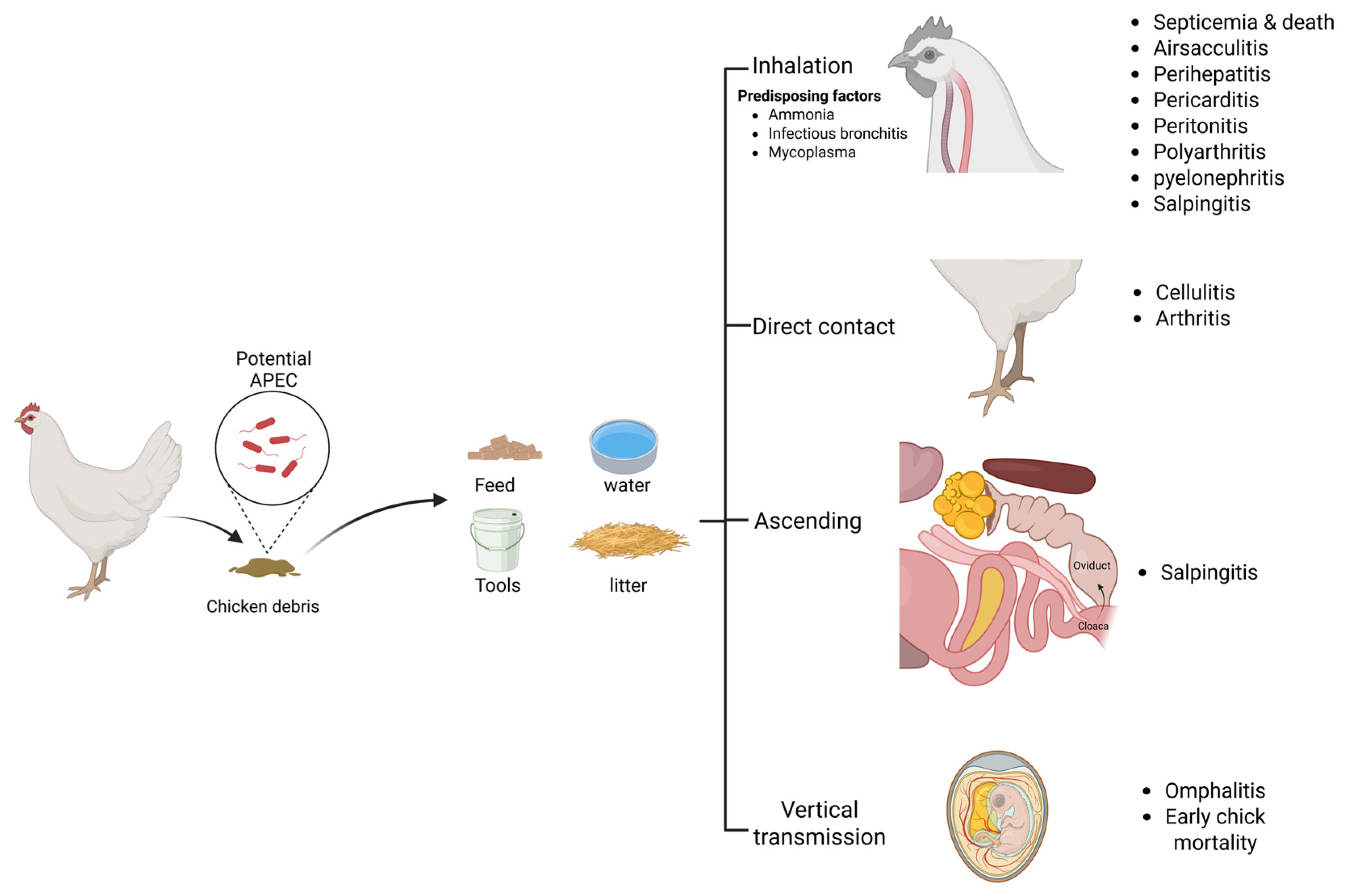
2. APEC Pathogenesis and Pathological Picture
3. Virulence Factors
3.1. Adherence
3.2. Iron Acquisition Systems
3.3. Increased Serum Survival
4. APEC Zoonosis
5. Diagnosis and Identification Scheme
6. Control Strategies of APEC
6.1. Management and Biosecurity Measures
6.2. Antibiotics
6.3. Phytochemicals
6.4. Vaccines

| Inactivated/Killed vaccine | ||||
|---|---|---|---|---|
| Vaccine strain serotype | Inactivation | Vaccination route | Bird | Reference |
| APEC (strain KAI-2/O78) | Formalin inactivated | Eye drop and coarse spray | Chicken | [257] |
| Monovalent (E. coli O78 or O1) | Formalin inactivated | Subcutaneous | Chicken | [267] |
| Multivalent (O18, O78 and O111) | Unclear | Intramuscular | Chicken | [259] |
| O157 | Formalin inactivated | Subcutaneous | Chicken | [272] |
| Bivalent (E. coli 19-381 and 19-383-M1) | Formaldehyde inactivated | Intramuscular | Chicken | [273] |
| Live-attenuated vaccine | ||||
| Vaccine strain serotype | Mutation | Vaccination route | Bird | Reference |
| O2 | carAB operon mutation | Oral | Turkeys | [284] |
| O78 and O2 | ∆cya and ∆cya∆crp | - | [255] | |
| O78 O2 | ∆cya∆crp ∆cya∆crp | Spray | Chicken | [269] |
| O78 | ∆galE, ∆purA, and ∆aroA (single mutation) | Spray | Chicken | [256] |
| O78 | ∆aroA | Spray and oral | Chicken | [266] |
| O78 | Crp deletion | Spray, eye drop, and in ovo | Chicken | [278] |
| Subunit vaccine | ||||
| Strain serotype | Antigen | Route | Bird | reference |
| O1 | Pili protein | Subcutaneous | Chicken | [285] |
| O1, O2, and O78 | Pili proteins of the three serotypes (Multivalent) | Subcutaneous | Chicken | [286] |
| Unclear | Sugar-binding domain of FimH (FimH156) | Intramuscular or intranasal | Chicken | [270] |
| Unclear | Sugar-binding domain of PapGII (PapGII196) | Intramuscular | Chicken | [271] |
| Unclear | Iss protein fused to glutathione S-transferase (GST-iss) | Subcutaneous | Chicken | [287] |
| Unclear | Liposome-encapsulated mixture of rough LPSs of core types R1, R2, R3 and R4. | Intramuscular | Chicken | [288] |
| Unclear | Iss protein, fused to glutathione S-transferase (GST-iss) | intramuscular | Chicken | [274] |
| APEC O78 and NEMC O18 | Recombinant antigens (rAg) including (EtsC, OmpA, OmpT, and TraT) | Subcutaneous | Chicken | [48] |
| Unclear | Enterobactin | Subcutaneous | Chicken | [260,261] |
| Recombinant vaccine | ||||
| Recombinant strain | Exogenous genes of E. coli | Route | Bird | Reference |
| ∆lon ∆cpxR ∆asdA16 S. Typhimurium (JOL912) | P-fimbriae (papA and papG) Aerobactin receptor (iutA) CS31A surface antigen (clpG) | Orally | Chicken | [275] |
| S. Typhimurium, ∆cya-27, ∆crp-27, ∆asdA16 | Ecp operon encoding E. coli pilus | Orally | Chicken | [289] |
| Lactobacillus saerimneri M-11 | Fimbrial subunit A (fimA) Outer-membrane protein C (ompC) | Orally | Chicken | [290] |
6.5. Bacteriophages
6.6. Probiotics
6.7. Prospective APEC Control
6.7.1. Antimicrobial Nanoparticles
6.7.2. Enzybiotics (Endolysins)
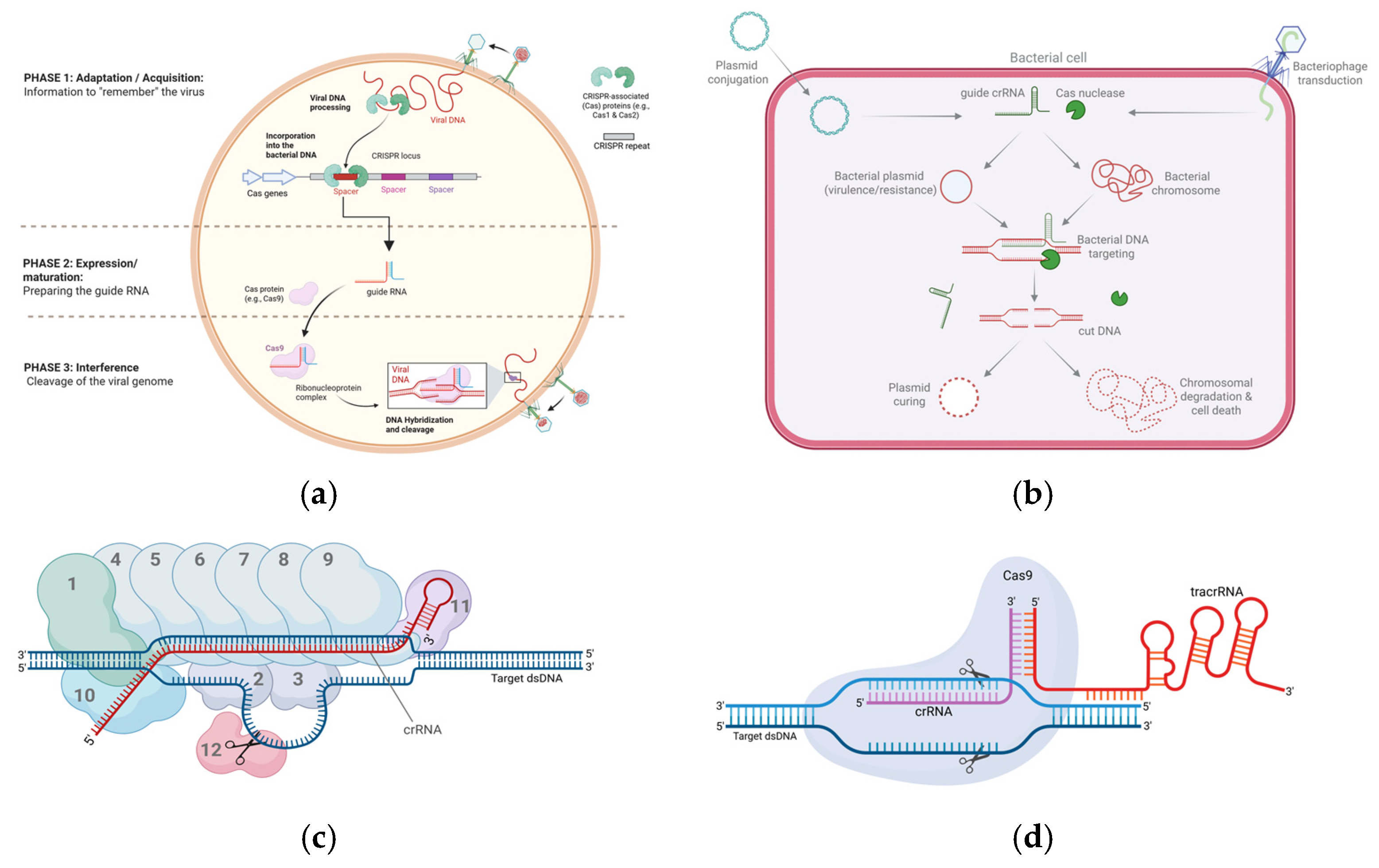
6.7.3. CRISPR-Based Antimicrobials
7. Conclusions
Author Contributions
Funding
Institutional Review Board Statement
Informed Consent Statement
Data Availability Statement
Conflicts of Interest
References
- Denamur, E.; Clermont, O.; Bonacorsi, S.; Gordon, D. The Population Genetics of Pathogenic Escherichia coli. Nat. Rev. Microbiol. 2021, 19, 37–54. [Google Scholar] [CrossRef]
- Peng, Z.; Wang, X.; Huang, J.; Li, B. Pathogenic Escherichia coli. In Molecular Medical Microbiology, 3rd ed.; Tang, Y.-W., Hindiyeh, M., Liu, D., Sails, A., Spearman, P., Zhang, J.-R., Eds.; Academic Press: Cambridge, MA, USA, 2024; pp. 1065–1096. [Google Scholar] [CrossRef]
- Riley, L.W. Distinguishing Pathovars from Nonpathovars: Escherichia coli. Microbiol. Spectr. 2020, 8, 101128. [Google Scholar] [CrossRef]
- Pakbin, B.; Brück, W.M.; Rossen, J.W.A. Virulence Factors of Enteric Pathogenic Escherichia coli: A Review. Int. J. Mol. Sci. 2021, 22, 9922. [Google Scholar] [CrossRef] [PubMed]
- Logue, C.M.; Wannemuehler, Y.; Nicholson, B.A.; Doetkott, C.; Barbieri, N.L.; Nolan, L.K. Comparative Analysis of Phylogenetic Assignment of Human and Avian ExPEC and Fecal Commensal Escherichia coli Using the (Previous and Revised) Clermont Phylogenetic Typing Methods and Its Impact on Avian Pathogenic Escherichia coli (APEC) Classification. Front. Microbiol. 2017, 8, 283. [Google Scholar] [CrossRef]
- Sora, V.M.; Meroni, G.; Martino, P.A.; Soggiu, A.; Bonizzi, L.; Zecconi, A. Extraintestinal Pathogenic Escherichia coli: Virulence Factors and Antibiotic Resistance. Pathogens 2021, 10, 1355. [Google Scholar] [CrossRef]
- Robins-Browne, R.M.; Holt, K.E.; Ingle, D.J.; Hocking, D.M.; Yang, J.; Tauschek, M. Are Escherichia coli Pathotypes Still Relevant in the Era of Whole-Genome Sequencing? Front. Cell. Infect. Microbiol. 2016, 6, 141. [Google Scholar] [CrossRef] [PubMed]
- Martinez-Medina, M. Special Issue: Pathogenic Escherichia Coli: Infections and Therapies. Antibiotics 2021, 10, 112. [Google Scholar] [CrossRef] [PubMed]
- Clermont, O.; Bonacorsi, S.; Bingen, E. Rapid and Simple Determination of the Escherichia coli Phylogenetic Group. Appl. Environ. Microbiol. 2000, 66, 4555–4558. [Google Scholar] [CrossRef]
- Clermont, O.; Christenson, J.K.; Denamur, E.; Gordon, D.M. The Clermont Escherichia coli Phylo-Typing Method Revisited: Improvement of Specificity and Detection of New Phylo-Groups. Environ. Microbiol. Rep. 2013, 5, 58–65. [Google Scholar] [CrossRef]
- Clermont, O.; Dixit, O.V.A.; Vangchhia, B.; Condamine, B.; Dion, S.; Bridier-Nahmias, A.; Denamur, E.; Gordon, D. Characterization and Rapid Identification of Phylogroup G in Escherichia Coli, a Lineage with High Virulence and Antibiotic Resistance Potential. Environ. Microbiol. 2019, 21, 3107–3117. [Google Scholar] [CrossRef]
- Pires-Dos-Santos, T.; Bisgaard, M.; Christensen, H. Genetic Diversity and Virulence Profiles of Escherichia coli Causing Salpingitis and Peritonitis in Broiler Breeders. Vet. Microbiol. 2013, 162, 873–880. [Google Scholar] [CrossRef]
- Beghain, J.; Bridier-Nahmias, A.; Le Nagard, H.; Denamur, E.; Clermont, O. ClermonTyping: An Easy-to-Use and Accurate in silico Method for Escherichia Genus Strain Phylotyping. Microb. Genom. 2018, 4, e000192. [Google Scholar] [CrossRef]
- Mosquito, S.; Pons, M.J.; Riveros, M.; Ruiz, J.; Ochoa, T.J. Diarrheagenic Escherichia coli Phylogroups Are Associated with Antibiotic Resistance and Duration of Diarrheal Episode. Sci. World J. 2015, 2015, 610403. [Google Scholar] [CrossRef] [PubMed]
- Panth, Y. Colibacillosis in Poultry: A Review. J. Agric. Nat. Resour. 2019, 2, 301–311. [Google Scholar] [CrossRef]
- Kemmett, K.; Humphrey, T.; Rushton, S.; Close, A.; Wigley, P.; Williams, N.J. A Longitudinal Study Simultaneously Exploring the Carriage of APEC Virulence Associated Genes and the Molecular Epidemiology of Faecal and Systemic E. coli in Commercial Broiler Chickens. PLoS ONE 2013, 8, e67749. [Google Scholar] [CrossRef] [PubMed]
- Xiao, S.-S.; Mi, J.-D.; Mei, L.; Liang, J.; Feng, K.-X.; Wu, Y.-B.; Liao, X.-D.; Wang, Y. Microbial Diversity and Community Variation in the Intestines of Layer Chickens. Animals 2021, 11, 840. [Google Scholar] [CrossRef]
- Yang, M.; Shi, L.; Ge, Y.; Leng, D.; Zeng, B.; Wang, T.; Jie, H.; Li, D. Dynamic Changes in the Gut Microbial Community and Function during Broiler Growth. Microbiol. Spectr. 2022, 10, e0100522. [Google Scholar] [CrossRef]
- Stromberg, Z.R.; Johnson, J.R.; Fairbrother, J.M.; Kilbourne, J.; Van Goor, A.; Curtiss, R.; Mellata, M. Evaluation of Escherichia coli Isolates from Healthy Chickens to Determine Their Potential Risk to Poultry and Human Health. PLoS ONE 2017, 12, e0180599. [Google Scholar] [CrossRef]
- Zou, M.; Ma, P.-P.; Liu, W.-S.; Liang, X.; Li, X.-Y.; Li, Y.-Z.; Liu, B.-T. Prevalence and Antibiotic Resistance Characteristics of Extraintestinal Pathogenic Escherichia coli among Healthy Chickens from Farms and Live Poultry Markets in China. Animals 2021, 11, 1112. [Google Scholar] [CrossRef]
- Ewers, C.; Antão, E.-M.; Diehl, I.; Philipp, H.-C.; Wieler, L.H. Intestine and Environment of the Chicken as Reservoirs for Extraintestinal Pathogenic Escherichia coli Strains with Zoonotic Potential. Appl. Environ. Microbiol. 2009, 75, 184–192. [Google Scholar] [CrossRef]
- Dziva, F.; Stevens, M.P. Colibacillosis in Poultry: Unravelling the Molecular Basis of Virulence of Avian Pathogenic Escherichia coli in Their Natural Hosts. Avian. Pathol. 2008, 37, 355–366. [Google Scholar] [CrossRef] [PubMed]
- Malik, Y.S.; Milton, A.A.P.; Ghatak, S.; Ghosh, S. Avian Colibacillosis (Escherichia coli). In Role of Birds in Transmitting Zoonotic Pathogens; Springer: Singapore, 2021; pp. 149–161. [Google Scholar] [CrossRef]
- Wang, X.; Li, L.; Shang, H.; Zhou, F.; Wang, C.; Zhang, S.; Gao, P.; Guo, P.; Zhu, R.; Sun, Z.; et al. Effects of Duck Circovirus on Immune Function and Secondary Infection of Avian Pathogenic Escherichia coli. Poult. Sci. 2022, 101, 101799. [Google Scholar] [CrossRef] [PubMed]
- Antão, E.-M.; Glodde, S.; Li, G.; Sharifi, R.; Homeier, T.; Laturnus, C.; Diehl, I.; Bethe, A.; Philipp, H.-C.; Preisinger, R.; et al. The Chicken as a Natural Model for Extraintestinal Infections Caused by Avian Pathogenic Escherichia coli (APEC). Microb. Pathog. 2008, 45, 361–369. [Google Scholar] [CrossRef]
- Kromann, S.; Olsen, R.H.; Bojesen, A.M.; Jensen, H.E.; Thøfner, I. Development of an Aerogenous Escherichia coli Infection Model in Adult Broiler Breeders. Sci. Rep. 2021, 11, 19556. [Google Scholar] [CrossRef]
- Paudel, S.; Fink, D.; Abdelhamid, M.K.; Zöggeler, A.; Liebhart, D.; Hess, M.; Hess, C. Aerosol Is the Optimal Route of Respiratory Tract Infection to Induce Pathological Lesions of Colibacillosis by a Lux-Tagged Avian Pathogenic Escherichia coli in Chickens. Avian Pathol. 2021, 50, 417–426. [Google Scholar] [CrossRef]
- Christensen, H.; Bachmeier, J.; Bisgaard, M. New Strategies to Prevent and Control Avian Pathogenic Escherichia coli (APEC). Avian Pathol. 2021, 50, 370–381. [Google Scholar] [CrossRef]
- Joseph, J.; Zhang, L.; Adhikari, P.; Evans, J.D.; Ramachandran, R. Avian Pathogenic Escherichia coli (APEC) in Broiler Breeders: An Overview. Pathogens 2023, 12, 1280. [Google Scholar] [CrossRef]
- Mehat, J.W.; van Vliet, A.H.M.; La Ragione, R.M. The Avian Pathogenic Escherichia coli (APEC) Pathotype Is Comprised of Multiple Distinct, Independent Genotypes. Avian Pathol. 2021, 50, 402–416. [Google Scholar] [CrossRef]
- Kathayat, D.; Lokesh, D.; Ranjit, S.; Rajashekara, G. Avian Pathogenic Escherichia coli (APEC): An Overview of Virulence and Pathogenesis Factors, Zoonotic Potential, and Control Strategies. Pathogens 2021, 10, 467. [Google Scholar] [CrossRef] [PubMed]
- Grakh, K.; Mittal, D.; Parkash, A.; Bangar, Y.C. Assessing the Potential Risk Factors Associated with Avian Colibacillosis Using a Questionnaire Survey. Haryana Vet. 2020, 59, 71–74. [Google Scholar]
- Alber, A.; Stevens, M.P.; Vervelde, L. The Bird’s Immune Response to Avian Pathogenic Escherichia coli. Avian Pathol. 2021, 50, 382–391. [Google Scholar] [CrossRef] [PubMed]
- Arné, P.; Marc, D.; Brée, A.; Schouler, C.; Dho-Moulin, M. Increased Tracheal Colonization in Chickens without Impairing Pathogenic Properties of Avian Pathogenic Escherichia coli MT78 with a fimH Deletion. Avian Dis. 2000, 44, 343–355. [Google Scholar] [CrossRef]
- Ramírez, R.M.; Almanza, Y.; García, S.; Heredia, N. Adherence and Invasion of Avian Pathogenic Escherichia coli to Avian Tracheal Epithelial Cells. World J. Microbiol. Biotechnol. 2009, 25, 1019–1023. [Google Scholar] [CrossRef]
- Zhang, G.; Sunkara, L.T. Avian Antimicrobial Host Defense Peptides: From Biology to Therapeutic Applications. Pharmaceuticals 2014, 7, 220–247. [Google Scholar] [CrossRef]
- Wu, H.; Xiong, H.; Huang, X.; Zhou, Q.; Hu, D.; Qi, K.; Liu, H. Lung Infection of Avian Pathogenic Escherichia coli Co-Upregulates the Expression of CSP-A and CLL in Chickens. Res. Vet. Sci. 2022, 152, 99–106. [Google Scholar] [CrossRef] [PubMed]
- Peng, L.-Y.; Cui, Z.-Q.; Wu, Z.-M.; Fu, B.-D.; Yi, P.-F.; Shen, H.-Q. RNA-Seq Profiles of Chicken Type II Pneumocyte in Response to Escherichia coli Infection. PLoS ONE 2019, 14, e0217438. [Google Scholar] [CrossRef] [PubMed]
- Nawab, A.; An, L.; Wu, J.; Li, G.; Liu, W.; Zhao, Y.; Wu, Q.; Xiao, M. Chicken Toll-like Receptors and Their Significance in Immune Response and Disease Resistance. Int. Rev. Immunol. 2019, 38, 284–306. [Google Scholar] [CrossRef]
- Wigley, P. Immunity to Bacterial Infection in the Chicken. Dev. Comp. Immunol. 2013, 41, 413–417. [Google Scholar] [CrossRef]
- Reese, S.; Dalamani, G.; Kaspers, B. The Avian Lung-Associated Immune System: A Review. Vet. Res. 2006, 37, 311–324. [Google Scholar] [CrossRef]
- Sutton, K.; Costa, T.; Alber, A.; Bryson, K.; Borowska, D.; Balic, A.; Kaiser, P.; Stevens, M.; Vervelde, L. Visualisation and Characterisation of Mononuclear Phagocytes in the Chicken Respiratory Tract Using CSF1R-Transgenic Chickens. Vet. Res. 2018, 49, 104. [Google Scholar] [CrossRef]
- Maina, J.N. A Critical Assessment of the Cellular Defences of the Avian Respiratory System: Are Birds in General and Poultry in Particular Relatively More Susceptible to Pulmonary Infections/Afflictions? Biol. Rev. 2023, 98, 2152–2187. [Google Scholar] [CrossRef]
- Ariaans, M.P.; Matthijs, M.G.R.; van Haarlem, D.; van de Haar, P.; van Eck, J.H.H.; Hensen, E.J.; Vervelde, L. The Role of Phagocytic Cells in Enhanced Susceptibility of Broilers to Colibacillosis after Infectious Bronchitis Virus Infection. Vet. Immunol. Immunopathol. 2008, 123, 240–250. [Google Scholar] [CrossRef]
- Li, Z.; Qi, Z.; Wang, X.; Lu, L.; Wang, H.; He, Z.; Chen, Z.; Shao, Y.; Tu, J.; Song, X. Avian Pathogenic Escherichia coli Infection Causes Infiltration of Heterophilic Granulocytes of Chick Tracheal by the Complement and Coagulation Cascades Pathway. BMC Vet. Res. 2023, 19, 262. [Google Scholar] [CrossRef] [PubMed]
- Alber, A.; Morris, K.M.; Bryson, K.J.; Sutton, K.M.; Monson, M.S.; Chintoan-Uta, C.; Borowska, D.; Lamont, S.J.; Schouler, C.; Kaiser, P.; et al. Avian Pathogenic Escherichia coli (APEC) Strain-Dependent Immunomodulation of Respiratory Granulocytes and Mononuclear Phagocytes in CSF1R-Reporter Transgenic Chickens. Front. Immunol. 2019, 10, 3055. [Google Scholar] [CrossRef] [PubMed]
- Wigley, P. The Immune System of the Chicken. In Poultry Health: A Guide for Professionals; CABI: Wallingford, UK, 2021; pp. 8–19. [Google Scholar] [CrossRef]
- Van Goor, A.; Stromberg, Z.R.; Mellata, M. A Recombinant Multi-Antigen Vaccine with Broad Protection Potential against Avian Pathogenic Escherichia coli. PLoS ONE 2017, 12, e0183929. [Google Scholar] [CrossRef]
- Ye, X.; Hsu, C.-Y.; Jia, L.; Zhang, X.; Magee, C.; Whitham, S.; Leigh, S.; Evans, J.D.; Zhang, L.; Robinson, K. Dynamic Immune Response to Avian Pathogenic Escherichia coli Infection in Broiler Chickens: Insights into pro-Inflammatory and Anti-Inflammatory Cytokine Regulation. Poult. Sci. 2025, 104, 105029. [Google Scholar] [CrossRef]
- Bagheri, S.; Mitra, T.; Paudel, S.; Abdelhamid, M.K.; Könnyü, S.; Wijewardana, V.; Kangethe, R.T.; Cattoli, G.; Lyrakis, M.; Hess, C.; et al. Aerosol Vaccination of Chicken Pullets with Irradiated Avian Pathogenic Escherichia coli Induces a Local Immunostimulatory Effect. Front. Immunol. 2023, 14, 1185232. [Google Scholar] [CrossRef]
- Goonewardene, K.; Ahmed, K.A.; Gunawardana, T.; Popowich, S.; Kurukulasuriya, S.; Karunarathna, R.; Gupta, A.; Ayalew, L.E.; Lockerbie, B.; Foldvari, M.; et al. Mucosal Delivery of CpG-ODN Mimicking Bacterial DNA via the Intrapulmonary Route Induces Systemic Antimicrobial Immune Responses in Neonatal Chicks. Sci. Rep. 2020, 10, 5343. [Google Scholar] [CrossRef] [PubMed]
- Mellata, M.; Dho-Moulin, M.; Dozois, C.M.; Curtiss, R.; Lehoux, B.; Fairbrother, J.M. Role of Avian Pathogenic Escherichia coli Virulence Factors in Bacterial Interaction with Chicken Heterophils and Macrophages. Infect. Immun. 2003, 71, 494–503. [Google Scholar] [CrossRef]
- Matter, L.B.; Barbieri, N.L.; Nordhoff, M.; Ewers, C.; Horn, F. Avian Pathogenic Escherichia coli MT78 Invades Chicken Fibroblasts. Vet. Microbiol. 2011, 148, 51–59. [Google Scholar] [CrossRef]
- Zhuge, X.; Sun, Y.; Jiang, M.; Wang, J.; Tang, F.; Xue, F.; Ren, J.; Zhu, W.; Dai, J. Acetate Metabolic Requirement of Avian Pathogenic Escherichia coli Promotes Its Intracellular Proliferation within Macrophage. Vet. Res. 2019, 50, 31. [Google Scholar] [CrossRef]
- Gao, Q.; Su, S.; Li, X.; Wang, H.; Liu, J.; Gao, S. Transcriptional Analysis of RstA/RstB in Avian Pathogenic Escherichia coli Identifies Its Role in the Regulation of HdeD-Mediated Virulence and Survival in Chicken Macrophages. Vet. Microbiol. 2020, 241, 108555. [Google Scholar] [CrossRef] [PubMed]
- Horn, F.; Corrêa, A.M.R.; Barbieri, N.L.; Glodde, S.; Weyrauch, K.D.; Kaspers, B.; Driemeier, D.; Ewers, C.; Wieler, L.H. Infections with Avian Pathogenic and Fecal Escherichia coli Strains Display Similar Lung Histopathology and Macrophage Apoptosis. PLoS ONE 2012, 7, e41031. [Google Scholar] [CrossRef]
- Sharif, H.; Javed, M.T.; Ghafoor, H.; Younis, M.; Khan, S.U.; Rehman, A.U.; Ashfaq, K.; Saleem, G.; Manzoor, F.; Tariq, N.; et al. Association of Pathogenicity Genes (cvaC, iss, iutA, Stx1A, Stx2A and Vat) of E. coli with Gross and Histopathological Lesions of Colibacillosis in Broilers. Sci. Lett. 2018, 6, 40–46. [Google Scholar]
- Shah, S.A.; Mir, M.S.; Wani, B.M.; Kamil, S.A.; Goswami, P.; Amin, U.; Shafi, M.; Rather, M.A.; Beigh, A.B. Pathological Studies on Avian Pathogenic Escherichia coli Infection in Broilers. Pharma Innov. J. 2019, 8, 68–73. [Google Scholar]
- Joshua, B.I.; Nanchak, L.R.; Ayo, A.C.; Jummai, B.D.; Emmanuel, L.L.; Suleiman, I.; Alesa, U.M.; Dominic, U.A.; Pwajok, C.T.P.; Gunya, D.Y.; et al. Gross and Histopatholigical Lesions Associated with Escherichia coli Infection in Chickens Examined, At Ecwa Veterinary Clinic, Bukuru, Plateau State, Nigeria. Acta Sci. Microbiol. 2022, 5, 74–81. [Google Scholar] [CrossRef]
- Nolan, L.K.; Barnes, H.J.; Vaillancourt, J.-P.; Abdul-Aziz, T.; Logue, C.M. Colibacillosis. In Diseases of Poultry, 13th ed.; Swayne, D.E., Ed.; John Wiley and Sons: New York, NY, USA, 2013; pp. 751–805. [Google Scholar] [CrossRef]
- Lutful Kabir, S.M.; Sikder, M.H.; Alam, J.; Neogi, S.B.; Yamasaki, S. Colibacillosis and Its Impact on Egg Production. In Egg Innovations and Strategies for Improvements; Hester, P.Y., Ed.; Academic Press: Cambridge, MA, USA, 2017; pp. 523–535. [Google Scholar] [CrossRef]
- Gerasimova, A.O.; Novikova, O.B.; Savicheva, A.A. Avian Colibacillosis—Current Aspects. Vet. Sci. Today 2023, 12, 284–292. [Google Scholar] [CrossRef]
- Wang, C.; Pors, S.E.; Olsen, R.H.; Bojesen, A.M. Transmission and Pathogenicity of Gallibacterium anatis and Escherichia coli in Embryonated Eggs. Vet. Microbiol. 2018, 217, 76–81. [Google Scholar] [CrossRef]
- Oikarainen, P.E.; Pohjola, L.K.; Pietola, E.S.; Heikinheimo, A. Direct Vertical Transmission of ESBL/PAmpC-Producing Escherichia coli Limited in Poultry Production Pyramid. Vet. Microbiol. 2019, 231, 100–106. [Google Scholar] [CrossRef] [PubMed]
- Swelum, A.A.; Elbestawy, A.R.; El-Saadony, M.T.; Hussein, E.O.S.; Alhotan, R.; Suliman, G.M.; Taha, A.E.; Ba-Awadh, H.; El-Tarabily, K.A.; Abd El-Hack, M.E. Ways to Minimize Bacterial Infections, with Special Reference to Escherichia coli, to Cope with the First-Week Mortality in Chicks: An Updated Overview. Poult. Sci. 2021, 100, 101039. [Google Scholar] [CrossRef]
- Govindarajan, D.K.; Viswalingam, N.; Meganathan, Y.; Kandaswamy, K. Adherence Patterns of Escherichia coli in the Intestine and Its Role in Pathogenesis. Med. Microecol. 2020, 5, 100025. [Google Scholar] [CrossRef]
- Solanki, V.; Tiwari, M.; Tiwari, V. Host-Bacteria Interaction and Adhesin Study for Development of Therapeutics. Int. J. Biol. Macromol. 2018, 112, 54–64. [Google Scholar] [CrossRef]
- Aleksandrowicz, A.; Khan, M.M.; Sidorczuk, K.; Noszka, M.; Kolenda, R. Whatever Makes Them Stick—Adhesins of Avian Pathogenic Escherichia coli. Vet. Microbiol. 2021, 257, 109095. [Google Scholar] [CrossRef]
- Isidro-Coxca, M.I.; Ortiz-Jiménez, S.; Puente, J.L. Type 1 Fimbria and P Pili: Regulatory Mechanisms of the Prototypical Members of the Chaperone-Usher Fimbrial Family. Arch. Microbiol. 2024, 206, 373. [Google Scholar] [CrossRef]
- LA Ragione, R.M.; Cooley, W.A.; Woodward, M.J. The Role of Fimbriae and Flagella in the Adherence of Avian Strains of Escherichia coli O78:K80 to Tissue Culture Cells and Tracheal and Gut Explants. J. Med. Microbiol. 2000, 49, 327–338. [Google Scholar] [CrossRef]
- Chen, J.; Dai, W.; Cui, S.; Lei, W.; Dai, D. Screening of Antigenic Epitopes Related to the Adhesion of the Avian Escherichia coli Type 1 Fimbrial Agglutinin Domain. BMC Vet. Res. 2023, 19, 187. [Google Scholar] [CrossRef]
- Kline, K.A.; Fälker, S.; Dahlberg, S.; Normark, S.; Henriques-Normark, B. Bacterial Adhesins in Host-Microbe Interactions. Cell Host Microbe 2009, 5, 580–592. [Google Scholar] [CrossRef]
- Avalos Vizcarra, I.; Hosseini, V.; Kollmannsberger, P.; Meier, S.; Weber, S.S.; Arnoldini, M.; Ackermann, M.; Vogel, V. How Type 1 Fimbriae Help Escherichia coli to Evade Extracellular Antibiotics. Sci. Rep. 2016, 6, 18109. [Google Scholar] [CrossRef]
- Nawaz, S.; Wang, Z.; Zhang, Y.; Jia, Y.; Jiang, W.; Chen, Z.; Yin, H.; Huang, C.; Han, X. Avian Pathogenic Escherichia coli (APEC): Current Insights and Future Challenges. Poult. Sci. 2024, 103, 104359. [Google Scholar] [CrossRef]
- Werneburg, G.T.; Thanassi, D.G. Pili Assembled by the Chaperone/Usher Pathway in Escherichia coli and Salmonella. EcoSal Plus 2018, 8, 101128. [Google Scholar] [CrossRef]
- Lane, M.C.; Mobley, H.L.T. Role of P-Fimbrial-Mediated Adherence in Pyelonephritis and Persistence of Uropathogenic Escherichia coli (UPEC) in the Mammalian Kidney. Kidney Int. 2007, 72, 19–25. [Google Scholar] [CrossRef]
- Ghazvini, H.; Taheri, K.; Edalati, E.; Sedighi, M.; Mirkalantari, S. Virulence Factors and Antimicrobial Resistance in Uropathogenic Escherichia coli Strains Isolated from Cystitis and Pyelonephritis. Turk. J. Med. Sci. 2019, 49, 361–367. [Google Scholar] [CrossRef]
- Rocha, A.C.G.P.; Rocha, S.L.S.; Lima-Rosa, C.A.V.; Souza, G.F.; Moraes, H.L.S.; Salle, F.O.; Moraes, L.B.; Salle, C.T.P. Genes Associated with Pathogenicity of Avian Escherichia coli (APEC) Isolated from Respiratory Cases of Poultry. Pesq. Vet. Bras. 2008, 28, 183–186. [Google Scholar] [CrossRef]
- Paixão, A.C.; Ferreira, A.C.; Fontes, M.; Themudo, P.; Albuquerque, T.; Soares, M.C.; Fevereiro, M.; Martins, L.; de Sá, M.I.C. Detection of Virulence-Associated Genes in Pathogenic and Commensal Avian Escherichia coli Isolates. Poult. Sci. 2016, 95, 1646–1652. [Google Scholar] [CrossRef]
- Xu, X.; Sun, Q.; Zhao, L. Virulence Factors and Antibiotic Resistance of Avian Pathogenic Escherichia coli in Eastern China. J. Vet. Res. 2019, 63, 317–320. [Google Scholar] [CrossRef]
- Kariyawasam, S.; Nolan, L.K. Pap Mutant of Avian Pathogenic Escherichia coli O1, an O1:K1:H7 Strain, Is Attenuated in vivo. Avian Dis. 2009, 53, 255–260. [Google Scholar] [CrossRef]
- Ganz, T. Iron and Infection. Int. J. Hematol. 2018, 107, 7–15. [Google Scholar] [CrossRef]
- Kramer, J.; Özkaya, Ö.; Kümmerli, R. Bacterial Siderophores in Community and Host Interactions. Nat. Rev. Microbiol. 2020, 18, 152–163. [Google Scholar] [CrossRef]
- Schalk, I.J. Bacterial Siderophores: Diversity, Uptake Pathways and Applications. Nat. Rev. Microbiol. 2025, 23, 24–40. [Google Scholar] [CrossRef]
- Page, M.G.P. The Role of Iron and Siderophores in Infection, and the Development of Siderophore Antibiotics. Clin. Infect. Dis. 2019, 69, S529–S537. [Google Scholar] [CrossRef]
- Gatsios, A.; Kim, C.S.; Crawford, J.M. Escherichia coli Small Molecule Metabolism at the Host–Microorganism Interface. Nat. Chem. Biol. 2021, 17, 1016–1026. [Google Scholar] [CrossRef]
- Khasheii, B.; Mahmoodi, P.; Mohammadzadeh, A. Siderophores: Importance in Bacterial Pathogenesis and Applications in Medicine and Industry. Microbiol. Res. 2021, 250, 126790. [Google Scholar] [CrossRef]
- Mey, A.R.; Gómez-Garzón, C.; Payne, S.M. Iron Transport and Metabolism in Escherichia, Shigella, and Salmonella. EcoSal Plus 2021, 9, eESP-0034. [Google Scholar] [CrossRef]
- Moran, R.A.; Holt, K.E.; Hall, R.M. pCERC3 from a Commensal ST95 Escherichia coli: A ColV Virulence-Multiresistance Plasmid Carrying a Sul3-Associated Class 1 Integron. Plasmid 2016, 84–85, 11–19. [Google Scholar] [CrossRef]
- Gao, H.; Bian, X. Editorial: Microbial Siderophores: Biosynthesis, Regulation, and Physiological and Ecological Impacts. Front. Microbiol. 2022, 13, 892485. [Google Scholar] [CrossRef]
- Cui, J.; Dong, Y.; Chen, Q.; Zhang, C.; He, K.; Hu, G.; He, D.; Yuan, L. Horizontal Transfer Characterization of ColV Plasmids in BlaCTX-M-Bearing Avian Escherichia coli. Poult. Sci. 2024, 103, 103631. [Google Scholar] [CrossRef]
- Ling, J.; Pan, H.; Gao, Q.; Xiong, L.; Zhou, Y.; Zhang, D.; Gao, S.; Liu, X. Aerobactin Synthesis Genes IucA and IucC Contribute to the Pathogenicity of Avian Pathogenic Escherichia coli O2 Strain E058. PLoS ONE 2013, 8, e57794. [Google Scholar] [CrossRef]
- Gao, Q.; Jia, X.; Wang, X.; Xiong, L.; Gao, S.; Liu, X. The Avian Pathogenic Escherichia coli O2 Strain E058 Carrying the Defined Aerobactin-Defective IucD or IucDiutA Mutation Is Less Virulent in the Chicken. Infect. Genet. Evol. 2015, 30, 267–277. [Google Scholar] [CrossRef]
- Perry, R.D.; Fetherston, J.D. Yersiniabactin Iron Uptake: Mechanisms and Role in Yersinia Pestis Pathogenesis. Microbes Infect. 2011, 13, 808–817. [Google Scholar] [CrossRef]
- Desvaux, M.; Dalmasso, G.; Beyrouthy, R.; Barnich, N.; Delmas, J.; Bonnet, R. Pathogenicity Factors of Genomic Islands in Intestinal and Extraintestinal Escherichia coli. Front. Microbiol. 2020, 11, 2065. [Google Scholar] [CrossRef]
- Katumba, G.L.; Tran, H.; Henderson, J.P. The Yersinia High-Pathogenicity Island Encodes a Siderophore-Dependent Copper Response System in Uropathogenic Escherichia coli. mBio 2022, 13, e0239121. [Google Scholar] [CrossRef]
- Miller, D.A.; Luo, L.; Hillson, N.; Keating, T.A.; Walsh, C.T. Yersiniabactin Synthetase: A Four-Protein Assembly Line Producing the Nonribosomal Peptide/Polyketide Hybrid Siderophore of Yersinia Pestis. Chem. Biol. 2002, 9, 333–344. [Google Scholar] [CrossRef]
- Schubert, S.; Rakin, A.; Heesemann, J. The Yersinia High-Pathogenicity Island (HPI): Evolutionary and Functional Aspects. Int. J. Med. Microbiol. 2004, 294, 83–94. [Google Scholar] [CrossRef]
- Schubert, S.; Picard, B.; Gouriou, S.; Heesemann, J.; Denamur, E. Yersinia High-Pathogenicity Island Contributes to Virulence in Escherichia coli Causing Extraintestinal Infections. Infect. Immun. 2002, 70, 5335–5337. [Google Scholar] [CrossRef]
- Johnson, J.R.; Magistro, G.; Clabots, C.; Porter, S.; Manges, A.; Thuras, P.; Schubert, S. Contribution of Yersiniabactin to the Virulence of an Escherichia coli Sequence Type 69 (“Clonal Group A”) Cystitis Isolate in Murine Models of Urinary Tract Infection and Sepsis. Microb. Pathog. 2018, 120, 128–131. [Google Scholar] [CrossRef]
- Brumbaugh, A.R.; Smith, S.N.; Subashchandrabose, S.; Himpsl, S.D.; Hazen, T.H.; Rasko, D.A.; Mobley, H.L.T. Blocking Yersiniabactin Import Attenuates Extraintestinal Pathogenic Escherichia coli in Cystitis and Pyelonephritis and Represents a Novel Target to Prevent Urinary Tract Infection. Infect. Immun. 2015, 83, 1443–1450. [Google Scholar] [CrossRef]
- Tu, J.; Xue, T.; Qi, K.; Shao, Y.; Huang, B.; Wang, X.; Zhou, X. The Irp2 and FyuA Genes in High Pathogenicity Islands Are Involved in the Pathogenesis of Infections Caused by Avian Pathogenic Escherichia coli (APEC). Pol. J. Vet. Sci. 2016, 19, 21–29. [Google Scholar] [CrossRef]
- Sorsa, L.J.; Dufke, S.; Heesemann, J.; Schubert, S. Characterization of an IroBCDEN Gene Cluster on a Transmissible Plasmid of Uropathogenic Escherichia coli: Evidence for Horizontal Transfer of a Chromosomal Virulence Factor. Infect. Immun. 2003, 71, 3285–3293. [Google Scholar] [CrossRef]
- Soliman, A.M.; Ramadan, H.; Yu, L.; Hisatsune, J.; Sugai, M.; Elnahriry, S.S.; Nariya, H.; El-Domany, R.A.; Shimamoto, T.; Jackson, C.R.; et al. Complete Genome Sequences of Two Escherichia coli Clinical Isolates from Egypt Carrying mcr-1 on IncP and IncX4 Plasmids. Front. Microbiol. 2022, 13, 989045. [Google Scholar] [CrossRef]
- Hantke, K.; Nicholson, G.; Rabsch, W.; Winkelmann, G. Salmochelins, Siderophores of Salmonella enterica and Uropathogenic Escherichia coli Strains, Are Recognized by the Outer Membrane Receptor IroN. Proc. Natl. Acad. Sci. USA 2003, 100, 3677–3682. [Google Scholar] [CrossRef]
- Ons, E.; Bleyen, N.; Tuntufye, H.N.; Vandemaele, F.; Goddeeris, B.M. High Prevalence Iron Receptor Genes of Avian Pathogenic Escherichia coli. Avian Pathol. 2007, 36, 411–414. [Google Scholar] [CrossRef][Green Version]
- Hossain, F.E.; Islam, S.; Islam, M.A.; Islam, S.; Ahmed, F. Detection of Virulence Genes of APEC (Avian Pathogenic Escherichia coli) Isolated from Poultry in Noakhali, Bangladesh. Bioresearch Commun. 2021, 7, 967–972. [Google Scholar] [CrossRef]
- Caza, M.; Lépine, F.; Milot, S.; Dozois, C.M. Specific Roles of the IroBCDEN Genes in Virulence of an Avian Pathogenic Escherichia coli O78 Strain and in Production of Salmochelins. Infect. Immun. 2008, 76, 3539–3549. [Google Scholar] [CrossRef]
- Gao, Q.; Wang, X.; Xu, H.; Xu, Y.; Ling, J.; Zhang, D.; Gao, S.; Liu, X. Roles of Iron Acquisition Systems in Virulence of Extraintestinal Pathogenic Escherichia coli: Salmochelin and Aerobactin Contribute More to Virulence than Heme in a Chicken Infection Model. BMC Microbiol. 2012, 12, 143. [Google Scholar] [CrossRef]
- Magistro, G.; Hoffmann, C.; Schubert, S. The Salmochelin Receptor IroN Itself, but Not Salmochelin-Mediated Iron Uptake Promotes Biofilm Formation in Extraintestinal Pathogenic Escherichia coli (ExPEC). Int. J. Med. Microbiol. 2015, 305, 435–445. [Google Scholar] [CrossRef] [PubMed]
- Silveira, F.; Maluta, R.P.; Tiba, M.R.; de Paiva, J.B.; Guastalli, E.A.L.; da Silveira, W.D. Comparison between Avian Pathogenic (APEC) and Avian Faecal (AFEC) Escherichia coli Isolated from Different Regions in Brazil. Vet. J. 2016, 217, 65–67. [Google Scholar] [CrossRef]
- Huja, S.; Oren, Y.; Trost, E.; Brzuszkiewicz, E.; Biran, D.; Blom, J.; Goesmann, A.; Gottschalk, G.; Hacker, J.; Ron, E.Z.; et al. Genomic Avenue to Avian Colisepticemia. mBio 2015, 6, 101128. [Google Scholar] [CrossRef]
- Xu, W.-Y.; Li, Y.-J.; Fan, C. Different Loci and MRNA Copy Number of the Increased Serum Survival Gene of Escherichia coli. Can. J. Microbiol. 2018, 64, 147–154. [Google Scholar] [CrossRef] [PubMed]
- Biran, D.; Sura, T.; Otto, A.; Yair, Y.; Becher, D.; Ron, E.Z. Surviving Serum: The Escherichia coli iss Gene of Extraintestinal Pathogenic E. coli Is Required for the Synthesis of Group 4 Capsule. Infect. Immun. 2021, 89, e0031621. [Google Scholar] [CrossRef]
- Nolan, L.K.; Horne, S.M.; Giddings, C.W.; Foley, S.L.; Johnson, T.J.; Lynne, A.M.; Skyberg, J. Resistance to Serum Complement, iss, and Virulence of Avian Escherichia coli. Vet. Res. Commun. 2003, 27, 101–110. [Google Scholar] [CrossRef] [PubMed]
- Lynne, A.M.; Skyberg, J.A.; Logue, C.M.; Nolan, L.K. Detection of iss and bor on the Surface of Escherichia coli. J. Appl. Microbiol. 2007, 102, 660–666. [Google Scholar] [CrossRef]
- Varga, C.; Brash, M.L.; Slavic, D.; Boerlin, P.; Ouckama, R.; Weis, A.; Petrik, M.; Philippe, C.; Barham, M.; Guerin, M.T. Evaluating Virulence-Associated Genes and Antimicrobial Resistance of Avian Pathogenic Escherichia coli Isolates from Broiler and Broiler Breeder Chickens in Ontario, Canada. Avian Dis. 2018, 62, 291–299. [Google Scholar] [CrossRef]
- Afayibo, D.J.A.; Zhu, H.; Zhang, B.; Yao, L.; Abdelgawad, H.A.; Tian, M.; Qi, J.; Liu, Y.; Wang, S. Isolation, Molecular Characterization, and Antibiotic Resistance of Avian Pathogenic Escherichia coli in Eastern China. Vet. Sci. 2022, 9, 319. [Google Scholar] [CrossRef]
- Wilczyński, J.; Stępień-Pyśniak, D.; Wystalska, D.; Wernicki, A. Molecular and Serological Characteristics of Avian Pathogenic Escherichia coli Isolated from Various Clinical Cases of Poultry Colibacillosis in Poland. Animals 2022, 12, 1090. [Google Scholar] [CrossRef]
- Wijetunge, D.S.S.; Gongati, S.; DebRoy, C.; Kim, K.S.; Couraud, P.O.; Romero, I.A.; Weksler, B.; Kariyawasam, S. Characterizing the Pathotype of Neonatal Meningitis Causing Escherichia coli (NMEC). BMC Microbiol. 2015, 15, 211. [Google Scholar] [CrossRef]
- Zeng, Q.; Xiao, S.; Gu, F.; He, W.; Xie, Q.; Yu, F.; Han, L. Antimicrobial Resistance and Molecular Epidemiology of Uropathogenic Escherichia coli Isolated From Female Patients in Shanghai, China. Front. Cell. Infect. Microbiol. 2021, 11, 653983. [Google Scholar] [CrossRef] [PubMed]
- Chuba, P.J.; Leon, M.A.; Banerjee, A.; Palchaudhuri, S. Cloning and DNA Sequence of Plasmid Determinant iss, Coding for Increased Serum Survival and Surface Exclusion, Which Has Homology with Lambda DNA. Mol. Gen. Genet. 1989, 216, 287–292. [Google Scholar] [CrossRef] [PubMed]
- Miajlovic, H.; Smith, S.G. Bacterial Self-Defence: How Escherichia coli Evades Serum Killing. FEMS Microbiol. Lett. 2014, 354, 1–9. [Google Scholar] [CrossRef]
- Johnson, T.J.; Wannemuehler, Y.; Doetkott, C.; Johnson, S.J.; Rosenberger, S.C.; Nolan, L.K. Identification of Minimal Predictors of Avian Pathogenic Escherichia coli Virulence for Use as a Rapid Diagnostic Tool. J. Clin. Microbiol. 2008, 46, 3987–3996. [Google Scholar] [CrossRef]
- Pokharel, P.; Dhakal, S.; Dozois, C.M. The Diversity of Escherichia coli Pathotypes and Vaccination Strategies against This Versatile Bacterial Pathogen. Microorganisms 2023, 11, 344. [Google Scholar] [CrossRef] [PubMed]
- Kariyawasam, S.; Han, J. Avian Pathogenic Escherichia coli: Link to Foodborne Urinary Tract Infections in Humans. In Food Safety in Poultry Meat Production; Springer: Cham, Switzerland, 2019; pp. 261–292. [Google Scholar] [CrossRef]
- Rodriguez-Siek, K.E.; Giddings, C.W.; Doetkott, C.; Johnson, T.J.; Fakhr, M.K.; Nolan, L.K. Comparison of Escherichia coli Isolates Implicated in Human Urinary Tract Infection and Avian Colibacillosis. Microbiology 2005, 151, 2097–2110. [Google Scholar] [CrossRef] [PubMed]
- Ron, E.Z. Host Specificity of Septicemic Escherichia coli: Human and Avian Pathogens. Curr. Opin. Microbiol. 2006, 9, 28–32. [Google Scholar] [CrossRef] [PubMed]
- Adiri, R.S.; Gophna, U.; Ron, E.Z. Multilocus Sequence Typing (MLST) of Escherichia coli O78 Strains. FEMS Microbiol. Lett. 2003, 222, 199–203. [Google Scholar] [CrossRef] [PubMed]
- Johnson, T.J.; Wannemuehler, Y.; Johnson, S.J.; Stell, A.L.; Doetkott, C.; Johnson, J.R.; Kim, K.S.; Spanjaard, L.; Nolan, L.K. Comparison of Extraintestinal Pathogenic Escherichia coli Strains from Human and Avian Sources Reveals a Mixed Subset Representing Potential Zoonotic Pathogens. Appl. Environ. Microbiol. 2008, 74, 7043–7050. [Google Scholar] [CrossRef] [PubMed]
- Mora, A.; Viso, S.; López, C.; Alonso, M.P.; García-Garrote, F.; Dabhi, G.; Mamani, R.; Herrera, A.; Marzoa, J.; Blanco, M.; et al. Poultry as Reservoir for Extraintestinal Pathogenic Escherichia coli O45:K1:H7-B2-ST95 in Humans. Vet. Microbiol. 2013, 167, 506–512. [Google Scholar] [CrossRef]
- Danzeisen, J.L.; Wannemuehler, Y.; Nolan, L.K.; Johnson, T.J. Comparison of Multilocus Sequence Analysis and Virulence Genotyping of Escherichia coli from Live Birds, Retail Poultry Meat, and Human Extraintestinal Infection. Avian Dis. 2013, 57, 104–108. [Google Scholar] [CrossRef]
- Maluta, R.P.; Logue, C.M.; Casas, M.R.T.; Meng, T.; Guastalli, E.A.L.; Rojas, T.C.G.; Montelli, A.C.; Sadatsune, T.; de Carvalho Ramos, M.; Nolan, L.K.; et al. Overlapped Sequence Types (STs) and Serogroups of Avian Pathogenic (APEC) and Human Extra-Intestinal Pathogenic (ExPEC) Escherichia coli Isolated in Brazil. PLoS ONE 2014, 9, e105016. [Google Scholar] [CrossRef]
- Hojabri, Z.; Darabi, N.; Arab, M.; Saffari, F.; Pajand, O. Clonal Diversity, Virulence Genes Content and Subclone Status of Escherichia coli Sequence Type 131: Comparative Analysis of E. coli ST131 and Non-ST131 Isolates from Iran. BMC Microbiol. 2019, 19, 117. [Google Scholar] [CrossRef]
- Massella, E.; Reid, C.J.; Cummins, M.L.; Anantanawat, K.; Zingali, T.; Serraino, A.; Piva, S.; Giacometti, F.; Djordjevic, S.P. Snapshot Study of Whole Genome Sequences of Escherichia coli from Healthy Companion Animals, Livestock, Wildlife, Humans and Food in Italy. Antibiotics 2020, 9, 782. [Google Scholar] [CrossRef]
- Díaz-Jiménez, D.; García-Meniño, I.; Fernández, J.; García, V.; Mora, A. Chicken and Turkey Meat: Consumer Exposure to Multidrug-Resistant Enterobacteriaceae Including Mcr-Carriers, Uropathogenic E. coli and High-Risk Lineages Such as ST131. Int. J. Food Microbiol. 2020, 331, 108750. [Google Scholar] [CrossRef]
- Moulin-Schouleur, M.; Schouler, C.; Tailliez, P.; Kao, M.-R.; Brée, A.; Germon, P.; Oswald, E.; Mainil, J.; Blanco, M.; Blanco, J. Common Virulence Factors and Genetic Relationships between O18:K1:H7 Escherichia coli Isolates of Human and Avian Origin. J. Clin. Microbiol. 2006, 44, 3484–3492. [Google Scholar] [CrossRef]
- Moulin-Schouleur, M.; Répérant, M.; Laurent, S.; Brée, A.; Mignon-Grasteau, S.; Germon, P.; Rasschaert, D.; Schouler, C. Extraintestinal Pathogenic Escherichia coli Strains of Avian and Human Origin: Link between Phylogenetic Relationships and Common Virulence Patterns. J. Clin. Microbiol. 2007, 45, 3366–3376. [Google Scholar] [CrossRef]
- Jakobsen, L.; Hammerum, A.M.; Frimodt-Møller, N. Virulence of Escherichia coli B2 Isolates from Meat and Animals in a Murine Model of Ascending Urinary Tract Infection (UTI): Evidence That UTI Is a Zoonosis. J. Clin. Microbiol. 2010, 48, 2978–2980. [Google Scholar] [CrossRef] [PubMed]
- Tivendale, K.A.; Logue, C.M.; Kariyawasam, S.; Jordan, D.; Hussein, A.; Li, G.; Wannemuehler, Y.; Nolan, L.K. Avian-Pathogenic Escherichia coli Strains Are Similar to Neonatal Meningitis E. coli Strains and Are Able to Cause Meningitis in the Rat Model of Human Disease. Infect. Immun. 2010, 78, 3412–3419. [Google Scholar] [CrossRef]
- Chanteloup, N.K.; Porcheron, G.; Delaleu, B.; Germon, P.; Schouler, C.; Moulin-Schouleur, M.; Gilot, P. The Extra-Intestinal Avian Pathogenic Escherichia coli Strain BEN2908 Invades Avian and Human Epithelial Cells and Survives Intracellularly. Vet. Microbiol. 2011, 147, 435–439. [Google Scholar] [CrossRef] [PubMed]
- Wang, X.; Wei, L.; Wang, B.; Zhang, R.; Liu, C.; Bi, D.; Chen, H.; Tan, C. Complete Genome Sequence and Characterization of Avian Pathogenic Escherichia coli Field Isolate ACN001. Stand. Genomic. Sci. 2016, 11, 13. [Google Scholar] [CrossRef] [PubMed]
- Mellata, M.; Johnson, J.R.; Curtiss, R. Escherichia coli Isolates from Commercial Chicken Meat and Eggs Cause Sepsis, Meningitis and Urinary Tract Infection in Rodent Models of Human Infections. Zoonoses Public Health 2018, 65, 103–113. [Google Scholar] [CrossRef]
- Johnson, T.J.; Kariyawasam, S.; Wannemuehler, Y.; Mangiamele, P.; Johnson, S.J.; Doetkott, C.; Skyberg, J.A.; Lynne, A.M.; Johnson, J.R.; Nolan, L.K. The Genome Sequence of Avian Pathogenic Escherichia coli Strain O1:K1:H7 Shares Strong Similarities with Human Extraintestinal Pathogenic E. coli Genomes. J. Bacteriol. 2007, 189, 3228–3236. [Google Scholar] [CrossRef]
- Pietsch, M.; Irrgang, A.; Roschanski, N.; Brenner Michael, G.; Hamprecht, A.; Rieber, H.; Käsbohrer, A.; Schwarz, S.; Rösler, U.; Kreienbrock, L.; et al. Whole Genome Analyses of CMY-2-Producing Escherichia coli Isolates from Humans, Animals and Food in Germany. BMC Genom. 2018, 19, 601. [Google Scholar] [CrossRef]
- Li, D.; Wyrsch, E.R.; Elankumaran, P.; Dolejska, M.; Marenda, M.S.; Browning, G.F.; Bushell, R.N.; McKinnon, J.; Chowdhury, P.R.; Hitchick, N.; et al. Genomic Comparisons of Escherichia coli ST131 from Australia. Microb. Genom. 2021, 7, 000721. [Google Scholar] [CrossRef]
- Tsai, Y.-Y.; Ienes Lima, J.; Alvarez Narvaez, S.; Logue, C.M. Whole-Genome Analysis of Five Escherichia coli Strains Isolated from Focal Duodenal Necrosis in Laying Hens Reveals Genetic Similarities to the E. coli O25:H4 ST131 Strain. Microbiol. Spectr. 2025, 13, e0211024. [Google Scholar] [CrossRef]
- Xia, F.; Cheng, J.; Jiang, M.; Wang, Z.; Wen, Z.; Wang, M.; Ren, J.; Zhuge, X. Genomics Analysis to Identify Multiple Genetic Determinants That Drive the Global Transmission of the Pandemic ST95 Lineage of Extraintestinal Pathogenic Escherichia coli (ExPEC). Pathogens 2022, 11, 1489. [Google Scholar] [CrossRef] [PubMed]
- Saidenberg, A.B.S.; Edslev, S.M.; Hallstrøm, S.; Rasmussen, A.; Park, D.E.; Aziz, M.; Dos Santos Queiroz, B.; Baptista, A.A.S.; Barbosa, F.; Rocha, V.G.P.; et al. Escherichia coli ST117: Exploring the Zoonotic Hypothesis. Microbiol. Spectr. 2024, 12, e0046624. [Google Scholar] [CrossRef]
- Guabiraba, R.; Schouler, C. Avian Colibacillosis: Still Many Black Holes. FEMS Microbiol. Lett. 2015, 362, fnv118. [Google Scholar] [CrossRef] [PubMed]
- Kunert Filho, H.C.; Carvalho, D.; Grassotti, T.T.; Soares, B.D.; Rossato, J.M.; Cunha, A.C.; Brito, K.C.T.; Cavalli, L.S.; Brito, B.G. Avian Pathogenic Escherichia coli—Methods for Improved Diagnosis. Worlds Poult. Sci. J. 2015, 71, 249–258. [Google Scholar] [CrossRef]
- Younis, G.; Awad, A.; Mohamed, N. Phenotypic and Genotypic Characterization of Antimicrobial Susceptibility of Avian Pathogenic Escherichia coli Isolated from Broiler Chickens. Vet. World 2017, 10, 1167–1172. [Google Scholar] [CrossRef]
- Kim, Y.B.; Yoon, M.Y.; Ha, J.S.; Seo, K.W.; Noh, E.B.; Son, S.H.; Lee, Y.J. Molecular Characterization of Avian Pathogenic Escherichia coli from Broiler Chickens with Colibacillosis. Poult. Sci. 2020, 99, 1088–1095. [Google Scholar] [CrossRef]
- Hu, J.; Afayibo, D.J.A.; Zhang, B.; Zhu, H.; Yao, L.; Guo, W.; Wang, X.; Wang, Z.; Wang, D.; Peng, H.; et al. Characteristics, Pathogenic Mechanism, Zoonotic Potential, Drug Resistance, and Prevention of Avian Pathogenic Escherichia coli (APEC). Front. Microbiol. 2022, 13, 1049391. [Google Scholar] [CrossRef]
- Hussain, H.I.; Iqbal, Z.; Iqbal, M.; Kuang, X.; Wang, Y.; Yang, L.; Ihsan, A.; Aqib, A.I.; Kaleem, Q.M.; Gu, Y.; et al. Coexistence of Virulence and β-Lactamase Genes in Avian Pathogenic Escherichia coli. Microb. Pathog. 2022, 163, 105389. [Google Scholar] [CrossRef] [PubMed]
- Collingwood, C.; Kemmett, K.; Williams, N.; Wigley, P. Is the Concept of Avian Pathogenic Escherichia coli as a Single Pathotype Fundamentally Flawed? Front. Vet. Sci. 2014, 1, 5. [Google Scholar] [CrossRef]
- Feng, A.; Akter, S.; Leigh, S.A.; Wang, H.; Pharr, G.T.; Evans, J.; Branton, S.L.; Landinez, M.P.; Pace, L.; Wan, X.-F. Genomic Diversity, Pathogenicity and Antimicrobial Resistance of Escherichia coli Isolated from Poultry in the Southern United States. BMC Microbiol. 2023, 23, 15. [Google Scholar] [CrossRef]
- La Ragione, R.M.; Woodward, M.J. Virulence Factors of Escherichia coli Serotypes Associated with Avian Colisepticaemia. Res. Vet. Sci. 2002, 73, 27–35. [Google Scholar] [CrossRef]
- Delicato, E.R.; de Brito, B.G.; Gaziri, L.C.J.; Vidotto, M.C. Virulence-Associated Genes in Escherichia coli Isolates from Poultry with Colibacillosis. Vet. Microbiol. 2003, 94, 97–103. [Google Scholar] [CrossRef]
- Mohamed, L.; Ge, Z.; Yuehua, L.; Yubin, G.; Rachid, K.; Mustapha, O.; Junwei, W.; Karine, O. Virulence Traits of Avian Pathogenic (APEC) and Fecal (AFEC) E. coli Isolated from Broiler Chickens in Algeria. Trop. Anim. Health Prod. 2018, 50, 547–553. [Google Scholar] [CrossRef]
- Subedi, M.; Luitel, H.; Devkota, B.; Bhattarai, R.K.; Phuyal, S.; Panthi, P.; Shrestha, A.; Chaudhary, D.K. Antibiotic Resistance Pattern and Virulence Genes Content in Avian Pathogenic Escherichia coli (APEC) from Broiler Chickens in Chitwan, Nepal. BMC Vet. Res. 2018, 14, 113. [Google Scholar] [CrossRef]
- Johar, A.; Al-Thani, N.; Al-Hadidi, S.H.; Dlissi, E.; Mahmoud, M.H.; Eltai, N.O. Antibiotic Resistance and Virulence Gene Patterns Associated with Avian Pathogenic Escherichia coli (APEC) from Broiler Chickens in Qatar. Antibiotics 2021, 10, 564. [Google Scholar] [CrossRef] [PubMed]
- Skyberg, J.A.; Horne, S.M.; Giddings, C.W.; Wooley, R.E.; Gibbs, P.S.; Nolan, L.K. Characterizing Avian Escherichia coli Isolates with Multiplex Polymerase Chain Reaction. Avian Dis. 2003, 47, 1441–1447. [Google Scholar] [CrossRef]
- Ewers, C.; Janssen, T.; Kiessling, S.; Philipp, H.-C.; Wieler, L.H. Rapid Detection of Virulence-Associated Genes in Avian Pathogenic Escherichia coli by Multiplex Polymerase Chain Reaction. Avian Dis. 2005, 49, 269–273. [Google Scholar] [CrossRef] [PubMed]
- De Carli, S.; Ikuta, N.; Lehmann, F.K.M.; da Silveira, V.P.; de Melo Predebon, G.; Fonseca, A.S.K.; Lunge, V.R. Virulence Gene Content in Escherichia coli Isolates from Poultry Flocks with Clinical Signs of Colibacillosis in Brazil. Poult. Sci. 2015, 94, 2635–2640. [Google Scholar] [CrossRef] [PubMed]
- Ovi, F.; Zhang, L.; Nabors, H.; Jia, L.; Adhikari, P. A Compilation of Virulence-Associated Genes That Are Frequently Reported in Avian Pathogenic Escherichia coli (APEC) Compared to Other E. coli. J. Appl. Microbiol. 2023, 134, lxad014. [Google Scholar] [CrossRef]
- Messaili, C.; Messai, Y.; Bakour, R. Virulence Gene Profiles, Antimicrobial Resistance and Phylogenetic Groups of Fecal Escherichia coli Strains Isolated from Broiler Chickens in Algeria. Vet. Ital. 2019, 55, 35–46. [Google Scholar] [CrossRef]
- Kazimierczak, J.; Pospiech, K.; Sowińska, P.; Pękala, A.; Borówka, P.; Wójcik, E.A.; Marciniak, B.; Lis, M.W.; Strapagiel, D.; Dastych, J. A Rapid Detection of Avian Pathogenic Escherichia coli (APEC) Strains Based on Minimal Number of Virulence Markers Identified by Whole Genome Sequencing. BMC Microbiol. 2025, 25, 147. [Google Scholar] [CrossRef]
- Johnson, T.J.; Siek, K.E.; Johnson, S.J.; Nolan, L.K. DNA Sequence of a ColV Plasmid and Prevalence of Selected Plasmid-Encoded Virulence Genes among Avian Escherichia coli Strains. J. Bacteriol. 2006, 188, 745–758. [Google Scholar] [CrossRef]
- Papoušková, A.; Čížek, A. A Complex Approach to a Complex Problem: The Use of Whole-Genome Sequencing in Monitoring Avian-Pathogenic Escherichia coli—A Review. Acta Vet. Brno 2020, 89, 273–282. [Google Scholar] [CrossRef]
- Johnson, T.J.; Miller, E.A.; Flores-Figueroa, C.; Munoz-Aguayo, J.; Cardona, C.; Fransen, K.; Lighty, M.; Gonder, E.; Nezworski, J.; Haag, A.; et al. Refining the Definition of the Avian Pathogenic Escherichia coli (APEC) Pathotype through Inclusion of High-Risk Clonal Groups. Poult. Sci. 2022, 101, 102009. [Google Scholar] [CrossRef]
- Cummins, M.L.; Reid, C.J.; Roy Chowdhury, P.; Bushell, R.N.; Esbert, N.; Tivendale, K.A.; Noormohammadi, A.H.; Islam, S.; Marenda, M.S.; Browning, G.F.; et al. Whole Genome Sequence Analysis of Australian Avian Pathogenic Escherichia coli That Carry the Class 1 Integrase Gene. Microb. Genom. 2019, 5, e000250. [Google Scholar] [CrossRef]
- Cordoni, G.; Woodward, M.J.; Wu, H.; Alanazi, M.; Wallis, T.; La Ragione, R.M. Comparative Genomics of European Avian Pathogenic E. coli (APEC). BMC Genom. 2016, 17, 960. [Google Scholar] [CrossRef]
- Azam, M.; Mohsin, M.; Johnson, T.J.; Smith, E.A.; Johnson, A.; Umair, M.; Saleemi, M.K. Genomic Landscape of Multi-Drug Resistant Avian Pathogenic Escherichia coli Recovered from Broilers. Vet. Microbiol. 2020, 247, 108766. [Google Scholar] [CrossRef] [PubMed]
- Chen, X.; Liu, W.; Li, H.; Yan, S.; Jiang, F.; Cai, W.; Li, G. Whole Genome Sequencing Analysis of Avian Pathogenic Escherichia coli from China. Vet. Microbiol. 2021, 259, 109158. [Google Scholar] [CrossRef] [PubMed]
- Papouskova, A.; Masarikova, M.; Valcek, A.; Senk, D.; Cejkova, D.; Jahodarova, E.; Cizek, A. Genomic Analysis of Escherichia coli Strains Isolated from Diseased Chicken in the Czech Republic. BMC Vet. Res. 2020, 16, 189. [Google Scholar] [CrossRef] [PubMed]
- Poulsen, L.L.; Kudirkiene, E.; Jørgensen, S.L.; Djordjevic, S.P.; Cummins, M.L.; Christensen, J.P.; Christensen, H.; Bisgaard, M.; Thøfner, I. Whole Genome Sequence Comparison of Avian Pathogenic Escherichia coli from Acute and Chronic Salpingitis of Egg Laying Hens. BMC Vet. Res. 2020, 16, 148. [Google Scholar] [CrossRef]
- Rafique, M.; Potter, R.F.; Ferreiro, A.; Wallace, M.A.; Rahim, A.; Ali Malik, A.; Siddique, N.; Abbas, M.A.; D’Souza, A.W.; Burnham, C.-A.D.; et al. Genomic Characterization of Antibiotic Resistant Escherichia coli Isolated from Domestic Chickens in Pakistan. Front. Microbiol. 2019, 10, 3052. [Google Scholar] [CrossRef]
- Mageiros, L.; Méric, G.; Bayliss, S.C.; Pensar, J.; Pascoe, B.; Mourkas, E.; Calland, J.K.; Yahara, K.; Murray, S.; Wilkinson, T.S.; et al. Genome Evolution and the Emergence of Pathogenicity in Avian Escherichia coli. Nat. Commun. 2021, 12, 765. [Google Scholar] [CrossRef]
- Weerts, E.A.W.S.; Matthijs, M.G.R.; Bonhof, J.; van Haarlem, D.A.; Dwars, R.M.; Gröne, A.; Verheije, M.H.; Jansen, C.A. The Contribution of the Immune Response to Enhanced Colibacillosis upon Preceding Viral Respiratory Infection in Broiler Chicken in a Dual Infection Model. Vet. Immunol. Immunopathol. 2021, 238, 110276. [Google Scholar] [CrossRef]
- Liu, Q.X.; Zhou, Y.; Li, X.M.; Ma, D.D.; Xing, S.; Feng, J.H.; Zhang, M.H. Ammonia Induce Lung Tissue Injury in Broilers by Activating NLRP3 Inflammasome via Escherichia/Shigella. Poult. Sci. 2020, 99, 3402–3410. [Google Scholar] [CrossRef]
- Sheikh, I.U.; Nissa, S.S.; Zaffer, B.; Bulbul, K.H.; Akand, A.H.; Ahmed, H.A.; Hasin, D.; Hussain, I.; Hussain, S.A. Ammonia Production in the Poultry Houses and Its Harmful Effects. Int. J. Vet. Sci. Anim. Husb. 2018, 3, 30–33. [Google Scholar]
- Prabakar, G.; Pavulraj, S.; Shanmuganathan, S.; Kirubakaran, A.; Mohana, N. Early Nutrition and Its Importance in Poultry: A Review. Indian J. Anim. Nutr. 2016, 33, 245. [Google Scholar] [CrossRef]
- Ghimpețeanu, O.M.; Pogurschi, E.N.; Popa, D.C.; Dragomir, N.; Drăgotoiu, T.; Mihai, O.D.; Petcu, C.D. Antibiotic Use in Livestock and Residues in Food-A Public Health Threat: A Review. Foods 2022, 11, 1430. [Google Scholar] [CrossRef] [PubMed]
- Vermeulen, B.; De Backer, P.; Remon, J.P. Drug Administration to Poultry. Adv. Drug Deliv. Rev. 2002, 54, 795–803. [Google Scholar] [CrossRef] [PubMed]
- Agunos, A.; Léger, D.; Carson, C. Review of Antimicrobial Therapy of Selected Bacterial Diseases in Broiler Chickens in Canada. Can. Vet. J. 2012, 53, 1289–1300. [Google Scholar] [PubMed]
- Glisson, J.R.; Hofacre, C.L.; Mathis, G.F. Comparative Efficacy of Enrofloxacin, Oxytetracycline, and Sulfadimethoxine for the Control of Morbidity and Mortality Caused by Escherichia coli in Broiler Chickens. Avian Dis. 2004, 48, 658–662. [Google Scholar] [CrossRef]
- Akbar, H.; Khan, M.; Khan, A.A.; Khan, M.A.; Shuaib, M.; Akbar, S.F.; Manzoor, S.; Irshad-ur-rehman; Ahmad, S.; Ali, L.; et al. Comparative Efficacy of Doxycycline and Flumequine Against Experimentally Induced Colibacillosis in Broiler Chicks. J. Vet. Med. Anim. Health 2009, 1, 017–022. [Google Scholar]
- Dheilly, A.; Bouder, A.; Le Devendec, L.; Hellard, G.; Kempf, I. Clinical and Microbial Efficacy of Antimicrobial Treatments of Experimental Avian Colibacillosis. Vet. Microbiol. 2011, 149, 422–429. [Google Scholar] [CrossRef]
- Haq, K.U.; Khan, A.A.; Ullah, S.; Nabi, G. Comparative Efficacy of Norfloxacin, Clarithromycin and Cefpodoxime Against Experimentally Induced Colibacillosis in Pigeons. Am. Eurasian J. Toxicol. Sci. 2015, 7, 72–82. [Google Scholar]
- Escolà-Vergé, L.; Los-Arcos, I.; Almirante, B. New Antibiotics for the Treatment of Infections by Multidrug-Resistant Microorganisms. Med. Clin. 2020, 154, 351–357. [Google Scholar] [CrossRef] [PubMed]
- Brown, K.; Uwiera, R.R.E.; Kalmokoff, M.L.; Brooks, S.P.J.; Inglis, G.D. Antimicrobial Growth Promoter Use in Livestock: A Requirement to Understand Their Modes of Action to Develop Effective Alternatives. Int. J. Antimicrob. Agents 2017, 49, 12–24. [Google Scholar] [CrossRef]
- Kalia, V.C.; Shim, W.Y.; Patel, S.K.S.; Gong, C.; Lee, J.-K. Recent Developments in Antimicrobial Growth Promoters in Chicken Health: Opportunities and Challenges. Sci. Total Environ. 2022, 834, 155300. [Google Scholar] [CrossRef] [PubMed]
- Abreu, R.; Semedo-Lemsaddek, T.; Cunha, E.; Tavares, L.; Oliveira, M. Antimicrobial Drug Resistance in Poultry Production: Current Status and Innovative Strategies for Bacterial Control. Microorganisms 2023, 11, 953. [Google Scholar] [CrossRef]
- Agyare, C.; Boamah, V.E.; Zumbi, C.N.; Osei, F.B. Antibiotic Use in Poultry Production and Its Effects on Bacterial Resistance. In Antimicrobial Resistance—A Global Threat; IntechOpen: London, UK, 2018; pp. 33–51. [Google Scholar]
- Ahmed, A.M.; Shimamoto, T.; Shimamoto, T. Molecular Characterization of Multidrug-Resistant Avian Pathogenic Escherichia coli Isolated from Septicemic Broilers. Int. J. Med. Microbiol. 2013, 303, 475–483. [Google Scholar] [CrossRef] [PubMed]
- Radwan, I.; Abd El-Halim, M.; Abed, A. Molecular Characterization of Antimicrobial-Resistant Escherichia coli Isolated from Broiler Chickens. J. Vet. Med. Res. 2020, 27, 128–142. [Google Scholar] [CrossRef]
- Thomrongsuwannakij, T.; Narinthorn, R.; Mahawan, T.; Blackall, P.J. Molecular and Phenotypic Characterization of Avian Pathogenic Escherichia coli Isolated from Commercial Broilers and Native Chickens. Poult. Sci. 2022, 101, 101527. [Google Scholar] [CrossRef]
- Landoni, M.F.; Albarellos, G. The Use of Antimicrobial Agents in Broiler Chickens. Vet. J. 2015, 205, 21–27. [Google Scholar] [CrossRef]
- Watts, A.; Wigley, P. Avian Pathogenic Escherichia coli: An Overview of Infection Biology, Antimicrobial Resistance and Vaccination. Antibiotics 2024, 13, 809. [Google Scholar] [CrossRef]
- Kurnia, R.S.; Indrawati, A.; Mayasari, N.L.P.I.; Priadi, A. Molecular Detection of Genes Encoding Resistance to Tetracycline and Determination of Plasmid-Mediated Resistance to Quinolones in Avian Pathogenic Escherichia coli in Sukabumi, Indonesia. Vet. World 2018, 11, 1581–1586. [Google Scholar] [CrossRef]
- El Seedy, F.R.; Abed, A.H.; Wafaa, M.M.H.; Bosila, A.S.; Mwafy, A. Antimicrobial Resistance and Molecular Characterization of Pathogenic E. coli Isolated from Chickens. J. Vet. Med. Res. 2019, 26, 280–292. [Google Scholar] [CrossRef]
- Ibrahim, R.A.; Cryer, T.L.; Lafi, S.Q.; Basha, E.-A.; Good, L.; Tarazi, Y.H. Identification of Escherichia coli from Broiler Chickens in Jordan, Their Antimicrobial Resistance, Gene Characterization and the Associated Risk Factors. BMC Vet. Res. 2019, 15, 159. [Google Scholar] [CrossRef]
- Dhaouadi, S.; Soufi, L.; Hamza, A.; Fedida, D.; Zied, C.; Awadhi, E.; Mtibaa, M.; Hassen, B.; Cherif, A.; Torres, C.; et al. Co-Occurrence of mcr-1 Mediated Colistin Resistance and β-Lactamase-Encoding Genes in Multidrug-Resistant Escherichia coli from Broiler Chickens with Colibacillosis in Tunisia. J. Glob. Antimicrob. Resist. 2020, 22, 538–545. [Google Scholar] [CrossRef]
- Partridge, S.R. Resistance Mechanisms in Enterobacteriaceae. Pathology 2015, 47, 276–284. [Google Scholar] [CrossRef]
- Partridge, S.R.; Kwong, S.M.; Firth, N.; Jensen, S.O. Mobile Genetic Elements Associated with Antimicrobial Resistance. Clin. Microbiol. Rev. 2018, 31, 101128. [Google Scholar] [CrossRef]
- Johnson, T.J.; Logue, C.M.; Johnson, J.R.; Kuskowski, M.A.; Sherwood, J.S.; Barnes, H.J.; DebRoy, C.; Wannemuehler, Y.M.; Obata-Yasuoka, M.; Spanjaard, L.; et al. Associations between Multidrug Resistance, Plasmid Content, and Virulence Potential among Extraintestinal Pathogenic and Commensal Escherichia coli from Humans and Poultry. Foodborne Pathog. Dis. 2012, 9, 37–46. [Google Scholar] [CrossRef]
- Tohmaz, M.; Askari Badouei, M.; Kalateh Rahmani, H.; Hashemi Tabar, G. Antimicrobial Resistance, Virulence Associated Genes and Phylogenetic Background versus Plasmid Replicon Types: The Possible Associations in Avian Pathogenic Escherichia coli (APEC). BMC Vet. Res. 2022, 18, 421. [Google Scholar] [CrossRef]
- Yoon, M.Y.; Kim, Y.B.; Ha, J.S.; Seo, K.W.; Noh, E.B.; Son, S.H.; Lee, Y.J. Molecular Characteristics of Fluoroquinolone-Resistant Avian Pathogenic Escherichia coli Isolated from Broiler Chickens. Poult. Sci. 2020, 99, 3628–3636. [Google Scholar] [CrossRef]
- Nógrády, N.; Pászti, J.; Pikó, H.; Nagy, B. Class 1 Integrons and Their Conjugal Transfer with and without Virulence-Associated Genes in Extra-Intestinal and Intestinal Escherichia coli of Poultry. Avian Pathol. 2006, 35, 349–356. [Google Scholar] [CrossRef]
- Cavicchio, L.; Dotto, G.; Giacomelli, M.; Giovanardi, D.; Grilli, G.; Franciosini, M.P.; Trocino, A.; Piccirillo, A. Class 1 and Class 2 Integrons in Avian Pathogenic Escherichia coli from Poultry in Italy. Poult. Sci. 2015, 94, 1202–1208. [Google Scholar] [CrossRef]
- Awad, A.; Arafat, N.; Elhadidy, M. Genetic Elements Associated with Antimicrobial Resistance among Avian Pathogenic Escherichia coli. Ann. Clin. Microbiol. Antimicrob. 2016, 15, 59. [Google Scholar] [CrossRef]
- Kalantari, M.; Sharifiyazdi, H.; Asasi, K.; Abdi-Hachesoo, B. High Incidence of Multidrug Resistance and Class 1 and 2 Integrons in Escherichia coli Isolated from Broiler Chickens in South of Iran. Vet. Res. Forum. 2021, 12, 101–107. [Google Scholar] [CrossRef]
- Dheilly, A.; Le Devendec, L.; Mourand, G.; Bouder, A.; Jouy, E.; Kempf, I. Resistance Gene Transfer during Treatments for Experimental Avian Colibacillosis. Antimicrob. Agents Chemother. 2012, 56, 189–196. [Google Scholar] [CrossRef]
- Oladeinde, A.; Cook, K.; Lakin, S.M.; Woyda, R.; Abdo, Z.; Looft, T.; Herrington, K.; Zock, G.; Lawrence, J.P.; Thomas, J.C.; et al. Horizontal Gene Transfer and Acquired Antibiotic Resistance in Salmonella Enterica Serovar Heidelberg Following In vitro Incubation in Broiler Ceca. Appl. Environ. Microbiol. 2019, 85, e01903-19. [Google Scholar] [CrossRef]
- Zhang, L.; Levy, K.; Trueba, G.; Cevallos, W.; Trostle, J.; Foxman, B.; Marrs, C.F.; Eisenberg, J.N.S. Effects of Selection Pressure and Genetic Association on the Relationship between Antibiotic Resistance and Virulence in Escherichia coli. Antimicrob. Agents Chemother. 2015, 59, 6733–6740. [Google Scholar] [CrossRef]
- Abd El-Baky, R.M.; Ibrahim, R.A.; Mohamed, D.S.; Ahmed, E.F.; Hashem, Z.S. Prevalence of Virulence Genes and Their Association with Antimicrobial Resistance Among Pathogenic E. coli Isolated from Egyptian Patients with Different Clinical Infections. Infect. Drug Resist. 2020, 13, 1221–1236. [Google Scholar] [CrossRef]
- Dheilly, A.; Le Devendec, L.; Mourand, G.; Jouy, E.; Kempf, I. Antimicrobial Resistance Selection in Avian Pathogenic E. coli during Treatment. Vet. Microbiol. 2013, 166, 655–658. [Google Scholar] [CrossRef]
- Andersson, D.I.; Hughes, D. Selection and Transmission of Antibiotic-Resistant Bacteria. Microbiol. Spectr. 2017, 5, 101128. [Google Scholar] [CrossRef]
- Gadde, U.; Kim, W.H.; Oh, S.T.; Lillehoj, H.S. Alternatives to Antibiotics for Maximizing Growth Performance and Feed Efficiency in Poultry: A Review. Anim. Health Res. Rev. 2017, 18, 26–45. [Google Scholar] [CrossRef]
- Lillehoj, H.; Liu, Y.; Calsamiglia, S.; Fernandez-Miyakawa, M.E.; Chi, F.; Cravens, R.L.; Oh, S.; Gay, C.G. Phytochemicals as Antibiotic Alternatives to Promote Growth and Enhance Host Health. Vet. Res. 2018, 49, 76. [Google Scholar] [CrossRef]
- Khameneh, B.; Eskin, N.A.M.; Iranshahy, M.; Fazly Bazzaz, B.S. Phytochemicals: A Promising Weapon in the Arsenal against Antibiotic-Resistant Bacteria. Antibiotics 2021, 10, 1044. [Google Scholar] [CrossRef]
- Tajkarimi, M.M.; Ibrahim, S.A.; Cliver, D.O. Antimicrobial Herb and Spice Compounds in Food. Food Control 2010, 21, 1199–1218. [Google Scholar] [CrossRef]
- Seidavi, A.; Tavakoli, M.; Slozhenkina, M.; Gorlov, I.; Hashem, N.M.; Asroosh, F.; Taha, A.E.; Abd El-Hack, M.E.; Swelum, A.A. The Use of Some Plant-Derived Products as Effective Alternatives to Antibiotic Growth Promoters in Organic Poultry Production: A Review. Environ. Sci. Pollut. Res. Int. 2021, 28, 47856–47868. [Google Scholar] [CrossRef]
- Hotea, I.; Dragomirescu, M.; Berbecea, A.; Radulov, I. Phytochemicals as Alternatives to Antibiotics in Animal Production. In Antibiotics and Probiotics in Animal Food—Impact and Regulation; Kamboh, A.A., Ed.; IntechOpen: London, UK, 2022. [Google Scholar] [CrossRef]
- Khare, T.; Anand, U.; Dey, A.; Assaraf, Y.G.; Chen, Z.-S.; Liu, Z.; Kumar, V. Exploring Phytochemicals for Combating Antibiotic Resistance in Microbial Pathogens. Front. Pharmacol. 2021, 12, 720726. [Google Scholar] [CrossRef]
- Altemimi, A.; Lakhssassi, N.; Baharlouei, A.; Watson, D.G.; Lightfoot, D.A. Phytochemicals: Extraction, Isolation, and Identification of Bioactive Compounds from Plant Extracts. Plants 2017, 6, 42. [Google Scholar] [CrossRef]
- Peek, H.W.; Halkes, S.B.A.; Tomassen, M.M.M.; Mes, J.J.; Landman, W.J.M. In vivo Screening of Five Phytochemicals/Extracts and a Fungal Immunomodulatory Protein against Colibacillosis in Broilers. Avian Pathol. 2013, 42, 235–247. [Google Scholar] [CrossRef]
- Chodkowska, K.A.; Iwiński, H.; Wódz, K.; Nowak, T.; Różański, H. In vitro Assessment of Antimicrobial Activity of Phytobiotics Composition towards of Avian Pathogenic Escherichia coli (APEC) and Other E. coli Strains Isolated from Broiler Chickens. Antibiotics 2022, 11, 1818. [Google Scholar] [CrossRef]
- Temitope, O. Comparative Study of Antibacterial and Phytochemical Properties of Nigerian. Arch. Curr. Res. Int. 2015, 2, 1–11. [Google Scholar] [CrossRef]
- Wagle, B.R.; Donoghue, A.M.; Jesudhasan, P.R. Select Phytochemicals Reduce Campylobacter jejuni in Postharvest Poultry and Modulate the Virulence Attributes of C. jejuni. Front. Microbiol. 2021, 12, 725087. [Google Scholar] [CrossRef]
- Diaz Carrasco, J.M.; Redondo, L.M.; Redondo, E.A.; Dominguez, J.E.; Chacana, A.P.; Fernandez Miyakawa, M.E. Use of Plant Extracts as an Effective Manner to Control Clostridium perfringens Induced Necrotic Enteritis in Poultry. Biomed. Res. Int. 2016, 2016, 3278359. [Google Scholar] [CrossRef]
- Nazir, A.; Malik, K.; Qamar, H.; Basit, M.H.; Liaqat, A.; Shahid, M.; Khan, M.I.; Fatima, A.; Irshad, A.; Sadia, H. A Review: Use of Plant Extracts and Their Phytochemical Constituents to Control Antibiotic Resistance in S. aureus. Pure Appl. Biol. 2020, 9, 720–727. [Google Scholar] [CrossRef]
- Awad, N.F.S.; Abd El-Hamid, M.I.; Nabil, N.M.; Tawakol, M.M.; Eid, S.; Al-Zaban, M.I.; Farouk, H.; Zakai, S.A.; Elkelish, A.; Ibrahim, M.S.; et al. Multidrug Resistant and Multivirulent Avian Bacterial Pathogens: Tackling Experimental Leg Disorders Using Phytobiotics and Antibiotics Alone or in Combination. Poult. Sci. 2023, 102, 102889. [Google Scholar] [CrossRef]
- El-Shall, N.A.; Abd El-Hack, M.E.; Albaqami, N.M.; Khafaga, A.F.; Taha, A.E.; Swelum, A.A.; El-Saadony, M.T.; Salem, H.M.; El-Tahan, A.M.; AbuQamar, S.F.; et al. Phytochemical Control of Poultry Coccidiosis: A Review. Poult. Sci. 2022, 101, 101542. [Google Scholar] [CrossRef]
- Kongkham, B.; Prabakaran, D.; Puttaswamy, H. Opportunities and Challenges in Managing Antibiotic Resistance in Bacteria Using Plant Secondary Metabolites. Fitoterapia 2020, 147, 104762. [Google Scholar] [CrossRef]
- Hassanzadeh, K.; Buccarello, L.; Dragotto, J.; Mohammadi, A.; Corbo, M.; Feligioni, M. Obstacles against the Marketing of Curcumin as a Drug. Int. J. Mol. Sci. 2020, 21, 6619. [Google Scholar] [CrossRef]
- Di Lorenzo, C.; Colombo, F.; Biella, S.; Stockley, C.; Restani, P. Polyphenols and Human Health: The Role of Bioavailability. Nutrients 2021, 13, 273. [Google Scholar] [CrossRef]
- Woyengo, T.A.; Nyachoti, C.M. Review: Anti-Nutritional Effects of Phytic Acid in Diets for Pigs and Poultry—Current Knowledge and Directions for Future Research. Can. J. Anim. Sci. 2013, 93, 9–21. [Google Scholar] [CrossRef]
- Chukwuebuka, E.; Chinenye, I.J. Biological Functions and Anti-Nutritional Effects of Phytochemicals in Living System. J. Pharm. Biol. Sci. 2015, 10, 10–19. [Google Scholar]
- Abdel-Moneim, A.E.; Shehata, A.M.; Alzahrani, S.O.; Shafi, M.E.; Mesalam, N.M.; Taha, A.E.; Swelum, A.A.; Arif, M.; Fayyaz, M.; Abd El-Hack, M.E. The Role of Polyphenols in Poultry Nutrition. J. Anim. Physiol. Anim. Nutr. 2020, 104, 1851–1866. [Google Scholar] [CrossRef]
- Zhai, H.; Liu, H.; Wang, S.; Wu, J.; Kluenter, A.-M. Potential of Essential Oils for Poultry and Pigs. Anim. Nutr. 2018, 4, 179–186. [Google Scholar] [CrossRef]
- Abdelli, N.; Solà-Oriol, D.; Pérez, J.F. Phytogenic Feed Additives in Poultry: Achievements, Prospective and Challenges. Animals 2021, 11, 3471. [Google Scholar] [CrossRef]
- Wells, C.W. Effects of Essential Oils on Economically Important Characteristics of Ruminant Species: A Comprehensive Review. Anim. Nutr. 2024, 16, 1–10. [Google Scholar] [CrossRef]
- Yang, C.; Chowdhury, M.A.; Huo, Y.; Gong, J. Phytogenic Compounds as Alternatives to In-Feed Antibiotics: Potentials and Challenges in Application. Pathogens 2015, 4, 137–156. [Google Scholar] [CrossRef]
- Molyneux, R.J.; Lee, S.T.; Gardner, D.R.; Panter, K.E.; James, L.F. Phytochemicals: The Good, the Bad and the Ugly? Phytochemistry 2007, 68, 2973–2985. [Google Scholar] [CrossRef]
- Egbuna, C.; Thomas, S.A.; Nwosu, O.K.; Oriyomi, O.V.; Kryeziu, T.L.; Kaliyaperumal, S.; Ifemeje, J.C. Toxic Plants and Phytochemicals. In Phytochemistry; Apple Academic Press/Taylor & Francis: Boca Raton, FL, USA, 2018; pp. 519–544. [Google Scholar]
- Guldiken, B.; Ozkan, G.; Catalkaya, G.; Ceylan, F.D.; Ekin Yalcinkaya, I.; Capanoglu, E. Phytochemicals of Herbs and Spices: Health versus Toxicological Effects. Food Chem. Toxicol. 2018, 119, 37–49. [Google Scholar] [CrossRef]
- Salem, M.A.; Serag, A.; El-Seedi, H.R.; Hamdan, D.I.; Ezzat, S.M.; Zayed, A. Identification and Analysis of Toxic Phytochemicals. In Phytochemistry, the Military and Health; Mtewa, A.G., Egbuna, C., Eds.; Elsevier: Amsterdam, The Netherlands, 2021; pp. 443–479. [Google Scholar] [CrossRef]
- Hoelzer, K.; Bielke, L.; Blake, D.P.; Cox, E.; Cutting, S.M.; Devriendt, B.; Erlacher-Vindel, E.; Goossens, E.; Karaca, K.; Lemiere, S.; et al. Vaccines as Alternatives to Antibiotics for Food Producing Animals. Part 2: New Approaches and Potential Solutions. Vet. Res. 2018, 49, 70. [Google Scholar] [CrossRef]
- Rabie, N.S.; Amin Girh, Z.M.S. Bacterial Vaccines in Poultry. Bull. Natl. Res. Cent. 2020, 44, 15. [Google Scholar] [CrossRef]
- Ghunaim, H.; Abu-Madi, M.A.; Kariyawasam, S. Advances in Vaccination against Avian Pathogenic Escherichia coli Respiratory Disease: Potentials and Limitations. Vet. Microbiol. 2014, 172, 13–22. [Google Scholar] [CrossRef] [PubMed]
- Hajra, D.; Datey, A.; Chakravortty, D. Attenuation Methods for Live Vaccines. Methods Mol. Biol. 2021, 2183, 331–356. [Google Scholar] [CrossRef]
- Vartak, A.; Sucheck, S. Recent Advances in Subunit Vaccine Carriers. Vaccines 2016, 4, 12. [Google Scholar] [CrossRef]
- Peighambari, S.M.; Gyles, C.L. Construction and Characterization of Avian Escherichia coli Cya Crp Mutants. Avian Dis. 1998, 42, 698–710. [Google Scholar] [CrossRef]
- Kariyawasam, S.; Wilkie, B.N.; Gyles, C.L. Construction, Characterization, and Evaluation of the Vaccine Potential of Three Genetically Defined Mutants of Avian Pathogenic Escherichia coli. Avian Dis. 2004, 48, 287–299. [Google Scholar] [CrossRef]
- Yaguchi, K.; Ohgitani, T.; Noro, T.; Kaneshige, T.; Shimizu, Y. Vaccination of Chickens with Liposomal Inactivated Avian Pathogenic Escherichia coli (APEC) Vaccine by Eye Drop or Coarse Spray Administration. Avian Dis. 2009, 53, 245–249. [Google Scholar] [CrossRef]
- Lee, J.H.; Chaudhari, A.A.; Oh, I.G.; Eo, S.K.; Park, S.-Y.; Jawale, C. V Immune Responses to Oral Vaccination with Salmonella-Delivered Avian Pathogenic Escherichia coli Antigens and Protective Efficacy against Colibacillosis. Can. J. Vet. Res. 2015, 79, 229–234. [Google Scholar]
- Koutsianos, D.; Gantelet, H.; Franzo, G.; Lecoupeur, M.; Thibault, E.; Cecchinato, M.; Koutoulis, K. An Assessment of the Level of Protection Against Colibacillosis Conferred by Several Autogenous and/or Commercial Vaccination Programs in Conventional Pullets upon Experimental Challenge. Vet. Sci. 2020, 7, 80. [Google Scholar] [CrossRef]
- Wang, H.; Cao, L.; Logue, C.M.; Barbieri, N.L.; Nolan, L.K.; Lin, J. Evaluation of Immunogenicity and Efficacy of the Enterobactin Conjugate Vaccine in Protecting Chickens from Colibacillosis. Vaccine 2023, 41, 930–937. [Google Scholar] [CrossRef]
- Wang, H.; Logue, C.M.; Nolan, L.K.; Lin, J. Assessment of an Enterobactin Conjugate Vaccine in Layers to Protect Their Offspring from Colibacillosis. Pathogens 2023, 12, 1002. [Google Scholar] [CrossRef]
- Hjelm, A.; Söderström, B.; Vikström, D.; Jong, W.S.P.; Luirink, J.; de Gier, J.-W. Autotransporter-Based Antigen Display in Bacterial Ghosts. Appl. Environ. Microbiol. 2015, 81, 726–735. [Google Scholar] [CrossRef]
- Chen, H.; Ji, H.; Kong, X.; Lei, P.; Yang, Q.; Wu, W.; Jin, L.; Sun, D. Bacterial Ghosts-Based Vaccine and Drug Delivery Systems. Pharmaceutics 2021, 13, 1892. [Google Scholar] [CrossRef] [PubMed]
- Tuntufye, H.N.; Ons, E.; Pham, A.D.N.; Luyten, T.; Van Gerven, N.; Bleyen, N.; Goddeeris, B.M. Escherichia coli Ghosts or Live E. coli Expressing the Ferri-Siderophore Receptors fepA, fhuE, iroN and iutA Do Not Protect Broiler Chickens against Avian Pathogenic E. coli (APEC). Vet. Microbiol. 2012, 159, 470–478. [Google Scholar] [CrossRef] [PubMed]
- Ebrahimi-Nik, H.; Bassami, M.R.; Mohri, M.; Rad, M.; Khan, M.I. Bacterial Ghost of Avian Pathogenic E. coli (APEC) Serotype O78:K80 as a Homologous Vaccine against Avian Colibacillosis. PLoS ONE 2018, 13, e0194888. [Google Scholar] [CrossRef]
- Salehi, T.Z.; Tabatabaei, S.; Karimi, V.; Fasaei, B.N.; Derakhshandeh, A.; Jahrom, A.O.N. Assessment of Immunity against Avian Colibacillosis Induced by an AroA Mutant Containing Increased Serum Survival Gene in Broilers. Braz. J. Microbiol. 2012, 43, 363–370. [Google Scholar] [CrossRef]
- El Jakee, J.K.; El Amry, G.M.; Hessain, A.M.; Hemeg, H.A.; Shafei, S.M.; Moussa, I.M. Production and Evaluation of Autogenous Vaccine against Avian Colibacillosis. J. Anim. Plant Sci. 2016, 26, 79–87. [Google Scholar]
- Li, L.; Thøfner, I.; Christensen, J.P.; Ronco, T.; Pedersen, K.; Olsen, R.H. Evaluation of the Efficacy of an Autogenous Escherichia coli Vaccine in Broiler Breeders. Avian Pathol. 2017, 46, 300–308. [Google Scholar] [CrossRef] [PubMed]
- Peighambari, S.M.; Hunter, D.B.; Shewen, P.E.; Gyles, C.L. Safety, Immunogenicity, and Efficacy of Two Escherichia coli cya crp Mutants as Vaccines for Broilers. Avian Dis. 2002, 46, 287–297. [Google Scholar] [CrossRef]
- Vandemaele, F.; Ververken, C.; Bleyen, N.; Geys, J.; D’Hulst, C.; Addwebi, T.; van Empel, P.; Goddeeris, B.M. Immunization with the Binding Domain of FimH, the Adhesin of Type 1 Fimbriae, Does Not Protect Chickens against Avian Pathogenic Escherichia coli. Avian Pathol. 2005, 34, 264–272. [Google Scholar] [CrossRef]
- Vandemaele, F.; Bleyen, N.; Abuaboud, O.; Vandermeer, E.; Jacobs, A.; Goddeeris, B.M. Immunization with the Biologically Active Lectin Domain of PapGII Induces Strong Adhesion-Inhibiting Antibody Responses but Not Protection against Avian Pathogenic Escherichia coli. Avian Pathol. 2006, 35, 238–249. [Google Scholar] [CrossRef]
- El Sayed, M.F.; Soliman, R.A.; Ghanem, H.M.; Khedr, M.M.S.; Mohamed, G.M.; El Safty, M.M.D. Trials for Preparation and Evaluation of a Combined Inactivated Reassorted H5N1 and Escherichia coli O157 Vaccine in Poultry. Vet. World 2021, 14, 1677–1681. [Google Scholar] [CrossRef]
- Keita, A.; Le Devendec, L.; Amelot, M.; Puterflam, J.; Lucas, C.; Bougeard, S.; Delannoy, S.; Schouler, C.; Fach, P.; Lucas, P.; et al. Efficacy of Passive Immunization in Broiler Chicks via an Inactivated Escherichia coli Autogenous Vaccine Administered to Broiler Breeder Hens. Avian Pathol. 2022, 51, 445–456. [Google Scholar] [CrossRef] [PubMed]
- Lynne, A.M.; Kariyawasam, S.; Wannemuehler, Y.; Johnson, T.J.; Johnson, S.J.; Sinha, A.S.; Lynne, D.K.; Moon, H.W.; Jordan, D.M.; Logue, C.M.; et al. Recombinant Iss as a Potential Vaccine for Avian Colibacillosis. Avian Dis. 2012, 56, 192–199. [Google Scholar] [CrossRef]
- Chaudhari, A.A.; Matsuda, K.; Lee, J.H. Construction of an Attenuated Salmonella Delivery System Harboring Genes Encoding Various Virulence Factors of Avian Pathogenic Escherichia coli and Its Potential as a Candidate Vaccine for Chicken Colibacillosis. Avian Dis. 2013, 57, 88–96. [Google Scholar] [CrossRef] [PubMed]
- La Ragione, R.M.; Woodward, M.J.; Kumar, M.; Rodenberg, J.; Fan, H.; Wales, A.D.; Karaca, K. Efficacy of a Live Attenuated Escherichia coli O78∶K80 Vaccine in Chickens and Turkeys. Avian Dis. 2013, 57, 273–279. [Google Scholar] [CrossRef]
- Ahmed, H.A.; Mekky, H.M.; El-Sadek, G.M. Studies on Vaccination of Turkey Against Escherichia coli Infection. Glob. Vet. 2012, 8, 601–604. [Google Scholar]
- Nagano, T.; Kitahara, R.; Nagai, S. An Attenuated Mutant of Avian Pathogenic Escherichia coli Serovar O78: A Possible Live Vaccine Strain for Prevention of Avian Colibacillosis. Microbiol. Immunol. 2012, 56, 605–612. [Google Scholar] [CrossRef]
- Mohamed, M.A.; Bakhit, B.M.; Ibrahim, A.A.; Saleh, M. Evaluation of The Living Escherichia coli-O78 Deleted AroA Vaccine Against Homologous and Heterologous E. coli Challenge in Broiler Chickens. J. Adv. Vet. Res. 2016, 6, 89–92. [Google Scholar]
- Gharib, A.; Hamouda, A.; bdel-Wahab, A.A.; Fawzy, M. Protective Efficacy of a Commercial Live Attenuated aroA Mutant Vaccine Against Avian Pathogenic Escherichia coli Challenge in Broilers. Zagazig Vet. J. 2017, 45, 366–375. [Google Scholar] [CrossRef]
- Sadeghi, M.; Tavakkoli, H.; Golchin, M.; Ghanbarpour, R.; Amanollahi, S. Efficacy and Safety of Poulvac E. coli Vaccine in Broiler Chickens Challenged with E. coli Serotype O78 and an Acute Field Isolate. Comp. Clin. Path. 2018, 27, 1629–1636. [Google Scholar] [CrossRef]
- Elbestawy, A.R.; Ellakany, H.F.; Abd El-Hamid, H.S.; Ibrahim, M.S.; Gado, A.R.; Mustafa, N.S.; Moussa, I.M.; Al-Maary, K.S.; Al-Sarar, D.S.; Alshammari, H.O.; et al. Comparative Evaluation of a Live E. coli Vaccine and Cefotaxime Treatment against Three E. coli Serotypes in Broilers. J. King Saud Univ. Sci. 2021, 33, 101353. [Google Scholar] [CrossRef]
- Gregersen, R.H.; Christensen, H.; Ewers, C.; Bisgaard, M. Impact of Escherichia coli Vaccine on Parent Stock Mortality, First Week Mortality of Broilers and Population Diversity of E. coli in Vaccinated Flocks. Avian Pathol. 2010, 39, 287–295. [Google Scholar] [CrossRef] [PubMed]
- Kwaga, J.K.; Allan, B.J.; van der Hurk, J.V.; Seida, H.; Potter, A.A. A carAB Mutant of Avian Pathogenic Escherichia coli Serogroup O2 Is Attenuated and Effective as a Live Oral Vaccine against Colibacillosis in Turkeys. Infect. Immun. 1994, 62, 3766–3772. [Google Scholar] [CrossRef]
- Gyimah, J.E.; Panigrahy, B. Immunogenicity of an Escherichia coli (Serotype O1) Pili Vaccine in Chickens. Avian Dis. 1985, 29, 1078–1083. [Google Scholar] [CrossRef]
- Gyimah, J.E.; Panigrahy, B.; Williams, J.D. Immunogenicity of an Escherichia coli Multivalent Pilus Vaccine in Chickens. Avian Dis. 1986, 30, 687–689. [Google Scholar] [CrossRef]
- Lynne, A.M.; Foley, S.L.; Nolan, L.K. Immune Response to Recombinant Escherichia coli Iss Protein in Poultry. Avian Dis. 2006, 50, 273–276. [Google Scholar] [CrossRef]
- Dissanayake, D.R.A.; Wijewardana, T.G.; Gunawardena, G.A.; Poxton, I.R. Potential Use of a Liposome-Encapsulated Mixture of Lipopolysaccharide Core Types (R1, R2, R3 and R4) of Escherichia coli in Controlling Colisepticaemia in Chickens. J. Med. Microbiol. 2010, 59, 100–107. [Google Scholar] [CrossRef] [PubMed]
- Stromberg, Z.R.; Van Goor, A.; Redweik, G.A.J.; Mellata, M. Characterization of Spleen Transcriptome and Immunity Against Avian Colibacillosis After Immunization with Recombinant Attenuated Salmonella Vaccine Strains. Front. Vet. Sci. 2018, 5, 198. [Google Scholar] [CrossRef]
- Ma, S.-T.; Ding, G.-J.; Huang, X.-W.; Wang, Z.-W.; Wang, L.; Yu, M.-L.; Shi, W.; Jiang, Y.-P.; Tang, L.-J.; Xu, Y.-G.; et al. Immunogenicity in Chickens with Orally Administered Recombinant Chicken-Borne Lactobacillus saerimneri Expressing FimA and OmpC Antigen of O78 Avian Pathogenic Escherichia coli. J. Med. Microbiol. 2018, 67, 441–451. [Google Scholar] [CrossRef] [PubMed]
- Wittebole, X.; De Roock, S.; Opal, S.M. A Historical Overview of Bacteriophage Therapy as an Alternative to Antibiotics for the Treatment of Bacterial Pathogens. Virulence 2014, 5, 226–235. [Google Scholar] [CrossRef]
- Keen, E.C. Phage Therapy: Concept to Cure. Front. Microbiol. 2012, 3, 238. [Google Scholar] [CrossRef]
- Sharma, S.; Chatterjee, S.; Datta, S.; Prasad, R.; Dubey, D.; Prasad, R.K.; Vairale, M.G. Bacteriophages and Its Applications: An Overview. Folia Microbiol. 2017, 62, 17–55. [Google Scholar] [CrossRef]
- Thung, T.Y.; Lee, E.; Premarathne, J.M.K.J.K.; Nurzafirah, M.; Kuan, C.H.; Elexson, N.; Tan, C.W.; Malcolm, T.T.H.; New, C.Y.; Ramzi, O.S.B.; et al. Bacteriophages and Their Applications. Food Res. 2018, 2, 404–414. [Google Scholar] [CrossRef] [PubMed]
- Kassa, T. Bacteriophages Against Pathogenic Bacteria and Possibilities for Future Application in Africa. Infect. Drug Resist. 2021, 14, 17–31. [Google Scholar] [CrossRef] [PubMed]
- Kutter, E.; De Vos, D.; Gvasalia, G.; Alavidze, Z.; Gogokhia, L.; Kuhl, S.; Abedon, S. Phage Therapy in Clinical Practice: Treatment of Human Infections. Curr. Pharm. Biotechnol. 2010, 11, 69–86. [Google Scholar] [CrossRef] [PubMed]
- Abedon, S.; Danis-Wlodarczyk, K.; Alves, D. Phage Therapy in the 21st Century: Is There Modern, Clinical Evidence of Phage-Mediated Efficacy? Pharmaceuticals 2021, 14, 1157. [Google Scholar] [CrossRef] [PubMed]
- Ferriol-González, C.; Domingo-Calap, P. Phage Therapy in Livestock and Companion Animals. Antibiotics 2021, 10, 559. [Google Scholar] [CrossRef]
- Ramos-Vivas, J.; Superio, J.; Galindo-Villegas, J.; Acosta, F. Phage Therapy as a Focused Management Strategy in Aquaculture. Int. J. Mol. Sci. 2021, 22, 10436. [Google Scholar] [CrossRef]
- Holtappels, D.; Fortuna, K.; Lavigne, R.; Wagemans, J. The Future of Phage Biocontrol in Integrated Plant Protection for Sustainable Crop Production. Curr. Opin. Biotechnol. 2021, 68, 60–71. [Google Scholar] [CrossRef]
- Mosimann, S.; Desiree, K.; Ebner, P. Efficacy of Phage Therapy in Poultry: A Systematic Review and Meta-Analysis. Poult. Sci. 2021, 100, 101472. [Google Scholar] [CrossRef]
- Huff, W.E.; Huff, G.R.; Rath, N.C.; Balog, J.M.; Donoghue, A.M. Therapeutic Efficacy of Bacteriophage and Baytril (Enrofloxacin) Individually and in Combination to Treat Colibacillosis in Broilers. Poult. Sci. 2004, 83, 1944–1947. [Google Scholar] [CrossRef]
- Huff, W.E.; Huff, G.R.; Rath, N.C.; Donoghue, A.M. Method of Administration Affects the Ability of Bacteriophage to Prevent Colibacillosis in 1-Day-Old Broiler Chickens. Poult. Sci. 2013, 92, 930–934. [Google Scholar] [CrossRef]
- Naghizadeh, M.; Karimi Torshizi, M.A.; Rahimi, S.; Dalgaard, T.S. Synergistic Effect of Phage Therapy Using a Cocktail Rather than a Single Phage in the Control of Severe Colibacillosis in Quails. Poult. Sci. 2019, 98, 653–663. [Google Scholar] [CrossRef]
- El-Gohary, F.A.; Huff, W.E.; Huff, G.R.; Rath, N.C.; Zhou, Z.Y.; Donoghue, A.M. Environmental Augmentation with Bacteriophage Prevents Colibacillosis in Broiler Chickens. Poult. Sci. 2014, 93, 2788–2792. [Google Scholar] [CrossRef]
- Lin, J.; Du, F.; Long, M.; Li, P. Limitations of Phage Therapy and Corresponding Optimization Strategies: A Review. Molecules 2022, 27, 1857. [Google Scholar] [CrossRef]
- Yen, M.; Cairns, L.S.; Camilli, A. A Cocktail of Three Virulent Bacteriophages Prevents Vibrio Cholerae Infection in Animal Models. Nat. Commun. 2017, 8, 14187. [Google Scholar] [CrossRef]
- Oechslin, F. Resistance Development to Bacteriophages Occurring during Bacteriophage Therapy. Viruses 2018, 10, 351. [Google Scholar] [CrossRef]
- Ge, H.; Fu, S.; Guo, H.; Hu, M.; Xu, Z.; Zhou, X.; Chen, X.; Jiao, X. Application and Challenge of Bacteriophage in the Food Protection. Int. J. Food Microbiol. 2022, 380, 109872. [Google Scholar] [CrossRef]
- Labrie, S.J.; Samson, J.E.; Moineau, S. Bacteriophage Resistance Mechanisms. Nat. Rev. Microbiol. 2010, 8, 317–327. [Google Scholar] [CrossRef]
- Wang, C.; Nie, T.; Lin, F.; Connerton, I.F.; Lu, Z.; Zhou, S.; Hang, H. Resistance Mechanisms Adopted by a Salmonella Typhimurium Mutant against Bacteriophage. Virus Res. 2019, 273, 197759. [Google Scholar] [CrossRef]
- Penadés, J.R.; Chen, J.; Quiles-Puchalt, N.; Carpena, N.; Novick, R.P. Bacteriophage-Mediated Spread of Bacterial Virulence Genes. Curr. Opin. Microbiol. 2015, 23, 171–178. [Google Scholar] [CrossRef]
- Colavecchio, A.; Cadieux, B.; Lo, A.; Goodridge, L.D. Bacteriophages Contribute to the Spread of Antibiotic Resistance Genes among Foodborne Pathogens of the Enterobacteriaceae Family—A Review. Front. Microbiol. 2017, 8, 1108. [Google Scholar] [CrossRef]
- Schneider, C.L. Bacteriophage-Mediated Horizontal Gene Transfer: Transduction. In Bacteriophages; Springer International Publishing: Cham, Switzerland, 2021; pp. 151–192. [Google Scholar]
- Ranjan, A. The Use of Probiotics, Prebiotics, and Synbiotics as an Alternative to Antibiotics. In Alternatives to Antibiotics; Springer Nature: Singapore, 2022; pp. 449–465. [Google Scholar]
- Mahesh, M.S.; Mohanta, R.K.; Patra, A.K. Probiotics in Livestock and Poultry Nutrition and Health. In Advances in Probiotics for Sustainable Food and Medicine; Springer Nature: Singapore, 2020; pp. 149–179. [Google Scholar] [CrossRef]
- Zommiti, M.; Chikindas, M.L.; Ferchichi, M. Probiotics—Live Biotherapeutics: A Story of Success, Limitations, and Future Prospects—Not Only for Humans. Probiotics Antimicrob. Proteins 2020, 12, 1266–1289. [Google Scholar] [CrossRef]
- Abd El-Hack, M.E.; El-Saadony, M.T.; Shafi, M.E.; Qattan, S.Y.A.; Batiha, G.E.; Khafaga, A.F.; Abdel-Moneim, A.E.; Alagawany, M. Probiotics in Poultry Feed: A Comprehensive Review. J. Anim. Physiol. Anim. Nutr. 2020, 104, 1835–1850. [Google Scholar] [CrossRef]
- Baldwin, S.; Hughes, R.J.; Hao Van, T.T.; Moore, R.J.; Stanley, D. At-Hatch Administration of Probiotic to Chickens Can Introduce Beneficial Changes in Gut Microbiota. PLoS ONE 2018, 13, e0194825. [Google Scholar] [CrossRef]
- Aziz Mousavi, S.M.A.; Mahmoodzadeh Hosseini, H.; Mirhosseini, S.A. A Review of Dietary Probiotics in Poultry. J. Appl. Biotechnol. Rep. 2018, 5, 48–54. [Google Scholar] [CrossRef]
- Karimi, A. Effect of Probiotics (Direct-Fed Microbials) in Poultry Production: A Comprehensive Review. Rev. Electron. Vet. 2022, 23, 72–82. [Google Scholar]
- Wolfenden, R.E.; Pumford, N.R.; Morgan, M.J.; Shivaramaiah, S.; Wolfenden, A.D.; Pixley, C.M.; Green, J.; Tellez, G.; Hargis, B.M. Evaluation of Selected Direct-Fed Microbial Candidates on Live Performance and Salmonella Reduction in Commercial Turkey Brooding Houses. Poult. Sci. 2011, 90, 2627–2631. [Google Scholar] [CrossRef]
- Shivaramaiah, S.; Pumford, N.R.; Morgan, M.J.; Wolfenden, R.E.; Wolfenden, A.D.; Torres-Rodríguez, A.; Hargis, B.M.; Téllez, G. Evaluation of Bacillus Species as Potential Candidates for Direct-Fed Microbials in Commercial Poultry. Poult. Sci. 2011, 90, 1574–1580. [Google Scholar] [CrossRef]
- Latorre, J.D.; Hernandez-Velasco, X.; Bielke, L.R.; Vicente, J.L.; Wolfenden, R.; Menconi, A.; Hargis, B.M.; Tellez, G. Evaluation of a Bacillus Direct-Fed Microbial Candidate on Digesta Viscosity, Bacterial Translocation, Microbiota Composition and Bone Mineralisation in Broiler Chickens Fed on a Rye-Based Diet. Br. Poult. Sci. 2015, 56, 723–732. [Google Scholar] [CrossRef]
- Tarabees, R.; El-Sayed, M.S.; Shehata, A.A.; Diab, M.S. Effects of the Probiotic Candidate E. faecalis-1, the Poulvac E. coli Vaccine, and Their Combination on Growth Performance, Caecal Microbial Composition, Immune Response, and Protection against E. coli O78 Challenge in Broiler Chickens. Probiotics Antimicrob. Proteins 2020, 12, 860–872. [Google Scholar] [CrossRef]
- Tarabees, R.; Gafar, K.M.; EL-Sayed, M.S.; Shehata, A.A.; Ahmed, M. Effects of Dietary Supplementation of Probiotic Mix and Prebiotic on Growth Performance, Cecal Microbiota Composition, and Protection Against Escherichia coli O78 in Broiler Chickens. Probiotics Antimicrob. Proteins 2019, 11, 981–989. [Google Scholar] [CrossRef]
- Hofacre, C.L.; Johnson, A.C.; Kelly, B.J.; Froyman, R. Effect of a Commercial Competitive Exclusion Culture on Reduction of Colonization of an Antibiotic-Resistant Pathogenic Escherichia coli in Day-Old Broiler Chickens. Avian Dis. 2002, 46, 198–202. [Google Scholar] [CrossRef]
- Ceccarelli, D.; van Essen-Zandbergen, A.; Smid, B.; Veldman, K.T.; Boender, G.J.; Fischer, E.A.J.; Mevius, D.J.; van der Goot, J.A. Competitive Exclusion Reduces Transmission and Excretion of Extended-Spectrum-β-Lactamase-Producing Escherichia coli in Broilers. Appl. Environ. Microbiol. 2017, 83, e03439-16. [Google Scholar] [CrossRef] [PubMed]
- Ebrahem, A.F.; El-Demerdash, A.S.; Orady, R.M.; Nabil, N.M. Modulatory Effect of Competitive Exclusion on the Transmission of ESBL E. coli in Chickens. Probiotics Antimicrob. Proteins 2024, 16, 1087–1098. [Google Scholar] [CrossRef]
- Li, T.; Teng, D.; Mao, R.; Hao, Y.; Wang, X.; Wang, J. A Critical Review of Antibiotic Resistance in Probiotic Bacteria. Food Res. Int. 2020, 136, 109571. [Google Scholar] [CrossRef]
- Amachawadi, R.G.; Giok, F.; Shi, X.; Soto, J.; Narayanan, S.K.; Tokach, M.D.; Apley, M.D.; Nagaraja, T.G. Antimicrobial Resistance of Enterococcus Faecium Strains Isolated from Commercial Probiotic Products Used in Cattle and Swine1,2. J. Anim. Sci. 2018, 96, 912–920. [Google Scholar] [CrossRef]
- Chantziaras, I.; Smet, A.; Filippitzi, M.E.; Damiaans, B.; Haesebrouck, F.; Boyen, F.; Dewulf, J. The Effect of a Commercial Competitive Exclusion Product on the Selection of Enrofloxacin Resistance in Commensal E. coli in Broilers. Avian Pathol. 2018, 47, 443–454. [Google Scholar] [CrossRef]
- Fu, S.; Yang, Q.; He, F.; Lan, R.; Hao, J.; Ni, P.; Liu, Y.; Li, R. National Safety Survey of Animal-Use Commercial Probiotics and Their Spillover Effects from Farm to Humans: An Emerging Threat to Public Health. Clin. Infect. Dis. 2020, 70, 2386–2395. [Google Scholar] [CrossRef]
- Wright, A. Regulating the Safety of Probiotics—The European Approach. Curr. Pharm. Des. 2005, 11, 17–23. [Google Scholar] [CrossRef] [PubMed]
- Liang, D.; Wu, F.; Zhou, D.; Tan, B.; Chen, T. Commercial Probiotic Products in Public Health: Current Status and Potential Limitations. Crit. Rev. Food Sci. Nutr. 2024, 64, 6455–6476. [Google Scholar] [CrossRef]
- Findik, F. Nanomaterials and Their Applications. Period. Eng. Nat. Sci. (PEN) 2021, 9, 62. [Google Scholar] [CrossRef]
- Kumari, S.; Sarkar, L. A Review on Nanoparticles: Structure, Classification, Synthesis & Applications. J. Sci. Res. 2021, 65, 42–46. [Google Scholar] [CrossRef]
- Altammar, K.A. A Review on Nanoparticles: Characteristics, Synthesis, Applications, and Challenges. Front. Microbiol. 2023, 14, 1677–1681. [Google Scholar] [CrossRef]
- Marinescu, L.; Ficai, D.; Oprea, O.; Marin, A.; Ficai, A.; Andronescu, E.; Holban, A.-M. Optimized Synthesis Approaches of Metal Nanoparticles with Antimicrobial Applications. J. Nanomater. 2020, 2020, 6651207. [Google Scholar] [CrossRef]
- Vassallo, A.; Silletti, M.F.; Faraone, I.; Milella, L. Nanoparticulate Antibiotic Systems as Antibacterial Agents and Antibiotic Delivery Platforms to Fight Infections. J. Nanomater. 2020, 2020, 6905631. [Google Scholar] [CrossRef]
- Hosseini, S.M.; Taheri, M.; Nouri, F.; Farmani, A.; Moez, N.M.; Arabestani, M.R. Nano Drug Delivery in Intracellular Bacterial Infection Treatments. Biomed. Pharmacother. 2022, 146, 112609. [Google Scholar] [CrossRef]
- Naskar, A.; Kim, K. Nanomaterials as Delivery Vehicles and Components of New Strategies to Combat Bacterial Infections: Advantages and Limitations. Microorganisms 2019, 7, 356. [Google Scholar] [CrossRef]
- Zhuo, Y.; Zhao, Y.-G.; Zhang, Y. Enhancing Drug Solubility, Bioavailability, and Targeted Therapeutic Applications through Magnetic Nanoparticles. Molecules 2024, 29, 4854. [Google Scholar] [CrossRef] [PubMed]
- Hussain, S.; Joo, J.; Kang, J.; Kim, B.; Braun, G.B.; She, Z.-G.; Kim, D.; Mann, A.P.; Mölder, T.; Teesalu, T.; et al. Antibiotic-Loaded Nanoparticles Targeted to the Site of Infection Enhance Antibacterial Efficacy. Nat. Biomed. Eng. 2018, 2, 95–103. [Google Scholar] [CrossRef]
- Cerbu, C.; Kah, M.; White, J.C.; Astete, C.E.; Sabliov, C.M. Fate of Biodegradable Engineered Nanoparticles Used in Veterinary Medicine as Delivery Systems from a One Health Perspective. Molecules 2021, 26, 523. [Google Scholar] [CrossRef]
- Nisar, P.; Ali, N.; Rahman, L.; Ali, M.; Shinwari, Z.K. Antimicrobial Activities of Biologically Synthesized Metal Nanoparticles: An Insight into the Mechanism of Action. J. Biol. Inorg. Chem. 2019, 24, 929–941. [Google Scholar] [CrossRef]
- Brandelli, A.; Ritter, A.C.; Veras, F.F. Antimicrobial Activities of Metal Nanoparticles. In Metal Nanoparticles in Pharma; Springer International Publishing: Cham, Switzerland, 2017; pp. 337–363. [Google Scholar]
- Dakal, T.C.; Kumar, A.; Majumdar, R.S.; Yadav, V. Mechanistic Basis of Antimicrobial Actions of Silver Nanoparticles. Front. Microbiol. 2016, 7, 6905631. [Google Scholar] [CrossRef] [PubMed]
- Cheon, J.Y.; Kim, S.J.; Rhee, Y.H.; Kwon, O.H.; Park, W.H. Shape-Dependent Antimicrobial Activities of Silver Nanoparticles. Int. J. Nanomed. 2019, 14, 2773–2780. [Google Scholar] [CrossRef]
- Sayed, F.A.-Z.; Eissa, N.G.; Shen, Y.; Hunstad, D.A.; Wooley, K.L.; Elsabahy, M. Morphologic Design of Nanostructures for Enhanced Antimicrobial Activity. J. Nanobiotechnol. 2022, 20, 536. [Google Scholar] [CrossRef]
- Goyal, D.; Kaur, G.; Tewari, R.; Kumar, R. Correlation of Edge Truncation with Antibacterial Activity of Plate-like Anisotropic Silver Nanoparticles. Environ. Sci. Pollut. Res. 2017, 24, 20429–20437. [Google Scholar] [CrossRef] [PubMed]
- Kaur, H.; Rauwel, P.; Rauwel, E. Antimicrobial Nanoparticles: Synthesis, Mechanism of Actions. In Antimicrobial Activity of Nanoparticles; Elsevier: Amsterdam, The Netherlands, 2023; pp. 155–202. [Google Scholar] [CrossRef]
- Slavin, Y.N.; Asnis, J.; Häfeli, U.O.; Bach, H. Metal Nanoparticles: Understanding the Mechanisms behind Antibacterial Activity. J. Nanobiotechnol. 2017, 15, 65. [Google Scholar] [CrossRef]
- Wang, L.; Hu, C.; Shao, L. The Antimicrobial Activity of Nanoparticles: Present Situation and Prospects for the Future. Int. J. Nanomedicine 2017, 12, 1227–1249. [Google Scholar] [CrossRef]
- Lam, P.-L.; Wong, R.S.-M.; Lam, K.-H.; Hung, L.-K.; Wong, M.-M.; Yung, L.-H.; Ho, Y.-W.; Wong, W.-Y.; Hau, D.K.-P.; Gambari, R.; et al. The Role of Reactive Oxygen Species in the Biological Activity of Antimicrobial Agents: An Updated Mini Review. Chem. Biol. Interact. 2020, 320, 109023. [Google Scholar] [CrossRef] [PubMed]
- Duffy, L.L.; Osmond-McLeod, M.J.; Judy, J.; King, T. Investigation into the Antibacterial Activity of Silver, Zinc Oxide and Copper Oxide Nanoparticles against Poultry-Relevant Isolates of Salmonella and Campylobacter. Food Control 2018, 92, 293–300. [Google Scholar] [CrossRef]
- Gabrielyan, L.; Badalyan, H.; Gevorgyan, V.; Trchounian, A. Comparable Antibacterial Effects and Action Mechanisms of Silver and Iron Oxide Nanoparticles on Escherichia coli and Salmonella Typhimurium. Sci. Rep. 2020, 10, 13145. [Google Scholar] [CrossRef] [PubMed]
- Abdalhamed, A.M.; Ghazy, A.A.; Ibrahim, E.S.; Arafa, A.A.; Zeedan, G.S.G. Therapeutic Effect of Biosynthetic Gold Nanoparticles on Multidrug-Resistant Escherichia coli and Salmonella Species Isolated from Ruminants. Vet. World 2021, 14, 3200–3210. [Google Scholar] [CrossRef]
- Sharma, R.P.; Raut, S.D.; Jadhav, V.V.; Mulani, R.M.; Kadam, A.S.; Mane, R.S. Assessment of Antibacterial and Anti-Biofilm Effects of Zinc Ferrite Nanoparticles against Klebsiella pneumoniae. Folia Microbiol. 2022, 67, 747–755. [Google Scholar] [CrossRef]
- Hassan, P.B.; Ameen, S.S.M.; Mohammed, L.; Ameen, S.M.M.; Omer, K.M. Enhanced Antibacterial Activity of a Novel Silver-Based Metal Organic Framework towards Multidrug-Resistant Klebsiella pneumonia. Nanoscale Adv. 2024, 6, 3801–3808. [Google Scholar] [CrossRef]
- Jesline, A.; John, N.P.; Narayanan, P.M.; Vani, C.; Murugan, S. Antimicrobial Activity of Zinc and Titanium Dioxide Nanoparticles against Biofilm-Producing Methicillin-Resistant Staphylococcus aureus. Appl. Nanosci. 2015, 5, 157–162. [Google Scholar] [CrossRef]
- Ahmed, H.A.; El Bayomi, R.M.; Hamed, R.I.; Mohsen, R.A.; El-Gohary, F.A.; Hefny, A.A.; Elkhawaga, E.; Tolba, H.M.N. Genetic Relatedness, Antibiotic Resistance, and Effect of Silver Nanoparticle on Biofilm Formation by Clostridium perfringens Isolated from Chickens, Pigeons, Camels, and Human Consumers. Vet. Sci. 2022, 9, 109. [Google Scholar] [CrossRef]
- Attallah, N.G.M.; Elekhnawy, E.; Negm, W.A.; Hussein, I.A.; Mokhtar, F.A.; Al-Fakhrany, O.M. In vivo and In vitro Antimicrobial Activity of Biogenic Silver Nanoparticles against Staphylococcus aureus Clinical Isolates. Pharmaceuticals 2022, 15, 194. [Google Scholar] [CrossRef]
- Bankier, C.; Matharu, R.K.; Cheong, Y.K.; Ren, G.G.; Cloutman-Green, E.; Ciric, L. Synergistic Antibacterial Effects of Metallic Nanoparticle Combinations. Sci. Rep. 2019, 9, 16074. [Google Scholar] [CrossRef] [PubMed]
- Al-Edhari, B.; Mashreghi, M.; Makhdoumi, A.; Darroudi, M. Antibacterial and Antibiofilm Efficacy of Ag NPs, Ni NPs and Al2O3 NPs Singly and in Combination against Multidrug-Resistant Klebsiella Pneumoniae Isolates. J. Trace Elem. Med. Biol. 2021, 68, 126840. [Google Scholar] [CrossRef] [PubMed]
- Panáček, A.; Kvítek, L.; Smékalová, M.; Večeřová, R.; Kolář, M.; Röderová, M.; Dyčka, F.; Šebela, M.; Prucek, R.; Tomanec, O.; et al. Bacterial Resistance to Silver Nanoparticles and How to Overcome It. Nat. Nanotechnol. 2018, 13, 65–71. [Google Scholar] [CrossRef]
- Kamat, S.; Kumari, M. Emergence of Microbial Resistance against Nanoparticles: Mechanisms and Strategies. Front. Microbiol. 2023, 14, 1102615. [Google Scholar] [CrossRef] [PubMed]
- Niño-Martínez, N.; Salas Orozco, M.F.; Martínez-Castañón, G.-A.; Torres Méndez, F.; Ruiz, F. Molecular Mechanisms of Bacterial Resistance to Metal and Metal Oxide Nanoparticles. Int. J. Mol. Sci. 2019, 20, 2808. [Google Scholar] [CrossRef]
- Liu, N.; Tang, M. Toxic Effects and Involved Molecular Pathways of Nanoparticles on Cells and Subcellular Organelles. J. Appl. Toxicol. 2020, 40, 16–36. [Google Scholar] [CrossRef] [PubMed]
- Yu, Z.; Li, Q.; Wang, J.; Yu, Y.; Wang, Y.; Zhou, Q.; Li, P. Reactive Oxygen Species-Related Nanoparticle Toxicity in the Biomedical Field. Nanoscale Res. Lett. 2020, 15, 115. [Google Scholar] [CrossRef]
- Ameh, T.; Gibb, M.; Stevens, D.; Pradhan, S.H.; Braswell, E.; Sayes, C.M. Silver and Copper Nanoparticles Induce Oxidative Stress in Bacteria and Mammalian Cells. Nanomaterials 2022, 12, 2402. [Google Scholar] [CrossRef] [PubMed]
- Utembe, W.; Tlotleng, N.; Kamng’ona, A. A Systematic Review on the Effects of Nanomaterials on Gut Microbiota. Curr. Res. Microb. Sci. 2022, 3, 100118. [Google Scholar] [CrossRef]
- Ma, Y.; Zhang, J.; Yu, N.; Shi, J.; Zhang, Y.; Chen, Z.; Jia, G. Effect of Nanomaterials on Gut Microbiota. Toxics 2023, 11, 384. [Google Scholar] [CrossRef]
- Arora, R.; Roy, T.; Adak, P. A Review of The Impact of Nanoparticles on Environmental Processes. BIO Web Conf. 2024, 86, 01001. [Google Scholar] [CrossRef]
- Ray, P.C.; Yu, H.; Fu, P.P. Toxicity and Environmental Risks of Nanomaterials: Challenges and Future Needs. J. Environ. Sci. Health C 2009, 27, 1–35. [Google Scholar] [CrossRef]
- Bundschuh, M.; Filser, J.; Lüderwald, S.; McKee, M.S.; Metreveli, G.; Schaumann, G.E.; Schulz, R.; Wagner, S. Nanoparticles in the Environment: Where Do We Come from, Where Do We Go To? Environ. Sci. Eur. 2018, 30, 6. [Google Scholar] [CrossRef]
- Heselpoth, R.D.; Swift, S.M.; Linden, S.B.; Mitchell, M.S.; Nelson, D.C. Enzybiotics: Endolysins and Bacteriocins. In Bacteriophages; Springer International Publishing: Cham, Switzerland, 2021; pp. 989–1030. [Google Scholar]
- Danis-Wlodarczyk, K.M.; Wozniak, D.J.; Abedon, S.T. Treating Bacterial Infections with Bacteriophage-Based Enzybiotics: In vitro, In vivo and Clinical Application. Antibiotics 2021, 10, 1497. [Google Scholar] [CrossRef]
- Oliveira, H.; Melo, L.D.R.; Santos, S.B. Bacteriophage Proteins as Antimicrobials to Combat Antibiotic Resistance. In Antibiotic Drug Resistance; Capelo-Martínez, J.L., Igrejas, G., Eds.; John Wiley and Sons: New York, NY, USA, 2019; pp. 343–406. [Google Scholar]
- Fernandes, S.; São-José, C. Enzymes and Mechanisms Employed by Tailed Bacteriophages to Breach the Bacterial Cell Barriers. Viruses 2018, 10, 396. [Google Scholar] [CrossRef]
- Chang, R.Y.K.; Nang, S.C.; Chan, H.-K.; Li, J. Novel Antimicrobial Agents for Combating Antibiotic-Resistant Bacteria. Adv. Drug Deliv. Rev. 2022, 187, 114378. [Google Scholar] [CrossRef] [PubMed]
- Rahman, M.U.; Wang, W.; Sun, Q.; Shah, J.A.; Li, C.; Sun, Y.; Li, Y.; Zhang, B.; Chen, W.; Wang, S. Endolysin, a Promising Solution against Antimicrobial Resistance. Antibiotics 2021, 10, 1277. [Google Scholar] [CrossRef]
- Aslam, B.; Arshad, M.I.; Aslam, M.A.; Muzammil, S.; Siddique, A.B.; Yasmeen, N.; Khurshid, M.; Rasool, M.; Ahmad, M.; Rasool, M.H.; et al. Bacteriophage Proteome: Insights and Potentials of an Alternate to Antibiotics. Infect. Dis. Ther. 2021, 10, 1171–1193. [Google Scholar] [CrossRef] [PubMed]
- Khan, F.M.; Rasheed, F.; Yang, Y.; Liu, B.; Zhang, R. Endolysins: A New Antimicrobial Agent against Antimicrobial Resistance. Strategies and Opportunities in Overcoming the Challenges of Endolysins against Gram-Negative Bacteria. Front. Pharmacol. 2024, 15, 1385261. [Google Scholar] [CrossRef]
- Abdelrahman, F.; Easwaran, M.; Daramola, O.I.; Ragab, S.; Lynch, S.; Oduselu, T.J.; Khan, F.M.; Ayobami, A.; Adnan, F.; Torrents, E.; et al. Phage-Encoded Endolysins. Antibiotics 2021, 10, 124. [Google Scholar] [CrossRef]
- Shemyakin, I.G.; Firstova, V.V.; Fursova, N.K.; Abaev, I.V.; Filippovich, S.Y.; Ignatov, S.G.; Dyatlov, I.A. Next-Generation Antibiotics, Bacteriophage Endolysins, and Nanomaterials for Combating Pathogens. Biochemistry 2020, 85, 1374–1388. [Google Scholar] [CrossRef] [PubMed]
- Sabur, A.; Khan, A.; Borphukan, B.; Razzak, A.; Salimullah, M.; Khatun, M. The Unique Capability of Endolysin to Tackle Antibiotic Resistance: Cracking the Barrier. J. Xenobiot. 2025, 15, 19. [Google Scholar] [CrossRef]
- Ho, M.K.Y.; Zhang, P.; Chen, X.; Xia, J.; Leung, S.S.Y. Bacteriophage Endolysins against Gram-Positive Bacteria, an Overview on the Clinical Development and Recent Advances on the Delivery and Formulation Strategies. Crit. Rev. Microbiol. 2022, 48, 303–326. [Google Scholar] [CrossRef]
- Jeong, T.-H.; Hong, H.-W.; Kim, M.S.; Song, M.; Myung, H. Characterization of Three Different Endolysins Effective against Gram-Negative Bacteria. Viruses 2023, 15, 679. [Google Scholar] [CrossRef]
- Liu, H.; Hu, Z.; Li, M.; Yang, Y.; Lu, S.; Rao, X. Therapeutic Potential of Bacteriophage Endolysins for Infections Caused by Gram-Positive Bacteria. J. Biomed. Sci. 2023, 30, 29. [Google Scholar] [CrossRef]
- Mondal, S.I.; Draper, L.A.; Ross, R.P.; Hill, C. Bacteriophage Endolysins as a Potential Weapon to Combat Clostridioides difficile Infection. Gut Microbes 2020, 12, 1813533. [Google Scholar] [CrossRef]
- Gontijo, M.T.P.; Jorge, G.P.; Brocchi, M. Current Status of Endolysin-Based Treatments against Gram-Negative Bacteria. Antibiotics 2021, 10, 1143. [Google Scholar] [CrossRef]
- Ajuebor, J.; McAuliffe, O.; O’Mahony, J.; Ross, R.P.; Hill, C.; Coffey, A. Bacteriophage Endolysins and Their Applications. Sci. Prog. 2016, 99, 183–199. [Google Scholar] [CrossRef]
- Golban, M.; Charostad, J.; Kazemian, H.; Heidari, H. Phage-Derived Endolysins Against Resistant Staphylococcus spp.: A Review of Features, Antibacterial Activities, and Recent Applications. Infect. Dis. Ther. 2025, 14, 13–57. [Google Scholar] [CrossRef] [PubMed]
- Lai, W.C.B.; Chen, X.; Ho, M.K.Y.; Xia, J.; Leung, S.S.Y. Bacteriophage-Derived Endolysins to Target Gram-Negative Bacteria. Int. J. Pharm. 2020, 589, 119833. [Google Scholar] [CrossRef] [PubMed]
- Sisson, H.M.; Jackson, S.A.; Fagerlund, R.D.; Warring, S.L.; Fineran, P.C. Gram-Negative Endolysins: Overcoming the Outer Membrane Obstacle. Curr. Opin. Microbiol. 2024, 78, 102433. [Google Scholar] [CrossRef] [PubMed]
- Bai, J.; Lee, S.; Ryu, S. Identification and in vitro Characterization of a Novel Phage Endolysin That Targets Gram-Negative Bacteria. Microorganisms 2020, 8, 447. [Google Scholar] [CrossRef]
- Nazir, A.; Xu, X.; Liu, Y.; Chen, Y. Phage Endolysins: Advances in the World of Food Safety. Cells 2023, 12, 2169. [Google Scholar] [CrossRef] [PubMed]
- Zermeño-Cervantes, L.A.; Martínez-Díaz, S.F.; Venancio-Landeros, A.A.; Cardona-Félix, C.S. Evaluating the Efficacy of Endolysins and Membrane Permeabilizers against Vibrio Parahaemolyticus in Marine Conditions. Res. Microbiol. 2023, 174, 104104. [Google Scholar] [CrossRef]
- Yang, H.; Yu, J.; Wei, H. Engineered Bacteriophage Lysins as Novel Anti-Infectives. Front. Microbiol. 2014, 5, 542. [Google Scholar] [CrossRef]
- Carratalá, J.V.; Arís, A.; Garcia-Fruitós, E.; Ferrer-Miralles, N. Design Strategies for Positively Charged Endolysins: Insights into Artilysin Development. Biotechnol. Adv. 2023, 69, 108250. [Google Scholar] [CrossRef]
- Briers, Y.; Walmagh, M.; Van Puyenbroeck, V.; Cornelissen, A.; Cenens, W.; Aertsen, A.; Oliveira, H.; Azeredo, J.; Verween, G.; Pirnay, J.-P.; et al. Engineered Endolysin-Based “Artilysins” To Combat Multidrug-Resistant Gram-Negative Pathogens. mBio 2014, 5, 101128. [Google Scholar] [CrossRef]
- Son, S.M.; Kim, J.; Ryu, S. Development of Sensitizer Peptide-Fused Endolysin Lys1S-L9P Acting against Multidrug-Resistant Gram-Negative Bacteria. Front. Microbiol. 2023, 14, 1296796. [Google Scholar] [CrossRef]
- Zheng, T.; Zhang, C. Engineering Strategies and Challenges of Endolysin as an Antibacterial Agent against Gram-negative Bacteria. Microb. Biotechnol. 2024, 17, e14465. [Google Scholar] [CrossRef]
- Röhrig, C.; Huemer, M.; Lorgé, D.; Luterbacher, S.; Phothaworn, P.; Schefer, C.; Sobieraj, A.M.; Zinsli, L.V.; Mairpady Shambat, S.; Leimer, N.; et al. Targeting Hidden Pathogens: Cell-Penetrating Enzybiotics Eradicate Intracellular Drug-Resistant Staphylococcus aureus. mBio 2020, 11, 101128. [Google Scholar] [CrossRef] [PubMed]
- Vander Elst, N.; Bert, J.; Favoreel, H.; Lavigne, R.; Meyer, E.; Briers, Y. Development of Engineered Endolysins with in vitro Intracellular Activity against Streptococcal Bovine Mastitis-causing Pathogens. Microb. Biotechnol. 2023, 16, 2367–2386. [Google Scholar] [CrossRef] [PubMed]
- Jun, S.Y.; Jung, G.M.; Yoon, S.J.; Choi, Y.-J.; Koh, W.S.; Moon, K.S.; Kang, S.H. Preclinical Safety Evaluation of Intravenously Administered SAL200 Containing the Recombinant Phage Endolysin SAL-1 as a Pharmaceutical Ingredient. Antimicrob. Agents Chemother. 2014, 58, 2084–2088. [Google Scholar] [CrossRef]
- Harhala, M.; Nelson, D.C.; Miernikiewicz, P.; Heselpoth, R.D.; Brzezicka, B.; Majewska, J.; Linden, S.B.; Shang, X.; Szymczak, A.; Lecion, D.; et al. Safety Studies of Pneumococcal Endolysins Cpl-1 and Pal. Viruses 2018, 10, 638. [Google Scholar] [CrossRef]
- Antonova, N.P.; Vasina, D.V.; Grigoriev, I.V.; Laishevtsev, A.I.; Kapustin, A.V.; Savinov, V.A.; Vorobev, A.M.; Aleshkin, A.V.; Zackharova, A.A.; Remizov, T.A.; et al. Pharmacokinetic and Preclinical Safety Studies of Endolysin-Based Therapeutic for Intravenous Administration. Int. J. Antimicrob. Agents 2024, 64, 107328. [Google Scholar] [CrossRef]
- Schmelcher, M.; Loessner, M.J. Bacteriophage Endolysins—Extending Their Application to Tissues and the Bloodstream. Curr. Opin. Biotechnol. 2021, 68, 51–59. [Google Scholar] [CrossRef] [PubMed]
- Seijsing, J.; Sobieraj, A.M.; Keller, N.; Shen, Y.; Zinkernagel, A.S.; Loessner, M.J.; Schmelcher, M. Improved Biodistribution and Extended Serum Half-Life of a Bacteriophage Endolysin by Albumin Binding Domain Fusion. Front. Microbiol. 2018, 9, 2927. [Google Scholar] [CrossRef] [PubMed]
- Wang, Y.; Wang, X.; Liu, X.; Lin, B. Research Progress on Strategies for Improving the Enzyme Properties of Bacteriophage Endolysins. J. Microbiol. Biotechnol. 2024, 34, 1189–1196. [Google Scholar] [CrossRef] [PubMed]
- Horvath, P.; Barrangou, R. CRISPR/Cas, the Immune System of Bacteria and Archaea. Science 2010, 327, 167–170. [Google Scholar] [CrossRef]
- Barrangou, R. The Roles of CRISPR–Cas Systems in Adaptive Immunity and Beyond. Curr. Opin. Immunol. 2015, 32, 36–41. [Google Scholar] [CrossRef]
- Grissa, I.; Vergnaud, G.; Pourcel, C. The CRISPRdb Database and Tools to Display CRISPRs and to Generate Dictionaries of Spacers and Repeats. BMC Bioinform. 2007, 8, 172. [Google Scholar] [CrossRef]
- Karimi, Z.; Ahmadi, A.; Najafi, A.; Ranjbar, R. Bacterial CRISPR Regions: General Features and Their Potential for Epidemiological Molecular Typing Studies. Open Microbiol. J. 2018, 12, 59–70. [Google Scholar] [CrossRef]
- Hille, F.; Charpentier, E. CRISPR-Cas: Biology, Mechanisms and Relevance. Philos. Trans. R. Soc. B Biol. Sci. 2016, 371, 20150496. [Google Scholar] [CrossRef]
- Strich, J.R.; Chertow, D.S. CRISPR-Cas Biology and Its Application to Infectious Diseases. J. Clin. Microbiol. 2019, 57, 101128. [Google Scholar] [CrossRef]
- Mohanraju, P.; Makarova, K.S.; Zetsche, B.; Zhang, F.; Koonin, E.V.; van der Oost, J. Diverse Evolutionary Roots and Mechanistic Variations of the CRISPR-Cas Systems. Science 2016, 353, aad5147. [Google Scholar] [CrossRef]
- Makarova, K.S.; Wolf, Y.I.; Iranzo, J.; Shmakov, S.A.; Alkhnbashi, O.S.; Brouns, S.J.J.; Charpentier, E.; Cheng, D.; Haft, D.H.; Horvath, P.; et al. Evolutionary Classification of CRISPR–Cas Systems: A Burst of Class 2 and Derived Variants. Nat. Rev. Microbiol. 2020, 18, 67–83. [Google Scholar] [CrossRef] [PubMed]
- Koonin, E.V.; Makarova, K.S. Origins and Evolution of CRISPR-Cas Systems. Philos. Trans. R. Soc. B Biol. Sci 2019, 374, 20180087. [Google Scholar] [CrossRef]
- Shmakov, S.; Smargon, A.; Scott, D.; Cox, D.; Pyzocha, N.; Yan, W.; Abudayyeh, O.O.; Gootenberg, J.S.; Makarova, K.S.; Wolf, Y.I.; et al. Diversity and Evolution of Class 2 CRISPR–Cas Systems. Nat. Rev. Microbiol. 2017, 15, 169–182. [Google Scholar] [CrossRef] [PubMed]
- Makarova, K.S.; Haft, D.H.; Barrangou, R.; Brouns, S.J.J.; Charpentier, E.; Horvath, P.; Moineau, S.; Mojica, F.J.M.; Wolf, Y.I.; Yakunin, A.F.; et al. Evolution and Classification of the CRISPR–Cas Systems. Nat. Rev. Microbiol. 2011, 9, 467–477. [Google Scholar] [CrossRef] [PubMed]
- Cui, L.; Bikard, D. Consequences of Cas9 Cleavage in the Chromosome of Escherichia coli. Nucleic Acids Res. 2016, 44, 4243–4251. [Google Scholar] [CrossRef]
- Gleditzsch, D.; Pausch, P.; Müller-Esparza, H.; Özcan, A.; Guo, X.; Bange, G.; Randau, L. PAM Identification by CRISPR-Cas Effector Complexes: Diversified Mechanisms and Structures. RNA Biol. 2019, 16, 504–517. [Google Scholar] [CrossRef]
- Gomaa, A.A.; Klumpe, H.E.; Luo, M.L.; Selle, K.; Barrangou, R.; Beisel, C.L. Programmable Removal of Bacterial Strains by Use of Genome-Targeting CRISPR-Cas Systems. mBio 2014, 5, e00928-13. [Google Scholar] [CrossRef]
- Rodrigues, M.; McBride, S.W.; Hullahalli, K.; Palmer, K.L.; Duerkop, B.A. Conjugative Delivery of CRISPR-Cas9 for the Selective Depletion of Antibiotic-Resistant Enterococci. Antimicrob. Agents Chemother. 2019, 63, e01454-19. [Google Scholar] [CrossRef]
- Hamilton, T.A.; Pellegrino, G.M.; Therrien, J.A.; Ham, D.T.; Bartlett, P.C.; Karas, B.J.; Gloor, G.B.; Edgell, D.R. Efficient Inter-Species Conjugative Transfer of a CRISPR Nuclease for Targeted Bacterial Killing. Nat. Commun. 2019, 10, 4544. [Google Scholar] [CrossRef] [PubMed]
- Bikard, D.; Euler, C.W.; Jiang, W.; Nussenzweig, P.M.; Goldberg, G.W.; Duportet, X.; Fischetti, V.A.; Marraffini, L.A. Exploiting CRISPR-Cas Nucleases to Produce Sequence-Specific Antimicrobials. Nat. Biotechnol. 2014, 32, 1146–1150. [Google Scholar] [CrossRef]
- Park, J.Y.; Moon, B.Y.; Park, J.W.; Thornton, J.A.; Park, Y.H.; Seo, K.S. Genetic Engineering of a Temperate Phage-Based Delivery System for CRISPR/Cas9 Antimicrobials against Staphylococcus aureus. Sci. Rep. 2017, 7, 44929. [Google Scholar] [CrossRef] [PubMed]
- Mayorga-Ramos, A.; Zúñiga-Miranda, J.; Carrera-Pacheco, S.E.; Barba-Ostria, C.; Guamán, L.P. CRISPR-Cas-Based Antimicrobials: Design, Challenges, and Bacterial Mechanisms of Resistance. ACS Infect. Dis. 2023, 9, 1283–1302. [Google Scholar] [CrossRef]
- Wang, X.; Lyu, Y.; Wang, S.; Zheng, Q.; Feng, E.; Zhu, L.; Pan, C.; Wang, S.; Wang, D.; Liu, X.; et al. Application of CRISPR/Cas9 System for Plasmid Elimination and Bacterial Killing of Bacillus cereus Group Strains. Front. Microbiol. 2021, 12, 536357. [Google Scholar] [CrossRef]
- Kiga, K.; Tan, X.-E.; Ibarra-Chávez, R.; Watanabe, S.; Aiba, Y.; Sato’o, Y.; Li, F.-Y.; Sasahara, T.; Cui, B.; Kawauchi, M.; et al. Development of CRISPR-Cas13a-Based Antimicrobials Capable of Sequence-Specific Killing of Target Bacteria. Nat. Commun. 2020, 11, 2934. [Google Scholar] [CrossRef] [PubMed]
- Kundar, R.; Gokarn, K. CRISPR-Cas System: A Tool to Eliminate Drug-Resistant Gram-Negative Bacteria. Pharmaceuticals 2022, 15, 1498. [Google Scholar] [CrossRef]
- Jothi, R.; Karthika, C.; Kamaladevi, A.; Satish, L.; Pandian, S.K.; Gowrishankar, S. CRISPR Based Bacterial Genome Editing and Removal of Pathogens. In Reprogramming the Genome: Applications of CRISPR-Cas in Non-Mammalian Systems Part A; Singh, V., Ed.; Progress in Molecular Biology and Translational Science; Elsevier: Amsterdam, The Netherlands, 2021; Volume 179, pp. 77–92. [Google Scholar] [CrossRef]
- Palacios Araya, D.; Palmer, K.L.; Duerkop, B.A. CRISPR-Based Antimicrobials to Obstruct Antibiotic-Resistant and Pathogenic Bacteria. PLoS Pathog. 2021, 17, e1009672. [Google Scholar] [CrossRef]
- Wang, P.; He, D.; Li, B.; Guo, Y.; Wang, W.; Luo, X.; Zhao, X.; Wang, X. Eliminating Mcr-1-Harbouring Plasmids in Clinical Isolates Using the CRISPR/Cas9 System. J. Antimicrob. Chemother. 2019, 74, 2559–2565. [Google Scholar] [CrossRef]
- Li, P.; Wan, P.; Zhao, R.; Chen, J.; Li, X.; Li, J.; Xiong, W.; Zeng, Z. Targeted Elimination of blaNDM-5 Gene in Escherichia coli by Conjugative CRISPR-Cas9 System. Infect. Drug Resist. 2022, 15, 1707–1716. [Google Scholar] [CrossRef]
- Tao, S.; Hu, C.; Fang, Y.; Zhang, H.; Xu, Y.; Zheng, L.; Chen, L.; Liang, W. Targeted Elimination of Vancomycin Resistance Gene VanA by CRISPR-Cas9 System. BMC Microbiol. 2023, 23, 380. [Google Scholar] [CrossRef]
- Buckner, M.M.C.; Ciusa, M.L.; Piddock, L.J. V Strategies to Combat Antimicrobial Resistance: Anti-Plasmid and Plasmid Curing. FEMS Microbiol. Rev. 2018, 42, 781–804. [Google Scholar] [CrossRef]
- Reid, C.J.; Cummins, M.L.; Börjesson, S.; Brouwer, M.S.M.; Hasman, H.; Hammerum, A.M.; Roer, L.; Hess, S.; Berendonk, T.; Nešporová, K.; et al. A Role for ColV Plasmids in the Evolution of Pathogenic Escherichia coli ST58. Nat. Commun. 2022, 13, 683. [Google Scholar] [CrossRef]
- Citorik, R.J.; Mimee, M.; Lu, T.K. Sequence-Specific Antimicrobials Using Efficiently Delivered RNA-Guided Nucleases. Nat. Biotechnol. 2014, 32, 1141–1145. [Google Scholar] [CrossRef] [PubMed]
- López-Igual, R.; Bernal-Bayard, J.; Rodríguez-Patón, A.; Ghigo, J.-M.; Mazel, D. Engineered Toxin–Intein Antimicrobials Can Selectively Target and Kill Antibiotic-Resistant Bacteria in Mixed Populations. Nat. Biotechnol. 2019, 37, 755–760. [Google Scholar] [CrossRef] [PubMed]
- Dorado-Morales, P.; Lambérioux, M.; Mazel, D. Unlocking the Potential of Microbiome Editing: A Review of Conjugation-based Delivery. Mol. Microbiol. 2024, 122, 273–283. [Google Scholar] [CrossRef]
- Neil, K.; Allard, N.; Grenier, F.; Burrus, V.; Rodrigue, S. Highly Efficient Gene Transfer in the Mouse Gut Microbiota Is Enabled by the Incl2 Conjugative Plasmid TP114. Commun. Biol. 2020, 3, 523. [Google Scholar] [CrossRef] [PubMed]
- Neil, K.; Allard, N.; Roy, P.; Grenier, F.; Menendez, A.; Burrus, V.; Rodrigue, S. High-efficiency Delivery of CRISPR-Cas9 by Engineered Probiotics Enables Precise Microbiome Editing. Mol. Syst. Biol. 2021, 17, MSB202110335. [Google Scholar] [CrossRef]
- Gholizadeh, P.; Köse, Ş.; Dao, S.; Ganbarov, K.; Tanomand, A.; Dal, T.; Aghazadeh, M.; Ghotaslou, R.; Ahangarzadeh Rezaee, M.; Yousefi, B.; et al. How CRISPR-Cas System Could Be Used to Combat Antimicrobial Resistance. Infect. Drug Resist. 2020, 13, 1111–1121. [Google Scholar] [CrossRef]
- Jain, A.; Srivastava, P. Broad Host Range Plasmids. FEMS Microbiol. Lett. 2013, 348, 87–96. [Google Scholar] [CrossRef]
- Fage, C.; Lemire, N.; Moineau, S. Delivery of CRISPR-Cas Systems Using Phage-Based Vectors. Curr. Opin. Biotechnol. 2021, 68, 174–180. [Google Scholar] [CrossRef] [PubMed]
- Yosef, I.; Goren, M.G.; Globus, R.; Molshanski-Mor, S.; Qimron, U. Extending the Host Range of Bacteriophage Particles for DNA Transduction. Mol. Cell 2017, 66, 721–728.e3. [Google Scholar] [CrossRef] [PubMed]
- Gencay, Y.E.; Jasinskytė, D.; Robert, C.; Semsey, S.; Martínez, V.; Petersen, A.Ø.; Brunner, K.; de Santiago Torio, A.; Salazar, A.; Turcu, I.C.; et al. Engineered Phage with Antibacterial CRISPR–Cas Selectively Reduce E. coli Burden in Mice. Nat. Biotechnol. 2024, 42, 265–274. [Google Scholar] [CrossRef]
- Zhang, X.-H.; Tee, L.Y.; Wang, X.-G.; Huang, Q.-S.; Yang, S.-H. Off-Target Effects in CRISPR/Cas9-Mediated Genome Engineering. Mol. Ther. Nucleic Acids 2015, 4, e264. [Google Scholar] [CrossRef] [PubMed]
- Pacesa, M.; Lin, C.-H.; Cléry, A.; Saha, A.; Arantes, P.R.; Bargsten, K.; Irby, M.J.; Allain, F.H.-T.; Palermo, G.; Cameron, P.; et al. Structural Basis for Cas9 Off-Target Activity. Cell 2022, 185, 4067–4081.e21. [Google Scholar] [CrossRef]
- Anderson, E.M.; Haupt, A.; Schiel, J.A.; Chou, E.; Machado, H.B.; Strezoska, Ž.; Lenger, S.; McClelland, S.; Birmingham, A.; Vermeulen, A.; et al. Systematic Analysis of CRISPR–Cas9 Mismatch Tolerance Reveals Low Levels of off-Target Activity. J. Biotechnol. 2015, 211, 56–65. [Google Scholar] [CrossRef]
- Javed, M.U.; Hayat, M.T.; Mukhtar, H.; Imre, K. CRISPR-Cas9 System: A Prospective Pathway toward Combatting Antibiotic Resistance. Antibiotics 2023, 12, 1075. [Google Scholar] [CrossRef]
- Ishida, K.; Gee, P.; Hotta, A. Minimizing Off-Target Mutagenesis Risks Caused by Programmable Nucleases. Int. J. Mol. Sci. 2015, 16, 24751–24771. [Google Scholar] [CrossRef]
- Guo, C.; Ma, X.; Gao, F.; Guo, Y. Off-Target Effects in CRISPR/Cas9 Gene Editing. Front. Bioeng. Biotechnol. 2023, 11, 1143157. [Google Scholar] [CrossRef]
- Asmamaw Mengstie, M.; Teshome Azezew, M.; Asmamaw Dejenie, T.; Teshome, A.A.; Tadele Admasu, F.; Behaile Teklemariam, A.; Tilahun Mulu, A.; Mekonnen Agidew, M.; Adugna, D.G.; Geremew, H.; et al. Recent Advancements in Reducing the Off-Target Effect of CRISPR-Cas9 Genome Editing. Biologics 2024, 18, 21–28. [Google Scholar] [CrossRef]
- Uribe, R.V.; Rathmer, C.; Jahn, L.J.; Ellabaan, M.M.H.; Li, S.S.; Sommer, M.O.A. Bacterial Resistance to CRISPR-Cas Antimicrobials. Sci. Rep. 2021, 11, 17267. [Google Scholar] [CrossRef]
- Pursey, E.; Sünderhauf, D.; Gaze, W.H.; Westra, E.R.; van Houte, S. CRISPR-Cas Antimicrobials: Challenges and Future Prospects. PLoS Pathog. 2018, 14, e1006990. [Google Scholar] [CrossRef]
- Davidson, A.R.; Lu, W.-T.; Stanley, S.Y.; Wang, J.; Mejdani, M.; Trost, C.N.; Hicks, B.T.; Lee, J.; Sontheimer, E.J. Anti-CRISPRs: Protein Inhibitors of CRISPR-Cas Systems. Annu. Rev. Biochem. 2020, 89, 309–332. [Google Scholar] [CrossRef]
- Zerbini, F.; Zanella, I.; Fraccascia, D.; König, E.; Irene, C.; Frattini, L.F.; Tomasi, M.; Fantappiè, L.; Ganfini, L.; Caproni, E.; et al. Large Scale Validation of an Efficient CRISPR/Cas-Based Multi Gene Editing Protocol in Escherichia coli. Microb. Cell Fact. 2017, 16, 68. [Google Scholar] [CrossRef]
- Lam, K.N.; Spanogiannopoulos, P.; Soto-Perez, P.; Alexander, M.; Nalley, M.J.; Bisanz, J.E.; Nayak, R.R.; Weakley, A.M.; Yu, F.B.; Turnbaugh, P.J. Phage-Delivered CRISPR-Cas9 for Strain-Specific Depletion and Genomic Deletions in the Gut Microbiome. Cell Rep. 2021, 37, 109930. [Google Scholar] [CrossRef]
- Fischer, S.; Maier, L.-K.; Stoll, B.; Brendel, J.; Fischer, E.; Pfeiffer, F.; Dyall-Smith, M.; Marchfelder, A. An Archaeal Immune System Can Detect Multiple Protospacer Adjacent Motifs (PAMs) to Target Invader DNA. J. Biol. Chem. 2012, 287, 33351–33363. [Google Scholar] [CrossRef]
- Huang, J.; Ding, K.; Chen, J.; Fan, J.; Huang, L.; Qiu, S.; Wang, L.; Du, X.; Wang, C.; Pan, H.; et al. Comparison of CRISPR-Cas9, CRISPR-Cas12f1, and CRISPR-Cas3 in Eradicating Resistance Genes KPC-2 and IMP-4. Microbiol. Spectr. 2025, 13, e02572-24. [Google Scholar] [CrossRef] [PubMed]
- Hullahalli, K.; Rodrigues, M.; Palmer, K.L. Exploiting CRISPR-Cas to Manipulate Enterococcus faecalis Populations. eLife 2017, 6, e26664. [Google Scholar] [CrossRef] [PubMed]
- Qi, L.S.; Larson, M.H.; Gilbert, L.A.; Doudna, J.A.; Weissman, J.S.; Arkin, A.P.; Lim, W.A. Repurposing CRISPR as an RNA-Guided Platform for Sequence-Specific Control of Gene Expression. Cell 2013, 152, 1173–1183. [Google Scholar] [CrossRef] [PubMed]


Disclaimer/Publisher’s Note: The statements, opinions and data contained in all publications are solely those of the individual author(s) and contributor(s) and not of MDPI and/or the editor(s). MDPI and/or the editor(s) disclaim responsibility for any injury to people or property resulting from any ideas, methods, instructions or products referred to in the content. |
© 2025 by the authors. Licensee MDPI, Basel, Switzerland. This article is an open access article distributed under the terms and conditions of the Creative Commons Attribution (CC BY) license.
Share and Cite
Kamal, O.; Kneuper, H.; Cogan, T.; Woodward, M.J. Avian Pathogenic Escherichia coli: Advances in Pathogenesis, Diagnosis, and Control. Vet. Sci. 2026, 13, 19. https://doi.org/10.3390/vetsci13010019
Kamal O, Kneuper H, Cogan T, Woodward MJ. Avian Pathogenic Escherichia coli: Advances in Pathogenesis, Diagnosis, and Control. Veterinary Sciences. 2026; 13(1):19. https://doi.org/10.3390/vetsci13010019
Chicago/Turabian StyleKamal, Osama, Holger Kneuper, Tristan Cogan, and Martin J Woodward. 2026. "Avian Pathogenic Escherichia coli: Advances in Pathogenesis, Diagnosis, and Control" Veterinary Sciences 13, no. 1: 19. https://doi.org/10.3390/vetsci13010019
APA StyleKamal, O., Kneuper, H., Cogan, T., & Woodward, M. J. (2026). Avian Pathogenic Escherichia coli: Advances in Pathogenesis, Diagnosis, and Control. Veterinary Sciences, 13(1), 19. https://doi.org/10.3390/vetsci13010019