1. Introduction
We consider the data sample
from a random sample
for a discrete random variable
with sample space
and one-dimensional parameter
A statistic
is a function of the random sample
for any fixed but arbitrary value of a parameter
associated with the underlying
Thus a statistic
is a random variable itself. Here we consider only real-valued statistics that reduce the data sample
to a number
that might be used to summarize
to characteriz
,
However, data reduction is an irreversible process [
1] and always involves some information loss. For instance, if
is the sample mean
the original measurements
cannot be reconstructed from
and some information about
is lost. Nonetheless, such data reduction is frequently used to make inferences.
More explicitly, our motivation for considering such situations is that
is usually communicated in practice as a summary for the data
but without the actual data. The question then naturally arises: how much information is lost to someone about a data sample
when only the value of
is available for
, but not the data itself? To answer this question, we develop a theoretical framework for determining how much information is lost about a given data set
by knowing only the value of
but neither
itself nor the parameter
. Our information-theoretic approach to data reduction generalizes the observation in [
2] that a binomial random variable loses all the information about the order of successes in the associated sequence of Bernoulli trials. In other words, for a series of n Bernoulli trials one cannot recreate the order of successes by only knowing the number that occurred.
For any real-valued statistic and the given sample data we decompose the total information about available in into the sum of (a) the information available in the reduced data and (b) the information lost in the process of data reduction. When is a sufficient statistic for this lost information is independent of . Moreover, by taking the expected value of this lost information over all possible data sets, we define an associated entropy measure that depends on but neither nor . Our approach also works for non-sufficient statistics, but the lost information and associated entropy would then involve . Thus must be estimated before computing these quantities.
The paper is organized as follows. In
Section 2, we present the necessary definitions, notation, and preliminary results. In
Section 3, we decompose the total information available about
in
and give various expressions for the Shannon information lost by reducing
to
In
Section 4, we develop an entropy measure associated with this lost information. In
Section 5, we present examples of our results for some standard discrete distributions and several sufficient statistics for
Conclusions are offered in
Section 6.
2. Preliminaries
Standard definitions, notation, and results to be used in our development are now presented for completeness and accessibility. In addition, some new definitions and results are established for subsequent use.
Definition 1,
Result 1,
Definition 2, and
Definition 3 can be found in [
3,
4,
5] and elsewhere. The notion of a sufficient statistic is first defined.
Definition 1 (Sufficient Statistic [3]). A statisticis a sufficient statistic (SS) for the parameterif the probabilityis independent of.
Note that
instead of
is used in (1) since this probability is independent of
In addition, observe that (1) is not a joint conditional probability distribution for
since its condition changes with
. This observation is significant in
Section 4. The fact that (1) does not involve
can be used to prove the Fisher Factorization Theorem (FFT) below, which is the usual method for determining if a statistic is an SS for
. In the FFT, we use the notation
to denote the joint probability mass function (pmf) of
evaluated at the variable
for a fixed value of
.
Result 1 (FFT [3]). The real-valued statisticis sufficient forif and only if there exist functionsandsuch that for any sample dataand for all values ofthe joint pmfofcan be factored asfor real-valued, nonnegative functionson andonThe functiondoes not depend onwhiledoes depend onbut only through We focus on a sufficient statistic
for
in
Section 3, where we need the notion of a partition [
5] defined next.
Definition 2 (Partition [3]). Letbe the denumerable sample space of the discrete random variableso thatis the denumerable sample space of the random sample. For any statistic, letbe the denumerable setfor which, which is the range ofThenpartitions the sample spaceinto the mutually exclusive and collectively exhaustive partition sets.
We also use the well-known likelihood function.
Definition 3 (Likelihood Function [3,4,5]). Letbe sample data from a random samplefrom a discrete random variablewith sample spaceand real-valued parameterand letdenote the joint pmf of the random sample. For any sample data,
the likelihood function ofis defined as The likelihood function
in (3) is a function of the variable
for given data
. However, the joint pmf
as a function of
for fixed
is frequently called the likelihood function as well. In this case, we also write the joint pmf as
We distinguish the two cases since
is not a statistic but
is one that incorporates all available information about
. Moreover,
is an SS for
[
4] and uniquely determines an associated SS called the likelihood kernel to be used in subsequent examples.
We next define a new concept called the likelihood kernel. As a function of
for fixed
, it is shown below to be a sufficient statistic for
and is used in
Section 5 to facilitate the computation of lost information associated with other sufficient statistics T. As a function of
for fixed
, a possibility not considered here, the likelihood kernel may be useful in applying the likelihood principle [
3,
4] to make inferences about
without resorting to the notion of equivalence classes. It would be the “simplest” factor of
that can be used in a likelihood ratio comparing two values of
Definition 4 (Likelihood kernel). Letbe the sample space of. For fixed but arbitrarysuppose thatcan be factored aswhereandhave the following properties.
- (a)
Every nonnumerical factor ofcontains
- (b)
does not contain
- (c)
Forbothand
- (d)
is not divisible by any positive number except 1.
Thenis defined as the likelihood kernel ofandas the residue of
Theorem 1. The likelihood kernelhas the following properties.
- (i)
exists uniquely.
- (ii)
is an SS for.
- (iii)
For anyandthe likelihood ratioequals
Proof. To prove (i), for fixed we first show that the likelihood kernel of Definition 4 exists by construction. Since the formula for must explicitly contain the parameter cannot appear only in the range of . Hence as a function of can be factored into , satisfying (a) and (b) of Definition 4, where and the numerical factor of is either or Then since and Thus (c) is satisfied. Finally, the only positive integer that evenly divides or is so (d) holds. It follows that the and its associated in Definition 4 are well defined and exist.
We next show that as constructed above is unique. Let with residue and with both satisfy Definition 4. Thus for does not contain , while every nonnumerical factor of does contain It follows that and must be identical or else be a positive multiple of one another. Assume that for some If is divisible by a positive number other than to contradict (d). Thus is unique.
To prove (ii), we show that this unique is an SS for For let and in (2). Then, = Thus is an SS by the FFT of Result 1. Finally, (iii) follows from Definition 4 and the fact that the joint pmf for □
We next discuss the notion of information to be used. Actually, probability itself is a measure of information in the sense that it captures the surprise level of an event. An observer obtains more information, i.e., surprise, if an unlikely event occurs than if a likely one does. Instead of probability, however, we use the additive measure known as Shannon information [
6,
7], defined as follows.
Definition 5 (Shannon Information [6,7]). Letbe sample data for the random samplefrom the discrete random variablewith a one-dimensional parameterand letbe the joint pmf ofatThe Shannon information obtained from the sample datais defined aswhere the units of is bits if the base of the logarithm is 2, which is to be used here.
Other definitions for information have been proposed. For example, Vigo [
8,
9] has defined a measure of representational information. Further details on different types of information can be found in [
10,
11,
12,
13,
14,
15,
16]. For Shannon information, we use its expected value over
.
Definition 6 (Entropy [17,18,19,20]). Under the conditions of Definition 5, the Shannon entropyis defined as the expected value ofi.e., The general properties of Shannon entropy are given in [17,18,19,20], for example. Since entropy is the expected information over all possible random samples, it can be argued that entropy is a better measure of the available information aboutthan would the Shannon information for a single data setwhich might not be typical [18]. We next give a method to obtain the information loss aboutthat occurs when a data setis reduced toIn our approach, we focus on a sufficient statisticso there will be noin (5) for the lost information below. 3. Information Decomposition under Data Reduction by a Real-Valued Statistic
We now develop a procedure to determine how much information about
contained in a data set
is lost when the data is reduced to
by the sufficient statistic
Consider the joint conditional probability
which is identified with the probabilistic information lost about the event
by the data reduction of
to
The notation
refers to the fact that the discrete probability (7), in general, involves the parameter
We next express (7) using the definition of conditional probability to obtain the basis of our development.
Result 2 is given in ([
3], p. 273) and proven below to illustrate the reasoning.
Result 2 [3]. Letbe sample data for a random samplefrom a discrete random variablewith sample spaceand real-valued parameterand letbe any real-valued statistic. Then Proof. Using the definition of conditional probability, rewrite (7) as
However,
whenever
so (8) follows. □
Observe that if
is an SS for
the left side of (8) is independent of
by the FFT and hence so is the right. Taking the negative logarithm of (8) and rearranging terms gives
From (8), note that
since
so
Similarly,
These facts suggest that the left side of (10) is the total Shannon information in bits about
contained in the sample data
. On the right side of (10), the term
is considered the information about
contained in the reduced data summary
and the term
is identified as the information about
that has been lost as the result of the data reduction by
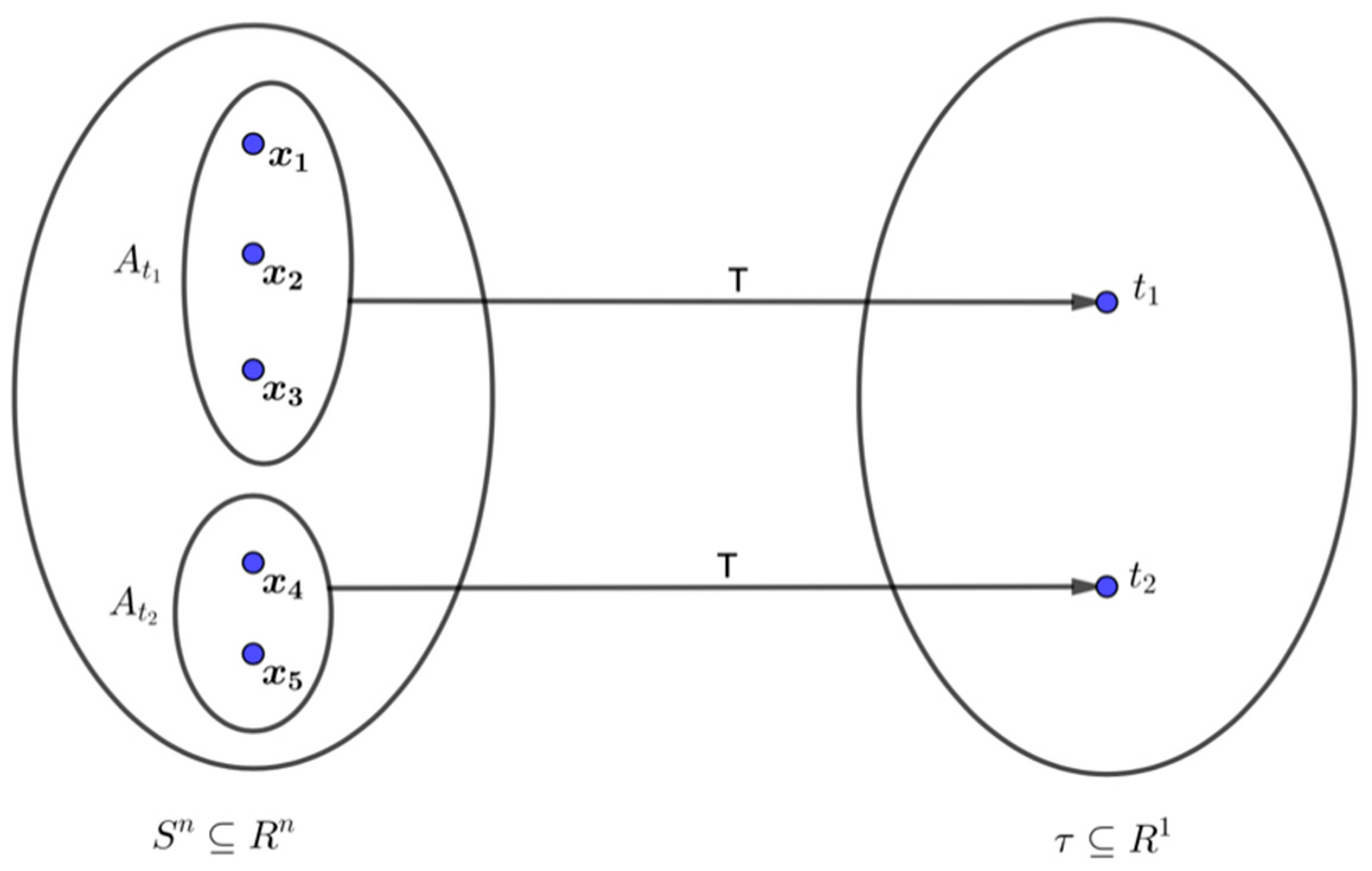
In particular, this lost information represents a combinatorial loss in the sense that multiple
’s may give the same value
, as depicted in
Figure 1 above. In other words, the lost information
is a measure of the knowledge unavailable about the data sample
when only the reduced data summary
is known but not
itself. For a sufficient statistic
for
, this lost information is independent of
. It is a characteristic of
for the given data sample
In terms of
Figure 1, (10) may be described as follows. On the left of the figure is the sample space
over which probabilities on
are computed. On the right is the range
of
over which the probability of
are computed.
reduces the data sample
into
where multiple
’s may give the same
. In
Figure 1, the distinct data samples
and
are all reduced into the same value
However, knowing that
for some data sample
does not provide sufficient information to know unequivocally, for example, that
Information is lost in the reduction. One can also say that the total information
obtained from the left side of
Figure 1 is reduced to
obtained from the right. The reduction in information from the left to the right side is precisely the lost information
of (10). For fixed
it is lost due to the ambiguity as to which data sample on the left actually gave
There is no such ambiguity when
is one-to-one.
The general decomposition of information in (10) is next summarized in Definition 7, where does not need to be sufficient for
Definition 7 (). Letbe sample data for a random samplefrom a discrete random variablewith sample spaceand real-valued parameterFor any real-valued statisticthe Shannon information aboutobtained from the sample datacan be decomposed as
where
and
Definition 7generalizes the information decomposition of [2] for a data sampleof size n from a Bernoulli random variablein [2] is the probability 0.5 of success on a single Bernoulli trial, andIt should be noted that the notationin [2], which refers to compressed information, corresponds toin Equation (13). We use the term “data reduction” as described in [3] as opposed to “data compression” to prevent misinterpretation. In computer science, data compression refers to encoding information using fewer bits than the original representation and is often lossless.
Both Result 2 and Definition 7 are valid for any real-valued statistic for The notation indicates that is a function of the sample data for a fixed but arbitrary parameter value Similarly, both and are functions of for fixed and However, in this paper we focus on sufficient statistics, which provide a simpler expression for that does not involve For a sufficient statistic for we use the notation for the lost information, though and still require The next result is an application of the FFT of Result 1.
Theorem 2 (Lost Information for an SS). Letbe sample data for a random samplefrom a discrete random variablewith sample spaceand real-valued parameterLetbe an SS forletbe the joint pmf ofand writeas in Result 1. Then for allwhereis defined in Definition 2 for Proof. Let
Then
since
is a realization of
Because
is an SS, we write (7) without
. It now suffices to establish that
from which (15) immediately follows. Rewrite (8) as
so from (17) and (2), then
However,
in (18), so
Since
and hence
, this term can be canceled on the right side of (19) to yield (16). Taking the
of (16) completes the proof. □
Now consider Theorem 2 when each is a singleton in (16), i.e., when is a one-to-one function. In this extreme case, since in the denominator of the right side of (16). Thus from which for all in . Thus, the special case of a one-to-one T justifies the identification of the lost information as . In other words, for all data samples if whenever then is not diminished by the reduction of the singleton to the number .
More generally, it is also true that when is one-to-one but not sufficient for In this case, write However, since is one-to-one, then , and again .
Now consider the other extreme case where is constant on Thus However, so and on In this case, because the event gives no information about
We also note that
could be used as a metric to compare sufficient statistics for a given data sample
. For example,
could be regarded as better than
for
if
However, this comparison would be limited to the given
. In
Section 4, we propose but do not explore a metric based on entropy independent of a particular data sample. We next show that (16) can be simplified when
is the likelihood function.
Corollary 1 (Information Loss for Likelihood Function). Under the assumptions of Theorem 2, if then
where is the cardinality of the partition set for Proof. For in (2), let be the identity function and Then substituting into (16) gives the denominator to yield (20). □
We next state a reproductive property of a statistic that is a one-to-one function of a sufficient statistic for
Theorem 3. If there is a one-to-one function between a sufficient statisticforand an arbitrary real-valued statisticonthen the following hold.
- (i)
is also an SS.
- (ii)
andpartition the sample space into the same partition sets.
- (iii)
Proof. To prove (i), let
be a real-valued one-to-one function of
such that
Since
is an SS, by Equation (2) there are real-valued functions
on
and
on
for which
By substituting
from (21) in (22), we get
which can be rewritten as
Since
in (24) satisfies the condition of
Result 1 for
,
is an SS.
To prove (ii), we use
Definition 2. Let
partition the sample space
into the mutually exclusive and collectively exhaustive sets
. By Equation (21) we can also write
as
Since
is a one-to-one function, it has an inverse
. Letting
we apply
to the right side of (25) and get
However,
and the cardinalities satisfy
so the right side of (26) is
and
Finally, to get (iii) we use
Theorem 2 to calculate information lost over two statistics
and
Since
is the same in (22) and (24) and since Equation (27) holds, we sum
over the same sets in the denominator of Equation (16) for both
and
to give
and complete the proof. □
We next compare the information loss of the sufficient statistic to other sufficient statistics. For the sufficient statistic a lemma is needed.
Lemma 1. Letbe any data sample for a random samplefrom the discrete random variablewith real-valued parameter. Thenis a function ofand
Proof. From ([
3], p. 280),
is a function of
if and only if
whenever
For all data samples
and
we prove that if
then
Thus suppose that
By
Definition 4, we can decompose
and
into
and
respectively. Note that
Otherwise,
in contradiction to
being sample data with a nonzero probability of occurring. Now write
Suppose that
so that
in (29). From
Definition 4, every nonnumerical factor of
and
contains
Moreover, neither
nor
is divisible by any positive number except the number 1. Hence, since
does not contain
the nonnumerical factors of
and
must cancel in (29) and the remaining numerical factors could not be identical. Thus at least one of these factors would be divisible by a positive number other than 1 in contradiction to
Definition 4. It now follows that
so
is some function
of
Finally,
since this function
is surjective from
onto its image
. □
Lemma 2. Under the conditions of Lemma 1, the sufficient statisticsandsatisfy Proof. Let
and suppose that
Then
so it follows from
Lemma 1 that
and thus
Hence
and so
Taking the negative log of both sides of the inequality in (31) and using (13) gives (30). □
Theorem 4. Letbe sample data for a random samplefrom a discrete random variablewith the real-valued parameterThen for all Proof. Let
Note that
in (12) does not depend on the arbitrary sufficient statistic
of (11). Hence
Then (32) follows immediately from (30) and (33). □
As a consequence of Theorem 3, Theorem 4 has an immediate corollary.
Corollary 2. Under the conditions of Theorem 4, letbe a sufficient statistic forfor which there is a one-to-one function betweenand.
Then for all The question remains open as to whether (34) holds for all sufficient statistics for . Regardless, the proofs of Lemma 2 and Theorem 4 illustrate the fact that the relation between the lost information for two statistics and is determined by the relation between their partition sets and For example, if for every there exists a for which , then the partition of by the of is said to be coarser than the partition by the of In that case, because each has more with than there are with In other words, is at least as ambiguous as in determining the data sample giving the value of the respective statistics.
4. Entropic Loss for an SS
For a sufficient statistic for , we now propose an entropy measure to characterize by the expected lost information incurred by the reduction of to This expectation is taken over all possible data sets This nonstandard entropy measure is called entropic loss, and it depends on neither a particular data set nor the value of Before defining this measure, we need to determine the appropriate pmf to use in taking an expectation. The following results are used.
Result 3. Under the assumptions of Theorem 2, for any data sample letand consider the partition set Then
Proof. Summing (16) over
yields
to give (35). □
Result 4. Under the assumptions of Theorem 2, the sum Proof. We perform the sum on the left of (37) by first summing over
for fixed
and then summing over each
to give
The inner series on the right side of (38) sums to one by
Result 3. Hence, the outer sum yields
for
for which
□
From (37), it follows that the left side of (37) is not a probability distribution on unless Moreover, is not a conditional probability distribution even if since the condition varies with However, we use Result 4 to normalize and obtain the appropriate pmf for calculating the expectation of .
Definition 8 (Entropic Loss). Under the assumptions of Theorem 2, the entropic loss resulting from the data reduction byis defined as
which from (15) and (16) can be rewritten as
Observe that (39) and (40) are independent of both and Indeed, for a given underlying random variable and sample size n, is a function only of Thus, could be used as a metric to compare sufficient statistics independent of the data sample. In particular, could be regarded as better than if i.e., if the expected information loss associated with is less than that for Moreover, for a given underlying random variable and sample size n, Definition 8 could be extended to non-sufficient statistics. In that case, the entropic loss would be a function of both and For a fixed a non-sufficient statistic could again be considered as better than a non-sufficient if < for a given statistic the numerical value could be considered as a better numerical point estimate for than the value if < Similarly, could be minimized over to give a best numerical point estimate for based on the entropic loss criterion. However, we do not pursue these possibilities here. We next compute for the sufficient statistic
Theorem 5 (Entropic Loss for Likelihood Function). Under the assumptions of Theorem 2, the entropic loss resulting from the data reduction by
is
Proof. From (20), write
We decompose the sum over
x ∈ S
n in (42) to consecutive sums over
and then
to get
Equation (41) now follows from (43). □
Result 5. Suppose there is a one-to-one function between two sufficient statisticsandfor. Then
Proof. For all
from
Theorem 3, so
from which
Thus from (45) and (46),
Now summing (47) over
yields
However, from
Theorem 3,
Thus dividing the left side of (48) by
and the right side by
yields (44). □
5. Examples and Computational Issues
In this section, we present examples involving the discrete Poisson, binomial, and geometric distributions [
21]. For each distribution, three sufficient statistics for a parameter
are analyzed. For each such
,
does not involve
. However, calculating
can still present computational issues, some of which are discussed below. Our examples are simple in order to focus on the definitions and results of
Section 3 and
Section 4.
Example 1 (Poisson Distribution). Consider the random samplewith the data samplefrom a Poisson random variable. We consider three sufficient statistics for the parameterThese sufficient statistics arethe likelihood kernelfor fixed but arbitraryand the likelihood function. We useas a surrogate forNeitherorinvolvesand can thus be used either to characterizeor to estimateMoreover, there is an obvious one-to-one function relatingandso Theorems 3 and 5 establish thatandrespectively. We analyzebecause it is also Poisson, whereasis not Poisson sinceis notnecessarily a nonnegative integer. In contrast tobothandcontainand can only be used to characterizeFor each of these three sufficient statistics, we develop an expression forand describe how to obtain a numerical value. We then illustrate previous results with a realistic Poisson data sample. We present further computational results in Table 1. Case 1: Let
is a sufficient statistic for
from
Result 1 since
can be factored in (2) into the functions
and
Next recall that the statistic
has a Poisson distribution with parameter
[
21]. Thus,
and so (8) becomes
where the multinomial coefficient
It follows from (49) and (10) that
which is also
, as noted above.
For a data sample
the evaluation of
in (50) involves computing factorials [
22]. For realistic data, the principal limitation to calculating them by direct multiplication is their magnitude. See [
23] for a discussion. However, (50) can be approximated using either the well-known Stirling formula or the more accurate Ramanujan approximation [
24]. The online multinomial coefficient calculator [
25] can evaluate multinomial coefficients for when all
as well as
are less than approximately 50 if any
is removed from
Such deletions do not affect the calculation since
.
As a numerical example, consider a data sample
of size
from a Poisson random variable
with
, where
Then,
and the calculator at [
25] gives
10
123 in (49) and (50). Moreover,
518.915. Hence, from (50),
bits. This value corresponds to 13.708 bytes at 8 bits per byte or to 0.013 kilobytes (KB) at 1024 bytes per KB. It follows from previous discussion in this example that the Shannon information lost by using the sample mean
as a surrogate for
itself is
KB, which seems surprisingly small. Perhaps the small loss results partially from the fact that
Case 2: Let
for fixed but arbitrary
For a data sample
, write
from which
and
in (4). Note that for all fixed
there is an obvious one-to-one function between
and (53). Hence, from
Case 1,
KB from
Theorem 3 for all
For
from (53) and is constant with respect to any data sample
Thus,
and
It follows that
provides no information about
Case 3: Let
for fixed but arbitrary
We attempt to obtain
for a data sample
by determining
and using (20). From (52), note that for all fixed
if and only if
Thus, for any fixed satisfying if both and However, for some it is possible that when neither nor For example, let and Then, 5, and However, (54) is satisfied.
This complication suggests that an efficient implicit enumeration of the
satisfying (54) would be required to obtain
for calculating
from (20). Using such an algorithm, a conventional computer could possibly compute
for the numerical data and value of
in
Case 1, since there is now a 250 petabyte, 200 petaflop conventional computer [
26]. Substantially larger problems, if not already tractable, will likely be so in the foreseeable future on quantum computers. Recently, the milestone of quantum supremacy was achieved where the various possible combinations of a certain randomly generated output were obtained in 110 s, whereas this task would have taken the above conventional supercomputer 10,000 years [
27]. Regardless, for the data of
Case 1, we have the upper bound
KB from (32)
. Finally, we present some simple computational results to illustrate the relationships among
with regard to the Poisson distribution.
Table 1 below summarizes the results for sample data
with
In particular, a complete enumeration of
in (20) gives
.
Example 2 (Binomial Distribution). Consider a random samplefrom a binomial random variablewithparametersandwhereis the probability of success on any of theBernoulli trials associated with theLetbe fixed, so the only parameter isMoreover, the sample space of the underlying random variable is now finite.
Case 1:. Again,
is an SS for
From [
21],
has a binomial distribution with parameter
for fixed
Hence,
and
From (1), dividing (56) by (55) gives
By taking the
of (57), the lost information is given as
Case 2: In this case, we use (16) as in
Example 1. Write
from which
and
in (4). To factor the right side of (60) as in (2), let
be the identity function and
. Hence,
and (60) gives
where
From (62), for any fixed satisfying it can easily be shown that if and only if Thus, in general, for a given and fixed determining in Case 2 would require an enumeration of the satisfying (62) to compute (61). We perform such an enumeration below for a simple example.
Case 3: For a data sample
, we now have
with
being the identity function and
in (2). For fixed
satisfying
from (63) we obtain that
if and only if
As in Case 3 of Example 1, developing an algorithm to use (64) and determine for calculating from (20) is beyond the scope of this paper.
As a simple example, consider the experiment of flipping a possibly biased coin twice (
). The total number of heads follows a binomial distribution with the parameter
, which is the probability of getting a head on any flip. By doing this experiment three times, we generate the random variables
with possible values 0, 1, 2.
Table 2 shows all the possibilities and the lost information for the statistics. The small size of this example allows the computation of
in
Cases 2 and
3 via total enumeration.
Now, using (40), we give in
Table 3 the entropic losses of
Example 2 for
Note that
is the same for the sum
and the likelihood kernel
which are related by a one-to-one function. Hence,
Result 5 is corroborated. In addition, observe that
is smallest for the likelihood function
.
Example 3 (Geometric Distribution). Consider a random samplewith sample datafrom a geometric random variablewhere the parameteris the probability of success on any of the series of independent Bernoulli trials for whichis the trial number on which the first success is obtained. It readily follows from [5] that Case 1:. For fixed
has a negative binomial distribution with parameter
[
21]. Hence,
Thus
is an SS for
since it satisfies (2) with
and
. Moreover, substitution of (65) and (66) into (8) gives
Then from (14) and (67) we obtain that
Case 2:. From (66), for all
and
Thus, for 0 there is an obvious one-to-one function between and in (69). Thus, from Theorem 3, as given in (68).
Case 3:. Since
from (69), then
from (68). However, there is an alternate derivation of (70). For 0
it follows from (69) that then
if and only if
But for fixed positive integers
we have from [
28] that the number of solutions
to (71) in positive integers
is
Thus, (70) follows for
from (72) and (20), so
from
Theorem 3.
As a numerical illustration, let the random variable
denote the number of flips of a possibly biased coin until a head is obtained. Then,
has a geometric distribution, where the parameter
is now the probability of getting a head on any flip. Suppose this experiment is performed three times yielding the sample data
shown in
Table 4.
is then calculated for each of the sufficient statistics for
of
Example 3. Observe that the individual statistics depend on
while the lost information does not. Moreover,
for all data samples, as established above.
6. Conclusions
In this paper, the Shannon information obtained for a random sample
taken from a discrete random variable
with a single parameter
was decomposed into two components: (i) the reduced information associated with the value of a real-valued statistic
evaluated at the data sample
, and (ii) the information lost by using this value as a surrogate for
Information is lost because multiple data sets can give the same value of the statistic. In data analysis, the data uniquely determines the value of a statistic, but typically the value of the statistic does not uniquely determine the data yielding it. The lost information thus measures the knowledge unavailable about the data sample
when only the reduced data summary
is known, but not
itself. To eliminate the effect of
, we focused on sufficient statistics for
such as the sample mean. We then answered the question: how much Shannon information is lost to someone about a data sample
when only the value of
is available but not the data
itself? Our answer is independent of the parameter
and does not require that
be known. Our method generalizes the approach of [
2] for analyzing the information contained in a sequence of Bernoulli trials.
More generally, we developed a metric associated with the value used to summarize, represent, or characterize a given data set. Our approach and results are significant because such statistics are often communicated without the original data. One could argue that should be communicated along with in a manner similar to providing the margin of error associated with the results of a poll. A small would signify that is more informative than if were large.
In addition, we defined the entropic loss associated with a sufficient statistic under consideration as the expected lost information over all possible samples, to give a value dependent only on . We noted but did not explore the possibility that entropic loss could be used as a metric to compare different sufficient statistics. Moreover, if sufficient statistics were not required, entropic loss could provide metrics on either or if the other of these variables is fixed. Finally, numerical examples of our results were presented and some computational issues noted.