


Highlights
- Foliar chitosan hydrochloride increased antioxidant activity, polyphenolic content, and protein levels in Sauvignon Blanc berries.
- Wines from treated grapes exhibited higher total phenolics, polysaccharides, Abs 320 nm values, and total proteins.
- Chitosan biostimulation can modulate key grape secondary metabolites, thereby affecting wine composition.
- There is potential to modify the quality and stability of wine through the targeted application of biostimulants.
Abstract
An increasing trend toward alternative methods in grapevine protection is evident, diverging from conventional chemical approaches. Biostimulants, such as chitosan hydrochloride, are compounds able to elicit the synthesis of plants’ metabolites, leading to an increase in their natural defence mechanism. Some of these metabolites could potentially impact wine sensory properties such as colour, mouthfeel, and aroma. This study investigates the effect of chitosan hydrochloride treatment on Sauvignon blanc vines, isolating impacts on plant, grape, and wine levels. Using a randomized block design with 74 potted plants grown in a glasshouse, the study found that foliar chitosan application did not affect plant growth or phenolic compound accumulation in the leaves. Conversely, it significantly decreased polyphenol oxidase (PPO) activity and increased antioxidant activity and polyphenolic content in grape berries. Treated berries exhibited doubled protein content, less thaumatin-like proteins, and more β-glucanases and chitinases than control grapes. Microvinifications revealed that wines from treated grapes had higher total polyphenols, polysaccharides, Abs 320 nm values, and total proteins than control wines. These preliminary results suggest that chitosan application affects key grape metabolites with potential implications for wine quality, warranting further investigation.
1. Introduction
Grapevines are susceptible to attacks by several pathogens that can lead to significant yield losses and compromise grape quality at harvest. To mitigate these risks, grape growers typically apply on average 10–15 fungicide treatments per growing season [1]. However, the extensive use of fungicides poses risks to human health, has environmental impacts including ecological consequences on soil and earthworm populations [2,3], and on groundwater quality [4], and can interfere with grapevine physiology, and may leave residues in wines [5].
In response to these concerns, there is a growing interest towards research and development of complementary and/or alternative methods to protect the vines. One promising alternative strategy consists of the stimulation and/or potentiation of the grapevine defence responses by means of molecules often originating from microbes, plants, or algae, also called elicitors [5]. Elicitors can activate the synthesis of secondary metabolites, enhancing the plant’s natural resistance to pathogens through a phenomenon known as “induced resistance” [6]. Common elicitors include plant hormones such as salicylic acid (SA) and jasmonic acid (JA), as well as hormone derivatives or analogous compounds including 1,2,3-benzothiadiazole (BTH), chitosan, laminarin, and many others [7]. In general, the action of these compounds on plants is achieved by the synthesis of several categories of compounds, in particular phytoalexins, with a broad spectrum of actions not only against pathogens, but also on the antioxidant potential and the organoleptic properties of plant-based foods [8]. Elicitors may activate a plant response mainly by triggering the expression of specific genes such as those encoding for (i) pathogenesis-related (PR) proteins; (ii) enzymes such as Phenylalanine Ammonia Lyase (PAL) and Lipoxygenase (LOX) which determine accumulation of phenylpropanoid compounds (PPCs), and (iii) enzymes involved in biosynthesis of terpenoids [9,10].
According to those mechanisms, it is conceivable that also the composition of the grape juice, and that of the resulting wine, might be affected by the elicitors used to treat the plants in the vineyard. An increase in the polyphenol content, and consequently in the health properties of the wine, would be expected, as partly reported by others [11,12,13,14,15]. However, little information is available about the effects of the increased polyphenol content on organoleptic properties (colour, mouthfeel), as well as on the wine aroma properties (such as those related to terpenoids) derived from treatment with elicitors [16,17,18]. Moreover, the effects on grape and wine quality of an increased synthesis of grape PR proteins are also unknown, these being particularly important as grape allergens [19] and for their role on white [20] and red [21,22] wine stability.
Many classes of elicitors have been recently proposed for application in viticulture [17,23], including humic acids [24], seaweed extracts such as laminarin [25,26], chitosan and its derivatives [14,25], methyl jasmonate [14], and other compounds such as yeast extracts and calcium oxide [14,26].
Chitosan is one of the most promising biostimulants proposed for grapevine protection as, besides having antimicrobial properties and being able to elicit plant defence mechanisms, it is also safe and inexpensive [9]. Chitosan initially induces the activation of several genes associated with defence responses of the plants [27,28], with a consequent inhibition of several pathogens by the induction of defence response mechanisms in the host tissues [25]. Limited research on the impact of chitosan treatments on grape and wine properties suggests that this application may enhance phenolic content, particularly promoting the accumulation of anthocyanins in red grape varieties [29,30,31]. Conversely, some studies have found that chitosan does not significantly alter the phenolic composition of grapes or the wines produced from them [14]. Some authors reported a decrease in the content of free amino acid upon chitosan application [23,25], while other authors looked at the volatile profiles of wines produced from grapes treated with chitosan, finding that the treatment can lead to increased levels of total acetals and alcohols in red wine [18].
The aim of this project is to gather preliminary results on the potential effects of treating grapevines with a biostimulant (chitosan hydrochloride) on both plant growth and the composition of grapes and wines, with particular attention to those determining the organoleptic and technological properties of the final products.
2. Materials and Methods
2.1. Materials
All reagents used were purchased from Sigma-Aldrich (Milan, Italy) unless otherwise stated. The elicitor chitosan hydrochloride powder (100% purity), obtained from crab shells and sold for the stimulation of plants’ resistance against fungal and bacterial pathogens, was purchased from Agrilaete (Crepaldo, Italy).
2.2. Experimental Design
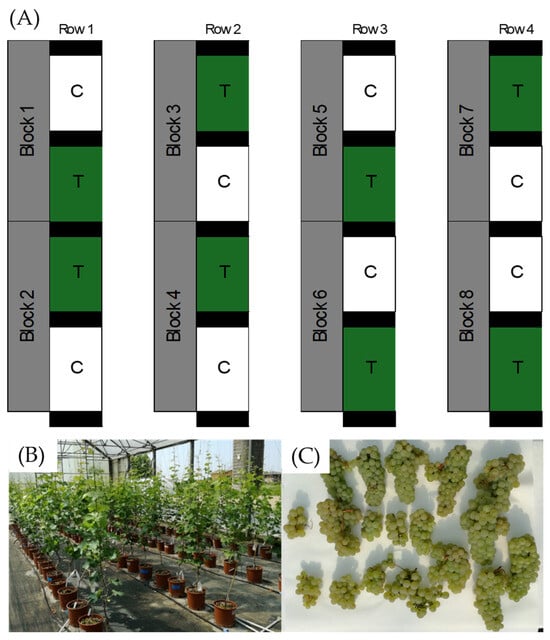
The study was conducted during the growing season of 2018 in a glasshouse at the “Lucio Toniolo” experimental farm of the Agripolis campus (Legnaro, Italy), University of Padova. Four-year-old Vitis vinifera cv Sauvignon blanc vines grafted onto Kober 5BB rootstock were used. The vines were grown in 10 L pots containing a sand–pumice–peat mixture in a 2:2:6 volumetric ratio. A total of 74 vines, showing similar developmental characteristics such as cane length and bud number, were randomly assigned to two groups and organized into four rows following a randomized block design. Each row consisted of two blocks, with each block containing both a control and a treated set, each comprising 4–5 vines (Figure 1A,B). Before budburst, plants were pruned to retain three dormant buds per vine and fertilized at budburst with 15 g per plant of a slow-release granular synthetic fertilizer (Osmocote Topdress 19% N—6% P2O5—11% K2O + 2% MgO + 0.5% Fe, 5–6 months’ release period), applied around the drip irrigation system. At the 5-separated-leaves stage (extended BBCH stage 15 [32]), vines were thinned to two shoots per plant and trained vertically.
Figure 1.
(A) Experimental design. (B) View of the experimental setup. (C) Example of the yield from the vines of one control block.
Two days before each application, a solution of chitosan hydrochloride was prepared at 2 g/L in distilled water. Foliar applications of chitosan were performed weekly from veraison until harvest, for a total of 6 applications. Treatments were applied using a 6 L manual pump sprayer between 9:00 and 10:00 a.m. Untreated (control) vines were sprayed at the same time with an equivalent volume of distilled water. To prevent contamination between treatments, the control vines, placed at the end of each row and in between treatment sets, were screened by a custom-made plastic cover during spraying. The glasshouse was closed to prevent the drifting of the product by the wind.
To ensure even application, the spray volume per plant was adjusted throughout the season to reflect canopy growth, ranging from approximately 100 to 250 mL per plant per treatment. All plants received comparable volumes at each time point.
The experiment was conducted under semi-controlled conditions in a glasshouse, and temperature, relative humidity, and light intensity conditions were monitored throughout the experiment. The glasshouse was equipped with an automatic opening system on the roof set to open when an air temperature of 30 °C was reached. On average, daytime temperatures during the experimental period ranged from 25 °C to 34 °C, and occasionally peaked up to 37 °C in late June (29–30 June) with minimum nighttime temperatures of about 20 °C. Relative humidity varied between 40% and 80%, allowing for a Vapor Pressure Deficit (VPD) ranging between 1 kPa and 3 kPa, and plants received natural light through the glass roof, with internal Photosynthetic Photon Flux Density (PPFD) values at midday ranging between 1300 and 1500 μmol of photons m2 s−1. While greenhouse conditions may accelerate phenological development compared to open-field conditions, both budburst and harvest occurred approximately one month earlier than usual, suggesting a proportional shift of the entire growing season rather than a selective effect on ripening.
2.3. Sampling Protocol
Corresponding to each chitosan treatment, two samplings were made. The first was performed at time zero (T0), so just before the treatment took place, while the second was performed 24 h after the treatment (T24). During each sampling, six treated plants and six untreated plants (control) were randomly selected, and from each, the 6th fully unfolded leaf from the shoot tip was collected. Each leaf was weighed, rolled, and inserted into a 15 mL Falcon tube before being frozen with liquid nitrogen and broken down into small pieces using a metal spatula. Leaf samples were kept at −80 °C until analysis. The last sampling was performed one day before the harvest of the grapes.
2.4. Vine Growth Analyses
2.4.1. Shoot Length and Leaf Area
Shoot length was recorded, at regular intervals during the growing season, by measuring each of the 148 shoots with a flexible measuring tape, starting from the base of the canes to the tip. Leaf length (L) was recorded along the mid-rib, from the lamina tip to the point of attachment to the petiole. Leaf width (W) was taken at the broadest section of the leaf lamina, measured perpendicular to the lamina mid-rib.
Leaf area was estimated based on the daily increase in L and the maximum value of W. Measurements of L and W were rounded to the nearest 0.1 cm. At the end of the growing season, a total of 420 leaves were sampled for direct assessment of leaf area (LA) using a LI-3100 area meter (LICOR, Lincoln, NE, USA), calibrated to 0.01 cm2. The relationship between biometric traits and leaf area was examined using linear regression analysis. Model performance was evaluated through the coefficient of determination (R2) and the root mean square error (RMSE) [33,34,35]. LA served as the dependent variable, while the independent variable was the product L × W × a. The parameter “a” was optimized to minimize the residual sum of squares, yielding a value of 0.944048, with R2 = 0.96 and RMSE = 4.52 [35].
2.4.2. Leaves Total Phenolic Quantification
The total phenolic content of the collected leaves was measured by finely grinding, with a ceramic pestle and mortar, 500 mg of frozen leaf sample. A total of 100 mg of leaf material was then added with 1 mL of methanol to extract the phenolic material, kept for 1 h in ice, before being centrifuged (14,000 rpm, 4 °C, 20 min) with a Universal 320 R Centrifuge (Andreas Hettich GmbH, Tuttlingen, Germany). The supernatant was used for the quantification of phenolics by using a modified version of the Folin–Ciocalteu method [36]. Briefly, 10 μL of leaf extract was diluted 20 times with methanol for a final sample volume of 200 μL. Each sample was then added with 800 μL of 7.5% Na2CO3 solution (w/v) and 1 mL of Folin–Ciocalteu reagent pre-diluted 10 times in ultrapure water. The so prepared samples were incubated at 22 °C for 2 h in the dark before measuring their absorbance at 725 nm with a Cary® 50 Bio UV–Visible Spectrophotometer (Varian, Palo Alto, CA, USA). The calibration curve was prepared using serial dilutions of gallic acid in methanol in the range of 0–100 mg/L.
2.4.3. Berry Weight and Diameter
One hundred berries from the control and the treated vines, respectively, were sampled randomly from all plants. Berries were weighted to obtain the average berry weight, and their average diameter was calculated by measuring the diameter of 10 berries (5 replicates) with a digital calliper (mod: 1651DGTB, Beta Utensili, Sovico, Italy).
2.4.4. Yield and Berries’ Protein Content
The yield was determined by harvesting separately all the 16 blocks (8 controls and 8 treated). Bunches were counted, weighed, and visually assessed for potential presence of diseased berries (Figure 1C).
At harvest, grape berries were sampled, rapidly frozen in liquid nitrogen, and then stored at −80 °C until analysis.
Proteins were extracted from 10 g of frozen berries [37]. Seeds were first removed, and the remaining berries were ground into a fine powder using a pestle and mortar under liquid nitrogen. The powder was then suspended in 10 mL of McIlvaine buffer (pH 7) containing 1% (v/v) Triton X-100 and 2% (w/v) Polyvinylpolypyrrolidone (PVPP). The mixture was stirred for 1 h at 0 °C, followed by centrifugation at 14,000 rpm for 15 min at 4 °C. The resulting supernatant was filtered (0.45 μm) and stored at −20 °C until analysis. Protein content in the extracts was determined using the Bradford method, with a calibration curve prepared with Bovine Serum Albumin (BSA) [38].
2.4.5. Polyphenol Oxidase (PPO) Activity and Total Phenolic Quantification
Extracts for PPO activity and total phenolic quantification were prepared from 10 g of frozen grape berries. These were first rinsed with distilled water, and seeds were removed. The remaining berries were then ground into a fine powder using a pestle and mortar under liquid nitrogen. One gram of this powder was mixed with 5 mL of 70% (v/v) ethanol solution and stirred at 200 rpm for 30 min, followed by centrifugation at 5000× g for 10 min at 25 °C. The supernatants were filtered through a 0.45 μm membrane and stored at −20 °C until further analysis.
PPO activity in the berry protein extract was measured spectrophotometrically according to Rapeanu [39]. In brief, 100 µL of extract was combined with 1 mL of catechol substrate solution (10 mM in McIlvaine buffer, pH 7), while the blank contained only 1 mL of substrate. Enzyme activity was assessed in triplicate by recording the increase in A420 nm over 5 min at 25 °C using a Varian Cary® 50 spectrophotometer (Varian Inc., Palo Alto, CA, USA).
Total phenolic content was determined following Azuma [40]. Briefly, 1 mL of diluted berry extract was combined with 5 mL of 10% (w/v) Na2CO3 in 1 M NaOH and 500 µL of Folin–Ciocalteu reagent (diluted 1:2 with ultrapure water). After filtering through a 0.45 μm membrane, A650 nm was measured in triplicate, and the total phenolics were quantified using a calibration curve prepared with serial dilutions of gallic acid solubilized in 70% ethanol.
2.4.6. Determination of Antioxidant Activity
The antioxidant activity of the berries was determined using the ferric-reducing–antioxidant-power (FRAP) assay [41] applied to the grape berries extracts prepared for protein quantification. Briefly, the FRAP reagent was prepared by mixing 5 mL of 0.3 M Na-acetate pH 3.6 with 500 µL of 10 mL 2,4,6,-tripyridyl-s-triazine (TPTZ) in 40 mM HCl. A total of 900 µL of FRAP reagent was added to 100 µL of extract. The blank was prepared using 100 µL of 70% ethanol instead of the extract. This mixture was incubated in a water bath (mod: SW-20C; Julabo, Seelbach; Germany) at 37 °C for 30 min in the dark. The A593 nm was measured (in triplicate), and the antioxidant activity expressed as Trolox equivalent.
2.5. Experimental Winemaking
Harvested grapes from different blocks had to be combined to have a sufficient quantity (approx. 9 kg) of two homogenous grape lots for winemaking, one for the control (C) and one for the treated (T). Grapes were manually sorted and destemmed, and the juice was extracted using a small stainless steel bench basket press with a 3 kg capacity (mod: NEW-8770; Ich-Zapfe, Seelze, Germany). For both treatments (C and T), the juice extraction yield was set to 50%. The obtained juices (4.5 L per treatment) were added with 60 mg/L of Potassium Metabisulphite (PMS) and 20 mg/L of pectolytic enzyme (Lafazym CL, Laffort, Bordeaux, France). The juices were left to settle for 14 h at 13 °C, and the following day, 2.6 L of clear juice for each treatment was collected by racking. The turbidity of both starting juices was adjusted to 130 NTU by adding some of the lees separated ones after racking. The alcoholic fermentation was started by adding 30 g/L of dried EC1118 Lalvin Saccharomyces cerevisiae yeast (Lallemand, Montreal, Canada) following manufacturer instructions. Then, both juices were split in 4 × 1 L Schott bottles each containing 650 mL of juice, covered with a foam cap, and kept at 20 °C with stirring performed once a day by hand for 30 s. During fermentation, two additions of yeast nutrients (diammonium phosphate, DAP, Fermoplus) were made, 200 mg/L at day 3 and 100 mg/L at day 12, to favour the completion of fermentation. At the end of fermentation (day 15), bottles were capped (to trap residual CO2 in the headspace) and transferred at 4 °C to prevent oxidation. Five days later, samples were racked, added with 50 mg/L of PMS and placed at 4 °C with no ullage for cold settling for 1 month.
2.5.1. Wine Composition and Protein Characterization
Total Acidity was determined by titration, and the pH was measured by a classic pH meter (mod: HI5222-02; Hanna Instruments, Woonsocket, RI, USA). The organic acid, sugar, and ethanol contents were measured by High-Performance Liquid Chromatography (HPLC) (Agilent 1260 series II quaternary pump LC; Agilent Technologies, Santa Clara, CA, USA) as previously described [42]. In brief, a Hi-Plex H column (300 mm × 7.7 mm, Agilent Technologies, Santa Clara, CA, USA) was used, and the elution was performed at 65 °C in isocratic mode with 5 mM H2SO4 at a flow rate of 0.5 mL/min. Samples (1 mL) were filtered (0.45 μm) and then injected (10 μL) into the HPLC system. Organic acids were detected at 210 nm using a diode array detector, while sugars and ethanol were detected by a Refractive Index Detector (RID) (Agilent Technologies, Santa Clara, CA, USA).
Protein content was then determined according to the Potassium Dodecyl Sulfate—Bicinchoninic Acid (PDS-BCA) method [43] using a specific kit (Pierce Biotechnology, Waltham, MA, USA) and following the manufacturer’s instructions.
Protein characterization was conducted applying Sodium Dodecyl Sulphate-Polyacrylamide Gel Electrophoresis (SDS-PAGE) using a Mini-Protean III electrophoresis system (Bio-Rad, Hercules, CA, USA) following the Laemmli method [44]. Electrophoresis was run at a constant current of 42 mA per gel, using a resolving gel composed of 14% acrylamide/N,N’-methylene-bisacrylamide (29:1, Sigma-Aldrich, Milan, Italy), until the Bromophenol Blue dye front exited the gel. Protein bands were visualized by staining with Coomassie Blue (Imperial Stain, Pierce, Rockford, IL, USA) [45]. For analyses under reducing conditions, 5% (v/v) 2-mercaptoethanol (2-ME; Sigma-Aldrich, Milan, Italy) was added to the sample loading buffer. Gel images were captured with a Molecular Imager® ChemiDoc™ XRS+ system (Bio-Rad, Hercules, CA, USA), and a densitometric analysis of protein bands was performed using ImageLab software (Bio-Rad, Hercules, CA, USA; version 3.0) to enable sample comparisons.
2.5.2. Wine Polysaccharide Quantification by High-Resolution Size-Exclusion Chromatography (HRSEC)
The polysaccharides quantity and molecular distribution were determined using the method recently described by Moreira et al. [46], adapted from the method proposed by Ayestarán et al. [47]. By using a double calibration, one for molecular weight using pullulan standards, and one with pectin and dextran at different concentrations, the method allows for both a quantification and determination of different classes of polysaccharides based on their molecular weight.
2.5.3. Wine Phenolics Quantification
The total phenolic content was quantified using a spectrophotometric approach based on the Folin–Ciocalteu colorimetric assay [36]. Wine samples of (1 mL) were first diluted with 4 mL of distilled water. Then, 200 μL of the diluted wine was combined with 1 mL of diluted Folin–Ciocalteu reagent (1:10 dilution; Sigma Chemicals Co., St. Louis, MO, USA). After 1 min, 800 μL of 7.5% sodium carbonate solution was added, and the mixture was incubated in a water batch at 40 °C for 30 min. Absorbance was subsequently measured at 650 nm. Total polyphenolic concentration was determined by reference to a calibration curve prepared with gallic acid (50–500 mg/L) as the standard.
2.5.4. Wine Colour Analysis
Wine colour was assessed spectrophotometrically by measuring the absorbance at 320, 420, and 520 nm using a plastic cuvette.
2.6. Statistical Analysis
Statistical comparisons were performed using a two-tailed Student’s t-test in GraphPad Prism software (version 7.01 for Windows, GraphPad Software, La Jolla, CA, USA), with significance assessed at a threshold of α = 0.05.
3. Results
3.1. Chitosan Effect on Vine Growth, Yield, and Berry Composition
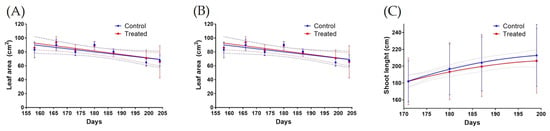
The effect of repeated chitosan treatments on some vine growth parameters was monitored within the period between veraison and harvest. The leaves collected during the experiment were weighed (Figure 2A), their area measured (Figure 2B), and the length of all the primary shoots were recorded (Figure 2C).
Figure 2.
Trends of vine growth parameters during the growing season. (A) Leaf weight. (B) Leaf area. (C) Shoot length. For each time point, a two-tailed Student’s t-test was used to assess the presence of significant differences.
The data show that the weight and sizes of the newly formed leaves decreased over time as shown by the negative inclination of the slopes of the fitted curves in Figure 2A–C. Despite some minor noticeable differences, statistical analysis indicates that, for leaf weight and leaf area, the slopes of the fitted curves did not differ significantly between treated and control samples (Figure 2A–C). The speed of growth of vine shoots decreased during ripening (Figure 2C), consistent with the expected reduction in shoot elongation at this developmental stage. Despite showing a diverging trend, the shoots’ length of the control did not differ from that of the treated vines for any of the time points considered. Therefore, chitosan treatments did not induce any measurable modification in the plant growth attributes analysed.
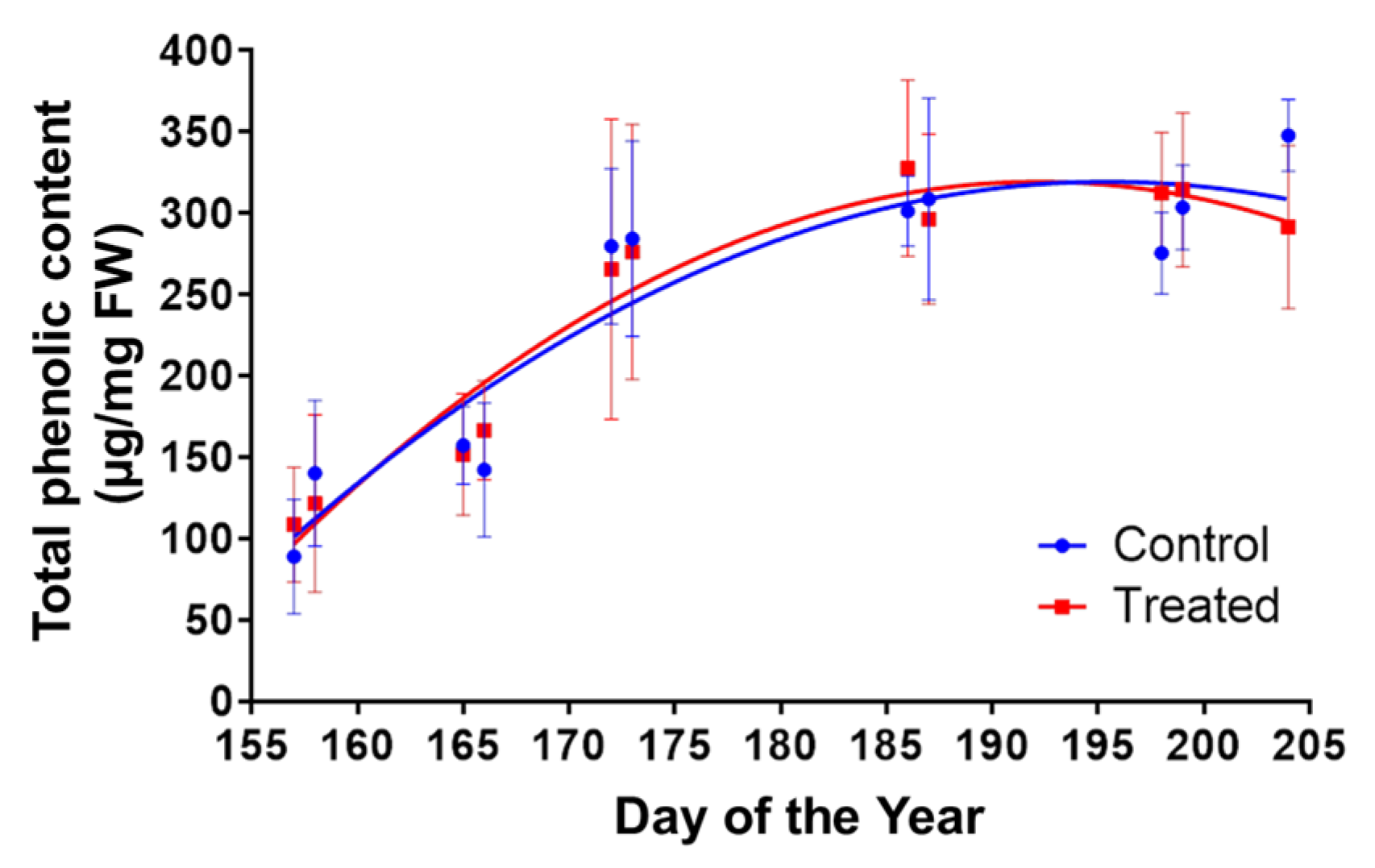
Given that the application of elicitors has been shown to activate a plant response resulting in an increased synthesis of phenolic compounds [48], the leaves collected during the ripening phase were also tested for their content of phenolics (Figure 3).
Figure 3.
Total phenolic content of the leaves during the period of treatments with chitosan, expressed as µg/mg of leaves’ fresh weight.
The amount of total phenolic compounds in grapevine leaves increased from veraison to harvest with a plateauing trend. The fitted curves for treated and control samples did not significantly differ, thus indicating that chitosan application did not result in a different accumulation of phenolic compounds in the leaves.
At harvest, all grapes from each block were collected (see Figure 1B) and weighed to calculate the yield. Representative berry samples were collected, weighed, and their diameters measured, before being analysed to determine their protein and phenolic contents, as well as their PPO and antioxidant activities (Table 1).
Table 1.
Grape berries parameter at harvest; ns, p ≥ 0.05; ***, p < 0.001.
The berry weight and diameter remained unaffected by the chitosan treatment, a finding in line with the yield per vine that was indeed very similar with an average production of about 400 g of grapes per vine.
The treatment with chitosan resulted in several significant modifications of some components extracted from whole berries. While the treatment did not induce any modification on the phenolic content of grapevine leaves (see Figure 3), this parameter was significantly modified (+16.7%) in grape berries (Table 1). Moreover, the PPO activity decreased significantly (−64.5%), and the antioxidant activity of the treated berries became higher than that of the controls (+28.7%). Finally, the protein content was greatly increased in treated berries (+142%).
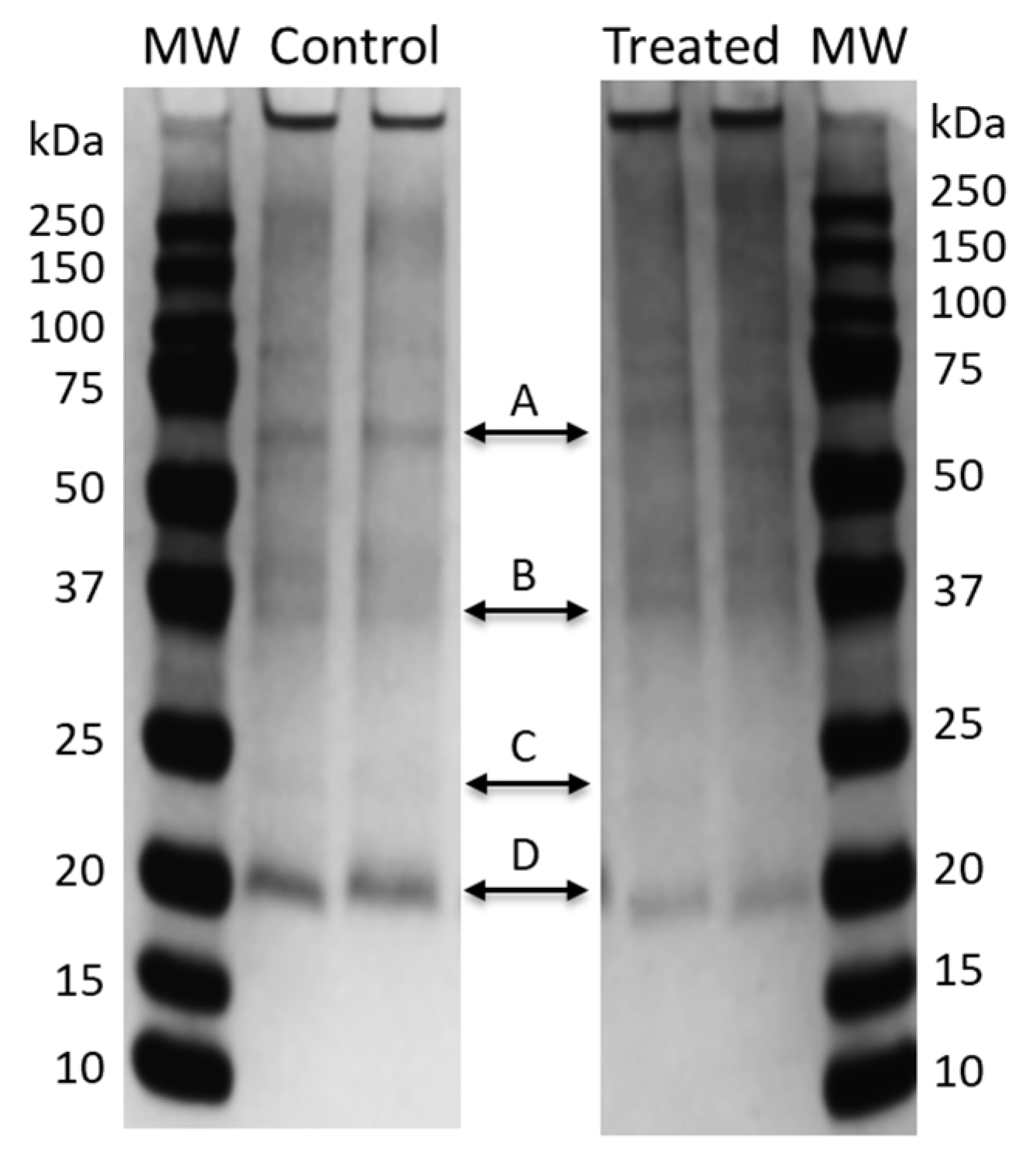
To understand possible variations in the relative quantity of the berry proteins, samples were analysed by SDS-PAGE (Figure 4).
Figure 4.
SDS-PAGE of representative berry samples from treated and untreated (control) grapevines. MW: Molecular weight standards. Arrows indicate tentatively identified proteins as follows: (A) invertases; (B) β-glucanases; (C) chitinases; (D) thaumatin-like proteins (TLPs) [20].
Some small differences between the SDS-PAGE profile of the control and treated Sauvignon blanc berries were noticeable for the relative intensity of the bands tentatively identified as four of the major grape proteins (see arrows in Figure 4). In particular, the proteins with a molecular weight higher than 35 kDa were those showing an increase in the treated berries, while the intensity of the bands with higher mobility seemed to be reduced. Indeed, the densitometric comparison of the protein bands indicated that the relative intensities of the bands corresponding to invertases and β-glucanases were significantly higher in the berry samples derived from the chitosan-treated vines. Even though the band with a mobility corresponding to that of chitinases (band C in Figure 4) was very faint in both samples, its intensity was 30% higher in the treated berries, which however showed thaumatin-like protein bands (bands D in Figure 4) of significantly lower intensity.
3.2. Oenological Parameters of Grape Juice and Wine
The juices of berries derived from untreated and treated vines were analysed for their basic chemical parameters (Table 2).
Table 2.
Analytical parameters of the juice at harvest. Data result from the average of samples from each of the 8 blocks per treatment (biological replicates) without technical replicates within each block. ns: not significant (p > 0.05).
The results indicate that none of the chemical parameters measured were significantly affected by the chitosan treatment. Table 2 shows that the all the juices had a rather high acidity and medium-low sugar content.
To establish the effects of the treatment on the technological and organoleptic quality of the wine, grapes were pooled within each treatment group to minimize variability between individual plants and to obtain a representative sample of the juice. The pooled juices from both the treated and untreated samples were then subdivided into four lots each to carry out eight individual small-scale fermentations. No significant differences were noticed in terms of fermentation, which took on average 15 days for both treatments to be completed. The eight wines produced were individually analysed for a series of parameters, and the results are reported in Table 3.
Table 3.
Analytical parameters of the wines at the end of fermentation. n = 4; ns, not significant p ≥ 0.05; *, p < 0.05; **, p < 0.01; ***, p < 0.001.
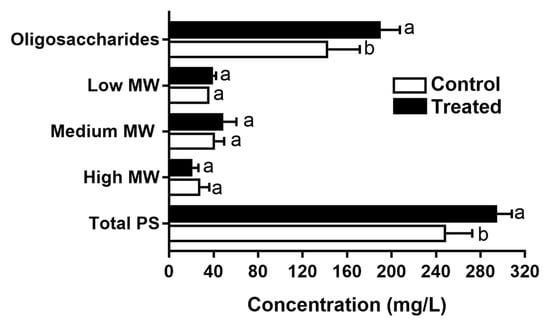
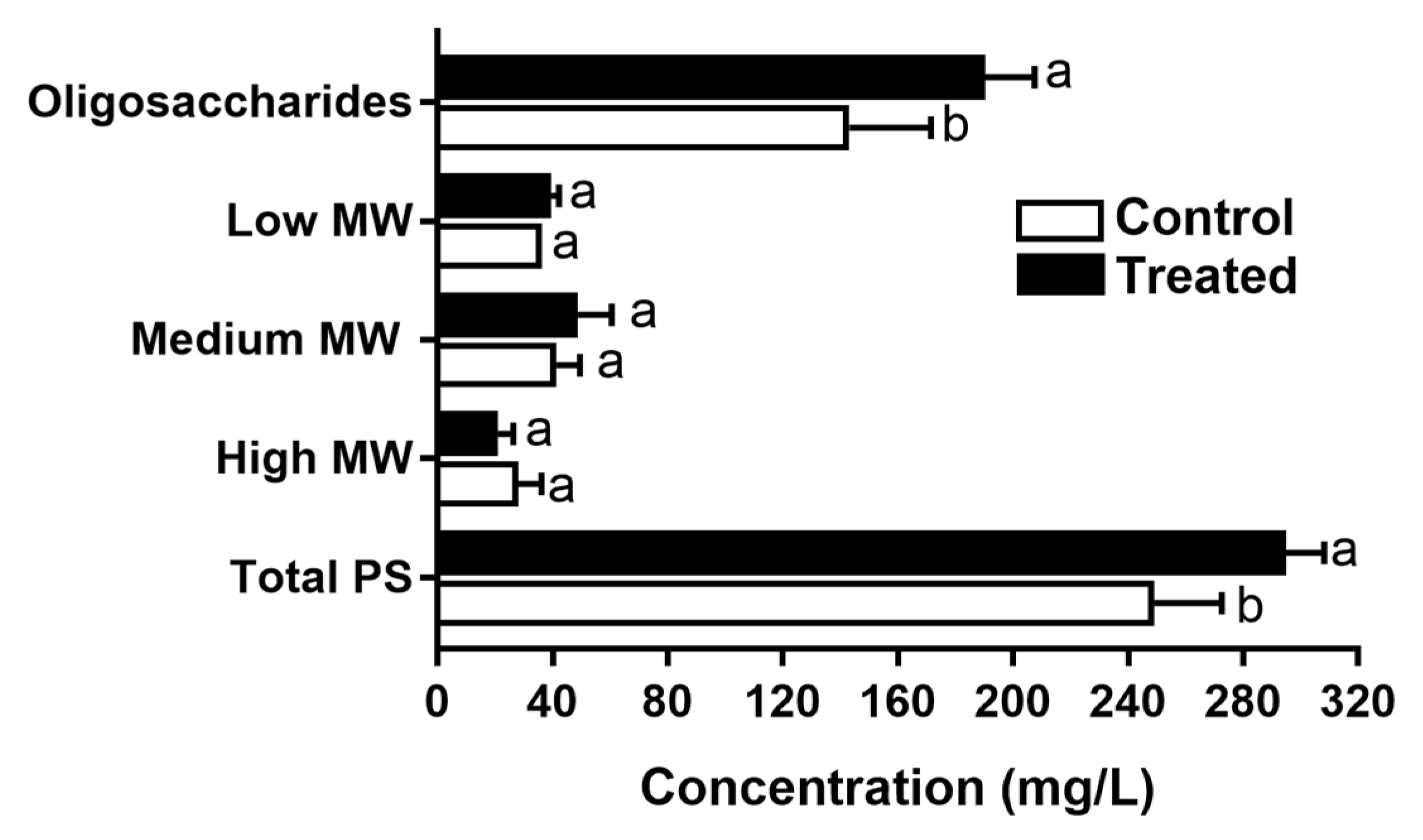
Table 3 shows that wines produced with chitosan-treated grapes presented only some small but significant differences in terms of the main wine parameters such as residual glucose, titratable acidity, citric acid, acetic acid, and potassium contents, which were slightly lower in the treated wines. Conversely, chitosan treatment induced an increase of 320 nm Abs related to the higher content in total phenolics (+13%) found upon elicitation with chitosan treatments. The total protein and total polysaccharide contents of the wines from chitosan-treated samples were significantly higher than those of the control (+14% and +35%, respectively). The polysaccharide composition of the wines, as determined by HRSEC (Figure 5), showed that the significant increase in total polysaccharides observed was mostly driven by the higher quantity of oligosaccharides in treated wines, while no significant differences appeared for the other classes of polysaccharides considered (Figure 5).
Figure 5.
Concentrations of wine polysaccharides in wines from treated and untreated grapes. Saccharides were separated by HPLC in fractions of high (1100–180 kDa), medium (180–40 kDa), low (40–7.5 kDa), and very low (oligosaccharides, 7.5–1 kDa) molecular weights (MWs). Mean values followed by the same letter are not significantly different at p ≤ 0.05 by the t-test.
4. Discussion
Among the viticultural management processes, the application of biostimulants to grapevines against biotic and abiotic stresses is increasingly popular among grape growers [13,23,49,50], aiming at applying more sustainable production practices. The defence from pathogens achievable by application of biostimulants is partly due to the stimulation in the synthesis of grapevine compounds acting against biotic and abiotic stresses [9,23]. Several of these compounds, when able to survive vinification, could be found in finished wine in which they can affect wine stability (e.g., pathogenesis-related proteins causing haze formation) and modulate quality (e.g., secondary metabolites such as phenolics and volatiles).
After initial studies focused mostly on comprehending the potential to protect vines from stresses, recently, a few research groups have started to investigate the impact of biostimulants’ application on wine composition and quality [11,14,16,50,51]. Generally, in these studies, the impact of different biostimulants on quality-related wine compounds has been explored in wines obtained from grapes grown in open-field conditions. While this approach has merit, it is possible that findings, especially in seasons with challenging climatic conditions, could be confused by the effects that the environmental conditions, including fungal infections, might have had on grape composition. Therefore, it is necessary to study the potential effects of biostimulants on wine quality without external interferences. That is why in this preliminary study, the focus was on testing the effect of the foliar application of chitosan hydrochloride in a controlled environment, using potted vines trained in a glasshouse and a randomized block design with the sole purpose of investigating the impact of the biostimulant on plant, berry, juice, and wine levels.
Contrary to what was observed in annual crops [52], the vine growth parameters measured (Figure 2) were unaffected by the treatment, a finding in line with the literature [14]. Two possible explanations can be given for this occurrence. On one hand, the stimulation of plant vegetative growth by elicitors is reported to be an indirect effect of the biostimulants that, by alleviating the biotic and abiotic plant stresses, have a positive impact on plant vigour, especially in annual plants [9]. However, in our experimental conditions, the above-mentioned stresses were absent; hence, this indirect effect could not occur. Additionally, it is possible that the lack of growth stimulation is due to the time of application of the product that, in our study, started at veraison. At this developmental stage, carbon is preferentially allocated to the ripening berry [53]; therefore, the biostimulant may not have been able to directly stimulate the vegetative growth.
Moreover, although it has been shown that the expression of genes encoding enzymes linked to the accumulation of phenolics in grapevines (PAL, CHS, F3H) can be upregulated by chitosan application [31], our treatments did not significantly affect the phenolic content of the leaves. This may be due to the strong metabolic activation of phenolic biosynthesis occurring throughout leaf development, as previously demonstrated in different varieties [54]. Therefore, when treatments were performed in the present study, the maximum metabolic stimulation was already physiologically achieved and the margin for further induction was possibly reduced. On the other hand, in previous studies showing the upregulation of phenylpropanoid biosynthetic genes caused by chitosan [31], sampled leaves were likely to be fully expanded, and a margin for further induction of phenolic biosynthesis still existed.
The enological parameters obtained from analysing grape berries (Table 1) and the resulting musts (Table 2) generally indicated a lack of effects. Indeed, yield/wine, berry weight and diameter, sugar content of the berries, pH, titratable acidity, tartaric acid, and malic acid did not differ significantly between the control and treated samples. In general, these data confirmed the expectations that chitosan does not cause major modifications in macro-parameters such as sugar content or acidity, but should play more important roles by altering the synthesis of secondary plant metabolites [55]. Therefore, the lack of differences in the above-mentioned parameters could be expected, especially given that the potential biotic and abiotic stresses have been excluded from the trial by growing plants in controlled conditions, and indeed is in line with the findings of a previous study performed on Vitis vinifera cv. Tempranillo [14].
The most important quantitative effect of chitosan application was the increase in protein content (+142% compared to control berries) (see Table 1), indicating the strong effect of this biostimulant on nitrogen metabolism. The class of proteins responsible for this increase can be expected to be that of the pathogenesis-related (PR) proteins [9], which are typically overexpressed in plants in response to elicitors mimicking fungal attacks [56,57], such as chitosan. However, the electrophoretic analysis of the berry juices (Figure 4) was unable to indicate a clear increase of the staining intensity of the bands corresponding to the main components of this class of grape proteins (chitinases, thaumatin-like proteins, β-glucanases), whose apparent molecular weight in SDS-PAGE is well established [20], making these proteins easily identifiable. It is then possible that the species responsible for the increased protein quantity are not easily detectable by SDS-PAGE, as it seems to be indicated by the heavy smearing appearing at the top of the gels which is likely to be constituted by aggregates containing proteins. However, the calculation of the relative quantity of the single bands within the SDS-PAGE profile suggests that chitosan application increased the presence of some proteins such as invertases, β-glucanases, and chitinases, while diminishing that of thaumatin-like proteins. Indeed chitinases and β-glucanases, which are expressed in coordination after fungal infection [58,59], are known to be involved in the defence mechanisms of grapevines against pathogens, so that their accumulation in response to the treatment suggests that chitosan could regulate the expression of the genes responsible for the production of these PR proteins [60].
Polyphenol oxidase activity, which is also involved in plant defence, being overexpressed in response to wounding by herbivores or bacterial infections [61], was instead diminished in chitosan-treated berries. This is an interesting finding, which can have some consequences for the mechanisms involved in wine oxidation phenomena and could be related to the increased antioxidant activity and (soluble) phenolic content which were found to be increased in chitosan-treated berries (Table 1). These findings could have enological implications as wines richer in phenolics with lower PPO activity would be naturally less prone to oxidation because of a reduced generation of o-quinones, which are a very strong oxidative species [62]. This fact is of particular relevance for white wines as these are the most sensitive to oxidation due to their naturally low content of phenolics when compared to red wines [63].
Looking at the role of chitosan treatment on wine quality parameters, some significant differences emerged in wine phenolics, proteins, and polysaccharides (Table 3 and Figure 5). Grapes from chitosan-treated plants resulted in wines with 17.6% more phenolics, with higher 320 nm Abs, indicating a higher content of free hydroxycinnamic acids [64]. This result is in line with the total phenolic quantification performed in berries (Table 1) and with previous studies showing that treatments with elicitors during veraison positively stimulated the accumulation of phenolic compounds in red cultivars due to the upregulation of leaves’ and berries’ genes involved in the biosynthesis of phenolics, such as PAL [29,31,48]. However, other authors have reported on the lack of an effect of chitosan elicitors on grape and wine phenolic content and composition [14].
Looking at the higher content of proteins present in berries, and at the literature about the elicitation of PR proteins’ production upon chitosan treatment, it is unsurprising that wines resulting from the chitosan-treated berries also contained higher amounts of proteins (Table 3). This occurrence could have technological relevance because the treatment with chitosan may result in the production of wines requiring potentially higher bentonite doses to be stabilized against protein haze formation [65]. Additionally, more investigations into the type of overproduced proteins would be needed also to assess whether these treatments could increase the risks for consumers allergic to PR proteins [66,67,68].
Chitosan treatment led also to the production of wines with a higher polysaccharide content (Table 3), which is in disagreement with the results of another study [69] reporting lower contents of soluble polysaccharides in red wines produced from chitosan-treated grapes, which was attributed to a reinforcement of the skin cell wall resulting in a reduced extraction of polysaccharides into the wine. However, the white wines considered here were produced without skin maceration, and this makes the two studies incomparable. Moreover, the increase in saccharides in our wines upon chitosan application was mainly due to the oligosaccharidic fraction. Two hypothesis can be made to justify the oligosaccharides’ increase in finished wines: on one hand, the treatment could have resulted in an elicitation of their production, thus confirming that these compounds are used by plants as signals to produce defence secondary metabolites [70], in line with reports on the role of oligosaccharides in plant protection against abiotic stress [71]. On the other hand, given that the molecular weight of the chitosan used was about 2.5 kDa (as determined by HRSEC), it cannot be excluded that a portion of the product used ended up in the wine, thus potentially accounting for the higher content of observed oligosaccharides.
5. Conclusions
As a general idea, the possibility to modulate wine quality by using biostimulants to affect secondary metabolite production and accumulation in grapes led us to investigate the effect of chitosan on potted grapevines grown in a greenhouse. Such a protected environment allowed us to avoid the environmental effects on the plants but may have also accelerated phenology and altered vine physiology compared to those found under field conditions. Considering this limitation and the fact that the data were collected from a single vintage and a single variety, the findings of this investigation seem to confirm the initial hypothesis. Indeed, biostimulation with chitosan significantly impacted some secondary metabolites of the grape berry affecting wine composition, with a particularly large effect on some compounds such as phenolics, polysaccharides, and proteins. These molecules are known to play technological and sensorial roles in wine quality, as they are strongly involved in determining wine stability, mouthfeel, and colour, whose analysis was not the object of the present study. It is likely that other secondary metabolites not considered in this study could have been affected by the chitosan treatment too, with the obvious candidate being the volatile compounds that should be included in future investigations involving also sensorial analyses to effectively assess the hypothesised changes in wine sensory profile. Future research should furthermore be conducted on a larger scale, involving vines grown under field conditions across multiple vintages. This would allow us to determine whether biostimulation with chitosan could be considered not only as a strategy for grape protection but also as a tool to modulate wine composition and potentially improve its quality.
Author Contributions
Conceptualization, M.M., F.M., A.L., S.V. and A.C.; data curation, M.M., F.T. and A.D.I.; formal analysis, M.M., F.M., F.T., A.D.I. and C.M.M.; funding acquisition, M.M., A.B., F.M., A.L., S.V. and A.C.; investigation, A.B., F.M. and F.T.; methodology, M.M., A.B., F.M., F.T., A.D.I., C.M.M. and S.V.; project administration, A.C.; resources, M.M., A.L. and S.V.; software, C.M.M.; supervision, M.M., A.L., F.T., C.M.M. and A.C.; validation, A.B. and A.C.; visualization, M.M. and A.D.I.; writing—original draft, M.M.; writing—review and editing, A.B., F.M., A.L., A.D.I., C.M.M., S.V. and A.C. All authors have read and agreed to the published version of the manuscript.
Funding
This research was funded by the University of Padova, project BIRD17919. The HPLC Agilent 1260 series II quaternary pump LC was funded by Progetto di Eccellenza “Centro per l’Agricoltura, la Sostenibilità e gli Alimenti” (CASA), CUP C26C18000190001, MIUR, Italy.
Institutional Review Board Statement
Not applicable.
Informed Consent Statement
Not applicable.
Data Availability Statement
The data presented in this study are available upon request from the corresponding author.
Acknowledgments
Mara Vegro, Alexandros Diamantis, and Roberta Menin are thanked for their technical assistance.
Conflicts of Interest
The authors declare no conflicts of interest.
References
- Delrot, S.; Grimplet, J.; Carbonell-Bejerano, P.; Schwandner, A.; Bert, P.-F.; Bavaresco, L.; Dalla Costa, L.; Di Gaspero, G.; Duchêne, E.; Hausmann, L.; et al. Genetic and Genomic Approaches for Adaptation of Grapevine to Climate Change. In Genomic Designing of Climate Smart Fruit Crops; Kole, C., Ed.; Springer: Berlin/Heidelberg, Germany, 2020. [Google Scholar]
- Schreck, E.; Gontier, L.; Dumat, C.; Geret, F. Ecological and Physiological Effects of Soil Management Practices on Earthworm Communities in French Vineyards. Eur. J. Soil Biol. 2012, 52, 8–15. [Google Scholar] [CrossRef] [Scilit]
- Lini, R.S.; Scanferla, D.T.P.; de Oliveira, N.G.; Aguera, R.G.; Santos, T.D.S.; Teixeira, J.J.V.; Kaneshima, A.M.D.S.; Mossini, S.A.G. Fungicides as a Risk Factor for the Development of Neurological Diseases and Disorders in Humans: A Systematic Review. Crit. Rev. Toxicol. 2024, 54, 35–54. [Google Scholar] [CrossRef] [Scilit]
- Aliste, M.; Pérez-Lucas, G.; Garrido, I.; Fenoll, J.; Navarro, S. Risk Assessment of 1,2,4-Triazole-Typed Fungicides for Groundwater Pollution Using Leaching Potential Indices. Water Air Soil Pollut. 2021, 232, 469. [Google Scholar] [CrossRef] [Scilit]
- Delaunois, B.; Farace, G.; Jeandet, P.; Clément, C.; Baillieul, F.; Dorey, S.; Cordelier, S. Elicitors as Alternative Strategy to Pesticides in Grapevine? Current Knowledge on Their Mode of Action from Controlled Conditions to Vineyard. Environ. Sci. Pollut. Res. 2014, 21, 4837–4846. [Google Scholar] [CrossRef] [Scilit] [PubMed]
- Shah, A.A.; Gupta, A. Secondary Metabolite Basis of Elicitor- and Effector-Triggered Immunity in Pathogen Elicitation Amid Infections. In Genetic Manipulation of Secondary Metabolites in Medicinal Plant; Singh, R., Kumar, N., Eds.; Springer Nature: Singapore, 2023; pp. 225–251. ISBN 978-981-9949-39-7. [Google Scholar]
- Gozzo, F.; Faoro, F. Systemic Acquired Resistance (50 Years after Discovery): Moving from the Lab to the Field. J. Agric. Food Chem. 2013, 61, 12473–12491. [Google Scholar] [CrossRef] [Scilit]
- Capanoglu, E. The Potential of Priming in Food Production. Trends Food Sci. Technol. 2010, 21, 399–407. [Google Scholar] [CrossRef] [Scilit]
- Monteiro, E.; Gonçalves, B.; Cortez, I.; Castro, I. The Role of Biostimulants as Alleviators of Biotic and Abiotic Stresses in Grapevine: A Review. Plants 2022, 11, 396. [Google Scholar] [CrossRef] [Scilit]
- Vera, J.; Castro, J.; Gonzalez, A.; Moenne, A. Seaweed Polysaccharides and Derived Oligosaccharides Stimulate Defense Responses and Protection Against Pathogens in Plants. Mar. Drugs 2011, 9, 2514–2525. [Google Scholar] [CrossRef] [Scilit] [PubMed]
- Paladines-Quezada, D.F.; Gil-Muñoz, R.; Apolinar-Valiente, R.; Williams, P.; Fernández-Fernández, J.I.; Doco, T. Effect of Applying Elicitors to Vitis vinifera L. Cv. Monastrell at Different Ripening Times on the Complex Carbohydrates of the Resulting Wines. Eur. Food Res. Technol. 2022, 248, 2369–2381. [Google Scholar] [CrossRef] [Scilit]
- Pardo-García, A.I.; Martínez-Gil, A.M.; Cadahía, E.; Pardo, F.; Alonso, G.L.; Salinas, M.R. Oak Extract Application to Grapevines as a Plant Biostimulant to Increase Wine Polyphenols. Food Res. Int. 2014, 55, 150–160. [Google Scholar] [CrossRef] [Scilit]
- Pérez-Álvarez, E.P.; Sáenz de Urturi, I.; Rubio-Bretón, P.; Marín-San Román, S.; Murillo-Peña, R.; Parra-Torrejón, B.; Ramírez-Rodríguez, G.B.; Delgado-López, J.M.; Garde-Cerdán, T. Application of Elicitors, as Conventional and Nano Forms, in Viticulture: Effects on Phenolic, Aromatic and Nitrogen Composition of Tempranillo Wines. Beverages 2022, 8, 56. [Google Scholar] [CrossRef] [Scilit]
- Portu, J.; López, R.; Baroja, E.; Santamaría, P.; Garde-Cerdán, T. Improvement of Grape and Wine Phenolic Content by Foliar Application to Grapevine of Three Different Elicitors: Methyl Jasmonate, Chitosan, and Yeast Extract. Food Chem. 2016, 201, 213–221. [Google Scholar] [CrossRef] [Scilit] [PubMed]
- Portu, J.; López, R.; Santamaría, P.; Garde-Cerdán, T. Methyl Jasmonate Treatment to Increase Grape and Wine Phenolic Content in Tempranillo and Graciano Varieties during Two Growing Seasons. Sci. Hortic. 2018, 240, 378–386. [Google Scholar] [CrossRef] [Scilit]
- Gutiérrez-Gamboa, G.; Garde-Cerdán, T.; Rubio-Bretón, P.; Pérez-Álvarez, E.P. Seaweed Foliar Applications at Two Dosages to Tempranillo Blanco (Vitis vinifera L.) Grapevines in Two Seasons: Effects on Grape and Wine Volatile Composition. Food Res. Int. 2020, 130, 108918. [Google Scholar] [CrossRef] [Scilit] [PubMed]
- Salifu, R.; Chen, C.; Sam, F.E.; Jiang, Y. Application of Elicitors in Grapevine Defense: Impact on Volatile Compounds. Horticulturae 2022, 8, 451. [Google Scholar] [CrossRef] [Scilit]
- Vitalini, S.; Ruggiero, A.; Rapparini, F.; Neri, L.; Tonni, M.; Iriti, M. The Application of Chitosan and Benzothiadiazole in Vineyard (Vitis vinifera L. Cv Groppello Gentile) Changes the Aromatic Profile and Sensory Attributes of Wine. Food Chem. 2014, 162, 192–205. [Google Scholar] [CrossRef] [Scilit]
- Žiarovská, J.; Zamiešková, L.; Bilčíková, J.; Zeleňáková, L.; Sabo, J.; Kačániová, M. Comparative Analysis of Allergenic Chitinase Expression in Grape Varieties. J. Hyg. Eng. Des. 2021, 34, 97. [Google Scholar]
- Van Sluyter, S.C.; McRae, J.M.; Falconer, R.J.; Smith, P.A.; Bacic, A.; Waters, E.J.; Marangon, M. Wine Protein Haze: Mechanisms of Formation and Advances in Prevention. J. Agric. Food Chem. 2015, 63, 4020–4030. [Google Scholar] [CrossRef] [Scilit]
- Marassi, V.; Marangon, M.; Zattoni, A.; Vincenzi, S.; Versari, A.; Reschiglian, P.; Roda, B.; Curioni, A. Characterization of Red Wine Native Colloids by Asymmetrical Flow Field-Flow Fractionation with Online Multidetection. Food Hydrocoll. 2021, 110, 106204. [Google Scholar] [CrossRef] [Scilit]
- Marangon, M.; Marassi, V.; Mattivi, F.; Marangon, C.M.; Moio, L.; Roda, B.; Rolle, L.; Ugliano, M.; Versari, A.; Zanella, S.; et al. The Role of Protein-Phenolic Interactions in the Formation of Red Wine Colloidal Particles: This Is an Original Research Article Submitted in Cooperation with Macrowine 2025. OENO One 2025, 59, 2. [Google Scholar] [CrossRef] [Scilit]
- Gutiérrez-Gamboa, G.; Romanazzi, G.; Garde-Cerdán, T.; Pérez-Álvarez, E.P. A Review of the Use of Biostimulants in the Vineyard for Improved Grape and Wine Quality: Effects on Prevention of Grapevine Diseases. J. Sci. Food Agric. 2019, 99, 1001–1009. [Google Scholar] [CrossRef] [Scilit]
- Ferrara, G.; Brunetti, G. Effects of the Times of Application of a Soil Humic Acid on Berry Quality of Table Grape (Vitis vinifera L.) Cv Italia. Span. J. Agric. Res. 2010, 8, 817. [Google Scholar] [CrossRef] [Scilit]
- Garde-Cerdán, T.; Mancini, V.; Carrasco-Quiroz, M.; Servili, A.; Gutiérrez-Gamboa, G.; Foglia, R.; Pérez-Álvarez, E.P.; Romanazzi, G. Chitosan and Laminarin as Alternatives to Copper for Plasmopara Viticola Control: Effect on Grape Amino Acid. J. Agric. Food Chem. 2017, 65, 7379–7386. [Google Scholar] [CrossRef] [Scilit] [PubMed]
- Pugliese, M.; Monchiero, M.; Gullino, M.L.; Garibaldi, A. Application of Laminarin and Calcium Oxide for the Control of Grape Powdery Mildew on Vitis Vinifera Cv. Moscato. J. Plant Dis. Prot. 2018, 125, 477–482. [Google Scholar] [CrossRef] [Scilit]
- De Bona, G.S.; Vincenzi, S.; De Marchi, F.; Angelini, E.; Bertazzon, N. Chitosan Induces Delayed Grapevine Defense Mechanisms and Protects Grapevine against Botrytis Cinerea. J. Plant Dis. Prot. 2021, 128, 715–724. [Google Scholar] [CrossRef] [Scilit]
- Singh, R.K.; Ruiz-May, E.; Rajput, V.D.; Minkina, T.; Gómez-Peraza, R.L.; Verma, K.K.; Shekhawat, M.S.; Pinto, C.; Falco, V.; Quiroz-Figueroa, F.R. Viewpoint of Chitosan Application in Grapevine for Abiotic Stress/Disease Management towards More Resilient Viticulture Practices. Agriculture 2022, 12, 1369. [Google Scholar] [CrossRef] [Scilit]
- Silva, V.; Singh, R.K.; Gomes, N.; Soares, B.G.; Silva, A.; Falco, V.; Capita, R.; Alonso-Calleja, C.; Pereira, J.E.; Amaral, J.S.; et al. Comparative Insight upon Chitosan Solution and Chitosan Nanoparticles Application on the Phenolic Content, Antioxidant and Antimicrobial Activities of Individual Grape Components of Sousão Variety. Antioxidants 2020, 9, 178. [Google Scholar] [CrossRef] [Scilit]
- Singh, R.K.; Soares, B.; Goufo, P.; Castro, I.; Cosme, F.; Pinto-Sintra, A.L.; Inês, A.; Oliveira, A.A.; Falco, V. Chitosan Upregulates the Genes of the ROS Pathway and Enhances the Antioxidant Potential of Grape (Vitis vinifera L. ‘Touriga Franca’ and ’Tinto Cão’) Tissues. Antioxidants 2019, 8, 525. [Google Scholar] [CrossRef] [Scilit]
- Singh, R.K.; Martins, V.; Soares, B.; Castro, I.; Falco, V. Chitosan Application in Vineyards (Vitis vinifera L. Cv. Tinto Cão) Induces Accumulation of Anthocyanins and Other Phenolics in Berries, Mediated by Modifications in the Transcription of Secondary Metabolism Genes. Int. J. Mol. Sci. 2020, 21, 306. [Google Scholar] [CrossRef] [Scilit]
- Lorenz, D.H.; Eichhorn, K.W.; Bleiholder, H.; Klose, R.; Meier, U.; Weber, E. Growth Stages of the Grapevine: Phenological Growth Stages of the Grapevine (Vitis vinifera L. ssp. vinifera)—Codes and Descriptions According to the Extended BBCH Scale. Aust. J. Grape Wine Res. 1995, 1, 100–103. [Google Scholar] [CrossRef] [Scilit]
- Tsialtas, J.T.; Koundouras, S.; Zioziou, E. Leaf Area Estimation by Simple Measurements and Evaluation of Leaf Area Prediction Models in Cabernet-Sauvignon Grapevine Leaves. Photosynthetica 2008, 46, 452–456. [Google Scholar] [CrossRef] [Scilit]
- Ruperti, B.; Botton, A.; Populin, F.; Eccher, G.; Brilli, M.; Quaggiotti, S.; Trevisan, S.; Cainelli, N.; Guarracino, P.; Schievano, E.; et al. Flooding Responses on Grapevine: A Physiological, Transcriptional, and Metabolic Perspective. Front. Plant Sci. 2019, 10, 339. [Google Scholar] [CrossRef] [Scilit]
- Meggio, F.; Trevisan, S.; Manoli, A.; Ruperti, B.; Quaggiotti, S. Systematic Investigation of the Effects of a Novel Protein Hydrolysate on the Growth, Physiological Parameters, Fruit Development and Yield of Grapevine (Vitis vinifera L., Cv Sauvignon Blanc) under Water Stress Conditions. Agronomy 2020, 10, 1785. [Google Scholar] [CrossRef] [Scilit]
- Singleton, V.L.; Orthofer, R.; Lamuela-Raventós, R.M. Analysis of Total Phenols and Other Oxidation Substrates and Antioxidant by Means of Foline Ciocalteu Reagent. Methods Enzym. 1999, 299, 153–178. [Google Scholar]
- Zocca, F.; Lomolino, G.; Spettoli, P.; Lante, A. Deriphat 2-DE to Visualize Polyphenol Oxidase in Moscato and Prosecco Grapes. Electrophoresis 2007, 28, 3992–3997. [Google Scholar] [CrossRef] [Scilit]
- Bradford, M. A Rapid and Sensitive Method for the Quantitation of Microgram Quantities of Protein Utilizing the Principle of Protein-Dye Binding. Anal. Biochem. 1976, 72, 248–254. [Google Scholar] [CrossRef] [PubMed]
- Rapeanu, G.; Van Loey, A.; Smout, C.; Hendrickx, M. Biochemical Characterization and Process Stability of Polyphenoloxidase Extracted from Victoria Grape (Vitis vinifera Ssp. Sativa). Food Chem. 2006, 94, 253–261. [Google Scholar] [CrossRef] [Scilit]
- Azuma, K.; Nakayama, M.; Koshioka, M.; Ippoushi, K.; Yamaguchi, Y.; Kohata, K.; Yamauchi, Y.; Ito, H.; Higashio, H. Phenolic Antioxidants from the Leaves of Corchorus olitorius L. J. Agric. Food Chem. 1999, 47, 3963–3966. [Google Scholar] [CrossRef] [Scilit] [PubMed]
- Cisneros, M.; Canazza, E.; Mihaylova, D.; Lante, A. The Effectiveness of Extracts of Spent Grape Pomaces in Improving the Oxidative Stability of Grapeseed Oil. Appl. Sci. 2024, 14, 10184. [Google Scholar] [CrossRef] [Scilit]
- Marangon, M.; Lucchetta, M.; Duan, D.; Stockdale, V.J.; Hart, A.; Rogers, P.J.; Waters, E.J. Protein Removal from a Chardonnay Juice by Addition of Carrageenan and Pectin. Aust. J. Grape Wine Res. 2012, 18, 194–202. [Google Scholar] [CrossRef] [Scilit]
- Vincenzi, S.; Mosconi, S.; Zoccatelli, G.; Pellegrina, C.D.; Veneri, G.; Chignola, R.; Peruffo, A.; Curioni, A.; Rizzi, C. Development of a New Procedure for Protein Recovery and Quantification in Wine. Am. J. Enol. Vitic. 2005, 56, 182–187. [Google Scholar] [CrossRef] [Scilit]
- Laemmli, U.K. Cleavage of Structural Proteins during the Assembly of the Head of Bacteriophage T4. Nature 1970, 227, 680–685. [Google Scholar] [CrossRef] [Scilit]
- Blum, H.; Beier, H.; Gross, H.J. Improved Silver Staining of Plant Proteins, RNA and DNA in Polyacrylamide Gels. Electrophoresis 1987, 8, 93–99. [Google Scholar] [CrossRef] [Scilit]
- Moreira, L.D.P.D.; Nadai, C.; da Silva Duarte, V.; Brearley-Smith, E.J.; Marangon, M.; Vincenzi, S.; Giacomini, A.; Corich, V. Starmerella Bacillaris Strains Used in Sequential Alcoholic Fermentation with Saccharomyces Cerevisiae Improves Protein Stability in White Wines. Fermentation 2022, 8, 252. [Google Scholar] [CrossRef] [Scilit]
- Ayestarán, B.; Guadalupe, Z.; León, D. Quantification of Major Grape Polysaccharides (Tempranillo v.) Released by Maceration Enzymes during the Fermentation Process. Anal. Chim. Acta 2004, 513, 29–39. [Google Scholar] [CrossRef]
- Miliordos, D.E.; Alatzas, A.; Kontoudakis, N.; Kouki, A.; Unlubayir, M.; Gémin, M.-P.; Tako, A.; Hatzopoulos, P.; Lanoue, A.; Kotseridis, Y. Abscisic Acid and Chitosan Modulate Polyphenol Metabolism and Berry Qualities in the Domestic White-Colored Cultivar Savvatiano. Plants 2022, 11, 1648. [Google Scholar] [CrossRef] [Scilit]
- Cataldo, E.; Fucile, M.; Mattii, G.B. Biostimulants in Viticulture: A Sustainable Approach against Biotic and Abiotic Stresses. Plants 2022, 11, 162. [Google Scholar] [CrossRef] [Scilit]
- Olavarrieta, C.E.; Sampedro, M.C.; Vallejo, A.; Štefelová, N.; Barrio, R.J.; De Diego, N. Biostimulants as an Alternative to Improve the Wine Quality from Vitis vinifera (Cv. Tempranillo) in La Rioja. Plants 2022, 11, 1594. [Google Scholar] [CrossRef] [Scilit]
- Soares, B.; Barbosa, C.; Oliveira, M.J. Chitosan Application towards the Improvement of Grapevine Performance and Wine Quality. Ciênc. Téc. Vitivinícola 2023, 38, 43–59. [Google Scholar] [CrossRef] [Scilit]
- Chakraborty, M.; Hasanuzzaman, M.; Rahman, M.; Khan, M.A.R.; Bhowmik, P.; Mahmud, N.U.; Tanveer, M.; Islam, T. Mechanism of Plant Growth Promotion and Disease Suppression by Chitosan Biopolymer. Agriculture 2020, 10, 624. [Google Scholar] [CrossRef] [Scilit]
- Hernández-Montes, E.; Escalona, J.M.; Tomás, M.; Martorell, S.; Bota, J.; Tortosa, I.; Medrano, H. Carbon Balance in Grapevines (Vitis vinifera L.): Effect of Environment, Cultivar and Phenology on Carbon Gain, Losses and Allocation. Aust. J. Grape Wine Res. 2022, 28, 534–544. [Google Scholar] [CrossRef] [Scilit]
- Katalinic, V.; Mozina, S.S.; Generalic, I.; Skroza, D.; Ljubenkov, I.; Klancnik, A. Phenolic Profile, Antioxidant Capacity, and Antimicrobial Activity of Leaf Extracts from Six Vitis vinifera L. Varieties. Int. J. Food Prop. 2013, 16, 45–60. [Google Scholar] [CrossRef] [Scilit]
- Pichyangkura, R.; Chadchawan, S. Biostimulant Activity of Chitosan in Horticulture. Sci. Hortic. 2015, 196, 49–65. [Google Scholar] [CrossRef] [Scilit]
- Martinez-Esteso, M.J.; Selles-Marchart, S.; Vera-Urbina, J.C.; Pedreno, M.A.; Bru-Martinez, R. Changes of Defense Proteins in the Extracellular Proteome of Grapevine (Vitis vinifera Cv. Gamay) Cell Cultures in Response to Elicitors. J. Proteom. 2009, 73, 331–341. [Google Scholar] [CrossRef] [Scilit]
- Patel, Z.M.; Mahapatra, R.; Jampala, S.S.M. Chapter 11—Role of Fungal Elicitors in Plant Defense Mechanism. In Molecular Aspects of Plant Beneficial Microbes in Agriculture; Sharma, V., Salwan, R., Al-Ani, L.K.T., Eds.; Academic Press: Cambridge, MA, USA, 2020; pp. 143–158. ISBN 978-0-12-818469-1. [Google Scholar]
- Ebrahim, S.; Usha, K.; Singh, B. Pathogenesis-Related (PR)-Proteins: Chitinase and β-1,3-Glucanase in Defense Mechanism against Malformation in Mango (Mangifera indica L.). Sci. Hortic. 2011, 130, 847–852. [Google Scholar] [CrossRef] [Scilit]
- Kumudini, B.S.; Jayamohan, N.S.; Patil, S.V.; Govardhana, M. Chapter 11—Primary Plant Metabolism During Plant–Pathogen Interactions and Its Role in Defense. In Plant Metabolites and Regulation Under Environmental Stress; Ahmad, P., Ahanger, M.A., Singh, V.P., Tripathi, D.K., Alam, P., Alyemeni, M.N., Eds.; Academic Press: Cambridge, MA, USA, 2018; pp. 215–229. ISBN 978-0-12-812689-9. [Google Scholar]
- Ferri, M.; Tassoni, A.; Franceschetti, M.; Righetti, L.; Naldrett, M.J.; Bagni, N. Chitosan Treatment Induces Changes of Protein Expression Profile and Stilbene Distribution in Vitis vinifera Cell Suspensions. Proteomics 2009, 9, 610–624. [Google Scholar] [CrossRef] [Scilit]
- Constabel, C.P.; Barbehenn, R. Defensive Roles of Polyphenol Oxidase in Plants. In Induced Plant Resistance to Herbivory; Schaller, A., Ed.; Springer: Dordrecht, The Netherlands, 2008; pp. 253–270. ISBN 978-1-4020-8182-8. [Google Scholar]
- Li, H.; Guo, A.; Wang, H. Mechanisms of Oxidative Browning of Wine. Food Chem. 2008, 108, 1–13. [Google Scholar] [CrossRef] [Scilit]
- Echave, J.; Barral, M.; Fraga-Corral, M.; Prieto, M.A.; Simal-Gandara, J. Bottle Aging and Storage of Wines: A Review. Molecules 2021, 26, 713. [Google Scholar] [CrossRef] [Scilit] [PubMed]
- Somers, T.C.; Ziemelis, G. Spectral Evaluation of Total Phenolic Components in Vitis vinifera: Grapes and Wines. J. Sci. Food Agric. 1985, 36, 1275–1284. [Google Scholar] [CrossRef] [Scilit]
- Waters, E.J.; Alexander, G.; Muhlack, R.; Pocock, K.F.; Colby, C.; O’neill, B.K.; Høj, P.B.; Jones, P. Preventing Protein Haze in Bottled White Wine. Aust. J. Grape Wine Res. 2005, 11, 215–225. [Google Scholar] [CrossRef] [Scilit]
- Curioni, A.; Brearley-Smith, E.J.; Marangon, M. Are Wines from Interspecific Hybrid Grape Varieties Safe for Allergic Consumers? J. Agric. Food Chem. 2021, 69, 15037–15038. [Google Scholar] [CrossRef] [Scilit]
- Kemp, B.; Marangon, M.; Curioni, A.; Waters, E.; Marchal, R. 8—New Directions in Stabilization, Clarification, and Fining. In Managing Wine Quality, 2nd ed.; Reynolds, A.G., Ed.; Woodhead Publishing Series in Food Science, Technology and Nutrition; Woodhead Publishing: Cambridge, UK, 2022; pp. 245–301. ISBN 978-0-08-102065-4. [Google Scholar]
- Pastorello, E.A.; Farioli, L.; Pravettoni, V.; Ortolani, C.; Fortunato, D.; Giuffrida, M.G.; Perono Garoffo, L.; Calamari, A.M.; Brenna, O.; Conti, A. Identification of Grape and Wine Allergens as an Endochitinase 4, a Lipid-Transfer Protein, and a Thaumatin. J. Allergy Clin. Immunol. 2003, 111, 350–359. [Google Scholar] [CrossRef] [Scilit] [PubMed]
- Apolinar-Valiente, R.; Ruiz-García, Y.; Williams, P.; Gil-Muñoz, R.; Gómez-Plaza, E.; Doco, T. Preharvest Application of Elicitors to Monastrell Grapes: Impact on Wine Polysaccharide and Oligosaccharide Composition. J. Agric. Food Chem. 2018, 66, 11151–11157. [Google Scholar] [CrossRef] [Scilit] [PubMed]
- Morkunas, I.; Ratajczak, L. The Role of Sugar Signaling in Plant Defense Responses against Fungal Pathogens. Acta Physiol. Plant. 2014, 36, 1607–1619. [Google Scholar] [CrossRef] [Scilit]
- ElSayed, A.I.; Rafudeen, M.S.; Golldack, D. Physiological Aspects of Raffinose Family Oligosaccharides in Plants: Protection against Abiotic Stress. Plant Biol. 2014, 16, 1–8. [Google Scholar] [CrossRef] [Scilit]



Disclaimer/Publisher’s Note: The statements, opinions and data contained in all publications are solely those of the individual author(s) and contributor(s) and not of MDPI and/or the editor(s). MDPI and/or the editor(s) disclaim responsibility for any injury to people or property resulting from any ideas, methods, instructions or products referred to in the content. |
© 2025 by the authors. Licensee MDPI, Basel, Switzerland. This article is an open access article distributed under the terms and conditions of the Creative Commons Attribution (CC BY) license (https://creativecommons.org/licenses/by/4.0/).