You are currently viewing a new version of our website. To view the old version click .
Beverages
  • Feature Paper
  • Article
  • Open Access

28 November 2025

The Volatile Composition of Commercially Available New England India Pale Ales as Defined by Hop Blending


,
,
and
1
Department of Biology, Tufts University, Medford, MA 02155, USA
2
Department of Chemistry, Tufts University, Medford, MA 02155, USA
*
Authors to whom correspondence should be addressed.

Abstract

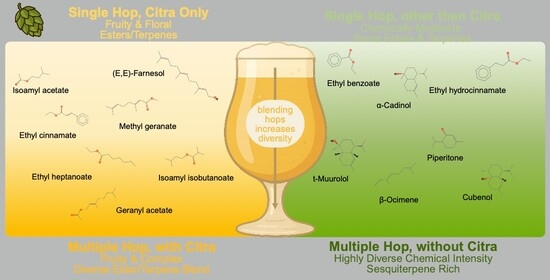
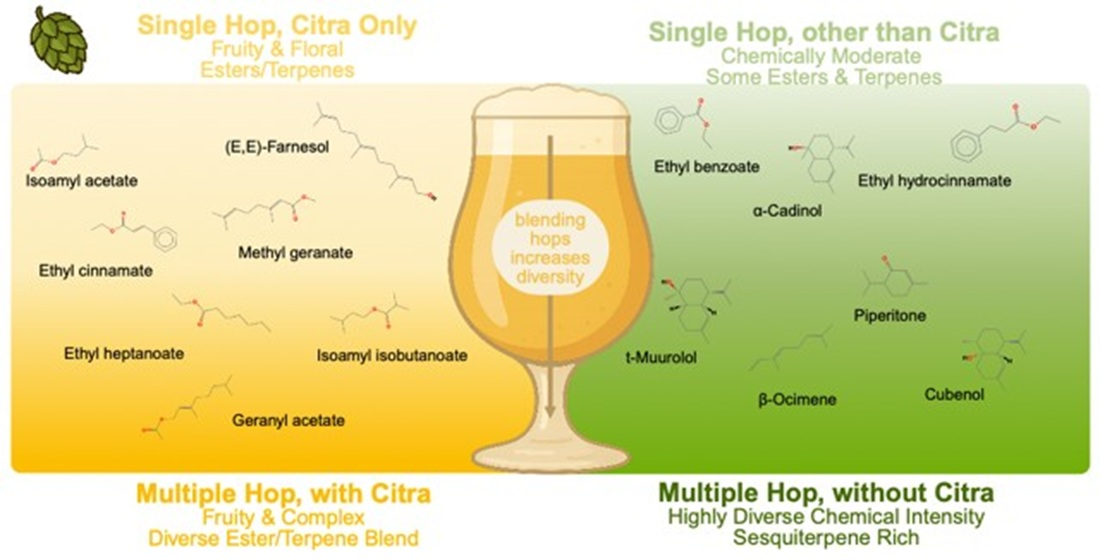
New England India Pale Ales (NEIPAs) are characterized by their hazy appearance and intense hop-derived aroma. These characteristics are central to their consumer appeal and market identity, yet the chemical drivers of these qualities remain poorly defined. This study aimed to investigate how hop profile influences NEIPA chemistry, emphasizing the role of Citra in defining volatile composition. Four profiles were evaluated: Single Hop, Citra; Multiple Hops, with Citra; Single Hop, Other; and Multiple Hops, without Citra. Volatile compounds were analyzed using a combination of sequential two-dimensional gas chromatography-mass spectrometry (GC–GC/MS) and one-dimensional gas chromatography-mass spectrometry (GC-MS). Multivariate statistical analysis was used to identify which compounds differentiated the four hop profiles. Esters, monoterpenes, and sesquiterpenes all contributed to differences across hop profiles. Inclusion of Citra hops yielded distinct volatile chemistry marked by isoamyl acetate, methyl geranate, ethyl cinnamate, and (E,E)-farnesol. By contrast, blended hop profiles showed greater chemical diversity. These findings demonstrate that hop blending alters beer chemistry beyond the sum of individual hops and identify key compounds that may serve as markers of blended versus single-hop NEIPAs. This work provides new insights into the chemical drivers of hop aroma complexity and establishes a framework for connecting hop usage, beer chemistry, and sensory outcomes.

1. Introduction

New England India Pale Ales (NEIPAs) have emerged as one of the most distinctive and commercially successful beer styles of the past decade []. They are characterized by a hazy appearance, a smooth full body, and intense hop-derived aromas of citrus, passion fruit, and pineapple. NEIPAs can be differentiated from traditional American IPAs by their use of late hop addition and dry hopping, often employing multiple hop varieties. Among these, Citra has achieved an iconic status due to its capacity to impart distinct tropical and citrus fruit aromas and its continued dominance in U.S. hop production []. At the same time, NEIPAs are rarely brewed with single-hop additions alone. Brewers frequently employ blends of multiple hop varieties, which have the potential to create sensory profiles that extend beyond the attributes of any single constituent []. While these blending practices may be central to NEIPA’s appeal, the underlying chemical impact of single- or multiple-hop NEIPAs remains underexplored. Understanding this gap requires consideration of the multiple chemical and perceptual factors that mediate hop-derived aroma in beer.
Hop-derived volatiles are the primary drivers of NEIPA aroma, and their production and perception involve several layers of complexity. First, hops contain hundreds of volatile compounds spanning several chemical classes, including esters, alcohols, terpenes, ketones, acids, and sulfur-containing molecules [,,]. Second, brewing practices such as wort parameters [], yeast [,], hop addition schedule [,], and storage [,] can each impact the abundance and distribution of volatiles, further complicating the link between specific hop usage and the sensory character of the final beer. Third, because numerous hop volatiles exhibit exceptionally low sensory detection thresholds, their presence at trace concentrations can markedly affect overall aroma [,]. This complexity is further amplified by the integrative nature of human perception, where interactions among volatiles may lead to masking, enhancement, or the emergence of novel qualities beyond those of individual compounds [,,].
The complexity of hop chemistry and sensory perception is further compounded by blending. Brewers often combine hops to achieve specific flavor outcomes, with blends such as Citra with Mosaic or Simcoe widely used to create the “juicy” or “tropical” profiles characteristic of NEIPAs. Prior sensory-directed studies have shown that hop blends frequently produce non-additive effects on aroma expression, sometimes enhancing complexity at the expense of intensity []. Chemical analyses provide support for these findings, showing that blends yield volatile profiles distinct from the additive contributions of individual components, reflecting both synergistic and antagonistic interactions [,]. For example, terpene alcohols and esters may enhance a given aromatic attribute, or an alternative combination may suppress the attribute [,,]. Although hop blends are common in brewing practice, systematic investigations of interactive effects among hop varieties on aroma remain limited, and such studies would be especially valuable for Citra [].
This study aimed to address these gaps by examining how hop profile, single-hop vs. multiple-hop brews, shapes the volatile composition of NEIPAs. The central research question focused on whether inclusion of Citra, a defining cultivar in NEIPAs, produces a unique volatile signature distinct from that of other single- or blended hop treatments. Four hop profiles were evaluated: Single Hop, Citra; Multiple Hops with Citra; Single Hop, Other; and Multiple Hops without Citra. The study objectives were to (i) identify chemical signatures that differentiate single-hop from multiple-hop blends and (ii) determine how the inclusion of Citra, a defining cultivar in NEIPAs, contributes to distinct volatile outcomes. Volatile compounds were characterized using sequential gas chromatography-mass spectrometry GC–GC/MS and GC–MS workflows, and multivariate analysis was applied to identify compounds that most effectively discriminated among hop treatments.

2. Materials and Methods

2.1. Beer Selection

Twenty New England India Pale Ales (NEIPAs) (Table 1) were purchased directly from a brewery or a local specialty beer shop in Belmont, MA, USA. All beers were packaged in 16 oz cans, stored at 4 °C before and after purchase, and analyzed by GC/MS within one month of purchase. As this study focused on commercially available NEIPAs, detailed brewing parameters such as malt bill, yeast strain, fermentation conditions, and hop dosage were not disclosed by producers. Samples were therefore grouped by verified hop usage, single versus multiple hops, and inclusion or exclusion of Citra hops. This design captures chemical trends representative of real-world variability and allows assessment of whether consistent volatile signatures can be detected above the background noise introduced by production differences. The 20 beers were categorized into four groups of five beers depending on the stated usage of Citra hops during brewing. The first group comprised beers that were brewed using only Citra hops and was labeled as Single Hop, Citra. The second group comprised beers that were brewed with Citra as one of multiple hops, and the group was labeled as Multiple Hops, with Citra. The third and fourth groups contain beers that were brewed without Citra. Beers brewed with a single hop other than Citra were labeled as Single Hop, Other, and beers that were brewed with multiple hops other than Citra were labeled as Multiple Hops, without Citra. The four groups aimed to determine how Citra imparts distinctive volatile chemical signatures in beer when used alone or with other hop varieties.
Table 1. NEIPA beer samples and profile groups.

2.2. Data Collection and Analytical Workflow Overview

This study employed a multi-step analytical workflow to characterize the volatile profiles of four different NEIPA hop profiles (see Section 2.1). The workflow started with the development of a target compound database using a representative beer, heartcutting two-dimensional gas chromatography (GC-GC/MS; see Section 2.6), and Ion Analytics software (see Section 2.3). Chromatographic and mass spectral data were then collected from each of the 20 beers from three replicate injections (see Section 2.5 and Section 2.7). This was followed by compound deconvolution using the compiled target compound database (see Section 2.4). After deconvolution, peak areas were standardized to an internal standard to correct for run-to-run variation and then normalized. Univariate statistical analysis was applied to capture significant differences among the four hop profiles, and multivariate analyses were applied to identify chemical signatures associated with the four hop profiles (see Section 2.8).

2.3. Target Compound Database Building

A target compound database was developed using a single beer (CM4; Single Hop, Citra) following prior methods [,,]. In brief, this process involved heartcutting using sequential two-dimensional gas chromatography-mass spectrometry (GC-GC/MS) and Ion Analytics software version 5.1. Heartcuts were collected at one-minute intervals throughout the chromatographic run. Using a cryo-trap system, each heartcut was precisely transferred from the first column to the second column, ensuring temporal resolution was maintained. This procedure resulted in 47 data files with high-resolution chromatograms, where compounds that co-eluted on the first column were further separated due to the orthogonal selectivity of the second column. Each heartcut was analyzed using Ion Analytics, where individual chromatographic peaks were visually inspected to assess whether their mass spectral profiles remained consistent from scan to scan across the peak. If scan-to-scan spectral consistency was observed, tentative identification was made by comparing the mass fragmentation patterns to reference libraries (e.g., NIST17). Confirmation was achieved by cross-referencing published retention indices and authentic standards. Compounds that could not be identified were assigned a numerical ID to allow comparison across samples. For each peak that displayed scan-to-scan consistency, the following data were compiled to build the target compound database: CAS # (when applicable), retention time (index), reference mass spectrum, and 3–6 target ions (m/z): one main ion (designated as the base peak) and 2–5 confirming ions with their relative abundances.

2.4. Targeted Spectral Deconvolution and Compound Identification

Employing the target compound database (see Section 2.3), Ion Analytics software was used to perform targeted spectral deconvolution and compound identification [] on the GC/MS data collected for each of the 20 beers (see Section 2.7). For each compound entry in the target database, the software first extracted the main ion and corresponding confirming ions within a ±30 s retention-time window centered on the expected elution of the target compound. For each spectral scan, the intensities of the confirming ions were normalized to the main ion (Equation (1)). The resulting reduced ion intensity, Ii(t), represents the abundance of the ith confirming ion at scan t, relative to the main ion (i = 1). Here Ai(t) denotes measured ion intensity at scan t, and Ri is the expected relative abundance ratio of that ion to the main ion as defined in the reference spectrum for the target compound. The resulting reduced ion intensities are visualized as a histogram in which the main and confirming ions appear at the same height when their relative abundances are consistent, indicating a potential chromatographic peak suitable for integration. When the expected and observed ion ratios align across consecutive scans, the consistent relative intensities of these ions confirm a stable spectral pattern characteristic of a single compound.
I i t = A i t R i A i
The following four metrics are used for target compound identification:
1.
Q-ratio: Defines the deviation threshold among the confirming ions and main ions within a scan; a potential peak is identified as a minimum of five consecutive scans meeting the threshold. A Q-ratio of 20% was set for this study.
2.
Reduced Intensity Deviation (ΔI): Describes the average deviation among ion ratios across the peak; lower ΔI values indicate a stronger spectral match (Equation (2)). An acceptable compound match is determined by ΔIK + Δ0/Ai, where K is the user-defined (acceptable) relative percent difference and Δ0 is the additive error attributable to instrument noise and/or background signal.
I = i = 1 N 1 j = i + 1 N A b s ( I i I j ) i = 1 N 1 i
3.
Scan-to-Scan Variance (ΔE): The SSV is calculated from ΔE = ΔI × log (Ai). The algorithm calculates the relative error by comparing the mass spectrum of one scan against the others. The smaller the difference, the closer the SSV is to zero, the better the spectral agreement. It is acceptable when ΔI or ΔE are below the maximum allowable error, ΔEmax, in five consecutive scans. In this study the maximum allowable scan-to-scan error, ΔEmax, was set to 5 [,].
4.
Q-value: Measures the total deviation between the observed and expected ion ratios across the peak, expressed as percentage. Values approaching 100 indicate higher certainty between sample and reference spectra.
These four criteria formed a single criterion, which was used to confirm compound identity. When the criterion is met, the software normalizes evaluated ions to the main ion, producing a histogram of ion signals. Visual inspection of target compound histograms makes compound identity easy to confirm. Spectral deconvolution with MS subtraction provided the means to identify detectable compounds by GC/MS. If a compound is not found through deconvolution, it is reported as “non detect” in the data table.

2.5. Thin-Film Solid-Phase Microextraction (TF-SPME) of Beer Samples

Thin-film solid-phase microextraction (TF-SPME) was used to sample the volatile and semi-volatile compounds of each beer. Samples were first sonicated (L&R Ultrasonics Quantrex 280, Kerny, NJ, USA) in ice water for 20 min to remove CO2 []. A 10 mL aliquot of sample was pipetted into a 10 mL clear glass screw cap headspace vial, followed by the addition of a 10 mm-long stir bar. Within each vial a dual phase polydimethysiloxane (PDMS)/divinylbenzene (DVB) film (20 mm × 4 mm; Gerstel, Linthicum, MD, USA) was then submerged directly in the liquid. Vials were then capped and stirred at 1200 rpm for 60 min on a 20-position stir plate (Gerstel, Linthicum, MD, USA). After extraction, the films were manually removed, rinsed with deionized water, dried with a lint-free Kimtech wipe, and then inserted into a thermal desorption tube for analysis using GC/MS or GC-GC/MS as described below.

2.6. Sequential GC-GC/MS Parameters

Heartcuts for targeted database building were collected using an Agilent model 7890A/5975C GC/MS (Agilent Technology, Santa Clara, CA, USA) equipped with two LTM columns, deans switch, and transfer lines. Agilent’s pneumatics controller module (PCM) and software controlled the flow between columns to make heartcuts. The instrument was equipped with a multi-purpose sampler (MPS, Gerstel, Linthicum, MD, USA), thermal desorption unit (TDU, Gerstel, Linthicum, MD, USA), cooled injection system (CIS4, Gerstel, Linthicum, MD, USA), and cryotrap/thermal desorption unit (CTS2, Gerstel, Linthicum, MD, USA). The MPS automated the stir bar injection process while the CTS2 freeze-trapped and then desorbed each sample fraction transferred from the first to the second column. LTM 1 housed column 1 (C1, 30 m × 250 µm × 0.25 µm INNOWAX, Agilent Technologies, Santa Clara, CA, USA). C1 operating conditions were initial temperature 40 °C (1 min), temperature ramp to 250 °C at 5 °C/min, 20 min hold. LTM 2 housed column 2 (C2, 30 m × 250 µm × 0.25 µm DB-5MS, Agilent Technologies, Santa Clara, CA, USA). C2 operating conditions were initial 40 °C (1 min), ramping to 280 °C at 5 °C/min, 10 min hold. MS ion source and quadrupole temperatures were 250 °C and 150 °C, respectively. The electron impact voltage and m/z scan range and frequency were 70 eV and 40–350 m/z. Spectra were collected in positive ion mode.

2.7. GC/MS Parameters

The chromatographic profiles of the 20 beer samples (Table 1) were collected from triplicate injections. Each replicate analysis was conducted using an independent beer can (20 beers × 3 replicates = 60 total injections). To minimize potential bias from time-dependent or instrumental variation, the 60 samples were randomized into batches of 10 injections. Batch order and sample sequence were randomized prior to extraction (see Section 2.5) and analyzed to account for minor variation in extraction efficiency or instrument response. Data were collected using an Agilent 7890A gas chromatograph coupled with an Agilent 5977A mass selective detector (Agilent Technology, Santa Clara, CA, USA). The GC/MS was equipped with an MPS Robotic autosampler, dynamic headspace unit (DHS) thermal desorption unit (TDU), and cooled injection system (CIS4), each manufactured by Gerstel (Gerstel, Linthicum, MD, USA). Following sampling, as described in Section 2.4, the DVB/PDMS films were transferred to the TDU for desorption. Prior to desorption, the CIS with glass bead liner was cooled to −120 °C with liquid nitrogen. Desorption was initiated by ramping the TDU from 40 °C to 250 °C at 600 °C/min with a 5 min hold at 250 °C. The chromatographic analysis was initiated with the ramping of the CIS from −120 °C to 280 °C followed by a 5 min hold. The GC oven was outfitted with a DB5-MS UI capillary column (30 m, 0.25 mm i.d., 0.25 mm film thickness; Agilent Technology, Santa Clara, CA, USA). The oven temperature was programmed to hold at 40 °C for 1 min; then ramp at 5 °C/min to 280 °C; then hold for 5 min. There was a constant flow of helium carrier at 1.2 mL/min with a split ratio of 1:10. The MSD was set to a solvent delay for the initial 1.25 min, with an electron energy of −70 eV, a source temperature of 250 °C, and quadrupole temperature of 150 °C. Data were acquired in scan mode ranging from 40 m/z to 350 m/z, with a step of 0.1 m/z, scan frequency of 4.5 scans/s, and cycle time of 221.05 ms.

2.8. Data Processing and Statistical Analysis

Following database building, deconvolution, and peak identification, peak areas were standardized for each compound against the internal standard (1 uL of 10 ppm Naphthalene-d8; Restek, Bellefonte, PA, USA) by first dividing the measured peak area by the within injection peak area of the internal standard, then multiplying by the average of the internal standard across all injections (n = 60), such that after standardization, the area for each internal standard peak was equivalent across all 60 injections. After standardizing to adjust for within-run variation, the areas for each compound across all 60 injections were normalized by subtraction of the compound means and dividing by the standard deviation.
A compound library (see Section 2.3 and Section 2.4) containing 364 features was used to query the chemical composition of the four hop profiles. Because these features were not consistently detected in all 60 injections (i.e., 20 beers × 3 replicates), we refined the dataset to include only those features present in at least 12 of 15 injections within a single hop category. This threshold was derived from the experimental design: each hop category consisted of five example beers, with three GC injections per beer, totaling 15 injections. Requiring detection in at least 12 of 15 injections ensured that a feature was present in at least four out of five beers within a hop profile category. Features meeting this threshold were retained as potential compounds, resulting in a subset of 120. We then performed analysis of variance (ANOVA) to evaluate differences in abundance for each compound among the four hop profiles. This approach served to reduce noise and limit overfitting, ultimately identifying 56 compounds Fcrit (3, 56) > 2.77 that significantly varied among the four hop profiles. Tukey’s Honestly Significant Difference (HSD) test was applied to assess pairwise differences among hop profiles.
Statistical analyses were performed using R version 4.3.1 “Beagle Scouts” and the R Studio version 2023.09.1+949 “Desert Sunflower” []. Graphics were prepared using the ggplot2 package []. Canonical correlation analysis were calculated using the vegan package [], and linear discriminant analysis (LDA) were calculated using the MASS package []. Canonical correlation analysis (CCA) was applied to evaluate the chemical relationships among the four hop profiles. The analysis included all 60 analytical replicates from the 56 ANOVA-identified compounds (Table 2), and hop profile was used as the categorical predictor variable. LDA was applied to evaluate a subset of chemical measures.
Table 2. Summary of 56 volatile compounds that differed significantly among the four hop profiles (ANOVA, p < 0.05). Compounds are organized by chemical class, denoted in bold, and listed with experimental (Exp.) and referenced literature (Lit.) retention indices (RI). Letters (a–c) indicate post hoc mean separation, where shared letters denote no significant difference among treatments. The highest peak area for each compound is designated as “a,” with descending relative abundances labeled alphabetically. Spectra for each of the 15 unidentified compounds are reported in Supplemental Figure S1.

3. Results

3.1. Volatiles

Chromatographic analysis identified a diverse suite of volatile compounds spanning esters, alcohols, terpenes, ketones, carboxylic acids, sulfur-containing compounds, lactones, and several unknowns (Supplemental Table S1; Table 2). To assess the effect of hop profile, a one-way analysis of variance (ANOVA) was applied to the peaks of each compound by hop profile (Fcrit (3, 56) = 2.77, p = 0.05). Peak areas for 56 compounds were found to significantly vary by hop profile. Tukey’s Honestly Significant Difference (HSD) test was then applied to the each of the 56 compounds to assess differences among the four hop profiles. Results of the post hoc means separation are reported in Table 2 using alphabetical lettering (a–c), where “a” represents the highest mean peak area and shared letters denote no significant difference (p < 0.05).
Across the four hop profiles, 24 compounds were found to be high or higher in the Single Hop, Citra profile, and 33 compounds were as higher or higher in Single Hop, Other profile. For multiple hop brews, 35 and 46 compounds were as high or higher in Multiple Hops, with Citra and Multiple Hops, without Citra, respectively. Together, these counts demonstrate distinct chemical outcomes depending on hop profile. Below we highlight how key classes of chemical compounds differed.
In addition, Table 2 summarizes the identity, class, and retention index of the 56 compounds. Among this set of compounds, esters were the most abundant class (14 compounds), followed by terpenes (13) and ketones (6). Smaller categories included three alcohols, two carboxylic acids, two sulfur-containing compounds, and a single lactone. In addition, 15 unknowns were detected and were listed by their retention index but not structurally identified.

3.1.1. Esters

Esters represented the most abundant class of volatiles that significantly varied among the hop profiles. Of the 14 esters detected, 8 showed their greatest abundance in either the Single Hop, Citra, or Multiple Hops with Citra profiles, while 3, isoamyl acetate, methyl geranate, and 2-phenylethyl acetate, were the most abundant in the Single Hop, Citra profile. In contrast, branched-chain esters such as 2-methylbutyl isobutyrate and isoamyl isobutyrate were lowest across the Single Hop, Citra treatment. Additionally, esters such as ethyl cinnamate and ethyl hydrocinnamate were enriched in both Single Hop, Citra and the two non-Citra profiles, demonstrating the potential of hop blending to influence the ester profile. Overall, the ester distribution underscores Citra’s role in elevating bright, fruity top notes, while non-Citra blends contribute a subset of esters that can impart aromatic complexity (see Table 2).

3.1.2. Terpenes

Terpenes formed a group of 13 compounds comprised of 3 monoterpenes and 10 sesquiterpenes. Of the three monoterpenes, piperitone and β-ocimene were enriched in the Multiple Hops, without Citra profiles, but β-myrcene showed little difference across the hop profiles. The sesquiterpenes showed a broader distribution: of the 10 detected, 1 showed its greatest abundance in the Single Hop, Citra profile, 5 were most abundant in the two non-Citra profiles, and 4 were shared across all four profiles. (E,E)-Farnesol,known to contribute floral and mild citrus notes (Table 2), was the only sesquiterpene terpene clearly enriched by the inclusion of Citra hops. By contrast, sesquiterpene alcohols such as α-cadinol, epi-cubenol, β-eudesmol, t-muurolol, and cubenol were more abundant in the Multiple Hops, without Citra profile, consistent with the woody, herbal, and resinous character (Table 2) of non-Citra hops. Shared terpenes included humulol, caryophyllenyl alcohol, and caryophyllene, which showed no clear pattern across hop profiles, reflecting their ubiquity as hop-derived terpenes. Collectively, the terpene distribution illustrates that while Citra imparts a distinct floral–citrus terpene signature, non-Citra blends dominate in woody and resinous terpene expression.

3.1.3. Ketones

Ketones comprised six compounds, including 2-butanone, 2-nonanone, 2-decanone, 2-undecanone, benzophenone, and 6-methyl-5-heptene-2-one. Of these, all were shared across treatments, showing no clear enrichment in single- or multiple-hop NEIPAs that did or did not include Citra. Their distribution suggests that ketones are a broadly expressed class of volatiles in hopped beers and are less diagnostic for differentiating Citra contributions. Although individual ketones add fruity, citrus, or balsamic nuances, their occurrence across all hop treatments indicates they represent background chemistry rather than hop-specific drivers of aroma.

3.1.4. Other

Other compound classes report fewer compounds showing various distributions across hop treatments. Phenylethyl alcohol was most abundant in the Multiple Hops, without Citra profile, contributing rosy, honey-like notes. Two additional alcohols, 1-octen-3-ol and 2-undecanol, did not show a clear pattern across hop profiles. Two sulfur-derived volatiles were reported, including S-methyl thio-3-methylbutyrate, which was most abundant in the Multiple Hops, with Citra profile, and 2,3,5-trithiahexane, which was lowest in the Single Hop, Citra profile. Two carboxylic acids, represented by isobutyric and heptanoic acid, showed no distinct pattern across hop profiles, but had the potential to impart “short-chain” cheesy and fatty aromas. Additionally, a single lactone, γ-nonanolactone, also showed no distinct pattern across hop profiles, but had the potential to impart creamy, coconut- and peach-like notes. Finally, 15 unknown compounds were identified by retention index only, with the majority showing increased abundance in the Multiple Hops, without Citra hop profile. Spectra for each of the 15 unidentified compounds are reported in Supplemental Figure S1. While these classes were relatively minor compared with esters, terpenes, and ketones, they add nuance and depth to the hop volatile profile.
Overall, the volatile profiles revealed clear contrasts between Citra and non-Citra treatments, with Citra most closely linked to fruity esters and selected floral terpenes, while non-Citra blends emphasized a set of bicyclic sesquiterpenes characterized by woody, resinous notes. At the same time, many compounds were shared across the four profiles, pointing to a background of common hop chemistry layered with treatment-specific distinctions. To disentangle these overlapping trends and identify how groups of volatiles jointly differentiate hop profiles, we next applied canonical correlation analysis (CCA).

3.2. Chemical Signatures of Hop Profile

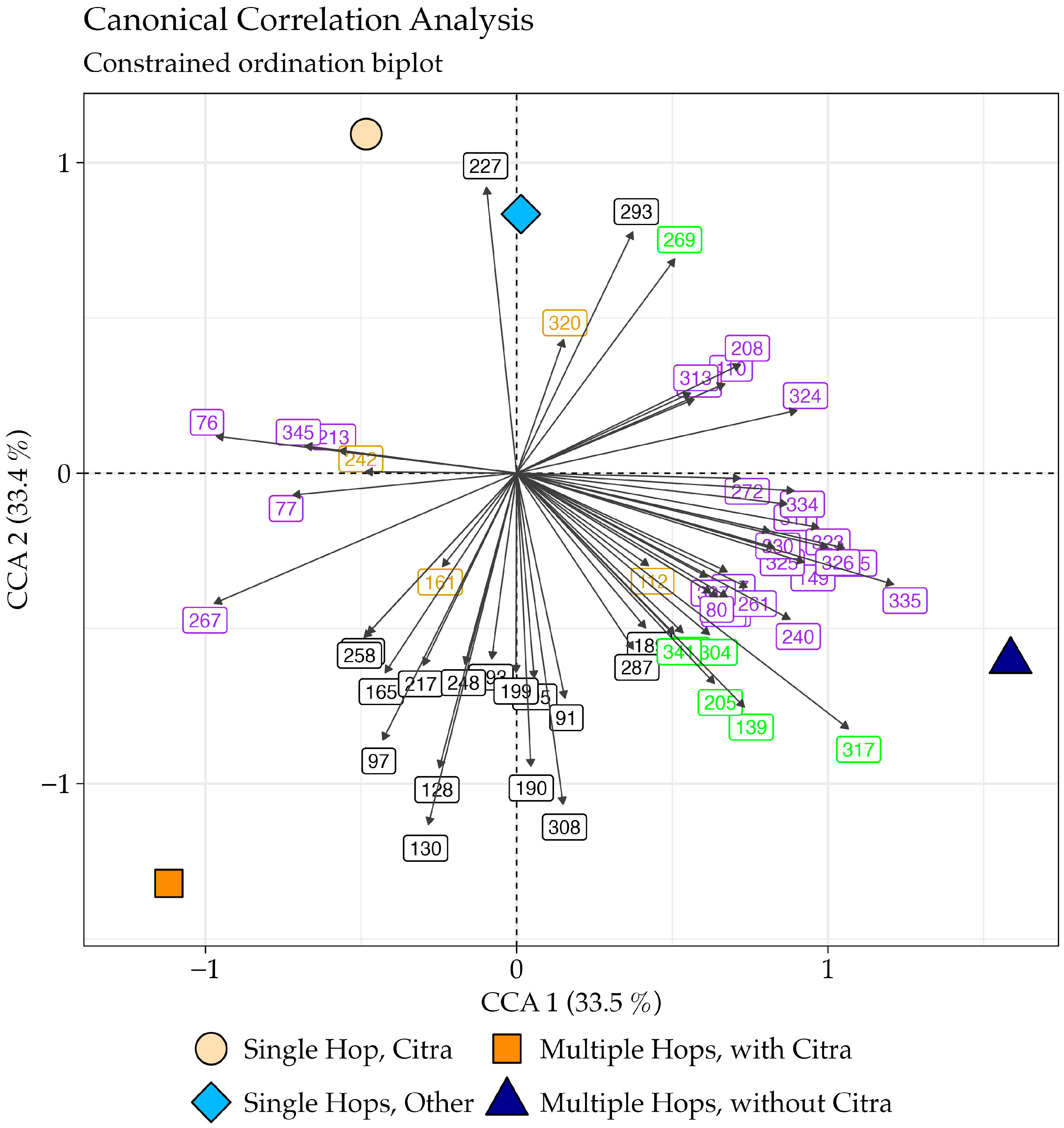
Canonical correlation analysis (CCA) was employed to explore the relationship among volatile compounds to help identify potential chemical patterns associated with each hop profile. The analysis included all 56 compounds listed in Table 2. Overall, a significant relationship was observed between hop profile and chemical composition #CCA, F(3, 56) = 10.55, p < 0.05, with axis 1 (33.5%) and axis 2 (33.4%) together explaining 66.9% of the total chemical variation among hop profiles. Figure 1 displays the loading vectors for each compound along with the scores for each of the four hop profiles. In Figure 1, 27 compounds (red) were correlated with axis 1, 18 (black) with axis 2, 7 (green) with both axes, and lastly 4 (dark yellow) were not correlated with either axis. Axis 1 separated the Citra profiles from the non-Citra profiles, while axis 2 distinguished multi-hop from single-hop treatments. The Single Hop, Citra and Single Hop, Other profiles grouped closely near the top center of the plot, indicating a high degree of chemical similarity between the two profiles. In contrast, the two Multiple Hops profiles were clearly separated. The Multiple Hops, without Citra profile was positioned in quadrant IV, while the Multiple Hops, with Citra profile was positioned quadrant III. Overall, the two Multiple Hops profiles showed a distinct separation, while the single hops profiles did not, suggesting that hop blending drives greater chemical differentiation than hop variety alone.
Figure 1. Canonical correlation biplot showing loading vectors for individual compounds and scores for the four hop profiles. (ref. Table 2). Vectors reporting a significant correlation with axis 1 are shown in purple, vectors reporting a significant correlation with axis 2 are shown in black, vectors reporting a significant correlation with both axis 1 and 2 are shown in green, and vectors not correlated with either axis 1 or 2 are shown brown. Axis 1 separated Citra from non-Citra treatments, while axis 2 distinguished multi-hop from single-hop profiles. Single-hop treatments clustered closely, whereas the two multi-hop treatments were clearly separated, indicating that hop blending drives greater chemical divergence than hop variety alone.
Chemical markers (Table 2) with potential to distinguish the four hop profiles were identified by their correlation with axis 1 or axis 2 (Figure 1, Table 2). Of the 14 esters, 6 were correlated with axis 1 (isoamyl acetate #76, 2-MeBu acetate #77, ethyl benzoate #208, ethyl pentanoate #80, ethyl phenylacetate #237, methyl geranate #267), 5 with axis 2 (ethyl cinnamate #293, ethyl nicotinate #227, ethyl heptanoate #165, 2-methylbutyl isobutyrate #128, iso-amyl iso-butyrate #130), and 2 with both axes (ethyl hydrocinnamate #269, 2-Me-2-methylbutanoate #171). One ester, 2-phenylethyl acetate #242, showed no clear association. Terpenes, the second-largest group, also showed mixed alignments: of the 13 compounds, 7 sesquiterpenes and 1 monoterpene loaded on axis 1 ((E,E)-farnesol #345, caryophyllenyl alcohol #313, epi-cubenol #323, cubenol #326, t-muurolol #330, β-eudesmol #335, α-cadinol #334, piperitone #240), 2 aligned with axis 2 (β-myrcene #119, caryophyllene #287), and 2 were correlated with both axes (β-ocimene #139, δ-cadinene #304). Alcohols were consistently linked to axis 1, with 1-octen-3-ol #110, 2-undecanol #261, and phenylethyl alcohol #185 all showing strong alignment. In contrast, both carboxylic acids, isobutyric acid #91 and heptanoic acid #193, and the two sulfur compounds (S-methyl thio-3-methylbutyrate #97, 2,3,5-trithiahexane #190) were associated with axis 2. Among the six ketones, two loaded on axis 1 (benzophenone #324, 2-butanone #14), two on axis 2 (2-undecanone #258, 2-decanone #217), and two showed no correlation (2-nonanone #161, 6-methyl-5-heptene-2-one #112). A single lactone, γ-nonanolactone #272, was linked to axis 1. Finally, of the 15 unknown compounds, 7 were correlated with axis 1 (unk Ri-1185 #213, unk Ri-1525 #307, unk Ri-1566 #312, unk Ri-1545 #311, unk Ri-1635 #325, unk Ri-1095 #189, unk Ri-1514 #308), 5 with axis 2 (unk Ri-1157 #195, unk Ri-1141 #199, unk Ri-1278 #248, unk Ri-1072 #149, unk Ri-1661 #341), and 3 with both axes (unk Ri-1162 #205, unk Ri-1661 #341, Me 3,6-dodecadienoate #317).
Collectively, these results suggest that axis 1 is driven by a portion of the esters, and many of the terpenes and alcohols, whereas axis 2 is driven by acids, sulfur volatiles, and the remaining esters. Taken together, the compounds correlated with each axis help explain the positioning of the four hop profiles in the CCA biplot. Along axis 1, from left to right, the four hop profiles align by inclusion of Citra, moving from Multiple Hop, with Citra, to Single Hop, Citra, followed by Single Hop, Other, and lastly Multiple Hop, without Citra. In contrast, axis 2 shows separation by blending, with the two single-hop treatments at the top, and the two multi-hop profiles at the bottom. Thus, the ordination reflects a dual pattern: single-hop treatments overlapped due to a shared baseline of ester- and alcohol-driven chemistry, whereas multi-hop treatments were chemically distinct, underscoring the role of hop blending in expanding volatile diversity.

3.3. Linear Discriminant Analysis

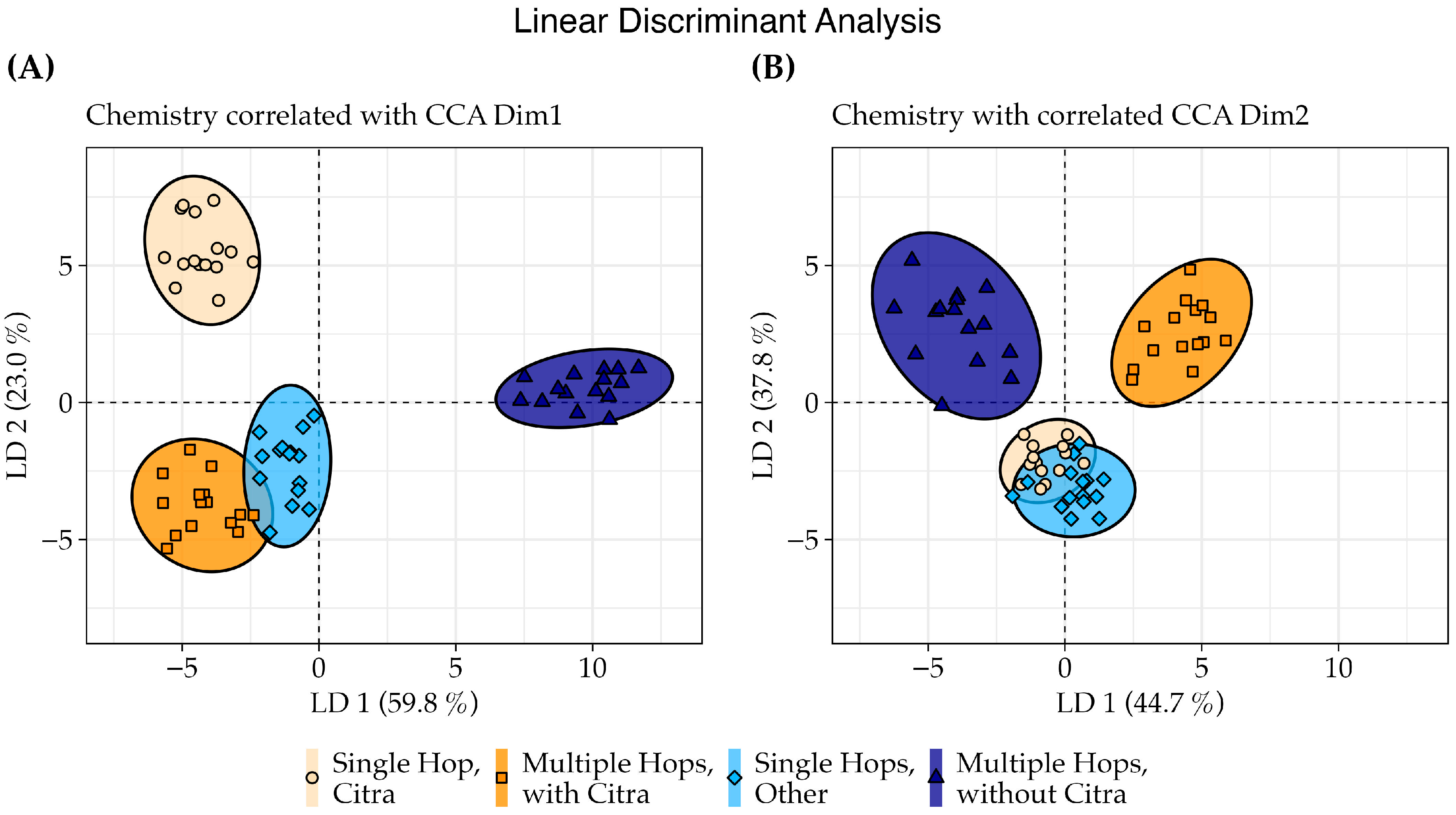
To further evaluate how volatile compounds distinguish hop treatments, linear discriminant analysis (LDA) was applied (Figure 2). Two separate models were constructed using subsets of compounds identified in the canonical correlation analysis (CCA): one set based on the 34 compounds significantly correlated with axis 1, and a second set based on the 25 compounds correlated with axis 2. This approach allowed for the testing of whether volatiles correlated with each axis could reliably classify the four hop profiles, and the determination of which compound classes contributed most strongly to group separation. Figure 2 displays the results, with panel A showing the axis 1 model and panel B, the axis 2 model. In each panel, sample scores are plotted with 95% confidence ellipses surrounding the hop treatment groups.
Figure 2. Linear discriminant analysis (LDA) of hop volatile profiles using compounds correlated with axis 1 (panel A) and axis 2 (panel B) from the CCA (cf. Figure 1). Panel (A) separated Citra from non-Citra profiles, with Multiple Hops without Citra clearly discriminated. Panel (B) separated multi-hop from single-hop treatments, while the two single-hop profiles overlapped closely. In summary, axis 1 captures Citra versus non-Citra contrasts, whereas axis 2 captures multi-hop versus single-hop contrasts.
In panel 2A (axis 1), the LDA explained 82.8% of the total variance, with component 1 accounting for 59.8% and component 2 for 23.0%. The model results were similar to that of the CCA (cf. Figure 1), showing clear separation between the two multiple-hop treatments, and clear separation between the Citra treatments. However, Multiple Hops with Citra was not fully separated from the Single Hop, Other profile, which possibly reflects the contribution of non-Citra hops within the blends. By contrast, the Multiple Hops, without Citra profile was distinctly discriminated from all other treatments. In panel 2B (axis 2), the LDA accounted for 82.5% of the total variation, with component 1 explaining 44.7% and component 2 explaining 37.8%. The model showed that the two single-hop profiles, Single Hop, Citra and Single Hop, Other, overlapped closely, reflecting their shared chemistry, while the multi-hop profiles remained distinct. Taken together, the two LDA models reinforce the conclusion that hop blending drives greater chemical divergence than hop variety alone, with multi-hop treatments showing the clearest separation in volatile composition.

3.4. Boxplot Analysis of Top Compounds

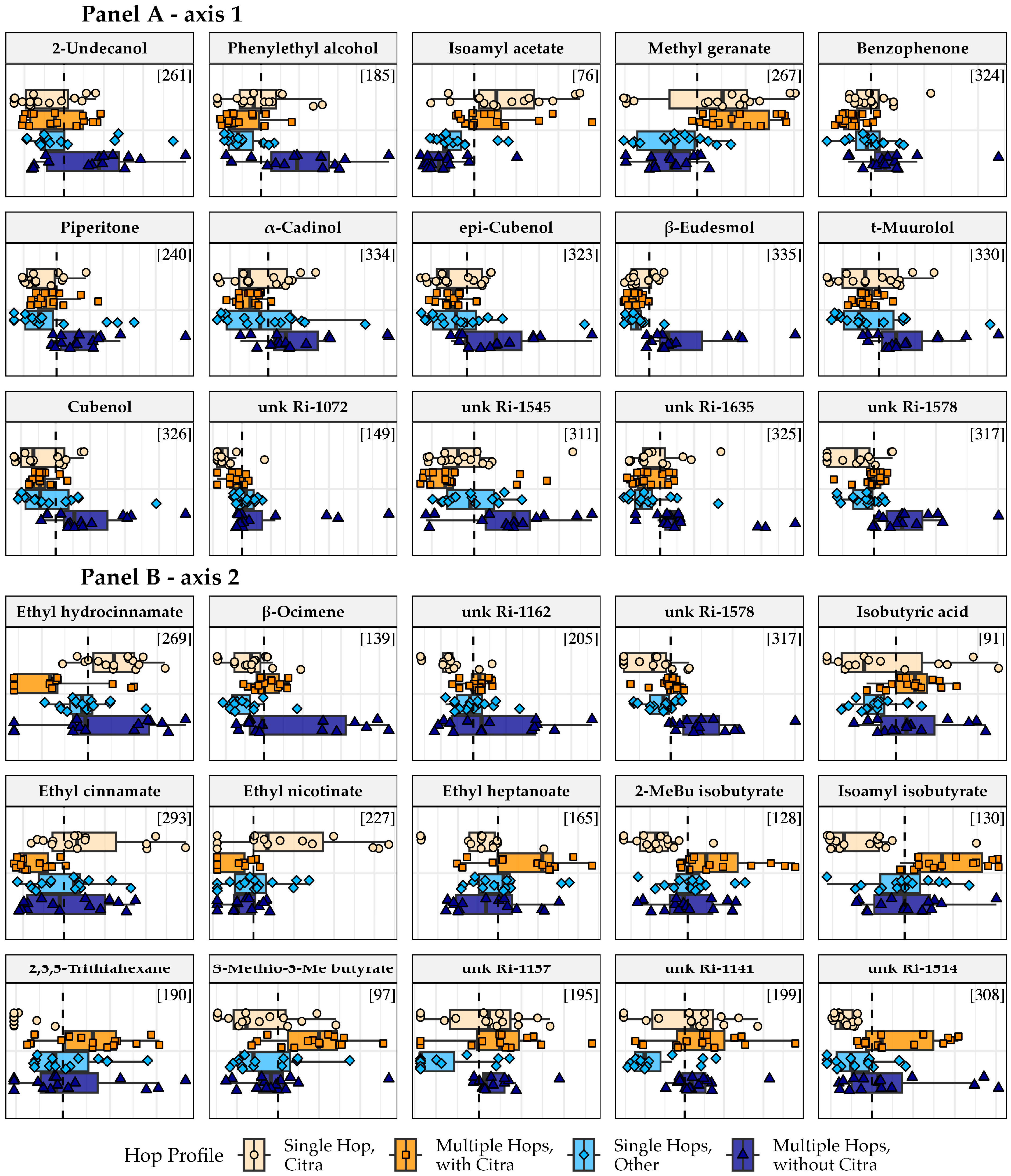
To visualize the relationship of individual volatiles to each hop profile, boxplots (Figure 3) were generated for the 15 compounds showing the strongest correlations with each of the CCA axes (cf. Figure 1; Table 2). Panel 3A presents compounds most strongly associated with axis 1, and Panel 3B displays those linked to axis 2. For reference, the compound index corresponding listed in Table 2 and Figure 1 is displayed in the upper-right corner of each plot. In Panel 3A, isoamyl acetate #76 and methyl geranate #267 showed the highest abundances in the two Citra treatments. Many of the sesquiterpene alcohols (Panel 3B), such as α-cadinol #334, epi-cubenol #323, β-eudesmol #335, t-muurolol #330, and cubenol #326, showed clear differentiation in only a single hop profile, emphasizing their role as possible markers of beers brewed with Multiple Hops, without Citra.
Figure 3. Boxplots of the 15 compounds most strongly correlated with axis 1 (panel A) and axis 2 (panel B) from the CCA. Compound indices correspond to Table 2 and are shown in the upper-right corner of each plot. Spectra for each of the 15 unidentified compounds are reported in Supplemental Figure S1.
In addition, several unknowns were also among the top contributors, reflecting unresolved components that nonetheless aligned strongly with the hop profiles. Interestingly, (E,E)-farnesol #345 was previously identified as a key Citra-associated sesquiterpene but was absent from the top 15. This suggests that correlation strength alone may not capture a comprehensive picture of specific chemical drivers. Lastly, the Multiple Hops without Citra profile exhibited the widest abundance distribution across several volatiles, which likely reflects the diversity in the hop bill. Collectively, the boxplots provide a compound-level view of the volatiles that most strongly shape axis separation, reinforcing the dominance of ester-driven chemistry in Citra profiles, while highlighting variability, specificity, and the limitations of correlation-based ranking as a sole metric for compound importance.

4. Discussion

The present study investigated the volatile composition of New England India Pale Ales (NEIPAs) brewed using different hop profiles, with the aim of identifying chemical markers that distinguish beers brewed with Citra hops from those produced with other hop varieties or multi-hop blends. Across the four examined hop categories—Single Hop, Citra; Single Hop, Other; Multiple Hops with Citra; and Multiple Hops without Citra—GC-MS analysis revealed 56 volatile compounds that differed significantly (Table 2), spanning esters, terpenes, ketones, alcohols, carboxylic acids, sulfur-containing species, lactones, and numerous unknowns. Esters and terpenes comprised the dominant classes, which reflects their primary role driving the aroma profile of beer. These data provide new insight into how hop selection influences the chemical profiles of NEIPAs, with implications for brewers seeking to design products with consistent and distinctive sensory attributes.

Hop Variety as a Driver of Volatile Diversity

The finding that esters were the most abundant class aligns with previous studies demonstrating their contribution to the flavor profile of hop-forward beers such as NEIPAs [,,]. Ester chemistry in beer is dynamic and changes across production and aging. As transient compounds, esters contribute to a flavor profile that develops and evolves over the course of the beer’s life. In general, esters in beer can be traced to two major sources: those naturally occurring in hops and carried into beer during hopping, and those formed during production and storage. Below we explore how these two factors might explain the patterns observed.
The first source consists of esters that occur naturally in hops and are carried into beer during hopping [,,,]. This group includes compounds such as 2-methylbutyl isobutyrate, isobutyl isobutyrate, and isoamyl isobutyrate, along with a suite of geranyl esters including methyl geranate, geranyl propionate, geranyl isobutyrate, and geranyl acetate. Geranyl acetate was consistently enriched in Citra treatments, underscoring the role of terpene esterification in shaping this hop’s distinctive sensory profile. Previous studies have emphasized terpene alcohols such as geraniol and citronellol as central to Citra’s aroma [,], and our findings support this work by showing that their ester derivatives, such as geranyl acetate, may also play an important role in varietal expression. In addition, previous research has also reported that beers brewed with Citra contain comparatively low concentrations of branched-chain esters, including 2-methylbutyl isobutyrate, relative to other hop varieties []. This further supports the present results, where the Single Hop, Citra profile exhibited the lowest levels of these compounds, suggesting that hop variety is a key driver of their abundance.
The second source consists of esters that are formed during beer production and are influenced by factors such as fermentation conditions [,] and hopping regime [,]. This group of compounds arises from the wide diversity of short-chain acids and alcohols present during brewing. While some of these precursors are hop-derived, the esters are formed during fermentation and storage, making production a critical stage of their development. In our study, we identified several esters likely formed during fermentation (Table 2; Supplemental Table S1), including isoamyl acetate, ethyl hydroxycinnamate, ethyl benzoate, ethyl pentanoate, and ethyl heptanoate. Collectively, these compounds potentially contribute to a broad spectrum of sensory attributes which includes floral, fruity, apple, pear, candy-like, and rum-like aromas [,,]. Fermentation-driven esters provide fruity and candy-like notes, while hop-derived esters reinforce a citrus and floral character. This convergence may help explain why Citra consistently delivers a strong varietal signature, even as blending alters the overall balance. Together, the two ester sources potentially contribute complementary dimensions to Citra’s flavor.
Monoterpenes and sesquiterpenes further distinguished hop categories. Several terpenes were enriched in the non-Citra profiles, with higher relative abundances of sesquiterpenes such as α-cadinol, epi-cubenol, β-eudesmol, t-muurolol, cubenol, and δ-cadinene. In contrast, (E,E)-farnesol and geranyl acetate were more abundant in the Citra profiles. These results underscore that hop character in NEIPAs is shaped by direct transfer of hop volatiles, such as geranyl acetate [,,,]. It should also be noted that the limited variation observed for some hop-derived volatiles likely reflects compound-specific physicochemical constraints, including solubility, volatility, and oxidative reactivity, which can reduce the apparent impact of hopping regime or hop dosage on their final concentrations.
Additional compound classes also contributed to differences among hop categories. γ-Nonalactone, enriched in the two Citra profiles, is associated with peach- and coconut-like notes consistent with tropical descriptors, while the two profiles without Citra contained higher levels of heptanoic acid, a fermentation-derived carboxylic acid. Ketones such as 2-nonanone and 2-undecanone were also more abundant in the profiles without Citra. In our study, two sulfur compounds were detected at lower abundance in the Citra profiles, which contrasts with previous reports describing Citra as rich in sulfur-derived volatiles associated with sweaty and tropical fruit-like notes []. These findings suggest that volatile expression is highly context-dependent and shaped by factors such as hop handling, yeast strain, and hopping regime.
Lastly, 15 unknowns were consistently detected and varied significantly across hop categories, particularly in multi-hop blends where a larger pool of precursors may have promoted chemical interactions that generated novel volatiles not observed in single-hop treatments. Their prominence in blends underscores that chemical diversity extends beyond additive contributions, reflecting emergent properties of hop mixtures. These unknowns may contribute to the perception that blends offer complexity at the expense of clear varietal expression. Collectively, these results demonstrate that even minor and less well-characterized classes contribute to the overall aroma balance of NEIPAs.
Overall, the distribution of esters, terpenes, ketones, acids, sulfur compounds, lactones, and unknowns supports the conclusion that hop profile imparts a distinct and multi-faceted chemical signature. For Citra this reflects the elevated presence of hop-derived volatiles such as geranyl acetate and (E,E)-farnesol, and also the suite of additional chemistries formed during beer production. By contrast, multi-hop blends without Citra appeared more chemically diverse. These findings highlight the importance of hop choice in determining the chemical complexity and the sensory potential of modern hop-forward beers.
This study provides a foundation for future work on the chemical and sensory of NEIPA flavor. A key next step is linking identified volatiles to sensory outcomes through sensory-directed methods such as GC-Olfactometry and descriptive analysis. In addition, further work to identify the 15 unknown compounds could potentially provide additional marker chemistry. Finally, these findings support the needs for a systematic study evaluating how hop profiles influence consumer acceptance, ultimately leading to a more integrated understanding of both the chemistry and the preference drivers underlying NEIPAs.

5. Conclusions

This study demonstrates that the hop profile shapes the volatile composition of New England India Pale Ales (NEIPAs). Citra hops contributed to a distinctive chemical signature characterized by esters, monoterpenes, and hop-derived compounds such as geranyl acetate and (E,E)-farnesol. Beers brewed with multiple hops exhibited greater chemical diversity and higher levels of many key volatiles. These findings underscore both the unique contribution of Citra hops and the role of blending to achieve chemical complexity. By identifying compounds that differentiate single-hop from multi-hop NEIPAs, this work provides a framework for future work linking volatile chemistry to sensory outcomes and consumer acceptance. The identified chemical markers can also inform brewing strategies aimed at achieving consistent aroma profiles and provide practical tools for quality control and flavor standardization in NEIPA production.

Supplementary Materials

The following supporting information can be downloaded at https://www.mdpi.com/article/10.3390/beverages11060167/s1: Table S1: Compounds identified for statistical analysis, References [,,,,,,,,,,,,,,,,,,,,,,,,,,,,,,,,,,,,,,]; Figure S1: Mass spectra of the fifteen unidentified compounds.

Author Contributions

Conceptualization, S.J.L. and C.M.O.; methodology, S.C.F. and A.R.J.; software, A.R.J.; formal analysis, S.C.F.; data curation, S.C.F.; writing—original draft preparation, S.C.F.; writing—review and editing, S.C.F. and C.M.O.; visualization, S.C.F. and C.M.O. All authors have read and agreed to the published version of the manuscript.

Funding

Tufts Undergraduate Research Fund and the Department of Interdisciplinary Studies at Tufts University.

Institutional Review Board Statement

Not applicable.

Data Availability Statement

Data to be made available upon request.

Acknowledgments

During the preparation of this manuscript, assistance with text clarity was provided by ChatGPT (GPT-5, OpenAI, 2025). The authors have reviewed and edited the output and take full responsibility for the content of this publication.

Conflicts of Interest

The authors declare no conflicts of interest.

Abbreviations

The following abbreviations are used in this manuscript:
GCGas Chromatography
MSMass Spectrometry
SPMESolid Phase Microextraction
CCACanonical Correlation Analysis
LDALinear Discriminant Analysis
NEIPANew England India Pale Ale

References

  1. Maye, J.P.; Smith, R. Hidden Secrets of the New England IPA. Master Brew. Assoc. Am. 2018, 55, 88–92. [Google Scholar] [CrossRef]
  2. Hop Growers of America. 2023 Statistical Report; Hop Growers of America: Yakima, WA, USA, 2024. [Google Scholar]
  3. Lafontaine, S.R.; Shellhammer, T.H. Sensory Directed Mixture Study of Beers Dry-Hopped with Cascade, Centennial, and Chinook. J. Am. Soc. Brew. Chem. 2018, 76, 199–208. [Google Scholar] [CrossRef]
  4. Tressl, R.; Friese, L.; Fendesack, F.; Koeppler, H. Gas Chromatographic-Mass Spectrometric Investigation of Hop Aroma Constituents in Beer. J. Agric. Food Chem. 1978, 26, 1422–1426. [Google Scholar] [CrossRef]
  5. Kishimoto, T.; Teramoto, S.; Fujita, A.; Yamada, O. Principal Component Analysis of Hop-Derived Odorants Identified by Stir Bar Sorptive Extraction Method. J. Am. Soc. Brew. Chem. 2021, 79, 272–280. [Google Scholar] [CrossRef]
  6. Lermusieau, G.; Bulens, M.; Collin, S. Use of GC−Olfactometry to Identify the Hop Aromatic Compounds in Beer. J. Agric. Food Chem. 2001, 49, 3867–3874. [Google Scholar] [CrossRef]
  7. Samia, R.; Shayevitz, A.; Fischborn, T.; Shellhammer, T.H. Wort Nitrogen and Yeast Strain Drive Thiol Release, Flavor Expression, and Fermentation Performance in Beer. J. Am. Soc. Brew. Chem. 2025, 83, 429–441. [Google Scholar] [CrossRef]
  8. Kawa-Rygielska, J.; Adamenko, K.; Pietrzak, W.; Paszkot, J.; Głowacki, A.; Gasiński, A. Characteristics of New England India Pale Ale Beer Produced with the Use of Norwegian KVEIK Yeast. Molecules 2022, 27, 2291. [Google Scholar] [CrossRef]
  9. Takoi, K.; Koie, K.; Itoga, Y.; Katayama, Y.; Shimase, M.; Nakayama, Y.; Watari, J. Biotransformation of Hop-Derived Monoterpene Alcohols by Lager Yeast and Their Contribution to the Flavor of Hopped Beer. J. Agric. Food Chem. 2010, 58, 5050–5058. [Google Scholar] [CrossRef]
  10. Hauser, D.G.; Simaeys, K.R.V.; Lafontaine, S.R.; Shellhammer, T.H. A Comparison of Single-Stage and Two-Stage Dry-Hopping Regimes. J. Am. Soc. Brew. Chem. 2019, 77, 251–260. [Google Scholar] [CrossRef]
  11. Hauser, D.G.; Lafontaine, S.R.; Shellhammer, T.H. Extraction Efficiency of Dry-Hopping. J. Am. Soc. Brew. Chem. 2019, 77, 188–198. [Google Scholar] [CrossRef]
  12. Rettberg, N.; Schubert, C.; Dennenlöhr, J.; Thörner, S.; Knoke, L.; Maxminer, J. Instability of Hop-Derived 2-Methylbutyl Isobutyrate during Aging of Commercial Pasteurized and Unpasteurized Ales. J. Am. Soc. Brew. Chem. 2020, 78, 175–184. [Google Scholar] [CrossRef]
  13. Kemp, O.; Hofmann, S.; Braumann, I.; Jensen, S.; Fenton, A.; Oladokun, O. Changes in Key Hop-derived Compounds and Their Impact on Perceived Dry-hop Flavour in Beers after Storage at Cold and Ambient Temperature. J. Inst. Brew. 2021, 127, 367–384. [Google Scholar] [CrossRef]
  14. Steinhaus, M.; Schieberle, P. Comparison of the Most Odor-Active Compounds in Fresh and Dried Hop Cones (Humulus lupulus L. Variety Spalter Select) Based on GC−Olfactometry and Odor Dilution Techniques. J. Agric. Food Chem. 2000, 48, 1776–1783. [Google Scholar] [CrossRef]
  15. Laing, D.G.; Francis, G.W. The Capacity of Humans to Identify Odors in Mixtures. Physiol. Behav. 1989, 46, 809–814. [Google Scholar] [CrossRef]
  16. Green, B.G.; Lim, J.; Osterhoff, F.; Blacher, K.; Nachtigal, D. Taste Mixture Interactions: Suppression, Additivity, and the Predominance of Sweetness. Physiol. Behav. 2010, 101, 731–737. [Google Scholar] [CrossRef]
  17. Delwiche, J. The Impact of Perceptual Interactions on Perceived Flavor. Food Qual. Prefer. 2004, 15, 137–146. [Google Scholar] [CrossRef]
  18. Takoi, K.; Itoga, Y.; Matsumoto, I.; Nakayama, Y. Control of Hop Aroma Impression of Beer with Blend-Hopping Using Geraniol-Rich Hop and New Hypothesis of Synergy among Hop-Derived Flavour Compounds. BrewingScience 2016, 69, 85–93. [Google Scholar]
  19. Rodrigues, F.; Caldeira, M.; Câmara, J.S. Development of a Dynamic Headspace Solid-Phase Microextraction Procedure Coupled to GC–qMSD for Evaluation the Chemical Profile in Alcoholic Beverages. Anal. Chim. Acta 2008, 609, 82–104. [Google Scholar] [CrossRef] [PubMed]
  20. Simpson, R.F. Volatile Aroma Components of Australian Port Wines. J. Sci. Food Agric. 1980, 31, 214–222. [Google Scholar] [CrossRef]
  21. Galvan, D.; Effting, L.; Cremasco, H.; Conte-Junior, C.A. Recent Applications of Mixture Designs in Beverages, Foods, and Pharmaceutical Health: A Systematic Review and Meta-Analysis. Foods 2021, 10, 1941. [Google Scholar] [CrossRef]
  22. Frost, S.C.; Walker, P.; Orians, C.M.; Robbat, A. The Chemistry of Green and Roasted Coffee by Selectable 1D/2D Gas Chromatography Mass Spectrometry with Spectral Deconvolution. Molecules 2022, 27, 5328. [Google Scholar] [CrossRef] [PubMed]
  23. Kfoury, N.; Baydakov, E.; Gankin, Y.; Robbat, A. Differentiation of Key Biomarkers in Tea Infusions Using a Target/Nontarget Gas Chromatography/Mass Spectrometry Workflow. Food Res. Int. 2018, 113, 414–423. [Google Scholar] [CrossRef]
  24. Kowalsick, A.; Kfoury, N.; Robbat, A.; Ahmed, S.; Orians, C.; Griffin, T.; Cash, S.B.; Stepp, J.R. Metabolite Profiling of Camellia Sinensis by Automated Sequential, Multidimensional Gas Chromatography/Mass Spectrometry Reveals Strong Monsoon Effects on Tea Constituents. J. Chromatogr. A 2014, 1370, 230–239. [Google Scholar] [CrossRef]
  25. Robbat, A.; Wilton, N.M. A New Spectral Deconvolution–Selected Ion Monitoring Method for the Analysis of Alkylated Polycyclic Aromatic Hydrocarbons in Complex Mixtures. Talanta 2014, 125, 114–124. [Google Scholar] [CrossRef] [PubMed]
  26. Robbat, A.; Kfoury, N.; Baydakov, E.; Gankin, Y. Optimizing Targeted/Untargeted Metabolomics by Automating Gas Chromatography/Mass Spectrometry Workflows. J. Chromatogr. A 2017, 1505, 96–105. [Google Scholar] [CrossRef] [PubMed]
  27. Choi, S.J.; Jung, M.Y. Simple and Fast Sample Preparation Followed by Gas Chromatography-Tandem Mass Spectrometry (GC-MS/MS) for the Analysis of 2- and 4-Methylimidazole in Cola and Dark Beer. J. Food Sci. 2017, 82, 1044–1052. [Google Scholar] [CrossRef]
  28. Posit Team. RStudio: Integrated Development Environment for R; Posit Software, PBC: Boston, MA, USA, 2024. [Google Scholar]
  29. Wickham, H. ggplot2: Elegant Graphics for Data Analysis; Springer: New York, NY, USA, 2016. [Google Scholar]
  30. Oksanen, J.; Simpson, G.L.; Blanchet, F.G.; Kindt, R.; Legendre, P.; Minchin, P.R.; O’Hara, R.B.; Solymos, P.; Stevens, M.H.H.; Szoecs, E.; et al. Vegan: Community Ecology Package 2001, version 2.7-1; The R Foundation: Vienna, Austria, 2001. [Google Scholar]
  31. Venables, W.N.; Ripley, B.D. Modern Applied Statistics with S; Springer: New York, NY, USA, 2002; ISBN 978-0-387-95457-8. [Google Scholar]
  32. Cho, I.H.; Namgung, H.-J.; Choi, H.-K.; Kim, Y.-S. Volatiles and Key Odorants in the Pileus and Stipe of Pine-Mushroom (Tricholoma matsutake Sing.). Food Chem. 2008, 106, 71–76. [Google Scholar] [CrossRef]
  33. Flamini, G.; Cioni, P.L.; Morelli, I.; Maccioni, S.; Baldini, R. Phytochemical Typologies in Some Populations of Myrtus communis L. on Caprione Promontory (East Liguria, Italy). Food Chem. 2004, 85, 599–604. [Google Scholar] [CrossRef]
  34. Quijano, C.E.; Salamanca, G.; Pino, J.A. Aroma Volatile Constituents of Colombian Varieties of Mango (Mangifera indica L.). Flavour Fragr. J. 2007, 22, 401–406. [Google Scholar] [CrossRef]
  35. Forero, M.D.; Quijano, C.E.; Pino, J.A. Volatile Compounds of Chile Pepper (Capsicum annuum L. Var. Glabriusculum) at Two Ripening Stages. Flavour Fragr. J. 2009, 24, 25–30. [Google Scholar] [CrossRef]
  36. Pino, J.A.; Mesa, J.; Muñoz, Y.; Martí, M.P.; Marbot, R. Volatile Components from Mango (Mangifera indica L.) Cultivars. J. Agric. Food Chem. 2005, 53, 2213–2223. [Google Scholar] [CrossRef]
  37. Beaulieu, J.C.; Grimm, C.C. Identification of Volatile Compounds in Cantaloupe at Various Developmental Stages Using Solid Phase Microextraction. J. Agric. Food Chem. 2001, 49, 1345–1352. [Google Scholar] [CrossRef] [PubMed]
  38. Premecz, J.E.; Ford, M.E. Gas Chromatographic Separation of Substitutes Pyridines. J. Chromatogr. 1987, 388, 23–35. [Google Scholar] [CrossRef]
  39. Carunchia Whetstine, M.E.; Croissant, A.E.; Drake, M.A. Characterization of Dried Whey Protein Concentrate and Isolate Flavor. J. Dairy Sci. 2005, 88, 3826–3839. [Google Scholar] [CrossRef]
  40. Mahattanatawee, K.; Goodner, K.L.; Baldwin, E.A. Volatile Constituents and Character Impact Compounds of Selected Florrida’s Tropical Fruit. Proc. Fla. State Hort. Soc. 2005, 118, 414–418. [Google Scholar]
  41. Benkaci–Ali, F.; Baaliouamer, A.; Meklati, B.Y.; Chemat, F. Chemical Composition of Seed Essential Oils from Algerian Nigella sativa Extracted by Microwave and Hydrodistillation. Flavour Fragr. J. 2007, 22, 148–153. [Google Scholar] [CrossRef]
  42. Baccouri, B.; Temime, S.; Campeol, E.; Cioni, P.; Daoud, D.; Zarrouk, M. Application of Solid-Phase Microextraction to the Analysis of Volatile Compounds in Virgin Olive Oils from Five New Cultivars. Food Chem. 2007, 102, 850–856. [Google Scholar] [CrossRef]
  43. Maia, J.G.S.; Andrade, E.H.A.; Da Silva, A.C.M.; Oliveira, J.; Carreira, L.M.M.; Araújo, J.S. Leaf Volatile Oils from Four Brazilian Xylopia Species. Flavour Fragr. J. 2005, 20, 474–477. [Google Scholar] [CrossRef]
  44. Saroglou, V.; Arfan, M.; Shabir, A.; Hadjipavlou-Litina, D.; Skaltsa, H. Composition and Antioxidant Activity of the Essential Oil of Teucrium royleanum Wall. Ex Benth Growing in Pakistan. Flavour Fragr. J. 2007, 22, 154–157. [Google Scholar] [CrossRef]
  45. Asuming, W.A.; Beauchamp, P.S.; Descalzo, J.T.; Dev, B.C.; Dev, V.; Frost, S.; Ma, C.W. Essential Oil Composition of Four Lomatium Raf. Species and Their Chemotaxonomy. Biochem. Syst. Ecol. 2005, 33, 17–26. [Google Scholar] [CrossRef]
  46. Wang, C.F. Chemical Composition and Toxicities of Essential Oil of Illicium fragesii Fruits against Sitophilus zeamais. Afr. J. Biotechnol. 2011, 10, 18179–18184. [Google Scholar] [CrossRef]
  47. Andriamaharavo, N.R. Retention Data; NIST Mass Spectrometry Data Center: Gaithersburg, MD, USA, 2014.
  48. Feizbakhsh, A.; Naeemy, A. Volatile Constituents of Essential Oils of Eleocharis pauciflora (Light) Link and Eleocharis uniglumis (Link) J.A. Schultes Growing Wild in Iran. Bull. Chem. Soc. Ethiop. 2011, 25, 461–464. [Google Scholar] [CrossRef]
  49. Palmeira, S.F.; Moura, F.D.S.; Alves, V.D.L.; Oliveira, F.M.D.; Bento, E.S.; Conserva, L.M.; Andrade, E.H.D.A. Neutral Components from Hexane Extracts of Croton sellowii. Flavour Fragr. J. 2004, 19, 69–71. [Google Scholar] [CrossRef]
  50. Hazzit, M.; Baaliouamer, A.; Faleiro, M.L.; Miguel, M.G. Composition of the Essential Oils of Thymus and Origanum Species from Algeria and Their Antioxidant and Antimicrobial Activities. J. Agric. Food Chem. 2006, 54, 6314–6321. [Google Scholar] [CrossRef]
  51. Skaltsa, H.D.; Demetzos, C.; Lazari, D.; Sokovic, M. Essential Oil Analysis and Antimicrobial Activity of Eight Stachys Species from Greece. Phytochemistry 2003, 64, 743–752. [Google Scholar] [CrossRef]
  52. Balbontín, C.; Gaete-Eastman, C.; Vergara, M.; Herrera, R.; Moya-León, M.A. Treatment with 1-MCP and the Role of Ethylene in Aroma Development of Mountain Papaya Fruit. Postharvest Biol. Technol. 2007, 43, 67–77. [Google Scholar] [CrossRef]
  53. Dural, H.; Bagci, Y.; Ertugrul, K.; Demirelma, H.; Flamini, G.; Cioni, P.L.; Morelli, I. Essential Oil Composition of Two Endemic Centaurea Species from Turkey, Centaurea mucronifera and Centaurea chrysantha, Collected in the Same Habitat. Biochem. Syst. Ecol. 2003, 31, 1417–1425. [Google Scholar] [CrossRef]
  54. Setzer, W.N.; Noletto, J.A.; Lawton, R.O.; Haber, W.A. Leaf Essential Oil Composition of Five Zanthoxylum Species from Monteverde, Costa Rica. Mol. Divers. 2005, 9, 3–13. [Google Scholar] [CrossRef] [PubMed]
  55. Pino, J.A.; Márquez, E.; Quijano, C.E.; Castro, D. Volatile Compounds in Noni (Morinda citrifolia L.) at Two Ripening Stages. Ciênc. Tecnol. Aliment. 2010, 30, 183–187. [Google Scholar] [CrossRef]
  56. Schubert, C.; Thörner, S.; Knoke, L.; Rettberg, N. Development and Validation of a HS-SPME-GC-SIM-MS Multi-Method Targeting Hop-Derived Esters in Beer. J. Am. Soc. Brew. Chem. 2023, 81, 12–22. [Google Scholar] [CrossRef]
  57. Alvim, R.P.R.; De Cássia Oliveira Gomes, F.; Garcia, C.F.; De Lourdes Almeida Vieira, M.; De Resende Machado, A.M. Identification of Volatile Organic Compounds Extracted by Headspace Solid-Phase Microextraction in Specialty Beers Produced in Brazil: Identification of Volatile Compounds in Specialty Beers. J. Inst. Brew. 2017, 123, 219–225. [Google Scholar] [CrossRef]
  58. Rettberg, N.; Thörner, S.; Labus, A.B. Aroma Active Monocarboxylic Acids–Origin and Analytical Characterization in Fresh and Aged Hops. BrewingScience 2014, 67, 33–47. [Google Scholar]
  59. Lafontaine, S.; Varnum, S.; Roland, A.; Delpech, S.; Dagan, L.; Vollmer, D.; Kishimoto, T.; Shellhammer, T. Impact of Harvest Maturity on the Aroma Characteristics and Chemistry of Cascade Hops Used for Dry-Hopping. Food Chem. 2019, 278, 228–239. [Google Scholar] [CrossRef]
  60. Kishimoto, T.; Wanikawa, A.; Kono, K.; Shibata, K. Comparison of the Odor-Active Compounds in Unhopped Beer and Beers Hopped with Different Hop Varieties. J. Agric. Food Chem. 2006, 54, 8855–8861. [Google Scholar] [CrossRef] [PubMed]
  61. Takoi, K.; Tokita, K.; Sanekata, A.; Usami, Y.; Itoga, Y.; Koie, K.; Matsumoto, I.; Nakayama, Y. Varietal Difference of Hop-Derived Flavour Compounds in Late-Hopped/Dry-Hopped Beers. BrewingScience 2016, 69, 1–7. [Google Scholar]
  62. He, Y.; Dong, J.; Yin, H.; Zhao, Y.; Chen, R.; Wan, X.; Chen, P.; Hou, X.; Liu, J.; Chen, L. Wort Composition and Its Impact on the Flavour-Active Higher Alcohol and Ester Formation of Beer—A Review: Wort Composition and Impact on Higher Alcohol and Ester Formation. J. Inst. Brew. 2014, 120, 157–163. [Google Scholar] [CrossRef]
  63. Féchir, M.; Dailey, J.W.; Buffin, B.; Russo, C.J.; Shellhammer, T.H. The Impact of Whirlpool Hop Addition on the Wort Metal Ion Composition and on the Flavor Stability of American Style Pale Ales Using Citra® Hop Extract and Pellets. J. Am. Soc. Brew. Chem. 2022, 81, 466–479. [Google Scholar] [CrossRef]
  64. Klimczak, K.; Cioch-Skoneczny, M.; Duda-Chodak, A. Effects of Dry-Hopping on Beer Chemistry and Sensory Properties—A Review. Molecules 2023, 28, 6648. [Google Scholar] [CrossRef]
  65. Langos, D.; Granvogl, M.; Schieberle, P. Characterization of the Key Aroma Compounds in Two Bavarian Wheat Beers by Means of the Sensomics Approach. J. Agric. Food Chem. 2013, 61, 11303–11311. [Google Scholar] [CrossRef] [PubMed]
  66. Liu, Y.; Dancker, P.; Biendl, M.; Coelhan, M. Comparison of Polyfunctional Thiol, Element, and Total Essential Oil Contents in 32 Hop Varieties from Different Countries. Food Chem. 2024, 455, 139855. [Google Scholar] [CrossRef]
  67. Xu, X.; Stee, L.L.P.; Williams, J.; Beens, J.; Adahchour, M.; Vreuls, R.J.J.; Brinkman, U.A.; Lelieveld, J. Comprehensive Two-Dimensional Gas Chromatography (GC × GC) Measurements of Volatile Organic Compounds in the Atmosphere. Atmos. Chem. Phys. 2003, 3, 665–682. [Google Scholar] [CrossRef]
  68. Fang, Y.; Qian, M. Aroma Compounds in Oregon Pinot Noir Wine Determined by Aroma Extract Dilution Analysis (AEDA). Flavour Fragr. J. 2005, 20, 22–29. [Google Scholar] [CrossRef]
  69. Kim, T.H.; Shin, J.H.; Baek, H.H.; Lee, H.J. Volatile Flavour Compounds in Suspension Culture of Agastache rugosa Kuntze (Korean Mint). J. Sci. Food Agric. 2001, 81, 569–575. [Google Scholar] [CrossRef]
  70. Lozano, P.R.; Miracle, E.R.; Krause, A.J.; Drake, M.; Cadwallader, K.R. Effect of Cold Storage and Packaging Material on the Major Aroma Components of Sweet Cream Butter. J. Agric. Food Chem. 2007, 55, 7840–7846. [Google Scholar] [CrossRef]
  71. Da Silva, U.F.; Borba, E.L.; Semir, J.; Marsaioli, A.J. A Simple Solid Injection Device for the Analyses of Bulbophyllum (Orchidaceae) Volatiles. Phytochemistry 1999, 50, 31–34. [Google Scholar] [CrossRef]
  72. Bader, A.; Flamini, G.; Cioni, P.L.; Morelli, I. Essential Oil Composition of Achillea santolina L. and Achillea biebersteinii Afan. Collected in Jordan. Flavour Fragr. J. 2003, 18, 36–38. [Google Scholar] [CrossRef]
  73. Isidorov, V.A.; Krajewska, U.; Dubis, E.N.; Jdanova, M.A. Partition Coefficients of Alkyl Aromatic Hydrocarbons and Esters in a Hexane–Acetonitrile System. J. Chromatogr. A 2001, 923, 127–136. [Google Scholar] [CrossRef]
  74. Baccarani, A.; Brand, G.; Dacremont, C.; Valentin, D.; Brochard, R. The Influence of Stimulus Concentration and Odor Intensity on Relaxing and Stimulating Perceived Properties of Odors. Food Qual. Prefer. 2021, 87, 104030. [Google Scholar] [CrossRef]
  75. Beal, A.D.; Mottram, D.S. Compounds Contributing to the Characteristic Aroma of Malted Barley. J. Agric. Food Chem. 1994, 42, 2880–2884. [Google Scholar] [CrossRef]
  76. Dreher, J.G.; Rouseff, R.L.; Naim, M. GC−Olfactometric Characterization of Aroma Volatiles from the Thermal Degradation of Thiamin in Model Orange Juice. J. Agric. Food Chem. 2003, 51, 3097–3102. [Google Scholar] [CrossRef] [PubMed]
  77. Flamini, G.; Cioni, P.L.; Morelli, I. Composition of the Essential Oils and in Vivo Emission of Volatiles of Four Lamium Species from Italy: L. purpureum, L. hybridum, L. bifidum and L. amplexicaule. Food Chem. 2005, 91, 63–68. [Google Scholar] [CrossRef]
  78. Maia, J.G.S.; Andrade, E.H.A.; Zoghbi, M.D.G.B. Volatile Constituents of the Leaves, Fruits and Flowers of Cashew (Anacardium occidentale L.). J. Food Compos. Anal. 2000, 13, 227–232. [Google Scholar] [CrossRef]
  79. Zhao, J.; Liu, J.; Zhang, X.; Liu, Z.; Tsering, T.; Zhong, Y.; Nan, P. Chemical Composition of the Volatiles of Three Wild Bergenia Species from Western China. Flavour Fragr. J. 2006, 21, 431–434. [Google Scholar] [CrossRef]
  80. Cho, I.H.; Lee, S.M.; Kim, S.Y.; Choi, H.-K.; Kim, K.-O.; Kim, Y.-S. Differentiation of Aroma Characteristics of Pine-Mushrooms (Tricholoma matsutake Sing.) of Different Grades Using Gas Chromatography−Olfactometry and Sensory Analysis. J. Agric. Food Chem. 2007, 55, 2323–2328. [Google Scholar] [CrossRef]
  81. Pino, J.A.; Marbot, R.; Rosado, A.; Vázquez, C. Volatile Constituents of Malay Rose Apple [Syzygium malaccense (L.) Merr. & Perry]. Flavour Fragr. J. 2004, 19, 32–35. [Google Scholar] [CrossRef]
  82. Pino, J.; Marbot, R.; Rosado, A.; Vázquez, C. Volatile Constituents of Fruits of Garcinia dulcis Kurz. from Cuba. Flavour Fragr. J. 2003, 18, 271–274. [Google Scholar] [CrossRef]
  83. Demetzos, C.; Angelopoulou, D.; Perdetzoglou, D. A Comparative Study of the Essential Oils of Cistus salviifolius in Several Populations of Crete (Greece). Biochem. Syst. Ecol. 2002, 30, 651–665. [Google Scholar] [CrossRef]
  84. Flamini, G.; Cioni, P.L.; Morelli, I.; Bader, A. Essential Oils of the Aerial Parts of Three Salvia Species from Jordan: Salvia lanigera, S. spinosa and S. syriaca. Food Chem. 2007, 100, 732–735. [Google Scholar] [CrossRef]
  85. Saroglou, V.; Dorizas, N.; Kypriotakis, Z.; Skaltsa, H.D. Analysis of the Essential Oil Composition of Eight Anthemis Species from Greece. J. Chromatogr. A 2006, 1104, 313–322. [Google Scholar] [CrossRef]
  86. Weissbecker, B.; Holighaus, G.; Schutz, S. Gas Chromatography with Mass Spectrometric and Electroantennographic Detection: Analysis of Wood Odorants by Direct Coupling of Insect Olfaction and Mass Spectrometry. J. Chromatogr. A 2004, 1056, 209–216. [Google Scholar] [CrossRef]
  87. Antonella, V.; Rosa, G.; Zappalà, M.; Cotroneo, A. Essential Oil Composition of Different Cultivars of Bergamot Grown in Sicily. Ital. J. Food Sci. 2000, 12, 493–501. [Google Scholar]
  88. Ruther, J. Retention Index Database for Identification of General Green Leaf Volatiles in Plants by Coupled Capillary Gas Chromatography−mass Spectrometry. J. Chromatogr. A 2000, 890, 313–319. [Google Scholar] [CrossRef]
  89. Javidnia, K.; Miri, R.; Kamalinejad, M.; Khazraii, H. Chemical Composition of the Volatile Oil of Aerial Parts of Valeriana sisymbriifolia Vahl. Grown in Iran. Flavour Fragr. J. 2006, 21, 516–518. [Google Scholar] [CrossRef]
  90. Javidnia, K.; Miri, R.; Kamalinejad, M.; Nasiri, A. Composition of the Essential Oil of Salvia mirzayanii Rech. f. & Esfand from Iran. Flavour Fragr. J. 2002, 17, 465–467. [Google Scholar] [CrossRef]
  91. Skaltsa, H.D.; Mavrommati, A.; Constantinidis, T. A Chemotaxonomic Investigation of Volatile Constituents in Stachys subsect. Swainsonianeae (Labiatae). Phytochemistry 2001, 57, 235–244. [Google Scholar] [CrossRef] [PubMed]
  92. Saroglou, V.; Marin, P.D.; Rancic, A.; Veljic, M.; Skaltsa, H. Composition and Antimicrobial Activity of the Essential Oil of Six Hypericum Species from Serbia. Biochem. Syst. Ecol. 2007, 35, 146–152. [Google Scholar] [CrossRef]
  93. Wu, S.; Zorn, H.; Krings, U.; Berger, R.G. Volatiles from Submerged and Surface-cultured Beefsteak Fungus, Fistulina hepatica. Flavour Fragr. J. 2007, 22, 53–60. [Google Scholar] [CrossRef]
  94. Zeng, Y.-X.; Zhao, C.-X.; Liang, Y.-Z.; Yang, H.; Fang, H.-Z.; Yi, L.-Z.; Zeng, Z.-D. Comparative Analysis of Volatile Components from Clematis Species Growing in China. Anal. Chim. Acta 2007, 595, 328–339. [Google Scholar] [CrossRef]
  95. Zhao, Y.; Wang, X.; Wang, Z.; Lu, Y.; Fu, C.; Chen, S. Essential Oil of Actinidia macrosperma, a Catnip Response Kiwi Endemic to China. J. Zhejiang Univ.-Sci. B 2006, 7, 708–712. [Google Scholar] [CrossRef] [PubMed]
  96. Flamini, G.; Tebano, M.; Cioni, P.L. Volatiles Emission Patterns of Different Plant Organs and Pollen of Citrus limon. Anal. Chim. Acta 2007, 589, 120–124. [Google Scholar] [CrossRef]
  97. Bastos, D.H.M.; Ishimoto, E.Y.; Ortiz, M.; Marques, M.; Fernando Ferri, A.; Torres, E.A.F.S. Essential Oil and Antioxidant Activity of Green Mate and Mate Tea (Ilex paraguariensis) Infusions. J. Food Compos. Anal. 2006, 19, 538–543. [Google Scholar] [CrossRef]
  98. Su, Y.; Ho, C.; Wang, E.I. Analysis of Leaf Essential Oils from the Indigenous Five Conifers of Taiwan. Flavour Fragr. J. 2006, 21, 447–452. [Google Scholar] [CrossRef]
  99. Papandreou, V.; Magiatis, P.; Chinou, I.; Kalpoutzakis, E.; Skaltsounis, A.-L.; Tsarbopoulos, A. Volatiles with Antimicrobial Activity from the Roots of Greek Paeonia Taxa. J. Ethnopharmacol. 2002, 81, 101–104. [Google Scholar] [CrossRef]
  100. Pino, J.; Marbot, R.; Vázquez, C. Volatile Components of the Fruits of Vangueria madagascariensis J. F. Gmel. from Cuba. J. Essent. Oil Res. 2004, 16, 302–304. [Google Scholar] [CrossRef]
  101. Radulović, N.; Mišić, M.; Aleksić, J.; Đoković, D.; Palić, R.; Stojanović, G. Antimicrobial Synergism and Antagonism of Salicylaldehyde in Filipendula vulgaris Essential Oil. Fitoterapia 2007, 78, 565–570. [Google Scholar] [CrossRef]
  102. Radulović, N.; Lazarević, J.; Ristić, N.; Palić, R. Chemotaxonomic Significance of the Volatiles in the Genus Stachys (Lamiaceae): Essential Oil Composition of Four Balkan Stachys Species. Biochem. Syst. Ecol. 2007, 35, 196–208. [Google Scholar] [CrossRef]
  103. Blagojević, P.; Radulović, N.; Palić, R.; Stojanović, G. Chemical Composition of the Essential Oils of Serbian Wild-Growing Artemisia absinthium and Artemisia vulgaris. J. Agric. Food Chem. 2006, 54, 4780–4789. [Google Scholar] [CrossRef]
  104. Karioti, A.; Hadjipavlou-Litina, D.; Mensah, M.L.K.; Fleischer, T.C.; Skaltsa, H. Composition and Antioxidant Activity of the Essential Oils of Xylopia aethiopica (Dun) A. Rich. (Annonaceae) Leaves, Stem Bark, Root Bark, and Fresh and Dried Fruits, Growing in Ghana. J. Agric. Food Chem. 2004, 52, 8094–8098. [Google Scholar] [CrossRef]
  105. Carunchia Whetstine, M.E.; Cadwallader, K.R.; Drake, M. Characterization of Aroma Compounds Responsible for the Rosy/Floral Flavor in Cheddar Cheese. J. Agric. Food Chem. 2005, 53, 3126–3132. [Google Scholar] [CrossRef] [PubMed]
Disclaimer/Publisher’s Note: The statements, opinions and data contained in all publications are solely those of the individual author(s) and contributor(s) and not of MDPI and/or the editor(s). MDPI and/or the editor(s) disclaim responsibility for any injury to people or property resulting from any ideas, methods, instructions or products referred to in the content.

Article Metrics

Citations

Article Access Statistics

Multiple requests from the same IP address are counted as one view.