
Beyond Alignment: Static Coronal Alterations Do Not Predict Dynamic Foot Loading or Spatiotemporal Gait Patterns After Unilateral Total Knee Replacement—A Prospective Study
 ,
,  , , , ,
Abstract
1. Introduction
2. Materials and Methods
2.1. Inclusion and Exclusion Criteria
2.1.1. Inclusion Criteria
2.1.2. Exclusion Criteria
2.2. Surgical Intervention
2.3. Pre- and Post-Operative Patient Evaluation
2.3.1. Radiological Examination
2.3.2. Dynamic Baropodometric Analysis
2.4. Statistical Analysis
3. Results
4. Discussion
5. Conclusions
Supplementary Materials
Author Contributions
Funding
Institutional Review Board Statement
Informed Consent Statement
Data Availability Statement
Conflicts of Interest
Abbreviations
| AKJ | Affected Knee Joint |
| AMPP | Affected Maximum Plantar Pressure |
| AP | AnteroPosterior |
| APP | Affected Plantar Pressure |
| ASL | Affected StepLength |
| ASST | Affected Single Support Time |
| AST | Affected Step Time |
| BMI | Body Mass Index |
| DICOM | Digital Imaging and Communications in Medicine |
| FF | ForeFoot |
| FTA | FemoroTibial Angle |
| GCT | Gait Cycle Time |
| HF | HindFoot |
| ICC | Intra-class Correlation Coefficient |
| KA | Knee Alignment |
| KLC | Kellgren-Laurence Classification |
| KOA | Knee OsteoArthritis |
| MF | MidFoot |
| MSST | Mean Single Support Time |
| MST | Mean Step Time |
| N | Neutral |
| po | Postoperative |
| PPAS | Plantar Pressure Analysis System |
| pr | Preoperative |
| RoMAN | Roentgen Monographic Analysis |
| SD | Standard Deviation |
| Sp | Walking Speed |
| SWBR | Standing, weight-bearing radiograph |
| TKR | Total Knee Replacement |
| UMPP | Unaffected Maximum Plantar Pressure |
| UPP | Unaffected Plantar Pressure |
| USL | Unaffected Step Length |
| USST | Unaffected Single Support Time |
| UST | Unaffected Step Time |
| VL | Valgus |
| VR | Varus |
References
- Baker, P.N.; van der Meulen, J.H.; Lewsey, J.; Gregg, P.J. The role of pain and function in determining patient satisfaction after total knee replacement. Data from the National Joint Registry for England and Wales. J. Bone Joint Surg. Br. 2007, 89, 893–900. [Google Scholar] [CrossRef]
- Jaffe, W.L.; Dundon, J.M.; Camus, T. Alignment and balance methods in total knee arthroplasty. J. Am. Acad. Orthop. Surg. 2018, 26, 709–716. [Google Scholar] [CrossRef]
- Price, A.J.; Alvand, A.; Troelsen, A.; Katz, J.N.; Hooper, G.; Gray, A.; Carr, A.; Beard, D. Knee replacement. Lancet 2018, 392, 1672–1682. [Google Scholar] [CrossRef]
- Insall, J.; Scott, W.N.; Ranawat, C.S. The total condylar knee prosthesis. A report of two hundred and twenty cases. J. Bone Jt. Surg. Ser. A 1979, 61, 173–180. [Google Scholar] [CrossRef]
- Diduch, D.R.; Insall, J.N.; Scott, W.N.; Scuderi, G.R.; Font-Rodriguez, D. Total knee replacement in young, active patients: Long-term follow-up and functional outcome. J. Bone Jt. Surg. 1997, 79, 575–582. [Google Scholar] [CrossRef] [PubMed]
- Tao, W.; Liu, T.; Zheng, R.; Feng, H. Gait analysis using wearable sensors. Sensors 2012, 12, 2255–2283. [Google Scholar] [CrossRef] [PubMed]
- Cho, Y.S.; Jang, S.H.; Cho, J.S.; Kim, M.J.; Lee, H.D.; Lee, S.Y.; Moon, S.B. Evaluation of Validity and Reliability of Inertial Measurement Unit-Based Gait Analysis Systems. Ann. Rehabil. Med. 2018, 42, 872–883. [Google Scholar] [CrossRef] [PubMed]
- Kurtz, S.; Ong, K.; Lau, E.; Mowat, F.; Halpern, M. Projections of primary and revision hip and knee arthroplasty in the United States from 2005 to 2030. J. Bone Jt. Surg. 2007, 89, 780–785. [Google Scholar] [CrossRef]
- Blakeney, W.G.; Vendittoli, P.A. The Future of TKA. In Personalized Hip and Knee Joint Replacement; Springer: Berlin/Heidelberg, Germany, 2020; pp. 169–174. [Google Scholar] [CrossRef]
- Blakeney, W.; Beaulieu, Y.; Puliero, B.; Kiss, M.O.; Vendittoli, P.A. Bone resection for mechanically aligned total knee arthroplasty creates frequent gap modifications and imbalances. Knee Surg. Sports Traumatol. Arthrosc. 2020, 28, 1532–1541. [Google Scholar] [CrossRef]
- Nakajima, A.; Sonobe, M.; Akatsu, Y.; Aoki, Y.; Takahashi, H.; Suguro, T.; Nakagawa, K. Association between limb alignment and patient-reported outcomes after total knee arthroplasty using an implant that reproduces anatomical geometry. J. Orthop. Surg. Res. 2018, 13, 320. [Google Scholar] [CrossRef]
- Ntourantonis, D.; Lianou, I.; Iliopoulos, I.; Pantazis, K.; Korovessis, P.; Panagiotopoulos, E. Static Baropodometry for Assessing Short-Term Functional Outcome after Unilateral Total Knee Arthroplasty: Exploring Correlation between Static Plantar Pressure Measurements and Self-Reported Outcomes. J. Clin. Med. 2023, 12, 6917. [Google Scholar] [CrossRef]
- Bellemans, J.; Colyn, W.; Vandenneucker, H.; Victor, J. The Chitranjan Ranawat award: Is neutral mechanical alignment normal for all patients? The concept of constitutional varus. Clin. Orthop. Relat. Res. 2012, 470, 45–53. [Google Scholar] [CrossRef]
- Mugnai, R.; Zambianchi, F.; Digennaro, V.; Marcovigi, A.; Tarallo, L.; del Giovane, C.; Catani, F. Clinical outcome is not affected by total knee arthroplasty alignment. Knee Surg. Sports Traumatol. Arthrosc. 2016, 24, 33339–33345. [Google Scholar] [CrossRef]
- Vanlommel, L.; Vanlommel, J.; Claes, S.; Bellemans, J. Slight undercorrection following total knee arthroplasty results in superior clinical outcomes in varus knees. Knee Surg. Sports Traumatol. Arthrosc. 2013, 21, 2325–2330. [Google Scholar] [CrossRef]
- D’aMato, M.; Kosse, N.M.; Wymenga, A.B. Restoration of pre-operative joint line orientation and alignment does not affect KSS and KOOS 1 year after total knee arthroplasty. Knee Surg. Sports Traumatol. Arthrosc. 2021, 29, 3170–3177. [Google Scholar] [CrossRef]
- Slevin, O.; Amsler, F.; Hirschmann, M.T. No correlation between coronal alignment of total knee arthroplasty and clinical outcomes: A prospective clinical study using 3D-CT. Knee Surg. Sports Traumatol. Arthrosc. 2017, 25, 3892–3900. [Google Scholar] [CrossRef]
- Chandler, J.T.; Moskal, J.T. Evaluation of Knee and Hindfoot Alignment before and after Total Knee Arthroplasty: A Prospective Analysis. J. Arthroplast. 2004, 19, 211–216. [Google Scholar] [CrossRef]
- Tallroth, K.; Harilainen, A.; Kerttula, L.; Sayed, R. Ankle osteoarthritis is associated with knee osteoarthritis. Conclusions based on mechanical axis radiographs. Arch. Orthop. Trauma Surg. 2008, 128, 555–560. [Google Scholar] [CrossRef]
- Norton, A.A.; Callaghan, J.J.; Amendola, A.; Phisitkul, P.; Wongsak, S.; Liu, S.S.; Fruehling-Wall, C. Correlation of Knee and Hindfoot Deformities in Advanced Knee OA: Compensatory Hindfoot Alignment and Where It Occurs. Clin. Orthop. Relat. Res. 2015, 473, 166–174. [Google Scholar] [CrossRef]
- Palanisami, D.R.; Rajasekaran, R.B.; Reddy, P.K.; Natesan, R.; Sethuraman, A.; Rajasekaran, S. Foot loading pattern and hind foot alignment are corrected in varus knees following total knee arthroplasty: A pedobarographic analysis. Knee Surg. Sports Traumatol. Arthrosc. 2020, 28, 1861–1867. [Google Scholar] [CrossRef]
- Xu, D.; Zhou, H.; Quan, W.; Ma, X.; Chon, T.-E.; Fernandez, J.; Gusztav, F.; Kovács, A.; Baker, J.S.; Gu, Y. New Insights Optimize Landing Strategies to Reduce Lower Limb Injury Risk. Cyborg Bionic Syst. 2024, 5, 0126. [Google Scholar] [CrossRef]
- Rosenbaum, D.; Hautmann, S.; Gold, M.; Claes, L. Effects of walking speed on plantar pressure patterns and hindfoot angular motion. Gait Posture 1994, 2, 191–197. [Google Scholar] [CrossRef]
- Zhang, H.; Chen, Y.; Jiang, H.; Yan, W.; Ouyang, Y.; Wang, W.; Liu, Y.; Zhou, Y.; Gu, S.; Wan, H.; et al. Comparison of accuracy for hip-knee-ankle (HKA) angle by X-ray and knee motion analysis system and the relationships between HKA and gait posture. BMC Musculoskelet. Disord. 2023, 24, 452. [Google Scholar] [CrossRef]
- Biggs, P.R.; Whatling, G.M.; Wilson, C.; Holt, C.A. Correlations between patient-perceived outcome and objectively-measured biomechanical change following Total Knee Replacement. Gait Posture 2019, 70, 65–70. [Google Scholar] [CrossRef]
- Biggs, P.R.; Whatling, G.M.; Wilson, C.; Metcalfe, A.J.; Holt, C.A. Which osteoarthritic gait features recover following total knee replacement surgery? PLoS ONE 2019, 14, e0203417. [Google Scholar] [CrossRef]
- Faul, F.; Erdfelder, E.; Lang, A.G.; Buchner, A. G*Power 3: A flexible statistical power analysis program for the social, behavioral, and biomedical sciences. Behavior Research Methods 2007, 39, 175–191. [Google Scholar] [CrossRef]
- Kellgren, J.H.; Lawrence, J.S. Radiological Assessment of Osteo-Arthrosis. Ann. Rheum. Dis. 1957, 16, 494. [Google Scholar] [CrossRef]
- Smith, A.J.; Lloyd, D.G.; Wood, D.J. A kinematic and kinetic analysis of walking after total knee arthroplasty with and without patellar resurfacing. Clin. Biomech. 2006, 21, 379–386. [Google Scholar] [CrossRef]
- Fleaca, S.; Mohor, C.; Dura, H.; Chicea, R.; Mohor, C.; Boicean, A.; Roman, M. Effect of patella resurfacing on functional outcome and revision rate in primary total knee arthroplasty (Review). Exp. Ther. Med. 2021, 23, 104. [Google Scholar] [CrossRef]
- Myles, C.M.; Rowe, P.J.; Nutton, R.W.; Burnett, R. The effect of patella resurfacing in total knee arthroplasty on functional range of movement measured by flexible electrogoniometry. Clin. Biomech. 2006, 21, 733–739. [Google Scholar] [CrossRef]
- Liao, C.-D.; Liou, T.-H.; Huang, Y.-Y.; Huang, Y.-C. Effects of balance training on functional outcome after total knee replacement in patients with knee osteoarthritis: A randomized controlled trial. Clin. Rehabil. 2013, 27, 697–709. [Google Scholar] [CrossRef]
- Arnold, J.B.; Mackintosh, S.; Olds, T.S.; Jones, S.; Thewlis, D. Improvements in knee biomechanics during walking are associated with increased physical activity after total knee arthroplasty. J. Orthop. Res. 2015, 33, 1818–1825. [Google Scholar] [CrossRef]
- Christensen, J.C.; Blackburn, B.E.; Anderson, L.A.; Gililland, J.M.; Peters, C.L.; Archibeck, M.J.; Pelt, C.E. Recovery Curve for Patient Reported Outcomes and Objective Physical Activity After Primary Total Knee Arthroplasty-A Multicenter Study Using Wearable Technology. J. Arthroplast. 2023, 38, S94–S102. [Google Scholar] [CrossRef]
- DICOM. Available online: https://www.dicomstandard.org/ (accessed on 20 January 2026).
- Crockarell, J.R.; Snearly, C.M. Accuracy and Precision of Two Computer-Assisted Methods of Radiographic Wear Measurement in Total Hip Arthroplasty. J. Arthroplast. 2012, 27, 37–40. [Google Scholar] [CrossRef]
- Callary, S.A.; Solomon, L.B.; Holubowycz, O.T.; Campbell, D.G.; Howie, D.W. Accuracy of methods to measure femoral head penetration within metal-backed acetabular components. J. Orthop. Res. 2017, 35, 988–996. [Google Scholar] [CrossRef]
- Petersen, T.L.; Engh, G.A. Radiographic assessment of knee alignment after total knee arthroplasty. J. Arthroplast. 1988, 3, 67–72. [Google Scholar] [CrossRef]
- Walter, S.D.; Eliasziw, M.; Donner, A. Sample size and optimal designs for reliability studies. Stat. Med. 1998, 17, 101–110. [Google Scholar] [CrossRef]
- Koo, T.K.; Li, M.Y. A Guideline of Selecting and Reporting Intraclass Correlation Coefficients for Reliability Research. J. Chiropr. Med. 2016, 15, 155–163. [Google Scholar] [CrossRef]
- Fang, D.M.; Ritter, M.A.; Davis, K.E. Coronal Alignment in Total Knee Arthroplasty. Just How Important is it? J. Arthroplast. 2009, 24, 39–43. [Google Scholar] [CrossRef]
- Ritter, M.A. The Anatomical Graduated Component total knee replacement: A long-term evaluation with 20-year survival analysis. J. Bone Jt. Surg. Ser. B 2009, 91, 745–749. [Google Scholar] [CrossRef]
- Loran-Engineering. Available online: http://www.loran-engineering.com/biomech_eng.html (accessed on 20 January 2026).
- Meyers-Rice, B.; Sugars, L.; McPoil, T.; Cornwall, M.W. Comparison of three methods for obtaining plantar pressures in nonpathologic subjects. J. Am. Podiatr. Med. Assoc. 1994, 84, 499–504. [Google Scholar] [CrossRef]
- McPoil, T.G.; Cornwall, M.W.; Dupuis, L.; Cornwell, M. Variability of plantar pressure data: A comparison of the two-step and midgait methods. J. Am. Podiatr. Med. Assoc. 1999, 89, 495–501. [Google Scholar] [CrossRef]
- Kressig, R.W.; Beauchet, O.; Anders, J.; Beauchet, O.; Feipel, V.; Freiberger, E.; Fruehwald, T.; Geser, C.; Helbostad, J.; Holm, I.; et al. Guidelines for clinical applications of spatio-temporal gait analysis in older adults. Aging Clin. Exp. Res. 2006, 18, 174–176. [Google Scholar] [CrossRef]
- Grabiner, M.D.; Feuerbach, J.W.; Lundin, T.M.; Davis, B.L. Visual guidance to force plates does not influence ground reaction force variability. J. Biomech. 1995, 28, 1115–1117. [Google Scholar] [CrossRef]
- Microsoft Corporation. Microsoft Office Excel 365; Microsoft Corporation: Washington, DC, USA, 2023. [Google Scholar]
- IBM Corp. IBM SPSS Statistics for Windows, Version 28.0.1.1(14); IBM Corp.: New York, NY, USA, 2021.
- Insall, J. Total knee replacement. In Surgery of the Knee; Churchill Livingstone: New York, NY, USA, 1984; pp. 587–695. [Google Scholar]
- Dossett, H.G.; Estrada, N.A.; Swartz, G.J.; LeFevre, G.W.; Kwasman, B.G. A randomised controlled trial of kinematically and mechanically aligned total knee replacements: Two-year clinical results. Bone Jt. J. 2014, 96, 907–913. [Google Scholar] [CrossRef]
- Winnock de Grave, P.; Luyckx, T.; Claeys, K.; Tampere, T.; Kellens, J.; Müller, J.; Gunst, P. Higher satisfaction after total knee arthroplasty using restricted inverse kinematic alignment compared to adjusted mechanical alignment. Knee Surg. Sports Traumatol. Arthrosc. 2022, 30, 488–499. [Google Scholar] [CrossRef]
- Young, S.W.; Sullivan, N.P.T.; Walker, M.L.; Holland, S.; Bayan, A.; Farrington, B. No Difference in 5-year Clinical or Radiographic Outcomes between Kinematic and Mechanical Alignment in TKA: A Randomized Controlled Trial. Clin. Orthop. Relat. Res. 2020, 478, 1271–1279. [Google Scholar] [CrossRef]
- Sappey-Marinier, E.; Pauvert, A.; Batailler, C.; Swan, J.; Cheze, L.; Servien, E.; Lustig, S. Kinematic versus mechanical alignment for primary total knee arthroplasty with minimum 2 years follow-up: A systematic review. SICOT J. 2020, 6, 18. [Google Scholar] [CrossRef]
- Hunt, M.A.; Birmingham, T.B.; Jenkyn, T.R.; Giffin, J.R.; Jones, I.C. Measures of frontal plane lower limb alignment obtained from static radiographs and dynamic gait analysis. Gait Posture 2008, 27, 635–640. [Google Scholar] [CrossRef]
- Larose, G.; Fuentes, A.; Lavoie, F.; Aissaoui, R.; de Guise, J.; Hagemeister, N. Can total knee arthroplasty restore the correlation between radiographic mechanical axis angle and dynamic coronal plane alignment during gait? Knee 2019, 26, 586–594. [Google Scholar] [CrossRef]
- Rivière, C.; Ollivier, M.; Girerd, D.; Argenson, J.N.; Parratte, S. Does standing limb alignment after total knee arthroplasty predict dynamic alignment and knee loading during gait? Knee 2017, 24, 627–633. [Google Scholar] [CrossRef]
- Kamenaga, T.; Nakano, N.; Takayama, K.; Tsubosaka, M.; Takashima, Y.; Kikuchi, K.; Fujita, M.; Kuroda, Y.; Hashimoto, S.; Hayashi, S.; et al. Comparison of plantar pressure distribution during walking and lower limb alignment between modified kinematically and mechanically aligned total knee arthroplasty. J. Biomech. 2021, 120, 110379. [Google Scholar] [CrossRef]
- Güven, M.; Kocadal, O.; Akman, B.; Şayli, U.; Altlntaś, F. Pedobarographic Analysis in Total Knee Arthroplasty. J. Knee Surg. 2017, 30, 951–959. [Google Scholar] [CrossRef]
- Febrer-Nafría, M.; Dreyer, M.J.; Maas, A.; Taylor, W.R.; Smith, C.R.; Nasab, S.H. Knee kinematics are primarily determined by implant alignment but knee kinetics are mainly influenced by muscle coordination strategy. J. Biomech. 2023, 161, 111851. [Google Scholar] [CrossRef]
- Avramidis, K.; Strike, P.W.; Taylor, P.N.; Swain, I.D. Effectiveness of electric stimulation of the vastus medialis muscle in the rehabilitation of patients after total knee arthroplasty. Arch. Phys. Med. Rehabil. 2003, 84, 1850–1853. [Google Scholar] [CrossRef]
- Kittelson, A.J.; Stackhouse, S.K.; Stevens-Lapsley, J.E. Neuromuscular electrical stimulation after total joint arthroplasty: A critical review of recent controlled studies. Eur. J. Phys. Rehabil. Med. 2013, 49, 909–920. [Google Scholar] [PubMed]
- Meier, W.A.; Marcus, R.L.; Dibble, L.E.; Foreman, K.B.; Peters, C.L.; Mizner, R.L.; LaStayo, P.C. The long-term contribution of muscle activation and muscle size to quadriceps weakness following total knee arthroplasty. J. Geriatr. Phys. Ther. 2009, 32, 79–82. [Google Scholar] [CrossRef] [PubMed]
- Stevens-Lapsley, J.E.; Balter, J.E.; Wolfe, P.; Eckhoff, D.G.; Kohrt, W.M. Early Neuromuscular Electrical Stimulation to Improve Quadriceps Muscle Strength After Total Knee Arthroplasty: A Randomized Controlled Trial. Phys. Ther. 2012, 92, 210–226. [Google Scholar] [CrossRef] [PubMed]
- Rupprecht, T.; Oczipka, F.; Lüring, C.; Pennekamp, P.; Grifka, J. Korrelieren die klinischen, radiologischen und intraoperativen Befunde der Gonarthrose? Eine prospektive Studie an 103 Patienten. Z. Orthop. Unfall. 2007, 145, 430–435. [Google Scholar] [CrossRef]
- Külcü, D.G.; Yanık, B.; Atalar, H.; Gülşen, G. Associated Factors with Pain and Disability in Patients with Knee Osteoarthritis. Arch. Rheumatol. 2010, 25, 077–081. [Google Scholar] [CrossRef]
- Cubukcu, D.; Sarsan, A.; Alkan, H. Relationships between Pain, Function and Radiographic Findings in Osteoarthritis of the Knee: A Cross-Sectional Study. Arthritis 2012, 2012, 984060. [Google Scholar] [CrossRef] [PubMed]
- Barker, K.; Lamb, S.E.; Toye, F.; Jackson, S.; Barrington, S. Association between radiographic joint space narrowing, function, pain and muscle power in severe osteoarthritis of the knee. Clin. Rehabil. 2004, 18, 793–800. [Google Scholar] [CrossRef] [PubMed]
- McAlindon, T.E.; Cooper, C.; Kirwan, J.R.; Dieppe, P.A. Determinants of disability in osteoarthritis of the knee. Ann. Rheum. Dis. 1993, 52, 258–262. [Google Scholar] [CrossRef] [PubMed]
- da Silva Soares, F.; Moreira, V.M.P.S.; Alves, L.V.; Dionisio, V.C. What is the influence of severity levels of knee osteoarthritis on gait initiation? Clin. Biomech. 2020, 74, 51–57. [Google Scholar] [CrossRef]
- Kwon, S.B.; Ro, D.H.; Song, M.K.; Han, H.-S.; Lee, M.C.; Kim, H.C. Identifying key gait features associated with the radiological grade of knee osteoarthritis. Osteoarthr. Cartil. 2019, 27, 1755–1760. [Google Scholar] [CrossRef]
- Astephen, J.L.; Deluzio, K.J.; Caldwell, G.E.; Dunbar, M.J.; Hubley-Kozey, C.L. Gait and neuromuscular pattern changes are associated with differences in knee osteoarthritis severity levels. J. Biomech. 2008, 41, 868–876. [Google Scholar] [CrossRef]
- Hall, M.C.; Mockett, S.P.; Doherty, M. Relative impact of radiographic osteoarthritis and pain on quadriceps strength, proprioception, static postural sway and lower limb function. Ann. Rheum. Dis. 2006, 65, 865–870. [Google Scholar] [CrossRef]
- Kiss, R.M. Effect of severity of knee osteoarthritis on the variability of gait parameters. J. Electromyogr. Kinesiol. 2011, 21, 695–703. [Google Scholar] [CrossRef]
- Menz, H.B. Two feet, or one person? Problems associated with statistical analysis of paired data in foot and ankle medicine. Foot 2004, 14, 2–5. [Google Scholar] [CrossRef]
- Shang, G.; Hu, M.; Guo, J.; Hao, X.; Xiang, S. Using short knee radiographs to predict the coronal alignment after TKA: Is it an accurate proxy for HKA on full-length images? J. Orthop. Surg. Res. 2022, 17, 340. [Google Scholar] [CrossRef]
- Pan, S.; Huang, C.; Zhang, X.; Ruan, R.; Yan, Z.; Li, Z.; Pang, Y.; Guo, K.; Zheng, X. Non-weight-bearing short knee radiographs to evaluate coronal alignment before total knee arthroplasty. Quant. Imaging Med. Surg. 2022, 12, 1214–1222. [Google Scholar] [CrossRef] [PubMed]
- Laskin, R.S. Total Knee Replacement with Posterior Cruciate Ligament Retention in Patients with a Fixed Varus Deformity. Clin. Orthop. Relat. Res. 1996, 331, 29–34. [Google Scholar] [CrossRef] [PubMed]
- Ranawat, A.S.; Ranawat, C.S.; Elkus, M.; Rasquinha, V.J.; Rossi, R.; Babhulkar, S. Total Knee Arthroplasty for Severe Valgus Deformity. J. Bone Jt. Surg. 2005, 87, 271–284. [Google Scholar] [CrossRef] [PubMed]



| Abbreviation | Definition | Units | |
|---|---|---|---|
| AST | Affected step time | Time interval from toe-off of the affected limb to its subsequent initial contact with the ground. | ms |
| UST | Unaffected step time | Time interval from toe-off of the unaffected limb to its subsequent initial contact with the ground. | ms |
| MST | Mean step time | AST/UST average | ms |
| ASST | Affected single support time | Duration of single-limb support on the affected side | ms |
| USST | Unaffected single support time | Duration of single-limb support on the unaffected side | ms |
| MSST | Mean single support time | ASST/USST average | ms |
| DST | Double support time | Time period during which both feet are simultaneously in contact with the ground | ms |
| GCT | Gait cycle time | Time required to complete one full gait cycle. | ms |
| APP | Affected plantar pressure | Average plantar pressure recorded under the affected foot during gait cycle. | kPa |
| UPP | Unaffected plantar pressure | Average plantar pressure recorded under the unaffected foot during gait cycle. | kPa |
| AMPP | Affected maximum plantar pressure | Maximum plantar pressure recorded under the affected foot during gait cycle. | kPa |
| UMPP | Unaffected maximum plantar pressure | Maximum plantar pressure recorded under the unaffected foot during gait cycle. | kPa |
| Sp | Walking speed | Distance covered per time unit of time during walking. | m/s |
| ASL | Affected step length | Linear distance between successive initial contacts of the affected foot and the contralateral foot during walking. | cm |
| USL | Unaffected step length | Linear distance between successive initial contacts of the unaffected foot and the contralateral foot during walking. | cm |
| n | % | ||
|---|---|---|---|
| Sex | |||
| Females | 22 | 62.9 | |
| Males | 13 | 37.1 | |
| Age (years), mean (SD) | 72.7 (6.4) | ||
| Height (cm), mean (SD) | 167.5 (7.7) | ||
| Weight (kg), mean (SD) | 76.6 (9.5) | ||
| BMI (kg/m2), mean (SD) | 27.2 (2) | ||
| BMI | |||
| Normal | 4 | 11.4 | |
| Overweight | 28 | 80.0 | |
| Obese | 3 | 8.6 | |
| AKJ | |||
| Right | 15 | 46.9 | |
| Left | 17 | 53.1 | |
| KLC | |||
| Moderate (3) | 11 | 31.4 | |
| Severe (4) | 24 | 68.6 | |
| pr | po | p | |
|---|---|---|---|
| FTA (°), mean (SD) | 176.26 (5.37) | 175.57 (1.73) | 0.305 + |
| KA, n (%) | |||
| VL | 12 (37.5) | 2 (6.3) | 0.001 ++ |
| N | 5 (15.6) | 25 (78.1) | 0.001 ++ |
| VR | 15 (46.9) | 5 (15.6) | 0.001 ++ |
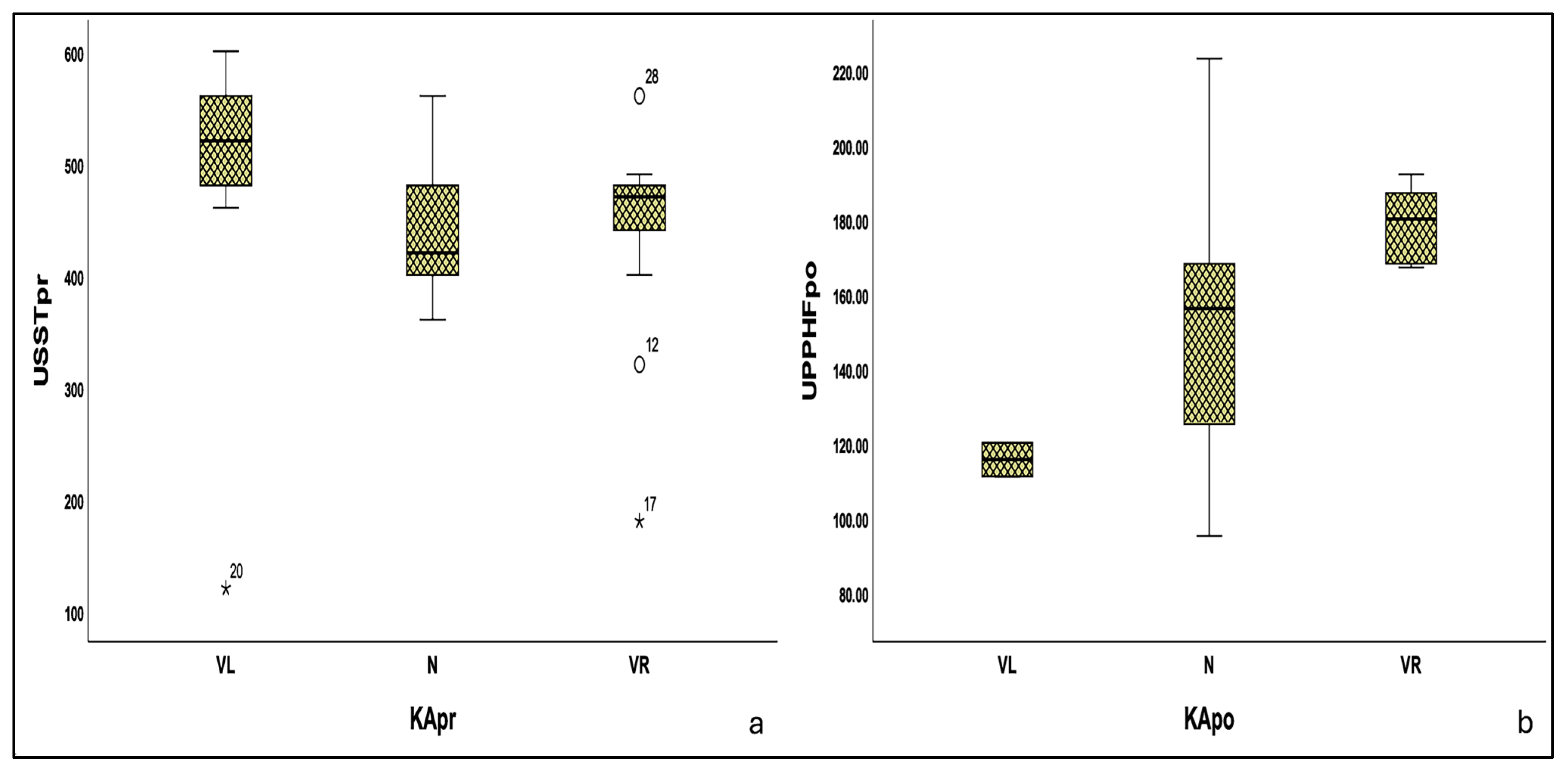
| USSTpr-KApr | UPPHF-KApo | |||
|---|---|---|---|---|
| p | Adj. P a | p | Adj. P a | |
| N-VR | 0.878 | 1.000 | 0.159 | 0.478 |
| N-VL | 0.055 | 0.164 | 0.017 | 0.052 |
| VR-VL | 0.015 | 0.044 | 0.050 | 0.150 |
Disclaimer/Publisher’s Note: The statements, opinions and data contained in all publications are solely those of the individual author(s) and contributor(s) and not of MDPI and/or the editor(s). MDPI and/or the editor(s) disclaim responsibility for any injury to people or property resulting from any ideas, methods, instructions or products referred to in the content. |
© 2026 by the authors. Licensee MDPI, Basel, Switzerland. This article is an open access article distributed under the terms and conditions of the Creative Commons Attribution (CC BY) license.
Share and Cite
Ntourantonis, D.; Iliopoulos, I.; Pantazis, K.; Kaspiris, A.; Kokkalis, Z.; Gliatis, J.; Panagiotopoulos, E. Beyond Alignment: Static Coronal Alterations Do Not Predict Dynamic Foot Loading or Spatiotemporal Gait Patterns After Unilateral Total Knee Replacement—A Prospective Study. Bioengineering 2026, 13, 134. https://doi.org/10.3390/bioengineering13020134
Ntourantonis D, Iliopoulos I, Pantazis K, Kaspiris A, Kokkalis Z, Gliatis J, Panagiotopoulos E. Beyond Alignment: Static Coronal Alterations Do Not Predict Dynamic Foot Loading or Spatiotemporal Gait Patterns After Unilateral Total Knee Replacement—A Prospective Study. Bioengineering. 2026; 13(2):134. https://doi.org/10.3390/bioengineering13020134
Chicago/Turabian StyleNtourantonis, Dimitrios, Ilias Iliopoulos, Konstantinos Pantazis, Angelos Kaspiris, Zinon Kokkalis, John Gliatis, and Elias Panagiotopoulos. 2026. "Beyond Alignment: Static Coronal Alterations Do Not Predict Dynamic Foot Loading or Spatiotemporal Gait Patterns After Unilateral Total Knee Replacement—A Prospective Study" Bioengineering 13, no. 2: 134. https://doi.org/10.3390/bioengineering13020134
APA StyleNtourantonis, D., Iliopoulos, I., Pantazis, K., Kaspiris, A., Kokkalis, Z., Gliatis, J., & Panagiotopoulos, E. (2026). Beyond Alignment: Static Coronal Alterations Do Not Predict Dynamic Foot Loading or Spatiotemporal Gait Patterns After Unilateral Total Knee Replacement—A Prospective Study. Bioengineering, 13(2), 134. https://doi.org/10.3390/bioengineering13020134