


Abstract
The energy–water–carbon (EWC) nexus has become a critical concern for industrial systems seeking sustainable development, yet existing assessment approaches often require intensive computation and lack practical adaptability. This study proposes a probability-pinch analysis (P-PA) framework that enhances conventional pinch analysis (PA) by integrating allocation-based correction factors to account for system inefficiencies across all time intervals explicitly. The framework incorporates PA tools, specifically the Power Cascade Table (PCT), Water Cascade Table (WCT), and Energy Planning Pinch Diagram (EPPD), to design ideal energy–water systems that do not consider losses. Correction factors based on probable energy and water flows are then incorporated to capture system inefficiencies, with design modifications proposed to meet annual carbon reduction targets. Results from an industrial plant case study validate the effectiveness of P-PA in establishing minimum resource targets while achieving a 46% reduction in carbon emissions through system modifications. Deviations from conventional PA were within 10%, confirming the framework’s accuracy and reliability in designing integrated energy–water systems within the EWC nexus. It could serve as a handy tool for designing large-scale energy–water systems that require substantial computational effort, but it may be less accurate for small-scale applications. Nevertheless, compared with conventional PA-based approaches, P-PA offers a balanced combination of rigor, simplicity, and adaptability, making it well-suited for industrial EWC nexus analysis and decision support in sustainable process design.
1. Introduction
The interdependence between energy and water resources has become a significant concern in today’s world, where rapid industrialization, urban expansion, and population growth are driving unprecedented demand for both. Energy production relies heavily on water for various processes, including cooling in power plants, steam generation, hydropower, and biofuel production. Similarly, the supply, treatment, and distribution of water require substantial amounts of energy, particularly in energy-intensive processes such as desalination, pumping, and wastewater treatment. Studies adopting a water–energy nexus perspective further indicate that energy embedded in water systems can account for nearly 20% of total energy consumption [1]. Carbon emissions are linked to both energy and water systems. Energy production, especially from the combustion of fossil fuels, is a significant source of carbon dioxide emissions. Additionally, the energy used for water supply and treatment often comes from carbon-intensive sources, further increasing greenhouse gas emissions.
This interconnectedness has given rise to the concept of the energy–water–carbon (EWC) nexus, a framework that reflects the relationship between energy, water, and carbon emissions [2]. The EWC nexus underscores the intricate interdependencies among these resources, where actions in one sector have a direct impact on the others. These interactions influence resource efficiency, environmental sustainability, and economic outcomes [3]. Designing each resource network independently may lead to inaccurate sizing, under- or over-design of equipment, inefficient operation, and unnecessary increases in operating costs and carbon emissions, especially in energy and water-intensive industries.
Building on the nexus concept, Li et al. [4] proposed a comprehensive framework that integrates material flow analysis, input–output modeling, system dynamics, and multi-objective optimization to examine the EWC nexus within the Beijing–Tianjin–Hebei urban agglomeration from 2020 to 2035. Their simulation revealed that coordinated industrial restructuring across regions could deliver substantial resource and emission benefits with water, energy, and carbon efficiencies improving by 24.4%, 21.8%, and 42.4%, respectively. The integrated material-energy flow model was also applied by Wang et al. [5] to explore the interconnections between energy, water, and carbon in China’s steel industry. By modeling energy and water flows and evaluating the impact of 31 energy-saving technologies (ESTs), the study found that adopting these ESTs could save 7.84 GJ/t of energy and 9.19 m3/t of water, while reducing CO2 emissions by 911.26 kg/t. Their findings emphasize the cost-effectiveness technology-based interventions for optimizing production with reduced environmental impacts from an EWC perspective.
Du et al. [6] examined the EWC nexus across different industries using an integrated environmentally extended multi-regional input–output analysis (EEMRIO) with structural decomposition analysis (SDA). The EWC characteristics between sectors were quantified using the EEMRIO, while the SDA was used to evaluate the factors affecting the characteristics under economic development scenarios. Reductions in energy, water, and carbon coefficients by 2030 were projected, with resource intensity and production structure found to have a significant impact on the evolution of EWC nexus characteristics. A business process-based model was introduced by Munsamy and Telukdarie [7] to assess the EWC nexus within water distribution networks (WDN), particularly to evaluate the effects of the Fourth Industrial Revolution technologies. The findings demonstrate that the adoption substantially improves efficiency, reducing energy use and CO2 emissions by 16% and decreasing water loss by 22%, thereby enhancing revenue for water utilities.
Gargari et al. [8] presented an integrated multi-criteria decision-making (MCDM) analysis to achieve economic and environmental objectives specifically for the steel industry. A new integrated system with various units of iron and steel production and wastewater treatment was developed, considering the EWC nexus. Different innovative technologies with renewable energy and water production were evaluated to reduce energy and water consumption. The combination of a moving bed biological reactor, ultrafiltration, and reverse osmosis was identified as the optimal solution. It can produce 8.73 million m3 of water and 1.6 MW of renewable energy for the system. Nakkasunchi and Brandoni [9] recently developed an integrated energy assessment model known as the Water-Energy Nexus Tool (WENT) to conduct energy accounting of wastewater treatment plants and design a low-carbon polygeneration system. Various low-carbon energy options were evaluated based on energy consumption and associated emissions, energy recovery from wastewater and sludge, and the integration of renewable energy sources. The model’s outputs provide valuable insights, including the most energy-intensive components in the system and the most viable renewable technology for the system.
Chen et al. [10] optimized water consumption, fossil energy allocation, electricity expansion and generation, and carbon emission reduction using a dual risk aversion optimization method as a model for energy–water nexus systems. The model was integrated with fuzzy mathematical programming, stochastic robust programming, two-stage stochastic programming, and robust fuzzy probabilistic programming to address uncertain parameters and multi-objective trade-offs in the operation. Cost-effective plans for conserving fossil and water resources, as well as reducing carbon emissions, were explored. The results offer valuable insights for system planning that balance cost and risk considerations. Gómez-Gardars et al. [11] employed a nonlinear programming model to evaluate combined heat and power (CHP) systems with thermal storage, aiming to minimize water use, emissions, and inefficiencies. The results demonstrate that incorporating thermal storage could decrease water consumption, cut emissions, and improve system efficiency. This work highlights the potential of thermal storage and multi-objective optimization to enhance sustainability in residential energy systems by addressing the EWC nexus.
The aforementioned works primarily employed mathematical programming (MP) and modeling approaches to address EWC nexus problems. While these methods can capture the complexity of multi-resource systems, they often require extensive computational resources, specialized solvers, or detailed datasets. This highlights the need for simplified models such as Pinch Analysis (PA) to support informed decision-making. PA offers several advantages over MP methods, including lower computational requirements, intuitive graphical representation, and straightforward implementation for practitioners. MP and PA are complementary, where PA provides rapid and interpretable targeting that can support or constrain subsequent optimization analyses performed using MP. However, limited studies have been done using PA for EWC nexus applications. Charmchi et al. [12] introduced Hydropower Pinch Analysis (HyPoPA), a supply-side management tool for optimizing multi-purpose hydro reservoir operations within the water-energy nexus. Using composite curves and cascade tables, HyPoPA evaluates and predicts water and energy resources across operational scenarios of unreliable, reliable, and self-sufficient conditions. In a case study on the Karkheh reservoir, HyPoPA enabled an additional 37.2 GWh of hydroelectric generation and conserved 1.66 billion m3 of water during a drought year. This demonstrates its potential for sustainable resource management under fluctuating climate conditions.
Oh et al. [13] proposed a PA-based framework to design integrated energy–water systems that address the EWC nexus. This framework combines the Power Cascade Table (PCT), Water Cascade Table (WCT), and Energy Planning Pinch Diagram (EPPD) to set minimum targets for each resource, thereby optimizing system performance. Tested in a small-scale industrial case, the framework achieved a 20% reduction in CO2 emissions with minimal impact on the design of energy and water systems. Naveed et al. [14] extended the PA framework of Oh et al. [13] by incorporating power and water losses, highlighting their impact on carbon emissions and system capacities. This extension underscores the importance of accounting for losses in resource flows to set realistic and practical EWC targets in integrated energy–water system designs.
These PA-based studies demonstrate how adapting PA can enhance the sustainability and efficiency of resource management within the EWC nexus. However, these methods can be tedious and time-consuming due to the manual effort required to match the supply and demand of resources across different time intervals. This complexity may limit the practicality of applying PA in dynamic, large-scale systems where resource availability and demand fluctuate frequently. To address these limitations, fraction-based theory has been incorporated into traditional PA methods to improve their flexibility and computational efficiency. Liu et al. [15] simplified the manual construction of the algebraic Power Pinch Analysis technique, known as the Modified Storage Cascade Table (SCT), by proposing the Probability-Power Pinch Analysis (P-PoPA) method. This approach accounted for energy losses in power systems by introducing allocation-based correction factors to represent the manual power supply and demand matching procedure. The outputs from P-PoPA deviated by only 2.3% from the Modified SCT approach, highlighting the method’s potential for accurate system sizing in complex energy setups. Similarly, Mohammad Rozali et al. [16] applied P-PoPA to hybrid power systems integrating diesel generators with renewable energy sources, achieving deviations of less than 3% compared to conventional PoPA results. In a remote school case study, the approach enabled a 19% reduction in annual diesel fuel consumption and avoided more than 90 tons of CO2 emissions.
While these findings highlight P-PoPA’s effectiveness as a decision-support tool for cleaner and more efficient hybrid systems, its application has so far been limited to designing hybrid power systems. Therefore, the derived correction factors were only based on energy losses during power transfer and storage. Additionally, the amount of carbon emissions reduced from the actual diesel power requirement was only briefly mentioned in the conclusion by Mohammad Rozali et al. [16], based on an estimated carbon emission factor for diesel fuel. In contrast, the work by Liu et al. [15] did not consider carbon emissions at all. Both works also overlook the role of water in power generation and its subsequent effects on environmental emissions. This gap is particularly relevant in integrated systems where energy and water usage are deeply interconnected, such as in water-intensive renewable energy production or industrial facilities requiring extensive water management.
To address this gap, the present study introduces a novel Probability-Pinch Analysis (P-PA) framework that extends conventional PA by incorporating fraction-based correction factors. The framework accounts for resource transfers, storage, and conversion inefficiencies simultaneously, enabling a realistic system design. The correction factors allow energy and water losses to be incorporated directly into the targeting stage. This eliminates the need for the manual matching step of the PA method, which can become tedious and prone to error in complex and highly interconnected systems. Unlike P-PoPA, the correction factors derived in the proposed P-PA framework account for losses in both energy and water flows, enabling accurate establishment of minimum energy and water targets for the optimal design of integrated energy–water systems within the EWC nexus. Furthermore, it supports the evaluation of design modifications to achieve specific annual carbon reduction targets. Overall, the framework contributes to the development of innovative methodologies for sustainable process design.
2. Methodology
The proposed P-PA framework integrates energy, water, and carbon interactions within a unified resource-targeting approach. It was developed based on the first and second laws of thermodynamics, which underpin the determination of minimum resource targets through mass and energy balance principles. Instead of manually incorporating system inefficiencies when matching surplus and deficit at each time interval, P-PA introduces allocation probabilities that systematically capture storage, transfer, and conversion losses. In this context, probability does not represent stochastic or random behavior, but rather the proportional share of each component based on its relative contribution to total system flows. These values represent deterministic allocation probabilities, indicating the most likely proportion of energy or water transferred between components.
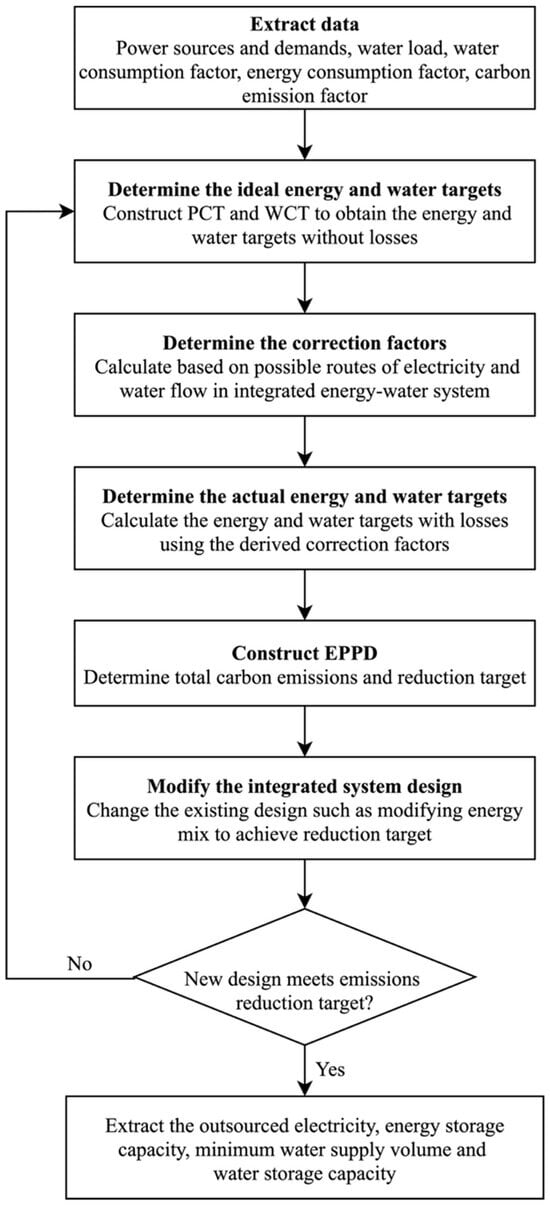
The nexus among energy, water, and carbon emissions was addressed in the framework by explicitly considering how the use of one resource influences the others. Power consumption in the water system was incorporated into the energy system analysis. Likewise, the water system analysis accounted for the water required by the energy system. Consequently, the total carbon emissions from the integrated energy–water system were evaluated based on the energy and water requirements established in the design. This integrated treatment reflects established system-analysis principles and provides a consistent foundation for assessing nexus performance. The overall P-PA framework for designing integrated energy–water systems is summarized in Figure 1.
Figure 1.
P-PA framework considering the EWC nexus.
2.1. Step 1: Extract Data
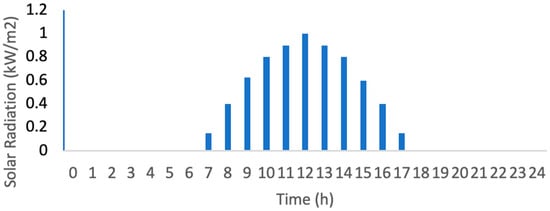
The data required for the analyses include power sources and demands, water demand, carbon emission factors, and water and energy consumption factors. An illustrative case study featuring a 300 m2 solar PV panel system that supplies direct current (DC) and an 85 kW biomass generator that supplies alternating current (AC) for various appliances in an integrated energy–water system was used to demonstrate the P-PA application. Table 1 shows the hourly power demands for the energy system [14], while Figure 2 shows the average solar radiation data [13]. In the illustrative case study, a sodium-sulfur (NaS) battery that stores energy as DC electricity with one-way charging and discharging efficiencies ( of 90% [16] is used as the energy storage system. The energy system also comprises converters for AC-DC power conversion, which were assumed to be 95% efficient () [16].
Table 1.
Power demands of the illustrative case study [14].
Figure 2.
Average solar radiation, own elaboration based on data from [13].
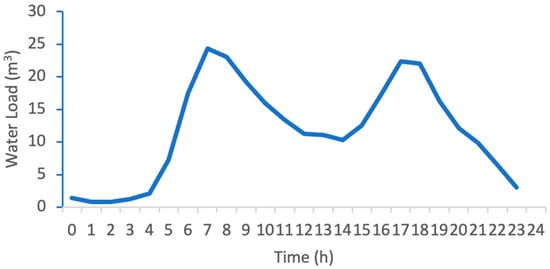
Figure 3 shows the hourly water demands of the water system, including demands for process cooling, cleaning, and other water system processes [13]. The water consumption of the solar facility was considered negligible due to its minimal usage, whereas the biomass power scheme utilizes water at a rate of 0.0037 m3/kWh [17]. Furthermore, 0.9246 kWh of electricity is needed for every 1 m3 of water supplied [18]. Additionally, carbon emission factors are required in the analysis. The carbon emission factor of solar is 0 t CO2/MWh, whereas that of biomass is 0.4032 t CO2/MWh [19]. Delivering 1 m3 of water also results in 0.344 kg of CO2 emissions [20].
Figure 3.
Hourly water demands, own elaboration based on data from [13].
2.2. Step 2: Determine the Ideal Energy and Water Targets
Ideal targets were determined without accounting for energy and water losses in the system. The PCT and WCT methods were employed to establish the ideal targets for the energy and water systems, respectively. Note that these methods are energy and water balance tools and do not account for operational constraints, such as power rate limits, generator ramping, and minimum up- and down-time requirements of system components. The targets obtained from the P-PA represent design targets that can serve as a guideline for subsequent detailed operational analysis, where component-specific power rate limits and dynamic operating constraints can be incorporated during the system design stage.
The PCT was used to obtain the ideal targets for the energy system, including the ideal maximum storage capacity (), ideal total outsourced electricity needed (), ideal total electricity transfer for determining outsourced electricity () and energy storage capacity (), ideal total discharging quantity and total stored quantity for determining outsourced electricity ( and ), as well as ideal total discharging quantity and total amount stored for determining maximum storage capacity ( and Table 2 presents the constructed PCT for the illustrative case study. Its development accounts for the energy demands of the water system. Columns 1 to 3 of the PCT were obtained following the procedure outlined in Oh et al. [13].
Table 2.
Power Cascade Table for the illustrative case study.
Column 1 of the PCT displays the time interval during which the analysis was conducted on an hourly basis. Column 2 indicates the electricity generation from power sources. Solar power generation ( was calculated using Equation (1):
where It is the solar irradiance at time , is the area of PV panels, and is the efficiency of PV panels. For the illustrative case study, was assumed to be 15% [13]. In Column 3, is the electricity demand from the energy system. For the water system, the electricity demand ( was assumed to operate on AC power. Large-scale water treatment and distribution facilities typically draw electricity from national grids, which supply AC power for efficient transmission and equipment compatibility [21].
Columns 4 to 7 were obtained following the procedures described in Mohammad Rozali et al. [16]. The values in Column 6 represent the instantaneous energy available for storage at each time interval, calculated from the accumulated surplus electricity in the preceding time interval. The highest value of storage capacity in Column 6 is the , which is 158.81 kWh in the illustrative case study. The storage system, assumed to start with zero charge at h stores excess energy and discharges it when needed. If the storage capacity value in Column 6 is zero, power must be imported from the grid to satisfy any power deficits in the system. Column 7 indicates the outsourced electricity required. Based on the sum of values in Column 7, the in the illustrative case study was calculated as 44.85 kWh.
The ideal amount of electricity transfer () was categorized into outsourced electricity ( and energy storage ( for accurate energy flow representation. Both involve summing the amount of electricity transfer in Column 4, but across different time intervals. was obtained by summing the electricity transfer where outsourced electricity is needed. This was determined by identifying the last non-zero value in column 7 before all subsequent values became zero. In the illustrative case study, the last non-zero value in Column 7 occurs at time 24 h, so all values in Column 4 from 0 h to 24 h were included. Hence, the was calculated as 2151.23 kWh. On the other hand, the represents the sum of electricity transfer from the time charging begins until the point at which the maximum storage capacity is achieved. This excludes earlier charging phases that are fully discharged before reaching the maximum capacity, ensuring that only the energy contributing to the final storage amount is considered. For the illustrative case study, the summation of Column 4 values began at time 0 h until 8 h, resulting in of 533.74 kWh.
The ideal total discharging quantity () and the ideal total stored quantity ( were classified into two components each. In the energy system, the outsourced electricity is utilized only if the storage capacity in the current time interval ) is insufficient to satisfy the electricity deficit in the next time interval (. In cases where energy storage is empty = 0), the outsourced electricity becomes the only option available to satisfy the unmet load demand. and were used to determine the ideal amount of outsourced electricity. Both quantities were obtained by summing the values in Column 5.
represents the amount of energy discharged from storage until the storage capacity in Column 6 reaches zero. In the illustrative case study, was obtained by summing the absolute values of electricity deficits in Column 5 between time intervals 8 h and 11 h, and between 15 h and 20 h. The final usable energy available, 25.39 kWh at 20 h (Column 6), was then added to this sum. This yields a of 191.40 kWh. On the other hand, signifies the amount of charging energy in storage that has not been discharged by the last time outsourced electricity (Column 7) was required. This value was determined by summing the total positive values in Column 5 and then subtracting them from the previously obtained . For the illustrative case study, the sum of positive values in Column 5 is 191.40 kWh. Subtracting this amount from the value (191.40 kWh) gives 0 kWh. This indicates that no stored energy remains in the battery at the end of the day.
To determine the ideal energy storage capacity, and are required. For the illustrative case study, the charging of the energy storage starts at time 0 h, and the maximum storage capacity is achieved at time 8 h. The positive values in Column 5 during the 0–8 h period indicate that no electricity discharging occurs. This results in = 0 kWh. represents the total energy charged to the storage until the maximum capacity is achieved, but not yet discharged within the same period (0–8 h). Summing all positive values in Column 5 over this period and subtracting them from the previously obtained gives an value of 153.01 kWh for the illustrative case study.
The WCT for the illustrative case study is shown in Table 3. The ideal values to be extracted from the WCT include the ideal water supply volume per day (), ideal total water transfer (), ideal water charging volume (), ideal amount of water discharged from the tank (), and ideal water storage capacity ().
Table 3.
Water Cascade Table for the illustrative case study.
Columns 1 to 3 were obtained following the procedures outlined in Oh et al. [13]. Column 1 represents the hourly time intervals. Column 2 shows the initial water supply volume (), which was set according to the maximum value in Figure 3. The is the summation of values in Column 2, which equals 583.44 m3 for the illustrative case study. In Column 3, is the water demand from the water system, while is the water demand from the energy system. The amount of water transferred directly from water sources to demand is given in Column 4. It was determined by taking the lower value between the values in Columns 2 and 3 at each time interval. The summation of the values in Column 4 provides the of 289.29 m3. Column 5 shows the water surplus and deficit () which was calculated using Equation (2):
where is the volume of water sources in Column 2 and is the total water demand from both the energy and water systems in Column 3. The positive values in Column 5 were summed to give the of 294.47 m3. Column 6 shows the instantaneous water stored () based on the cumulative water surplus from the previous time interval, obtained using Equation (3):
where is the water storage capacity at the previous time interval. The ideal water storage capacity () can be obtained from the maximum value in Column 6, which is 294.15 m3. The minimum water supply volume for the system could be achieved when the cumulative water stored at the beginning () and at the end of the time intervals ( are equal. If this condition is not met, a revised water supply volume () needs to be calculated using Equation (4) [21]:
The iterative process continues until the difference between consecutive estimated volumes is below 0.05%. For this illustrative case study, the minimum ideal capacities were obtained after one iteration. The values before and after iteration are summarized in Table 4, together with the ideal values from the PCT. Note that the ideal values identified for the water system are in unit volume (m3). This implies the summation of water amounts over a 24 h operation. In subsequent analysis, the ideal values after iteration will be used to determine the actual design parameters for the water system.
Table 4.
Ideal values for the illustrative case study.
2.3. Step 3: Determine the Correction Factors
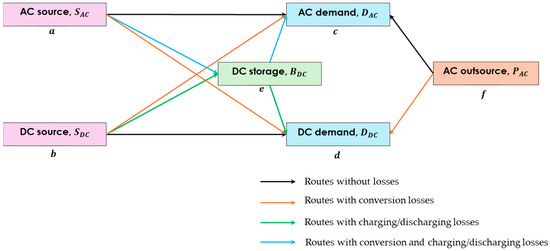
To enhance practicality, correction factors were introduced to account for losses in the storage and transfer of energy and water. The correction factors were derived based on all possible routes of electricity and water flow. Figure 4 illustrates 10 possible electricity routes in the energy system. These routes involve AC/DC sources and demands, DC energy storage, and outsourced power [16].
Figure 4.
Possible routes of electricity flow for the illustrative case study.
Fraction values of each component in the energy system were denoted as . For example, fraction represents the share of AC power from biomass, calculated as its ratio to the total power supply from the available sources in the energy system. The same approach was applied to determine the values of , , and . Table 5 summarizes the power values of each component in the energy system, which were used to calculate these fraction values. The fraction for energy storage () was set to 1 because in the illustrative case study, only one storage type is used (DC storage). However, in other systems, multiple energy storage types may be utilized, such as a combination of AC and DC storage systems. In such cases, the fraction should be adjusted accordingly to reflect the contribution of each storage type to the overall system. Similarly, the fraction for outsourced electricity (f) was set to 1 because the outsourced electricity is purchased from the grid, which exclusively supplies only AC power. If additional backup sources supplying DC electricity are integrated into the system, the value of f for the outsourced electricity would need to be adjusted. For example, a DC backup generator could be added alongside grid power. In such cases, f would represent the ratio of outsourced AC electricity to the total backup supplies, in both AC and DC forms. Table 6 lists the calculated fraction values for the illustrative case study.
Table 5.
Amount of power for the illustrative case study.
Table 6.
Fraction values for the energy system of the illustrative case study.
The correction factors for all possible routes including those from the source to demand (), from the source to the energy storage (), from the storage to demand (), and from outsourced electricity to demand () can then be computed. Table 7 summarizes the calculated correction factors. For example, supplying an AC source to DC demand involves power conversion loss. Therefore, converter efficiency () was multiplied by the product of and fractions. To send excess AC source to storage, the battery’s charging efficiency () needs to be considered in addition to the conversion loss, since the battery stores energy in DC form.
Table 7.
Correction factors for the energy system of the illustrative case study.
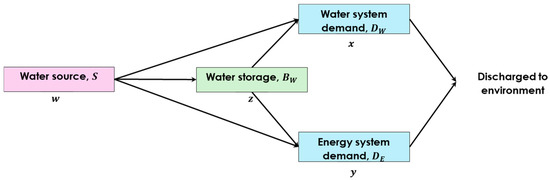
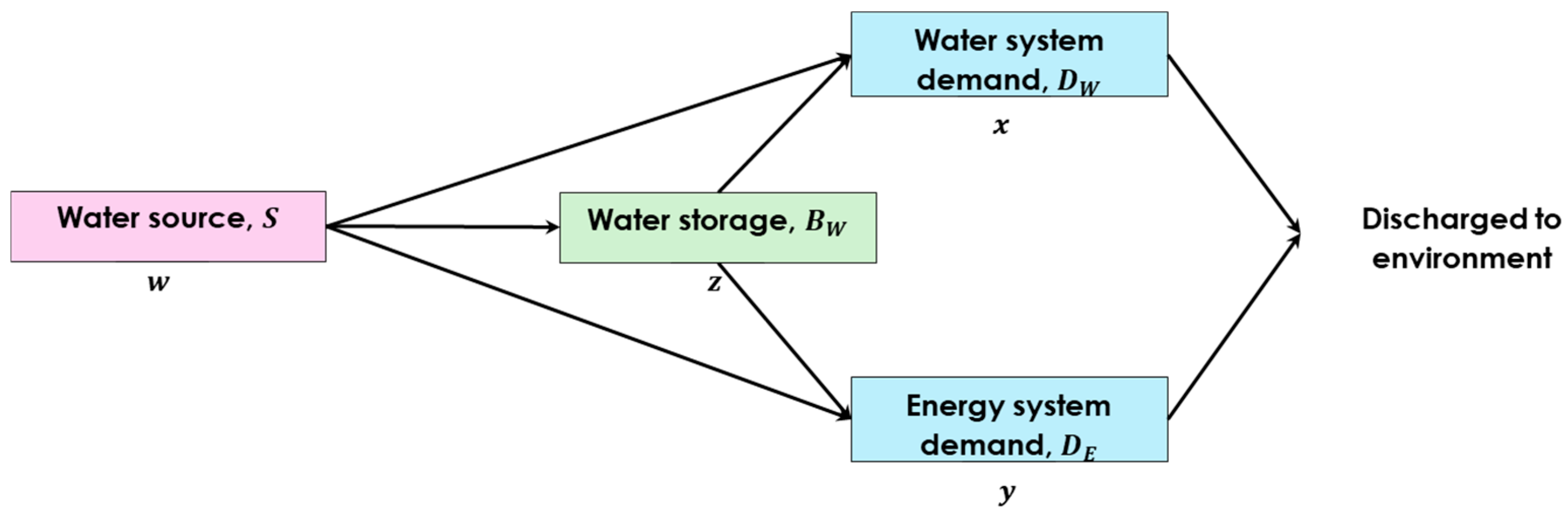
Figure 5 illustrates all possible water flow routes, including sources, storage, and demands for the water system. Water flows have five probable routes, excluding the environmental discharge, as it is not used for consumption or reuse. Similarly to the energy system, components in the water system were represented with . Water demands can be classified into requirements from the water system and the energy system. Table 8 provides the fractions assigned to each component of the water system. The fraction for the source (w) was set to 1 because only one type of water source was considered in the system, namely river water. In other water systems, multiple water sources may be utilized, such as a combination of groundwater, desalinated water, and seawater. In such cases, the fraction w needs to be adjusted accordingly to reflect the contribution of each source to the overall water supply in the system. The demand fractions x and y reflect the demand for water from both the water and energy systems, respectively. The total water demands can be obtained by summing the values in Column 3 of the WCT. The resulting demands are = 281.74 m3 for the water system and = 7.55 m3 for the energy system. The fraction for water storage (z) was set to 1 because it was assumed that only one water storage tank was applied exclusively for storing water without relying on alternative storage within the water system in the illustrative case study.
Figure 5.
Possible routes of water flow for the illustrative case study.
Table 8.
Fraction values for the water system of the illustrative case study.
Water loss varies with the water supply and is generally between 8% and 10%, or 5% and 6%, depending on the system design and operational constraints [22]. To account for the worst-case scenario, the maximum water loss rate of 10% was assumed. Consequently, the effective utilization taking into account potential evaporation losses and pipe leakages during transfer, was estimated at 90%, denoted as . Table 9 summarizes the correction factors for water transfer efficiency, which account for losses across various routes in the water system.
Table 9.
Correction factors for the water system of the illustrative case study.
2.4. Step 4: Determine the Actual Energy and Water Targets
After the correction factors are known, the actual energy and water targets, including outsourced electricity, energy storage capacity, water supply volume, and water storage capacity, can be determined. For the energy system, the actual outsourced electricity () required to meet the demand exceeds the ideal value () due to energy losses in power conversion, storage, and transfer. Equation (5) accounts for these losses to ensure sufficient outsourced electricity to compensate for system inefficiencies.
Equation (5) incorporates four terms to represent each type of energy loss. The first term represents the energy lost due to AC/DC conversion inefficiencies along direct power routes from sources to demands. This loss was accounted for by multiplying the ideal total electricity transfer ( with , which represents the probability of power lost during the transfer. The second term accounts for losses associated with storing energy. The energy stored that has yet to be discharged () undergoes conversion inefficiencies during charging. This loss is represented by the product, where represents the efficiency loss during charging. The third term represents the energy losses incurred during the discharge of energy. This loss was calculated by multiplying with . and represent the charging and discharging efficiency, respectively. Lastly, the fourth term captures the conversion losses in delivering power from outsourced electricity to the demand, calculated as multiplied by . By incorporating these energy losses, the actual required outsourced electricity () was calculated as 130.52 kWh. This indicates the additional power needed beyond the ideal calculation to account for real-system inefficiencies.
Similarly, the actual energy storage capacity () was adjusted from the ideal capacity () by incorporating energy losses during charging, discharging, and power transfer, as expressed in Equation (6).
In this equation, three primary types of energy losses were considered to determine The first term, accounts for losses during the direct transfer of power from the source to the demand up to the maximum storage capacity. The second term, represents losses that occur during the charging phase, where the stored energy has not yet been discharged. The factor captures the fraction of energy lost before entering the storage system. The third term, expresses the loss during the discharging phase. The expression denotes the overall energy loss resulting from inefficiencies in the combined charging and discharging processes. Solving Equation (6) gives a usable energy storage capacity of 128.43 kWh. The actual installed energy storage capacity () must be larger to account for the depth of discharge (DoD). Using Equation (7) and the assumed DoD of 80% for NaS batteries [13], the required storage capacity becomes 160.53 kWh. This size is smaller than the storage requirement without considering losses because the amount of energy available for storage is higher in ideal systems with 100% efficiency.
For the water system, the actual water supply volume () accounts for practical inefficiencies in water transfer and storage. In the WCT, was obtained assuming that the entire water supply is transferred and stored without any losses. However, in actual water systems operations, inefficiencies such as pipe leakages and evaporation losses imply that a higher water supply is required. Equation (8) was used to calculate , derived from and adjusted for different types of water losses.
Equation (8) introduces three terms to represent the key inefficiencies within the water system. The first term accounts for water losses during direct transfer from the source to the demand. The total ideal volume of water transfer ( was adjusted by accounting for the fraction of water lost due to leakage during the transfer . The second term accounts for the loss associated with storing water. The water available for storage ( experiences inefficiencies due to evaporation and handling losses, represented as . The third term represents the water losses incurred during discharge from storage. The ideal amount of water discharged from the tank () undergoes the combined storage inefficiencies. The corresponding loss was accounted for by the product. and represent the efficiencies of water transfer into and out of the storage tank, respectively. With these factors included and converting the total supply volume in 24 h operation to an hourly supply rate, the actual minimum water supply volume ( for the illustrative case study is 13.85 m3/h. This result provides a more accurate measure of the total water required to meet demand, taking into account the real-world losses within the water system. Note that the actual target equations apply an additive construction to compute the additional supply or storage requirement when the system is not 100% efficient, rather than using the multiplicative efficiency. This is because the multiplicative relationship is valid for single-route systems, whereas the P-PA formulations consider the additional resources required to compensate for losses across multiple independent routes.
The ideal water storage capacity ( does not require adjustment even when accounting for potential losses. When the ideal water supply volume increases to cover losses such as water leakage or evaporation, the additional supply in directly compensates for the water loss. As a result, the total amount of water available for storage after losses matches the requirement in the ideal scenario. In short, increasing the water supply volume offsets the need to expand storage tank capacity, as the added water continually replenishes any losses. Table 10 summarizes the actual values of the key parameters of both the energy and water systems.
Table 10.
Actual values for the illustrative case study.
2.5. Step 5: Construct EPPD
The carbon analysis in this study applies an operational boundary, accounting only for onsite emissions arising from onsite electricity generation and water-supply processes within the facility. Upstream and downstream life-cycle impacts are excluded from the system boundary. The EPPD method [13] was utilized, in which carbon emissions were estimated based on the annual power generation and the emission factor of each energy source. In the illustrative case study, carbon emissions from the solar and biomass power systems were analyzed. The CO2 emissions from power sources ( were calculated using Equation (9):
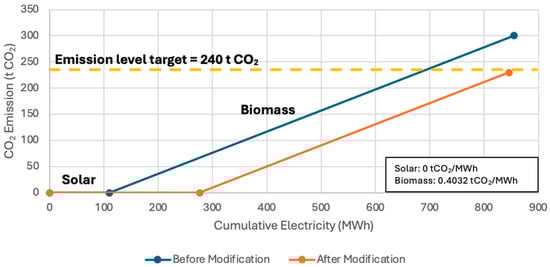
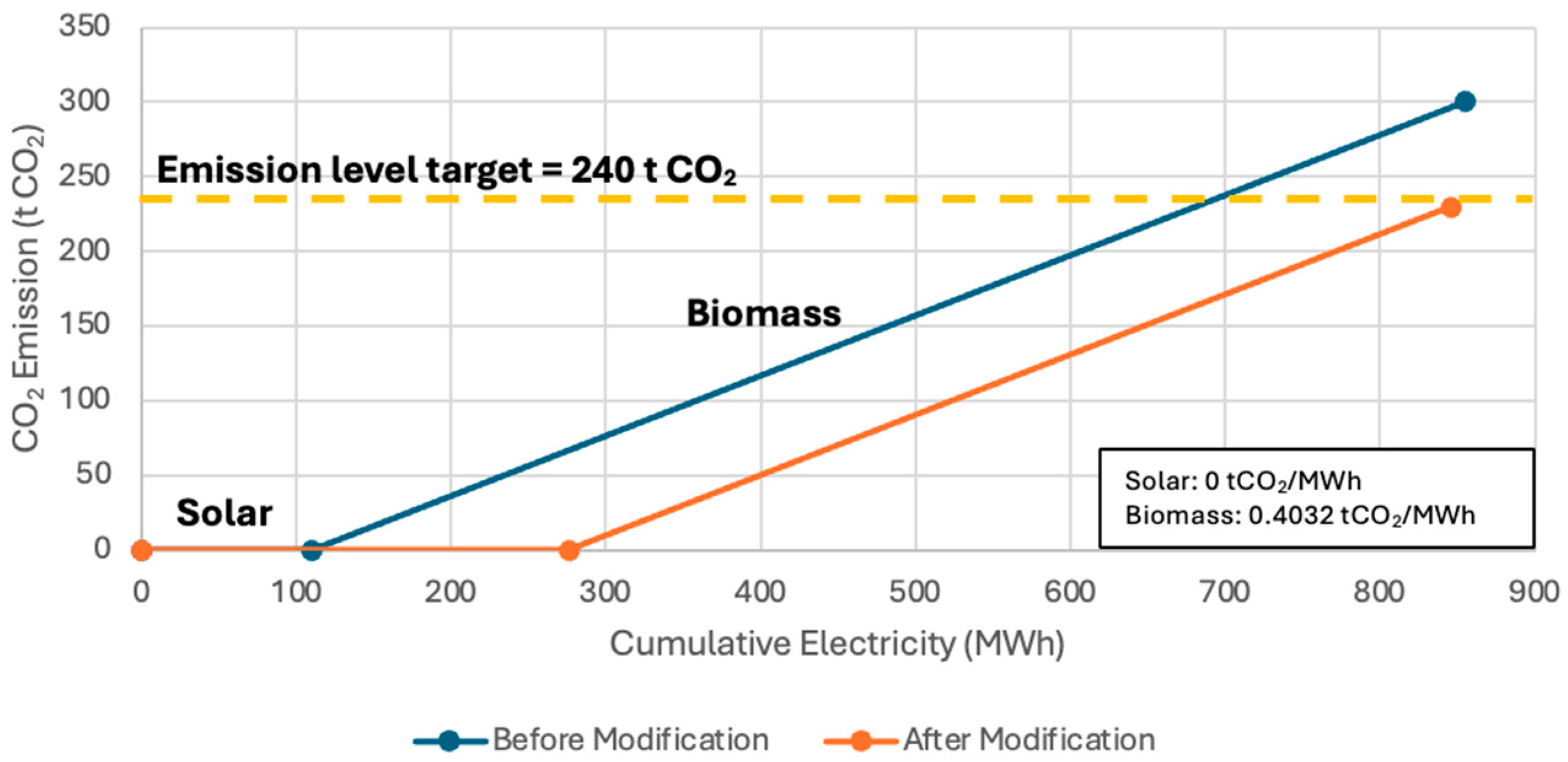
where is the emission factor of power source , and is its electricity generation capacity. The EPPD prioritizes cleaner energy sources by arranging them in ascending order of their emission factors. Higher-emission sources are used only when necessary. The x-axis represents the energy sources ordered by their emission factors, while the y-axis shows the cumulative carbon emissions. The slope of the graph indicates the carbon intensity (t CO2/MWh), with steeper slopes signifying higher emissions.
For the illustrative case study, the EPPD results in Figure 6 highlight the carbon emissions associated with solar and biomass energy sources. Solar energy generates 110.46 MWh of electricity annually with zero carbon emissions, making it the cleanest energy source in the system. In contrast, biomass energy produces 744.60 MWh per year with associated emissions of 300.22 t CO2. A 20% reduction target was set for the illustrative case study, lowering emissions from 300.22 t CO2 to 240.16 t CO2. To achieve this target, design modifications on the integrated energy–water system were proposed and discussed in the next step.
Figure 6.
EPPD for the illustrative case study.
2.6. Step 6: Modify the Integrated System Design
The final step involves implementing modifications in the integrated system design to achieve the annual carbon emission reduction target. For the illustrative case study, the carbon intensity analysis from the EPPD indicates that carbon emission reductions can be achieved by minimizing reliance on biomass and increasing solar PV capacity. Therefore, the biomass generator capacity was reduced from 85 kW to 65 kW, while the solar PV panel area was expanded from 300 m2 to 750 m2, resulting in increased clean energy generation. Steps 1 to 5 were repeated to apply these changes, and the final system design obtained are summarized in Table 11. The EPPD results confirm that the emission reduction target was met, with emissions reduced from 300.22 t CO2 to 229.58 t CO2, representing a 24% decrease. While the water system changes are minimal with less than a 1% reduction in supply capacity after the design modifications, the energy system experiences a 40% increase in outsourced electricity and a 66% increase in storage capacity.
Table 11.
Overall results of the illustrative case study.
3. Results and Discussion
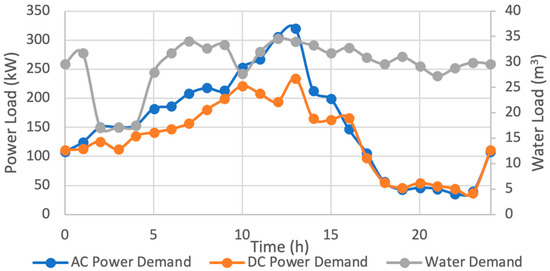
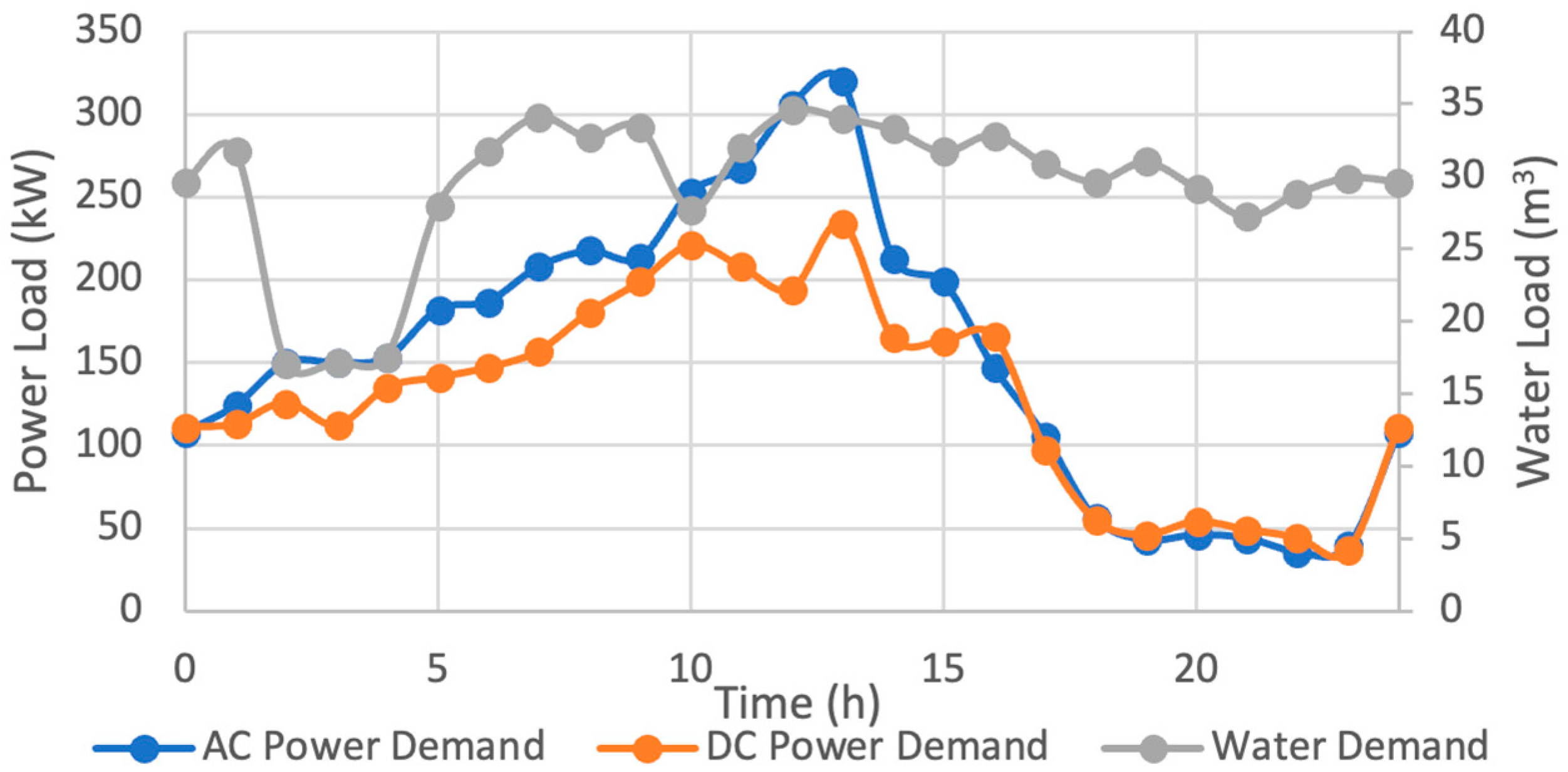
An industrial plant in Peninsular Malaysia [23] was selected as the case study to test the proposed framework. The energy system includes a 1000 m2 solar power system and is supported by natural gas and biomass generators with capacities of 200 kW and 100 kW, respectively. The plant utilizes NaS battery as the energy storage scheme. The specifications of the solar system and the efficiencies of the NaS battery were assumed to be identical to those in the illustrative case study. The hourly AC power, DC power, and water load of the industrial plant are shown in Figure 7 [23]. The complete dataset for the case study is available in the Supplementary Materials.
Figure 7.
Power and water load of case study, own elaboration based on data from [23].
Water consumption was assumed to be negligible for the solar power facility, while the biomass and natural gas systems utilized water at rates of 0.0037 m3/kWh and 0.0044 m3/kWh, respectively [17]. In addition, 0.9246 kWh of electricity is required for every 1 m3 of water supplied [18]. Carbon emission factors for solar, biomass, and natural gas power systems are 0 t CO2/MWh, 0.4032 t CO2/MWh, and 0.181 t CO2/MWh, respectively [19]. In addition, delivering 1 m3 of water results in 0.344 kg of CO2 emissions [20]. Table 12 summarizes all input parameters and data sources for the case study.
Table 12.
Input variables for the case study.
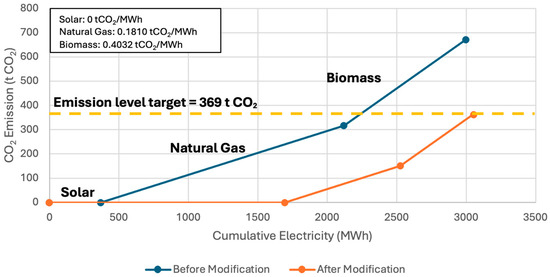
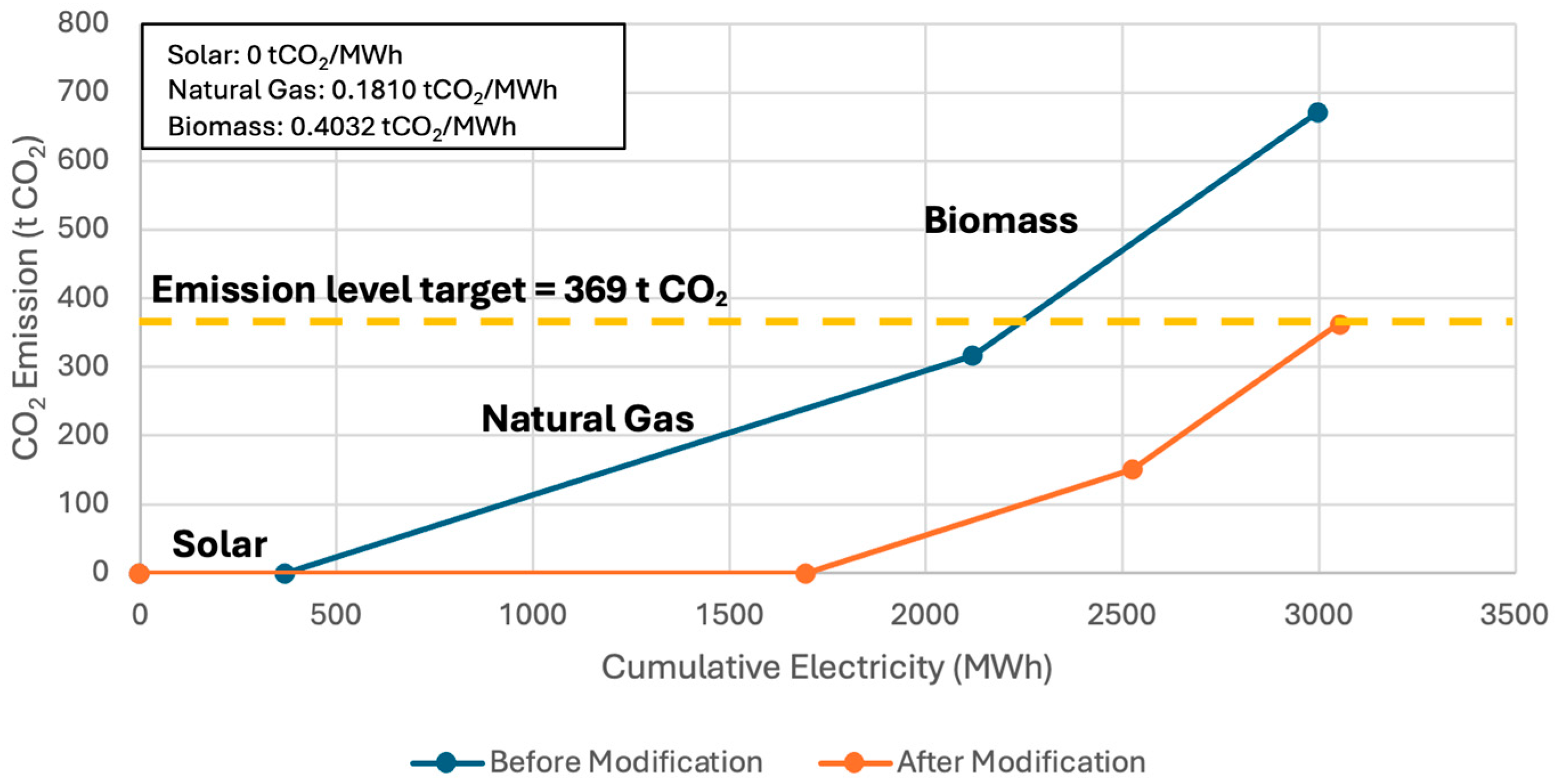
The PCT and WCT were constructed for the case study to determine the ideal values for key design parameters. Correction factors were then calculated to account for power conversion losses, storage inefficiencies, and water losses due to evaporation and leakage. The overall design obtained from the P-PA framework for the integrated system is shown in Table 13. The energy system produces 670.32 t CO2 annually, with biomass and natural gas identified as the primary contributors due to their high carbon intensity. This is evident from the slopes of their profiles in the EPPD (Figure 8). Despite being the cleanest source, solar energy initially accounts for only 12% of the fuel mix in the system. To align with Malaysia’s 2030 carbon emission reduction target of 45% compared to 2005 levels [24], design modifications were implemented.
Table 13.
Overall results of the case study.
Figure 8.
EPPD for the case study.
The generator capacities for biomass and natural gas were reduced from 100 kW to 60 kW and from 200 kW to 95 kW, respectively. On the other hand, the solar PV panel area was increased from 1000 m2 to 4600 m2. This increases the solar share to 56%, significantly reducing the system’s carbon footprint. Following the design modifications in the case study, carbon emissions amount decreases from 670.32 t CO2 to 362.55 t CO2 per year, which exceeds Malaysia’s 45% reduction target for 2030. This outcome demonstrates the effectiveness of increasing solar energy use while reducing reliance on high-carbon energy sources.
Reconstructing the PCT and WCT with the new fuel mix demonstrates minimal impact on the water system, with both supply capacity and emissions each reduced by only 2%. This is because water consumption in the biomass and natural gas power systems accounts for only 4% of total water use. In contrast, the energy system experiences more substantial changes. The outsourced electricity requirement increases by 62%, mainly due to reduced onsite generation during periods of low solar radiation. With the downsized biomass and natural gas generators unable to meet demand at these times, a larger share of electricity must be outsourced from the grid. Additionally, energy storage capacity increases by 58% to store excess electricity generated during peak solar periods. This stored energy helps maintain a stable energy supply during periods of low solar conditions, ensuring reliable system performance despite fluctuations in solar output.
As observed in Table 13, the P-PA method estimated an energy storage capacity of 1971.50 kWh and outsourced electricity of 1223.60 kWh. These correspond to deviations of 5% and 1%, respectively, relative to the PA results. These results demonstrate that the P-PA method closely aligns with the PA approach, with the most significant deviation being under 10%. The deviations arise from the incorporation of system-wide energy losses via correction factors in Equations (5) and (6), unlike the PA method which calculates losses manually for each time interval. For the water system, deviations in the results are minimal with 1% and 4% differences in water supply volume and storage capacity, respectively. These minimal deviations are likely due to the simpler flow routes and fewer conversion steps compared to the energy system. Emissions from the energy system remain constant at 362.55 t CO2/year for both methods, while the water system shows a variation of only 1%. Note that a comparison with MP methods is not included, as MP optimizes a fully detailed model of system operation, whereas PA-based approaches provide preliminary resource targets. These methods operate on different levels of the design hierarchy, making MP and PA complementary rather than directly comparable.
Scenarios with different source and demand profiles were tested using the P-PA method to demonstrate its applicability under varying operating conditions. The first scenario represents days with low solar availability, while the second scenario considers higher industrial energy and water consumption. Table 14 presents the results for both scenarios. As observed, the deviations between the PA and P-PA results remain small, with the highest deviation being 5.9% for water storage capacity in the second scenario.
Table 14.
Results for different scenarios.
Additionally, the sensitivity of P-PA to changes in system efficiencies was evaluated to confirm the robustness of the method. Opposite cases of high and low efficiencies for resource transfer, conversion, and storage were defined. Table 15 summarizes the results for the system after modification. The most significant impact of changing system efficiencies is observed in the energy storage capacity. When the system operates less efficiently, the amount of energy available for storage decreases by 15.8%, which consequently increases the outsourced electricity requirement by 5.7%. In contrast, the high-efficiency case shows a smaller impact, with 12.0% and 3.4% changes in energy storage capacity and outsourced electricity, respectively, relative to the base case. The water system shows minimal sensitivity to these efficiency variations. The required water supply volume changes by less than 5% in both the low- and high-efficiency cases compared to the base case. No changes are observed in the water storage capacity, as the adjusted water supply compensates for the water losses in each scenario. This maintains the same amount of water available for storage. These sensitivity results demonstrate that selecting an efficient energy storage system is particularly important for minimizing losses within the overall system.
Table 15.
Sensitivity analysis results.
Overall, the P-PA method proves to be a reliable and accurate tool for designing integrated energy–water systems. The procedural difference between P-PA and PA results in reduced analytical effort. Conventional PA requires tedious manual matching and repeated adjustments of supply and demand imbalances, especially when inefficiencies must be accounted for at every time interval. In contrast, the correction factors in P-PA incorporate these inefficiencies systematically, allowing for direct supply and demand balances to be obtained without iterative reconciliation. The targeting equations based on the derived correction factors are algebraic and scale independently of the number of time intervals, thereby reducing computational effort. This simplification is particularly advantageous in large-scale systems where multiple components interact, as approximation errors across many flow routes tend to average out. In contrast, small systems exhibit greater sensitivity to individual route losses, which explains the proportionally higher deviations observed in the illustrative case study.
Although minor deviations from PA results exist, P-PA provides a more efficient workflow by eliminating manual matching steps, making it particularly suitable for large-scale integrated energy–water systems where interdependent resource flows make traditional PA labor-intensive. The implementation of P-PA however, requires reliable and representative time-series data to derive allocation probabilities that accurately represent the proportional contribution of each component. In systems with highly variable or uncertain operating conditions, additional preprocessing or complementary modeling tools may be needed to obtain representative values. Nonetheless, the framework provides a convenient early-stage decision-support tool that simplifies system-level targeting prior to detailed optimization or simulation.
4. Conclusions
This work proposes the application of the P-PA framework to design integrated energy–water systems, considering the EWC nexus. P-PA offers key advantages over traditional PA by eliminating manual resource-matching steps and incorporating system inefficiencies through fraction-based correction factors. This enables faster and more practical targeting, particularly for complex or large-scale energy–water systems where conventional PA becomes tedious and error-prone. In the case study of an industrial site in Peninsular Malaysia, implementing design modifications in the energy system shows a cascading effect on the water system, and consequently led to a 46% reduction in the carbon emissions. These results validate the importance of addressing the EWC nexus in the design of these resource networks. The comparison of results between the P-PA and PA approaches reveals minimal deviations of less than 10% for the case study, confirming the accuracy and reliability of the P-PA approach. The method is less accurate for small-scale applications, where deviations may exceed 20%. Future work can address this by refining the correction factors formulation and the actual target equations derived from the ideal targets and correction factors, allowing more detailed loss representation across all flow routes. The key contributions of P-PA relative to conventional PA and P-PoPA can be summarized as follows:
- Simultaneous consideration of energy–water interactions with an integrated, system-wide loss model.
- Fast, algebraic computation that eliminates manual matching and is suitable for early-stage design screening.
- Expanded variable set that accounts for efficiencies, losses, storage, outsourcing, and multi-route corrections.
- Demonstrated accuracy with deviation ranges below 10% for large-scale systems, while small systems may exhibit higher sensitivity to individual route losses with deviations of 20–25%.
This study focuses only on operational onsite emissions and does not account for life-cycle impacts such as the energy and water embodied in the manufacturing, transportation, and disposal of system components. Including full life-cycle assessments and grid-related emission factors would provide a more comprehensive evaluation, depending on the objectives and the desired level of completeness in future assessments. Nevertheless, the successful implementation of P-PA for industrial applications has meaningful implications for industries and countries aiming to enhance sustainability. It supports efficient energy and water use, leading to reductions in resource consumption during process operations, which in turn translate into operational cost savings. Users of the framework can quantify these savings using local tariffs and apply financial evaluation tools such as the payback period, net present value, or internal rate of return to assess the economic feasibility and expected implementation timeframe of the proposed design improvements. Overall, P-PA presents a practical and sustainable tool for designing resource-efficient industrial systems.
Supplementary Materials
The following supporting information can be downloaded at https://www.mdpi.com/article/10.3390/chemengineering9060145/s1: Table S1: Hourly solar radiation; Table S2: Hourly water demand; Table S3: Hourly power demand; Table S4: Power source; Table S5: Power Cascade Table; Table S6: Water Cascade Table; Table S7: Correction factors.
Author Contributions
Conceptualization, A.L.D.F. and N.E.M.R.; methodology, A.L.D.F.; validation, A.L.D.F. and N.E.M.R.; formal analysis, A.L.D.F.; investigation, A.L.D.F.; resources, N.E.M.R.; data curation, A.L.D.F.; writing—original draft preparation, A.L.D.F.; writing—review and editing, N.E.M.R.; supervision, N.E.M.R.; funding acquisition, N.E.M.R. All authors have read and agreed to the published version of the manuscript.
Funding
This research received no external funding.
Data Availability Statement
The original contributions presented in the study are included in the article, further inquiries can be directed to the corresponding author.
Conflicts of Interest
The authors declare no conflicts of interest.
Abbreviations
The following abbreviations are used in this manuscript:
| EWC | Energy–water–carbon |
| EST | Energy-saving technologies |
| PA | Pinch analysis |
| P-PA | Probability-pinch analysis |
| P-PoPA | Probability-power pinch analysis |
| HyPoPA | Hydropower pinch analysis |
| WENT | Water–energy nexus tool |
| PCT | Power cascade table |
| WCT | Water cascade table |
| SCT | Storage cascade table |
| EPPD | Energy planning pinch diagram |
| MILP | Mixed-integer linear program |
| MCDM | Multi-criteria decision-making |
| SDA | Structural Decomposition Analysis |
| EEMRIO | Environmentally extended multi-regional input–output |
References
- Li, J.; Han, J.; Zuo, Q.; Guo, M.; Wang, S.; Yu, L. Water–energy–carbon nexus of China’s Yellow River water allocation schemes. Energy Convers. Manag. 2025, 332, 119761. [Google Scholar] [CrossRef] [Scilit]
- Mamaghani, F.A.; Omidvar, B.; Avami, A.; Nabi-Bidhendi, G. An optimal integrated power and water supply planning model considering Water-Energy-Emission nexus. Energy Convers. Manag. 2023, 277, 116595. [Google Scholar] [CrossRef] [Scilit]
- Wang, Z.; Ma, C.; Tan, Z.; Wu, T. Low-carbon development pathways for the water-energy-food-carbon nexus in the Yangtze river economic Belt: Insights from coupling coordination and obstacle degree analysis. J. Clean. Prod. 2025, 523, 146399. [Google Scholar] [CrossRef] [Scilit]
- Li, S.; Xiang, N.; Shu, C.; Xu, F. Unveiling the industrial synergy optimization pathways in Beijing-Tianjin-Hebei urban agglomeration based on water-energy-carbon nexus. J. Environ. Manag. 2025, 376, 124528. [Google Scholar] [CrossRef] [Scilit] [PubMed]
- Wang, X.; Zhang, Q.; Xu, L.; Tong, Y.; Jia, X.; Tian, H. Water-energy-carbon nexus assessment of China’s iron and steel industry: Case study from plant level. J. Clean. Prod. 2020, 253, 119910. [Google Scholar] [CrossRef] [Scilit]
- Du, S.; Liang, C.; Sun, H.; Deng, X.; Xue, J.; Chen, F.; Xiao, W.; Zhou, H.; Meng, C.; You, Z. Policy implications of energy-water-carbon emissions nexus based on national policies in China. Energy 2025, 339, 138950. [Google Scholar] [CrossRef] [Scilit]
- Munsamy, M.; Telukdarie, A. Optimising the energy-water-CO2 nexus of a water distribution network. Clean. Eng. Technol. 2022, 11, 100574. [Google Scholar] [CrossRef] [Scilit]
- Gargari, L.S.; Joda, F.; Ameri, M. A techno-economic assessment for the water-energy-carbon nexus based on the development of a mathematical model: In the iron and steel industry. Sustain. Energy Technol. Assess. 2024, 63, 103653. [Google Scholar]
- Nakkasunchi, S.; Brandoni, C. Water-Energy Nexus Tool: A complete energy assessment model for wastewater treatment plants. Energy Convers. Manag. 2025, 346, 120477. [Google Scholar] [CrossRef] [Scilit]
- Chen, C.; Zeng, X.; Yu, L.; Huang, G.; Li, Y. Planning energy-water nexus systems based on a dual risk aversion optimization method under multiple uncertainties. J. Clean. Prod. 2020, 255, 120100. [Google Scholar] [CrossRef] [Scilit]
- Gómez-Gardars, E.B.; Rodríguez-Macias, A.; Tena-García, J.L.; Fuentes-Cortés, L.F. Assessment of the water–energy–carbon nexus in energy systems: A multi-objective approach. Appl. Energy 2022, 305, 117872. [Google Scholar] [CrossRef] [Scilit]
- Charmchi, A.S.T.; Ifaei, P.; Yoo, C. Smart supply-side management of optimal hydro reservoirs using the water/energy nexus concept: A hydropower pinch analysis. Appl. Energy 2021, 281, 116136. [Google Scholar] [CrossRef] [Scilit]
- Oh, X.B.; Rozali, N.E.M.; Liew, P.Y.; Klemeš, J.J. Design of integrated energy-water systems using Pinch Analysis: A nexus study of energy-water-carbon emissions. J. Clean. Prod. 2021, 322, 129092. [Google Scholar] [CrossRef] [Scilit]
- Naveed, U.; Mohammad Rozali, N.E.; Mahadzir, S. Energy–water–carbon nexus study for the optimal design of integrated energy–water systems considering process losses. Energies 2022, 15, 8605. [Google Scholar] [CrossRef] [Scilit]
- Liu, W.H.; Alwi, S.R.W.; Hashim, H.; Lim, J.S.; Rozali, N.E.M.; Ho, W.S. Sizing of Hybrid Power System with varying current type using numerical probabilistic approach. Appl. Energy 2016, 184, 1364–1373. [Google Scholar] [CrossRef] [Scilit]
- Mohammad Rozali, N.E.; Ho, W.S.; Wan Alwi, S.R.; Manan, Z.A.; Klemeš, J.J.; Cheong, J.S. Probability-Power Pinch Analysis targeting approach for diesel/biodiesel plant integration into hybrid power systems. Energy 2019, 187, 115913. [Google Scholar] [CrossRef] [Scilit]
- Macknick, J.; Newmark, R.; Heath, G.; Hallett, K. Review of Operational Water Consumption and Withdrawal Factors for Electricity Generating Technologies; Technical Report; U.S. Department of Energy Efficiency & Renewable Energy: Oak Ridge, TN, USA, 2011.
- Young, R. A Survey of Energy Use in Water Companies; American Council for an Energy-Efficient Economy: Washington, DC, USA, 2015. [Google Scholar]
- U.S. Environmental Protection Agency (EPA). Emission Factors for Greenhouse Gas Inventories—Stationary Combustion Emission Factors; Washington, DC, USA, 2014.
- Trubetskaya, A.; Horan, W.; Conheady, P.; Stockil, K.; Moore, S. A Methodology for Industrial Water Footprint Assessment Using Energy-Water-Carbon Nexus. Processes 2021, 9, 393. [Google Scholar] [CrossRef] [Scilit]
- Yu, C.; Chen, C.; Zhou, M.; Li, B.; Zhao, L.; Shen, L.; Lin, H. Alternating current electrochemistry for energy-efficient contaminant removal and resource recovery in water treatment: A critical review. Chem. Eng. J. 2025, 518, 164624. [Google Scholar] [CrossRef] [Scilit]
- Cacciotti, R.; Kaiser, A.; Sardella, A.; De Nuntiis, P.; Drdácký, M.; Hanus, C.; Bonazza, A. Climate change-induced disasters and cultural heritage: Optimizing management strategies in Central Europe. Clim. Risk Manag. 2021, 32, 100301. [Google Scholar] [CrossRef] [Scilit]
- Aziz, E.A.; Alwi, S.R.W.; Lim, J.S.; Manan, Z.A.; Klemeš, J.J. An integrated Pinch Analysis framework for low CO2 emissions industrial site planning. J. Clean. Prod. 2017, 146, 125–138. [Google Scholar] [CrossRef] [Scilit]
- Gan, P.C.; Sitathani, K. Malaysia: Climate Promise Country Report; United Nations Development Programme (UNDP): New York, NY, USA, 2023. [Google Scholar]

Disclaimer/Publisher’s Note: The statements, opinions and data contained in all publications are solely those of the individual author(s) and contributor(s) and not of MDPI and/or the editor(s). MDPI and/or the editor(s) disclaim responsibility for any injury to people or property resulting from any ideas, methods, instructions or products referred to in the content. |
© 2025 by the authors. Licensee MDPI, Basel, Switzerland. This article is an open access article distributed under the terms and conditions of the Creative Commons Attribution (CC BY) license (https://creativecommons.org/licenses/by/4.0/).