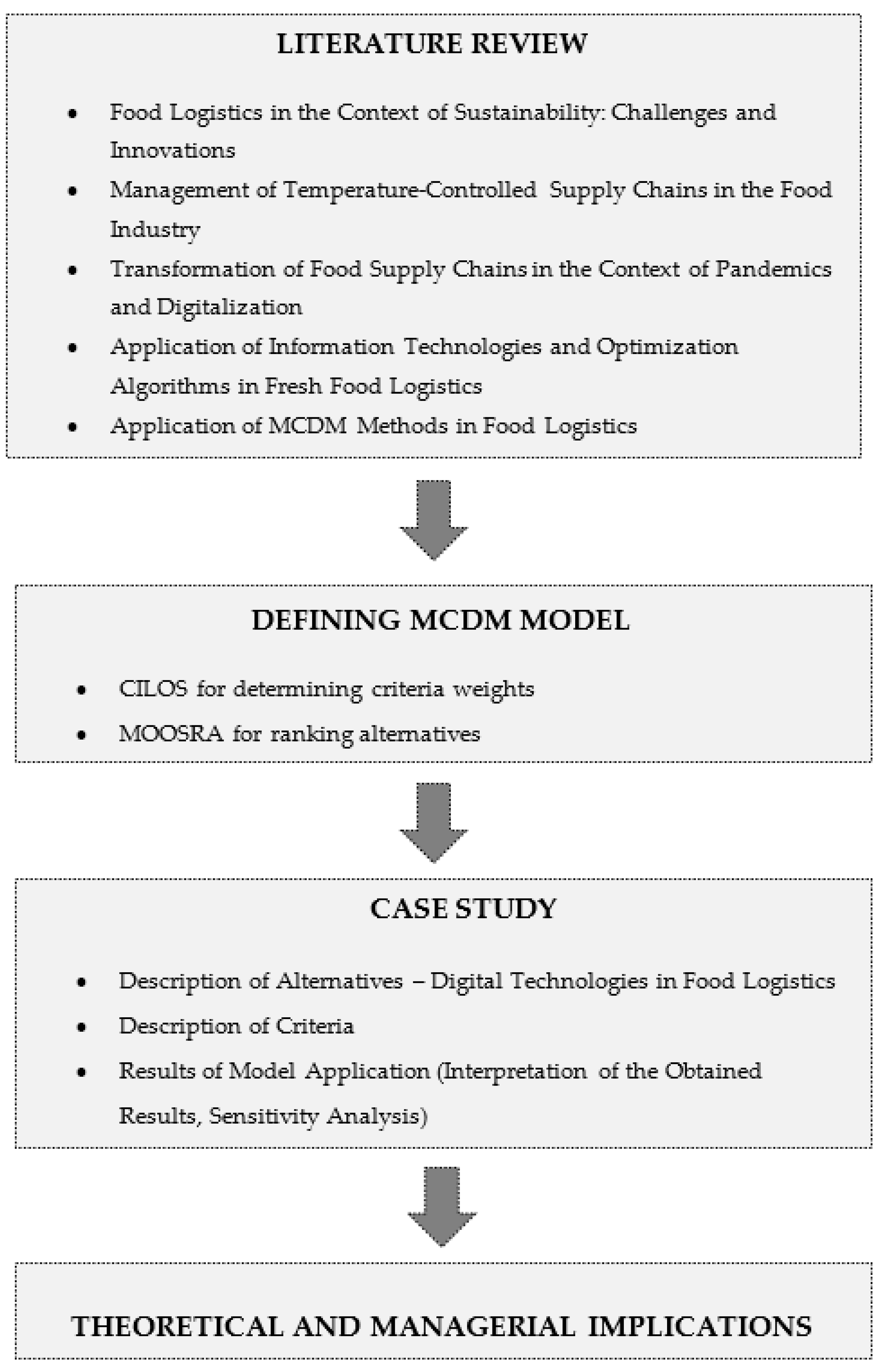
In the field of FL, logistics providers play a key role in ensuring the efficient, safe, and sustainable flow of food products along the supply chain. Their role today goes beyond traditional transportation and storage activities, encompassing digital process management, quality monitoring, and temperature control. As noted by Andrejić & Pajić [
42], the implementation of modern digital technologies enables greater transparency, real-time tracking of goods, and more effective risk management. Research [
43,
44] confirms that applying MCDM models contributes to better selection of locations, partners, and technologies, thereby enhancing system efficiency and sustainability. In this context, this chapter presents a description of the alternatives—digital technologies in FL, an overview of evaluation criteria, the results of model application, and sensitivity analysis, providing a comprehensive insight into the potential for advancing digital transformation among logistics providers and their crucial role in modernizing FSCs.
4.1. Description of Alternatives—Digital Technologies in Food Logistics
In modern FSCs, the
Internet of Things (IoT) (A1) is a key technology for ensuring food safety, freshness, and logistics efficiency. IoT connects devices with sensors and software, enabling continuous monitoring of product movement and storage conditions across the FL chain. This allows real-time tracking of location, temperature, and environmental parameters, supporting timely interventions and quality preservation [
12].
IoT in FL typically follows a multi-layered architecture: perception, data, service, and end-user layers. QR codes, RFID tags, and smart access points support rapid data collection and exchange, improving visibility, coordination, and reducing operational costs in complex FSCs [
45]. Upstream, particularly in smart agriculture, IoT sensors monitor temperature, humidity, and light, enabling better production and storage decisions [
46]. During processing and packaging, IoT supports automation, equipment monitoring, and early detection of irregularities, while smart packaging further extends quality control [
47].
In CSCs, IoT ensures continuous temperature monitoring and detects equipment failures or unauthorized access, reducing spoilage and strengthening consumer trust [
48]. During distribution, IoT supports hub-and-spoke and multi-hub logistics, enabling rapid responses to disruptions and improving efficiency for temperature-sensitive goods [
49].
Traceability is enhanced via IoT sensors and RFID, supporting compliance with international standards and increasing supply chain transparency [
50]. Integration with blockchain enables secure end-to-end traceability, improved inventory management, and reduced waste, contributing to sustainability [
51]. IoT also improves transport by enhancing capacity utilization, enabling timely interventions, and reducing losses [
52]. Beyond routine operations, IoT strengthens FSC resilience during crises, such as pandemics [
53].
Challenges remain in cybersecurity, system integration, and high investment costs, yet rising demands for transparency and responsiveness drive continued digital transformation in FL [
45]. Modeling platforms such as LabVIEW™ allow simulation and evaluation of logistics strategies across the food ecosystem, supporting more sustainable and efficient operations [
54].
Blockchain technology (A2) in FSCs enhances transparency, traceability, and data security across all stages. Unlike centralized systems, which often provide limited visibility and are vulnerable to manipulation, blockchain enables decentralized information management without intermediaries [
55]. Its foundation—decentralized peer-to-peer networks with cryptographic protection and consensus validation—ensures immutable, time-stamped records, reducing fraud risk and increasing reliability [
56].
Blockchain supports trust, quality control, and efficiency. Digital traceability allows rapid detection of issues, while smart contracts automate processes such as payments, compliance checks, and risk management, reducing errors and administrative burdens [
57,
58,
59]. Integration with IoT and AI further improves monitoring of food quality and safety. Hybrid systems can store sensitive data locally while recording hash values on the blockchain, ensuring both security and transparency [
60].
Applications are reported across cereals, meat, and dairy sectors, supporting certification, quality monitoring, and waste reduction [
60]. Blockchain also strengthens regulatory compliance and resilience against fraud or cyberattacks through permanent records, digital signatures, and reputation mechanisms [
61,
62]. Moreover, increased transparency helps reduce food losses and supports sustainable production practices [
63].
However, adoption faces challenges. High initial costs limit implementation for small and medium-sized enterprises (SME), while scalability issues can affect performance in high-volume operations [
55,
61]. Regulatory and legal uncertainty, including unclear standards and responsibilities, further slows adoption [
62]. Despite these barriers, blockchain remains a key tool for enhancing transparency, efficiency, and sustainability in modern FSCs.
Big Data (A3) involves the rapid processing of large and diverse datasets across the FSC. In FL, it enables real-time tracking of product movement, storage conditions, and quality, improving operational efficiency and aligning supply with demand [
12]. Its applications also support innovative business models, with analyses estimating substantial economic value through enhanced logistics, consumption, and personalized services [
64].
A key use of Big Data is optimizing real-time deliveries, reducing delays and losses, particularly for perishable goods. By using current information instead of relying solely on historical data, it improves demand forecasting, inventory management, and customer experience, while supporting waste reduction and efficient resource use. However, implementation requires significant investment and careful management of data security and privacy [
12].
In agriculture, Big Data supports precise monitoring of field conditions, land management, and identification of production bottlenecks, increasing yields and connectivity among supply chain participants [
65]. By improving coordination, it also contributes to sustainability, though challenges such as digital inequality and cybersecurity remain [
66,
67].
Frameworks like Circular Economy and Agri-Food 4.0 integrate Big Data with IoT, AI, and blockchain to enhance transparency, efficiency, and sustainability across FSCs [
68,
69]. Adoption is limited by high costs, lack of skilled personnel, and weak infrastructure, especially in smaller markets [
66,
70]. The COVID-19 pandemic further emphasized the need for flexible, digitally empowered supply chains, prompting policies to strengthen digital capacities and reduce information gaps [
71].
Automation and robotics (A4) are central to modern FL, improving processes from storage and packaging to distribution and inventory management. Industry 4.0–enabled robotic systems possess cognitive and collaborative capabilities, allowing autonomous decision-making and adaptation to changing conditions [
72].
Integration with IoT devices, sensors, and advanced software allows real-time monitoring of temperature, humidity, and product location, reducing spoilage and enabling timely interventions [
73]. Visual quality control has improved through cameras, computer vision, and machine learning, while augmented reality and advanced human–machine interfaces facilitate process management.
Robots are also increasingly applied in retail and hospitality, performing tasks such as food preparation and customer service, enhancing efficiency, hygiene, and consistency [
12]. The COVID-19 pandemic highlighted the need for flexible, safe solutions, prompting the adoption of contactless robotic systems and automated vehicles for local distribution [
74].
Within cyber-physical systems combining IoT, AI, and edge computing, robots can autonomously optimize delivery routes, adjust to environmental conditions, and reduce carbon emissions, supporting sustainable FSC operations [
73]. IoT-enabled monitoring of food waste further improves inventory management, reduces losses, and enhances consumption planning [
73].
Challenges remain, including high acquisition and maintenance costs, especially for SMEs, as well as ethical concerns regarding employment [
72]. Nonetheless, automation and robotics enable precise monitoring, reduce operational costs, and improve consumer satisfaction, making them transformative for modern FL.
Cloud and Edge Computing (A5) enhance FL by improving efficiency, speed, and data security. Their role is especially critical in CSCs, where real-time monitoring of temperature and storage conditions is essential for maintaining food and pharmaceutical quality [
75].
Cloud platforms integrated with intelligent delivery management systems allow monitoring of warehouse capacities, vehicles, and transport conditions, enabling dynamic route adjustments and cost reductions. Edge computing processes data closer to the source—within vehicles or warehouses—reducing latency and allowing immediate responses to temperature spikes, humidity changes, or vibrations [
76].
Solutions such as Azure Sphere and Microsoft Azure enable secure local data collection, cloud-based analysis, and integration with AI and advanced analytics, improving planning, monitoring, and resource allocation [
76]. Cloud computing also offers flexible storage, pay-as-you-go models, and better coordination among producers, distributors, and retailers. Applications like cloud manufacturing further increase flexibility, accelerate innovation, reduce waste, and optimize resource use [
12].
Challenges include data security across distributed locations, regulatory compliance, and subscription costs. Encryption, private clouds, and careful economic planning are essential to mitigate these risks [
12]. Despite these challenges, cloud and edge computing provide reliable, scalable, and fast solutions for FL, enhancing monitoring, delivery efficiency, and sustainability while supporting competitiveness across the supply chain [
76].
4.2. Description of Criteria
Industry 4.0 brings significant transformations to the industrial environment, particularly through the implementation of advanced digital technologies with the potential to improve every segment of the FSC. However, the adoption of these innovative solutions in FL faces numerous challenges, primarily of technical, educational, and regulatory nature. In order for logistics providers to make informed decisions regarding the implementation of digital technologies, it is essential to clearly define and thoroughly understand the key criteria for evaluating and selecting the most suitable solutions. These criteria cover a wide range of factors, including system efficiency and flexibility, food safety, quality control, sustainability, and economic viability, allowing for a comprehensive and realistic assessment of relevant technologies within the specific FL context [
77].
Operational Efficiency (C1). Operational efficiency reflects how digital technologies improve profitability and competitiveness in FL by reducing costs, shortening delivery times, and optimizing resources such as vehicles, warehouse space, and labor. Automation, better coordination, and real-time tracking help minimize delays and food losses.
Flexibility and Agility (C2). Flexibility and agility are vital in FL due to seasonal fluctuations, demand changes, or unexpected events. Technologies that enable dynamic routing, automatic shipment rerouting, and real-time inventory monitoring allow rapid adaptation, reducing spoilage and delays.
Sustainability and Energy Efficiency (C3). Digital solutions that optimize fuel and electricity use, lower greenhouse gas emissions, and reduce food waste support environmental goals and long-term supply chain sustainability.
Food Safety and Traceability (C4). Real-time monitoring of conditions (temperature, humidity) and automated tracking of product origin and quality enhance food safety, transparency, and regulatory compliance.
Reliability and Accuracy of Information (C5). Accurate, consistent, and up-to-date data on shipments and storage are essential for proper decision-making, preventing errors that can increase food waste.
Measurement and Analytics Capability (C6). Technologies enabling precise tracking of KPIs—delivery times, capacity use, product quality, and spoilage—support process optimization and predictive control.
Scalability and Interoperability (C7). Solutions should scale with the business and integrate seamlessly with existing systems, ensuring effective supply chain management and collaboration.
Investment and Operational Costs (C8). Technologies must be financially viable, balancing initial and maintenance costs against operational savings and reduced losses, especially for smaller organizations.
Speed of Implementation and Practical Acceptance (C9). Fast, user-friendly adoption is crucial for ROI. Success depends on operator engagement and acceptance to ensure effective integration.
It is important to emphasize that some criteria, such as Operational Efficiency (C1), and Flexibility and Agility (C2), are described qualitatively rather than quantitatively. While quantitative indicators (e.g., “cost reduction per order” for C1 or “reduction in response time to demand fluctuations” for C2) would be useful, such data were not available for all alternatives. Therefore, expert judgment based on professional experience and relevant literature was used to ensure a consistent and reliable evaluation of the relative importance of each criterion.
4.3. Results of Model Application
The combination of the CILOS and MOOSRA methods provides a balanced and comprehensive framework for multi-criteria decision-making (MCDM). The CILOS method is used to determine the relative importance (weights) of the criteria based on the loss of system performance when a particular criterion is removed. This ensures that the obtained weights accurately reflect the real impact of each criterion on the final decision outcome, leading to a more objective and data-driven weighting process. Once the weights are established, the MOOSRA method is applied to evaluate and rank the alternatives. MOOSRA accounts for both benefit-type and cost-type criteria by employing ratio analysis, which simplifies the comparison process and enables clear quantitative ranking of alternatives. By integrating these two methods, the decision-making process combines the objectivity of weight determination (CILOS) with the robustness and interpretability of alternative ranking (MOOSRA). This hybrid approach minimizes subjectivity, provides an accurate representation of each criterion’s influence, and enhances the reliability and transparency of the final ranking results. The outcomes derived from the application of these methods are presented in the following section.
The scores were obtained through a structured expert judgment process involving 5 specialists with significant experience in the relevant field (
Table 2). Each alternative was evaluated against all criteria based on expert knowledge, practical experience, and relevant literature. Prior to the evaluation, the criteria and scoring procedure were clearly defined to ensure consistency and reliability of the assessments. The use of expert-based scoring is justified by the lack of fully measurable quantitative data for all criteria and is consistent with numerous recent studies in the field of multi-criteria decision-making. The selection of experts was conducted in a structured and transparent manner. Experts were chosen based on predefined criteria to ensure the relevance and reliability of their judgments. The selection criteria included: (i) a minimum of ten years of professional experience in logistics and supply chain management; (ii) current or previous involvement in decision-making processes related to the research problem; (iii) managerial or expert positions in logistics organizations; and (iv) demonstrated familiarity with the evaluated criteria. Several measures were implemented to reduce potential bias. Expert anonymity was ensured, and no group discussions were allowed during the evaluation phase. Individual expert judgments were aggregated, which mitigates the impact of outliers and subjective extremes.
Table 3 presents the initial decision matrix, which contains expert evaluations of five alternatives across nine criteria and serves as the basis for subsequent normalization and impact analysis. The matrix was constructed using expert assessments based on a ten-point Likert-type scale ranging from 1 to 10, where 1 denotes very poor performance, 5 represents average performance, and 10 indicates excellent performance with respect to the evaluated criterion.
After forming the initial matrix, the normalization of values (
Table 4) is performed to ensure the comparability of criteria expressed in different units. The normalized matrix enables further calculation of the mutual influences among the criteria and the creation of a square matrix. In this process, Equation (1) was applied.
The next step is the creation of the square decision matrix (
Table 5), which is used to analyze the mutual influence among the criteria. The square matrix enables the identification of the criteria with the highest relative loss of influence. In this process, Equations (2) and (3) were applied.
Based on the square matrix, the relative influence loss matrix (
Table 6) is formed, showing how much the total influence of the criteria would decrease if a particular criterion were removed. This analysis enables an objective determination of the importance of each criterion within the system. In this process, Equation (4) was applied.
The next step is the formation of the weight system matrix (
Table 7), which integrates data from the relative influence loss matrix and enables the calculation of the final criterion weights. In this process, Equations (5)–(7) were applied.
Finally, by applying the CILOS method, the final criterion weights (
Table 8) are obtained, reflecting the relative importance of each criterion in the decision-making process. In this process, Equation (8) was applied.
After determining the criterion weights using the CILOS method (
Table 8), the obtained values serve as input data for the MOOSRA method, whose purpose is to quantitatively determine the final ranking of the considered alternatives. Within this method, the initial decision matrix (
Table 2) was also used, containing expert evaluations of the alternatives according to the defined criteria.
Based on the initial decision matrix, the values were normalized (
Table 9) in order to eliminate differences in the measurement units and scales of the criteria, thereby enabling their mutual comparability. This step represents a key phase of the MOOSRA method, as the normalized values form the basis for further weighting according to the previously determined criterion weights. In this process, Equations (9) and (10) were applied.
The weighted normalized matrix enables the calculation of the overall performance indicator for each alternative (
Table 10), taking into account both beneficial and cost criteria. In this way, a quantitative basis for ranking the alternatives is established, contributing to the objectivity of the final solution. In this process, Equation (11) was applied.
Finally, based on the calculated preference values (
), the alternatives were ranked, where a higher value indicates better overall performance and occupies a higher position in the final solution. The results of these methods are presented in
Table 11. In this process, Equation (12) was applied. The obtained ranking provides a clear overview of the relative advantages of each evaluated technology within the defined criteria framework. This ensures that the decision-making process remains consistent, transparent, and aligned with the overall objectives of the research.
4.3.1. Interpretation of the Obtained Results
Although Automation and Robotics (A4) achieved the highest preference value, their prominence is not only due to technical capabilities. Their strong impact results from combined improvements in operational efficiency, error reduction, and enhanced safety across multiple stages of the food supply chain. At the same time, high investment and implementation costs can pose a significant barrier, especially for SMEs. Large logistics companies with sufficient financial and organizational resources are better positioned to adopt these technologies. Nevertheless, SMEs may still benefit through gradual and selective implementation, for example, via modular solutions, task-specific automation, or leasing and service-based models that reduce upfront costs.
The high ranking of Blockchain technology (A2) reflects its strategic role in improving traceability, transparency, and data security, rather than immediate operational efficiency. Its main advantage lies in reducing informational gaps and building trust across complex supply chains, which is critical in FL where safety and quality are priorities. Challenges such as scalability, energy consumption, and system integration remain relevant, particularly for SMEs, which may favor permissioned or consortium-based blockchain solutions, whereas larger organizations can deploy blockchain across complex networks.
Big Data (A3) and IoT (A1) are ranked in the middle because their impact is largely indirect and dependent on synergies. Big Data analytics is most effective when combined with timely and accurate sensor data (IoT) and sufficient computational infrastructure (Cloud/Edge). This interdependence explains why IoT and Cloud/Edge Computing (A5) rank lower individually, despite their enabling role. Their value is strategic, supporting other technologies, rather than directly visible in performance scores.
Overall, the ranking should be interpreted not merely as a performance score, but as an indication of the strategic and operational relevance of each technology, considering cost, feasibility, and complementary effects. Large enterprises are more likely to adopt cost-intensive solutions quickly, while SMEs may prefer incremental, modular, or complementary approaches. This highlights the need for phased and scalable strategies for digital transformation in FL, balancing long-term strategic benefits with short-term feasibility. Also, it should be noted that the applied MCDM framework assumes independence among the evaluated alternatives. While this assumption enables a transparent and comparable ranking of individual technologies, it does not explicitly capture potential synergies or interdependencies between them. In real-world logistics systems, technologies such as IoT, Big Data analytics, Blockchain, and Cloud/Edge Computing are often implemented jointly, where their combined effect may exceed the sum of individual contributions.
The distinct contribution of this study lies in its direct analysis of digital technologies in food logistics, systematically ranking them according to their strategic and operational relevance. Most existing studies either provide an overview of technology applications in food logistics or analyze individual technologies, without offering a systematic ranking and comparative evaluation. To further support the discussion, the results can be compared with broader research on supply chains. Nayyar et al. [
78] ranked IoT, Big Data Analytics, and Blockchain as key Industry 4.0 technologies for enhancing supply chain performance. IoT enables real-time tracking and transparency, Big Data supports predictive analytics and more accurate demand planning, while Blockchain improves traceability and data security. However, it is important to note that Nayyar et al. [
78] do not specifically analyze the application of these technologies in food logistics, but rather consider supply chains more broadly. Nonetheless, their findings support and help explain the logic behind the ranking of digital technologies in this study, particularly in terms of their strategic and complementary value.
4.3.2. Sensitivity Analysis
For the purpose of sensitivity analysis, four scenarios of criterion weight distribution were defined, reflecting different perspectives and priorities relevant to the implementation of digital technologies in food logistics. Changes in criterion weights in each scenario represent an attempt to model real business contexts in which logistics providers make decisions (
Table 12).
Scenario 1 represents an even distribution of weights, where all criteria have the same value (1/9). This scenario is neutral and serves as a reference framework for comparison. The assumption is that all evaluation aspects are equally important, without favoring individual dimensions such as costs, technological features, or implementation speed;
Scenario 2 focuses on technical criteria, reflected in a significant increase in the weights of C6—Measurement and Analytics Capability (0.20) and C7—Scalability and Interoperability (0.15). This approach assumes that successful implementation of digital technologies in FL depends on their ability to integrate with existing systems, provide reliable data, and support advanced analytics. Criteria such as Operational Efficiency (C1) and Flexibility (C2) receive lower weights here, as they are considered secondary to technical feasibility and functionality;
Scenario 3 emphasizes economic and risk-driven aspects of decision-making, where the highest weights are assigned to C8—Investment and Operational Costs (0.30) and C9—Implementation Speed and Practical Acceptance (0.15). This configuration corresponds to environments with limited budgets and high instability, such as humanitarian logistics or small food companies. Weights are reduced for criteria related to long-term technical capabilities, such as C1, C2, C7, in favor of short-term cost-effectiveness and implementation speed;
Scenario 4 reflects a management perspective, in which criteria related to rapid implementation (C9—0.30) and cost efficiency (C8—0.20) dominate, while factors such as Operational Efficiency (C1), Flexibility (C2), and Technical Characteristics (C6, C7) receive lower values. This scenario mirrors business-strategy-driven and pragmatic decisions, where managers prefer solutions that can be deployed quickly, easily adopted in practice, and do not require complex integrations.
The four scenarios were designed to reflect realistic variations in priorities that logistics providers might face, including balanced, technically driven, cost-sensitive, and management-focused perspectives. The identical ranking of alternatives across all scenarios demonstrates the robustness and stability of the MOOSRA results, indicating that the model reliably supports decision-making even when criterion importance shifts. As a result, the application of the MOOSRA method shows that Automation and Robotics (A
4) occupy the first position with the highest preference value, highlighting their key impact on process efficiency, error reduction, and safety in the FSC. Next is Blockchain technology (A
2), which contributes to traceability, transparency, and data security, followed by Big Data technologies (A
3), enabling advanced data collection and analysis for process optimization and demand forecasting. IoT (A
1) ranks fourth, reflecting its role as a sensor-based foundation and its importance when combined with analytical and infrastructural systems, while Cloud and Edge Computing (A
5) are ranked last, as their function primarily supports other technologies rather than directly influencing supply chain performance. This consistency confirms the stability and robustness of the alternative ranking (
Table 13), emphasizing the interdependence between different digital technologies and their complementary roles in improving logistics operations. Such results also underline the importance of strategic prioritization when selecting technologies for implementation in practice. Overall, the analysis offers a solid basis for further research and supports informed decision-making in the digital transformation of FL.