Review about Non-Lipid Components and Minor Fat-Soluble Bioactive Compounds of Almond Kernel

 ,
,  , , and
Abstract
1. Introduction
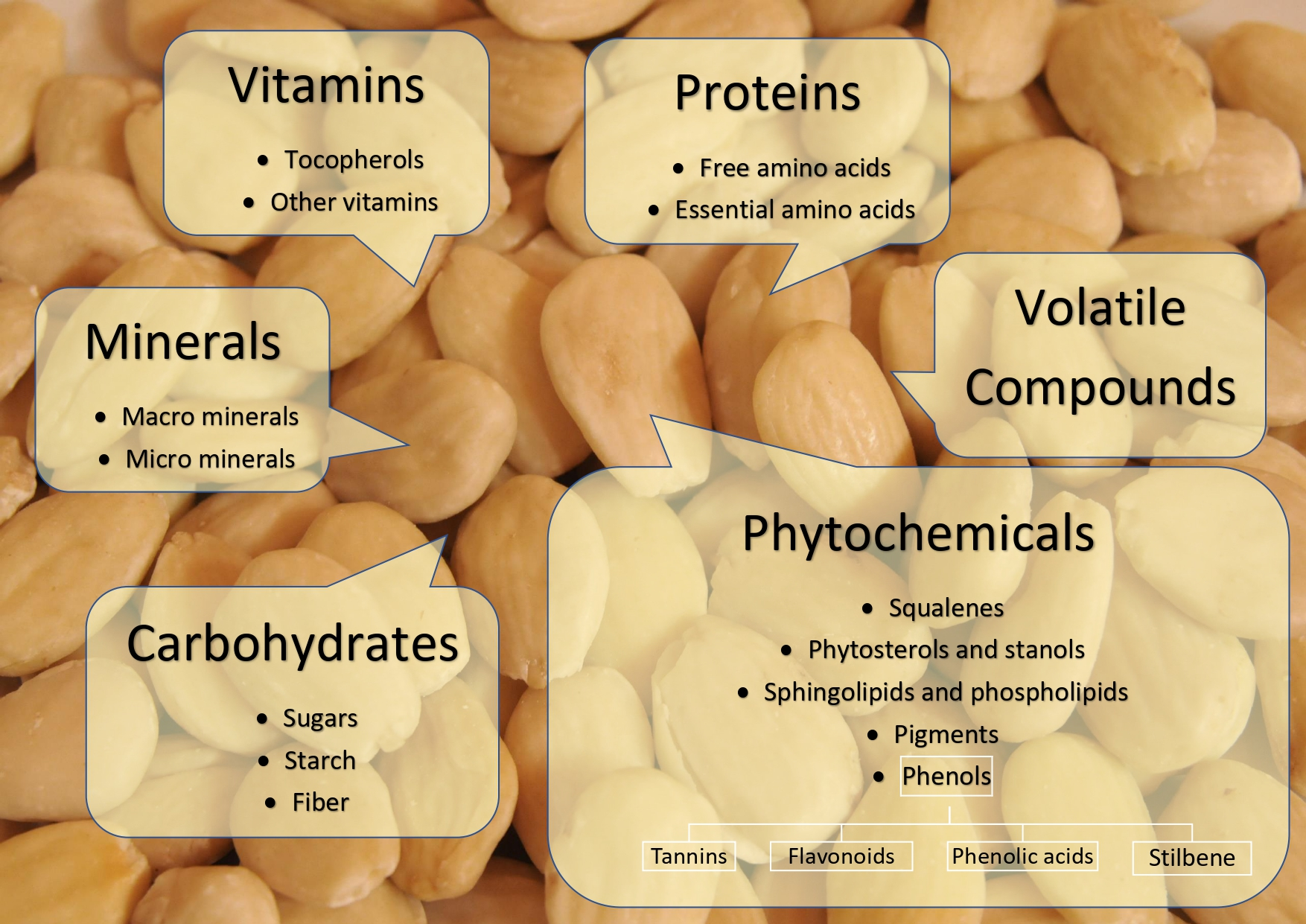
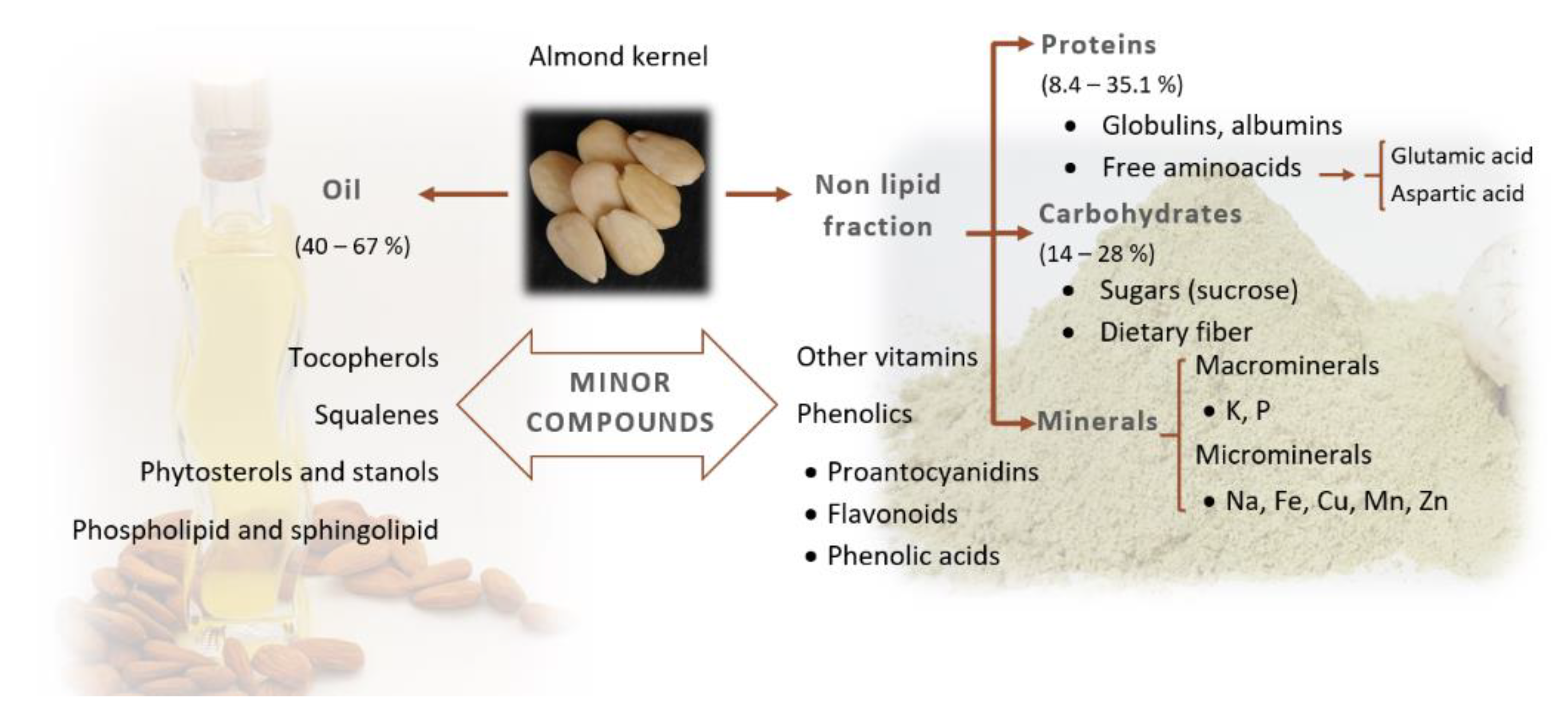
2. Chemical Composition of Almond Kernel
3. Protein Fraction of Almond Kernel
3.1. Protein Profile
3.2. Free Amino Acids
3.3. Essential Amino Acids
4. Carbohydrates in Almond Kernel
4.1. Sugars
4.2. Starch
4.3. Fiber
5. Mineral Fraction of Almond Kernel
5.1. Ashes
5.2. Macrominerals
5.3. Microminerals or Trace Elements
6. Phytochemical Compounds of Almond Kernel
6.1. Tocopherols (Vitamin E)
6.2. Vitamins
6.3. Squalenes
6.4. Phytosterols and Stanols
6.5. Sphingolipids and Phospholipids
6.6. Chlorophylls and Carotenoids
6.7. Phenols
6.7.1. Tannins
6.7.2. Flavonoids
6.7.3. Phenolic Acids
6.7.4. Stilbene
7. Volatile Compounds
8. Conclusions
Author Contributions
Funding
Conflicts of Interest
References
- FAOSTAT. Available online: http://www.fao.org/faostat/en/#data/QC (accessed on 5 November 2020).
- Felipe, A. El Almendro. I. El Material Vegetal; Mira Editores: Zaragoza, Spain, 2000. [Google Scholar]
- Salazar, D.; Melgarejo, P. El Cultivo del Almendro; Mundi-Prensa: Madrid, Spain, 2002. [Google Scholar]
- Barreca, D.; Nabavi, S.M.; Sureda, A.; Rasekhian, M.; Raciti, R.; Silva, A.S.; Annunziata, G.; Arnone, A.; Tenore, G.C.; Süntar, İ.; et al. Almonds (Prunus dulcis Mill. D. A. webb): A source of nutrients and health-promoting compounds. Nutrients 2020, 12, 672. [Google Scholar] [CrossRef] [Scilit] [PubMed]
- Creedon, A.C.; Hung, E.S.; Berry, S.E.; Whelan, K. Nuts and their effect on gut microbiota, gut function and symptoms in adults: A systematic review and meta-analysis of randomised controlled trials. Nutrients 2020, 12, 2347. [Google Scholar] [CrossRef] [Scilit] [PubMed]
- Siddiqui, I.; Husain, Q.; Azam, A. Exploring the antioxidant effects of peptides from almond proteins using PAni-Ag-GONC conjugated trypsin by improving enzyme stability & applications. Int. J. Biol. Macromol. 2020, 158, 150–158. [Google Scholar] [CrossRef] [Scilit] [PubMed]
- Prats, M.S. Caracterización Quimiométrica de Diez Variedades de Almendra Cultivadas en Diferentes Localidades. Ph.D. Thesis, University of Alicante, Alicante, Spain, 2000. [Google Scholar]
- Yada, S.; Lapsley, P.; Huang, G. A review of composition studies of cultivated almonds: Macronutrients and micronutrients. J. Food Compos. Anal. 2011, 24, 469–480. [Google Scholar] [CrossRef] [Scilit]
- Yada, S.; Huang, G.; Lapsley, K. Natural variability in the nutrient composition of California-grown almonds. J. Food Compos. Anal. 2013, 30, 80–85. [Google Scholar] [CrossRef] [Scilit]
- Kodad, O.; Estopañán, G.; Juan, T.; Alonso, J.M.; Espiau, M.T.; Rafel Socias i Company. Oil content, fatty acid composition and tocopherol concetration in the spanish almond genebank collection. Sci. Horicult. 2014, 177, 99–107. [Google Scholar] [CrossRef] [Scilit]
- Rabadán, A.; Álvarez-Ortí, M.; Gómez, R.; de Miguel, C.; Pardo, J.E. Influence of genotype and crop year in the chemometrics of almond and pistachio oils. J. Sci. Food Agric. 2017, 98, 2402–2410. [Google Scholar] [CrossRef] [Scilit]
- Rabadán, A.; Pardo, J.E.; Gómez, R.; Álvarez-Ortí, M. Influence of temperature in the extraction of nut oils by means of screw pressing. LWT 2018, 93, 354–361. [Google Scholar] [CrossRef] [Scilit]
- Roncero, J.M.; Álvarez-Ortí, M.; Pardo-Giménez, A.; Gómez, R.; Rabadán, A.; Pardo, J.E. Almond virgin oil: Parameters of regulated physicochemical quality and stability. Riv. Ital. Sostanze Grasse 2016, 93, 237–243. [Google Scholar]
- Font i Forcada, C.; Kodad, O.; Juan, T.; Estopañan, G.; Rafel Socias i Company. Genetic variability and pollen effect on the transmission of the chemical components of the almond kernel. Span. J. Agric. Res. 2011, 9, 781–789. [Google Scholar] [CrossRef] [Scilit]
- Saura, F.; Cañellas, J.; Soler, L. La Almendra. Composición, Variedades, Desarrollo y Maduración; Instituto Nacional de Investigaciones Agrarias (INIA): Madrid, Spain, 1988. [Google Scholar]
- Casares, R.L.H. Chemical data on the raises of Málaga. An. Bromatol. 1952, 4, 411–419. [Google Scholar]
- Hall, A.M. The nutritive value of fresh and roasted, California-grown Nonpareil almonds. J. Agric. Food Chem. 1958, 6, 377–382. [Google Scholar] [CrossRef] [Scilit]
- Esteban, R.M. Estudio Comparativo de la Calidad Nutritiva de Variedades de Almendra del S.E. y N.E. español; Instituto Nacional de Investigación y Tecnología Agraria y Alimentaria (INIA): Madrid, Spain, 1985. [Google Scholar]
- Salvo, F.A. Composizionee dell’olio di mandorle. Nota III: Variazione di alcuni parametri chimici e chimico-ficici durante la conservazione. Riv. Ital. Sostanze Grasse 1986, 63, 37–40. [Google Scholar]
- García, C.G. Major fatty acid composition of 19 almond cultivars of different origins. A chemometric approach. J. Agric. Food Chem. 1996, 44, 1751–1755. [Google Scholar] [CrossRef] [Scilit]
- Martín, M.L. Comparative study on the triglyceride composition of almond kernel oil. A new basis for cultivar chemometric characterization. J. Agric. Food Chem. 1999, 47, 3688–3692. [Google Scholar] [CrossRef] [Scilit]
- Kodad, O. Criterios de Selección y de Evaluación de Nuevas Obtenciones Autocompatibles en un Programa de Mejora Genética del Almendro (Prunus amygdalus Batsch). Ph.D. Thesis, University of Lleida, Lleida, Spain, 2006. [Google Scholar]
- Barile, D.; Coïsson, J.D.; Arlorio, M.; Rinaldi, M. Identification of production area of Ossolano Italian cheese with chemometric complex approach. Food Control. 2006, 17, 197–206. [Google Scholar] [CrossRef] [Scilit]
- Costa, J.; Mafra, I.; Carrapatoso, I.; Oliveira, M.B. Almond allergens: Molecular characterization, detection, and clinical relevance. J. Agric. Food Chem. 2012, 60, 1337–1349. [Google Scholar] [CrossRef] [Scilit]
- Xie, L.; Bolling, B.W. Characterisation of stilbenes in California almonds (Prunus dulcis) by UHPLC–MS. Food Chem. 2014, 148, 300–306. [Google Scholar] [CrossRef] [Scilit]
- Vanamala, J. Food systems approach to cancer prevention. Crit. Rev. Food Sci. Nutr. 2017, 57, 2573–2588. [Google Scholar] [CrossRef] [Scilit]
- Bolling, B. Polyphenol content and antioxidant activity of California almonds depend on cultivar and harvest year. Food Chem. 2010, 122, 819–825. [Google Scholar] [CrossRef] [Scilit]
- Zhu, Y.W. Lipophilic antioxidant content of almonds (Prunus dulcis): A regional and varietal study. J. Food Compos. Anal. 2015, 39, 120–127. [Google Scholar] [CrossRef] [Scilit]
- Csakvari, A.C.; Lupitu, A.; Bungău, S.; Gîtea, M.A.; Gîtea, D.; Ţiţ, D.M.; Copolovici, D. Fatty acids profile and antioxidant activity of almond oils obtained from six Romanian varieties. Farmacia 2019, 67, 882–887. [Google Scholar] [CrossRef] [Scilit]
- Maestri, D.; Martínez, M.; Bodoira, R.; Rossi, Y.; Oviedo, A.; Pierantozzi, P. Variability in almond oil chemical traits from traditional cultivars and native genetic resources from Argentina. Food Chem. 2015, 170, 55–61. [Google Scholar] [CrossRef] [Scilit]
- Sena-Moreno, E.; Pardo, J.E.; Pardo-Giménez, A.; Gómez, R.; Alvarez-Ortí, M. Differences in Oils from Nuts Extracted by Means of Two Pressure Systems. Int. J. Food Prop. 2016, 19, 2750–2760. [Google Scholar] [CrossRef] [Scilit]
- Roncero, J.M.; Alvarez-Ortí, M.; Pardo-Giménez, A.; Gómez, R.; Rabadán, A.; Pardo, J.E. Virgin almond oil: Extraction methods and composition. Grasas Aceites 2016, 67, e143. [Google Scholar] [CrossRef] [Scilit]
- Martínez, M.L.; Bordón, M.G.; Bodoira, R.M.; Penci, M.C.; Ribotta, P.D.; Maestri, D.M. Walnut and almond oil screw-press extraction at industrial scale: Effects of process parameters on oil yield and quality. Grasas Aceites 2017, 68, e216. [Google Scholar] [CrossRef] [Scilit]
- Pardo-Giménez, A.; Carrasco, J.; Roncero, J.M.; Álvarez-Ortí, M.; Zied, D.C.; Pardo, J.E. Recycling of the biomass waste defatted almond meal as a novel nutritional supplementation for cultivated edible mushrooms. Acta Sci. Agron. 2018, 40, e39341. [Google Scholar] [CrossRef] [Scilit]
- Ojeda-Amador, R.; Fregapane, G.; Salvador, M. Chemical Characterization of Virgin Almond and Hazelnut Oils and Their By-Products. Eur. J. Lipid Sci. Technol. 2019, 121, 1–10. [Google Scholar] [CrossRef] [Scilit]
- Barreira, J.C.M.; Nunes, M.A.; da Silva, B.V.; Pimentel, F.B.; Costa, A.S.G.; Alvarez-Ortí, M.; Pardo, J.E.; Oliveira, M.B.P.P. Almond cold-pressed oil by-product as ingredient for cookies with potential health benefits: Chemical and sensory evaluation. Food Sci. Hum. Wellness 2019, 8, 292–298. [Google Scholar] [CrossRef] [Scilit]
- Rabadán, A.; Álvarez-Ortí, M.; Martínez, E.; Pardo-Giménez, A.; Zied, D.C.; Pardo, J.E. Effect of replacing traditional ingredients for oils and flours from nuts and seeds on the characteristics and consumer preferences of lamb meat burgers. LWT 2021, 136, 110307. [Google Scholar] [CrossRef] [Scilit]
- Sathe, S.K. Solubilization, electrophoretic characterization and in vitro digestibility of almond (Prunus amygdalus) proteins. J. Food Biochem. 1993, 16, 249–264. [Google Scholar] [CrossRef] [Scilit]
- Kodad, O.; Mamouni, A.; Lahlo, M.; Rafel Socias i Company. Contenido en aceite y proteína y de los caracteres físicos del fruto y de la pepita del almendro en las condiciones climáticas mediterráneas. ITEA Inf. Tec. Econ. Agrar. 2011, 107, 300–314. [Google Scholar]
- Ozcan, M.; Ünver, A.; Erkan, E.; Arslan, D. Characteristics of some almond kernel and oils. Sci. Hortic. 2011, 127, 330–333. [Google Scholar] [CrossRef] [Scilit]
- Drogoudi, P.D.; Pantelidis, G.; Bacchetta, L.; Giorgio, D.; Duval, H.; Metzidakis, I. Protein and mineral nutrient contents in kernels from 72 sweet almond cultivars and accessions grown in France, Greece and Italy. Int. J. Food Sci. Nutr. 2012, 64, 202–209. [Google Scholar] [CrossRef] [Scilit] [PubMed]
- Kodad, O.; Estopañán, G.; Juan, T.; Socias i Compani, R. Protein content and oil composition of almond from moroccan seedlings: Genetic diversity, oil quality and geographical origin. J. Am. Oil Chem. Soc. 2013, 90, 243–252. [Google Scholar] [CrossRef] [Scilit]
- USDA Food Database U.S. Department of Agriculture. Available online: https://fdc.nal.usda.gov/download-datasets.html (accessed on 21 February 2019).
- Osborne, T.B.; Campbell, G.F. Conglutin and vitellin. J. Am. Chem. Soc. 1986, 18, 609–623. [Google Scholar] [CrossRef] [Scilit]
- Ahrens, S.; Venkatachalam, M.; Mistry, A.M.; Lapsley, K.; Sathe, S.K. Almond (Prunus dulcis L.) protein quality. Plant Foods Hum. Nutr. 2005, 60, 123–128. [Google Scholar] [CrossRef] [Scilit]
- Barreira, J.; Casal, S.; Ferreira, I.; Peres, A.M.; Pereira, J. Supervised chemical pattern recognition in almond (Prunus dulcis) portuguese PDO cultivars: PCA- and LDA-Based triennial study. J. Agric. Food Chem. 2012, 60, 9697–9704. [Google Scholar] [CrossRef] [Scilit]
- Askin, M.; Baltab, M.; Tekintasc, F.; Kazankayab, A.; Balta, F. Fatty acid composition affected by kernel weight in almond (Prunus dulcis Mill.) genetic resources. J. Food Compos. Anal. 2007, 20, 7–12. [Google Scholar] [CrossRef] [Scilit]
- Simsek, M.; Gulsoy, E.; Yavic, A.; Arikan, B.; Yildirim, Y.; Olmez, N.; Erdogmus, B.; Boguc, F. Fatty acid, mineral and proximate compositions of various genotypes and commercial cultivars of sweet almond from the same ecological conditions. Appl. Ecol. Environ. Res. 2018, 16, 2957–2971. [Google Scholar] [CrossRef] [Scilit]
- Agumbiade, S.O. Evaluation of some nutritional characteristics of inidian almond (Prunus amygdalus) nut. Pak. J. Nutr. 2006, 5, 316–318. [Google Scholar] [CrossRef] [Scilit]
- Chung, K.H.; Shin, K.O.; Hwang, H.J.; Choi, K.S. Chemical composition of nuts and seeds sold in Korea. Nutr. Res. Pract. 2013, 7, 82–88. [Google Scholar] [CrossRef] [Scilit] [PubMed]
- Moodley, R.; Kindness, A.; Jonnalagadda, S. Elemental composition and chemical characteristics of five edible nuts (almond, Brazil, pecan, macadamia and walnut) consumed in Southern Africa. J. Environ. Sci. Health Part B 2007, 58, 585–591. [Google Scholar] [CrossRef] [Scilit] [PubMed]
- Čolić, S.D.; Bakić, I.V.; Zagorac, D.C.; Natić, M.M.; Smailagić, A.T.; Pergal, M.V.; Pešić, M.B.; Milinčić, D.D.; Rabrenović, B.B.; Akšić, M.M. Chemical Fingerprint and Kernel Quality Assessment in Different Grafting Combinations of Almond Under Stress Condition. Sci. Hortic. 2020, 275, 109705. [Google Scholar] [CrossRef] [Scilit]
- Akpambang, V.; Amoo, I.; Izuagie, A. Comparative compositional analysis on two varieties of melon (Colocynthis citrullus and Cucumeropsis edulis) and a variety of almond (Prunus amygdalus). Res. J. Agric. Biol. Sci. 2008, 4, 639–642. [Google Scholar] [CrossRef] [Scilit]
- Aslantas, R.; Guleryuz, M.; Turan, M. Some chemical contents of selected almond (Prunus amygdalus Batsch) types. Cah. Options Méditerr. 2001, 56, 347–350. [Google Scholar]
- Kazantzis, I.; Nanos, G.; Stavroulakis, G. Effect of harvest time and storage conditions on almond kernel oil and sugar composition. J. Sci. Food Agric. 2003, 83, 354–359. [Google Scholar] [CrossRef] [Scilit]
- Barreira, J.; Pereira, J.; Oliveira, M.; Ferreira, I. Sugars profiles of different chestnut (Castanea sativa Mill.) and almond (Prunus dulcis) cultivars by HPLC-RI. Plant Foods Hum. Nutr. 2010, 65, 38–43. [Google Scholar] [CrossRef] [Scilit]
- Sánchez-Bel, P.; Egea, I.; Martınez-Madrid, M.; Flores, B.; Romojaro, F. Influence of irrigation and organic/inorganic fertilization on chemical quality of almond (Prunus amygdalus cv. Guara). J. Agric. Food Chem. 2008, 56, 10056–10062. [Google Scholar] [CrossRef] [Scilit]
- Oliveira, I.; Meyer, A.; Afonso, S.; Aires, A.; Goufo, P. Phenolic and fatty acid profiles, α-tocopherol and sucrose contents, and antioxidant capacities of understudied Portuguese almond cultivars. J. Food Biochem. 2019, 43, e12887. [Google Scholar] [CrossRef] [Scilit]
- Ruggeri, S.; Cappelloni, M.; Gambelli, L.; Carnovale, E. Chemical composition and nutritive value of nuts grown in Italy. Ital. J. Food Sci. 1998, 10, 243–252. [Google Scholar]
- Mandalari, G.; Nueno-Palop, C.; Bisignano, G.; Wickham, M.S.; Narbad, A. Potential prebiotic properties of almond (Amygdalus communis L.) seeds. Appl. Environ. Microbiol. 2008, 74, 4264–4270. [Google Scholar] [CrossRef] [Scilit] [PubMed]
- Font i Forcada, C.; Fernández i Martí, A.; Rafel Socias i Company. Mapping quantitative trait loci for kernel composition in almond. BMC Genet. 2012, 13, 47. [Google Scholar] [CrossRef] [Scilit] [PubMed]
- Venkatachalam, M.; Sathe, S. Chemical composition of selected edible nut seeds. J. Agric. Food Chem. 2006, 54, 4705–4714. [Google Scholar] [CrossRef] [Scilit]
- Barbera, G.; Di Marco, L.; La Mantia, T.; Schirra, M. Effect of rootstock on productive and qualitative response of two almond varieties. Acta Hortic. 1994, 373, 129–134. [Google Scholar] [CrossRef] [Scilit]
- Sathe, S.K. Biochemical characterization of amandin, the major storage protein in almond (Prunus dulcis L.). J. Agric. Food Chem. 2002, 50, 4333–4341. [Google Scholar] [CrossRef] [Scilit]
- Grané-Teruel, N.; Luna, M.; Berenguer, V. Statistical comparative study of free amino acid HPLC data from a selected almond set. Food Chem. 1999, 65, 23–28. [Google Scholar] [CrossRef] [Scilit]
- Amrein, T.; Lukac, H.; Andres, L.; Perren, R.; Escher, F.; Amado, R. Acrylamide in roasted almonds and hazelnuts. J. Agric. Food Chem. 2005, 53, 7819–7825. [Google Scholar] [CrossRef] [Scilit]
- Serón, L.A.; Garrigós, E.S.; Berenguer, V.; Grané-Teruel, N. Characterisation of 19 almond cultivars on the basis of their free amino acids composition. Food Chem. 1998, 61, 455–459. [Google Scholar] [CrossRef] [Scilit]
- House, J.D.; Hill, K.; Neufeld, J.; Franczyk, A.; Nosworthy, M.G. Determination of the protein quality of almonds (Prunus dulcis L.) as assessed by in vitro and in vivo methodologies. Food Sci. Nutr. 2019, 7, 2932–2938. [Google Scholar] [CrossRef] [Scilit]
- Nanos, G.; Kazantzis, I.; Kefalas, P.; Petrakis, C.; Stavroulakis, G. Irrigation and harvest time affect almond kernel quality and composition. Sci. Hortic. 2002, 96, 249–256. [Google Scholar] [CrossRef] [Scilit]
- Rabadán, A.; Álvarez-Ortí, M.; Gómez, R.; Pardo-Giménez, A.; Pardo, J.E. Suitability of Spanish almond cultivars for the industrial production of almond oil and defatted flour. Sci. Hortic. 2017, 225, 539–546. [Google Scholar] [CrossRef] [Scilit]
- Arrázola, G. Análisis de Glucósidos Cianogénicos en Variedades de Almendros: Implicaciones en la Mejora Genética. Ph.D. Thesis, University of Alicante, Alicante, Spain, 2002. [Google Scholar]
- Lipan, L.; Martín-Palomo, M.J.; Sánchez-Rodríguez, L.; Cano-Lamadrid, M.; Sendra, E.; Hernańdez, F.; Burlo, F.; Vázquez-Araújo, L.; Andreu, L.; Carbonell-Barrachina, A.A. Almond fruit quality can be improved by means of deficit irrigation strategies. Agric. Water Manag. 2019, 217, 236–242. [Google Scholar] [CrossRef] [Scilit]
- FOSS. Fiber Determination Using the Fibertec I&M Systems; Application Note AN304; FOSS Tecator AB: Höganäs, Sweden, 2001. [Google Scholar]
- Schirra, M.; Mulas, M.; Nieddu, G.; Virdis, F. Mineral content in Texas almonds during fruit growth and ripening. Acta Hortic. 1994, 373, 207–214. [Google Scholar] [CrossRef] [Scilit]
- Martínez, M.L.; Penci, M.C.; Marin, M.A.; Ribotta, P.D.; Maestri, D.M. Screw press extraction of almond (Prunus dulcis Miller): Oil recovery and oxidative stability. J. Food Eng. 2013, 119, 40–45. [Google Scholar] [CrossRef] [Scilit]
- Sudhakar, P.; Priyanka, K.; Peter, A.E.; Sandeep, B.V.; Rajeswari, M.; Rao, B.; Sujatha, P. A study on the proximate composition and nutritive value of local tree almonds, Prunus amygdalus. Ann. Plant Sci. 2018, 7, 2363–2372. [Google Scholar] [CrossRef] [Scilit]
- Jing, Z.; Cheng, J.; Guo, C.; Wang, X. Seed traits, nutrient elements and assessment of genetic diversity for almond (Amygdalus spp.) endangered to China as revealed using SRAP markers. Biochem. Syst. Ecol. 2013, 49, 51–57. [Google Scholar] [CrossRef] [Scilit]
- Ozcan, M.M. Determination of the mineral compositions of some selected oil-bearing seeds and kernels using Inductively Coupled Plasma Atomic Emission Spectrometry (ICP-AES). Grasas Aceites 2006, 57, 211–218. [Google Scholar] [CrossRef] [Scilit]
- Cabrera, C.; Lloris, F.; Gimenez, R.; Olalla, M.; Lopez, M.C. Mineral content in legumes and nuts: Contribution to the Spanish dietary intake. Sci. Total Environ. 2003, 308, 1–14. [Google Scholar] [CrossRef] [Scilit]
- Alasalvar, C.; Pelvan, E. Fat-soluble bioactives in nuts. Eur. J. Lipid Sci. Technol. 2011, 113, 943–949. [Google Scholar] [CrossRef] [Scilit]
- Bolling, B.; Chen, C.Y.; McKay, D.; Blumberg, J.B. Tree nut phytochemicals: Composition, antioxidant capacity, bioactivity, impact factors. A systematic review of almonds, Brazils, cashews, hazelnuts, macadamias, pecans, pine nuts, pistachios and walnuts. Nutr. Res. Rev. 2011, 24, 244–275. [Google Scholar] [CrossRef] [Scilit] [PubMed]
- Chen, C.Y.; Lapsley, K.; Blumberg, J. A nutrition and health perspective on almond. J. Sci. Food Agric. 2006, 86, 2245–2250. [Google Scholar] [CrossRef] [Scilit]
- Stuetz, W.; Schlormann, W.; Glei, M. B-vitamins, carotenoids and α-/γ-tocopherol in raw and roasted nuts. Food Chem. 2017, 221, 222–227. [Google Scholar] [CrossRef] [Scilit] [PubMed]
- Kornsteiner, M.W. Tocopherols and total phenolics in 10 different nut types. Food Chem. 2006, 98, 381–387. [Google Scholar] [CrossRef] [Scilit]
- Madawala, S.K.; Dutta, P. Lipid components and oxidative status of selected specialty oils. Grasas Aceites 2012, 63, 143–151. [Google Scholar] [CrossRef] [Scilit]
- Kodad, O.; Estopañán, G.; Juan, T.; Socias i Company, R. Tocopherol concentration in almond oil from Moroccan seedlings: Geographical origin and post-harvest implications. J. Food Compos. Anal. 2014, 33, 161–165. [Google Scholar] [CrossRef] [Scilit]
- Ozcan, M.; Al Juhaimi, F.; Ghafoor, K.; Babiker, E. Characterization of physico-chemical and bioactive properties of oils of some important almond cultivars by cold press and soxhlet extraction. J. Food Sci. Technol. 2020, 57, 955–961. [Google Scholar] [CrossRef] [Scilit]
- Rizzolo, A.; Baldo, C.; Polesello, A. Application of high-performance liquid chromatography to the analysis of niacin and biotin in Italian almond cultivars. J. Chromatogr. A 1991, 553, 187–192. [Google Scholar] [CrossRef] [Scilit]
- Rafel Socias i Company; Kodad, O.; Alonso, J.M.; Font-Forcada, C. Fruit quality in almond: Physical aspects for breeding strategies. Acta Hortic. 2009, 814, 475–480. [Google Scholar] [CrossRef] [Scilit]
- Cherif, A.; Belkacemi, K.; Kallel, H.; Angers, P.; Arul, J.; Boukhchina, S. Phytosterols, unsaturated fatty acid composition and accumulation in the almond kernel during harvesting period: Importance for development regulation. Comptes Rendus Biol. 2009, 332, 1069–1077. [Google Scholar] [CrossRef] [Scilit]
- Azadmard, S.; Emami, S.H.; Hesari, J.; Peighambardoust, S.H.; Nemati, M. Nuts Composition and their Health Benefits. World Acad. Sci. Eng. Technol. 2011, 81, 508–512. [Google Scholar] [CrossRef]
- Givianrad, M.; Saber-Tehrani, M.; Jafari, J.A. Chemical composition of oils from wild almond (Prunus scoparia) and wild pistachio (Pistacia atlantica). Grasas y Aceites 2013, 64, 77–84. [Google Scholar] [CrossRef] [Scilit]
- Matthäus, B.; Özcan, M.M.; Juhaimi, F.; Adiamo, O.Q.; Alsawmahi, O.N.; Ghafoor, K.; Babiker, E. Effect of the Harvest Time on Oil Yield, Fatty Acid, Tocopherol and Sterol Contents of Developing Almond and Walnut Kernels. J. Oleo Sci. 2018, 67, 39–45. [Google Scholar] [CrossRef] [Scilit] [PubMed]
- Fernandes, G.D.; Gómez-Coca, R.B.; Pérez-Camino, M.C.; Moreda, W.; Barrera-Arellano, D. Chemical Characterization of Major and Minor Compounds of Nut Oils: Almond, Hazelnut, and Pecan Nut. J. Chem. 2017, 2609549. [Google Scholar] [CrossRef] [Scilit]
- Miraliakbari, H.; Shahidi, F. Lipid class compositions, tocopherols and sterols of tree nut oils extracted with different solvents. J. Food Lipids 2008, 15, 81–96. [Google Scholar] [CrossRef] [Scilit]
- Phillips, K.M.; Ruggio, D.; Ashraf-Khorassanij, M. Phytosterol composition of nuts and seeds commonly consumed in the United States. J. Agric. Food Chem. 2005, 53, 9436–9445. [Google Scholar] [CrossRef] [Scilit] [PubMed]
- Chen, C.; Blumberg, J. In vitro activity of almond skin polyphenols for scavenging free radicals and inducing quinone reductase. J. Agric. Food Chem. 2008, 56, 4427–4434. [Google Scholar] [CrossRef] [Scilit]
- Maguire, L.O.; Galvin, K.; O’Connor, T.O. Fatty acid profile, tocopherol, squalene and phytosterol content of walnuts, almonds, peanuts, hazelnuts and the macadamia nut. Int. J. Food Sci. Nutr. 2004, 55, 171–178. [Google Scholar] [CrossRef] [Scilit]
- Alasalvar, C.S. Tree Nuts: Composition, Phytochemicals and Health Effects; CRC Press, Taylor and Francis Group: Boca Raton, FL, USA, 2008. [Google Scholar] [CrossRef] [Scilit]
- Malisiova, F.H.S. Liposomal formulations from phospholipids of Greek almond oil. Properties and biological activity. Verl. Z. Nat. 2004, 59, 330–334. [Google Scholar] [CrossRef] [Scilit]
- Boukhchina, S.; Sebai, K.; Cherif, A.; Kallel, H.; Mayer, P. Identification of glycerophospholipids in rapeseed, olive, almond, and sunflower oils by LC-MS and LC-MS. Can. J. Chem. 2004, 82, 1210–1215. [Google Scholar] [CrossRef] [Scilit]
- Fang, F.H.T. Determination of sphingolipids in nuts and seeds by a single quadrupole liquid chromatography-mass spectrometry method. J. Food Lipids 2005, 12, 327–343. [Google Scholar] [CrossRef] [Scilit]
- Song, S.; Cheong, L.; Wang, H.; Man, Q.; Pang, S.; Li, Y. Characterization of phospholipid profiles in six kinds of nut using HILIC-ESI-IT-TOF-MS system. Food Chem. 2018, 240, 1171–1178. [Google Scholar] [CrossRef] [Scilit] [PubMed]
- Ogah, O.; Watkins, C.S.; Ubi, B.E.; Oraguzie, N.C. Phenolic compounds in Rosaceae fruit and nut crops. J. Agric. Food Chem. 2014, 62, 9369–9386. [Google Scholar] [CrossRef] [Scilit] [PubMed]
- Lara, M.V.; Bonghi, C.; Famiani, F.; Vizzotto, G.; Walker, R.P.; Drincovich, M.F. Stone Fruit as Biofactories of Phytochemicals with Potential Roles in Human Nutrition and Health. Front. Plant Sci. 2020, 11, 562252. [Google Scholar] [CrossRef] [Scilit] [PubMed]
- Bodoira, R.; Maestri, D. Phenolic Compounds from Nuts: Extraction, Chemical Profiles, and Bioactivity. J. Agric. Food Chem. 2020, 68, 927–942. [Google Scholar] [CrossRef] [Scilit]
- Bolling, B. Almond Polyphenols: Methods of Analysis, Contribution to Food Quality, and Health Promotion. Compr. Rev. Food Sci. Food Saf. 2017, 16, 346–368. [Google Scholar] [CrossRef] [Scilit]
- Wijeratne, S.; Abou-Zaid, M.; Shahidi, F. Antioxidant polyphenols in almond and its coproducts. J. Agric. Food Chem. 2006, 54, 312–318. [Google Scholar] [CrossRef] [Scilit]
- Milbury, P.E.; Chen, C.Y.; Dolnikowski, G.G.; Blumberg, J.B. Determination of flavonoids and phenolics and their distribution in almonds. J. Agric. Food Chem. 2006, 54, 5027–5033. [Google Scholar] [CrossRef] [Scilit]
- Bartolomé, B.; Monagas, M.; Garrido, I.; Gómez-Cordovés, C.; Martín-Álvarez, P.J.; Lebrón-Aguilar, R.; Urpí-Sardà, M.; Llorach, R.; Andrés-Lacueva, C. Almond (Prunus dulcis (Mill.) D.A. Webb) polyphenols: From chemical characterization to targeted analysis of phenolic metabolites in humans. Arch. Biochem. Biophys. 2010, 501, 124–133. [Google Scholar] [CrossRef] [Scilit]
- Monagas, M.; Garrido, I.; Lebron-Aguilar, R.; Bartolome, B.; Gomez-Cordoves, C. Almond (Prunus dulcis (Mill.) D.A. Webb) Skins as a Potential Source of Bioactive Polyphenols. J. Agric. Food Chem. 2007, 55, 8498–8507. [Google Scholar] [CrossRef] [Scilit]
- Barreira, J.C.; Ferreira, I.C.; Oliveira, M.B.; Pereira, J.A. Antioxidant activity and bioactive compounds of ten Portuguese regional and commercial almond cultivars. Food Chem. Toxicol. 2008, 46, 2230–2235. [Google Scholar] [CrossRef] [Scilit] [PubMed]
- Hanine, H.; Zinelabidine, L.; Hssaini, H.; Nablousi, A.; Ennahli, S.; Latrache, H. Pomological and biochemical characterization of almond cultivars in Morocco. Turk. J. Agric. Nat. Sci. 2014, 1, 743–753. [Google Scholar]
- Lombardi-Boccia, G.; Lucarini, M.; Lanzi, S.; Aguzzi, A.; Cappelloni, M. Nutrients and antioxidant molecules in yellow plums (Prunus domestica L.) from conventional and organic productions: A comparative study. J. Agric. Food Chem. 2004, 52, 90–94. [Google Scholar] [CrossRef] [Scilit] [PubMed]
- Wu, X.; Beecher, G.; Holden, J.; Haytowitz, D.; Gebhardt, S.; Prior, R. Lipophilic and hydrophilic antioxidant capacities of common foods in the United States. J. Agric. Food Chem. 2004, 52, 4026–4037. [Google Scholar] [CrossRef] [Scilit]
- Čolić, S.D.; Fotiric Aksic, M.M.; Lazarevic, K.B.; Zec, G.N.; Gasic, U.M.; Dabic Zagorac, D.C.; Natic, M.M. Fatty acid and phenolic profiles of almond grown in Serbia. Food Chem. 2017, 234, 455–463. [Google Scholar] [CrossRef] [Scilit]
- Garrido, I.; Monagas, M.; Gómez-Cordovés, C.; Bartolomé, B. Extracción de antioxidantes a partir de subproductos del procesado de la almendra. Grasas Aceites 2007, 58, 130–135. [Google Scholar] [CrossRef] [Scilit]
- Garrido, I.; Monagas, M.; Gómez-Cordovés, C.; Bartolomé, B. Polyphenols and antioxidant properties of almond skins: Influence of industrial processing. J. Food Sci. 2008, 73, 106–115. [Google Scholar] [CrossRef] [Scilit]
- Ma, X.; Zhou, X.-Y.; Qiang, Q.-Q.; Zhang, Z.-Q. Ultrasound assisted extraction and preliminary purification of proanthocyanidins and chlorogenic acid from almond (Prunus dulcis) skin. J. Sep. Sci. 2014, 37, 1834–1841. [Google Scholar] [CrossRef] [Scilit]
- Lin, J.T.; Liu, S.C.; Hu, C.C.; Shyu, Y.S.; Hsu, C.Y.; Yang, D.J. Effects of roasting temperature and duration on fatty acid composition, phenolic composition, Maillard reaction degree and antioxidant attribute of almond (Prunus dulcis) kernel. Food Chem. 2016, 190, 520–528. [Google Scholar] [CrossRef] [Scilit]
- Bittner, K.; Rzeppa, S.; Humpf, H.U. Distribution and quantification of flavan-3-ols and procyanidins with low degree of polymerization in nuts, cereals, and legumes. J. Agric. Food Chem. 2013, 61, 9148–9154. [Google Scholar] [CrossRef] [Scilit]
- Xie, L.; Roto, A.V.; Bolling, B.W. Characterization of ellagitannins, gallotannins, and bound proanthocyanidins from California almond (Prunus dulcis) varieties. J. Agric. Food Chem. 2012, 60, 12151–12156. [Google Scholar] [CrossRef] [Scilit] [PubMed]
- Yıldırım, A.N.; San, B.; Koyuncu, F.; Yıldırım, F. Variability of phenolics, α-tocopherol and amygdalin contents of selected almond (Prunus amygdalus Batsch.) genotypes. J. Food Agric. Environ. 2010, 8, 50–53. [Google Scholar] [CrossRef]
- Gu, L.; Kelm, M.A.; Hammerstone, J.F.; Beecher, G.; Holden, J.; Haytowitz, D.; Gebhardt, S.P.; Ronald, L. Concentrations of Proanthocyanidins in Common Foods and Estimations of Normal Consumption. J. Nutr. 2004, 134, 613–617. [Google Scholar] [CrossRef] [Scilit] [PubMed]
- Amarowicz, R.; Troszynska, A.; Shahidi, F. Antioxidant activity of almond seed extract and its fractions. J. Food Lipids 2005, 12, 344–358. [Google Scholar] [CrossRef] [Scilit]
- Bolling, B.W.; Dolnikowski, G.; Blumberg, J.B.; Chen, C.Y. Quantification of almond skin polyphenols by liquid chromatography-mass spectrometry. J. Food Sci. 2009, 74, 326–332. [Google Scholar] [CrossRef] [Scilit] [PubMed]
- Valdés, A.; Vidal, L.; Beltrán, A.; Canals, A.; Garrigós, M.C. Microwave-assisted extraction of phenolic compounds from almond skin byproducts (Prunus amygdalus): A multivariate analysis approach. J. Agric. Food Chem. 2015, 63, 5395–5402. [Google Scholar] [CrossRef] [Scilit]
- Qureshi, M.N.; Numonov, S.; Abudurexiti, A.; Aisa, H.A. Phytochemical investigations and evaluation of antidiabetic potential of Prunus dulcis nuts. LWT Food Sci. Technol. 2016, 66, 311–317. [Google Scholar] [CrossRef] [Scilit]
- Hughey, C.A.; Janusziewicz, R.; Minardi, C.S.; Phung, J.; Huffman, B.A.; Reyes, L.; Wilcox, B.E.; Prakash, A. Distribution of almond polyphenols in blanch water and skins as a function of blanching time and temperature. Food Chem. 2012, 131, 1165–1173. [Google Scholar] [CrossRef] [Scilit]
- Gu, L.; Kelm, M.A.; Hammerstone, J.F.; Beecher, G.; Holden, J.; Haytowitz, D. Screening of foods containing proanthocyanidins and their structural characterization using LC-MS/MS and thiolytic degradation. J. Agric. Food Chem. 2003, 51, 7513–7521. [Google Scholar] [CrossRef] [Scilit]
- Senter, S.D.; Horvat, R.J. Comparative GLC-MS analysis of phenolic acids of selected tree nuts. J. Food Sci. 1983, 48, 798–799. [Google Scholar] [CrossRef] [Scilit]
- Koes, R.; Quattrocchio, F.; Mol, J. The flavonoid biosynthetic pathway in plants: Function and evolution. BioEssays 1994, 16, 123–132. [Google Scholar] [CrossRef] [Scilit]
- Erten, E.; Cadwallader, K. Identification of predominant aroma components of raw, dry roasted and oil roasted almonds. Food Chem. 2017, 217, 244–253. [Google Scholar] [CrossRef] [Scilit] [PubMed]

| Nutrient | Range of Variability (g/100 g) | Origin | Source of Variability Studied | References | ||
|---|---|---|---|---|---|---|
| V * | E ** | Ap *** | ||||
| Protein, total (N × 5.18) | ||||||
| 16.4–22.1 | USA | - | - | - | [38] | |
| 18.5–24.0 | California | Yes | Yes | - | [9] | |
| 20.7–23.3 | USA | Yes | - | - | [45] | |
| 15.8–25.1 | Spain | Yes | Yes | - | [18] | |
| 14.5–29.2 | Spain | Yes | Yes | - | [39] | |
| 8.4–24.7 | Spain | Yes | - | - | [14] | |
| 14.1–26.5 | Spain | - | - | - | [3] | |
| 21.0–24.0 | Portugal | Yes | Yes | - | [46] | |
| 9.6–28.5 | France, Italy and Greece | Yes | Yes | - | [41] | |
| 20.0–32.8 | Spain and Morocco | Yes | Yes | - | [39] | |
| 14.1–35.1 | Morocco | Yes | Yes | - | [42] | |
| 16.7–31.5 | Turkey | Yes | Yes | - | [47] | |
| 12.7–16.3 | Turkey | Yes | - | - | [40] | |
| 20.4–25.8 | Turkey | Yes | Yes | - | [48] | |
| 11.52 ± 1.1 | Nigeria | - | - | - | [49] | |
| 23.8 | India | - | - | - | [50] | |
| 20.0 | South Africa | - | - | - | [51] | |
| 17.36–23.02 | Serbia | Yes | - | Yes | [52] | |
| Carbohydrates, total | ||||||
| 14–21 | Portugal | Yes | Yes | - | [46] | |
| 23.6–27 | USA | Yes | - | - | [45] | |
| 28 | Nigeria | - | - | - | [53] | |
| 28.0 | South Africa | - | - | - | [51] | |
| Sugars, soluble | ||||||
| 2.6 | Turkey | Yes | - | - | [54] | |
| 7.9 | Spain | Yes | - | - | [15] | |
| 1.74–4.31 | Greece | Yes | - | Yes | [55] | |
| Sucrose | ||||||
| 2.5–5.1 | California | Yes | Yes | - | [9] | |
| 1.42–3.62 | Greece | Yes | - | Yes | [55] | |
| 1.15–2.22 | Portugal | Yes | - | - | [56] | |
| 3.67–7.09 | Spain | - | - | Yes | [57] | |
| 1.21–3.08 | Portugal | Yes | - | - | [58] | |
| Starch | ||||||
| 0.4–1.4 | Italy | - | - | - | [59] | |
| Fiber, total dietary | ||||||
| 9.8 | California | - | - | - | [60] | |
| 7.9–16 | California | Yes | Yes | - | [9] | |
| 3.3–8.6 | Spain | Yes | Yes | - | [22] | |
| 4.73–6.01 | Spain | - | - | Yes | [57] | |
| 11–14 | Italy | - | - | - | [59] | |
| Ash (g/100 g) | K | P | Ca | Mg | S | Cl | Na | Fe | Cu | Mn | Zn | Origin | Reference |
|---|---|---|---|---|---|---|---|---|---|---|---|---|---|
| 435 | 577 | 298 | 299 | 587 | 2.27 | 3.4 | 0.96 | 1.36 | 3.04 | Spain | [7] | ||
| 2.69–3.6 | 821 | 585 | 275 | 281 | 130 | 14 | 10.8 | 4 | 1.2 | 1.6 | 3.8 | Spain | [15] |
| 618–785 | 345–507 | 88–124 | 242–285 | 4.7–15.5 | 3.5–5.3 | 1–1.6 | 1.1–1.7 | 3.4–3.9 | Spain | [18] | |||
| 2.74–3.05 | 1373.8 | 873.8 | 243.2 | 351 | 32.6 | 23.4 | 1 | 5 | Turkey | [40] | |||
| 1546–1685 | 253–259 | 640–678 | 447–494 | 5.5–6.5 | 2.4–2.6 | 3.8 | 7.6–8.0 | [63] | |||||
| 1050 | 300 | 467 | 30 | 7.0 | 0.5 | 3.4 | Italy | [74] | |||||
| 3.03–4.66 | 1677–2051 | 404–800 | 98–187 | 361–513 | 5.66–10.38 | 3.98–14.6 | 1.60–2.30 | 2.90–3.39 | 7.78–8.84 | Turkey | [54] | ||
| - | 465–1235 | 119–748 | 160 -663 | 100–333 | France, Italy and Greece | [41] | |||||||
| 2.3–3.4 | 543–902 | 364–548 | 198–373 | 224–303 | 2.58–4.47 | 0.46–1.57 | 1.31–3.98 | 2.02–4.03 | California | [9] | |||
| 3.29–4.66 | 679–986 | 584–697 | 250–332 | 325–381 | 9.20–16.06 | 6.08–10.62 | 2.02–3.97 | 2.52–4.76 | 4.80–9.53 | Turkey | [48] * | ||
| 5.0 | 539.2 | 542.4 | 7.15 | 2.37 | 2.58 | 4.97 | South Africa | [51] | |||||
| 133.25 | 450.0 | 6.25 | India | [76] |
| Nutrient | Range of Means | Origin | Variability Sources | References | |||
|---|---|---|---|---|---|---|---|
| mg/100 g Almonds | mg/100 g Almond Oil | Variety | Environment | Extraction Method | |||
| Vitamin E homolog | |||||||
| Total tocopherols | 50.1–49.0 | Spain | Yes | Yes | - | [12] | |
| α-tocopherol | 24.2 | - | - | - | - | [84] | |
| 17.4 | - | - | - | - | [85] | ||
| 37.0–57.1 | Argentina | Yes | Yes | - | [30] | ||
| 18.0–32.0 | California | Yes | Yes | - | [9] | ||
| 30.9–65.7 | Morocco | Yes | Yes | - | [42] | ||
| 31.3–54.6 | Morocco | Yes | Yes | - | [86] | ||
| 34.9 | California | - | - | - | [83] | ||
| 5.96–19.42 | Portugal | Yes | - | - | [58] | ||
| 27–38 | Portugal | Yes | Yes | - | [46] | ||
| 42.0–54.2 | Spain | Yes | - | - | [35] | ||
| 23.7–37.4 | Spain | Yes | - | - | [35] | ||
| 14.18–17.96 | Yes | - | Yes | [87] | |||
| β-tocopherol | 3.1 | - | - | - | - | [84] | |
| 1.7 | - | - | - | - | [85] | ||
| 0.18–0.24 | Portugal | Yes | Yes | - | [46] | ||
| ϓ-tocopherol | 3.1 | - | - | - | - | [84] | |
| 5.7 | - | - | - | - | [85] | ||
| 0.54–4.25 | Morocco | Yes | Yes | - | [86] | ||
| 0.7–2.1 | Portugal | Yes | Yes | - | [46] | ||
| 1.4 | California | - | - | - | [83] | ||
| 0.67–2.79 | Spain | Yes | - | - | [35] | ||
| 0.17–1.4 | Spain | Yes | - | - | [35] | ||
| δ-tocopherol | n.d. | - | - | - | - | [84] | |
| 1.7 | - | - | - | - | [85] | ||
| 0.017–0.24 | Morocco | Yes | Yes | - | [86] | ||
| 0.02–0.05 | Portugal | Yes | Yes | - | [46] | ||
| α-tocotrienol | Traces | - | - | - | - | [85] | |
| 0.04–0.2 | Portugal | Yes | Yes | - | [46] | ||
| 0.3–0.5 | Spain | Yes | - | - | [35] | ||
| ϓ-tocotrienol | 0.11–0.24 | Portugal | Yes | Yes | - | [46] | |
| Other vitamins | |||||||
| Biotin | 0.01–0.05 | California | - | - | - | [17] | |
| 0.12–0.90 | Italy | - | - | - | [88] | ||
| Folate | 0.10–0.13 | California | - | - | - | [17] | |
| Niacin (B3) | 3.3–3.7 | California | - | - | - | [17] | |
| 1.5–3.4 | Italy | - | - | - | [88] | ||
| 1.40–5.02 | California | Yes | Yes | - | [9] | ||
| Pantotenic acid | 0.36–0.38 | California | - | - | - | [17] | |
| Pyridoxine (B6) | 0.16 | California | - | - | - | [17] | |
| 0.186 | California | - | - | - | [83] | ||
| Riboflavin (B2) | 1–1.1 | California | - | - | - | [17] | |
| 0.58–2.27 | California | Yes | Yes | - | [9] | ||
| 1.432 | California | - | - | - | [83] | ||
| Thiamine (B1) | 0.19–0.25 | California | - | - | - | [17] | |
| 0.192 | California | - | - | - | [83] | ||
| Compound | µg/g (%) | References |
|---|---|---|
| Desmethylsterols | ||
| Cholesterol | n.d.–7.18 (0.25) | [85,92,93,94] |
| 24-Methylene-cholesterol | 1.15 (0.04)–3.9 | [93,94] |
| Campesterol | 49–134 (2.46–16.7) | [11,12,85,92,93,94,95] |
| Campestanol | 3.73 (0.13)-33 | [94,96] |
| Stigmasterol | 3.9–50 (0.41–6,9) | [85,92,93,94,95,96] |
| Δ7-Campesterol | 22.39 (0.78) | [94] |
| Δ5,23-Stigmastadienol + Clerosterol | 30.8–40.19 (1.40) | [93,94] |
| β-Sitosterol | 580–2290 (72.4–95.5) | [11,12,85,87,92,93,94,95,96] |
| Sitostanol | 32–54.83 (1.91) | [93,94,96] |
| Δ5-Avenasterol | 32–283.89 (3.52–9.89) | [85,92,93,94,95,96] |
| Δ5,24-Stigmastadienol | 6.05–42.48 (0.29–1.48) | [92,93,94] |
| Δ7-Stigamasterol | 9.74–55.69 (0.43–1.94) | [12,93,94] |
| Δ7-Avenasterol | 5.42–39.90 (0.26–1.39) | [11,93,94] |
| Total µg/g | 1222–2870 | [11,12,85,92,93,94,96,97] |
| Methylsterols | ||
| Obtusifoliol | 7.90 (26.57) | [94] |
| Gramisterol | 4.00 (13.46) | [94] |
| Citrostadienol | 17.83 (59.96) | [94] |
| Dimethylsterols | ||
| Dammaradienol | 0.62 (7.44) | [94] |
| Taraxerol | 0.38 (4.55) | [94] |
| α + β Amyrin | 2.08 (24.97) | [94] |
| Cycloartenol | 0.99 (11.91) | [94] |
| 24-Methylencycloartanol | 4.27 (51.13) | [94] |
| Total sterols | 2908.56 | [94] |
| Squalene µg/g | 37.9–114.2 | [30,90,94,98] |
| Terpenic alcohols | ||
| Phytol | (71.65) | [94] |
| Geranylgeraniol | (28.35) | [94] |
| Total µg/g | 9.74 | [94] |
| Aliphatic alcohols | ||
| C22-OH | (23.13) | [94] |
| C23-OH | (2.56) | [94] |
| C24-OH | (29.66) | [94] |
| C25-OH | (7.70) | [94] |
| C26-OH | (40.31) | [94] |
| Total µg/g | 5.55 | [94] |
| Range of Means | Origin | Variability Sources | References | |||||
|---|---|---|---|---|---|---|---|---|
| Almonds | Almond Skins | Almond Oil | Defatted Almond Cake | Variety | Environment | Extraction Method | ||
| Total phenolic content (mg/g) gallic acid equivalents (GAE) | ||||||||
| 4.18 | USA | - | - | - | [115] | |||
| 1.27–2.41 | 0.099–0.268 | California | Yes | - | - | [109] | ||
| 1.30–4.56 | Austria | Yes | - | - | [84] | |||
| 0.45–0.49 a | Austria | Yes | - | - | [84] | |||
| 1.10–2.90 | [97] | |||||||
| 0.09–1.63 | Portugal | Yes | Yes | - | [112] | |||
| 27.1–59.1 | Morocco | Yes | - | - | [113] | |||
| 0.019–0.022 b | Spain | Yes | [31] | |||||
| 0.0085–0.0324 | Spain | Yes | Yes | Yes | [11] | |||
| 0.019–0.026 | Spain | Yes | Yes | [12] | ||||
| 0.03–0.81 | Portugal | Yes | - | - | [58] | |||
| 0.71–1.26 | 0.003–0.006 | 0.82–2.06 | Spain | Yes | - | Yes | [35] | |
| 0.20–1.39 | Serbia | Yes | - | - | [116] | |||
| Total proanthocyanidins (mg/g) | ||||||||
| 0.15–48.80 | Spain | - | - | Yes | [117] | |||
| 5.81–28.80 | Spain | - | - | Yes | [118] | |||
| 0.70–2.90 c | - | - | - | - | [62] | |||
| 5.00–25.00 | - | - | - | Yes | [119] | |||
| Total flavonoids (mg/g) | ||||||||
| 6.24–25.02 | Portugal | Yes | - | - | [112] | |||
| 84.68–237.20 d | Portugal | Yes | - | - | [56] | |||
| 14.1–25.7 | Morocco | Yes | - | - | [113] | |||
| n.d.–5.45 | [120] | |||||||
| 12.88–19.49 | Portugal | Yes | - | - | [58] | |||
| Compound | Almond | skin | References | |
|---|---|---|---|---|
| Flavonoids | ||||
| Flavan-3-ol | (+)-Catechin | 0.1–36.6 | 0.69–18.4 | [52,109,110,111,116,118,120,121,122,123,124,125] |
| (-)catechin gallate | 0.68–1.04 | [52,126,127] | ||
| Dihydrokaempferol | 0.04–9.8 | 4.99–6.02 | [111,118,126] | |
| Dihydroquercetin | 0.51–1.60 | n.d.–1.61 | [110,111,118,128] | |
| (-)-Epicatechin | 0.03–26.6 | 0.13–11.0 | [52,58,109,110,111,118,120,121,122,123,128,129] | |
| Epicatechin gallate | 1.34–2.60 | [52,126,127] | ||
| Gallocatechin gallate | n.d.–0.104 | [58] | ||
| (-)epigallocatechin gallate | 1.04–1.60 | [52] | ||
| (-)epigallocatechin | 8.07–8.87 | [52] | ||
| (-)gallocatechin | 1.17–3.26 | [52] | ||
| Flavanone | Eriodictyol | n.d.–0.46 | n.d.–0.78 | [58,110,111,118,120,126,128] |
| Eridictyol-7-O-glucoside | n.d.–0.49 | 0.04–3.38 | [58,110,111,118,120] | |
| Naringenin | 0.01–9.74 | 0.03–20.6 | [58,110,111,116,118,120,126,127,129] | |
| Naringenin-7-O-glucoside | 0–5.88 | 0.04–14.3 | [58,110,111,118,120,126,127,129] | |
| Flavonol | Isorhamnetin | 0.005–3.20 | 0.40–4.55 | [58,110,111,118,120,124,125,126,127,128,129,130] |
| Isorhamnetin-3-O-galactoside | 0.30–0.92 | [111,118] | ||
| Isorhamnetin-3-O-glucoside | n.d.–14.9 | 0.20–16.9 | [58,110,120,126,127,129] | |
| Isorhamnetin-3-O-rutinoside | n.d.–74.1 | 0.53–75.7 | [58,110,111,118,120,126,127,128,129] | |
| Kaempferol | n.d.–0.49 | 0.01–1.25 | [110,111,116,118,120,123,124,125,126,128,129,130] | |
| Kaempferol-3-O-galactoside | n.d.–2.17 | 0.72–1.15 | [111,118,126] | |
| Kaempferol-3-O-glucoside | n.d.–3.77 | n.d.-39.0 | [58,110,111,118,120,126,128,129] | |
| Kaempferol-3-O-rutinoside | n.d.–23.3 | 0.10–23.9 | [58,109,110,111,118,120,126,127,128,129] | |
| Quercetin | n.d.–3.58 | 0.03–0.70 | [110,111,118,120,123,124,125,126,128,129,130] | |
| Quercetin-3-O-galactoside | 0.24–1.37 | n.d.-1.34 | [109,110,111,118,120,126] | |
| Quercetin-3-O-glucoside | 0.04–0.16 | n.d.-0.90 | [109,110,111,118,120,129] | |
| Quercetin-3-O-rutinoside | n.d.–1.66 | n.d.-41.2 | [58,111,118,120,126,127,129] | |
| Phenolic acids/aldehydes | ||||
| Hydroxybenzoic acid | p-Hydroxybenzoic acid | n.d.–1.23 | 0.03–1.90 | [58,110,111,116,118,120,126,129,131] |
| Gallic acid | 0.05–1.61 | n.d.–1.61 | [58,123,131] | |
| Protocatechuic acid | n.d.–6.19 | 0.04–4.46 | [58,110,111,116,118,120,131] | |
| Vanillic acid | n.d.–0.30 | 0.01–5.81 | [58,110,111,116,118,120,124,125,130,131] | |
| Ellagic acid | n.d.–0.135 | [116] | ||
| Hydroxybenzoic aldehyde | Protocatechuic aldehyde | 2.52–5.77 | 0.25–2.17 | [110,111,118] |
| Hydroxycinnamic acid | Chlorogenic acid | n.d.-2.29 | 0.17–9.57 | [58,110,111,116,118,120,123] |
| Caffeic acid | 0.11–3.21 | n.d.–3.21 | [116,123,125] | |
| o-Coumaric acid | 0.22–0.69 | [120,123,124,125,130] | ||
| p-Coumaric acid | 0.01–0.59 | n.d.–0.37 | [58,110,111,116,118] | |
| Ferulic acid | 0.02–2.15 | [116,125] | ||
| Proanthocyanidins | ||||
| A-type trimers | 0.16–0.53 | [111,118] | ||
| Procyanidin B1 | 1.69–7.28 | [111,118,121], | ||
| Procyanidin B2 | 0.03–8.30 | 0.23–3.39 | [110,111,118,122] | |
| Procyanidin B3 | 0.19–0.45 | [111,118,121,124,127] | ||
| Procyanidin B3+B1 | 0.30–2.96 | [110,111,118,121,122,124,125] | ||
| Procyanidin B5 | n.d.-0.43 | 0.23–1.51 | [110,111,118,121,122,124] | |
| Procyanidin B7 | 0.28–1.43 | 0.37–2.47 | [110,111,118,121,122,124] | |
| Procyanidin C1 | 0.11–2.55 | [110,121,122,124] | ||
| Tannins | ||||
| PAC dimers | 4.00–18.7 | [110,122,124] | ||
| PAC trimers | 2.70–14.0 | [122,124] | ||
| PAC 4–6 mers | 7.00–51.4 | [122,124] | ||
| PAC 7–10 mers | 9.60–52.0 | [122,124] | ||
| PAC polymers | 43.9–121 | [122,124] | ||
Publisher’s Note: MDPI stays neutral with regard to jurisdictional claims in published maps and institutional affiliations. |
© 2020 by the authors. Licensee MDPI, Basel, Switzerland. This article is an open access article distributed under the terms and conditions of the Creative Commons Attribution (CC BY) license (http://creativecommons.org/licenses/by/4.0/).
Share and Cite
Roncero, J.M.; Álvarez-Ortí, M.; Pardo-Giménez, A.; Rabadán, A.; Pardo, J.E. Review about Non-Lipid Components and Minor Fat-Soluble Bioactive Compounds of Almond Kernel. Foods 2020, 9, 1646. https://doi.org/10.3390/foods9111646
Roncero JM, Álvarez-Ortí M, Pardo-Giménez A, Rabadán A, Pardo JE. Review about Non-Lipid Components and Minor Fat-Soluble Bioactive Compounds of Almond Kernel. Foods. 2020; 9(11):1646. https://doi.org/10.3390/foods9111646
Chicago/Turabian StyleRoncero, José M., Manuel Álvarez-Ortí, Arturo Pardo-Giménez, Adrián Rabadán, and José E. Pardo. 2020. "Review about Non-Lipid Components and Minor Fat-Soluble Bioactive Compounds of Almond Kernel" Foods 9, no. 11: 1646. https://doi.org/10.3390/foods9111646
APA StyleRoncero, J. M., Álvarez-Ortí, M., Pardo-Giménez, A., Rabadán, A., & Pardo, J. E. (2020). Review about Non-Lipid Components and Minor Fat-Soluble Bioactive Compounds of Almond Kernel. Foods, 9(11), 1646. https://doi.org/10.3390/foods9111646