
Assessing Esthetic and Functional Benefits of Three Types of Maxillary Partial Denture Designs over Five Years

 ,
,  ,
,
Abstract
1. Introduction
2. Materials and Methods
2.1. Study Design
2.2. Sample Size
2.3. Participants and Procedures
2.4. Dental Patient Reported Outcome Measures (d-PROMS)
2.5. Statistical Analysis
3. Results
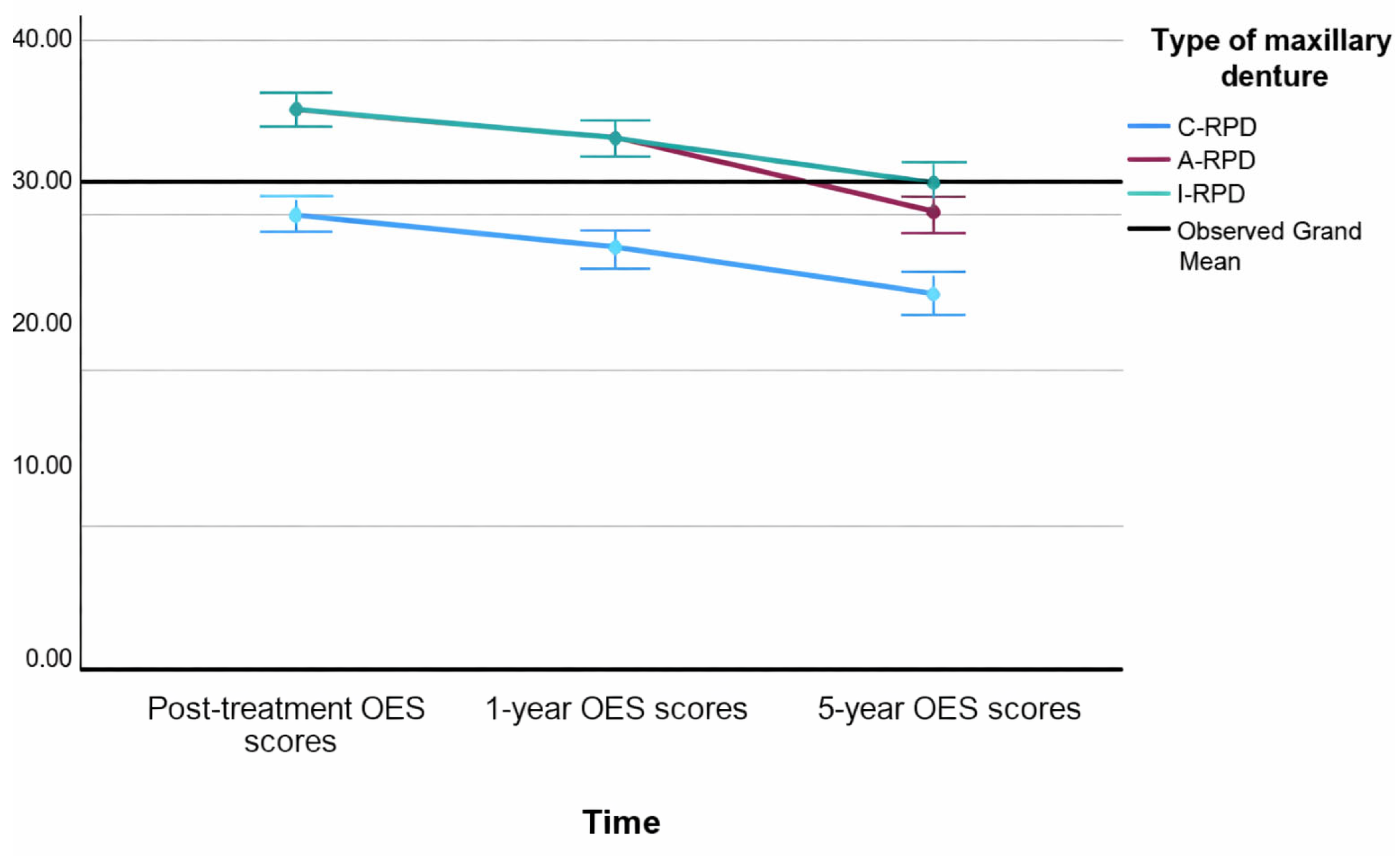
3.1. Esthetic Outcomes (OES)
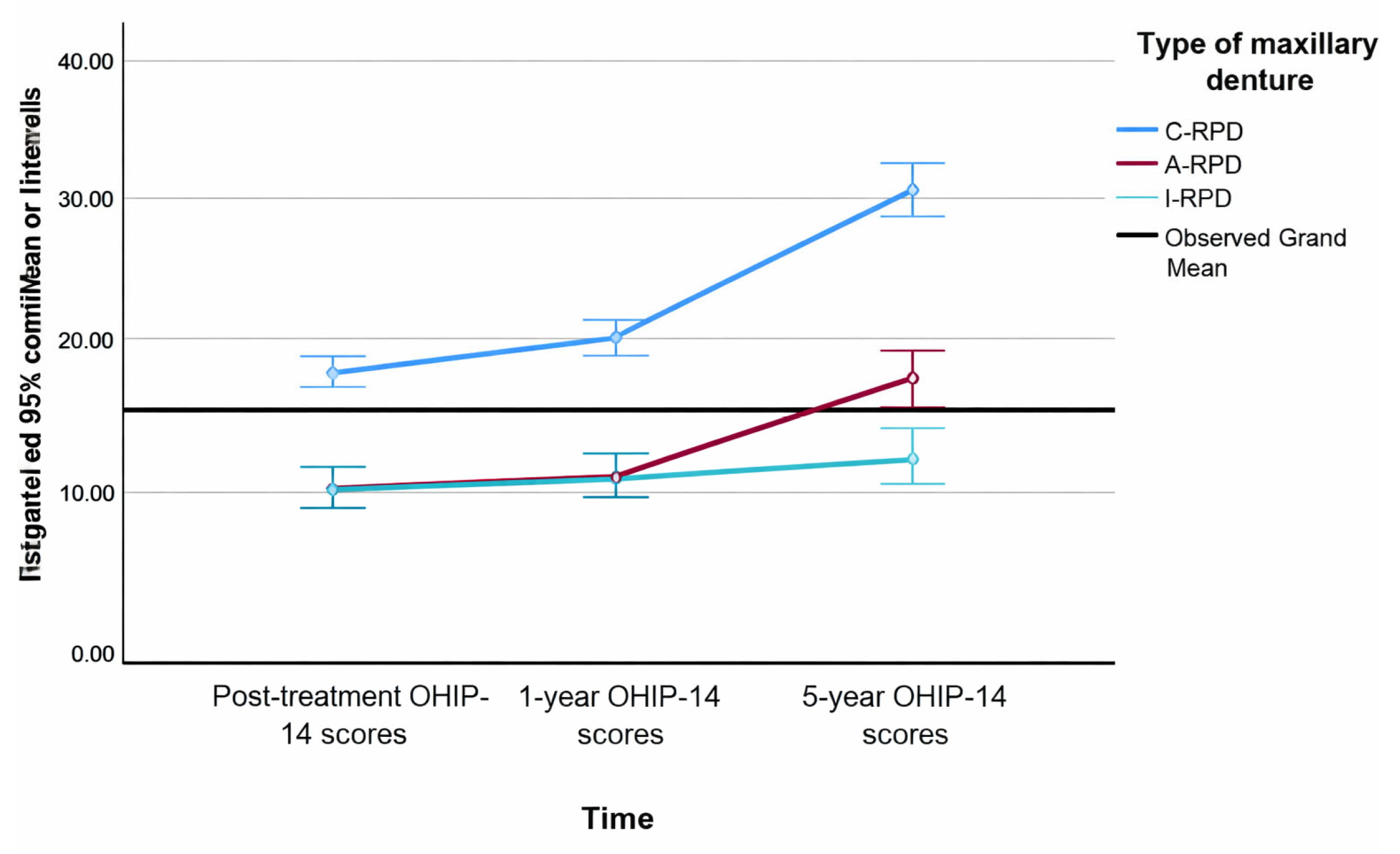
3.2. Oral Health-Related Quality of Life (OHIP-14)
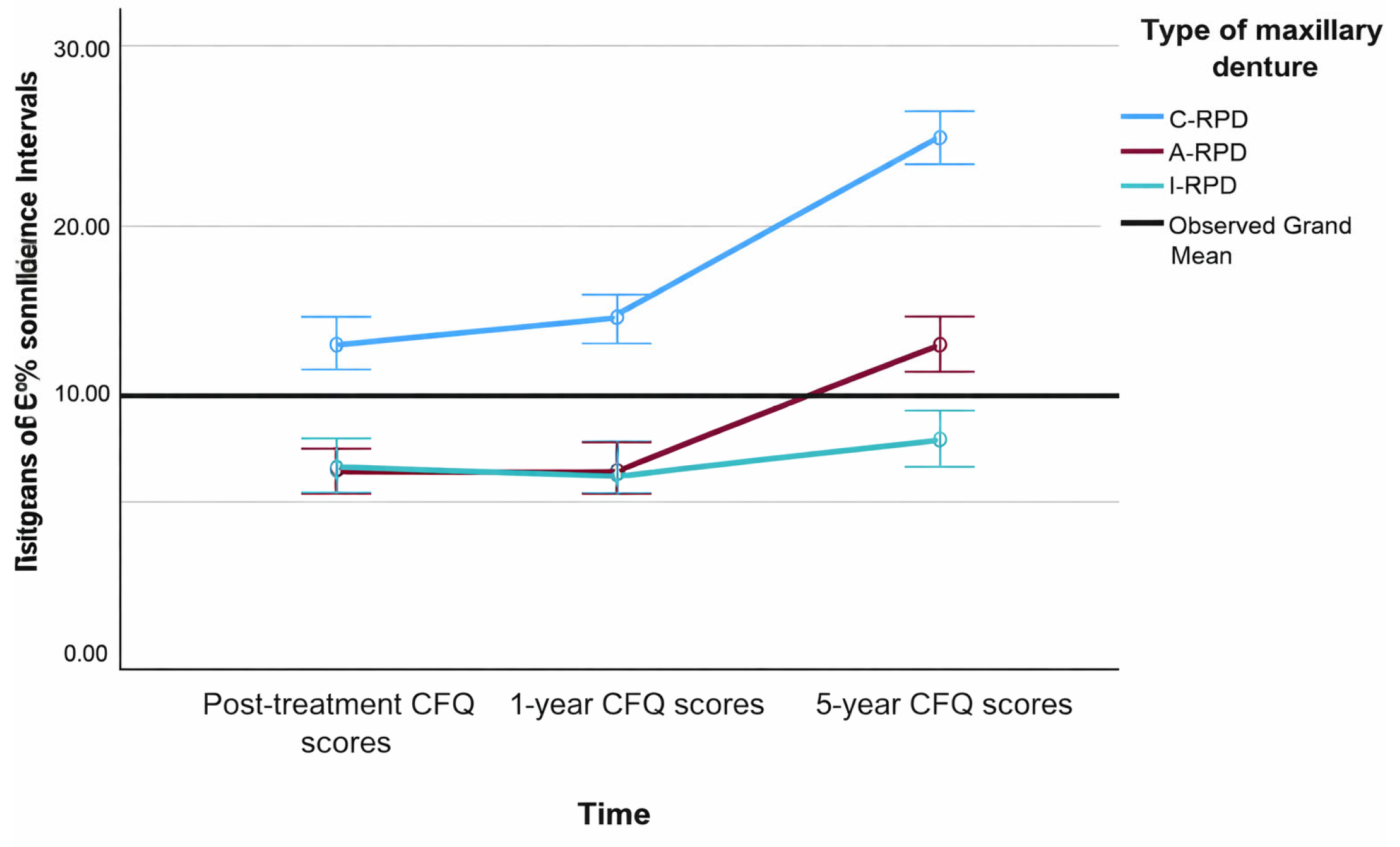
3.3. Chewing Function (CFQ)
3.4. Clinical Maintenance During Follow-Up
4. Discussion
5. Conclusions
Author Contributions
Funding
Institutional Review Board Statement
Informed Consent Statement
Data Availability Statement
Conflicts of Interest
Abbreviations
| OES | Orofacial Esthetic Scale |
| OHRQoL | Oral Health Related Quality of Life |
| OHIP-14 | Oral Health Impact Profile |
| C-RPD | Clasp-retained removable partial denture |
| A-RPD | Attachment-retained removable partial denture |
| I-RPD | Implant retained removable partial denture |
| d-PROMs | Dental patient-reported outcome measures |
| CFQ | Chewing Function Questionnaire |
References
- John, M.T.; Reissmann, D.R.; Feuerstahler, L.; Waller, N.; Baba, K.; Larsson, P.; Čelebić, A.; Szabo, G.; Rener-Sitar, K. Exploratory factor analysis of the Oral Health Impact Profile. J. Oral Rehabil. 2014, 41, 635–643. [Google Scholar] [CrossRef] [Scilit] [PubMed]
- John, M.T.; Feuerstahler, L.; Waller, N.; Baba, K.; Larsson, P.; Čelebić, A.; Kende, D.; Rener-Sitar, K.; Reissmann, D.R. Confirmatory factor analysis of the Oral Health Impact Profile. J. Oral Rehabil. 2014, 4, 644–652. [Google Scholar] [CrossRef] [Scilit] [PubMed]
- Hirata, R.; Sampaio, C.S.; de Andrade, O.S.; Kina, S.; Goldstein, R.E.; Ritter, A.V. Quo vadis, esthetic dentistry? Ceramic veneers and overtreatment-A cautionary tale. J. Esthet. Restor. Dent. 2022, 34, 7–14. [Google Scholar] [CrossRef] [Scilit] [PubMed]
- Topić, J.; Poljak-Guberina, R.; Persic Kirsic, S.; Kovacic, I.; Petricevic, N.; Popovac, A.; Čelebić, A. Adaptation to New Dentures and 5 Years of Clinical Use: A Comparison between Complete Denture and Mini-implant Mandibular Overdenture Patients based on Oral Health-Related Quality of Life (OHRQoL) and Orofacial Esthetics. Acta Stomatol. Croat. 2022, 56, 132–142. [Google Scholar] [CrossRef] [Scilit]
- Larsson, P.; Bondemark, L.; Häggman-Henrikson, B. The impact of oro-facial appearance on oral health-related quality of life: A systematic review. J. Oral Rehabil. 2021, 48, 271–281. [Google Scholar] [CrossRef] [Scilit]
- Disha, V.; Čelebić, A.; Peršić, S.; Papić, M.; Rener-Sitar, K. Orofacial esthetics, chewing function, and oral health-related quality of life in Kennedy class I patients with mini-implant-retained removable partial dentures: A 3-year clinical prospective study. Clin. Oral Investig. 2024, 28, 393, Erratum in Clin. Oral Investig. 2024, 28, 353. https://doi.org/10.1007/s00784-024-05741-z. PMID: 38910229. [Google Scholar] [CrossRef] [Scilit]
- Campos, L.A.; Campos, J.A.D.B.; Marôco, J.; Peltomäki, T. Aesthetic dental treatment, orofacial appearance, and life satisfaction of Finnish and Brazilian adults. PLoS ONE 2023, 18, e0287235. [Google Scholar] [CrossRef] [Scilit]
- van Sambeek, R.M.F.; de Vos, R.; Crins, L.A.M.J.; Bronkhorst, E.; Mehta, S.B.; Pereira-Cenci, T.; Loomans, B.A.C. Perception of oral health-related quality of life and orofacial aesthetics following restorative treatment of tooth wear: A five-year follow-up. J. Dent. 2023, 136, 104626. [Google Scholar] [CrossRef] [Scilit]
- Čelebić, A.; Knezović-Zlatarić, D. A comparison of patient’s satisfaction between complete and partial removable denture wearers. J. Dent. 2003, 31, 445–451. [Google Scholar] [CrossRef] [Scilit]
- Silva, B.N.S.; Campos, L.A.; Martins, B.G.; Marôco, J.; Peltomäki, T.; Campos, J.A.D.B. Measuring concern about smile appearance among adults. Eur. J. Orthod. 2024, 46, cjae053. [Google Scholar] [CrossRef] [Scilit]
- Peršić, S.; Čelebić, A. Influence of different prosthodontic rehabilitation options on oral health-related quality of life, orofacial esthetics and chewing function based on patient-reported outcomes. Qual. Life Res. 2015, 24, 919–926. [Google Scholar] [CrossRef] [Scilit] [PubMed]
- Santos, L.G.; Jardim, L.C.; Schuch, L.F.; Silveira, F.M.; Wagner, V.P.; Pires, F.R.; Santos, J.N.D.; Martins, M.D. Foreign body reactions related to orofacial esthetic fillers: A systematic review. Oral Dis. 2024, 30, 855–864. [Google Scholar] [CrossRef] [Scilit] [PubMed]
- Paulson, D.R.; Chanthavisouk, P.; John, M.T.; Feuerstahler, L.; Chen, X.; Ingleshwar, A. Linking patient-reported oral and general health-related quality of life. PeerJ 2024, 12, e17440. [Google Scholar] [CrossRef] [Scilit] [PubMed]
- Carlsson, V.; Hakeberg, M.; Blomkvist, K.; Wide Boman, U. Orofacial esthetics and dental anxiety: Associations with oral and psychological health. Acta Odontol. Scand. 2014, 72, 707–713. [Google Scholar] [CrossRef] [Scilit]
- Sáez-Alcaide, L.M.; Cortés-Bretón-Brinkmann, J.; Sánchez-Labrador, L.; Pérez-González, F.; Forteza-López, A.; Molinero-Mourelle, P.; López-Quiles, J. Patient-reported outcomes in patients with severe maxillary bone atrophy restored with zygomatic implant-supported complete dental prostheses: A systematic review. Acta Odontol. Scand. 2022, 80, 363–373. [Google Scholar] [CrossRef] [Scilit]
- Alhajj, M.N.; Ariffin, Z.; Čelebić, A.; Alkheraif, A.A.; Amran, A.G.; Ismail, I.A. Perception of orofacial appearance among laypersons with diverse social and demographic status. PLoS ONE 2020, 15, e0239232. [Google Scholar] [CrossRef] [Scilit]
- Peršić, S.; Kranjčić, J.; Pavičić, D.K.; Mikić, V.L.; Čelebić, A. Treatment outcomes based on patients’ self-reported measures after receiving new clasp or precision attachment-retained removable partial dentures. J. Prosthodont. 2017, 26, 115–122. [Google Scholar] [CrossRef] [Scilit]
- Lang, N.P.; Zitzmann, N.U. Clinical research in implant dentistry: Evaluation of implant-supported restorations, aesthetic and patient-reported outcomes. J. Clin. Periodontol. 2012, 39 (Suppl. S12), 133–138. [Google Scholar] [CrossRef] [Scilit]
- Wang, Y.; Bäumer, D.; Ozga, A.K.; Körner, G.; Bäumer, A. Patient satisfaction and oral health-related quality of life 10 years after implant placement. BMC Oral Health 2021, 21, 30. [Google Scholar] [CrossRef] [Scilit]
- Ellakany, P.; Fouda, S.M.; Alghamdi, M.; Bakhurji, E. Factors affecting dental self-confidence and satisfaction with dental appearance among adolescents in Saudi Arabia: A cross-sectional study. BMC Oral Health 2021, 21, 149. [Google Scholar] [CrossRef] [Scilit]
- Boukhris, H.; Zidani, H.; Bouslama, G.; Bel Haj Salah, K.; BenYoussef, S. Long-term patient satisfaction and oral health-related quality of life following anterior maxillary implant placement: A five-year follow-up study. Eur. J. Dent. 2025. [Google Scholar] [CrossRef] [Scilit] [PubMed]
- Kudsi, Z.; Fenlon, M.R.; Baysan, A. Do tooth loss and dentures cause body image disturbance? Int. J. Prosthodont. 2022, 35, 609–615. [Google Scholar] [CrossRef] [Scilit] [PubMed]
- Baran, I.; Ergün, G.; Semiz, M. Socio-demographic and economic factors affecting the acceptance of removable dentures. Eur. J. Dent. 2007, 1, 104–110. [Google Scholar] [CrossRef] [Scilit] [PubMed]
- Douglass, C.W.; Watson, A.J. Future needs for fixed and removable partial dentures in the United States. J. Prosthet. Dent. 2002, 87, 9–14. [Google Scholar] [CrossRef] [Scilit]
- Kim, J.J. Revisiting the removable partial denture. Dent. Clin. N. Am. 2019, 63, 263–278. [Google Scholar] [CrossRef] [Scilit]
- Yoshimoto, T.; Hasegawa, Y.; Salazar, S.; Kikuchi, S.; Hori, K.; Ono, T. Factors affecting masticatory satisfaction in patients with removable partial dentures. Int. J. Environ. Res. Public Health 2021, 18, 6620. [Google Scholar] [CrossRef] [Scilit]
- Lemos, C.A.A.; Nunes, R.G.; Santiago-Júnior, J.F.; Gomes, J.M.d.L.; Limirio, J.P.J.O.; Rosa, C.D.D.R.; Verri, F.R.; Pellizzer, E.P. Are implant-supported removable partial dentures a suitable treatment for partially edentulous patients? A systematic review and meta-analysis. J. Prosthet. Dent. 2023, 129, 538–546. [Google Scholar] [CrossRef] [Scilit]
- Zlatarić, D.K.; Čelebić, A. Treatment outcomes with removable partial dentures: A comparison between patient and prosthodontist assessments. Int. J. Prosthodont. 2001, 14, 423–426. [Google Scholar]
- Shaha, M.; Varghese, R.; Atassi, M. Understanding the impact of removable partial dentures on patients’ lives and their attitudes to oral care. Br. Dent. J. 2021, 1–6. [Google Scholar] [CrossRef] [Scilit]
- Ali, Z.; Baker, S.R.; Shahrbaf, S.; Martin, N.; Vettore, M.V. Oral health-related quality of life after prosthodontic treatment for patients with partial edentulism: A systematic review and meta-analysis. J. Prosthet. Dent. 2019, 121, 59–68.e3. [Google Scholar] [CrossRef] [Scilit]
- Choong, E.K.M.; Shu, X.; Leung, K.C.M.; Lo, E.C.M. Oral health-related quality of life (OHRQoL) after rehabilitation with removable partial dentures (RPDs): A systematic review and meta-analysis. J. Dent. 2022, 127, 104351. [Google Scholar] [CrossRef] [Scilit]
- Campos Sugio, C.Y.; Mosquim, V.; Jacomine, J.C.; Zabeu, G.S.; de Espíndola, G.G.; Bonjardim, L.R.; Bonfante, E.A.; Wang, L. Impact of rehabilitation with removable complete or partial dentures on masticatory efficiency and quality of life: A cross-sectional mapping study. J. Prosthet. Dent. 2022, 128, 1295–1302. [Google Scholar] [CrossRef] [Scilit] [PubMed]
- Hayashi, Y.; Inamochi, Y.; Wakabayashi, N. Minimal clinically important differences of oral health-related quality of life after removable partial denture treatments. J. Dent. 2020, 92, 103246. [Google Scholar] [CrossRef] [Scilit] [PubMed]
- Kurosaki, Y.; Kimura-Ono, A.; Mino, T.; Arakawa, H.; Koyama, E.; Nakagawa, S.; Nguyen, H.T.T.; Osaka, S.; Saeki, M.; Minakuchi, H.; et al. Six-year follow-up assessment of prosthesis survival and oral health-related quality of life in individuals with partial edentulism treated with three types of prosthodontic rehabilitation. J. Prosthodont. Res. 2021, 65, 332–339. [Google Scholar] [CrossRef] [Scilit] [PubMed]
- Curado, T.F.F.; Nascimento, L.N.; Silva, J.R.; de Paula, M.S.; Schimmel, M.; McKenna, G.; Leles, C.R. Mandibular overdenture retained by four one-piece titanium-zirconium mini implants: A 2-year RCT on patient-reported outcomes. J. Dent. 2024, 149, 105267. [Google Scholar] [CrossRef] [Scilit]
- Van de Winkel, T.; Heijens, L.; Listl, S.; Meijer, G. What is the evidence on the added value of implant-supported overdentures? A review. Clin. Implant Dent. Relat. Res. 2021, 23, 644–656. [Google Scholar] [CrossRef] [Scilit]
- Larsson, P.; John, M.T.; Nilner, K.; Bondemark, L.; List, T. Development of an Orofacial Esthetic Scale in prosthodontic patients. Int. J. Prosthodont. 2010, 23, 249–256. [Google Scholar]
- Larsson, P.; John, M.T.; Nilner, K.; List, T. Reliability and validity of the Orofacial Esthetic Scale in prosthodontic patients. Int. J. Prosthodont. 2010, 23, 257–262. [Google Scholar]
- Peršić, S.; Palac, A.; Bunjevac, T.; Čelebić, A. Development of a new chewing function questionnaire for assessment of a self-perceived chewing function. Community Dent. Oral Epidemiol. 2013, 41, 565–573. [Google Scholar] [CrossRef] [Scilit]
- Dula, L.J.; Kelmendi, T.Z.; Shala, K.; Staka, G.; Pustina-Krasniqi, T.; Kosumi, S. Attachment-Retained versus Clasp-Retained Removable Partial Dentures: Effects of Retention on Patient Satisfaction. Eur. J. Dent. 2025, 19, 823–834. [Google Scholar] [CrossRef] [Scilit]
- Alqutaibi, A.Y. A within-subject comparison of the conventional clasp-retained with attachment-retained removable partial dentures. J. Taibah Univ. Med. Sci. 2020, 15, 305–311. [Google Scholar] [CrossRef] [Scilit]
- Disha, V.; Čelebić, A.; Rener-Sitar, K.; Kovačić, I.; Filipović-Zore, I.; Peršić, S. Mini dental implant-retained removable partial dentures: Treatment effect size and 6-months follow-up. Acta Stomatol. Croat. 2018, 52, 184–192. [Google Scholar] [CrossRef] [Scilit]
- Awawdeh, M.; Alotaibi, M.B.; Alharbi, A.H.; Alnafisah, S.A.; Alasiri, T.S.; Alrashidi, N.I. A systematic review of patient satisfaction with removable partial dentures (RPDs). Cureus 2024, 16, e51793. [Google Scholar] [CrossRef] [Scilit] [PubMed]
- Park, J.H.; Lee, J.Y.; Shin, S.W.; Kim, H.J. Effect of conversion to implant-assisted removable partial denture in patients with mandibular Kennedy classification I: A systematic review and meta-analysis. Clin. Oral Implant. Res. 2020, 31, 360–373. [Google Scholar] [CrossRef] [Scilit] [PubMed]
- Santos, N.R.; Dal Piva, A.O.; Borges, A.L.; da Silva, J.M. Mechanical behavior of implant-assisted removable partial denture for Kennedy class II. J. Clin. Exp. Dent. 2020, 12, e38–e45. [Google Scholar] [CrossRef] [Scilit]
- Bortolini, S.; Natali, A.; Franchi, M.; Coggiola, A.; Consolo, U. Implant-retained removable partial dentures: An 8-year retrospective study. J. Prosthodont. 2011, 20, 168–172. [Google Scholar] [CrossRef] [Scilit]
- Omura, A.J.; Latthe, V.; Marin, M.M.; Cagna, D.R. Implant-assisted removable partial dentures: Practical considerations. Gen. Dent. 2016, 64, 38–45. [Google Scholar]
- Abou-Ayash, S.; Rudaz, A.C.; Janner, S.; Kraus, D.; Schimmel, M.; Enkling, N. Converting bilateral free-end removable partial dentures to implant-assisted removable partial dentures using 6 mm short implants: Patient-reported outcomes of a prospective clinical study. Int. J. Environ. Res. Public Health 2022, 19, 8998. [Google Scholar] [CrossRef] [Scilit]
- Cawood, J.I.; Howell, R.A. A classification of the edentulous jaws. Int. J. Oral Maxillofac. Surg. 1988, 17, 232–236. [Google Scholar] [CrossRef] [Scilit]
- Čelebić, A.; Kovačić, I.; Petričević, N.; Puljić, D.; Popovac, A.; Kiršić, S.P. Mini-implants retaining removable partial dentures in subjects without posterior teeth: A 5-year prospective study comparing the maxilla and the mandible. Medicina 2023, 59, 237. [Google Scholar] [CrossRef] [Scilit]
- Kullar, A.S.; Miller, C.S. Are there contraindications for placing dental implants? Dent. Clin. N. Am. 2019, 63, 345–362. [Google Scholar] [CrossRef] [Scilit] [PubMed]
- Peršić, S.; Milardović, S.; Mehulic, K.; Čelebić, A. Psychometric properties of the Croatian version of the Orofacial Esthetic Scale and suggestions for modification. Int. J. Prosthodont. 2011, 24, 523–533. [Google Scholar] [PubMed]
- Rener-Sitar, K.; Petričević, N.; Čelebić, A.; Marion, L. Psychometric properties of Croatian and Slovenian short form of oral health impact profile questionnaires. Croat. Med. J. 2008, 49, 536–544. [Google Scholar] [CrossRef] [Scilit] [PubMed]
- Waller, N.; John, M.T.; Feuerstahler, L.; Baba, K.; Larsson, P.; Peršić, S.; Kende, D.; Reißmann, D.R.; Rener-Sitar, K. A 7-day recall period for a clinical application of the oral health impact profile questionnaire. Clin. Oral Investig. 2016, 20, 91–99. [Google Scholar] [CrossRef] [Scilit]
- Cohen, J. Statistical Power Analysis for the Behavioral Sciences, 2nd ed.; Lawrence Erlbaum Associates: Hillsdale, NJ, USA, 1988; pp. 273–407. [Google Scholar]
- John, M.T.; Sekulić, S.; Bekes, K.; Al-Harthy, M.H.; Michelotti, A.; Reissmann, D.R.; Nikolovska, J.; Sanivarapu, S.; Lawal, F.B.; List, T.; et al. Why patients visit dentists—A study in all World Health Organization regions. J. Evid. Based Dent. Pract. 2020, 20, 101459. [Google Scholar] [CrossRef] [Scilit]
- Bors, A.; Szekely, M.; Beresescu, L.; Maier, A.; Beresescu, F. Patient Satisfaction and Perception with Digital Complete Dentures Compared to Conventional Complete Dentures—A Pilot Study. Dent. J. 2025, 13, 291. [Google Scholar] [CrossRef] [Scilit]
- Seki, K.; Shiratsuchi, K.; Toki, A.; Kamimoto, A.; Hagiwara, Y. Novel Esthetic Technique for Restoring Dental Implant Access Holes: A Case. Report. Dent. J. 2025, 13, 53. [Google Scholar] [CrossRef] [Scilit]
- Knezović Zlatarić, D.; Soldo, M. Considerations for conservative, all-ceramic prosthodontic single-tooth replacements in the anterior region: A systematic review. Dent. J. 2025, 13, 219. [Google Scholar] [CrossRef] [Scilit]
- Lamorgese, M.; Veiga, N.; Correia, M.J.; Gomes, A.T.P.C.; Lopes, S.; Lopes-Rocha, L.; Fidalgo-Pereira, R.; Lopes, P.C. White spot lesion treatment options: A systematic review of different techniques for masking these lesions. Gels 2025, 11, 371. [Google Scholar] [CrossRef] [Scilit]
- Verde, T.C.; de Melo Ferreira, G.M.L.B.; Favoreto, M.W.; de Souza Carneiro, T.; Muniz, R.S.C.; Reis, A.; Cardenas, A.F.M.; Loguercio, A.D.; de Siqueira, F.S.F. Impact of the in-office bleaching gels pH on tooth sensitivity in combined bleaching techniques: A randomized clinical trial. Clin. Oral Investig. 2025, 29, 256. [Google Scholar] [CrossRef] [Scilit]
- Araujo, E.; Perdigão, J. Anterior veneer restorations—An evidence-based minimal-intervention perspective. J. Adhes. Dent. 2021, 23, 91–110. [Google Scholar] [CrossRef] [Scilit] [PubMed]
- Lassmann, Ł.; Calamita, M.A.; Blatz, M.B. The “Smile Design and Space” concept for altering vertical dimension of occlusion and esthetic restorative material selection. J. Esthet. Restor. Dent. 2025, 37, 56–67. [Google Scholar] [CrossRef] [Scilit] [PubMed]
- Dos Santos, R.B.; Collares, K.; Brandeburski, S.B.N.; Pecho, O.E.; Della Bona, A. Experimental methodologies to evaluate the masking ability of dental materials: A systematic review. J. Esthet. Restor. Dent. 2021, 33, 1118–1131. [Google Scholar] [CrossRef] [Scilit] [PubMed]
- Anitua, E.; Tarazona, A.; Alkhraisat, M.H. Retrospective Study of Functional and Esthetic Outcomes Using Narrow-Diameter Implants for Single Upper Central Incisor Replacements. Dent. J. 2025, 13, 144. [Google Scholar] [CrossRef] [Scilit]
- Jantea, A.; Mihali, S.G.; Lolos, D.; Tudor, A.; Oancea, R.; Porojan, L. Immediate Patient Satisfaction with Dental Esthetics After Endodontic and Prosthodontic Treatment of Dental Dyschromia. Dent. J. 2025, 13, 44. [Google Scholar] [CrossRef] [Scilit]
- Migliorati, M.; Zuffanti, A.; Capuano, M.; Canullo, L.; Caponio, V.C.A.; Menini, M. Periodontal, occlusal, and aesthetic outcomes of missing maxillary lateral incisor replacement: A systematic review and network meta-analysis. Int. Orthod. 2025, 23, 100957. [Google Scholar] [CrossRef] [Scilit]
- Odersjö, M.L.; Johansson, L.; Robertson, A.; Sabel, N. Self-reported oral health-related quality of life and orofacial esthetics among young adults with treated dental trauma. Clin. Exp. Dent. Res. 2025, 11, e70068. [Google Scholar] [CrossRef] [Scilit]
- Qaraghuli, A.M.; Signore, A.; Benedicenti, S.; Halawani, M.T.E.; Solimei, L. Comparison and effect of common beverages on color stability of different esthetic restorative materials: An in vitro study. J. Contemp. Dent. Pract. 2022, 23, 1085–1090. [Google Scholar] [CrossRef] [Scilit]
- Alam, M.K.; Alsharari, A.H.L.; Shayeb, M.A.L.; Alogaibi, Y.A. Macroesthetics in orthodontics—A systematic review and meta-analysis. J. Orthod. Sci. 2025, 14, 12. [Google Scholar] [CrossRef] [Scilit]
- Agarwal, S.; Sachdev, S.S.; Mistry, L.N.; Agrawal, S.; Deshpande, S.; Sharma, V.; Thorat, R. Soft tissue management in implant dentistry: A comprehensive review. Cureus 2025, 17, e79557. [Google Scholar] [CrossRef] [Scilit]
- Shafaee, H.; Shahnaseri, S.; Ghorbani, M.; Bardideh, E.; Mousavi, S.A.; Akyalcin, S. The use of clear aligners for orthognathic surgery: A systematic review. J. Oral Maxillofac. Surg. 2025, 83, 813–831. [Google Scholar] [CrossRef] [Scilit] [PubMed]
- Favoreto, M.W.; Wendlinger, M.; Jiménez-Díez, D.; Ceballos, L.; Loguercio, A.D. Impact of bleaching on white spot lesions: Hydrogen peroxide permeability and color alteration. Clin. Oral Investig. 2025, 29, 401. [Google Scholar] [CrossRef] [Scilit] [PubMed]
- Zhu, R.; Zhang, Z.; Yan, Z.; Yi, X.; Zheng, Y.; Zhan, M.; Pei, Y.; Xiong, X.; Yu, H. Region of chief complaint is associated with aesthetic expectation in prosthodontic patients: A cross-sectional study. J. Oral Rehabil. 2025, 52, 701–711. [Google Scholar] [CrossRef] [Scilit] [PubMed]
- Oreški, N.P.; Čelebić, A.; Petričević, N. Assessment of esthetic characteristics of the teeth and surrounding anatomical structures. Acta Stomatol. Croat. 2017, 51, 22–32. [Google Scholar] [CrossRef] [Scilit]
- Awad, M.A.; Alghamdi, D.S.; Alghamdi, A.T. Visible portion of anterior teeth at rest and analysis of different smile characteristics in the Saudi population of the Jeddah region. Int. J. Dent. 2020, 2020, 8859376. [Google Scholar] [CrossRef] [Scilit]
- Alikhasi, M.; Yousefi, P.; Afrashtehfar, K.I. Smile design: Mechanical considerations. Dent. Clin. N. Am. 2022, 66, 477–487. [Google Scholar] [CrossRef] [Scilit]
- Mendoza-Carrasco, I.; Hotta, J.; Sugio, C.Y.C.; Procópio, A.L.F.; Urban, V.M.; Mosquim, V.; Foratori-Junior, G.A.; Soares, S.; Neppelenbroek, K.H. Nonmetal clasp dentures: What is the evidence about their use? J. Indian Prosthodont. Soc. 2020, 20, 278–284. [Google Scholar] [CrossRef] [Scilit]
- Korać, S.; Ajanović, M.; Džanković, A.; Konjhodžić, A.; Hasić-Branković, L.; Gavranović-Glamoč, A.; Tahmiščija, I. Color stability of dental composites after immersion in beverages and performed whitening procedures. Acta Stomatol. Croat. 2022, 56, 22–32. [Google Scholar] [CrossRef] [Scilit]
- Valenti, C.; Isabella Federici, M.; Masciotti, F.; Marinucci, L.; Xhimitiku, I.; Cianetti, S.; Pagano, S. Mechanical properties of 3D printed prosthetic materials compared with milled and conventional processing: A systematic review and meta-analysis of in vitro studies. J. Prosthet. Dent. 2024, 132, 381–391. [Google Scholar] [CrossRef] [Scilit]
- Alhajj, M.N.; Halboub, E.; Yacob, N.; Al-Maweri, S.A.; Ahmad, S.F.; Čelebić, A.; Al-Mekhlafi, H.M.; Salleh, N.M. Adhesion of Candida albicans to digital versus conventional acrylic resins: A systematic review and meta-analysis. BMC Oral Health 2024, 24, 303. [Google Scholar] [CrossRef] [Scilit]
- Abuljadayel, R.; Mushayt, A.; Al Mutairi, T.; Sajini, S. Evaluation of bioactive restorative materials’ color stability: Effect of immersion media and thermocycling. Cureus 2023, 15, e43038. [Google Scholar] [CrossRef] [Scilit] [PubMed]
- Chuang, P.E.; Chen, F.N.; Shieh, T.M.; Chuang, C.C.; Wei, C.; Nikawa, H.; Peng, T.Y. Aging performance and bacteria adhesion of 3D-printed, CAD/CAM-milled, and conventional definitive denture resins. J. Prosthodont. Res. 2025, in press. [Google Scholar] [CrossRef] [Scilit] [PubMed]
- Li, X.C.; Bidra, A.S. A technique for improved gingival esthetics on complete arch implant-supported acrylic resin prototype prosthesis. J. Prosthet. Dent. 2023, 130, 160–163. [Google Scholar] [CrossRef] [Scilit] [PubMed]
- Lukež, A.; Katić, V.; Lauš, I.; Grbeša, M.; Špalj, S. Frequency, context and characteristics of smile used in advertising. Acta Stomatol. Croat. 2017, 51, 41–47. [Google Scholar] [CrossRef] [Scilit]
- Poplašen, L.M.; Marelić, M.; Vukušić Rukavina, T. Differences between Doctors of Dental Medicine and Doctors of Medicine Awareness of Their Online Image and Perception Concerns: A Quantitative Cross-Sectional Study. Acta Stomatol. Croat. 2024, 58, 291–304. [Google Scholar] [CrossRef] [Scilit]
- Xiao, Z.; Chen, G.; Zhao, Y.; Wang, Y.; Gu, Y. Perceptual difference of smile aesthetics between 2-dimensional photographs and 3-dimensional dentofacial images: A cross-sectional study. BMC Oral Health 2023, 23, 104. [Google Scholar] [CrossRef] [Scilit]
- Selvakumar, D.; Seenivasan, M.K.; Natarajan, S.; Natarajan, P.; Saravanakumar, P. Evaluation and comparison of the effects of persulfate containing and persulfate-free denture cleansers on acrylic resin teeth stained with cigarette smoke: An in vitro study. Cureus 2020, 12, e7318. [Google Scholar] [CrossRef] [Scilit]
- Allen, F. Pragmatic care for an aging compromised dentition. Aust. Dent. J. 2019, 64 (Suppl. S1), S63–S70. [Google Scholar] [CrossRef] [Scilit]
- Panek, H.; Krawczykowska, H.; Dobosz, A.; Napadłek, P.; Panek, B.A.; Sosna-Gramza, M. Follow-up visits as a measure of adaptation process to removable prostheses. Gerodontology 2006, 23, 87–92. [Google Scholar] [CrossRef] [Scilit]
- Hawkins, C.H.; Sterrett, J.D.; Murphy, H.J.; Thomas, J.C. Ridge contour related to esthetics and function. J. Prosthet. Dent. 1991, 66, 165–168. [Google Scholar] [CrossRef] [Scilit]
- Müller, F. Interventions for edentate elders—What is the evidence? Gerodontology 2014, 31, 44–51. [Google Scholar] [CrossRef] [Scilit] [PubMed]
- Jensen, C.; Speksnijder, C.M.; Raghoebar, G.M.; Kerdijk, W.; Meijer, H.J.A.; Cune, M.S. Implant-supported mandibular removable partial dentures: Functional, clinical and radiographical parameters in relation to implant position. Clin. Implant Dent. Relat. Res. 2017, 19, 432–439. [Google Scholar] [CrossRef] [Scilit] [PubMed]
- Abou-Ayash, S.; Fonseca, M.; Pieralli, S.; Reissmann, D.R. Treatment effect of implant-supported fixed complete dentures and implant overdentures on patient-reported outcomes: A systematic review and meta-analysis. Clin. Oral Implant. Res. 2023, 34 (Suppl. S26), 177–195. [Google Scholar] [CrossRef] [Scilit] [PubMed]
- Putra Wigianto, A.Y.; Goto, T.; Iwawaki, Y.; Ishida, Y.; Watanabe, M.; Ichikawa, T. Treatment outcomes of implant-assisted removable partial denture with distal extension based on the Kennedy classification and attachment type: A systematic review. Int. J. Implant Dent. 2021, 7, 111. [Google Scholar] [CrossRef] [Scilit]
- Sasaki, M.; Sawase, T. Implant-assisted removable partial dentures: Part I. A scoping review of clinical applications. J. Prosthodont. Res. 2024, 68, 20–39. [Google Scholar] [CrossRef] [Scilit]
- Kuroshima, S.; Sasaki, M.; Al-Omari, F.A.; Uto, Y.; Ohta, Y.; Uchida, Y.; Sawase, T. Implant-assisted removable partial dentures: Part II. A systematic review of the effects of implant position on the biomechanical behavior. J. Prosthodont. Res. 2024, 68, 40–49. [Google Scholar] [CrossRef] [Scilit]
- Bandiaky, O.N.; Lokossou, D.L.; Soueidan, A.; Le Bars, P.; Gueye, M.; Mbodj, E.B.; Le Guéhennec, L. Implant-supported removable partial dentures compared to conventional dentures: A systematic review and meta-analysis of quality of life, patient satisfaction, and biomechanical complications. Clin. Exp. Dent. Res. 2022, 8, 294–312. [Google Scholar] [CrossRef] [Scilit]
- Rungsiyakull, P.; Kujarearntaworn, K.; Khongkhunthian, P.; Swain, M.; Rungsiyakull, C. Effect of the location of dental mini-implants on strain distribution under mandibular Kennedy Class I implant-retained removable partial dentures. Int. J. Dent. 2021, 2021, 6688521. [Google Scholar] [CrossRef] [Scilit]
- Al Jaghsi, A.; Mundt, T. Upgrading removable denture design by using strategic implants: A case report. Ann. Anat. 2023, 245, 152002. [Google Scholar] [CrossRef] [Scilit]
- Mundt, T.; Al Jaghsi, A.; Schwahn, B.; Hilgert, J.; Lucas, C.; Biffar, R.; Schwahn, C.; Heinemann, F. Immediate versus delayed loading of strategic mini dental implants for the stabilization of partial removable dental prostheses: A patient cluster randomized, parallel-group 3-year trial. BMC Oral Health 2016, 17, 30. [Google Scholar] [CrossRef] [Scilit]
- Mundt, T.; Heinemann, F.; Müller, J.; Schwahn, C.; Al Jaghsi, A. Survival and stability of strategic mini-implants with immediate or delayed loading under removable partial dentures: A 3-year randomized controlled clinical trial. Clin. Oral Investig. 2023, 27, 1767. [Google Scholar] [CrossRef] [Scilit]
- Mundt, T.; Al Jaghsi, A.; Heinemann, F.; Schwahn, C. Mini-implant placement under existing removable partial dentures decreased the mobility of remaining teeth in a randomized controlled 3-year clinical trial. Clin. Oral Investig. 2025, 29, 266. [Google Scholar] [CrossRef] [Scilit]
- Al Jaghsi, A.; Heinemann, F.; Biffar, R.; Mundt, T. Immediate versus delayed loading of strategic mini-implants under existing removable partial dentures: Patient satisfaction in a multi-center randomized clinical trial. Clin. Oral Investig. 2021, 25, 255. [Google Scholar] [CrossRef] [Scilit]
- Mundt, T.; Schwahn, C.; Heinemann, F.; Schimmel, M.; Lucas, C.; Al Jaghsi, A. Stabilizing Removable Partial Dentures by Immediate or Delayed Loading of Mini-implants: Chewing Efficiency in a Randomized Controlled Clinical Trial. Int. J. Oral Maxillofac. Implant. 2020, 35, 178. [Google Scholar] [CrossRef] [Scilit]



| a. | ||||||
|---|---|---|---|---|---|---|
| Orofacial Esthetic Scale (OES; 8–40) | ||||||
| Time Point | Treatment Group | N | Mean | SD | Min | Max |
| Pre-treatment | C-RPD | 30 | 23.00 | 4.32 | 15.00 | 30.00 |
| A-RPD | 31 | 22.10 | 4.64 | 10.00 | 33.00 | |
| I-RPD | 27 | 21.41 | 3.19 | 16.00 | 28.00 | |
| Post-treatment | C-RPD | 30 | 30.33 | 3.21 | 25.00 | 39.00 |
| A-RPD | 31 | 36.45 | 3.01 | 29.00 | 40.00 | |
| I-RPD | 27 | 36.56 | 1.97 | 32.00 | 39.00 | |
| 1-year follow-up | C-RPD | 30 | 28.23 | 3.95 | 18.00 | 35.00 |
| A-RPD | 31 | 34.90 | 2.83 | 28.00 | 40.00 | |
| I-RPD | 27 | 34.89 | 1.60 | 32.00 | 37.00 | |
| 5-year follow-up | C-RPD | 30 | 25.57 | 4.48 | 19.00 | 34.00 |
| A-RPD | 31 | 30.52 | 3.58 | 20.00 | 37.00 | |
| I-RPD | 27 | 32.41 | 1.82 | 29.00 | 35.00 | |
| b. | ||||||
| Oral Health Impact Profile-14 (OHIP-14; 0–56) | ||||||
| Time point | Treatment group | N | Mean | SD | Min | Max |
| Pre-treatment | C-RPD | 30 | 28.23 | 6.43 | 16.00 | 50.00 |
| A-RPD | 31 | 27.00 | 7.74 | 9.00 | 42.00 | |
| I-RPD | 27 | 29.11 | 5.05 | 19.00 | 38.00 | |
| Post- treatment | C-RPD | 30 | 17.63 | 3.85 | 11.00 | 26.00 |
| A-RPD | 31 | 10.84 | 3.51 | 5.00 | 21.00 | |
| I-RPD | 27 | 10.85 | 2.68 | 6.00 | 17.00 | |
| 1-year follow-up | C-RPD | 30 | 18.80 | 4.63 | 11.00 | 28.00 |
| A-RPD | 31 | 11.45 | 3.32 | 6.00 | 20.00 | |
| I-RPD | 27 | 11.33 | 2.75 | 7.00 | 19.00 | |
| 5-year follow-up | C-RPD | 30 | 28.43 | 5.95 | 18.00 | 48.00 |
| A-RPD | 31 | 17.35 | 5.03 | 2.00 | 28.00 | |
| I-RPD | 27 | 13.11 | 2.29 | 9.00 | 18.00 | |
| c. | ||||||
| Chewing Function Questionnaire (CFQ; 0–40) | ||||||
| Time point | Treatment group | N | Mean | SD | Min | Max |
| Pre-treatment | C-RPD | 30 | 24.83 | 3.94 | 19.00 | 33.00 |
| A-RPD | 31 | 25.52 | 7.68 | 9.00 | 38.00 | |
| I-RPD | 27 | 26.93 | 3.46 | 19.00 | 33.00 | |
| Post- treatment | C-RPD | 30 | 16.43 | 3.49 | 10.00 | 25.00 |
| A-RPD | 31 | 11.61 | 3.67 | 6.00 | 23.00 | |
| I-RPD | 27 | 12.04 | 3.90 | 5.00 | 20.00 | |
| 1-year follow-up | C-RPD | 30 | 16.90 | 3.95 | 9.00 | 24.00 |
| A-RPD | 31 | 11.29 | 2.88 | 6.00 | 19.00 | |
| I-RPD | 27 | 11.04 | 3.04 | 5.00 | 18.00 | |
| 5-year follow-up | C-RPD | 30 | 25.80 | 3.90 | 18.00 | 34.00 |
| A-RPD | 31 | 16.97 | 3.93 | 9.00 | 26.00 | |
| I-RPD | 27 | 13.44 | 2.86 | 7.00 | 20.00 | |
Disclaimer/Publisher’s Note: The statements, opinions and data contained in all publications are solely those of the individual author(s) and contributor(s) and not of MDPI and/or the editor(s). MDPI and/or the editor(s) disclaim responsibility for any injury to people or property resulting from any ideas, methods, instructions or products referred to in the content. |
© 2025 by the authors. Licensee MDPI, Basel, Switzerland. This article is an open access article distributed under the terms and conditions of the Creative Commons Attribution (CC BY) license (https://creativecommons.org/licenses/by/4.0/).
Share and Cite
Peršić Kiršić, S.; Čelebić, A.; Filipović-Zore, I.; Strajnić, L.; Petričević, N. Assessing Esthetic and Functional Benefits of Three Types of Maxillary Partial Denture Designs over Five Years. Dent. J. 2025, 13, 610. https://doi.org/10.3390/dj13120610
Peršić Kiršić S, Čelebić A, Filipović-Zore I, Strajnić L, Petričević N. Assessing Esthetic and Functional Benefits of Three Types of Maxillary Partial Denture Designs over Five Years. Dentistry Journal. 2025; 13(12):610. https://doi.org/10.3390/dj13120610
Chicago/Turabian StylePeršić Kiršić, Sanja, Asja Čelebić, Irina Filipović-Zore, Ljiljana Strajnić, and Nikola Petričević. 2025. "Assessing Esthetic and Functional Benefits of Three Types of Maxillary Partial Denture Designs over Five Years" Dentistry Journal 13, no. 12: 610. https://doi.org/10.3390/dj13120610
APA StylePeršić Kiršić, S., Čelebić, A., Filipović-Zore, I., Strajnić, L., & Petričević, N. (2025). Assessing Esthetic and Functional Benefits of Three Types of Maxillary Partial Denture Designs over Five Years. Dentistry Journal, 13(12), 610. https://doi.org/10.3390/dj13120610