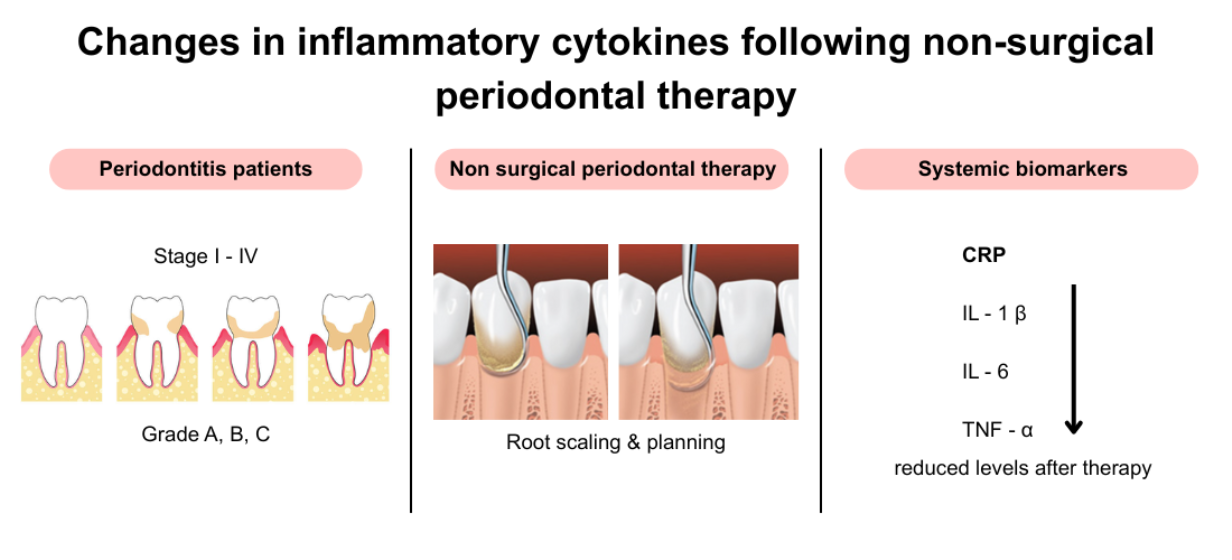
Inflammatory Cytokine Variations After Non-Surgical Periodontal Therapy Across Periodontal Stages and Grades

 , , , , , and
Abstract
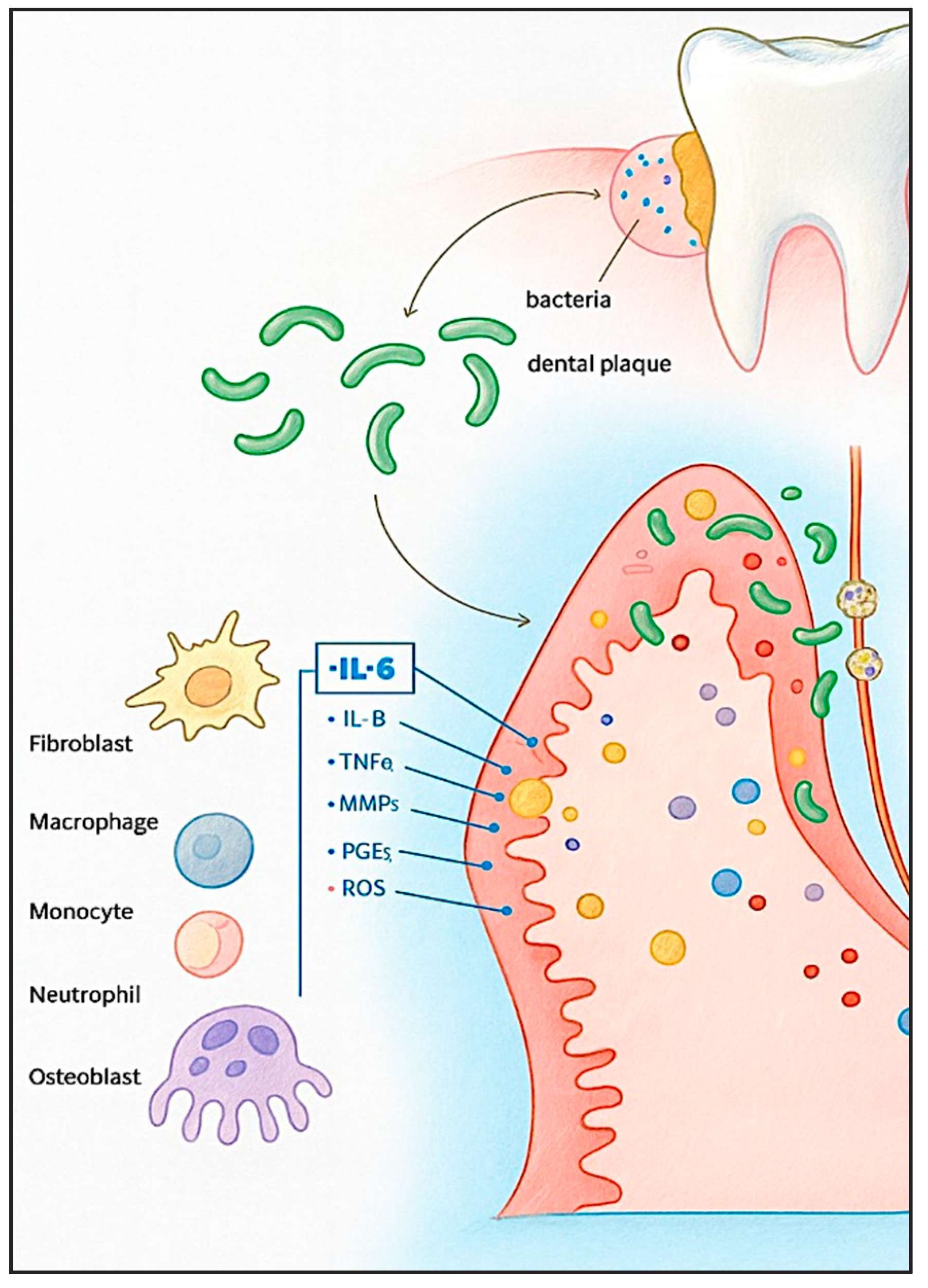
1. Introduction
2. Materials and Methods
2.1. Study Design and Ethical Approval
2.2. Classification and Study Variables
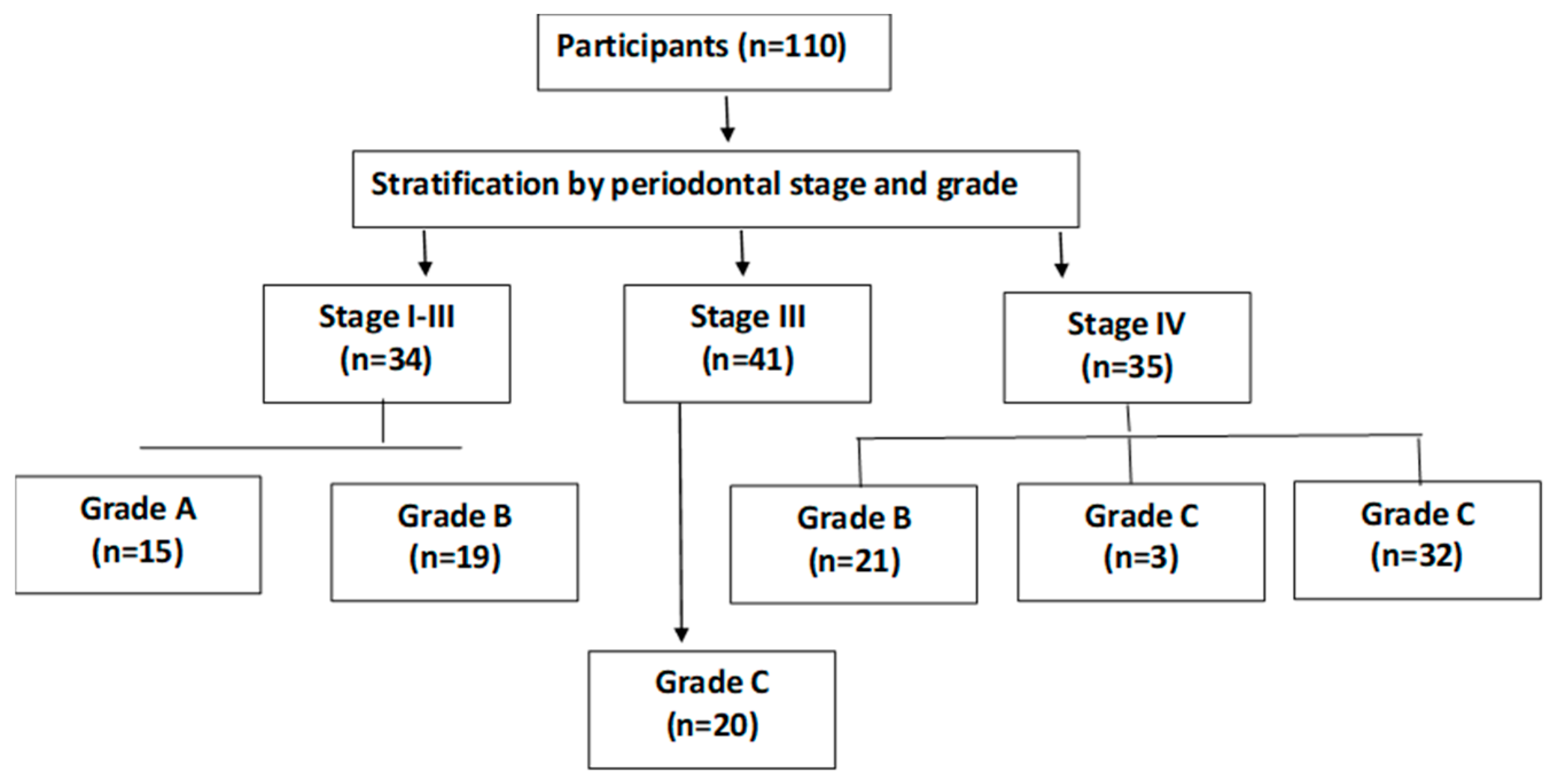
2.3. Participants
- Group I: Periodontally healthy individuals or those with gingivitis (n = 35);
- Group II: Patients with Stage I–II periodontitis (n = 35);
- Group III: Patients with advanced Stage III–IV periodontitis (n = 40) (Figure 2).
2.4. Clinical Examination
2.5. Periodontal Treatment
2.6. Biochemical Analysis
2.7. Statistical Analysis
3. Results
4. Discussion
Strengths and Limitations of the Study
5. Conclusions
Author Contributions
Funding
Institutional Review Board Statement
Informed Consent Statement
Data Availability Statement
Conflicts of Interest
References
- Tonetti, M.S.; Greenwell, H.; Kornman, K.S. Staging and grading of periodontitis: Framework and proposal of a new classification and case definition. J. Clin. Periodontol. 2018, 45, S149–S161. [Google Scholar] [CrossRef] [PubMed]
- Cardisciani, M.; Di Nicolantonio, S.; Altamura, S.; Ortu, E.; Del Pinto, R.; Pietropaoli, D. Temporal dynamics of early inflammatory markers after professional dental cleaning: A meta-analysis and spline-based meta-regression of TNF-α, IL-1β, IL-6, and (hs)CRP. Front. Immunol. 2025, 16, 1634622. [Google Scholar] [CrossRef]
- Abdulkareem, A.A.; Al-Taweel, F.B.; Al-Sharqi, A.J.B.; Gul, S.S.; Sha, A.; Chapple, I.L.C. Current concepts in the pathogenesis of periodontitis: From symbiosis to dysbiosis. J. Oral Microbiol. 2023, 15, 2197779. [Google Scholar] [CrossRef] [PubMed]
- Altaca, M.; Cebesoy, E.I.; Kocak-Oztug, N.A.; Bingül, I.; Cifcibasi, E. Interleukin-6, -17, and -35 levels in association with clinical status in stage III and stage IV periodontitis: A cross-sectional study. BMC Oral Health 2024, 24, 1015. [Google Scholar] [CrossRef]
- Relvas, M.; Silvestre, R.; Gonçalves, M.; Cabral, C.; Mendes-Frias, A.; Monteiro, L.; Viana da Costa, A. Analysis of Salivary Levels of IL-1β, IL17A, OPG and RANK-L in Periodontitis Using the 2017 Classification of Periodontal Diseases-An Exploratory Observational Study. J. Clin. Med. 2023, 12, 1003. [Google Scholar] [CrossRef]
- Mohammed, M.A.; Abbas, R.F.; Akram, H.M. Salivary IL-17 and IL-10 as potential diagnostic biomarkers of different stages of periodontitis in smoker and nonsmoker patients. Eur. J. Dent. 2023, 18, 253–264. [Google Scholar] [CrossRef]
- Zhang, Y.; Kang, N.; Xue, F.; Qiao, J.; Duan, J.; Chen, F.; Cai, Y. Evaluation of salivary biomarkers for the diagnosis of periodontitis. BMC Oral Health 2021, 21, 266. [Google Scholar] [CrossRef] [PubMed]
- Romano, F.; Del Buono, W.; Bianco, L.; Arena, M.; Mariani, G.M.; Di Scipio, F.; Berta, G.N.; Aimetti, M. Gingival crevicular fluid cytokines in moderate and deep sites of Stage III periodontitis patients in different rates of clinical progression. Biomedicines 2020, 8, 515. [Google Scholar] [CrossRef]
- Kadayıf, A.; Taşçi, Ö.E.; Karaduman, B. Effects of non-surgical periodontal therapy on gingival crevicular fluid CTRP-1, TNF-α, and IL-10 levels. Clin. Oral Investig. 2025, 29, 345. [Google Scholar] [CrossRef]
- Zhang, Y.; Jia, R.; Zhang, Y.; Sun, X.; Mei, Y.; Zou, R.; Niu, L.; Dong, S. Effect of non-surgical periodontal treatment on cytokines/adipocytokines levels among periodontitis patients with or without obesity: A systematic review and meta-analysis. BMC Oral Health 2023, 23, 717. [Google Scholar] [CrossRef]
- Kim, J.Y.; Kim, H.N. Changes in Inflammatory Cytokines in Saliva after Non-Surgical Periodontal Therapy: A Systematic Review and Meta-Analysis. Int. J. Environ. Res. Public Health 2020, 18, 194. [Google Scholar] [CrossRef] [PubMed]
- Arregoces, F.M.E.; Roa, N.S.; Velosa-Porras, J.; Rodríguez, L.V.; Merchan, M.J.; Poveda, J.C.V.; Otero, L.; Ruiz, Á.J.; Uriza, C.L. Changes in Serum Inflammatory Markers and in Clinical Periodontal Condition After Non-Surgical Periodontal Treatment in Hypertensive Patients. Biomedicines 2025, 13, 374. [Google Scholar] [CrossRef]
- Leite, F.R.M.; López, R.; Møller, H.J.; Nascimento, G.G. Salivary cytokine expression after non-surgical periodontal therapy in smokers: 12-month follow-up. J. Periodontol. 2023, 94, 823–834. [Google Scholar] [CrossRef]
- Silness, J.; Löe, H. Periodontal disease in pregnancy. II. Correlation between oral hygiene and periodontal condition. Acta Odontol. Scand. 1964, 22, 121–135. [Google Scholar] [CrossRef]
- Löe, H.; Silness, J. Periodontal disease in pregnancy. I. Prevalence and severity. Acta Odontol. Scand. 1963, 21, 533–551. [Google Scholar] [CrossRef] [PubMed]
- Raza, M.; Abud, D.G.; Wang, J.; Shariff, J.A. Ease and practicability of the 2017 classification of periodontal diseases and conditions: A study of dental electronic health records. BMC Oral Health 2024, 24, 621. [Google Scholar] [CrossRef] [PubMed]
- Zhou, H.H.; Tang, Y.L.; Xu, T.H.; Cheng, B. C-reactive protein: Structure, function, regulation, and role in clinical diseases. Front. Immunol. 2024, 15, 1438271. [Google Scholar] [CrossRef]
- Rai, J.; Shah, V.; Shah, M. Periodontitis Severity Grading Scale and C-Reactive Protein: A Possible Relation. Cureus 2023, 15, e41618. [Google Scholar] [CrossRef]
- Machado, V.; Botelho, J.; Escalda, C.; Hussain, S.B.; Luthra, S.; Mascarenhas, P.; Orlandi, M.; Mendes, J.J.; D’Aiuto, F. Serum C-Reactive Protein and Periodontitis: A Systematic Review and Meta-Analysis. Front. Immunol. 2021, 12, 706432. [Google Scholar] [CrossRef]
- Grebenciucova, E.; Van Haerents, S. Interleukin 6: At the interface of human health and disease. Front. Immunol. 2023, 14, 1255533. [Google Scholar] [CrossRef]
- Brodzikowska, A.; Górski, B.; Bogusławska-Kapała, A. Association between IL-1 Gene Polymorphisms and Stage III Grade B Periodontitis in Polish Population. Int. J. Environ. Res. Public Health 2022, 19, 14687. [Google Scholar] [CrossRef]
- Kabacaoğlu, B.; Öztürk Özener, H. Evaluation of inflammasomes as biomarker following non-surgical periodontal treatment. Arch. Oral Biol. 2024, 164, 105987. [Google Scholar] [CrossRef] [PubMed]
- Bertoldi, C.; Nasi, M.; Salvatori, R.; Pinti, M.; Montagna, S.; Tonetti, M.; Generali, L.; Bellei, E.; Zaffe, D.; Selleri, V.; et al. Salivary Biomarker Analysis to Distinguish Between Health and Periodontitis Status: A Preliminary Study. Dent. J. 2025, 13, 436. [Google Scholar] [CrossRef] [PubMed]
- Hascoët, E.; Blanchard, F.; Blin-Wakkach, C.; Guicheux, J.; Lesclous, P.; Cloitre, A. New insights into inflammatory osteoclast precursors as therapeutic targets for rheumatoid arthritis and periodontitis. Bone Res. 2023, 11, 26. [Google Scholar] [CrossRef] [PubMed]
- Teles, F.; Martin, L.; Patel, M.; Hu, W.; Bittinger, K.; Kallan, M.J.; Chandrasekaran, G.; Cucchiara, A.J.; Giannobile, W.V.; Stephens, D.; et al. Gingival Crevicular Fluid Biomarkers During Periodontitis Progression and After Periodontal Treatment. J. Clin. Periodontol. 2025, 52, 40–55. [Google Scholar] [CrossRef]
- Gür, B.; Afacan, B.; Çevik, Ö.; Köse, T.; Emingil, G. Gingival crevicular fluid periodontal ligament-associated protein-1, sclerostin, and tumor necrosis factor-alpha levels in periodontitis. J. Periodontol. 2023, 94, 1166–1175. [Google Scholar] [CrossRef]
- Keles Yucel, Z.P.; Balli, U. Leucine-rich alpha-2 glycoprotein (LRG): A novel acute phase protein expressed in stage 3 grade C periodontitis before and after periodontal therapy. J. Periodontol. 2021, 92, 104–112. [Google Scholar] [CrossRef]
- Macrì, M.; D’Albis, G.; D’Albis, V.; Antonacci, A.; Abbinante, A.; Stefanelli, R.; Pegreffi, F.; Festa, F. Periodontal Health and Its Relationship with Psychological Stress: A Cross-Sectional Study. J. Clin. Med. 2024, 13, 2942. [Google Scholar] [CrossRef]
- Villafuerte, K.R.V.; Palucci Vieira, L.H.; Santos, K.O.; Rivero-Contreras, E.; Lourenço, A.G.; Motta, A.C.F. Psychological Stress Reduces the Effectiveness of Periodontal Treatment: A Systematic Review. J. Clin. Med. 2025, 14, 1680. [Google Scholar] [CrossRef]



| Total with Periodontitis | Control Group | p-Value | |||
|---|---|---|---|---|---|
| Total | 75 | 100.0 | 35 | 100.0 | |
| Gender | |||||
| F | 45 | 60.0 | 18 | 51.4 | p = 0.522 |
| M | 30 | 40.0 | 17 | 48.6 | |
| Residence | |||||
| Urban | 50 | 66.7 | 26 | 74.3 | p = 0.559 |
| Rural | 25 | 33.3 | 9 | 25.7 | |
| Education | |||||
| Elementary | 10 | 13.3 | 7 | 20.0 | p = 0.537 |
| Middle High school | 65 | 86.7 | 28 | 80.0 | |
| Age (year) | 45.1 ± 10.7 23–71 | 30.4 ± 5.7 20–41 | p < 0.0001 | ||
| Stage | |||||
| I and II | 21 | 28.0 | |||
| III | 30 | 40.0 | |||
| IV | 24 | 32.0 | |||
| Grade | |||||
| A | 22 | 29.3 | |||
| B | 34 | 45.3 | |||
| C | 19 | 25.3 | |||
| Stage | CRP (mg/L) | Baseline | Post-Treatment | |
|---|---|---|---|---|
| I and II | N | 21 | 21 | p = 0.0010 |
| Mean ± SD | 1.9 ± 1.7 | 1.4 ± 1.5 | ||
| Rank | 0.0–7.0 | 0.0–7.0 | ||
| III | N | 24 | 24 | p = 0.0005 |
| Mean ± SD | 2.1 ± 2.0 | 1.7 ± 2.0 | ||
| Rank | 0.0–9.1 | 0.0–9.1 | ||
| IV | N | 30 | 30 | p < 0.0001 |
| Mean ± SD | 3.2 ± 3.4 | 2.6 ± 3.5 | ||
| Rank | 0.0–14.1 | 0.0–14.1 | ||
| Control gr. | N | 35 | ||
| Mean ± SD | 0.5 ± 0.6 | |||
| Rank | 0.0–3.1 | |||
| Grade | ||||
| A | N | 19 | 19 | p = 0.0020 |
| Mean ± SD | 2.0 ± 2.2 | 1.6 ± 2.2 | ||
| Rank | 0.0–9.1 | 0.0–9.1 | ||
| B | N | 22 | 22 | p = 0.0012 |
| Mean ± SD | 2.2 ± 1.6 | 1.7 ± 1.6 | ||
| Rank | 0.0–7.0 | 0.0–7.0 | ||
| C | N | 34 | 34 | p < 0.0001 |
| Mean ± SD | 3.0 ± 3.3 | 2.4 ± 3.4 | ||
| Rank | 0.0–14.1 | 0.0–14.1 | ||
| Stage | IL-1 (pg/mL) | Baseline | Post-Treatment | |
|---|---|---|---|---|
| I and II | N | 21 | 21 | p = 0.0001 |
| Mean ± DS | 5.0 ± 8.8 | 3.8 ± 6.3 | ||
| Range | 1.0–42.0 | 0.5–29.0 | ||
| III | N | 30 | 30 | p < 0.0001 |
| Mean ± DS | 6.8 ± 10.0 | 4.6 ± 6.2 | ||
| Range | 1.0–30.2 | 0.2–20.4 | ||
| IV | N | 24 | 24 | p = 0.0001 |
| Mean ± DS | 9.0 ± 15.1 | 8.1 ± 15.4 | ||
| Range | 1.0–56.2 | 0.2–56.2 | ||
| Control gr. | N | 35 | ||
| Mean ± DS | 2.1 ± 2.2 | |||
| Range | 0.2–7.4 | |||
| Grade | IL-1 (pg/mL) | Baseline | Post-Treatment | |
| A | N | 22 | 22 | p < 0.0001 |
| Mean ± DS | 6.2 ± 11.5 | 5.2 ± 11.6 | ||
| Range | 1.0–56.2 | 0.5–56.2 | ||
| B | N | 34 | 34 | p < 0.0001 |
| Mean ± DS | 6.5 ± 9.4 | 4.4 ± 5.9 | ||
| Range | 1.0–30.2 | 0.2–56.2 | ||
| C | N | 19 | 19 | p = 0.0005 |
| Mean ± DS | 9.0 ± 15.0 | 7.7 ± 13.9 | ||
| Range | 1.0–56.2 | 0.2–56.2 |
| Stage | IL-6 (pg/mL) | Baseline | Post-Treatment | |
|---|---|---|---|---|
| I and II | N | 21 | 21 | p = 0.0002 |
| Mean ± DS | 3.0 ± 4.8 | 2.6 ± 4.9 | ||
| Range | 0.2–21.6 | 0.1–21.6 | ||
| III | N | 30 | 30 | p < 0.0001 |
| Mean ± DS | 3.4 ± 4.2 | 2.7 ± 3.7 | ||
| Range | 0.2–22.2 | 0.1–18.0 | ||
| IV | N | 24 | 24 | p = 0.0002 |
| Mean ± DS | 4.8 ± 4.4 | 3.4 ± 2.6 | ||
| Range | 0.2–22.2 | 0.1–11.0 | ||
| Control gr. | N | 35 | ||
| Mean ± DS | 1.9 ± 1.6 | |||
| Range | 0.4–0.6 | |||
| Grade | IL-6 (pg/mL) | Baseline | Post-Treatment | |
| A | N | 22 | 22 | p = 0.0001 |
| Mean ± DS | 1.9 ± 1.7 | 3.2 ± 4.6 | ||
| Range | 0.2–21.6 | 0.1–21.6 | ||
| B | N | 34 | 34 | p < 0.0001 |
| Mean ± DS | 3.0 ± 4.1 | 2.5 ± 3.5 | ||
| Range | 0.2–22.2 | 0.1–18.0 | ||
| C | N | 19 | 19 | p = 0.0010 |
| Mean ± DS | 4.7 ± 5.0 | 3.4 ± 3.0 | ||
| Range | 0.2–22.2 | 0.1–11.0 |
| Stage | TNF-α (pg/mL) | Baseline | Post-Treatment | |
|---|---|---|---|---|
| III | N | 21 | 21 | p = 0.0001 |
| Mean ± DS | 71.8 ± 60.3 | 49.7 ± 51.3 | ||
| Range | 12.8–236.4 | 6.0–236.4 | ||
| I and II | N | 24 | 24 | p = 0.0001 |
| Mean ± DS | 75.0 ± 60.4 | 58.7 ± 62.1 | ||
| Range | 27.6–321.0 | 15.0–321.0 | ||
| IV | N | 30 | 30 | p < 0.0001 |
| Mean ± DS | 89.7 ± 89.7 | 60.4 ± 53.6 | ||
| Range | 12.8–300.8 | 6.0–180.0 | ||
| Range | 12.8–321.0 | 6.0–321.0 | ||
| Control gr. | N | 35 | ||
| Mean ± DS | 64.6 ± 72.3 | |||
| Range | 14.0–319.0 | |||
| Grade | TNF-α (pg/mL) | Baseline | Post-Treatment | |
| A | N | 22 | 22 | p < 0.0001 |
| Mean ± DS | 68.8 ± 50.9 | 47.2 ± 47.8 | ||
| Range | 12.8–236.4 | 6.0–236.4 | ||
| B | N | 34 | 34 | p < 0.0001 |
| Mean ± DS | 85.0 ± 85.1 | 58.5 ± 50.7 | ||
| Range | 12.8–300.8 | 6.0–180.0 | ||
| C | N | 19 | 19 | p = 0.0005 |
| Mean ± DS | 85.2 ± 73.7 | 65.0 ± 70.7 | ||
| Range | 27.6–321.0 | 17.0–321.0 |
| Stage | N | CRP (mg/L) Mean ± SD | IL-1 (pg/mL) Mean ± SD | IL-6 (pg/mL) Mean ± SD | TNF-α (pg/mL) Mean ± SD | ||||
|---|---|---|---|---|---|---|---|---|---|
| Baseline | Post Treatment | Baseline | Post Treatment | Baseline | Post Treatment | Baseline | Post Treatment | ||
| I and II | 21 | 1.9 ± 1.7 | 1.4 ± 1.5 | 5.0 ± 8.8 | 3.8 ± 6.3 | 3.0 ± 4.8 | 2.6 ± 4.9 | 75.0 ± 60.4 | 58.7 ± 62.1 |
| III | 24 | 2.1 ± 2.0 | 1.7 ± 2.0 | 6.8 ± 10.0 | 4.6 ± 6.2 | 3.4 ± 4.2 | 2.7 ± 3.7 | 71.8 ± 60.3 | 49.7 ± 51.3 |
| IV | 30 | 3.2 ± 3.4 | 2.6 ± 3.5 | 9.0 ± 15.1 | 8.1 ± 15.4 | 4.8 ± 4.4 | 3.4 ± 2.6 | 89.7 ± 89.7 | 60.4 ± 53.6 |
| p-value | p = 0.225 | p = 0.278 | p = 0.166 | p = 0.324 | p = 0.025 I and II vs. III p < 0.05 | p = 0.009 I and II vs. III p < 0.05 | p = 0.619 | p = 0.636 | |
| Grade | N | CRP (mg/L) Mean ± SD | IL-1 (pg/mL) Mean ± SD | IL-6 (pg/mL) Mean ± SD | TNF-α (pg/mL) Mean ± SD | ||||
| Baseline | Post Treatment | Baseline | Post Treatment | Baseline | Post Treatment | Baseline | Post Treatment | ||
| A | 19 | 2.0 ± 2.2 | 1.6 ± 2.2 | 6.2 ± 11.5 | 5.2 ± 11.6 | 1.9 ± 1.7 | 3.2 ± 4.6 | 68.8 ± 50.9 | 47.2 ± 47.8 |
| B | 22 | 2.2 ± 1.6 | 1.7 ± 1.6 | 6.5 ± 9.4 | 4.4 ± 5.9 | 3.0 ± 4.1 | 2.5 ± 3.5 | 85.0 ± 85.1 | 58.5 ± 50.7 |
| C | 34 | 3.0 ± 3.3 | 2.4 ± 3.4 | 9.0 ± 15.0 | 7.7 ± 13.9 | 4.7 ± 5.0 | 3.4 ± 3.0 | 85.2 ± 73.7 | 65.0 ± 70.7 |
| p-value | p = 0.456 | p = 0.592 | p = 0.615 | p = 0.819 | p = 0.218 | p = 0.179 | p = 0.832 | p = 0.519 | |
| Stage/ Grade | N | CRP (mg/L) Mean ± SD | IL-1 (pg/mL) Mean ± SD | IL-6 (pg/mL) Mean ± SD | TNF-α (pg/mL) Mean ± SD | ||||
|---|---|---|---|---|---|---|---|---|---|
| Baseline | Post Treatment | Baseline | Post Treatment | Baseline | Post Treatment | Baseline | Post Treatment | ||
| 1 and 2A | 5 | 1.1 ± 1.4 | 0.7 ± 0.9 | 10.3 ± 17.8 | 7.1 ± 12.3 | 1.0 ± 0.8 | 0.7 ± 0.7 | 103.2 ± 74.8 | 54.2 ± 47.0 |
| 1 and 2B | 11 | 2.5 ± 1.8 | 1.9 ± 1.9 | 3.5 ± 2.8 | 2.8 ± 3.0 | 4.7 ± 6.1 | 4.2 ± 6.4 | 69.6 ± 64.4 | 52.4 ± 64.6 |
| 1 and 2C | 5 | 1.4 ± 1.5 | 1.0 ± 0.8 | 3.1 ± 2.0 | 2.6 ± 2.1 | 1.0 ± 1.1 | 0.9 ± 1.2 | 45.3 ± 10.4 | 39.3 ± 18.0 |
| 3A | 13 | 2.2 ± 2.5 | 1.9 ± 2.5 | 9.1 ± 15.1 | 8.6 ± 15.3 | 6.1 ± 5.3 | 4.5 ± 3.0 | 80.9 ± 76.4 | 72.8 ± 80.4 |
| 3B | 11 | 1.9 ± 1.4 | 1.5 ± 1.3 | 8.9 ± 16.0 | 7.5 ± 16.2 | 3.1 ± 2.2 | 2.2 ± 1.4 | 68.0 ± 36.0 | 42.0 ± 23.8 |
| 4A | 1 | 3.5 ± 0.0 | 2.2 ± 0.0 | 1.2 ± 0.0 | 0.3 ± 0.0 | 3.4 ± 0.0 | 2.2 ± 0.0 | 27.6 ± 0.0 | 18.0 ± 0.0 |
| 4C | 29 | 3.2 ± 3.5 | 2.7 ± 3.6 | 7.0 ± 10.1 | 4.7 ± 6.3 | 3.3 ± 4.3 | 2.7 ± 3.7 | 91.8 ± 90.5 | 61.8 ± 54.0 |
| p = 0.308 | p = 0.431 | p = 0.544 | p = 0.620 | p = 0.021 1 and 2C vs. 3A p < 0.05 | p = 0.017 1 and 2 A vs. 3A p < 0.05 | p = 0.540 | p = 0.682 | ||
| CRP-hs (mg/L) | IL-1 (pg/mL) | IL-6 (pg/mL) | TNF-α (pg/mL) | |
|---|---|---|---|---|
| Bleeding on probing (BOP) | r = 0.176 | r = 0.129 | r = 0.074 | r = 0.147 |
| R2 = 0.031 | R2 = 0.017 | R2 = 0.005 | R2 = 0.022 | |
| p = 0.130 | p = 0.270 | p = 0.530 | p = 0.209 | |
| Probing Pocket Depth (PPD) | r = −0.087 | r = −0.133 | r = −0.008 | r = 0.159 |
| R2 = 0.0076 | R2 = 0.017 | R2 = 0.00007 | R2 = 0.025 | |
| p = 0.455 | p = 0.254 | p = 0.942 | p = 0.172 | |
| Clinical Attachment Level (CAL) | r = −0.283 | r = −0.322 | r = −0.435 | r = −0.255 |
| R2 = 0.079 | R2 = 0.104 | R2 = 0.189 | R2 = 0.065 | |
| p = 0.014 | p = 0.004 | p = 0.000 | p = 0.027 |
Disclaimer/Publisher’s Note: The statements, opinions and data contained in all publications are solely those of the individual author(s) and contributor(s) and not of MDPI and/or the editor(s). MDPI and/or the editor(s) disclaim responsibility for any injury to people or property resulting from any ideas, methods, instructions or products referred to in the content. |
© 2025 by the authors. Licensee MDPI, Basel, Switzerland. This article is an open access article distributed under the terms and conditions of the Creative Commons Attribution (CC BY) license (https://creativecommons.org/licenses/by/4.0/).
Share and Cite
Krasniqi, M.S.; Dalipi, Z.S.; Shabani, D.B.; Droboniku, E.; Begolli, G.; Kaçani, G.; Meto, A. Inflammatory Cytokine Variations After Non-Surgical Periodontal Therapy Across Periodontal Stages and Grades. Dent. J. 2025, 13, 591. https://doi.org/10.3390/dj13120591
Krasniqi MS, Dalipi ZS, Shabani DB, Droboniku E, Begolli G, Kaçani G, Meto A. Inflammatory Cytokine Variations After Non-Surgical Periodontal Therapy Across Periodontal Stages and Grades. Dentistry Journal. 2025; 13(12):591. https://doi.org/10.3390/dj13120591
Chicago/Turabian StyleKrasniqi, Mirlinda Sopi, Zana Sllamniku Dalipi, Donika Bajrami Shabani, Etleva Droboniku, Gramos Begolli, Gerta Kaçani, and Aida Meto. 2025. "Inflammatory Cytokine Variations After Non-Surgical Periodontal Therapy Across Periodontal Stages and Grades" Dentistry Journal 13, no. 12: 591. https://doi.org/10.3390/dj13120591
APA StyleKrasniqi, M. S., Dalipi, Z. S., Shabani, D. B., Droboniku, E., Begolli, G., Kaçani, G., & Meto, A. (2025). Inflammatory Cytokine Variations After Non-Surgical Periodontal Therapy Across Periodontal Stages and Grades. Dentistry Journal, 13(12), 591. https://doi.org/10.3390/dj13120591