Current Progress on 229Th Nuclear Clock

Abstract
1. Introduction
2. Theoretical Foundations of the Nuclear Clock Transition
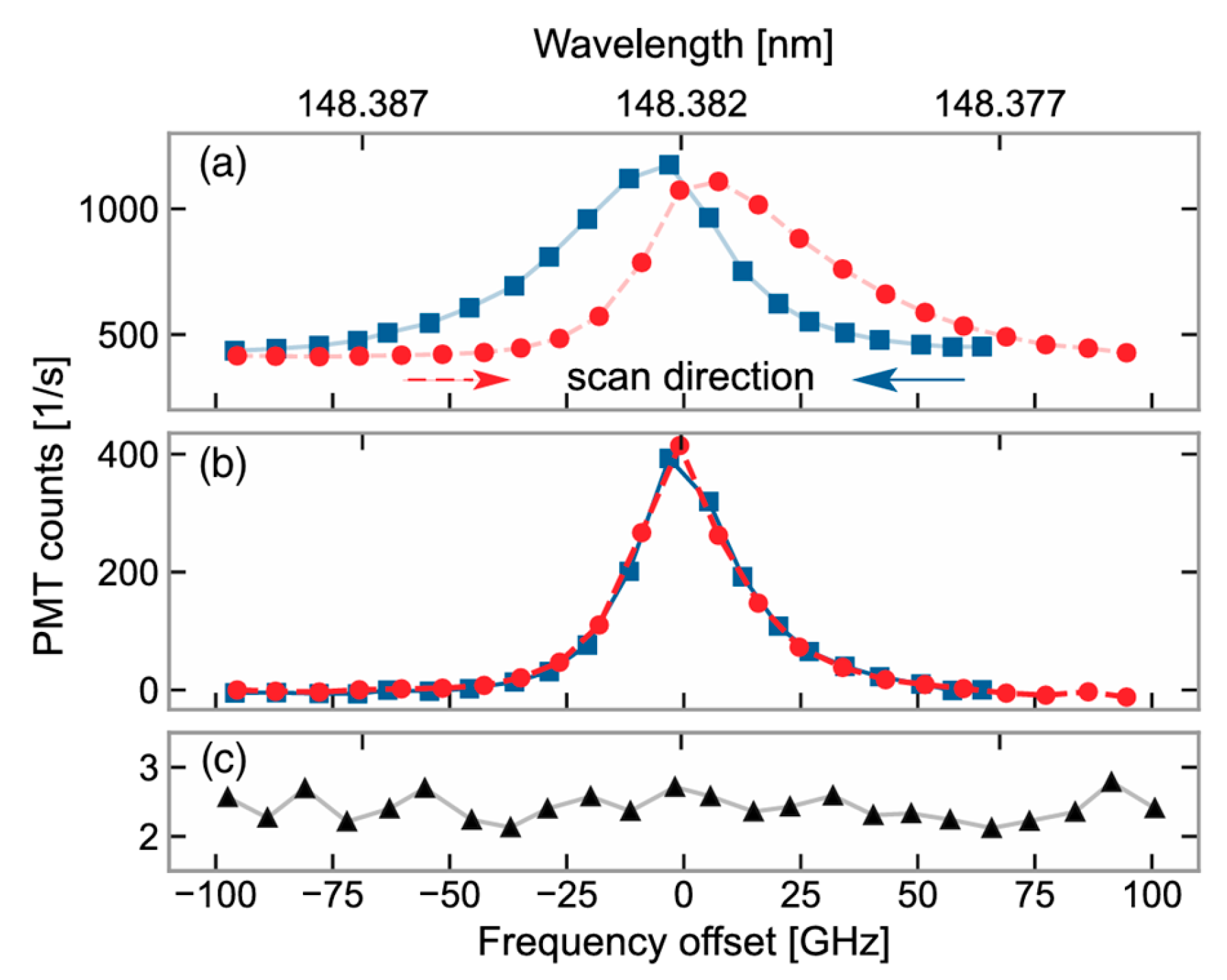
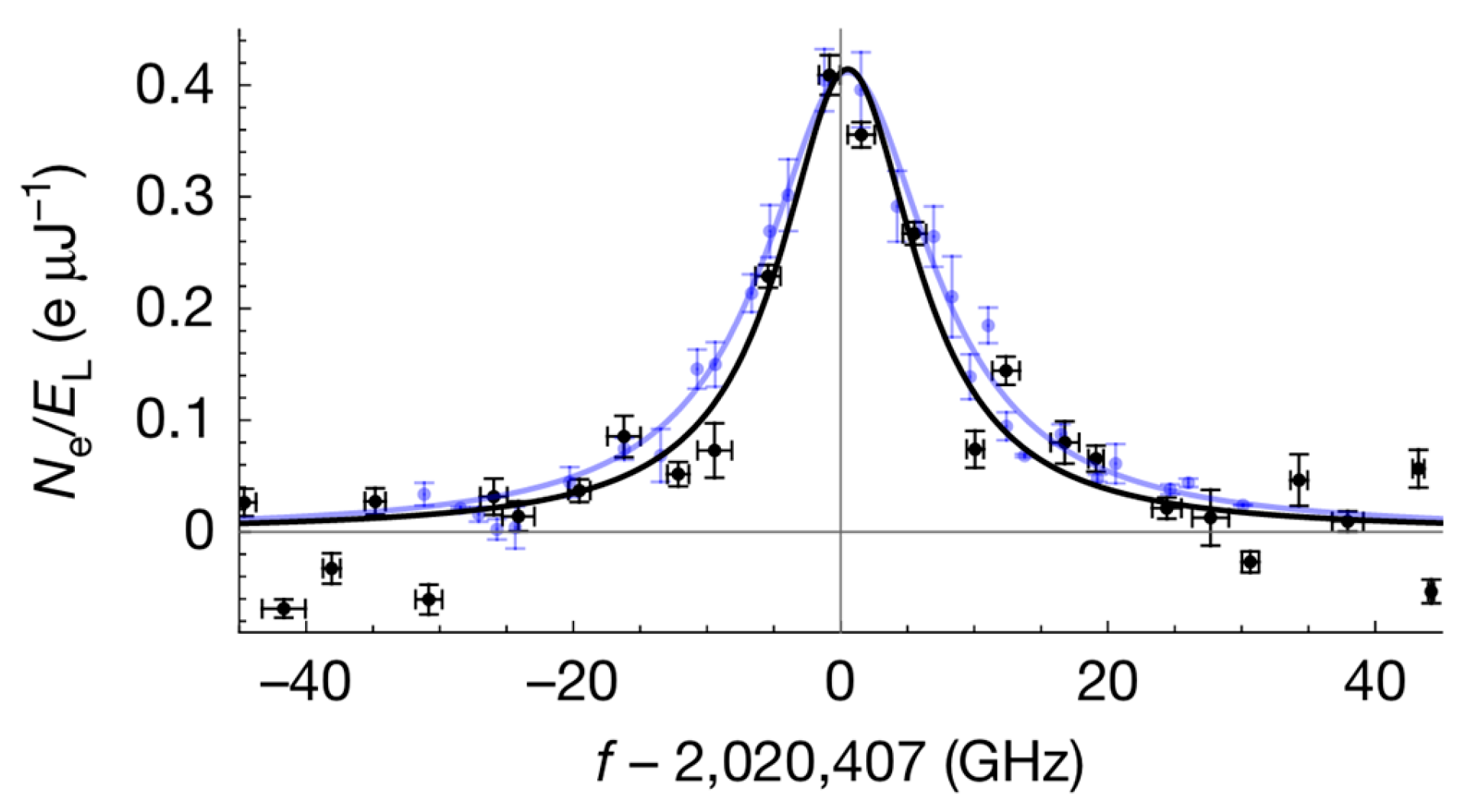
3. Key Progress in Nuclear Clock Research
4. Key Technologies for Implementing the Nuclear Clock
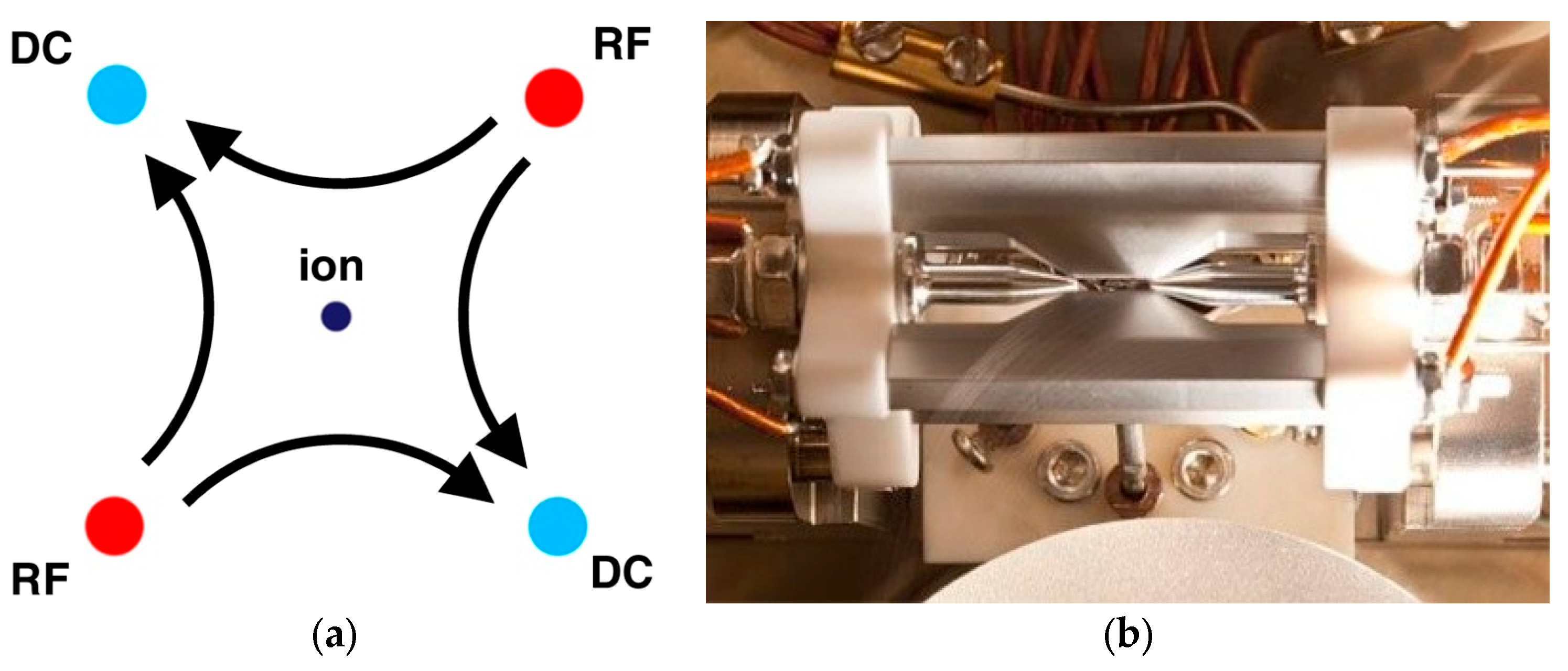
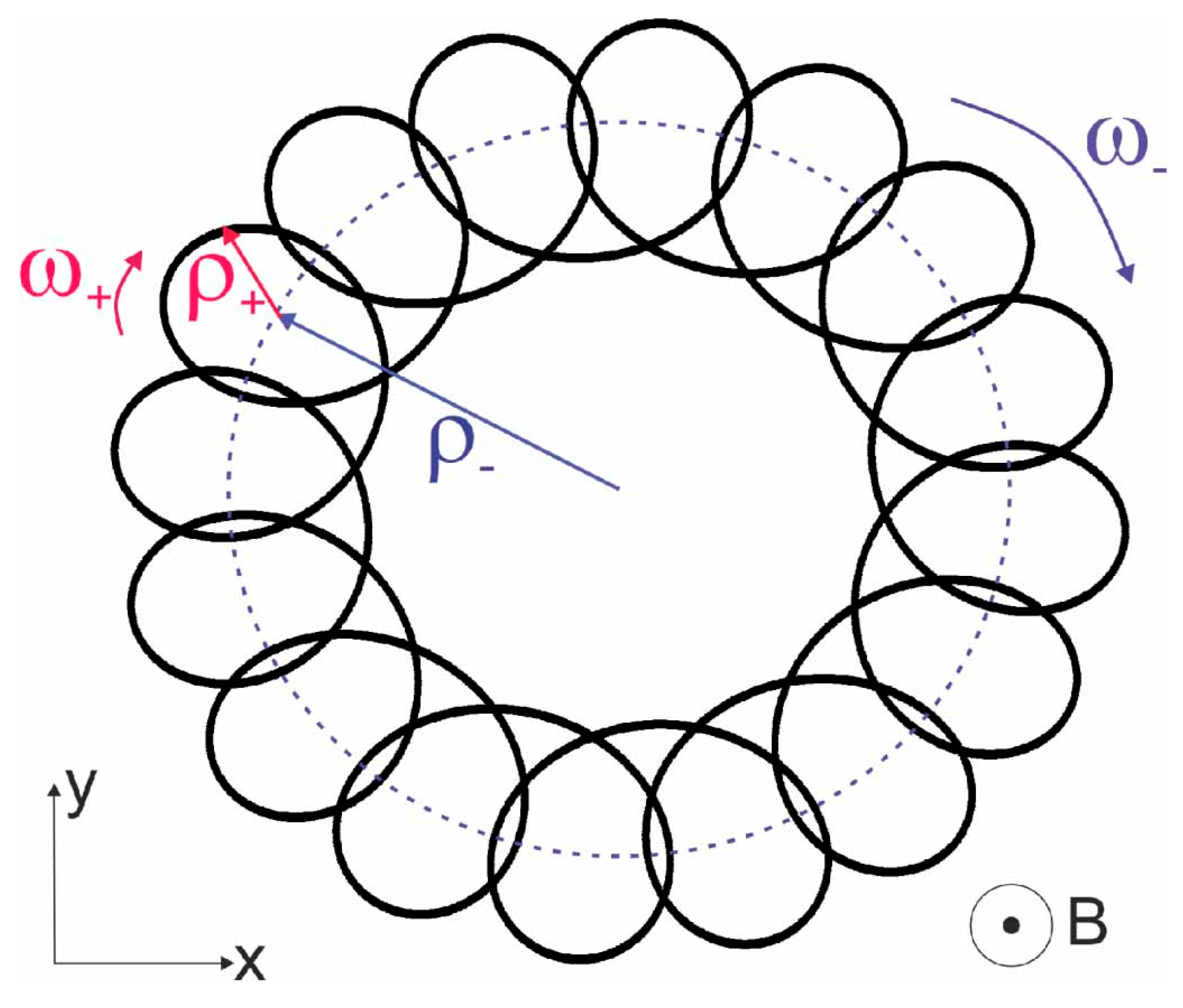
4.1. Trapped-Ion Scheme
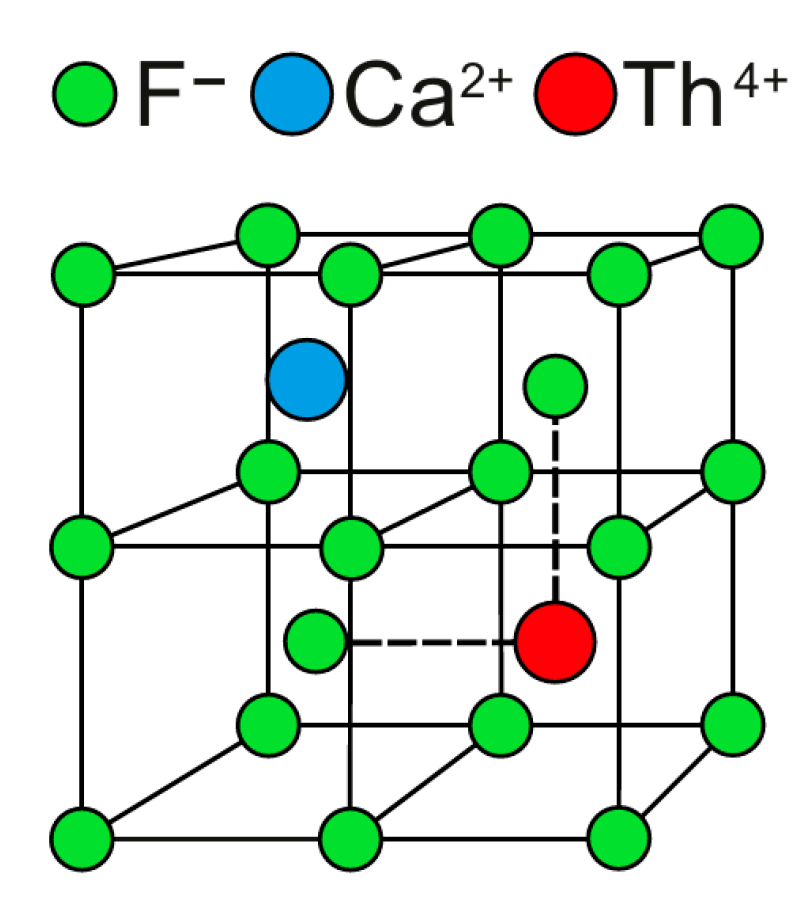
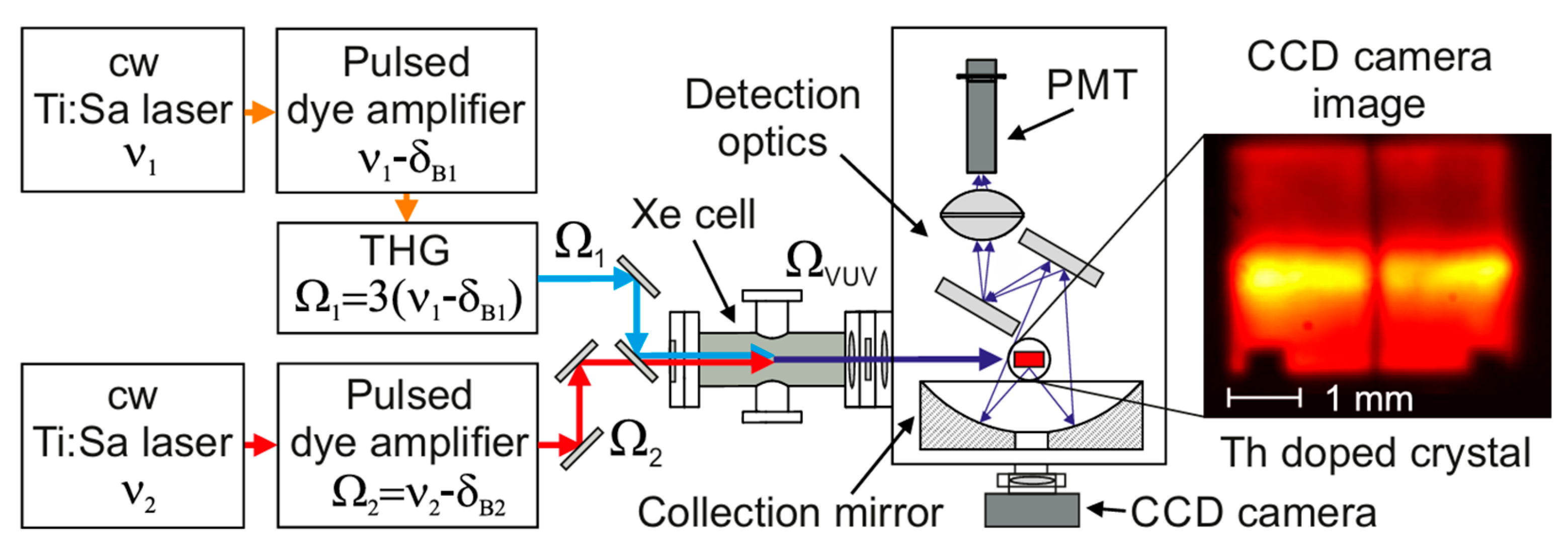
4.2. Crystal-Doping Scheme
4.3. Nuclear Clock Excitation and Readout Technologies
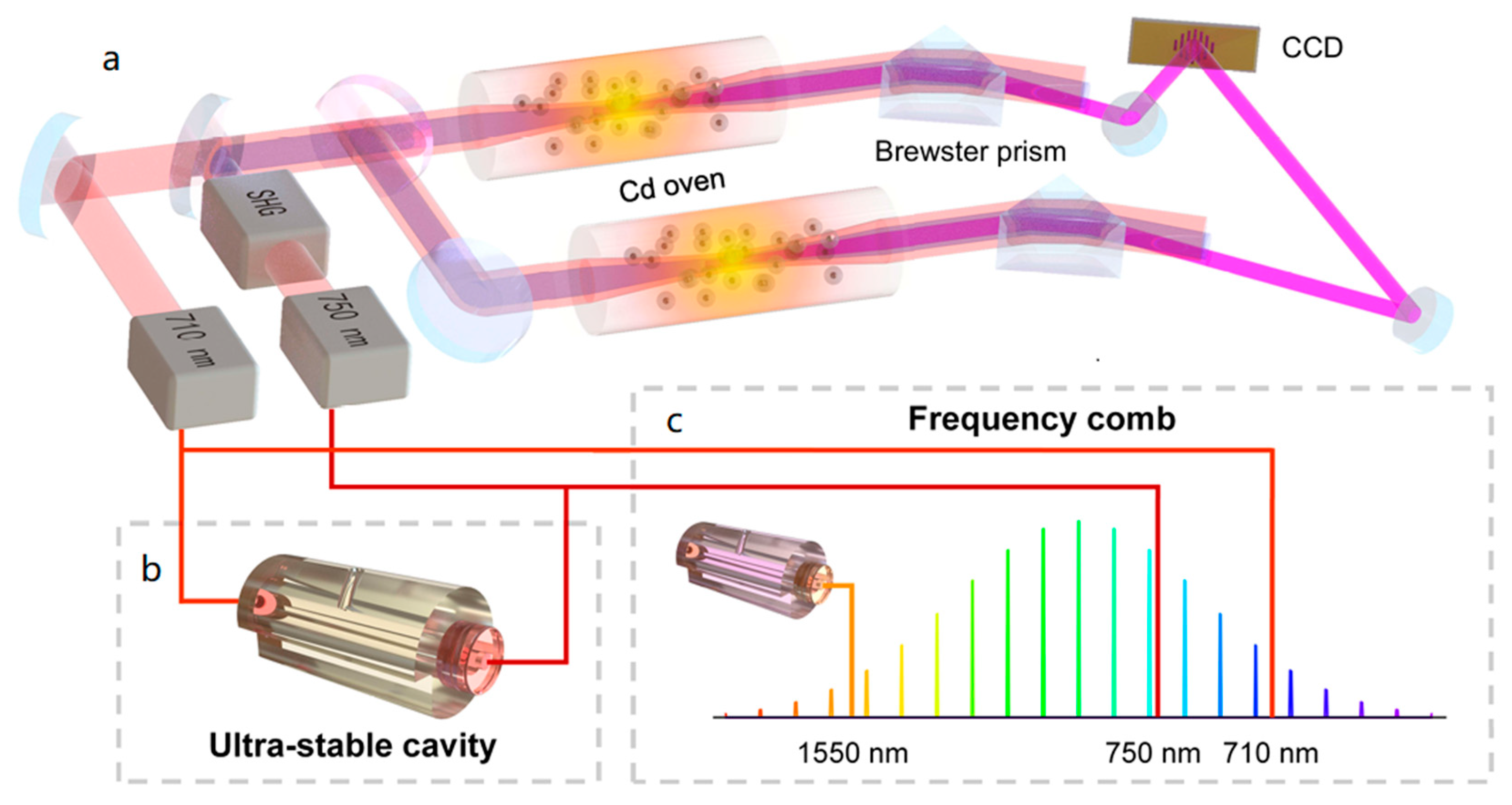
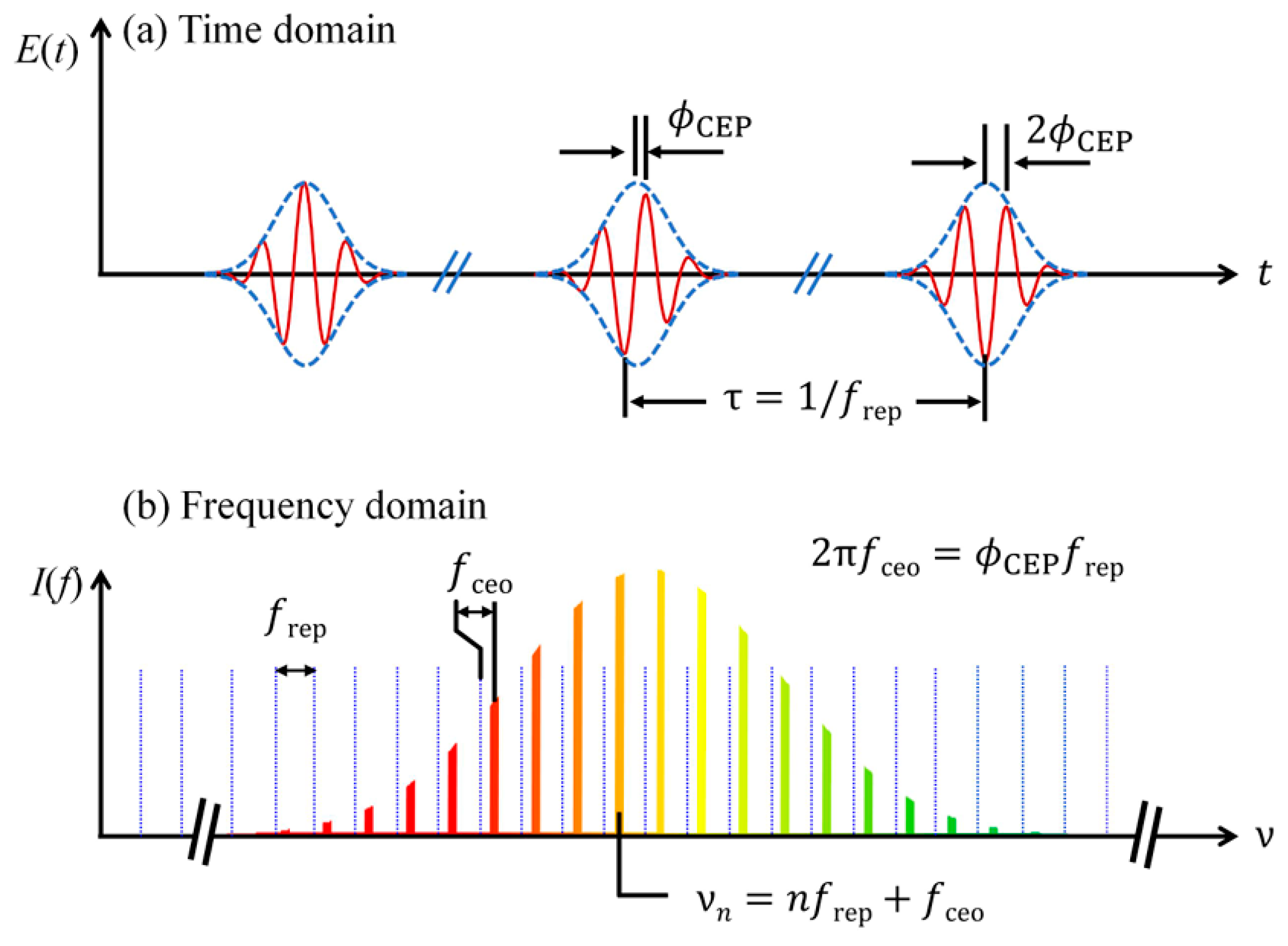
4.4. VUV/XUV Laser and VUV/XUV Optical Frequency Comb Technology
5. Future Prospects and Applications of the Nuclear Clock
Funding
Data Availability Statement
Conflicts of Interest
References
- Stephenson, F.R.; Morrison, L.V. Long-Term Fluctuations in the Earth’s Rotation: 700 BC to AD 1990. Phil. Trans. R. Soc. Lond. A 1995, 351, 165–202. [Google Scholar] [CrossRef]
- McCarthy, D.D.; Seidelmann, P.K. Time—From Earth Rotation to Atomic Physics, 1st ed.; Wiley: Hoboken, NJ, USA, 2009; ISBN 978-3-527-40780-4. [Google Scholar]
- Essen, L.; Parry, J.V.L. An Atomic Standard of Frequency and Time Interval: A Cæsium Resonator. Nature 1955, 176, 280–282. [Google Scholar] [CrossRef]
- Marshall, M.C.; Castillo, D.A.R.; Arthur-Dworschack, W.J.; Aeppli, A.; Kim, K.; Lee, D.; Warfield, W.; Hinrichs, J.; Nardelli, N.V.; Fortier, T.M.; et al. High-Stability Single-Ion Clock with 5.5 × 10⁻¹⁹ Systematic Uncertainty. Phys. Rev. Lett. 2025, 135, 033201. [Google Scholar] [CrossRef]
- Ludlow, A.D.; Boyd, M.M.; Ye, J.; Peik, E.; Schmidt, P.O. Optical Atomic Clocks. Rev. Mod. Phys. 2015, 87, 637–701. [Google Scholar] [CrossRef]
- Nicholson, T.L.; Campbell, S.L.; Hutson, R.B.; Marti, G.E.; Bloom, B.J.; McNally, R.L.; Zhang, W.; Barrett, M.D.; Safronova, M.S.; Strouse, G.F.; et al. Systematic Evaluation of an Atomic Clock at 2 × 10⁻¹⁸ Total Uncertainty. Nat. Commun. 2015, 6, 6896. [Google Scholar] [CrossRef]
- Rosenband, T.; Hume, D.B.; Schmidt, P.O.; Chou, C.W.; Brusch, A.; Lorini, L.; Oskay, W.H.; Drullinger, R.E.; Fortier, T.M.; Stalnaker, J.E.; et al. Frequency Ratio of Al+ and Hg+ Single-Ion Optical Clocks; Metrology at the 17th Decimal Place. Science 2008, 319, 1808–1812. [Google Scholar] [CrossRef] [PubMed]
- Grotti, J.; Koller, S.; Vogt, S.; Häfner, S.; Sterr, U.; Lisdat, C.; Denker, H.; Voigt, C.; Timmen, L.; Rolland, A.; et al. Geodesy and Metrology with a Transportable Optical Clock. Nature Phys. 2018, 14, 437–441. [Google Scholar] [CrossRef]
- Van Tilburg, K.; Leefer, N.; Bougas, L.; Budker, D. Search for Ultralight Scalar Dark Matter with Atomic Spectroscopy. Phys. Rev. Lett. 2015, 115, 011802. [Google Scholar] [CrossRef] [PubMed]
- Cacciapuoti, L.; Salomon, C. Space Clocks and Fundamental Tests: The ACES Experiment. Eur. Phys. J. Spec. Top. 2009, 172, 57–68. [Google Scholar] [CrossRef]
- Minkov, N.; Pálffy, A. Reduced Transition Probabilities for the Gamma Decay of the 7.8 eV Isomer in Th 229. Phys. Rev. Lett. 2017, 118, 212501. [Google Scholar] [CrossRef]
- Seiferle, B.; Von Der Wense, L.; Bilous, P.V.; Amersdorffer, I.; Lemell, C.; Libisch, F.; Stellmer, S.; Schumm, T.; Düllmann, C.E.; Pálffy, A.; et al. Energy of the 229Th Nuclear Clock Transition. Nature 2019, 573, 243–246. [Google Scholar] [CrossRef]
- Flambaum, V.V. Enhanced Effect of Temporal Variation of the Fine Structure Constant and the Strong Interaction in Th 229. Phys. Rev. Lett. 2006, 97, 092502. [Google Scholar] [CrossRef] [PubMed]
- Safronova, M.S.; Porsev, S.G.; Kozlov, M.G.; Thielking, J.; Okhapkin, M.V.; Głowacki, P.; Meier, D.M.; Peik, E. Nuclear Charge Radii of Th 229 from Isotope and Isomer Shifts. Phys. Rev. Lett. 2018, 121, 213001. [Google Scholar] [CrossRef] [PubMed]
- Kazakov, G.A.; Litvinov, A.N.; Romanenko, V.I.; Yatsenko, L.P.; Romanenko, A.V.; Schreitl, M.; Winkler, G.; Schumm, T. Performance of a229 Thorium Solid-State Nuclear Clock. New J. Phys. 2012, 14, 083019. [Google Scholar] [CrossRef]
- Campbell, C.J.; Radnaev, A.G.; Kuzmich, A.; Dzuba, V.A.; Flambaum, V.V.; Derevianko, A. Single-Ion Nuclear Clock for Metrology at the 19th Decimal Place. Phys. Rev. Lett. 2012, 108, 120802. [Google Scholar] [CrossRef]
- Thirolf, P.G.; Kraemer, S.; Moritz, D.; Scharl, K. The Thorium Isomer 229mTh: Review of Status and Perspectives after More than 50 Years of Research. Eur. Phys. J. Spec. Top. 2024, 233, 1113–1131. [Google Scholar] [CrossRef]
- Peik, E.; Tamm, C. Nuclear Laser Spectroscopy of the 3.5 eV Transition in Th-229. Europhys. Lett. 2003, 61, 181–186. [Google Scholar] [CrossRef]
- Tiedau, J.; Okhapkin, M.V.; Zhang, K.; Thielking, J.; Zitzer, G.; Peik, E.; Schaden, F.; Pronebner, T.; Morawetz, I.; De Col, L.T.; et al. Laser Excitation of the Th-229 Nucleus. Phys. Rev. Lett. 2024, 132, 182501. [Google Scholar] [CrossRef]
- Zhang, C.; Ooi, T.; Higgins, J.S.; Doyle, J.F.; Von Der Wense, L.; Beeks, K.; Leitner, A.; Kazakov, G.A.; Li, P.; Thirolf, P.G.; et al. Frequency Ratio of the 229mTh Nuclear Isomeric Transition and the 87Sr Atomic Clock. Nature 2024, 633, 63–70. [Google Scholar] [CrossRef]
- Reich, C.W.; Helmer, R.G. Energy Separation of the Doublet of Intrinsic States at the Ground State of 229Th. Phys. Rev. Lett. 1990, 64, 271–273. [Google Scholar] [CrossRef]
- Von Der Wense, L.; Seiferle, B.; Laatiaoui, M.; Neumayr, J.B.; Maier, H.-J.; Wirth, H.-F.; Mokry, C.; Runke, J.; Eberhardt, K.; Düllmann, C.E.; et al. Direct Detection of the 229Th Nuclear Clock Transition. Nature 2016, 533, 47–51. [Google Scholar] [CrossRef]
- Kraemer, S.; Moens, J.; Athanasakis-Kaklamanakis, M.; Bara, S.; Beeks, K.; Chhetri, P.; Chrysalidis, K.; Claessens, A.; Cocolios, T.E.; Correia, J.G.M.; et al. Observation of the Radiative Decay of the 229Th Nuclear Clock Isomer. Nature 2023, 617, 706–710. [Google Scholar] [CrossRef]
- Elwell, R.; Schneider, C.; Jeet, J.; Terhune, J.E.S.; Morgan, H.W.T.; Alexandrova, A.N.; Tran Tan, H.B.; Derevianko, A.; Hudson, E.R. Laser Excitation of the 229Th Nuclear Isomeric Transition in a Solid-State Host. Phys. Rev. Lett. 2024, 133, 013201. [Google Scholar] [CrossRef]
- Elwell, R.; Terhune, J.E.S.; Schneider, C.; Morgan, H.W.T.; Tan, H.B.T.; Perera, U.C.; Rehn, D.A.; Alfonso, M.C.; Von Der Wense, L.; Seiferle, B.; et al. Laser-Based Conversion Electron Mössbauer Spectroscopy of 229ThO2. Nature 2025, 648, 300–305. [Google Scholar] [CrossRef] [PubMed]
- Si, R.; Shi, C.; Xue, N.; Kong, X.; Chen, C.; Tu, B.; Ma, Y.-G. Prediction of Nuclear Clock Transition Frequency Difference between 229Th3+ and 229Th4+ via Ab Initio Self-Consistent Field Theory. Sci. China Phys. Mech. Astron. 2025, 68, 272011. [Google Scholar] [CrossRef]
- Yu, S.-C.; Hua, X.; Tong, X.; Li, C.-B.; She, L. Highly Charged229 Th6+ Ions as the Candidate Platform for Nuclear Clock. Chin. Phys. Lett. 2025, 42, 120302. [Google Scholar] [CrossRef]
- Campbell, C.J.; Radnaev, A.G.; Kuzmich, A. Wigner Crystals of 229Th for Optical Excitation of the Nuclear Isomer. Phys. Rev. Lett. 2011, 106, 223001. [Google Scholar] [CrossRef]
- Yamaguchi, A.; Shigekawa, Y.; Haba, H.; Kikunaga, H.; Shirasaki, K.; Wada, M.; Katori, H. Laser Spectroscopy of Triply Charged 229Th Isomer for a Nuclear Clock. Nature 2024, 629, 62–66. [Google Scholar] [CrossRef]
- Beeks, K.; Sikorsky, T.; Schumm, T.; Thielking, J.; Okhapkin, M.V.; Peik, E. The Thorium-229 Low-Energy Isomer and the Nuclear Clock. Nat. Rev. Phys. 2021, 3, 238–248. [Google Scholar] [CrossRef]
- Beloy, K. Trap-Induced Ac Zeeman Shift of the Thorium-229 Nuclear Clock Frequency. Phys. Rev. Lett. 2023, 130, 103201. [Google Scholar] [CrossRef]
- Cho, D.I.D.; Hong, S.; Lee, M.; Kim, T. A Review of Silicon Microfabricated Ion Traps for Quantum Information Processing. Micro Nano Syst. Lett. 2015, 3, 2. [Google Scholar] [CrossRef]
- Ringleb, S.; Kiffer, M.; Stöhlker, T.; Vogel, M. Collisional Thermalisation Behaviour of Highly-Charged-Ion Plasmas in a Penning Trap. J. Phys. B At. Mol. Opt. Phys. 2025, 58, 095202. [Google Scholar] [CrossRef]
- Ooi, T.; Doyle, J.F.; Zhang, C.; Higgins, J.S.; Ye, J.; Beeks, K.; Sikorsky, T.; Schumm, T. Frequency Reproducibility of Solid-State Th-229 Nuclear Clocks. arXiv 2025, arXiv:2507.01180. [Google Scholar] [CrossRef]
- Zhang, C.; Von Der Wense, L.; Doyle, J.F.; Higgins, J.S.; Ooi, T.; Friebel, H.U.; Ye, J.; Elwell, R.; Terhune, J.E.S.; Morgan, H.W.T.; et al. 229ThF4 Thin Films for Solid-State Nuclear Clocks. Nature 2024, 636, 603–608. [Google Scholar] [CrossRef] [PubMed]
- Gong, Q.; Li, L.; Li, S.; Zhang, S.; Tao, S.; Deng, G.; Zhang, P.; Zhao, C.; Hang, Y.; Zhu, S.; et al. Thorium-Doped Strontium Fluoride Crystal: A Unique Candidate for a Solid Nuclear Optical Clock Material. Opt. Lett. 2025, 50, 2290. [Google Scholar] [CrossRef]
- Gong, Q.; Zhao, C.; Tao, S.; Hang, Y.; Zhu, S.; Ma, L. Thorium-Doped Lithium Fluoride Single Crystal: A Potential Promising Candidate for Solid State Nuclear Optical Clock Materials. Adv. Opt. Mater. 2023, 11, 2202327. [Google Scholar] [CrossRef]
- Morgan, H.W.T.; Terhune, J.E.S.; Elwell, R.; Tan, H.B.T.; Perera, U.C.; Derevianko, A.; Hudson, E.R.; Alexandrova, A.N. A Spinless Crystal for a High-Performance Solid-State 229Th Nuclear Clock. arXiv 2025, arXiv:2503.11374. [Google Scholar]
- Morgan, H.W.T.; Tan, H.B.T.; Derevianko, A.; Elwell, R.; Terhune, J.E.S.; Hudson, E.R.; Alexandrova, A.N. Design of New Thorium Nuclear Clock Materials Based on Polyatomic Ions. Dalton Trans. 2025, 54, 10574–10580. [Google Scholar] [CrossRef]
- Perera, U.C.; Morgan, H.W.T.; Hudson, E.R.; Derevianko, A. Host-Dependent Frequency Offsets in Th 229 Nuclear Clockwork. Phys. Rev. Lett. 2025, 135, 123001. [Google Scholar] [CrossRef]
- Nickerson, B.S.; Pimon, M.; Bilous, P.V.; Gugler, J.; Beeks, K.; Sikorsky, T.; Mohn, P.; Schumm, T.; Pálffy, A. Nuclear Excitation of the Th 229 Isomer via Defect States in Doped Crystals. Phys. Rev. Lett. 2020, 125, 032501. [Google Scholar] [CrossRef]
- Li, L.; Li, Z.; Wang, C.; Gan, W.-T.; Hua, X.; Tong, X. Scheme for the Excitation of Thorium-229 Nuclei Based on Electronic Bridge Excitation. Nucl. Sci. Tech. 2023, 34, 24. [Google Scholar] [CrossRef]
- Lal, V.; Okhapkin, M.V.; Tiedau, J.; Irwin, N.; Petrov, V.; Peik, E. Continuous-Wave Laser Source at the 148 Nm Nuclear Transition of Th-229. Optica 2025, 12, 1971. [Google Scholar] [CrossRef]
- Xiao, Q.; Penyazkov, G.; Li, X.; Huang, B.; Bu, W.; Shi, J.; Shi, H.; Liao, T.; Yan, G.; Tian, H.; et al. A Continuous-Wave Vacuum Ultraviolet Laser for the Nuclear Clock. arXiv 2025, arXiv:2507.19449. [Google Scholar] [CrossRef]
- McPherson, A.; Gibson, G.; Jara, H.; Johann, U.; Luk, T.S.; McIntyre, I.A.; Boyer, K.; Rhodes, C.K. Studies of Multiphoton Production of Vacuum-Ultraviolet Radiation in the Rare Gases. J. Opt. Soc. Am. B 1987, 4, 595. [Google Scholar] [CrossRef]
- Ferray, M.; L’Huillier, A.; Li, X.F.; Lompre, L.A.; Mainfray, G.; Manus, C. Multiple-Harmonic Conversion of 1064 Nm Radiation in Rare Gases. J. Phys. B At. Mol. Opt. Phys. 1988, 21, L31–L35. [Google Scholar] [CrossRef]
- L’Huillier, A.; Balcou, P. High-Order Harmonic Generation in Rare Gases with a 1-Ps 1053-Nm Laser. Phys. Rev. Lett. 1993, 70, 774–777. [Google Scholar] [CrossRef]
- Macklin, J.J.; Kmetec, J.D.; Gordon, C.L. High-Order Harmonic Generation Using Intense Femtosecond Pulses. Phys. Rev. Lett. 1993, 70, 766–769. [Google Scholar] [CrossRef]
- Corkum, P.B. Plasma Perspective on Strong Field Multiphoton Ionization. Phys. Rev. Lett. 1993, 71, 1994–1997. [Google Scholar] [CrossRef]
- Jones, R.J.; Ye, J. Femtosecond Pulse Amplification by Coherent Addition in a Passive Optical Cavity. Opt. Lett. 2002, 27, 1848. [Google Scholar] [CrossRef]
- Jones, R.J.; Moll, K.D.; Thorpe, M.J.; Ye, J. Phase-Coherent Frequency Combs in the Vacuum Ultraviolet via High-Harmonic Generation inside a Femtosecond Enhancement Cavity. Phys. Rev. Lett. 2005, 94, 193201. [Google Scholar] [CrossRef]
- Gohle, C.; Udem, T.; Herrmann, M.; Rauschenberger, J.; Holzwarth, R.; Schuessler, H.A.; Krausz, F.; Hänsch, T.W. A Frequency Comb in the Extreme Ultraviolet. Nature 2005, 436, 234–237. [Google Scholar] [CrossRef] [PubMed]
- Yost, D.C.; Schibli, T.R.; Ye, J. Efficient Output Coupling of Intracavity High-Harmonic Generation. Opt. Lett. 2008, 33, 1099. [Google Scholar] [CrossRef] [PubMed]
- Cingöz, A.; Yost, D.C.; Allison, T.K.; Ruehl, A.; Fermann, M.E.; Hartl, I.; Ye, J. Direct Frequency Comb Spectroscopy in the Extreme Ultraviolet. Nature 2012, 482, 68–71. [Google Scholar] [CrossRef] [PubMed]
- Xiao, Z.; Zhang, H.; Zhu, M.; Zhang, L.; Hua, L.; Kang, H.; Zhang, J.; Liu, X. Out-Coupling Grating for XUV Frequency Combs in the Short Wavelength Region. Opt. Express 2025, 33, 22780. [Google Scholar] [CrossRef]
- Carlson, D.R.; Lee, J.; Mongelli, J.; Wright, E.M.; Jones, R.J. Intracavity Ionization and Pulse Formation in Femtosecond Enhancement Cavities. Opt. Lett. 2011, 36, 2991. [Google Scholar] [CrossRef]
- Allison, T.K.; Cingöz, A.; Yost, D.C.; Ye, J. Extreme Nonlinear Optics in a Femtosecond Enhancement Cavity. Phys. Rev. Lett. 2011, 107, 183903. [Google Scholar] [CrossRef]
- Yost, D.C.; Cingöz, A.; Allison, T.K.; Ruehl, A.; Fermann, M.E.; Hartl, I.; Ye, J. Power Optimization of XUV Frequency Combs for Spectroscopy Applications [Invited]. Opt. Express 2011, 19, 23483. [Google Scholar] [CrossRef][Green Version]
- Mills, A.K.; Hammond, T.J.; Lam, M.H.C.; Jones, D.J. XUV Frequency Combs via Femtosecond Enhancement Cavities. J. Phys. B At. Mol. Opt. Phys. 2012, 45, 142001. [Google Scholar] [CrossRef]
- Porat, G.; Heyl, C.M.; Schoun, S.B.; Benko, C.; Dörre, N.; Corwin, K.L.; Ye, J. Phase-Matched Extreme-Ultraviolet Frequency-Comb Generation. Nat. Photon. 2018, 12, 387–391. [Google Scholar] [CrossRef]
- Han, H.-N.; Zhang, J.-W.; Zhang, Q.; Zhang, L.; Wei, Z.-Y. Beijing National Laboratory for Condensed Matter Physics, Institute of Physics, Chinese Academy of Sciences, Beijing 100190, China Theoretical and Experimental Study on Femtosecond Enhancement Resonator. Acta Phys. Sin. 2012, 61, 164206. [Google Scholar] [CrossRef]
- Zhang, J.-W.; Han, H.-N.; Hou, L.; Zhang, L.; Yu, Z.-J.; Li, D.-H.; Wei, Z.-Y. Frequency Doubled Femtosecond Ti:Sapphire Laser with an Assisted Enhancement Cavity. Chin. Phys. B 2016, 25, 014205. [Google Scholar] [CrossRef]
- Zheng, L.; Liu, H.; Wang, H.-B.; Wang, G.-Y.; Jiang, J.-W.; Han, H.-N.; Zhu, J.-F.; Wei, Z.-Y. Generation and Research Progress of Femtosecond Optical Frequency Combs in Extreme Ultraviolet. Acta Phys. Sin. 2020, 69, 224203. [Google Scholar] [CrossRef]
- Shao, X.; Han, H.; Wang, H.; Ma, J.; Hu, Y.; Li, C.; Teng, H.; Chang, G.; Wang, B.; Wei, Z. High Power Optical Frequency Comb with 10−19 Frequency Instability. Opt. Express 2023, 31, 32813. [Google Scholar] [CrossRef]
- Kandula, D.Z.; Gohle, C.; Pinkert, T.J.; Ubachs, W.; Eikema, K.S.E. Extreme Ultraviolet Frequency Comb Metrology. Phys. Rev. Lett. 2010, 105, 063001. [Google Scholar] [CrossRef] [PubMed]
- Seres, E.; Seres, J.; Spielmann, C. Extreme Ultraviolet Light Source Based on Intracavity High Harmonic Generation in a Mode Locked Ti:Sapphire Oscillator with 94 MHz Repetition Rate. Opt. Express 2012, 20, 6185. [Google Scholar] [CrossRef] [PubMed]
- Beeks, K.; Kazakov, G.A.; Schaden, F.; Morawetz, I.; Toscani De Col, L.; Riebner, T.; Bartokos, M.; Sikorsky, T.; Schumm, T.; Zhang, C.; et al. Fine-Structure Constant Sensitivity of the Th-229 Nuclear Clock Transition. Nat. Commun. 2025, 16, 9147. [Google Scholar] [CrossRef]
- Wang, W.; Fritzsche, S.; Li, Y. Search for Variations of the Fine-Structure Constant via the Hyperfine Electronic Bridge in Highly Charged Th 229 Ions. Phys. Rev. A 2025, 112, 022811. [Google Scholar] [CrossRef]
- Dimarcq, N.; Gertsvolf, M.; Mileti, G.; Bize, S.; Oates, C.W.; Peik, E.; Calonico, D.; Ido, T.; Tavella, P.; Meynadier, F.; et al. Roadmap towards the Redefinition of the Second. Metrologia 2024, 61, 012001. [Google Scholar] [CrossRef]
- Hogle, S.; Boll, R.A.; Murphy, K.; Denton, D.; Owens, A.; Haverlock, T.J.; Garland, M.; Mirzadeh, S. Reactor Production of Thorium-229. Appl. Radiat. Isot. 2016, 114, 19–27. [Google Scholar] [CrossRef]
- Tong, X.; Hua, L.; Hua, X.; Liu, X. The Ticking of Thorium Nuclear Optical Clocks: A Developmental Perspective. Natl. Sci. Rev. 2025, 12, nwaf083. [Google Scholar] [CrossRef]



| KPIs | Solid-State Nuclear Clock Schemes | Ionic Nuclear Clock Schemes | Remarks |
|---|---|---|---|
| Short-term stability | |||
| Long-term systematic uncertainty | |||
| Technical maturity | Moderate | Lower | The solid-state nuclear clock scheme has been preliminarily implemented in laboratory settings. |
| Implementation difficulty | High | Extremely high | Both schemes suffer from issues such as equipment complexity |
Disclaimer/Publisher’s Note: The statements, opinions and data contained in all publications are solely those of the individual author(s) and contributor(s) and not of MDPI and/or the editor(s). MDPI and/or the editor(s) disclaim responsibility for any injury to people or property resulting from any ideas, methods, instructions or products referred to in the content. |
© 2026 by the authors. Licensee MDPI, Basel, Switzerland. This article is an open access article distributed under the terms and conditions of the Creative Commons Attribution (CC BY) license.
Share and Cite
Luo, Y.; Shao, X.; Wei, Z.; Zhao, J.; Han, H. Current Progress on 229Th Nuclear Clock. Photonics 2026, 13, 141. https://doi.org/10.3390/photonics13020141
Luo Y, Shao X, Wei Z, Zhao J, Han H. Current Progress on 229Th Nuclear Clock. Photonics. 2026; 13(2):141. https://doi.org/10.3390/photonics13020141
Chicago/Turabian StyleLuo, Yuanqiang, Xiaodong Shao, Zhiyi Wei, Jian Zhao, and Hainian Han. 2026. "Current Progress on 229Th Nuclear Clock" Photonics 13, no. 2: 141. https://doi.org/10.3390/photonics13020141
APA StyleLuo, Y., Shao, X., Wei, Z., Zhao, J., & Han, H. (2026). Current Progress on 229Th Nuclear Clock. Photonics, 13(2), 141. https://doi.org/10.3390/photonics13020141