1. Introduction
Vertical-cavity surface-emitting lasers (VCSELs) in conjunction with multimode fibers (MMFs) have been widely utilized for short-distance communication links up to ~100 m [
1,
2]. As data rates advance to 100 G/lane [
3], the constraints on transmission distance become pronounced. Toward 200 G/lane VCSEL-MMF transmission [
4], the transmission reaches reduce to 30–50 m. Using an OM4 fiber with high effective modal bandwidth (EMB), 200 G/lane VCSEL transmission over 50 m of MMF has been achieved [
4]. The IEEE 802.3 group is working to define the requirements and capabilities of VCSEL transmission at 200 G/lane over MMFs [
5]. Within the same group, referred to as Ad Hoc E4AI, the applicability of optical fiber to 400 G standards will be considered. The range of fibers under evaluation will include both existing and novel types, such as single-mode fibers (SMFs), multi-core fibers (MCFs), and MMFs [
6].
Active research on single-mode (SM) VCSELs [
7,
8,
9] focuses on reducing chromatic dispersion (CD) bandwidth limitations due to narrower spectral linewidths. To improve performance, single-mode (SM) multi-aperture (MA) VCSEL arrays have been proposed to increase output power and reduce resistance [
10,
11]. SM VCSELs have often shown unusually long transmission reach at high data rates, while current multimode VCSEL transmission is limited by fiber modal bandwidth and VCSEL-CD interaction. A recent study [
12] examined the link bandwidth capability of SM MA VCSEL transmission over MMFs. It revealed that enhanced link bandwidth results from narrow laser linewidth and favorable laser chirp–CD interaction. The study demonstrated that OM4 fibers with an EMB threshold of 4700 MHz·km can meet link the bandwidth requirements for 200/100 G/lane transmission over 100/200 m using SM MA VCSELs.
The work in [
12] used carefully configured setups to isolate modal bandwidth contributions from other factors, focusing on the transmission capability of MMFs with modal bandwidth around OM4 threshold of 4700 MHz·km. In the current study, we conducted experiments to determine laser chirp parameters. With these parameters, the transfer function due to laser chirp–CD interaction can be expressed analytically. Through this study, we show that the use of SM MA VCSELs can extend the viability of the VCSEL-MMF ecosystem for the next generation of higher data rates to maintain the transmission reaches achieved at lower data rates using MM VCSELs. The chirp properties also provide sufficient bandwidth for SM MA VCSELs to transmit over kilometer-scale lengths of single-mode fiber at a high data rate of 100G or above, given that sufficient optical power can be coupled into the fiber. In
Section 2, we conducted detailed experiments to measure the laser chirp and chromatic dispersion of the single-mode fiber used in the measurements. We also compared the results with a more generic formula used to extract chirp parameters for directly modulated lasers, confirming that the nature of the chirp is dominantly transient. Other characteristics of the SM MA VCSEL were also extracted. By measuring the system-level transfer function at different bias currents, the system characteristics can also be reconstructed using OptiSystem (version 22.0). In
Section 3, we reconstructed the full link-level transfer functions for different MMF lengths and bandwidth values. Detailed laser chirp information allows us to analyze link bandwidth, providing insights into transmission reach across different scenarios—such as varying fiber modal bandwidth and length—which would be challenging to achieve experimentally due to the difficulty in controlling fiber modal bandwidth. The discussions are outlined in
Section 4. Finally, conclusions are presented in
Section 5.
2. Measurements of the SM MA VCSEL and Its Chirp Properties
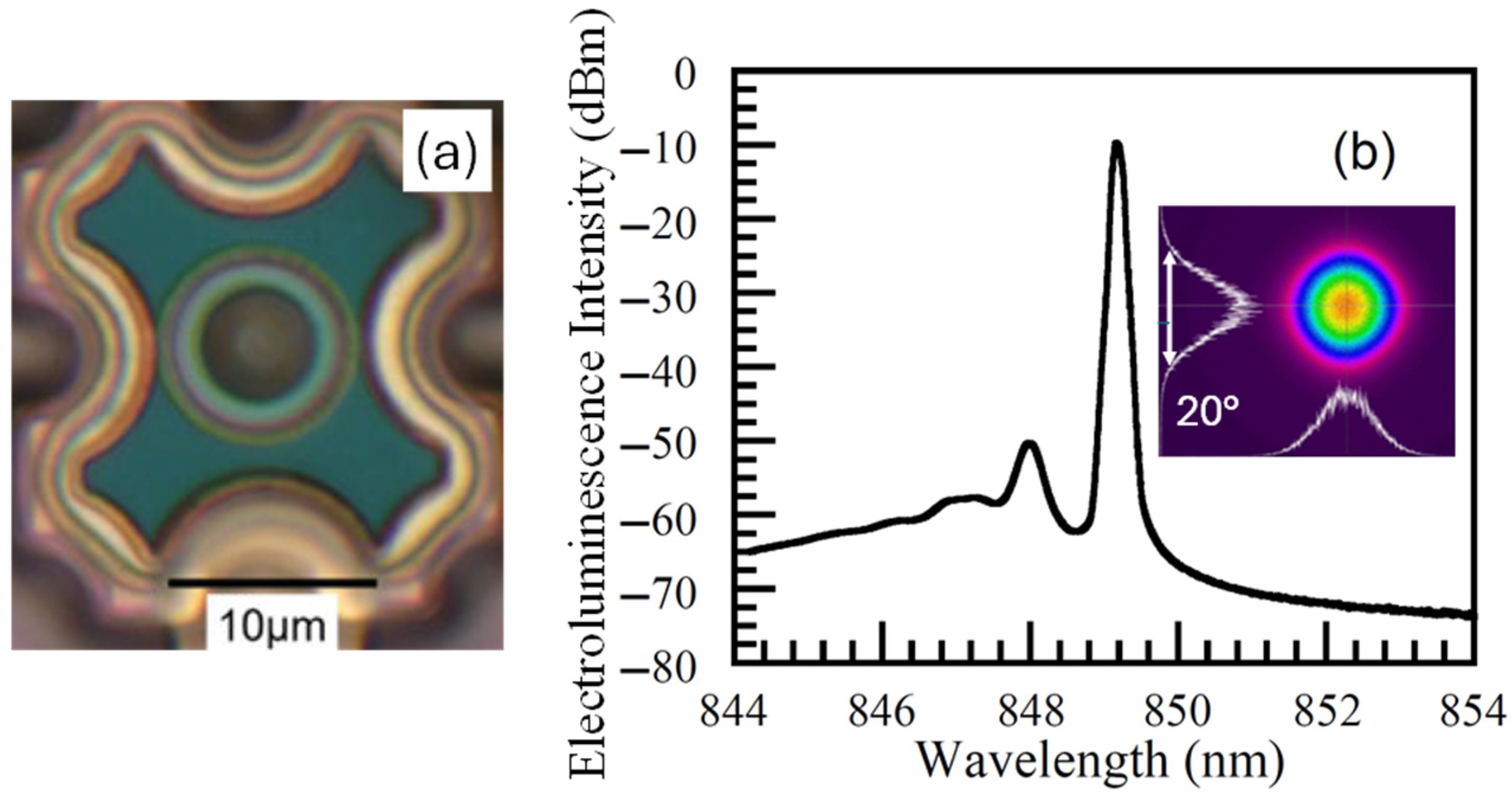
The SM MA VCSEL consists of four 850 nm oxide-confined VCSELs, arranged in a rectangular pattern with apertures ~10–12 µm apart, as shown in
Figure 1a. The optical spectrum of this VCSEL is shown in
Figure 1b. This design yields a root mean square (RMS) spectral linewidth of ~0.1 nm, while maintaining output power and resistance comparable to those of MM VCSELs used in transceivers. The device remains polarization stable with an S
21 modulation bandwidth of 27 GHz at the -3dBe level at room temperature and 25 GHz at 85 °C, measured at an 8 mA bias current. The dBe scale is defined as
operator. Each aperture functions as an independent VCSEL at its own wavelength, despite the low RMS of the combined spectrum [
10,
11]. Relative intensity noise is below −152 dB/Hz. To realize stable lasing, while avoiding optical coupling of the apertures, we select a 10 µm pitch and 2–2.5 µm dimensions for each individual diamond-shaped apertures. In the same geometry, if the size of the aperture is increased beyond 3 µm, the diamond-shaped apertures form long tails and the probability of optical coupling increases. Optical coupling results in the formation of coherent supermodes extending over the whole MA region and the formation of narrow lobes in the far-field pattern [
13]. The formation of single supermodes is observed in coupled aperture VCSELs realized with the photonic crystal approach [
14] and etching and overgrowth approach [
15]. It does not prevent data transmission [
13] and may even improve performance by bandwidth boosting.
In Ref. [
12], the link performance of SM MA VCSEL transmission over MMF is determined by the modal bandwidth of the fiber and laser chirp–CD interaction. For the SM MA VCSEL, the laser linewidth is around 0.1 nm, so the bandwidth attributed to CD due to laser–CD interaction is much higher than that of a typical multimode (MM) VCSEL at 3.1 GHz·km with a 0.6 nm RMS linewidth [
2,
16]. However, the laser chirp–CD interaction is an additional factor that results in bandwidth enhancement instead of obstructing transmission.
For directly modulated lasers (DMLs), including SM MA VCSELs, the frequency chirp not only induces phase modulation through the transient chirp, characterized by the alpha parameter, but also frequency modulation through the adiabatic chirp, such that the transfer function based on small-signal frequency response is as follows [
17]:
where
, L is the fiber length, D is the chromatic dispersion of the fiber,
is the laser wavelength,
c is the speed of light, α is the parameter characterizing the transient chirp, often referred to as the alpha parameter, and
is a parameter to describe the adiabatic chirp. In this work, we have chosen the sign convention of α to be the same as Refs. [
18,
19]. Note that α is also referred to as the linewidth enhancement factor. Equation (1) describes the generic situation for DML. However, we believe that the SM VCSEL studied in [
18] and here are dominated by transient chirp. Therefore, in the first step, we extracted the chirp parameters using the formalism described in [
18,
19], which enables both the alpha parameter and the fiber’s CD to be determined through straightforward equations. The extracted alpha parameter was then substituted into Equation (1) to compare and verify the agreement between the experimental measurements and the more general model.
The experimental setup is the same as in [
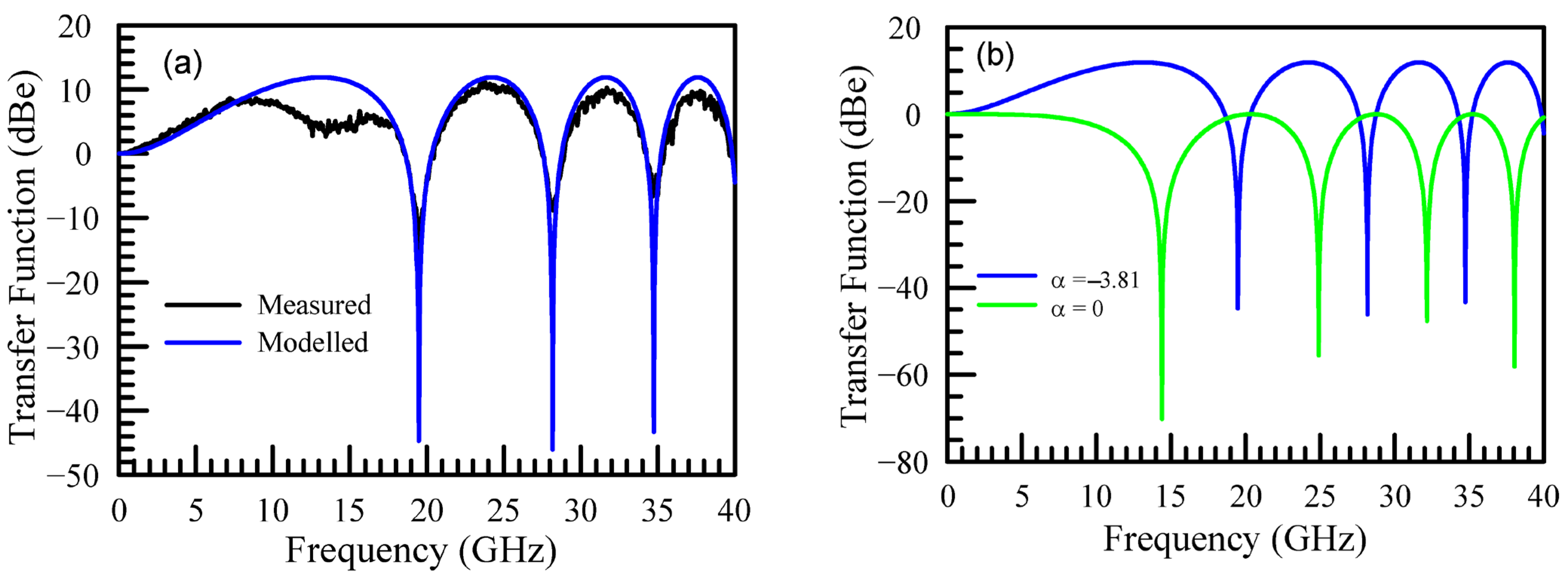
12], with the VCSEL directly modulated with a 7 mA bias current through a vector network analyzer; in the chirp measurements, a long Hi780 fiber, single-mode at 850 nm and with a length of 10.099 km, is used. An optical power of 1.8 dBm was coupled into the fiber, while the VCSEL emitted 4.9 dBm before coupling. This corresponds to a coupling efficiency of 21.4%. Coupling was achieved using two lenses: the first lens, with a focal length of 8 mm, collimated the light from the VCSEL, while the second lens, with a focal length of 11 mm, focused the light into the fiber. The measured link transfer function is shown in
Figure 2a. The measured transfer function represents the amplitude of the S21 parameter obtained from the vector network analyzer (VNA). The contribution for the back-to-back system was calibrated out. Several dips in the frequency response are observed. Following the results in [
18,
19], these resonance-like dips occur at frequencies
, which can be determined using the following equation:
where
c is the speed of light in the vacuum, D is the fiber chromatic dispersion, L is the fiber length,
is the operation wavelength, and
is an integer corresponding to the first, second, third dips, and so on. Therefore, α can be calculated using the frequencies at first and second dips:
The values for the first and second frequency dips are
and
. Using Equation (3), the laser chirp parameter α was obtained to be −3.81. The CD can be calculated using the following equation,
The CD of the fiber is found to be −99.37 ps/(nm·km), aligning well with the known value [
18].
In
Figure 2a, we show the modeled transfer function based on the extracted parameters as a blue curve alongside the measured data in black. It is observed that the two agree well, particularly in the matching dip frequencies. This suggests that the laser chirp is dominantly transient, with negligible adiabatic chirp. In
Figure 2b, we also compare the transfer functions to a hypothetical case where the laser has zero chirp, demonstrating that the presence of chirp increases the frequency response and shifts the dip frequency to a higher value. The interaction between the negative chirp and negative CD favorably cancels some bandwidth limitations caused by modal dispersion. Over the single-mode fiber, the SM MA VCSEL enables ~19 GHz bandwidth at the −3 dBo threshold over 10 km distance, which is 8 GHz higher than the bandwidth expected for zero chirp modulation. dBo is defined as
operator.
To accurately capture the dynamic response of the SM MA VCSEL, we employed OptiSystem’s VCSEL Measured Component, which enables the extraction of intrinsic laser rate equation parameters based on small-signal modulation measurements [
20]. The component accepts experimentally measured intensity modulation (IM) responses—typically measured at multiple bias currents—as well as L-I characteristics such as threshold current and slope efficiency. It includes options for modeling thermal effects and enables parameter optimization to align the simulated laser behavior with the measured data.
To suppress the influence of packaging-related parasitics commonly observed in VCSEL modulation measurements—such as those introduced by bond pads, interconnects, or probe structures—a subtracted small-signal modulation response is used as input to the laser component in OptiSystem software (version 22.0). This subtracted response is obtained by taking the difference between IM measurements at two different bias currents, effectively removing common-mode parasitic effects that are present in both measurements. As a result, the remaining signal more accurately reflects the intrinsic modulation dynamics of the VCSEL itself. This approach enables reliable fitting of the subtracted response using the laser rate equation framework and has been validated in prior work on directly modulated laser characterization [
21].
The laser component minimizes the sum of squared errors between the measured and simulated values of four quantities: damping factor
, resonance frequency factor
, threshold current
, and optical power
at a given bias point. The optimization process is governed by the following objective function [
21]:
Each term in this expression is computed using the rate equation framework. The analytical expressions for
,
,
, and
are listed below [
19]:
The variables used in the above expressions represent key physical parameters of the VCSEL model. Specifically, denotes the group velocity of light in the laser cavity, while is the differential gain coefficient. The terms and refer to the steady-state photon and carrier densities, respectively, at the operating bias current. The gain compression factor is represented by , and and denote the carrier and photon lifetimes. The optical confinement factor is given by , and represents the carrier density at transparency. The spontaneous emission coupling factor is denoted by . Additionally, is the elementary charge, is the volume of the active region, is the internal quantum efficiency, is Planck’s constant, and is the optical frequency of the emitted light.
Once the rate equation parameters are extracted, the VCSEL Measured Component solves the coupled rate equations, numerically simulating the transient and steady-state behaviors of the laser. These equations describe the time evolution of the carrier density
N(
t), photon density
S(
t), and optical phase φ(t) [
20,
21].
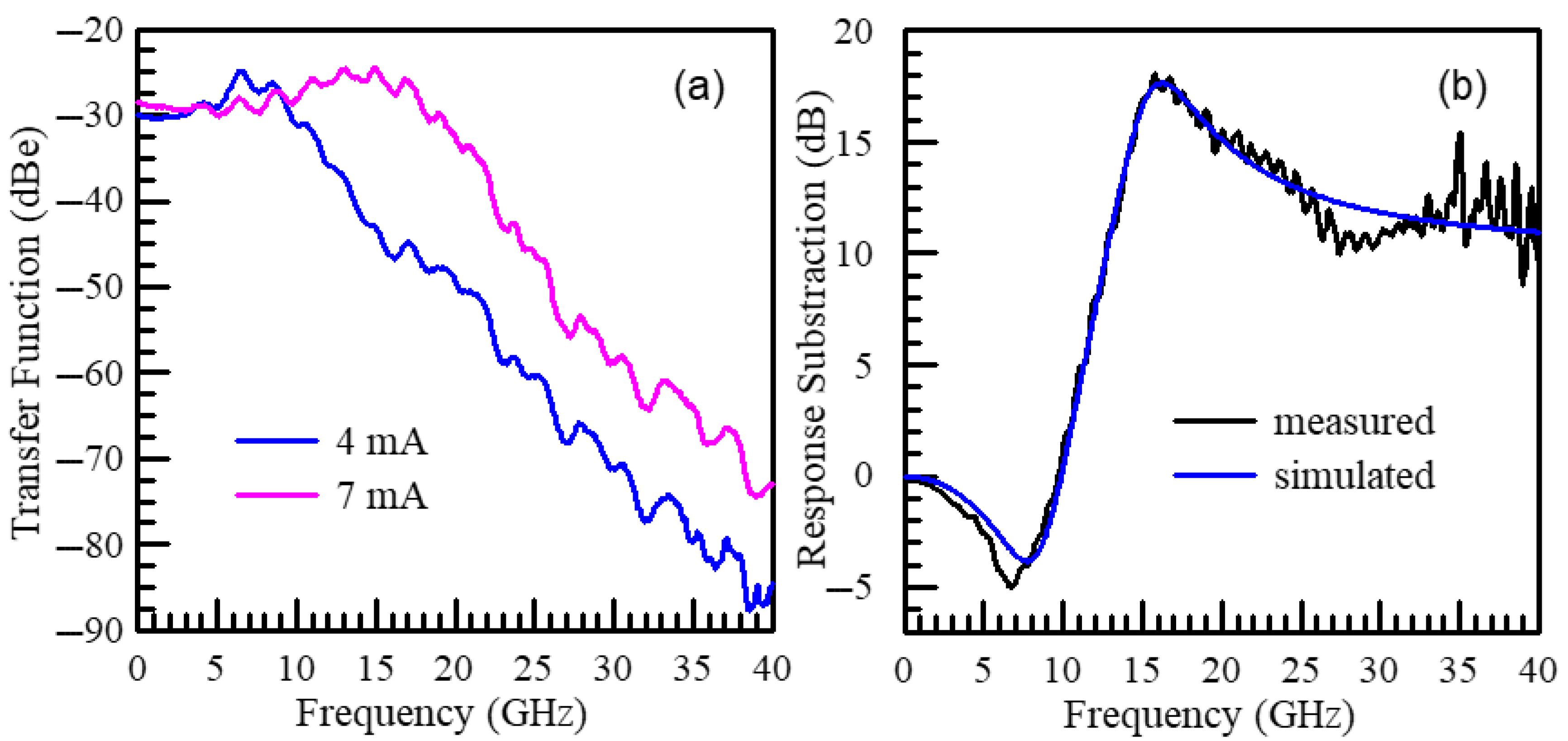
To characterize the laser under different modulation regimes, we measured the small-signal modulation responses of the SM MA VCSEL at bias currents of 4 mA and 7 mA to evaluate its behavior across operating conditions. These measurements, shown in
Figure 3a, reveal the raw IM responses and serve as the basis for further modeling. The measured signals were affected by packaging-induced parasitics, limiting the observed bandwidth to approximately 25 GHz. To isolate the intrinsic laser dynamics, we computed the subtracted response between the two bias points, effectively removing shared parasitic contributions. This subtracted IM response is shown in
Figure 3b, and it is used as input to OptiSystem’s VCSEL Measured Component for parameter extraction. The fitting process employed measured parameters including a threshold current of 1 mA, a slope efficiency of 0.7167 mW/mA, a reference current of 2 mA, and a chirp parameter α = −3.81. The extracted parameters enabled generation of a simulated subtracted response model, which is also plotted in
Figure 3b. The excellent agreement between the modeled and measured subtracted responses validates the accuracy of the parameter fitting and confirms that the intrinsic dynamics of the laser were successfully captured.
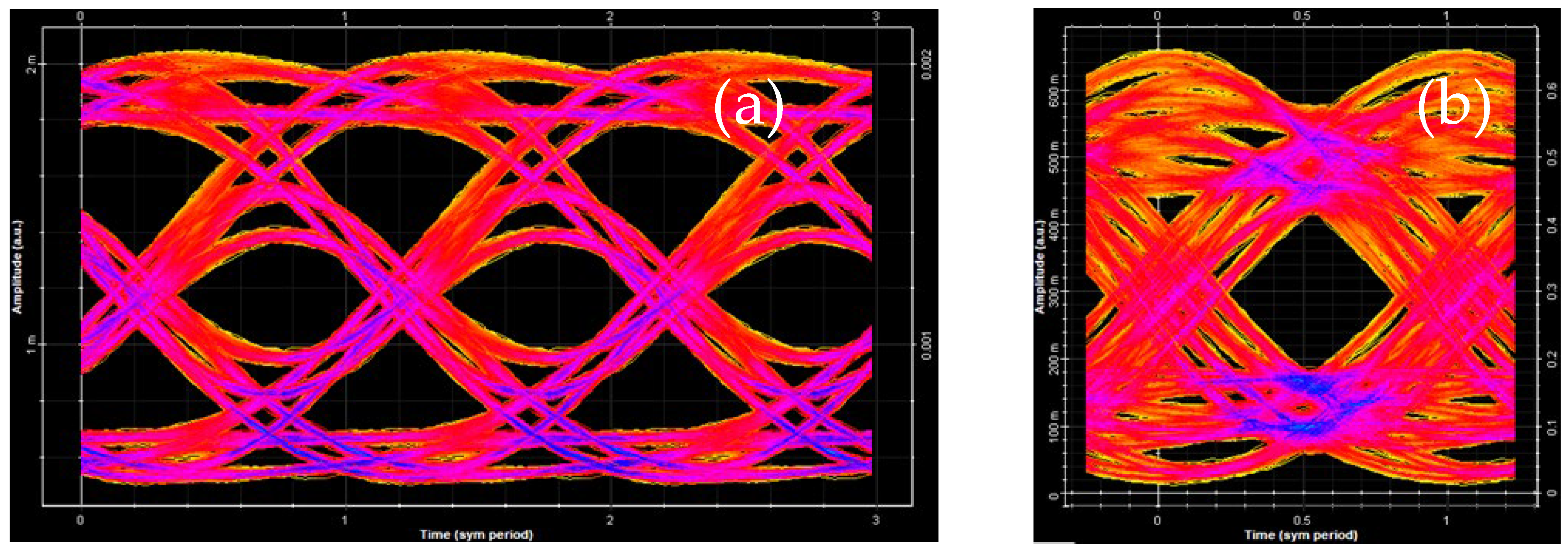
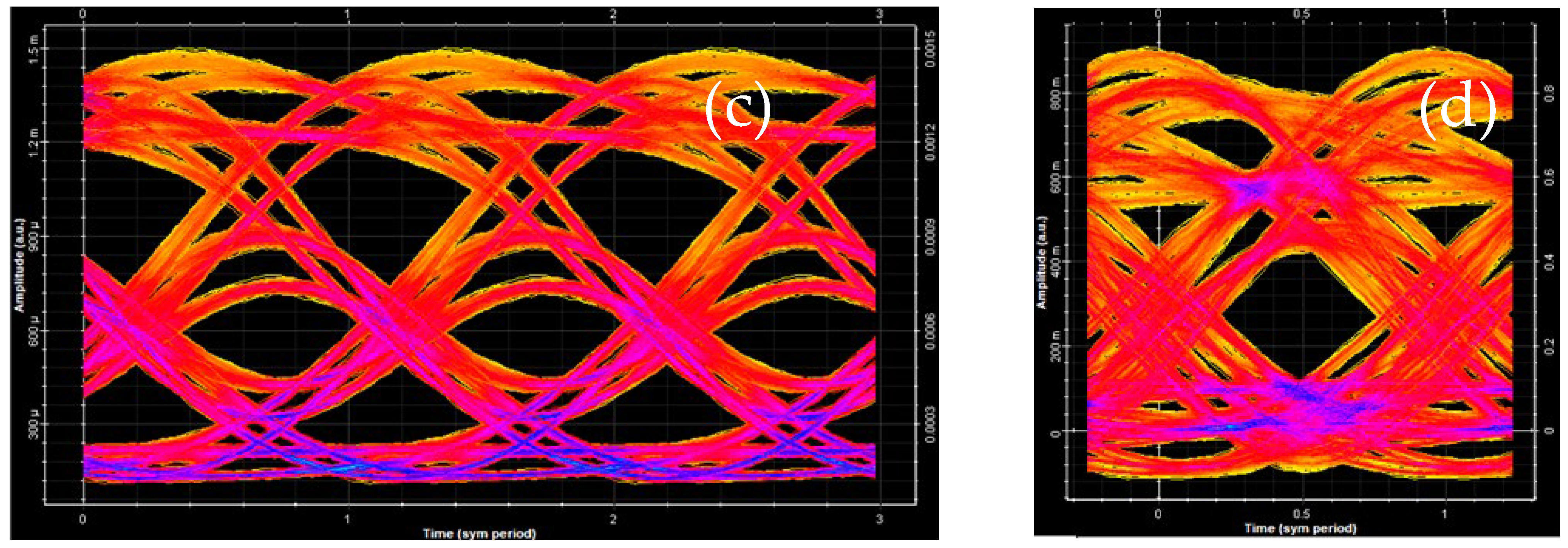
Using these extracted parameters, we then simulated system-level performance under realistic transmission scenarios. In
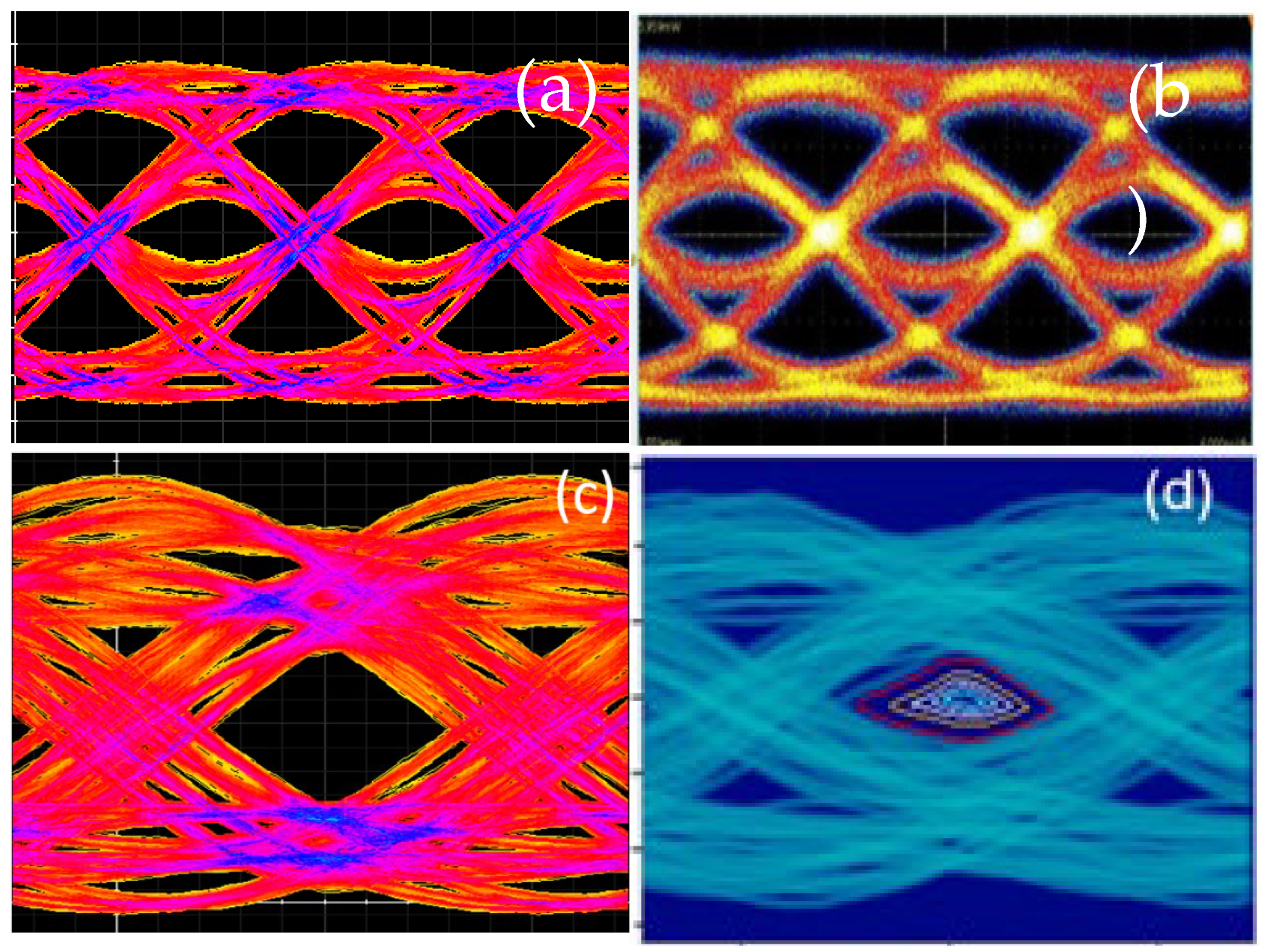
Figure 4, eye diagrams for several representative conditions reported in [
12] are presented. In the experiment, the MMF used has a modal bandwidth of around 4000 MHz·km at 850 nm. The bit pattern generator used is the SHF 12104A (made by SHF Communication Technologies AG, Berlin, Germany). Eye diagrams were acquired using a Tektronix DSA8300 sampling oscilloscope with the optical module 80C15 (Made by Tektronix, Inc. Beaverton, OR, USA).
Figure 4a,b show the eye diagrams for back-to-back and after a 100 m MMF, respectively, without any equalization, highlighting the preservation of timing and amplitude integrity across short-reach links.
Figure 4c,d present the eye diagrams for simulated output of a 200 m MMF link with a 2-tap feed-forward equalizer (FFE) and the measured eye diagram, respectively. The simulation employed a bias current of 8 mA, consistent with the experimental setup. The close match between simulated and measured eye diagrams across all scenarios demonstrates the robustness and predictive capability of the extracted VCSEL model, based on the extracted threshold current, slope efficiency, and alpha parameter, to accurately predict system-level performance. This includes the following:
Frequency response over various fiber lengths and modal bandwidths;
Optical eye diagrams at different bit rates and equalization conditions;
Bandwidth enhancement due to chirp–CD interaction.
The strong agreement between simulation and experiment enables us to confidently extend the model to untested scenarios, such as new fiber lengths, launch conditions, or VCSEL currents, offering valuable predictive insights for system configurations where direct measurement is impractical. We will therefore apply our simulations to a broader range of fiber parameters in
Section 4.
3. Analysis of Link Bandwidth and Transmission Reach
For DMLs in O-band and C-band, often many kilometers of single-mode fibers are needed to show chirp effects. However, for 850 nm applications, the effect of laser chirp can be significant even when the fiber length is 200 m or less. Note that an MMF typically has CD of around −98.5 ps/(km·nm) at 850 nm [
12]. With the laser chirp parameters extracted in
Section 2, we can construct a link transfer function, based on (a) modal bandwidth and (b) laser chirp–CD interaction, as follows:
The transfer functions are additive when using the dBe scale. Note that in optical communication standards, both electrical bandwidth (−3 dBe) and optical bandwidth (−3 dBo) are applied. The dBo scale is defined as
operator. −3 dBo is equivalent to −6 dBe.
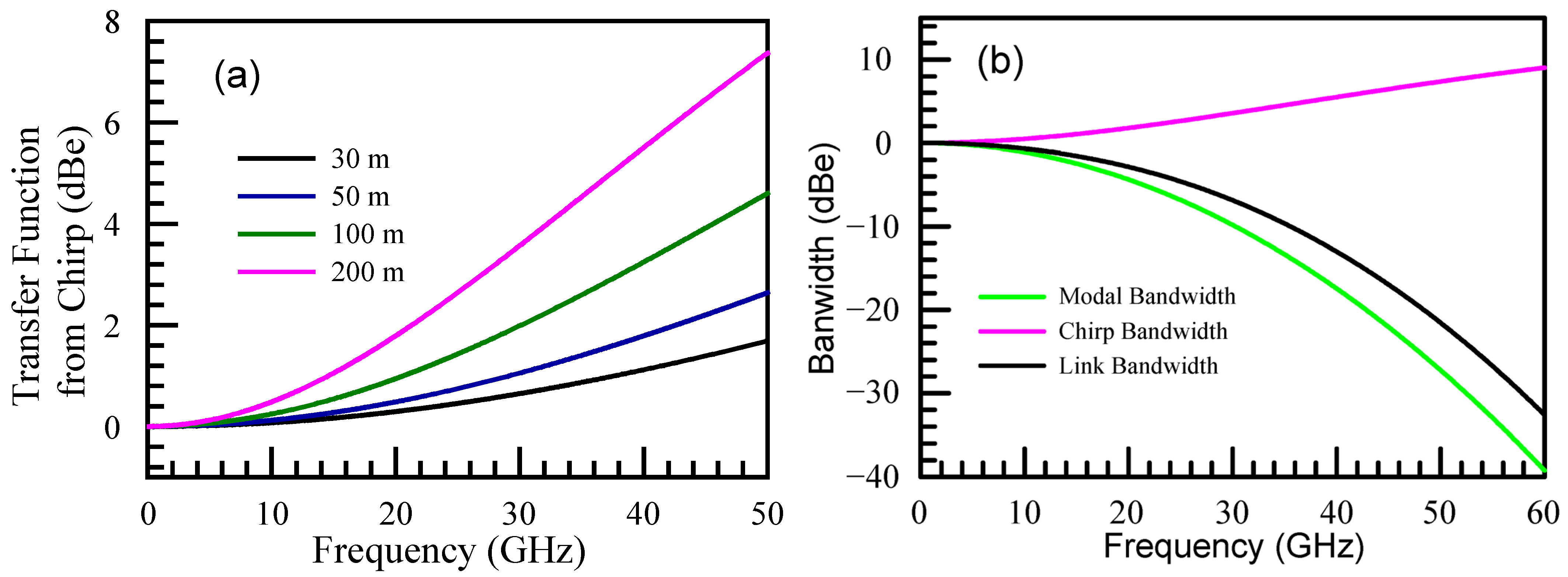
One notable aspect of the laser chirp effect of the 850 nm SM MA VCSEL is its influence at short fiber lengths of 30–200 m, rather than the usual kilometer-scale distances. Using the extracted chirp parameter, we calculated the impact of chirp–CD interaction on the transfer function using Equation (1). Even with 30 m of MMF, the chirp effect can mitigate the reduction in bandwidth caused by modal dispersion, resulting in a link bandwidth that exceeds the modal bandwidth. As shown in
Figure 5a, the transfer function due to the interaction between laser chirp and CD increases with modulation frequency over several fiber lengths of 30 m, 50 m, 100 m, and 200 m, which is a significant effect. In
Figure 5b, we show the transfer functions attributed to modal dispersion, chirp–CD interaction, and their total contribution for 200 m of OM4 with an EMB of 4700 MHz·km. The transfer functions attributed to modal dispersion decreases as frequency increases. However, the transfer function for CD–chirp interaction increases with frequency, resulting in a total link-level bandwidth that is higher than the modal bandwidth—contrary to conventional cases for transmission using MM VCSELs.
Table 1 shows the link bandwidth for five cases with varying levels of modal bandwidths and lengths across OM3 and OM4 fibers. IEEE 802.3 db requires a link bandwidth of 18 GHz at the −3 dBe level to transmit at 100 G/lane, translating to 100 m over OM4 and 60 m over OM3 fibers [
3]. In
Table 1, we show the link bandwidth attributed to OM3 and OM4 fibers at selected lengths and EMBs, spanning from low to high. For comparison, we also modeled the expected link bandwidth for conventional MM VCSELs, which has a specified linewidth of 0.6 nm [
2,
16]. It is observed that, for SM MA VCSELs, with the chirp effect, transmission can exceed current standards. In all five cases studied, the link bandwidth exceeds 18 GHz, thus meeting the transmission requirement. For a nominal OM3 fiber with 2000 MHz·km, the transmission reach is 85 m. For an OM3 fiber with 3500 MHz·km, the transmission reach already exceeds 100 m, reaching 150 m. At a nominal OM4 fiber with 4700 MHz·km, the expected transmission reach is 200 m, which is 2 times the distance specified by IEEE 802.3 db for 100 G/lane-based VCSEL transceivers. With even higher EMBs, above the OM4 fiber threshold, such as at 6500 MHz·km and 8000 MHz·km, the transmission reach can extend to 300 m and 400 m, respectively.
Table 1 also shows the results for MM VCSELS, which is currently commercially adopted. Due to their high laser linewidth of 0.6 nm and CD value of around −98.5 ps/ (nm·km) [
16], the bandwidth attributed to CD is calculated to be 3.16 GHz·km at 850 nm (see chapter 4 and 6 of [
2]). Without the boost from the laser chirp–CD interaction, the link bandwidth is limited both by the modal bandwidth and bandwidth attributed to CD. Therefore, the transmission reach for MM VCSEL is limited at 100 m for OM4 fibers. In
Figure 6, the modeled eye diagrams for the two of the configurations in
Table 1 are presented using the parameters extracted as described in the second part of
Section 2. The modeled cases are 50 Gb/s SM MA VCSEL transmission over 150 m of MMF with an EMB of 3500 MHz·km and over 300 m of MMF with an EMB of 6500 MHz·km. Both cases—without equalization and with a 2-tap FFE—are shown. Without equalization, the eye diagrams remain open but exhibit significant degradation. In contrast, the use of a 2-tap FFE results in significantly open eye diagrams, indicating high-quality transmission. Additionally, although the MMFs have different lengths in both the cases, they achieve similar link bandwidths, as listed in
Table 1. As expected, the quality of the eye diagrams is also quite similar, as shown in
Figure 6. The simulated eye diagrams further confirm the results obtained from the link bandwidth calculations.
For 200 G/lane VCSEL transmission, the standard for link bandwidth requirements is still under development and has not yet been established [
5]. Here, we assume that 50 GHz link bandwidth (2.5 times that of 100 G/lane) is needed. In
Table 2, we show cases with varying levels of EMB and lengths across OM3 and OM4 fibers. It is observed that a 35 m reach can be achieved for a nominal OM3 fiber with 2000 MHz·km. The transmission distance increases with modal bandwidth, reaching 150 m and 200 m for OM4 fibers with high EMBs. The transmission distances presented here are in contrast with recent demonstrations of 200 G/lane MM VCSELs. In those cases, after utilizing OM4 fibers with an EMB significantly higher than the OM4 standard threshold of 4700 MHz·km, the transmission achieved a reach of 50 m [
4].
To further improve data transmission by overcoming EMB restrictions, several approaches are being considered. In one case, special launch conditions possible within the existing standards are applied. Redistribution of the mode intensities within the MMF enables significant improvement in EMB [
22]. Under certain launch conditions, the effective mode diameter in the MMF can be significantly reduced, allowing for smaller surface areas of the photodetectors and consequently higher detection bandwidths. MA VCSELs with a narrow far-field are well suited for such launch geometry optimizations. A more advanced case is the coupling of VCSEL to single-mode fiber, either to a fiber behaving as single-mode within the short-wavelength division multiplexing (SWDM) range (840 nm–960 nm) like Hi780 SMF, or to a standard SMF (two-mode within SWDM range) with mode filters applied to exclude excitation of the high-order modes [
23]. The coupling efficiency of MA VCSELs to SMF is relatively low (defined in this work as 20–30% for Hi780 fiber); this problem can be mitigated by the significant output power of the MA VCSELs, enabling robust data transmission. MA VCSELs applied in data transmission can operate with independently lasing apertures, like those reported in this work. In this case, the communication between the SM apertures is weak, and the mode partition noise can be neglected. In another case, MA VCSELs can lase in a single coherent supermode [
10,
14,
24]. The latter devices may allow for optimal performance over SMF [
23]. Restricted central launching of such VCSELs can be applied to standard MMF [
24,
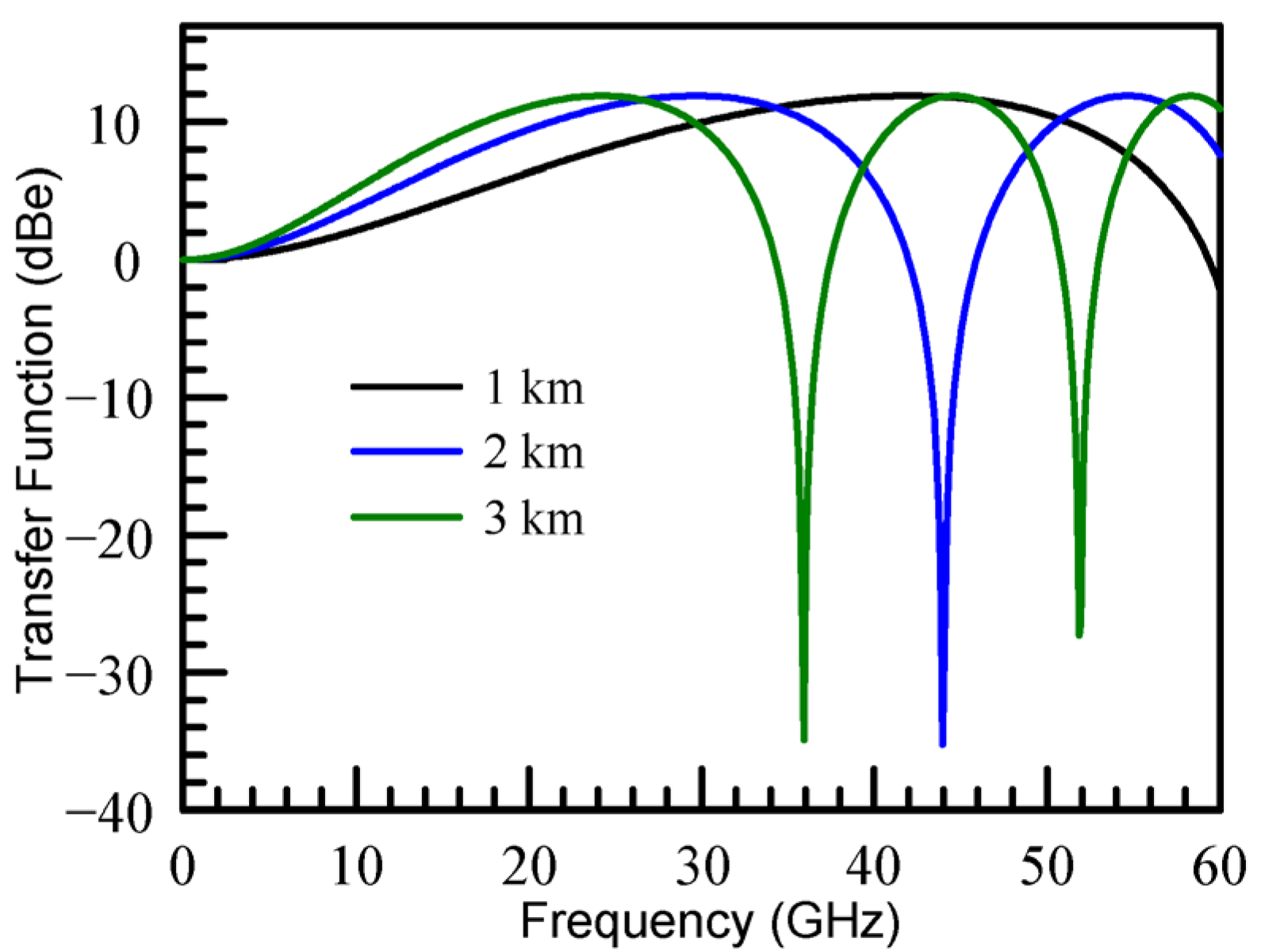
25], enabling km long robust transmission at 112-Gb/s PAM4 over OM2 fiber. To illustrate the potential of using single-mode fiber for SM MA VCSEL transmission, in
Figure 7, we show the transfer functions for 1 km, 2 km, and 3 km of Hi780 fiber using the measured chirp parameter and the CD value for Hi780 fiber. Since single-mode fiber has infinite modal bandwidth, the only source of contribution is from the laser chirp–CD interaction. The link bandwidths are 35.14 GHz, 43.04 GHz, and 60.86 GHz at the −6 dBe (= −3 dBo) level, which is sufficient for 100G and higher data rate transmissions. Thus, based on bandwidth, such links can support transmission over kilometers of single-mode fiber at 100G or above, as the bandwidth significantly exceeds the requirements specified in IEEE 802.3 db [
3].



 ,
,