Abstract
We demonstrate a fundamentally mode-locked Yb-doped “solid-state fiber laser” with a repetition rate of 1 GHz and a pulse duration of 48 fs. The nonlinear-polarization-evolution (NPE) mode-locking of the “solid-state fiber laser” enables up to 286 mW of average power and a 26 nm spectrum bandwidth, which supports a 48 fs pulse duration. The laser self-starts and the central wavelength can be tuned from 1032.4 nm to 1035.6 nm. To the best of our knowledge, it is the shortest pulse duration directly obtained by GHz fundamentally mode-locked Yb-fiber lasers.
1. Introduction
High-repetition-rate (≥500 MHz) femtosecond fiber lasers are attractive for high-speed scientific and engineering fields. In nonlinear bio-optical imaging systems, a laser source with a GHz repetition rate can promote signal-to-noise ratio and reduce data acquisition time [1,2]. Optical frequency combs, via high-repetition-rate lasers, display large line spacing, which might enable the manipulation of individual comb lines [3]. These capabilities are useful in many applications, in particular, astronomical spectrum calibrations for the investigations on the genesis of the universe and the search for Earth-like planets [4,5].
Yb-doped fiber lasers by harmonic mode-locking and semiconductor saturable absorber mirror (SESAMs) mode-locking could deliver a multi-GHz repetition rate. However, the repetition rate achieved with harmonic mode-locking would be not sufficiently stable for further applications [6,7,8], while the saturable absorbers usually deliver a low output power and limited spectral coverage [3,9,10,11,12]. In addition, in order to increase the repetition rate, heavily doped phosphate glass fibers fabricated in laboratories are frequently used as the gain medium [10,11,12]. In this sense, it would add significant cost and reduce the throughput. On the other hand, it has been demonstrated that NPE mode-locked fiber lasers produced pulses with pulse energy at the nanojoule level and pulse duration in tens of femtoseconds [13,14,15].
Recently, “solid-state fiber lasers” have been demonstrated by employing a non-polarization-maintaining fiber mostly via NPE mode-locking [14,15,16,17,18,19]. The configuration of a “solid-state fiber laser” includes free-space components and a fiber gain medium. The time jitter of a fundamentally model-locked Yb-doped “solid-state fiber laser” was reduced to 130 attoseconds in free-running operation by minimizing the vibrations from the holders for free-space components [16], while the repetition rate was increased to the GHz level [13,14]. Even if enormous amounts of research efforts have focused on the repetition rate promotion [14,15,16] and “noise” reduction [18,19] of “solid-state fiber lasers”, further applications, e.g., spectrum calibrations in precision metrology, might still prefer GHz Yb:fiber lasers with an even shorter pulse duration and larger bandwidth. In addition, although previously reported high-repetition-rate “solid-state fiber lasers” have introduced a grating pair to make the laser operate in a dispersion-managed soliton regime [14,15], the separation distance of the grating pair is usually fixed. However, it is known that tunability would be always favorable to spectral metrology. In this sense, it might still be of interest to see whether the output spectra can be modulated by managing the dispersion inside the cavity, even if the separation distance could be sensitive to the alignment of the cavity.
In this paper, we demonstrate the generation of 48 fs, 1 GHz fundamentally mode-locked pulses directly from a Yb-doped “solid-state fiber laser”. A highly integrated ring-cavity fiber laser was built with 11.5 cm of commercial Yb-doped fiber as the gain medium. The fundamental mode locking at a 1 GHz repetition rate was attributed to the combination of the high injection power and the designed wavelength division multiplexer (WDM) collimator, which enabled sufficient nonlinearity for NPE mode locking by the generated high peak power in the cavity. The central wavelength of this “solid-state fiber oscillator” was tuned from 1032.4 nm to 1035.6 nm by dispersion management via adjusting the separation distances between a pair of gratings inside the ring cavity. The maximum output power was 286 mW, with a corresponding spectral bandwidth of 26 nm.
2. Materials and Methods
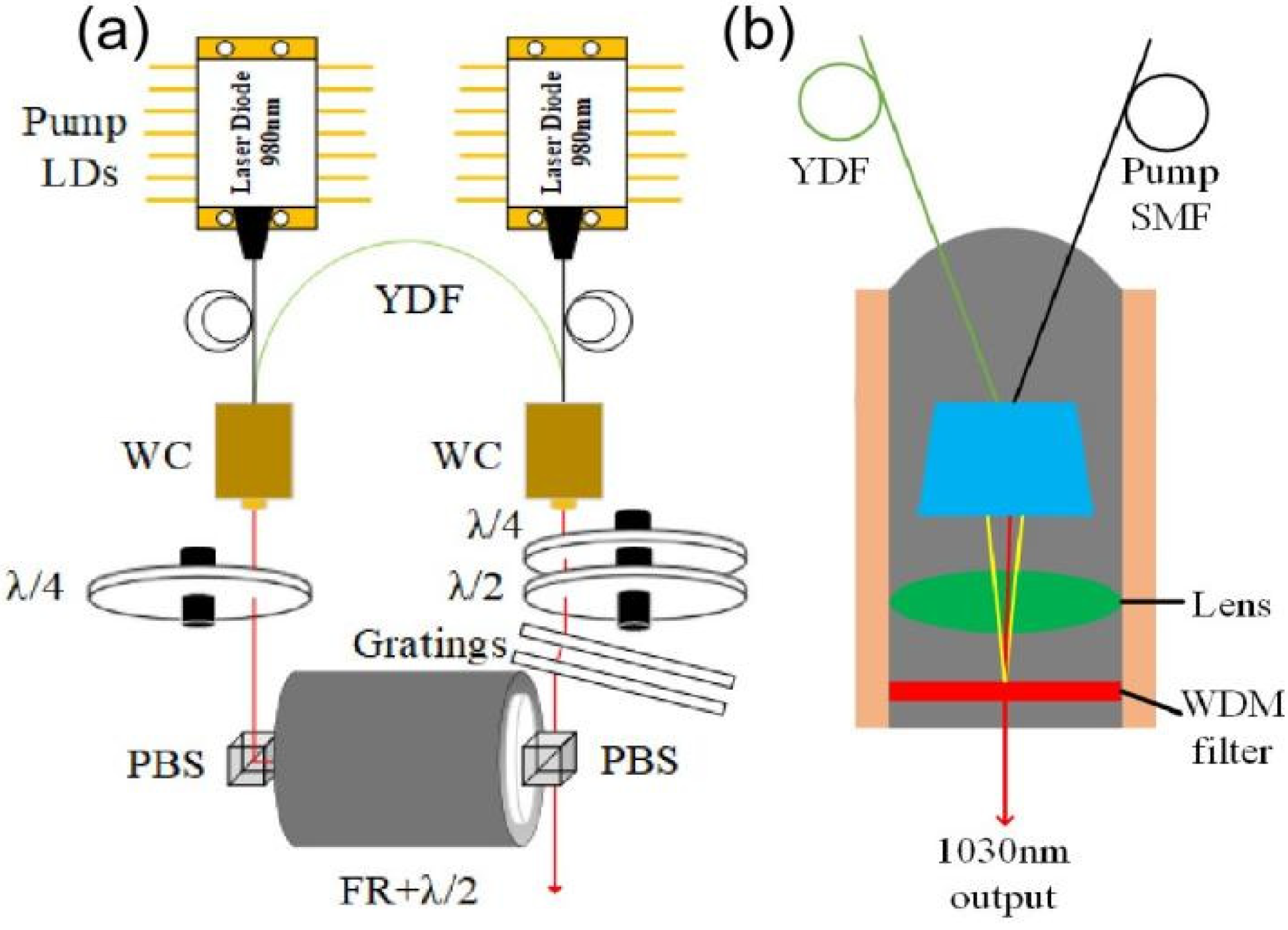
The schematic diagram of the “solid-state fiber laser” is illustrated in Figure 1a. The 22.5 cm ring cavity consisted of an 11.5 cm commercial gain fiber and 11 cm free-space instruments. The gain fiber (CorActvie SCF-YB550) had a 4-μm core diameter. The absorption of the pump was ~1750 dB/m at 976 nm. Each end of the gain fiber was integrated into a WDM collimator. In this case, there was no non-gain fiber inside the cavity. The functions of a collimator and a WDM were combined in the WDM collimator in our experiment. As shown in Figure 1b, each WDM collimator was held in a capillary, which consisted of a dichroic filter and a lens with 1 mm for the apertures [15]. The pump beam at 976 nm was reflected by the filter into the gain fiber, which, in fact, bounced between two filters in two WDM collimators at both ends of the gain fiber in Figure 1a. The laser beam at ~1030 nm could pass through the filter and be collimated by the collimation lens. A pump power of 1.5 W was injected into the ring cavity in the following experiments. Thus, the tips of the gain fiber in the WDM collimator were easily damaged. The problem was solved by coupling each tip of the fiber with a 300-μm-long horn-shaped self-made beam expander. The diameters of the input and the output ports of the expander were 50 μm and 150 μm, respectively. The WDM collimator had ~1 dB for the coupling loss. In Figure 1a, two 1200 mW 976 nm laser diodes (LDs, Mairui Optoelectronics Inc.) were coupled from both ends of the gain fiber through WDM collimators. A pump protector and an isolator were installed after each LD. Both of them could protect the LDs from damage due to back reflections. The unidirectional operation was ensured by a Faraday rotator with two PBSs and a half-wave plate. GHz repetition rate demanded shrinking the laser cavity via the integrated design by decreasing the length of both the gain fiber and the free space. A Martinez compressor with a 1250 lines/mm transmission grating pair was employed for dispersion compensation inside the ring cavity. The mode-locking could be maintained as the separation distance of the grating pair tuning from 1.0 to 1.6 mm, which corresponded with net intracavity dispersions of −3000 to −8400 fs2. The close-to-zero net dispersion guaranteed that the laser worked in a dispersion-managed soliton regime. In Figure 1a, the pulses transmitted from the PBS were delivered outside the laser cavity. The output port was next to the grating pair in order to achieve the shortest pulse duration.
Figure 1.
(a) Schematic configuration of the “solid-state fiber laser”. LD: 1200 mW laser diode; FR: Faraday rotator; PBS: polarization beam splitter; WC: wavelength-division-multiplexer (WDM) collimator; λ/2: Half-wave plate; λ/4: Quarter-wave plate; YDF: Yb-doped fiber. (b) Schematic diagram of the WDM collimator.
In our experiment, mode locking was yielded by the manipulation of the wave plates’ rotation. Differing from the lower-repetition-rate NPE laser, only a few of the wave plate combinations gave rise to mode-locking. It could be one of the advantages of the high-repetition-rate solid-state fiber” laser for limited mode-locking states [14].
3. Results
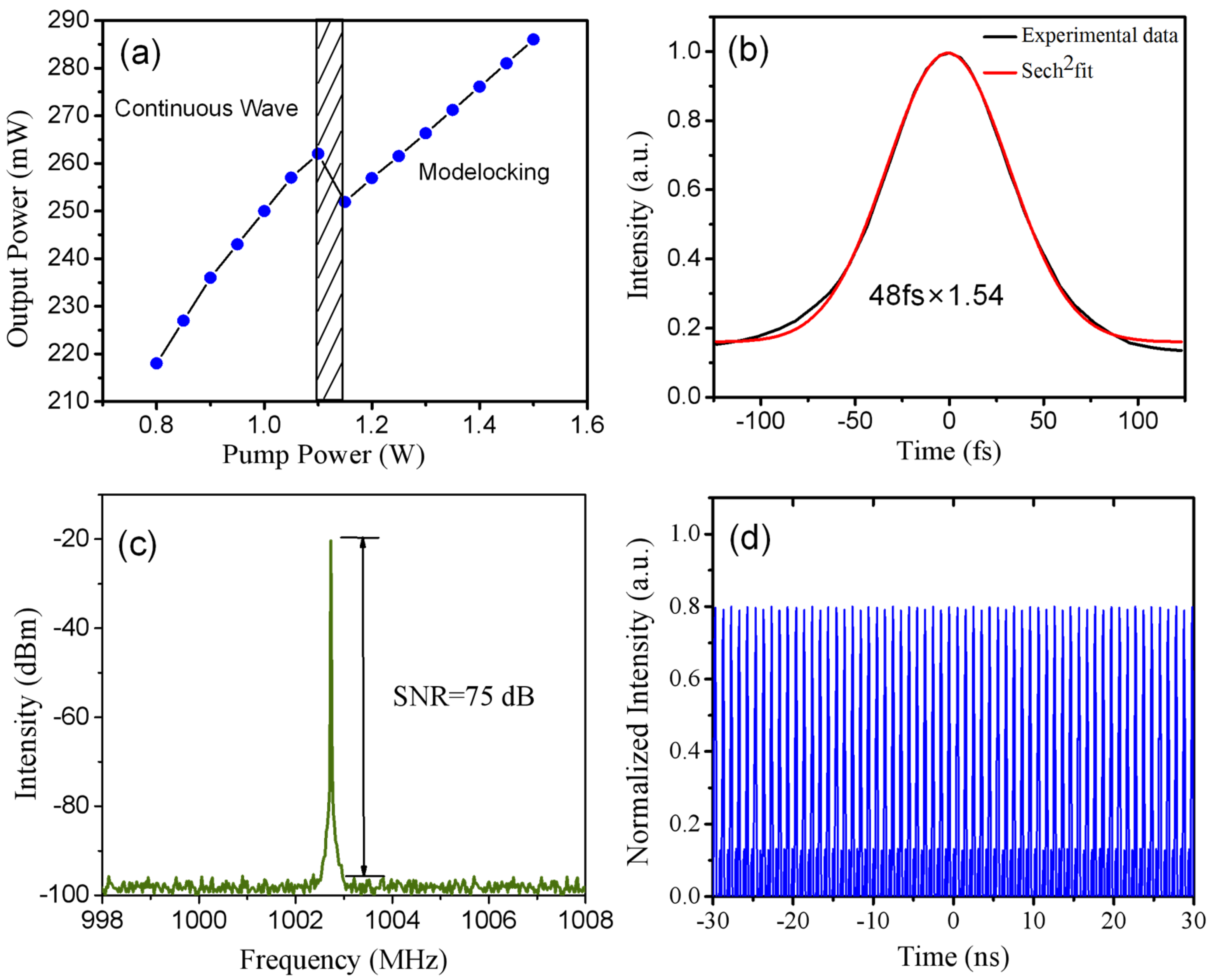
Figure 2a shows the measured output powers as the pump powers were increased. The separation distance of the grating pairs was fixed at 1.0 mm. The laser operated at a continuous wave mode under relatively lower pump powers. The laser could self-start when the pump power exceeded 1.15 W. In our experiment, the laser was investigated at a 1.5-W pump power, which generated 286 mW for the laser power, corresponding to 0.286 nJ for the pulse energy. The input pump power was measured after the isolator. The autocorrelation trace was measured by an autocorrelator (PulseCheck50 NIR, APE) and fitted by sech2. With a deconvolution factor of 1.54 (assuming a hyperbolic secant pulse profile), the pulse duration was calculated to be 48 fs, which was near-transform-limited [see Figure 2b]. The radio frequency (RF) spectrum was measured with a 10 kHz resolution bandwidth by an RF spectrum analyzer (CXA Signal Analyzer), which is exhibited in Figure 2c. The output pulse train had a fundamental repetition rate of 1.0027 GHz, with 75 dB for the signal-to-background ratio, which was in good accordance with the calculation from the cavity length. The output pulse train was measured by a 2.5 GHz photodetector (LIGHTSENSIN, LSIPD-A75) and a 4 GHz oscilloscope (AGILENT TECHNOLOGIES, DSO9404A), as shown in Figure 2d. The measured pulse train indicated high stability. In addition, there are no satellite pulses between neighbouring pulses in Figure 2d.
Figure 2.
(a) Experimentally measured average output powers with increased pump powers. (b) The autocorrelation traces of experimentally measured (black solid curve) and hyperbolic secant fitting (red solid curve) pulses. (c) Radio frequency (RF) spectrum, resolution bandwidth = 10 kHz. (d) The delivered pulse trains. The grating separation was set to 1.0 mm.
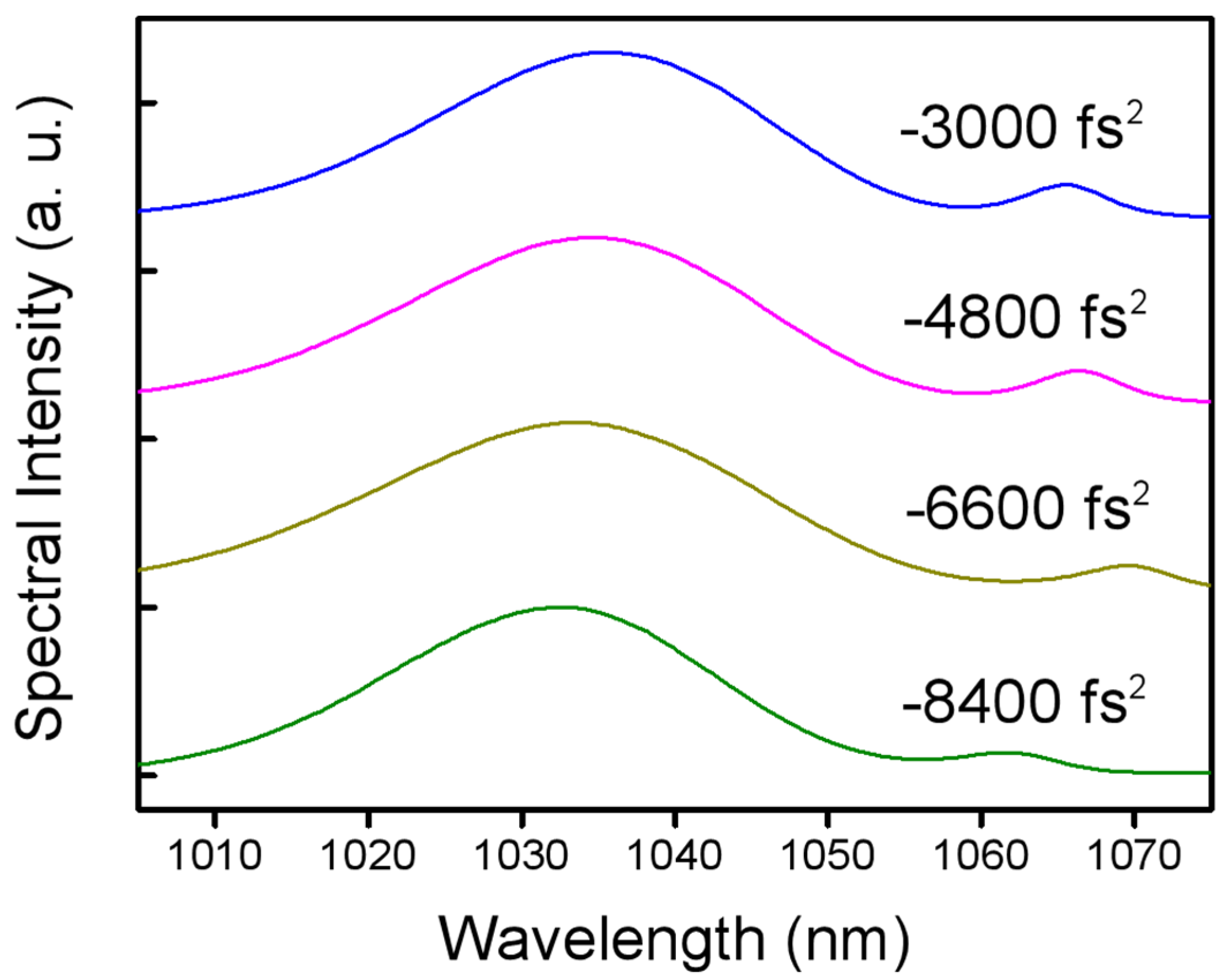
In order to manage the inter-cavity dispersion, the laser operation was characterized by different separation distances between the transmission gratings. The positive group delay dispersion (GDD) in the cavity was due to the gain fibers and free space instruments. The negative dispersion was contributed by the grating pair, whose group velocity dispersion (GVD) was −0.9 × 10⁴ fs2/mm. The output spectra are analyzed in Figure 3 and were monitored by an optical spectral analyzer (THORLABS, OSA202C) with 0.02 nm spectral resolution. Previous experiments on a high-repetition-rate “solid-state fiber laser” were usually carried out with a fixed net dispersion [13,14,15,16,17]. In our experiment, the mode-locking could be maintained with a slight change in the grating pair separations from 1.0 to 1.6 mm, which corresponded to net cavity dispersions from −3000 to −8400 fs2. In Figure 3, as −3000, −4800, −6600, and −8400 for the net cavity dispersion, the central wavelength of the output spectra were 1035.6, 1034.8, 1033.6, and 1032.4 nm, with 26.0, 25.7, 25.1, and 24.8 nm for the spectral bandwidth at full width and half maximum (FWHM). The mode-locking states could not last with the further increase or decrease in the grating separation due to the misalignment-induced power decrease. The broadest spectrum was 26 nm with 1.0 mm for the grating separation. The calculated Fourier-transform limit of the optical spectrum was 42.8 fs. This value was close to the measured pulse duration of 48 fs.
Figure 3.
The evolution of the output optical spectra with −3000, −4800, −6600 and −8400 fs2 for the net cavity dispersion. The corresponding grating separations are 1.0, 1.2, 1,4, and 1.6 mm, respectively. The spectra were recorded with 1.5 W for the injected pump power. The measured spectra are presented in linear scales.
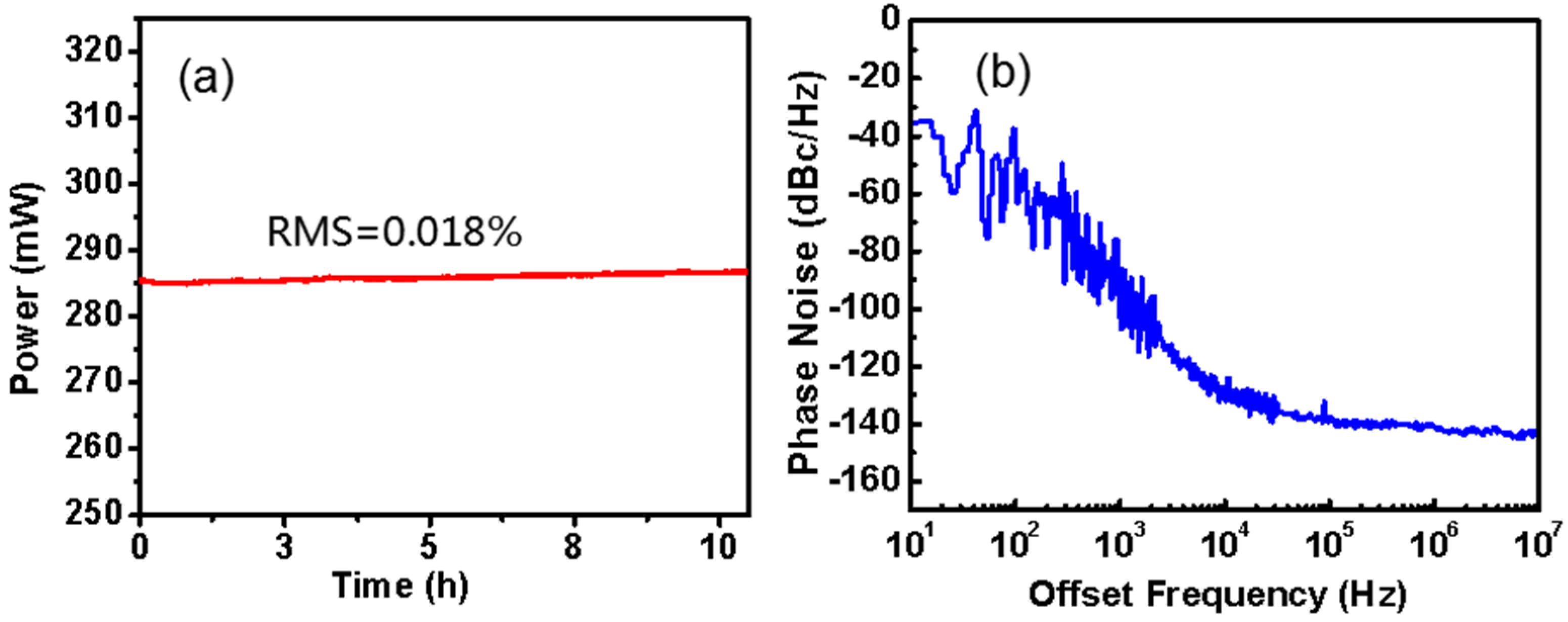
Without any enclosure of the laser oscillator, the average power of the “solid-state fiber” was measured with the full-power output for a duration of 10.5 h in Figure 4a. The average output power was ~286 mW. The root mean square (RMS) of 0.018% is presented in Figure 4a, while Figure 4b indicates the measured phase noise spectra. The values of phase noises decreased from −35 dBc/Hz to −145 dBc/Hz as the offset frequency increased from 10 Hz to 10 MHz. Both power fluctuation and phase noise characteristics indicated the stable operation of the “solid-state fiber laser”. In fact, the laser (oscillator) was used as the light source for the coherent pulse stacking amplification in our laboratory, which was able to self-start when we only increased the pump power. It had already maintained a turnkey operation for 6 months.
Figure 4.
(a) Power fluctuation and (b) Phase noise characteristics of the ~1 GHz “solid-state fiber laser” with 1.5 W for the injected pump power and −3000 fs2 for net cavity dispersion.
4. Discussions
Our work is compared with some typical studies in Table 1. Compared with previous approaches of high-repetition-rate (≥500 MHz) fundamentally mode-locked Yb-fiber lasers, we achieved advances in the direct output pulse duration and the bandwidth. We believe that the scheme of the “solid-state fiber laser”, the high pump power injection, and the WDM collimator with a larger damage threshold could be the reason for the large bandwidth of the generated soliton pulse, which supports a shorter duration. It is noteworthy that the calibration of the injected pump power in our experiment was conducted after the isolator, and the pump protector and the isolator each had a 10% transmission loss.
Table 1.
Comparison of output pulse duration for high-repetition-rate mode-locked fiber lasers.
5. Conclusions
In conclusion, we demonstrate a slightly tunable “solid-state fiber laser”, generating 1 GHz, 48 fs pulses with a 26 nm bandwidth. The stability of this oscillator could be improved by reducing the mechanical noise by integrating all components on a silica glass brick instead of metal holders and the baseplate [16,20]. On the other hand, it was recently reported that two-dimensional nanomaterials were used as saturable absorbers in lasers [21,22,23,24,25,26,27]. The repetition rate of the fiber laser could be further increased by employing two-dimensional nanomaterials for mode-locking. This kind of fiber laser can be used as the seed for coherent pulse stacking amplification [28] and other applications.
Author Contributions
Conceptualization, S.Y.; methodology, H.Z. and M.H.; validation, M.H.; formal analysis, M.H.; investigation, Y.C.; resources, Y.C.; data curation, Y.C.; writing—original draft preparation, Y.C. and J.S.; writing—review and editing, H.Z.; supervision, H.Z.; project administration, H.Z.; funding acquisition, H.Z. All authors have read and agreed to the published version of the manuscript.
Funding
This work is supported by the National Key Research and Development Program (2018YFB0504400), National Natural Science Foundation of China (61875243, 12022411, and 11727812), Shanghai Rising-Star Program (22QC1401000), Shanghai Municipal Science and Technology Major Project (2019SHZDZX01-ZX05 and 2019SHZDZX01-ZX06).
Institutional Review Board Statement
Not applicable.
Informed Consent Statement
Not applicable.
Data Availability Statement
The data that support the findings of this study are available from the corresponding author upon reasonable request.
Conflicts of Interest
The authors declare no conflict of interest.
References
- Ideguchi, T.; Holzner, S.; Bernhardt, B.; Guelachvili, G.; Picque, N.; Haensch, T.W. Coherent Raman spectra-imaging with laser frequency comb. Nature 2013, 502, 355–358. [Google Scholar] [CrossRef]
- Ji, N.; Magee, J.C.; Betzig, E. High-speed, low-photodamage nonlinear imaging using passive pulse splitters. Nat. Methods 2008, 5, 197. [Google Scholar] [CrossRef]
- Chen, H.; Chang, G.; Xu, S.; Yang, Z.; Kärtner, F. 3 GHz, fundamentally mode-locked, femtosecond Yb-fiber laser. Opt. Lett. 2012, 37, 3522–3524. [Google Scholar] [CrossRef]
- Diddams, S.A. The evolving optical frequency comb. J. Opt. Soc. Am. B 2010, 27, B51. [Google Scholar] [CrossRef]
- Stark, S.P.; Steinmetz, T.; Probst, R.A.; Hundertmark, H.; Wilken, T.; Haensch, T.W.; Udem, T.; Russell, P.S.J.; Holzwarth, R. 14 GHz visible supercontinuum generation: Calibration sources for astronomical spectrographs. Opt. Express 2011, 19, 15690. [Google Scholar] [CrossRef]
- Zhao, Z.; Jin, L.; Set, S.; Yamashita, S. 2.5 GHz harmonic mode locking from a femtosecond Yb-doped fiber laser with high fundamental repetition rate. Opt. Lett. 2021, 46, 3621–3624. [Google Scholar] [CrossRef]
- Ling, Y.; Huang, Q.; Song, Q.; Yan, Z.; Mou, C.; Zhou, K.; Zhang, L. Intracavity birefringence-controlled GHz-tuning range passively harmonic mode-locked fiber laser based on NPR. Appl. Opt. 2020, 59, 6724. [Google Scholar] [CrossRef] [PubMed]
- He, W.; Pang, M.; Menyuk, C.; Russell, P.S.J. Sub-100-fs 1.87 GHz mode-locked fiber laser using stretched-soliton effects. Optica 2016, 3, 1366. [Google Scholar] [CrossRef]
- Cheng, H.; Wang, W.; Zhou, Y.; Qiao, T.; Lin, W.; Xu, S.; Yang, Z. 5 GHz fundamental repetition rate, wavelength tunable, all-fiber passively mode-locked Yb-fiber laser. Opt. Express 2017, 25, 27646–27651. [Google Scholar] [CrossRef] [PubMed]
- Ou, S.; Yu, Z.; Guo, L.; Zhang, Q.; Zhang, N.; Liu, H.; Shum, P. GHz-repetition-rate fundamentally mode-locked, isolator-free ring cavity Yb-doped fiber lasers with SESAM mode-locking. Opt. Express 2022, 30, 43543. [Google Scholar] [CrossRef] [PubMed]
- Wang, W.; Lin, W.; Cheng, H.; Zhou, Y.; Qiao, T.; Liu, Y.; Ma, P.; Zhou, S.; Yang, Z. Gain-guided soliton: Scaling repetition rate of passively modelocked Yb-doped fiber lasers to 12.5 GHz. Opt. Express 2019, 27, 10438–10448. [Google Scholar] [CrossRef]
- Cheng, H.; Wang, W.; Zhou, Y.; Qiao, T.; Lin, W.; Guo, Y.; Xu, S.; Yang, Z. High-repetition-rate ultrafast fiber lasers. Opt. Express 2018, 26, 16411. [Google Scholar] [CrossRef]
- Li, C.; Wang, G.; Jiang, T.; Wang, A.; Zhang, Z. 750 MHz fundamental repetition rate femtosecond Yb:fiber ring laser. Opt. Lett. 2013, 38, 314. [Google Scholar] [CrossRef]
- Li, C.; Ma, Y.; Gao, X.; Niu, F.; Jiang, T.; Wang, A.; Zhang, Z. 1 GHz repetition rate femtosecond Yb:fiber laser for direct generation of carrier-envelope offset frequency. Appl. Opt. 2015, 54, 8350–8353. [Google Scholar] [CrossRef] [PubMed]
- Wang, A.; Yang, H.; Zhang, Z. 503MHz repetition rate femtosecond Yb:fiber ring laser with an integrated WDM collimator. Opt. Express 2011, 19, 25412. [Google Scholar] [CrossRef] [PubMed]
- Yang, R.; Zhao, M.; Jin, X.; Li, Q.; Chen, Z.; Wang, A.; Zhang, Z. Attosecond timing jitter from high repetition rate femtosecond solid-state fiber lasers. Optica 2022, 9, 874–877. [Google Scholar] [CrossRef]
- Wang, Y.; Tian, H.; Hou, D.; Meng, F.; Ma, Y.; Xu, H.; Kärtner, X.; Song, Y.; Zhang, Z. Timing jitter reduction through relative intensity noise suppression in high-repetition-rate mode-locked fiber lasers. Opt. Express 2019, 27, 11273. [Google Scholar] [CrossRef]
- Ma, Y.; Xu, B.; Ishii, H.; Meng, F.; Nakajima, Y.; Matsushima, I.; Schibli, T.; Zhang, Z.; Minoshima, K. Low-noise 750 MHz spaced ytterbium fiber frequency combs. Opt. Lett. 2018, 43, 4136. [Google Scholar] [CrossRef] [PubMed]
- Liu, G.; Jiang, X.; Wang, A.; Chang, G.; Kaertner, F.; Zhang, Z. Robust 700 MHz mode-locked Yb:fiber laser with a biased nonlinear amplifying loop mirror. Opt. Express 2018, 26, 26003. [Google Scholar] [CrossRef] [PubMed]
- Wang, Y.; Tian, H.; Ma, Y.; Song, Y.; Zhang, Z. Timing jitter of high-repetition-rate mode-locked fiber lasers. Opt. Lett. 2018, 43, 4382. [Google Scholar] [CrossRef]
- Wang, Z.; Ma, C.; Song, Y.; Liu, J.; Zhu, H.; Duan, Y.; Zhang, H. Simultaneous generation and real-time observation of loosely bound solitons and noise-like pulses in a dispersion-managed fiber laser with net-normal dispersion. Opt. Express 2020, 28, 39463–39474. [Google Scholar] [CrossRef] [PubMed]
- Wang, Z.; Wang, Z.; Liu, Y.; He, R.; Zhao, J.; Wang, G.; Yang, G. Self-organized compound pattern and pulsation of dissipative solitons in a passively mode-locked fiber laser. Opt. Lett. 2018, 43, 478–481. [Google Scholar] [CrossRef] [PubMed]
- Guo, B.; Xiao, Q.; Wang, S.; Zhang, H. 2D Layered Materials: Synthesis, Nonlinear Optical Properties, and Device Applications. Laser Photonics Rev. 2019, 13, 1800327. [Google Scholar] [CrossRef]
- Ma, C.; Wang, C.; Gao, B.; Adams, J.; Wu, G.; Zhang, H. Recent progress in ultrafast lasers based on 2D materials as a saturable absorber. Appl. Phys. Rev. 2019, 6, 041304. [Google Scholar] [CrossRef]
- Fu, B.; Sun, J.; Wang, C.; Shang, C.; Xu, L.; Li, J.; Zhang, H. MXenes: Synthesis, Optical Properties, and Applications in Ultrafast Photonics. Small 2021, 17, 2006054. [Google Scholar] [CrossRef]
- Zhao, X.; Jin, H.; Liu, J.; Chao, J.; Liu, T.; Zhang, H.; Wang, G.; Lyu, W.; Wageh, S.; Al-Hartomy, O.; et al. Integration and Applications of Nanomaterials for Ultrafast Photonics. Laser Photonics Rev. 2022, 16, 2200386. [Google Scholar] [CrossRef]
- Wu, L.; Fan, T.; Wei, S.; Xu, Y.; Zhang, Y.; Ma, D.; Shu, Y.; Xiang, Y.; Liu, J.; Li, J.; et al. All-optical logic devices based on black arsenic–phosphorus with strong nonlinear optical response and high stability. Opto-Electron. Adv. 2022, 5, 200046. [Google Scholar] [CrossRef]
- Pei, H.; Puppe, J.; Chen, S.; Sheikhsofla, M.; Nees, J.; Yang, Y.; Wilcox, R.; Leemans, W.; Galvanauskas, A. 10 mJ Energy Extraction from Yb-doped 85 µm core CCC Fiber using Coherent Pulse Stacking Amplification of fs Pulses. In OSA Laser Congress; Optica Publishing Group: Washington, DC, USA, 2017. [Google Scholar]
Disclaimer/Publisher’s Note: The statements, opinions and data contained in all publications are solely those of the individual author(s) and contributor(s) and not of MDPI and/or the editor(s). MDPI and/or the editor(s) disclaim responsibility for any injury to people or property resulting from any ideas, methods, instructions or products referred to in the content. |
© 2023 by the authors. Licensee MDPI, Basel, Switzerland. This article is an open access article distributed under the terms and conditions of the Creative Commons Attribution (CC BY) license (https://creativecommons.org/licenses/by/4.0/).