


Abstract
In this study, a comprehensive analysis of the fixed/preassigned-time synchronization of a class of quaternion-valued BAM (QBAM) neural networks with stochastic and impulsive effects is conducted. Unlike previous analysis methods, our method features a direct analysis approach. First, to clarify the combined impact of impulsive and stochastic phenomena on synchronization behavior, we establish a QBAM neural network system incorporating stochastic and impulsive effects. Notably, differing from prior relevant studies, we assume that the activation function is discontinuous, thereby enhancing the practical relevance of this research. Second, leveraging the quaternion-valued sign function and its properties, we implement impulsive control via the direct analysis method to achieve Fixed/Predefined-Time synchronization of the considered system. Finally, numerical simulations are performed to verify the ability of the theoretical analysis and the proposed control protocol to realize synchronization under impulsive and stochastic effects.
1. Introduction
Quaternions, consisting of one real and three imaginary components, have emerged as a powerful mathematical framework in a range of fields including neural networks owing to their unique ability to address complex problems with real or complex numbers [1]. Specifically, quaternion-valued neural networks (QVNNs) exhibit remarkable potential for tackling complex tasks such as the classic XOR problem [2], primarily due to their inherent capacity to efficiently process high-dimensional and heterogeneous data. For instance, the authors of [3] demonstrated the effectiveness of QVNNs in color image storage and retrieval, where quaternions were used to naturally encode RGB color channels and spatial information, avoiding the redundancy of real-valued decomposition.
Synchronization refers to a process in which two or more systems gradually adjust their states and behaviors under external or coupling control to ultimately achieve consistent dynamic characteristics. In practical applications, chaotic systems are extremely sensitive to the initial conditions and exhibit complex characteristics, thus imposing extremely high convergence speed requirements for synchronization. Finite-time (FNT) synchronization enables systems to achieve synchronization within a finite time through the design of nonlinear controllers and possesses excellent robustness. However, this technique has an inherent drawback—its reliance on initial conditions—which greatly limits its scope in practical application [4]. This limitation has further promoted the expansion and improvement of research on the synchronization of QVNNs. The synchronization of QVNNs holds significant practical application value and has attracted extensive attention in fields such as pattern recognition [5], secure communication [6], and control systems [7]. For instance, Peng et al. investigated the FNT synchronization of QVNNs with discrete and distributed delays by utilizing an improved 1-norm [8], while Chen et al. explored FNT stabilization of fractional-order fuzzy QBAM neural networks without decomposition [9]. To overcome the limitations of FNT synchronization, fixed-time (FXT) synchronization—whose convergence is independent of initial states—has garnered widespread attention, and remarkable progress has been achieved in relevant research fields so far [10,11,12,13]. On this basis, Hu et al. further proposed preassigned-time (PAT) synchronization. This technique ensures that the system can achieve convergence within a preset time regardless of its initial state, which not only enhances the robustness of the synchronization process but also significantly reduces the reliance on the accuracy of the initial conditions [14]. This breakthrough has triggered extensive research on PAT synchronization for various neural network models [15,16,17,18,19], thereby forging a new path for the application of synchronization technologies in engineering.
Some research has also been conducted on FXT group consensus. For example, Liu et al. proposed a finite-time event-triggered consensus method for multi-agent systems—designing centralized/distributed strategies and solving the “infinite triggering” issue [20]. Shang et al. also developed a distributed protocol for real-valued multi-agent systems, enabling followers to track subgroup leaders within a fixed time [21]. However, the aforementioned studies are all confined to real/complex-valued frameworks and mostly focus on the synchronization between two systems. Additionally, while neural learning-based FXT consensus tracking has been explored for nonlinear multi-agent systems [22], extending this to quaternion-valued systems with coupled impulsive and stochastic disturbances remains an open challenge. Therefore, it is necessary to explore FXT synchronization among multiple quaternion-valued systems.
Among neural networks, the BAM network has attracted considerable attention due to its unique bidirectional information association and storage mechanism. Different from traditional neural networks, BAM neural networks can quickly match and associate incomplete, distorted, or noisy input patterns with pre-stored prototype patterns, and also exhibits robust pattern recovery and correlation retrieval capabilities. Although these networks benefit from a high robustness and excellent performance in fields such as pattern recognition, intelligent retrieval, and fault diagnosis, the synchronization problem of BAM neural networks has become a research hotspot in the field of neural network control in recent years [18,19,23,24,25,26,27]. However, when deploying BAM neural networks, especially QBAM networks, in practical engineering scenarios, various interferences are inevitably encountered, such as random disturbances caused by external environmental impacts, hardware circuit aging, and node failures. These interferences can directly damage the dynamic characteristics of the network, leading to instability or even failure of the synchronous state [18,23]. Therefore, in-depth analysis of the influence of randomness on the synchronization of QBAM networks and effective anti-interference control strategies are of crucial significance for ensuring the reliable operation of QBAM networks under complex working conditions. Nevertheless, systematic research on this key issue is relatively scarce at present, which highlights the urgent need for further exploration and breakthroughs.
Although numerous achievements have been made in research on QVNN synchronization, existing works still have significant limitations. For instance, Zhang et al. investigated the FXT/PAT synchronization of fractional quaternion delayed neural networks with disturbances using fractional sliding mode control [28], but neglected impulsive effects. These effects represent transient disturbances induced by external shocks, such as electromagnetic interference in aerospace electronics, or hardware failures, such as sudden voltage spikes in neuromorphic chips, among other analogous factors. Furthermore, analysis of traditional QVNNs has mostly relied on the decomposition method, in which problems are solved by decomposing quaternions into real components [24,25,29]. This approach not only increases the dimensionality and computational complexity but also reduces the efficiency of quaternion-based modeling and may introduce conservatism.
Although many scholars have used the non-separation method [8,9,30,31,32], this assumes that activation functions are continuous [15,16,17,33,34,35,36]. This constraint is overly strict and cannot accommodate practical scenarios involving discontinuous dynamics. For example, in robotic control systems, hardware saturation causes the motor torque or sensor outputs to abruptly reach their physical limits. In autonomous navigation, in the quaternion-based adjustment of drone attitude, sudden state transitions may occur when encountering gusts. In engineering applications such as quaternion-based multi-robot coordination, impulsive signals emerge when robots exchange motion commands instantaneously, and discontinuous activation functions can model the on–off behavior of actuators. Some studies have also performed in-depth analyses on the synchronization of neural networks with discontinuous activation functions [37,38]. This result has not only broken the constraints of traditional continuous activation functions, but also further confirmed the research value of such discontinuous models. Therefore, studying neural networks with impulsive and discontinuous activation functions is more applicable to real-world systems.
To bridge these gaps, this study focuses on FXT/PAT synchronization of QBAM neural networks with impulsive and stochastic effects, employing discontinuous activation functions. Its key innovations are summarized as follows:
- We take the lead in investigating the synchronization of QBAM networks under the coexistence of impulsive and stochastic perturbations, and explicitly quantify the combined influence of these dual disturbances on synchronization dynamics;
- Departing from traditional decomposition methods [24,25,29], we adopt a direct analytical framework based on the properties of the quaternion-valued sign function, which avoids dimensionality expansion and reduces computational complexity. A dedicated quaternion-valued controller is designed to achieve FXT/PAT synchronization;
- We relax the restrictive continuous activation function assumption [15,16,17,33,34,35,36] by incorporating discontinuous activation functions, making the QBAM model more consistent with practical engineering scenarios;
- By integrating quaternions into BAM networks, we enhance the storage capacity and simultaneously reduce conservatism in associative memory processes, effectively addressing the inherent limitations of real/complex-valued BAM models.
The remainder of this paper is structured as follows: Section 2 presents the preliminary definitions, assumptions, and lemmas, while Section 3 details the main theoretical analysis and key results and Section 4 validates the proposed protocols via numerical simulations. Section 5 concludes with a summary of contributions, future research directions, and potential applications.
2. Model Construction and Preliminaries
In what follows, we will study the QBAM neural networks with stochastic effects and impulsive impacts. The specific form is as follows:
where and denote the indices of two neuron groups, respectively. represent the state values of the rth neuron in the domain and the ℓth neuron in the domain at time t. are the self-inhibitions coefficients associated with the rth and ℓth neurons, respectively; and denote the discontinuous activation functions, while serve as connection weights; stand for the external input signals received by the rth neuron and ℓth neuron at time t; and are defined noise intensity functions; is used to represent quaternion-valued Brownian motion process, which is defined on a complete probability space . This probability space is equipped with a natural filtration , and this filtration is generated by . and are positive constants, serving as the state gain coefficients for the rth and ℓth neurons at impulsive moments, respectively and as , for all . These expressions are used to depict the jump phenomena that occur at the impulse time instants . The set forms a strictly increasing sequence, and it satisfies . For system (1), the initial condition is specified as: .
In this paper, we will investigate drive-response synchronization. The response system corresponding to drive system (1) is:
where denote the state variables of the response system. and are the controllers that will be designed in the next section. The initial values of system (2) are , for all .
Remark 1.
The system under investigation in this paper is a QVNN, which improves upon real- and complex-valued neural networks in both structure and capability. Unlike their lower-dimensional counterparts, QVNNs can address complex problems with real or complex arithmetic, owing to their unique four-dimensional structure (one real and three imaginary dimensions) [1,2]. A critical distinguishing feature of quaternions is their non-commutativity: for any two distinct quaternions, has . This property, absent in real and complex fields, fundamentally alters the network’s dynamic behavior and complicates analytical approaches. Moreover, many mathematical tools and properties valid in real or complex domains cannot be directly extended to the quaternion field. These intrinsic differences necessitate dedicated theoretical frameworks for analyzing the dynamics of QVNNs, underscoring the significance of specialized investigations into their synchronization and stability behaviors.
If we set , then we can obtain the following error system:
where , for all .
For drive-response systems (1) and (2), perform the following non-smooth analysis: there exist measurable functions such that
For system (2), we perform a similar analysis: such that
and then the error system under non-smooth analysis becomes
First, we present relevant preliminary concepts and theoretical foundations. Subsequently, leveraging these analytical tools, we systematically derive the key findings tailored to the system under investigation.
Assumption 1.
For any given noise function , there exists a positive scalar such that the following inequality holds:
where is a quaternion-valued function.
Assumption 2.
For (indexing two norm types, e.g., 1-norm and 2-norm on quaternions Q) and , there exist positive real numbers such that the discontinuous activation function satisfies:
where with .
Remark 2.
Unlike existing QBAM network studies that universally assume continuous activation functions, in this work, discontinuous activation functions are explicitly incorporated to better align with real-world scenarios. This relaxed assumption enhances the practical applicability of the synchronization criteria. Meanwhile, the direct quaternion analysis leveraging the quaternion-valued sign function addresses the unique challenges of discontinuous systems without dimensionality expansion, thus balancing model accuracy and computational efficiency.
Definition 1
([39]). Suppose positive constants and exist. They satisfy the condition that for the number of impulsive moments within time interval , the following inequality holds:
and then the impulse sequence is said to have an average impulse interval .
Remark 3.
For a deterministic impulse sequence , the average impulse interval is defined as the symptotic average of the time differences between consecutive impulses, i.e.,
In this case, the inequality in Definition 1 characterizes as the “reference interval” that bounds the deviation between the actual number of impulses and the theoretical count .
For a random impulse sequence, the average impulse interval can be defined as the mathematical expectation of the consecutive time differences, i.e., .
Definition 2
([18]). The zero solution of system (1) is said to be FXT stable in probability. For the solution associated with the initial conditions and (where n and m denote the dimensions of the and neuron domains, respectively), the following conditions are satisfied:
- (1)
- For any non-zero initial conditions and , there exists a settling time (ST) function . Importantly, the probability that this ST is finite, i.e., . In other words, we can almost surely expect the solution to reach zero in finite time.
- (2)
- For arbitrary values and , there exists a . When the initial condition and is smaller than δ, the probability that the solution and stays bounded by v for all is at least . Formally, .
- (3)
- The mathematical expectation of the ST has an upper bound. There exists a constant such that, for all initial conditions and , the expected value satisfies .
Definition 3
([18]). Let , be initial values, and be a preassigned constant independent of . The zero solution of system (1) is called PAT stable in probability if the following two conditions hold:
- (1)
- The zero solution is FXT stable in probability.
- (2)
- The ST satisfies .
Definition 4.
and the mathematical expectation of the settling time satisfies for some constant . Furthermore, systems (1) and (2) achieve PAT synchronization in probability if, for any specified (independent of initial conditions and system parameters):
- (1)
- For any initial errors and , there exists a settling time such that:and for all .
- (2)
- The probability that is finite is 1, i.e.,
- (3)
- There exists a constant (independent of initial conditions ) such that
- (1)
- The error states satisfy:and for all .
- (2)
- , for all .
Lemma 1
([18]). Suppose there exists a Lyapunov function satisfying , where: denotes the state vector of the error system. The following conditions hold:
- (1)
- , for any ,
- (2)
- where represents the infinitesimal generator of the Itô process , and ϖ denoting positive scalars, while and are constants, and is the average impulse interval of the impulse sequence . denotes the right-hand limit at time t. Through theoretical deduction, it can be concluded that the origin for system (3) is FXT stable in probability. Moreover, the ST allows for estimation via the subsequent formulation:where .
Lemma 2
([18]). Suppose a Lyapunov function exists and satisfies:
- (1)
- , for any ,
- (2)
- where , is an arbitrary number given in advance, are positive scalars and defined as in Lemma 1, and . Then the error system (3) is PAT stable in probability with .
Lemma 3
([40]). For any complex numbers , the following inequality holds:
- (1)
- .
- (2)
- .
- (3)
- .
- (4)
- .
Lemma 4
([40]). Let be a non-zero quaternion-valued function for all , . Then the following inequality holds:
- (1)
- .
- (2)
- .
- (3)
- .
Lemma 5
([41]). If , then
3. Main Results
3.1. FXT Synchronization
In this section, we intend to accomplish FXT synchronization between systems (1) and (2). Initially, for the error system, the controllers and are capable of being designed as follows:
where , , and . If we perform the same non-smooth analysis to the above controllers, then we have
where .
For convenience, if we denote
then the following results can be achieved.
Theorem 1.
Proof.
Construct the following Lyapunov function dependent on the state vectors and :
where are the state vectors of the error system (3), and
First, calculating the infinitesimal generator of the Lyapunov function along the error system (3). For , by the Lemma 4, we have
Based on Lemma 3, it can be obtained that
Similarly,
Moreover,
Similarly, for yields the same results that
In summary, we have
If we set , then by Lemma 5, we have
where .
For ,
By leveraging Equations (11) and (12), and with the support of Lemma 1, we can deduce that the error system (3) has the capability to achieve FXT stability in probability, associated with a ST . Consequently, by Definition 4, systems (1) and (2) achieve FXT synchronization in probability. The corresponding ST is derived as follows:
□
Remark 4.
From the above mentioned Theorem 1, it is observed that the expansion of does not contain any noise function, whereas the system we consider is a stochastic neural network system. This is due to the fact that the noise term is zero according to Ito’s formula [42]:
For also has a similar result. By analyzing these derivative results, it can be deduced that the synchronization behavior of the system under controller (4), which is designed based on the 1-norm, remains unaffected by external disturbances.
Next, we present the FXT synchronization under the 2-norm , and design the corresponding controller as follows:
where , are positive constants, and the , .
If the control parameters satisfy the conditions:
under these premises, the subsequent findings may be rigorously deduced.
Theorem 2.
Under the guidance of Assumptions 1 and 2, if the inequality holds. In this case, systems (1) and (2), which are governed by the control scheme (13), are capable of achieving FXT synchronization with probabilistic stability. The associated ST allows for estimation through the following formulation:
where and .
Proof.
Construct the following Lyapunov function:
where
Due to
we have
By Lemma 3, it can be obtained that
Furthermore,
From Lemma 3, it can be concluded that
and
From Assumption 1,
Using the same method, we can obtain
From the above two formulas, we have
If we set , , then by Lemma 5 we have
where .
For ,
By utilizing Equations (22) and (23) and drawing on Lemma 1, it can be rigorously proven that the error system (3) is capable of achieving FXT stability in probability, with the corresponding ST denoted as . In consequence, by Definition 4 systems (1) and (2) achieve FXT synchronization in probability, and the associated ST can be derived as follows:
□
Remark 5.
Existing literature often analyzes quaternion-valued systems via separation methods, which decompose them into four real-valued subsystems. However, this approach incurs substantial computational overhead particularly for BAM neural networks, which inherently comprise two interconnected layers. Decomposing a QBAM system into multiple subsystems not only complicates calculations but also artificially inflates the system dimensionality. To address this, this work pioneers the use of a non-separation approach to study BAM network synchronization, thereby reducing computational complexity and avoiding unnecessary dimensional expansion.
To better clarify the impact of impulsive and stochastic effects, we consider a simplified scenario: if impulsive and stochastic effects are excluded from systems (1) and (2), the drive-response systems under non-smooth analysis degenerate into the following simplest differential equations:
The response system becomes
If we denote
then, under controller (13), a result can be derived from Theorem 2 as follows:
3.2. PAT Synchronization
For realize the PAT synchronization we design the controllers as follows:
where the parameters and are defined as controller (4).
From Theorem 1 and its conditions, we directly derive the following result:
Theorem 3.
Proof.
If the Lyapunov function is constructed as Theorem 1, then for , it is not difficult to obtain that:
Similarly, for we can drive
Overall, we have
if we set , then by Lemma 5, we have
where .
For ,
Corollary 2.
Proof.
We can quickly obtain the proof of Corollary 2 from the proof process of Theorem 2 and Lemma 2, so we omit its proof here. □
Remark 6.
To conduct a critical comparison between the system and method studied in this paper and existing works, we present the comparison table as follows (Table 1):
Table 1.
Comparison table of core methods and characteristics between literature and this paper.
This paper distinguishes itself by integrating BAM for enhanced pattern association, quaternion-valued systems for holistic high-dimensional information modeling, and non-separation approaches for preserving intrinsic data correlations—a combination unmatched by most references. Moreover, it uniquely embraces stochastic disturbances for real-world robustness, impulse effects for biologically plausible and dynamic information processing, and discontinuous activations for efficient discrete-task adaptation. In contrast, references [18,24,28,30,39,40] each lack at least two of these key features. For instance, references [18,39] do not consider systems with quaternions and discontinuous activation functions; references [28,30], although supporting quaternions, fail to adopt non-separation methods to handle quaternion-related issues; reference [40], while using non-separation methods, does not involve BAM neural networks, stochastic disturbances, or impulsive effects in the studied system. Thus, the proposed method achieves a comprehensive advantage in modeling expressiveness, biological fidelity, robustness, and task adaptability, making it a more versatile and powerful solution than existing works.
4. Numerical Results
This section verifies the feasibility of the theoretical results via numerical simulations.
Example 1.
Consider the following QBAM with impulsive and stochastic effects:
where the parameters chosen as , , , , and the activation functions external inputs , for .
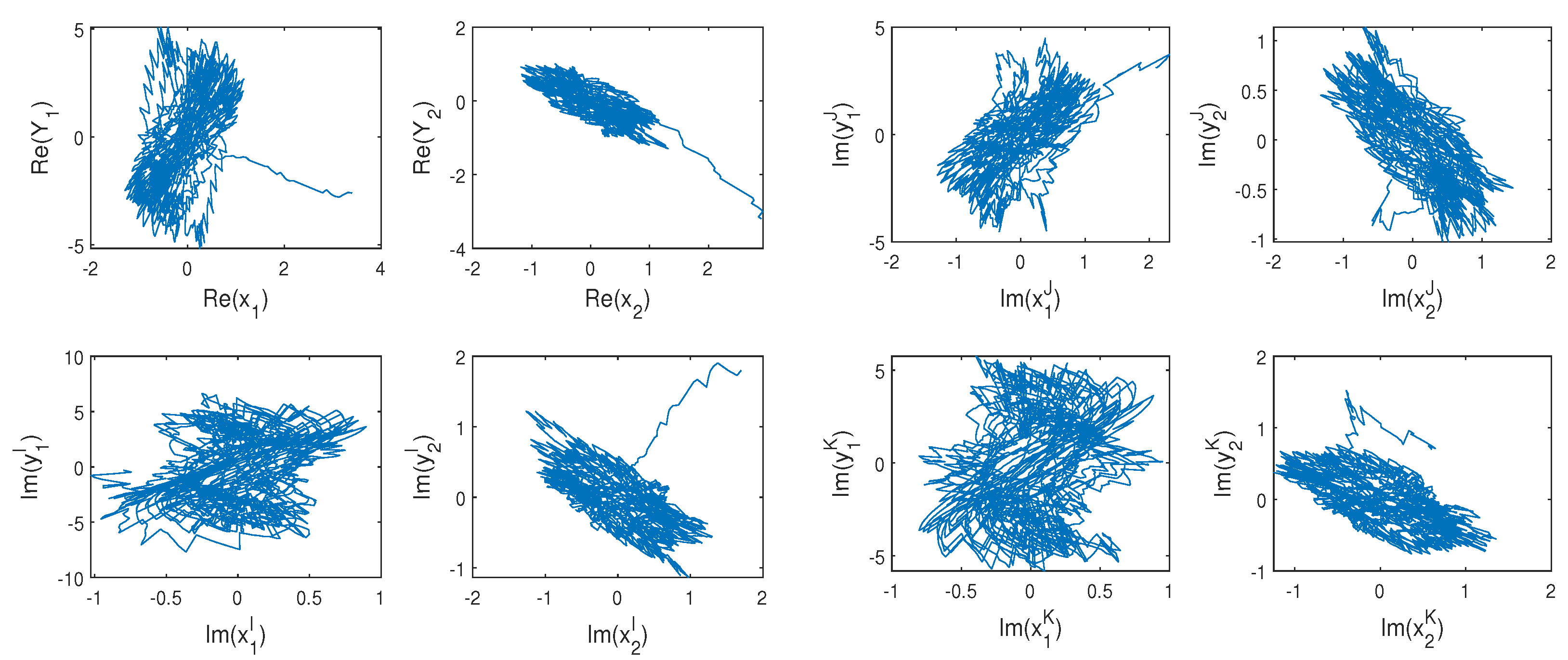
Based on the aforementioned system parameters and the structure of the activation function, under the 1-norm scenario, we obtain ; under the 2-norm scenario, we have , this verifies that Assumption 2 holds in both norm scenarios. Let , then Assumption 1 also holds. To perform the analysis, we first define the impulsive moments as for and assign the impulsive gains as . For system (34), the initial conditions are set as: and . Under these parameters, the MATLAB (https://www.mathworks.com/products/matlab.html, accessed on 18 December 2025) numerical simulation of system (34) is illustrated in Figure 1. From this simulation, it can be readily observed that system (34) possesses a chaotic attractor.
Figure 1.
Demonstration of chaotic attractor of real and imaginary parts of system (34).
Remark 7.
The parameters and structure in Example 1 are designed to fill critical gaps in existing QVNNs research: (i) The terms and are used to model “transient disturbances”, such as hardware glitches in neuromorphic chips or sudden external shocks in robotic systems. This phenomenon is largely overlooked in prior QVNN synchronization studies [10,11,12,15,16,17]. (ii) The terms in and capture discontinuous dynamics, including hardware saturation common in actuator limits of robotic control or binary neural firing. This extends beyond the continuous activation function assumption in works like [15,16,17,33,34,35,36]. (iii) By preserving the non-separation quaternion framework, we avoid the dimensionality explosion and conservatism of decomposition methods [24,25,29], making the model more efficient for real-world applications such as multi-channel signal processing or 3D attitude control, where quaternions naturally describe orientation. (iv) The and terms account for random noise, such as thermal fluctuations in electronics or wind disturbances in drones. This is a key factor in engineering systems that traditional deterministic QVNN models ignore.
The response system corresponding to QBAMs (34) is given by:
where are controllers designed to achieve synchronous between systems (34) and (35), and other parameters remain the same as those defined in system (34).
Now, consider the controllers designed for Theorem 1:
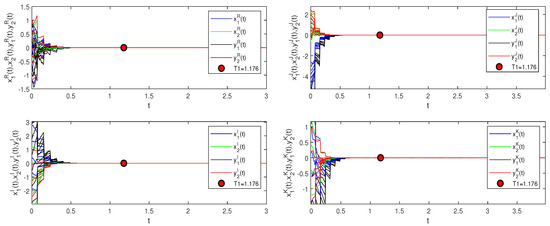
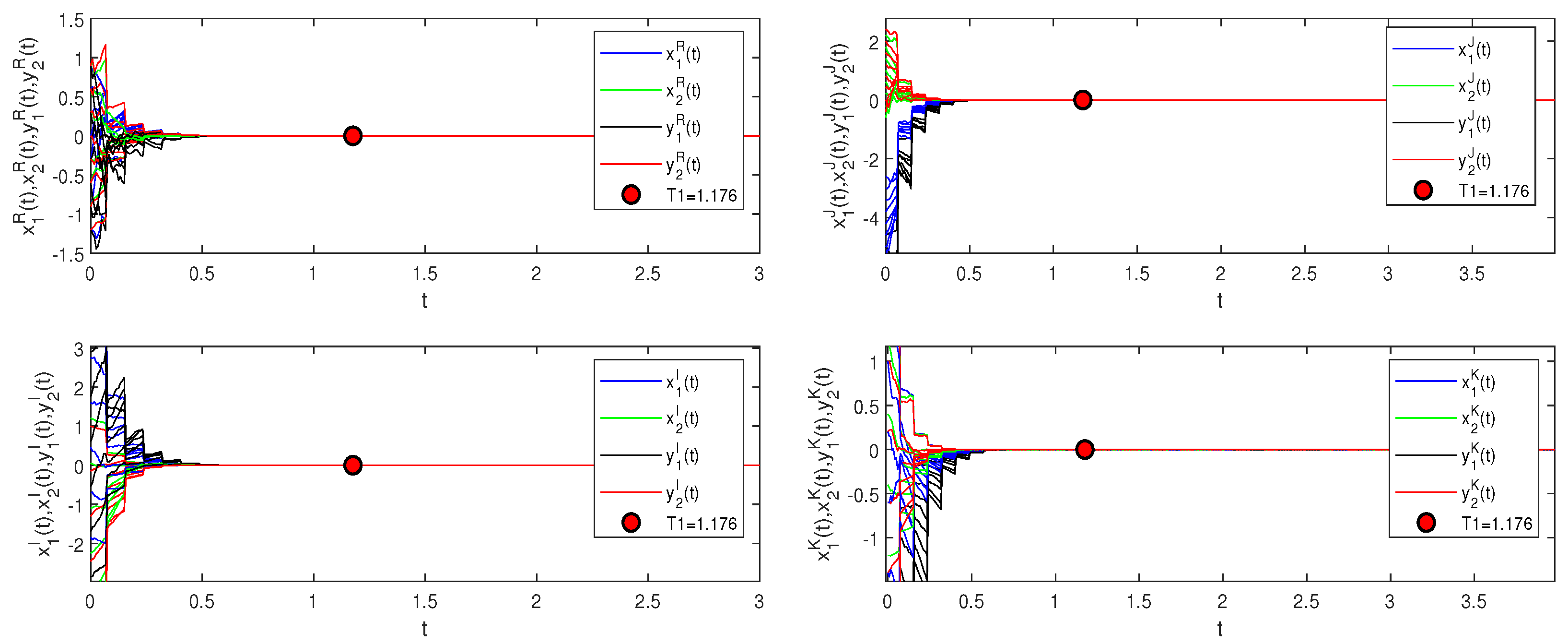
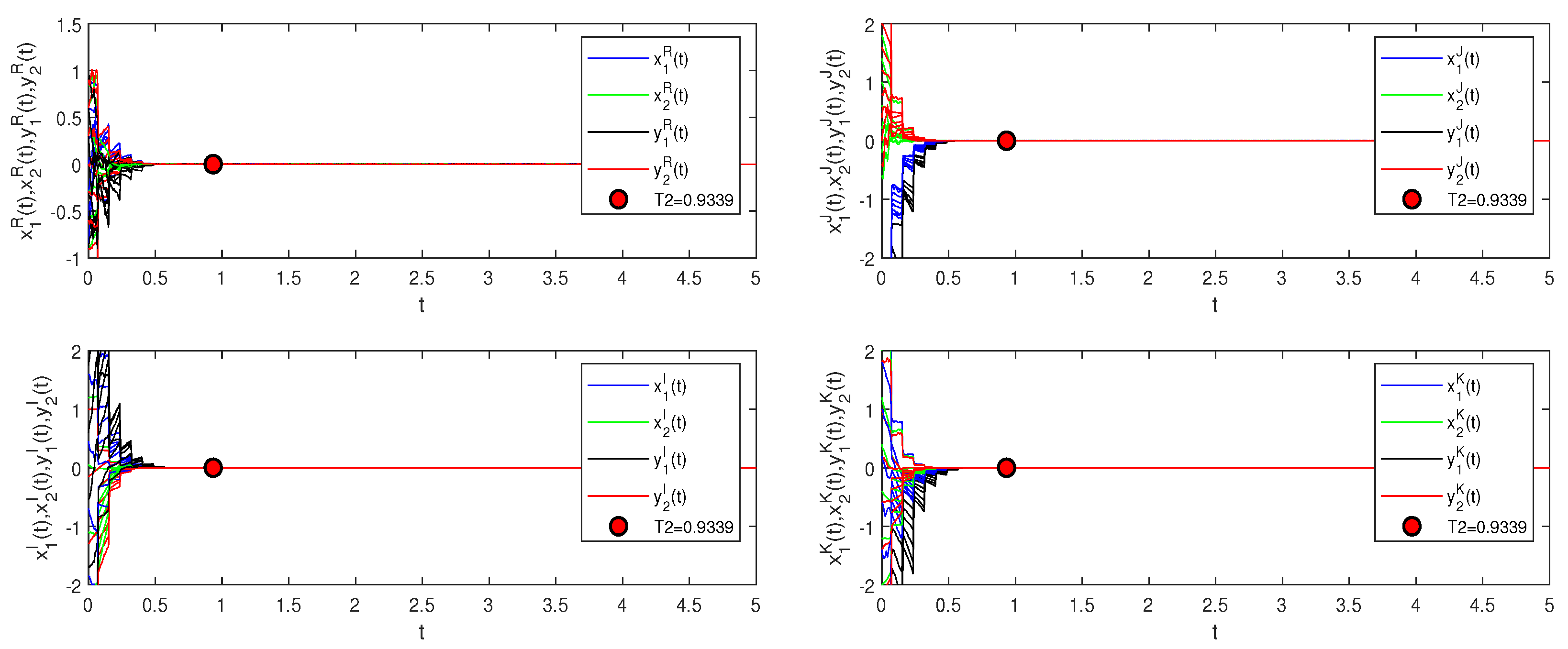
Here, let , and (where ). Through a simple computational process, we find that , this indicates that . Additionally, the other two equalities specified in Theorem 1 are also satisfied. Thus, in accordance with Theorem 1, the drive-response systems (34) and (35) achieve synchronization at . The numerical simulation depicting the synchronization process of systems (34) and (35) is illustrated in Figure 2, which serves to visually validate the theoretical findings.
For Theorem 2, the following controllers are constructed:
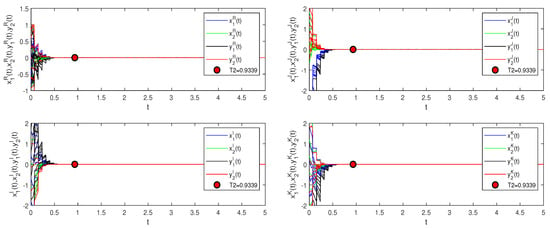
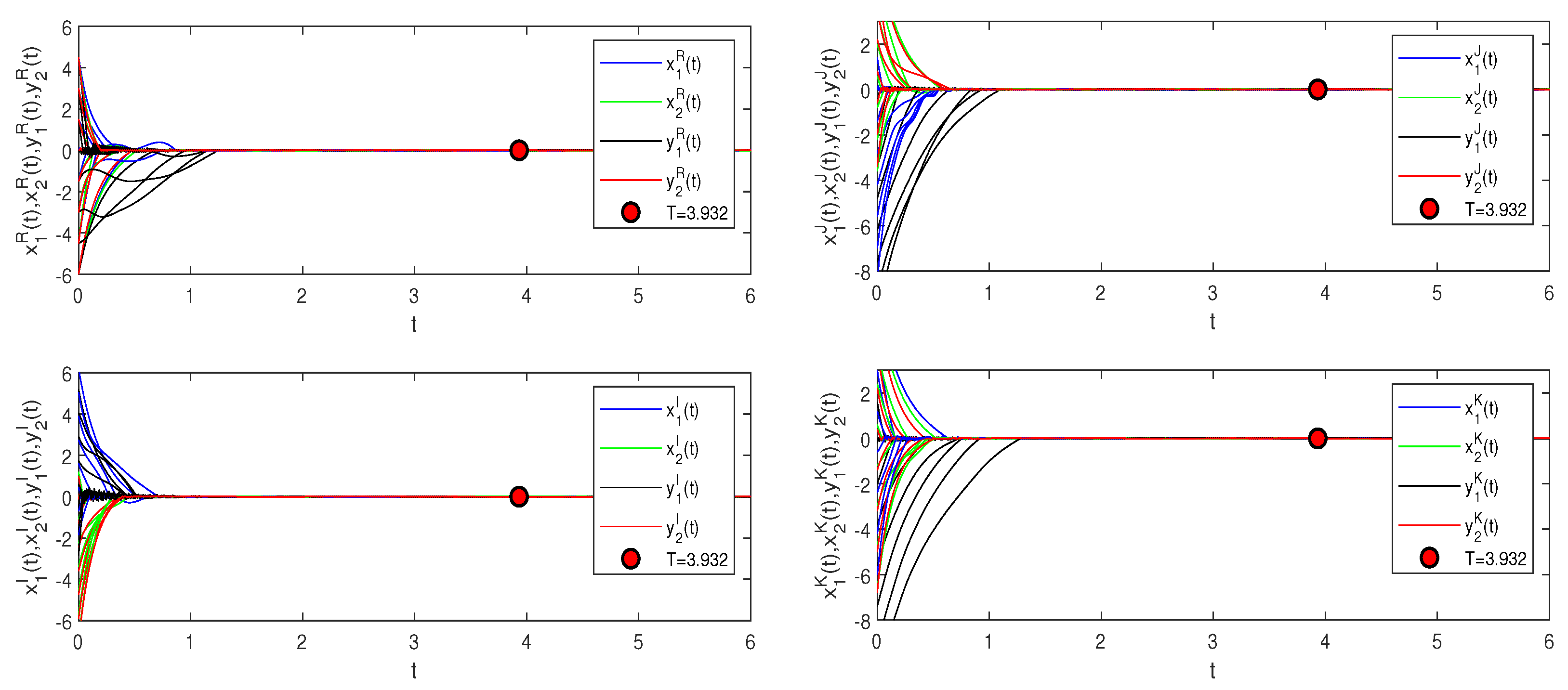
In this case, let , and . It is straightforward to calculate that . This indicates that . Thus, in accordance with Theorem 2, the drive-response systems (34) and (35) achieve synchronization with . The numerical simulation depicting the synchronization process of systems (34) and (35) is illustrated in Figure 3.
Next, we will demonstrate the synchronous behavior of systems (34) and (35) at PAT under the controllers (26) and (33), respectively.
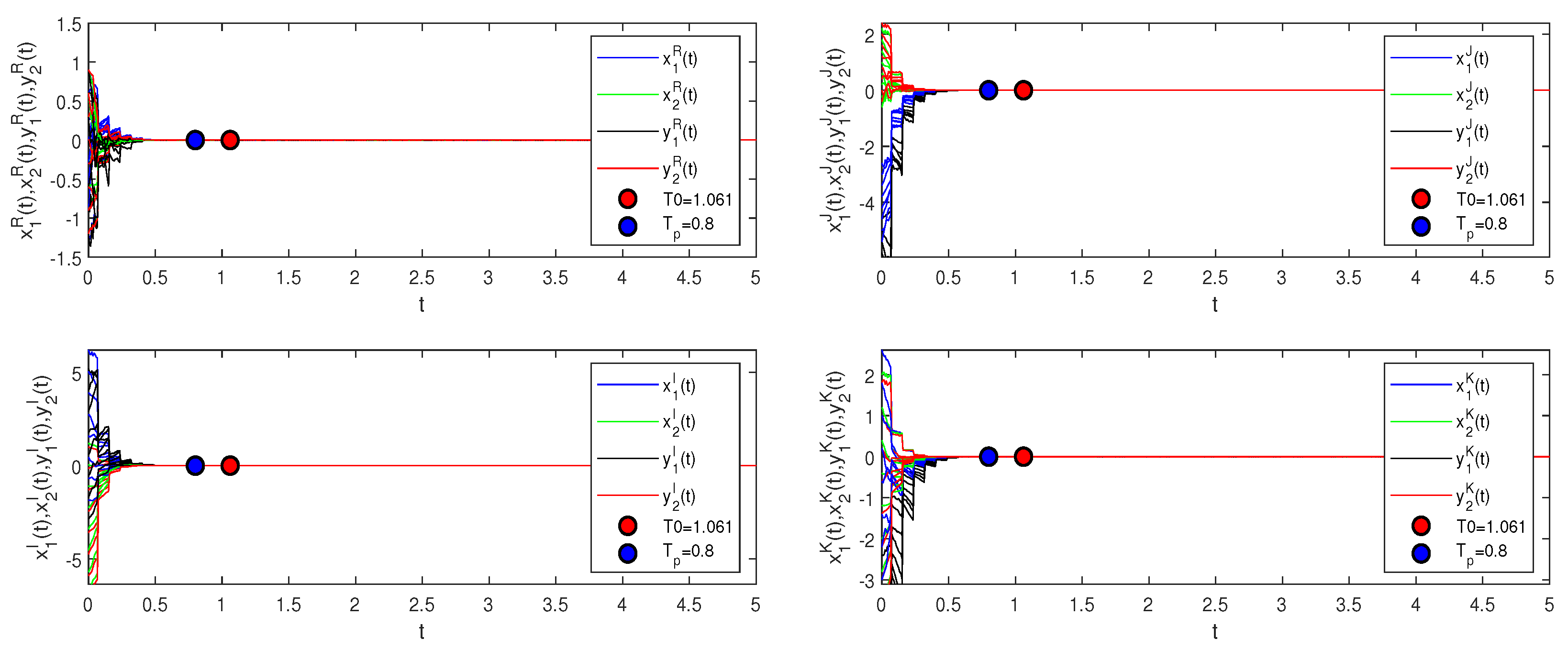
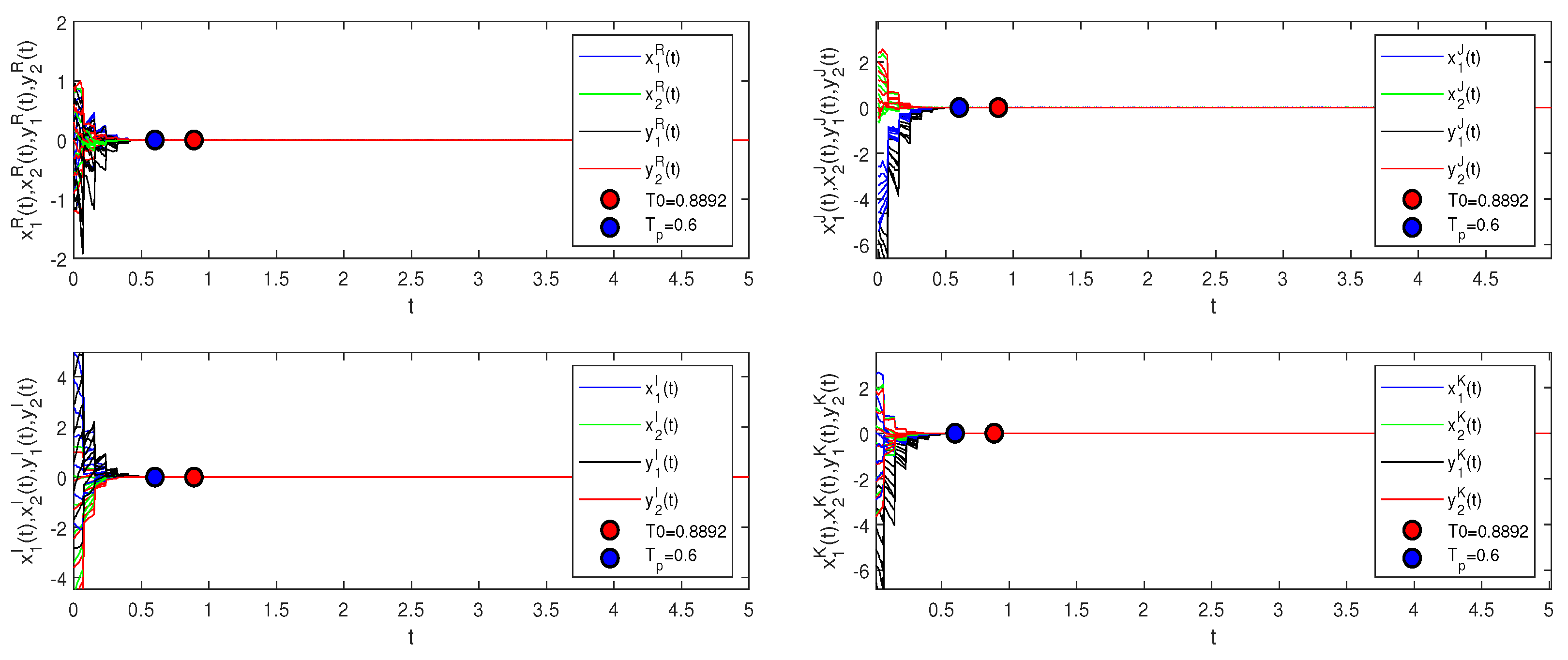
Firstly, we demonstrate the PAT synchronization under the controllers (26). If we set , then the conditions in Theorem 3 are satisfied and in which . Therefore, the systems (34) and (35) will also reach a synchronized state before according to Theorem 3. The simulation of synchronization process of system (34) and (35) is presented in Figure 4.
For Corollary 2, if we set , the condition in Theorem 3 is satisfied and in which . Therefore, the systems (34) and (35) will also reach a synchronized state before according to Corollary 2. The simulation of synchronization process of system (34) and (35) is presented in Figure 5.
To further verify the specific impact of impulsive and stochastic effects on system synchronization, we conducted comparative simulations for the simplified scenario described earlier where impulsive perturbations and stochastic noise terms are removed from systems (1) and (2). The simulation of synchronization process of system (24) and (25) is presented in Figure 6.
Remark 8.
The disturbed system in Figure 3, featuring impulsive and stochastic effects, serves as a realistic litmus test that far surpasses the idealized undisturbed scenario in Figure 6. In engineering applications, neural networks inevitably encounter abrupt perturbations and persistent stochastic noise. By replicating these real-world challenges, Figure 3 exposes how the proposed control protocol navigates through impulsive state jumps and suppresses stochastic oscillations. The fact that synchronization is still achieved, despite such disruptions, not only validates the protocols robustness but also delineates its operational boundaries. This practical validation is pivotal it bridges the gap between theoretical stability proofs and real-world deployability, ensuring the protocol can withstand unideal conditions in engineering systems like secure communication modules or adaptive control hardware.
Remark 9.
A notable and counterintuitive observation from the comparative simulations is that under identical parameters, the disturbed system (Figure 3) synchronizes faster than the undisturbed one (Figure 6). This counterintuitive result reveals that perturbations, when paired with a well-designed control protocol, can accelerate convergence. On one hand, impulsive effects act as transient high-gain corrections: when the synchronization error deviates from the target, impulsive jumps instantly adjust the neuron states to a range close to synchronization, avoiding the slow accumulation of errors and directly shortening the convergence path. On the other hand, stochastic noise helps the system escape local slow-convergence basins: without disturbances, the system may be trapped in small-range error fluctuations for a long time; while the tiny random fluctuations from noise break this stagnation, enabling the system to quickly enter the channel of “rapid error decay”. This challenges the view of disturbances as merely obstacles, highlighting their constructive role in nonlinear systems. When harnessed by robust control, they circumvent the limitations of smooth dynamics, enabling faster synchronization in practical scenarios.
Remark 10.
This paper is the only work that simultaneously embeds BAM, quaternion-valued systems, stochastic disturbance, impulse effects, non-separation methods, and discontinuous activation functions. This integrated structure optimizes information propagation paths, reduces redundant computations, and enhances dynamic response capabilities, directly translating into faster convergence speed. In contrast, in Table 2, Reference [18] lacks support for quaternions and discontinuous activation functions, making it unable to efficiently handle high-dimensional data and discrete tasks, thus resulting in slower convergence (). Reference [39], although supporting BAM, stochastic disturbance and impulse effects, relies on separated high-dimensional processing, leading to information loss and redundant computations, and consequently, slower fixed-time convergence (). Reference [40] has incomplete support for BAM, stochastic disturbance, and impulse effects, and its structural deficiencies hinder dynamic information transmission and robust adaptation, resulting in significantly slower convergence in practical asymptotic tasks (). In summary, the convergence time results confirm that the comprehensive system structure of the proposed method in this paper ensures faster, more robust, and more efficient performance in both fixed-time and practical scenarios.
Table 2.
Comparison table of convergence time.
5. Conclusions and Prospects
This study systematically investigates FXT/PAT synchronization of QBAM neural networks, addressing stochastic perturbations, impulsive disturbances, and discontinuous activation functions. A direct analytical method based on quaternion-valued sign functions is proposed, avoiding the dimensional expansion and computational complexity of traditional separation approaches. Theoretical and numerical results confirm that the designed control protocol ensures synchronization under combined perturbations, while relaxing the restrictive assumption of continuous activation functions enhances practical relevance. Integrating quaternions into BAM networks also improves storage capacity and reduces conservatism in associative memory, contributing to advancements in pattern recognition and secure communication.
Future work will expand this framework to QBAM networks featuring mixed time delays and hybrid disturbances (such as Markovian jumps). Additionally, it will explore hardware implementations to connect theoretical results with real-world applications. Generalizing the direct analysis method to other quaternion-valued network architectures represents another promising avenue.
Author Contributions
M.A. made substantial contributions to this work, including drafting the original manuscript, developing the methodology, securing funding, and participating in review processes. A.A. was involved in writing, creating visualizations, conducting reviews, performing editorial tasks, and providing supervision. All authors have read and agreed to the published version of the manuscript.
Funding
This research was Sponsored by Natural Science Foundation of Xinjiang Uygur Autonomous Region (Grant No.: 2025D01B17), Kashi University: The School-Level Research Program (Grant No.: 2023(2859)) and 2023 Postgraduate Scientific Research Start-up Fund (Grant No.: 022023140).
Data Availability Statement
The data presented in this study are available on request from the corresponding author.
Acknowledgments
The authors acknowledge the financial support from the Natural Science Foundation of Xinjiang Uygur Autonomous Region (grant number: 2025D01B17). We also thank Kashi University for providing funding through the School-Level Research Program (grant number: 2023(2859)) and the 2023 Scientific Research Start-up Funds for Postgraduates (grant number: 022023140).
Conflicts of Interest
The authors state that there are no conflicts of interest related to the publication of this paper.
Abbreviations
The following symbols and parameters are used in this manuscript:
| Symbol | Meaning | Domain/Explanation |
| Q | Set of quaternion numbers | Algebraic basis |
| Set of real numbers | Algebraic basis | |
| Set of positive real numbers | Algebraic basis | |
| n-dimensional quaternion vector space | Space definition | |
| N | Positive integers | Index definition |
| Quaternion decomposition (real/imaginary components, follow Hamilton rules) | Quaternion representation | |
| Conjugate of x () | Algebraic operation | |
| The mathematical expectation of x () | Component expectations | |
| 1-norm of quaternion () | Norm definition | |
| 2-norm of quaternion () | Norm definition | |
| Signum function of quaternion () | Function definition | |
| Impulsive time sequence (strictly increasing, ) | Impulsive characteristic | |
| Impulsive state gain coefficients (positive constants) | Impulsive parameters | |
| Positive scalar for noise function | Stochastic analysis | |
| Lipschitz constants of activation functions ( for 1-norm/2-norm) | Function characteristic | |
| Constants in average impulsive interval | Impulsive analysis | |
| Number of impulsive moments in | Impulsive analysis | |
| Bounding constants for Lyapunov function () | Stability analysis | |
| Positive scalars in Lyapunov analysis () | Stability analysis | |
| Controller parameters () | Control parameters |
References
- Zhang, J.; Ma, X.; Li, Y.; Gan, Q.; Wang, C. Synchronization in fixed/preassigned-time of delayed fully quaternion-valued memristive neural networks via non-separation method. Commun. Nonlinear Sci. Numer. Simul. 2022, 113, 106581. [Google Scholar] [CrossRef] [Scilit]
- Nitta, T. Orthogonality of Decision Boundaries in Complex-Valued Neural Networks. Neural Comput. 2004, 16, 73–97. [Google Scholar] [CrossRef] [Scilit]
- Manoj, N.; Sriraman, R.; Gurusamy, R.; Shang, Y. Design and analysis of quaternion-valued neural networks for storing and retrieving color images. J. Appl. Math. Comput. 2025, 71, 617–643. [Google Scholar] [CrossRef] [Scilit]
- Polyakov, A. Nonlinear Feedback Design for Fixed-Time Stabilization of Linear Control Systems. IEEE Trans. Autom. Control 2012, 57, 2106–2110. [Google Scholar] [CrossRef] [Scilit]
- Altamirano-Escobedo, G.; Bayro-Corrochano, E. Quaternion Quantum Neural Network for Classification. Adv. Appl. Clifford Algebr. 2023, 33, 40. [Google Scholar] [CrossRef] [Scilit]
- Li, R.; Wu, H.; Cao, J. Impulsive exponential synchronization of fractional-order complex dynamical networks with derivative couplings via feedback control based on discrete time state observations. Acta Math. Sci. 2022, 42, 737–754. [Google Scholar] [CrossRef] [Scilit]
- Takahashi, K. Remarks on Control of Robot Manipulator Using Quaternion Neural Network. In Proceedings of the 2018 Asia-Pacific Signal and Information Processing Association Annual Summit and Conference (APSIPA ASC), Honolulu, HI, USA, 12–15 November 2018; pp. 560–565. [Google Scholar]
- Peng, T.; Qiu, J.; Lu, J.; Tu, Z.; Cao, J. Finite-Time and Fixed-Time Synchronization of Quaternion-Valued Neural Networks With/Without Mixed Delays: An Improved One-Norm Method. IEEE Trans. Neural Netw. Learn. Syst. 2022, 33, 7475–7487. [Google Scholar] [CrossRef] [Scilit] [PubMed]
- Chen, S.; Li, H.-L.; Kao, Y.; Zhang, L.; Hu, C. Finite-time stabilization of fractional-order fuzzy quaternion-valued BAM neural networks via direct quaternion approach. J. Frankl. Inst. 2021, 358, 7650–7673. [Google Scholar] [CrossRef] [Scilit]
- Deng, H.; Bao, H. Fixed-time synchronization of quaternion-valued neural networks. Phys. A Stat. Mech. Appl. 2019, 527, 121351. [Google Scholar] [CrossRef] [Scilit]
- Kumar, U.; Das, S.; Huang, C.; Cao, J. Fixed-time synchronization of quaternion-valued neural networks with time-varying delay. Proc. R. Soc. A Math. Phys. Eng. Sci. 2020, 476, 20200324. [Google Scholar] [CrossRef] [Scilit]
- Li, H.; Chen, S.; Yang, J. Fixed-time synchronization of delayed quaternion-valued neural networks with fractional-order under quantized control. J. Xinjiang Univ. 2023, 40, 1–9. [Google Scholar]
- Abdurahman, A.; Tohti, R.; Li, C. New results on fixed-time synchronization of impulsive neural networks via optimized fixed-time stability. J. Appl. Math. Comput. 2024, 70, 18. [Google Scholar] [CrossRef] [Scilit]
- Hu, C.; He, H.; Jiang, H. Fixed/Preassigned-Time Synchronization of Complex Networks via Improving Fixed-Time Stability. IEEE Trans. Cybern. 2021, 51, 2882–2892. [Google Scholar] [CrossRef] [Scilit]
- Peng, T.; Wu, Y.; Tu, Z.; Alofi, A.S.; Lu, J. Fixed-time and prescribed-time synchronization of quaternion-valued neural networks: A control strategy involving Lyapunov functions. Neural Netw. 2023, 160, 108–121. [Google Scholar] [CrossRef] [Scilit]
- Wei, W.; Yu, J.; Wang, L.; Hu, C.; Jiang, H. Fixed/Preassigned-time synchronization of quaternion-valued neural networks via pure power-law control. Neural Netw. 2022, 146, 341–349. [Google Scholar] [CrossRef] [Scilit]
- Pang, M.; Zhang, Z.; Wang, X.; Wang, Z.; Lin, C. Fixed/Preassigned-time synchronization of high-dimension-valued fuzzy neural networks with time-varying delays via nonseparation approach. Knowl.-Based Syst. 2022, 255, 109774. [Google Scholar] [CrossRef] [Scilit]
- You, J.; Abdurahman, A.; Sadik, H. Fixed/Predefined-Time Synchronization of Complex-Valued Stochastic BAM Neural Networks with Stabilizing and Destabilizing Impulse. Mathematics 2022, 10, 4384. [Google Scholar] [CrossRef] [Scilit]
- Abdujelil, A.; Mairemunisa, A.; Haijun, J. Fixed/predefined-time lag synchronization of complex-valued BAM neural networks with stochastic perturbations. Appl. Math. Comput. 2023, 444, 127811. [Google Scholar]
- Liu, J.; Yu, Y.; Wang, Q.; Sun, C. Fixed-time event-triggered consensus control for multi-agent systems with nonlinear uncertainties. Neurocomputing 2017, 260, 497–504. [Google Scholar] [CrossRef] [Scilit]
- Shang, Y.; Ye, Y. Fixed-Time Group Tracking Control With Unknown Inherent Nonlinear Dynamics. IEEE Access 2017, 5, 12833–12842. [Google Scholar] [CrossRef] [Scilit]
- Liu, Y.; Yang, G. Neural Learning-Based Fixed-Time Consensus Tracking Control for Nonlinear Multiagent Systems with Directed Communication Networks. IEEE Trans. Neural Netw. Learn. Syst. 2020, 32, 639–652. [Google Scholar]
- Xiao, J.; Zhong, S.; Li, Y.; Xu, F. Finite-time Mittag-Leffler synchronization of fractional-order memristive BAM neural networks with time delays. Neurocomputing 2017, 219, 431–439. [Google Scholar] [CrossRef] [Scilit]
- Zhang, Z.; Guo, R.; Liu, X.; Hong, M.; Lin, C.; Chen, B. Fixed-time synchronization for complex-valued BAM neural networks with time delays. Asian J. Control 2019, 23, 298–314. [Google Scholar] [CrossRef] [Scilit]
- Guo, Y.; Luo, Y.; Wang, W.; Luo, X.; Ge, C.; Kurths, J.; Yuan, M.; Gao, Y. Fixed-time Synchronization of Complex-valued Memristive BAM Neural Network and Applications in Image Encryption and Decryption. Int. J. Control Autom. Syst. 2019, 18, 462–476. [Google Scholar] [CrossRef] [Scilit]
- Chen, C.; Li, L.; Peng, H.; Yang, Y. Fixed-time synchronization of memristor-based BAM neural networks with time-varying discrete delay. Neural Netw. 2017, 96, 47–54. [Google Scholar] [CrossRef] [Scilit]
- Wang, Q.; Qian, Y.; Qiao, Y. Fixed-time synchronization of discontinuous complex-valued BAM neural networks with time delays. Neurocomputing 2025, 638, 130160. [Google Scholar] [CrossRef] [Scilit]
- Zhang, H.; Gao, P.; Ye, R.; Stamova, I.; Cao, J. Fixed/Predefined time synchronization of fractional quaternion delayed neural networks with disturbances. Math. Comput. Simul. 2025, 232, 276–294. [Google Scholar] [CrossRef] [Scilit]
- Li, X.; Zhang, W.; Fang, J.A.; Li, H. Event-triggered exponential synchronization for complex-valued memristive neural networks with time-varying delays. IEEE Trans. Neural Netw. Learn. Syst. 2020, 31, 4104–4116. [Google Scholar] [PubMed]
- Yin, B.; Peng, S. Prescribed-Time/Fixed-Time Synchronization of Quaternion-Valued Neural Networks: A Method Without Decomposition. Math. Methods Appl. Sci. 2025, 48, 9151–9159. [Google Scholar] [CrossRef] [Scilit]
- Li, R.; Cao, J. Quasi-stabilization/synchronization of quaternion-valued memristive neural networks: Norm approach. Math. Methods Appl. Sci. 2024, 48, 5110–5125. [Google Scholar] [CrossRef] [Scilit]
- He, Y.; Zhang, W.; Zhang, H.; Cao, J.; Abdel-Aty, M. Projective synchronization results of fractional order quaternion valued neural networks with proportional delay under event-triggered control. Expert Syst. Appl. 2025, 282, 127643. [Google Scholar] [CrossRef] [Scilit]
- Jin, W.; Cui, W.; Wang, Z. Finite-time Synchronization of fractional-order complex-valued fuzzy cellular neural networks with time-varying delays. J. Intell. Fuzzy Syst. 2021, 41, 7341–7351. [Google Scholar] [CrossRef] [Scilit]
- Aouiti, C.; Assali, E.A.; Cherif, F.; Zeglaoui, A. Fixed-time synchronization of competitive neural networks with proportional delays and impulsive effect. Neural Comput. Appl. 2019, 32, 13245–13254. [Google Scholar] [CrossRef] [Scilit]
- Cui, W.; Wang, Z.; Jin, W. Fixed-time synchronization of Markovian jump fuzzy cellular neural networks with stochastic disturbance and time-varying delays. Fuzzy Sets Syst. 2021, 411, 68–84. [Google Scholar] [CrossRef] [Scilit]
- Wan, P.; Sun, D.; Zhao, M. Finite-time and fixed-time anti-synchronization of Markovian neural networks with stochastic disturbances via switching control. Neural Netw. 2020, 123, 1–11. [Google Scholar] [CrossRef] [Scilit] [PubMed]
- Qian, Y.; Qiao, Y. On synchronization of discontinuous competitive fuzzy neural networks with time-varying delays via non-chattering quantization. Neurocomputing 2026, 660, 131920. [Google Scholar] [CrossRef] [Scilit]
- Qian, Y.; Qiao, Y. Fixed-/preassigned-time synchronization control of discontinuous inertial fuzzy neural networks with time delays. Int. J. Biomath. 2025, 2550116. [Google Scholar] [CrossRef] [Scilit]
- Mahemuti, R.; Abdurahman, A. Predefined-Time (PDT) Synchronization of Impulsive Fuzzy BAM Neural Networks with Stochastic Perturbations. Mathematics 2023, 11, 1291. [Google Scholar] [CrossRef] [Scilit]
- Wei, W.; Hu, C.; Yu, J.; Jiang, H. Fixed/Preassigned-Time Synchronization of Quaternion-Valued Neural Networks Involving Delays and Discontinuous Activations: A Direct Approach. Acta Math. Sci. 2023, 43, 1439–1461. [Google Scholar] [CrossRef] [Scilit]
- Abudusaimaiti, M.; Abudukeremu, A.; Sabir, A. Fixed/Preassigned-Time Stochastic Synchronization of Complex-Valued Fuzzy Neural Networks with Time Delay. Mathematics 2023, 11, 3769. [Google Scholar] [CrossRef] [Scilit]
- Guo, R.; Lv, W.; Zhang, Z. Quasi-projective synchronization of stochastic complex-valued neural networks with time-varying delay and mismatched parameters. Neurocomputing 2020, 415, 184–192. [Google Scholar] [CrossRef] [Scilit]


Disclaimer/Publisher’s Note: The statements, opinions and data contained in all publications are solely those of the individual author(s) and contributor(s) and not of MDPI and/or the editor(s). MDPI and/or the editor(s) disclaim responsibility for any injury to people or property resulting from any ideas, methods, instructions or products referred to in the content. |
© 2025 by the authors. Licensee MDPI, Basel, Switzerland. This article is an open access article distributed under the terms and conditions of the Creative Commons Attribution (CC BY) license.