



New Adaptive Echolocation Radar Technique Incorporated into the Bat Algorithm Applied to Benchmark Functions (Radar-Bat)

 ,
,  ,
,  and
and
Abstract
1. Introduction
- Maritime radar-type directional sweep that allows for systematic exploration in multiple directions.
- Adaptive mapping to direct the search to less explored areas.
- CFAR-type adaptive dynamic threshold for accepting solutions based on the best current value.
Research Hypotheses
2. Materials and Methods
2.1. Radar-Type Directional Sweep
- : Best global solution.
- : Displacement in the d direction.
- : Random vector in n dimensions.
- s: Step size.
2.2. Adaptive Map
- density(x): normalized density in the cell containing x.
- cell(x): cell that contains position x.
- count[cell(x)]: number of visits to that cell.
- global mean: global average of visits across all cells, and 1 stabilizes the scale by preventing division by zero in the initial stages. To avoid visiting saturated zones, a correction is applied to the objective function, as shown in Equation (7):
- f(xi): original value of the objective function.
- λ > 0: density penalty factor (0 < λ ≤ 0.2).
- density(xi): normalized density in the cell containing x. This component is integrated with the BA acceptance rule of the adaptive CFAR, maintaining a controlled false acceptance rate.
2.3. Directional Sweep
- priority(d): priority assigned to address d.
- d: candidate direction in the sweep.
- : average density in the region towards the d direction. Low density promotes a high priority of visiting search spaces, while high density has low priority and fewer attempts to explore those areas.
2.4. CFAR-Type Adaptive Threshold
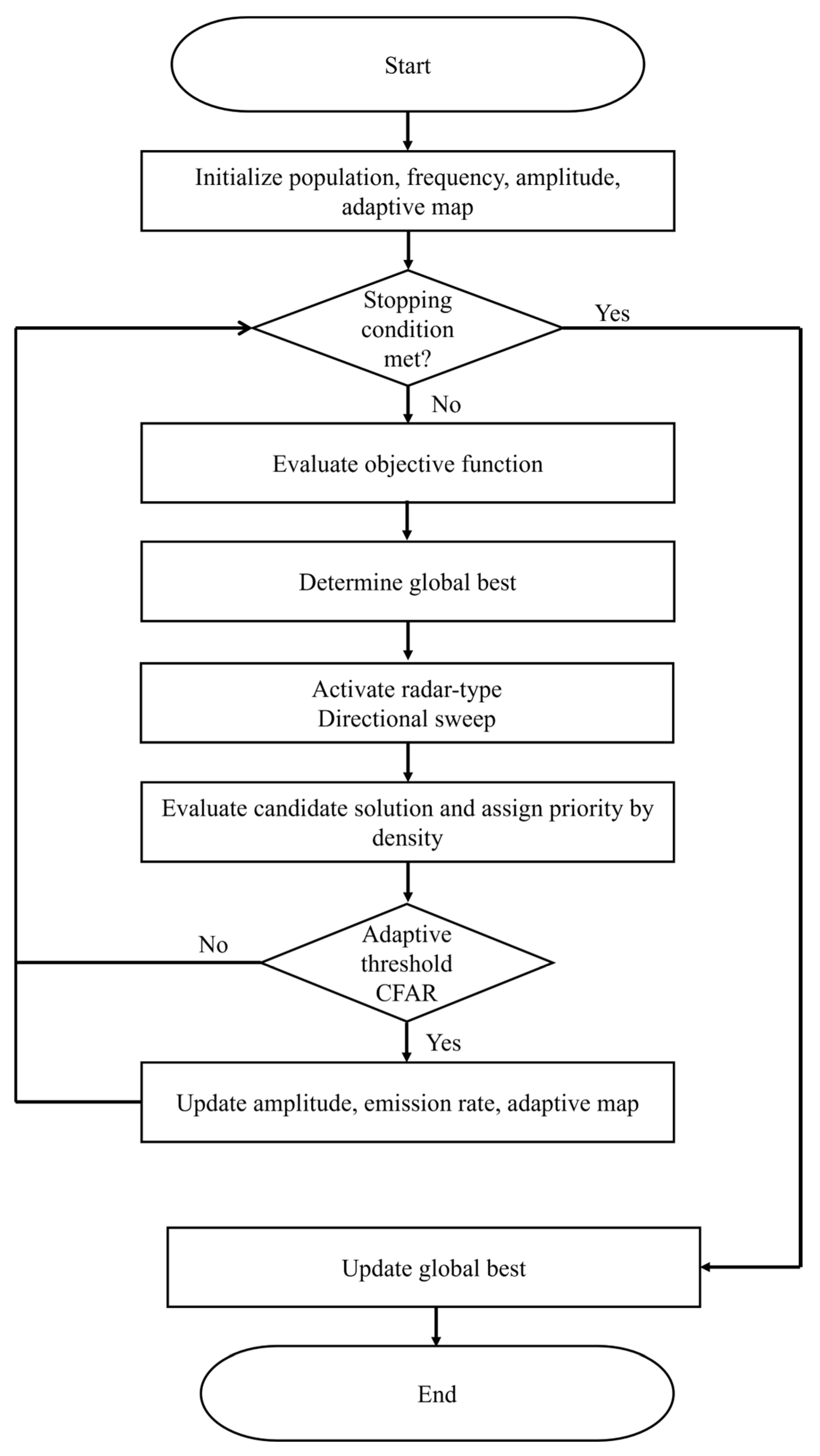
2.5. Proposed Radar-Bat Algorithm
| Algorithm 1. Radar-Bat Algorithm |
| Input: |
| Define objective function f(x) |
| Parameters/Variables: |
| n: number of bats |
| fmin, fmax |
| Ai: initial loudness |
| ri: initial rate |
| α, γ: update coefficients |
| t: iteration counter |
| Output: |
| : global best solution |
| 1: Initialize parameters |
| 2: //Initialize adaptive map |
| 3: : δ = cell size per dimension |
| 4: : count[cell] = 0 (or empty dictionary) |
| 5: for each bat i //Generate initial population |
| 6: xi = random position |
| 7: = random speed |
| 8: fi = random frequency in [fmin, fmax] |
| 9: end foreach |
| 10: Evaluate objective function f(xi) for all |
| 11: = best solution found |
| 12: while the stopping criterion is not met |
| 13: t = t + 1 |
| 14: for each bat i //BA standard update |
| 15: β ϵ [0, 1] random |
| 16: |
| 17: |
| 18: |
| 19: |
| 20: Generate a set of directions |
| 21: for each address |
| 22: |
| 23: |
| 24: |
| 25: |
| 26: end foreach |
| 27: Sort by descending priority(d) |
| 28: Evaluate candidates (top − k) and choose the best for trial |
| 29: end if |
| 30: //Evaluation penalized by map |
| 31: |
| 32: //CFAR threshold and acceptance |
| 33: average of over references (excluding for the reference cell) |
| 34: |
| 35: |
| 36: Accept xi |
| 37: |
| 38: |
| 39: end if |
| 40: //Global best |
| 41: |
| 42: end if |
| 43: //Map update (always) |
| 44: end foreach |
| 45: end while |
| 46: return |
| 47: end |
3. Related Work
3.1. Bat Algorithm (BA)
3.2. Variants of the BA
3.2.1. Multi-Objective Bat Algorithm (MOBA)
3.2.2. Integrated BA with Functional Link Artificial Neural Network (BAT-FLANN)
3.2.3. Discrete BA (DABA/IDBA)
3.2.4. Binary BA (BBA)
3.2.5. Enhanced BA (EBA)
3.2.6. Directional BA (dBA)
3.3. Works That Include Radar-Inspired Techniques
3.3.1. Adaptive Constant False Alarm Rate (CFAR)
3.3.2. Systematic Directional Sweep
3.4. Recent Advances in Metaheuristics and Applied Optimization
3.5. Conceptual and Operational Differences of Radar Bat Compared to Existing Variants
- Systematic directional sweep with angular prioritization. Radar Bat generates multiple directions around the global best and prioritizes them based on density (lower density ⇒ higher priority). This avoids redundant assessments in saturated sectors and focuses exploitation on promising “angles,” while maintaining angular diversity. Unlike the dBA, which does not model spatial saturation or reorder directions by coverage, Radar Bat uses an explicit priority criterion linked to the adaptive map.
- Adaptive visit map and density penalty. The algorithm maintains a dynamic record of visit density per cell in the search space. This structure guides movement toward underexplored regions and applies a mild penalty during evaluation to discourage overvisited areas. This concept introduces explicit spatial control, absent in the basic BA, EBA, and dBA, which becomes crucial in multimodal functions with a high probability of premature convergence.
- Adaptive acceptance based on CFAR. Radar Bat dynamically adjusts an acceptance threshold relative to the current best value, regulating the incorporation of new solutions to maintain a constant false alarm rate. This mechanism acts as a probabilistic filter that protects the quality of the exploitation process without slowing down the scan and is not found in the dBA, the EBA, or multi-target/discrete variants.
3.6. Applications of the BA in Real-World Problems
- Structural design and topology optimization: The BA has been used to optimize parameters in complex structures, achieving weight reduction and improved strength compared to traditional methods, such as the GA and PSO [43]. Variants such as the Binary Bat Algorithm have allowed for the elimination of gray areas in designs, generating manufacturable solutions [44].
- Industrial processes and manufacturing: Dao & Nguyen [4] report applications of the BA in production planning, supply chain management, and process optimization, highlighting improvements in efficiency and cost reduction.
- Smart systems and IoT: Improved versions of the BA have optimized routing and energy efficiency in IoT networks, helping to extend the lifespan of devices [45].
- Electrical systems and economic dispatch: The BA has been applied to the integration of renewable energy into electrical grids, reducing operating costs and improving system stability [46].
- Machine and federated learning: The FedBat variant has accelerated convergence in federated learning environments up to five times faster than FedAvg, with 40% improvements in accuracy [47]. Hybrid BA + GWO methods have also been developed to optimize the training of convolutional neural networks [48], improving classification on complex datasets.
- Mobile robotics: The Leader-Based Bat Algorithm (LBBA) has been applied to data fusion for robot localization, achieving greater accuracy and lower computational consumption [48].
4. Computational Experiments
4.1. Benchmark Function Set
- Periodic multimodal functions, which are designed to evaluate exploration capacity and avoidance of local optima [53].
- Ill-conditioned and non-separable functions, which test robustness in complex landscapes [57].
- Penalized and constrained functions, which included analyzing performance under constraint management and penalty-based adaptation [57].
4.2. Variables/Parameters Used
4.3. Evaluation Metrics
- The objective value (OV) achieved.
- The execution time (Time).
- Non-parametric statistical tests (Wilcoxon and Friedman), with a significance level of 5%.
4.4. Computer Architecture and Software
5. Results
5.1. Sensitive and Robust Analysis of Parameters
- Number of sweep directions (k). Increasing the value of k enriches the angular coverage and tends to improve the OV to a point of diminishing returns. In parallel, it increases the cost per iteration (generation and evaluation of candidates) and can increase the Time if a moderate range is exceeded. In practice, a medium k, together with a cautious top k, offers good performance.
- CFAR threshold factor (kcfar). High values make the filter too strict (low AR and slower convergence), and low values make it permissive (high AR and risk of accepting lower quality candidates). Adjusting kcfar around the base value in Table 4 preserves a stable acceptance rate and good balance.
- Density penalty (λ). A moderate λ favors diversity and reduces stagnation. An excessive λ excessively penalizes useful regions and can degrade convergence. Since the density is normalized, its impact is gradual and controllable within ±20%.
- CFAR window size (wcfar). Larger windows stabilize the threshold (lower variance in AR) with marginal time costs. Small windows react faster but can induce volatility in acceptance.
- stepCoeff and top − k priority (low density). stepCoeff regulates the intensity of the directional displacement: very low values limit local exploitation. Very high prices increase unproductive revaluations. Selecting a top − k that is too large dilutes the focus; one that is too small reduces angular diversity.
5.2. Complexity, Scalability, and Quality–Time Trade-Offs
- Directional sweeping: This involves the generation and evaluation of k addresses → additional cost is proportional to k × n (n = number of bats).
- Queries and updates of the adaptive map: This includes an operation O(1) per batch but with accumulated overhead in high-dimensional spaces.
- CFAR filtering: This involves a calculation of the dynamic threshold → cost O(1) per evaluation.
- In low-dimensional problems (≤30 variables), the increase in time is moderate , while in high-dimensional problems (≥50 variables) it can exceed 4×, due to the increase in evaluations per sweep.
- The adaptive map scales well because it uses a hash structure, but the number of addresses, k, is the most critical factor.
- Radar Bat achieves significant improvements in quality (OV) in multimodal and complex functions, reducing premature convergence.
- Although Radar Bat incorporates additional mechanisms such as directional scanning, adaptive mapping, and CFAR filtering, experimental results show that the increase in computational cost does not always translate into longer execution times. On several benchmark functions in 10D, 30D, and 50D, Radar Bat matches or even outperforms the BA in runtime, and non-parametric tests do not indicate any consistent statistical advantage in favor of the BA in efficiency.
6. Discussion
6.1. Comparative Synthesis (OV vs. Time)
6.2. Effect of Dimensionality
6.3. Robustness Between Independent Runs
6.4. Statistical Validity
6.5. Parameter Sensitivity and Operational Trade-Offs
- Number of sweep directions (addresses): Increasing the number of directions enriches angular diversity but also adds computational overhead. Too many directions produce noticeable time growth with limited additional benefits, whereas reducing them excessively decreases directional coverage and weakens exploration.
- CFAR factor: A high CFAR value leads to excessive filtering, reducing the acceptance rate and slowing convergence. Conversely, a very low CFAR increases the acceptance of suboptimal candidates, which may degrade the final solution quality. Parameters such as the density penalty and CFAR window size exhibit moderate and stabilizing effects, helping maintain a controlled acceptance rate.
6.6. Practical Implications and Limits
- Radar Bat should be used: in offline scenarios, fine-accuracy optimization, or multimodal and complex problems where solution quality and robustness are a priority. Given its coordinated radar-inspired modules, it provides superior exploration–exploitation balance and more stable convergence, and empirical results show that its execution time can remain competitive depending on the problem and dimensionality.
- The BA should be used: when execution time is the primary constraint, particularly in scenarios with very high dimensionality and limited computational budget, or when a good-enough solution is acceptable. Its simpler structure ensures consistently low overhead.
- Current limitations: The additional mechanisms in Radar Bat introduce extra computational costs, especially when the number of sweep directions, k, is large; the algorithm is sensitive to parameters such as k and the CFAR factor; and its implementation is inherently more complex than that of the basic BA. These aspects must be considered when choosing between both methods.
7. Conclusions and Future Work
- (H1) Solution quality. Confirmed. Radar Bat obtains lower OVs than the BA in most functions, with statistically significant differences in multiple cases. This advantage is most pronounced in multimodal, composition, and non-separable problems.
- (H2) Exploration–exploitation balance. Confirmed. The interplay between directional sweeping, the adaptive density map, and the CFAR acceptance rule reduces premature stagnation and promotes more robust convergence, as reflected in the OV improvements and the reduced dispersion between independent runs.
- (H3) Robustness between runs. Confirmed (with nuances). Radar Bat exhibits lower variability across independent executions, especially in multimodal functions. Although the added modules theoretically increase the computational cost, in practice, the execution time does not always increase proportionally, and in several functions Radar Bat matches or even outperforms the BA in runtime.
Author Contributions
Funding
Data Availability Statement
Acknowledgments
Conflicts of Interest
References
- Zebari, A.Y.; Almufti, S.M.; Abdulrahman, C.M. Bat algorithm (BA): Review, applications and modifications. Int. J. Sci. World 2020, 8, 1–7. [Google Scholar] [CrossRef]
- Yang, X.S. A new metaheuristic bat-inspired algorithm. In Nature Inspired Cooperative Strategies for Optimization (NICSO 2010); Springer: Berlin/Heidelberg, Germany, 2010; pp. 65–74. [Google Scholar]
- Yang, X.S.; He, X. Bat algorithm: Literature review and applications. Int. J. Bio-Inspired Comput. 2013, 5, 141–149. [Google Scholar] [CrossRef]
- Dao, T.K.; Nguyen, T.T. A review of the bat algorithm and its varieties for industrial applications. J. Intell. Manuf. 2025, 36, 5327–5349. [Google Scholar] [CrossRef]
- Umar, S.U.; Rashid, T.A.; Ahmed, A.M.; Hassan, B.A.; Baker, M.R. Modified Bat Algorithm: A Newly Proposed Approach for Solving Complex and Real-World Problems. arXiv 2024, arXiv:2407.15318. [Google Scholar] [CrossRef]
- Chawla, M.; Duhan, M. Bat algorithm: A survey of the state-of-the-art. Appl. Artif. Intell. 2015, 29, 617–634. [Google Scholar] [CrossRef]
- Chakri, A.; Khelif, R.; Benouaret, M.; Yang, X.S. New directional bat algorithm for continuous optimization problems. Expert Syst. Appl. 2017, 69, 159–175. [Google Scholar] [CrossRef]
- Yang, X.S. Bat algorithm for multi-objective optimisation. Int. J. Bio-Inspired Comput. 2011, 3, 267–274. [Google Scholar] [CrossRef]
- Tseng, C.L.; Cheng, C.S.; Shen, Y.H. A Reinforcement Learning-Based Multi-Objective Bat Algorithm Applied to Edge Computing Task-Offloading Decision Making. Appl. Sci. 2024, 14, 5088. [Google Scholar] [CrossRef]
- Wang, Y.; Jia, C.; Zhao, R. Multi-objective Bat Algorithm Based on Decomposition. Trans. Chin. Soc. Agric. Mach. 2015, 46, 316–324. [Google Scholar]
- Mishra, S.; Shaw, K.; Mishra, D. A new meta-heuristic bat inspired classification approach for microarray data. Procedia Technol. 2012, 4, 802–806. [Google Scholar] [CrossRef]
- Zhao, H.; Chen, B. FLANN Adaptive Filter. In Efficient Nonlinear Adaptive Filters: Design, Analysis and Applications; Springer International Publishing: Cham, Switzerland, 2023; pp. 83–161. [Google Scholar]
- Muja, M.; Lowe, D. Flann-Fast Library for Approximate Nearest Neighbors User Manual; Computer Science Department, University of British Columbia: Vancouver, BC, Canada, 2009; Volume 5. [Google Scholar]
- Muja, M.; Lowe, D.G. Flann, fast library for approximate nearest neighbors. In International Conference on Computer Vision Theory and Applications (VISAPP’09); INSTICC Press: Setúbal, Portugal, 2009; Volume 3, pp. 1–21. [Google Scholar]
- Reddy, K.A.N.; Lakshmi, L.; Devi, K.D.S.; Rao, K.S.; Prasad, S.N.; Nookala, V. Discrete Bat Algorithm for Efficient Multi-Document Summarization. Ing. Syst. D’information 2024, 29, 1981. [Google Scholar] [CrossRef]
- Zhang, Q.; Xing, Y.; Yao, M.; Wang, J.; Guo, X.; Qin, S.; Qi, L.; Huang, F. An improved discrete bat algorithm for multi-objective partial parallel disassembly line balancing problem. Mathematics 2024, 12, 703. [Google Scholar] [CrossRef]
- Mirjalili, S.; Mirjalili, S.M.; Yang, X.S. Binary bat algorithm. Neural Comput. Appl. 2014, 25, 663–681. [Google Scholar] [CrossRef]
- Hussain, K.; Zhu, W.; Salleh, M.N.M.; Ali, H.; Talpur, N.; Naseem, R.; Ahmad, A.; Ullah, A. Enhanced bat algorithm for solving non-convex economic dispatch problem. In Proceedings of the International Conference on Soft Computing and Data Mining, Iizuka, Japan, 28–29 August 2019; Springer International Publishing: Cham, Switzerland, 2019; pp. 419–428. [Google Scholar]
- Naji, R.M.; Dulaimi, H.; Al-Khazraji, H. An optimized PID controller using enhanced bat algorithm in drilling processes. J. Eur. Systèmes Autom. 2024, 57, 767. [Google Scholar] [CrossRef]
- Yang, X.S. (Ed.) Nature-Inspired Algorithms and Applied Optimization; Springer: Cham, Switzerland, 2018; Volume 744. [Google Scholar]
- Chakri, A.; Yang, X.S.; Khelif, R.; Benouaret, M. Reliability-based design optimization using the directional bat algorithm. Neural Comput. Appl. 2018, 30, 2381–2402. [Google Scholar] [CrossRef]
- Bourouz, S.L.; Baadeche, M.; Soltani, F. Adaptive CFAR detection for MIMO radars in Pearson clutter. Signal Image Video Process. 2025, 19, 1–7. [Google Scholar] [CrossRef]
- Yang, Y.; Xiu, C. Adaptive Constant False Alarm Detector Based on Composite Fuzzy Fusion Rules. Appl. Sci. 2025, 15, 942. [Google Scholar] [CrossRef]
- Chunbo, X.I.U.; Yifan, L.I. Adaptive Constant False Alarm Rate Detector Based on Long Short-term Memory Network. Radioengineering 2025, 34, 132–142. [Google Scholar]
- Salem, A.I.; Hafez, A.E.D.S.; Amar, A.S. Intelligent Adaptive CFAR for Radar Signal Processing. In Proceedings of the 2021 International Telecommunications Conference (ITC-Egypt), Alexandria, Egypt, 13–15 July 2021; IEEE: New York, NY, USA, 2021; pp. 1–6. [Google Scholar]
- Shrivathsa, V.S. Cell averaging-constant false alarm rate detection in radar. Int. Res. J. Eng. Technol. IRJET 2018, 7, 2433–2438. [Google Scholar]
- Kamal, M.S. Multi-Target. Detection in Cutter-Edge environments using modified GOCFAR. Int. J. Sci. Eng. Res. 2016, 7, 330–344. [Google Scholar]
- Wang, J. CFAR-based interference mitigation for FMCW automotive radar systems. IEEE Trans. Intell. Transp. Syst. 2021, 23, 12229–12238. [Google Scholar] [CrossRef]
- Rohling, H. Radar CFAR thresholding in clutter and multiple target situations. IEEE Trans. Aerosp. Electron. Syst. 2007, 4, 608–621. [Google Scholar] [CrossRef]
- Stimson, G.W.; Griffiths, H.D.; Baker, C.J.; Adamy, D. Stimson’s Introduction to Airborne Radar, 3rd ed.; SciTech Publishing: Raleigh, NC, USA, 2014; Available online: https://web.xidian.edu.cn/junli/files/20140415_104344.pdf (accessed on 14 December 2025).
- Skolnik, M.I. Radar handbook. IEEE Aerosp. Electron. Syst. Mag. 2008, 23, 41. [Google Scholar] [CrossRef]
- Howard, D.D. Tracking Radar. In Radar Handbook, 3rd ed.; Skolnik, M.I., Ed.; McGraw-Hill: New York, NY, USA, 2008; Available online: http://www.helitavia.com/skolnik/Skolnik_chapter_18.pdf (accessed on 14 December 2025).
- Barrett, R. AP3302—Radar Theory. RAF STTN. Available online: http://www.radarpages.co.uk/theory/ap3302/sec1/ch3/sec1ch334.htm (accessed on 14 December 2025).
- Sherman, S.M.; Barton, D.K. Monopulse Principles and Techniques, 2nd ed.; Artech House: Norwood, MA, USA, 2011; Available online: https://api.pageplace.de/preview/DT0400.9781608071753_A25417435/preview-9781608071753_A25417435.pdf (accessed on 14 December 2025).
- MathWorks. Introduction to Scanning and Processing Losses in Pulse Radar. Available online: https://www.mathworks.com/help/radar/ug/introduction-to-scanning-and-processing-losses-in-pulse-radar.html (accessed on 14 December 2025).
- MathWorks. cfarloss—Loss Due to CFAR Adaptive Processing (Gregers-Hansen Universal Curve). Available online: https://www.mathworks.com/help/radar/ref/cfarloss.html (accessed on 14 December 2025).
- Antipov, I.; Baldwinson, J. Estimation of a Constant False Alarm Rate Processing Loss for a High-Resolution Maritime Radar System; No. DSTOTR2158; Defence Science and Technology Organization (DSTO): Canberra, Australia, 2008. [Google Scholar]
- Hussein, N.K.; Qaraad, M.; El Najjar, A.M.; Farag, M.A.; Elhosseini, M.A.; Mirjalili, S.; Guinovart, D. Schrödinger optimizer: A quantum duality-driven metaheuristic for stochastic optimization and engineering challenges. Knowl.-Based Syst. 2025, 328, 114273. [Google Scholar]
- Qaraad, M.; Amjad, S.; Hussein, N.K.; Farag, M.A.; Mirjalili, S.; Elhosseini, M.A. Quadratic interpolation and a new local search approach to improve particle swarm optimization: Solar photovoltaic parameter estimation. Expert Syst. Appl. 2024, 236, 121417. [Google Scholar] [CrossRef]
- Qaraad, M.; Amjad, S.; Hussein, N.K.; Badawy, M.; Mirjalili, S.; Elhosseini, M.A. Photovoltaic parameter estimation using improved moth flame algorithms with local escape operators. Comput. Electr. Eng. 2023, 106, 108603. [Google Scholar] [CrossRef]
- Qaraad, M.; Amjad, S.; Hussein, N.K.; Mirjalili, S.; Halima, N.B.; Elhosseini, M.A. Comparing SSALEO as a scalable large scale global optimization algorithm to high-performance algorithms for real-world constrained optimization benchmark. IEEE Access 2022, 10, 95658–95700. [Google Scholar]
- Rujan, L.; Neagoe, V.E. A Hybrid Technique Based on Fusion of Bat Algorithm (Ba)-Grey Wolf Optimizer (Gwo) Deep Cnn for Classification of Military Ground Vehicles in Sar Aerial Imagery. In Proceedings of the 2025 17th International Conference on Electronics, Computers and Artificial Intelligence (ECAI), Târgoviște, Romania, 26–27 June 2025; IEEE: New York, NY, USA, 2025; pp. 1–5. [Google Scholar]
- Yang, X.S.; Hossein Gandomi, A. Bat algorithm: A novel approach for global engineering optimization. Eng. Comput. 2012, 29, 464–483. [Google Scholar] [CrossRef]
- Jaafer, A.A.; Al-Bazoon, M.; Dawood, A.O. Structural topology design optimization using the binary bat algorithm. Appl. Sci. 2020, 10, 1481. [Google Scholar] [CrossRef]
- Ramachandran, R.; Kannagi, L.; Karthikeyan, G.; Ratheesh, R.; Abijith, G.R. An Improved Bat Optimization Algorithm for Knowledge Discovery for Routing and Energy Efficiency in the Internet of Things Environment. In Proceedings of the 2024 International Conference on Innovative Computing, Intelligent Communication and Smart Electrical Systems (ICSES), Chennai, India, 12–13 December 2024; IEEE: New York, NY, USA, 2024; pp. 1–7. [Google Scholar]
- Liang, H.; Liu, Y.; Shen, Y.; Li, F.; Man, Y. A hybrid bat algorithm for economic dispatch with random wind power. IEEE Trans. Power Syst. 2018, 33, 5052–5061. [Google Scholar] [CrossRef]
- Wang, J.; Sun, C. Rapid Federated Learning Powered by Bat Algorithm. In Neural Information Processing; Springer Nature: Singapore, 2024; pp. 16–31. [Google Scholar]
- Araujo-Neto, W.; Olivi, L.R.; Villa, D.K.D.; Sarcinelli-Filho, M. Data fusion applied to the leader-based bat algorithm to improve the localization of mobile robots. Sensors 2025, 25, 403. [Google Scholar] [CrossRef] [PubMed]
- Naser, M.Z.; Al-Bashiti, M.K.; Tapeh, A.T.G.; Eslamlou, A.D.; Naser, A.; Kodur, V.; Hawileeh, R.; Abdalla, J.; Khodadadi, N.; Gandomi, A.H. A review of 315 benchmark and test functions for machine learning optimization algorithms and metaheuristics with mathematical and visual descriptions. arXiv 2024, arXiv:2406.09581. [Google Scholar] [CrossRef]
- Surjanovic, S.; Bingham, D. Sphere Function. Simon Fraser University (SFU)—Optimization Test Problems. Available online: https://www.sfu.ca/~ssurjano/spheref.html (accessed on 14 December 2025).
- BenchmarkFcns. Sphere Function. Available online: https://benchmarkfcns.info/doc/spherefcn.html (accessed on 14 December 2025).
- García-Portugués, E.; Verdebout, T. sphunif: Uniformity Tests on the Circle, Sphere, and Hypersphere. Vignette. CRAN R-Project. Available online: https://cran.r-project.org/web/packages/sphunif/vignettes/sphunif.html (accessed on 14 December 2025).
- Surjanovic, S.; Bingham, D. Ackley Function. Simon Fraser University (SFU)—Optimization Test Problems. Available online: https://www.sfu.ca/~ssurjano/ackley.html (accessed on 14 December 2025).
- Ackley, D. A Connectionist Machine for Genetic Hillclimbing; Springer Science & Business Media: Berlin/Heidelberg, Germany, 2012; Volume 28. [Google Scholar]
- Molga, M.; Smutnicki, C. Test Functions for Optimization Needs (Technical Report). 2005. Available online: https://robertmarks.org/Classes/ENGR5358/Papers/functions.pdf (accessed on 21 December 2025).
- Suganthan, P.N.; Hansen, N.; Liang, J.J.; Deb, K.; Chen, Y.P.; Auger, A.; Tiwari, S. Problem Definitions and Evaluation Criteria for the CEC 2005 Special Session on Real-Parameter Optimization; KanGAL Report; 2005005; Nanyang Technological University: Singapore, 2005. [Google Scholar]
- Sharma, P.; Raju, S. Metaheuristic optimization algorithms: A comprehensive overview and classification of benchmark test functions. Soft Comput.-A Fusion Found. Methodol. Appl. 2024, 28, 3123. [Google Scholar]


| BA Variant | Main Mechanism | Reported Strengths | Typical Limitations | Key Differences with Radar Bat |
|---|---|---|---|---|
| Basic BA [2,3] | Frequency update (f), velocity (v), position (x), amplitude (A) and emission rate (r). | Simplicity and satisfactory performance in unimodal problems. | Local stagnation, loss of diversity in multimodal transport, and slow convergence without additional control. | Radar Bat adds a systematic directional sweep, adaptive visit mapping and CFAR acceptance and is coordinated to balance exploration–exploitation. |
| Directional BA (dBA) [7,20] | Directional echolocation and generation of solutions around the global best in defined directions. | Improved exploration with spatial orientation and satisfactory results in CEC 2005. | It does not model visit density of prioritized addresses by saturation without a CFAR threshold. | Radar Bat prioritizes directions by low density (adaptive map) and applies CFAR as an acceptance rule with a dynamic threshold. |
| Enhanced BA (EBA) [18,19] | Adaptive diversification mechanism and dynamic parameter adjustment. | Reduces premature convergence and improves late stages. | It does not incorporate explicit control of saturated regions or radar-inspired acceptance. | Radar Bat uses density penalty to prevent over exploitation and CFAR to regulate false acceptances. |
| Hybrids BA + ML [9,42] | Integration with learning techniques (reinforcement, CNN, and others). | They improve diversity or convergence in specific tasks. | Greater complexity: the focus is not on radar-type detection/thresholds. | Radar Bat introduces radar principles (systematic scanning and CFAR) without relying on learning models. |
| MOBA/MOBA-D/DABA/BBA [8,10,15,17] | Multi-objective and discrete extensions (decomposition, differential operators, and binarization). | Suitable for Pareto and discrete spaces. | They do not consider CFAR or adaptive mapping to guide a continuous search. | Radar Bat provides radar-inspired mechanisms applied to continuous multimodal spaces with acceptance control. |
| Authors | Problems | Solving Methods | Results |
|---|---|---|---|
| Yang & Gandomi, 2012 [43] | Structural Design | Traditional BA | Weight reduction and improved endurance |
| Jaafer et al., 2020 [44] | Topology Optimization | Binary BA | Elimination of gray areas, and manufacturable designs |
| Dao & Nguyen, 2024 [4] | Industrial Processes and Manufacturing | Improved BA | Greater efficiency in planning and cost reduction |
| Ramachandran et al., 2024 [45] | Smart Systems and IoT | Improved BA | Route optimization and energy efficiency |
| Liang et al., 2018 [46] | Electrical Systems and Economic Dispatch | BA | Efficient integration of renewables and lower cost |
| Wang, et al., 2024 [47] | Federated Learning | FedBat | 5× faster convergence and +40% accuracy |
| Rujan & Neagoe, 2025 [48] | Hybrid CNN Training | BA + GWO | Improvement in ranking and training |
| Araujo-Neto et al., 2025 [49] | Mobile Robot Localization | LBBA | Greater accuracy and lower computational power |
| Function | Set | Function Name | Lower Bound | Upper Bound | Global Minimum |
|---|---|---|---|---|---|
| F1 | CEC 2005 | Sphere | −100 | 100 | 0 |
| F2 | CEC 2005 | Ackley N.2 | −32 | 32 | −200 |
| F3 | CEC 2005 | Rastrigin | 5.12 | 5.12 | 0 |
| F4 | CEC 2005 | Schwefel 2.22 | −10 | 10 | 0 |
| F5 | CEC 2005 | Rosenbrock | −30 | 30 | 0 |
| F6 | CEC 2005 | Griewank | −600 | 600 | 0 |
| F7 | CEC 2005 | Schaffer F7 | −100 | 100 | 0 |
| F8 | CEC 2005 | Step | −100 | 100 | 0 |
| F9 | CEC 2005 | Penalized Function #1 (PF1) | −50 | 50 | 1 |
| F10 | CEC 2005 | Penalized Function #2 (PF2) | −50 | 50 | 1 |
| F11 | CEC 2010 | Expanded Schaffer’s F6 | [−100 | 100] D | 0 |
| F12 | CEC 2010 | Lunacek Bi-Rastrigin | [−5.12 | 5.12] D | 0 |
| F13 | CEC 2017 | Shifted & Rotated Rastrigin | −100 | 100 | 0 |
| F14 | CEC 2017 | Shifted & Rotated Expanded Schaffer’s F6 | −100 | 100 | 0 |
| F15 | CEC 2017 | Shifted & Rotated Lunacek Bi-Rastrigin | −100 | 100 | 0 |
| F16 | CEC 2017 | Hybrid Function 3 | −100 | 100 | 0 |
| F17 | CEC 2020 | Composition Function 1 | −100 | 100 | 0 |
| F18 | CEC 2020 | Composition Function 2 | −100 | 100 | 0 |
| F19 | CEC 2020 | Composition Function 3 | −100 | 100 | 0 |
| F20 | CEC 2020 | Composition Function 4 | −100 | 100 | 0 |
| Variables /Parameters | n | maxIter | fmin | fmax | Alpha | Gamma | * radarDirections | * stepCoeff0 | * stepCoeffMin | * stepCoeffMax | * stepFracMin | * stepFracMax | * cfark | * cfarWindow |
|---|---|---|---|---|---|---|---|---|---|---|---|---|---|---|
| F1 | 30 | 2000 | 0.0 | 2.0 | 0.9 | 0.9 | 7 | 0.20 | 0.002 | 0.010 | 0.001 | 0.010 | 0.2 | 200 |
| F2 | 30 | 3000 | 0.0 | 2.0 | 0.95 | 0.9 | 15 | 0.30 | 0.0015 | 0.010 | 0.001 | 0.010 | 0.2 | 200 |
| F3 | 30 | 5000 | 0.0 | 2.0 | 0.95 | 0.9 | 24 | 0.30 | 0.002 | 0.010 | 0.001 | 0.08 | 0.2 | 200 |
| F4 | 30 | 2000 | 0.0 | 2.0 | 0.9 | 0.9 | 12 | 0.10 | 0.002 | 0.010 | 0.005 | 0.15 | 0.1 | 200 |
| F5 | 30 | 2000 | 0.0 | 1.5 | 0.9 | 0.9 | 9 | 0.20 | 0.002 | 0.010 | 0.001 | 0.10 | 0.2 | 200 |
| F6 | 50 | 3000 | 0.0 | 2.5 | 0.9 | 0.9 | 11 | 0.25 | 0.002 | 0.010 | 0.001 | 0.15 | 0.2 | 200 |
| F7 | 30 | 2000 | 0.0 | 2.5 | 0.9 | 0.9 | 11 | 0.25 | 0.002 | 0.010 | 0.0005 | 0.08 | 0.1 | 200 |
| F8 | 30 | 2000 | 0.0 | 2.0 | 0.9 | 0.9 | 9 | 0.20 | 0.002 | 0.010 | 0.0003 | 0.04 | 0.1 | 200 |
| F9 | 30 | 2000 | 0.0 | 2.5 | 0.9 | 0.9 | 11 | 0.25 | 0.002 | 0.010 | 0.001 | 0.10 | 0.1 | 200 |
| F10 | 30 | 2000 | 0.0 | 2.5 | 0.9 | 0.9 | 11 | 0.25 | 0.002 | 0.010 | 0.001 | 0.10 | 0.1 | 200 |
| F11 | 30 | 2000 | 0.0 | 2.0 | 0.9 | 0.9 | 24 | 0.30 | 0.002 | 0.010 | 0.001 | 0.10 | 0.1 | 200 |
| F12 | 30 | 2000 | 0.0 | 2.0 | 0.9 | 0.9 | 24 | 0.30 | 0.002 | 0.010 | 0.001 | 0.10 | 0.1 | 200 |
| F13 | 30 | 2000 | 0.0 | 2.0 | 0.9 | 0.9 | 7 | 0.20 | 0.002 | 0.010 | 0.001 | 0.10 | 0.2 | 200 |
| F14 | 30 | 2000 | 0.0 | 2.0 | 0.9 | 0.9 | 7 | 0.20 | 0.002 | 0.010 | 0.001 | 0.10 | 0.2 | 200 |
| F15 | 30 | 2000 | 0.0 | 2.0 | 0.9 | 0.9 | 7 | 0.20 | 0.002 | 0.010 | 0.001 | 0.10 | 0.2 | 200 |
| F16 | 30 | 3000 | 0.0 | 2.0 | 0.9 | 0.9 | 7 | 0.20 | 0.002 | 0.010 | 0.001 | 0.10 | 0.2 | 200 |
| F17 | 30 | 2000 | 0.0 | 2.0 | 0.9 | 0.9 | 7 | 0.20 | 0.002 | 0.010 | 0.001 | 0.10 | 0.2 | 200 |
| F18 | 30 | 2000 | 0.0 | 2.0 | 0.9 | 0.9 | 7 | 0.20 | 0.002 | 0.010 | 0.001 | 0.10 | 0.2 | 200 |
| F19 | 30 | 2000 | 0.0 | 2.0 | 0.9 | 0.9 | 7 | 0.20 | 0.002 | 0.010 | 0.001 | 0.10 | 0.2 | 200 |
| F20 | 30 | 2000 | 0.0 | 2.0 | 0.9 | 0.9 | 7 | 0.20 | 0.002 | 0.010 | 0.001 | 0.10 | 0.2 | 200 |
| Function | Measure | BA (OV) | BA (Time) | Radar Bat (OV) | Radar Bat (Time) | p-Value (OV) | p-Value (Time) |
|---|---|---|---|---|---|---|---|
| F1 | Worst | 10,000.1393 | 0.0243099 | 6.3879 × 10⁻¹⁰ | 0.1707651 | ||
| Best | 0.00085235 | 0.0148707 | 8.2693 × 10⁻¹¹ | 0.1060291 | |||
| Average | 1000.082683051.27822 | 0.01761107 ↓ | 2.9412 × 10⁻¹⁰ ↑ | 0.12374854 | 1.863 × 10⁻⁹ | 1.863 × 10⁻⁹ | |
| F2 | Worst | 19.9667689 | 0.1320564 | 18.6620064 | 0.2451857 | ||
| Best | 0.03326652 | 0.0708326 | 3.9457 × 10⁻⁵ | 0.1678669 | |||
| Average | 9.726132149.82132963 | 0.08292876 ↓ | 0.69935702 ↑ | 0.1841859 | 1.863 × 10⁻⁹ | 1.863 × 10⁻⁹ | |
| F3 | Worst | 57.8591334 | 0.1814007 | 54.7225462 | 0.3838954 | ||
| Best | 0.00010656 | 0.112251 | 1.1274 × 10⁻⁸ | 0.3142031 | |||
| Average | 18.053351617.4612472 ↓ | 0.13532596 ↓ | 30.3793174 | 0.33863606 | 0.01745 | 8.009 × 10⁻⁸ | |
| F4 | Worst | 50.046658 | 0.1056349 | 0.000498782 | 0.1581533 | ||
| Best | 0.0232463 | 0.0341702 | 0.000138686 | 0.1060761 | |||
| Average | 13.39575412.1129655 | 0.044995090.01452885 ↓ | 0.0002925929.89271 × 10−5 ↑ | 0.121539850.0139111 | 1.863 × 10⁻⁹ | 1.863 × 10⁻⁹ | |
| F5 | Worst | 90,032.759 | 0.0610071 | 220.9169531 | 0.1560994 | ||
| Best | 8.9512322 | 0.035908 | 0.030967501 | 0.1079797 | |||
| Average | 15,999.56933693.489 | 0.04076830.0056701 ↓ | 14.7244911252.09052514 ↑ | 0.11878630.01018032 | 1.863 × 10⁻⁹ | 1.863 × 10⁻⁹ | |
| F6 | Worst | 90.6913481 | 0.0895035 | 5.733724968 | 0.3748278 | ||
| Best | 0.00166109 | 0.0623175 | 0.135354175 | 0.3068801 | |||
| Average | 9.234740327.5720608 | 0.067710710.00587223 ↓ | 1.34011861.235685718 ↑ | 0.330761620.01763457 | 0.00202 | 1.863 × 10⁻⁹ | |
| F7 | Worst | 75.6185272 | 0.0664148 | 70.0659463 | 0.1079612 | ||
| Best | 2.10008151 | 0.0434471 | 29.97867635 | 0.0273035 | |||
| Average | 32.159911719.7758497 ↓ | 0.048196470.005174 ↓ | 53.48690829.937490086 | 0.071903310.01800473 | 5.588 × 10⁻⁹ | 3.148 × 10⁻⁷ | |
| F8 | Worst | 10,000 | 0.0280927 | 4882 | 0.0223103 | ||
| Best | 0 | 0.0162166 | 144 | 0.0098872 | |||
| Average | 1333.33333457.459 ↓ | 0.01971610.0031042 | 1468.3333331043.13233 | 0.01202510.00258 ↑ | 0.01366 | 1.863 × 10⁻⁹ | |
| F9 | Worst | 3.0997208 | 0.0717776 | 57.0437086 | 0.2323935 | ||
| Best | 0.0976539 | 0.0389644 | 6.84965 × 10⁻⁷ | 0.0475919 | |||
| Average | 1.13611970.8431228 ↓ | 0.04577280.0063391 ↓ | 1.01 × 10112.83428519 | 0.14353660.0392076 | 6.91 × 10⁻⁷ | 1.863 × 10⁻⁹ | |
| F10 | Worst | 1.0989119 | 0.0592117 | 34.45556064 | 0.2428297 | ||
| Best | 0.0342446 | 0.0382551 | 6.950366628 | 0.0415479 | |||
| Average | 0.52388180.2751209 ↓ | 0.04402160.0046593 ↓ | 23.451825946.981512487 | 0.1438460.0444886 | 1.863 × 10⁻⁹ | 5.588 × 10⁻⁹ | |
| F11 | Worst | 4.4976246 | 0.2135022 | 30.035482922 | 3.2356075 | ||
| Best | 1.0946746 | 0.1349621 | 1.089514609 | 2.7558183 | |||
| Average | 3.30003340.8428091 | 0.15724030.0187212 ↓ | 2.2206519960.407708567 ↑ | 2.8218610.0844723 | 0.00000379 | 1.863 × 10⁻⁹ | |
| F12 | Worst | 77.874648 | 0.124003 | 30.02942493 | 2.6115819 | ||
| Best | 16.482707 | 0.078068 | 5.728872562 | 2.1954125 | |||
| Average | 39.11386717.39268 | 0.08849430.0085677 ↓ | 15.240059275.264138622 ↑ | 2.25484160.0746098 | 1.863 × 10⁻⁹ | 1.863 × 10⁻⁹ | |
| F13 | Worst | 10,048.224 | 0.7123079 | 2860.703932 | 0.1650829 | ||
| Best | 1.8080374 | 0.0256678 | 181.0796933 | 0.1160548 | |||
| Average | 690.052882541.5975 ↓ | 0.37536390.2063294 | 1043.877294565.9786853 | 0.13112790.0124577 ↑ | 0.0001529 | 0.000001684 | |
| F14 | Worst | 3.9985789 | 1.013812 | 3.955739237 | 0.2141963 | ||
| Best | 1.9502479 | 0.0314361 | 2.200687916 | 0.1281871 | |||
| Average | 3.04646690.5508076 ↓ | 0.53486180.296343 | 3.4339536360.458363489 | 0.14855030.0180209 ↑ | 0.003744 | 3.856 × 10⁻⁷ | |
| F15 | Worst | 19,602.84 | 0.8095663 | 2673.5902 | 0.1967265 | ||
| Best | 52.731172 | 0.0247255 | 745.0041458 | 0.1191439 | |||
| Average | 2686.3136743.1946 | 0.4179710.2407418 | 1475.371724496.0679328 ↑ | 0.13482830.016955 ↑ | 0.01366 | 0.000003239 | |
| F16 | Worst | 38.21407 | 0.8056742 | 70.64657171 | 0.1666109 | ||
| Best | 26.816675 | 0.0231911 | 23.55459343 | 0.1228863 | |||
| Average | 32.7315012.8736643 ↓ | 0.42281720.2374668 | 38.6327182910.53810123 | 0.13561050.0109546 ↑ | 0.01454 | 0.000001684 | |
| F17 | Worst | 10,038.136 | 1.178485 | 3220.495885 | 0.1854007 | ||
| Best | 0.0801587 | 0.0372261 | 270.7041778 | 0.1348267 | |||
| Average | 1356.49033456.464 | 0.62252280.3484197 | 1102.49097651.1940053 ↑ | 0.15207260.0131511 ↑ | 0.01366 | 2.049 × 10⁻⁷ | |
| F18 | Worst | 10,067.04 | 1.0680997 | 1904.632688 | 0.2092836 | ||
| Best | 2.8919174 | 0.0351696 | 223.9649706 | 0.1324171 | |||
| Average | 358.355681833.7691 ↓ | 0.56855360.315248 | 959.2203475502.7852989 | 0.15492010.0170636 ↑ | 0.00000379 | 2.049 × 10⁻⁷ | |
| F19 | Worst | 10,040.701 | 1.4116224 | 2200.873564 | 0.242558 | ||
| Best | 0.4898948 | 0.0444053 | 295.7362899 | 0.1505285 | |||
| Average | 358.695641828.7118 ↓ | 0.74952130.4148876 | 1022.512554502.8569724 | 0.16960610.0214646 ↑ | 0.00000379 | 1.024 × 10⁻⁷ | |
| F20 | Worst | 20,034.401 | 0.7910152 | 2678.657306 | 0.1983725 | ||
| Best | 0.1993893 | 0.0245537 | 328.6371934 | 0.12004 | |||
| Average | 2017.47786103.4839 | 0.41660770.234659 | 1399.764898591.9638337 ↑ | 0.1345610.0159415 ↑ | 0.00202 | 0.000001684 |
| Function | Measure | BA (OV) | BA (Time) | Radar Bat (OV) | Radar Bat (Time) | p-Value (OV) | p-Value (Time) |
|---|---|---|---|---|---|---|---|
| F1 | Worst | 40,000 | 0.1985555 | 222.609553 | 0.4310259 | ||
| Best | 0.34226479 | 0.0937763 | 6.5883 × 10⁻⁹ | 0.3134785 | |||
| Average | 16,000.50269321.64221 | 0.111186680.0197405 | 10.633694841.1116222 ↑ | 0.329261170.228851 | 1.863 × 10⁻⁹ | 1.863 × 10⁻⁹ | |
| F2 | Worst | 19.9667689 | 0.2555377 | 0.000355 | 0.6530111 | ||
| Best | 0.17851445 | 0.1842283 | 0.00017165 | 0.4812651 | |||
| Average | 18.25385475.12609113 | 0.208903140.02068376 | 0.000255835.0583 × 10−5 ↑ | 0.505874810.03117967 | 1.863 × 10⁻⁹ | 1.863 × 10⁻⁹ | |
| F3 | Worst | 54.72254619 | 0.3838954 | 198.9859873 | 0.4605345 | ||
| Best | 1.12738 × 10⁻⁸ | 0.3142031 | 0.011984043 | 0.3442726 | |||
| Average | 30.3793174217.43152256 ↓ | 0.338636060.01611005 ↓ | 114.661848652.90592789 | 0.3709484270.024445473 | 1.863 × 10⁻⁹ | 3.856 × 10⁻⁷ | |
| F4 | Worst | 110.4802418 | 0.1566768 | 108.710427 | 0.3932696 | ||
| Best | 10.24385732 | 0.0973048 | 0.002357541 | 0.315477 | |||
| Average | 54.246818624.36526036 | 0.1122647630.013315222 ↓ | 11.8139631931.15600507 ↑ | 0.337889890.01998195 | 3.725 × 10⁻⁹ | 1.863 × 10⁻⁹ | |
| F5 | Worst | 160,201,933.4 | 0.1799396 | 89.0110953 | 0.3680815 | ||
| Best | 29.11246119 | 0.0994757 | 16.15960299 | 0.312421 | |||
| Average | 34,708,012.5945514459.08 | 0.1149224730.015688041 ↓ | 23.4420159815.64445318 ↑ | 0.331399640.01541402 | 1.863 × 10⁻⁹ | 1.863 × 10⁻⁹ | |
| F6 | Worst | 270.9779766 | 0.2148482 | 8.094336508 | 0.9941833 | ||
| Best | 0.008615966 | 0.1731614 | 8.71941 × 10⁻¹⁰ | 0.9170981 | |||
| Average | 111.485519484.36736433 | 0.1807952130.010048589 ↓ | 1.1098779251.819524202 ↑ | 0.9434801670.01927391 | 1.863 × 10⁻⁹ | 1.863 × 10⁻⁹ | |
| F7 | Worst | 206.9869401 | 0.1713231 | 225.6080041 | 0.259384 | ||
| Best | 56.25527478 | 0.1331629 | 134.9540999 | 0.21459 | |||
| Average | 130.586667539.47515897 ↓ | 0.139614440.008197451 ↓ | 178.309740621.89246624 | 0.2228560130.01289402 | 1.863 × 10⁻⁹ | 1.863 × 10⁻⁹ | |
| F8 | Worst | 40,000 | 0.0684935 | 23,931 | 0.0445155 | ||
| Best | 0 | 0.0421479 | 5376 | 0.027242 | |||
| Average | 15,001.0333311063.93692 | 0.047099950.00539311 | 13,588.533334132.504949 = | 0.0325826670.0043981 ↑ | 0.5158 | 3.725 × 10⁻⁹ | |
| F9 | Worst | 256,000,033.8 | 0.1430192 | 50.61029131 | 0.5570902 | ||
| Best | 0.977221078 | 0.11002 | 6.440002335 | 0.4268773 | |||
| Average | 59,733,340.86110126875.9 | 0.1172573930.00871062 = | 21.645393848.343014562 ↑ | 0.4751891970.0317713 | 0.3818 | 1.863 × 10⁻⁹ | |
| F10 | Worst | 820,125,527.6 | 0.1518055 | 103.8413144 | 0.5850668 | ||
| Best | 2.884254565 | 0.111198 | 66.68865615 | 0.3565689 | |||
| Average | 205,031,382.2299790023.5 | 0.1187584070.00965511 = | 88.0273340810.00585226 ↑ | 0.494387080.0396376 | 0.3931 | 1.863 × 10⁻⁹ | |
| F11 | Worst | 13.97384311 | 0.4896625 | 12.16582522 | 7.7983492 | ||
| Best | 7.019151071 | 0.3984596 | 8.336282345 | 7.3259448 | |||
| Average | 11.722112291.745538239 | 0.4331724470.01925415 ↓ | 10.961027810.904921222 ↑ | 7.4635559070.118481 | 0.0001303 | 1.863 × 10⁻⁹ | |
| F12 | Worst | 334.8658472 | 0.3256651 | 230.1839022 | 6.5629579 | ||
| Best | 140.3000627 | 0.2228123 | 51.83466378 | 6.1112825 | |||
| Average | 239.615854342.79455225 | 0.2529117970.02802774 ↓ | 129.197202144.57470267 ↑ | 6.2190748370.0920976 | 3.725 × 10⁻⁹ | 1.863 × 10⁻⁹ | |
| F13 | Worst | 30,092.22455 | 1.9183165 | 11,513.29003 | 0.4320116 | ||
| Best | 131.0642882 | 0.0633381 | 5149.799038 | 0.3409226 | |||
| Average | 18,747.139088173.013429 | 1.03528040.55232499 | 8104.7165651816.308875 ↑ | 0.3688175870.0236074 ↑ | 3.856 × 10⁻⁷ | 0.000001419 | |
| F14 | Worst | 13.5249871 | 2.4457026 | 13.24020196 | 0.4857571 | ||
| Best | 6.249284205 | 0.0798217 | 9.500535357 | 0.3841591 | |||
| Average | 11.938714561.416398179 = | 1.2987868630.69749791 | 12.439018810.801889751 | 0.421128750.0234254 ↑ | 0.1048 | 5.718 × 10⁻⁷ | |
| F15 | Worst | 59,887.72609 | 2.1311729 | 8500.742129 | 0.437214 | ||
| Best | 246.1269762 | 0.0707403 | 5106.971985 | 0.3528416 | |||
| Average | 30,459.9543520535.46767 | 1.1409235830.62669236 | 6848.518435929.5667837 ↑ | 0.376350930.0208737 ↑ | 8.326 × 10⁻⁷ | 0.000001419 | |
| F16 | Worst | 10,067.83123 | 2.0574053 | 2196.551542 | 0.4226983 | ||
| Best | 35.03831033 | 0.0725163 | 276.5758481 | 0.3547051 | |||
| Average | 724.19438652539.34531 ↓ | 1.1014388530.60063971 | 952.7485526538.7776946 | 0.3743366330.0196658 ↑ | 0.0001529 | 0.000001991 | |
| F17 | Worst | 40,094.39894 | 2.9481679 | 13,420.96582 | 0.4702213 | ||
| Best | 2.893468278 | 0.0984258 | 3016.106202 | 0.3961296 | |||
| Average | 14,099.47110037.28129 | 1.5620245530.85042644 | 7693.3318562598.988255 ↑ | 0.4120290930.0165566 ↑ | 0.004032 | 1.639 × 10⁻⁷ | |
| F18 | Worst | 40,056.25334 | 2.7319143 | 12,139.62628 | 0.4554466 | ||
| Best | 10.2538413 | 0.0888195 | 3991.227967 | 0.3909454 | |||
| Average | 12,460.8948311923.52813 | 1.454275390.78860491 | 8017.6105582026.603829 = | 0.4091211930.0170138 ↑ | 0.08794 | 2.552 × 10⁻⁷ | |
| F19 | Worst | 40,133.59788 | 3.7205621 | 11,342.05359 | 0.5025953 | ||
| Best | 6.667948983 | 0.1340991 | 4029.255436 | 0.4406902 | |||
| Average | 14,443.5761411667.42077 | 1.9776860131.07215707 | 8023.4334341942.567796 ↑ | 0.4654351270.0164123 ↑ | 0.008143 | 8.009 × 10⁻⁸ | |
| F20 | Worst | 80,106.64266 | 5.1940506 | 8191.813847 | 0.4214853 | ||
| Best | 27.67668062 | 0.1828253 | 4811.814429 | 0.352937 | |||
| Average | 23,453.13718974.51839 | 2.738483771.5035281 | 6761.867917798.5446988 ↑ | 0.3753897870.0165011 ↑ | 0.000002762 | 1.304 × 10⁻⁸ |
| Function | Measure | BA (OV) | BA (Time) | Radar Bat (OV) | Radar Bat (Time) | p-Value (OV) | p-Value (Time) |
|---|---|---|---|---|---|---|---|
| F1 | Worst | 60,001.13312 | 0.247733 | 10,043.61388 | 0.6558398 | ||
| Best | 0.498880255 | 0.1583028 | 1.13903 × 10⁻⁷ | 0.516558 | |||
| Average | 30,004.5615516188.2106 | 0.1737783070.01775397 ↓ | 1338.1880161948.13083 ↑ | 0.547416980.02803618 | 1.863 × 10⁻⁹ | 1.863 × 10⁻⁹ | |
| F2 | Worst | 19.96676885 | 0.3943842 | 19.96527746 | 0.9897371 | ||
| Best | 19.96456108 | 0.2952682 | 0.000318564 | 0.8006719 | |||
| Average | 19.965738690.0112012 | 0.3252150330.2037865 ↓ | 0.6660299773.64504593 ↑ | 0.8607162970.05298813 | 1.863 × 10⁻⁹ | 1.863 × 10⁻⁹ | |
| F3 | Worst | 191.0312331 | 1.0579376 | 446.432157 | 0.6524045 | ||
| Best | 71.63695814 | 0.9240184 | 53.35571725 | 0.5636339 | |||
| Average | 129.344235827.29295025 ↓ | 0.959948390.03505091 | 219.068966495.5399546 | 0.6011458630.01865211 ↑ | 5.718 × 10⁻⁷ | 1.863 × 10⁻⁹ | |
| F4 | Worst | 172.4081717 | 0.2419044 | 176.3859422 | 0.6165423 | ||
| Best | 20.37872423 | 0.1629418 | 0.013580232 | 0.5185903 | |||
| Average | 92.1640625141.9316595 | 0.183050870.01496635 ↓ | 25.2893832552.0544765 ↑ | 0.547874270.02239526 | 3.725 × 10⁻⁹ | 1.863 × 10⁻⁹ | |
| F5 | Worst | 321,678,555.7 | 0.2941725 | 221.158386 | 0.6357004 | ||
| Best | 50.7885047 | 0.1678619 | 26.80077313 | 0.5330488 | |||
| Average | 141,892,370.491343729.8 | 0.199699710.03222246 ↓ | 61.117518442.5976979 ↑ | 0.5550828970.02479361 | 1.863 × 10⁻⁹ | 1.863 × 10⁻⁹ | |
| F6 | Worst | 810.9802044 | 0.3525088 | 70.15610631 | 1.8378278 | ||
| Best | 0.143963001 | 0.2811122 | 1.040515154 | 1.5247707 | |||
| Average | 252.835883191.294474 | 0.2969362330.01581344 ↓ | 21.5332408917.0661457 ↑ | 1.572857470.05982755 | 8.009 × 10⁻⁸ | 1.863 × 10⁻⁹ | |
| F7 | Worst | 362.2530166 | 0.2641062 | 332.7407093 | 0.4635024 | ||
| Best | 141.0697246 | 0.2212196 | 244.1405655 | 0.3624891 | |||
| Average | 252.903387155.3660386 ↓ | 0.2308118770.0108706 ↓ | 284.796345419.7743748 | 0.3746197070.0210483 | 0.00009903 | 1.863 × 10⁻⁹ | |
| F8 | Worst | 70,000 | 0.1039345 | 39,722 | 0.075029 | ||
| Best | 10,000 | 0.0690007 | 12,726 | 0.0428447 | |||
| Average | 33,668.9333315195.722 | 0.074323650.007289 | 25,098.833337232.9701 ↑ | 0.050567140.0069996 ↑ | 0.000002762 | 3.725 × 10⁻⁹ | |
| F9 | Worst | 768,000,043 | 0.2288471 | 36.79404675 | 0.8887803 | ||
| Best | 0.910705675 | 0.1828703 | 10.90918844 | 0.7329883 | |||
| Average | 256,000,018.7232887734 | 0.191401740.0118043 ↓ | 22.132633827.0240589 ↑ | 0.772731310.0356019 | 0.0003128 | 1.863 × 10⁻⁹ | |
| F10 | Worst | 1,640,251,129 | 0.557448 | 181.4746847 | 0.8723436 | ||
| Best | 5.063775874 | 0.4561606 | 113.8023092 | 0.4030092 | |||
| Average | 519,412,845.2456033613 | 0.4822739230.0231975 ↓ | 143.311982716.754382 ↑ | 0.794126470.078193 | 0.00000922 | 3.725 × 10⁻⁹ | |
| F11 | Worst | 23.58362613 | 0.8357268 | 22.3660953 | 12.3619911 | ||
| Best | 17.19129874 | 0.6688943 | 17.20044526 | 11.8929492 | |||
| Average | 20.719694481.6352431 | 0.7266073830.0350554 ↓ | 20.203480311.203891 ↑ | 12.111876030.1068074 | 0.00002367 | 1.863 × 10⁻⁹ | |
| F12 | Worst | 685.6447802 | 0.4524459 | 361.3296275 | 9.8995923 | ||
| Best | 349.0342388 | 0.377516 | 157.4065857 | 9.5632182 | |||
| Average | 510.622603592.941697 | 0.4008776030.0187486 ↓ | 276.724902844.917063 ↑ | 9.6943667730.0926423 | 1.863 × 10⁻⁹ | 1.863 × 10⁻⁹ | |
| F13 | Worst | 80,050.8725 | 3.1031813 | 21,784.06561 | 0.6702972 | ||
| Best | 10,053.28268 | 0.1052424 | 11,745.02654 | 0.5715036 | |||
| Average | 36,159.8527216921.108 | 1.647627140.8969913 | 15,655.376172939.879 ↑ | 0.6020233470.021667 ↑ | 2.608 × 10⁻⁸ | 0.000002349 | |
| F14 | Worst | 23.06329595 | 3.9933395 | 23.15026131 | 0.7793784 | ||
| Best | 17.40082762 | 0.1455925 | 17.207398 | 0.6531479 | |||
| Average | 20.860802461.5502698 = | 2.1511206671.1341828 | 20.916356171.4086996 | 0.6808163970.0303475 ↑ | 0.5838 | 3.148 × 10⁻⁷ | |
| F15 | Worst | 139,138.1509 | 3.2426557 | 19,748.73819 | 0.8227231 | ||
| Best | 571.7559107 | 0.1137507 | 9007.883653 | 0.6057817 | |||
| Average | 64,464.6370435482.614 | 1.7249774330.9312557 | 12,376.602162142.4169 ↑ | 0.6747759330.0532837 ↑ | 9.313 × 10⁻⁹ | 0.000002762 | |
| F16 | Worst | 20,083.61539 | 3.5396903 | 6874.872155 | 0.6970403 | ||
| Best | 52.04283179 | 0.1271546 | 908.1873321 | 0.5770504 | |||
| Average | 3414.8418445465.8752 = | 1.9366434171.0186844 | 3516.2905821491.644 | 0.621787060.0284621 ↑ | 0.9677 | 3.856 × 10⁻⁷ | |
| F17 | Worst | 70,474.63567 | 4.6627447 | 22,453.34786 | 0.7996777 | ||
| Best | 110.8551151 | 0.158928 | 11,470.93309 | 0.6501649 | |||
| Average | 31,887.1930817079.837 | 2.460731281.3477711 | 16,725.130843019.5662 ↑ | 0.6951336930.0296623 ↑ | 0.0001529 | 1.304 × 10⁻⁷ | |
| F18 | Worst | 70,278.48444 | 4.3236828 | 21,306.56204 | 0.68306811 | ||
| Best | 10,083.81566 | 0.147917 | 8313.015303 | 0.6521883 | |||
| Average | 35,495.5723314774.005 | 2.2816682071.2499982 | 14,616.087953386.7972 ↑ | 0.79246890.0374495 ↑ | 8.009 × 10⁻⁸ | 3.148 × 10⁻⁷ | |
| F19 | Worst | 80,435.4152 | 5.9109799 | 18,596.38117 | 0.912485 | ||
| Best | 101.8972131 | 0.204749 | 11,184.40827 | 0.7447735 | |||
| Average | 29,859.7289517950.228 | 3.1043883171.7168576 | 14,639.719521919.1058 ↑ | 0.774271420.0388138 ↑ | 0.0000305 | 8.009 × 10⁻⁸ | |
| F20 | Worst | 120,222.5595 | 8.4025635 | 20,331.08251 | 0.7271801 | ||
| Best | 20,208.21807 | 0.2650227 | 10,416.98736 | 0.6019979 | |||
| Average | 62,173.9186227975.382 | 4.4320592332.4493728 | 13,092.579973410.2221 ↑ | 0.6243920030.0252403 ↑ | 1.863 × 10⁻⁹ | 1.304 × 10⁻⁸ |
| 10 Dimensions | 30 Dimensions | 50 Dimensions | ||||
|---|---|---|---|---|---|---|
| Function | p-Value (OV) | p-Value (Time) | p-Value (OV) | p-Value (Time) | p-Value (OV) | p-Value (Time) |
| F1 | 4.32 × 10⁻⁸ | 4.32 × 10⁻⁸ | 4.32 × 10⁻⁸ | 4.32 × 10⁻⁸ | 4.32 × 10⁻⁸ | 4.32 × 10⁻⁸ |
| F2 | 4.32 × 10⁻⁸ | 4.32 × 10⁻⁸ | 4.32 × 10⁻⁸ | 4.32 × 10⁻⁸ | 4.32 × 10⁻⁸ | 4.32 × 10⁻⁸ |
| F3 | 0.001015 | 4.32 × 10⁻⁸ | 4.32 × 10⁻⁸ | 0.00001177 | 0.0002607 | 4.32 × 10⁻⁸ |
| F4 | 4.32 × 10⁻⁸ | 4.32 × 10⁻⁸ | 3.186 × 10⁻⁷ | 4.32 × 10⁻⁸ | 3.186 × 10⁻⁷ | 4.32 × 10⁻⁸ |
| F5 | 4.32 × 10⁻⁸ | 4.32 × 10⁻⁸ | 4.32 × 10⁻⁸ | 4.32 × 10⁻⁸ | 4.32 × 10⁻⁸ | 4.32 × 10⁻⁸ |
| F6 | 0.00001177 | 4.32 × 10⁻⁸ | 4.32 × 10⁻⁸ | 4.32 × 10⁻⁸ | 0.00005904 | 4.32 × 10⁻⁸ |
| F7 | 3.186 × 10⁻⁷ | 0.0002607 | 4.32 × 10⁻⁸ | 4.32 × 10⁻⁸ | 0.001015 | 4.32 × 10⁻⁸ |
| F8 | 0.00005904 | 4.32 × 10⁻⁸ | 0.4652 | 3.186 × 10⁻⁷ | 0.00005904 | 3.186 × 10⁻⁷ |
| F9 | 0.0002607 | 4.32 × 10⁻⁸ | 0.003487 | 4.32 × 10⁻⁸ | 0.1441 | 4.32 × 10⁻⁸ |
| F10 | 4.32 × 10⁻⁸ | 3.186 × 10⁻⁷ | 0.1441 | 0.0002607 | 0.01059 | 3.186 × 10⁻⁷ |
| F11 | 3.186 × 10⁻⁷ | 4.32 × 10⁻⁸ | 4.32 × 10⁻⁸ | 3.186 × 10⁻⁷ | 0.0002607 | 4.32 × 10⁻⁸ |
| F12 | 4.32 × 10⁻⁸ | 4.32 × 10⁻⁸ | 3.186 × 10⁻⁷ | 4.32 × 10⁻⁸ | 4.32 × 10⁻⁸ | 4.32 × 10⁻⁸ |
| F13 | 0.000002065 | 0.0002607 | 0.00001177 | 0.00005904 | 0.00001177 | 0.0002607 |
| F14 | 0.01059 | 0.00005904 | 0.2733 | 0.00005904 | 0.715 | 0.00001177 |
| F15 | 0.00005904 | 0.0002607 | 0.001015 | 0.00005904 | 3.186 × 10⁻⁷ | 0.0002607 |
| F16 | 0.01059 | 0.0002607 | 0.000002065 | 0.0002607 | 0.02846 | 0.00005904 |
| F17 | 0.00005904 | 0.00001177 | 0.02846 | 0.00001177 | 0.0002607 | 0.00005904 |
| F18 | 3.186 × 10⁻⁷ | 0.00005904 | 0.1441 | 0.00005904 | 4.32 × 10⁻⁸ | 0.00005904 |
| F19 | 3.186 × 10⁻⁷ | 0.00001177 | 0.01059 | 0.00001177 | 0.0002607 | 0.00005904 |
| F20 | 0.00001177 | 0.00005904 | 0.003487 | 3.186 × 10⁻⁷ | 4.32 × 10⁻⁸ | 0.000002065 |
| Parameter | Definition | Evaluated Rank | Δ (OV) | Δ (Time) | Δ (AR) |
|---|---|---|---|---|---|
| Number of addresses (k) | Angular coverage and diversity of candidates. | Base ±20% (e.g., 12 → 10–14) | ±8% | ±12% | ±6% |
| CFAR factor (kcfar) | Rigor of the acceptance filter. | Base ±20% (e.g., 0.010 → 0.008–0.012) | ±5% | ±3% | ±9% |
| Density penalty (λ) | It penalizes over-saturated areas. | Base ±20% (e.g., 0.08 → 0.064–0.096) | ±10% | ±2% | ±4% |
| CFAR window size (wcfar) | Threshold stability in the face of noise. | Base ±20% (e.g., 200 → 160–240) | ±6% | ±4% | ±5% |
| Directional sweep step (stepCoeff) | Intensity of local exploitation. | Base ±20% (e.g., 0.30 → 0.24–0.36) | ±7% | ±6% | ±5% |
| Top-k priority directions (kp) | Focus on low-density angles. | Base ±20% (e.g., 7 → 6–8) | ±4% | ±3% | ±3% |
Disclaimer/Publisher’s Note: The statements, opinions and data contained in all publications are solely those of the individual author(s) and contributor(s) and not of MDPI and/or the editor(s). MDPI and/or the editor(s) disclaim responsibility for any injury to people or property resulting from any ideas, methods, instructions or products referred to in the content. |
© 2026 by the authors. Licensee MDPI, Basel, Switzerland. This article is an open access article distributed under the terms and conditions of the Creative Commons Attribution (CC BY) license.
Share and Cite
García-Morales, M.A.; Salas-Cabrera, R.; García-Morales, B.M.-E.; Frausto-Solís, J.; Rodríguez-Guillén, J. New Adaptive Echolocation Radar Technique Incorporated into the Bat Algorithm Applied to Benchmark Functions (Radar-Bat). Math. Comput. Appl. 2026, 31, 20. https://doi.org/10.3390/mca31010020
García-Morales MA, Salas-Cabrera R, García-Morales BM-E, Frausto-Solís J, Rodríguez-Guillén J. New Adaptive Echolocation Radar Technique Incorporated into the Bat Algorithm Applied to Benchmark Functions (Radar-Bat). Mathematical and Computational Applications. 2026; 31(1):20. https://doi.org/10.3390/mca31010020
Chicago/Turabian StyleGarcía-Morales, Miguel A., Rubén Salas-Cabrera, Bárbara María-Esther García-Morales, Juan Frausto-Solís, and Joel Rodríguez-Guillén. 2026. "New Adaptive Echolocation Radar Technique Incorporated into the Bat Algorithm Applied to Benchmark Functions (Radar-Bat)" Mathematical and Computational Applications 31, no. 1: 20. https://doi.org/10.3390/mca31010020
APA StyleGarcía-Morales, M. A., Salas-Cabrera, R., García-Morales, B. M.-E., Frausto-Solís, J., & Rodríguez-Guillén, J. (2026). New Adaptive Echolocation Radar Technique Incorporated into the Bat Algorithm Applied to Benchmark Functions (Radar-Bat). Mathematical and Computational Applications, 31(1), 20. https://doi.org/10.3390/mca31010020