Abstract
A complex Pythagorean fuzzy set (CPFS) is an extension of a Pythagorean fuzzy set that is used to handle the vagueness with the degrees whose ranges are enlarged from real to complex subset with unit disc. In this research study, we propose the innovative concept of complex Pythagorean fuzzy graphs (CPFGs). Further, we present the concepts of regular and edge regular graphs in a complex Pythagorean fuzzy environment. Moreover, we develop a complex Pythagorean fuzzy graph based multi-attribute decision making an approach to handling the situations in which the graphic structure of attributes is obscure. A numerical example concerning information technology improvement project selection is utilized to illustrate the availability of the developed approach.
1. Introduction
The concept of Pythagorean fuzzy sets [1,2,3] is a relatively peculiar mathematical framework in the fuzzy family with a larger ability to deal with imprecision and obscurity in decision-making. The Pythagorean fuzzy model relaxes the condition with and has higher potentiality than intuitionistic fuzzy sets (IFSs) [4] to manage the complex obscurity in practical decision making problems. Ramot et al. [5] put forward the concept of a complex fuzzy set (CFS) by extending the range of membership function from real to complex number with the unit disc. Yazdanbakhsh and Dick [6] provided a systematic review of CFSs. After the inception of CFS by Ramot et al., several researchers [6,7,8] divert their attention to CFSs. Later, Alkouri and Salleh [9,10] generalized the concept of CFS to complex intuitionistic fuzzy sets (CIFSs) by representing the degree of complex valued non-membership functions and proposed the concepts of complex intuitionistic fuzzy relation and a distance measure under a CIFS environment. Rani and Garg [11] investigated some series of distance measures between the two CIFSs, presented the complex intuitionistic fuzzy power aggregation operators [12], generalized complex intuitionistic fuzzy aggregation operators [13] and provided their applications in the process of decision-making. Kumar and Bajaj [14] introduced some distance and entropy measures in complex intuitionistic fuzzy soft circumstances. PFS can only handle the vagueness and uncertainty that exist in the data but is unable to show the partial ignorance of the information and its fluctuations at a specific phase of time during their execution. Moreover, in real life, vagueness and uncertainty presenting in the data occur concurrently with changes to the phase (periodicity) of the data. Thus, to consider this information, the existing theories are insufficient and hence, some information loss during the process. To overthrow it, Ullah et al. [15] introduced the notion of CPFSs and extended some distance measures to accommodate complex Pythagorean fuzzy values.
A graph is a model of relations and is a convenient tool for depicting information comprising a relationship between objects. In networking, due to the development of system complexity, a variety of uncertain information is frequently encountered. To handle this vague or uncertain information, Rosenfeld [16] put forward the notion of fuzzy graphs. Mordeson and Peng [17] defined the operations on graphs within fuzzy contexts. Yu and Xu [18] developed the graph based multi-attribute decision-making model, to solve MADM problems with the interrelated attributes. With the more obscure information in the networks, several generalizations of fuzzy graphs [19,20] have been put forward by many researchers. Naz et al. [21] emanated the concept of Pythagorean fuzzy graphs (PFGs). Later, Akram et al. [22,23,24] proposed certain novel concepts of graphs under a Pythagorean fuzzy environment. Akram et al. [25] simplify the expressions of an interval-valued Pythagorean fuzzy set by providing a new idea of a simplified interval-valued Pythagorean fuzzy set and originally put forward the notion of simplified interval-valued Pythagorean fuzzy graph along its applications in decision making. In the existing theories of fuzzy graph and its generalization, the vagueness present in the data and its relations are managed with the aid of membership and non-membership degrees which are the subset of real numbers and may give up some effective information. An alternative to these, CFS handles the uncertainties with the degrees whose ranges are extended from the real subset to the complex subset with unit disc and hence handle the two-dimensional information in a single set. To utilize this benefit, Thirunavukarasu et al. [26] put forward the concept of complex fuzzy graphs. Yaqoob et al. [27] introduced the concept of complex intuitionistic fuzzy graph with its application in cellular network provider companies. Further, Yaqoob and Akram [28] extended the concept of complex fuzzy graphs to complex neutrosophic graphs. As CPFS is a more generalized version of the existing theories such as FSs, IFSs, CFSs and CIFSs. Thus, motivated by this, in this paper, within complex Pythagorean fuzzy contexts, we introduce the innovative concept of complex Pythagorean fuzzy graphs (CPFGs) in which pairs of the membership degrees represent the two-dimensional information. We develop operations on two CPFGs and investigate their desirable properties. We define the concepts of regular and edge regular graphs with appropriate illustration and examine some of their crucial properties with complex Pythagorean fuzzy information. Aggregation operators have great importance in many fields of information processing such as decision making, medical diagnosis, pattern recognition, data mining machine retrieval and machine learning, and so forth. Aggregation operators are commonly used to convert all the inputted individual information into a single value. So, we also develop systematic operations and aggregation operators to aggregate complex Pythagorean fuzzy information. Finally, we develop a CPFG based MADM approach to handle situations in which the attributes graphic structure is uncertain.
The paper is structured as follows: Section 2 proposes a new generalization of Pythagorean fuzzy graphs—called CPFG—and investigates its properties in detail. Section 3 discusses the edge regularity of a graph in complex Pythagorean fuzzy circumstances. In Section 4, we discuss the aggregation operators of CPFSs and provide the application of CPFSs and CPFGs in MADM and finally we draw conclusions and elaborate on future work in Section 5.
Definition 1
([15]). Let Y be the universe of discourse. A complex Pythagorean fuzzy set defined on Y is an object of the form
where , , and .
Definition 2
([15]). Let and be the three CPFSs in Y, then
- (i)
- if and only if for amplitude terms and , for phase terms, for all ;
- (ii)
- if and only if for amplitude terms and , for phase terms, for all ;
- (iii)
For simplicity, the pair is called the complex Pythagorean fuzzy number (CPFN), where such that and such that .
Example 1.
Suppose a fixed set Y contains only one element r, Then is a CPFN and denoted by for simplicity.
2. Graphs in Complex Pythagorean Fuzzy Environment

In this section, the innovative concepts of complex Pythagorean fuzzy relation and CPFG are introduced and some related properties are investigated.
Definition 3.
Let and be two CPFSs in Y, then
- (i)
- ;
- (ii)
- .
Definition 4.
A CPFS in is said to be a complex Pythagorean fuzzy relation in Y, characterized by
where and depict the membership and non-membership function of , respectively, such that and for all
Definition 5.
A complex Pythagorean fuzzy graph on a non-empty set Y is a pair , where is a complex Pythagorean fuzzy set on Y and is a complex Pythagorean fuzzy relation on Y such that:
and for all We call and the complex Pythagorean fuzzy vertex set and the complex Pythagorean fuzzy edge set of , respectively.
Example 2.
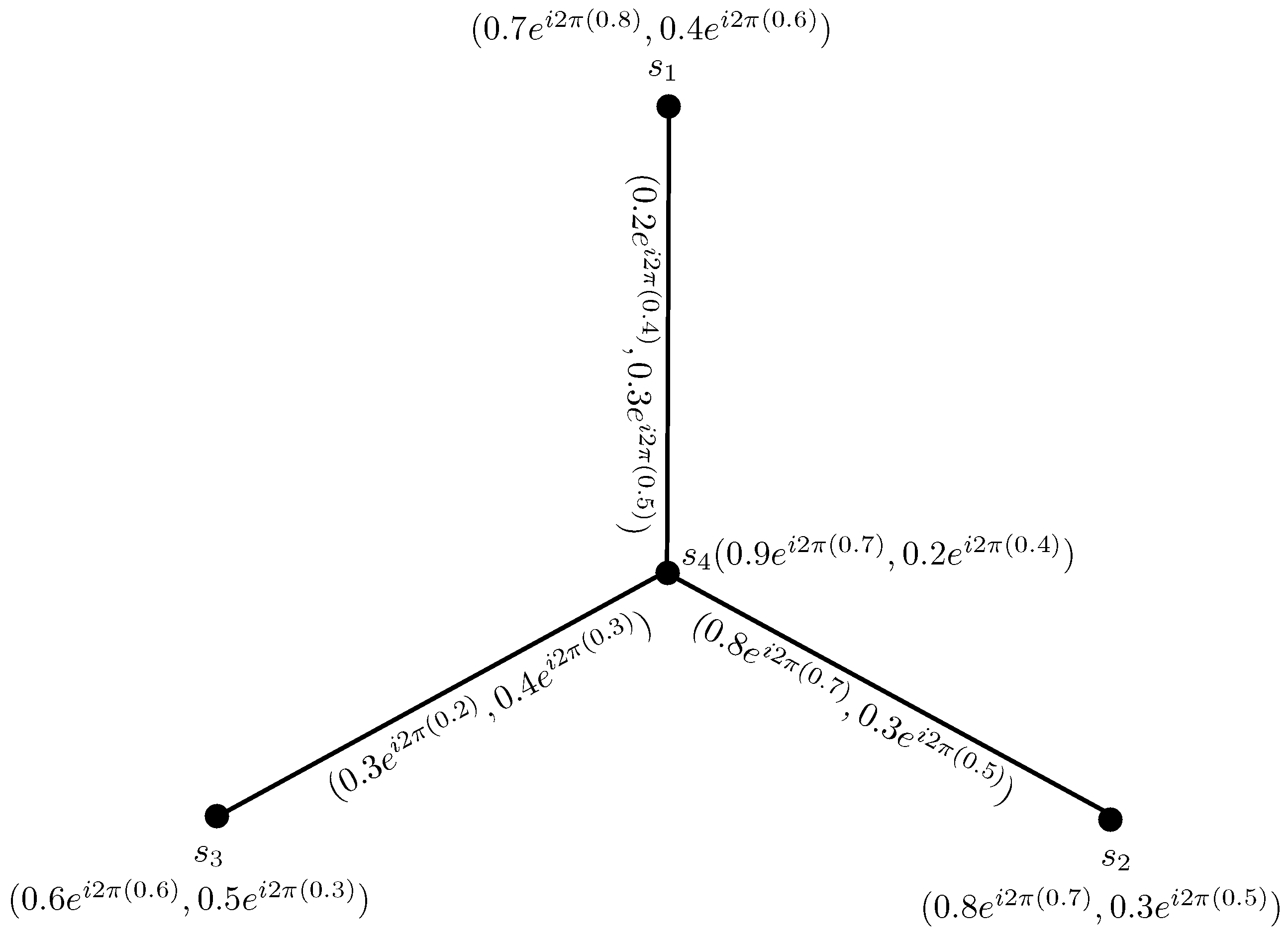
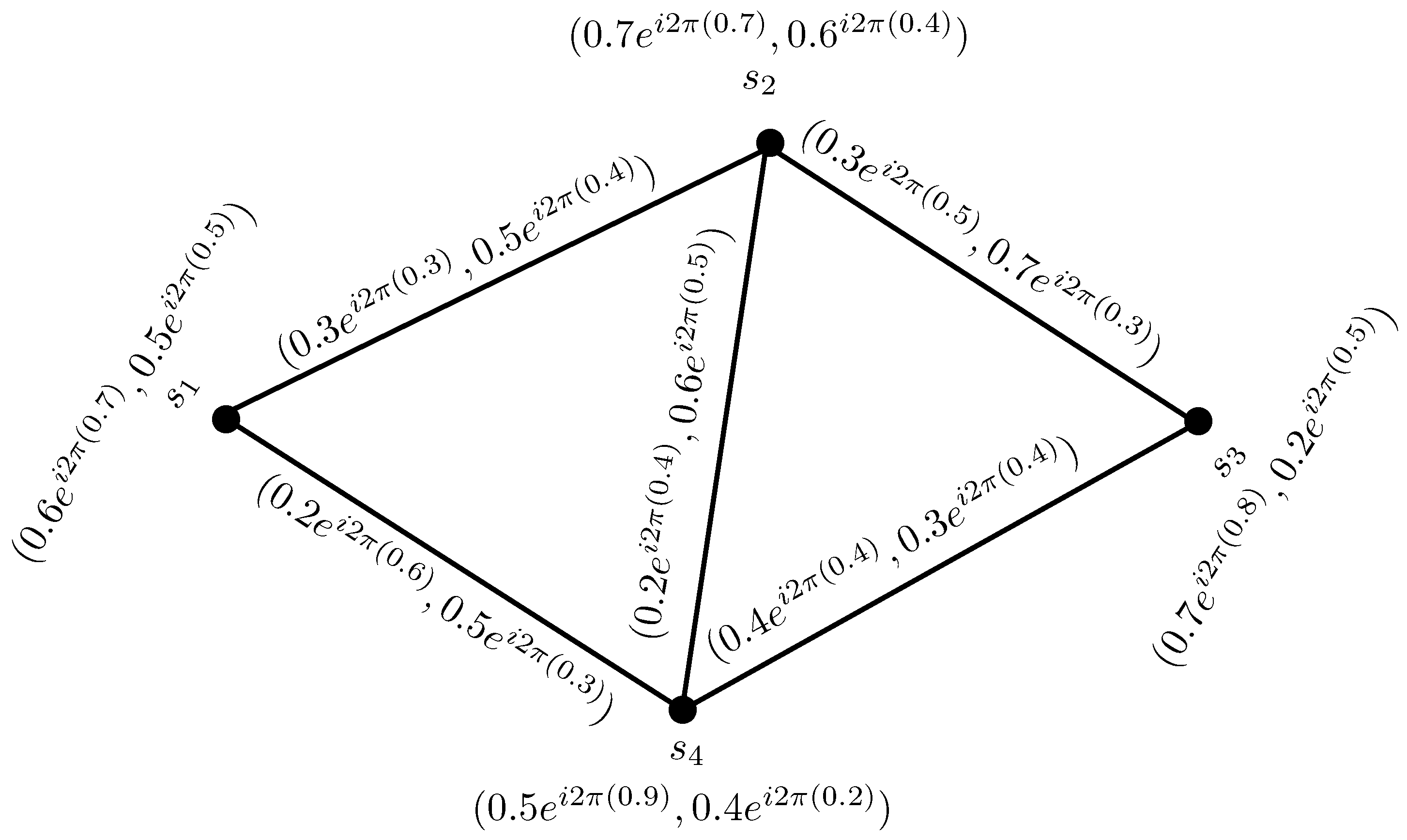
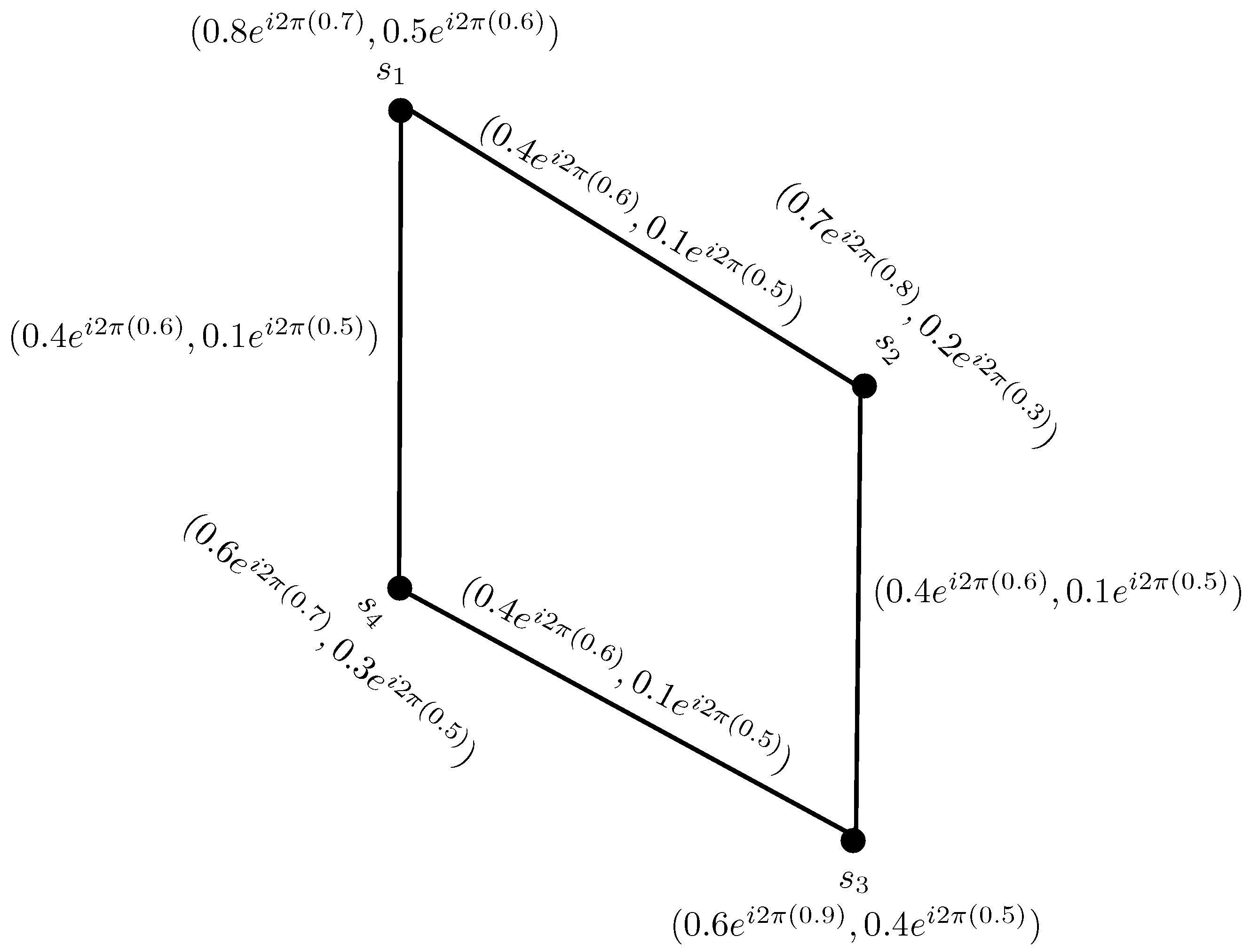
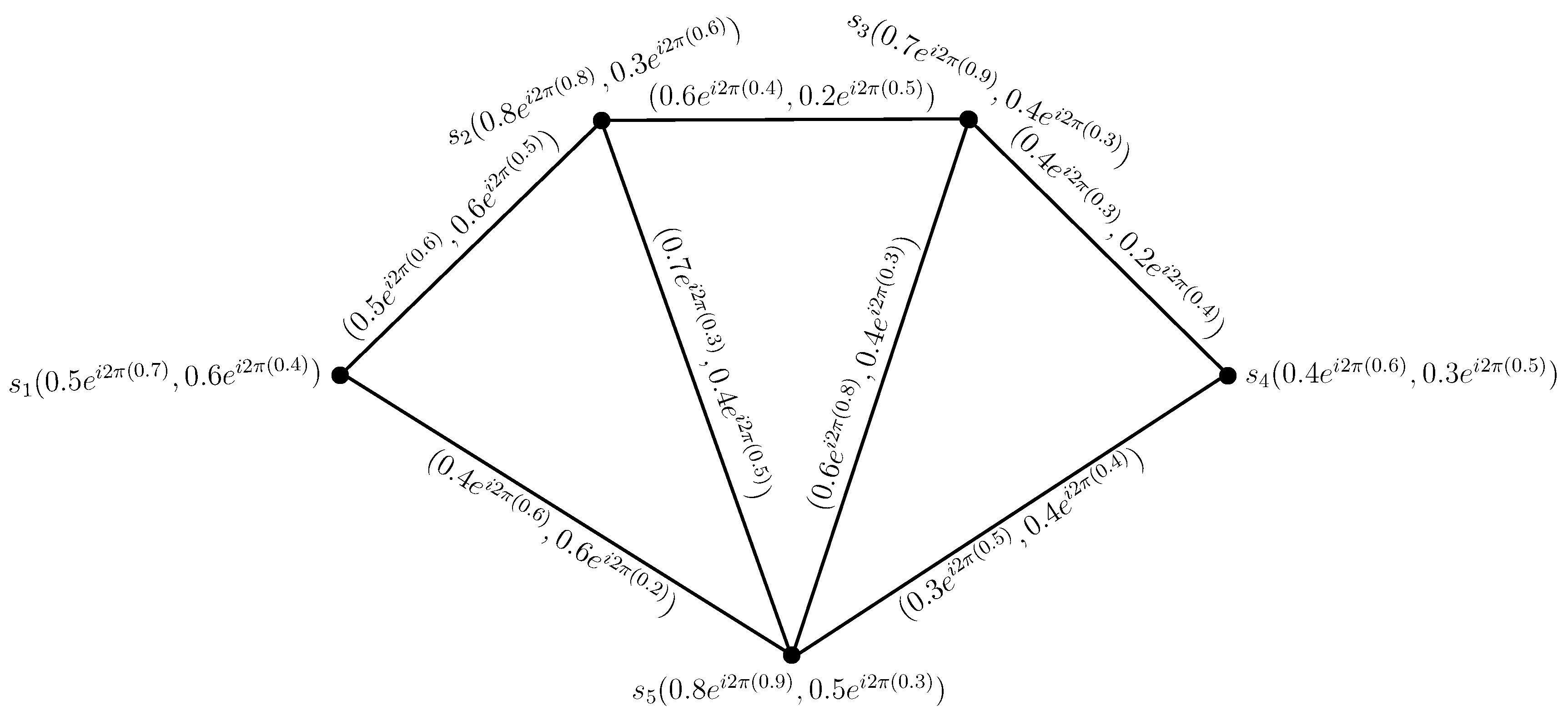
Consider a graph , where is the vertex set and is the edge set of G. Let be a CPFG on C, as given in Figure 1, defined by:
Figure 1.
Complex Pythagorean fuzzy graph.
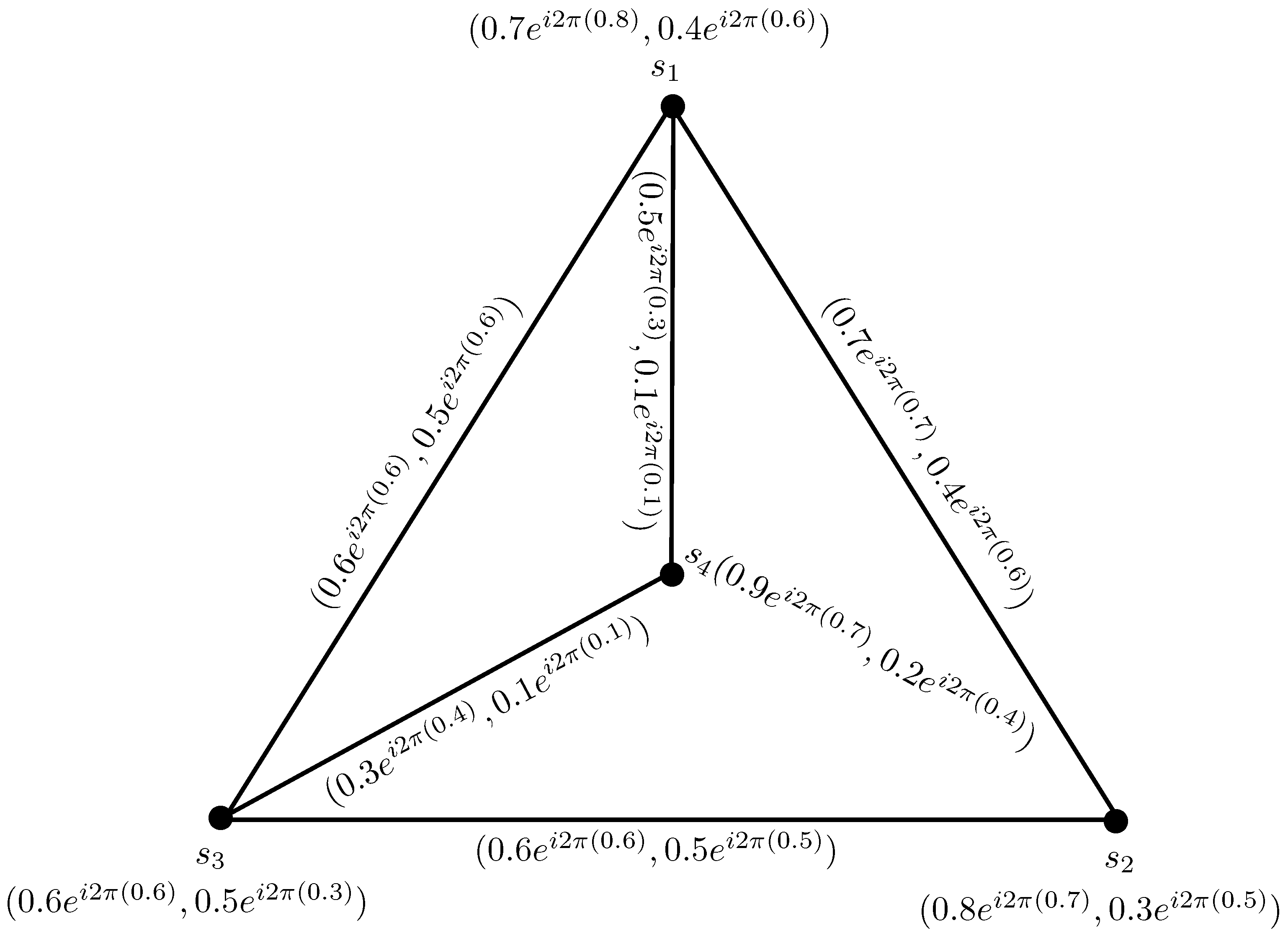
To compare the CPFGs with PFGs, we convert the vertex set and the edge set of CPFG in Figure 1, from complex Pythagorean fuzzy numbers to the Pythagorean fuzzy numbers by considering the phase terms of each complex Pythagorean fuzzy value as zero, as shown in Figure 2.
Figure 2.
Pythagorean fuzzy graph.
The proposed extended fuzzy graph—named CPFG—is more rational to reality in the process of decision-making. In PFG, the information consists of a real-valued membership and non-membership degrees and just considers the amplitude term, which causes loss of information. Further, a CPFG is an extension of the existing theories such as fuzzy graphs, complex fuzzy graphs [26] and PFGs [21] by considering more or more information related to the vertices and relations and to deal with the two-dimensional information in a single set.
Definition 6.
Let and be the vertex and the edge set of a CPFG , then the order of a CPFG is denoted by and is defined as:
The size of a CPFG is denoted by and is defined as:
Example 3.
The order and size of the CPFG given in Figure 1 is and , respectively.
Definition 7.
The complement of a CPFG on an underlying graph is a CPFG defined by
- 1.
- and
- 2.
Example 4.
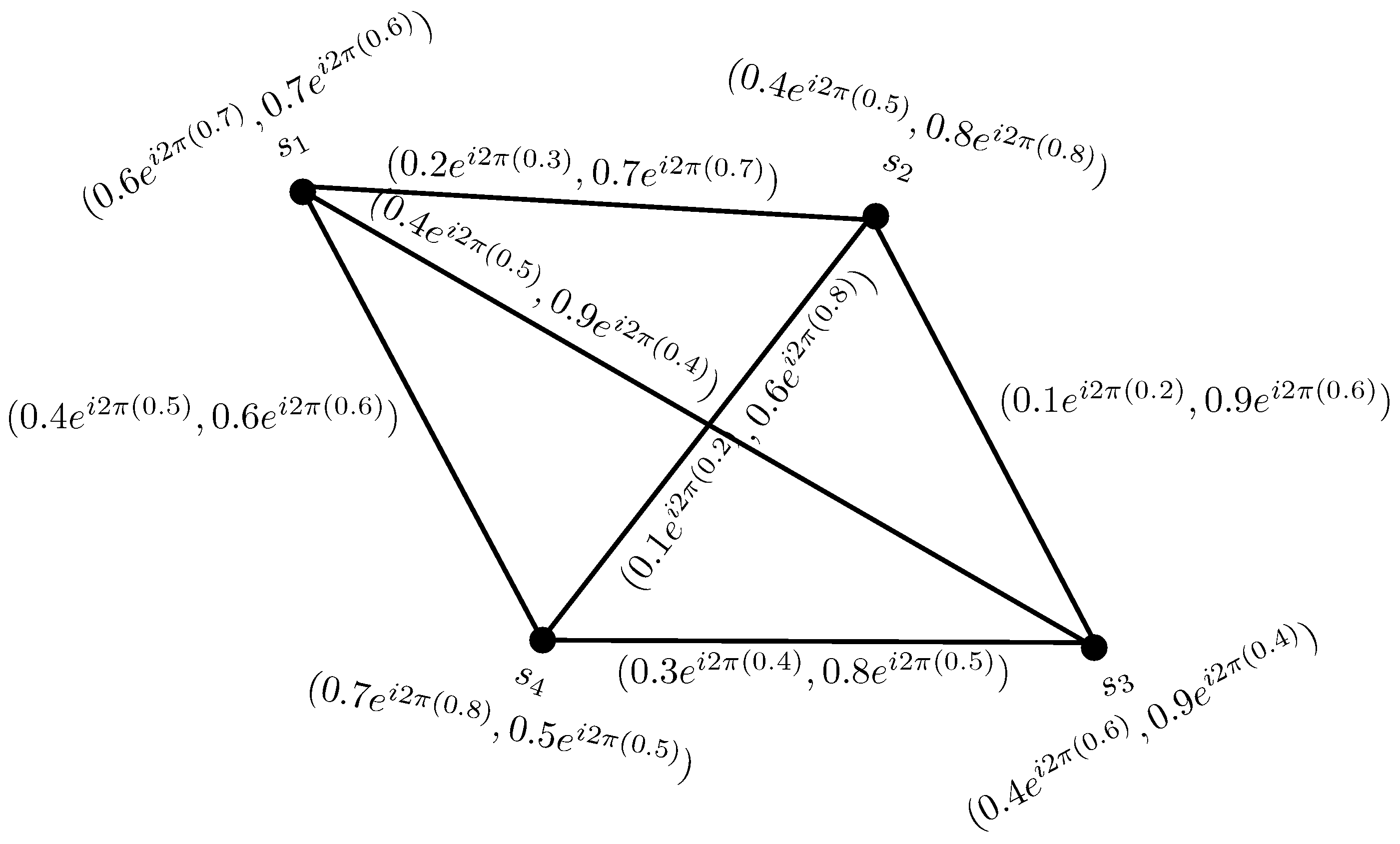
Consider a CPFG on , as in Figure 3, defined by:
Figure 3.
Complex Pythagorean fuzzy graph.
Utilizing Definition 7, complement of a CPFG can be obtained, as given in Figure 4, and defined by:
Figure 4.
Complement of a complex Pythagorean fuzzy graph.
It is easy to see from Figure 4 that is a CPFG.
Theorem 1.
The complement of a complement of CPFG is a CPFG itself, that is, .
Proof.
Suppose that is a CPFG. Then, by utilizing Definition 7, we have
If , then
If , then
for all Hence . □
Definition 8.
The union of two CPFGs and of the graphs and , respectively, is defined as follows:
- (i)
- (ii)
- (iii)
- (iv)
Theorem 2.
The union of and is a CPFG of if and only if and are CPFGs of and , respectively, where .
Definition 9.
The ring-sum of two CPFGs and of the graphs and , respectively, is defined as follows:
Proposition 1.
If and are the CPFGs, then is the CPFG.
Definition 10.
Let and be two CPFGs of and , respectively. The join of and , is defined as:
- (i)
- (ii)
- (iii)
where is the set of all edges joining the vertices of and ,
Theorem 3.
The join of and is a CPFG of if and only if and are CPFGs of and , respectively, where .
Definition 11.
The degree of a vertex in a CPFG is denoted by , and is defined as where
Definition 12.
The total degree of a vertex in a CPFG is denoted by , and is defined as where
Definition 13.
Let and be two CPFGs. For any vertex there are three cases to consider.
Case 1: Either or . Then, no edge incident at r lies in . Thus, for
For ,
Case 2: but no edge incident at r lies in . Then, any edge incident at r is either in or in .
Similarly,
Similarly,
Case 3: and some edges incident at r are in .
Similarly, . In addition,
Example 5.
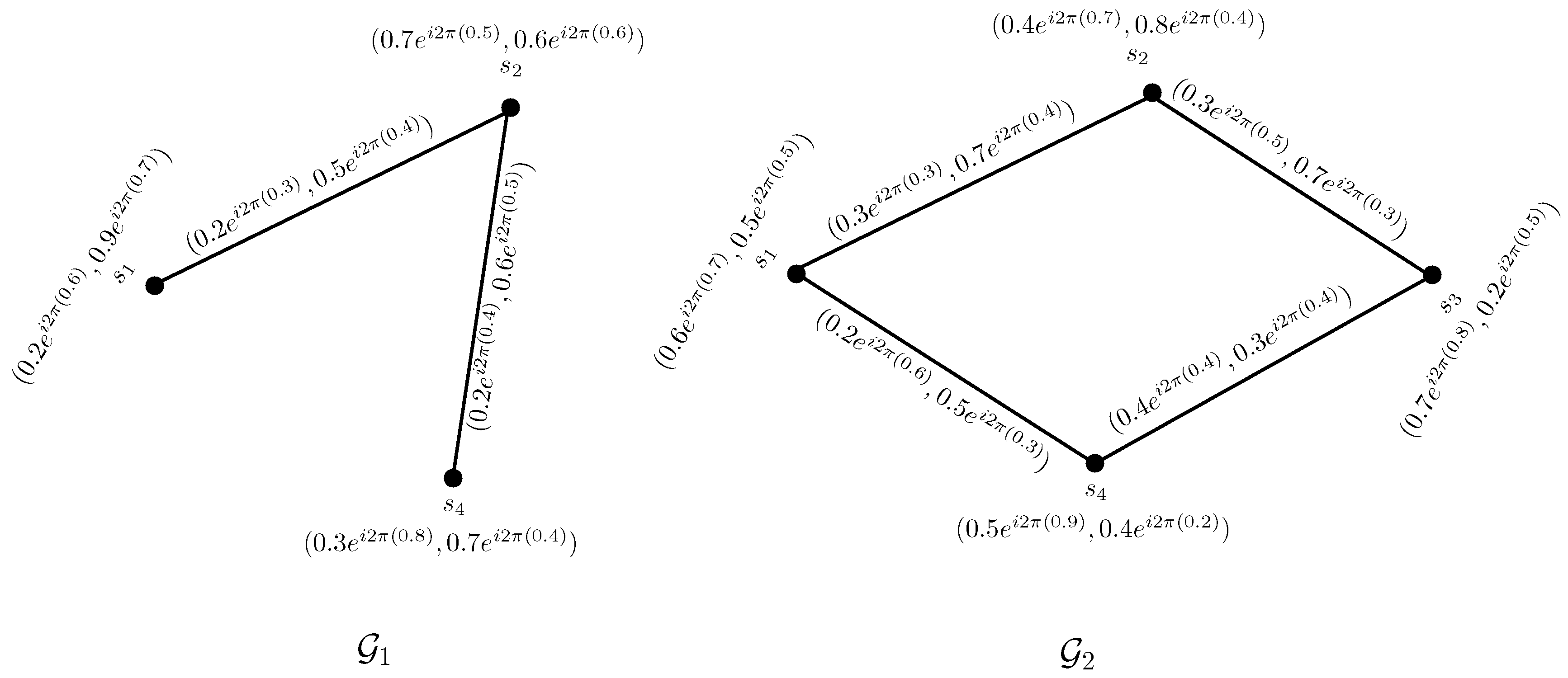
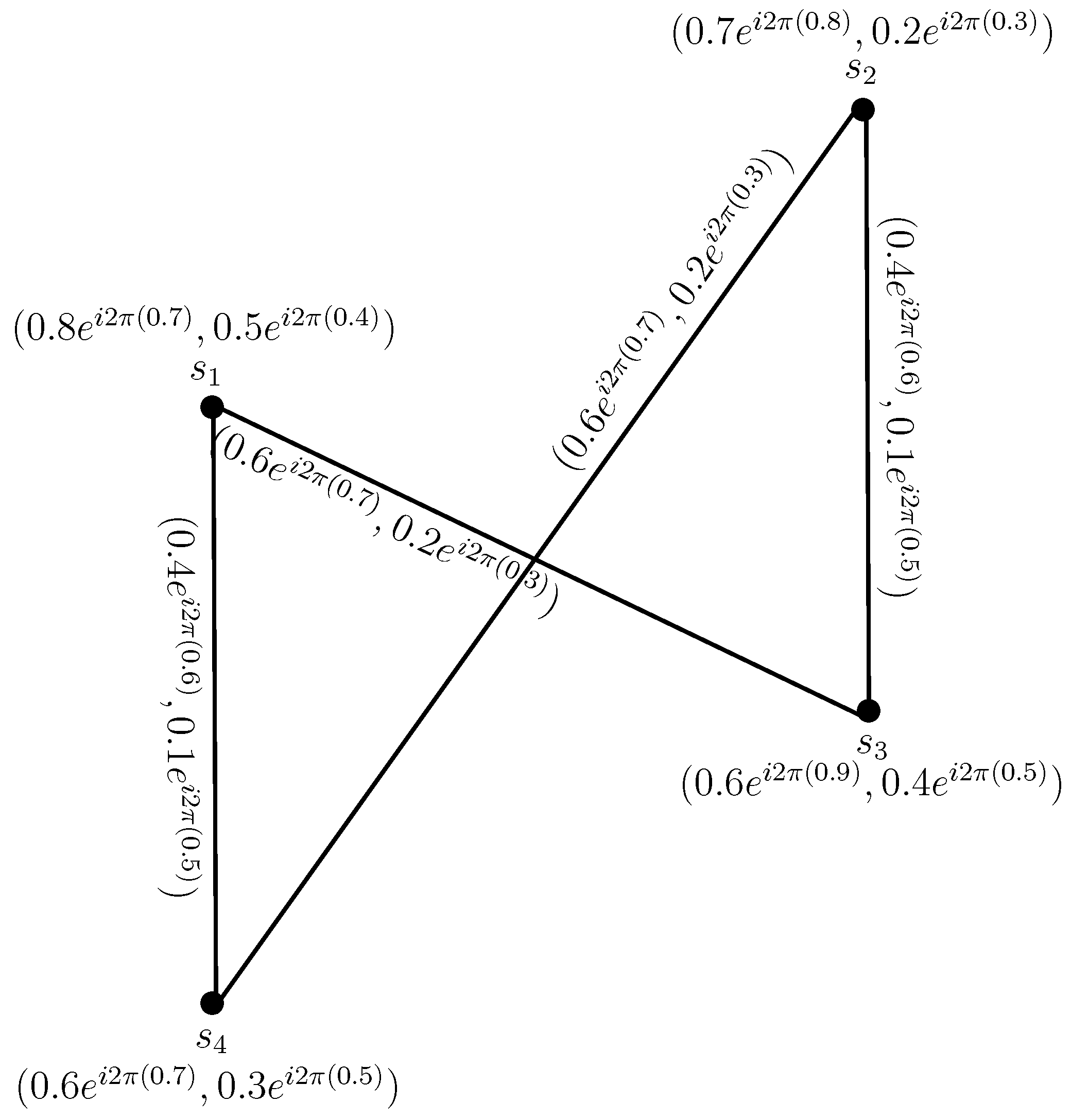
Consider two CPFGs and on and , respectively, as in Figure 5.
Figure 5.
CPFGs.
Further, their union is given in Figure 6.
Figure 6.
Union of two CPFGs.
Since , thus,
Therefore, .
Therefore, .
Since but no edge incident at lies in ,
Therefore,
Therefore,
Since and , thus,
Therefore,
Therefore,
Definition 14.
Let and be two CPFGs. For any vertex there are two cases to consider.
Case 1: If either or .
Case 2: If . Then, any edge incident at r is either in or in .
In both cases:
Definition 15.
Let and be two CPFGs. For any vertex
Definition 16.
A CPFG on G is called a regular CPFG if the degree of its each vertex is same. If each vertex has degree , that is, for all , where
is called regular of degree or -regular.
Example 6.
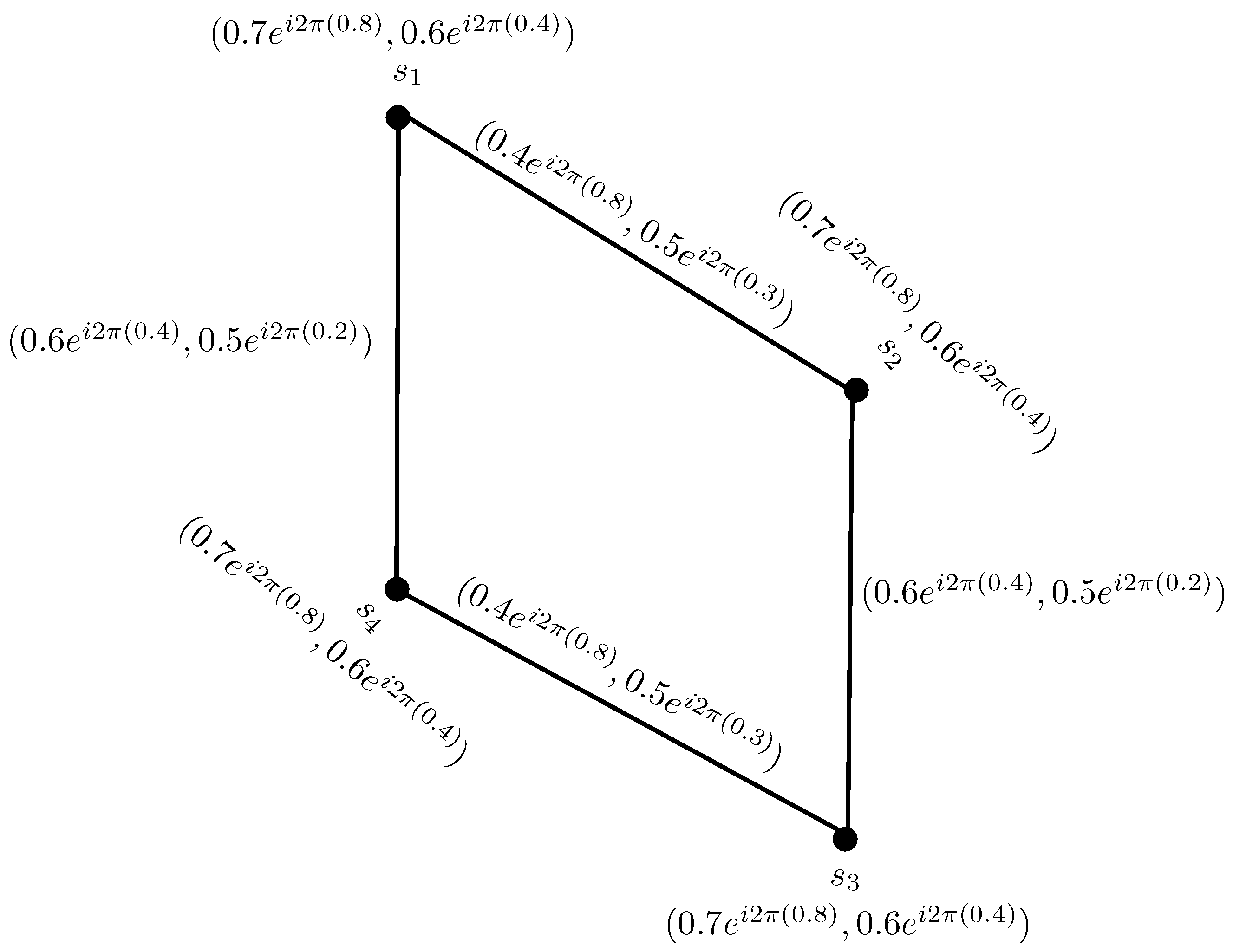
Consider a CPFG on , as in Figure 7, defined by:
Figure 7.
-regular complex Pythagorean fuzzy graph.
The degrees of its vertices and are determined as:
. Clearly, . Therefore, is -regular CPFG.
Definition 17.
A CPFG on G is called partially regular, if the graph G is regular.
Definition 18.
A CPFG on G is called full regular, if is both partially regular and regular.
Definition 19.
A CPFG on G is called a totally regular, if its each vertex has the same total degree. If each vertex has total degree , that is, for all , where
is called totally regular of degree or -regular.
Example 7.
Consider a CPFG on , as in Figure 8, defined by:
Figure 8.
-totally regular complex Pythagorean fuzzy graph.
The total degrees of its vertices and are determined as:
Clearly, . Therefore, is -totally regular CPFG.
Theorem 4.
Let be a -regular CPFG. Then where
Proof.
Assume that is a CPFG with size
Since is -regular, that is, for all , where
Therefore,
Since each edge is considered twice, so
□
Theorem 5.
Let be a -totally regular CPFG. Then where
Proof.
Assume that is a CPFG. Since is -totally regular, that is, for all , where
Therefore,
Since each edge is considered twice
□
Corollary 1.
Let be a -regular and -totally regular CPFG. Then .
Proof.
Assume that is a -regular CPFG. Then the size of is
As is a -totally regular CPFG. Then from Theorem 5, we must have
Hence . □
3. Edge Regularity of a Graph in Complex Pythagorean Fuzzy Circumstances
In this section, we propose the concepts of edge regular and totally edge regular complex Pythagorean fuzzy graphs and discuss their properties in detail. Further, these results are elaborated with examples.
Definition 20.
Let be a CPFG. The degree of an edge is defined as where
Definition 21.
The minimum and the maximum edge degree of a CPFG is and , respectively, where
Definition 22.
A CPFG on G is called an edge regular, if its each edge has the same degree. If each edge has degree , i.e., for all , where
is called edge regular of degree or -edge regular.
Example 8.
Consider a CPFG on , as in Figure 9, defined by:
Figure 9.
-edge regular CPFG.
Clearly, . So, is -edge regular CPFG.
Theorem 6.
Let be a CPFG on a cycle graph G. Then
Proof.
Let be a CPFG and let G be a cycle Then
Consider
Similarly, . Hence □
Theorem 7.
Let be a CPFG on a regular graph G. Then
where for all .
Proposition 2.
Let be a CPFG on a l-regular graph G. Then
Proof.
Suppose that is a CPFG on a l-regular graph G. Utilizing Theorem 7, we get
Since G is a l-regular graph, for all , so
□
Theorem 8.
Let be a CPFG on a graph G. If is a constant function, then is an edge regular CPFG if and only if G is an edge regular.
Proof.
Suppose that is a constant function, and for all , where and are constants. Assume that is an edge regular CPFG. We show that G is an edge regular. On the contrary, suppose that G is an edge irregular, i.e., for at least on pair of .
From the definition of edge degree of a CPFG,
where
Analogously, we can show that for all Therefore Since , so . Thus is an edge irregular, a contradiction. Hence G is an edge regular.
Conversely, let G be an edge regular. To show that is an edge regular CPFG. Consider is an edge irregular CPFG. i.e., for at least one pair of Now implies
, since is a constant, so , a contradiction. Therefore is an edge regular CPFG. □
Theorem 9.
Let be a regular CPFG. Then is an edge regular CPFG if and only if is a constant function.
Proof.
Let be a -regular CPFG i.e., for all . Suppose that is a constant function. Then and for all , where and are constants. By definition of edge degree of a CPFG,
where
Similarly, for all . Hence is an edge regular CPFG.
Conversely, assume that is an edge regular CPFG, i.e., for all We show that is a constant function. Since , where
Similarly, for all . Hence is a constant function. □
Definition 23.
The total degree of an edge in a CPFG is defined as where
Definition 24.
A CPFG on G is called a totally edge regular, if its each edge has the same total degree. If each edge has total degree , i.e., for all , where
is called totally edge regular of degree or -totally edge regular.
Example 9.
Consider a CPFG on , as in Figure 10, defined by:
Figure 10.
-totally edge regular complex Pythagorean fuzzy graph.
Clearly, . So, is -totally regular CPFG.
Theorem 10.
Let be a CPFG on a regular graph G. Then
Theorem 11.
Let be a CPFG. Then is a constant function if and only if the statements given below are equivalent:
- (i)
- is an edge regular CPFG;
- (ii)
- is a totally edge regular CPFG.
Proof.
Assume that is a constant function. Then and for every , where and are constants.
. Suppose that is -edge regular CPFG. Then for all .
Consider
Therefore, CPFG is a totally edge regular.
. Let be a -totally edge regular CPFG. Then for all .
Now,
Therefore, is a -edge regular CPFG.
Conversely, assume that (i) and (ii) are equivalent. We show that is a constant function. Assume that is not a constant function. Then and for at least one pair of . Suppose that is a -edge regular CPFG. Then Hence
As and , so . Hence is a totally edge irregular, a contradiction. Therefore, is a constant function. Similarly, is a constant function, if is a totally edge regular CPFG. □
Theorem 12.
If a CPFG is edge regular as well as totally edge regular, then is a constant function.
Proof.
Obvious. □
Theorem 13.
Let be a CPFG on a l-regular graph G. Then is a constant function if and only if is both regular and totally edge regular CPFG.
Proof.
Let be a CPFG on a l-regular graph G. Assume that is a constant function, and for all , where and are constants.
Utilizing definition of vertex degree, we have
Therefore, is regular CPFG.
Now, , where
Similarly, for all Therefore is a totally edge regular CPFG.
Conversely, assume that is regular as well as totally edge regular CPFG. We show that is a constant function. Since CPFG is regular, for all . Also, is a totally edge regular, for all According to the definition of total degree of an edge, we have where
Similarly, for all Hence is a constant function. □
Definition 25.
A CPFG on G is said to be partially edge regular, if G is an edge regular.
Definition 26.
A CPFG on G is said to be full edge regular, if is edge regular as well as partially edge regular.
Theorem 14.
Let be a CPFG on G such that is a constant function. If is full regular CPFG, then is full edge regular CPFG.
Proof.
Suppose that is a constant function. and for all , where and are constants. Let be a full regular CPFG, then and for all , where and are constants. Therefore constant. Hence the graph G is an edge regular.
Now, for all where
Similarly, constant, for all Hence is an edge regular CPFG. Thus is full edge regular CPFG. □
Theorem 15.
Let be a -partially edge regular and -totally edge regular CPFG. Then , where .
Proof.
The size of CPFG is
Since is -partially edge regular and -totally edge regular CPFG, i.e., and , respectively. Therefore,
□
4. An Approach to Decision Making with Complex Pythagorean Fuzzy Information
In this section, a decision-making approach is developed based on the proposed CPFGs. Further, the developed approach is demonstrated with a suitable illustration.
Definition 27.
Let be a collection of CPFNs, the complex Pythagorean fuzzy weighted averaging (CPFWA) operator is a mapping CPFWA, where
is the weight vector of with , and
With the operations of CPFNs, by induction on n, we get CPFWA operator as:
Definition 28.
Let be a collection of CPFNs, the complex Pythagorean fuzzy weighted geometric (CPFWG) operator is a mapping CPFWG, where
is the weight vector of satisfying and
With the operations of CPFNs, by induction on n, we get CPFWG operator as:
Definition 29.
Let be a collection of CPFNs and be the weight vector of , satisfying and the complex Pythagorean fuzzy ordered weighted averaging (CPFOWA) operator is a mapping CPFOWA, where
With the operations of CPFNs, by induction on n, we get CPFOWA operator as:
Definition 30.
Let be a collection of CPFNs and be the weight vector of , satisfying and then the complex Pythagorean fuzzy ordered weighted geometric (CPFOWG) operator is a mapping CPFOWG, where
With the operations of CPFNs, by induction on n, we get CPFOWG operator as:
Particularly, if then the CPFOWA and CPFOWG operators reduce to the CPFWA and CPFWG operators, respectively.
A score function for the CPFN is defined as follows:
Definition 31.
Let be a CPFN. Then
is the score of ϱ, where s is the score function of ϱ, .
Definition 32.
Let be a CPFN. Then
is the accuracy of ϱ, where h is the accuracy function of ϱ, .
For any two CPFNs and ,
- if , then ;
- if , then
- if , then ;
- if , then .
4.1. Decision-Making Approach
Consider a MADM problem containing a discrete set of m alternatives . Let be a set of attributes characterized by a CPFS . Also each attribute classified with a vertex and links between attributes with relations (edges) in CPFG.
In a CPFG , for an alternative, assume that if an attribute is most important, we choose , otherwise . Then the importance of each attribute can be calculated by using
where is the set of the attributes ’s neighbors and
is the influence coefficient between relevant attributes.
In the CPFG based MADM problems, if there are prioritization relations among the attributes, we will solve this problem by using the prioritized aggregation operators [29] together with the necessary complex Pythagorean fuzzy graphic structure.
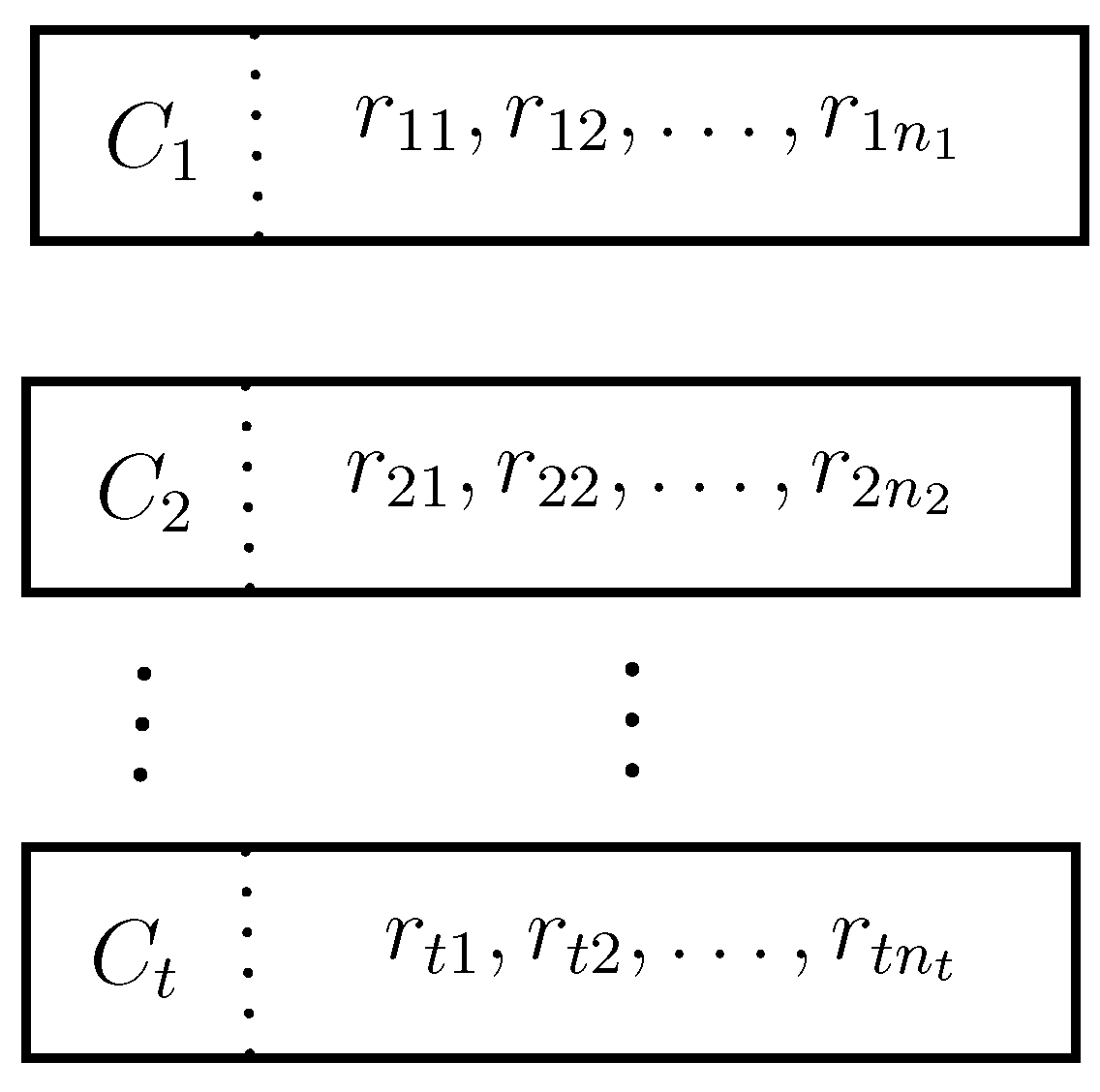
For a CPFG, suppose that we have a collection of attributes (vertices) partitioned into t distinct categories such that , where are the attributes in the category and suppose is a prioritization relationship among these categories. In the category , the attributes have a higher priority than those in if . Then the universal set of attributes is and the total number of attributes is . The prioritized hierarchy structure of Z is shown in Figure 11. We put forward an approach to handle the CPFG based MADM problems according to the prioritized complex Pythagorean fuzzy aggregation operators well-organized with the degrees of attributes.
Figure 11.
Prioritized hierarchies of attributes (criteria) set.
Compute the degrees of all attributes which can be normalized by
The weights are associated with attributes dependent upon the satisfaction of the higher priority attribute by designing the prioritization between attributes. Then for each category , firstly we define
where is an alternative function such as the maximum or minimum function, for calculating based on which we determine the weight of each category:
Using the complex Pythagorean fuzzy weighted combination (CPFWC) operator, the overall importance of the alternative can be calculated as:
And finally to select an optimal alternative, determine the score functions and rank all the alternatives in accordance with .
The approach involves the following steps:
- Step 1.
- For a MADM problem, consider a discrete set of alternatives , a set of uncertain attributes and the construction of a CPFG the vertices of which indicate the attributes considered and edges indicate complex Pythagorean fuzzy relations of attributes.
- Step 2.
- We determine the degrees of all attributes in a CPFG and normalize them on the basis of Equation (2).
- Step 3.
- Among the attributes, we nominate the prioritization relationships. Then the collection of attributes is partitioned into t distinct categories such that , where are the attributes in the category .
- Step 4.
- On the basis of Equation (3), we compute the values of for each priority category .
- Step 5.
- On the basis of Equation (4), we cumpute the weight of each category according to .
- Step 6.
- On the basis of Equation (1), we determine the importance of each attribute .
- Step 7.
- By using the CPFWC operator (Equation (5)), we determine the overall importance of the alternatives and select the optimal alternative(s) in accordance with .
4.2. Illustrative Example
In this subsection, a numerical example is utilized to illustrate the validity of the developed MADM approach.
Midwest American Manufacturing Corp. (MAMC)’s information management steering committee wants to prioritize for development and implementation a set of nine information technology improvement projects (alternatives) :
- : Quality Management Information;
- : Customer Order Tracking;
- : Fleet Management;
- : Electronic Mail;
- : Employee Skills Tracking;
- : Inventory Control;
- : Design Change Management;
- : Materials Purchasing Management;
- : Budget Analysis.
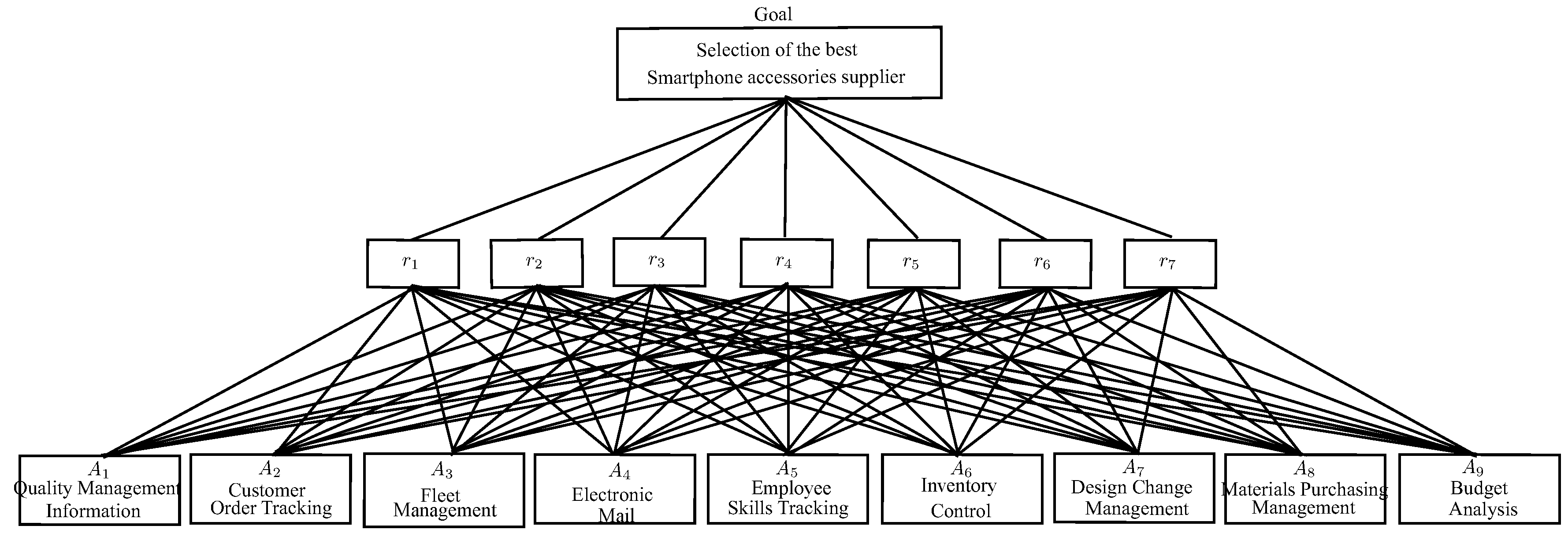
which have been given by area managers. The committee is distressed that the projects (alternatives) are prioritized from maximum to minimum potential input to the firm’s strategic goal of achieving ambitious advantage in the industry. To determine the possible input of each project, a set of seven factors (attributes) are considered: Under the complex Pythagorean fuzzy circumstances, an expert is invited to evaluate these alternatives with complex Pythagorean fuzzy elements. Therefore, the complex Pythagorean fuzzy decision matrix is given in Table 1. The hierarchical structure of the given decision making problem is depicted in Figure 12.
Table 1.
The evaluation information on the projects in a complex Pythagorean fuzzy environment.
Figure 12.
The optimal project selection hierarchical structure.
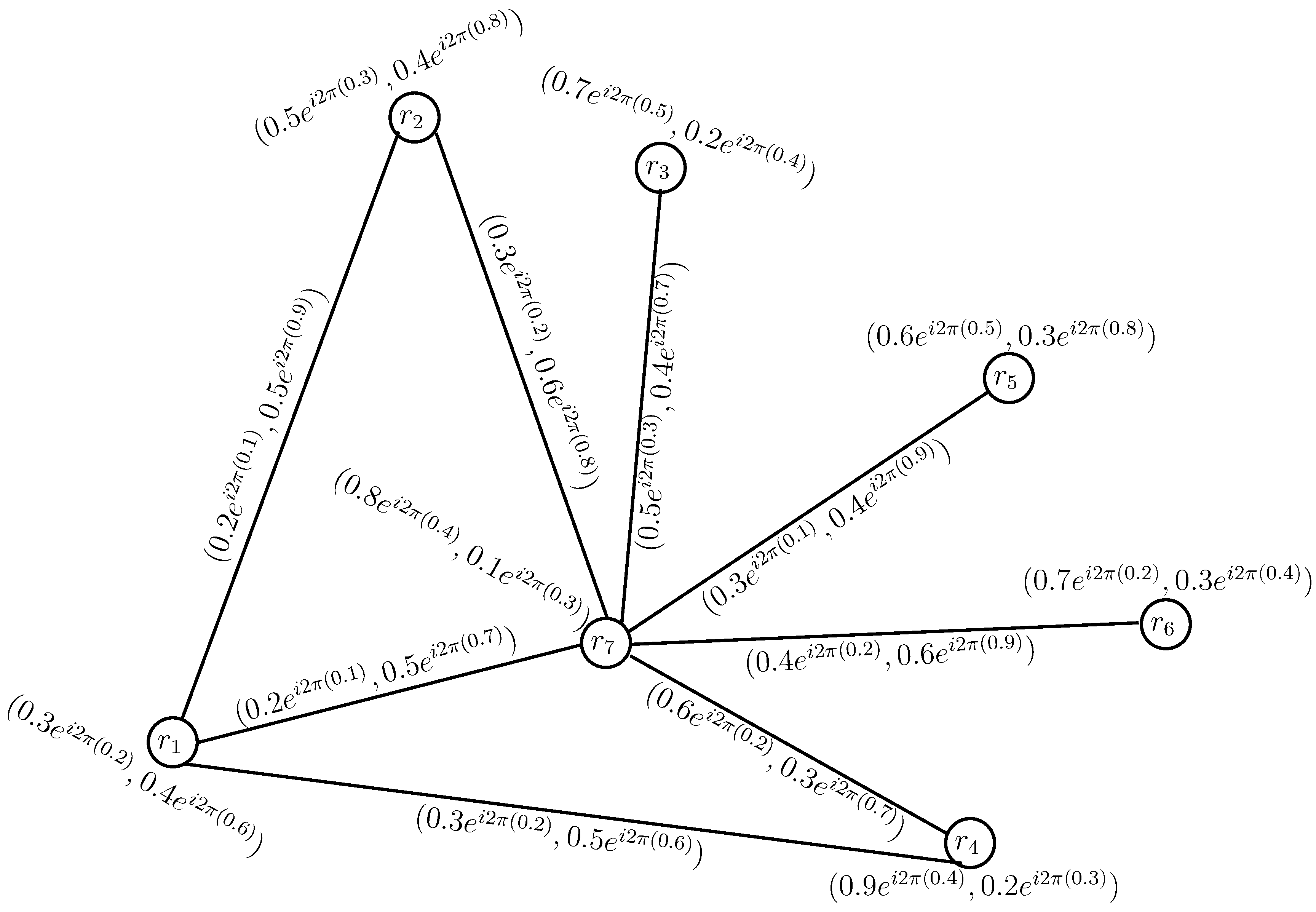
Assume that a graph , with seven factors (attributes) and a set of their relations (edges) . Let be a CPFG of a graph G, as in Figure 13.
Figure 13.
The relationships among the factors .
- Step 1.
- In graph of Figure 13, the degree of each attribute is determined as:Utilizing Equation (2), normalize the above degrees as:
- Step 2.
- Suppose that there exist prioritization complex Pythagorean fuzzy relations , if . So, .
- Step 3.
- If is a minimum function, then utilizing Equation (3), we obtain
- Step 4.
- On the basis of Equation (4), we calculate the weight of each category as:
- Step 5.
- If there is an alternative , in which just attribute ‘’ is most important, then and . Also take for and , then on the basis of Equation (1), the importance of all attributes are:
- Step 6.
- On the basis of Equation (5), we determine the overall importance of the alternative as:
Furthermore, we determine the score functions of overall importance of the other alternatives :
We rank the alternatives according to the score function of the overall importance of the alternatives , as:
4.3. Comparative Analysis
Ashraf et al. [30] proposed the graph based decision making model, to accommodate single-valued neutrosophic values. We have utilized this approach to the above illustrative example and compared the decision results with the proposed approach of this paper for CPFGs. The results corresponding to these approaches are summarized in Table 2.
Table 2.
Comparative analysis.
From this comparative study, the results obtained by the existing approach coincide with the proposed one which validates the proposed approach. Hence, the proposed approach can be suitably utilized to solve the MCDM problems. The novelty of this decision making approach is that we have developed an MADM model with the interrelated attributes and described numerous relationships among the attributes by utilizing the corresponding graphical structures with complex Pythagorean fuzzy information.
5. Conclusions
CPFS as a generalized formation represents some general complex scenario. Our research paper enriches the area of fuzzy graph theory in several directions. Firstly, under the Pythagorean fuzzy circumstances, a novel concept of CPFGs has been proposed by combining PFGs and CFGs. CPFG, an extended structure of a fuzzy graph is more practical and flexible as compared to the classical, fuzzy, complex fuzzy and Pythagorean fuzzy models as it deals the vagueness with the membership and non-membership degrees whose ranges are generalized from real to the complex subset with a unit disc. Secondly, the novel concepts of regular and edge regular graphs have been defined with appropriate illustration and some of their crucial properties are examined within complex Pythagorean fuzzy contexts. Thirdly, some aggregation techniques have been investigated for CPFNs and, further, the complex Pythagorean fuzzy graphic structure has been utilized to depict the interrelated attributes in MADM and developed the multi-attribute decision making approach based on CPFG. Meanwhile, we interpret the relationships among the attributes and then derive a solution utilizing the MADM model based on the CPFGs. Taking into account the interval-valued vagueness, we shall extend the proposed research work to the complex interval-valued Pythagorean fuzzy setting and provide its applications further.
Author Contributions
M.A. and S.N. conceived of the presented idea. S.N. developed the theory and performed the computations. M.A. verified the analytical methods.
Conflicts of Interest
The authors declare that they have no conflict of interest regarding the publication of the research article.
References
- Yager, R.R. Pythagorean fuzzy subsets. In Proceedings of the Joint IFSA World Congress and NAFIPS Annual Meeting, Edmonton, AB, Canada, 24–28 June 2013; pp. 57–61. [Google Scholar]
- Yager, R.R.; Abbasov, A.M. Pythagorean membership grades, complex numbers, and decision making. Int. J. Intell. Syst. 2013, 28, 436–452. [Google Scholar] [CrossRef]
- Yager, R.R. Pythagorean membership grades in multi-criteria decision making. IEEE Trans. Fuzzy Syst. 2014, 22, 958–965. [Google Scholar] [CrossRef]
- Atanassov, K.T. Intuitionistic fuzzy sets. Fuzzy Sets Syst. 1986, 20, 87–96. [Google Scholar] [CrossRef]
- Ramot, D.; Milo, R.; Fiedman, M.; Kandel, A. Complex fuzzy sets. IEEE Trans. Fuzzy Syst. 2002, 10, 171–186. [Google Scholar] [CrossRef]
- Yazdanbakhsh, O.; Dick, S. A systematic review of complex fuzzy sets and logic. Fuzzy Sets Syst. 2018, 338, 1–22. [Google Scholar] [CrossRef]
- Greenfield, S.; Chiclana, F.; Dick, S. Interval-valued complex fuzzy logic. In Proceedings of the IEEE International Conference on Fuzzy Systems, Vancouver, BC, Canada, 24–29 July 2016; pp. 1–6. [Google Scholar]
- Ramot, D.; Friedman, M.; Langholz, G.; Kandel, A. Complex fuzzy logic. IEEE Trans. Fuzzy Syst. 2003, 11, 450–461. [Google Scholar] [CrossRef]
- Alkouri, A.; Salleh, A. Complex intuitionistic fuzzy sets. AIP Conf. Proc. 2012, 14, 464–470. [Google Scholar]
- Alkouri, A.U.M.; Salleh, A.R. Complex Atanassov’s intuitionistic fuzzy relation. Abstr. Appl. Anal. 2013, 1–18. [Google Scholar] [CrossRef]
- Rani, D.; Garg, H. Distance measures between the complex intuitionistic fuzzy sets and its applications to the decision-making process. Int. J. Uncertain. Quantif. 2017, 7, 423–439. [Google Scholar] [CrossRef]
- Rani, D.; Garg, H. Complex intuitionistic fuzzy power aggregation operators and their applications in multi-criteria decision making. Expert Syst. 2018, 35, e12325. [Google Scholar] [CrossRef]
- Garg, H.; Rani, D. Some generalized complex intuitionistic fuzzy aggregation operators and their application to multi criteria decision-making process. Arab. J. Sci. Eng. 2019, 44, 2679–2698. [Google Scholar] [CrossRef]
- Kumar, T.; Bajaj, R.K. On complex intuitionistic fuzzy soft sets with distance measures and entropies. J. Math. 2014. [Google Scholar] [CrossRef]
- Ullah, K.; Mahmood, T.; Ali, Z.; Jan, N. On some distance measures of complex Pythagorean fuzzy sets and their applications in pattern recognition. Complex Intell. Syst. 2019. [Google Scholar] [CrossRef]
- Rosenfeld, A. Fuzzy Graphs, Fuzzy Sets and Their Applications; Zadeh, L.A., Fu, K.S., Shimura, M., Eds.; Academic Press: New York, NY, USA, 1975; pp. 77–95. [Google Scholar]
- Mordeson, J.N.; Peng, C.S. Operations on fuzzy graphs. Inf. Sci. 1994, 79, 159–170. [Google Scholar] [CrossRef]
- Yu, X.; Xu, Z. Graph-based multi-agent decision making. Int. J. Approx. Reason. 2012, 53, 502–512. [Google Scholar] [CrossRef]
- Habib, A.; Akram, M.; Farooq, A. q-Rung orthopair fuzzy competition graphs with application in the soil ecosystem. Mathematics 2019, 7, 91. [Google Scholar] [CrossRef]
- Naz, S.; Akram, M.; Smarandache, F. Certain notions of energy in single-valued neutrosophic graphs. Axioms 2018, 7, 50. [Google Scholar] [CrossRef]
- Naz, S.; Ashraf, S.; Akram, M. A novel approach to decision-making with Pythagorean fuzzy information. Mathematics 2018, 6, 95. [Google Scholar] [CrossRef]
- Akram, M.; Dar, J.M.; Naz, S. Pythagorean Dombi fuzzy graphs. Complex Intell. Syst. 2019. [Google Scholar] [CrossRef]
- Akram, M.; Dar, J.M.; Naz, S. Certain graphs under Pythagorean fuzzy environment. Complex Intell. Syst. 2019, 5, 127–144. [Google Scholar] [CrossRef]
- Akram, M.; Habib, A.; Ilyas, F.; Dar, J.M. Specific types of Pythagorean fuzzy graphs and application to decision-making. Math. Comput. Appl. 2018, 23, 42. [Google Scholar] [CrossRef]
- Akram, M.; Naz, S.; Davvaz, B. Simplified interval-valued Pythagorean fuzzy graphs with application. Complex Intell. Syst. 2019, 5, 229–253. [Google Scholar] [CrossRef]
- Thirunavukarasu, P.; Suresh, R.; Viswanathan, K.K. Energy of a complex fuzzy graph. Int. J. Math. Sci. Eng. Appl. 2016, 10, 243–248. [Google Scholar]
- Yaqoob, N.; Gulistan, M.; Kadry, S.; Wahab, H. Complex intuitionistic fuzzy graphs with application in cellular network provider companies. Mathematics 2019, 7, 35. [Google Scholar] [CrossRef]
- Yaqoob, N.; Akram, M. Complex neutrosophic graphs. Bull. Comput. Appl. Math. 2018, 6, 85–109. [Google Scholar]
- Yager, R.R. Prioritized aggregation operators. Int. J. Approx. Reason. 2008, 48, 263–274. [Google Scholar] [CrossRef]
- Samina, A.; Naz, S.; Rashmanlou, H.; Malik, M.A. Regularity of graphs in single valued neutrosophic environment. J. Intell. Fuzzy Syst. 2017, 33, 529–542. [Google Scholar]
© 2019 by the authors. Licensee MDPI, Basel, Switzerland. This article is an open access article distributed under the terms and conditions of the Creative Commons Attribution (CC BY) license (http://creativecommons.org/licenses/by/4.0/).