


Abstract
In this paper, we apply the notion of bipolar-valued fuzzy set to UP-algebras. We introduce the notions of bipolar fuzzy UP-subalgebras (resp., bipolar fuzzy UP-filters, bipolar fuzzy UP-ideals, and bipolar fuzzy strongly UP-ideals) of UP-algebras and prove their generalizations. We provide a condition for a bipolar fuzzy UP-filter to be a bipolar fuzzy UP-ideal. Further, we discuss the relation between bipolar fuzzy UP-subalgebras (resp., bipolar fuzzy UP-filters, bipolar fuzzy UP-ideals, and bipolar fuzzy strongly UP-ideals) and their level cuts.
Keywords:
UP-algebra; bipolar fuzzy UP-subalgebra; bipolar fuzzy UP-filter; bipolar fuzzy UP-ideal; bipolar fuzzy strongly UP-ideal MSC:
03G25; 08A72
1. Introduction
Among the important and intensively studied classes of algebras are the algebras of logic. Examples of these are BCK-algebras [1], BCI-algebras [2], BCH-algebras [3], KU-algebras [4], SU-algebras [5], UP-algebras [6], and others. They are strongly connected with logic. For example, the BCI-algebras introduced by Iséki [2] in 1966 have connections with BCI-logic, being the BCI-system in combinatory logic, which has applications in the language of functional programming. BCK- and BCI-algebras are two classes of logical algebras. They were introduced by Imai and Iséki [1,2] in 1966 and have been extensively investigated by many researchers. It is known that the class of BCK-algebras is a proper subclass of the class of BCI-algebras.
The notion of UP-algebras was introduced by Iampan [6] in 2017, and it is known that the class of KU-algebras [4] is a proper subclass of the class of UP-algebras. They have been examined by several researchers, for example, Somjanta et al. [7] introduced the notion of fuzzy sets in UP-algebras, the notion of intuitionistic fuzzy sets in UP-algebras was introduced by Kesorn et al. [8], the notion of Q-fuzzy sets in UP-algebras was introduced by Tanamoon et al. [9], Senapati et al. [10,11] applied cubic set and interval-valued intuitionistic fuzzy structure to UP-algebras, and so on.
The notion of fuzzy subsets of a set was first considered by Zadeh [12] in 1965. The fuzzy set theories developed by Zadeh and others have found many applications in the domain of mathematics and elsewhere. There are several kinds of fuzzy set extensions in the fuzzy set theory, for example, intuitionistic fuzzy sets (see [8,13,14]), interval-valued fuzzy sets (see [15]), vague sets (see [16]), bipolar-valued fuzzy sets, etc. The notion of bipolar-valued fuzzy sets, first introduced by Zhang [17] in 1994, is an extension of fuzzy sets whose membership degree range is enlarged from the interval to .
After the introduction of the notion of bipolar-valued fuzzy sets by Zhang [17], several studies were conducted on the generalizations of the notion of bipolar-valued fuzzy sets and the application to many logical algebras, a few of which are mentioned in the following. Jun et al. (see [18,19]) introduced the notions of bipolar fuzzy subalgebras, bipolar fuzzy closed ideals, bipolar fuzzy regularities, bipolar fuzzy regular subalgebras, bipolar fuzzy filters, and bipolar fuzzy closed quasi filters in BCH-algebras. Akram et al. studied bipolar-valued fuzzy set theory in graphs, Lie algebras, and K-algebras (see [20,21,22]). Muhiuddin [23] introduced the notions of bipolar fuzzy KU-subalgebras and bipolar fuzzy KU-ideals in KU-algebras. Senapati introduced the notion of bipolar fuzzy BG-subalgebras in BG-algebras and the notion of bipolar fuzzy B-subalgebras in B-algebras (see [24,25]).
In this paper, we apply the notion of bipolar-valued fuzzy set to UP-algebras. We introduce the notions of bipolar fuzzy UP-subalgebras (resp., bipolar fuzzy UP-filters, bipolar fuzzy UP-ideals, and bipolar fuzzy strongly UP-ideals) of UP-algebras and prove their generalizations. We provide a condition for a bipolar fuzzy UP-filter to be a bipolar fuzzy UP-ideal. Further, we discuss the relation between bipolar fuzzy UP-subalgebras (resp., bipolar fuzzy UP-filters, bipolar fuzzy UP-ideals, and bipolar fuzzy strongly UP-ideals) and their level cuts.
2. Basic Results on UP-Algebras
An algebra of type is called a UP-algebra [6], where A is a nonempty set, · is a binary operation on A, and 0 is a fixed element of A (i.e., a nullary operation) if it satisfies the following axioms: for any ,
- (UP-1)
- ,
- (UP-2)
- ,
- (UP-3)
- , and
- (UP-4)
- and imply .
From [6], we know that the notion of UP-algebras is a generalization of KU-algebras.
Example 1
([6]). Let X be a universal set. Define two binary operations · and * on the power set of X by putting and for all . Then, and are UP-algebras, and we shall call it the power UP-algebra of type 1 and the power UP-algebra of type 2, respectively.
In a UP-algebra , the following assertions are valid (see [6,26]).
Definition 1
([6,7]). A nonempty subset S of a UP-algebra is called
- (1)
- a UP-subalgebra of A if for any , .
- (2)
- a UP-filter of A if it satisfies the following properties:
- (i)
- the constant 0 of A is in S, and
- (ii)
- for any , and imply .
- (3)
- a UP-ideal of A if it satisfies the following properties:
- (i)
- the constant 0 of A is in S, and
- (ii)
- for any , and imply .
- (4)
- a strongly UP-ideal of A if it satisfies the following properties:
- (i)
- the constant 0 of A is in S, and
- (ii)
- for any , and imply .
Guntasow et al. [27] proved the generalization that the notion of UP-subalgebras is a generalization of UP-filters, the notion of UP-filters is a generalization of UP-ideals, and the notion of UP-ideals is a generalization of strongly UP-ideals. Moreover, they also proved that a UP-algebra A is the only one strongly UP-ideal of itself.
In what follows, let A be a UP-algebra unless otherwise specified.
The following theorem is easily obtained.
Theorem 1.
Let be a nonempty family of UP-subalgebras (resp., UP-filters, UP-ideals, strongly UP-ideals) of A. Then, is a UP-subalgebra (resp., UP-filters, UP-ideals, strongly UP-ideals) of A.
3. Bipolar Fuzzy Sets
Let X be the universe of discourse. A bipolar-valued fuzzy set [17] in X is an object having the form
where and are mappings. For the sake of simplicity, we shall use the symbol for the bipolar-valued fuzzy set , and use the notion of bipolar fuzzy sets instead of the notion of bipolar-valued fuzzy sets.
Next, we introduce the notion of bipolar fuzzy UP-subalgebras (resp., bipolar fuzzy UP-filters, bipolar fuzzy UP-ideals, and bipolar fuzzy strongly UP-ideals) of a UP-algebra A and provide the necessary examples.
Definition 2.
A bipolar fuzzy set in A is called a bipolar fuzzy UP-subalgebra of A if it satisfies the following properties: for any ,
- (1)
- , and
- (2)
- .
Remark 1.
If is a bipolar fuzzy UP-subalgebra of A, then,
Indeed, for all ,
and
Example 2.
Consider a UP-algebra with the following Cayley table:
Define a bipolar fuzzy set in A as follows:
Then, is a bipolar fuzzy UP-subalgebra of A.
Definition 3.
A bipolar fuzzy set in A is called a bipolar fuzzy UP-filter of A if it satisfies the following properties: for any ,
- (1)
- (2)
- (3)
- , and
- (4)
- .
Example 3.
Consider a UP-algebra with the following Cayley table:
Define a bipolar fuzzy set in A as follows:
Then, is a bipolar fuzzy UP-filter of A.
Definition 4.
A bipolar fuzzy set in A is called a bipolar fuzzy UP-ideal of A if it satisfies the following properties: for any ,
- (1)
- (2)
- (3)
- and
- (4)
- .
Example 4.
Consider a UP-algebra with the following Cayley table:
Define a bipolar fuzzy set in A as follows:
Then, is a bipolar fuzzy UP-ideal of A.
Definition 5.
A bipolar fuzzy set in A is called a bipolar fuzzy strongly UP-ideal of A if it satisfies the following properties: for any ,
- (1)
- (2)
- (3)
- and
- (4)
- .
Example 5.
Consider a UP-algebra with the following Cayley table:
Define a bipolar fuzzy set in A as follows:
Then, is a bipolar fuzzy strongly UP-ideal of A.
Theorem 2.
A bipolar fuzzy set in A is constant if and only if it is a bipolar fuzzy strongly UP-ideal of A.
Proof.
Assume that is a constant bipolar fuzzy set in A. Then, there exist and such that
Thus, and for all . For all ,
and
Hence, is a bipolar fuzzy strongly UP-ideal of A.
Conversely, assume that is a bipolar fuzzy strongly UP-ideal of A. Then, for all ,
and
For all ,
and
Hence, and for all . Therefore, is a constant bipolar fuzzy set in A. □
Theorem 3.
Every bipolar fuzzy strongly UP-ideal of A is a bipolar fuzzy UP-ideal.
Proof.
Let be a bipolar fuzzy strongly UP-ideal of A. By Theorem 2, there exists such that
For all ,
and
and
and
Hence, is a bipolar fuzzy UP-ideal of A. □
Example 6.
Consider a UP-algebra with the following Cayley table:
Define a bipolar fuzzy set in A as follows:
Then, is a bipolar fuzzy UP-ideal of A but it is not a bipolar fuzzy strongly UP-ideal of A. Indeed,
and
Theorem 4.
Every bipolar fuzzy UP-ideal of A is a bipolar fuzzy UP-filter.
Proof.
Let be a bipolar fuzzy UP-ideal of A. Then, for all and
and and
Hence, is a bipolar fuzzy UP-filter of A. □
Example 7.
Consider a UP-algebra with the following Cayley table:
Define a bipolar fuzzy set in A as follows:
Then, is a bipolar fuzzy UP-filter of A but it is not a bipolar fuzzy UP-ideal of A. Indeed,
and
Theorem 5.
Every bipolar fuzzy UP-filter of A is a bipolar fuzzy UP-subalgebra.
Proof.
Let be a bipolar fuzzy UP-filter of A. Then, for all and
and and
Hence, is a bipolar fuzzy UP-subalgebra of A. □
Example 8.
Consider a UP-algebra with the following Cayley table:
Define a bipolar fuzzy set in A as follows:
Then, is a bipolar fuzzy UP-subalgebra of A but it is not a bipolar fuzzy UP-filter of A. Indeed,
and
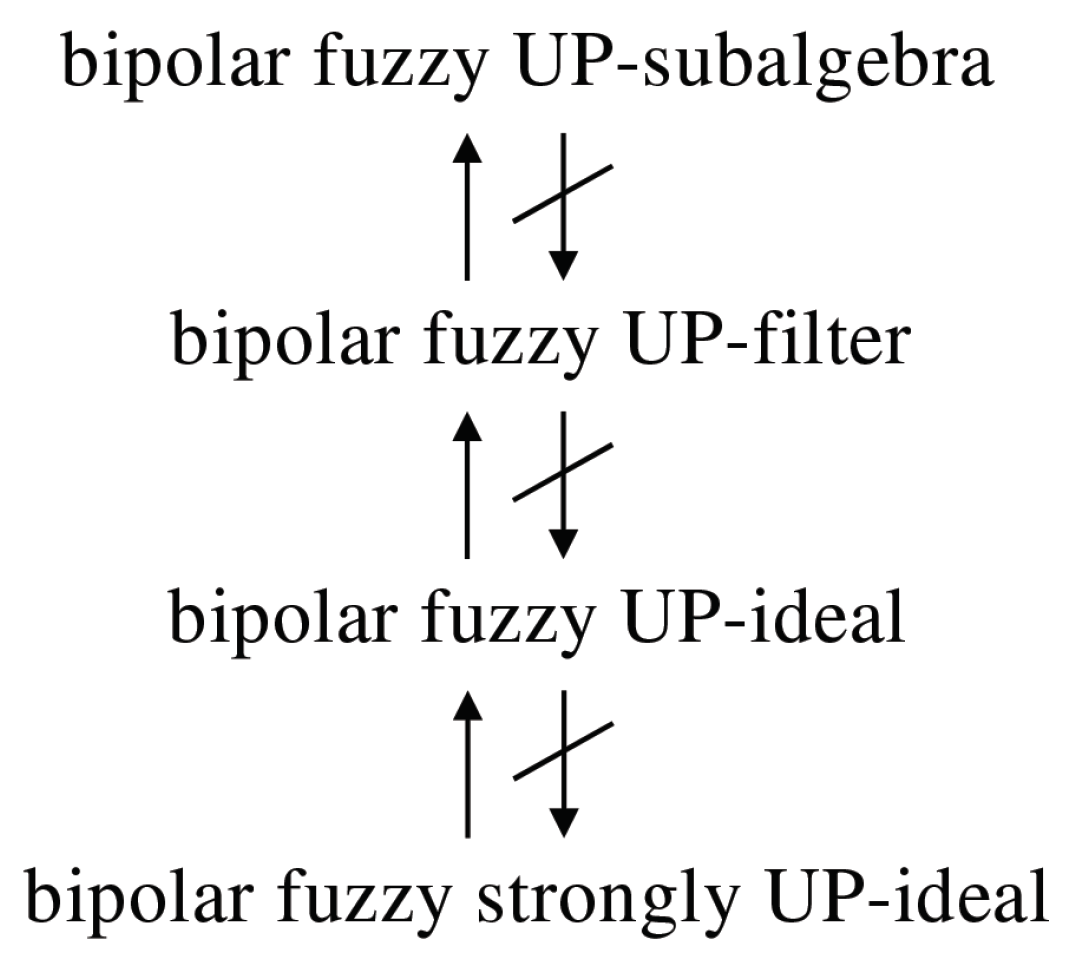
By Theorems 3–5 and Examples 6–8, we have that the notion of bipolar fuzzy UP-subalgebras is a generalization of bipolar fuzzy UP-filters, the notion of bipolar fuzzy UP-filters is a generalization of bipolar fuzzy UP-ideals, and the notion of bipolar fuzzy UP-ideals is a generalization of bipolar fuzzy strongly UP-ideals.
4. Level Cuts of a Bipolar Fuzzy Set
In this section, we discuss the relation between bipolar fuzzy UP-subalgebras (resp., bipolar fuzzy UP-filters, bipolar fuzzy UP-ideals, and bipolar fuzzy strongly UP-ideals) and their level cuts.
Definition 6.
Let be a bipolar fuzzy set in A. For , the sets
and
are called the negative lower -cut and the positive upper -cut of , respectively. The set
is called the -cut of . For any , we denote the set
is called the k-cut of .
Example 9.
From Example 8, we have , and .
Theorem 6.
Let be a bipolar fuzzy set in A. Then, is a bipolar fuzzy UP-subalgebra of A if and only if the following statements are valid:
- (1)
- for all is a UP-subalgebra of A if is nonempty, and
- (2)
- for all is a UP-subalgebra of A if is nonempty.
Proof.
Assume that is a bipolar fuzzy UP-subalgebra of A. Let be such that and let . Then, and . Since is a bipolar fuzzy UP-subalgebra of A, we have . Thus, . Hence, is a UP-subalgebra of A. Next, let be such that and let . Then, and . Since is a bipolar fuzzy UP-subalgebra of A, we have . Thus, . Hence, is a UP-subalgebra of A.
Conversely, assume that for all is a UP-subalgebra of A if is nonempty and for all is a UP-subalgebra of A if is nonempty. Let . Then, . Choose . Then, and , that is, . By assumption, we have is a UP-subalgebra of A. So, . Hence, . Next, let . Then, Choose . Then, and , that is, . By assumption, we have is a UP-subalgebra of A. So, . Hence, Therefore, is a bipolar fuzzy UP-subalgebra of A. □
Corollary 1.
If is a bipolar fuzzy UP-subalgebra of A, then, for all is a UP-subalgebra of A while is nonempty.
Proof.
It is straightforward by Theorems 1 and 6. □
Theorem 7.
Let be a bipolar fuzzy set in A. Then, is a bipolar fuzzy UP-filter of A if and only if the following statements are valid:
- (1)
- for all is a UP-filter of A if is nonempty, and
- (2)
- for all is a UP-filter of A if is nonempty.
Proof.
Assume that is a bipolar fuzzy UP-filter of A. Let be such that and let . Then, . Since is a bipolar fuzzy UP-filter of A, we have . Thus, . Next, let be such that and . Then, and . Since is a bipolar fuzzy UP-filter of A, we have
So, . Hence, is a UP-filter of A. Let be such that and let . Then, . Since is a bipolar fuzzy UP-filter of A, we have Thus, . Next, let be such that and . Then, and . Since is a bipolar fuzzy UP-filter of A, we have
So, . Hence, is a UP-filter of A.
Conversely, assume that for all is a UP-filter of A if is nonempty and for all is a UP-filter of A if is nonempty. Let . Then, . Choose . Then, , that is, . By assumption, we have is a UP-filter of A. So, . Hence, . Next, let . Then, . Choose . Then, and , that is, . By assumption, we have is a UP-filter of A. So, , Hence, . Let . Then, . Choose . Then, , that is, . By assumption, we have is a UP-filter of A. So, . Hence, . Next, let . Then, . Choose . Then, and , that is, . By assumption, we have is a UP-filter of A. So, . Hence, . Therefore, is a bipolar fuzzy UP-filter of A. □
Corollary 2.
If is a bipolar fuzzy UP-filter of A, Then, for all is a UP-filter of A while is nonempty.
Proof.
It is straightforward by Theorems 1 and 7. □
Theorem 8.
Let be a bipolar fuzzy set in A. Then, is a bipolar fuzzy UP-ideal of A if and only if the following statements are valid:
- (1)
- for all is a UP-ideal of A if is nonempty, and
- (2)
- for all is a UP-ideal of A if is nonempty.
Proof.
Assume that is a bipolar fuzzy UP-ideal of A. Let be such that and let . Then, . Since is a bipolar fuzzy UP-ideal of A, we have . Thus, . Next, let be such that and . Then, and . Since is a bipolar fuzzy UP-ideal of A, we have
So, . Hence, is a UP-ideal of A. Let be such that and let . Then, . Since is a bipolar fuzzy UP-ideal of A, we have . Thus, . Next, let be such that and . Then, and . Since is a bipolar fuzzy UP-ideal of A, we have
So, . Hence, is a UP-ideal of A.
Conversely, assume that for all is a UP-ideal of A if is nonempty and for all is a UP-ideal of A if is nonempty. Let . Then, . Choose . Then, , that is, . By assumption, we have is a UP-ideal of A. So, . Hence, . Next, let . Then, . Choose . Then, and , that is, . By assumption, we have is a UP-ideal of A. So, . Hence, . Let . Then, . Choose . Then, , that is, . By assumption, we have is a UP-ideal of A. So, . Hence, . Next, let . Then, . Choose . Then, and , that is, . By assumption, we have is a UP-ideal of A. So, . Hence, . Therefore, is a bipolar fuzzy UP-ideal of A. □
Corollary 3.
If is a bipolar fuzzy UP-ideal of A, Then, for all is a UP-ideal of A while is nonempty.
Proof.
It is straightforward by Theorems 1 and 8. □
Give an example of conflict that the converse of Corollary 2, 1, and 3 is not true.
Example 10.
Consider a UP-algebra with the following Cayley table:
Define a bipolar fuzzy set in A as follows:
Then, for all is a UP-subalgebra (resp., UP-filter, UP-ideal) of A while is nonempty. Indeed,
- (1)
- if ,
- (2)
- if , and
- (3)
- if .
However, φ is not a bipolar fuzzy UP-subalgebra of A. Indeed,
By Theorems 4 and 5, we have that φ is not a bipolar fuzzy UP-filter and a bipolar fuzzy UP-ideal of A.
Theorem 9.
Let be a bipolar fuzzy set in A. Then, is a bipolar fuzzy strongly UP-ideal of A if and only if the following statements are valid:
- (1)
- for all is a strongly UP-ideal of A if is nonempty, and
- (2)
- for all is a strongly UP-ideal of A if is nonempty.
Proof.
Assume that is a bipolar fuzzy strongly UP-ideal of A. Let be such that and let . Then, . Since is a bipolar fuzzy strongly UP-ideal of A, we have . Thus, . Next, let be such that and . Then, and . Since is a bipolar fuzzy strongly UP-ideal of A, we have
So, . Hence, is a strongly UP-ideal of A. Let be such that and let . Then, . Since is a bipolar fuzzy strongly UP-ideal of A, we have . Thus, . Next, let be such that and . Then, and . Since is a bipolar fuzzy strongly UP-ideal of A, we have
So, . Hence, is a strongly UP-ideal of A.
Conversely, assume that for all is a strongly UP-ideal of A if is nonempty and for all is a strongly UP-ideal of A if is nonempty. Let . Then, . Choose . Then, , that is, . By assumption, we have is a strongly UP-ideal of A. So, . Hence, . Next, let . Then, . Choose . Then, and , that is, . By assumption, we have is a strongly UP-ideal of A. So, . Hence, . Let . Then, . Choose . Then, , that is, . By assumption, we have is a strongly UP-ideal of A. So, . Hence, . Next, let . Then, . Choose . Then, and , that is, . By assumption, we have is a strongly UP-ideal of A. So, . Hence, . Therefore, is a bipolar fuzzy strongly UP-ideal of A. □
Corollary 4.
Let be a bipolar fuzzy set in A. Then, is a bipolar fuzzy strongly UP-ideal of A if and only if for all is a strongly UP-ideal of A while is nonempty.
Proof.
It is straightforward by Theorems 1, 9, and 2, and A is the only one strongly UP-ideal of itself. □
Theorem 10.
Let be a bipolar fuzzy UP-filter of A satisfies the following assertion:
Then, is a bipolar fuzzy UP-ideal of A.
Proof.
For all ,
and
and
and
Hence, is a bipolar fuzzy UP-ideal of A. □
Definition 7.
Let be a bipolar fuzzy set in A. We define a subset of A by
Theorem 11.
Let be a bipolar fuzzy UP-subalgebra of A. Then, is a UP-subalgebra of A.
Proof.
Clearly, . Let . Then, , and . Thus,
and
So, and , that is, . Therefore, is a UP-subalgebra of A. □
Theorem 12.
Let be a bipolar fuzzy UP-filter of A. Then, is a UP-filter of A.
Proof.
Clearly, . Let be such that and . Then, , and . Thus,
and
So, and , that is, . Therefore, is a UP-filter of A. □
Theorem 13.
Let be a bipolar fuzzy UP-ideal of A. Then, is a UP-ideal of A.
Proof.
Clearly, . Let be such that and . Then, , and . Thus,
and
So, and , that is, . Therefore, is a UP-ideal of A. □
Give an example of conflict that the converse of Theorems 11–13 is not true.
Example 11.
From Example 10, we have is a UP-subalgebra (resp., UP-filter, UP-ideal) of A but φ is not a bipolar fuzzy UP-subalgebra (resp., bipolar fuzzy UP-ideal, bipolar fuzzy UP-filter) of A.
Theorem 14.
Let be a bipolar fuzzy set in A. Then, is a bipolar fuzzy strongly UP-ideal of A if and only if is a strongly UP-ideal of A.
Proof.
It is straightforward by Theorem 2, and A is the only one strongly UP-ideal of itself. □
5. Conclusions and Future Work
In this paper, we have introduced the notions of bipolar fuzzy UP-subalgebras (resp., bipolar fuzzy UP-filters, bipolar fuzzy UP-ideals, and bipolar fuzzy strongly UP-ideals) of UP-algebras, proved their generalizations, and investigated some of their important properties. Then, we have the generalization diagram of bipolar-valued fuzzy sets in UP-algebras in Figure 1.
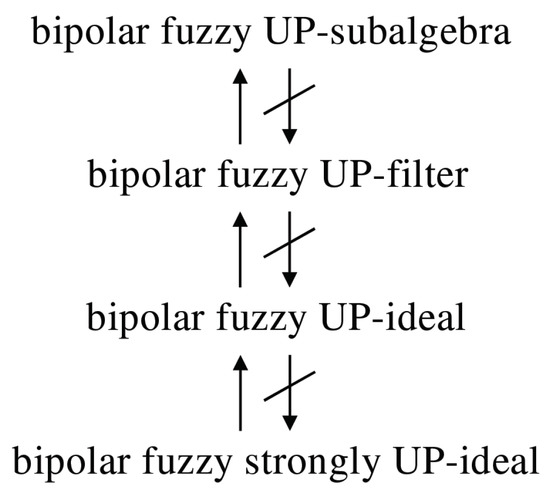
Figure 1.
Bipolar-valued fuzzy sets in UP-algebras.
In our future study of UP-algebras, the following objectives considered:
- To get more results in bipolar-valued fuzzy sets in UP-algebras.
- To define bipolar fuzzy translations in UP-algebras.
- To define operations of bipolar-valued fuzzy sets in UP-algebras.
- To define bipolar fuzzy soft sets over UP-algebras.
Author Contributions
Conceptualization, A.I.; Investigation, K.K., C.U. and A.I.; Writing—original draft, K.K., C.U. and A.I.; Writing—review & editing, A.I.
Acknowledgments
This work was financially supported by the University of Phayao.
Conflicts of Interest
The authors declare no conflict of interest.
References
- Imai, Y.; Iséki, K. On Axiom System of Propositional Calculi. XIV. Proc. Jpn. Acad. 1966, 42, 19–22. [Google Scholar] [CrossRef]
- Iséki, K. An Algebra Related with a Propositional Calculus. Proc. Jpn. Acad. 1966, 42, 26–29. [Google Scholar] [CrossRef]
- Hu, Q.P.; Li, X. On BCH-algebras. Math. Semin. Notes Kobe Univ. 1983, 11, 313–320. [Google Scholar]
- Prabpayak, C.; Leerawat, U. On ideals and congruences in KU-algebras. Sci. Magna 2009, 5, 54–57. [Google Scholar]
- Keawrahun, S.; Leerawat, U. On isomorphisms of SU-algebras. Sci. Magna 2011, 7, 39–44. [Google Scholar]
- Iampan, A. A new branch of the logical algebra: UP-algebras. J. Algebra Relat. Top. 2017, 5, 35–54. [Google Scholar]
- Somjanta, J.; Thuekaew, N.; Kumpeangkeaw, P.; Iampan, A. Fuzzy sets in UP-algebras. Ann. Fuzzy Math. Inform. 2016, 12, 739–756. [Google Scholar]
- Kesorn, B.; Maimun, K.; Ratbandan, W.; Iampan, A. Intuitionistic fuzzy sets in UP-algebras. Ital. J. Pure Appl. Math. 2015, 34, 339–364. [Google Scholar]
- Tanamoon, K.; Sripaeng, S.; Iampan, A. Q-fuzzy sets in UP-algebras. Songklanakarin J. Sci. Technol. 2018, 40, 9–29. [Google Scholar]
- Senapati, T.; Jun, Y.B.; Shum, K.P. Cubic set structure applied in UP-algebras. Discrete Math. Algorithms Appl. 2018, 10, 1850049. [Google Scholar] [CrossRef]
- Senapati, T.; Muhiuddin, G.; Shum, K.P. Representation of UP-algebras in interval-valued intuitionistic fuzzy environment. Ital. J. Pure Appl. Math. 2017, 38, 497–517. [Google Scholar]
- Zadeh, L.A. Fuzzy sets. Inf. Control 1965, 8, 338–353. [Google Scholar] [CrossRef]
- Senapati, T.; Shum, K.P. Atanassov’s intuitionistic fuzzy bi-normed KU-ideals of a KU-algebra. J. Intell. Fuzzy Syst. 2016, 30, 1169–1180. [Google Scholar] [CrossRef]
- Senapati, T.; Shum, K.P. Atanassov’s intuitionistic fuzzy bi-normed KU-subalgebras of a KU-algebra. Mo. J. Math. Sci. 2017, 29, 92–112. [Google Scholar]
- Mostafa, S.M.; Naby, M.A.A.; Elgendy, O.R. Interval-valued fuzzy KU-ideals in KU-algebras. Int. Math. Forum 2011, 6, 3151–3159. [Google Scholar]
- Hadipour, A.R.; Saeid, A.B. Vague BF-algebras. Bul. Acad. Ştiinţe Repub. Mold. Mat. 2010, 64, 11–22. [Google Scholar]
- Zhang, W.-R. Bipolar fuzzy sets and relations: A computational framework for cognitive modeling and multiagent decision analysis. Proc. IEEE Conf. 1994, 305–309. [Google Scholar] [CrossRef]
- Jun, Y.B.; Park, C.H. Filters of BCH-algebras based on bipolar-valued fuzzy sets. Int. Math. Forum 2009, 4, 631–643. [Google Scholar]
- Jun, Y.B.; Song, S.Z. Subalgebras and closed ideals of BCH-algebras based on bipolar-valued fuzzy sets. Sci. Math. Jpn. 2008, 68, 287–297. [Google Scholar]
- Akram, M. Bipolar fuzzy graphs. Inf. Sci. 2011, 181, 5548–5564. [Google Scholar] [CrossRef]
- Akram, M. Bipolar fuzzy soft lie algebras. Quasigroups Relat. Syst. 2013, 21, 1–10. [Google Scholar]
- Akram, M.; Saeid, A.B.; Shum, K.P.; Meng, B.L. Bipolar fuzzy K-algebras. Int. J. Fuzzy Syst. 2010, 10, 252–258. [Google Scholar]
- Muhiuddin, G. Bipolar fuzzy KU-subalgebras/ideals of KU-algebras. Ann. Fuzzy Math. Inform. 2014, 8, 409–418. [Google Scholar]
- Senapati, T. Bipolar fuzzy structure of BG-subalgebras. J. Fuzzy Math. 2015, 23, 209–220. [Google Scholar]
- Senapati, T. On bipolar fuzzy B-subalgebras of B-algebras. In Emerging Research on Applied Fuzzy Sets and Intuitionistic Fuzzy Matrices; IGI Publishing: Hershey, PA, USA, 2016. [Google Scholar]
- Iampan, A. Introducing fully UP-semigroups. Discuss. Math. Gen. Algebra Appl. 2018, 38, 297–306. [Google Scholar] [CrossRef]
- Guntasow, T.; Sajak, S.; Jomkham, A.; Iampan, A. Fuzzy translations of a fuzzy set in UP-algebras. J. Indones. Math. Soc. 2017, 23, 1–19. [Google Scholar]
© 2018 by the authors. Licensee MDPI, Basel, Switzerland. This article is an open access article distributed under the terms and conditions of the Creative Commons Attribution (CC BY) license (http://creativecommons.org/licenses/by/4.0/).