

You are currently viewing a new version of our website. To view the old version click .

Separations, Volume 6, Issue 4

December 2019 - 13 articles

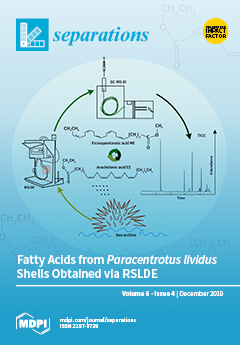
Cover Story: The fishing industry produces large amounts of wastes in fish markets and in processing industries, and part of these unwanted materials are sea urchins’ shells. It would be of interest for a broad audience to reuse shells as an example of circular economy. To this end, we show that convenient extractive techniques exist which are easy to be implemented on the base of automated devices and do not require special expertise. The presented strategy is capable of providing natural essential fatty acids and their esters to be used in a number of diverse industries (e.g. cosmetics, foods, pharmaceutical). View this paper.
  • Issues are regarded as officially published after their release is announced to the table of contents alert mailing list .
  • You may sign up for email alerts to receive table of contents of newly released issues.
  • PDF is the official format for papers published in both, html and pdf forms. To view the papers in pdf format, click on the "PDF Full-text" link, and use the free Adobe Reader to open them.

Articles (13)

  • Review
  • Open Access
99 Citations
14,580 Views
29 Pages

Metal–Organic Frameworks as Key Materials for Solid-Phase Microextraction Devices—A Review

  • Adrián Gutiérrez-Serpa,
  • Idaira Pacheco-Fernández,
  • Jorge Pasán and
  • Verónica Pino

Metal–organic frameworks (MOFs) have attracted recently considerable attention in analytical sample preparation, particularly when used as novel sorbent materials in solid-phase microextraction (SPME). MOFs are highly ordered porous crystalline struc...

  • Feature Paper
  • Article
  • Open Access
9 Citations
3,204 Views
11 Pages

In the present contribution, new-generation bar adsorptive microextraction devices combined with microliquid desorption, followed by high-performance liquid chromatography–diode array detection (BAµE-µLD/HPLC–DAD) are proposed...

  • Feature Paper
  • Article
  • Open Access
24 Citations
5,064 Views
16 Pages

In this study, we report the combination of comprehensive two-dimensional gas chromatography (GC×GC) with multivariate pattern recognition through template matching for the assignment of the contribution of Brazilian Ale 02 yeast strain to the...

of 2

Get Alerted

Add your email address to receive forthcoming issues of this journal.

XFacebookLinkedIn
Separations - ISSN 2297-8739