



Next Issue
Volume 16, May
Previous Issue
Volume 16, March


Eur. J. Investig. Health Psychol. Educ., Volume 16, Issue 4 (April 2026) – 10 articles
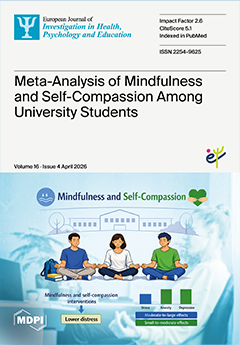
Cover Story (view full-size image): University students present elevated levels of psychological distress, including stress, anxiety, and depression. This meta-analysis synthesizes evidence from 49 studies (N = 5043) to evaluate the efficacy of mindfulness- and self-compassion-based interventions (MBSCIs). Findings indicate moderate-to-large effects for stress reduction and small-to-moderate effects for anxiety and depression at post-treatment. Meta-regression analyses show that changes in mindfulness and self-compassion significantly predict reductions in distress outcomes. However, no study was assessed with an overall low risk of bias; therefore, these results should be interpreted with caution and considered as preliminary evidence for MBSCIs as a feasible complementary approach within university mental health contexts. View this paper
  • Issues are regarded as officially published after their release is announced to the table of contents alert mailing list.
  • You may sign up for e-mail alerts to receive table of contents of newly released issues.
  • PDF is the official format for papers published in both, html and pdf forms. To view the papers in pdf format, click on the "PDF Full-text" link, and use the free Adobe Reader to open them.
Order results
Result details
Select all
Export citation of selected articles as:
16 pages, 1782 KB  
Study Protocol
Higher Education as a Driver for the Humanization of Pediatric Pain Care (HUPEDCARE): Protocol of a Multicenter Study
by Sagrario Gómez-Cantarino, Henrique Ciabotti Elias, Miriam Hermida-Mota, Pablo Pando Cerra, Deisa Salyse dos Reis Cabral Semedo, Ana Suzete Baessa Moniz, Sonsoles Hernández-Iglesias, Ana Maria Aguiar Frias, Tuğba Erdem, Maria da Conceição Fernandes Santiago, Inmaculada García-Valdivieso, Amelia Marina Morillas Bulnes, Jahit Sacarlal and Renata Karina Reis
Eur. J. Investig. Health Psychol. Educ. 2026, 16(4), 56; https://doi.org/10.3390/ejihpe16040056 - 20 Apr 2026
Viewed by 625
Abstract
Pediatric pain remains a highly prevalent and under-addressed health problem worldwide, largely due to educational gaps, limited humanization of care, and insufficient integration of digital and pedagogical innovations in higher education, and the purpose of this study is to describe and implement an [...] Read more.
Pediatric pain remains a highly prevalent and under-addressed health problem worldwide, largely due to educational gaps, limited humanization of care, and insufficient integration of digital and pedagogical innovations in higher education, and the purpose of this study is to describe and implement an international, higher education–driven model to improve training in humanized pediatric pain management. This multicenter mixed-methods study involves 15 universities from Europe, Africa, and Latin America and includes the development and cross-cultural validation of the HUPEDCARE-Q questionnaire to identify knowledge gaps, the design of an open-access, multilingual digital learning platform (PEDCARE) that integrates learning management and social networking functions, and the implementation of capacity-building workshops based on a training-the-trainers model for students, educators, health professionals, and families. The expected outcomes of the project include the establishment of a standardized instrument for assessing educational needs, the creation of a scalable digital educational environment, and the feasibility of international academic collaboration to strengthen competencies in pediatric pain care. The study suggests that higher education, combined with digital transformation and culturally sensitive approaches, may support the humanization of pediatric pain management and address educational and health inequities, although further research is needed to confirm these potential impacts. Full article
(This article belongs to the Collection Teaching Innovation in Higher Education: Areas of Knowledge)
Show Figures

Figure 1

23 pages, 723 KB  
Systematic Review
Training Teachers for Self-Regulated Learning: A Structured Narrative Review
by Lucía Poladura, Elena Blanco, Ellián Tuero, Celestino Rodríguez and José Carlos Núñez
Eur. J. Investig. Health Psychol. Educ. 2026, 16(4), 55; https://doi.org/10.3390/ejihpe16040055 - 20 Apr 2026
Viewed by 290
Abstract
This structured narrative review aimed to synthesize the findings of various studies to determine the efficacy of Self-Regulated Learning (SRL) training programs for in-service and pre-service teachers on their knowledge and skills, and to evaluate the transfer to teaching practice and student outcomes. [...] Read more.
This structured narrative review aimed to synthesize the findings of various studies to determine the efficacy of Self-Regulated Learning (SRL) training programs for in-service and pre-service teachers on their knowledge and skills, and to evaluate the transfer to teaching practice and student outcomes. Following PRISMA guidelines, a search was conducted across Web of Science, Scopus, and PsycInfo, ultimately including 30 intervention studies. The results confirmed that professional development is effective in enhancing teachers’ knowledge, skills, and beliefs related to SRL. However, due to wide methodological diversity, the review identified varied intervention factors showing promise, but a unified association between sample type (in-service vs. pre-service) and overall impact was unattainable. While SRL training successfully improves teacher competency, the limited evaluation of student performance or long-term effects prevents the definitive claim that the training reliably changes teaching practice toward a more self-regulated approach. Future research should prioritize robust longitudinal designs and include student-level measures. Full article
Show Figures

Figure 1

16 pages, 1294 KB  
Article
Mapping the Network Structure of Psychosocial Symptoms and School Well-Being Across Gender in Secondary School Students
by Philippos Zdoupas
Eur. J. Investig. Health Psychol. Educ. 2026, 16(4), 54; https://doi.org/10.3390/ejihpe16040054 - 16 Apr 2026
Viewed by 332
Abstract
Gender differences in the prevalence of psychosocial problems during adolescence are well established, with girls reporting higher internalizing symptoms and boys higher externalizing symptoms. However, it remains unclear whether these differences extend beyond symptom levels to the structural organization linking psychosocial problems and [...] Read more.
Gender differences in the prevalence of psychosocial problems during adolescence are well established, with girls reporting higher internalizing symptoms and boys higher externalizing symptoms. However, it remains unclear whether these differences extend beyond symptom levels to the structural organization linking psychosocial problems and school well-being (SWB). The present study examined gender-specific network structures comprising internalizing symptoms, externalizing symptoms, and six dimensions of SWB in a sample of 949 secondary school students in Germany (Grades 8–10; 50.6% boys, 49.4% girls). Partial correlation networks were estimated separately for boys and girls using EBIC-regularized graphical models, followed by network comparison tests and centrality analyses. Results indicated no significant differences in global strength, network structure, or individual edges between genders, suggesting a largely shared network structure. Across both networks, internalizing symptoms, particularly symptoms of anxiety and depression, emerged as central and bridging nodes connecting psychosocial problems with multiple dimensions of SWB. Externalizing symptoms showed minor descriptive differences in prominence but did not alter the overall structural pattern. These findings indicate that gender differences in adolescent mental health may reflect differences in symptom intensity rather than fundamentally distinct psychosocial systems, suggesting common structural patterns underlying SWB across gender. Full article
Show Figures

Figure 1

14 pages, 435 KB  
Article
The Moderating and Mediating Role of Psychological Resilience in the Relationship Between Borderline Personality Symptoms and Suicidal Ideation Among University Students
by Emadeldin M. Elsokkary, Abd elmureed Abd elgaber Kaseem and Abdulrahman Suliman Alnamlah
Eur. J. Investig. Health Psychol. Educ. 2026, 16(4), 53; https://doi.org/10.3390/ejihpe16040053 - 16 Apr 2026
Viewed by 465
Abstract
Objective: This study examined psychological resilience (PR) as a potential moderator and mediator of the association between borderline personality symptoms (BPS) and suicidal ideation (SI) among university students. Method: A cross-sectional design was used with (N = 257) university students. [...] Read more.
Objective: This study examined psychological resilience (PR) as a potential moderator and mediator of the association between borderline personality symptoms (BPS) and suicidal ideation (SI) among university students. Method: A cross-sectional design was used with (N = 257) university students. Moderation and mediation were tested in separate, theory-guided models using the PROCESS macro for SPSS, version 28. The moderation model (Model 1) and the mediation model (Model 4) were estimated with heteroskedasticity-consistent standard errors (HC3). In the adjusted analyses, sex, age, previous psychological consultation, previous psychotropic medication use, and family history of mental illness were entered as covariates. The indirect effect was evaluated using percentile bootstrap confidence intervals based on (5000) resamples. Results: BPS was positively correlated with SI, whereas PR was negatively correlated with both BPS and SI. In the adjusted moderation model, BPS was positively associated with SI (b = 0.118, p < 0.001) and PR was negatively associated with SI (b = −0.204, p = 0.048), but the interaction term was not significant (b = −0.001, p = 0.820) with negligible explained variance (ΔR2 = 0.0003). In the adjusted mediation model, BPS was significantly associated with lower PR (a: b = −0.135, p < 0.001), and PR was associated with lower SI while controlling for BPS and the covariates (b: b = −0.216, p = 0.028). The total effect of BPS on SI was significant (c: b = 0.146, p < 0.001), and the direct effect remained significant after including PR (c′: b = 0.117, p < 0.001). The indirect effect was significant (ab = 0.029; 95% bootstrap CI [0.005, 0.061]). Conclusions: Psychological resilience did not moderate the association between BPS and suicidal ideation, but it showed a statistically significant indirect association consistent with the proposed mediation model. Higher BPS were associated with lower resilience, which in turn was associated with higher suicidal ideation. These findings suggest that resilience-related targets may complement interventions addressing core BPS-related risk processes, while the cross-sectional design precludes causal conclusions. Full article
Show Figures

Figure 1

22 pages, 894 KB  
Article
A Moderated Mediation Model of AI-Driven Identity Threats and Employee Cyberloafing: The Role of AI-Inclusive Identity
by Alqa Ashraf, Qingfei Min and Aleena Ashraf
Eur. J. Investig. Health Psychol. Educ. 2026, 16(4), 52; https://doi.org/10.3390/ejihpe16040052 - 1 Apr 2026
Viewed by 1176
Abstract
This study intended to examine how human–AI collaboration-based identity threat appraisals in the form of the loss of autonomy and loss of skill trigger a professional identity that fosters cyberloafing. Based on social identity theory, this study applied a three-wave survey design with [...] Read more.
This study intended to examine how human–AI collaboration-based identity threat appraisals in the form of the loss of autonomy and loss of skill trigger a professional identity that fosters cyberloafing. Based on social identity theory, this study applied a three-wave survey design with 507 employees. The proposed research model was tested using partial least squares structural equation modeling (PLS-SEM) with SmartPLS 4, which enabled the assessment of both measurement and structural models. The perceived loss of skill and loss of autonomy are positively associated with professional identity threat, which mediates their relationships with cyberloafing. AI-inclusive identity weakens these associations for the loss of autonomy, suggesting that employees with strong AI-inclusive identity exhibit weaker professional identity threat. When integrating AI, organizations should mitigate appraisals of the loss of autonomy and loss of skill through participatory design, role redesign, and communication that emphasizes unique human contributions. Supporting healthy AI–human identity integration may reduce counterproductive behaviors such as cyberloafing. By positioning identity threat appraisals as human–AI collaboration-driven antecedents of professional identity threat and cyberloafing, this study extends social identity theory to human–AI contexts. It further demonstrates that over-identification with AI may heighten professional identity threats by diminishing the value of uniquely human contributions. Full article
(This article belongs to the Topic Personality and Cognition in Human–AI Interaction)
Show Figures

Figure 1

2 pages, 149 KB  
Editorial
Advancing Health Behavior Theories in Research and Practice
by Yifei Liu and Dhananjay Nayakankuppam
Eur. J. Investig. Health Psychol. Educ. 2026, 16(4), 51; https://doi.org/10.3390/ejihpe16040051 - 1 Apr 2026
Viewed by 362
Abstract
Understanding health behaviors is fundamental to designing effective health interventions [...] Full article
20 pages, 1091 KB  
Article
Emotional Contagion in the Workplace: A Moderated Mediation Model of Psychological Well-Being, Job Performance, and Turnover Intention in Hotels
by Alaa M. S. Azazz, Ibrahim A. Elshaer, Hemdan El-Shamy, Sameh Fayyad, Osman Elsawy and Abuelkassem A. A. Mohammad
Eur. J. Investig. Health Psychol. Educ. 2026, 16(4), 50; https://doi.org/10.3390/ejihpe16040050 - 31 Mar 2026
Viewed by 911
Abstract
The hotel industry is widely induced by emotional transactions between frontline employees and their guests leading to unintentional transfer of emotions, a phenomenon known as emotional contagion (EC). EC can result in positive or negative outcomes in the workplace influencing employees’ well-being and [...] Read more.
The hotel industry is widely induced by emotional transactions between frontline employees and their guests leading to unintentional transfer of emotions, a phenomenon known as emotional contagion (EC). EC can result in positive or negative outcomes in the workplace influencing employees’ well-being and performance. This research paper explored direct effects of emotional contagion (EC) on (H1) employees’ well-being (PW), (H2) job performance (JP), and (H3) turnover intention (IL). Based on the affective events theory (AET) and the social exchange theory (SET), employee’s psychological well-being was employed as a mediating factor (H6-H7) and leader–member exchange (LMX) as a moderator variable that might alleviate the adverse consequences of EC (H8). Cross-sectional survey data were collected online from 792 frontline employees. The proposed model was evaluated with partial least squares structural equation modeling (PLS-SEM). The findings revealed that EC can significantly weaken PW, which accordingly decreases JP and increases IL. Nonetheless, strong levels of LMX can alleviate these harmful influences, emphasizing the main significant role of LMX in regulating emotional dynamics in the service workplace. This study expands our understanding of how emotional mechanisms and LMX practices can adjust employee resilience, retention, and performance in the context of high-emotion service. Full article
Show Figures

Figure 1

18 pages, 710 KB  
Article
Mental Health in Spanish Veterinarians: Emotional Exhaustion, Affective Symptomatology, and Suicidal Ideation
by Sergio Guntín, Santiago López-Roel, Manuel Isorna and Francisca Fariña
Eur. J. Investig. Health Psychol. Educ. 2026, 16(4), 49; https://doi.org/10.3390/ejihpe16040049 - 31 Mar 2026
Viewed by 587
Abstract
The mental health of veterinary professionals has become an increasing concern due to the high levels of psychological distress and suicide risk reported in this profession. The present study examined the association between emotional exhaustion and suicidal ideation, considering the mediating role of [...] Read more.
The mental health of veterinary professionals has become an increasing concern due to the high levels of psychological distress and suicide risk reported in this profession. The present study examined the association between emotional exhaustion and suicidal ideation, considering the mediating role of depressive, anxiety, and stress symptoms. A total of 216 Spanish veterinary professionals completed standardized questionnaires assessing emotional exhaustion, affective symptoms, and suicidal ideation. The results revealed a high prevalence of emotional exhaustion, with more than half of the participants reporting high or very high levels. In addition, a considerable proportion of the sample reported experiencing at least one indicator of suicidal ideation during the previous year. Emotional exhaustion was associated with higher levels of depression, anxiety, and stress. However, the mediation analysis indicated that only depressive symptoms explained the relationship between emotional exhaustion and suicidal ideation, whereas anxiety and stress did not show a significant mediating effect. Overall, the model accounted for a substantial proportion of the variance in suicidal ideation. These findings highlight the central role of depression in the link between emotional exhaustion and suicidal ideation, underscoring the need for early detection and prevention of depressive symptoms in veterinary professionals. Full article
Show Figures

Figure 1

24 pages, 729 KB  
Article
The Role of Worry and Emotional Intelligence in Depression in a Non-Clinical and Subclinical Sample
by Maria Rita Sergi, Aristide Saggino, Michela Balsamo, Leonardo Carlucci, Michela Terrei and Marco Tommasi
Eur. J. Investig. Health Psychol. Educ. 2026, 16(4), 48; https://doi.org/10.3390/ejihpe16040048 - 28 Mar 2026
Viewed by 618
Abstract
Background: Recent data show that approximately 3.8% of the global population has a diagnosis of depression. Understanding psychological risk and protective factors is crucial for improving prevention strategies and mental health interventions. Among these, worry and emotional intelligence (EI) have emerged as relevant, [...] Read more.
Background: Recent data show that approximately 3.8% of the global population has a diagnosis of depression. Understanding psychological risk and protective factors is crucial for improving prevention strategies and mental health interventions. Among these, worry and emotional intelligence (EI) have emerged as relevant, yet they are rarely studied together. To date, no studies that analyzed the relationship between emotional intelligence, worry, and depression have been found. Therefore, this study aims to investigate the association among EI, worry, and depression. Methods: This study included 924 participants (N = 806 non-clinical and N = 118 subclinical sample with elevated depressive symptoms), with a mean age of M = 25.55 years (SD = 11.38). A total of 118 participants (12.8%) met the criteria for clinical depression based on the BDI-II cut-off. All participants completed the Penn State Worry Questionnaire, the Beck Depression Inventory-II, and the Emotional Intelligence Scale. To examine the relationships among all variables examined, zero-order correlation coefficients were calculated. To investigate the predictive power of EI and worry on depression, Bayesian linear regression was conducted. Results: The results showed significant and positive correlations between worry and depression in both samples. EI showed significant and negative correlations with both depression and worry in both the subclinical sample with elevated depressive symptoms and the non-clinical sample. Finally, worry emerged as the strongest contributor to the somatic dimension of depression in both groups. In the subclinical sample with elevated depressive symptoms, age and Evaluation and Expression of Emotion to Self, along with worry, were the best predictors of somatic symptoms. Conclusions: Our data suggest that higher worry levels are associated with higher levels of depressive symptoms, whereas higher EI was negatively associated with depressive symptoms and may play a potential buffering role. Training programs designed to enhance EI could help mitigate the impact of negative events, improve problem-solving skills, and enhance the expression of one’s own emotions. Full article
Show Figures

Figure 1

30 pages, 2656 KB  
Systematic Review
A Meta-Analysis Examining the Efficacy and Predictors of Change in Mindfulness- and Self-Compassion-Based Interventions (MBSCIs) in Reducing Psychological Distress Among University Students
by Cristina Galino Buen, David Martínez-Rubio, Lorena González-García, Alexandra-Elena Marin, Mª Dolores Vara and Carlos López-Pinar
Eur. J. Investig. Health Psychol. Educ. 2026, 16(4), 47; https://doi.org/10.3390/ejihpe16040047 - 27 Mar 2026
Viewed by 2563
Abstract
Introduction: University students are vulnerable to psychological distress due to the academic and social demands of this life stage. Mindfulness and self-compassion are effective and adaptable strategies in an academic environment that promote emotional regulation and psychological well-being. This study aims to [...] Read more.
Introduction: University students are vulnerable to psychological distress due to the academic and social demands of this life stage. Mindfulness and self-compassion are effective and adaptable strategies in an academic environment that promote emotional regulation and psychological well-being. This study aims to conduct a systematic review and meta-analysis to evaluate the combined impact of mindfulness- and self-compassion-based interventions (MBSCIs) on psychological distress. It will also analyze their role as predictors of therapeutic change, as well as the moderating influence of sociodemographic and contextual factors. Method: We systematically searched PubMed, Scopus and Web of Science for randomized controlled trials (RCTs) and single-group pre-post trials investigating the effect of MBSCI on anxiety, depression and stress in college students. Studies were combined using the inverse variance method in a random effects model. Additional subgroup and meta-regression analyses were performed, and risk of bias was assessed. The review was pre-registered (PROSPERO registration number: CRD420251003822). Results: Our review included 49 studies with a total of 5043 participants (3721 in the intervention group, and 1322 in the control group). The results provide relevant evidence on the efficacy of MBSCI in the university population, especially in reducing symptoms of stress, anxiety, and depression. The effect sizes observed were moderate-to-large for stress and small-to-moderate for anxiety and depression, supporting their clinical usefulness in university educational settings. However, these findings should be interpreted with caution, as no included study achieved low risk of bias, and heterogeneity was moderate-to-high across most outcomes. Conclusions: The results suggest that MBSCI could alleviate psychological distress in university students. However, these results are limited by some methodological issues (risk of bias, heterogeneity, lack of follow-ups, poor standardization). It would be advisable to integrate these practices into the university curriculum as workshops or complementary activities. Further studies are needed to confirm their effectiveness and explore sustained effects and differences according to individual characteristics. Full article
Show Figures

Figure 1

Previous Issue
Next Issue
Back to TopTop
