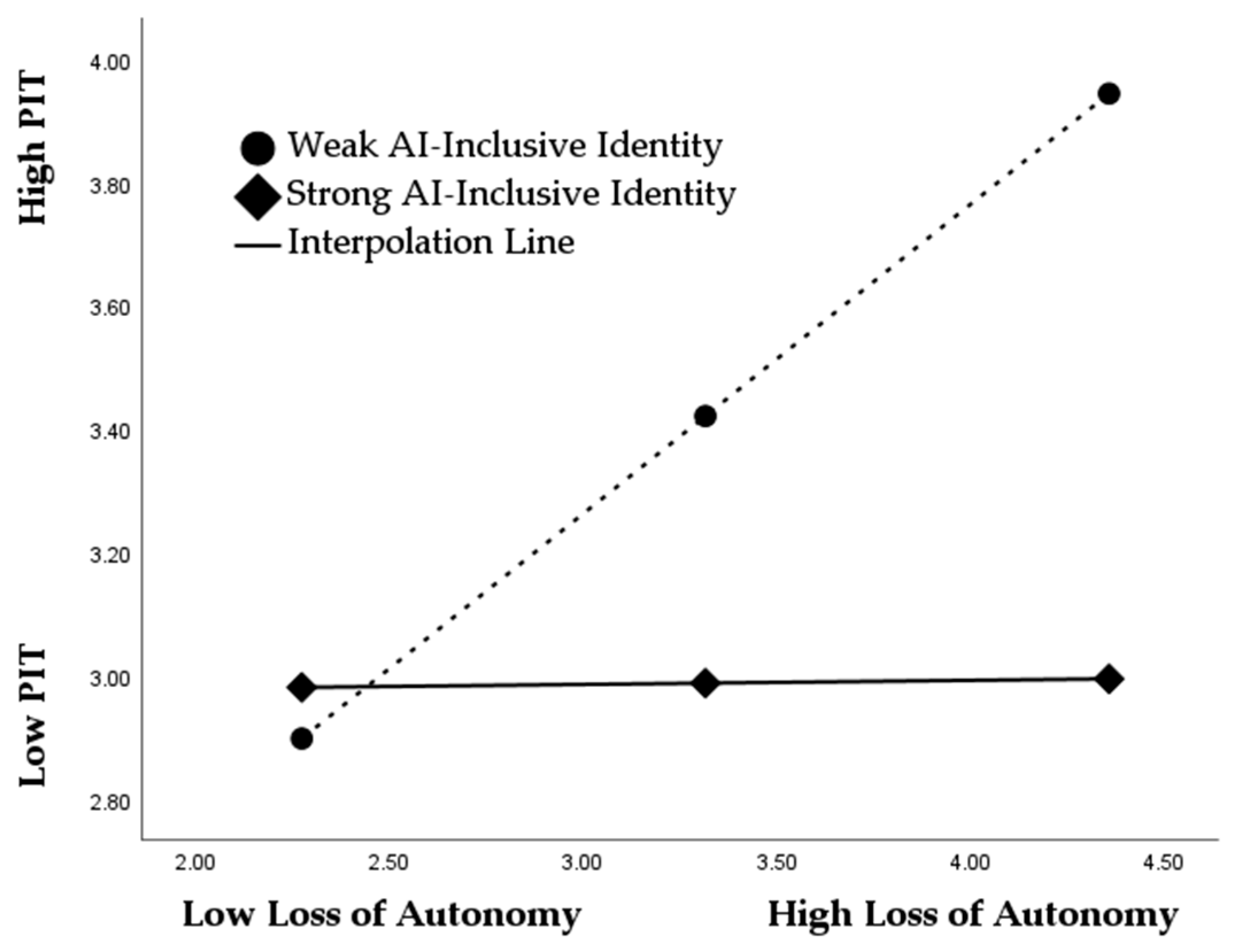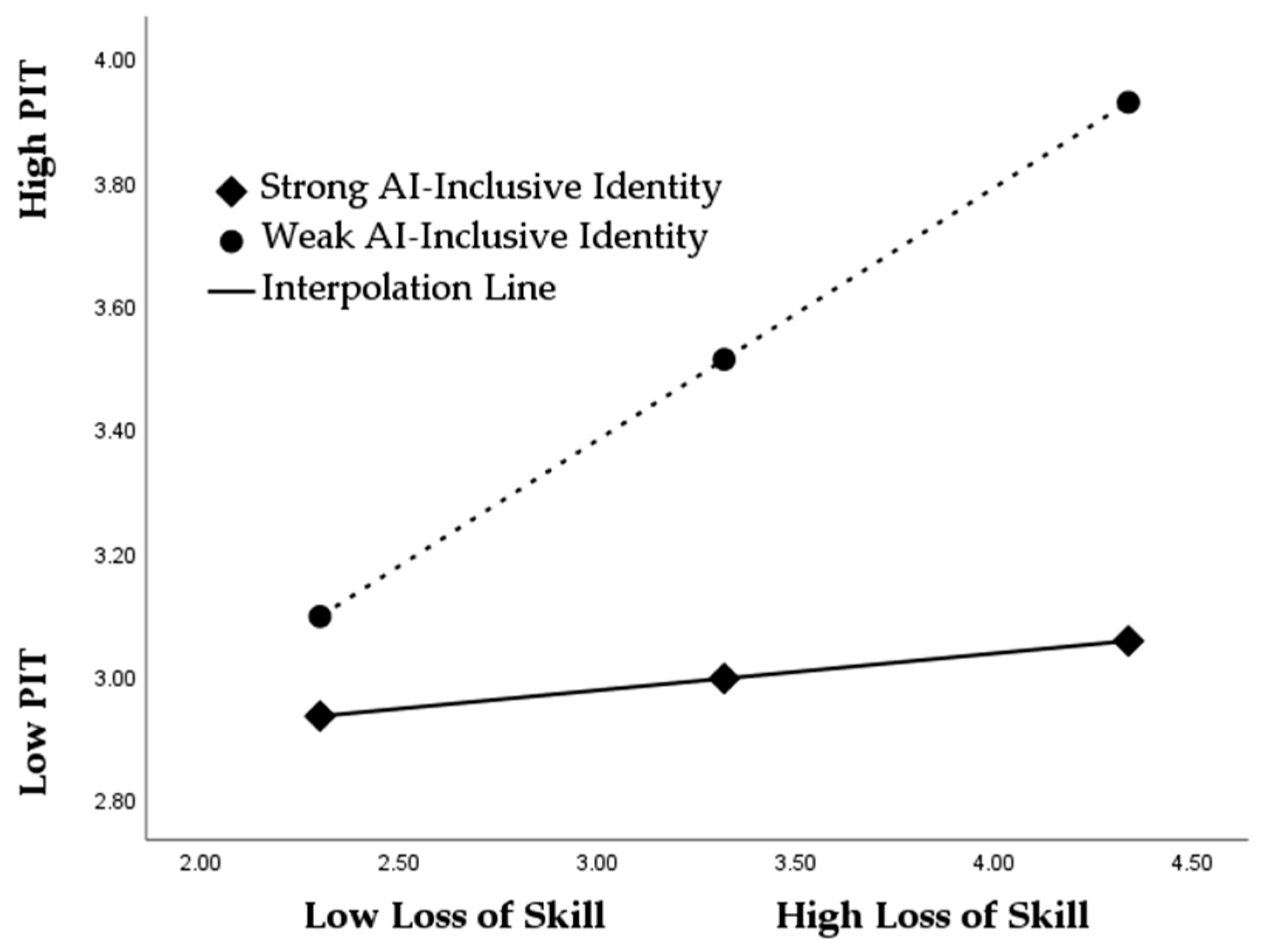

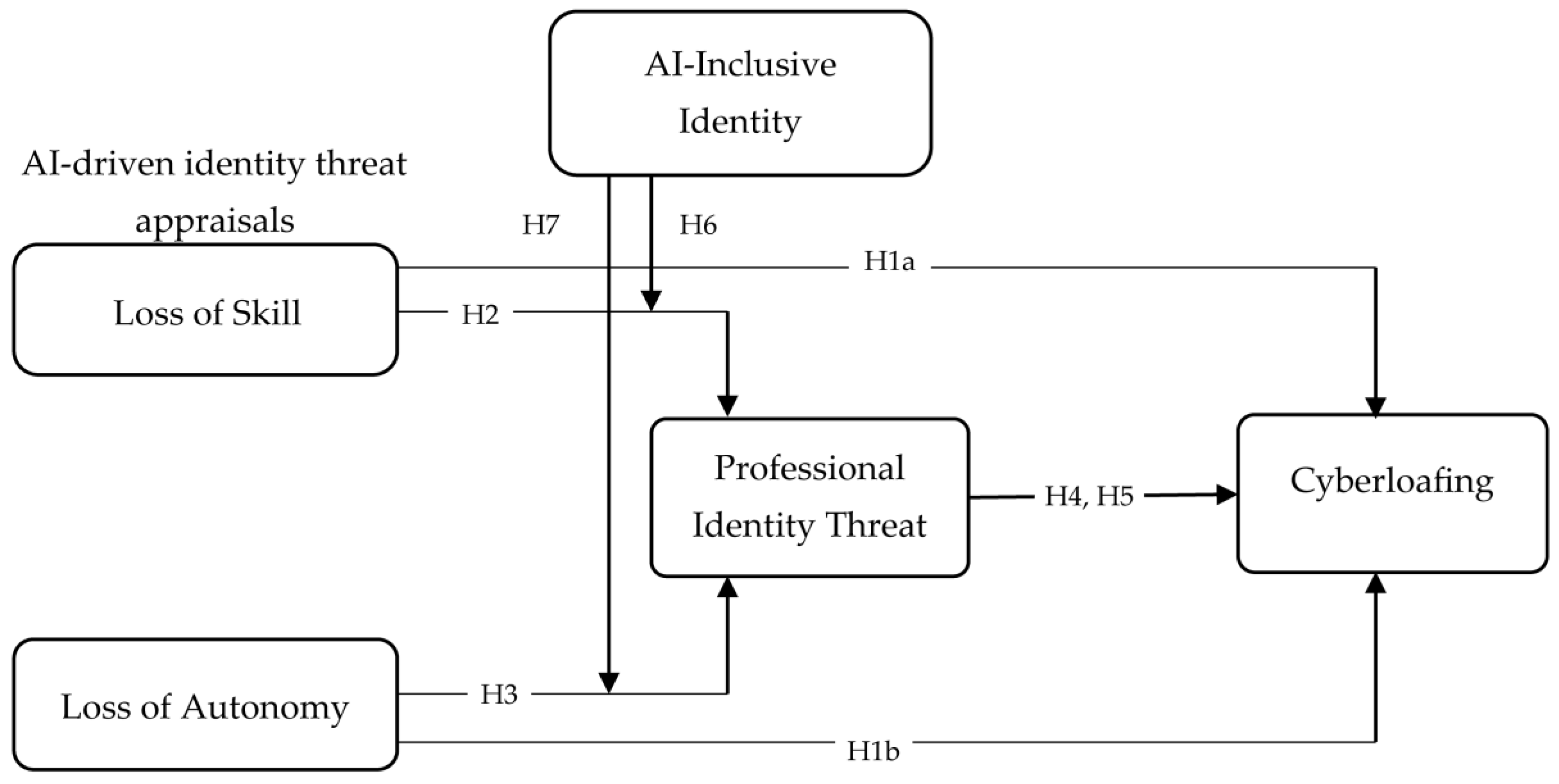
A Moderated Mediation Model of AI-Driven Identity Threats and Employee Cyberloafing: The Role of AI-Inclusive Identity

Abstract
1. Introduction
2. Theorical Foundation and Hypotheses
2.1. Social Identity Theory in the Era of AI
2.2. Development of Hypotheses
2.2.1. AI-Driven Identity Threat Appraisals and Cyberloafing
2.2.2. Mediating Role of Professional Identity Threat
2.2.3. The Moderating Role of AI-Inclusive Identity
3. Materials and Methods
3.1. Participants and Design
3.2. Measurement Scale
4. Results
4.1. Common Method Bias
4.2. Confirmatory Factor Analysis
4.3. Measurement Model Validation
4.4. Discriminant Validity (DV)
4.5. Descriptives and Correlation Coefficients
4.6. Testing of Hypotheses
4.6.1. Main Effects
4.6.2. Mediation Effects
4.6.3. Moderation Effects
4.6.4. Moderated Mediation Effects
5. Discussion
5.1. Theoretical Contributions
5.2. Practical Contributions
5.3. Limitations and Future Research Agenda
Author Contributions
Funding
Institutional Review Board Statement
Informed Consent Statement
Data Availability Statement
Acknowledgments
Conflicts of Interest
References
- Alfrey, K.-L. R., Waters, K. M., Condie, M., & Rebar, A. L. (2023). The role of identity in human behavior research: A systematic scoping review. Identity, 23(3), 208–223. [Google Scholar] [CrossRef]
- Andel, S. A., Kessler, S. R., Pindek, S., Kleinman, G., & Spector, P. E. (2019). Is cyberloafing more complex than we originally thought? Cyberloafing as a coping response to workplace aggression exposure. Computers in Human Behavior, 101, 124–130. [Google Scholar] [CrossRef]
- Ashforth, B. E., & Mael, F. (1989). Social identity theory and the organization. The Academy of Management Review, 14, 20. [Google Scholar] [CrossRef]
- Ashforth, B. E., & Schinoff, B. S. (2016). Identity under construction: How individuals come to define themselves in organizations. Annual Review of Organizational Psychology and Organizational Behavior, 3, 111–137. [Google Scholar] [CrossRef]
- Askew, K., Buckner, J. E., Taing, M. U., Ilie, A., Bauer, J. A., & Coovert, M. D. (2014). Explaining cyberloafing: The role of the theory of planned behavior. Computers in Human Behavior, 36, 510–519. [Google Scholar] [CrossRef]
- Bai, S., & Zhang, X. (2025). My coworker is a robot: The impact of collaboration with AI on employees’ impression management concerns and organizational citizenship behavior. International Journal of Hospitality Management, 128, 104179. [Google Scholar] [CrossRef]
- Barley, S. R., Bechky, B. A., & Milliken, F. J. (2017). The changing nature of work: Careers, identities, and work lives in the 21st century. Academy of Management Discoveries, 3(2), 111–115. [Google Scholar] [CrossRef]
- Breakwell, G. M. (1986). Coping with threatened identities. Routledge. [Google Scholar]
- Breaugh, J. A. (1985). The measurement of work autonomy. Human Relations, 38, 551–570. [Google Scholar] [CrossRef]
- Brynjolfsson, E., & McAfee, A. (2014). The second machine age: Work, progress, and prosperity in a time of brilliant technologies (1st ed.). W. W. Norton & Company. [Google Scholar]
- Budhwar, P., Malik, A., De Silva, M. T. T., & Thevisuthan, P. (2022). Artificial intelligence—Challenges and opportunities for international HRM: A review and research agenda. The International Journal of Human Resource Management, 33, 1065–1097. [Google Scholar] [CrossRef]
- Carter, M., & Grover, V. (2015). Me, my self, and I(T): Conceptualizing information technology identity and its implications. MIS Quarterly, 39, 931–957. [Google Scholar] [CrossRef]
- Cohen, J. (2013). Statistical power analysis for the behavioral sciences. Routledge. [Google Scholar] [CrossRef]
- Craig, K., Thatcher, J. B., & Grover, V. (2019). The IT identity threat: A conceptual definition and operational measure. Journal of Management Information Systems, 36, 259–288. [Google Scholar] [CrossRef]
- Davenport, T. H., Ronanki, R., Wheaton, J., & Nguyen, A. (2018). Feature artificial intelligence for the real world 108. Harvard Business Review, 96(1), 108–116. [Google Scholar]
- Deci, E. L., & Ryan, R. M. (2000). The “what” and “why” of goal pursuits: Human needs and the self-determination of behavior. Psychological Inquiry, 11, 227–268. [Google Scholar] [CrossRef]
- Dell’Acqua, F., McFowland, E., Mollick, E., Lifshitz-Assaf, H., Kellogg, K., Rajendran, S., Krayer, L., Candelon, F., & Lakhani, K. (2023). Navigating the jagged technological frontier: Field experimental evidence of the effects of AI on knowledge worker productivity and quality (Harvard Business School Working Paper). Harvard Business School. [Google Scholar]
- Derks, D., van Duin, D., Tims, M., & Bakker, A. B. (2015). Smartphone use and work–home interference: The moderating role of social norms and employee work engagement. Journal of Occupational and Organizational Psychology, 88(1), 155–177. [Google Scholar] [CrossRef]
- Duan, W.-Y., Wu, T.-J., Wei, A.-P., & Huang, Y.-T. (2024). Reducing the adverse effects of compulsory citizenship behaviour on employee innovative behaviour via AI usage in China. Asia Pacific Business Review, 1–21. [Google Scholar] [CrossRef]
- Echegu, D. A. (2024). Artificial intelligence (AI) in customer service: Revolutionising support and engagement. IAA Journal of Scientific Research, 11, 33–39. [Google Scholar] [CrossRef]
- Ellemers, N., Spears, R., & Doosje, B. (2002). Self and social identity. Annual Review of Psychology, 53, 161–186. [Google Scholar] [CrossRef]
- Faraj, S., Pachidi, S., & Sayegh, K. (2018). Working and organizing in the age of the learning algorithm. Information and Organization, 28(1), 62–70. [Google Scholar] [CrossRef]
- Fornell, C., & Larcker, D. F. (1981). Evaluating structural equation models with unobservable variables and measurement error. Journal of Marketing Research, 18(1), 39–50. [Google Scholar] [CrossRef]
- Freeburg, D., & Klein, K. (2025). Workplace technology as a threat to worker identity: Evidence from public libraries. Journal of Librarianship and Information Science. [Google Scholar] [CrossRef]
- Freidson, E. (2001). Professionalism, the third logic: On the practice of knowledge. University of Chicago Press. [Google Scholar]
- Gupta, M., Mehta, N. K. K., Agarwal, U. A., & Jawahar, I. M. (2025). The mediating role of psychological capital in the relationship between LMX and cyberloafing. Leadership & Organization Development Journal, 46, 85–101. [Google Scholar] [CrossRef]
- Hair, J., Hult, G. T. M., Ringle, C., & Sarstedt, M. (2016). A primer on partial least squares structural equation modeling. SAGE Publications, Inc. [Google Scholar]
- Hair, J. F., Hult, G. T. M., Ringle, C. M., & Sarstedt, M. (2017). A primer on partial least squares structural equation modeling (PLS-SEM) (2nd ed.). Sage. [Google Scholar]
- Henseler, J., Ringle, C. M., & Sarstedt, M. (2015). A new criterion for assessing discriminant validity in variance-based structural equation modeling. Journal of the Academy of Marketing Science, 43, 115–135. [Google Scholar] [CrossRef]
- Hessari, H., Daneshmandi, F., Busch, P., & Smith, S. (2025). Mitigating cyberloafing through employee adaptability: The roles of temporal leadership, teamwork attitudes and competitive work environment. Asia-Pacific Journal of Business Administration, 17, 303–336. [Google Scholar] [CrossRef]
- Hobfoll, S. E. (1989). Conservation of resources: A new attempt at conceptualizing stress. American Psychologist, 44(3), 513–524. [Google Scholar] [CrossRef] [PubMed]
- Hobfoll, S. E., Halbesleben, J., Neveu, J.-P., & Westman, M. (2018). Conservation of resources in the organizational context: The reality of resources and their consequences. Annual Review of Organizational Psychology and Organizational Behavior, 5, 103–128. [Google Scholar] [CrossRef]
- Ibarra, H. (1999). Provisional selves: Experimenting with image and identity in professional adaptation. Administrative Science Quarterly, 44, 764–791. [Google Scholar] [CrossRef]
- Jarrahi, M. H. (2018). Artificial intelligence and the future of work: Human-AI symbiosis in organizational decision making. Business Horizons, 61(4), 577–586. [Google Scholar] [CrossRef]
- Jia, N., Luo, X., Fang, Z., & Liao, C. (2024). When and how artificial intelligence augments employee creativity. Academy of Management Journal, 67(1), 5–32. [Google Scholar] [CrossRef]
- Jiang, F., Jiang, Y., Zhi, H., Dong, Y., Li, H., Ma, S., Wang, Y., Dong, Q., Shen, H., & Wang, Y. (2017). Artificial intelligence in healthcare: Past, present and future. Stroke and Vascular Neurology. [Google Scholar] [CrossRef] [PubMed]
- Jussupow, E., Spohrer, K., Dibbern, J., & Heinzl, A. (2018, June 23–28). AI changes who we are—Doesn’t IT? Intelligent decision support and physicians’ professional identiy. European Conference on Information Systems, Portsmouth, UK. [Google Scholar]
- Kellogg, K. C., Valentine, M. A., & Christin, A. (2020). Algorithms at work: The new contested terrain of control. Academy of Management Annals, 14(1), 366–410. [Google Scholar] [CrossRef]
- Kim, H.-W., & Kankanhalli, A. (2009). Investigating user resistance to information systems implementation: A status quo bias perspective. MIS Quarterly, 33(3), 567–582. [Google Scholar] [CrossRef]
- Koay, K. Y., & Soh, P. C.-H. (2018). Should cyberloafing be allowed? The role of recovery and work engagement. Computers in Human Behavior, 81, 209–217. [Google Scholar] [CrossRef]
- Kock, N. (2015). Common method bias in PLS-SEM: A full collinearity assessment approach. International Journal of e-Collaboration, 11(4), 1–10. [Google Scholar] [CrossRef]
- Kong, H., Yin, Z., Baruch, Y., & Yuan, Y. (2023). The impact of trust in AI on career sustainability: The role of employee—AI collaboration and protean career orientation. Journal of Vocational Behavior, 146, 103928. [Google Scholar] [CrossRef]
- Lapointe, L., & Rivard, S. (2005). A multilevel model of resistance to information technology implementation. MIS Quarterly, 29(3), 461–491. [Google Scholar] [CrossRef]
- Lazarus, R., & Folkman, S. (1984). Stress, appraisal, and coping. Springer. [Google Scholar]
- Liang, Y., Wu, T.-J., & Lin, W. (2024). Exploring the impact of forced teleworking on counterproductive work behavior: The role of event strength and work-family conflict. Internet Research, 36(1), 53–77. [Google Scholar] [CrossRef]
- Lim, V. K. G. (2002). The IT way of loafing on the job: Cyberloafing, neutralizing, and organizational justice. Journal of Organizational Behavior, 23(5), 675–694. [Google Scholar] [CrossRef]
- Lim, V. K. G., & Chen, D. J. Q. (2012). Cyberloafing at the workplace: Gain or drain on work? Behaviour & Information Technology, 31(4), 343–353. [Google Scholar] [CrossRef]
- Lim, V. K. G., & Teo, T. S. H. (2005). Prevalence, perceived seriousness, justification and regulation of cyberloafing in Singapore. Information & Management, 42, 1081–1093. [Google Scholar] [CrossRef]
- Little, T. D., Cunningham, W. A., Shahar, G., & Widaman, K. F. (2002). To parcel or not to parcel: Exploring the question, weighing the merits. Structural Equation Modeling: A Multidisciplinary Journal, 9(2), 151–173. [Google Scholar] [CrossRef]
- Liu, Q., & Geertshuis, S. (2019). Professional identity and the adoption of learning management systems. Studies in Higher Education, 46, 624–637. [Google Scholar] [CrossRef]
- Lu, X., Wang, Y., Chen, X., & Lu, Q. (2024). From stress to screen: Understanding cyberloafing through cognitive and affective pathways. Behavioral Sciences, 14(3), 249. [Google Scholar] [CrossRef] [PubMed] [PubMed Central]
- Ma, K., Zhang, Y., & Hui, B. (2024). How does AI affect college? The impact of AI usage in college teaching on students’ innovative behavior and well-being. Behavioral Sciences, 14, 1223. [Google Scholar] [CrossRef]
- Meijerink, J., & Bondarouk, T. (2023). The duality of algorithmic management: Toward a research agenda on HRM algorithms, autonomy and value creation. Human Resource Management Review, 33(1), 100876. [Google Scholar] [CrossRef]
- Meng, Q., Wu, T.-J., Duan, W., & Li, S. (2025). Effects of employee–artificial intelligence (AI) collaboration on counterproductive work behaviors (CWBs): Leader emotional support as a moderator. Behavioral Sciences, 15, 696. [Google Scholar] [CrossRef]
- Mirbabaie, M., Brünker, F., Möllmann Frick, N. R. J., & Stieglitz, S. (2022). The rise of artificial intelligence—Understanding the AI identity threat at the workplace. Electronic Markets, 32, 73–99. [Google Scholar] [CrossRef]
- Möhlmann, M., & Zalmanson, L. (2017, December 10–13). Hands on the wheel: Navigating algorithmic management and Uber drivers’ autonomy. International Conference on Information Systems (ICIS), Seoul, Republic of Korea. [Google Scholar]
- Möhlmann, M., Zalmanson, L., Henfridsson, O., & Gregory, R. W. (2021). Algorithmic management of work on online labor platforms: When matching meets control. MIS Quarterly, 45, 1999–2022. [Google Scholar] [CrossRef]
- Parent-Rocheleau, X., & Parker, S. K. (2022). Algorithms as work designers: How algorithmic management influences autonomy, control, and performance. Academy of Management Review, 47(4), 647–676. [Google Scholar]
- Parker, S. K., & Grote, G. (2022). Automation, algorithms, and beyond: Why work design matters more than ever in a Digital world. Applied Psychology, 71, 1171–1204. [Google Scholar] [CrossRef]
- Petriglieri, J. L. (2011). Under threat: Responses to and the consequences of threats to individuals’ identities. Academy of Management Review, 36, 641–662. [Google Scholar]
- Pindek, S., Spector, P. E., & Salgado, J. F. (2018). The interactive effects of workload and organization-based self-esteem on counterproductive work behaviors. Journal of Applied Psychology, 103(1), 47–61. [Google Scholar] [CrossRef]
- Podsakoff, P. M., MacKenzie, S. B., Lee, J.-Y., & Podsakoff, N. P. (2003). Common method biases in behavioral research: A critical review of the literature and recommended remedies. Journal of Applied Psychology, 88, 879–903. [Google Scholar] [CrossRef]
- Pratt, M. G., Rockmann, K. W., & Kaufmann, J. B. (2006). Constructing professional identity: The role of work and identity work in the negotiation of professional selves. Academy of Management Journal, 49(4), 235–262. [Google Scholar] [CrossRef]
- Ragu-Nathan, T. S., Tarafdar, M., Ragu-Nathan, B. S., & Tu, Q. (2008). The consequences of technostress for end users in organizations: Conceptual development and empirical validation. Information Systems Research, 19(4), 417–433. [Google Scholar] [CrossRef]
- Raisch, S., & Krakowski, S. (2021). Artificial intelligence and management: The automation–augmentation paradox. The Academy of Management Review, 46(1), 192–210. [Google Scholar] [CrossRef]
- Ringle, C. M., Sarstedt, M., Mitchell, R., & Gudergan, S. P. (2020). Partial least squares structural equation modeling in HRM research. The International Journal of Human Resource Management, 31(12), 1617–1643. [Google Scholar] [CrossRef]
- Rosenblat, A., & Stark, L. (2016). Algorithmic labor and information asymmetries: A case study of Uber’s drivers. International Journal of Communication, 10, 3758–3784. [Google Scholar]
- Saluja, S., Sinha, S., & Goel, S. (2024). Loafing in the era of generative AI. Organizational Dynamics, 54, 101101. [Google Scholar] [CrossRef]
- Schlund, R., & Zitek, E. M. (2024). Algorithmic versus human surveillance leads to lower perceptions of autonomy and increased resistance. Communications Psychology, 2(1), 53. [Google Scholar] [CrossRef]
- Schwarz, A., Rizzuto, T., Carraher-Wolverton, C., Roldán, J. L., & Barrera-Barrera, R. (2017). Examining the impact and detection of the “urban legend” of common method bias. ACM SIGMIS Database: The DATABASE for Advances in Information Systems, 48, 93–119. [Google Scholar] [CrossRef]
- Seeber, I., Bittner, E., Briggs, R. O., de Vreede, T., de Vreede, G.-J., Elkins, A., Maier, R., Merz, A. B., Oeste-Reiß, S., Randrup, N., Schwabe, G., & Söllner, M. (2020). Machines as teammates: A research agenda on AI in team collaboration. Information & Management, 57, 103174. [Google Scholar] [CrossRef]
- Shneiderman, B. (2022). Human-centered AI: A guide for responsible design. Oxford University Press. [Google Scholar]
- Swann, W. B., Gómez, Á., Dovidio, J. F., Hart, S., & Jetten, J. (2010). Dying and killing for one’s group. Psychological Science, 21, 1176–1183. [Google Scholar] [CrossRef]
- Tarafdar, M., Cooper, C. L., & Stich, J.-F. (2019). The technostress trifecta: Techno-eustress, techno-distress, and design. Information Systems Journal, 29(1), 6–42. [Google Scholar] [CrossRef]
- Tsai, H.-Y. (2023). Do you feel like being proactive day? How daily cyberloafing influences creativity and proactive behavior: The moderating roles of work environment. Computers in Human Behavior, 138, 107470. [Google Scholar] [CrossRef]
- Varghese, L., & Barber, L. K. (2017). A preliminary study exploring moderating effects of role stressors on the relationship between Big Five personality traits and workplace cyberloafing. Cyberpsychology: Journal of Psychosocial Research on Cyberspace, 11(4), 4. [Google Scholar] [CrossRef]
- Verhoef, P. C., Broekhuizen, T., Bart, Y., Bhattacharya, A., Dong, J. Q., Fabian, N., & Haenlein, M. (2021). Digital transformation: A multidisciplinary reflection and research agenda. Journal of Business Research, 122, 889–901. [Google Scholar] [CrossRef]
- Vial, G. (2019). Understanding digital transformation: A review and a research agenda. MIS Quarterly, 43(1), 223–257. [Google Scholar] [CrossRef]
- von Hippel, C., Kühner, C., Coundouris, S. P., Lim, A., Henry, J. D., & Zacher, H. (2024). Stereotype threat at work: A meta-analysis. Personality and Social Psychology Bulletin, 13, 1461672241297884. [Google Scholar] [CrossRef]
- Wu, T.-J., Liang, Y., & Wang, Y. (2024). The buffering role of workplace mindfulness: How job insecurity of human-artificial intelligence collaboration impacts employees’ work–life-related outcomes. Journal of Business and Psychology, 39, 1395–1411. [Google Scholar] [CrossRef]
- Yan, B., & Teng, Y. (2025). The double-edged sword effect of artificial intelligence awareness on organisational citizenship behaviour: A study based on knowledge workers. Behaviour & Information Technology, 1–17. [Google Scholar] [CrossRef]
- Zhang, Q., Liao, G., Ran, X., & Wang, F. (2025). The impact of AI usage on innovation behavior at work: The moderating role of openness and job complexity. Behavioral Sciences, 15, 491. [Google Scholar] [CrossRef] [PubMed]
- Zhang, S., Zhao, X., Zhou, T., & Kim, J. H. (2024). Do you have AI dependency? The roles of academic self-efficacy, academic stress, and performance expectations on problematic AI usage behavior. International Journal of Educational Technology in Higher Education, 21, 34. [Google Scholar] [CrossRef]



| Theoretical Lens | Typical Explanatory Path (Simplified) | Implications | Limitation | References |
|---|---|---|---|---|
| COR/resource depletion | Stressor → resource loss/exhaustion → cyberloafing | Cyberloafing as response to depletion; mediating role of emotional exhaustion | Treats tech/AI changes as generic stressors; does not theorize identity-relevant meaning | Hobfoll (1989); Hobfoll et al. (2018); Lim and Teo (2005); Koay and Soh (2018); Lu et al. (2024) |
| Coping/avoidance framing | Stressor → negative affect → avoidant coping (cyberloafing) | Cyberloafing as short-term psychological escape | Often underspecifies what is threatened (tasks vs professional self) | Lazarus and Folkman (1984); Lim and Chen (2012); Koay and Soh (2018); S. Zhang et al. (2024) |
| Algorithmic management/surveillance and control | Algorithmic monitoring → lower autonomy → resistance/worse outcomes | Establishes autonomy loss as core experience under algorithmic systems | Does not explain why autonomy loss becomes professional identity threat nor why it yields specific coping behavior | Kellogg et al. (2020); Möhlmann and Zalmanson (2017); Rosenblat and Stark (2016); Parent-Rocheleau and Parker (2022) |
| Digital transformation | Skill obsolescence viewed as threat appraisal → identity threat | Identifies AI-induced appraisals that cause identity threat | Lacks linking identity threat to any responsive behavior or outcome | (Mirbabaie et al., 2022) |
| Digital transformation resistance (threat-based) | Digital tech viewed as threat → resistance/negative emotions | Catalogs “threat perceptions” in digital transformation; acknowledges emotion | Often broad (job security/resources); limited micro-mechanism specifying professional identity threat from skill/autonomy losses | Lapointe and Rivard (2005); Kim and Kankanhalli (2009); Vial (2019); Verhoef et al. (2021) |
| Identity threat/SIT-based mechanism | Skill loss + autonomy loss (appraisals) → professional identity threat → coping (cyberloafing) | Explains why tech change is existentially threatening; predicts both strain and self-protective coping behaviors | Needs to incorporate other digital variations and integration with the cyberloafing literature | This study |
| Demographics | Items | Frequency | Percentage |
|---|---|---|---|
| Gender | Male | 230 | 45.5% |
| Female | 277 | 54.6% | |
| Age | Below 30 | 238 | 46.9% |
| 31–40 | 167 | 32.9% | |
| 41–50 | 58 | 11.4% | |
| Above 50 | 44 | 8.7% | |
| Years of employment | 1–3 | 25 | 4.9% |
| 4–6 | 125 | 24.7% | |
| 7–9 | 110 | 21.7% | |
| 10–12 | 137 | 27.0% | |
| More than 10 years | 110 | 21.7% |
| Models | χ2 | df | RMSEA | SRMR | CFI | TLI | IFI |
|---|---|---|---|---|---|---|---|
| five-factor model LA, LS, PIT, CF, AID | 1270.803 | 314 | 0.078 | 0.077 | 0.901 | 0.899 | 0.869 |
| four-factor model LA + LS, PIT, CF, AID | 1683.168 | 318 | 0.092 | 0.101 | 0.817 | 0.798 | 0.818 |
| three-factor model LA + LS, PIT + CF, AID | 2384.989 | 321 | 0.113 | 0.132 | 0.724 | 0.698 | 0.725 |
| two-factor model LA + LS + PIT + CF, AID | 2794.948 | 323 | 0.123 | 0.138 | 0.669 | 0.641 | 0.671 |
| one-factor model LA + LS + PIT + CF + AID | 3582.612 | 324 | 0.141 | 0.159 | 0.564 | 0.528 | 0.566 |
| Construct | Items | Loadings | α | CR | AVE |
|---|---|---|---|---|---|
| Professional identity threat (PIT) | TR1 | 0.831 | 0.885 | 0.916 | 0.686 |
| TR2 | 0.820 | ||||
| TR3 | 0.824 | ||||
| TR4 | 0.845 | ||||
| TR5 | 0.820 | ||||
| TC1 | 0.809 | 0.917 | 0.934 | 0.667 | |
| TC2 | 0.806 | ||||
| TC3 | 0.822 | ||||
| TC4 | 0.819 | ||||
| TC5 | 0.820 | ||||
| TC6 | 0.822 | ||||
| TC7 | 0.822 | ||||
| Loss of skill (LS) | LS1 | 0.877 | 0.848 | 0.908 | 0.767 |
| LS2 | 0.865 | ||||
| LS3 | 0.885 | ||||
| Loss of autonomy (LA) | LA1 | 0.861 | 0.833 | 0.900 | 0.750 |
| LA2 | 0.858 | ||||
| LA3 | 0.879 | ||||
| AI-inclusive identity (AID) | AID1 | 0.842 | 0.881 | 0.913 | 0.677 |
| AID2 | 0.838 | ||||
| AID3 | 0.828 | ||||
| AID4 | 0.823 | ||||
| AID5 | 0.827 | ||||
| Cyberloafing | CF1 | 0.810 | 0.866 | 0.909 | 0.714 |
| CF2 | 0.855 | ||||
| CF3 | 0.860 | ||||
| CF4 | 0.853 |
| AID | LS | PIT | CF | LS | |
|---|---|---|---|---|---|
| AID | 0.823 | ||||
| LA | −0.417 | 0.866 | |||
| PIT | −0.458 | 0.508 | 0.848 | ||
| CF | −0.317 | 0.461 | 0.486 | 0.845 | |
| LS | −0.351 | 0.432 | 0.437 | 0.404 | 0.876 |
| AID | LA | PIT | CF | LS | |
|---|---|---|---|---|---|
| AID | |||||
| LA | 0.486 | ||||
| PIT | 0.623 | 0.711 | |||
| CF | 0.364 | 0.540 | 0.667 | ||
| LS | 0.406 | 0.513 | 0.607 | 0.470 |
| Mean | Std. Deviation | LS | LA | AID | CF | PIT | |
|---|---|---|---|---|---|---|---|
| LS | 3.3176 | 1.018 | 1 | −0.041 | 0.090 | 0.403 *** | 0.439 *** |
| LA | 3.3149 | 1.040 | 1 | 0.141 | 0.459 *** | 0.503 *** | |
| AID | 3.3925 | 0.984 | 1 | −0.166 * | 0.107 * | ||
| CF | 3.3555 | 0.971 | 1 | −0.483 *** | |||
| PIT | 3.3128 | 0.822 | 1 |
| Model 1 | Model 2 | |||||
|---|---|---|---|---|---|---|
| DV:Cyberloafing | DV:PIT | DV:Cyberloafing | ||||
| Variables | β | t-Value | β | t-Value | β | t-Value |
| Control variables | ||||||
| Gender | 0.074 | 0.912 | 0.021 | 0.275 | 0.068 | 0.865 |
| Age | −0.027 | 0.263 | 0.119 | 1.206 | −0.062 | 0.679 |
| Tenure (years) | 0.064 | 0.649 | 0.088 | 0.918 | 0.040 | 0.429 |
| Independent variables | ||||||
| Loss of autonomy | 0.340 *** | 7.795 | 0.326 *** | 7.960 | 0.245 *** | 5.263 |
| Loss of skill | 0.246 *** | 5.849 | 0.231 *** | 5.758 | 0.179 *** | 4.231 |
| Mediator | ||||||
| PIT | 0.289 *** | 6.216 | ||||
| R2 | 0.268 | 0.348 | 0.321 | |||
| Paths | β | Boot SE | t | p | 95% CI |
|---|---|---|---|---|---|
| LA → PIT → CF | 0.187 | 0.026 | 7.139 | 0.000 | [0.138, 0.242] |
| LS → PIT → CF | 0.132 | 0.022 | 5.917 | 0.000 | [0.090, 0.178] |
| DV:PIT | ||
|---|---|---|
| Variables | β | t-Value |
| Control variables | ||
| Gender | 0.000 | 0.023 |
| Age | 0.089 | 0.955 |
| Tenure (years) | 0.038 | 0.414 |
| Independent variables | ||
| Loss of autonomy | 0.240 *** | 5.576 |
| Loss of skill | 0.144 *** | 3.484 |
| Moderator | ||
| AI-inclusive identity | 0.101 | 1.368 |
| Interaction term | ||
| Loss of autonomy × AI-inclusive identity | −0.227 *** | 6.530 |
| Loss of skill × AI-inclusive identity | −0.153 * | 2.464 |
| R2 | 0.448 | |
| Pathway | AI-Inclusive Identity | β | Boot SE | t-Value | p-Value | 95% Bootstrap CI |
|---|---|---|---|---|---|---|
| LA → PIT → CF | Low (−1 SD) | 0.243 | 0.036 | 6.828 | 0.000 | [0.177, 0.316] |
| Mean | 0.128 | 0.024 | 5.246 | 0.000 | [0.084, 0.179] | |
| High (+1 SD) | 0.013 | 0.024 | 0.550 | 0.583 | [−0.032, 0.064] | |
| LS→ PIT → CF | Low (−1 SD) | 0.103 | 0.030 | 3.470 | 0.001 | [0.049, 0.164] |
| Mean | 0.078 | 0.021 | 3.683 | 0.000 | [0.039, 0.122] | |
| High (+1 SD) | 0.052 | 0.025 | 2.109 | 0.035 | [0.006, 0.103] |
Disclaimer/Publisher’s Note: The statements, opinions and data contained in all publications are solely those of the individual author(s) and contributor(s) and not of MDPI and/or the editor(s). MDPI and/or the editor(s) disclaim responsibility for any injury to people or property resulting from any ideas, methods, instructions or products referred to in the content. |
© 2026 by the authors. Published by MDPI on behalf of the University Association of Education and Psychology. Licensee MDPI, Basel, Switzerland. This article is an open access article distributed under the terms and conditions of the Creative Commons Attribution (CC BY) license.
Share and Cite
Ashraf, A.; Min, Q.; Ashraf, A. A Moderated Mediation Model of AI-Driven Identity Threats and Employee Cyberloafing: The Role of AI-Inclusive Identity. Eur. J. Investig. Health Psychol. Educ. 2026, 16, 52. https://doi.org/10.3390/ejihpe16040052
Ashraf A, Min Q, Ashraf A. A Moderated Mediation Model of AI-Driven Identity Threats and Employee Cyberloafing: The Role of AI-Inclusive Identity. European Journal of Investigation in Health, Psychology and Education. 2026; 16(4):52. https://doi.org/10.3390/ejihpe16040052
Chicago/Turabian StyleAshraf, Alqa, Qingfei Min, and Aleena Ashraf. 2026. "A Moderated Mediation Model of AI-Driven Identity Threats and Employee Cyberloafing: The Role of AI-Inclusive Identity" European Journal of Investigation in Health, Psychology and Education 16, no. 4: 52. https://doi.org/10.3390/ejihpe16040052
APA StyleAshraf, A., Min, Q., & Ashraf, A. (2026). A Moderated Mediation Model of AI-Driven Identity Threats and Employee Cyberloafing: The Role of AI-Inclusive Identity. European Journal of Investigation in Health, Psychology and Education, 16(4), 52. https://doi.org/10.3390/ejihpe16040052