Abstract
The extensive use of digital media among adolescents has raised concerns about its impact on emotional development and mental health. Understanding the psychological factors behind problematic digital media use is essential for effective prevention. This study examined whether the relationships between emotion regulation (negative and positive), compulsive use, cognitive preoccupation, and negative outcomes linked to digital media are consistent across sex and academic year. We used a cross-sectional design with 2357 adolescents (12–16 years old) from Compulsory Secondary Education. Participants completed validated self-report questionnaires assessing problematic digital media use, and associated consequences in four domains: internet, video games, social networking, and messaging. Four structural equation models (SEMs), each focused on a media type, tested whether these relationships remained stable across sex and academic year. All models showed good fit, and differences between groups were minimal, supporting valid comparisons. Results confirm that emotion regulation difficulties and problematic digital media use are consistently associated with negative outcomes in all adolescents, regardless of sex or academic level. Preventive strategies targeting emotional regulation and digital media behaviors may be broadly applied to reduce emotional and functional problems related to excessive media use.
1. Introduction
The rapid growth of digital media, such as video games, internet browsing, social networking, and messaging, has raised concerns about their negative impact on mental health and social adjustment. Excessive use of smartphones and digital media among adolescents and young adults is linked to health issues, including depression, anxiety, sleep disturbances, and reduced cognitive functioning (Wacks & Weinstein, 2021). Recent systematic reviews suggest that around 25% of children and adolescents display problematic smartphone behaviors similar to behavioral addictions, strongly associated with mood and sleep disorders (Rega et al., 2023).
A key factor behind these harmful patterns is difficulty in emotion regulation. Individuals who struggle to manage negative emotions frequently use digital media to cope, increasing their risk of problematic usage (Gioia et al., 2021). Neuropsychiatric studies also show that impaired cognitive emotion regulation mediates the relationship between internet-use disorders and psychosocial issues (Pettorruso et al., 2020). In young people, insecure parental attachments and maladaptive emotion regulation strategies increase vulnerability to problematic internet use (Olmeda-Muelas et al., 2024).
Beyond general internet and smartphone addiction, problematic social media use correlates with narcissistic traits and low self-esteem. This suggests that social networks uniquely reinforce maladaptive emotional and self-regulatory behaviors (Andreassen et al., 2017). Meta-analytic studies highlight a bidirectional relationship between loneliness and problematic internet behaviors, illustrating the complex link between emotional well-being and digital media habits (Zhang et al., 2024).
To understand these relationships, structural equation models (SEMs) have linked dimensions of emotion regulation (negative and positive), indicators of problematic use (compulsive use, cognitive preoccupation), and negative outcomes. For valid demographic comparisons, SEMs must demonstrate measurement invariance. This means ensuring the latent constructs and their relationships are stable and comparable across different groups (Chen, 2007).
In this study, we extend previous research by testing the measurement invariance of integrative SEMs across sex (male vs. female) and academic year (first to fourth year) for four types of digital media: video games, internet browsing, social networking, and messaging. Establishing measurement invariance is crucial to confirm that differences in digital media use and related outcomes across demographic groups reflect genuine variations, not measurement artifacts. Confirming invariance enables meaningful comparisons of emotional regulation, problematic usage patterns, and negative consequences among adolescents.
2. Materials and Methods
2.1. Participants
The sample consisted of 2357 adolescents enrolled in Compulsory Secondary Education (ESO) from the Autonomous Community of Madrid. Participants were recruited from 29 private and state-subsidized schools. Of the participants, 1087 were female (mean age = 13.71, SD = 2.62) and 1270 were male (mean age = 13.70, SD = 1.77). Distribution by academic year was: first year, 720 students (30.5%); second year, 694 students (29.4%); third year, 515 students (21.8%); and fourth year, 428 students (18.2%) (Table 1). Notably, given the narrow age range and the shared developmental stage of the participants, academic year was used as the grouping variable instead of chronological age, as it offers a more ecologically valid framework for examining peer-group influences and digital media use patterns.
Table 1.
Distribution of participants across academic years by sex and age. Values are presented as number of participants with percentages in parentheses for each subgroup. Age is expressed as mean and standard deviation (M ± SD). Percentages may not add up to exactly 100% due to rounding.
2.2. Instruments
Problematic digital media use was assessed using the Questionnaire of Maladaptive Behavior toward ICT (Pérez-Wiesner et al., 2024). This instrument includes 14 items rated on a six-point Likert scale (1 = strongly disagree, 6 = strongly agree) and evaluates four subscales: positive mood regulation (α = 0.83), negative emotion regulation (α = 0.73), compulsive use (α = 0.76), and cognitive preoccupation (α = 0.72). Each subscale is composed of a different number of items: four for positive mood regulation (score range: 4–24), three for negative emotion regulation (score range: 3–18), three for compulsive use (score range: 3–18), and four for cognitive preoccupation (score range: 4–24). Examples of items include: “When I am really happy, I use the internet to communicate it” (positive mood regulation), “When I feel bad, I use the Internet to feel better” (negative emotion regulation), “I find it difficult to control my Internet use” (compulsive use), and “I often worry about connecting to the Internet” (cognitive preoccupation). Negative outcomes related to digital media use were measured using the Questionnaire on Negative Consequences of ICT (Pérez et al., 2014). This questionnaire assesses four domains of digital media activity: internet browsing, video games, social networking, and messaging. Each subscale includes seven items, resulting in a total of 28 items, all rated on the same six-point Likert scale. Cronbach’s alpha values were 0.77 for internet browsing, 0.86 for video games, 0.87 for social networking, and 0.89 for messaging. Each subscale has a minimum possible score of 7 and a maximum of 42. Examples of items include: “I spend my time browsing the internet when I should be doing other things” (internet browsing), “I have lost hours of sleep because of video games” (video games), “I have tried unsuccessfully to reduce the amount of time I spend using social media” (social networking), and “My academic or social activity is affected because I spend too much time on WhatsApp, SMS, etc.” (messaging). The instructions provided for each subscale include clarifications to distinguish between domains that may overlap in practice. For example, the section on social networking specifies platforms such as Facebook, TikTok, Instagram, and YouTube, while the messaging subscale refers explicitly to tools like WhatsApp, Messenger, Line, or SMS.
The construction of this second questionnaire was based on the main groups of diagnostic criteria from the DSM-5 for substance use disorder, including risky use, impaired control, social impairment, and withdrawal. These criteria were adapted to assess negative consequences in each digital activity domain, allowing for a nuanced understanding of problematic use depending on the specific online context, and were informed by a review of instruments previously published or adapted in Spain (Labrador et al., 2013).
2.3. Procedure
We initially contacted 31 schools in Madrid (Spain); 29 agreed to participate. Before data collection, parents’ associations and school guidance departments were informed about the study’s aims, the questionnaires, and participant anonymity. Signed informed consent was obtained from parents, and assent from the adolescents. Participants completed questionnaires anonymously using tablets during regular class hours under teacher supervision throughout the 2022–2023 academic year. The study was approved by the Ethics Committee of Complutense University of Madrid.
2.4. Data Analysis
We conducted analyses using SPSS (Version 29) and R (Version 4.x) with the lavaan package for SEMs and semPlot for path diagrams. We managed missing item-level data (less than 3% per scale) using full information maximum likelihood (FIML). Model parameters were estimated using robust maximum likelihood (MLR) to account for non-normality.
For each digital media domain (internet, video games, social networking, messaging), we specified a structural equation model (SEM). Each SEM included four latent predictors (negative emotion regulation, positive emotion regulation, compulsive use, cognitive preoccupation) regressed on a single latent outcome (negative consequences). Covariances among predictors were freely estimated.
Measurement invariance was tested via multigroup analyses across sex (male vs. female) and academic year (first to fourth). We tested three nested models sequentially:
(a) Configural invariance: no constraints on loadings or intercepts. (b) Metric invariance: factor loadings constrained equal. And (c) Scalar invariance: intercepts are additionally constrained to be equal.
Model fit was assessed using the χ2 statistic, Comparative Fit Index (CFI), Tucker–Lewis Index (TLI), Root Mean Square Error of Approximation (RMSEA), and Standardized Root Mean Square Residual (SRMR). Accepted thresholds were CFI/TLI ≥ 0.95, RMSEA ≤ 0.06, and SRMR ≤ 0.08. We considered incremental fit changes (ΔCFI ≤ 0.01; ΔRMSEA ≤ 0.015; ΔSRMR ≤ 0.03) more important than χ2 differences due to sample size sensitivity. All statistical procedures complied with the transparency and reproducibility guidelines of the European Journal of Investigation in Health, Psychology and Education.
3. Results
First, we performed descriptive analyses to examine the central tendency and dispersion of the study variables, as well as their associations. Table 2 presents the means and standard deviations for each dimension of problematic digital media use and the reported negative consequences across the four digital media domains. Table 3 also displays the Pearson correlation matrix between these variables, revealing statistically significant and positive associations throughout. Among the dimensions, positive mood regulation showed the strongest correlations with the different media domains.
Table 2.
Descriptive statistics of test scores.
Table 3.
Pearson’s correlation matrix between the study variables.
We conducted analyses of variance (ANOVA) to examine differences in digital media use across academic years and between sexes. For each digital media domain (internet browsing, video games, social networking, and messaging), a separate two-way ANOVA was performed, with academic year and sex as between-subject factors.
3.1. Internet Use
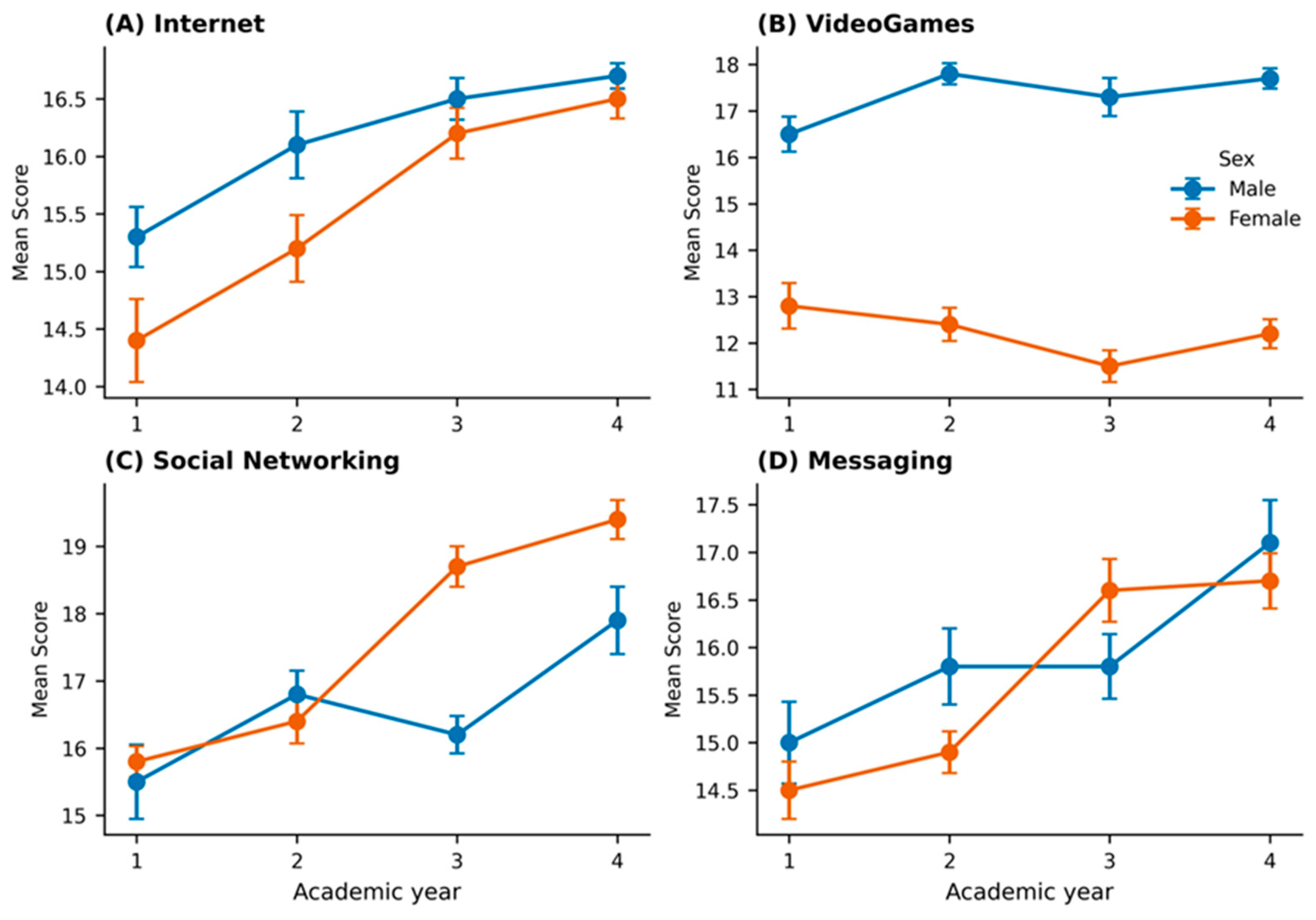
Significant main effects were found for academic year, F(3, 2349) = 10.04, p < 0.001, η2p = 0.013, and sex, F(1, 2349) = 5.68, p = 0.017, η2p = 0.002. There was no significant interaction effect between academic year and sex, F(3, 2349) = 0.55, p = 0.647, η2p = 0.001. Male students reported higher internet use compared to female students, with an incremental increase observed across academic years for both groups.
3.2. Video Game Use
A significant main effect of sex emerged, F(1, 2349) = 267.49, p < 0.001, η2p = 0.002, demonstrating considerably higher video game use among males. The interaction between academic year and sex was also significant, F(3, 2349) = 3.08, p = 0.026, η2p = 0.102, indicating different developmental patterns across academic years between males and females. The main effect of academic year alone was not significant, F(3, 2349) = 1.37, p = 0.250, η2p = 0.004.
3.3. Social Networking
Significant main effects were found for academic year, F(3, 2349) = 15.87, p < 0.001, η2p = 0.02, and sex, F(1, 2349) = 8.36, p = 0.004, η2p = 0.004. Additionally, the interaction between academic year and sex was significant, F(3, 2349) = 4.45, p = 0.004, η2p = 0.006, showing that female students exhibited a marked increase in social networking use across academic years, surpassing male students, particularly at higher academic levels.
3.4. Messaging
Messaging showed a significant increase across academic years, F(3, 2349) = 6.78, p < 0.001, η2p = 0.009. No significant differences were found by sex, F(1, 2349) = 0.19, p = 0.661, η2p < 0.001 nor was there a significant interaction, F(3, 2349) = 1.29, p = 0.275, η2p = 0.002. Messaging use increased similarly across academic years for both male and female students.
Figure 1 illustrates mean scores for digital media use across academic years, separated by sex, demonstrating trends for each domain.
Figure 1.
Mean self-reported usage scores across academic years for (A) Internet, (B) Video Games, (C) Social Networking, and (D) Messaging, stratified by sex. Error bars represent standard errors of the mean (±SEM). Male participants are represented in blue and female participants in orange. A progressive increase in usage across academic years is observed for most domains, with notable sex differences particularly in Video Games and Social Networking.
3.5. Measurement Invariance Across Sex
Before conducting the measurement invariance tests, confirmatory factor analyses (CFA) were carried out to verify the adequacy of the measurement models for both instruments used in the study. The analyses showed good model fit for both the Questionnaire of Maladaptive Behavior toward ICT and the Questionnaire on Negative Consequences of ICT, with all indices falling within acceptable thresholds. These results support the validity of the measurement models across different subscales (see Table 4).
Table 4.
Confirmatory factor analysis of the measured variables.
Measurement invariance was tested sequentially (configural, metric, and scalar invariance) for each SEM by sex. All baseline configural models showed good fit (CFI ≥ 0.951, TLI ≥ 0.943, RMSEA ≤ 0.047, SRMR ≤ 0.044). Metric and scalar invariance constraints yielded statistically significant χ2 differences, but changes in incremental fit indices were minimal (ΔCFI ≤ 0.006, ΔRMSEA ≤ 0.002, ΔSRMR ≤ 0.003), indicating full metric and scalar invariance across sexes (Table 5 and Table 6).
Table 5.
Fit indices for all the models, multigroup analysis using sex.
Table 6.
Metric and scalar invariance analysis summary. Increases in fit indices for the four models by sex.
3.6. Measurement Invariance Across Academic Years
Measurement invariance analyses across academic years also demonstrated good fit indices at the configural level (CFI ≥ 0.939, TLI ≥ 0.929, RMSEA ≤ 0.047, SRMR ≤ 0.044). Constraining factor loadings (metric invariance) and intercepts (scalar invariance) resulted in statistically significant χ2 differences, yet again incremental fit indices showed negligible changes (ΔCFI ≤ 0.005, ΔRMSEA ≤ 0.001, ΔSRMR ≤ 0.003), supporting full metric and scalar invariance across academic-year cohorts (Table 7 and Table 8). Detailed structural equation models, including standardized regression weights for each latent variable and their indicators across sex and academic year, can be consulted in the Supplementary Material.
Table 7.
Fit indices for all the models, multigroup analysis using academic year.
Table 8.
Metric and scalar invariance analysis summary. Increases in fit indices for the four models by academic year.
Overall, these results confirm domain-specific patterns of digital media engagement, clear sex-related differences (particularly in video games and social networking), and developmental trends. Additionally, the robustness of measurement and structural models across demographic groups validates the generalizability of the relationships among emotion regulation, problematic digital media use, and negative outcomes.
4. Discussion
The present study examined whether the associations between emotional regulation (ER) difficulties, compulsive digital media use, cognitive preoccupation, and negative consequences remain invariant across sex and academic year in adolescents. The results confirmed metric and scalar invariance in all models, indicating that the underlying psychological processes operate similarly across these demographic groups. This is a key finding, as it demonstrates that the mechanisms linking emotional dysregulation and problematic digital media use are stable and generalizable throughout adolescence. Invariance ensures that the constructs assessed are psychometrically equivalent, validating the use of a single structural model across diverse subpopulations (Byrne, 2008; Chen, 2007). While previous research has often explored sex differences in the prevalence or intensity of digital media use (Andreassen et al., 2017), our results highlight that the underlying psychological structure of risk is consistent across groups.
Consistent with prior findings, difficulties in both negative and positive emotion regulation significantly predicted adverse outcomes across all digital media domains. This supports Gross’s (2002) theoretical model of emotion regulation and aligns with meta-analytic evidence linking ER difficulties to maladaptive behaviors (Aldao et al., 2010). Furthermore, compulsive use and cognitive preoccupation emerged as strong predictors of negative outcomes, replicating previous work connecting impulsivity and rumination with problematic internet and gaming behaviors (Meerkerk et al., 2010; Kuss & Griffiths, 2012; Billieux et al., 2008).
Although some earlier studies have suggested demographic differences in digital media use (Kuss & Griffiths, 2011), our findings demonstrate that both the measurement and structural relationships remain consistent across sex and academic years. These results suggest the existence of a consistent psychological pathway—linking ER difficulties and problematic usage to negative outcomes—across sex and academic year groups in our adolescent sample.
4.1. Clinical and Research Implications
These results have important implications for intervention design. The demonstrated invariance suggests that universal strategies—such as school-based programs focused on strengthening emotion regulation and reducing compulsive media use—can be implemented effectively without tailoring by sex or age. This is supported by longitudinal studies showing similar developmental trajectories for problematic digital media use among boys and girls (Gámez-Guadix et al., 2015), and by neurodevelopmental evidence indicating that, despite structural brain differences, adolescents of both sexes follow comparable patterns in emotional maturation (Vijayakumar et al., 2019).
4.2. Limitations
Several limitations should be acknowledged. First, the cross-sectional design limits causal inference and prevents assessment of the temporal stability of the observed relationships. Longitudinal designs are needed to explore these dynamics more thoroughly. Second, reliance on self-report measures may introduce bias due to shared method variance, social desirability, or recall errors. Future research should consider incorporating objective behavioral metrics or multi-informant methods. Third, although the sample size (N = 2357) and its diversity in educational settings enhance representativeness, the generalizability beyond adolescents in the Madrid region remains uncertain. Additionally, test–retest reliability was not assessed, and other potentially influential demographic moderators—such as socioeconomic status or cultural background—were not included in the analysis.
Supplementary Materials
The following supporting information can be downloaded at: https://www.mdpi.com/article/10.3390/ejihpe15080145/s1, Figure S1. Structural model for negative consequences of internet use by academic year; Figure S2. Structural model for negative consequences of instant messaging use by academic year; Figure S3. Structural model for negative consequences of social networking use by academic year; Figure S4. Structural model for negative consequences of video game use by academic year; Figure S5. Structural model for negative consequences of internet use by sex; Figure S6. Structural model for negative consequences of instant messaging use by sex; Figure S7. Structural model for negative consequences of social networking use by sex; Figure S8. Structural model for negative consequences of video game use by sex.
Author Contributions
Conceptualization: M.P.-W. and J.A.L.-M.; formal analysis, J.A.L.-M. and M.P.-W.; investigation: M.P.-W. and K.-M.B.; writing—original draft preparation M.P.-W.; writing—review and editing: K.-M.B. All authors have read and agreed to the published version of the manuscript.
Funding
This research received no external funding.
Institutional Review Board Statement
The study was conducted in accordance with the Declaration of Helsinki, and approved by the Ethics Committee of the Complutense University of Madrid (protocol code CE_20220317-05_SAL, approved on 17 March 2022).
Informed Consent Statement
Informed consent was obtained from all subjects involved in the study.
Data Availability Statement
The raw data supporting the conclusions of this article will be made available by the authors on request.
Conflicts of Interest
The authors declare no conflicts of interest.
Abbreviations
The following abbreviations are used in this manuscript:
| SEM | Structural equation model. |
| CIF | Comparative Fit Index |
| CIUS | Compulsive Internet Use Scale |
References
- Aldao, A., Nolen-Hoeksema, S., & Schweizer, S. (2010). Emotion-regulation strategies across psychopathology: A meta-analytic review. Clinical Psychology Review, 30(2), 217–237. [Google Scholar] [CrossRef] [PubMed]
- Andreassen, C. S., Pallesen, S., & Griffiths, M. D. (2017). The relationship between addictive use of social media, narcissism, and self-esteem: Findings from a large national survey. Addictive Behaviors, 64, 287–293. [Google Scholar] [CrossRef] [PubMed]
- Billieux, J., Van der Linden, M., & Rochat, L. (2008). The role of impulsivity in actual and problematic use of the mobile phone. Applied Cognitive Psychology, 22(9), 1195–1210. [Google Scholar] [CrossRef]
- Byrne, B. M. (2008). Testing for multigroup equivalence of a measuring instrument: A walk through the process. Psicothema, 20(Número 4), 872–882. [Google Scholar] [PubMed]
- Chen, F. F. (2007). Sensitivity of goodness of fit indexes to lack of measurement invariance. Structural Equation Modeling: A Multidisciplinary Journal, 14(3), 464–504. [Google Scholar] [CrossRef]
- Gámez-Guadix, M., Calvete, E., Orue, I., & Las Hayas, C. (2015). Problematic Internet use and problematic alcohol use from the cognitive-behavioral model: A longitudinal study among adolescents. Addictive Behaviors, 40, 109–114. [Google Scholar] [CrossRef] [PubMed]
- Gioia, F., Rega, V., & Boursier, V. (2021). Problematic Internet use and emotional dysregulation among young people: A literature review. Clinical Neuropsychiatry, 18(1), 41–54. [Google Scholar] [CrossRef] [PubMed]
- Gross, J. J. (2002). Emotion regulation: Affective, cognitive, and social consequences. Psychophysiology, 39(3), 281–291. [Google Scholar] [CrossRef] [PubMed]
- Kuss, D. J., & Griffiths, M. D. (2011). Online social networking and addiction: A review of the psychological literature. International Journal of Environmental Research and Public Health, 8(9), 3528–3552. [Google Scholar] [CrossRef] [PubMed]
- Kuss, D. J., & Griffiths, M. D. (2012). Internet gaming addiction: A systematic review of empirical research. International Journal of Mental Health and Addiction, 10(2), 278–296. [Google Scholar] [CrossRef]
- Labrador, F. J., Villadangos, S. M., & Crespo, M. (2013). Desarrollo y validación del cuestionario de uso problemático de nuevas tecnologías (UPNT). Anales De Psicología, 29(3), 836–847. [Google Scholar] [CrossRef][Green Version]
- Meerkerk, G.-J., Van Den Eijnden, R. J. J. M., Vermulst, A. A., & Garretsen, H. F. L. (2010). The Compulsive Internet Use Scale (CIUS): Some psychometric properties. Cyberpsychology & Behavior, 10(1), 13–16. [Google Scholar] [CrossRef]
- Olmeda-Muelas, N., Cuesta-Zamora, C., Joiner, R., & Ricarte, J. (2024). Parental attachment security and problematic Internet use in children: The mediating role of maladaptive cognitive emotion regulation strategies. Clinical Child Psychology and Psychiatry, 29(2), 746–763. [Google Scholar] [CrossRef] [PubMed]
- Pettorruso, M., Valle, S., Cavic, E., Martinotti, G., Di Giannantonio, M., & Grant, J. E. (2020). Problematic Internet use, personality profiles and emotion dysregulation in a cohort of young adults: Trajectories from risky behaviors to addiction. Psychiatry Research, 289, 113036. [Google Scholar] [CrossRef] [PubMed]
- Pérez, M., Lozano, J. H., & Fernández, M. P. (2014, November 15). CANT: Evaluación de la adicción a las nuevas tecnologías. Ponencia Presentada en el VII Congreso Internacional y XXII Congreso Nacional de Psicología Clínica, Sevilla, Spain. [Google Scholar]
- Pérez-Wiesner, M., Bühler, K.-M., & López-Moreno, J. A. (2024). Validation of an instrument for detecting problematic internet use in adolescents. Behavioral Sciences, 14(8), 715. [Google Scholar] [CrossRef] [PubMed]
- Rega, V., Gioia, F., & Boursier, V. (2023). Problematic media use among children up to the age of 10: A systematic literature review. International Journal of Environmental Research and Public Health, 20(10), 5854. [Google Scholar] [CrossRef] [PubMed]
- Vijayakumar, S., Sallet, J., Verhagen, L., Folloni, D., Medendorp, W. P., & Mars, R. B. (2019). Mapping multiple principles of parietal-frontal cortical organization using functional connectivity. Brain Structure & Function, 224(2), 681–697. [Google Scholar] [CrossRef]
- Wacks, Y., & Weinstein, A. (2021). Excessive smartphone use is associated with health problems in adolescents and young adults: A review. Frontiers in Psychiatry, 12, 669042. [Google Scholar] [CrossRef] [PubMed]
- Zhang, Y., Li, J., Zhang, M., Ai, B., & Jia, F. (2024). Bidirectional associations between loneliness and problematic internet use: A meta-analytic review of longitudinal studies. Addictive Behaviors, 150, 107916. [Google Scholar] [CrossRef] [PubMed]
Disclaimer/Publisher’s Note: The statements, opinions and data contained in all publications are solely those of the individual author(s) and contributor(s) and not of MDPI and/or the editor(s). MDPI and/or the editor(s) disclaim responsibility for any injury to people or property resulting from any ideas, methods, instructions or products referred to in the content. |
© 2025 by the authors. Published by MDPI on behalf of the University Association of Education and Psychology. Licensee MDPI, Basel, Switzerland. This article is an open access article distributed under the terms and conditions of the Creative Commons Attribution (CC BY) license (https://creativecommons.org/licenses/by/4.0/).