

Psychometric Evaluation of the Multidimensional Scale of Perceived Social Support Among Early Adolescents in Darjeeling, India

 ,
,
Abstract
1. Introduction
Objectives
2. Methods
2.1. Setting
2.2. Participants
2.3. Measures
2.3.1. The Multidimensional Scale of Perceived Social Support (MSPSS)
2.3.2. Strengths and Difficulties Questionnaire (SDQ)
2.3.3. Additional Measures
2.4. Data Analysis
2.5. Ethics Approval
3. Results
3.1. Descriptive Statistics
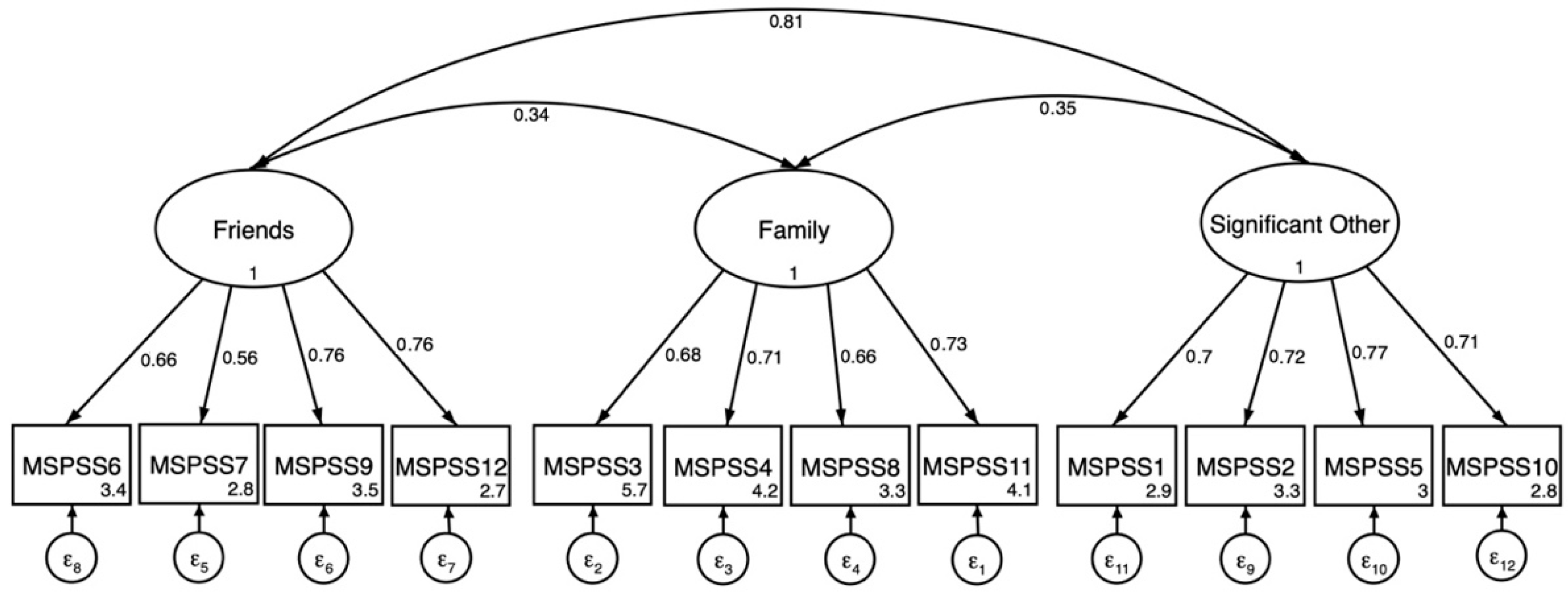
3.2. Factor Analysis
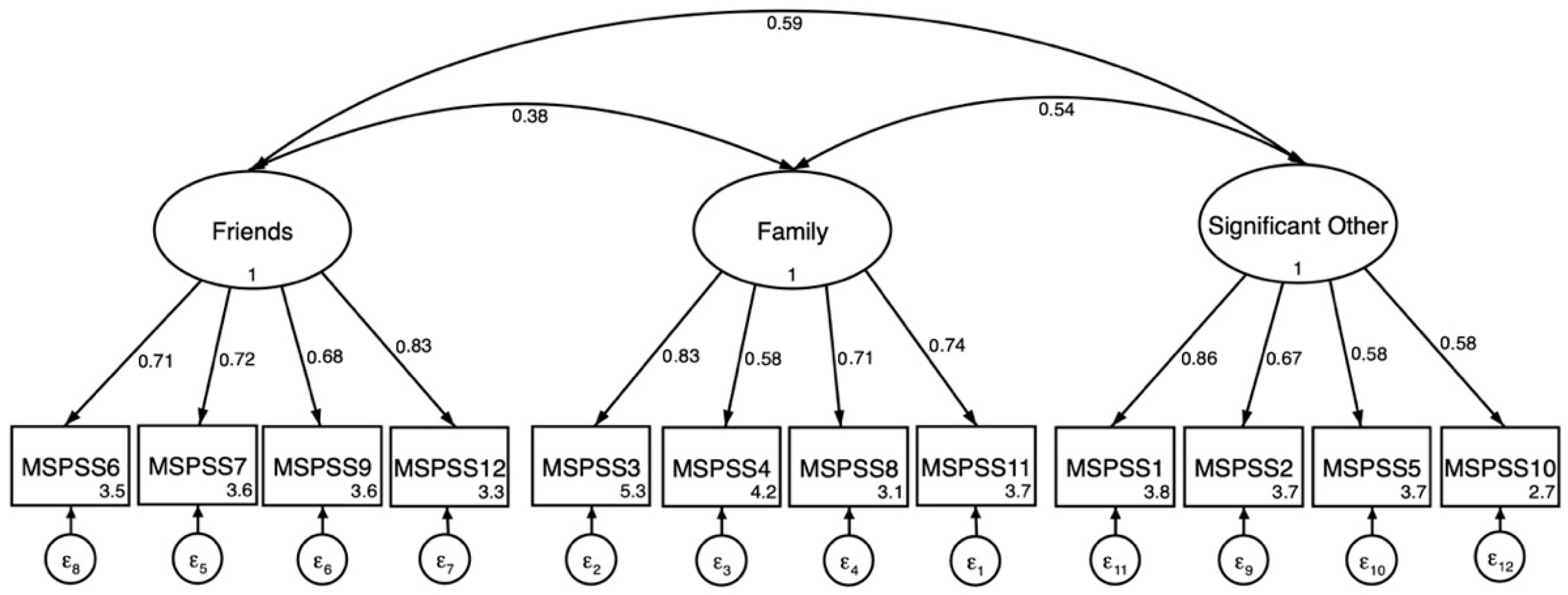
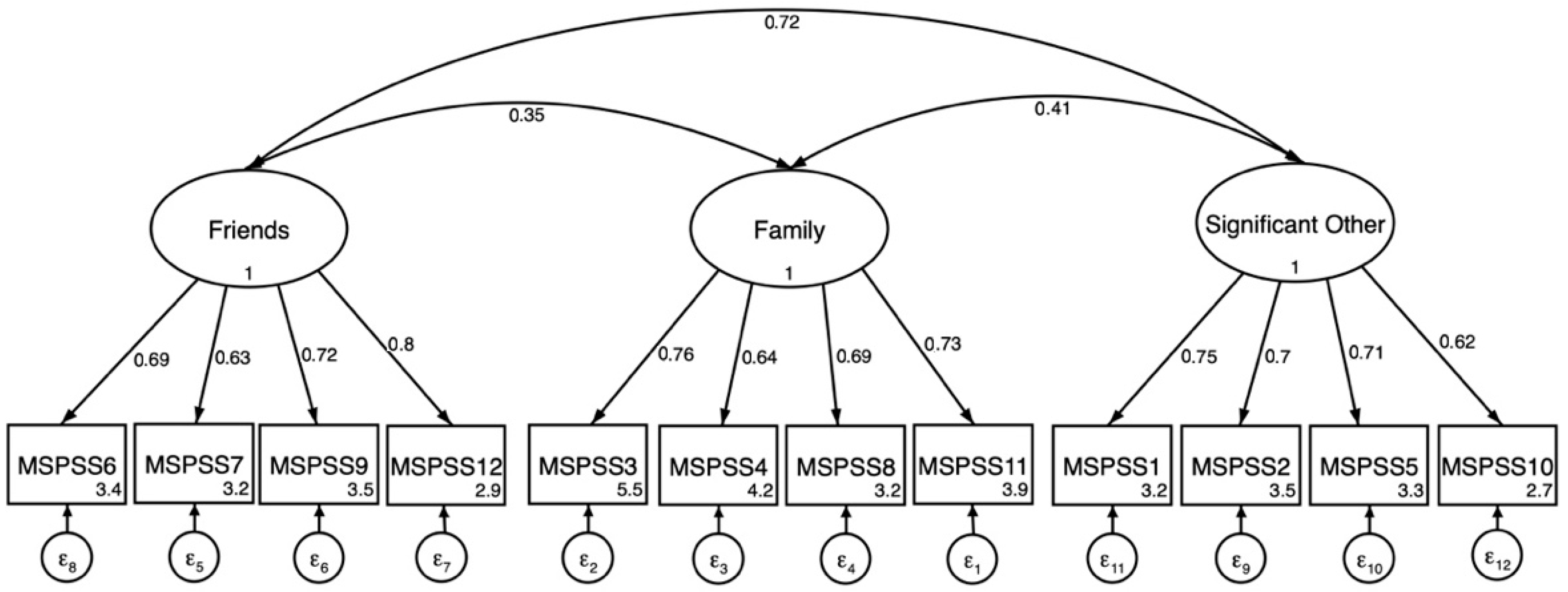
3.3. Configural and Measurement Invariance
3.4. Internal Consistency
3.5. Concurrent and Convergent Validity
4. Discussion
Limitations
5. Conclusions
Author Contributions
Funding
Institutional Review Board Statement
Informed Consent Statement
Data Availability Statement
Acknowledgments
Conflicts of Interest
References
- Akhtar, A., Rahman, A., Husain, M., Chaudhry, I. B., Duddu, V., & Husain, N. (2010). Multidimensional scale of perceived social support: Psychometric properties in a South Asian population. Journal of Obstetrics and Gynaecology Research, 36(4), 845–851. [Google Scholar] [CrossRef]
- Aloba, O., Opakunle, T., & Ogunrinu, O. (2019). Psychometric characteristics and measurement invariance across genders of the Multidimensional Scale of Perceived Social Support (MSPSS) among Nigerian adolescents. Health Psychology Report, 7(1), 69–80. [Google Scholar] [CrossRef]
- Alshammari, A. S., Piko, B. F., & Fitzpatrick, K. M. (2021). Social support and adolescent mental health and well-being among Jordanian students. International Journal of Adolescence and Youth, 26(1), 211–223. [Google Scholar] [CrossRef]
- Beckes, L., & Coan, J. A. (2011). Social baseline theory: The role of social proximity in emotion and economy of action. Social and Personality Psychology Compass, 5(12), 976–988. [Google Scholar] [CrossRef]
- Bentler, P. M. (1990). Comparative fit indexes in structural models. Psychological Bulletin, 107(2), 238. [Google Scholar] [CrossRef]
- Bernaras, E., Jaureguizar, J., & Garaigordobil, M. (2019). Child and adolescent depression: A review of theories, evaluation instruments, prevention programs, and treatments. Frontiers in Psychology, 10, 543. [Google Scholar] [CrossRef]
- Blakemore, S.-J., & Mills, K. L. (2014). Is adolescence a sensitive period for sociocultural processing? Annual Review of Psychology, 65, 187–207. [Google Scholar] [CrossRef]
- Bloom, P. A., Galfalvy, H., Bitran, A., Blanchard, A., Chernick, L. S., Dayan, P., Durham, K., Greenblatt, J., Joyce, K., & Kirshenbaum, J. S. (2025). Momentary stress and social context among adolescents at risk for suicide: An experience sampling study. Journal of Affective Disorders, 393, 120407. [Google Scholar] [CrossRef] [PubMed]
- Braams, B. R., van Duijvenvoorde, A. C., Peper, J. S., & Crone, E. A. (2015). Longitudinal changes in adolescent risk-taking: A comprehensive study of neural responses to rewards, pubertal development, and risk-taking behavior. Journal of Neuroscience, 35(18), 7226–7238. [Google Scholar] [CrossRef]
- Bruwer, B., Emsley, R., Kidd, M., Lochner, C., & Seedat, S. (2008). Psychometric properties of the Multidimensional Scale of Perceived Social Support in youth. Comprehensive Psychiatry, 49(2), 195–201. [Google Scholar] [CrossRef]
- Buchanan, M. (2014). Participatory development communication and child well-being in Northern Ghana: A journey. Royal Roads University (Canada). [Google Scholar]
- Canty-Mitchell, J., & Zimet, G. D. (2000). Psychometric properties of the Multidimensional Scale of Perceived Social Support in urban adolescents. American Journal of Community Psychology, 28(3), 391–400. [Google Scholar] [CrossRef]
- Chen, F. F. (2007). Sensitivity of goodness of fit indexes to lack of measurement invariance. Structural Equation Modeling: A Multidisciplinary Journal, 14(3), 464–504. [Google Scholar] [CrossRef]
- Cheng, S.-T., & Chan, A. C. (2004). The multidimensional scale of perceived social support: Dimensionality and age and gender differences in adolescents. Personality and Individual Differences, 37(7), 1359–1369. [Google Scholar] [CrossRef]
- Cherewick, M., Reaven, J., Cruz, C. M., Giri, P., Rai, R. P., Leiferman, J., & Matergia, M. (2024). Neurodiversity, social support, and mental wellbeing: Pathways to resilience among early adolescents. Advances in Neurodevelopmental Disorders. [Google Scholar] [CrossRef]
- Cheung, G. W., & Rensvold, R. B. (2002). Evaluating goodness-of-fit indexes for testing measurement invariance. Structural Equation Modeling, 9(2), 233–255. [Google Scholar] [CrossRef]
- Chou, K.-L. (2000). Assessing Chinese adolescents’ social support: The multidimensional scale of perceived social support. Personality and Individual Differences, 28(2), 299–307. [Google Scholar] [CrossRef]
- Chu, P. S., Saucier, D. A., & Hafner, E. (2010). Meta-analysis of the relationships between social support and well-being in children and adolescents. Journal of Social and Clinical Psychology, 29(6), 624–645. [Google Scholar] [CrossRef]
- Ciarrochi, J., Morin, A. J., Sahdra, B. K., Litalien, D., & Parker, P. D. (2017). A longitudinal person-centered perspective on youth social support: Relations with psychological wellbeing. Developmental Psychology, 53(6), 1154. [Google Scholar] [CrossRef] [PubMed]
- Coan, J. A., Maresh, E. L., & Gross, J. (2014). Social baseline theory and the social regulation of emotion. In The handbook of emotion regulation. Guilford Press. [Google Scholar]
- Cohen, S., & McKay, G. (2020). Social support, stress and the buffering hypothesis: A theoretical analysis. In Handbook of psychology and health, Volume IV (pp. 253–267). Routledge. [Google Scholar]
- Cohen, S., & Syme, S. (1985). Social support and health. Academic Press. [Google Scholar]
- Cohen, S., & Wills, T. A. (1985). Stress, social support, and the buffering hypothesis. Psychological Bulletin, 98(2), 310. [Google Scholar] [CrossRef] [PubMed]
- Costello, A. B., & Osborne, J. (2019). Best practices in exploratory factor analysis: Four recommendations for getting the most from your analysis. Practical Assessment, Research, and Evaluation, 10(1), 7. [Google Scholar]
- Crone, E. A., & Dahl, R. E. (2012). Understanding adolescence as a period of social–affective engagement and goal flexibility. Nature Reviews Neuroscience, 13(9), 636–650. [Google Scholar] [CrossRef]
- Dahl, R. E., Allen, N. B., Wilbrecht, L., & Suleiman, A. B. (2018). Importance of investing in adolescence from a developmental science perspective. Nature, 554(7693), 441–450. [Google Scholar] [CrossRef]
- Davidson, R. J., & McEwen, B. S. (2012). Social influences on neuroplasticity: Stress and interventions to promote well-being. Nature Neuroscience, 15(5), 689–695. [Google Scholar] [CrossRef] [PubMed]
- Edwards, L. M. (2004). Measuring perceived social support in Mexican American youth: Psychometric properties of the multidimensional scale of perceived social support. Hispanic Journal of Behavioral Sciences, 26(2), 187–194. [Google Scholar] [CrossRef]
- Flament, M., Nguyen, H., Furino, C., Schachter, H., MacLean, C., Wasserman, D., Sartorius, N., & Remschmidt, H. (2007). Evidence-based primary prevention programmes for the promotion of mental health in children and adolescents: A systematic worldwide review. In The mental health of adolescents. An area of global neglect (pp. 65–136). E-Book. [Google Scholar] [CrossRef]
- Furman, W., & Buhrmester, D. (1992). Age and sex differences in perceptions of networks of personal relationships. Child development, 63(1), 103–115. [Google Scholar] [CrossRef]
- Gecková, A., Van Dijk, J. P., Stewart, R., Groothoff, J. W., & Post, D. (2003). Influence of social support on health among gender and socio-economic groups of adolescents. The European Journal of Public Health, 13(1), 44–50. [Google Scholar] [CrossRef]
- Glozah, F. N. (2013). Effects of academic stress and perceived social support on the psychological wellbeing of adolescents in Ghana. Open Journal of Medical Psychology, 2(4), 143–150. [Google Scholar] [CrossRef]
- Goodman, R. (1997). The strengths and difficulties questionnaire: A research note. Journal of Child Psychology and Psychiatry, 38(5), 581–586. [Google Scholar] [CrossRef]
- Gorkhaland Territorial Administration. (2018). Gorkhaland territorial administration profile. Gorkhaland Territorial Administration. [Google Scholar]
- Guan, M., & So, J. (2016). Influence of social identity on self-efficacy beliefs through perceived social support: A social identity theory perspective. Communication Studies, 67(5), 588–604. [Google Scholar] [CrossRef]
- Guan, N. C., Seng, L. H., Hway Ann, A. Y., & Hui, K. O. (2015). Factorial validity and reliability of the Malaysian simplified Chinese version of Multidimensional Scale of Perceived Social Support (MSPSS-SCV) among a group of university students. Asia Pacific Journal of Public Health, 27(2), 225–231. [Google Scholar] [CrossRef] [PubMed]
- Hankin, B. L., Abramson, L. Y., Moffitt, T. E., Silva, P. A., McGee, R., & Angell, K. E. (1998). Development of depression from preadolescence to young adulthood: Emerging gender differences in a 10-year longitudinal study. Journal of Abnormal Psychology, 107(1), 128. [Google Scholar] [CrossRef]
- Hayes, A. F., & Coutts, J. J. (2020). Use omega rather than Cronbach’s alpha for estimating reliability. But…. Communication Methods and Measures, 14(1), 1–24. [Google Scholar] [CrossRef]
- Hu, L. T., & Bentler, P. M. (1999). Cutoff criteria for fit indexes in covariance structure analysis: Conventional criteria versus new alternatives. Structural Equation Modeling: A Multidisciplinary Journal, 6(1), 1–55. [Google Scholar] [CrossRef]
- Hurley, A. E., Scandura, T. A., Schriesheim, C. A., Brannick, M. T., Seers, A., Vandenberg, R. J., & Williams, L. J. (1997). Exploratory and confirmatory factor analysis: Guidelines, issues, and alternatives. Journal of Organizational Behavior, 18(6), 667–683. [Google Scholar] [CrossRef]
- Jain, Y. K., Joshi, N. K., Bhardwaj, P., & Suthar, P. (2019). Health-promoting school in India: Approaches and challenges. Journal of Family Medicine and Primary Care, 8(10), 3114–3119. [Google Scholar] [CrossRef] [PubMed]
- Kansara, K., Saxena, D., Puwar, T., Yasobant, S., Trivedi, P., Savaliya, S., & Fancy, M. (2018). Convergence and outreach for successful implementation of Rashtriya Kishor Swasthya Karyakram. Indian Journal of Community Medicine: Official Publication of Indian Association of Preventive & Social Medicine, 43(Suppl. S1), S18. [Google Scholar]
- Kessler, R. C., Berglund, P., Demler, O., Jin, R., Merikangas, K. R., & Walters, E. E. (2005). Lifetime prevalence and age-of-onset distributions of DSM-IV disorders in the National Comorbidity Survey Replication. Archives of General Psychiatry, 62(6), 593–602. [Google Scholar] [CrossRef]
- Kleinberg, A., Aluoja, A., & Vasar, V. (2013). Social support in depression: Structural and functional factors, perceived control and help-seeking. Epidemiology and Psychiatric Sciences, 22(4), 345–353. [Google Scholar] [CrossRef]
- Klineberg, E., Clark, C., Bhui, K. S., Haines, M. M., Viner, R. M., Head, J., Woodley-Jones, D., & Stansfeld, S. A. (2006). Social support, ethnicity and mental health in adolescents. Social Psychiatry and Psychiatric Epidemiology, 41, 755–760. [Google Scholar] [CrossRef]
- Kyriazos, T. (2018). Applied psychometrics: Sample size and sample power considerations in factor analysis (EFA, CFA) and SEM in general. Psychology, 9, 2207–2230. [Google Scholar] [CrossRef]
- Lakey, B., & Cohen, S. (2000). Social support theory and measurement. In Social support measurement and intervention: A guide for health and social scientists (Vol. 2952). Oxford University Press. [Google Scholar]
- Laksmita, O. D., Chung, M.-H., Liao, Y.-M., & Chang, P.-C. (2020). Multidimensional Scale of Perceived Social Support in Indonesian adolescent disaster survivors: A psychometric evaluation. PLoS ONE, 15(3), e0229958. [Google Scholar] [CrossRef]
- Lam, C. B., McHale, S. M., & Crouter, A. C. (2014). Time with peers from middle childhood to late adolescence: Developmental course and adjustment correlates. Child Development, 85(4), 1677–1693. [Google Scholar] [CrossRef] [PubMed]
- Marshall, S. L., Parker, P. D., Ciarrochi, J., & Heaven, P. C. (2014). Is self-esteem a cause or consequence of social support? A 4-year longitudinal study. Child Development, 85(3), 1275–1291. [Google Scholar] [CrossRef] [PubMed]
- Matergia, M., Ferrarone, P., Khan, Y., Matergia, D. W., Giri, P., Thapa, S., & Simões, E. A. (2019). Lay field-worker–led school health program for primary schools in low-and middle-income countries. Pediatrics, 143(4). [Google Scholar] [CrossRef] [PubMed]
- McCarthy, K., Brady, M., & Hallman, K. (2016). Investing when it counts: Reviewing the evidence and charting a course of research and action for very young adolescents. Population Council. Available online: https://knowledgecommons.popcouncil.org/departments_sbsr-pgy/568/ (accessed on 23 September 2025).
- McGorry, P. D., & Mei, C. (2018). Early intervention in youth mental health: Progress and future directions. BMJ Ment Health, 21(4), 182–184. [Google Scholar] [CrossRef]
- McGorry, P. D., Ratheesh, A., & O’Donoghue, B. (2018). Early intervention—An implementation challenge for 21st century mental health care. JAMA Psychiatry, 75(6), 545–546. [Google Scholar] [CrossRef]
- Miller, A. B., Esposito-Smythers, C., & Leichtweis, R. N. (2015). Role of social support in adolescent suicidal ideation and suicide attempts. Journal of Adolescent Health, 56(3), 286–292. [Google Scholar] [CrossRef]
- Morriss, R. K., & Morriss, E. E. (2000). Contextual evaluation of social adversity in the management of depressive disorder. Advances in Psychiatric Treatment, 6(6), 423–431. [Google Scholar] [CrossRef][Green Version]
- Muris, P., Meesters, C., Eijkelenboom, A., & Vincken, M. (2004). The self-report version of the Strengths and Difficulties Questionnaire: Its psychometric properties in 8-to 13-year-old non-clinical children. British Journal of Clinical Psychology, 43(4), 437–448. [Google Scholar] [CrossRef]
- Nandan, D. (2010). National rural health mission: Turning into reality. Indian Journal of Community Medicine, 35(4), 453–454. [Google Scholar] [CrossRef]
- Nelson, E. E., Leibenluft, E., McClure, E. B., & Pine, D. S. (2005). The social re-orientation of adolescence: A neuroscience perspective on the process and its relation to psychopathology. Psychological medicine, 35(2), 163–174. [Google Scholar] [CrossRef]
- Nunnally, J. C., & Bernstein, I. (1978). Psychometric Theory. In The role of university in the development of entrepreneurial vocations: A Spanish study (pp. 387–405). McGraw-Hill. [Google Scholar]
- Orben, A., Tomova, L., & Blakemore, S.-J. (2020). The effects of social deprivation on adolescent development and mental health. The Lancet Child & Adolescent Health, 4(8), 634–640. [Google Scholar] [CrossRef] [PubMed]
- Orçan, F. (2018). Exploratory and confirmatory factor analysis: Which one to use first? Journal of Measurement and Evaluation in Education and Psychology, 9(4), 414–421. [Google Scholar]
- Pandey, V., Vaishya, J. K., Kumawat, N. K., Murugeswaran, R., & Sastry, J. (2020). Promoting school herbal gardens: An innovative approach for spreading awareness among students. Medicinal Plants-International Journal of Phytomedicines and Related Industries, 12(4), 483–486. [Google Scholar] [CrossRef]
- Pfeifer, J. H., & Berkman, E. T. (2018). The development of self and identity in adolescence: Neural evidence and implications for a value-based choice perspective on motivated behavior. Child Development Perspectives, 12(3), 158–164. [Google Scholar] [CrossRef]
- Poudel, A., Gurung, B., & Khanal, G. P. (2020). Perceived social support and psychological wellbeing among Nepalese adolescents: The mediating role of self-esteem. BMC Psychology, 8(1), 43. [Google Scholar] [CrossRef]
- Rai, R. P. (2017). Small farmers: Locating them in “Darjeeling Tea”. In Tea technological initiatives (pp. 19–38). New Delhi Publishing Agency. [Google Scholar]
- Ramaswamy, V., Aroian, K. J., & Templin, T. (2009). Adaptation and psychometric evaluation of the multidimensional scale of perceived social support for Arab American adolescents. American Journal of Community Psychology, 43, 49–56. [Google Scholar] [CrossRef]
- Robu, V., Sandovici, A., & Ciudin, M. (2020). Measuring perceived social support in Romanian adolescents: Psychometric properties of the Multidimensional Scale of Perceived Social Support. Journal of Innovation in Psychology, Education and Didactics, 24(1), 65–90. [Google Scholar]
- Ronen, T., Hamama, L., Rosenbaum, M., & Mishely-Yarlap, A. (2016). Subjective well-being in adolescence: The role of self-control, social support, age, gender, and familial crisis. Journal of Happiness Studies, 17, 81–104. [Google Scholar] [CrossRef]
- Ryan, R. M., & Deci, E. L. (2000). Self-determination theory and the facilitation of intrinsic motivation, social development, and well-being. American Psychologist, 55(1), 68. [Google Scholar] [CrossRef]
- Schwarzer, R., & Knoll, N. (2007). Functional roles of social support within the stress and coping process: A theoretical and empirical overview. International Journal of Psychology, 42(4), 243–252. [Google Scholar] [CrossRef]
- Sharaf, A. Y., Thompson, E. A., & Walsh, E. (2009). Protective effects of self-esteem and family support on suicide risk behaviors among at-risk adolescents. Journal of Child and Adolescent Psychiatric Nursing, 22(3), 160–168. [Google Scholar] [CrossRef]
- Shulman, E. P., Smith, A. R., Silva, K., Icenogle, G., Duell, N., Chein, J., & Steinberg, L. (2016). The dual systems model: Review, reappraisal, and reaffirmation. Developmental Cognitive Neuroscience, 17, 103–117. [Google Scholar] [CrossRef]
- Steiger, J. H. (1980, May 30). Statistically based tests for the number of common factors. The Annual Meeting of the Psychometric Society, Iowa City, IA, USA. [Google Scholar]
- Steinberg, L. (2008). A social neuroscience perspective on adolescent risk-taking. Developmental Review, 28(1), 78–106. [Google Scholar] [CrossRef]
- Tavakol, M., & Dennick, R. (2011). Making sense of Cronbach’s alpha. International Journal of Medical Education, 2, 53. [Google Scholar] [CrossRef] [PubMed]
- Thoits, P. A. (2011). Mechanisms linking social ties and support to physical and mental health. Journal of Health and Social Behavior, 52(2), 145–161. [Google Scholar] [CrossRef] [PubMed]
- Tinsley, H. E., & Tinsley, D. J. (1987). Uses of factor analysis in counseling psychology research. Journal of Counseling Psychology, 34(4), 414. [Google Scholar] [CrossRef]
- Tottenham, N., & Galván, A. (2016). Stress and the adolescent brain: Amygdala-prefrontal cortex circuitry and ventral striatum as developmental targets. Neuroscience & Biobehavioral Reviews, 70, 217–227. [Google Scholar]
- Tucker, L. R., & Lewis, C. (1973). A reliability coefficient for maximum likelihood factor analysis. Psychometrika, 38(1), 1–10. [Google Scholar] [CrossRef]
- Twenge, J. M., & Nolen-Hoeksema, S. (2002). Age, gender, race, socioeconomic status, and birth cohort difference on the children’s depression inventory: A meta-analysis. Journal of Abnormal Psychology, 111(4), 578. [Google Scholar] [CrossRef]
- van den Berg, H. S., George, A. A., Plessis, E. D. D., Botha, A., Basson, N., De Villiers, M., & Makola, S. (2013). The pivotal role of social support in the well-being of adolescents. In Well-being research in South Africa (pp. 315–339). Springer Science + Business Media. [Google Scholar] [CrossRef]
- Wilson, A., Yendork, J. S., & Somhlaba, N. Z. (2017). Psychometric properties of multidimensional scale of perceived social support among Ghanaian adolescents. Child Indicators Research, 10, 101–115. [Google Scholar] [CrossRef]
- Winefield, H. R., Winefield, A. H., & Tiggemann, M. (1992). Social support and psychological well-being in young adults: The Multi-Dimensional Support Scale. Journal of Personality Assessment, 58(1), 198–210. [Google Scholar] [CrossRef] [PubMed]
- Wolf, E. J., Harrington, K. M., Clark, S. L., & Miller, M. W. (2013). Sample size requirements for structural equation models: An evaluation of power, bias, and solution propriety. Educational and Psychological Measurement, 73(6), 913–934. [Google Scholar] [CrossRef] [PubMed]
- Zimet, G. D., Dahlem, N. W., Zimet, S. G., & Farley, G. K. (1988). The multidimensional scale of perceived social support. Journal of Personality Assessment, 52(1), 30–41. [Google Scholar] [CrossRef]



| Females N = 135 | Males N = 139 | Total N = 274 | p-Value | |
|---|---|---|---|---|
| Age | 0.447 | |||
| 10 | 11 | 13 | 24 | |
| 11 | 25 | 30 | 55 | |
| 12 | 29 | 30 | 59 | |
| 13 | 31 | 29 | 60 | |
| 14 | 39 | 37 | 76 | |
| Mean (SD) | 12.5 (1.3) | 12.3 (1.3) | 12.4 (1.3) | |
| Class | 0.123 | |||
| 5 | 17 | 24 | 41 | |
| 6 | 28 | 28 | 56 | |
| 7 | 23 | 29 | 52 | |
| 8 | 32 | 34 | 66 | |
| 9 | 25 | 19 | 44 | |
| 10 | 9 | 5 | 14 | |
| Location | 0.335 | |||
| Urban | 15 | 4 | 19 | |
| Peri-urban | 22 | 32 | 57 | |
| Rural | 98 | 100 | 198 |
| Factors | ||||
|---|---|---|---|---|
| MSPSS Item | Friends | Family | Significant Other | Communality |
| 6 | 0.61 | 0.15 | 0.22 | 0.45 |
| 7 | 0.55 | 0.11 | 0.23 | 0.37 |
| 9 | 0.70 | 0.16 | 0.19 | 0.55 |
| 12 | 0.74 | 0.06 | 0.31 | 0.65 |
| 3 | 0.04 | 0.78 | 0.09 | 0.62 |
| 4 | 0.08 | 0.60 | 0.20 | 0.41 |
| 8 | 0.17 | 0.63 | 0.16 | 0.45 |
| 11 | 0.16 | 0.73 | 0.05 | 0.57 |
| 1 | 0.31 | 0.20 | 0.62 | 0.52 |
| 2 | 0.34 | 0.17 | 0.55 | 0.46 |
| 5 | 0.26 | 0.07 | 0.72 | 0.58 |
| 10 | 0.23 | 0.13 | 0.59 | 0.42 |
| X2 (df) | p-Value | CFI | ΔCFI | TLI | ΔTLI | SRMR | ΔSRMR | RMSEA | ΔRMSEA | |
|---|---|---|---|---|---|---|---|---|---|---|
| Total | 69.3(49) | 0.030 | 0.98 | REF | 0.98 | REF | 0.036 | REF | 0.039 | REF |
| Males | 62.8 (49) | 0.106 | 0.98 | 0.00 | 0.97 | −0.01 | 0.046 | 0.010 | 0.043 | 0.004 |
| Females | 76.7 (49) | 0.005 | 0.95 | −0.03 | 0.94 | −0.04 | 0.060 | 0.024 | 0.067 | 0.028 |
| Configural | 174.2 (116) | 0.000 | 0.95 | −0.03 | 0.94 | −0.04 | 0.073 | 0.047 | 0.061 | 0.022 |
| Concurrent Validity | Convergent Validity | |
|---|---|---|
| MSPSS | Prosocial Behavior | Peer Problems |
| Friends | 0.30 *** | −0.38 *** |
| Family | 0.35 *** | −0.37 *** |
| Significant Other | 0.31 *** | −0.30 *** |
| Total | 0.41 *** | −0.45 *** |
Disclaimer/Publisher’s Note: The statements, opinions and data contained in all publications are solely those of the individual author(s) and contributor(s) and not of MDPI and/or the editor(s). MDPI and/or the editor(s) disclaim responsibility for any injury to people or property resulting from any ideas, methods, instructions or products referred to in the content. |
© 2025 by the authors. Published by MDPI on behalf of the University Association of Education and Psychology. Licensee MDPI, Basel, Switzerland. This article is an open access article distributed under the terms and conditions of the Creative Commons Attribution (CC BY) license (https://creativecommons.org/licenses/by/4.0/).
Share and Cite
Cherewick, M.; Matergia, M.; Dukpa, C.; Mukhia, D.; Lama, R.; Rai, R.P.; Giri, P. Psychometric Evaluation of the Multidimensional Scale of Perceived Social Support Among Early Adolescents in Darjeeling, India. Eur. J. Investig. Health Psychol. Educ. 2025, 15, 251. https://doi.org/10.3390/ejihpe15120251
Cherewick M, Matergia M, Dukpa C, Mukhia D, Lama R, Rai RP, Giri P. Psychometric Evaluation of the Multidimensional Scale of Perceived Social Support Among Early Adolescents in Darjeeling, India. European Journal of Investigation in Health, Psychology and Education. 2025; 15(12):251. https://doi.org/10.3390/ejihpe15120251
Chicago/Turabian StyleCherewick, Megan, Michael Matergia, Choden Dukpa, Dikcha Mukhia, Rinzi Lama, Roshan P. Rai, and Priscilla Giri. 2025. "Psychometric Evaluation of the Multidimensional Scale of Perceived Social Support Among Early Adolescents in Darjeeling, India" European Journal of Investigation in Health, Psychology and Education 15, no. 12: 251. https://doi.org/10.3390/ejihpe15120251
APA StyleCherewick, M., Matergia, M., Dukpa, C., Mukhia, D., Lama, R., Rai, R. P., & Giri, P. (2025). Psychometric Evaluation of the Multidimensional Scale of Perceived Social Support Among Early Adolescents in Darjeeling, India. European Journal of Investigation in Health, Psychology and Education, 15(12), 251. https://doi.org/10.3390/ejihpe15120251