
Different Supports, Different Effects: Social Support Moderates the Impact of Parenting Stress on the Mental Health of Parents of Individuals with Intellectual and Developmental Disabilities

Abstract
1. Introduction
2. Theoretical Background and Hypothesis
2.1. Parenting Stress and Mental Health
2.2. Social Support and Mental Health
2.3. Social Support, Parenting Stress, and Mental Health
3. Data Sources and Analysis Methods
3.1. Data Sources
3.2. Description of Variables
3.2.1. Dependent Variable
3.2.2. Independent Variables
Parenting Stress
Social Support
3.2.3. Measurement Reliability and Validity
3.2.4. Control Variables
3.3. Analysis Methods
3.3.1. Parameter Testing
3.3.2. Regression Analysis
3.3.3. Moderating Effect Analysis
4. Results
4.1. Descriptive Statistics and Group Comparisons
4.2. Correlation Analysis
4.3. Regression Analysis Results
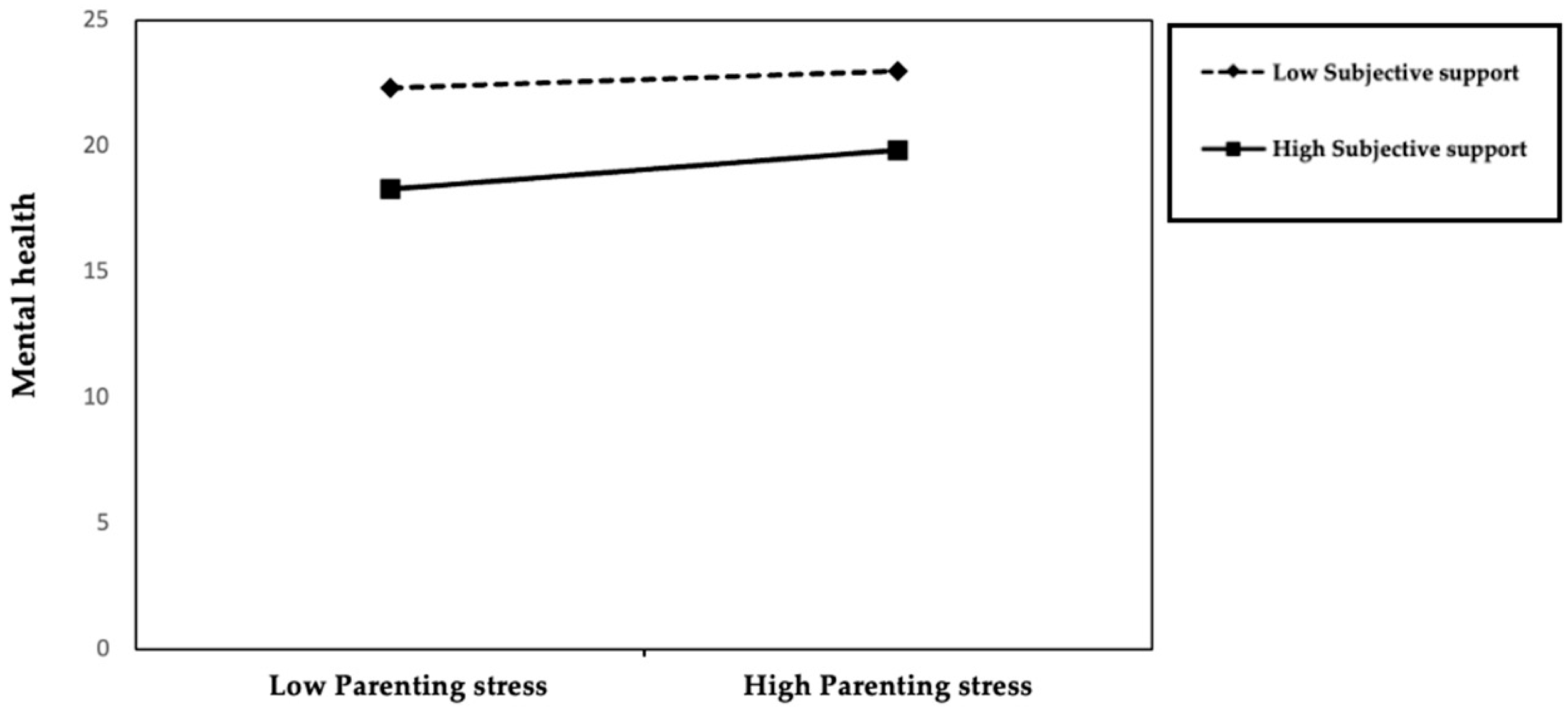
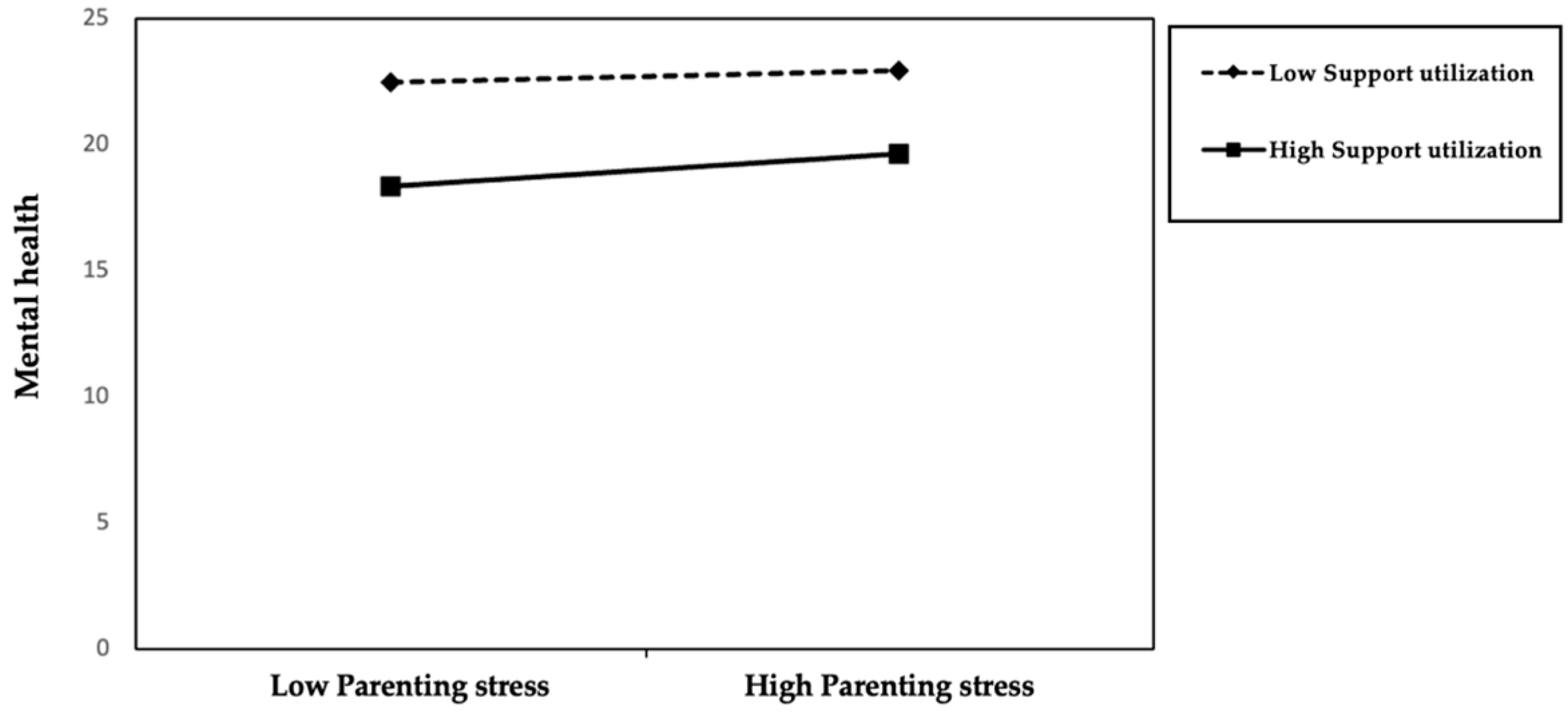
4.4. Moderation Effect Analysis Results
5. Discussion and Conclusions
5.1. Discussion
5.2. Conclusions
Author Contributions
Funding
Institutional Review Board Statement
Informed Consent Statement
Data Availability Statement
Acknowledgments
Conflicts of Interest
References
- Abdel-Halim, A. A. (1982). Social support and managerial affective responses to job stress. Journal of Organizational Behavior, 3(4), 281–295. [Google Scholar] [CrossRef]
- AlAnsari, A. M., & Jahrami, H. A. (2018). Health of mothers of children with autism spectrum disorders and intellectual disability. Bahrain Medical Bulletin, 40(3), 157–161. [Google Scholar]
- Alexander, M. J., & Higgins, E. T. (1993). Emotional trade-offs of becoming a parent: How social roles influence self-discrepancy effects. Journal of Personality and Social Psychology, 65(6), 1259. [Google Scholar] [CrossRef] [PubMed]
- Almansour, M. A., Alateeq, M. A., Alzahrani, M. K., Algeffari, M. A., & Alhomaidan, H. T. (2013). Depression and anxiety among parents and caregivers of autistic spectral disorder children. Neurosciences Journal, 18(1), 58–63. [Google Scholar]
- Ault, S., Breitenstein, S. M., Tucker, S., Havercamp, S. M., & Ford, J. L. (2021). Caregivers of children with autism spectrum disorder in rural areas: A literature review of mental health and social support. Journal of Pediatric Nursing, 61, 229–239. [Google Scholar] [CrossRef]
- Baldwin, M. W., & Holmes, J. G. (1987). Salient private audiences and awareness of the self. Journal of Personality and Social Psychology, 52(6), 1087–1098. [Google Scholar] [CrossRef]
- Beckman, P. (1983). Influence of selected child characteristics on stress in families of handicapped infants. American Journal of Mental Deficiency, 88(2), 150–156. [Google Scholar]
- Benson, P. R. (2012). Network Characteristics, perceived social support, and psychological adjustment in mothers of children with autism spectrum disorder. Journal of Autism and Developmental Disorders, 42(12), 2597–2610. [Google Scholar] [CrossRef]
- Bentovim, A. (1972). Emotional disturbances of handicapped pre-school children and their families--attitudes to the child. British Medical Journal, 3(5826), 579. [Google Scholar] [CrossRef]
- Ben-Zur, H., Duvdevany, I., & Lury, L. (2005). Associations of social support and hardiness with mental health among mothers of adult children with intellectual disability. Journal of Intellectual Disability Research, 49(1), 54–62. [Google Scholar] [CrossRef]
- Berkman, L. F. (1985). The relationship of social networks and social support to morbidity and mortality. In S. Cohen, & S. L. Syme (Eds.), Social support and health (pp. 241–262). Academic Press. (Parts of this chapter have appeared in “Annual Review of Public Health”, 1984, Vol. 5, pp. 413–432). [Google Scholar]
- Biswas, S., Moghaddam, N., & Tickle, A. (2015). What are the factors that influence parental stress when caring for a child with an intellectual disability? A critical literature review. International Journal of Developmental Disabilities, 61(3), 127–146. [Google Scholar] [CrossRef]
- Bitsika, V., & Sharpley, C. F. (2004). Stress, anxiety and depression among parents of children with autism spectrum disorder. Journal of Psychologists and Counsellors in Schools, 14(2), 151–161. [Google Scholar] [CrossRef]
- Bitsika, V., Sharpley, C. F., & Bell, R. (2013). The buffering effect of resilience upon stress, anxiety and depression in parents of a child with an autism spectrum disorder. Journal of Developmental and Physical Disabilities, 25(5), 533–543. [Google Scholar] [CrossRef]
- Blazer, D. G. (1982). Social support and mortality in an elderly community population. American Journal of Epidemiology, 115(5), 684–694. [Google Scholar] [CrossRef] [PubMed]
- Bouma, R., & Schweitzer, R. (1990). The impact of chronic childhood illness on family stress: A comparison between autism and cystic fibrosis. Journal of Clinical Psychology, 46(6), 722–730. [Google Scholar] [CrossRef] [PubMed]
- Boyd, B. A. (2002). Examining the relationship between stress and lack of social support in mothers of children with autism. Focus on Autism and Other Developmental Disabilities, 17(4), 208–215. [Google Scholar] [CrossRef]
- Broadhead, W. E., Kaplan, B. H., James, S. A., Wagner, E. H., Schoenbach, V. J., Grimson, R., Heyden, S., Tibblin, G., & Gehlbach, S. H. (1983). The epidemiologic evidence for a relationship between social support and health. American Journal of Epidemiology, 117(5), 521–537. [Google Scholar] [CrossRef]
- Bromley, J., Hare, D. J., Davison, K., & Emerson, E. (2004). Mothers supporting children with autistic spectrum disorders: Social support, mental health status and satisfaction with services. Autism, 8(4), 409–423. [Google Scholar] [CrossRef]
- Carter, E. W., Brock, M. E., & Trainor, A. A. (2014). Transition Assessment and planning for youth with severe intellectual and developmental disabilities. The Journal of Special Education, 47(4), 245–255. [Google Scholar] [CrossRef]
- Cassel, J. (1976). The contribution of the social environment to host resistance: The fourth wade hampton frost lecture. American Journal of Epidemiology, 104(2), 107–123. [Google Scholar] [CrossRef]
- Chao, R. K. (1994). Beyond parental control and authoritarian parenting style: Understanding Chinese parenting through the cultural notion of training. Child Development, 65(4), 1111–1119. [Google Scholar] [CrossRef]
- China Disabled Persons’ Federation. (2024). Statistical yearbook of China’s disabled persons’ cause. China Statistics Press. [Google Scholar]
- Chisholm, R. F., Kasl, S. V., & Mueller, L. (1986). The effects of social support on nuclear worker responses to the three mile island accident. Journal of Organizational Behavior, 7(3), 179–193. [Google Scholar] [CrossRef]
- Cohen, S. (1988). Psychosocial models of the role of social support in the etiology of physical disease. Health Psychology, 7(3), 269. [Google Scholar] [CrossRef] [PubMed]
- Cohen, S. (2004). Social relationships and health. American Psychologist, 59(8), 676. [Google Scholar] [CrossRef]
- Cohen, S., & Hoberman, H. M. (1983). Positive events and social supports as buffers of life change stress. Journal of Applied Social Psychology, 13(2), 99–125. [Google Scholar] [CrossRef]
- Cohen, S., & McKay, G. (1984). Social support, stress and the buffering hypothesis: A theoretical analysis. In Handbook of psychology and health (Vol. IV, pp. 253–267). Routledge. [Google Scholar]
- Cohen, S., & Syme, S. L. (1985). Social support and health. Academic Press. [Google Scholar]
- Cohen, S., & Wills, T. A. (1985). Stress, social support, and the buffering hypothesis. Psychological Bulletin, 98(2), 310. [Google Scholar] [CrossRef]
- Corrigan, P. W., & Miller, F. E. (2004). Shame, blame, and contamination: A review of the impact of mental illness stigma on family members. Journal of Mental Health, 13(6), 537–548. [Google Scholar] [CrossRef]
- Cramm, J., & Nieboer, A. (2011). Psychological well-being of caregivers of children with intellectual disabilities: Using parental stress as a mediating factor. Journal of Intellectual Disabilities, 15(2), 101–113. [Google Scholar] [CrossRef]
- Cutrona, C., & Russell, D. W. (1990). Type of social support and specific stress: Toward a theory of optimal matching. In B. R. Sarason, I. G. Sarason, & G. R. Pierce (Eds.), Social support: An interactional view (pp. 319–366). John Wiley & Sons. [Google Scholar]
- Davis, N. O., & Carter, A. S. (2008). Parenting stress in mothers and fathers of toddlers with autism spectrum disorders: Associations with child characteristics. Journal of Autism and Developmental Disorders, 38(7), 1278–1291. [Google Scholar] [CrossRef] [PubMed]
- Deater-Deckard, K. (1998). Parenting stress and child adjustment: Some old hypotheses and new questions. Clinical Psychology: Science and Practice, 5(3), 314–332. [Google Scholar] [CrossRef]
- Debra Bendell, R., Stone, W., Field, T., & Goldstein, S. (1989). Children’s effects on parenting stress in a low income, minority population. Topics in Early Childhood Special Education, 8(4), 58–71. [Google Scholar] [CrossRef]
- Dunn, K., Kinnear, D., Jahoda, A., & McConnachie, A. (2019). Mental health and well-being of fathers of children with intellectual disabilities: Systematic review and meta-analysis. BJPsych Open, 5(6), e96. [Google Scholar] [CrossRef]
- Dyson, L. L. (1997). Fathers and mothers of school-age children with developmental disabilities: Parental stress, family functioning, and social support. American Journal on Mental Retardation, 102(3), 267–279. [Google Scholar] [CrossRef]
- Ekas, N. V., Lickenbrock, D. M., & Whitman, T. L. (2010). Optimism, social support, and well-being in mothers of children with autism spectrum disorder. Journal of Autism and Developmental Disorders, 40(10), 1274–1284. [Google Scholar] [CrossRef]
- Emerson, E. (2003). Mothers of children and adolescents with intellectual disability: Social and economic situation, mental health status, and the self--assessed social and psychological impact of the child’s difficulties. Journal of Intellectual Disability Research, 47(4–5), 385–399. [Google Scholar] [CrossRef]
- Eyberg, S. M., Boggs, S. R., & Rodriguez, C. M. (1993). Relationships between maternal parenting stress and child disruptive behavior. Child & Family Behavior Therapy, 14(4), 1–9. [Google Scholar] [CrossRef]
- Foa, U. G. (1971). Interpersonal and economic resources. Science, 171(3969), 345–351. [Google Scholar] [CrossRef]
- Folkman, S., & Lazarus, R. S. (1985). If it changes it must be a process. Study of emotion and coping during three stages of a college examination. Journal of Personality and Social Psychology, 48(1), 150–170. [Google Scholar] [CrossRef]
- Fu, W., Li, R., Zhang, Y., & Huang, K. (2023). Parenting stress and parenting efficacy of parents having children with disabilities in China: The role of social support. International Journal of Environmental Research and Public Health, 20(3), 2133. [Google Scholar] [CrossRef] [PubMed]
- Ganster, D. C., & Victor, B. (1988). The impact of social support on mental and physical health. Psychology and Psychotherapy: Theory, Research and Practice, 61(1), 17–36. [Google Scholar] [CrossRef]
- Gill, M. J., & Harris, S. L. (1991). Hardiness and social support as predictors of psychological discomfort in mothers of children with autism I. Journal of Autism and Developmental Disorders, 21(4), 407–416. [Google Scholar] [CrossRef] [PubMed]
- Gottlieb, B. H. (1998). Social support strategies: Guidelines for mental health practice. UMI Books on Demand. [Google Scholar]
- Gray, D. E. (2002). Ten years on: A longitudinal study of families of children with autism. Journal of Intellectual and Developmental Disability, 27(3), 215–222. [Google Scholar] [CrossRef]
- Grier, E., Abells, D., Casson, I., Gemmill, M., Ladouceur, J., Lepp, A., Niel, U., Sacks, S., & Sue, K. (2018). Managing complexity in care of patients with intellectual and developmental disabilities: Natural fit for the family physician as an expert generalist. Canadian Family Physician, 64(Suppl. 2), S15–S22. [Google Scholar]
- Hammer, M. (1981). Social support, social networks, and schizophrenia. Schizophrenia Bulletin, 7(1), 45–57. [Google Scholar] [CrossRef] [PubMed]
- Hastings, R. P. (2002). Parental Stress and Behaviour Problems of Children with Developmental Disability. Journal of Intellectual and Developmental Disability, 27(3), 149–160. [Google Scholar] [CrossRef]
- Hastings, R. P. (2003). Child behaviour problems and partner mental health as correlates of stress in mothers and fathers of children with autism. Journal of Intellectual Disability Research, 47(4–5), 231–237. [Google Scholar] [CrossRef]
- Hayes, S. A., & Watson, S. L. (2013). The impact of parenting stress: A meta-analysis of studies comparing the experience of parenting stress in parents of children with and without autism spectrum disorder. Journal of Autism and Developmental Disorders, 43(3), 629–642. [Google Scholar] [CrossRef]
- Heller, K., Swindle, R. W., & Dusenbury, L. (1986). Component social support processes: Comments and integration. Journal of Consulting and Clinical Psychology, 54(4), 466. [Google Scholar] [CrossRef]
- Hodapp, R. M., Fidler, D. J., & Smith, A. C. M. (1998). Stress and coping in families of children with smith ± magenis syndrome. Journal of Intellectual Disability Research, 42(5), 331–340. [Google Scholar] [CrossRef]
- House, J. S. (1981). Work stress and social support. Addison-Wesley. [Google Scholar]
- House, J. S., Robbins, C., & Metzner, H. L. (1982). The association of social relationships and activities with mortality: Prospective evidence from the tecumseh community health study. American Journal of Epidemiology, 116(1), 123–140. [Google Scholar] [CrossRef]
- House, J. S., Umberson, D., & Landis, K. R. (1988). Structures and processes of social support. Annual Review of Sociology, 14(1), 293–318. [Google Scholar] [CrossRef]
- Israr, Z., & Ahmad, Z. R. (2019). Perceived social support and its association with mental health of mothers of children with chronic medical conditions. FWU Journal of Social Sciences, 13(1), 105–119. [Google Scholar]
- Jellett, R., Wood, C. E., Giallo, R., & Seymour, M. (2015). Family functioning and behaviour problems in children with autism spectrum disorders: The mediating role of parent mental health. Clinical Psychologist, 19(1), 39–48. [Google Scholar] [CrossRef]
- Kaufmann, G. M., & Beehr, T. A. (1986). Interactions between job stressors and social support: Some counterintuitive results. Journal of Applied Psychology, 71(3), 522. [Google Scholar] [CrossRef]
- Kessler, R. C., & McLeod, J. D. (1985). Social support and mental health in community samples. Academic Press. [Google Scholar]
- Khanna, R., Madhavan, S. S., Smith, M. J., Patrick, J. H., Tworek, C., & Becker-Cottrill, B. (2011). Assessment of health-related quality of life among primary caregivers of children with autism spectrum disorders. Journal of Autism and Developmental Disorders, 41(9), 1214–1227. [Google Scholar] [CrossRef] [PubMed]
- Kim, M. A., Yi, J., Sung, J., Hwang, S., Howey, W., & Jung, S. M. (2021). Changes in life experiences of adults with intellectual disabilities in the COVID-19 pandemics in South Korea. Disability and Health Journal, 14(4), 101120. [Google Scholar] [CrossRef]
- Kohn, P. M. (1996). On coping adaptively with daily hassles. In M. Zeidner, & N. S. Endler (Eds.), Handbook of coping: Theory, research, applications (pp. 181–201). John Wiley & Sons. [Google Scholar]
- Kohut, S. A. (1966). The abnormal child: His impact on the family. Physical Therapy, 46(2), 160–161. [Google Scholar] [CrossRef] [PubMed]
- Konstantareas, M. M., & Homatidis, S. (1989). Assessing child symptom severity and stress in parents of autistic children. Journal of Child Psychology and Psychiatry, 30(3), 459–470. [Google Scholar] [CrossRef] [PubMed]
- Kumari, M., & Biswas, D. S. (2024). The burden of care: A systematic review of parental stress in families of children with intellectual disabilities. International Journal of Trend in Scientific Research and Development (IJTSRD), 8(4), 842–847. [Google Scholar]
- Lakey, B., & Cassady, P. B. (1990). Cognitive processes in perceived social support. Journal of Personality and Social Psychology, 59(2), 337. [Google Scholar] [CrossRef]
- Lakey, B., Ross, L. T., Butler, C., & Bentley, K. (1996). Making social support judgments: The role of similarity and conscientiousness. Journal of Social and Clinical Psychology, 15(3), 283–304. [Google Scholar] [CrossRef]
- Leavy, R. L. (1983). Social support and psychological disorder: A review. Journal of Community Psychology, 11(1), 3–21. [Google Scholar] [CrossRef]
- Lecavalier, L., Leone, S., & Wiltz, J. (2006). The impact of behaviour problems on caregiver stress in young people with autism spectrum disorders. Journal of Intellectual Disability Research, 50(3), 172–183. [Google Scholar] [CrossRef] [PubMed]
- Lei, X., & Kantor, J. (2021). Social support and family functioning in chinese families of children with autism spectrum disorder. International Journal of Environmental Research and Public Health, 18(7), 3504. [Google Scholar] [CrossRef] [PubMed]
- Lepore, S. J. (1997). Social—Environmental influences on the chronic stress process. In Coping with chronic stress (pp. 133–160). Springer US. [Google Scholar]
- Lepore, S. J., & Evans, G. W. (1996). Coping with multiple stressors in the environment. In M. Zeidner, & N. S. Endler (Eds.), Handbook of coping: Theory, research, applications (pp. 350–377). John Wiley & Sons. [Google Scholar]
- Li, Q. (1998). Social support and individual mental health. Tianjin Social Sciences, 2(1), 66–69. [Google Scholar]
- Li, X., & Zhang, F. (2018). Protection of the rights and interests of persons with intellectual disabilities: A family perspective. Journal of Southwest University of Political Science & Law, 20(5), 58–65. [Google Scholar]
- Loyd, B. H., & Abidin, R. R. (1985). Revision of the parenting stress index. Journal of Pediatric Psychology, 10(2), 169–177. [Google Scholar] [CrossRef]
- McStravick, A., & Cousins, R. (2025). Understanding the Support needs of family caregivers living with severe developmental disability: An interpretive phenomenological analysis. Healthcare, 13(20), 2550. [Google Scholar] [CrossRef]
- Mead, G. H. (1934). Mind, self, and society from the standpoint of a social behaviorist. University of Chicago Press. [Google Scholar]
- Miodrag, N., & Hodapp, R. M. (2010). Chronic stress and health among parents of children with intellectual and developmental disabilities. Current Opinion in Psychiatry, 23(5), 407–411. [Google Scholar] [CrossRef]
- Miranda, A., Mira, A., Berenguer, C., Rosello, B., & Baixauli, I. (2019). Parenting stress in mothers of children with autism without intellectual disability. Mediation of behavioral problems and coping strategies. Frontiers in Psychology, 10, 464. [Google Scholar] [CrossRef]
- Mitchell, R. E., Billings, A. G., & Moos, R. H. (1982). Social support and well-being: Implications for prevention programs. Journal of Prevention, 3(2), 77–98. [Google Scholar] [CrossRef] [PubMed]
- Olsson, M. B., & Hwang, C. P. (2001). Depression in mothers and fathers of children with intellectual disability. Journal of Intellectual Disability Research, 45(6), 535–543. [Google Scholar] [CrossRef]
- Pain, H. (1999). Coping with a child with disabilities from the parents’ perspective: The function of information. Child: Care, Health and Development, 25(4), 299–313. [Google Scholar] [CrossRef]
- Pandey, D., & Dubey, P. (2019). Mediating effect of social support on stress among parents of children with intellectual disability. Indian Journal of Public Health Research & Development, 10(2), 153–158. [Google Scholar] [CrossRef]
- Parsons, D., Cordier, R., Lee, H., Falkmer, T., & Vaz, S. (2020). Stress, coping, and quality of life in families with a child with asd living regionally. Journal of Child and Family Studies, 29(2), 546–558. [Google Scholar] [CrossRef]
- Paulhus, D., & Christie, R. (1981). Spheres of control: An interactionist approach to assessment of perceived control. In Research with the locus of control construct (pp. 161–188). Elsevier. [Google Scholar]
- Pinquart, M., & Sörensen, S. (2007). Correlates of physical health of informal caregivers: A meta-analysis. The Journals of Gerontology, Series B: Psychological Sciences and Social Sciences, 62(2), P126–P137. [Google Scholar] [CrossRef] [PubMed]
- Pisula, E. (2007). A comparative study of stress profiles in mothers of children with autism and those of children with down’s syndrome. Journal of Applied Research in Intellectual Disabilities, 20(3), 274–278. [Google Scholar] [CrossRef]
- Reid, D. W., & Ziegler, M. (1981). The desired control measure and adjustment among the elderly. In Research with the locus of control construct (pp. 127–159). Elsevier. [Google Scholar]
- Rosengren, A., Orth-Gomer, K., Wedel, H., & Wilhelmsen, L. (1993). Stressful life events, social support, and mortality in men born in 1933. BMJ, 307(6912), 1102–1105. [Google Scholar] [CrossRef]
- Sawyer, M. G., Bittman, M., La Greca, A. M., Crettenden, A. D., Harchak, T. F., & Martin, J. (2010). Time demands of caring for children with autism: What are the implications for maternal mental health. Journal of Autism and Developmental Disorders, 40(5), 620–628. [Google Scholar] [CrossRef]
- Schalock, R. L. (2010). Intellectual disability: Definition, classification, and systems of supports. American Association on Intellectual & Developmental Disabilities. [Google Scholar]
- Seltzer, M. M., Abbeduto, L., Krauss, M. W., Greenberg, J., & Swe, A. (2004). Comparison groups in autism family research: Down syndrome. Journal of Autism and Developmental Disorders, 34(1), 41–48. [Google Scholar] [CrossRef]
- Shahali, S., Tavousi, M., Sadighi, J., Kermani, R. M., & Rostami, R. (2024). Health challenges faced by parents of children with disabilities: A scoping review. BMC Pediatrics, 24(1), 619. [Google Scholar] [CrossRef]
- Siklos, S., & Kerns, K. A. (2006). Assessing need for social support in parents of children with autism and down syndrome. Journal of Autism and Developmental Disorders, 36(7), 921–933. [Google Scholar] [CrossRef]
- Simon, R. W. (1995). Gender, multiple roles, role meaning, and mental health. Journal of Health and Social Behavior, 36(2), 182–194. [Google Scholar] [CrossRef]
- Singer, G. H. S. (2006). Meta-analysis of comparative studies of depression in mothers of children with and without developmental disabilities. American Journal on Mental Retardation, 111(3), 155–169. [Google Scholar] [CrossRef]
- Smith, L. E., Seltzer, M. M., & Greenberg, J. S. (2012). Daily health symptoms of mothers of adolescents and adults with fragile x syndrome and mothers of adolescents and adults with autism spectrum disorder. Journal of Autism and Developmental Disorders, 42(9), 1836–1846. [Google Scholar] [CrossRef]
- Sterling, J. D. (1998). Determinants of parenting in women with mental retardation. The Fielding Institute. [Google Scholar]
- Tehee, E., Honan, R., & Hevey, D. (2009). Factors contributing to stress in parents of individuals with autistic spectrum disorders. Journal of Applied Research in Intellectual Disabilities, 22(1), 34–42. [Google Scholar] [CrossRef]
- The WHOQOL Group. (1998). Development of the World Health Organization WHOQOL-BREF quality of life assessment. Psychological Medicine, 28(3), 551–558. [Google Scholar] [CrossRef] [PubMed]
- Thoits, P. A. (1983). Multiple identities and psychological well-being: A reformulation and test of the social isolation hypothesis. American Sociological Review, 48(2), 174–187. [Google Scholar] [CrossRef] [PubMed]
- Thoits, P. A. (1986). Social support as coping assistance. Journal of Consulting and Clinical Psychology, 54(4), 416. [Google Scholar] [CrossRef] [PubMed]
- Uchino, B. N., Cacioppo, J. T., & Kiecolt-Glaser, J. K. (1996). The relationship between social support and physiological processes: A review with emphasis on underlying mechanisms and implications for health. Psychological Bulletin, 119(3), 488. [Google Scholar] [CrossRef]
- Villaescusa, M., Martínez-Rueda, N., & Fernández, A. (2021). Support for families of youths and adults with intellectual disabilities: Contributions of a program from families’ and specialists’ perspectives. Education Sciences, 11(2), 88. [Google Scholar] [CrossRef]
- Walsh-Burke, K., & Marcusen, C. (1999). Self--advocacy training for cancer survivors. Cancer Practice, 7(6), 297–301. [Google Scholar] [CrossRef]
- Wang, Y. (2004). A review of the relationship between social support and physical and mental health. Psychological Science, 27(5), 1175–1177. [Google Scholar]
- Weiss, M. J. (2002). Hardiness and social support as predictors of stress in mothers of typical children, children with autism, and children with mental retardation. Autism, 6(1), 115–130. [Google Scholar] [CrossRef]
- Wen, Y. (2011). Short form of the parenting stress index. Psychological Publishing. [Google Scholar]
- Wills, T. A., Cohen, S., & Syme, S. L. (1985). Supportive functions of interpersonal relationships. Social Support and Health. [Google Scholar]
- Winnubst, J. A., Marcelissen, F. H., & Kleber, R. J. (1982). Effects of social support in the stressor-strain relationship: A dutch sample. Social Science & Medicine, 16(4), 475–482. [Google Scholar] [CrossRef]
- Wolf, L. C., Noh, S., & Fisman, S. N. (1989). Brief reports brief report: Psychological effects of parenting stress on parents of autistic children mark speechley. Journal of Autism and Developmental Disorders, 19, 157–166. [Google Scholar] [CrossRef] [PubMed]
- World Health Organization. (2024). Health equity for persons with disabilities: Guide for action. World Health Organization. [Google Scholar]
- Xiao, S. (1994). Theoretical foundation and research application of the social support rating scale. Journal of Clinical Psychiatry, 4(2), 98–100. [Google Scholar]
- Zhang, Y., Liu, L., Chen, J., Li, H., Chen, H., & Xu, M. (2016). Mental health status, coping styles and social support of family members of patients with depression. Journal of Clinical Psychiatry, 26(4), 260–262. [Google Scholar]
- Zhu, J., Wu, C., Luo, L., & Liu, Y. (2014). A study on the mental health status, social support and coping styles of family members of patients with depression. Journal of Medical Theory and Practice, 27(24), 3238–3240. [Google Scholar]



| Dimension | Reliability | Validity | Items | |
|---|---|---|---|---|
| Cronbach’s Alpha | KMO & Bartlett Test | Sig | ||
| Quality of Life Scale (Psychological Domain) | 0.845 | 0.847 | 0.000 | 7 |
| Parenting Stress Index (Short Form) | 0.945 | 0.952 | 0.000 | 36 |
| Social Support Rating Scale | 0.783 | 0.812 | 0.000 | 10 |
| Parenting Distress | Parent–Child Dysfunctional Interaction Difficult | Difficult Child | Total Parenting Stress | Subjective Support | Objective Support | Support Utilization | Total Social Support | Mental Health Score | ||
|---|---|---|---|---|---|---|---|---|---|---|
| Total score | 42.04 ± 9.64 | 33.46 ± 9.04 | 33.96 ± 8.78 | 109.47 ± 23.76 | 8.09 ± 3.09 | 18.97 ± 4.83 | 6.84 ± 2.07 | 33.91 ± 8.14 | 20.77 ± 4.03 | |
| Gender | male | 41.28 ± 9.86 | 34.34 ± 9.53 | 34.66 ± 9.22 | 110.29 ± 25.25 | 8.26 ± 2.99 | 19.26 ± 4.71 | 6.69 ± 1.99 | 34.23 ± 7.87 | 21.09 ± 3.95 |
| female | 42.44 ± 9.50 | 33.00 ± 8.75 | 33.60 ± 8.53 | 109.04 ± 22.96 | 8.01 ± 3.14 | 18.81 ± 4.89 | 6.92 ± 2.11 | 33.74 ± 8.27 | 20.60 ± 4.06 | |
| t | −1.56 | 1.93 | 1.57 | 0.68 | 1.08 | 1.21 | −1.43 | 0.76 | 1.57 | |
| Marital status | married | 42.08 ± 9.53 | 33.56 ± 8.94 | 34.02 ± 8.66 | 109.66 ± 23.33 | 8.19 ± 3.11 | 19.29 ± 4.71 | 6.84 ± 2.07 | 34.33 ± 8.05 | 20.76 ± 4.03 |
| others | 41.66 ± 10.79 | 32.38 ± 10.05 | 33.30 ± 10.08 | 107.35 ± 28.22 | 6.98 ± 2.58 | 15.41 ± 4.77 | 6.87 ± 2.08 | 29.27 ± 7.76 | 20.87 ± 4.11 | |
| t | −0.32 | −0.97 | −0.61 | −0.73 | −2.97 ** | −6.18 *** | 0.11 | −4.75 *** | 0.19 | |
| Employment status | employed | 43.63 ± 9.05 | 33.73 ± 8.70 | 33.93 ± 8.42 | 111.30 ± 22.37 | 7.51 ± 2.90 | 18.47 ± 4.82 | 6.66 ± 2.10 | 32.65 ± 7.88 | 20.23 ± 3.83 |
| unemployed | 40.05 ± 9.99 | 33.12 ± 9.45 | 34.00 ± 9.23 | 107.17 ± 25.24 | 8.82 ± 3.17 | 19.59 ± 4.77 | 7.07 ± 2.02 | 35.49 ± 8.19 | 21.45 ± 4.18 | |
| t | 5.15 *** | 0.92 | −0.11 | 2.37 * | −5.83 *** | −3.15 ** | −2.70 ** | −4.81 *** | −4.13 *** | |
| Health status | Without Disability | 41.96 ± 9.68 | 33.43 ± 9.03 | 33.93 ± 8.84 | 109.34 ± 23.86 | 8.11 ± 3.10 | 19.02 ± 4.80 | 6.83 ± 2.07 | 33.97 ± 8.10 | 20.84 ± 4.03 |
| With Disability | 43.75 ± 8.59 | 34.00 ± 9.31 | 34.60 ± 7.50 | 112.36 ± 21.46 | 7.75 ± 2.79 | 17.90 ± 5.47 | 6.96 ± 2.22 | 32.63 ± 8.88 | 19.21 ± 3.81 | |
| t | −1.94 | −0.34 | −0.43 | −0.71 | 0.64 | 1.29 | −0.35 | 0.92 | 2.28 | |
| Years of education | Mean | Std | Min | max | ||||||
| 12.11 | 4.37 | 0 | 21 | |||||||
| M ± SD | Parenting Stress | Social Support | Mental Health | |
|---|---|---|---|---|
| Parenting Stress | 109.47 ± 23.76 | 1 | ||
| Social support | 33.91 ± 8.14 | −0.272 ** | 1 | |
| Mental health | 20.77 ± 4.03 | −0.482 ** | 0.257 ** | 1 |
| Model 1 | Model 2 | Model 3 | Model 4 | |
|---|---|---|---|---|
| Gender | 0.012 | −0.006 | −0.022 | −0.030 |
| (0.345) | (0.336) | (0.304) | (0.302) | |
| Marital status | −0.013 | −0.056 | −0.002 | −0.025 |
| (0.532) | (0.526) | (0.469) | (0.474) | |
| Employment status | 0.129 *** | 0.093 ** | 0.103 *** | 0.085 ** |
| (0.350) | (0.343) | (0.309) | (0.308) | |
| Health status | −0.081 ** | −0.076 ** | −0.068 ** | −0.066 ** |
| (0.712) | (0.693) | (0.628) | (0.623) | |
| Years of education | −0.064 | −0.028 | −0.014 | −0.028 |
| (0.036) | (0.035) | (0.032) | (0.032) | |
| Social support | 0.242 *** | 0.128 *** | ||
| (0.018) | (0.017) | |||
| Parenting stress | −0.475 *** | −0.443 *** | ||
| (0.005) | (0.006) | |||
| Constant | 19.772 | 16.916 | 29.601 | 27.440 |
| N | 750 | 750 | 750 | 750 |
| Adj-R2 | 0.033 | 0.086 | 0.249 | 0.264 |
| Objective Support | Subjective Support | Support Utilization | ||||
|---|---|---|---|---|---|---|
| Model 5 | Model 6 | Model 7 | Model 8 | Model 9 | Model 10 | |
| Gender | −0.028 | −0.026 | −0.024 | −0.020 | −0.032 | −0.032 |
| (0.303) | (0.302) | (0.303) | (0.303) | (0.304) | (0.303) | |
| Marital status | −0.015 | −0.019 | −0.023 | −0.025 | −0.003 | −0.004 |
| (0.470) | (0.470) | (0.480) | (0.480) | (0.467) | (0.466) | |
| Employment status | 0.082 ** | 0.081 ** | 0.096 ** | 0.095 ** | 0.095 ** | 0.093 ** |
| (0.311) | (0.310) | (0.308) | (0.307) | (0.307) | (0.307) | |
| Health status | −0.067 ** | −0.071 ** | −0.066 ** | −0.067 ** | −0.070 ** | −0.070 ** |
| (0.624) | (0.624) | (0.625) | (0.625) | (0.625) | (0.624) | |
| Education level | −0.021 | −0.020 | −0.023 | −0.021 | −0.027 | −0.029 |
| (0.032) | (0.032) | (0.032) | (0.032) | (0.032) | (0.032) | |
| Parenting stress | −0.446 *** | −0.445 *** | −0.459 *** | −0.464 *** | −0.455 *** | −0.457 *** |
| (0.006) | (0.006) | (0.006) | (0.006) | (0.006) | (0.006) | |
| Subjective support | 0.110 *** | 0.123 *** | ||||
| (0.044) | (0.045) | |||||
| Parenting stress × Subjective support | 0.063 * | |||||
| (0.002) | ||||||
| Objective Support | 0.093 *** | 0.095 *** | ||||
| (0.028) | (0.028) | |||||
| Parenting stress × Objective support | 0.052 | |||||
| (0.001) | ||||||
| Support Utilization | 0.102 *** | 0.106 *** | ||||
| (0.064) | (0.064) | |||||
| Parenting stress × Support Utilization | 0.056 * | |||||
| (0.002) | ||||||
| N | 750 | 750 | 750 | 750 | 750 | 750 |
| Adj-R2 | 0.260 | 0.264 | 0.257 | 0.260 | 0.259 | 0.262 |
| ΔAdj-R2 | +0.004 | +0.003 | +0.003 | |||
| Parents Without Disability | Parents with Disability | |||||||||||
|---|---|---|---|---|---|---|---|---|---|---|---|---|
| Objective Support | Subjective Support | Support Utilization | Objective Support | Subjective Support | Support Utilization | |||||||
| Model 11 | Model 12 | Model 13 | Model 14 | Model 15 | Model 16 | Model 17 | Model 18 | Model 19 | Model 20 | Model 21 | Model 22 | |
| Sex | −0.023 | −0.020 | −0.018 | −0.015 | −0.028 | −0.027 | −0.302 * | −0.254 | −0.258 | −0.252 | −0.254 | −0.266 |
| (0.311) | (0.311) | (0.311) | (0.312) | (0.311) | (0.311) | (1.609) | (1.587) | (1.530) | (1.561) | (1.704) | (1.770) | |
| Marital status | −0.014 | −0.018 | −0.022 | −0.024 | −0.002 | −0.003 | −0.059 | −0.058 | −0.015 | −0.011 | 0.045 | 0.043 |
| (0.489) | (0.489) | (0.501) | (0.501) | (0.486) | (0.485) | (1.849) | (1.796) | (1.672) | (1.703) | (1.859) | (1.893) | |
| Employment status | 0.072 * | 0.071 * | 0.086 * | 0.085 * | 0.083 * | 0.082 | 0.397 * | 0.487 * | 0.453 * | 0.449 * | 0.389 * | 0.383 * |
| (0.321) | (0.321) | (0.318) | (0.318) | (0.317) | (0.316) | (1.490) | (1.511) | (1.443) | (1.468) | (1.530) | (1.564) | |
| Years of education | −0.014 | −0.013 | −0.014 | −0.013 | −0.022 | −0.024 | −0.194 | −0.247 | −0.314 | −0.290 | −0.148 | −0.134 |
| (0.032) | (0.032) | (0.033) | (0.033) | (0.033) | (0.033) | (0.169) | (0.167) | (0.174) | (0.186) | (0.175) | (0.183) | |
| Parenting stress (PS) | −0.456 *** | −0.454 *** | −0.470 *** | −0.473 *** | −0.462 *** | −0.465 *** | −0.370 * | −0.345 * | −0.376 * | −0.391 * | −0.372 * | −0.370 * |
| (0.006) | (0.006) | (0.006) | (0.006) | (0.006) | (0.006) | (0.031) | (0.031) | (0.030) | (0.031) | (0.033) | (0.033) | |
| Subjective support (SS) | 0.107 *** | 0.123 *** | 0.227 | 0.324 * | ||||||||
| (0.045) | (0.046) | (0.246) | (0.253) | |||||||||
| PE × SS | 0.070 * | −0.295 | ||||||||||
| (0.002) | (0.012) | |||||||||||
| Objective support (OS) | 0.084 * | 0.086 * | −0.376 * | 0.354 * | ||||||||
| (0.029) | (0.029) | (0.030) | (0.124) | |||||||||
| PE × OS | 0.049 | 0.070 | ||||||||||
| (0.001) | (0.007) | |||||||||||
| Support utilization | 0.115 *** | 0.119 *** | −0.083 | −0.090 | ||||||||
| (0.065) | (0.065) | (0.327) | (0.335) | |||||||||
| PE × SU | 0.059 * | 0.055 | ||||||||||
| (0.002) | (0.015) | |||||||||||
| N | 750 | 750 | 750 | 750 | 750 | 750 | 750 | 750 | 750 | 750 | 750 | 750 |
| Adj-R2 | 0.261 | 0.266 | 0.258 | 0.260 | 0.264 | 0.267 | 0.275 | 0.342 | 0.338 | 0.342 | 0.237 | 0.239 |
| Group | Model | Variables | Significant | Adj-R2 | ΔAdj-R2 |
|---|---|---|---|---|---|
| Parents without disability | Model 11 | Subjective support | Yes | 0.261 | - |
| Model 12 | Subjective support | Yes | 0.266 | +0.005 | |
| Interaction term: | Yes | ||||
| Model 13 | Objective support | Yes | 0.258 | - | |
| Model 14 | Objective support | Yes | 0.260 | +0.002 | |
| Interaction term: | No | ||||
| Model 15 | Support utilization | Yes | 0.264 | - | |
| Model 16 | Support utilization | Yes | 0.267 | +0.003 | |
| Interaction term: | Yes | ||||
| Parents with disability | Model 17 | Subjective support | No | 0.275 | - |
| Model 18 | Subjective support | Yes | 0.342 | +0.067 | |
| Interaction term: | No | ||||
| Model 19 | Objective support | Yes | 0.338 | - | |
| Model 20 | Objective support | Yes | 0.342 | +0.004 | |
| Interaction term: | No | ||||
| Model 21 | Support utilization | No | 0.237 | - | |
| Model 22 | Support utilization | No | 0.239 | +0.002 | |
| Interaction term: | No |
Disclaimer/Publisher’s Note: The statements, opinions and data contained in all publications are solely those of the individual author(s) and contributor(s) and not of MDPI and/or the editor(s). MDPI and/or the editor(s) disclaim responsibility for any injury to people or property resulting from any ideas, methods, instructions or products referred to in the content. |
© 2025 by the authors. Published by MDPI on behalf of the University Association of Education and Psychology. Licensee MDPI, Basel, Switzerland. This article is an open access article distributed under the terms and conditions of the Creative Commons Attribution (CC BY) license (https://creativecommons.org/licenses/by/4.0/).
Share and Cite
Xu, T.; Zhang, Y. Different Supports, Different Effects: Social Support Moderates the Impact of Parenting Stress on the Mental Health of Parents of Individuals with Intellectual and Developmental Disabilities. Eur. J. Investig. Health Psychol. Educ. 2025, 15, 248. https://doi.org/10.3390/ejihpe15120248
Xu T, Zhang Y. Different Supports, Different Effects: Social Support Moderates the Impact of Parenting Stress on the Mental Health of Parents of Individuals with Intellectual and Developmental Disabilities. European Journal of Investigation in Health, Psychology and Education. 2025; 15(12):248. https://doi.org/10.3390/ejihpe15120248
Chicago/Turabian StyleXu, Tao, and Yiran Zhang. 2025. "Different Supports, Different Effects: Social Support Moderates the Impact of Parenting Stress on the Mental Health of Parents of Individuals with Intellectual and Developmental Disabilities" European Journal of Investigation in Health, Psychology and Education 15, no. 12: 248. https://doi.org/10.3390/ejihpe15120248
APA StyleXu, T., & Zhang, Y. (2025). Different Supports, Different Effects: Social Support Moderates the Impact of Parenting Stress on the Mental Health of Parents of Individuals with Intellectual and Developmental Disabilities. European Journal of Investigation in Health, Psychology and Education, 15(12), 248. https://doi.org/10.3390/ejihpe15120248