


Abstract
Introduction: Urinary tract infections (UTI) are common infections encountered by physicians either on an outpatient or inpatient basis. These infections have taken center stage due to increasing resistance being reported for commonly used antibiotics. Understanding the distribution and antibiotic susceptibility patterns of uropathogens would facilitate appropriate therapy. Methods: A retrospective analysis of the culture isolates obtained from urine samples received at the Department of Microbiology, St. John’s Medical College Hospital, Bengaluru India, was performed between January 2012 and May 2012. Results: Of the 5592 urine specimens received, 28.2% showed significant growth. A total of 1673 identified pathogens were used in the analysis. Escherichia coli (54.6%) was the most common Gram-negative bacillus, followed by Klebsiella species (9.7%) and Pseudomonas species (7.5%). The most common Gram-positive coccus was Enterococcus (8.8%). Most of the Gram-negative isolates were resistant to ampicillin (79.3%) and cephalosporins (60%). Resistance to cephalosporins and fluoroquinolones was higher in isolates from inpatients. Other than Klebsiella spp., all other Enterobacteriaceae were susceptible to carbapenems (93%) and aminoglycosides (85%), whilst fluoroquinolones were effective for all Gram-positive bacteria. Conclusions: Due to a high level of antimicrobial resistance amongst the pathogens causing UTI in India, it is cautious to advise or modify therapy, as far as possible, after culture and sensitivity testing have been performed. Regional surveillance programs are warranted for the development of national UTI guidelines.
Introduction
Urinary tract infections (UTI) are common bacterial infections, with an estimated 150 million UTI per annum worldwide [1,2]. UTI are a significant cause of morbidity in elderly men, and in females of all ages [3]. The manifestations of UTI may vary from mild asymptomatic cystitis to pyelonephritis and septicemia [4]. Untreated UTI can result in serious complications such as recurrent infection, pyelonephritis with sepsis, pre-term birth in pregnant females, and renal damage in young children. Additionally, complexities brought on by inappropriate antimicrobial use could result in high rate of antimicrobial resistance and Clostridium difficile colitis [3].
UTI can be caused by both Gram-negative and Gram-positive bacteria, in addition to certain fungi. The major etiological agent is Escherichia coli followed by Klebsiella pneumoniae, Staphylococcus saprophyticus, Enterococcus faecalis, Group B Streptococcus, Proteus mirabilis, Pseudomonas aeruginosa, Staphylococcus aureus and Candida spp. [5,6].
Patients suffering from symptomatic UTI are commonly treated with antibiotics and these are usually given empirically before the laboratory results of urine culture are available [7,8]. Recently, several studies have revealed increasing trends of antibiotic resistance [9]. The antibiotic susceptibility pattern of uropathogens may vary according to the type of healthcare provided (primary or tertiary care at hospitals or other healthcare settings), different environments and geographical location; periodic evaluation of such pattern is necessary to update this information [10,11]. In this context, in the present study, we report the microbiological and antimicrobial profile of uropathogens documented from hospitalized patients with UTI, and those visiting the outpatient department with UTI in a tertiary care hospital in Bengaluru, India.
Methods
We retrospectively studied 1673 proven isolates obtained from 1574 urine samples, collected from January 2012 to May 2012 from both the inpatient (IP) and the outpatient (OP) sections of our tertiary care setting, St. John’s Medical College Hospital, Bengaluru, India. Most of the samples were midstream collections, especially for the outpatient group and for many inpatients, as mentioned on the request. The pathogen(s) grown from the first sample of urine were considered in the analysis. Repeated samples (from patients who were already included), samples that grew more than two types of organism, or had evidence of perineal contamination were not included for analysis.
All samples were processed for determining colony count, semi-quantitatively on 5% sheep blood and cystine lactose electrolyte-deficient (CLED) agar medium using calibrated loops, as per standard protocol [12]. Samples showing significant growth, bacteria growing >105 colony-forming units (CFU/mL) with single morphotype or up to 2 types, were considered significant and processed further for identification and susceptibility testing. Gram-positive organisms were processed, if isolated as pure growth even when the colony counts were <104 CFU/mL. Susceptibility testing was done by Kirby-Bauer disk diffusion method and interpreted according to the Clinical and Laboratory Standards Institute (CLSI) guidelines 2012 [13]. Except for vancomycin and meropenem, which were obtained from Oxoid (Basingstoke, UK), all other antibiotic discs were procured from HIMEDIA (Mumbai, India). Quality control of media and discs were performed using ATCC control strains.
Statistical analyses were performed using SPSS version 16 (SPSS, Inc., Chicago, IL, USA). The difference between age groups (≤14; 15–29; 30–59; ≥60 years) and the frequency of each uropathogen was analyzed by the Chi-square (χ2) test. P-values of less than 0.05 were regarded as statistically significant.
Results
A total number of 5592 urine specimens were received for culture from January 2012 to May 2012, of which 1574 (28.2%) samples showed significant growth. Of the 1574 patients with suspected UTI, 1085 (69%) were IP (619 males and 466 females) and 489 (31%) (214 males and 275 females) were from the OP department. Median age was 49 years (IQR 28, 63), and 61% were males.
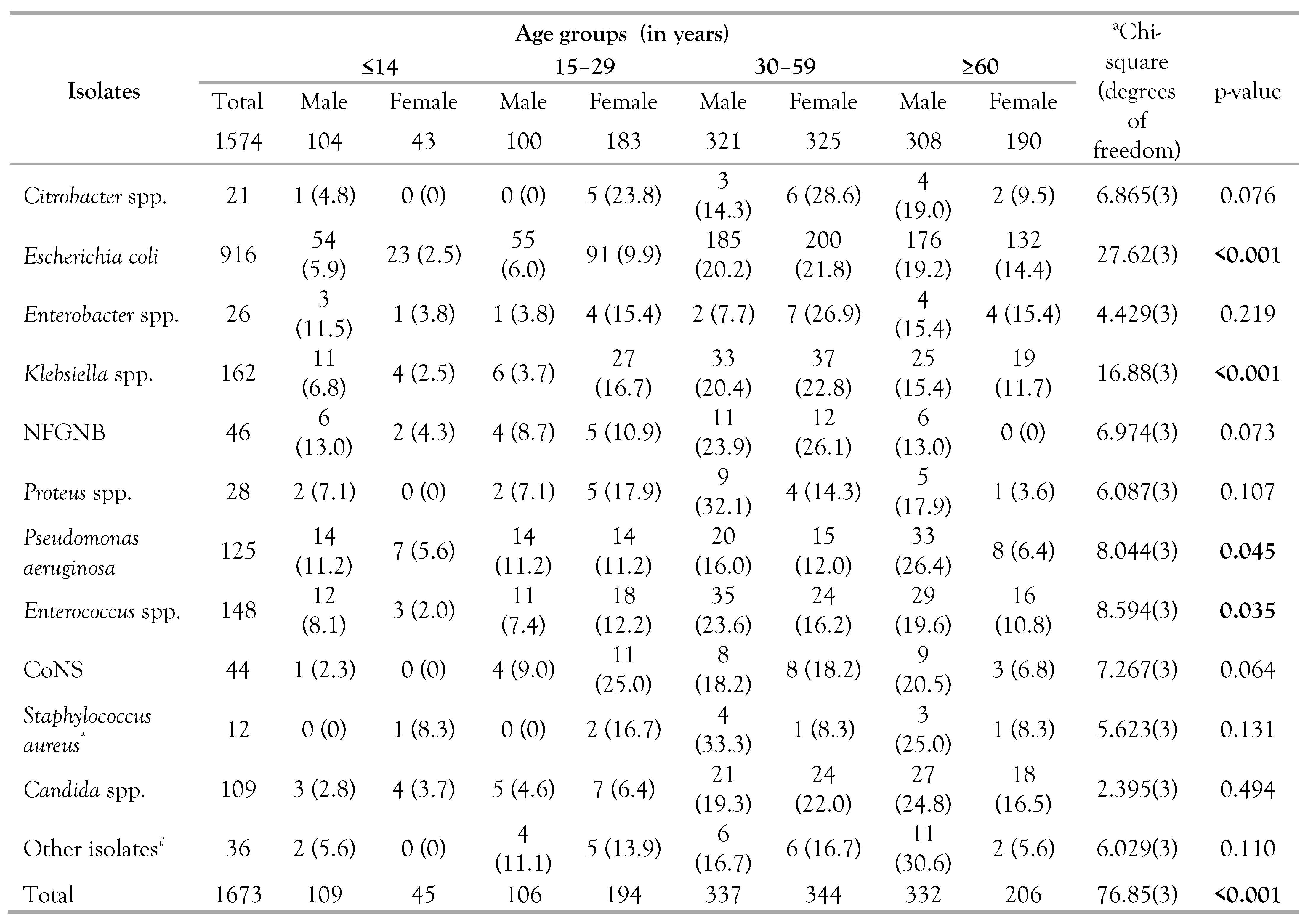
Importantly, a total of 1673 isolates were obtained from 1574 urine samples (1475 samples grew a single pathogen; 99 samples grew two pathogens including 86 Gram-positive and Gram-negative bacteria, 9 Gram-negative bacteria with yeast, and 4 Gram-positive bacteria with yeast). Gram-negative bacteria represented 70.4% of the isolates and E. coli (54.8%) was the leading pathogen followed by Klebsiella spp. (9.7%) and Pseudomonas spp. (7.5%). The frequency of isolation of uropathogens was significantly higher in the 30-59 years age group (p<0.001, χ(3)=76.850) (Table 1). E. coli (75.7%) and Klebsiella spp. (70.1%) were significantly more frequent in patients with ages over 30 years (p<0.001, χ(3)=27.620 and p<0.001, χ(3)=16.880, respectively). Enterococcus spp. (8.5%) was the most frequent Gram-positive pathogen; it was identified more commonly in patients belonging to middle age group (30-59 years, 40% of cases) and was associated with male gender (p=0.035, χ(3)=8.594). The incidence of Candida spp. was significant in the age group >50 years (61.5%) (p=0.016, χ(1)=29.1). The rate of isolation of coagulase negative staphylococci (CoNS) was higher (75%) in patients aged ≥30 years but the gender difference was not significant (p=0.060, χ(1)=3.536). Non-fermenting Gram-negative bacilli (NFGNB, presumptively identified as Acinetobacter spp.) were more commonly noted (91%) among IP (p=0.001, χ(1)=13.29 for NFGNB vs. other isolates compared in OP and IP).

Table 1.
Frequency distribution of uropathogens among different gender and age groups. Data are reported as number of isolates and percentages (within brackets) of total patients in each age group.
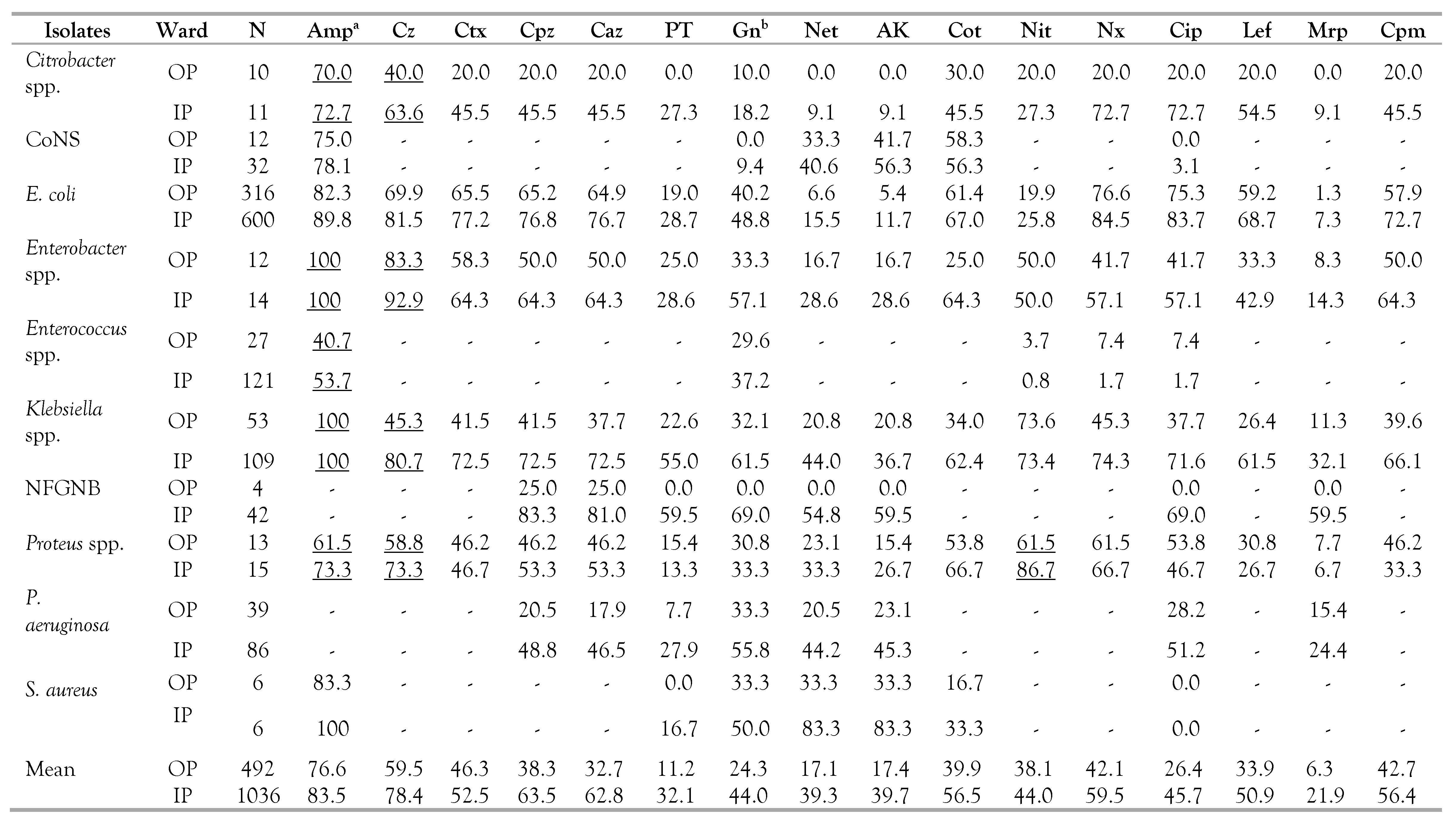
The percentage of resistance to commonly used antibiotics among these groups (IP and OP) is shown in Table 2. Most of the isolates were resistant to ampicillin (80%) and cephalosporins (60%); resistance to cephalosporins and fluoroquinolones (ciprofloxacin) was found to be higher among IP. UTI associated with Klebsiella spp. and NFGNB did not demonstrate susceptibility to the commonly used antimicrobial agents. Enterobacteriaceae other than Klebsiella spp. demonstrated higher susceptibility to carbapenems (93 %), aminoglycosides (amikacin 85.8%) and nitrofurantoin (83%). Fluoroquinolones were effective (>93%) for all Gram-positive bacteria isolated.
Table 2.
Percentage of antibiotic resistance of individual bacterial pathogens isolated from inpatients and outpatients.
Discussion
Correct diagnosis and treatment of UTI have important ramification into patients’ health, selective pressure for antibiotic resistance, and healthcare costs [3,14]. The prevalence and antimicrobial susceptibility of uropathogens may vary with time and geographical area, and therefore monitoring the local etiology of UTI is beneficial to guiding empiric treatment [15,16].
The present retrospective study highlights the age- and gender-wise distribution of UTI and antibiotic resistance patterns of uropathogens in the population seeking healthcare services from a tertiary care setting in South India. The proportion of affected males was high among young children and those with ages over 60 years old. We identified a higher number of males in the age groups ≤14 and ≥60 years. Similarly, there was a greater predominance of young females (15-29 years), whereas in the middle age group (30-59 years), equal proportions of males and females had UTI, which was in concordance with the findings of similar studies [6,17]. Females are more prone to develop UTI, probably due to the characteristic anatomy of the urethra and the effect of normal physiological changes that affect the urinary tract—short urethra, its proximity to the anus, urethral trauma during intercourse, dilation of the urethra and stasis of urine during pregnancy [18,19].
E. coli was the most frequently encountered uropathogen in our study followed by Klebsiella spp., P. aeruginosa, and Enterococcus spp. The isolation rate of urinary pathogens is consistent with reports of other recently published studies [6,18,20,21,22,23,24]. However, studies from some other parts of the country have shown different isolation rates, probably due to variation in sample size, geographical location or population [5]. NFGNB isolation was more common in IP as seen in a study by Malini et al. [25]. Non-fermenters are ubiquitous in the environment, able to survive in the hospital environment and can spread among hospitalized patients. They are emerging nosocomial pathogens especially in seriously ill patients and are responsible for causing a variety of infections [25].
Antibiotic resistance has become a major clinical problem worldwide and has increased over the years [24,26]. Antimicrobial susceptibility patterns of the pathogens vary widely by region, patient population and type of healthcare facility [20]. Most of the isolates were resistant to multiple antibiotics at our setting. Resistance to ampicillin and the cephalosporins (first, second, third and fourth generation) was seen most commonly among Gram-negative bacilli. Fluoroquinolones, which are the mainstay for treatment of urinary tract infections, were not found to be useful even among Gram-negative bacilli (76.6%). This is similar (>74%) to previous studies in India [20]. P. aeruginosa, Acinetobacter spp. and Klebsiella spp. demonstrated higher resistance to relevant antibiotics, and were resistant to most antibiotics. Klebsiella spp. have the ability to acquire resistance genes by mutations and more commonly by transmissible plasmids [27]. Progressive spread and increasing incidence of carbapenem resistance among Klebsiella spp. has become a severe public health issue.[28] Since carbapenems are often the last line of defense against resistant Gram-negative infections, resistance to these antibiotics could result in greater morbidity, mortality, costs, and prolonged hospital stay [28].
Carbapenems showed the highest efficacy on uropathogens among all tested antibiotics, with a susceptibility rate of 95% and 81% in OP and IP cases respectively. Inappropriate use of antibiotics may lead to the emergence and spread of resistance genes among bacteria [29]. UTI due to these multi-drug resistant bacteria associate increased morbidity and mortality, higher treatment costs, and prolonged hospital stay, thereby adding to the economical burden [29]. The Infectious Diseases Society of America (IDSA) guidelines consider nitrofurantoin and cotrimoxazole as current standard therapy for uncomplicated UTI in women [7]. However, the guidelines specify that local antimicrobial susceptibility patterns should be taken into account. As shown by our study and some previous studies, [20,22,30] aminopenicillins, ciprofloxacin and co-trimoxazole may not be appropriate choices for empirical treatment of UTI in our setting. Clinical correlation and culture results of catheter samples should be given additional emphasis prior to starting antibiotic therapy especially when the culture demonstrates resistant bacteria. Recently, fosfomycin has been introduced for the treatment of infections with multidrug-resistant uropathogens for which there are limited treatment options. It has a unique mechanism of action, which may provide a synergistic effect with other antibiotics including β-lactams, aminoglycosides and fluoroquinolones [31]. Good clinical practice should guide the use of the limited antibiotics left. Additionally, regional surveillance programs would be necessary to update the treatment guidelines of UTI in India.
Overall, this study provides important data on antimicrobial resistance among uropathogens in India. The limitations of the study were that it was laboratory based and limited to the cases for which cultures were requested from the clinic. Information on antibiotics administered prior to culture or data on subsequent treatment and its outcome in this study population would have added meaningful data to allow a better understanding of the prevalent practice in diagnosis and treatment of UTI in South India. Details on the method of collection were not available for all patients, limiting the analysis of the pathogens from these samples.
The rate of resistance to carbapenem among Gram-negative bacilli seen in our institution could possibly be due to the fact that this is a reference center, and that many of the patients had prior contact with other healthcare institutions and history of antibiotic use. Therefore, some data may be skewed and not entirely representative for similar patient populations at other types of healthcare institutions.
Conclusions
The uropathogens showed high levels of resistance to multiple urinary antimicrobial agents. Therefore, therapy should only be advocated, as far as possible, after culture and sensitivity has been performed and if required. Antibiotic resistance is becoming a huge public health problem that can lead to limited options for treatment, increasing hospitalization and associated costs.
Author Contributions
SN designed and supervised the study. BSK collected and analyzed the data, and drafted the manuscript. All authors reviewed and approved the final version of the manuscript.
Conflicts of Interest
All authors—none to declare.
References
- Janifer, J.; Geethalakshmi, S.; Satyavani, K.; Viswanathan, V. Prevalence of lower urinary tract infection in South Indian type 2 diabetic subjects. Indian J. Nephrol. 2009, 19, 107–111. [Google Scholar] [CrossRef] [PubMed]
- Stamm, W.E.; Norrby, S.R. Urinary tract infections: Disease panorama and challenges. J. Infect. Dis. 2001, 183 (Suppl. S1), S1–S4. [Google Scholar] [CrossRef]
- Flores-Mireles, A.L.; Walker, J.N.; Caparon, M.; Hultgren, S.J. Urinary tract infections: Epidemiology, mechanisms of infection and treatment options. Nat. Rev. Microbiol. 2015, 13, 269–284. [Google Scholar] [CrossRef]
- Naveen, R.; Mathai, E. Some virulence characteristics of uropathogenic Escherichia coli in different patient groups. Indian J. Med. Res. 2005, 122, 143–147. [Google Scholar] [PubMed]
- Gupta, S.; Kapur, S.; Padmavathi, D. Comparative prevalence of antimicrobial resistance in communityacquired urinary tract infection cases from representative States of northern and southern India. J. Clin. Diagn. Res. 2014, 8, DC09–12. [Google Scholar] [CrossRef] [PubMed]
- Prakash, D.; Saxena, R.S. Distribution and antimicrobial susceptibility pattern of bacterial pathogens causing urinary tract infection in urban community of meerut city, India. ISRN Microbiol. 2013, 2013, 749629. [Google Scholar] [CrossRef]
- Shaifali, I.; Gupta, U.; Mahmood, S.E.; Ahmed, J. Antibiotic susceptibility patterns of urinary pathogens in female outpatients. N. Am. J. Med. Sci. 2012, 4, 163–169. [Google Scholar]
- Kostakioti, M.; Hultgren, S.J.; Hadjifrangiskou, M. Molecular blueprint of uropathogenic Escherichia coli virulence provides clues toward the development of anti-virulence therapeutics. Virulence 2012, 3, 592–594. [Google Scholar] [CrossRef]
- Nickel, J.C. Urinary tract infections and resistant bacteria: Highlights of a Symposium at the Combined Meeting of the 25th International Congress of Chemotherapy (ICC) and the 17th European Congress of Clinical Microbiology and Infectious Diseases (ECCMID), March 31-April 3, 2007, Munich, Germany. Rev. Urol. 2007, 9, 78–80. [Google Scholar]
- Rudramurthy KGKumaran, R.; Geetha, R.K. Etiology and antimicrobial susceptibility pattern of bacterial agents from urinary tract infection in a tertiary care centre. Int. J. Sci. Study 2015, 2, 125–127. [Google Scholar]
- Gupta, V.; Yadav, A.; Joshi, R.M. Antibiotic resistance pattern in uropathogens. Indian J. Med. Microbiol. 2002, 20, 96–98. [Google Scholar]
- Collee, J.G.; Fraser, A.G.; Marmion, B.P.; Simmons, A. (Eds.) Mackey and MacCartney’s Practical Medical Microbiology, 14th ed.; Churchill Livingstone Publishers: Singapore, 2003. [Google Scholar]
- Clinical and Laboratory Standards Institute. Performance Standards for Antimicrobial Susceptibility Testing; 21st Informational Supplement, CLSI-2012. M100-S21, Vol.31 No.1; Clinical and Laboratory Standards Institute: Wayne, PA, USA, 2012. [Google Scholar]
- Najar, M.S.; Saldanha, C.L.; Banday, K.A. Approach to urinary tract infections. Indian J. Nephrol. 2009, 19, 129–139. [Google Scholar] [CrossRef]
- Foxman, B. The epidemiology of urinary tract infection. Nat. Rev. Urol. 2010, 7, 653–660. [Google Scholar] [CrossRef]
- Banerjee, S. The study of urinary tract infections and antibiogram of uropathogens in and around Ahmadnagar, Maharashtra. Internet J. Infect. Dis. 2009, 9, 1–5. [Google Scholar]
- Minardi, D.; d’Anzeo, G.; Cantoro, D.; Conti, A.; Muzzonigro, G. Urinary tract infections in women: Etiology and treatment options. Int. J. Gen. Med. 2011, 4, 333–343. [Google Scholar] [CrossRef]
- Dash, M.; Padhi, S.; Mohanty, I.; Panda, P.; Parida, B. Antimicrobial resistance in pathogens causing urinary tract infections in a rural community of Odisha, India. J. Family Community Med. 2013, 20, 20–26. [Google Scholar] [CrossRef] [PubMed]
- Kothari, A.; Sagar, V. Antibiotic resistance in pathogens causing community-acquired urinary tract infections in India: A multicenter study. J. Infect. Dev. Ctries. 2008, 2, 354–358. [Google Scholar] [CrossRef]
- Sood, S.; Gupta, R. Antibiotic resistance pattern of community acquired uropathogens at a tertiary care hospital in Jaipur, Rajasthan. Indian J. Community Med. 2012, 37, 39–44. [Google Scholar] [CrossRef] [PubMed]
- Nagaraj, S.; Kalal, B.S.; Kamath, N.; Muralidharan, S. Microbiological and antimicrobial profile of pathogens associated with pediatric urinary tract infection: A one year retrospective study from a tertiary care teaching hospital. Natl. J. Lab. Med. 2014, 3, 4–7. [Google Scholar]
- Eshwarappa, M.; Dosegowda, R.; Aprameya, I.V.; Khan, M.W.; Kumar, P.S.; Kempegowda, P. Clinico-microbiological profile of urinary tract infection in south India. Indian J. Nephrol. 2011, 21, 30–36. [Google Scholar] [CrossRef] [PubMed]
- Sharma, I.; Paul, D. Prevalence of community acquired urinary tract infections in Silchar Medical College, Assam, India and its antimicrobial susceptibility profile. Indian J. Med. Sci. 2012, 66, 273–279. [Google Scholar] [CrossRef] [PubMed]
- Kaur, N.; Sharma, S.; Malhotra, S.; Madan, P.; Hans, C. Urinary tract infection: Aetiology and antimicrobial resistance pattern in infants from a tertiary care hospital in northern India. J. Clin. Diagn. Res. 2014, 8, DC01–3. [Google Scholar] [CrossRef] [PubMed]
- Malini, A.; Deepa, E.; Gokul, B.; Prasad, S. Nonfermenting gram-negative bacilli infections in a tertiary care hospital in Kolar, Karnataka. J. Lab. Physicians 2009, 1, 62–66. [Google Scholar] [CrossRef] [PubMed]
- Gelband, H.; Miller-Petrie, M.; Pant, S.; et al. Center for Disease Dynamics and Economics & Policy. State of the World’s Antibiotics. CDDEP, Washington, DC, USA, 2015. [Google Scholar]
- Lombardi, F.; Gaia, P.; Valaperta, R.; et al. Emergence of carbapenem-resistant Klebsiella pneumoniae: Progressive spread and four-year period of observation in a cardiac surgery division. Biomed. Res. Int. 2015, 2015, 871947. [Google Scholar] [CrossRef]
- Xu, Y.; Gu, B.; Huang, M.; Liu, H.; et al. Epidemiology of carbapenem resistant Enterobacteriaceae (CRE) during 2000-2012 in Asia. J. Thorac. Dis. 2015, 7, 376–385. [Google Scholar]
- Kapil, A. Taming antimicrobial resistance: A national challenge. Natl. Med. J. India 2015, 28, 1–3. [Google Scholar]
- Saha, S.; Nayak, S.; Bhattacharyya, I.; et al. Understanding the patterns of antibiotic susceptibility of bacteria causing urinary tract infection in West Bengal, India. Front. Microbiol. 2014, 5, 463. [Google Scholar] [CrossRef]
- Michalopoulos, A.S.; Livaditis, I.G.; Gougoutas, V. The revival of fosfomycin. Int. J. Infect. Dis. 2011, 15, e732–9. [Google Scholar] [CrossRef]
© GERMS 2016.