Effects of Biochar on Soil Aggregation and Distribution of Organic Carbon Fractions in Aggregates


Abstract
1. Introduction
2. Materials and Methods
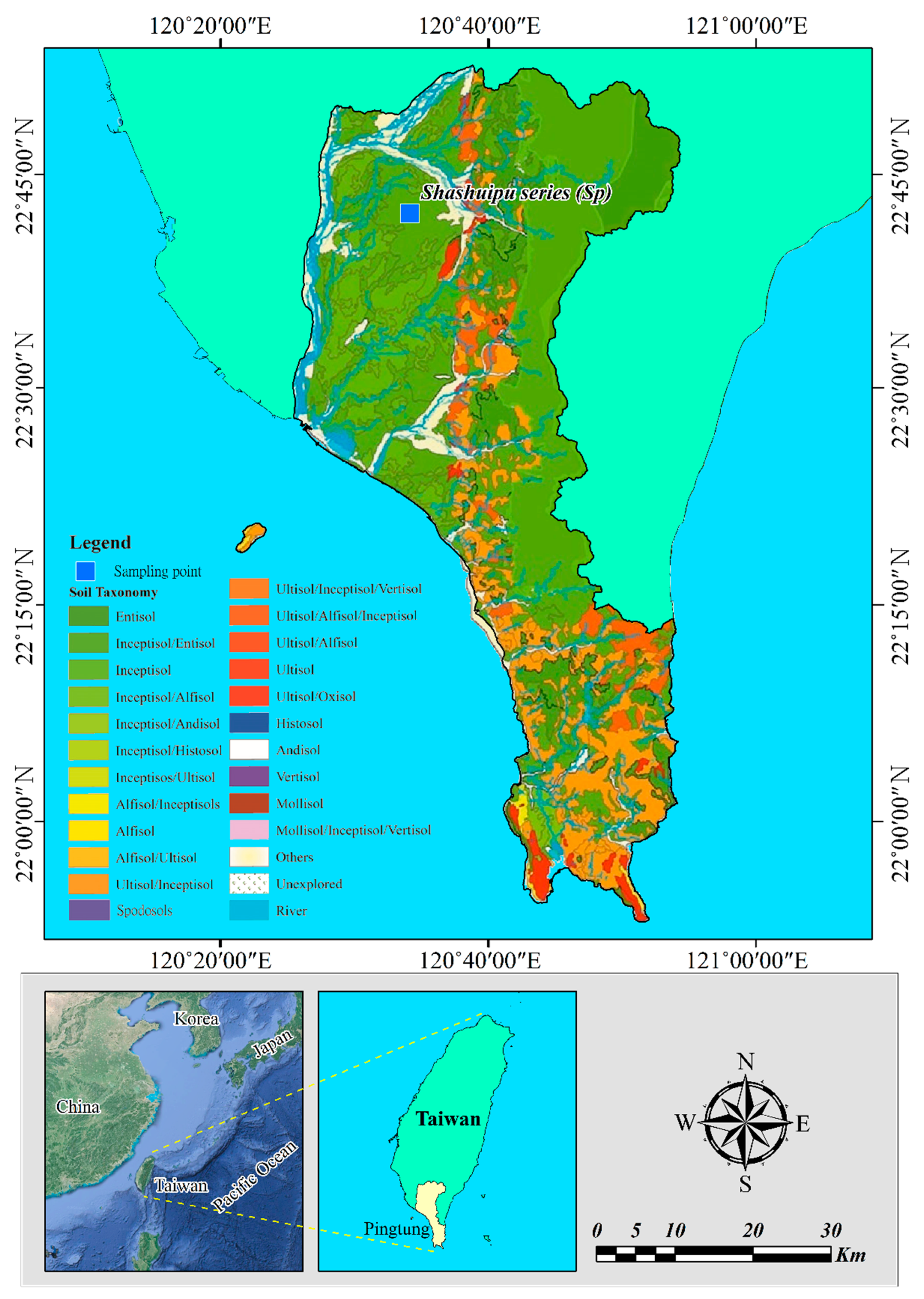
2.1. Studied Soil
2.2. Biochar and Compost
2.3. Incubation Experiment
2.4. Measuring the Stability of Soil Aggregates through Wet Sieving
2.5. Measuring OC Content through Wet Oxidation
2.6. Water-Extractable Organic Carbon (WEOC)
2.7. Readily Oxidizable Carbon
2.8. Analyzing MBC
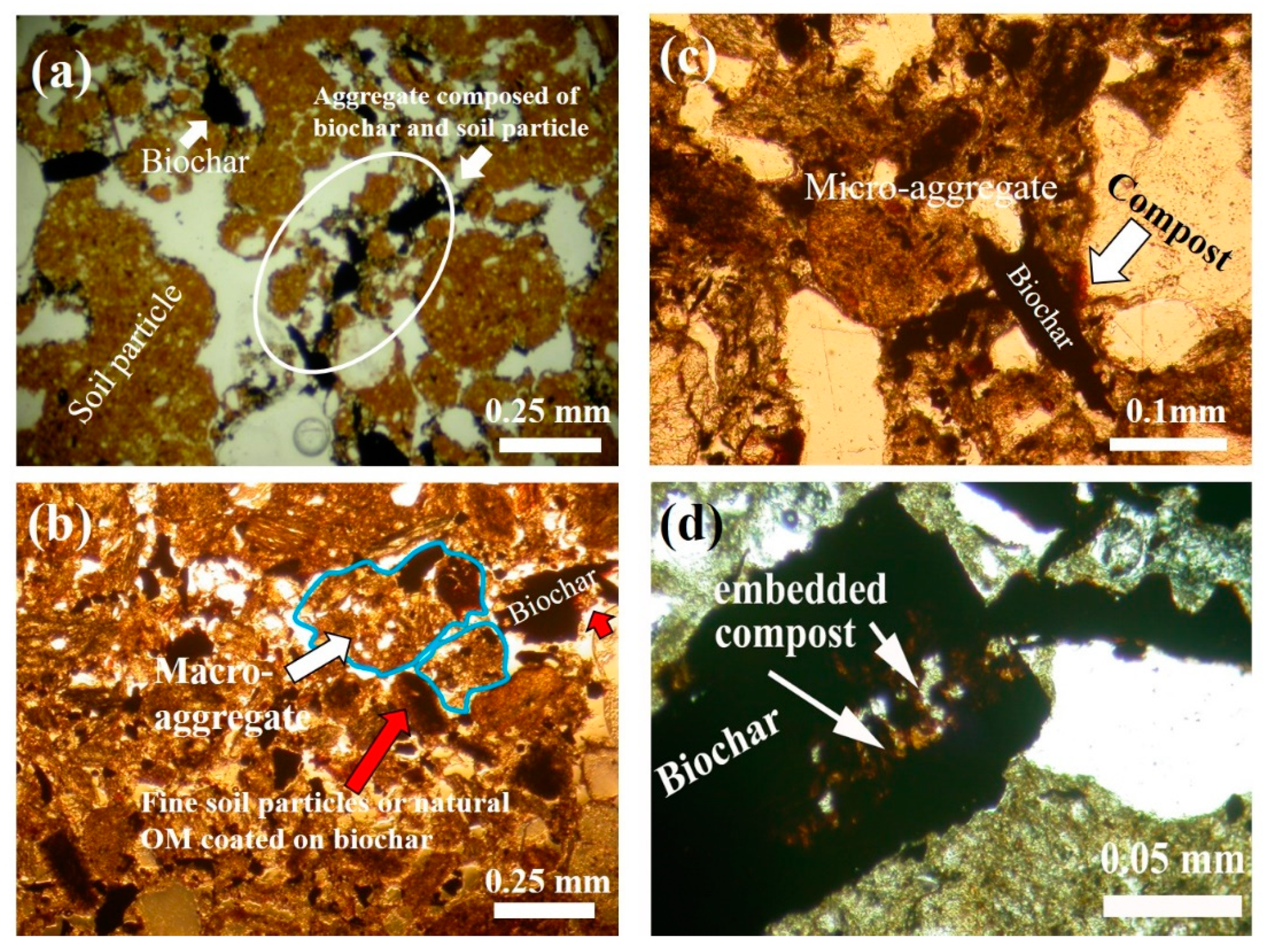
2.9. Soil Micromorphology
2.10. Statistical Analysis
3. Results
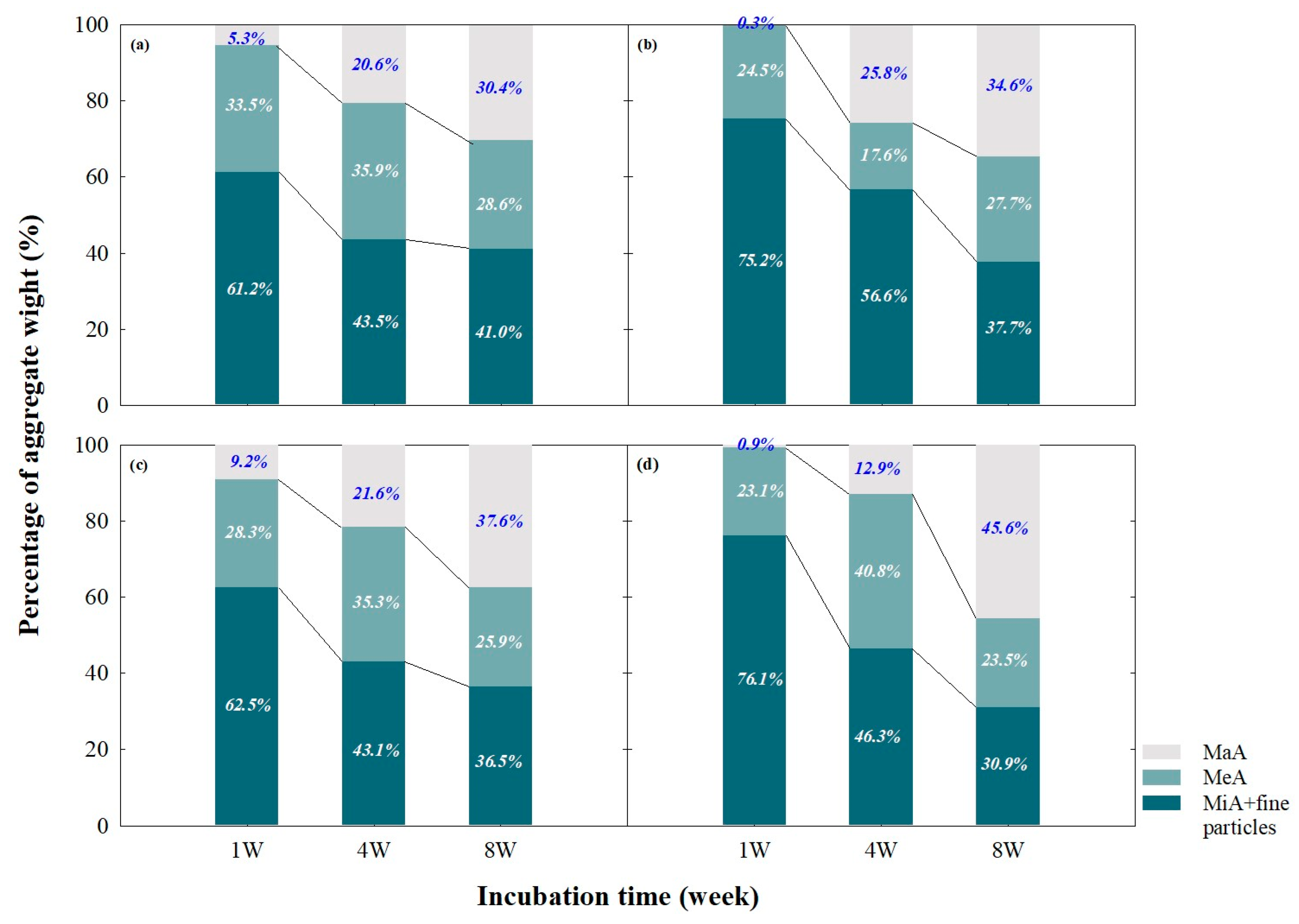
3.1. Changes in the Weight of Soil Aggregates after Treatment with Biochar and Compost
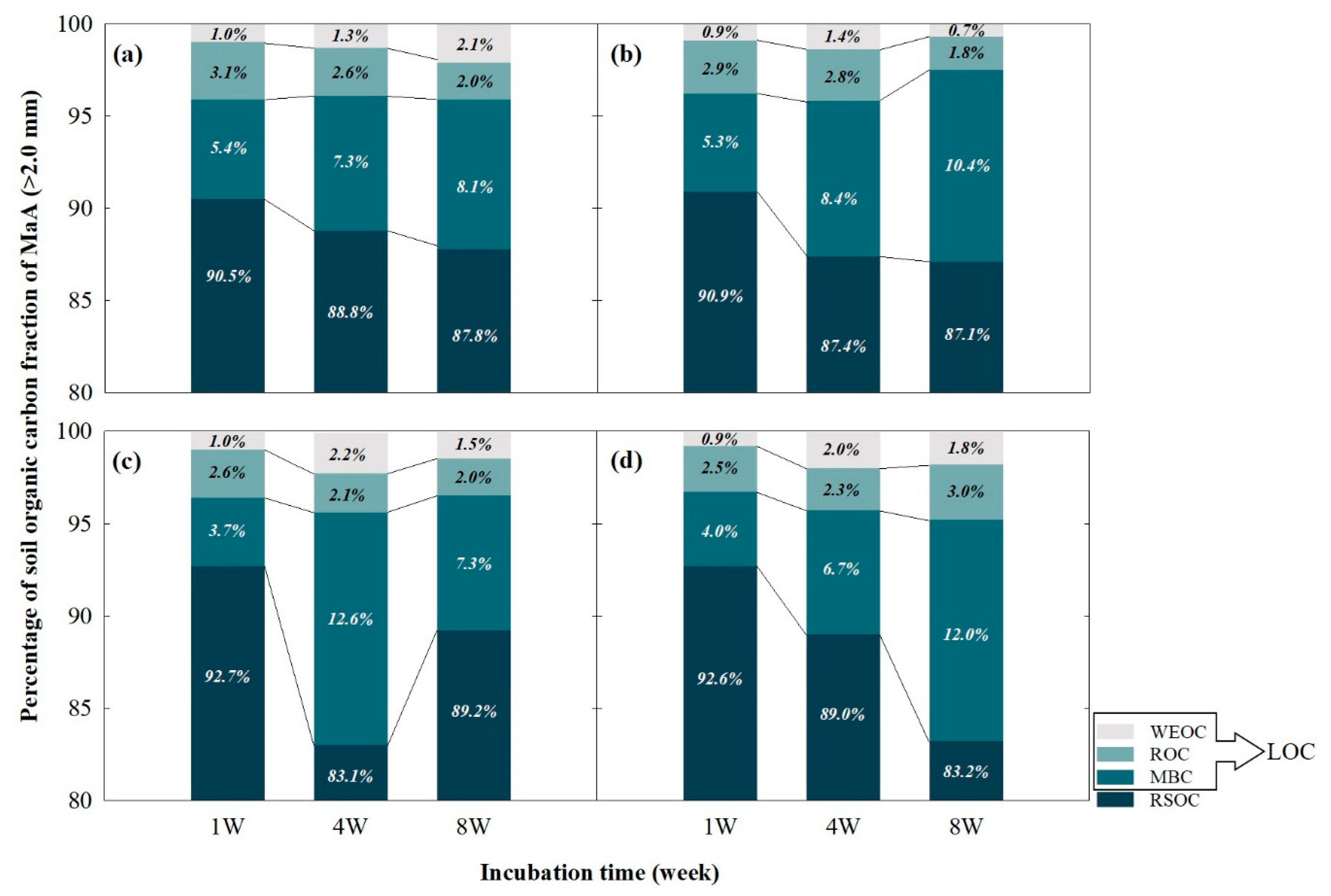
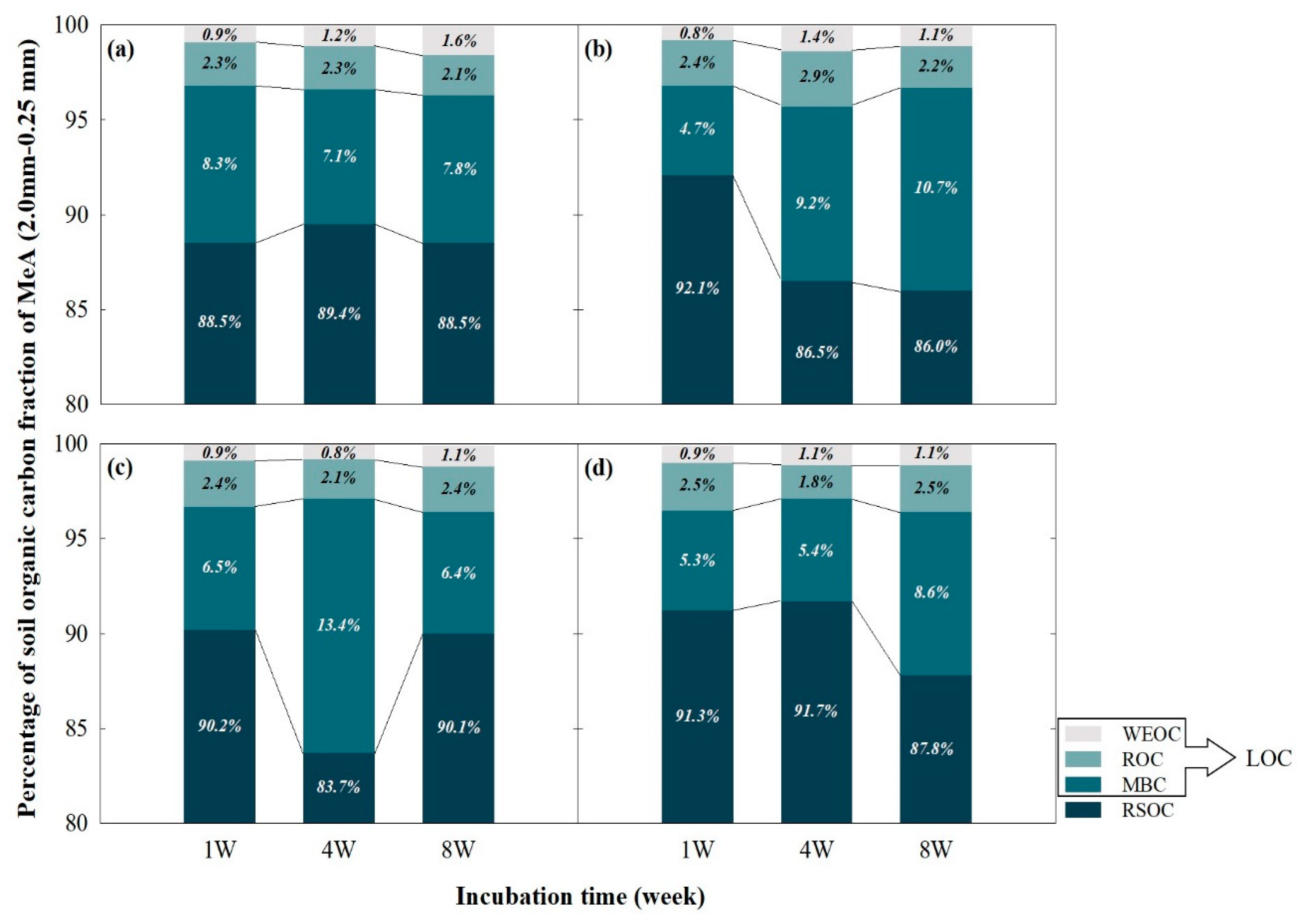
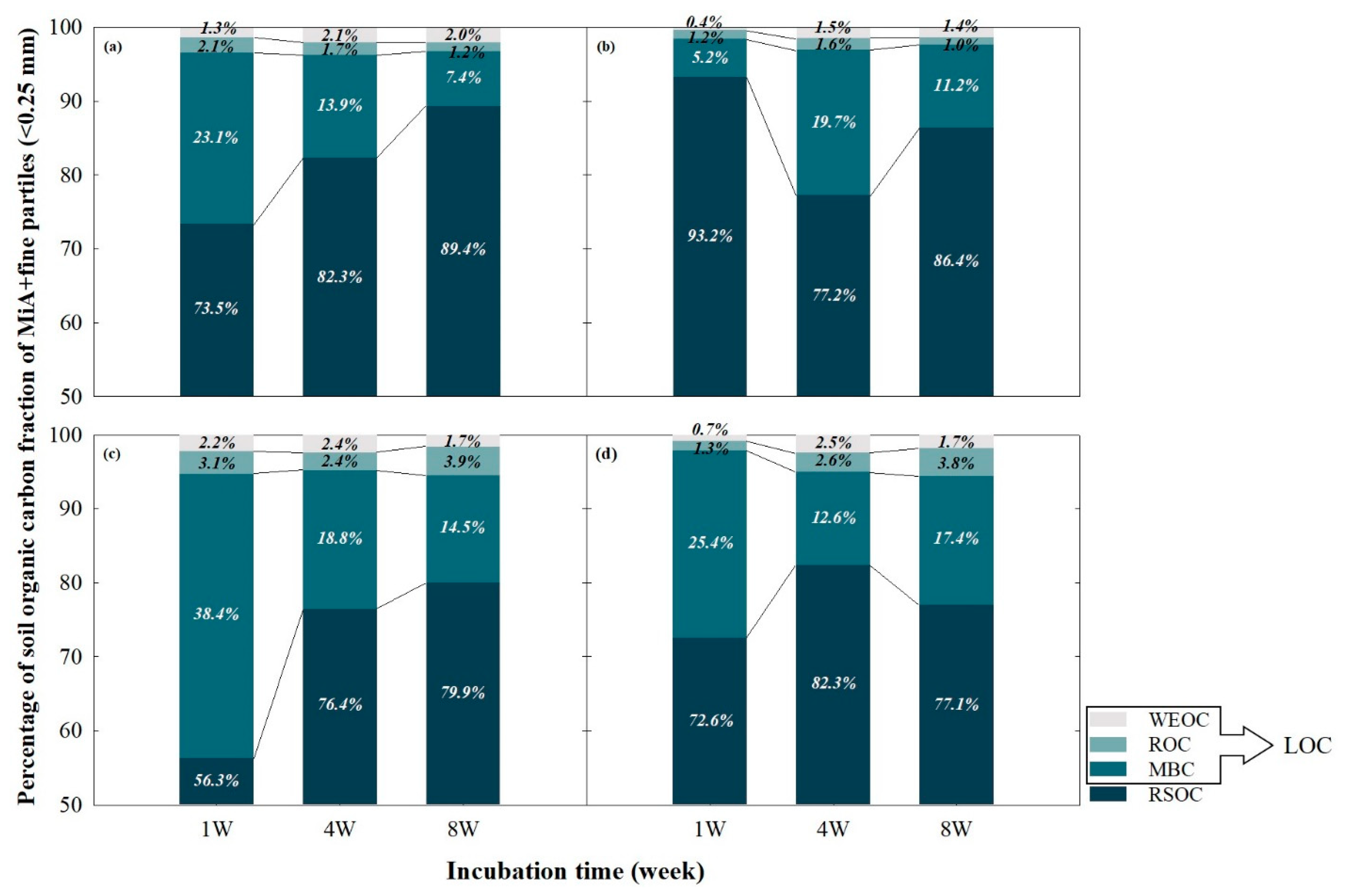
3.2. Distribution and Classification of OC in Biochar and Compost-Treated Soil Aggregates
4. Discussion
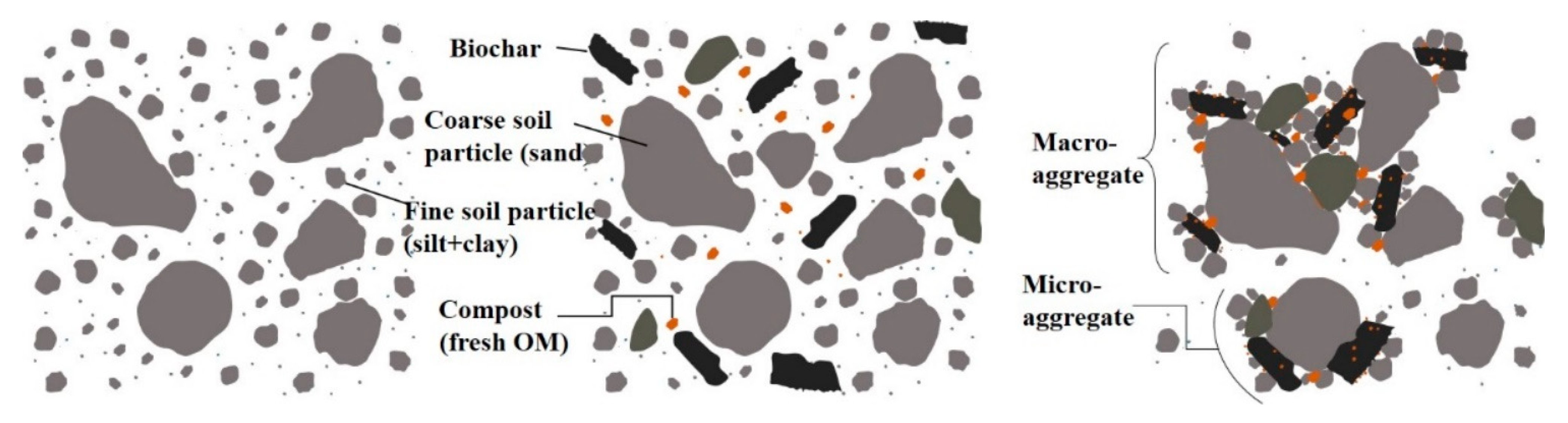
4.1. Effects of Biochar on the Formation of Soil Aggregates
4.2. Formation Mechanism of Soil Aggregation
5. Conclusions
Author Contributions
Funding
Institutional Review Board Statement
Informed Consent Statement
Data Availability Statement
Acknowledgments
Conflicts of Interest
Appendix A

| Time | MaAs (>2.0 mm) | MeAs (2.0–0.25 mm) | MiAs + Fine Particles (<0.25 mm) | |||||||||
|---|---|---|---|---|---|---|---|---|---|---|---|---|
| CK | RHB | COM | RHB + COM | CK | RHB | COM | RHB + COM | CK | RHB | COM | RHB + COM | |
| % | ||||||||||||
| 1w | 24.3 ± 4.42 bA * | 0.30 ± 0.02 cC | 9.20 ± 1.76 cB | 0.90 ± 0.11 cC | 14.5 ± 2.48 cB | 24.5 ± 2.36 aA | 28.3 ± 2.48 bA | 23.1 ± 3.61 bA | 61.2 ± 2.69 aB | 75.2 ± 1.93 aA | 62.5 ± 2.55 aB | 76.1 ± 3.01 aA |
| 4w | 20.6 ± 3.00 bB | 25.8 ± 1.45 bA | 21.6 ± 1.71 bB | 12.9 ± 1.55 bC | 35.9 ± 1.54 aB | 17.6 ± 1.41 bC | 35.3 ± 1.99 aB | 40.8 ± 2.34 aA | 43.5 ± 2.41 bB | 55.6 ± 2.63 bA | 43.1 ± 1.65 bB | 46.3 ± 2.91 bB |
| 8w | 32.4 ± 2.67 aC | 34.6 ± 2.70 aBC | 37.6 ± 2.12 aB | 45.6 ± 2.78 aA | 28.6 ± 1.23 bA | 27.7 ± 2.85 aAB | 25.9 ± 2.07 bAB | 23.5 ± 2.65 bB | 39.0 ± 2.25 bA | 37.7 ± 2.21 cA | 36.5 ± 2.46 cA | 30.9 ± 2.31 cB |
| Time | WEOC | ROC | MBC | RSOC | ||||||||||||
|---|---|---|---|---|---|---|---|---|---|---|---|---|---|---|---|---|
| CK | RHB | COM | RHB + COM | CK | RHB | COM | RHB + COM | CK | RHB | COM | RHB + COM | CK | RHB | COM | RHB + COM | |
| mg/kg | ||||||||||||||||
| 1w | 86.3 ± 11.0 bA * | 80.5 ± 10.0 bA | 94.8 ± 10.7 cA | 86.5 ± 5.19 bA | 267± 4.92 aA | 259 ± 16.3 aA | 246 ± 10.6 aA | 240 ± 29.1 bA | 466 ± 169 bA | 474 ± 129 bA | 351 ± 173 cA | 384 ± 88.7 bA | 7810 ± 1132 aA | 8133 ± 404 aA | 8783 ± 365 aA | 8893 ± 359 aA |
| 4w | 114 ± 16.6 bB | 125 ± 8.63 aB | 217 ± 25.7 aA | 195 ± 25.4 aA | 229 ± 19.1 bB | 251 ± 1.25 aA | 207 ± 12.4 bB | 223 ± 0.87 bB | 643 ± 97.3 abC | 907 ± 6.82 aB | 1241 ± 1.97 aA | 652 ± 79.9 bC | 7823 ± 215.0 aA | 7697 ± 1007 aA | 8183 ± 541 aA | 8653 ± 412 abA |
| 8w | 189 ± 24.9 aA | 63.1 ± 8.65 bB | 153 ± 7.17 bA | 177 ± 23.7 aA | 180 ± 19.1 cBC | 162 ± 12.7 bC | 205 ± 16.4 bB | 295 ± 28.3 aA | 846 ± 63.9 aA | 937 ± 218 aA | 746 ± 43.6 bA | 1181 ± 382 aA | 7780 ± 1019 aA | 7843 ± 805 aA | 9123 ± 1083 aA | 8187 ± 480 bA |
| Time | WEOC | ROC | MBC | RSOC | ||||||||||||
|---|---|---|---|---|---|---|---|---|---|---|---|---|---|---|---|---|
| CK | RHB | COM | RHB + COM | CK | RHB | COM | RHB + COM | CK | RHB | COM | RHB+COM | CK | RHB | COM | RHB + COM | |
| mg/kg | ||||||||||||||||
| 1w | 77.6 ± 5.38 cA * | 71.6 ± 11.0 bA | 84.9 ± 4.86 bA | 86.5 ± 13.3 aA | 267 ± 4.92 aA | 259 ± 16.3 aA | 246 ± 10.6 aA | 240 ± 29.1 aA | 466 ± 169 bA | 474 ± 129 bA | 350 ± 173 cA | 384 ± 88.8 cA | 7810 ± 1130 aA | 8133 ± 404 aA | 8783 ± 365 aA | 8893 ± 359 aA |
| 4w | 105 ± 7.63 bAB | 125 ± 28.8 aA | 79.1 ± 11.4 bB | 107 ± 21.4 aAB | 203 ± 9.78 bB | 260 ± 1.34 aA | 206 ± 5.51 bB | 175 ± 3.20 bC | 626 ± 75.8 abC | 933 ± 68.5 aB | 1320 ± 39.7 aA | 525 ± 22.5 bC | 7877 ± 380 aA | 7657 ± 748 aA | 8250 ± 702 aA | 8923 ± 725 aA |
| 8w | 144 ± 18.9 aA | 99.1 ± 17.2 abB | 113 ± 18. 6aAB | 108 ± 11.8 aB | 189 ± 11.6 bB | 198 ± 22.7 bB | 245 ± 10.9 aA | 246 ± 14.2 aA | 701 ± 30.4 aC | 963 ± 12.5 aA | 655 ± 41.0 bC | 846 ± 66.8 aB | 7960 ± 465 aAB | 7743 ± 814 aB | 9217 ± 730 aA | 8640 ± 673 aAB |
| Time | WEOC | ROC | MBC | RSOC | ||||||||||||
|---|---|---|---|---|---|---|---|---|---|---|---|---|---|---|---|---|
| CK | RHB | COM | RHB + COM | CK | RHB | COM | RHB + COM | CK | RHB | COM | RHB + COM | CK | RHB | COM | RHB + COM | |
| mg/kg | ||||||||||||||||
| 1w | 112 ± 6.22 bB * | 35.6 ± 1.62 bD | 208 ± 22.1 abA | 67.2 ± 4.40 cC | 181 ± 10.4 aB | 107 ± 20.1 bC | 293 ± 25.6 bA | 125 ± 24.0 cC | 1993 ± 558 aB | 465 ± 116 cC | 3639 ± 362 aA | 2440 ± 12.2 aB | 6343 ± 297 cC | 8343 ± 270 aA | 5337 ± 320 bD | 6977 ± 332 bB |
| 4w | 185 ± 10.0 aB | 134 ± 5.61 aC | 236 ± 16.2 aA | 243 ± 20.4 aA | 149 ± 11.3 bC | 143 ± 1.08 aC | 236 ± 5.22 cB | 253 ± 8.26 bA | 1225 ± 66.1 bB | 1769 ± 7.36 aA | 1852 ± 344 bA | 1225 ± 9.52 cB | 7250 ± 368 bB | 6930 ± 346 bB | 7523 ± 345 aAB | 8000 ± 351 aA |
| 8w | 179 ± 11.7 aA | 126 ± 7.37 aB | 174 ± 17.1 bA | 167 ± 13.5 bA | 108 ± 14.0 cC | 89.9 ± 4.80 bD | 399 ± 6.75 aA | 374± 5.02 aB | 665 ± 92.9 bC | 1009 ± 33.2 bB | 1483 ± 283 bA | 1712 ± 52.7 bA | 8040 ± 400 aA | 7780 ± 276 aA | 8170 ± 346 aA | 7587 ± 317 abA |
References
- Kimetu, J.M.; Lehmann, J. Stability and stabilisation of biochar and green manure in soil with different organic carbon contents. Aust. J. Soil Res. 2010, 48, 577–585. [Google Scholar] [CrossRef] [Scilit]
- Hseu, Z.Y.; Jien, S.H.; Chien, W.H.; Liou, R.C. Impacts of Biochar on Physical Properties and Erosion Potential of a Mudstone Slopeland Soil. Sci. World J. 2014, 2014, 602197. [Google Scholar] [CrossRef] [Scilit]
- Jien, S.H.; Wang, C.C.; Lee, C.H.; Lee, T.Y. Stabilization of organic matter by biochar application in compost-amended soils with contrasting pH and textures. Sustainability 2015, 7, 13317–13333. [Google Scholar] [CrossRef] [Scilit]
- Jien, S.H.; Chen, W.C.; Ok, Y.S.; Awad, Y.M.; Liao, C.S. Short-term biochar application induced variations in C and N mineralization in a compost-amended tropical soil. Environ. Sci. Pollut. Res. 2018, 25, 25715–25725. [Google Scholar] [CrossRef] [Scilit]
- Lee, C.H.; Wang, C.C.; Lin, H.H.; Lee, S.S.; Tsang, D.C.W.; Jien, S.H.; Ok, Y.S. In-situ biochar application conserves nutrients while simultaneously mitigating runoff and erosion of an Fe-oxide-enriched tropical soil. Sci. Total Environ. 2018, 619, 665–671. [Google Scholar] [CrossRef] [Scilit] [PubMed]
- Jien, S.H.; Kuo, Y.L.; Liao, C.S.; Wu, Y.T.; Igalavithana, A.D.; Tsang, D.C.W.; Ok, Y.S. Effects of field scale in situ biochar incorporation on soil environment in a tropical highly weathered soil. Environ. Pollut. 2021, 272, 116009. [Google Scholar] [CrossRef] [Scilit]
- Gul, S.; Whalen, J.K. Biochemical cycling of nitrogen and phosphorus in biochar-amended soils. Soil Biol. Biochem. 2016, 103, 1–15. [Google Scholar] [CrossRef] [Scilit]
- Pandian, K.; Subramaniayan, P.; Gnasekaran, P.; Chitraputhirapillai, S. Effect of biochar amendment on soil physical, chemical and biological properties and groundnut yield in rainfed Alfisol of semi-arid tropics. Arch. Agron. Soil Sci. 2016, 62, 1293–1310. [Google Scholar] [CrossRef] [Scilit]
- Du, Z.L.; Zhao, J.K.; Wang, Y.D.; Zhang, Q.Z. Biochar addition drives soil aggregation and carbon sequestration in aggregate fractions from an intensive agricultural system. Biochar A Sustain. Environ. 2017, 17, 581–589. [Google Scholar] [CrossRef] [Scilit]
- Zhang, Y.L.; Chen, H.; Bai, S.H.; Menke, C.; Zhang, M.Y.; Xu, Z.H. Interactive effects of biochar addition and elevated carbon dioxide concentration on soil carbon and nitrogen pools inmine spoil. J. Soils Sediments 2017, 17, 2400–2409. [Google Scholar] [CrossRef] [Scilit]
- Zhang, J.; Sun, C.; Liu, G.; Xue, S. Effects of long-term fertilisation on aggregates and dynamics of soil organic carbon in a semi-arid agro-ecosystem in China. PeerJ 2018, 6, e4758. [Google Scholar] [CrossRef] [Scilit] [PubMed]
- Gunina, A.; Kuzyakov, Y. Pathways of litter C by formation of aggregates and SOM density fractions: Implications from 13C natural abundance. Soil Biol. Biochem. 2014, 71, 95–104. [Google Scholar] [CrossRef] [Scilit]
- El-Naggar, A.; Awad, Y.M.; Tang, X.Y.; Liu, C.; Niazi, N.K.; Jien, S.H.; Tsang, D.C.W.; Song, H.C.; Ok, Y.S.; Lee, S.S. Biochar influences soil carbon pools and facilitates interactions with soil: A field investigation. Land Dev. Degrad. 2018, 29, 2162–2171. [Google Scholar] [CrossRef] [Scilit]
- Fan, R.; Yang, X.; Drury, C.F.; Guo, X.; Zhang, X. Distribution and stability of organic carbon in soil aggregate external and internal layers under three different land-use systems. Soil Sci. Soc. Am. J. 2013, 77, 1625–1635. [Google Scholar] [CrossRef] [Scilit]
- Six, J.; Elliott, E.T.; Paustian, K. Soil macroaggregate turnover and microaggregate formation: A mechanism for C sequestration under no-tillage agriculture. Soil Biol. Biochem. 2000, 32, 2099–2103. [Google Scholar] [CrossRef] [Scilit]
- Zheng, H.; Wang, X.; Luo, X.; Wang, Z.; Xing, B. Biochar-induced negative carbon mineralization priming effects in a coastal wetland soil: Roles of soil aggregation and microbial modulation. Sci. Total Environ. 2018, 610–611, 951–960. [Google Scholar] [CrossRef] [Scilit]
- Huang, R.; Tian, D.; Liu, J.; Lv, S.; He, X.; Gao, M. Responses of soil carbon pool and soil aggregates associated organic carbon to straw and straw-derived biochar addition in a dryland cropping mesocosm system. Agric. Ecosyst. Environ. 2018, 265, 576–586. [Google Scholar] [CrossRef] [Scilit]
- Oades, J.M. Soil organic matter and structural stability: Mechanisms and implications for management. Plant Soil 1984, 76, 319–337. [Google Scholar] [CrossRef] [Scilit]
- Awad, Y.M.; Blagodatskaya, E.; Ok, Y.S.; Kuzyakov, Y. Effects of polyacrylamide, biopolymer and biochar on the decomposition of 14C-labelled maize residues and on their stabilization in soil aggregates. Eur. J. Soil Sci. 2013, 64, 488–499. [Google Scholar] [CrossRef] [Scilit]
- Six, J.; Bossuyt, H.; De Gryze, S.; Denef, K. A history of research on the link between (micro) aggregates, soil biota, and soil organic matter dynamics. Soil Tillage Res. 2004, 79, 7–31. [Google Scholar] [CrossRef] [Scilit]
- Wang, F.E.; Chen, Y.X.; Tian, G.M.; Kumar, S.; He, Y.F.; Fu, Q.L.; Lin, Q. Microbial biomass carbon, nitrogen and phosphorus in the soil profiles of different vegetation covers established for soil rehabilitation in a red soil region of southeastern China. Nutr. Cycl. Agroecosyst. 2004, 68, 181–189. [Google Scholar] [CrossRef] [Scilit]
- Chen, K.; Peng, J.; Li, J.; Yang, Q.; Zhan, X.; Liu, N.; Han, X. Stabilization of soil aggregate and organic matter under the application of three organic resources and biochar-based compound fertilizer. J. Soils Sediments 2020, 20, 3633–3643. [Google Scholar] [CrossRef] [Scilit]
- Soil Survey Staff. Soil Taxonomy: A Basic System of Soil Classification for Making and Interpreting Soil Surveys, 2nd ed.; U.S. Department of Agriculture Handbook 436; Natural Resources Conservation Service, USDA: Washington, DC, USA, 1999.
- Yoder, R.E. A Direct Method of Aggregate Analysis of Soils and a Study of the Physical Nature of Erosion Losses. Agron. J. 1936, 28, 337–351. [Google Scholar] [CrossRef] [Scilit]
- Nelson, D.W.; Sommer, L.E. Total Carbon, Organic Carbon and Organic Matter. Methods of Soil Analysis, Part 2. Chemical and Microbiological Properties, 2nd ed.; ASA-SSSA, Madison; Wiley: Hoboken, NJ, USA, 1982; pp. 539–579. [Google Scholar] [CrossRef] [Scilit]
- Guigue, J.; Lévêque, J.; Mathieu, O.; Schmitt-Kopplin, P.; Lucio, M.; Arrouays, D.; Jolivet, C.; Dequiedt, S.; Chemidlin Prevost-Boure, N.; Ranjard, L. Water-extractable organic matter linked to soil physico-chemistry and microbiology at the regional scale. Soil Biol. Biochem. 2015, 84, 158–167. [Google Scholar] [CrossRef] [Scilit]
- Awale, R.; Chatterjee, A.; Franzen, D. Tillage and N-fertilizer influences on selected organic carbon fractions in a North Dakota silty clay soil. Soil Tillage Res. 2013, 134, 213–222. [Google Scholar] [CrossRef] [Scilit]
- Brookes, P.C.; Landman, A.; Pruden, G.; Jenkinson, D.S. Chloroform fumigation and release of soil nitrogen: A rapid direct extraction method to measure civrobial biomass nitrogen in soil. Soil Biol. Biochem. 1985, 17, 837–842. [Google Scholar] [CrossRef] [Scilit]
- Tripathi, R.; Nayak, A.K.; Bhattacharyya, P.; Shukla, A.K.; Shahid, M.; Raja, R.; Panda, B.B.; Mohanty, S.; Kumar, A.; Thilagam, V.K. Soil aggregation and distribution of carbon and nitrogen in different fractions after 41 years long-term fertilizer experiment in tropical rice-rice system. Geoderma 2014, 213, 280–286. [Google Scholar] [CrossRef] [Scilit]
- Tisdall, J.M.; Oades, J.M. Organic matter and water-stable aggregates in soils. Eur. J. Soil Sci. 1982, 33, 141–163. [Google Scholar] [CrossRef] [Scilit]
- Elliott, E.T. Aggregate Structure and Carbon, Nitrogen, and Phosphorus in Native and Cultivated Soils. Soil Sci. Soc. Am. J. 1986, 50, 627–633. [Google Scholar] [CrossRef] [Scilit]
- Cambardella, C.A.; Elliot, E.T. Carbon and nitrogen distributions in aggregates from cultivated and native grassland soils. Soil Sci. Soc. Am. J. 1993, 57, 1071–1076. [Google Scholar] [CrossRef] [Scilit]
- Wiesmeier, M.; Steffens, M.; Mueller, C.W.; Kölbl, A.; Reszkowska, A.; Peth, S.; Horn, R.; Kögel-Knabner, I. Aggregate stability and physical protection of soil organic carbon in semi-arid steppe soils. Eur. J. Soil Sci. 2012, 63, 22–31. [Google Scholar] [CrossRef] [Scilit]
- Gupta, V.V.S.R.; Germida, J.J. Distribution of microbial biomass and its activity in different soil aggregate size classes as affected by cultivation. Soil Biol. Biochem. 1988, 20, 777–786. [Google Scholar] [CrossRef] [Scilit]
- Tobiašová, E.; Barancíková, G.; Gömryová, E.; Makovníková, J.; Skalsky, R.; Halas, J.; Koco, S.; Tarasovicová, Z.; Takác, J.; Špaňo, M. Labile Forms of Carbon and Soil Aggregates. Soil Water Res. 2016, 11, 259–266. [Google Scholar] [CrossRef] [Scilit]
- Puget, P.; Chenu, C.; Balesdent, J. Total and young organic matter distributions in aggregates of silty cultivated soils. Eur. J. Soil Sci. 1995, 46, 449–459. [Google Scholar] [CrossRef] [Scilit]
- Aoyama, M.; Kumakura, N. Quantitative and qualitative changes of organic matter in an Ando soil induced by mineral fertilizer and cattle manure applications for 20 years. Soil Sci. Plant Nutr. 2001, 47, 241–252. [Google Scholar] [CrossRef] [Scilit]
- Sodhi, G.P.S.; Beri, V.; Benbi, D.K. Soil aggregation and distribution of carbon and nitrogen in different fractions under long-term application of compost in rice-wheat system. Soil Tillage Res. 2009, 103, 412–418. [Google Scholar] [CrossRef] [Scilit]
- Jien, S.H. Physical Characteristics of Biochars and Their Effects on Soil Physical Properties. Biochar Biomass Waste; Elsevier: Amsterdam, The Netherlands, 2019; pp. 21–35. [Google Scholar] [CrossRef] [Scilit]
- Lei, O.; Zhang, R. Effects of biochars derived from different feedstocks and pyrolysis temperatures on soil physical and hydraulic properties. J. Soils Sediments 2013, 13, 1561–1572. [Google Scholar] [CrossRef] [Scilit]
- Kuzyakov, Y.; Subbotina, I.; Chen, H.; Bogomolova, I.; Xu, X. Black carbon decomposition and incorporation into soil microbial biomass estimated by 14C labeling. Soil Biol. Biochem. 2009, 41, 210–219. [Google Scholar] [CrossRef] [Scilit]
- Rabbi, S.M.F.; Tighe, M.; Delgado-Baquerizo, M.; Cowie, A.; Robertson, F.; Dalal, R.; Page, K.; Crawford, D.; Wilson, B.R.; Schwenke, G.; et al. Climate and soil properties limit the positive effects of land use reversion on carbon storage in Eastern Australia. Sci. Rep. 2015, 5, 17866. [Google Scholar] [CrossRef] [Scilit]


| Properties | Soil | RHB | COM |
|---|---|---|---|
| Sand (%) | 55 | - | - |
| Clay (%) | 14 | - | - |
| Slit (%) | 31 | - | - |
| Soil texture | Sandy loam | - | - |
| BD (g/cm3) | 1.45 | - | - |
| PD (g/cm3) | 2.68 | - | - |
| TC (%) | 3.0 | 95 | 30 |
| OC (%) | 0.6 | 0.15 | 28 |
| pH (1:2.5) | 6.3 | 9.6 | 7.9 |
| CaCO3 (%) | 0.27 | 0.44 | - |
| NH4+-N (mg N/kg) | 13.4 | 10.1 | 211 |
| NO3-N (mg N/kg) | 16.0 | 8.67 | 118 |
| TN (%) | 0.16 | 0.91 | 1.8 |
| ROC (%) | 0.06 | 0.31 | 2.29 |
| CEC (cmol(+)/kg) | 16 | 26 | 87 |
| Exc. K (cmol(+)/kg) | 2.4 | 18 | 64 |
| Treatments | Whole Soil | MaA (>2.0 mm) | MeA (2.0–0.25 mm) | MiA + Fine Particle (<0.25 mm) | |
|---|---|---|---|---|---|
| % | |||||
| 1 week | CK | 0.68 ± 0.07 aA | 0.78 ± 0.03 aA | 0.75 ± 0.02 aA | 0.22 ± 0.01 aA |
| RHB | 0.78 ± 0.04 aA | 0.89 ± 0.02 bA | 1.08 ± 0.10 bA | 0.27 ± 0.03 aA | |
| COM | 1.35 ± 0.01 bA | 0.95 ± 0.01 bA | 0.99 ± 0.06 bA | 0.32 ± 0.03 aA | |
| COM+RHB | 1.25 ± 0.07 bA | 0.96 ± 0.02 bA | 1.00 ± 0.08 bA | 0.39 ± 0.03 aA | |
| 8 weeks | CK | 0.54 ± 0.01 aB | 0.89 ± 0.09 aA | 0.92 ± 0.05 bB | 0.28 ± 0.02 aA |
| RHB | 0.76 ± 0.03 bA | 0.90 ± 0.02 aA | 0.91 ± 0.06 bA | 0.31 ± 0.04 aA | |
| COM | 0.91 ± 0.01 bB | 1.01 ± 0.08 aA | 1.34 ± 0.36 bB | 0.84 ± 0.04 bB | |
| COM+RHB | 1.06 ± 0.03 cB | 1.08 ± 0.02 aA | 1.24 ± 0.38 bB | 0.73 ± 0.09 bB | |
Publisher’s Note: MDPI stays neutral with regard to jurisdictional claims in published maps and institutional affiliations. |
© 2021 by the authors. Licensee MDPI, Basel, Switzerland. This article is an open access article distributed under the terms and conditions of the Creative Commons Attribution (CC BY) license (https://creativecommons.org/licenses/by/4.0/).
Share and Cite
Lee, M.-H.; Chang, E.-H.; Lee, C.-H.; Chen, J.-Y.; Jien, S.-H. Effects of Biochar on Soil Aggregation and Distribution of Organic Carbon Fractions in Aggregates. Processes 2021, 9, 1431. https://doi.org/10.3390/pr9081431
Lee M-H, Chang E-H, Lee C-H, Chen J-Y, Jien S-H. Effects of Biochar on Soil Aggregation and Distribution of Organic Carbon Fractions in Aggregates. Processes. 2021; 9(8):1431. https://doi.org/10.3390/pr9081431
Chicago/Turabian StyleLee, Ming-Hsi, Ed-Haun Chang, Chia-Hsing Lee, Jyun-Yuan Chen, and Shih-Hao Jien. 2021. "Effects of Biochar on Soil Aggregation and Distribution of Organic Carbon Fractions in Aggregates" Processes 9, no. 8: 1431. https://doi.org/10.3390/pr9081431
APA StyleLee, M.-H., Chang, E.-H., Lee, C.-H., Chen, J.-Y., & Jien, S.-H. (2021). Effects of Biochar on Soil Aggregation and Distribution of Organic Carbon Fractions in Aggregates. Processes, 9(8), 1431. https://doi.org/10.3390/pr9081431