Abstract
Biodiesel is a fuel derived from vegetable oil. One of the vegetable oils that can be used in the manufacture of biodiesel is Crude Palm Oil (CPO). High-quality biodiesel must have a low iodine number and a high oxidation stability. This can be achieved if CPO does not contain polyunsaturated fatty acids (PUFA). It follows that in order to produce high-quality biodiesel, palm oil that contains high saturated fatty acids but that does not contain PUFA is needed. Therefore, it is necessary to fractionate PUFA with saturated fatty acids (SFA) and monounsaturated fatty acids (MUFA). The purpose of this study was to separate PUFA in the form of linoleic acid from CPO and to determine the best conditions in the separation process to produce fatty acids with low iodine numbers. Fractionation was carried out at temperatures of 30 °C and 35 °C, with an extraction time of 3 h and 4 h, and with ratios of CPO and solvent of 1:2 and 1:3 (v/v). The solvents used were n-heptane and DMSO (dimethyl sulfoxide). The results showed that linoleic acid could be separated from CPO using the fractionation method with the best conditions at a temperature of 35 °C, an extraction time of 4 h, a ratio of CPO and solvent of 1:3, an iodine number of 40.78766, and an oxidation stability of 19.03593 h. GC-MS analysis proved that the fractionated CPO did not contain linoleic acid. The lower the iodine number was, the higher the oxidation stability was.
1. Introduction
Palm oil is widely used in the food and non-food industries. This has caused palm oil production in Indonesia to increase every year. Based on data from the Central Statistics Agency [1], palm oil production increased between 5.67% and 7.7% from 2013 to 2015. Furthermore, from 2015 to 2016 there was a high increase in palm oil production of 53.28%. In 2017, there was also an increase in palm oil production of 34.47 million tons or 9.46%.
Palm fruit is a fruit that contains a lot of oil. Crude Palm Oil (CPO) is the result of the process of pressing the flesh of the palm fruit or mesocarp [2]. The components contained in CPO are almost 95% triglycerides, 4.5% diglycerides, and 0.9% monoglycerides. Variations in this composition depend on the species, growing location, and age of the oil palm [3]. However, the content of saturated fatty acid (SFA), monounsaturated fatty acid (MUFA), and polyunsaturated fatty acid (PUFA) in CPO results in a high iodine number in CPO [4]. According to Giriwono [5], palm oil contains almost 50% PUFA and almost 50% unsaturated fatty acids (UFA).
In recent times, palm oil has begun to be used as a sustainable energy production source [6,7]. Palm oil can be converted to biodiesel through the transesterification process [8,9]. However, the use of the biodiesel produced from palm oil containing PUFA as a fuel mixture has its pitfalls. Double bonds in oil and high temperatures in the engine will cause oxidation and rust in the engine [10]. High-quality biodiesel must have a low iodine number and a high oxidation stability [4].
Setyawardhani et al. [11] extracted rubber seed oil using n-hexane as a solvent. Hydrolysis was carried out in stages so as to enable the separation process between UFA and SFA to be carried out. Subsequently, methanol and HCl catalysts were used for SFA esterification to produce biodiesel with a low iodine number of 43.146. Chang and Gladstone [12] fractionated linoleic fatty acid using DMSO (dimethyl sulfoxide) solvent with an oil:solvent ratio of 1:2. The results showed that the use of DMSO increased the separation factor of linoleic acid.
Fractionation is one of the processes used in the chemical industry to separate a solution into several basic components or fractions. The purpose of this process is to obtain a component with certain desired properties. The commonly used fractionation technique is solvent extraction (liquid–liquid extraction). The principle of solvent extraction is separation based on differences in solubility. This solubility depends on the polarity of a compound, whereby polar compounds dissolve in polar solvents and non-polar compounds dissolve in non-polar solvents [13]. n-heptane and DMSO are mixtures of non-polar and polar solvents. The use of n-heptane aims to prevent SFA and MUFA from being soluble in DMSO, whereas DMSO is used to dissolve linoleic acid in PUFA.
In this study, PUFA fractionation in CPO was performed using n-heptane and DMSO as solvents. CPO was chosen as a raw material because it was easy to find in the market. This study aimed to separate linoleic acid from CPO and to determine the best conditions for the fractionation process (temperature, time, and ratio of CPO to solvent) in order to obtain a fatty acid with a low iodine value.
2. Materials and Methods
2.1. Materials and Tools
The materials used in this study were CPO, n-heptane–DMSO (1:1 v/v), demineral water, silica gel, carbon tetrachloride, potassium iodide, sodium thiosulfate, starch solution, and wijs solution. All materials used were 99% pure. The equipment used was the following: a glass beaker, a desiccator, a separating funnel, a hot plate, a magnetic stirrer, a measuring cup, a stative and clamps, a set of distillation tools, some analytical scales, and an oven.
2.2. Solvent Extraction Stage
CPO/solvent with ratios 1:2 and 1:3 (v/v) was inserted into the extraction tool. The solvents of n-heptane and DMSO were added into the extraction apparatus at temperature of 30 °C and 35 °C, respectively, and stirred for 3 and 4 h. The mixture of CPO and solvent was then put into a separating funnel and allowed to stand until 2 layers were formed. The top layer (oil phase) was separated from the bottom layer (aquatic phase). The oil phase was distilled at 110 °C to separate n-heptane from the oil. The iodine number in the oil phase was analysed. By way of contrast, the bottom layer was cooled at a temperature of 15 °C to form DMSO crystals and an aqueous phase. The aqueous phase was separated from the DMSO crystals and an iodine number analysis was performed.
2.3. Iodine Number Analysis
The iodine number was determined based on the suggested method by SNI 01-3555-1998. The sample was put into a 500 mL Erlenmeyer. After 15 mL of carbon tetrachloride and 25 mL of Wijs solution were also added, the Erlenmeyer, was closed and stored in a dark room for 1 to 2 h. Next, 10 mL of 20% KI solution and 200 mL of distilled water were added. After that, the Erlenmeyer was covered and shaken. Finally, 2 mL of 0.5% v/v starch solution was added to the mixture as an indicator and titrated with 0.1 N sodium thiosulfate standard solution.
2.4. Oxidation Stability Test
The oxidation stability was determined based on Racimat test method. The sample was weighed as much as 3 g and placed into a test tube, bubbling synthetic air (10 Lh−1, Linde). The tube was heated at 100 °C. The steam resulted after oxidizing the sample was passed through 50 mL of deionized water. The conductivity of this amount of water was measured by using a conductivity meter. The induction point was calculated to obtain oxidation stability.
2.5. GC-MS Analysis
CPO compositions were analysed using GC-MS (Shimadzu equipped with RTX-5 MS columns with dimensions of 30 × 0.25 mm × 0.25 µm with AOC-20i auto-injector). Samples were diluted 20 times with hexane and injected into the columns.
3. Results
3.1. Composition of Raw Materials through Analysis of Gas Chromatography—Mass Spectroscopy (GC-MS)
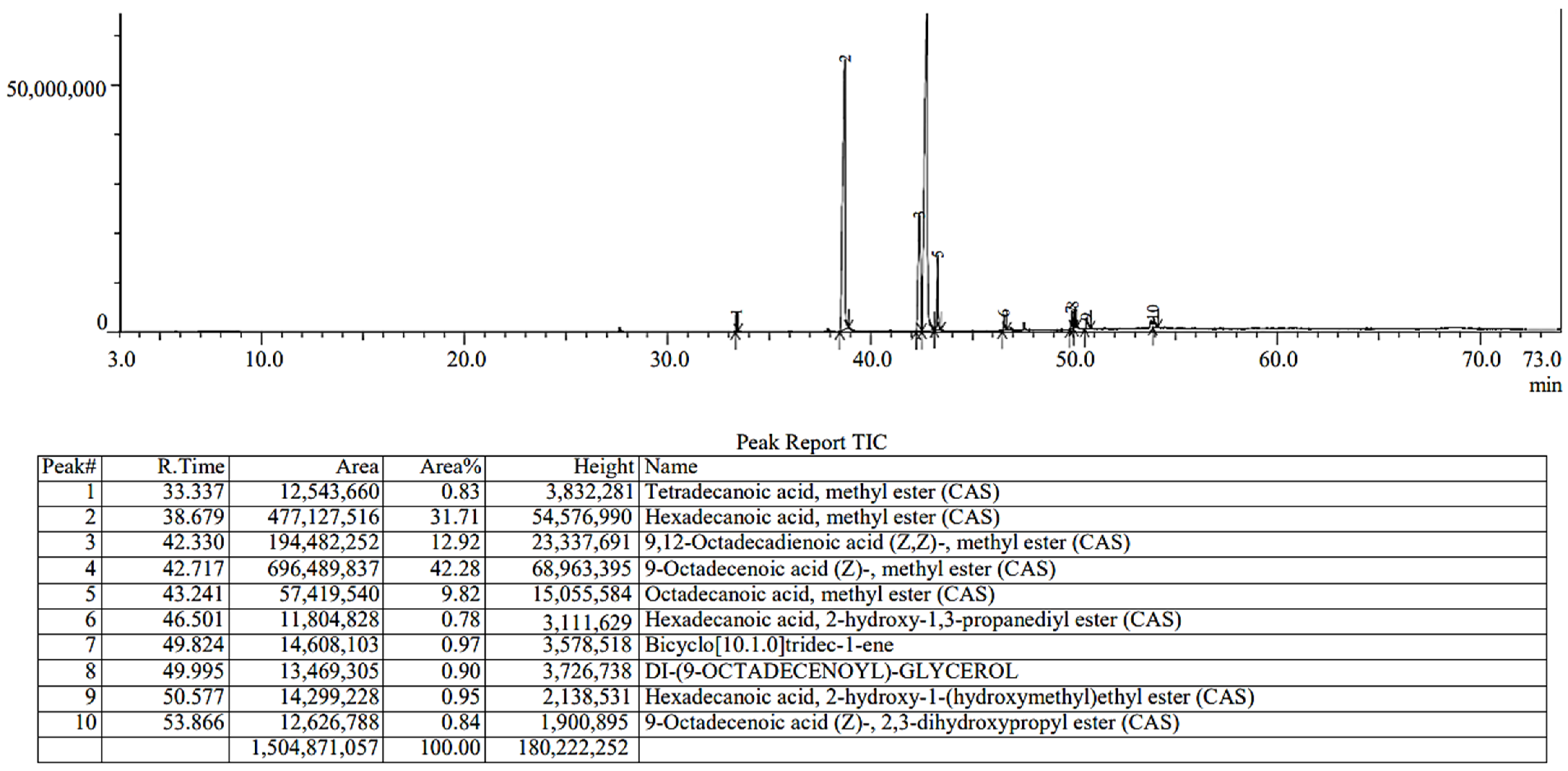
GC-MS was used to analyse the content of chemical compounds contained in CPO raw materials and determine the amount of each component of methyl ester peaks. The results of the GC-MS analysis can be seen in Figure 1.
Figure 1.
GC-MS analysis of CPO before fractionation.
Figure 1 demonstrates that the largest components in the raw materials of CPO are oleic acid, palmitic acid, and linoleic acid, with percentages of 42.28%, 31.71%, and 12.92%, respectively. The results of the GC-MS analysis were used as a comparison parameter for the fractionated CPO.
3.2. Iodine Number Test Results
The iodine number is the number of grams of iodine bound to 100 g of fat. It indicates the degree to which the oil is unsaturated. The CPO fractionation produces CPO containing SFA; a limited amount of MUFA; and a separate fraction of CPO—namely, PUFA. The iodine number of the CPO obtained by titration was 54.6. The iodine number data for each CPO fraction can be seen in Table 1.
Table 1.
Iodine number of CPO products in the oil phase and the aqueous phase.
Iodine number is the of unsaturated fatty acid content in oil. The higher the iodine number is, the higher the levels of unsaturated fatty acids in the oil will be [11]. Table 1 shows that the iodine number in the oil phase is in the range of 40 to 46, while in the aquatic phase it is in the range of 88 to 134. Based on the results of Soerawidjaja’s research [4], the iodine number of linoleic acid (PUFA) is 172.4, the iodine number of oleic acid (MUFA) is 85.6, and the iodine number of SFA is zero. This proves that the value of the iodine number is influenced by the PUFA content in CPO. The iodine number in the oil phase of the raw material decreases because the PUFA in the CPO has been separated. This is indicated by the increasing iodine number in the aqueous phase.
3.3. Product Composition through GC-MS Analysis
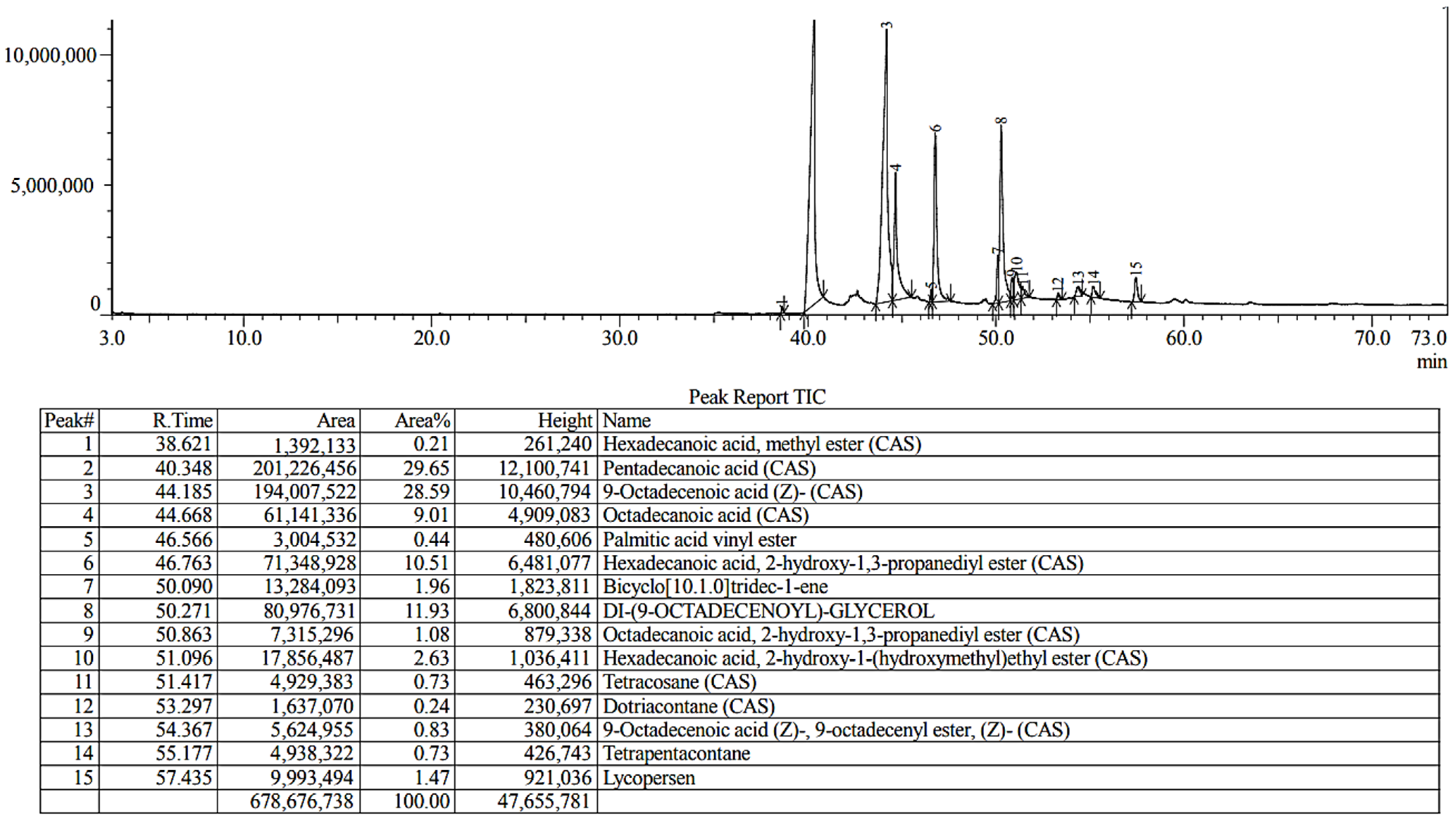
The fractionated CPO was analysed using GC-MS to determine the composition of the CPO. This analysis was carried out on CPO, which has the lowest iodine number in the oil phase—that is, the CPO is produced at a temperature of 35 °C, with an extraction time of 4 hours, and with a CPO:solvent ratio of 1:3. Figure 2 shows the results of GC-MS analysis in the oil phase, while, and Table 2 shows the chemical composition of CPO before and after fractionation using GC-MS.
Figure 2.
GC-MS chromatogram of CPO after fractionation.
Table 2.
Chemical composition of CPO before and after fractionation.
According to the results of the GC-MS analysis, the fractionation process completely removed the linoleic acid contained in CPO. This is because the DMSO dissolved the linoleic acid and separated it from CPO. The increase in the number of double bonds causes the oil or fat to be more polar and to have a higher degree of unsaturation [14]. The polarity of a solvent can be seen from the dielectric constant and dipole moment. Polar solvents have a high dielectric constant, and non-polar solvents have a low dielectric constant. The dipole moment is the vector sum of the bonding moments and lone pair moments in a molecule. Polar compounds have a dipole moment not equal to or greater than 0 (μ > 0 or 0), while non-polar compounds have a dipole moment equal to 0 (μ = 0). Because linoleic acid has a double bond and a dipole moment of 1.922 D, it can dissolve in DMSO, which has a dipole moment of 3.96 D and hence, polar; however, it did not dissolve in n-heptane, which is non-polar and has a zero dipole moment [15]. Table 2 illustrates that there was a decrease in the content of oleic acid in CPO from 42.285 to 28.59% after the fractionation process. This is because oleic acid has two functional groups: a non-polar hydrocarbon group (C-H) and a polar carboxylic acid group (-COOH) with a dipole moment of 1.18 D, meaning that only part of the oleic acid is dissolved in DMSO.
According to Teramoto et al. [16], the separation of linoleic acid can be carried out using the AgNO3 solution with the organic solvent n-dodecane. This extraction process results in a high increase in the distribution ratio with a decrease in temperature from 45 °C to 5 °C. In this study, n-heptane and DMSO were used as solvents because they can be used at temperatures of 30 °C and 35 °C. This research revealed an increase in the distribution ratio with increasing temperature, whereas at a temperature of 35 °C there was a decrease in the iodine number in the oil phase and an increase in the iodine number in the aquatic phase.
The separation of oleic acid from palmitic acid using acetonitrile as a solvent resulted in a precipitate containing 90% stearic acid and 10% oleic acid, and a residue containing 77% oleic acid and 23% stearic acid [17]. Based on the results of the GC-MS analysis in this study, the solvents of n-heptane and DMSO were able to separate linoleic acid and some oleic acid in CPO at temperatures of 30 °C and 35 °C. As illustrated below in Table 2, there was a reduction in the oleic acid content and the loss of linoleic acid content in the final CPO product after the fractionation process.
3.4. Effect of Iodine Number on Oxidation Stability
Oxidation stability is a measure of the shelf life of fuel before it is completely oxidised by oxygen. It is an important parameter for biodiesel fuel quality [10]. Biodiesel is susceptible to oxidation due to the presence of double bonds in the fatty acid composition, light, heat, air, trace metals, high temperature, antioxidants, and peroxides. The low oxidation stability of biodiesel depends on the number and position of double bonds in its chemical composition [18]. Polyunsaturated fatty acids are more susceptible to oxidation than monounsaturated fatty acids. The presence of PUFAs in fatty acids causes an increase in the oxidative instability of biodiesel [19,20,21,22].
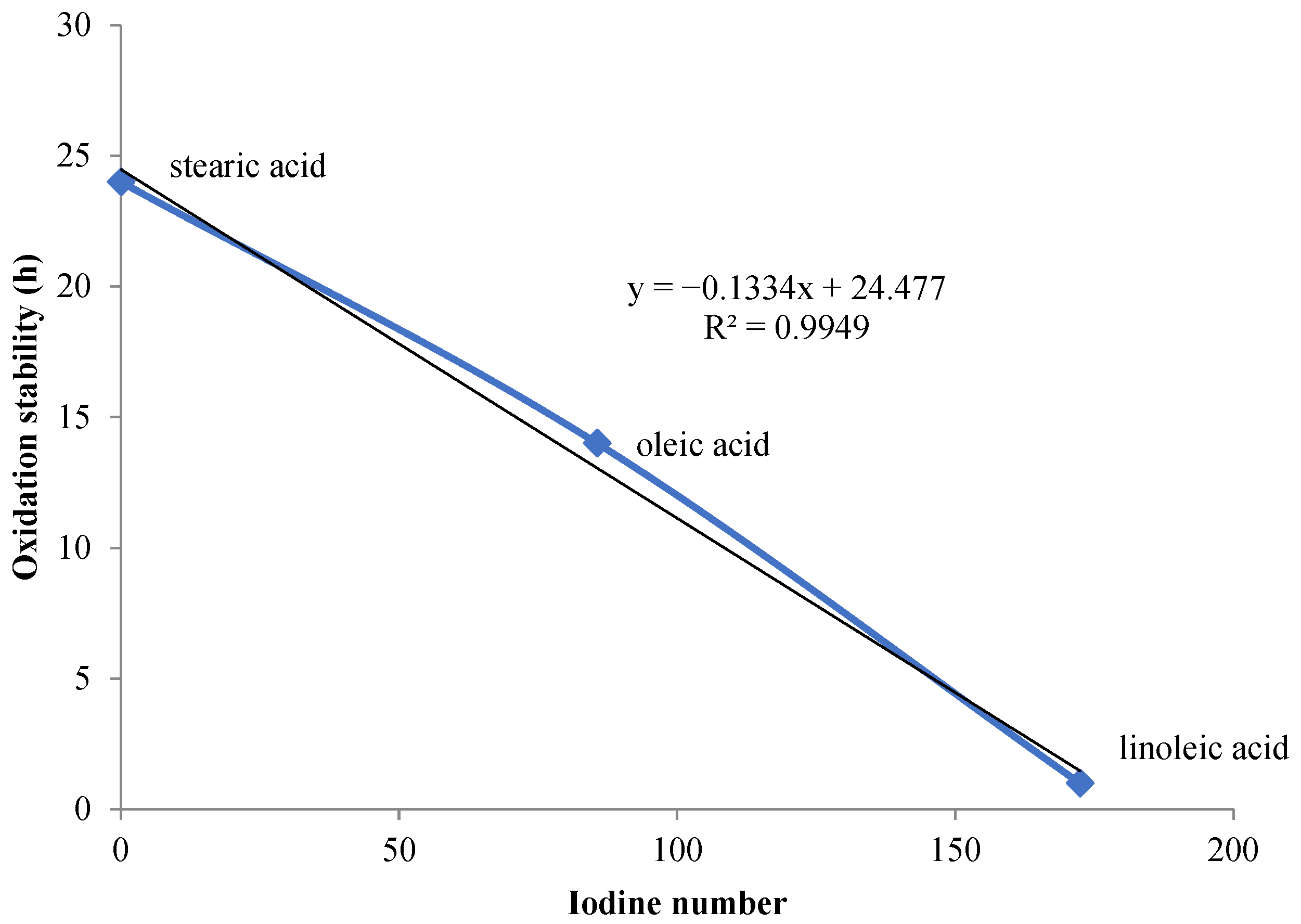
Based on Figure 3 and Table 3, it can be seen that the iodine number affected the oxidation stability proportionately, meaning that the higher the iodine number was, the lower the oxidation stability was. This finding is similar to Goto et al, (2010) report [23]. Meanwhile, to obtain good-quality biodiesel, a low iodine number and a high oxidation stability are required [4]. A low iodine value is obtained if CPO does not contain PUFA and separates PUFA using the fractionation process [11]. Data on the oxidation stability of fatty acid content obtained using the rancimat test method can be seen in Table 4. The oxidation stability of stearic acid is higher than that of linoleic acid or PUFA. PUFAs can increase the reactivity of biodiesel with oxygen when the molecules are exposed to water or air.
Figure 3.
Linear regression between oxidation stability and iodine number.
Table 3.
The relationship between oxidation stability and iodine number.
Table 4.
Stability of fatty acid oxidation using the Rancimat test method.
3.4.1. Effect of Temperature
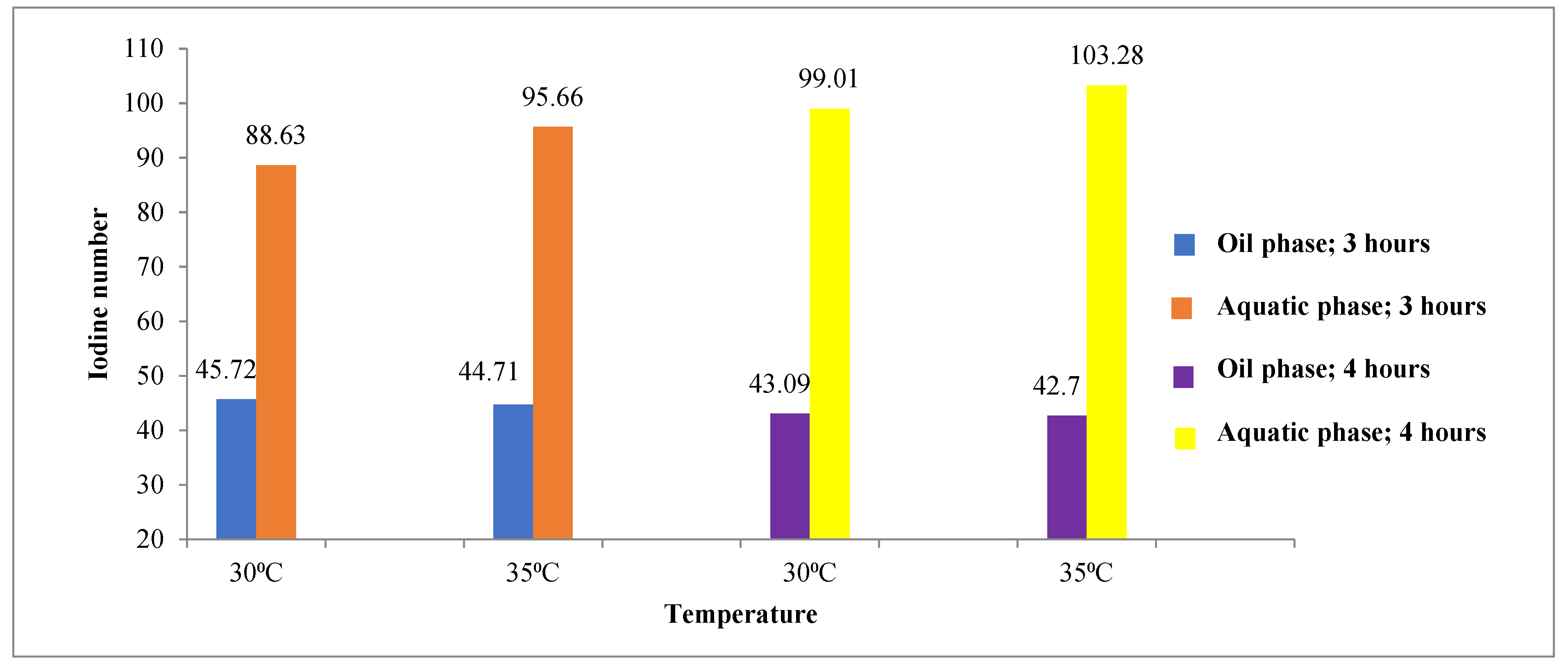
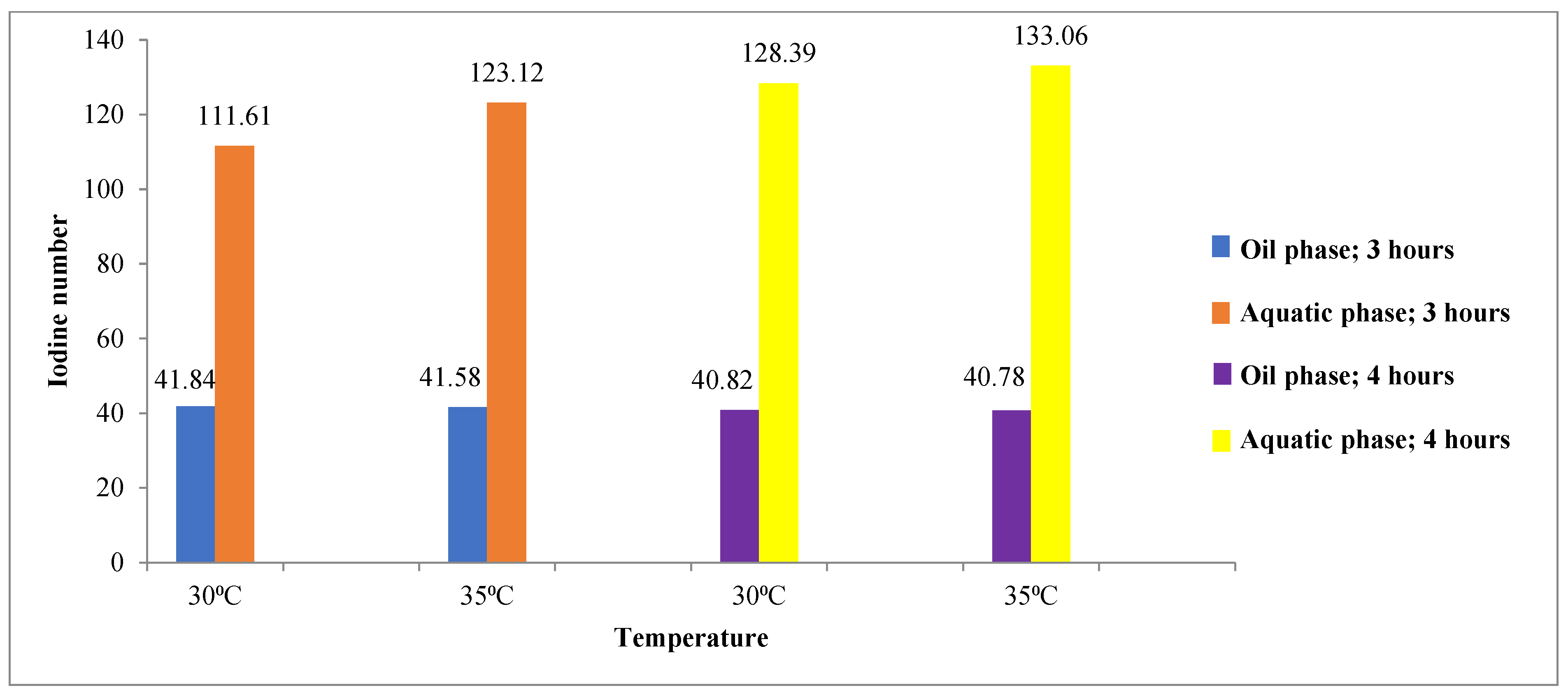
As revealed by the variability of the iodine number, there was an effect of temperature on the oxidation stability of the fractionated CPO (Figure 4 and Figure 5). The oxidation stability value showed that the higher the fractionation temperature was, the higher the oxidation stability was (Table 5). This is because the dissolved PUFA in DMSO increases with increasing temperature, resulting in a lower iodine number in the oil phase, meaning that the oxidation stability is higher. Oxidation stability is influenced by the presence of double bonds in fatty acids to the extent that the oxidation stability increases if the number of double bonds decreases [18].
Figure 4.
Effect of temperature and time on the iodine number at a ratio of 1:2.
Figure 5.
Effect of temperature and time on the iodine number at a ratio of 1:3.
Table 5.
Oxidation stability results based on iodine number.
Fractionation is an application of the mass transfer process whereby one of the factors that affect the speed of mass transfer is temperature. Increasing the temperature can increase the solubility of the solvent so that it can help the extract to dissolve in the solvent [24]. Using the changes in iodine number as an indicator, it is evident that the increase in the fractionation temperature causes an increase in oxidation stability (Table 5). This is because the increase in temperature causes significant amounts of PUFA to be dissolved in the DMSO, meaning that there was a decrease in the iodine number in the oil phase and higher oxidation stability. According to Mutjaba et al. [18], oxidation stability increases if the number of double bonds in FA is reduced.
3.4.2. The Effect of the CPO: Solvent Ratio
The effect of the CPO:solvent ratio on the fractionation process and oxidation stability can be calculated by determining the iodine number in the oil and the aqueous phases. Figure 4 and Figure 5 show that there is a considerable difference between the value of the iodine number of the oil phase and the aqueous phase. The high iodine number is caused by the presence of PUFA in CPO. Therefore, it is necessary to carry out a fractionation process for PUFA in CPO so that the iodine number in CPO decreases. It was also demonstrated that the greater the ratio of CPO:solvent was, the lower the iodine number in the oil phase was. This is because the use of more solvents results in more PUFA being separated from CPO, meaning that the iodine number in the aqueous phase is increased. The ratio of raw materials to solvents must be in accordance with the solubility of the solute, where the greater the ratio of raw materials to solvents is, the greater the amount of solute dissolved in the solvent will be. This causes the solubility of the solvent to increase [24].
As Table 5 illustrates, the greater the ratio of CPO to solvent is, the higher the oxidation stability will be and the more PUFA will bedissolved in DMSO. This resulted in a lower iodine number in the oil phase and higher oxidation stability. The presence of double bonds (unsaturation) in fatty acid molecules can oxidise biodiesel [10]. The low oxidation stability is related to the rate of oxidation, which is related to the number and position of double bonds in the chemical composition. The reduction in PUFA in the raw material increased the oxidation stability [18].
3.4.3. Effect of Time
Figure 4 and Figure 5 illustrate that the longer the extraction time is, the lower the iodine number will be. This is because PUFA is more separated from CPO at a longer extraction time. The length of extraction time affected the volume of PUFA extracted. The longer extraction time caused the contact time between the solvent and the raw material to be longer, meaning that more substances contained in the raw material were dissolved in the solvent [24].
Table 5 showed that the longer extraction time could increase the oxidation stability. This is because more PUFA was dissolved in DMSO, which caused a decrease in the iodine number in the oil phase, meaning that the oxidation stability increased. The number and position of double bonds in linoleic (PUFA) and oleic (MUFA) acids affect the rate of oxidation. PUFAs are sensitive to oxygen, so they are susceptible to oxidation. This is due to the instability of PUFA to the polymerisation reaction, which can reduce the properties of biodiesel fuel. The oxidative instability of biodiesel can affect engine operation and emissions. PUFA is more easily oxidised than MUFA [10]. Therefore, linoleic acid is more susceptible to oxidation than oleic acid [18].
4. Conclusions
The fractionation of polyunsaturated fatty acids from Crude Palm Oil using n-heptane and dimethyl sulfoxide as a solvent succeeded in separating linoleic acid from Crude Palm Oil. This was proven by the Gas Chromatography-Mass Spectrometry analysis, according to which the fractionated Crude Palm Oil did not contain linoleic acid. The results also prove that the ratio of CPO to the solvent used affects the quality of the product. The optimal condition for the fractionation process is when using a Crude Palm Oil:solvent ratio of 1:3, an extraction temperature of 35 °C, and an extraction time of 4 h. This best condition resulted in an iodine number of 40.788 and an oxidation stability of 19.036 h.
Author Contributions
Conceptualisation, Z.H., M.R.O. and R.I.; Data curation, D.A.F., M.M. and P.T.; Formal analysis, D.A.F.; Funding acquisition, Z.H. and N.T.; Investigation, Z.H., I.Z., N.T., M.M. and R.I.; Methodology, I.Z., N.T., P.T. and R.I.; Project administration, N.T.; Software, Z.H. and P.T.; Supervision, Z.H., M.R.O. and R.I.; Validation, D.A.F.; Visualisation, I.Z., N.T. and D.A.F.; Writing—original draft, Z.H., D.A.F. and R.I.; Writing—review and editing, Z.H., I.Z., P.T., M.M., M.R.O. and R.I. All authors have read and agreed to the published version of the manuscript.
Funding
This research was funded by University of Riau under World Class Research Grant with grant number: 1414/UN19.5.1.3/PT.01.03/2021.
Institutional Review Board Statement
Not applicable.
Informed Consent Statement
Not applicable.
Data Availability Statement
Not applicable.
Acknowledgments
We would like to thank University of Riau and World Class Research Grant for support this research.
Conflicts of Interest
The authors declare no conflict of interest.
References
- Statistik, B.P. Statistik Kopi Indonesia Tahun 2017; BPS Indonesia: Central Jakarta, Indonesia, 2017. [Google Scholar]
- Hasibuan, H.A. Kajian mutu dan karakteristik minyak sawit indonesia serta produk fraksinasinya. J. Stand. 2012, 14, 13. [Google Scholar] [CrossRef] [Green Version]
- Setyopratomo, P. Produksi asam lemak dari minyak kelapa sawit dengan proses hidrolisis. J. Tek. Kim. 2013, 7, 26–31. [Google Scholar]
- Soerawidjaja, S.H. Workshop on Higher Blending of Biodiesel for Automotive Utilization in ASEAN; Japan International Cooperation Agency: Tokyo, Japan, 2015. [Google Scholar]
- Giriwono, P.E. Gabungan Pengusaha Kelapa Sawit Indonesia. Available online: https://gapki.id/news/2144/sawit-minyak-nabati-paling-sehat (accessed on 11 October 2021).
- Helwani, Z.; Ramli, M.; Rusyana, A.; Marlina, M.; Fatra, W.; Idroes, G.M.; Suhendra, R.; Ashwie, V.; Mahlia, T.M.I.; Idroes, R. Alternative Briquette Material Made from Palm Stem Biomass Mediated by Glycerol Crude of Biodiesel Byproducts as a Natural Adhesive. Processes 2020, 8, 777. [Google Scholar] [CrossRef]
- Helwani, Z.; Fatra, W.; Fernando, A.Q.; Idroes, G.M.; Idroes, R. Torrefaction of Empty Fruit Bunches: Evaluation of Fuel Characteristics Using Response Surface Methodology. In IOP Conference Series: Materials Science and Engineering; IOP Publishing: Bristol, UK, 2020; Volume 845, p. 012019. [Google Scholar] [CrossRef]
- Helwani, Z.; Ramli, M.; Saputra, E.; Putra, Y.L.; Simbolon, D.F.; Othman, M.R.; Idroes, R. Composite Catalyst of Palm Mill Fly Ash-Supported Calcium Oxide Obtained from Eggshells for Transesterification of Off-Grade Palm Oil. Catalysts 2020, 10, 724. [Google Scholar] [CrossRef]
- Helwani, Z.; Ramli, M.; Saputra, E.; Bahruddin, B.; Yolanda, D.; Fatra, W.; Idroes, G.M.; Muslem, M.; Mahlia, T.M.I.; Idroes, R. Impregnation of CaO from Eggshell Waste with Magnetite as a Solid Catalyst (Fe3O4/CaO) for Transesterification of Palm Oil Off-Grade. Catalysts 2020, 10, 164. [Google Scholar] [CrossRef] [Green Version]
- Sia, C.B.; Kansedo, J.; Tan, Y.H.; Lee, K.T. Evaluation on biodiesel cold flow properties, oxidative stability and enhancement strategies: A review. Biocatal. Agric. Biotechnol. 2020, 24, 101514. [Google Scholar] [CrossRef]
- Setyawardhani, D.A.; Distantina, S.; Henfiana, H.; Dewi, A.S. Pembuatan biodiesel dari asam lemak jenuh minyak biji karet. In Proceedings of the Prosiding Seminar Rekayasa Kimia dan Proses, Semarang, Indonesia, 15 October 2010. [Google Scholar]
- Chang, H.-Y.; Gladstone, S. Separation of oleic acid and linoleic acid by solvent extraction. J. Am. Oil Chem. Soc. 1965, 42, 346–347. [Google Scholar] [CrossRef]
- Ketaren, S. Pengantar Teknologi Minyak Dan Lemak Pangan; UI-Press: Jakarta, Indonesia, 1986. [Google Scholar]
- Mamuaja, C.F. LIPIDA; Unsrat Press: Manado, Indonesia, 2017; pp. 1–122. [Google Scholar]
- Chandra, A.; Novalia, N. Studi Awal Ekstraksi Batch Daun Stevia Rebaudiana Bertoni Dengan Variabel Jenis Pelarut Dan Temperatur. Available online: http://journal.unpar.ac.id/index.php/rekayasa/article/view/1226 (accessed on 11 October 2021).
- Teramoto, M.; Matsuyama, H.; Ohnishi, N.; Uwagawa, S.; Nakai, K. Extraction of ethyl and methyl esters of polyunsaturated fatty acids with aqueous silver nitrate solutions. Ind. Eng. Chem. Res. 1994, 33, 341–345. [Google Scholar] [CrossRef]
- Hoerr, C.W. Separation of Oleic Acid from Stearic and Palmitic Acids. U.S. Patent US2705723A, 5 April 1955. [Google Scholar]
- Mujtaba, M.A.; Muk Cho, H.; Masjuki, H.H.; Kalam, M.A.; Ong, H.C.; Gul, M.; Harith, M.H.; Yusoff, M.N.A.M. Critical review on sesame seed oil and its methyl ester on cold flow and oxidation stability. Energy Rep. 2020, 6, 40–54. [Google Scholar] [CrossRef]
- Sorate, K.A.; Bhale, P.V. Biodiesel properties and automotive system compatibility issues. Renew. Sustain. Energy Rev. 2015, 41, 777–798. [Google Scholar] [CrossRef]
- Giakoumis, E.G. A statistical investigation of biodiesel physical and chemical properties, and their correlation with the degree of unsaturation. Renew. Energy 2013, 50, 858–878. [Google Scholar] [CrossRef]
- Moser, B.R. Biodiesel production, properties, and feedstocks. Vitr. Cell. Dev. Biol. Plant 2009, 45, 229–266. [Google Scholar] [CrossRef]
- Dunn, R.O. Effect of antioxidants on the oxidative stability of methyl soyate (biodiesel). Fuel Process. Technol. 2005, 86, 1071–1085. [Google Scholar] [CrossRef]
- Goto, S.; Oguma, M.; Chollacoop, N.; Dowling, L.; Sheedy, D.; Zhang, W. EAS-ERIA Biodiesel Fuel Trade Handbook: 2010; ERIA: Jakarta, Indonesia, 2010; pp. 6–15. [Google Scholar]
- Nasir, S.; Fitriyanti, F.; Kamila, H. Ekstraksi Dedak Padi Menjadi Minyak Mentah Dedak Padi (Rice-Bran Oil) dengan Menggunakan Pelarut n-Hexane dan Ethanol. J. Rekayasa Sriwij. 2009, 18, 37–44. [Google Scholar]
Publisher’s Note: MDPI stays neutral with regard to jurisdictional claims in published maps and institutional affiliations. |
© 2021 by the authors. Licensee MDPI, Basel, Switzerland. This article is an open access article distributed under the terms and conditions of the Creative Commons Attribution (CC BY) license (https://creativecommons.org/licenses/by/4.0/).