


Abstract
The current article discussed the heat transfer and thermal radioactive of the thin liquid flow of Sisko fluid on unsteady stretching sheet with constant magnetic field (MHD). Here the thin liquid fluid flow is assumed in two dimensions. The governing time-dependent equations of Sisko fluid are modeled and reduced to Ordinary differential equations (ODEs) by use of Similarity transformation with unsteadiness non-dimensionless parameter . To solve the model problem, we used analytical and numerical techniques. The convergence of the problem has been shown numerically and graphically using Homotopy Analysis Method (HAM). The obtained numerical result shows that the HAM estimates of the structures is closed with this result. The Comparison of these two methods (HAM and numerical) has been shown graphically and numerically. The impact of the thermal radiation and unsteadiness parameter over thin liquid flow is discovered analytically. Moreover, to know the physical representation of the embedded parameters, like , magnetic parameter M, stretching parameter , and Sisko fluid parameters have been plotted graphically and discussed.
1. Introduction
Recently in few years it has been scrutinized that the analysis of the thin film flow has pointedly contributed in different areas like industries, engineering, and technology, etc. All problems related to thin film flow have varied applications in different fields. Some common usage of thin film associated with daily life are wire and fiber coating, extrusion of polymer and metal from die, crystal growing, plastic sheets drawing, plastic foam processing, manufacturing of plastic fluid, artificial fibers, and fluidization of reactor. Thin polymer films have abundant applications in engineering and technology. Several trade and biomedical sectors are associated with caring and functional coatings, non-fouling bio surfaces, advanced membranes, biocompatibility of medical implants, microfluidics, separations, sensors and devices, and many more. In the light of the above applications, this issue brings the attention of the researchers to improve the development of such type of study. At the initial stage the thin film flow problems discuss for viscous fluid flow and with the passage of time it turned to some Non-Newtonian Fluids. Crane [1] discussed at first time the viscid fluid motion in linear extended plate. Dandapat [2] has discussed the flow of the heat transmission investigation of the viscoelastic fluids over an extended surface. Wang [3] investigate time depending flow of a finite thin layer fluid upon a stretching plate. Ushah and Sridharan [4] used horizontal sheet for the same said problem and prolonged it to the thin partial with the analysis of heat transfer. Liu and Andersson [5] discuss heat transmission investigation of the thin partials motion upon an unsteady extending piece. Aziz et al. [6] investigate the problem related to heat transfer of thin layer flow with thermal radioactivity. Tawade et al. [7] discussed the same problem with external magnetic field.
Furthermore, it is observed that the thin layer flow has vital roles in different fields of science. Andersson [8] is considered to be a pioneer who used the Power law model and investigated the liquid film flow viscid fluids flow upon a time dependent extending piece. Waris et al. [9] have investigated nanofluid flow with variable viscosity and thermal radioactive pass a time dependent and extending Sheet. Anderssona et al. [10] discussed the Heat transfer investigation in liquid film upon time dependent stretching plate. Chen [11,12] examined the same problem using the Power-law model. Wang et al. [13] used HAM Method to discuss the problem as examined by Chen. Saeed et al. [14] recently investigated the thin layer flow of casson Nano fluid with thermal radioactivity. The disk they took was rotating and the flow was three-dimensional. Shah et al. [15] discussed the same problem using Horizontal rotating disk. Khan et al. [16,17] studied the heat transfer investigation of the inclined magnetic field with Graphene Nanoparticles. Ullah et al. [18] studied the Brownian Motion and thermophoresis properties of the nanofluids thin layer flow of the Reiner Philippoff fluid upon an unstable stretching sheet. Shah et al. [19] investigate the thin film flow of the Williamson fluid upon an unsteady stretching surface.
Non-Newtonian fluids have abundant uses in the field of energy and technology. Plastic, food products, wall paint, greases, lubricant oil, drilling mud, etc are some common examples. Sisko fluid is also very important non-Newtonian fluids. At a very low shear rate, the Sisko flow has the same behavior as the Power-Law fluid. This property was used experimentally to fit the data of the flow of lubricating greases and also to model the flow of the whole human saliva [20]. Munir et al. studied Sisko fluid with mixed convection heat transfer. Siddiqui et al. [21,22] studied the thin film flow of Sisko fluid. Khan et al. [23] investigated the flow of boundary layer of the Sisko fluid upon a stretching surface. Molati et al. [24] discussed the MHD problem related to sisko fluid. Malik et al. [25] studied the sisko fluid with heat transfer and using convective boundary conditions.
In the past few years, the study of heat transfer and radiative flow through the stretch sheet has taken the attention from many scientists because of its large applications in engineering and industrial processes [26,27,28,29,30,31]. Rubber production, colloidal suspension, production of glass socks, metal spinning and drawing of plastic film, textile and paper production, use of geothermal energy, food processing, plasma studies, and aerodynamics are some practical examples of such flows. Radiation is often encountered in frequent engineering problems. Keeping in view its applications, Sheikholeslami et al. [32,33,34,35] presented the application of radioactive nanofluid flow in different geometries. Recently some researchers studied the problems related to heat transfer. Poom et al. [36] examined the casson nanofluid with MHD radiative flow and heat source using rotating channel. Khan et al. [37] discussed the similar HMD problem as above with time dependent and thin film flow of the three fluid models Oldroyed-B, Maxwell, and Jeffry. Ishaq et al. [38] discussed the MHD effect of unsteady porous stretching surface taking Nanofluid film flow of Eyring Powell fluid. Muhammad et al. [39] discussed the MHD rotating flow upon a stretching surface with radioactively Heat absorption. Hsiao [40,41,42,43] discussed non-Newtonian fluid flow with MHD.
The purpose of this manuscript is to model and analyze thin film flow of Sisko fluid on time dependent stretching surface in the presence of the constant magnetic field (MHD). Here the thin liquid fluid flow is assumed in two dimensions. The governing time-dependent equations of Sisko fluid are modelled and reduced to ODEs by use of Similarity transformation with unsteadiness non-dimensionless parameter . To solve the model problem, we used Homotopy Analysis Method-(HAM) which is one of the strongest and most time-saving methods. In addition, the heat transfer rates of thermal radiation are studied and analyzed. Shang [44] used another strong technique as Lie Algebra for solution of such type problem.
2. Basic Equations
The stated governing equation and heat equation are given below [23,24]:
For Sisko fluid is given as [25,26,27,28]
where
wherever are the material constants which are distinct for dissimilar fluids. If we take a = 0, b = 1 and n = 0 in the Sisko fluid model then we obtained the Power-law fluid model. If we take a = 1, b = 0 and n = 1 in the Sisko fluid model then we obtained the stress–strain relationship of Newtonian fluid.
Because of two-dimensional fluid flow the velocity and the stress profile are presumed as
where are representing velocity components.
Inserting Equation (5) into Equations (1) and (2), the momentum and continuity equations reduce to the form as:
If then above equations become the power law fluid and when then it reduced Newtonian fluid. Introduce the dimensionless variable as:
Equations (6) and (7) are written as
The dimensionless parameter and are defined as
The above equation after using the boundary layer approximations become as
3. Mathematical Formulation of the Problem
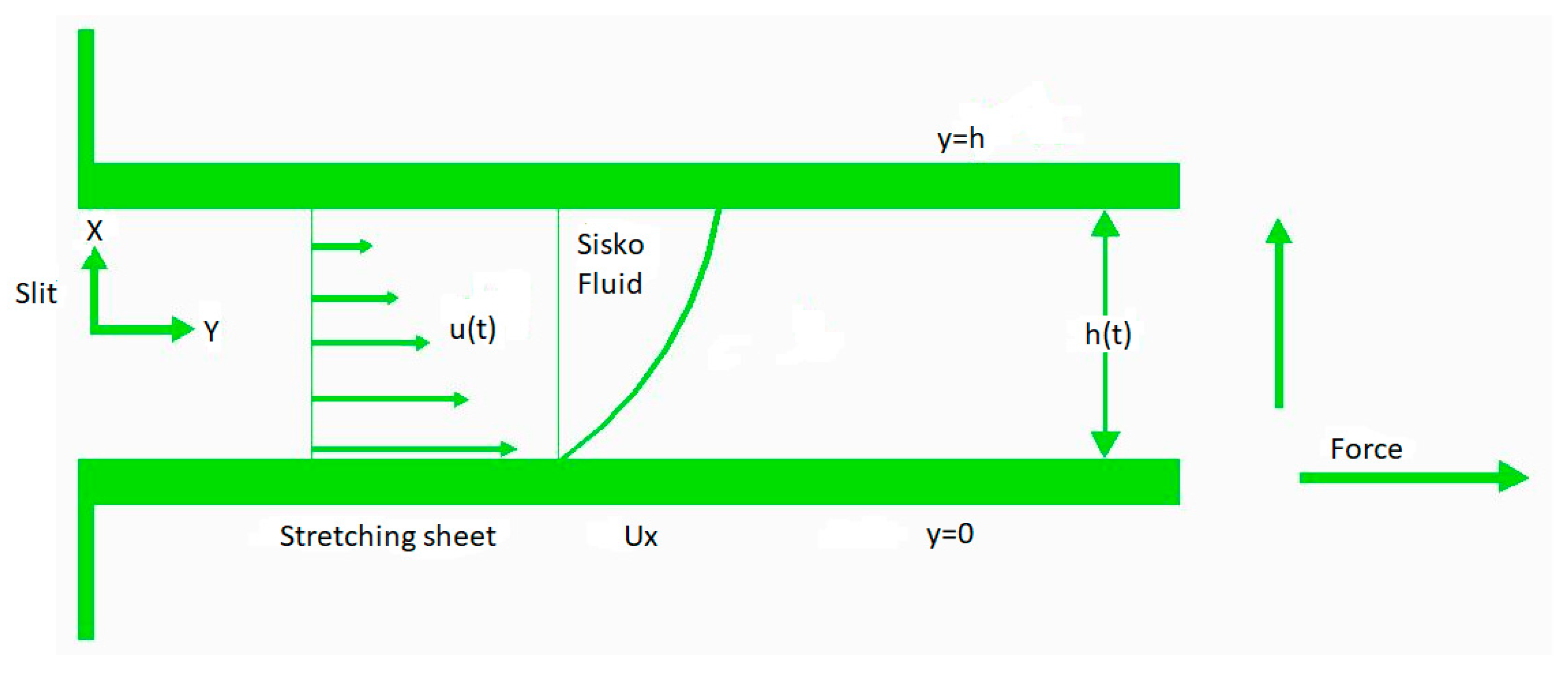
Consider a time depending and electric conducting the flow of thin layer of the Sisko fluid with impact of thermal radiations during spreading surface where x-axis is in parallel to the slot where y-axis shown in the figure is orthogonal to the surface as given below in Figure 1.
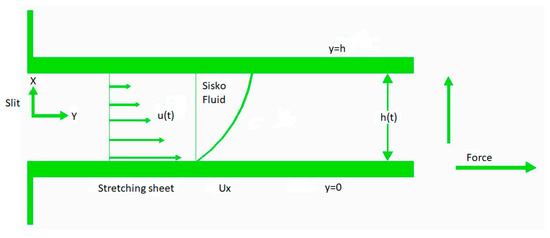
Figure 1.
Physical Sketch of the model problem.
It is stretching flow surface also the origin is immovable because equivalent and opposed forces are acting along the X-axis. The x-axis is taking with stress velocity along the spreading surface.
In which and are constants. The y-axis is making a right angle to it. The term is local Reynolds number, the surface velocity The heat and mass transfer simultaneously here is defined as which is surface temperature. Here is temperature at the slit, is reference temperature such that also defines temperature of the sheet, obtain from the at the slit in
First the slit is static with center and after an exterior power is implied to bounce the slit in the positive -axis at the rate , where . An exterior transmission magnetic force is given normally to the extending sheet which is presumed to be variable type and selected as
The fluid flow is assumed unsteady laminar and incompressible. The elementary boundary governing equations after using assumption are reduced as
Here approximation of Rosseland, where is define as [29,30,31,32],
Here represents the temperature fields, is the Stefan–Boltzmann constant, is the mean absorption coefficient, is the thermal conductivity of the thin film. Expanding using Taylor’s series about as below
Neglecting the higher order terms
Using Equation (21) in Equation (20) we get the following
Using Equation (22) in Equation (18) we get the following
The accompanying boundary conditions are given by
Similarity Transformations
The dimensionless variable and similarity variable for transformation as
Here indicate the stream function which identically satisfying Equation (16), identifies the thin film thickness. The velocity components in term of stream function are obtained as
Inserting the similarity transformation Equation (25) into Equations (16)–(18) and Equation (23) fulfills the continuity Equation (16)
The boundary constrains of the problem are:
The dimensionless film thickness which gives
The physical constraints after generalization are obtained as, is the non-dimensional measure of unsteadiness, is a Sisko fluid parameter, is stretching parameter, and represents the magnetic, is the Prandtl number and represent the radiation parameter.
The Skin friction is defined as
where
where is known as the local Reynolds number defined as . The Nusselt number is defined as in, which is the heat flux, where . After the dimensionalization the is gotten the below as
4. Application of Homotopy Analysis Method
In this section HAM is applied to Equations (27)–(29) to get an approximate analytical solution of MHD Sisko fluid flow over unsteady sheet in a following way:
The linear operators are
The above differential operators’ contents are shown below as
where are considered as arbitrary constant.
4.1. Zeroth rder Deformation Problem
Expressing as an embedding parameter with associate parameters and where . Then in case of zero order distribution the problem will be in the following form:
The subjected boundary conditions are obtained as
The resultant nonlinear operators have been mentioned as:
Expanding in term of with use of Taylor’s series expansion we get:
where
Here are selected in a way that the Series (43) converges at , switching in (43), we obtain:
4.2. ith-Order Deformation Problem
Differentiating zeroth order equations time we obtained the order deformation equations with respect to . Dividing by and then inserting so order deformation equations
The resultant boundary conditions are:
where
4.3. Convergence of Solution
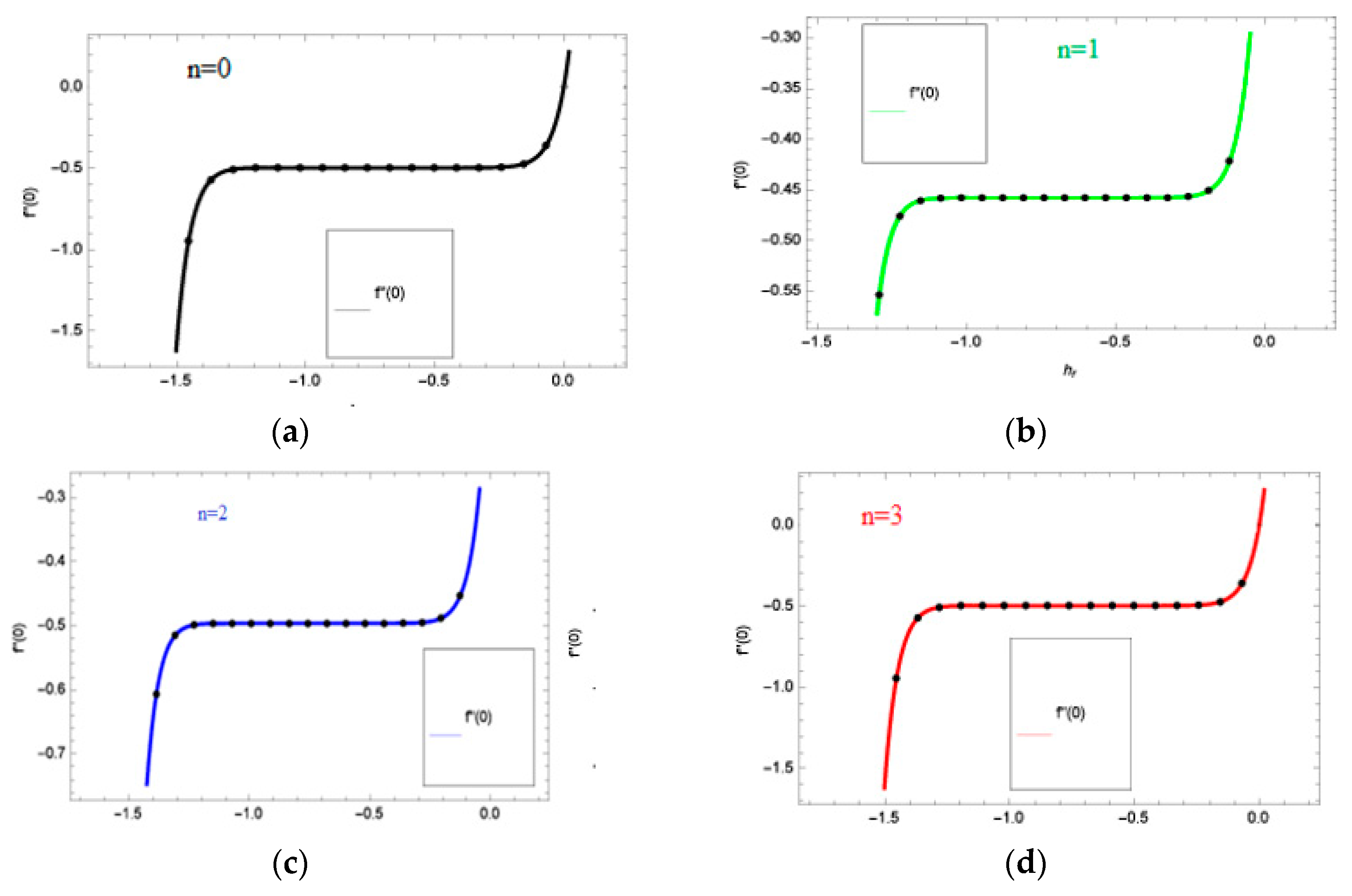
After using the HAM method to calculate these solutions of the modelled function as velocity and temperature, these parameters are seen. The responsibility of the computed parameters is to regulate of convergence of the series results. In the conceivable region of , -curves of and for order approximation are plotted in Figure 2 for different values of numbers. The -curves consecutively display the valid area. Table 1 values shows the numerical results of HAM solutions at dissimilar approximation. Its shows that the HAM method is fast convergent.
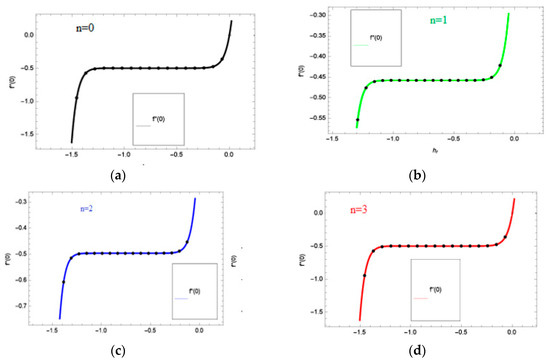
Figure 2.
The h-curve graphs for velocity profile for where .

Table 1.
The Homotopy Analysis Method (HAM) convergence table up to 25th order approximations when .
5. Results and Discussion
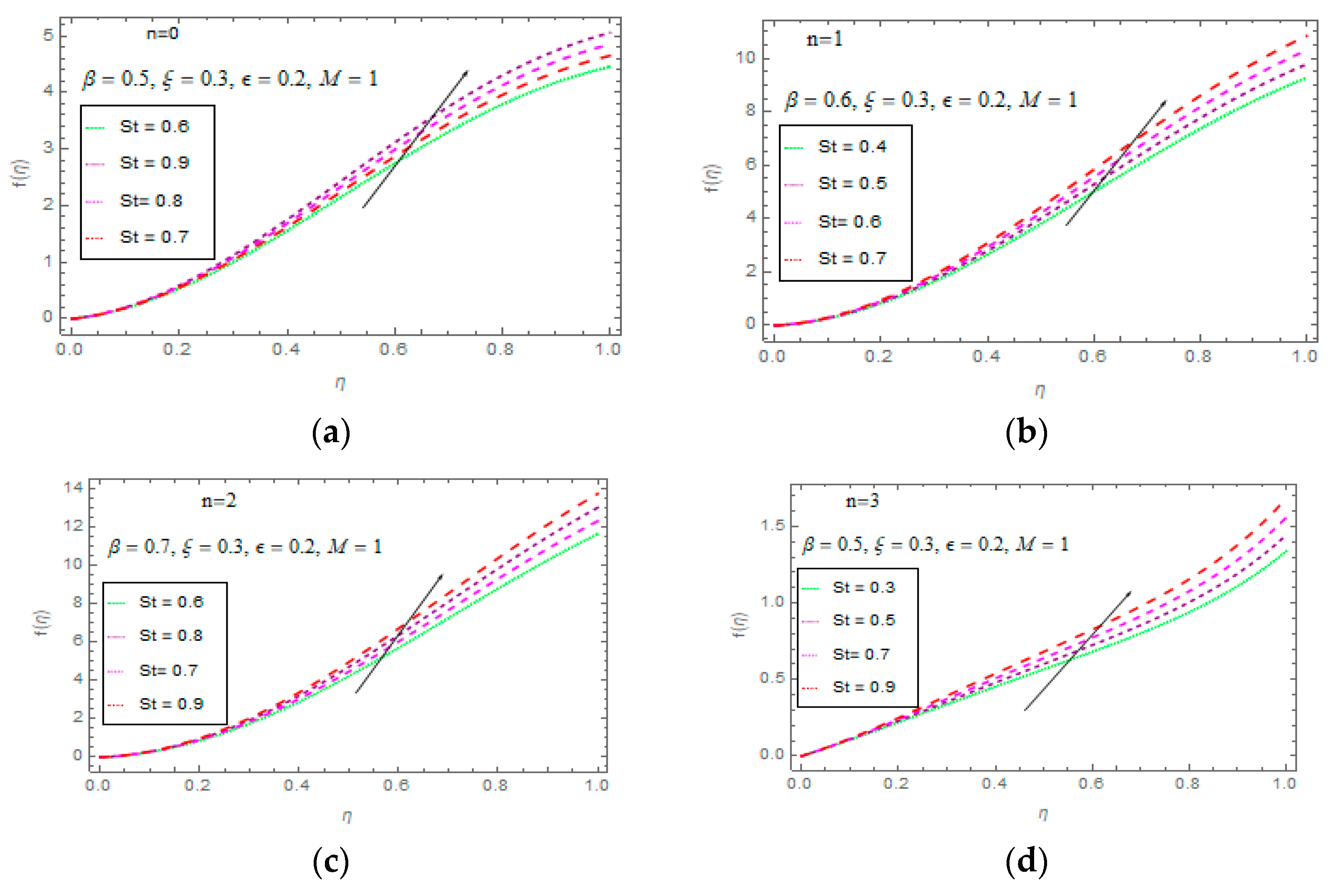
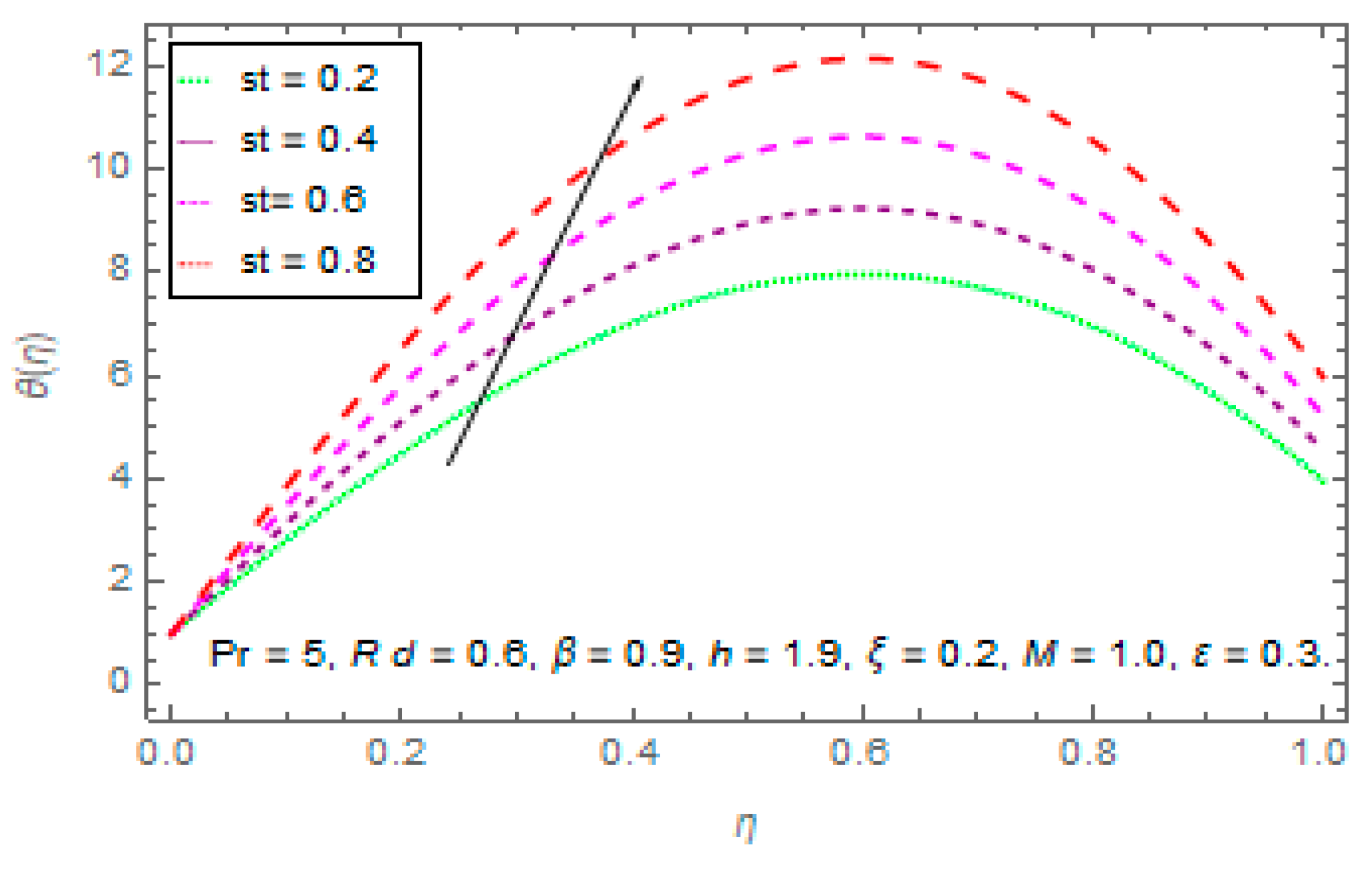
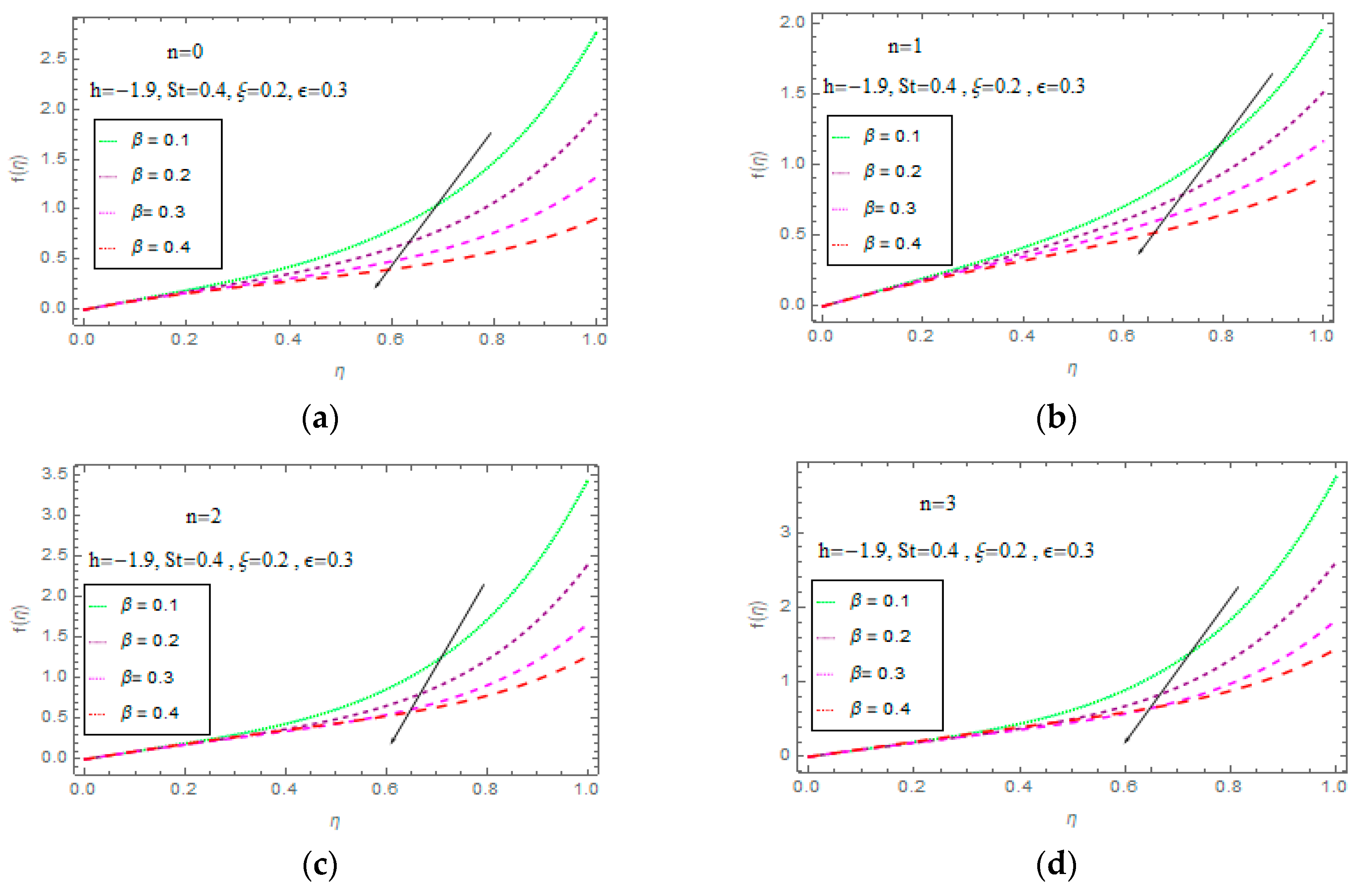
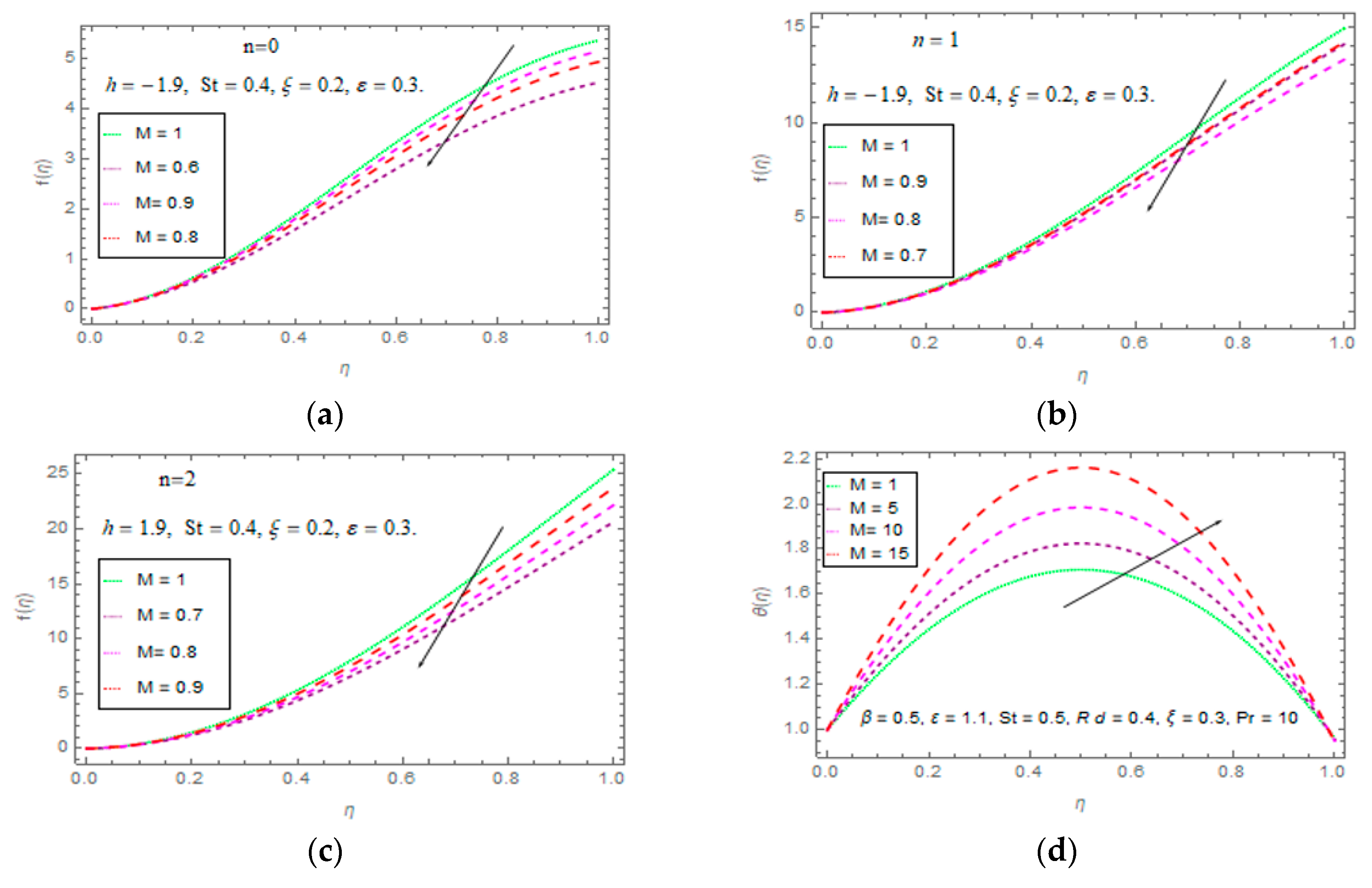
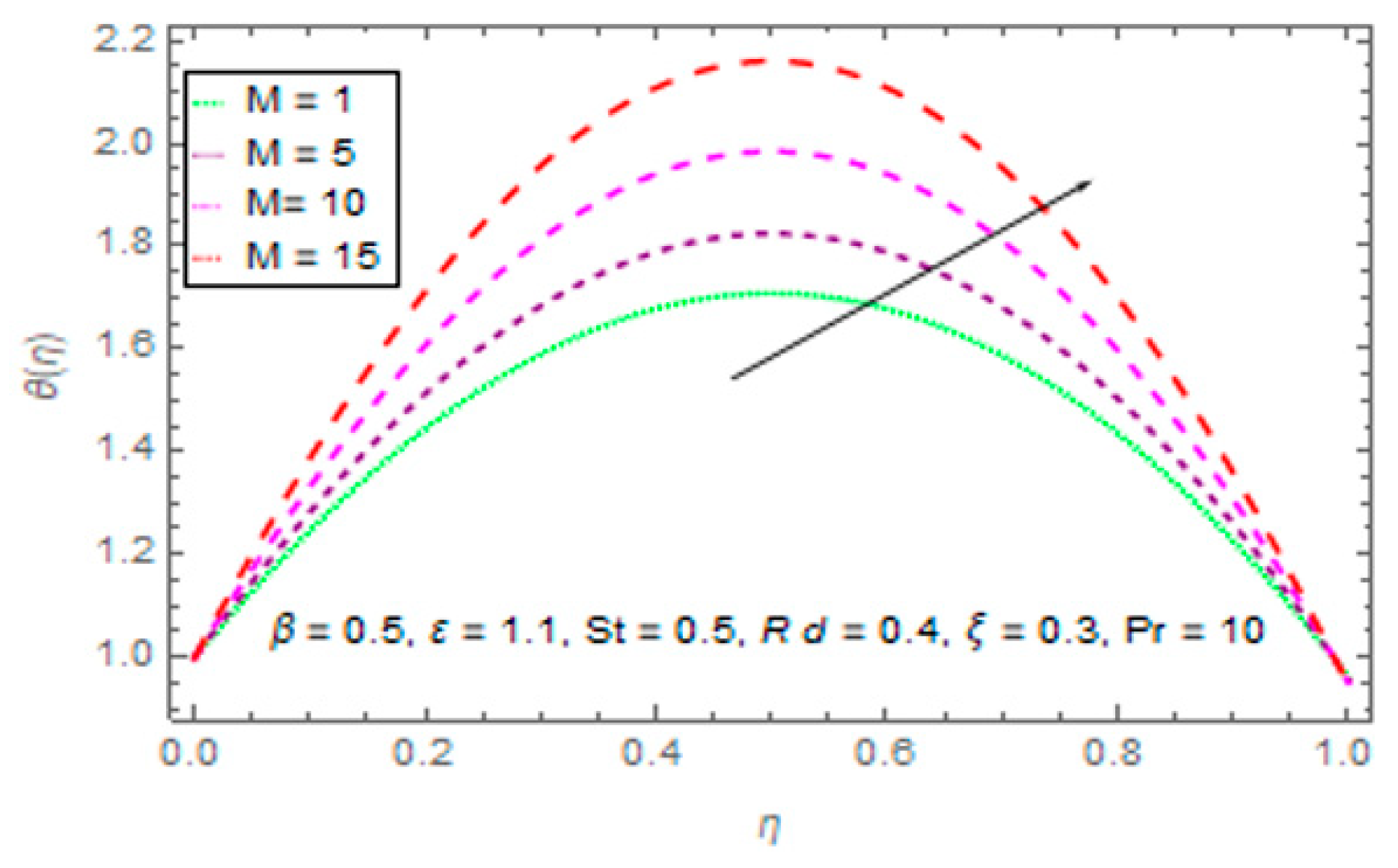
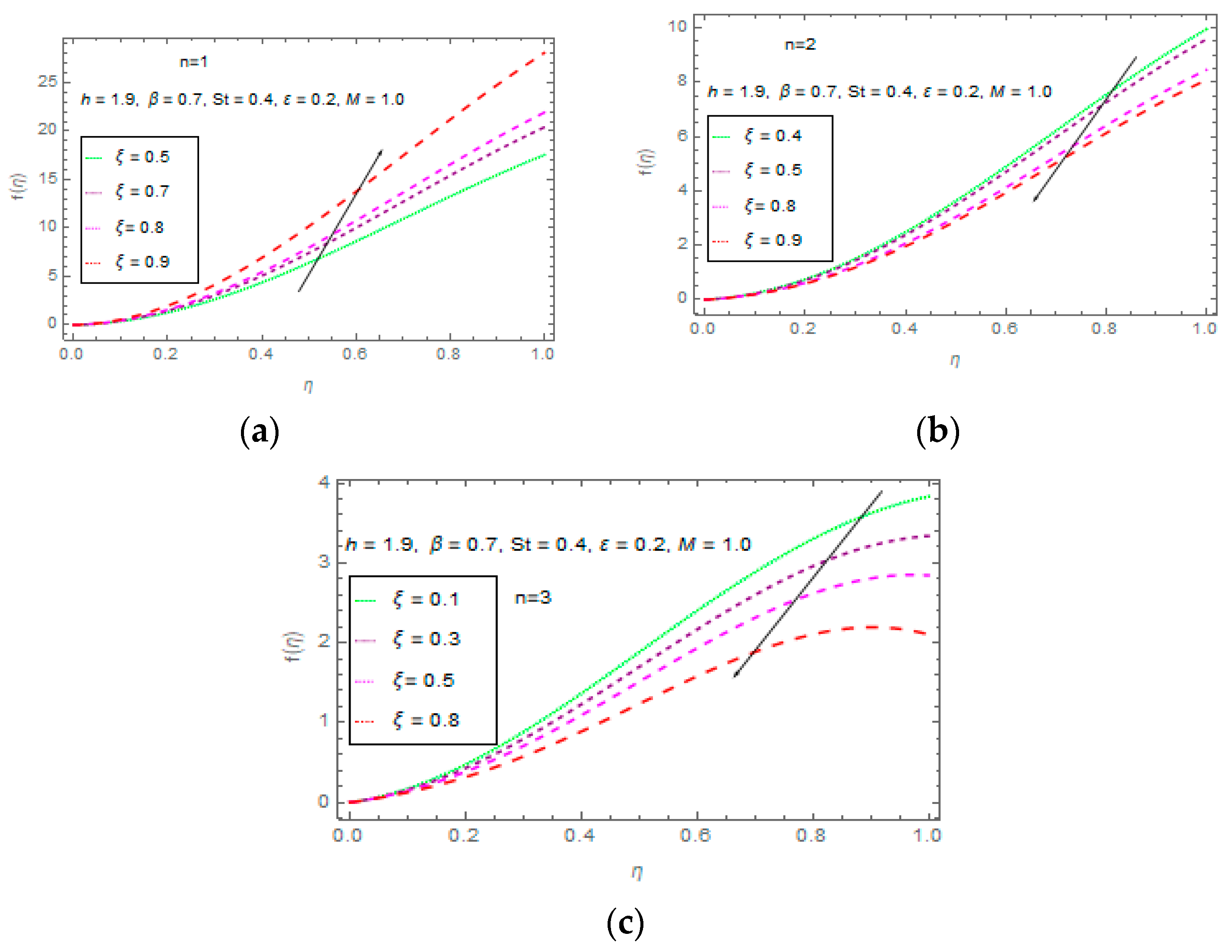
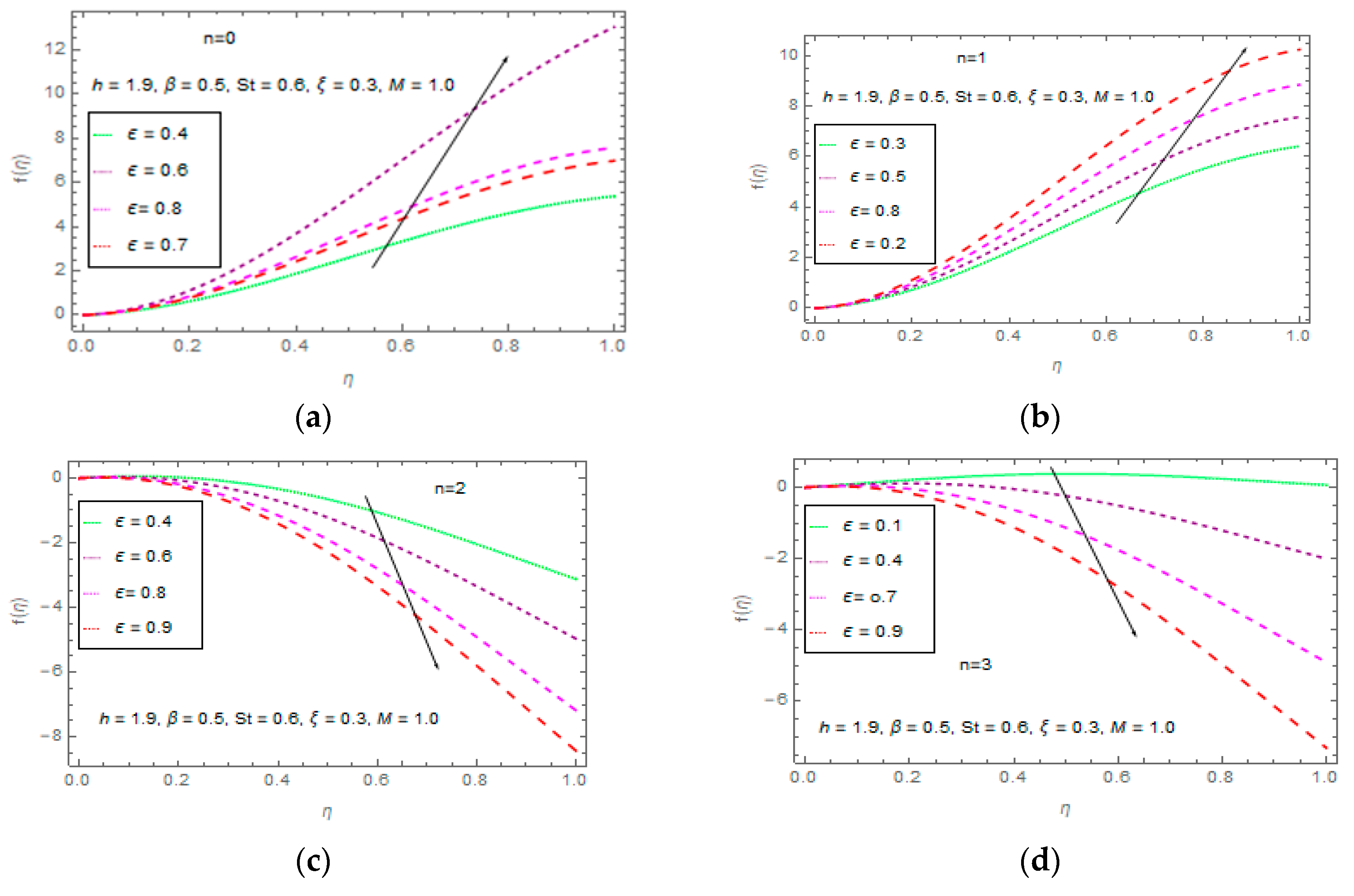
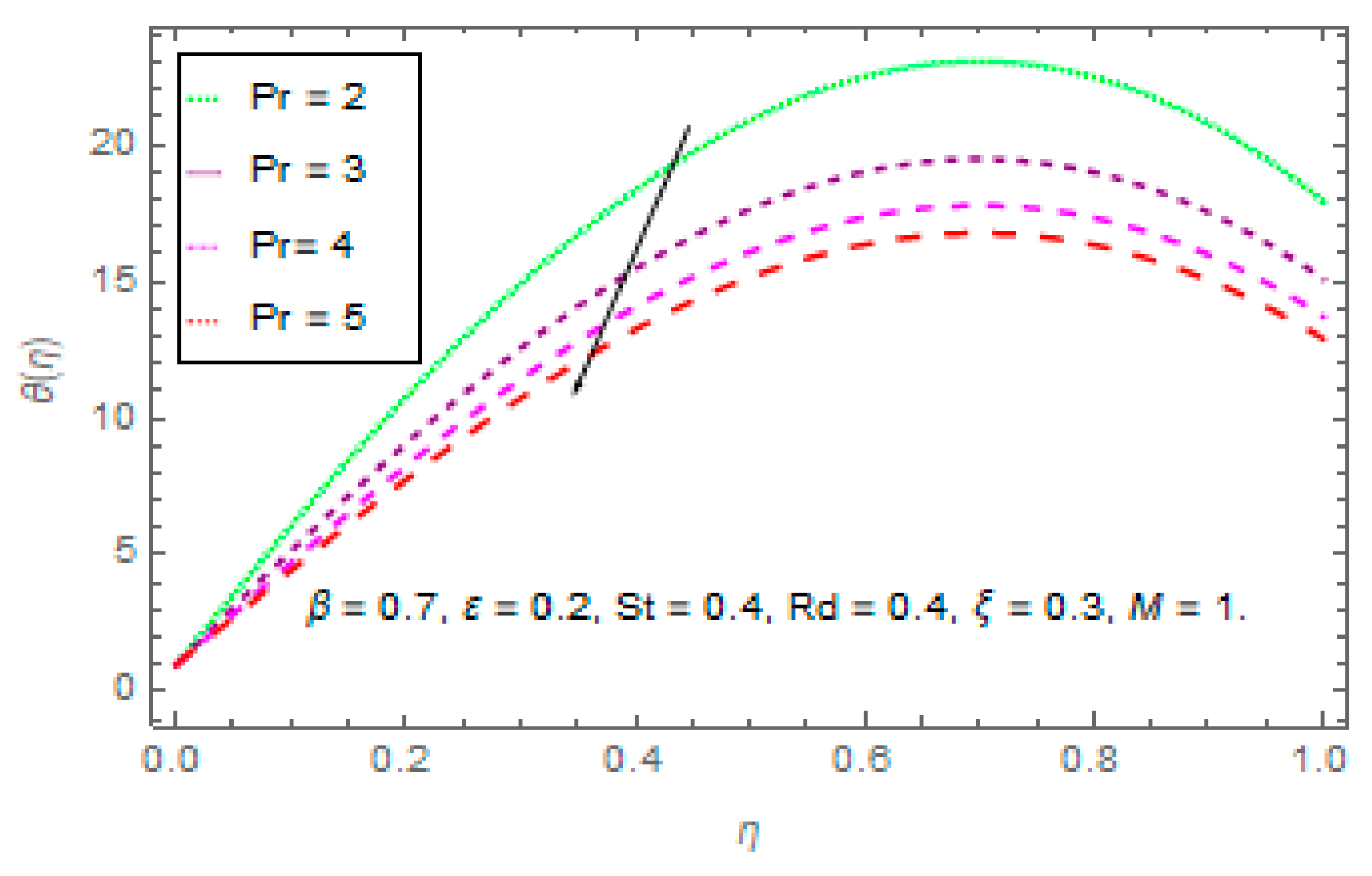
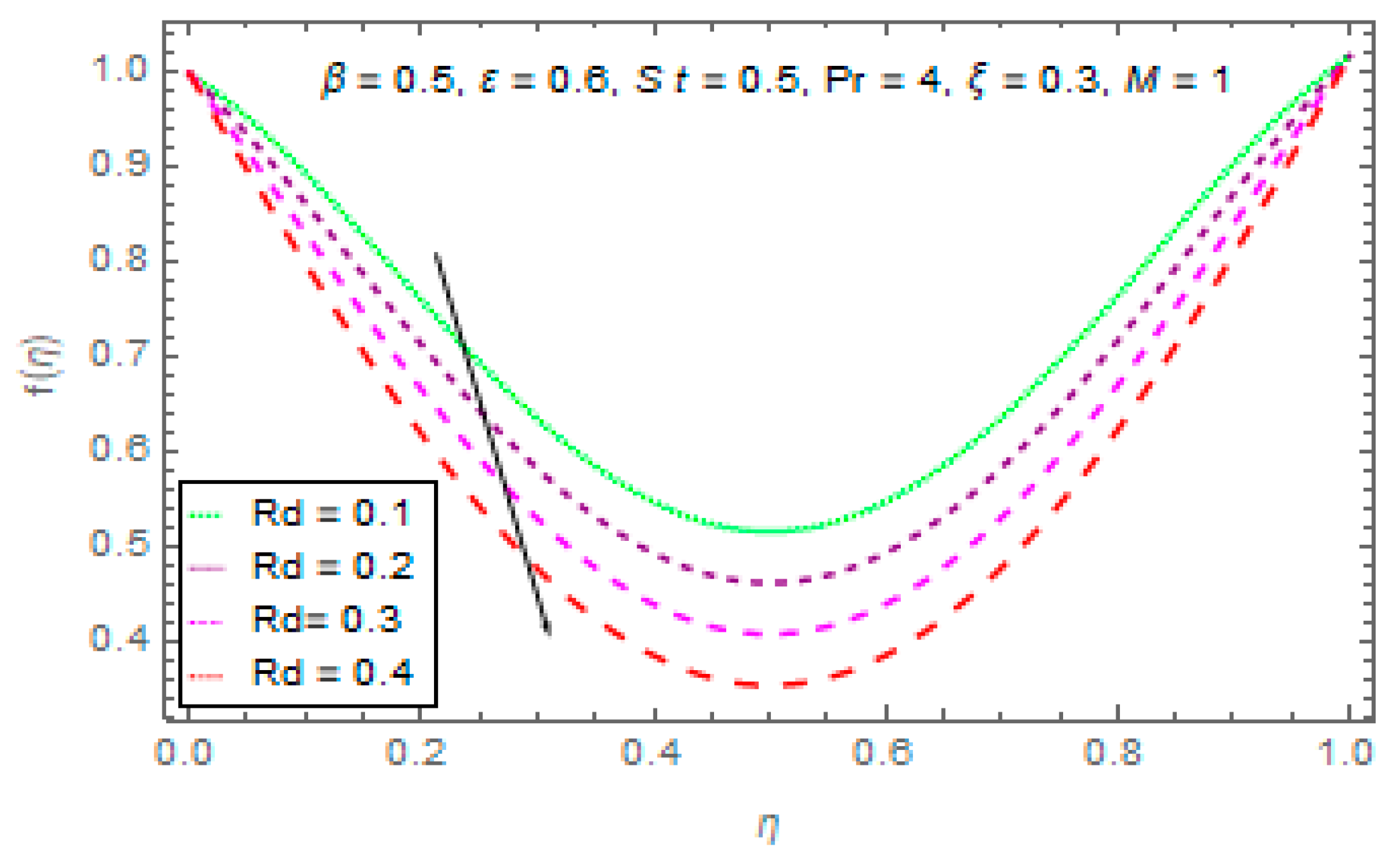
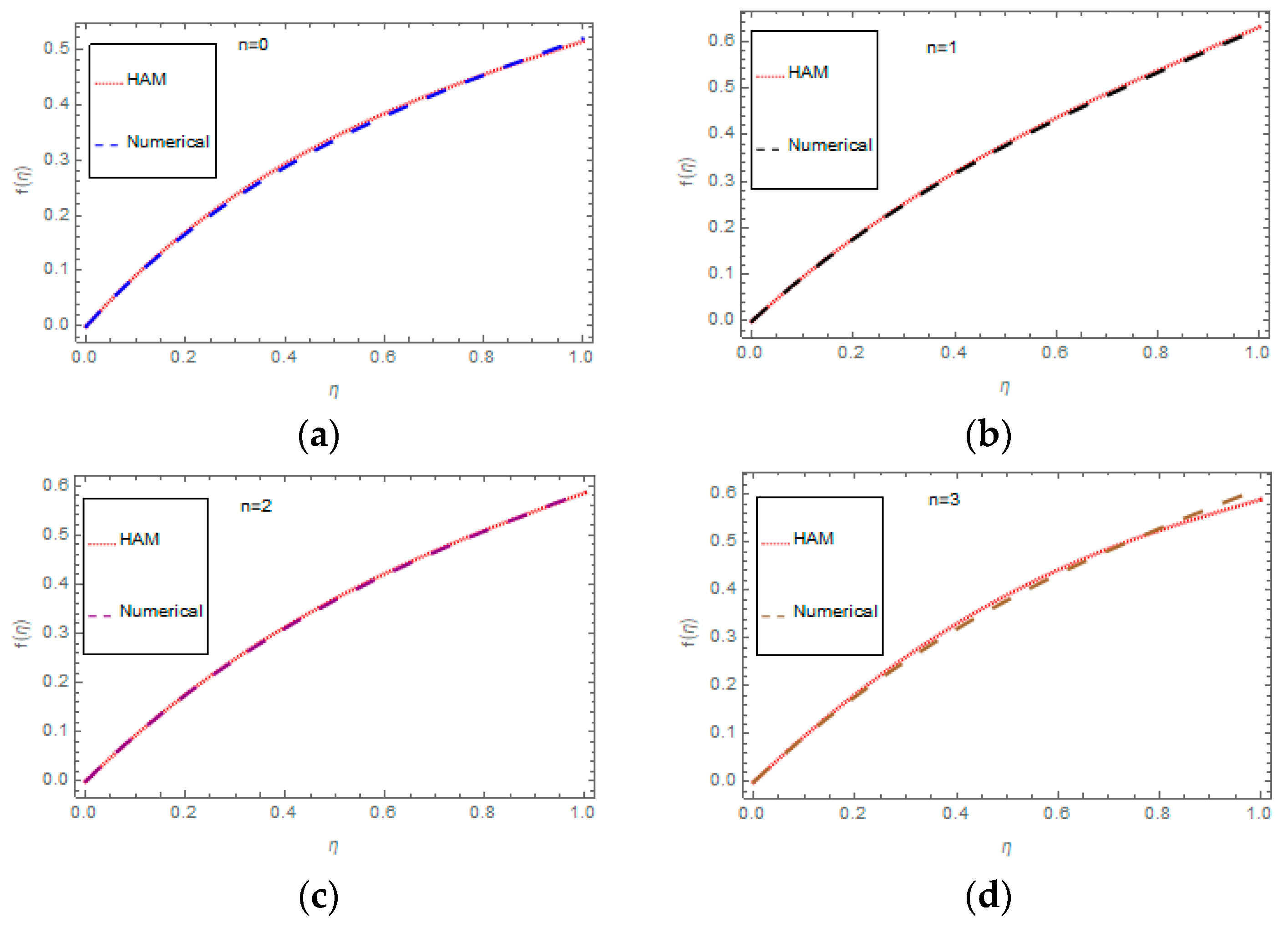
The current work investigates the MHD and radiative flow of Sisko thin film flow having unsteady stretching sheet. The purpose of the subsection is to inspect the physical outcomes of dissimilar implanting on the velocity distributions and temperature distribution which are described in Figure 3, Figure 4, Figure 5, Figure 6, Figure 7, Figure 8, Figure 9, Figure 10, Figure 11 and Figure 12. Figure 3a–d shows the influence of unsteady constraint on the velocity profile for dissimilar values of power index and Increasing increase the velocity field It is clear that varying power indices x having similar response to the time dependent parameter, that is the increase value of the power index rise the velocity distribution. The impact of the unsteadiness parameter on the heat profile is shown in Figure 4. It is observed that directly proportional to . augmented rises the temperature, which in turn rises the kinetic energy of the fluid, so the fluid motion increased. It is perceived that the effect of for the different value of power index and having a similar effect on heat profile Figure 5a–d demonstrate the effect of the film thickness for dissimilar values of power index and . It is perceived that the velocity profile falling down with higher values. Figure 6a–d describe the characteristics for for changed values of power index and . When increase on the surface of the sheet during the flow, the flow rate falls, which in results decrease the velocity profiles. This significance of on velocity field is due to the rise in the progresses the friction force of the movement, which is called the Lorentz force. It is the fact that fluid velocity reduce in the boundary layer sheet. Figure 7 demonstrates the effect of film thickness on temperature profile. It is observed that the large values of film thickness rise the temperature, and actually the higher value of speed up the molecular motion of the liquids which in turn increases the internal energy and the temperature increase. The effect of stretching parameter for each changed values of power index and on velocity profile is shown in Figure 8a–c. In case of , it is clear from Figure 8a that velocity profile increase for large value of stretching parameter . When values of power index are varied and the effect of stretching parameter become changed and for this effect is totally opposite that is the velocity field reduces. For the stretching parameter becomes zero. The effect of Sisko fluid parameter for each changed values of power index and on velocity profile is shown in Figure 9a–d. The large values of Sisko fluid parameter rise the fluid motion, but when the power index goes toward increase then this effect is seen changed and in case of the velocity field reduces (Figure 9d). The impact of on is shown in Figure 10. Both temperature and concentration distributions vary in reverse form with . When the . number increasing it decrease the temperature distribution, and when the number decreases it increases the temperature distribution. Same effect of on concentration distribution is shown in (32). For increasing values of power index and thermal radiation increases rapidly. The effect of (thermal radiation parameter) on is presented in Figure 11. When the heat transmission coefficient is minor, then the thermal radiation plays an important role in the heat transfer of comprehensive surface. By increasing thermal radiation parameter , its show that it augments the temperature in the fluid film. Due to this rising the rate of cooling is going down. For increasing values of power index and thermal radiation increases rapidly. The HAM and numerical comparison has been displayed in in Figure 12a–d. Excellent agreement is found between HAM and numerical method.
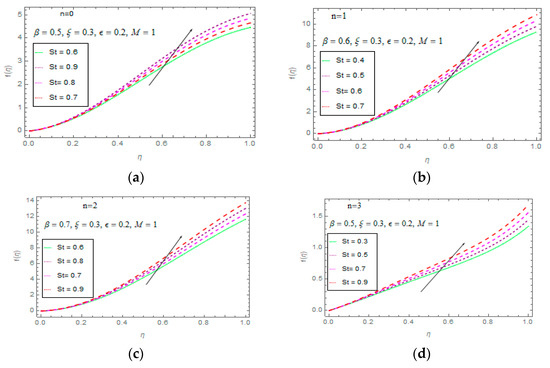
Figure 3.
Effect of on for .
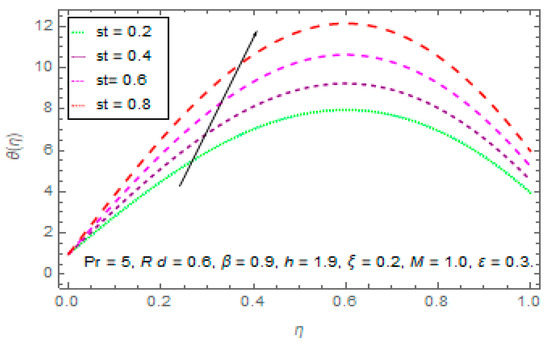
Figure 4.
Effect of on .
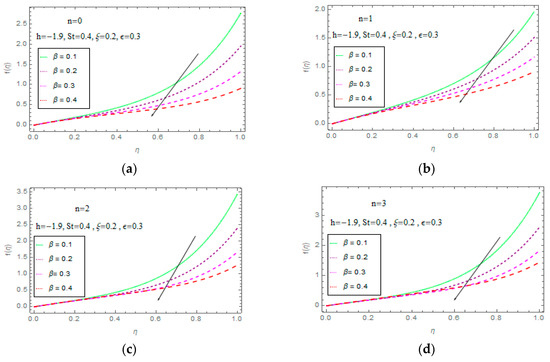
Figure 5.
Effect of on for .
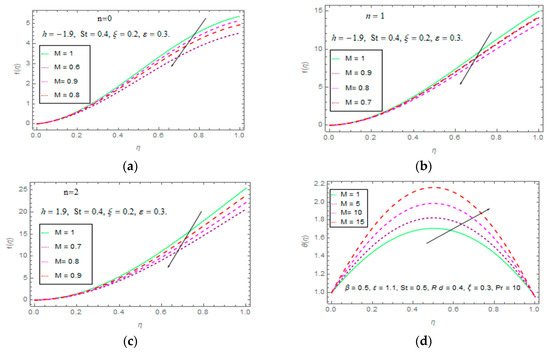
Figure 6.
Effect of on for .
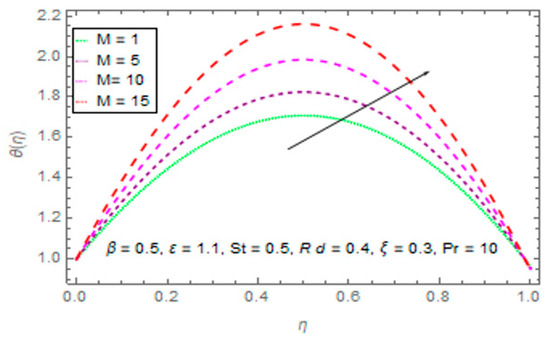
Figure 7.
Effect of on .
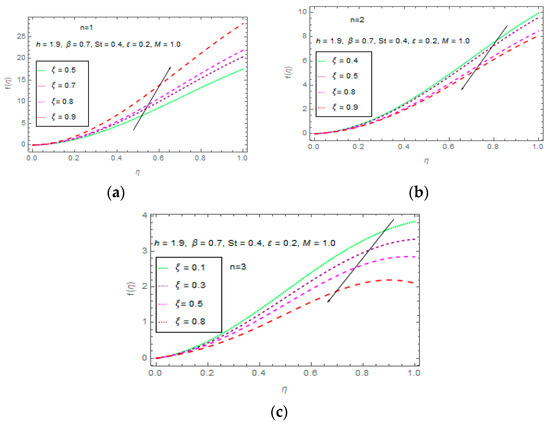
Figure 8.
Effect of on for .
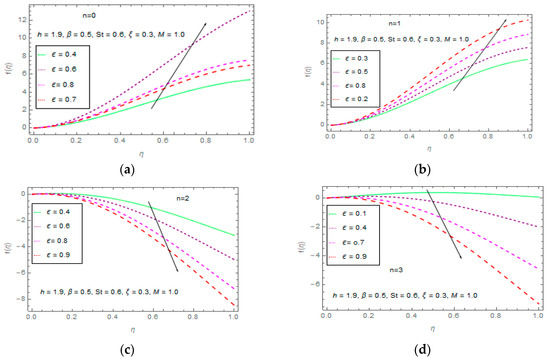
Figure 9.
Effect of on for .
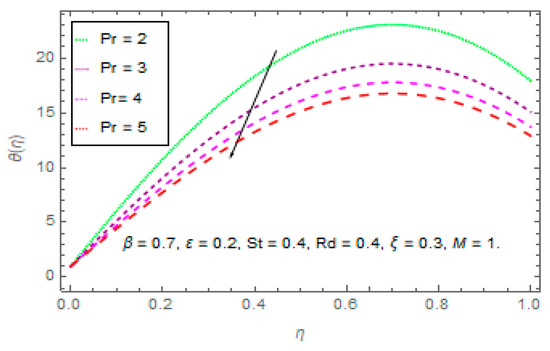
Figure 10.
Effect of on .
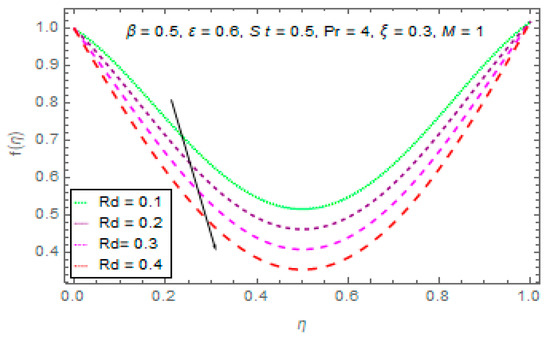
Figure 11.
Effect of on .
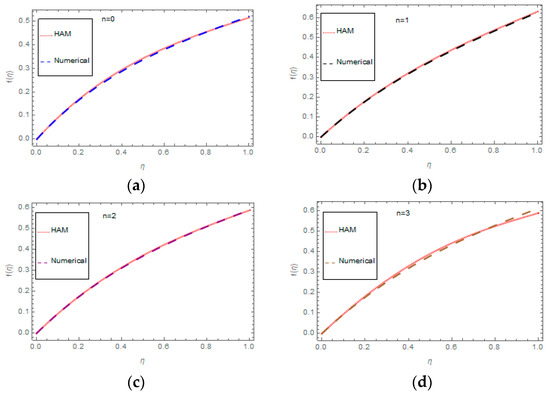
Figure 12.
Comparison graphs between Homotopy Analysis Method (HAM) & numerical solution for velocity profiles when .
Table Discussion
The modelled equations with boundary conditions) are solved analytically as well as numerically. The comparison between analytical and numerical solutions is shown graphically as well as numerically in Table 1, Table 2, Table 3, Table 4 and Table 5 for velocities and temperature. From these tables, an excellent agreement between HAM and Numerical (ND-Solve Techniques) are obtained. The comparison for velocity and temperature profiles for different behavior of fluid between HAM and numerical method are shown in Table 2, Table 3, Table 4, Table 5 and Table 6, which shows an excellent agreement with HAM solution. The numerical values of and on skin friction are given in Table 7. From this table it is clear that increasing values of and decrease while increasing increase skin friction. The numerical values of the surface temperature for the dissimilar value of and are given in Table 8. It is observed that the increasing values of and increase the surface temperature , where opposite effect is found for that is the largest value of reduces the surface temperature The gradient of wall temperature for dissimilar values of embedded parameters has been shown in Table 8. It is perceived that larger values of and fall the wall temperature and increase the wall temperature gradient .
Table 2.
The relationship between Homotopy Analysis Method (HAM) and Numerical techniques for in case of when .
Table 3.
Relationship between Homotopy Analysis Method (HAM) and Numerical techniques for in case of when .
Table 4.
Relationship between Homotopy Analysis Method (HAM) and ND-Solve for in case of when .
Table 5.
Association between Homotopy Analysis Method (HAM) and Numerical techniques for in case of when .
Table 6.
Association between Homotopy Analysis Method (HAM) and Numerical techniques for in case of when .
Table 7.
Coefficient of Skin friction for dissimilar values of and .
Table 8.
Values of dissimilar values of and .
6. Conclusions
Heat transfer and thermal radiation of the thin liquid flow of Sisko fluid on time dependent stretching surface in the presence of the constant magnetic field (MHD) are investigated. Here the thin liquid fluid flow is assumed in two dimensions. The governing time-dependent equations of Sisko fluid are modeled and reduced to ODEs by use of Similarity transformation with unsteadiness non-dimensionless parameter . To solve the model problem, we used analytical and numerical techniques. The convergence of the problem has been shown numerically and graphically using Homotopy Analysis Method (HAM).
The main key points are given below:
- ⮚
- In the present investigation we see that due to greater value of magnetic parameter, the velocity distribution of the thin films fluid will be decreasing.
- ⮚
- Increasing thin film thickness decreases the motion of the fluid
- ⮚
- Due to increasing radiation parameters, the Nusselt number increases.
- ⮚
- The increasing values of Pr number, raising the temperature of the surface, also caused the surface temperature to fall down for large values of unsteady parameters.
- ⮚
- The effect of the liquid film flow on the flow of Sisko fluids has been studied graphically and also shown in tables.
- ⮚
- At the end it is also summarized that due to the Lorentz’s force the liquid film flow is affected.
- ⮚
- The Sisko fluid parameter increases velocity field.
- ⮚
- The effect of all parameters is shown for dissimilar values of power index and .
Author Contributions
The 1st author “A.S.K.” modeled and write the paper (Conceptualization and investigation), the 2nd author “Y.N.” review, modify the paper and supervised, the 3rd author “Z.S.” solve the problem (Methodology and use software).
Funding
This research was funded by National Natural Science Foundation of China No. [11471262].
Conflicts of Interest
The authors declare no conflict of interest.
References
- Crane, L.J. Flow past a stretching plate. Angrew. Math. Phys. 1970, 21, 645–647. [Google Scholar] [CrossRef]
- Dandapat, B.S.; Gupta, A.S. Flow and heat transfer in a viscoelastic fluid over a stretching sheet. Int. J. Nonlinear Mech. 1989, 24, 215–219. [Google Scholar] [CrossRef]
- Wang, C.Y. Liquid film on an unsteady stretching surface. Q. Appl. Math. 1990, 48, 601–610. [Google Scholar] [CrossRef]
- Usha, R.; Sridharan, R. On the motion of a liquid film on an unsteady stretching surface. ASME Fluids Eng. 1993, 150, 43–48. [Google Scholar] [CrossRef]
- Liu, I.C.; Andersson, I.H. Heat transfer in a liquid film on an unsteady stretching sheet. Int. J. Therm. Sci. 2008, 47, 766–772. [Google Scholar] [CrossRef]
- Aziz, R.C.; Hashim, I.; Alomari, A.K. Thin film flow and heat transfer on an unsteady stretching sheet with internal heating. Meccanica 2011, 46, 349–357. [Google Scholar] [CrossRef]
- Tawade, L.; Abel, M.; GMetri, P.; Koti, A. Thin filmflow and heat transfer over an unsteady stretching sheet with thermal radiation, internal heating in presence of external magnetic field. Int. J. Adv. Appl. Math. Mech. 2016, 3, 29–40. [Google Scholar]
- Andersson, H.I.; Aarseth, J.B.; Braud, N.; Dandapat, B.C. Flow of a power-law fluid film on an unsteady stretching surface. J. Non-Newton. Fluid Mech. 1996, 62, 1–8. [Google Scholar] [CrossRef]
- Waris, K.; Gul, T.; Idrees, M.; Islam, S.; Khan, I.; Dennis, L.C.C. Thin FilmWilliamson Nanofluid Flow with Varying Viscosity and Thermal Conductivity on a Time-Dependent Stretching Sheet. Appl. Sci. 2016, 6, 334. [Google Scholar]
- Anderssona, H.I.; Aarseth, J.B.; Dandapatb, B.C. Heat transfer in a liquid film on an unsteady stretching. Int. J. Heat Mass Transf. 2000, 43, 69–74. [Google Scholar] [CrossRef]
- Chen, C.H. Heat transfer in a power-law liquid fillm over a unsteady stretching sheet. Heat Mass Transf. 2003, 39, 791–796. [Google Scholar] [CrossRef]
- Chen, C.H. Effect of viscous dissipation on heat transfer in a non-Newtonian liquid film over an unsteady stretching sheet. J. Non-Newton. Fluid Mech. 2006, 135, 128–135. [Google Scholar] [CrossRef]
- Wang, C.; Pop, L. Analysis of the flow of a power-law liquid film on an unsteady stretching surface by means of homotopy analysis method. J. Non-Newton. Fluid Mech. 2006, 138, 161–172. [Google Scholar] [CrossRef]
- Saeed, A.; Shah, Z.; Islam, S.; Jawad, M.; Ullah, A.; Gul, T.; Kumam, P. Three-Dimensional Casson Nanofluid Thin Film Flow over an Inclined Rotating Disk with the Impact of Heat Generation/Consumption and Thermal Radiation. Coatings 2019, 9, 248. [Google Scholar] [CrossRef]
- Shah, Z.; Dawar, A.; Kumam, P.; Khan, W.; Islam, S. Impact of Nonlinear Thermal Radiation on MHD Nanofluid Thin Film Flow over a Horizontally Rotating Disk. Appl. Sci. 2019, 9, 1533. [Google Scholar] [CrossRef]
- Khan, N.S.; Gul, T.; Kumam, P.; Shah, Z.; Islam, S.; Khan, W.; Zuhra, S.; Sohail, A. Influence of Inclined Magnetic Field on Carreau Nanoliquid Thin Film Flow and Heat Transfer with Graphene Nanoparticles. Energies 2019, 12, 1459. [Google Scholar] [CrossRef]
- Khan, N.S.; Zuhra, S.; Shah, Z.; Bonyah, E.; Khan, W.; Islam, S. Slip flow of Eyring-Powell nanoliquid film containing graphene nanoparticles. AIP Adv. 2018, 8, 115302. [Google Scholar] [CrossRef]
- Ullah, A.; Alzahrani, E.O.; Shah, Z.; Ayaz, M.; Islam, S. Nanofluids Thin Film Flow of Reiner-Philippoff Fluid over an Unstable Stretching Surface with Brownian Motion and Thermophoresis Effects. Coatings 2019, 9, 21. [Google Scholar] [CrossRef]
- Shah, Z.; Bonyah, E.; Islam, S.; Khan, W.; Ishaq, M. Radiative MHD thin film flow of Williamson fluid over an unsteady permeable stretching. Heliyon 2018, 4, e00825. [Google Scholar] [CrossRef] [PubMed]
- Isko, A. The flow of lubricating greases. Ind. Eng. Chem. 1958, 50, 1789–1792. [Google Scholar]
- Siddiqui, A.; Ahmed, M.; Ghori, Q. Thin film flow of non-newtonian fluids on a moving belt. Chaos Solitons Fractals 2007, 33, 1006–1016. [Google Scholar] [CrossRef]
- Siddiqui, A.; Ashraf, H.; Walait, A.; Haroon, T. On study of horizontal thin film flow of sisko fluid due to surface tension gradient. Appl. Math. Mech. 2015, 36, 847–862. [Google Scholar] [CrossRef]
- Khan, M.; Shahzad, A. On boundary layer flow of a Sisko fluid over a stretching sheet. Quaest. Math. 2012, 36, 137–151. [Google Scholar] [CrossRef]
- Molati, M.; Hayat, T.; Mahomed, F. Rayleigh problem for a MHD Sisko fluid. Nonlinear Anal. Real World Appl. 2009, 10, 3428–3434. [Google Scholar] [CrossRef]
- Malik, R.; Khan, M.; Munir, A.; Khan, W.A. Flow and Heat Transfer in Sisko Fluid with Convective Boundary Condition. PLoS ONE 2014, 9, e107989. [Google Scholar] [CrossRef]
- Shah, Z.; Islam, S.; Ayaz, H.; Khan, S. Radiative Heat and Mass Transfer Analysis of Micropolar Nanofluid Flow of Casson Fluid between Two Rotating Parallel Plates with Effects of Hall Current. ASME J. Heat Transf. 2019, 141. [Google Scholar] [CrossRef]
- Shah, Z.; Dawar, A.; Islam, S.; Khan, I.; Ching, D.L.C. Darcy-Forchheimer Flow of Radiative Carbon Nanotubes with Microstructure and Inertial Characteristics in the Rotating Frame. Case Stud. Therm. Eng. 2018, 12, 823–832. [Google Scholar] [CrossRef]
- Shah, Z.; Bonyah, E.; Islam, S.; Gul, T. Impact of thermal radiation on electrical mhd rotating flow of carbon nanotubes over a stretching sheet. AIP Adv. 2019, 9, 015115. [Google Scholar] [CrossRef]
- Shah, Z.; Dawar, A.; Islam, S.; Khan, I.; Ching, D.L.C.; Khan, A.Z. Cattaneo-Christov model for Electrical MagnetiteMicropoler Casson Ferrofluid over a stretching/shrinking sheet using effective thermal conductivity model. Case Stud. Therm. Eng. 2019, 13, 100352. [Google Scholar] [CrossRef]
- Khan, A.S.; Nie, Y.; Shah, Z.; Dawar, A.; Khan, W.; Islam, S. Three-Dimensional Nanofluid Flow with Heat and Mass Transfer Analysis over a Linear Stretching Surface with Convective Boundary Conditions. Appl. Sci. 2018, 8, 2244. [Google Scholar] [CrossRef]
- Khan, A.; Shah, Z.; Islam, S.; Khan, S.; Khan, W.; Khan, Z.A. Darcy–Forchheimer flow of micropolar nanofluid between two plates in the rotating frame with non-uniform heat generation/absorption. Adv. Mech. Eng. 2018, 10, 1–16. [Google Scholar] [CrossRef]
- Li, Z.; Sheikholeslami, M.; Shah, Z.; Shafee, A.; Al-Qawasmi, A.-R.; Tlili, I. Time dependent heat transfer in a finned triplex tube during phase changing of nanoparticle enhanced PCM. Eur. Phys. J. Plus 2019, 134, 173. [Google Scholar] [CrossRef]
- Sheikholeslami, M.; Shah, Z.; Shafi, A.; Khan, I.; Itili, I. Uniform magnetic force impact on water based nanofluid thermal behavior in a porous enclosure with ellipse shaped obstacle. Sci. Rep. 2019, 9. [Google Scholar] [CrossRef]
- Sheikholeslami, M.; Shah, Z.; Tassaddiq, A.; Shafee, A.; Khan, I. Application of Electric Field for Augmentation of Ferrofluid Heat Transfer in an Enclosure Including Double Moving Walls. IEEE Access 2019, 7, 21048–21056. [Google Scholar] [CrossRef]
- Kumam, P.; Shah, Z.; Dawar, A.; Ur Rasheed, H.; Islam, S. Entropy Generation in MHD Radiative Flow of CNTs Casson Nanofluid in Rotating Channels with Heat Source/Sink. Math. Probl. Eng. 2019, 2019, 9158093. [Google Scholar] [CrossRef]
- Khan, A.S.; Nie, Y.; Shah, Z. Impact of Thermal Radiation and Heat Source/Sink on MHD Time-Dependent Thin-Film Flow of Oldroyed-B, Maxwell, and Jeffry Fluids over a Stretching Surface. Processes 2019, 7, 191. [Google Scholar] [CrossRef]
- Ishaq, M.; Ali, G.; Shah, S.I.A.; Shah, Z.; Muhammad, S.; Hussain, S.A. Nanofluid Film Flow of Eyring Powell Fluid with Magneto Hydrodynamic Effect on Unsteady Porous Stretching Sheet, Punjab University. J. Math. 2019, 51, 131–153. [Google Scholar]
- Muhammad, S.; Ali, G.; Shah, Z.; Islam, S.; Hussain, S.A. The Rotating Flow of Magneto Hydrodynamic Carbon Nanotubes over a Stretching Sheet with the Impact of Non-Linear Thermal Radiation and Heat Generation/Absorption. Appl. Sci. 2018, 8, 482. [Google Scholar] [CrossRef]
- Hsiao, K.L. To Promote Radiation Electrical MHD Activation Energy Thermal Extrusion Manufacturing System Efficiency by Using Carreau-Nanofluid with Parameters Control Method. Energy 2017, 130, 486–499. [Google Scholar] [CrossRef]
- Hsiao, K.L. Combined Electrica MHD Heat Transfer Thermal Extrusion System Using Maxwell Fluid with Radiative and Viscous Dissipation Effects. Appl. Therm. Eng. 2016, 112, 1281–1288. [Google Scholar] [CrossRef]
- Hsiao, K.L. Micropolar Nanofluid Flow with MHD and Viscous Dissipation Effects Towards a Stretching Sheet with Multimedia Feature. Int. J. Heat Mass Transf. 2017, 112, 983–990. [Google Scholar] [CrossRef]
- Hsiao, K.L. Stagnation Electrical MHD Nanofluid Mixed Convection with Slip Boundary on a Stretching Sheet. Appl. Therm. Eng. 2016, 98, 850–861. [Google Scholar] [CrossRef]
- Shang, Y. A Lie algebra approach to susceptible-infected-susceptible epidemics, Electronic. J. Differ. Equ. 2012, 233, 1–7. [Google Scholar]
- Shang, Y. Analytical solution for an in-host viral infection model with time-inhomogeneous rates. Acta Phys. Pol. B 2015, 46, 1567. [Google Scholar] [CrossRef]
© 2019 by the authors. Licensee MDPI, Basel, Switzerland. This article is an open access article distributed under the terms and conditions of the Creative Commons Attribution (CC BY) license (http://creativecommons.org/licenses/by/4.0/).