


Abstract
The contamination of water with toxic metals, such as copper, poses significant environmental and public health challenges, necessitating sustainable treatment solutions. This study investigates the phytoremediation potential of Epipremnum aureum for the removal of Cu(II) from aqueous solutions under both static and dynamic conditions. Batch experiments were conducted using initial copper concentrations of 5, 10, 15, and 20 mg L−1, while a prototype vertical flow system (“green wall”) was implemented for continuous flow studies at 10 mg L−1. Copper removal efficiency, plant morphology, and kinetic behavior were monitored over four weeks. ATR-FTIR, SEM-EDX, and X-ray diffraction analyses were performed to elucidate the sorption mechanism. Results demonstrated that E. aureum tolerates copper concentrations up to 10 mg L−1 without significant morphological damage, achieving up to 70% removal in continuous flow, with sorption occurring via a combination of surface adsorption to oxygenated functional groups and intracellular absorption. At higher concentrations (≥15 mg L−1), plants exhibited severe stress and necrosis, limiting their remediation capacity. The findings indicate that E. aureum is effective for moderate copper contamination and provide mechanistic insights into its metal uptake processes, highlighting its suitability for integration into sustainable water treatment systems. This work contributes to the development of eco-friendly, plant-based strategies for toxic metal remediation, supporting advances in chemical and hybrid technologies for safe water management.
1. Introduction
Water contamination by toxic metals represents a major threat to aquatic ecosystems and human health [1]. Among these metals, copper is an essential micronutrient at low concentrations, participating in physiological processes such as photosynthesis, respiration, and cell wall metabolism [2].
However, excessive copper levels can induce toxicity in plants, animals, and humans, leading to oxidative stress, tissue damage, and bioaccumulation in aquatic organisms [3]. In Mexico, since 1999 high copper concentrations have been reported in various water bodies due to industrial activities [4], including cases such as the discharge from mining operations in the Sonora state, where copper levels in nearby rivers exceeded permissible limits (4–5 mg L−1, according to Mexican Environmental Legislation). Another example is the case of San Pedro river, where copper concentrations were recorded in a range of 0.06–6.60 mg L−1 [5]; on the other hand, Salcedo-Sanchez et al. (2022) detected copper in samples from San Juan-Taxco river at concentrations of 0.0818 mg L−1 [6], posing risks to both aquatic life and local communities [7]. Supplementary Figure S1 shows the geographical distribution of the aforementioned basins. These examples highlight the urgent need for effective strategies to mitigate copper pollution in aquatic environments.
In response to these environmental challenges, phytoremediation has emerged as an environmentally friendly and cost-effective strategy for the removal of toxic metals from aqueous media. This approach relies on plants with high contaminant uptake and accumulation capacities, enabling the purification of polluted water without generating secondary toxic waste [8]. The efficiency of phytoremediation depends on multiple factors, including the selection of plant species, the physicochemical conditions of the water, and the initial concentration of contaminants. By leveraging the natural abilities of certain plant species, phytoremediation offers a sustainable alternative to conventional, often costly, water treatment technologies.
Several plants species have been used in phytoremediation processes [9]. For example, Eichhornia crassipes, Pistia stratiotes, and Spirodela polyrhiza have been used for improving water quality parameters, accumulating moderate quantities of toxic metals such as Cu, Zn, Fe, Cr, and Cd with removal efficiencies of 90% over a period of 15 days [10]. Another research work reports the use of Lemna minor in the phytoremediation of industrial wastewater; in the case of Cu, a removal efficiency of 98.46% was reported using low initial concentrations of 25.84 ppb [11]. Pistia stratiotes, also known as Water Lettuce, has been used for several toxic metals (Cu, Fe, Pb and Zn), reporting high removal efficiencies such as 78.6% for Cu using a sample of steel industry effluent with initial copper concentrations of 0.16 mg L−1 [9]. On the other hand, Salvinia (Watermoss) has demonstrated good removal efficiencies for Cd, Cu, Ni and Zn. In the case of Cu, around 80% of the metal was removed; in this case, the experiments were conducted in field [12].
Among the plants with high phytoremediation potential, E. aureum (pothos), a perennial climbing plant of the Araceae family, has attracted significant attention due to its adaptability, rapid growth, and ease of propagation. Its fibrous root system allows extensive contact with contaminated water, while its tolerance to variations in nutrients, light, and temperature enhances its resilience in adverse conditions [13]. Moreover, E. aureum can survive in contaminated solutions while maintaining vegetative growth, activating physiological mechanisms that facilitate the uptake and accumulation of toxic metals such as copper [14]. These characteristics make it an ideal candidate for water treatment applications in both laboratory and real-world settings.
Recently, some authors have proposed future directions in the research of the phytoremediation process of water polluted with toxic metals, mainly related to the transition of laboratory experiments to practical and large-scale applications [15]. In this sense, vertical green wall systems have gained attention as innovative platforms for environmental remediation. By combining efficient space utilization with ecological benefits, such as air quality improvement and contaminant removal, green walls offer a multifunctional approach to sustainable water management [16]. Incorporating phytoremediator species like E. aureum into these systems enhances their functional role, allowing for the effective removal of metallic cations from wastewater while maintaining an aesthetically pleasing structure.
A laboratory-scale green wall prototype incorporating E. aureum was designed and evaluated for copper phytoremediation. System performance was assessed through copper removal kinetics and the investigation of sorption mechanisms. By integrating plant-based remediation into a structured green wall system, this work aims to contribute to the development of sustainable and accessible water treatment technologies capable of addressing toxic metal contamination in aquatic environments.
2. Materials and Methods
2.1. Static Phytoremediation Experiments
E. aureum plants were obtained from a commercial nursery (Zapopan, Jalisco, Mexico) and acclimated under controlled laboratory conditions for two weeks prior to the experiments. Only healthy plants of similar size and vigor were selected. Roots and leaves were thoroughly rinsed with distilled water to remove any adhering soil or impurities. Contaminated aqueous solutions were prepared using analytical-grade copper(II) sulfate pentahydrate (CuSO4·5H2O), provided by Sigma-Aldrich (Saint Louis, MO, USA; purity > 98%), at concentrations of 5, 10, 15, and 20 mg L−1. For each experiment, a single leaf with its petiole, obtained from a stem cutting, was used. Each treatment was performed in triplicate with a solution volume of 150 mL. A leaf cutting (leaf with petiole) was used to standardize the biomass, with a target weight of approximately 1.5 g. This replicates the mass:volume ratio of 0.01 used in our previous adsorption experiments [7] and represents a functional unit of the plant capable of regeneration. This approach allows for precise control of the biomass and is reproducible in laboratory-scale phytoremediation studies.
Phytoremediation experiments were conducted under static conditions by exposing the prepared leaf cuttings to the Cu(II) solutions for a period of four weeks. All experiments were conducted under controlled ambient laboratory conditions. The temperature was maintained at 25 ± 1 °C, the pH of the solutions was monitored and maintained at 6.5 ± 0.5 using H2SO4 0.1 M provided by Sigma-Aldrich (Saint Louis, MO, USA; purity 95–98%) when it was necessary, and illumination was provided by standard ceiling-mounted fluorescent laboratory lighting under a 12:12 h light:dark photoperiod. These conditions were held constant for all treatment. Samples of the aqueous phase were collected at defined intervals to determine residual copper concentrations. The concentration of Cu(II) in solution was quantified by UV-Vis spectroscopy, forming the intense blue copper-ammonia complex. For this purpose, an excess of ammonium hydroxide (NH4OH) from Sigma-Aldrich (Saint Louis, MO, USA; purity 28–30%) was added to each sample, the mixture was vortexed, and the absorbance was measured at 611 nm using a Shimadzu UV-1800 spectrophotometer (Kioto, Japan) [7]. The calibration curve (0–20 mg L−1), prepared from CuSO4·5H2O standards under the same complexation conditions, is presented as Supplementary Figure S2 and showed a coefficient of determination (R2) > 0.999.
Morphological parameters of the plants, including root length, leaf area, and overall biomass, were measured at the beginning and end of the study. Visual observations were recorded to assess changes in leaf coloration, turgor, and necrosis. These color evaluations were conducted comparatively relative to the initial state under identical imaging conditions and were not intended as quantitative physiological measurements.
2.2. Dynamic Phytoremediation in a Green Wall Prototype
Dynamic phytoremediation experiments were conducted using a green wall prototype to evaluate the performance of E. aureum under continuous flow conditions. The system consisted of a storage tank containing 10 mg L−1 Cu(II) aqueous solution, which was pumped by a peristaltic pump through horizontal tubing arranged in multiple levels to form the green wall. At each level, small plants, each consisting of a single leaf with a short stem obtained from cuttings, were positioned in direct contact with the flowing solution. Effluent from the final level was collected in a separate storage tank.
The flow rate was maintained constant at 4.5 mL min−1 to ensure uniform exposure of all plants to the contaminated solution. The pH of the solution was monitored and maintained at 6.5 ± 0.5 throughout the experiments. Water temperature and ambient light conditions were controlled to minimize environmental variability.
Samples of the aqueous phase were collected at defined intervals to monitor residual copper concentrations. Visual observations of plant morphology, including leaf coloration, turgor, and overall integrity, were recorded before, during, and after the experiment to assess physiological responses under continuous flow conditions.
Finally, the sorption kinetics data of the phytoremediation process under continuous flow conditions were adjusted to a linear first-order partial differential equation (Equation (1)), which corresponds to a dynamical Plug Flow Reactor (PFR).
In this model, the kinetic term (kCn) was expressed as a power-law expression. Due to the heterogeneous nature of this system, a power-law kinetic expression was adopted, where represents an effective or “fractal” dimension characteristic of heterogeneous transport and reaction processes. This exponent departs from the integer reaction orders typically associated with elementary reactions, reflecting anomalous kinetics arising from interfacial effects, spatial heterogeneity, and transport limitations within the root structure [17,18,19,20].
Additionally, it is important to note that the system can be reasonably approximated as a plug flow reactor with discrete reactive zones corresponding to individual plants. The tubular geometry exhibits a high length-to-diameter ratio (L/D ≈ 200), and the low flow rate (4.5 mL min−1) results in a Reynolds number of approximately 7.5, indicating strictly laminar flow. Under these conditions, axial back-mixing due to turbulence is negligible, and transport is dominated by unidirectional convection. Unlike suspended-growth biological reactors, where dissolved substrates and dispersed biomass can strongly contribute to axial scattering, the present system contains no freely suspended biomass; biological uptake is confined to discrete, fixed plant root locations, which act as localized sinks rather than sources of axial mixing. Furthermore, the kinetics of root-mediated adsorption relative to the hydrodynamic residence time leads to gradual axial concentration changes, consistent with plug-flow behavior. Any axial dispersion present is therefore expected to be small relative to convective transport, justifying the use of a plug-flow–type model.
2.3. Investigation of Cu(II) Sorption Mechanism
To elucidate the sorption mechanism of Cu(II) onto E. aureum, the morphology of the plants was examined before and after the adsorption process by scanning electron microscopy (SEM) and energy dispersive spectroscopy (EDX). The SEM micrographs and EDX spectra were obtained using a Scanning Electron microscope (JEOL model JSM IT710HR, Tokio, Japan).
Fourier transform infrared spectroscopy (ATR-FTIR) studies before and after the adsorption process were performed. For this purpose, a Nicolet iS5 FTIR spectrometer equipped with a diamond-tipped Attenuated Total Reflectance (ATR) device was used (Waltham, MA, USA). The spectra of all samples correspond to 32 scans with resolutions of 0.8 cm−1 and a data spacing of 0.060 cm−1.
XRD measurements were conducted using a Empyrean (Malvern PANalytical, Eindhoven, The Netherlands) with Cu Kα radiation, over a 2θ range of 10–80°. Diffractograms of the untreated plant material were used as controls to characterize the amorphous nature of the native biomass, primarily composed of cellulose, hemicellulose, and lignin. Subsequent XRD patterns of the Cu-exposed biomass were analyzed to detect the formation of crystalline copper species, such as copper sulfate, indicative of metal binding and crystallization on the plant matrix.
2.4. Statistical Analysis
All experiments were performed in duplicate, and data are presented as the mean ± standard deviation. To determine the statistical significance of the observed differences in copper removal efficiency across the different initial copper concentrations (5, 10, 15, and 20 mg L−1), a one-way analysis of variance (ANOVA) was performed. A p-value of less than 0.05 was considered statistically significant for all analyses. The statistical analysis was conducted using STATISTICA 10.0 software (StatSoft, Palo Alto, CA, USA).
3. Results&Discussion
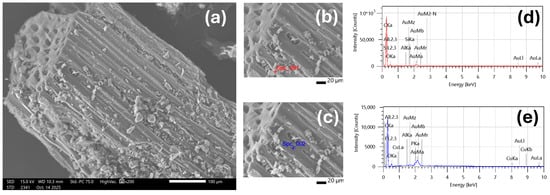
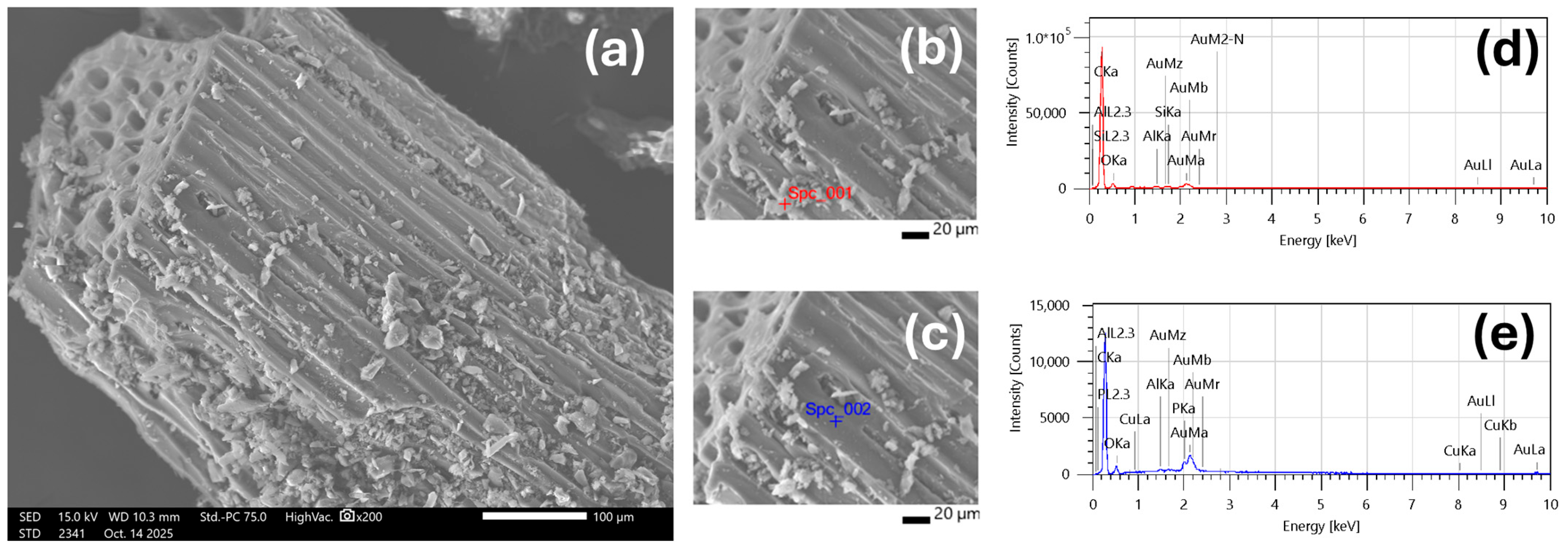
Figure 1a shows the microstructure of petiole of E. aureum. A fibrous and porous morphology can be observed, consisting of parallel vascular channels responsible for water and nutrient transport [21]. The surface displays heterogeneous deposits, possibly related to residual mineral particles or compounds derived from the growth medium. To compare the effect of copper sorption, SEM micrographs were obtained before and after the phytoremediation process (Figure 1b and Figure 1c, respectively). The images indicate that no significant alterations in the plant surface microstructure were observed after the sorption process. Additionally, the EDS spectra (Figure 1d,e) show a signal corresponding to Cu, confirming the presence of copper on the plant surface after treatment.
Figure 1.
(a) SEM micrograph of petiole of Epipremnum aureum (b) SEM micrograph of petiole of Epipremnum aureum before copper sorption (c) SEM micrograph of petiole of Epipremnum aureum after copper sorption (d) EDX spectrum of petiole of Epipremnum aureum m before copper sorption and (e) EDS spectrum of petiole of Epipremnum aureum after copper sorption.
Point EDX analyses (Spc_001 and Spc_002) revealed the predominant presence of light elements such as oxygen, silicon, and aluminum, mainly associated with the inorganic composition of the substrate and the possible presence of silica in the cell wall structures. Importantly, no copper signals (Cu Kα or Cu Lα peaks) were detected in any of the analyzed regions, confirming the absence of this element in the plant tissue prior to the phytoremediation process. This result establishes a reliable baseline to distinguish between the natural elemental composition of the plant tissue and the metal accumulation induced during contaminant removal experiments.
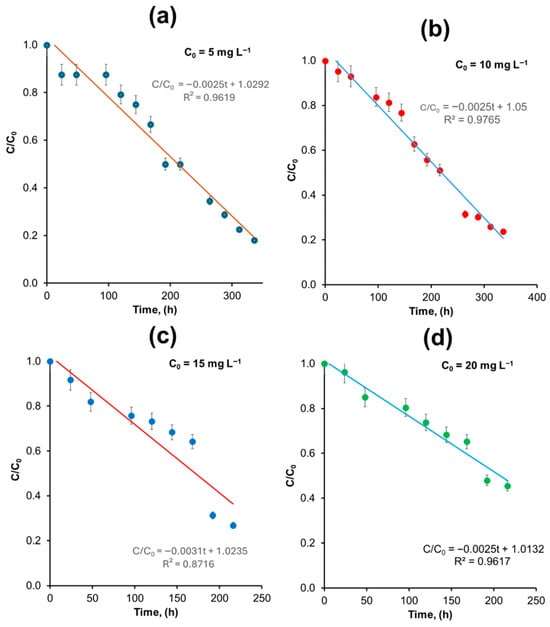
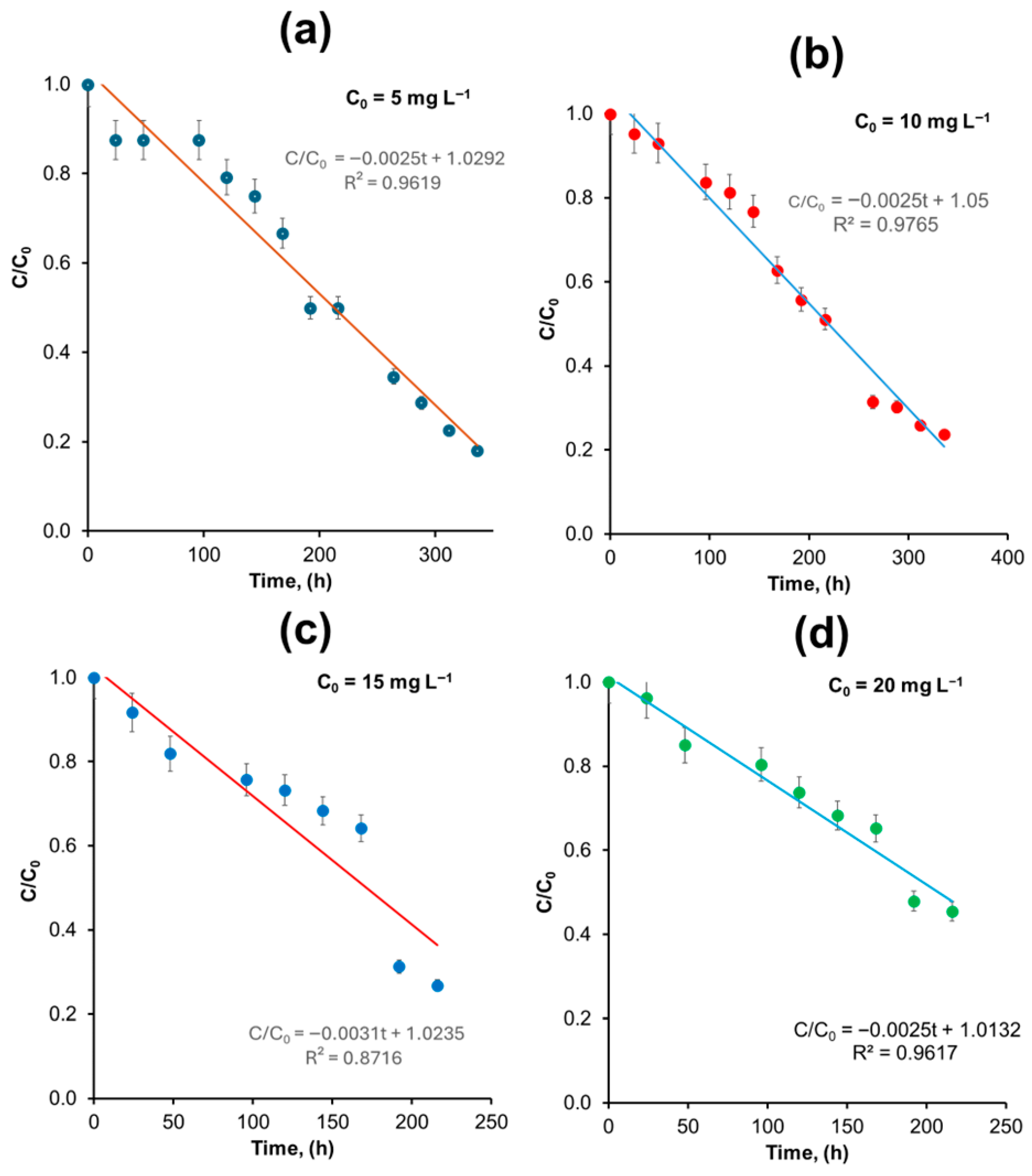
Phytoremediation assays of Cu(II) were conducted under static conditions using E. aureum exposed to copper-contaminated solutions with initial concentrations of 5, 10, 15, and 20 mg L−1 (Figure 2). The process was evaluated over a four-week period by monitoring the copper concentration in solution as well as the morphological variations observed in the plant. The concentration linearly decreases due to the slow kinetics [22].
Figure 2.
Cu(II) removal kinetics in static mode studies at different initial concentrations: (a) 5 mg L−1, (b) 10 mg L−1, (c) 15 mg L−1, (d) 20 mg L−1.
In all cases, no statistically significant variation was observed in the plant biomass (root length, width, and height), indicating that E. aureum can tolerate prolonged exposure to copper at the concentrations studied without appreciable morphological alterations. Figure 2a,b show a visual sequence of the phytoremediation process carried out by E. aureum in copper-contaminated solutions with initial concentrations of 5 and 10 mg L−1, respectively, over a four-week period. In both cases, the initial image (week 0) shows leaves with the intense green color characteristic of the species [23]. As time progresses (weeks 1–4), gradual changes in biomass coloration are observed, particularly slight discoloration and the appearance of yellowish tones in some leaves and roots (Supplementary Figure S3). The loss of green intensity and the emergence of yellow hues are physiological indicators of toxic metal stress [24]. However, the magnitude of these visual changes is relatively moderate, suggesting that at the evaluated concentrations, E. aureum exhibits high tolerance to copper, maintaining its basic metabolic activity and overall structural integrity.
The observed plant behavior correlates directly with the copper removal kinetics. During the initial weeks, copper sorption is more active, coinciding with early visual signs of stress. By the third and fourth weeks, coloration changes become more evident, which could be associated with the progressive saturation of sorption sites in the roots or peripheral tissues, slightly reducing the removal efficiency over time. This phenomenon is consistent with previous reports on plant stress caused by toxic metals, where prolonged exposure can trigger defense mechanisms such as the production of phenolic compounds, alterations in photosynthesis, and, in more severe cases, necrosis [25]. Nonetheless, in this case, the visual changes remain moderate, reinforcing the notion that the species is suitable for phytoremediation under moderate contamination levels.
In contrast, Figure 2c illustrates the evolution of the phytoremediation process at an initial copper concentration of 15 mg L−1. In the initial image (week 0), the plant displays a healthy green color. However, starting from the first week, drastic changes become evident: the leaves exhibit severe yellowing, loss of turgor, and early signs of necrotic spots. By the second week, the biomass shows clear evidence of degradation, including advanced wilting and tissue darkening. By the third week, most of the plant exhibits functional death, with completely dried or collapsed tissues. These results suggest that at 15 mg L−1, E. aureum experiences rapid and severe copper toxicity, compromising its basic physiological functions [14]. The early damage indicates that copper concentrations at this level exceed the plant’s natural tolerance and detoxification capacity, resulting in: (i) inhibition of photosynthesis (reflected by chlorosis), (ii) protein denaturation and membrane damage, and (iii) interference with essential metabolic processes such as nutrient uptake. The rapid progression toward cell death suggests that at this concentration, the plant’s antioxidant defense system is insufficient to counteract the oxidative stress induced by metal ions.
A similar trend is observed at the highest concentration (20 mg L−1, Figure 2d). At the beginning of the process (week 0), the biomass appears healthy. However, during the first week of exposure, even more rapid and severe alterations occur compared to the previous condition. Within the first few days, generalized wilting, intense discoloration (from green to brownish or black tones), and widespread necrosis in both leaves and roots are evident. By the end of the first week, most plant tissues show signs of complete death, with no evidence of recovery in the following weeks. The accelerated physiological response at 20 mg L−1 demonstrates that this copper concentration is highly toxic to E. aureum, causing: (i) immediate collapse of cellular structure, (ii) total inhibition of critical metabolic functions, and (iii) accumulation of reactive oxygen species at unsustainable levels for the plant. The rapid onset of tissue death indicates that at this concentration, the plant not only fails to tolerate the contaminant but is also unable to perform a meaningful phytoremediation process, as its biological activity ceases before effectively removing copper from the medium.
The above results demonstrate that the tolerance limit of E. aureum to copper likely lies between 10 and 15 mg L−1. Beyond this threshold, prolonged exposure becomes lethal to the biomass, negatively affecting both removal efficiency and the viability of systems based on this species. These findings support its suitability for long-term applications in phytoremediation systems integrated into green wall configurations. Based on these results, a copper concentration of 10 mg L−1 was selected to evaluate the process under dynamic conditions in a green wall prototype.
Finally, the experimental data were fitted to the Langmuir isotherm model. For this purpose, the equilibrium concentrations were plotted against the adsorption capacity of the plants, as determined by a mass balance. The results are presented in Supplementary Figure S4. The data show a good fit to the model, confirming that the adsorption process occurs via the formation of an adsorbate monolayer on the adsorbent surface. The maximum adsorption capacity was 1.4 mg g−1, which is consistent with the plant’s tolerance to high metal concentrations. The maximum Cu(II) adsorption capacity determined for Epipremnum aureum is competitive among living aquatic plants used in phytoremediation (Table 1). This value exceeds those reported for various aquatic species and is comparable to that of high-capacity species such as Eichhornia crassipes. Therefore, it is confirmed as a candidate with great potential for bioremediation applications in copper-contaminated waters.
Table 1.
Comparison of the Cu(II) accumulation capacity in live aquatic plants.
3.1. Sorption Mechanism of Cu(II) on Epipremnum aureum
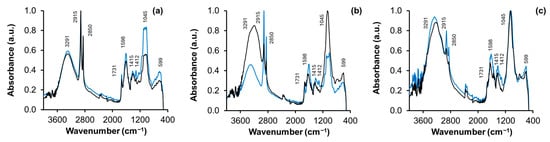
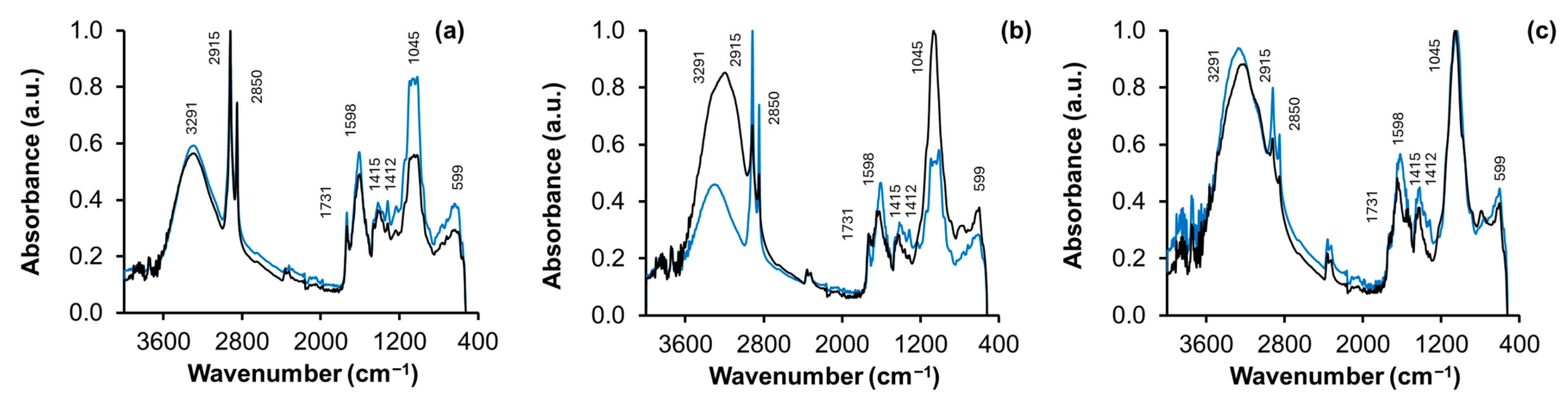
The main regions of the E. aureum biomaterial (root, petiole, and leaf) were characterized before and after Cu(II) adsorption using ATR-FTIR, as shown in Figure 3 and Supplementary Table S1. The FTIR spectra revealed the presence of oxygen-containing functional groups derived from cellulose, hemicellulose, and lignin. The band observed at 3291 cm−1 corresponds to the stretching of hydroxyl (–OH) groups inherent to the biomaterial, with a possible contribution from adsorbed residual moisture, while the signals at 2915 and 2850 cm−1 are attributed to asymmetric and symmetric C–H stretching in methylene groups, typical of structural biopolymers [32]. The band at 1731 cm−1 is assigned to the carbonyl (C=O) stretching of carboxyl groups, and the signal at 1045 cm−1 to C–O vibrations and bending of oxygenated groups associated with polysaccharides [33].
Figure 3.
ATR-FTIR spectra of different E. aureum tissues before (black line) and after (blue line) the Cu(II) removal process: (a) root, (b) petiole, and (c) leaf.
After Cu(II) adsorption, a significant decrease in the absorbance of the bands associated with –OH, –COOH, and C–O groups was observed in all analyzed regions, being most pronounced in the petiole, followed by the root and the leaf. This decrease indicates that these groups directly participate in the surface retention of the metal cation by restricting their normal vibrational modes [34]. No new bands were detected in the spectra, ruling out the formation of new covalent complexes. Under the studied conditions, the results suggest that hydroxyl and carboxyl groups tend to deprotonate, generating negative surface charges that favor Cu(II) adsorption through electrostatic interactions. The greater decrease observed in the petiole points to a higher affinity of this region for the metal, possibly related to the abundance or accessibility of oxygen-containing functional groups. Finally, these findings agree with previous reports on lignocellulosic matrices, where the surface adsorption of toxic metals is mainly attributed to the availability of oxygenated groups in the biomaterial [35].
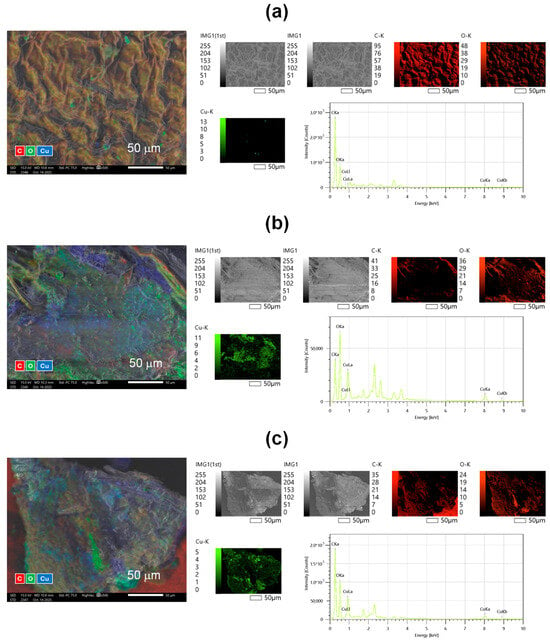
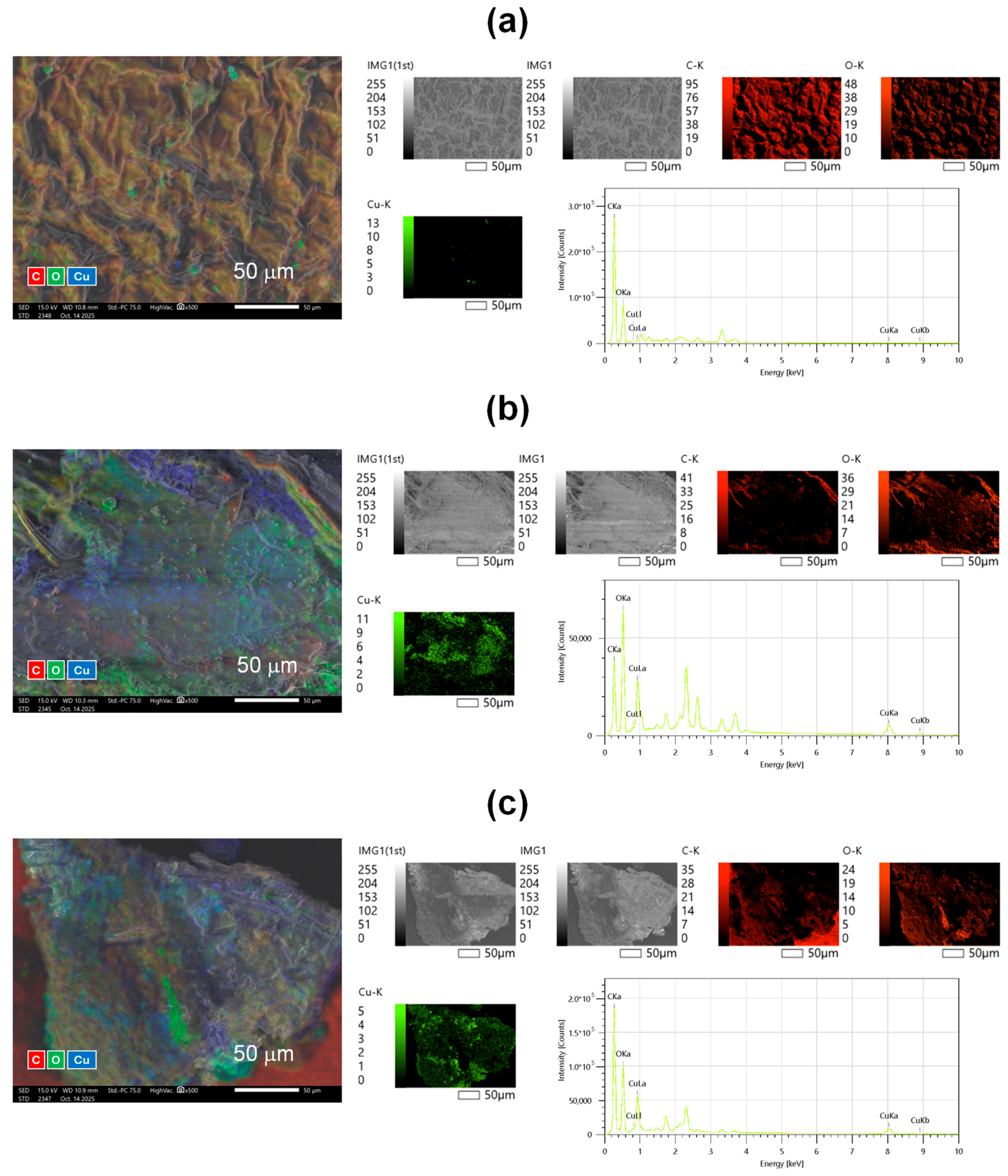
To confirm the previous hypothesis, SEM-EDX studies were performed (Figure 4). The plant was divided into three previously defined zones. Micrographs were obtained for each zone, and SEM-EDX mapping was performed to evaluate the metal distribution; the mapped elements were C, O, and Cu. As shown in Figure 4a, it was observed that the plant predominantly contained C and O. The micrographs validate the previous hypothesis, showing a distinct morphology in each zone. Also, it was observed that the root is more tortuous, indicating a larger surface area for the phenomenon to occur. The same is true for the petiole/stem; these are precisely the channels observed in the first micrograph. In contrast, the leaf appears much smoother, with roughness, but without interconnected spaces where the metal could concentrate.
Figure 4.
Physicochemical analysis of E. aureum after the Cu(II) removal process: (a–c) SEM-EDX micrographs and spectra of leaf, petiole, and root, respectively.
The mapping shown in Figure 4b,c confirms the FTIR results; the cyan/purple areas show that Cu(II), mapped in blue, is bound to oxygenated sites (mapped in green). It is confirmed that the metal distribution is highest in the petiole, followed by the root. This is attributed to the fact that these were the areas in direct contact with the contaminated solution. Since the leaf retains its structure and only changes color can be attributed to the plant’s tolerance and the stress induced by the presence of the metal in its growth medium.
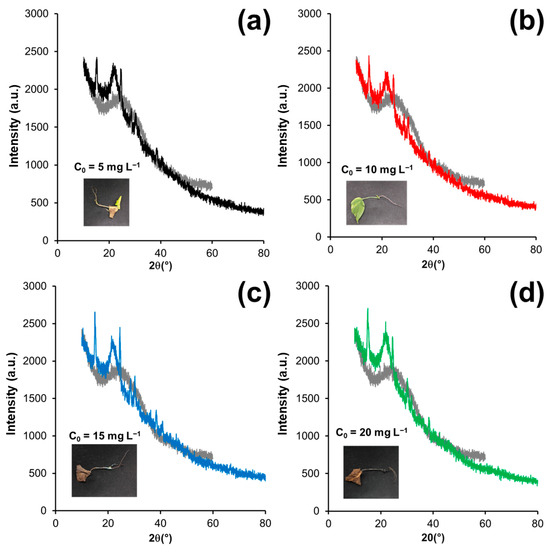
Finally, to strengthen the proposed sorption mechanism, X-ray diffraction (XRD) analyses were conducted on the plants before and after the phytoremediation process. The resulting diffractograms are shown in Figure 5. The diffractogram of the plant material prior to exposure to copper solutions (Figure 5a–d, gray pattern) exhibited a characteristic pattern of amorphous material, with a broad, high-intensity peak centered at 25° (2θ), which is typical of materials rich in natural organic compounds. Considering this and the amorphous nature of the material, the presence of carbon in biopolymeric structures such as cellulose, hemicellulose, and lignin can be inferred, as these constitute the primary structural matrix of plant cell walls [36]. These polymers exhibit molecular-level ordering that produces low-crystallinity diffraction patterns without sharp peaks, consistent with reports for unmodified plant biomass. The presence of this peak indicates that, initially, the biomass has a chemically active surface rich in oxygenated groups (–OH, –COOH) but lacks evident crystalline mineral or metallic phases [37]. This observation is important, as it suggests that all subsequent crystalline signals can be directly attributed to interactions with the contaminant (copper) during the phytoremediation assays.
Figure 5.
X-ray diffraction pattern of E. aureum before (gray pattern) and after exposing to different initial concentration of copper: (a) C0 = 5 mg L−1 (b) C0 = 10 mg L−1, (c) C0 = 15 mg L−1 and (d) C0 = 20 mg L−1.
Following exposure of E. aureum to copper solutions at different concentrations (Figure 5a–d), the diffractograms of the plant material showed significant changes. In all cases, new sharp and well-defined peaks appeared at 2θ angles of 14.96°, 21.84°, 24.39°, 30.19°, and 38.31°. Phase analysis indicate that these peaks are consistent with crystallographic phases corresponding to copper sulfate [38], indicating the presence of copper in an ordered, crystalline form associate with the biomass. It is important to note that these diffraction features do not necessarily imply in vivo crystallization of CuSO4 within plant tissues. Alternative explanations include the presence of copper-containing crystalline phases deposited on or near the biomass surface during drying, despite rinsing procedures. Therefore, XRD results are interpreted as evidence of copper accumulation in a structurally ordered form, rather than as definitive proof of biologically induced crystal formation.
Notably, after saturation with copper (Figure 5d), the amorphous background of the diffractogram persists, indicating that the original organic matrix of E. aureum remains structurally intact to some extent, although now embedded with or coated by copper sulfate deposits. These findings suggest that copper removal by E. aureum is not merely a physical trapping phenomenon but involves a complex sorption mechanism. Importantly, the biomass’s ability to support and stabilize these crystalline phases without complete degradation (at least at low concentrations) represents a key advantage for its application in contaminated water phytoremediation systems.
Based on these results, the sorption mechanism of copper on E. aureum can be attributed to two main phenomena: adsorption and absorption. Adsorption constitutes the first step in the copper removal process. During this stage, Cu(II) ions are superficially fixed onto the plant biomass, particularly on root surfaces. This process occurs through specific interactions between copper cations and oxygen-containing functional groups present in the cell wall, such as carboxyl (-COOH), hydroxyl (-OH), and carbonyl (C=O) groups [7]. These functional groups, located in structural components such as cellulose, hemicellulose, and lignin, possess negative charges or lone electron pairs that can form coordination bonds or electrostatic interactions with positively charged metal ions. The proposed adsorption mechanism may involve: (i) an initial electrostatic attraction between Cu(II) ions and the negatively charged surface, and (ii) the formation of coordination bonds through electron donation from oxygen atoms in functional groups to the metal ion. Evidence of surface copper complex formation, as shown by the XRD patterns, strongly supports this adsorption mechanism as a major pathway for metal capture.
Following surface adsorption, a portion of the copper may be internalized within plant tissues through a process known as absorption. In this stage, Cu(II) ions diffuse passively through the cell wall into the interior of the cells, followed by active transport across cell membranes mediated by metal ion transport proteins, particularly under conditions in which the plant maintains significant metabolic activity. Finally, the ions accumulate intracellularly in vacuoles, where copper can be sequestered to minimize toxicity via complexation with phytochelatins or metallothioneins, specialized compounds for toxic metal detoxification [39]. This second process is slower and dependent on the plant’s physiological state. When damage is mild (as in 5–10 mg L−1), absorption can be efficient; however, at higher concentrations, absorption is compromised due to the collapse of cellular functions, making surface adsorption the dominant mechanism. Therefore, at low concentrations, both mechanisms contribute significantly to overall removal, whereas at high concentrations, surface adsorption predominates due to the inhibition of cellular metabolism.
The kinetic behavior observed in static assays at different copper concentrations reinforces the proposal of a combined sorption mechanism. At low concentrations (5 mg L−1), the removal kinetics exhibited an initial rapid phase, attributable to surface adsorption of Cu(II) onto the available functional groups of E. aureum biomass. This phase was followed by a slower stage, likely corresponding to intracellular absorption and redistribution of the metal within plant tissues.
At higher concentrations (15 and 20 mg L−1), however, the kinetics reflected rapid saturation of surface adsorption sites, accompanied by progressive biomass deterioration. Under these conditions, active absorption was limited by accelerated physiological damage, leaving non-metabolically assisted surface adsorption as the main removal mechanism. These observations suggest that while a combination of adsorption and absorption ensures effective and sustained copper removal at low concentrations, at higher concentrations, the system primarily relies on passive adsorption before biomass collapse.
3.2. Dynamic Studies of Cu(II) Phytoremediation in Aqueous Solution
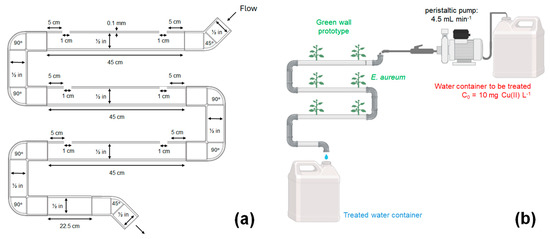
To understand how the mechanisms described before change over the time and characterize the dynamic response of the system, dynamic experiments were conducted at a Cu(II) concentration of 10 mg L−1 to evaluate the process in a green wall prototype. A technical diagram of the prototype is presented in Figure 6. The system was designed as a continuous-flow hydraulic arrangement to ensure homogeneous exposure of the plants to the contaminated solution. An aqueous Cu(II) solution (C0 = 10 mg L−1), stored in the influent container, was delivered to the phytoremediation system by means of a peristaltic pump operating at a constant flow rate of 4.5 mL min−1. The prototype consisted of a rigid PVC pipes network with an internal diameter of ½ in, arranged in a three-level serpentine configuration. Each level was composed of a straight horizontal segment 45 cm in length, connected by 90° elbows that allowed the progressive downward movement of the solution between levels, while 45° elbows were used at the inlet and outlet of the system. At the ends of each pipe (5 cm from the elbow connection), perforations were made that functioned as plant-solution contact channels. At each level, E. Aureum cuttings, each consisting of a single leaf with a short petiole, were positioned to maintain direct contact with the flowing solution. This configuration ensures that all plants experience equivalent hydraulic conditions and that the residence time of the contaminant is governed exclusively by the imposed flow rate. The effluent from the final level was directed to a separate container for collection of the treated water. Throughout system operation, the solution pH was maintained at 6.5 ± 0.5, and water temperature and ambient light conditions were controlled to minimize experimental variability. Aqueous samples were collected at predefined intervals to monitor residual Cu(II) concentrations, while visual observations of plant morphology, including leaf coloration, turgor, and structural integrity, were recorded before, during, and after the experiments.
Figure 6.
(a) Technical diagram and (b) functional scheme of the dynamic green wall prototype used for continuous-flow phytoremediation experiments.
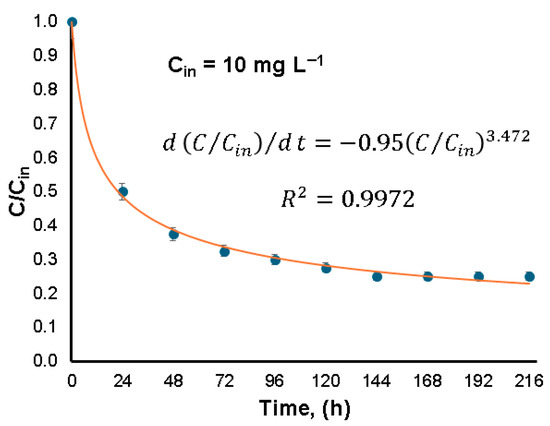
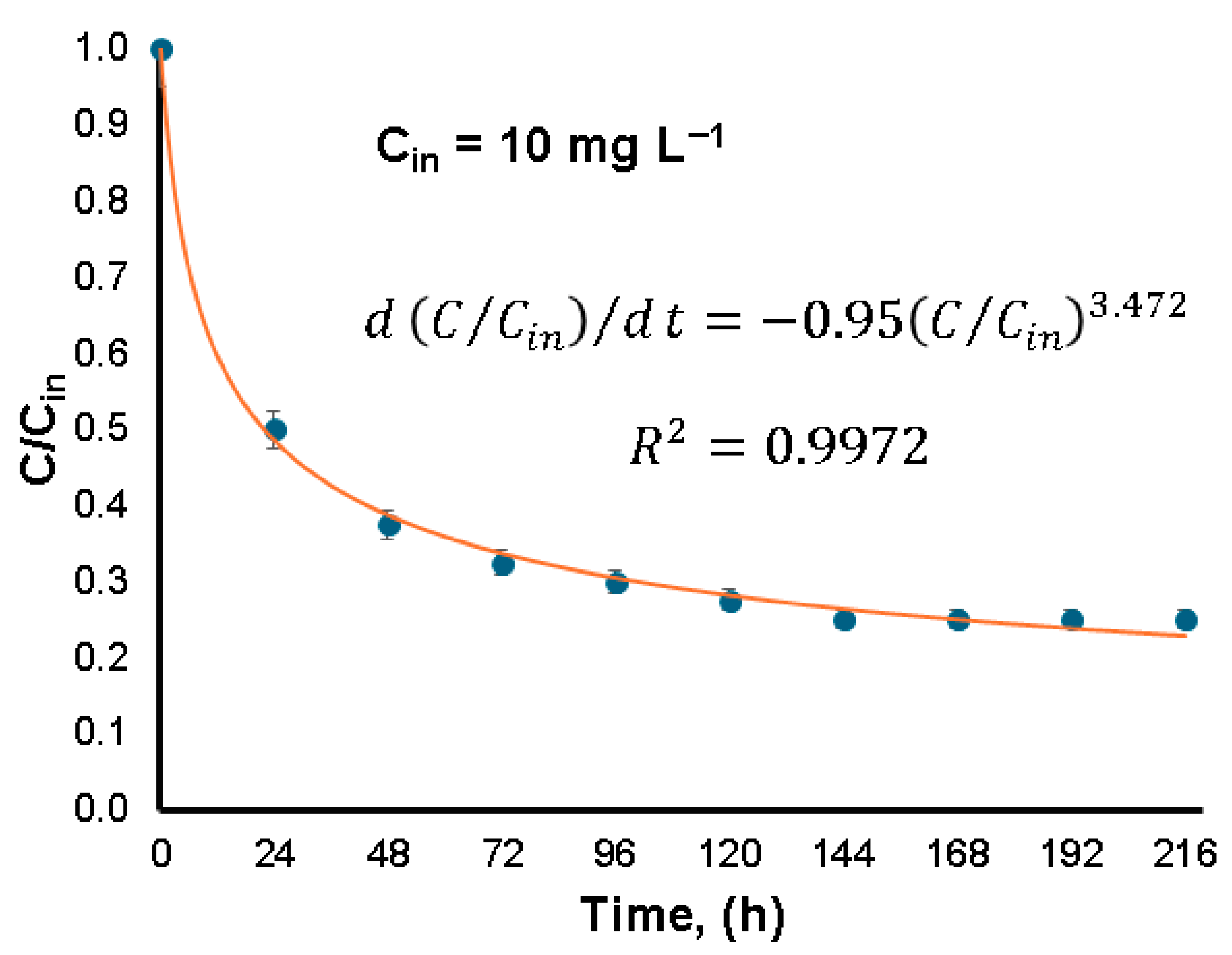
The sorption kinetics of the phytoremediation process under continuous flow conditions are presented in Figure 7. This configuration resembles a dynamical plug flow reactor (PRF), whose model is described by a linear first-order partial differential equation (Equation (1)), whose initial and boundary conditions are equal to the inlet concentration , which is not time-dependent. The method of the characteristics states that these systems can be solved as a set of ordinary differential equations [40]. In addition, we are only interested in the concentration at ; therefore, the concentration at this point is simply the characteristic . The initial condition-dependent solution can be discarded since measurements are performed every 24 h, hence the term , considering a constant normal area ; thus, the traveling wave does not have concentration changes at the boundary . Also note that the time derivative together with the convective term defines the material or co-moving derivative , with .
Figure 7.
Continuous-flow Cu(II) removal using a green wall prototype with E. aureum. Points: experimental effluent copper concentration data; solid line: fit to the dynamical plug flow reactor (PFR) model described by a convective PDE.
During the process, copper removal was observed to occur rapidly during the initial stages of contact between the contaminated solution and the plant biomass. This rapid phase can be attributed to the presence of numerous active sites, primarily oxygenated functional groups on the cell wall, which are available for the immediate surface adsorption of Cu(II). This behavior is consistent with rapid initial physical or chemical adsorption mechanisms dominated by surface interactions, similar to pseudo-first and second order kinetics [41].
Fitting the experimental data to a first-order model with a resistant fraction indicated that the process can be described by the differential expression , with a coefficient of determination R2 = 0.9972, considering that the inlet concentration is constant. This result suggests that approximately 70% of the copper is removed under continuous-flow conditions, reaching a steady-state value (C/C0 ≈ 0.30) after 120 min of operation at a flow rate of 4.5 mL min−1. The remaining ~30% corresponds to the equilibrium fraction that remains in solution once the active sorption sites are saturated.
As the process progresses, a gradual decrease in the removal rate is observed, indicating progressive saturation of the available adsorption sites. In addition, intraparticle diffusion phenomena may occur, where the transport of Cu(II) into the interior of the biomass or to less accessible sites begins to govern the kinetics. This change in behavior reflects an increasing influence of intracellular absorption or slower contaminant entrapment.
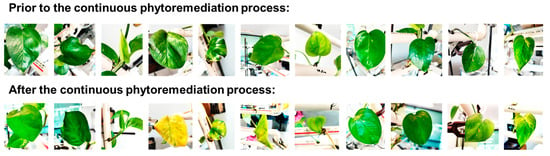
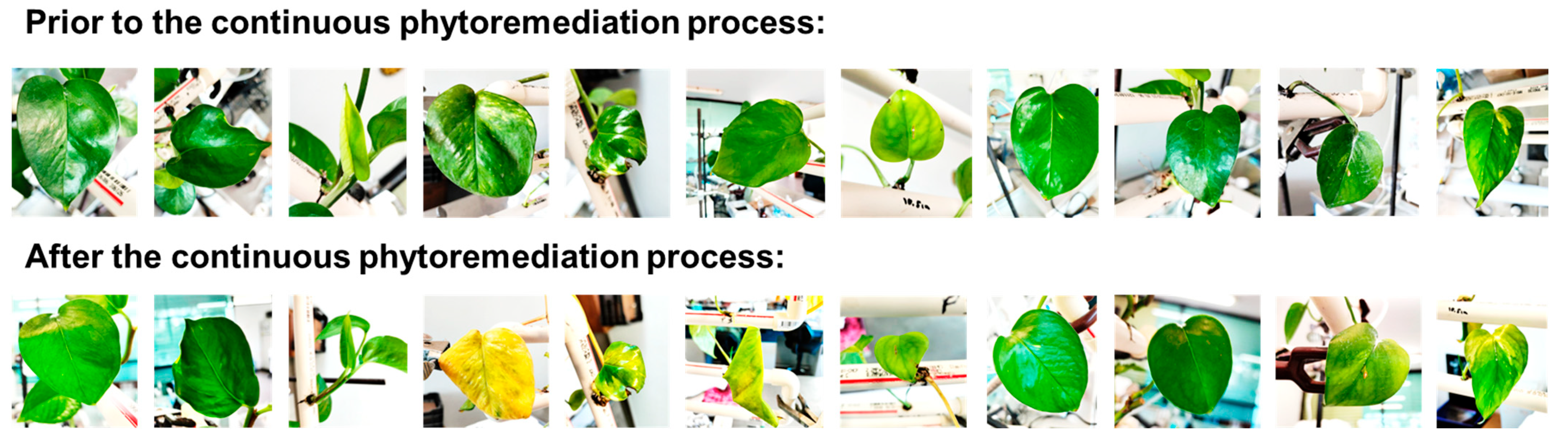
Furthermore, visual evidence before and after the process (Figure 8) shows minimal changes in the biomass, indicating that the plants retain their phytoremediation capacity, which is favorable for applications in continuous-flow treatment of low to moderate toxic metal loads.
Figure 8.
Physical changes in E. aureum during the phytoremediation process under continuous-flow conditions. Visual color changes are shown for qualitative comparison relative to the initial state and are not intended as quantitative physiological metrics.
Although the plants exhibited slight yellowing, particularly in the leaves, they maintained structural rigidity throughout the experimental process. This physiological response can be explained as follows:
- (i)
- The appearance of yellow tones in the leaves suggests a moderate level of physiological stress induced by the presence of copper ions. This phenomenon can be primarily attributed to partial inhibition of photosynthesis, as excess copper can interfere with chlorophyll synthesis and affect critical components of photosystem II. Additionally, the plants experience nutritional imbalances due to competition between Cu(II) and other essential ions such as iron (Fe(III)/Fe(II)) or magnesium (Mg(II)), which are required for chlorophyll formation and maintenance. Finally, moderate production of reactive oxygen species (ROS) cannot be ruled out, potentially oxidizing pigments or causing minor cellular damage [42].
These changes, although visible, are not severe at low concentrations, indicating that the plants are able to activate tolerance mechanisms, such as the synthesis of antioxidants (phytochelatins, glutathione, etc.), thereby limiting damage.
- (ii)
- Despite the yellowing, the plants retained rigidity throughout the experiment. This implies that the integrity of the cell walls was not significantly compromised. Moreover, water and solute transport systems (xylem and phloem) continued to function properly, allowing maintenance of hydraulic balance. Consequently, the plant’s defense mechanisms were sufficient to prevent cell lysis or collapse of structural tissues in the short to medium term [42].
The preservation of rigidity indicates that, at these concentrations, E. aureum can tolerate copper exposure without compromising vital functions such as mechanical support and internal transport of nutrients and water.
This controlled response is highly relevant from a phytoremediation perspective: although moderate visible stress occurs, the plant remains alive, functional, and structurally stable, allowing it to continue remediation processes sustainably. This ensures that systems based on E. aureum can operate over extended periods before requiring biomass replacement.
3.3. Comparative Advantages and Niche Applications
To contextualize the performance of E. aureum within the broader field of phytoremediation, its efficacy is compared against other documented plant-based systems for copper removal. While some aquatic species like Eichhornia crassipes (water hyacinth) may achieve higher removal rates (>90%) [43], they often require extensive land area in the form of lagoons and are recognized as invasive species, posing ecological risks [44]. In contrast, the vertical “green wall” configuration used in this study leverages vertical space, offering a significantly smaller footprint—a critical advantage for urban or industrial settings where space is limited. Furthermore, compared to terrestrial systems using plants like Phragmites australis in constructed wetlands, which can achieve 50–85% removal but require large land areas and are prone to clogging issues [45], E. aureum operates in a fully hydroponic system. This eliminates the need for soil media, thereby simplifying maintenance and reducing long-term operational costs.
In conclusion, while E. aureum may not surpass all other species in sheer removal capacity, its unique combination of moderate efficiency, vertical integration capability, low maintenance, and aesthetic value defines a distinct and promising application niche. It is not intended to replace established systems for treating highly contaminated industrial wastewater but rather to offer a sustainable, space-efficient solution for decentralized treatment of moderately contaminated water streams, such as urban runoff, greywater, or final polishing of treated effluents. This positions E. aureum-based green walls as a complementary technology within the broader toolkit for sustainable water management [16].
4. Conclusions
The findings of this study confirm that E. aureum is a promising candidate for the phytoremediation of copper-contaminated water, particularly when integrated into green wall systems. The plant demonstrated resilience under moderate copper exposure, and the removal process combines surface chemical adsorption with intracellular uptake, contributing to effective contaminant reduction. The successful operation of a continuous-flow green wall prototype highlights the feasibility of using E. aureum in sustainable, low-cost water treatment applications at small scales, which was one of the research gaps identified by previous studies.
Looking forward, the development of modular and portable green wall systems, coupled with real-time monitoring and biomass regeneration strategies, could expand the applicability of this technology to domestic, educational, and urban settings. Additionally, integrating these systems with other natural treatment processes or evaluating their performance against a broader range of contaminants could further enhance their role as innovative and eco-friendly solutions for water management in urban environments.
One of the main limitations of the present study is the interaction with other toxic metals; in this sense, one of our future perspectives is binary sorption using toxic metals.
Supplementary Materials
The following supporting information can be downloaded at: https://www.mdpi.com/article/10.3390/pr14010100/s1, Figure S1: Map of the Atlantic watershed of Mexico showing sampling points with copper contamination; Figure S2: Calibration curve for the spectrophotometric determination of Cu(II) via ammonia complexation; Figure S3: Weekly evolution of each plant used during the phytoremediation process during batch operation at different initial Cu(II) concentrations. Figure S4: Fitting adsorption equilibrium data to the Lagmuir isotherm model. Table S1. Normalized FTIR band intensities of root, petiole, and leaf tissues before and after Cu(II) sorption.
Author Contributions
Conceptualization, A.I.Z.-G. and L.A.R.-C.; methodology, A.I.Z.-G. and L.A.R.-C.; software, M.A.Z.-N., D.A.M.-G. and C.S.G.-N.; validation, C.S.G.-N. and K.S.-G.; formal analysis, K.S.-G., A.I.Z.-G., M.A.Z.-N. and L.A.R.-C.; investigation, D.A.M.-G., C.S.G.-N. and K.S.-G.; resources, K.S.-G. and L.A.R.-C.; data curation, K.S.-G., A.I.Z.-G., M.A.Z.-N. and L.A.R.-C.; writing—original draft preparation, all authors; writing—review and editing, K.S.-G., A.I.Z.-G., M.A.Z.-N. and L.A.R.-C.; visualization, A.I.Z.-G. and L.A.R.-C.; supervision, L.A.R.-C.; project administration, A.I.Z.-G.; funding acquisition, A.I.Z.-G. and K.S.-G. All authors have read and agreed to the published version of the manuscript.
Funding
This research was partially funded by COECyTJAL, through FODECIJAL-11178 project.
Data Availability Statement
The data that support the findings of this study are available from the corresponding author upon reasonable request.
Acknowledgments
D.A.M.-G. acknowledges the UAG for the financial support provided through academic performance scholarship.
Conflicts of Interest
The authors declare no conflicts of interest.
References
- Rathi, B.S.; Kumar, P.S.; Vo, D.-V.N. Critical Review on Hazardous Pollutants in Water Environment: Occurrence, Monitoring, Fate, Removal Technologies and Risk Assessment. Sci. Total Environ. 2021, 797, 149134. [Google Scholar] [CrossRef] [Scilit] [PubMed]
- Hänsch, R.; Mendel, R.R. Physiological Functions of Mineral Micronutrients (Cu, Zn, Mn, Fe, Ni, Mo, B, Cl). Curr. Opin. Plant Biol. 2009, 12, 259–266. [Google Scholar] [CrossRef] [Scilit] [PubMed]
- Sharma, K.; Rajan, S.; Nayak, S.K. Water Pollution: Primary Sources and Associated Human Health Hazards with Special Emphasis on Rural Areas. In Water Resources Management for Rural Development; Elsevier: Amsterdam, The Netherlands, 2024; pp. 3–14. [Google Scholar]
- Jane Wyatt, C.; Fimbres, C.; Romo, L.; Méndez, R.O.; Grijalva, M. Incidence of Heavy Metal Contamination in Water Supplies in Northern Mexico. Environ. Res. 1998, 76, 114–119. [Google Scholar] [CrossRef] [Scilit] [PubMed]
- Gómez-Alvarez, A.; Meza-Figueroa, D.; Villalba-Atondo, A.I.; Valenzuela-García, J.L.; Ramírez-Hernández, J.; Almendariz-Tapia, J. Estimation of Potential Pollution from Mine Tailings in the San Pedro River (1993–2005), Mexico–US Border. Environ. Geol. 2009, 57, 1469. [Google Scholar] [CrossRef] [Scilit]
- Salcedo Sánchez, E.R.; Martínez, J.M.E.; Morales, M.M.; Talavera Mendoza, O.; Alberich, M.V.E. Ecological and Health Risk Assessment of Potential Toxic Elements from a Mining Area (Water and Sediments): The San Juan-Taxco River System, Guerrero, Mexico. Water 2022, 14, 518. [Google Scholar] [CrossRef] [Scilit]
- Romero-Cano, L.A.; García-Rosero, H.; Gonzalez-Gutierrez, L.V.; Baldenegro-Pérez, L.A.; Carrasco-Marín, F. Functionalized Adsorbents Prepared from Fruit Peels: Equilibrium, Kinetic and Thermodynamic Studies for Copper Adsorption in Aqueous Solution. J. Clean. Prod. 2017, 162, 195–204. [Google Scholar] [CrossRef] [Scilit]
- Aryal, M. Phytoremediation Strategies for Mitigating Environmental Toxicants. Heliyon 2024, 10, e38683. [Google Scholar] [CrossRef] [Scilit]
- Pang, Y.L.; Quek, Y.Y.; Lim, S.; Shuit, S.H. Review on Phytoremediation Potential of Floating Aquatic Plants for Heavy Metals: A Promising Approach. Sustainability 2023, 15, 1290. [Google Scholar] [CrossRef] [Scilit]
- Shirinpur-Valadi, A.; Hatamzadeh, A.; Sedaghathoor, S. Study of the Accumulation of Contaminants by Cyperus Alternifolius, Lemna Minor, Eichhornia Crassipes, and Canna × Generalis in Some Contaminated Aquatic Environments. Environ. Sci. Pollut. Res. 2019, 26, 21340–21350. [Google Scholar] [CrossRef] [Scilit]
- Tufaner, F. Post-Treatment of Effluents from UASB Reactor Treating Industrial Wastewater Sediment by Constructed Wetland. Environ. Technol. 2020, 41, 912–920. [Google Scholar] [CrossRef] [Scilit]
- Saha, P.; Shinde, O.; Sarkar, S. Phytoremediation of Industrial Mines Wastewater Using Water Hyacinth. Int. J. Phytoremediation 2017, 19, 87–96. [Google Scholar] [CrossRef] [Scilit] [PubMed]
- Yadav, R.K.; Sahoo, S.; Yadav, A.K.; Patil, S.A. Epipremnum aureum Is a Promising Plant Candidate for Developing Nature-Based Technologies for Nutrients Removal from Wastewaters. J. Environ. Chem. Eng. 2021, 9, 106134. [Google Scholar] [CrossRef] [Scilit]
- Wu, J.; Fu, X.; Yu, C.; Lv, S.; Lv, J.; Zhao, L.; Du, S.; Li, S.; Ma, F.; Guo, H. Combined Physiological, Metabolomic and Response Surface Approaches to Analyze Copper Stress Resistance Mechanisms and Repair Potential of Epipremnum aureum. Sci. Hortic. 2024, 338, 113642. [Google Scholar] [CrossRef] [Scilit]
- Yang, L.; Wang, J.; Yang, Y.; Li, S.; Wang, T.; Oleksak, P.; Chrienova, Z.; Wu, Q.; Nepovimova, E.; Zhang, X.; et al. Phytoremediation of Heavy Metal Pollution: Hotspots and Future Prospects. Ecotoxicol. Environ. Saf. 2022, 234, 113403. [Google Scholar] [CrossRef] [Scilit]
- Lyu, L.; Matheson, S.; Fleck, R.; Torpy, F.R.; Irga, P.J. Modulating Phytoremediation: How Drip Irrigation System Affect Performance of Active Green Wall and Microbial Community Changes. J. Environ. Manag. 2024, 370, 122646. [Google Scholar] [CrossRef] [Scilit]
- El Bardiji, N.; Ziat, K.; Naji, A.; Saidi, M. Fractal-Like Kinetics of Adsorption Applied to the Solid/Solution Interface. ACS Omega 2020, 5, 5105–5115. [Google Scholar] [CrossRef] [Scilit]
- Bakalis, E.; Zerbetto, F. Adsorption Kinetics: Classical, Fractal, or Fractional? Langmuir 2025, 41, 19834–19844. [Google Scholar] [CrossRef] [Scilit]
- Kopelman, R. Fractal Reaction Kinetics. Science 1988, 241, 1620–1626. [Google Scholar] [CrossRef] [Scilit]
- Kopelman, R. Rate Processes on Fractals: Theory, Simulations, and Experiments. J. Stat. Phys. 1986, 42, 185–200. [Google Scholar] [CrossRef] [Scilit]
- Maheshwaran, M.V.; Hyness, N.R.J.; Senthamaraikannan, P.; Saravanakumar, S.S.; Sanjay, M.R. Characterization of Natural Cellulosic Fiber from Epipremnum aureum Stem. J. Nat. Fibers 2018, 15, 789–798. [Google Scholar] [CrossRef] [Scilit]
- Singh, K.P.; Shyam Kumar, A.; Paniteja, M.; Singh, S. Novel Properties of Epipremnum aureum for Treatment of Fluoride-Contaminated Water. SN Appl. Sci. 2019, 1, 741. [Google Scholar] [CrossRef] [Scilit]
- Kayed, K. Studying the Optical and Plasmonic Properties of Epipremnum aureum Leaves. Plasmonics 2025, 20, 5315–5321. [Google Scholar] [CrossRef] [Scilit]
- Krupa-Małkiewicz, M.; Ochmian, I. Sustainable Approaches to Alleviate Heavy Metal Stress in Tomatoes: Exploring the Role of Chitosan and Nanosilver. Agronomy 2024, 14, 2477. [Google Scholar] [CrossRef] [Scilit]
- Li, Q.; Tang, Y.; Dong, D.; Wang, X.; Wu, X.; Gul, S.; Li, Y.; Xie, X.; Liu, D.; Xu, W. Remediation of Pb-, Zn-, Cu-, and Cd-Contaminated Soil in a Lead–Zinc Mining Area by Co-Cropping Ilex Cornuta and Epipremnum aureum with Illite Application. Agriculture 2024, 14, 867. [Google Scholar] [CrossRef] [Scilit]
- Rezania, S.; Ponraj, M.; Talaiekhozani, A.; Mohamad, S.E.; Md Din, M.F.; Taib, S.M.; Sabbagh, F.; Sairan, F.M. Perspectives of Phytoremediation Using Water Hyacinth for Removal of Heavy Metals, Organic and Inorganic Pollutants in Wastewater. J. Environ. Manag. 2015, 163, 125–133. [Google Scholar] [CrossRef] [Scilit]
- Aoi, T.; Hayashi, T. Nutrient Removal by Water Lettuce (Pisitia Stratiotes). Water Sci. Technol. 1996, 34, 407–412. [Google Scholar] [CrossRef] [Scilit]
- Dhir, B.; Srivastava, S. Heavy Metal Removal from a Multi-Metal Solution and Wastewater by Salvinia Natans. Ecol. Eng. 2011, 37, 893–896. [Google Scholar] [CrossRef] [Scilit]
- Manios, T.; Stentiford, E.I.; Millner, P. Removal of Heavy Metals from a Metaliferous Water Solution by Typha Latifolia Plants and Sewage Sludge Compost. Chemosphere 2003, 53, 487–494. [Google Scholar] [CrossRef] [Scilit]
- Hou, W.; Chen, X.; Song, G.; Wang, Q.; Chi Chang, C. Effects of Copper and Cadmium on Heavy Metal Polluted Waterbody Restoration by Duckweed (Lemna Minor). Plant Physiol. Biochem. 2007, 45, 62–69. [Google Scholar] [CrossRef] [Scilit]
- Rahman, M.A.; Hasegawa, H. Aquatic Arsenic: Phytoremediation Using Floating Macrophytes. Chemosphere 2011, 83, 633–646. [Google Scholar] [CrossRef] [Scilit]
- Hummadi, K.K.; Zhu, L.; He, S. Bio-Adsorption of Heavy Metals from Aqueous Solution Using the ZnO-Modified Date Pits. Sci. Rep. 2023, 13, 22779. [Google Scholar] [CrossRef] [Scilit]
- Wang, X.; Wang, X.; Chen, W.; Yuan, J.; Zhang, Q. Adsorption of Cu(II) and Pb(II) in Aqueous Solution by Biochar Composites. ACS Omega 2025, 10, 13816–13828. [Google Scholar] [CrossRef] [Scilit]
- Šehović, E.; Memić, M.; Sulejmanović, J.; Hameed, M.; Begić, S.; Ljubijankić, N.; Selović, A.; Ghfar, A.A.; Sher, F. Thermodynamic Valorisation of Lignocellulosic Biomass Green Sorbents for Toxic Pollutants Removal. Chemosphere 2022, 307, 135737. [Google Scholar] [CrossRef] [Scilit]
- Oh, K.B.; Park, S.; Kim, Y.J.; Lee, G.W.; Jo, J.W.; Kim, J.H.; Kim, J.E.; Kang, G.; Lee, S.H.; Kim, H.J.; et al. Mechanisms of Cu(II) Adsorption onto Biochars Derived from Fallen and Non-Fallen Maple Leaves. Sustainability 2025, 17, 4233. [Google Scholar] [CrossRef] [Scilit]
- Sonu, K.; Sogani, M.; Sharma, M.K. Performance Evaluation of Plant Microbial Fuel Cell with Epipremnum aureum Plant Using Composite Anode Made of Corn Cob and Carbon Rod. Int. J. Environ. Stud. 2023, 80, 8–19. [Google Scholar] [CrossRef] [Scilit]
- Ju, X.; Bowden, M.; Brown, E.E.; Zhang, X. An Improved X-Ray Diffraction Method for Cellulose Crystallinity Measurement. Carbohydr. Polym. 2015, 123, 476–481. [Google Scholar] [CrossRef] [Scilit]
- Sivakumar, A.; Sahaya Jude Dhas, S.; Elberin Mary Theras, J.; Jose, M.; Sivaprakash, P.; Arumugam, S.; Martin Britto Dhas, S.A. Spectroscopic and Diffraction Studies of Polycrystalline Copper Sulfate Pentahydrate at Shocked Conditions. Solid State Sci. 2021, 121, 106751. [Google Scholar] [CrossRef] [Scilit]
- Kumar, V.; Pandita, S.; Singh Sidhu, G.P.; Sharma, A.; Khanna, K.; Kaur, P.; Bali, A.S.; Setia, R. Copper Bioavailability, Uptake, Toxicity and Tolerance in Plants: A Comprehensive Review. Chemosphere 2021, 262, 127810. [Google Scholar] [CrossRef] [Scilit]
- Aguilar-Garnica, E.; García-Sandoval, J.P.; González-Álvarez, V. PI Controller Design for a Class of Distributed Parameter Systems. Chem. Eng. Sci. 2011, 66, 4009–4019. [Google Scholar] [CrossRef] [Scilit]
- Revellame, E.D.; Fortela, D.L.; Sharp, W.; Hernandez, R.; Zappi, M.E. Adsorption Kinetic Modeling Using Pseudo-First Order and Pseudo-Second Order Rate Laws: A Review. Clean. Eng. Technol. 2020, 1, 100032. [Google Scholar] [CrossRef] [Scilit]
- Chen, G.; Li, J.; Han, H.; Du, R.; Wang, X. Physiological and Molecular Mechanisms of Plant Responses to Copper Stress. Int. J. Mol. Sci. 2022, 23, 12950. [Google Scholar] [CrossRef] [Scilit]
- Ben Bakrim, W.; Ezzariai, A.; Karouach, F.; Sobeh, M.; Kibret, M.; Hafidi, M.; Kouisni, L.; Yasri, A. Eichhornia Crassipes (Mart.) Solms: A Comprehensive Review of Its Chemical Composition, Traditional Use, and Value-Added Products. Front. Pharmacol. 2022, 13, 842511. [Google Scholar] [CrossRef] [Scilit]
- Poljuha, D.; Sladonja, B. The Use and Management of Invasive Plants. Plants 2025, 14, 1031. [Google Scholar] [CrossRef] [Scilit]
- Vymazal, J.; Březinová, T. Accumulation of Heavy Metals in Aboveground Biomass of Phragmites Australis in Horizontal Flow Constructed Wetlands for Wastewater Treatment: A Review. Chem. Eng. J. 2016, 290, 232–242. [Google Scholar] [CrossRef] [Scilit]

Disclaimer/Publisher’s Note: The statements, opinions and data contained in all publications are solely those of the individual author(s) and contributor(s) and not of MDPI and/or the editor(s). MDPI and/or the editor(s) disclaim responsibility for any injury to people or property resulting from any ideas, methods, instructions or products referred to in the content. |
© 2025 by the authors. Licensee MDPI, Basel, Switzerland. This article is an open access article distributed under the terms and conditions of the Creative Commons Attribution (CC BY) license.