


Abstract
This study analyzes, quantifies, and maps, from a bibliometric perspective, scientific research on microalgae energy production. It includes traditional simulation, machine learning, and hybrid approaches, covering 500 original articles from 2005 to 2024 in Scopus. We used Biblioshiny 4.1.2 software in RStudio 4.3.0 to categorize and evaluate the contributions of authors and journals. The studied field underwent an exponential growth in publications from 2004 to 2022, with an average annual increase of approximately 21%. Moreover, recent research focuses on photobioreactors, computational fluid dynamics, carbon dioxide capture, bio-oils, biodiesel, and hydrothermal liquefaction, increasingly integrating machine learning algorithms and hybrid methods. Since 2020, we have identified a clear trend toward combining modeling approaches to predict and improve energy efficiency, particularly for biodiesel, bio-derived hydrogen, and crude bio-oil produced via pyrolysis or hydrothermal liquefaction, which is often influenced by factors such as light, carbon dioxide, nutrients, and blending operations. Finally, recent advancements involve combining physical models with data to enable real-time optimization and control, supporting microalgae-based circular biorefining strategies. This review serves as a guide for future research in green energy materials and process modeling, inspiring colleagues to explore new ways for microalgae energy production and modeling.
1. Introduction
Energy production from microalgae is transitioning from laboratory studies on lipid creation and carbon dioxide capture to more advanced systems, such as photobioreactors, hydrothermal liquefaction, biodiesel, and biogas, to deploy industrial-scale applications. However, challenges still exist in photoconversion efficiency, mass transfer, operational management, and costs. Modeling is indispensable in this context to connect experimental findings to real-world applications. Recent findings show that the design and the operation of photobioreactors require accurate predictive tools integrating photo-, bio- and hydrodynamics as well as control and optimization [1,2].
On the other hand, the non-linear nature of all microalgal growth in photobioreactors clearly calls for an approach using adaptive models and monitoring strategies. For example, kinect models only preserve accuracy when there is a change in light, the reactor design or the environment, although they are also able to capture some of the complexity of the process [3,4,5]. This highlights the need for adaptive models and monitoring strategies that combine fundamental principles with data-driven methods to reduce uncertainty and improve generalization. In this regard, computational fluid dynamics has been found useful to design operational strategies like multistage photobioreactors with carbon dioxide capture, supported by process modeling, to examine mixing, mass transfer, and light distribution via improving realism in cultivation conditions [6,7,8]. These findings underline the importance of first-principle models for sizing and sensitivity analysis, despite their requirement for online measurement or estimation to manage uncertainty. On the other hand, machine learning has also been applied to predict growth, productivity, and carbon dioxide emissions from diverse datasets, particularly outdoors [9,10,11]. Meanwhile, grey-box models, which combine mechanistic structures with machine learning components, or digital twins that integrate models, data, and control, provide improved predictions with efficient computation and better generalization. They also enable soft sensors for variables that are hard to measure [12,13,14]. Therefore, it has been found that a shift towards real-time monitoring, combined with machine learning and multi-sensor systems, can facilitate informed control and scale-up [15].
Moreover, bibliometric research can help identify and understand emerging trends in a research area. It can assist the scientific community in pinpointing new areas of innovation within a specific observation window [16]. A growing, albeit fragmented, body of literature exists, comprising analyses focused on wastewater cultivation and biolipids [17] and holistic views of microalgae in biorefineries [18], and studies on the intersection of bioenergy and machine learning—whether in biodiesel/biofuels or at specific stages such as hydrothermal liquefaction—that map trends, thematic clusters, and collaboration networks [19,20,21]. Although some classic reviews have attempted to fill this gap by reporting the use of machine learning models in microalgae applications [11,22], to our knowledge, no bibliometric review has explicitly examined the comparative evolution of modeling paradigms—conventional, machine learning, and hybrid—along the microalgae energy chain, connecting these paradigms to technological trajectories such as computational fluid dynamics, soft-sensing, and digital twins. This gap highlights the novelty and relevance of the present review, which we believe will contribute to the field of microalgae energy modeling. This research provides a broader scientometric perspective, covering the period from 2005 to 2024, by retrieving original articles published in Scopus and using the bibliometrics tools in RStudio for data mining. VOSviewer is employed to analyze collaborations and co-occurrences. This review explored the following research questions:
- Q1: How many research articles were published annually between 2005 and 2024 around microalgae as an energy source and modeling?
- Q2: Who are the most prominent authors in these research areas?
- Q3: Which are the most relevant journals in the field?
- Q4: What are the thematic trends in these research topics?
This article is structured to offer a clear roadmap for readers. Section 2 explains the bibliometric study’s design and its limitations. Section 3 displays the results, including patterns in yearly publication numbers, the most cited authors and their collaborations, and the journals with the most publications. Section 4 explores emerging trends, providing a deeper understanding of the current landscape and future prospects for microalgae in energy production and modeling. Lastly, Section 5 summarizes the main conclusions, highlighting key findings and their relevance to the field.
2. Software and Methods
2.1. Study Design
This study employed bibliometric analysis, a common method for charting research in fuzzy scientific domains. Scientometrics, also known as bibliometry, applies mathematical and statistical techniques to quantify scientific activity and importance over time using numerical data [16]. Generally, bibliometric studies are multidisciplinary, providing a quantitative overview of a scientific field. They utilize metrics and knowledge graphs to illustrate how a particular area of knowledge develops, offering objective evidence of recent advances and emerging trends.
2.2. Data Source
Scopus was chosen because of its wide range of high-quality journals and research papers [23]. Access to the study files required institutional access for downloading and verifying them.
2.3. Search Strategy
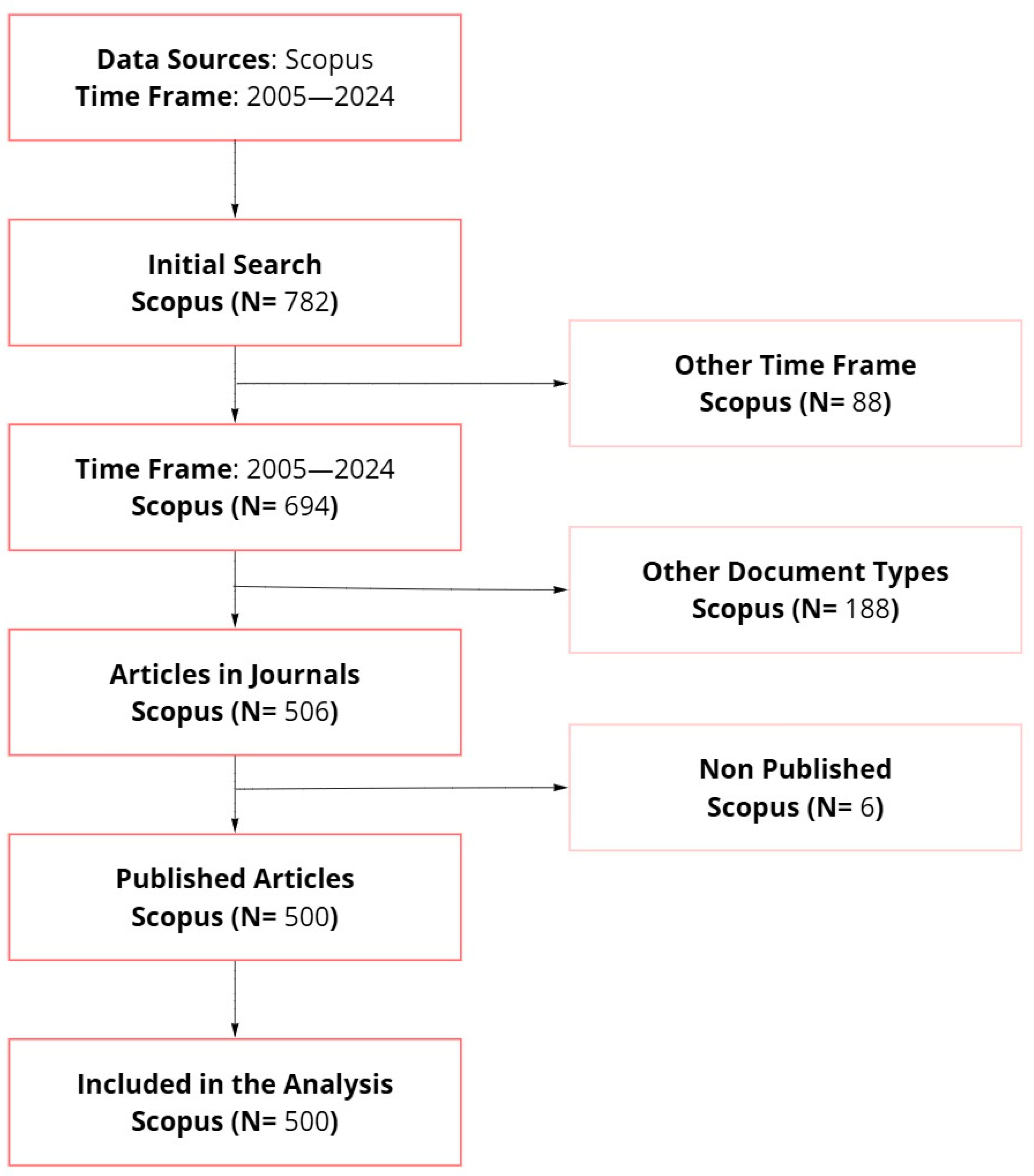
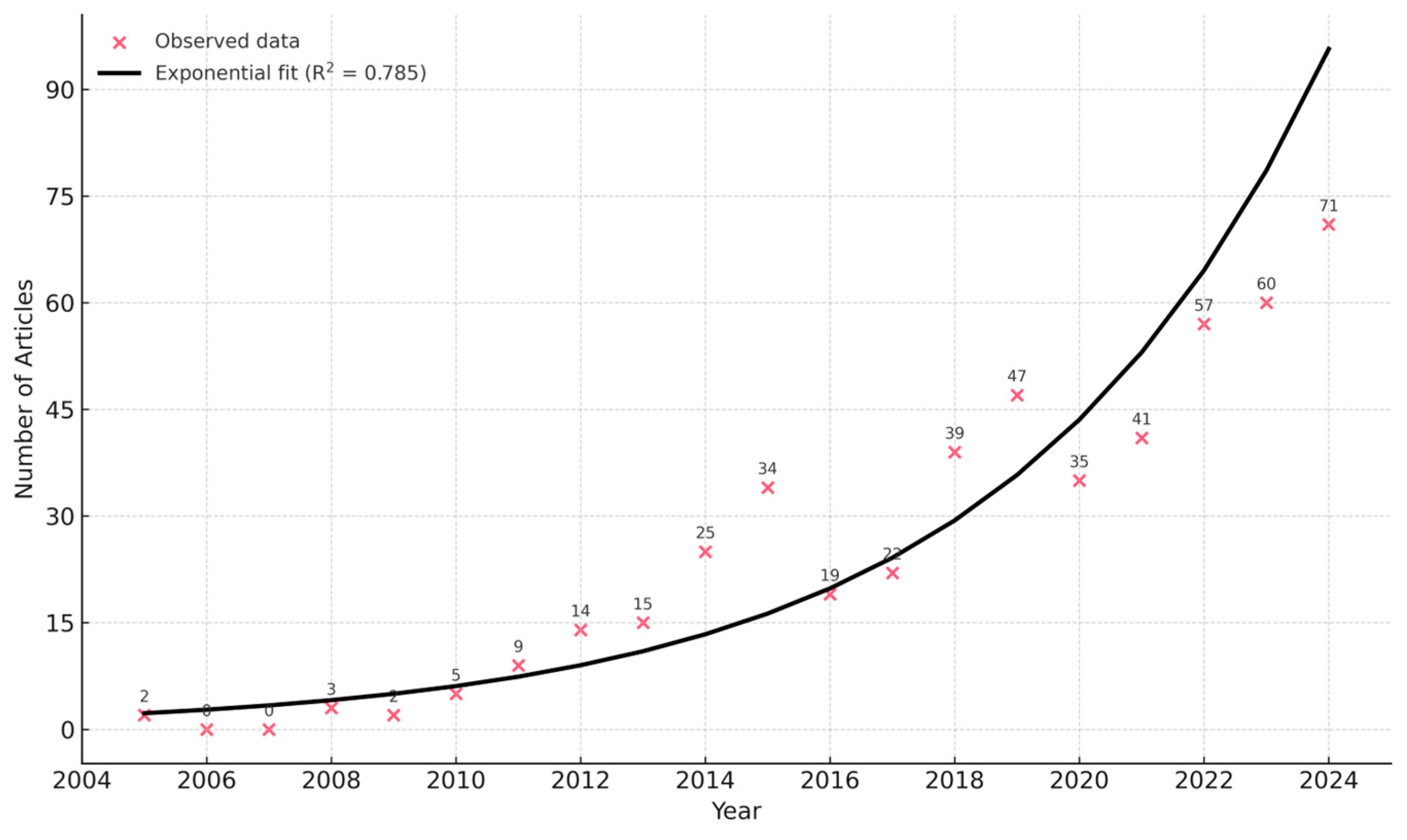
We introduced a comprehensive list of keywords, covering environmental sustainability indices and bioprocesses, compiling a database of 500 documents (see Figure 1). The search equation used was the following: TITLE-ABS-KEY (microalgae AND (biofuel OR biodiesel OR biogas OR energy) AND (“machine learning” OR “simulation” OR “artificial intelligence” OR “data-driven modelling” OR “predictive modelling” OR “deep learning” OR “neural network” OR “digital twin” OR “hybrid modelling”)) AND PUBYEAR > 2004 AND PUBYEAR < 2025 AND (LIMIT-TO (DOCTYPE, “ar”)) AND (LIMIT-TO (PUBSTAGE, “final”)). These keywords were developed through an iterative process, starting with articles retrieved from databases and expanding to include additional terms to address initially overlooked topics, covering data from 2005 to 2024. To enhance search accuracy, the focus was on titles and keywords, improving the retrieval of relevant papers from the target fields. The time span was chosen based on the number of articles retrieved, with 20 years considered suitable to reflect the development and evolution of the topic up to 2024 (see Figure 2). Only original articles were included to ensure access to primary findings and avoid biases from secondary sources like reviews. The final search of the Scopus database was conducted on 1 August 2025.
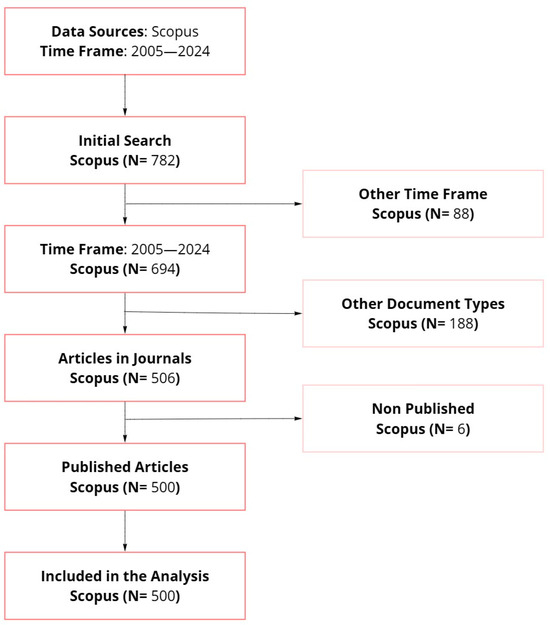
Figure 1.
Flowchart of the used bibliometric methodology to compile the database from Scopus.
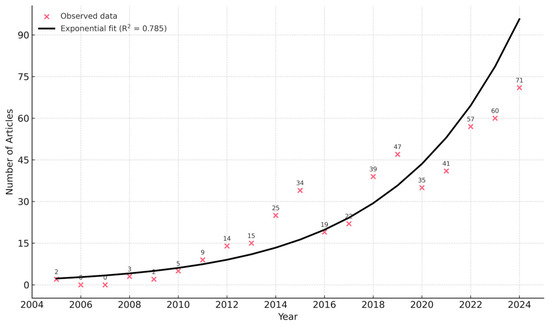
Figure 2.
Annual trend of publications from Scopus in the 2005–2024 timeframe, as measured by Bibliometrix.
2.4. Bibliometric Analysis
Charts and tables were created using data downloaded from the database in BibTeX and CSV formats. The Biblioshiny 4.1.2 from RStudio 4.3.0 helped in gathering and organizing the compiled database before manual editing. It provides information on the most productive countries, institutions, authors, research areas, journals, subject headings, h-index, impact factors, total citations, and more [24]. Additionally, VOSviewer 1.6.19 was used for data mining, mapping, and visualizing the most frequently used keywords by authors [25].
2.5. Limitations
The Scopus database is not perfectly suited for bibliometric analyses because it often contains errors such as duplicates and missing data, which can affect the reliability of the metrics and results. Furthermore, qualitative statements can be subjective, given that this type of review is originally quantitative [26]. In addition, this scientometrics study provides only a short-term forecast for the area under investigation [27], focusing solely on data extracted from Scopus. Therefore, to address these inherent limitations, our findings were not exclusively based on data from Scopus and the software used. Instead, we also confirmed the identified trends by reviewing published scientific articles from various publishers. Furthermore, we reviewed the downloaded database to ensure it contained no duplicates and to filter out any documents unrelated to our research topic.
3. Results and Discussion
The following sections present the results and discussion based on data collected from the Scopus database, addressing the research questions outlined in the preceding subsections.
3.1. Trends in the Annual Production of Original Papers
Figure 2 shows that the interest in research on the environmental sustainability index applied to bioprocesses has followed an exponential growth trend from 2005 to 2024, with a coefficient of determination of 0.785. This trend is mainly due to the increase in document production up to 2022, which is partially offset by the lower number of manuscript publications between 2023 and 2024. The annual growth rate in the observed period was found to be 20.67%. The rapid growth of scientific output is, in general terms, a response to the urgent global concern about the environmental impacts of industrial activities, as well as the increasing demand for energy efficiency, reductions in polluting emissions, and the pursuit of minimizing waste processes—factors driving this trend that highlight the need for immediate action [28].
However, to be more specific about research on microalgae for bioenergy production, we identified the following two factors. First, there have been advances in designing and operating photobioreactors—where mass transfer and radiation mixing are closely linked—shifting the field from purely experimental efforts to using established kinetic, radiative, and computational fluid dynamics models for sizing and control [3,29]. Secondly, there has been a recent shift towards digital approaches such as machine learning, multisensory monitoring, and hybrid systems like digital twins, all of which enhance prediction accuracy and scalability [11,13,14]. Finally, minor declines in published manuscripts in 2023 and 2024 may be related to systemic shocks like the covidization of experimental productivity [30].
The average total citation per year (TCPY) in the study period is 4.44, while the average citation per document (CPD) is 29.92. To provide context, the obtained CPD exceeds, for example, the average of 18 citations per document reported for micro-algal pigments [31] and is below the average of 38.69 seen in advanced bioenergy [21]. Additionally, our TCPY data is considerably higher than usual for algal subfields, such as phycobiliproteins, which has a mean of 1.85 [32]. This context for the average citation data of this work points out the research’s relevance and impact in microalgae energy and modeling research.
3.2. Most Cited Authors and Their Collaborations
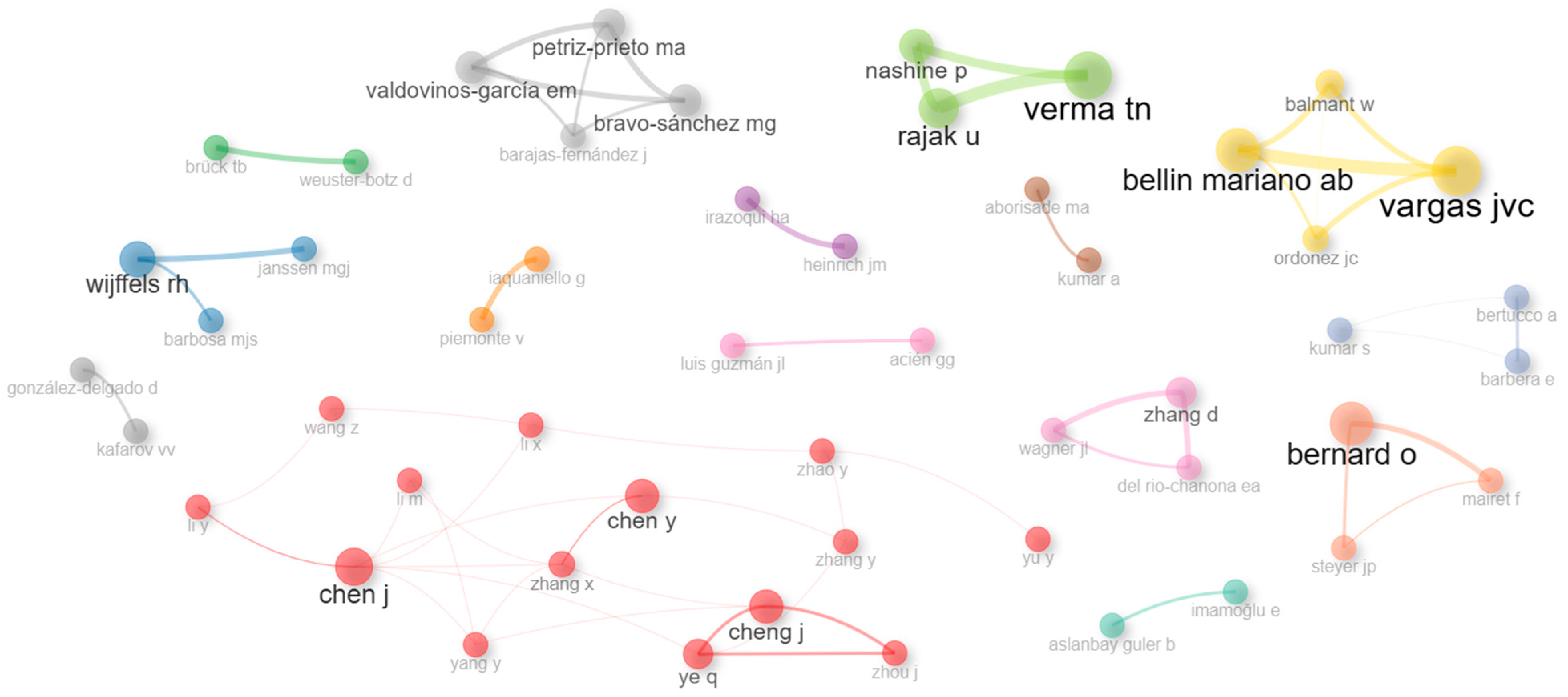
The Scopus-retrieved data highlight Bernardo O as the most productive researcher in the studied field, with the highest h-index, associated with multiple modeling approaches (see Table 1). However, Wijffels RH has the highest total number of citations received. While, as shown in Figure 3, Chen J is the leader in the collaboration.

Table 1.
Authors’ Local Impact, as measured by Bibliometrix.
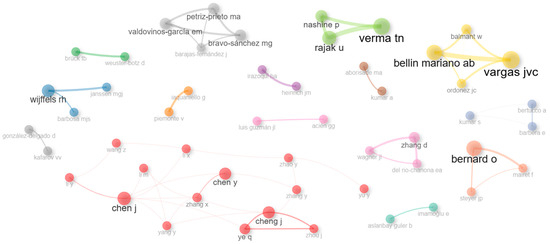
Figure 3.
Most collaborative authors, considering 60 authors and a minimum of one author connection, as measured by Bibliometrix.
The work of Olivier Bernard has been essential in the development from a simple phenomenological description to an advanced deterministic model and optimal control of microalgae. His team’s novel cultivation technique demonstrates that integrating weather forecasts with predictive models to better manage online input and output in open ponds could boost productivity by up to 2.2. They have also discovered that the best way to get that distribution of light and heat is not to add extra energy at all. These results lay the groundwork for the development of hybrid systems (part physical model and part machine learning algorithm) to enhance the accuracy of the weather forecast and for subsequent decision-making processes [33]. On a cellular level, Bernard has contributed to developing spatiotemporal biofilm models that integrate photosynthesis and extracellular polymer sustenance kinetics, accentuating lipid accumulation and enhancing the understanding of how transport, reactions, and productivity are interconnected [34].
Additionally, Bernard and colleagues developed a dynamic metabolic model that accurately predicts heterotrophic or mixotrophic transitions in fermentative residues, offering a quantitative basis for integrating mechanisms with machine learning while ensuring robustness and preventing overfitting [35]. Meanwhile, the high number of citations of Wijffels is likely due to the experimental energetic parameters provided for photoautotrophic growth, showing how energy maintenance and light saturation affect optimal photobioreactor performance, given that these data are used in metabolic flux analysis, process design, and control. Moreover, he and his team quantified ATP for biomass and maintenance, confirming the accuracy of their metabolic network and clarifying its transferability and methodological impact [36].
Note that Figure 3 does not closely match the data in Table 1 because these network plots mainly focus on collaboration searches. Bibliometric network analysis uses metrics like betweenness and PageRank to identify the roles authors play in co-authorship networks. The higher the value, the more likely they are to act as a bridge between subgroups. Betweenness measures how well an author can connect different groups, while PageRank assesses an author’s influence and number of connections, reflecting their position in the network. Based on our analysis (see Table A1 in Appendix A), Chen J has the highest betweenness and PageRank scores, making him the most prominent figure in Figure 3. Therefore, he is a key collaborator who works with top colleagues, serves as a bridge, and maintains strong ties. Authors like Ye Q, Li X, and Zhao Y also have high betweenness, highlighting their roles as important intermediaries, even though they have less overall influence.
This list of authors clearly highlights China’s mainland leading role in this research area, with India and the United States following. At the continental level, Asia, America, and Europe are the main contributors (see Figure A1 in Appendix A). Other bibliometric analyses on these issues explain this result as the outcome of multiple programs developed by China’s mainland and the United States to support the research and development of bioenergy technologies, including microalgae research, aimed at achieving energy security and independence, addressing climate change, promoting sustainability, and fostering economic growth [37].
Conversely, Lotka’s law indicates that four articles represent the key threshold for published works; below this, the share of authors with more publications falls below 1.3%. Lotka’s Law, also known as the inverse square law of scientific productivity, describes the relationship between authors and their publications. It states that the number of authors publishing a certain amount is inversely proportional to the square of that amount, meaning that a few authors are highly productive and account for a significant proportion of total publications [38]. Additionally, in the studied areas, the international co-authorship rate is 31.8%, and the average number of coauthors per document is 4.8.
3.3. Journals That Host the Highest Number of Articles
Table 2 shows that Bioresource Technology and Algal Research are the main journals related to microalgae energy production and modeling research. The total percentage of papers published in the top ten journals is about 31.8%, showing significant diversity among journals publishing articles on these topics. According to Bradford’s law, we can categorize sources into core areas, related areas, and non-relevant areas, based on the field targeted by the papers in the journals—see Equation (1).
where represents the number of journals that belong to the core area, is Euler’s constant , and is the number of articles published in the journal with more hosted documents [39]. Moreover, Bradford’s law requires the articles to be arranged in descending order of the number of publications. For this case, therefore . As a result, the source Biomass and Bioenergy in Table 2 is out of the core collection. Furthermore, it is noteworthy that the Journal Bioresource Technology is the preferred journal for publishing in these fields.
Table 2.
Top 10 journals publishing papers on microalgae, as a source of energy and modeling issues, as measured by Bibliometrix.
4. Microalgae as an Energy Source, Modeling Approaches, and Trending Topics
Microalgae have attracted considerable attention as promising materials for biofuels and renewable energy sources, due to their high productivity and efficiency in photosynthesis. They can even accumulate energy-rich substances such as lipids and carbohydrates. However, maximizing energy yields in bioreactors can be complicated by various environmental and operational factors, such as the availability of lipids or hydrogen for biodiesel production [40]. These interactions are not always easy to predict, as they are often complex. This is why model development and simulation of microalgal processes have been used as important tools in the last few decades. Hence, this review focuses on a selection of the primary methodologies applied over the last two decades to enhance the energetic output from microalgae, including classical models, machine learning-based models, and hybrid models. Table 3 summarizes our findings.
4.1. Conventional Modeling
Traditional microalgal modeling generally depends on deterministic or empirical techniques. Over the last few decades, most studies have used these methods exclusively to understand and scale up biomass and biofuel production from microalgae. For example, potential microalgal growth and nutrient uptake are usually described using classical kinetic functions such as logistic, Gompertz, Monod, and Droop, and parameters are obtained by fitting experimental data [41]. These describe exponential and stationary phases of growth, and relate growth rates to light or nutrient conditions. Material and energy balance models with photobioreactor simulations are also used in process design to predict biomass production at different operational scenarios. Another traditional technique is the statistical experimental optimization, such as the response surface methodology (RSM), in which empirical models that provide relationships between process variables and response are built. Prior to the widespread adoption of artificial intelligence, the conventional approach was to optimize one parameter at a time or utilize RSM to identify the optimal conditions [42]. However, these methods are not capable of analyzing dozens or even hundreds of variables, including complex interactions, simultaneously. For instance, response surfaces can overlook non-linear or sudden behaviors, and the number of experiments increases with the number of factors [43]. Classical models (CM) such as the Monod model and the Gompertz model are commonly used to estimate nutrient uptake and growth as a function of light or nutrient availability [44]. For instance, in the case of inhibition systems, mathematical models are used to monitor local microalgae based on chlorophyll a and biomass concentration. These methods can determine coefficients from the Monod and Aiba models for growth and biomass inhibition, which are affected by light penetration. This leads to maximum biomass and chlorophyll-a levels and helps determine nitrogen and phosphorus uptake rates [45]. CM also supports modeling lipid accumulation under nitrogen stress with inhibition kinetics and assists the scale-up of photobioreactors through balances, and sometimes radiation models, that estimate light penetration in dense cultures [46,47]. Nevertheless, in addition to classical statistical optimization, those approaches, based on the RSM, allowed for increasing the level of biodiesel or biohydrogen production through calibration of culture conditions [48].
The central positive aspect of the CM is its reliance on established physical and chemical principles, which facilitates the relative ease of interpretation and building from initial estimates. The use of CFD in scaling up and optimizing photobioreactors has been applied to energy production processes, such as biofuel production. In these cases, an integrated modeling approach that combines computational fluid dynamics and microalgal biofuel synthesis kinetics is used to simulate biomass growth and the production of novel biofuels [49]. Mathematical modeling of phenomena enhances understanding and helps define process parameters. Even simple models improve comprehension. However, creating models for photobioreactors is a complex process that requires a diverse range of expertise. Biological aspects of photosynthetic microorganisms, including kinetic growth modeling and photobioreactor design, are among the parameters used for physiological analysis. Then, using multiple approaches to model these parameters and their interactions highlights the crucial role of light and the challenges associated with conventional mechanistic modeling for simulating photobioreactors [50].
In addition to the aspects mentioned above, CMs accuracy decreases with the increase in system complexity or when key parameters are unavailable, since the performance criteria of these models are frequently based on simplifying assumptions such as well-mixed cultures, uniform light penetration, or fixed film configuration– states that might not hold in reality [51,52]. This has spurred the search for more modern, flexible, and advanced complementary techniques in recent years.
4.2. Machine Learning Modeling
In recent years, machine learning (ML) has emerged as a key technology for the modeling and optimization of microalgae-related processes. Over the last decade, with the rise in deep learning and increased machine computational power, the first efforts to predict microalgae culture behavior to enhance bioenergy production using artificial intelligence algorithms emerged [53]. Unlike deterministic models, ML models do not solely rely on the researcher’s prior knowledge or theoretical expectations. Instead, they learn patterns from the training data and are hence able to capture complex nonlinear patterns among a variety of predictors and outcome variables. In many cases, such an approach has provided more accurate predictions than the traditional method. For instance, ML has increased biomass productivity by 15–57% and lipid production by 20–43% through the enhancement of culture conditions, surpassing the empirical methods [40]. ML has also led to increased CO2 biofixation compared to conventional methods. Various ML methods have been applied in microalgae energy research, suitable for different applications. Some of the most common applications are summarized below.
Artificial neural networks (ANN) are probably the most used machine learning method in this field. An ANN is a machine learning model that works similarly to the human brain, using processes that mimic biological neurons to recognize patterns, assess options, and make decisions. They have been employed to predict growth rate, biomass concentration, and metabolite production based on environmental variables. For instance, Fernández-Izquierdo et al. [54] employed neural networks to predict polyphenol production in Parachlorella under various lighting conditions to determine the best light intensity and photoperiod that maximizes biomass and compound yields. In this application, the model achieved an R2 of 0.97 with less than 5% error, surpassing a traditional mechanistic model that had an R2 of 0.85 in both accuracy and generalization. This ML model is notable because it can handle complex nonlinear interactions among multiple factors, such as light, nutrients, and pH, as well as strain responses (e.g., lipid productivity in mg/L/year) [55]. Additionally, ANNs have been successfully used to predict biohydrogen production in dark microalgal fermentations with high precision (R2 > 0.98), considering factors such as fermentation time and volatile fatty acids [56].
Support Vector Machines (SVMs) are used in both regression and classification tasks in microalgae research. Their primary goal is to identify a hyperplane—whether a line or a higher-dimensional plane—that separates data points of different classes, maximizing the distance between the hyperplane and the closest data points, known as the “support vectors. SVMs are often employed to predict biomass yields and CO2 uptake across various factor combinations, demonstrating high accuracy and robustness. For example, in photofermentative hydrogen production, SVMs detect unfavorable conditions such as low light and pH levels, achieving 100% and 50% accuracy in identifying light and pH deviations from optimal values, respectively [57]. As a regression tool, it has surpassed traditional models. One study used SVMs with Chlorella data, achieving more accurate results than traditional statistical models, and another predicted CO2 sequestration with 17% less error than a Box–Behnken design [58]. SVM models serve to model the non-linear relation by using kernels, and to prevent overfitting, particularly when moderate data or error tolerance is important.
Decision trees and random forests, on the other hand, are used to extract decision rules and patterns from larger datasets. Decision trees are a supervised learning algorithm that employs a flowchart-like structure to make decisions or predictions, recursively splitting the data according to specific conditions or questions until reaching a final result. In contrast, Random Forest is an ensemble method that merges the predictions of several decision trees to achieve a more accurate and reliable final outcome. For instance, the Coşgun et al.’s decision tree model [59] analyzed 102 studies containing 4670 data points and identified the key factor combinations for high biomass or lipid content. Additionally, Random Forests perform exceptionally well with small datasets, as averaging many trees reduces the risk of overfitting [60]. They can handle many input variables and model complex interactions almost as well as neural networks, and even better than neural networks with a small amount of training data, which is ideal for scarce or expensive experimental data. This applies to hydrogen production studies, where random forests outperform ANNs [60]. When using boosting models like XGBoost, they can predict changes in algal growth under light variations more accurately than random forests trained on the same data [61].
Neurofuzzy models have also been utilized in microalgae research. A neuro-fuzzy inference system merges the learning capabilities of ANNs with fuzzy inference systems (FISs) to simulate expert decision-making. The combined neural network-fuzzy logic model has been successful in predicting optimum conditions and improving biohydrogen production [62]. This methodology is also applicable to the fundamental analysis of the initial pH, optimal N/C ratio, and substrate loading for maximizing H2 production [43].
Lately, attention has shifted towards Deep Learning and Long Short-Term Memory (LSTM), which are focused on more powerful neural networks for processing complex data. Deep Learning resembles ANNs but employs artificial neural networks with multiple layers. At the same time, LSTM is a specific kind of recurrent neural network tailored to analyze and forecast sequences of data, including text, speech, or time series. For example, in environmental crop monitoring, LSTM networks have been implemented to forecast production time series by considering the time-varying factors in a day [63]. Furthermore, convolutional networks have been used with LSTM to process microalgal image sequences to forecast growth patterns [11]. Even though the application of deep learning in the microalgae study field is still emerging, it is expected that it will become increasingly important when more data sets, such as large-scale microscopy images, as well as multi-omics data, become available.
Finally, to identify the best ML algorithm for microalgae studies, some research indicates that in data-scarce situations, models like Random Forest and SVM/SVR tend to be more reliable and stable [11,64]. In contrast, ANNs perform well with large datasets but are more prone to overfitting, requiring extensive hyperparameter tuning and more computational resources. Additionally, ANNs offer less interpretability compared to ensemble methods, such as Random Forest or Gaussian processes. However, a more cautious view is that the effectiveness of different machine learning algorithms depends on the specific application and dataset. Lastly, limitations of deep learning can be addressed using hybrid models or Gaussian processes with uncertainty quantification, along with more rigorous validation and regularization techniques [11,64].
4.3. Hybrid Approaches
Given the complementarity of the approaches discussed above, hybrid models have recently emerged to combine the strengths of traditional mechanistic models with machine learning capabilities. The term hybrid refers to combinations of mechanistic-statistical models where AI algorithms fine-tune model parameters or work alongside phenomenological modules, as well as hybrid intelligence that merges various artificial intelligence techniques. A typical hybrid deterministic-ML model divides the system into parts: some are modeled with phenomenological equations—such as momentum, matter, and energy balances—while others, which are difficult to describe analytically, are represented by neural networks or data-driven methods. This approach leverages existing theoretical knowledge and uses ML to learn unknown or complex nonlinear dynamics. For example, an ANN might improve the growth prediction of a Monod model under high cell density conditions where nonlinear shading occurs. Therefore, the hybrid model functions as a gray-box system, combining well-understood equations—white—with those learned—black components.
A recent study compared the determination of cultivation light conditions in Parachlorella cultures for biofuel compounds, using differential models: a deterministic, a hybrid, and a solely ML model [54]. The hybrid model achieved an R2 of nearly 0.92, surpassing the deterministic model with an R2 of 0.85 and with inferior error rates. Nonetheless, an ANN model based on an entirely data-driven approach achieved the best accuracy (R2 = 0.97) and generalization power. These findings suggest that hybrid models typically perform between conventional models and more flexible ANNs, although the optimal balance varies depending on the case.
Hybrid models are increasingly employed in the multi-objective optimization of microalgal systems. Hossain et al. [58] created a hybrid model that optimizes biomass and CO2 fixation in Chlorella cultivations by using various machine learning methods like boosted regression trees, neural networks, and SVR in integration with multi-objective Bayesian optimization. Through this process, it was discovered that settings that support higher productivity and higher carbon capture rates can demonstrate the benefits of combining artificial intelligence and process engineering targets. For instance, here, one can mention the adaptive neurofuzzy inference system (ANFIS), which combines ANNs with a rule-based approach. These models predict the optimal hydrogen production by combining experimental data and expert insights regarding pH and nutrient limits [64]. They are also highly effective at forecasting maximum yields, such as liters of H2, by considering features like inlet gas flow rate, pH, and impeller speed [62].
Moreover, some studies have used CFD and ML to optimize microalgae bioreactors with a data-driven surrogate framework. This reduces compute time from months to days by using deep learning on limited physical model results to learn hydrodynamics and kinetics. A hybrid stochastic algorithm then explores new conditions to find optimal solutions [65]. In addition, coupling mechanistic models with ANNs has been found helpful to predic bioreactor dynamics, including continuous PHA production by Pseudomonas putida GPo1. In such cases, non-structured mechanistic models based on Monod uptake kinetics can be used to describe bioreactor operation under specific process conditions. Later, the ANNs are trained on experimental data from different dilution rates and media. Finally, a hybrid model capable of accurately describing processes across diverse conditions, including nutrient limitations, can be obtained [66].
Hybridization-based approaches in microalgae are barely developed and are facing diverse challenges. The coupling of deterministic or mechanistic models and neural networks is nontrivial, as the timescales of the two sets must be harmonious, data must be generated with consistent factors, and training can sometimes be performed under physical constraints. Scarcity of data, particularly for calibration, is a significant barrier. A related recent review states that, despite the promise, issues such as a shortage of sensors, using models across different strains, and combining differential equations with neural networks are still developing at a slow pace [11]. Nonetheless, solutions are being developed in related fields, and it might be more effective to use hybrid approaches once tools and standards have matured.
Table 3.
Comparison of Modeling Methods in Microalgae Energy Production.
Table 3.
Comparison of Modeling Methods in Microalgae Energy Production.
| Aspect | Conventional Models | Machine Learning Models | Hybrid Models |
|---|---|---|---|
| Modeling Basis | Differential equations (e.g., Monod, Gompertz), balance models, empirical response surfaces, etc. | Pattern recognition from data (ANN, SVM, RF, etc.) | Mechanistic core + ML layers (e.g., ANN correcting Monod) |
| Interpretability | High—parameters have physical/biological meaning | Low—often black-box models | Medium—interpretable structure with adaptive ML components |
| Data Requirements 1 | Low—a few experiments may suffice | High—requires large and diverse datasets | Medium—benefits from prior knowledge, needs fewer data than pure ML |
| Accuracy | Moderate/High—limited in capturing nonlinearities | High—can capture complex and abrupt behaviors | High—combines theoretical structure with data-driven refinement |
| Scalability/Generalization | Suitable for extrapolation if based on physical laws | Limited—poor performance outside the training domain | Better extrapolation than ML-only models |
| Optimization Capabilities | Manual or using statistical tools (e.g., RSM) | Automatic via metaheuristics (e.g., XGBoost) | Multi-objective, physics-informed optimization (e.g., Bayesian, ANFIS) |
| Update Flexibility | Static—reparameterization needed for new data | Dynamic—retrainable with new data | Semi-dynamic—ML component adapts, constrained by a mechanistic base |
| Variable Integration | Limited—only predefined variables can be modeled | Flexible—integrates spectral, genomic, and omics data | Flexible—combines known constraints with novel variables |
| Performance in Data-Sparse Scenarios | Performs reliably with little data, robust in low-data conditions | Poor convergence or overfitting is likely | More robust than ML, can handle moderate data availability |
| Common Applications | Growth kinetics, photobioreactor design, stoichiometry, nutrient modeling | Predicting lipid, H2, biomass, CO2 uptake; real-time control, vision-based monitoring | Predicting productivity under new conditions: multi-objective optimization |
| Representative Models/Tools | Monod, Droop, material-energy balances, RSM, etc. | ANN, SVM, Random Forest, LSTM, Deep Learning, Neurofuzzy, XGBoost, etc. | ANN + Monod, SVR + differential equations, ANFIS, etc. |
| Strengths | Physically grounded, interpretable, extrapolative | Flexible, accurate, data-responsive, captures complex dynamics | Balances knowledge and data, robust predictions, and more reliable outside the training range |
| Weaknesses | Struggles with high complexity, assumes idealized conditions | Poor interpretability, needs large datasets, risk of unrealistic outputs | Requires integration expertise, consistency in time scales, and advanced calibration |
| Technological Readiness | Mature and widely implemented | Growing adoption; mature in ANN and Random Forest applications | Emerging but expanding rapidly in multi-criteria optimization |
| Outlook | Always necessary, but increasingly used in hybrid approaches | Relevant since the 2010s; expected to grow with big data and automation | Projected to expand significantly with deep learning and hybrid intelligence techniques |
1 Data requirement as suggested by the study of Agharafeie et al. [67].
4.4. Trending Topics as Measured by Bibliometrix and VOSviewer
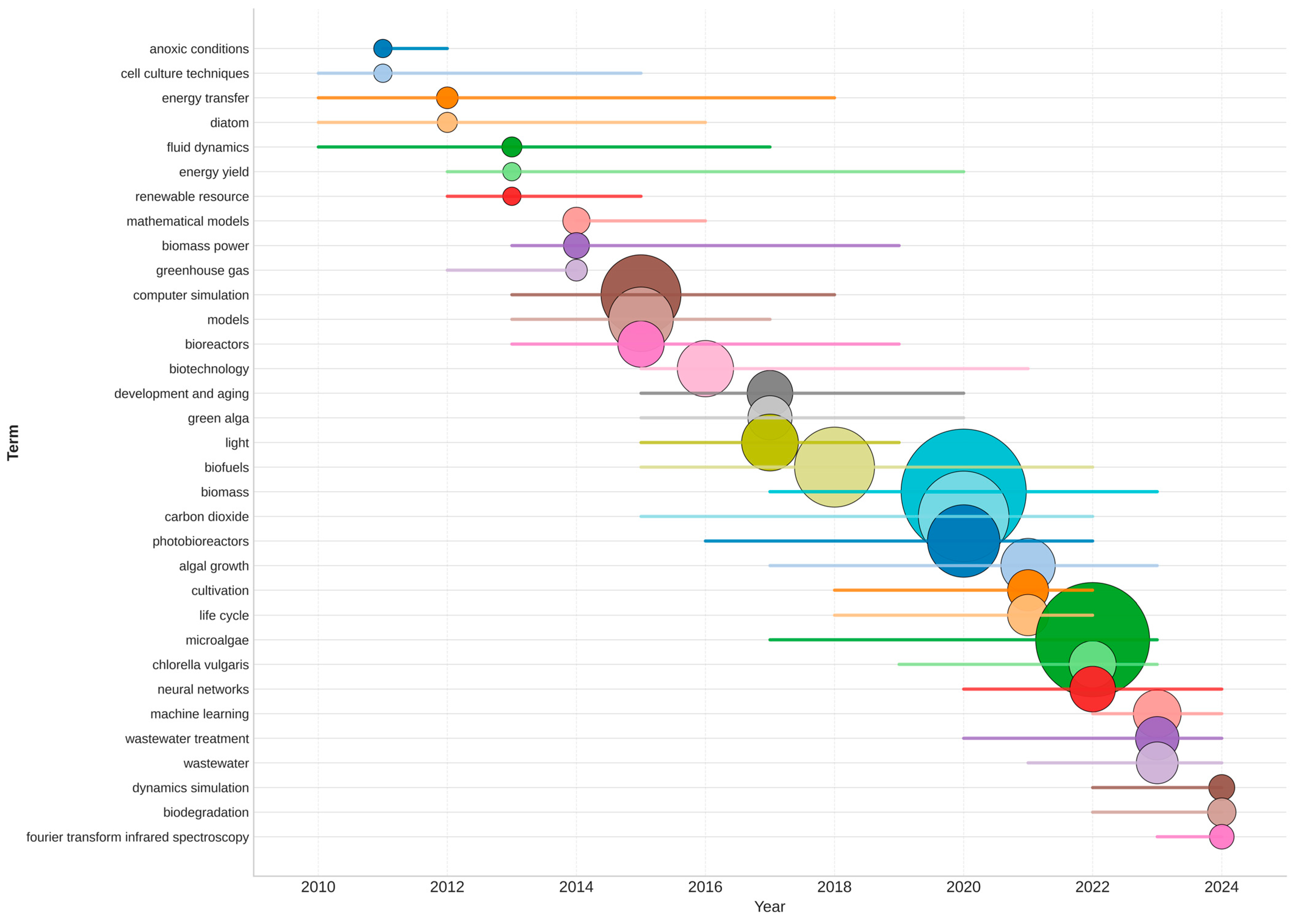
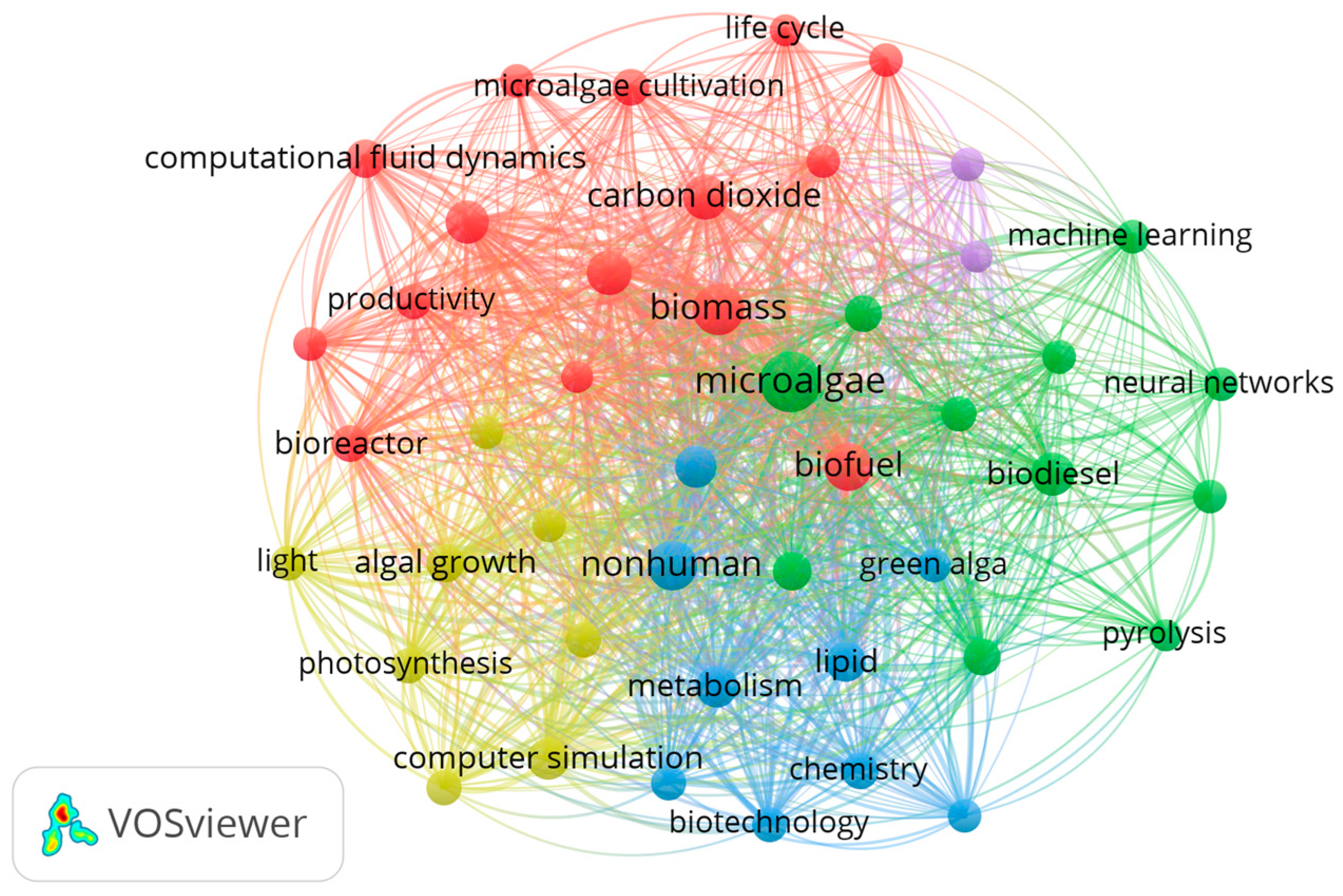
The visualization of the Scopus trend topics chart (Figure 4) and keyword clusters (Figure 5) highlights the most significant research areas related to microalgae research and modeling. Keywords accurately represent scientific articles, and their frequent use can indicate the main focus areas within a specific research field. The cluster analysis enabled us to identify the association of keywords and determine the research relevant to each particular cluster. The thematic trend chart, which uses up to the three most frequently used words per year (as long as they exceed a minimum threshold of five occurrences), aims to examine the evolution of the researchers’ interests over time. It is worth noting that the trending topics map in Figure 4 covers a range of keywords from 2010 to 2024, which corresponds with the compiled database and the paper production over time shown in Figure 2, due to the low number of proliferated documents during the 2004–2010 period.
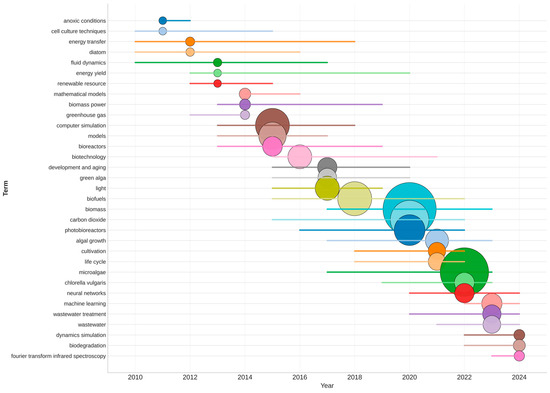
Figure 4.
Trend topics plot obtained with the matplotlib tab20 color palette with the data extracted from the software Bibliometrix for a minimum keyword frequency of 5.
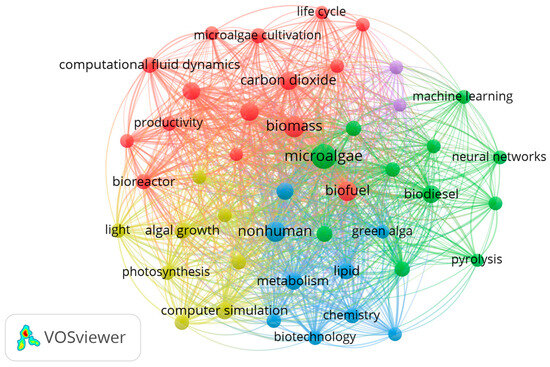
Figure 5.
Five cluster networks were obtained by using the most commonly used keywords by authors, considering a minimum of 25 occurrences in VOSviewer.
We highlight the keywords microalgae, biofuel, computer simulation, photobioreactors, computational fluid dynamics, and machine learning (see Table A2 in Appendix B and Figure 4). The integration of these words and the trending topics maps of Figure 4 suggests that, from 2020, the scientific community has been adopting the use of machine learning, wastewater treatment, dynamic simulation, biodegradation, and Fourier transform infrared spectroscopy (FTIR) in microalgae research. ML has evolved from a niche technology to mainstream-based solutions that, in some cases, surpass conventional optimization and operational methods, enabling the practical handling of microalgae processing. Two extensive reviews report a marked increase in the amount of research carried out using models such as ANN, SVM, Random Forest, and Deep Learning for predicting growth, optimizing cultures, and controlling bioreactors [10,53]. Meanwhile, dynamic simulation has become an important physical method for scaling up photobioreactors and race ponds, often combined with ML to reduce computational costs or incorporate physicochemical constraints. It has also boosted advances in photobioreactor design, radiation/mixing, and mass transfer [7,68]. At the same time, interest in biodegradation and broader bioremediation of persistent pollutants is increasing, especially concerning organic micropollutants and metabolic pathways. This involves microalgae-bacteria consortia and real-world effluent conditions. Some researchers have reported combined uses of microalgae and municipal waste materials for bioenergy production, harnessing microalgae’s bioremediation capabilities and their potential to be converted into value-added products [69,70]. Lastly, FTIR techniques—including Total Attenuated Reflectance (ATR), FTIR, and Near-Infrared (NIR) Spectroscopy—are increasingly used as rapid, non-destructive, high-throughput tools to monitor biomass, composition, and kinetics during processing and production [71,72,73].
Below, we provide a more detailed discussion of the growing contributions related to microalgae modeling issues connected to bioenergy production, as suggested by the five clusters of Figure 5.
4.4.1. Scaling and Sustainability
This cluster group (red in Figure 5) explores biomass production processes and carbon dioxide coupling in photobioreactors and storage tanks, mainly assessing system durability through life cycle analysis (LCA). These works combine numerical fluid dynamics, bioreactor technology, and productivity analysis, utilizing Computational Fluid Dynamics (CFD) to model hydrodynamics, mass transfer, mixing, and light distribution in photobioreactors, which in turn influence photosynthesis and productivity [7]. Recent research confirms CFD as a standard tool for diagnosing and designing biomass photobioreactors [29], where it can also be applicable to determine the effect of dissolved carbon dioxide on beam kinematics and process optimization [74]. In parallel, LCA is part of a post-2020 strategy comparing approaches such as biodiesel, hydrothermal liquefaction, and microbial fuel cells to identify critical factors and guide process and energy decisions [75]. Therefore, the interaction of carbon dioxide, biomass, and productivity highlights the combined focus on design, capture, and environmental impact.
4.4.2. Biofuel Pathways and Machine Learning
In the green nodes sector of Figure 5, machine learning techniques intersect with biodiesel and pyrolysis. Machine learning models are linked to lipids and biodiesel, utilizing methods such as artificial neural networks, support vector machines, Random Forest, and Deep Learning to optimize growth conditions, lipid content, lighting, nutrients, and pH, as well as process control—surpassing traditional optimization methods [12,40,53]. The connection to pyrolysis explains the complementary nature of pyrolysis and co-pyrolysis of algal biomass thermochemical pathways, alone or combined with waste or other biomass to produce biofuels or renewable chemicals [76]. Moreover, research on lipid accumulation under stress points out the importance of green algae in the sector due to its significance for biodiesel production [77].
Concerning biohydrogen production from microalgae, particularly chlorophytes, hydrogen is generated by the photosynthetic biotransduction by direct or indirect biophotolysis. This activation can be initiated by conditions such as sulfur restriction in Chlamydomonas reinhardtii. This mechanism decouples oxygen evolution, enabling redox-sensitive hydrogenases to operate [78]. These insights have driven over twenty years of progress in photophysiology and photosynthetic engineering, enhancing the regulation of photosystem II, protecting against photooxidative stress, and maintaining redox balance [79]. Hence, since 2020, the connection between biohydrogen production and machine learning has become clearer in thematic analysis [11,22]. Additionally, diverse researchers have used alternative methods such as photofermentation and dark fermentation, utilizing algal biomass or co-substrates to generate hydrogen [80]. These approaches have the operational advantage of reducing dependence on particular photochemical conditions, broadening biohydrogen applicability beyond photoautotrophic growth, and incorporating it into biorefining systems [81]. Furthermore, as mentioned in the lines above, various studies focus on machine learning models to predict and optimize hydrogen production, serving as an example of the digital advances witnessed in other similar areas associated with algal biorefineries [56]. Thus, machine learning is particularly beneficial for managing complex, multivariate, and nonlinear environments under experimental operational constraints.
4.4.3. Biotechnology, Chemistry, and Metabolism
The blue cluster indicates the field of microalgae biorefinery for biotechnology usage. This will require reprogramming carbon flow towards energy-dense lipids, metabolic gas engineering, and conversion and characterization chemistry. Biotechnology, plant science, lipids, and chemistry work together to promote triacylglyceride buildup—often through nitrogen stress—and to tailor the fatty acid profile by, for example, optimizing fatty acid yield for processes like fatty acid methyl esters or hydrothermal liquefaction [82,83]. In addition, accelerated characterization via vibrational spectroscopy and chemometrics has evolved into a useful approach for biomacromolecule profiling (rapid determination of the composition of multiple biomacromolecule species) and near real-time compositional tracking, linking bench and factory [84]. This field is progressing toward integrated biodiesel systems that generate high-value co-products such as pigments, nutraceuticals, and polysaccharides, improving their technical and economic sustainability [85,86]. This kind of initiative details a plan for metabolic engineering, chemical measurement, and multi-product strategies to align biochemical capabilities with industrial performance.
4.4.4. Photophysiology and Computational Simulation
The yellow nodes in Figure 5 combine photographic techniques—such as light control, photography, and algal growth—with computer simulations to examine how interactions between radiation, photoprotective responses, and plant behavior influence crop yields. Recent research shows biomass attenuation causes spatial light gradients and cellular cycles that affect quantum efficiency, photoclimation, and photoinhibition. Because light effects are complex to analyze directly [87,88], simulation frameworks that incorporate spectral radiative transfer with light-dependent kinematics, sometimes combined with CFD for modeling cell plates and micro-scale structures, are improving the accuracy of predictions for productivity and photobioreactor design [29,50]. As a result, virtual testing and optimization of LED lighting strategies and pulses at high frequency are ongoing. These findings vary depending on frequency, scale, and species, raising questions about the universal effectiveness of artificial parapets and model-based design approaches [89,90]. For example, in raceway ponds, engineering solutions such as machines with beneficial altitude/diameter cycles and additional lighting have demonstrated practical applications in real operating conditions [91]. In general, the adoption of computational simulation within this yellow cluster shows a positive move towards using digital twins for cultivation and predictive management of light, carbon dioxide, and mixing, reflecting a post-2020 adoption of Industry 4.0 technological advancements.
4.4.5. Wastewater Treatment and Biorefineries
The purple cluster in Figure 5 focuses on wastewater treatment based on microalgae. These nodes align with the wastewater treatment agenda, promoting resource recovery and biomass production. In this context, typically, microalgae are used to remove nitrogen and phosphorus, capture dissolved carbon dioxide, and reduce emerging contaminants such as those found in pharmaceuticals and personal care products [17]. Additionally, their cultivation is highly flexible, as waste effluents or carbon dioxide from industrial sources can be utilized to promote their growth [92]. This versatility makes their integration into biorefinery schemes attractive for producing biofuels, bioplastics, and high-value additives, aiming at circular economy strategies [69]. In this context, biological remediation technologies, through the co-cultivation of microalgae with wastewater streams, reinforce the nutrients’ efficient use and reduce operating costs, simultaneously generating environmental benefits by recycling and valorizing organic by-products [70,93]. Combining these approaches with other valorization technologies, such as fermentation, thermochemical conversion, or biocompound extraction, enables the product diversity, resulting in higher value products, including natural pigments, essential fatty acids, and bio-fertilizers, thus reinforcing the integrated biorefinery concept. However, scaling up commercially is still challenging, with issues in areas such as the reduction in energy cost for harvesting and drying, the optimization of photobioreactors, and providing a continuous supply of carbon dioxide and nutrients in scale operations at a large scale [69,92].
5. Conclusions
This review addresses the recent surge in interest among journals and researchers in microalgae energy production and modeling. The main conclusions delivered by responding to each one of the settled research questions are the following:
- The production of original papers on this topic underwent exponential growth up to 2022.
- To become a leading author in the field of study, six published papers are required.
- The top journals preferred by authors to publish in the field of study have an SJR higher than 0.257, with Bioresource Technology as the preferred journal.
Over the last few years, microalgae and energy research have introduced hybrid approximations that combine basic kinetic and process balance models with machine learning, connecting data science with physics-based approaches to enhance predictiveness, scalability, and decision-making. This analysis also highlights the importance of CFD in the design and operation of microalgae reactors. Furthermore, it was found that wastewater–microalgae systems are maturing as a technology within the circular biorefineries. Future research can focus on integrating physics models with data-driven models in real-time by utilizing remote sensing and digital twins in hybrid system design—including the use of reinforcement learning. Additionally, it should address barriers related to dataset standardization and the availability of high-quality, comprehensive data.
Author Contributions
Conceptualization, A.A.-M. and Á.D.G.-D.; methodology, A.A.-M.; software, A.A.-M.; validation, A.A.-M.; formal analysis, A.A.-M., S.R.-F. and Á.D.G.-D.; investigation, A.A.-M.; resources, A.A.-M.; data curation, A.A.-M.; writing—original draft preparation, A.A.-M.; writing—review and editing, A.A.-M., S.R.-F. and Á.D.G.-D.; visualization, A.A.-M.; supervision, Á.D.G.-D.; project administration, Á.D.G.-D. and S.R.-F.; funding acquisition. All authors have read and agreed to the published version of the manuscript.
Funding
This research was funded by the Colombian Ministry of Science, Technology and Innovation MINCIENCIAS through the project “Sustainable Use of Avocado (Laurus persea L.) Produced in the Montes de María to obtain Value Added Products under the Biorefinery Concept in the Department of Bolívar” and “Evaluation of the sustainability of a cascade biorefinery topology for the use of Hass avocado seeds cultivated in the Amazon region”, Codes BPIN 2020000100325 and SIGP 100307. Alviz-Meza A. was funded by the same call through budget record 147.
Data Availability Statement
The original contributions presented in this study are included in the article. Further inquiries can be directed to the corresponding author(s).
Acknowledgments
The authors thank the Universidad de Cartagena for technical support and for providing databases, equipment, and software to conclude this research successfully.
Conflicts of Interest
The authors declare no conflicts of interest.
Appendix A
Table A1.
Top 5 collaborative authors as measured by Bibliometrix.
Table A1.
Top 5 collaborative authors as measured by Bibliometrix.
| Scopus | |||
|---|---|---|---|
| Rank | Author | Betweenness | PageRank |
| 1st | Chen J | 32.70 | 0.034 |
| 2nd | Ye Q | 15.05 | 0.029 |
| 3rd | Li X | 14.33 | 0.017 |
| 4th | Zhao | 14.00 | 0.019 |
| 5th | Zhang Y | 10.08 | 0.015 |
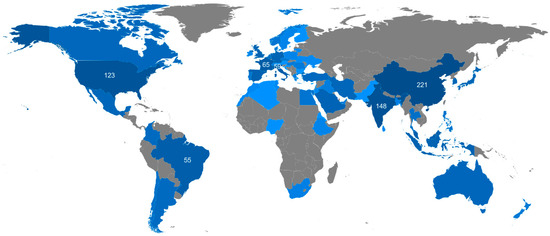
Figure A1.
The two countries that publish the most on topics covered in this study related to Asia, America, and Europe, according to Bibliometrix.
Figure A1.
The two countries that publish the most on topics covered in this study related to Asia, America, and Europe, according to Bibliometrix.
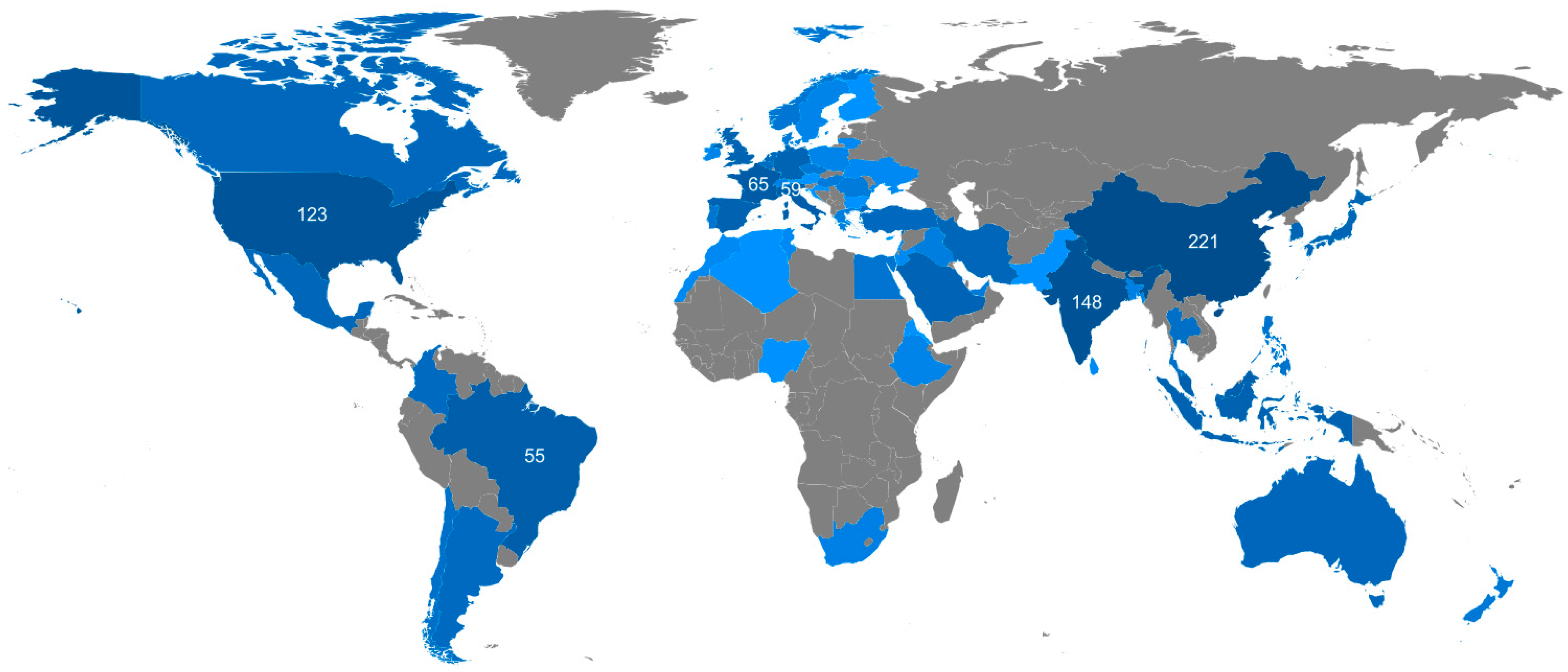
Appendix B
Table A2.
Top 10 most used author keywords according to Bibliometrix.
Table A2.
Top 10 most used author keywords according to Bibliometrix.
| Rank | Terms | Frequency |
|---|---|---|
| 1st | Microorganisms | 243 |
| 2nd | Biomass | 233 |
| 3rd | Carbon dioxide | 122 |
| 4th | Biofuels | 95 |
| 5th | Computer simulation | 95 |
| 6th | Photobioreactors | 78 |
| 7th | Metabolism | 65 |
| 8th | Models | 62 |
| 9th | Computational fluid dynamics | 60 |
| 10th | Kinetics | 59 |
References
- Yahaya, E.; Yeo, W.S.; Nandong, J.; Ngu, J.C.Y. CO2 Fed Microalgae Cultivation in Photobioreactor: Review on Challenges and Possible Solutions. Environ. Technol. Rev. 2025, 14, 540–564. [Google Scholar] [CrossRef]
- Abdur Razzak, S.; Bahar, K.; Islam, K.M.O.; Haniffa, A.K.; Faruque, M.O.; Hossain, S.M.Z.; Hossain, M.M. Microalgae Cultivation in Photobioreactors: Sustainable Solutions for a Greener Future. Green Chem. Eng. 2024, 5, 418–439. [Google Scholar] [CrossRef]
- Pruvost, J.; Le Gouic, B.; Cornet, J.F. Kinetic Modeling of CO2 Biofixation by Microalgae and Optimization of Carbon Supply in Various Photobioreactor Technologies. ACS Sustain. Chem. Eng. 2022, 10, 12826–12842. [Google Scholar] [CrossRef]
- Perin, G.; Morosinotto, T.; Jacob-Lopes, E.; Janssen, M. Understanding Regulation in Complex Environments: A Route to Enhance Photosynthetic Light-Reactions in Microalgae Photobioreactors. Front. Photobiol. 2023, 1, 1274525. [Google Scholar] [CrossRef]
- Liao, Y.; Fatehi, P.; Liao, B. A Study of Theoretical Analysis and Modelling of Microalgal Membrane Photobioreactors for Microalgal Biomass Production and Nutrient Removal. Membranes 2024, 14, 245. [Google Scholar] [CrossRef]
- Yahaya, E.; Yeo, W.S.; Nandong, J. Process Modeling and 3-Stage Photobioreactor Design for Algae Cultivation and CO2 Capture: A Case Study Using Palm Oil Mill Effluent. Biochem. Eng. J. 2024, 212, 109532. [Google Scholar] [CrossRef]
- Amanna, B.; Bahri, P.A.; Moheimani, N.R. Application of Computational Fluid Dynamics in Optimizing Microalgal Photobioreactors. Algal Res. 2024, 83, 103718. [Google Scholar] [CrossRef]
- Zhao, Y.; Jia, G.; Cheng, Y.; Zhu, H.; Chi, Z.; Shen, H.; Zhu, C. Numerical Study on the Internal Fluid Mixing and Its Influencing Mechanisms of the Wave-Driven Floating Photobioreactor for Microalgae Production. Front. Mar. Sci. 2023, 10, 1095590. [Google Scholar] [CrossRef]
- Yeh, Y.C.; Syed, T.; Brinitzer, G.; Frick, K.; Schmid-Staiger, U.; Haasdonk, B.; Tovar, G.E.M.; Krujatz, F.; Mädler, J.; Urbas, L. Improving Microalgae Growth Modeling of Outdoor Cultivation with Light History Data Using Machine Learning Models: A Comparative Study. Bioresour. Technol. 2023, 390, 129882. [Google Scholar] [CrossRef] [PubMed]
- Imamoglu, E. Artificial Intelligence and/or Machine Learning Algorithms in Microalgae Bioprocesses. Bioengineering 2024, 11, 1143. [Google Scholar] [CrossRef]
- Syed, T.; Krujatz, F.; Ihadjadene, Y.; Mühlstädt, G.; Hamedi, H.; Mädler, J.; Urbas, L. A Review on Machine Learning Approaches for Microalgae Cultivation Systems. Comput. Biol. Med. 2024, 172, 108248. [Google Scholar] [CrossRef]
- Porras Reyes, L.; Havlik, I.; Beutel, S. Software Sensors in the Monitoring of Microalgae Cultivations. Rev. Environ. Sci. Bio/Technology 2024, 23, 67–92. [Google Scholar] [CrossRef]
- Shahhoseyni, S.; Greco, L.; Sivaram, A.; Mansouri, S.S. A Reduced-Order Hybrid Model for Photobioreactor Performance and Biomass Prediction. Algal Res. 2024, 84, 103750. [Google Scholar] [CrossRef]
- Sheik, A.G.; Kumar, A.; Ansari, F.A.; Raj, V.; Peleato, N.M.; Patan, A.K.; Kumari, S.; Bux, F. Reinvigorating Algal Cultivation for Biomass Production with Digital Twin Technology—A Smart Sustainable Infrastructure. Algal Res. 2024, 84, 103779. [Google Scholar] [CrossRef]
- Uguz, S.; Sahin, Y.S.; Kumar, P.; Yang, X.; Anderson, G. Real-Time Algal Monitoring Using Novel Machine Learning Approaches. Big Data Cogn. Comput. 2025, 9, 153. [Google Scholar] [CrossRef]
- Donthu, N.; Kumar, S.; Mukherjee, D.; Pandey, N.; Lim, W.M. How to Conduct a Bibliometric Analysis: An Overview and Guidelines. J. Bus. Res. 2021, 133, 285–296. [Google Scholar] [CrossRef]
- Purba, L.D.A.; Susanti, H.; Admirasari, R.; Praharyawan, S.; Taufikurahman; Iwamoto, K. Bibliometric Insights into Microalgae Cultivation in Wastewater: Trends and Future Prospects for Biolipid Production and Environmental Sustainability. J. Environ. Manage. 2024, 352, 120104. [Google Scholar] [CrossRef]
- Hamid Nour, A.; Mokaizh, A.A.B.; Alazaiza, M.Y.D.; Bashir, M.J.K.; Mustafa, S.E.; Baarimah, A.O. Innovative Strategies for Microalgae-Based Bioproduct Extraction in Biorefineries: Current Trends and Future Solutions Integrating Wastewater Treatment. Sustainability 2024, 16, 10565. [Google Scholar] [CrossRef]
- Alagumalai, A.; Song, H. Exploring the Landscape of Machine Learning-Aided Research in Biofuels and Biodiesel: A Bibliometric Analysis. Green Energy Resour. 2024, 2, 100089. [Google Scholar] [CrossRef]
- Qian, L.; Zhang, X.; Ma, X.; Xue, P.; Tang, X.; Li, X.; Wang, S. A Review on Machine Learning-Aided Hydrothermal Liquefaction Based on Bibliometric Analysis. Energies 2024, 17, 5254. [Google Scholar] [CrossRef]
- Islam, M.S.; Fuad, M.M.N.; Malitha, S.B.; Alam, M.Z. Advanced Biofuels Research: A Scopus Database-Driven Bibliometric Evaluation and Future Directions Forecast via Machine Learning and Deep Learning. Clean. Chem. Eng. 2025, 11, 100188. [Google Scholar] [CrossRef]
- Ning, H.; Li, R.; Zhou, T. Machine Learning for Microalgae Detection and Utilization. Front. Mar. Sci. 2022, 9, 947394. [Google Scholar] [CrossRef]
- Zhu, J.; Liu, W. A Tale of Two Databases: The Use of Web of Science and Scopus in Academic Papers. Scientometrics 2020, 123, 321–335. [Google Scholar] [CrossRef]
- Aria, M.; Cuccurullo, C. Bibliometrix: An R-Tool for Comprehensive Science Mapping Analysis. J. Informetr. 2017, 11, 959–975. [Google Scholar] [CrossRef]
- Karahan, S.; Gül, L.F. Mapping Current Trends on Gamification of Cultural Heritage. In Game + Design Education; Springer International Publishing: Cham, Switzerland, 2021; pp. 281–293. [Google Scholar]
- Gaur, A.; Kumar, M. A Systematic Approach to Conducting Review Studies: An Assessment of Content Analysis in 25 Years of IB Research. J. World Bus. 2018, 53, 280–289. [Google Scholar] [CrossRef]
- Wallin, J.A. Bibliometric Methods: Pitfalls and Possibilities. Basic Clin. Pharmacol. Toxicol. 2005, 97, 261–275. [Google Scholar] [CrossRef]
- Basanta, R.; Delgado, M.G.; Martínez, J.C.; Vázquez, H.M.; Vázquez, G.B. Sostenibilidad del Reciclaje de Residuos de la Agroindustria Azucarera: Una Revisión Recycling of Waste from Sugarcane Agroindustry: A Review. CYTA J. Food 2007, 5, 293–305. [Google Scholar] [CrossRef]
- Luzi, G.; McHardy, C. Modeling and Simulation of Photobioreactors with Computational Fluid Dynamics—A Comprehensive Review. Energies 2022, 15, 3966. [Google Scholar] [CrossRef]
- Ioannidis, J.P.A.; Bendavid, E.; Salholz-Hillel, M.; Boyack, K.W.; Baas, J. Massive Covidization of Research Citations and the Citation Elite. Proc. Natl. Acad. Sci. USA 2022, 119, e2204074119. [Google Scholar] [CrossRef]
- Silva, S.C.; Ferreira, I.C.F.R.; Dias, M.M.; Filomena Barreiro, M. Microalgae-Derived Pigments: A 10-Year Bibliometric Review and Industry and Market Trend Analysis. Molecules 2020, 25, 3406. [Google Scholar] [CrossRef]
- Tan, H.T.; Yusoff, F.M.; Khaw, Y.S.; Ahmad, S.A.; Shaharuddin, N.A. Uncovering Research Trends of Phycobiliproteins Using Bibliometric Approach. Plants 2021, 10, 2358. [Google Scholar] [CrossRef]
- De-luca, R.; Bezzo, F.; Béchet, Q.; Bernard, O. Meteorological Data-Based Optimal Control Strategy for Microalgae Cultivation in Open Pond Systems. Complexity 2019, 2019, 4363895. [Google Scholar] [CrossRef]
- Polizzi, B.; Bernard, O.; Ribot, M. A Time-Space Model for the Growth of Microalgae Biofilms for Biofuel Production. J. Theor. Biol. 2017, 432, 55–79. [Google Scholar] [CrossRef]
- Baroukh, C.; Turon, V.; Bernard, O. Dynamic Metabolic Modeling of Heterotrophic and Mixotrophic Microalgal Growth on Fermentative Wastes. PLoS Comput. Biol. 2017, 16, e1005590. [Google Scholar] [CrossRef]
- Kliphuis, A.M.J.; Klok, A.J.; Martens, D.E.; Lamers, P.P.; Janssen, M.; Wijffels, R.H. Metabolic Modeling of Chlamydomonas Reinhardtii: Energy Requirements for Photoautotrophic Growth and Maintenance. J. Apply Phycol. 2012, 24, 253–266. [Google Scholar] [CrossRef]
- Arimbrathodi, S.P.; Javed, M.A.; Hamouda, M.A.; Aly Hassan, A.; Ahmed, M.E. BioH2 Production Using Microalgae: Highlights on Recent Advancements from a Bibliometric Analysis. Water 2023, 15, 185. [Google Scholar] [CrossRef]
- Martín, M.I.; Ana, S.; Pestana, I.; António, C.; Guerrero, P. Lotka Law Applied to the Scientific Production of Information Science Area. Braz. J. Inf. Sci. Res. Trends 2009, 2, 16–32. [Google Scholar] [CrossRef]
- Zhu, Z.; Yao, X.; Qin, Y.; Lu, Z.; Ma, Q.; Zhao, X.; Liu, L. Visualization and Mapping of Literature on the Scientific Analysis of Wall Paintings: A Bibliometric Analysis from 2011 to 2021. Herit. Sci. 2022, 10, 105. [Google Scholar] [CrossRef]
- Wu, Y.; Shan, L.; Zhao, W.; Lu, X. Harnessing Artificial Intelligence to Revolutionize Microalgae Biotechnology: Unlocking Sustainable Solutions for High-Value Compounds and Carbon Neutrality. Mar. Drugs 2025, 23, 184. [Google Scholar] [CrossRef]
- Schediwy, K.; Trautmann, A.; Steinweg, C.; Posten, C. Microalgal Kinetics—A Guideline for Photobioreactor Design and Process Development. Eng. Life Sci. 2019, 19, 830. [Google Scholar] [CrossRef]
- Sharma, P.; Sivaramakrishnaiah, M.; Deepanraj, B.; Saravanan, R.; Reddy, M.V. A Novel Optimization Approach for Biohydrogen Production Using Algal Biomass. Int. J. Hydrogen Energy 2024, 52, 94–103. [Google Scholar] [CrossRef]
- Salameh, T.; Sayed, E.T.; Olabi, A.G.; Hdaib, I.I.; Allan, Y.; Alkasrawi, M.; Abdelkareem, M.A. Adaptive Network Fuzzy Inference System and Particle Swarm Optimization of Biohydrogen Production Process. Ferment. 2022, 8, 483. [Google Scholar] [CrossRef]
- Pérez-Guzmán, S.M.; Hernández-Aguilar, E.; Alvarado-Lassman, A.; Méndez-Contreras, J.M. Kinetics of Obtaining Microalgal Biomass and Removal of Organic Contaminants in Photobioreactors Operated with Microalgae—Study Case: Treatment of Wastewater from a Poultry Slaughterhouse. Water 2024, 16, 1558. [Google Scholar] [CrossRef]
- Tunay, D.; Yildirim, O.; Ozkaya, B.; Demir, A. Determination of Photoautotrophic Growth and Inhibition Kinetics by the Monod and the Aiba Models and Bioenergetics of Local Microalgae Strain. Chemosphere 2022, 292, 133330. [Google Scholar] [CrossRef]
- Saldarriaga, L.F.; Almenglo, F.; Ramírez, M.; Cantero, D. Kinetic Characterization and Modeling of a Microalgae Consortium Isolated from Landfill Leachate under a High CO2 Concentration in a Bubble Column Photobioreactor. Electron. J. Biotechnol. 2020, 44, 47–57. [Google Scholar] [CrossRef]
- Huang, Q.; Jiang, F.; Wang, L.; Yang, C. Design of Photobioreactors for Mass Cultivation of Photosynthetic Organisms. Engineering 2017, 3, 318–329. [Google Scholar] [CrossRef]
- Bajwa, K.; Bishnoi, N.R.; Kirrolia, A.; Gupta, S.; Tamil Selvan, S. Response Surface Methodology as a Statistical Tool for Optimization of Physio-Biochemical Cellular Components of Microalgae Chlorella Pyrenoidosa for Biodiesel Production. Appl. Water Sci. 2019, 9, 128. [Google Scholar] [CrossRef]
- Ali, H.; Solsvik, J.; Wagner, J.L.; Zhang, D.; Hellgardt, K.; Park, C.W. CFD and Kinetic-Based Modeling to Optimize the Sparger Design of a Large-Scale Photobioreactor for Scaling up of Biofuel Production. Biotechnol. Bioeng. 2019, 116, 2200–2211. [Google Scholar] [CrossRef] [PubMed]
- Legrand, J.; Artu, A.; Pruvost, J. A Review on Photobioreactor Design and Modelling for Microalgae Production. React. Chem. Eng. 2021, 6, 1134–1151. [Google Scholar] [CrossRef]
- Shoener, B.D.; Schramm, S.M.; Béline, F.; Bernard, O.; Martínez, C.; Plósz, B.G.; Snowling, S.; Steyer, J.P.; Valverde-Pérez, B.; Wágner, D.; et al. Microalgae and Cyanobacteria Modeling in Water Resource Recovery Facilities: A Critical Review. Water Res. X 2019, 2, 100024. [Google Scholar] [CrossRef] [PubMed]
- White, A.; Tolman, M.; Thames, H.D.; Withers, H.R.; Mason, K.A.; Transtrum, M.K. The Limitations of Model-Based Experimental Design and Parameter Estimation in Sloppy Systems. PLoS Comput. Biol. 2016, 12, e1005227. [Google Scholar] [CrossRef]
- Fernández Izquierdo, P.; Patiño Coral, M.; Ortiz Benavides, F. Application of an Artificial Neural Network Coupled to a Genetic Algorithm for the Production of Polyphenols in Parachlorella Kessleri Grown under Mixotrophic Conditions. Algal Res. 2024, 77, 103331. [Google Scholar] [CrossRef]
- Liyanaarachchi, V.C.; Nishshanka, G.K.S.H.; Sakarika, M.; Nimarshana, P.H.V.; Ariyadasa, T.U.; Kornaros, M. Artificial Neural Network (ANN) Approach to Optimize Cultivation Conditions of Microalga Chlorella Vulgaris in View of Biodiesel Production. Biochem. Eng. J. 2021, 173, 108072. [Google Scholar] [CrossRef]
- Ahmad Sobri, M.Z.; Redhwan, A.; Ameen, F.; Lim, J.W.; Liew, C.S.; Mong, G.R.; Daud, H.; Sokkalingam, R.; Ho, C.D.; Usman, A.; et al. A Review Unveiling Various Machine Learning Algorithms Adopted for Biohydrogen Productions from Microalgae. Fermentation 2023, 9, 243. [Google Scholar] [CrossRef]
- Monroy, I.; Buitrón, G. Diagnosis of Undesired Scenarios in Hydrogen Production by Photo-Fermentation. Water Sci. Technol. 2018, 78, 1652–1657. [Google Scholar] [CrossRef]
- Hossain, S.M.Z.; Sultana, N.; Razzak, S.A.; Hossain, M.M. Modeling and Multi-Objective Optimization of Microalgae Biomass Production and CO2 Biofixation Using Hybrid Intelligence Approaches. Renew. Sustain. Energy Rev. 2022, 157, 112016. [Google Scholar] [CrossRef]
- Coşgun, A.; Günay, M.E.; Yıldırım, R. Machine Learning for Algal Biofuels: A Critical Review and Perspective for the Future. Green Chem. 2023, 25, 3354–3373. [Google Scholar] [CrossRef]
- Buskirk, T.D. Surveying the Forests and Sampling the Trees: An Overview of Classification and Regression Trees and Random Forests with Applications in Survey Research. Surv. Pract. 2018, 11, 1. [Google Scholar] [CrossRef]
- Tummawai, T.; Rohitatisha Srinophakun, T.; Padungthon, S.; Sukpancharoen, S. Application of Artificial Intelligence and Image Processing for the Cultivation of Chlorella Sp. Using Tubular Photobioreactors. ACS Omega 2024, 9, 46017–46029. [Google Scholar] [CrossRef]
- Rezk, H.; Alahmer, A.; Olabi, A.G.; Sayed, E.T. Application of Artificial Intelligence and Red-Tailed Hawk Optimization for Boosting Biohydrogen Production from Microalgae. Int. J. Thermofluids 2024, 24, 100876. [Google Scholar] [CrossRef]
- Yussof, F.N.; Maan, N.; Reba, M.N.M. LSTM Networks to Improve the Prediction of Harmful Algal Blooms in the West Coast of Sabah. Int. J. Environ. Res. Public Health 2021, 18, 7650. [Google Scholar] [CrossRef]
- Li, Y.; Guo, J.; Freitas, G.R.; Badenes, S.; Oliveira, R.; Martins, F.G. A Review of Intelligent Modeling for Microalgae Systems: Integrating Data Mining, Machine Learning, and Hybrid Approaches. Processes 2025, 13, 2956. [Google Scholar] [CrossRef]
- del Rio-Chanona, E.A.; Wagner, J.L.; Ali, H.; Fiorelli, F.; Zhang, D.; Hellgardt, K. Deep Learning-Based Surrogate Modeling and Optimization for Microalgal Biofuel Production and Photobioreactor Design. AIChE J. 2019, 65, 915–923. [Google Scholar] [CrossRef]
- Luna, M.F.; Ochsner, A.M.; Amstutz, V.; von Blarer, D.; Sokolov, M.; Arosio, P.; Zinn, M. Modeling of Continuous PHA Production by a Hybrid Approach Based on First Principles and Machine Learning. Processes 2021, 9, 1560. [Google Scholar] [CrossRef]
- Agharafeie, R.; Ramos, J.R.C.; Mendes, J.M.; Oliveira, R. From Shallow to Deep Bioprocess Hybrid Modeling: Advances and Future Perspectives. Fermentation 2023, 9, 922. [Google Scholar] [CrossRef]
- Akenteng, Y.D.; Chen, H.; Opoku, K.N.; Ullah, F.; Wang, S.; Kumar, S. The Role of Computational Fluid Dynamics (CFD) in Phytohormone-Regulated Microalgae-Based Carbon Dioxide Capture Technology. Sustainability 2025, 17, 860. [Google Scholar] [CrossRef]
- Kim, K.; Hourfar, F.; Razik, A.; Rizwan, A.H.B.; Almansoori, M.; Fowler, A.; Elkamel, M.; Kim, K.; Hourfar, F.; Bin, A.H.; et al. Importance of Microalgae and Municipal Waste in Bioenergy Products Hierarchy—Integration of Biorefineries for Microalgae and Municipal Waste Processing: A Review. Energies 2023, 16, 6361. [Google Scholar] [CrossRef]
- El-Sheekh, M.M.; El-Kassas, H.Y.; Ali, S.S. Microalgae-Based Bioremediation of Refractory Pollutants: An Approach towards Environmental Sustainability. Microb. Cell Factories 2025, 24, 19. [Google Scholar] [CrossRef]
- Sweiss, M.; Assi, S.; Barhoumi, L.; Al-Jumeily, D.; Watson, M.; Wilson, M.; Arnot, T.; Scott, R. Qualitative and Quantitative Evaluation of Microalgal Biomass Using Portable Attenuated Total Reflectance-Fourier Transform Infrared Spectroscopy and Machine Learning Analytics. J. Chem. Technol. Biotechnol. 2024, 99, 92–108. [Google Scholar] [CrossRef]
- Tiquia-Arashiro, S.; Li, X.; Pokhrel, K.; Kassem, A.; Abbas, L.; Coutinho, O.; Kasperek, D.; Najaf, H.; Opara, S. Applications of Fourier Transform-Infrared Spectroscopy in Microbial Cell Biology and Environmental Microbiology: Advances, Challenges, and Future Perspectives. Front. Microbiol. 2023, 14, 1304081. [Google Scholar] [CrossRef] [PubMed]
- Zheng, R.; Kamruzzaman, M. Near-Infrared Spectroscopy for Microalgae Studies: A Comprehensive Review of Applications and Outlooks. Algal Res. 2025, 89, 104074. [Google Scholar] [CrossRef]
- Ojaniemi, U.; Tamminen, A.; Syrjänen, J.; Barth, D. CFD Modeling of CO2 Fixation by Microalgae Cultivated in a Lab Scale Photobioreactor. Bioresour. Technol. 2025, 415, 131715. [Google Scholar] [CrossRef]
- Akinbuja, O.; Orta, S.V.; Boodhoo, K. Life Cycle Assessment of Microalgae-Assisted Microbial Fuel Cells. Int. J. Life Cycle Assess. 2025, 1–12. [Google Scholar] [CrossRef]
- Yang, C.; Li, R.; Zhang, B.; Qiu, Q.; Wang, B.; Yang, H.; Ding, Y.; Wang, C. Pyrolysis of Microalgae: A Critical Review. Fuel Process. Technol. 2019, 186, 53–72. [Google Scholar] [CrossRef]
- Skjånes, K.; Rebours, C.; Lindblad, P. Potential for Green Microalgae to Produce Hydrogen, Pharmaceuticals and Other High Value Products in a Combined Process. Crit. Rev. Biotechnol. 2013, 33, 172–215. [Google Scholar] [CrossRef] [PubMed]
- Tsygankov, A.A.; Kosourov, S.N.; Tolstygina, I.V.; Ghirardi, M.L.; Seibert, M. Hydrogen Production by Sulfur-Deprived Chlamydomonas Reinhardtii under Photoautotrophic Conditions. Int. J. Hydrogen Energy 2006, 31, 1574–1584. [Google Scholar] [CrossRef]
- Hippler, M.; Khosravitabar, F. Light-Driven H2 Production in Chlamydomonas Reinhardtii: Lessons from Engineering of Photosynthesis. Plants 2024, 13, 2114. [Google Scholar] [CrossRef]
- Albuquerque, M.M.; De Bona Sartor, G.; Jose Martinez-Burgos, W.; Scapini, T.; Edwiges, T.; Soccol, C.R.; Bianchi, A.; Medeiros, P. Biohydrogen Produced via Dark Fermentation: A Review. Methane 2024, 3, 500–532. [Google Scholar] [CrossRef]
- Sanghvi, A.H.; Manjoo, A.; Rajput, P.; Mahajan, N.; Rajamohan, N.; Abrar, I. Advancements in Biohydrogen Production—A Comprehensive Review of Technologies, Lifecycle Analysis, and Future Scope. RSC Adv. 2024, 14, 36868–36885. [Google Scholar] [CrossRef]
- Hu, Q.; Sommerfeld, M.; Jarvis, E.; Ghirardi, M.; Posewitz, M.; Seibert, M.; Darzins, A. Microalgal Triacylglycerols as Feedstocks for Biofuel Production: Perspectives and Advances. Plant J. 2008, 54, 621–639. [Google Scholar] [CrossRef]
- Markou, G.; Nerantzis, E. Microalgae for High-Value Compounds and Biofuels Production: A Review with Focus on Cultivation under Stress Conditions. Biotechnol. Adv. 2013, 31, 1532–1542. [Google Scholar] [CrossRef] [PubMed]
- Zhao, T.; Han, X.; He, L.; Jia, Y.; Yu, R.C. Fourier Transform Infrared Spectrometry Detection of Phaeodactylum Tricornutum Biomacromolecules in Response to Environmental Changes. ACS Omega 2023, 8, 702–708. [Google Scholar] [CrossRef]
- Chew, K.W.; Yap, J.Y.; Show, P.L.; Suan, N.H.; Juan, J.C.; Ling, T.C.; Lee, D.J.; Chang, J.S. Microalgae Biorefinery: High Value Products Perspectives. Bioresour. Technol. 2017, 229, 53–62. [Google Scholar] [CrossRef]
- Pandey, S.; Narayanan, I.; Selvaraj, R.; Varadavenkatesan, T.; Vinayagam, R. Biodiesel Production from Microalgae: A Comprehensive Review on Influential Factors, Transesterification Processes, and Challenges. Fuel 2024, 367, 131547. [Google Scholar] [CrossRef]
- Maltsev, Y.; Maltseva, K.; Kulikovskiy, M.; Maltseva, S. Influence of Light Conditions on Microalgae Growth and Content of Lipids, Carotenoids, and Fatty Acid Composition. Biology 2021, 10, 1060. [Google Scholar] [CrossRef] [PubMed]
- Levin, G.; Yasmin, M.; Liran, O.; Hanna, R.; Kleifeld, O.; Horev, G.; Wollman, F.A.; Schuster, G.; Nawrocki, W.J. Processes Independent of Nonphotochemical Quenching Protect a High-Light-Tolerant Desert Alga from Oxidative Stress. Plant Physiol. 2024, 197, 608. [Google Scholar] [CrossRef]
- Schulze, P.S.C.; Brindley, C.; Fernández, J.M.; Rautenberger, R.; Pereira, H.; Wijffels, R.H.; Kiron, V. Flashing Light Does Not Improve Photosynthetic Performance and Growth of Green Microalgae. Bioresour. Technol. Rep. 2020, 9, 100367. [Google Scholar] [CrossRef]
- Saccardo, A.; Porcelli, A.; Borella, L.; Sforza, E.; Bezzo, F. Model-Based Optimisation of Microalgae Growth under High-Intensity and High-Frequency Pulsed Light Conditions. J. Clean. Prod. 2024, 469, 143238. [Google Scholar] [CrossRef]
- Akca, M.S.; Kinaci, O.K.; Inanc, B. Improving Light Availability and Creating High-Frequency Light–Dark Cycles in Raceway Ponds through Vortex-Induced Vibrations for Microalgae Cultivation: A Fluid Dynamic Study. Bioprocess Biosyst. Eng. 2024, 47, 1863. [Google Scholar] [CrossRef]
- Giwa, A.; Adeyemi, I.; Dindi, A.; Lopez, C.G.B.; Lopresto, C.G.; Curcio, S.; Chakraborty, S. Techno-Economic Assessment of the Sustainability of an Integrated Biorefinery from Microalgae and Jatropha: A Review and Case Study. Renew. Sustain. Energy Rev. 2018, 88, 239–257. [Google Scholar] [CrossRef]
- Abate, R.; Oon, Y.S.; Oon, Y.L.; Bi, Y. Microalgae-Bacteria Nexus for Environmental Remediation and Renewable Energy Resources: Advances, Mechanisms and Biotechnological Applications. Heliyon 2024, 10, e31170. [Google Scholar] [CrossRef] [PubMed]
- Li, M.; Wang, Y.; Zhang, J.; Liu, B.; Xue, H.; Wu, L.; Li, Z. Knowledge Mapping of High-Rate Algal Ponds Research. Water 2023, 15, 1916. [Google Scholar] [CrossRef]
Disclaimer/Publisher’s Note: The statements, opinions and data contained in all publications are solely those of the individual author(s) and contributor(s) and not of MDPI and/or the editor(s). MDPI and/or the editor(s) disclaim responsibility for any injury to people or property resulting from any ideas, methods, instructions or products referred to in the content. |
© 2025 by the authors. Licensee MDPI, Basel, Switzerland. This article is an open access article distributed under the terms and conditions of the Creative Commons Attribution (CC BY) license (https://creativecommons.org/licenses/by/4.0/).