A Review of Safety Valves: Standards, Design, and Technological Advances in Industry

 ,
,  , , and
Abstract
1. Introduction
- Performance evaluation: assess the performance of safety valves across a range of operating conditions to identify potential failure points and prevent incidents;
- Operating condition assessment: analyze historical accidents and operational data to define the expected conditions under which the safety valves must function;
- Proper selection criteria: develop guidelines for selecting safety relief valves by considering critical factors such as equipment type, fluid properties, operating temperature, set pressure, and required discharge capacity;
- Accessibility analysis: ensure that all safety-critical valves are easily accessible for maintenance and inspection during the analysis phase;
- Design variable influence: investigate how design variables affect the operational characteristics of pressure safety valves, particularly their opening and reclosing behaviors;
- Optimal structural identification: identify the most effective structural designs for safety valves that deliver the best performance and reliability based on analysis results and industry benchmarks;
- Test result review: conduct a thorough review of existing test results and empirical data to evaluate and compare the performance metrics of various safety valves;
- Prototype applicability: assess the relevance and effectiveness of prototypical valve designs within specific systems to ensure they meet operational demands;
- Reliability and efficiency assessment: determine the reliability and efficiency of safety valves in mitigating overpressure situations and protecting system integrity;
- Improvement recommendations: formulate actionable recommendations for design modifications or operational changes aimed at enhancing the overall performance, reliability, and safety of safety valves.
2. Historical Background
3. Overview of Global Standards Governing Safety Valves
- ✓
- ✓
- ✓
- ✓
- ✓
- ✓
- ✓
- ✓
- ✓
- ✓
- ✓
- ✓
- ✓
- ✓
- ✓
- ✓
- ✓
- ✓
- ✓
- ✓
- ✓
- ✓
- ✓
- ✓
- ✓
- ✓
- ✓
- ✓
- ✓
- ✓
- ✓
- ✓
- ✓
- ✓
- ✓
- ✓
- ✓
- ✓
- ✓
- ✓
4. Types of Safety Valves
5. Design and Operation Principles
5.1. Discussion on the Working Principles of Safety Valves
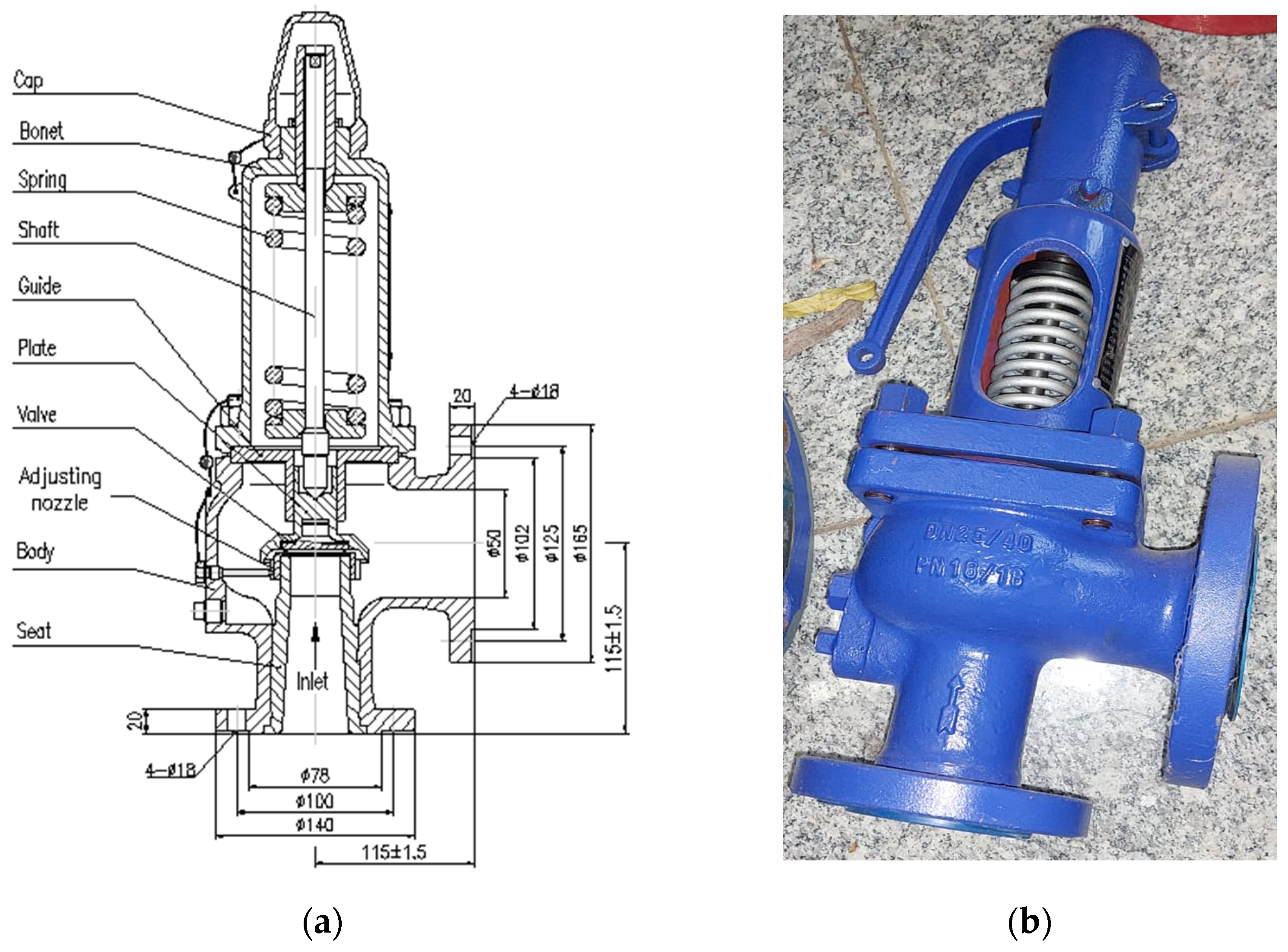
- Pressure monitoring: safety valves are designed to monitor the pressure inside a vessel or system. As the pressure rises, it is compared against the valve’s set point for different conditions.
- Spring mechanism: most safety valves employ a spring-loaded mechanism. The spring exerts a force that keeps the valve closed under normal operating conditions.
- Set pressure: When the internal pressure exceeds a predetermined “set pressure”, it overcomes the force exerted by the spring.
- Opening Mechanism: once the set pressure is reached, the valve opens, allowing excess fluid (gas or liquid) to escape. This release of pressure prevents the system from reaching dangerous levels.
- Full lift: as the internal pressure increases further, the valve will fully open, allowing maximum flow to disperse the excess pressure efficiently.
- Closing mechanism: once the pressure drops back to a safe level (below the set pressure), the spring closes the valve again, sealing the system and restoring its normal operating conditions.
- Types of safety valves: there are different types of safety valves based on their application, such as pop-off valves, balanced bellows valves, and pilot-operated valves, each having specific features to suit various system requirements.
- Regular testing: safety valves should be regularly tested and maintained to ensure reliability and proper functioning. Table 4 provides a clear and organized overview of the different types of safety valves, outlining their working principles, key components, and common applications [18,22,28,52,59,60,61,62,63].
5.2. Pressure Settings and Valve Response Under Different Conditions
5.3. Materials Used for Valve Components Based on Application
6. Testing and Maintenance
- (a)
- Set pressure test:
- ■
- Purpose: verifies that the safety valve opens at the specified set pressure;
- ■
- Standard: ASME Boiler and Pressure Vessel Code (BPVC) Section I or VIII;
- ■
- Reference: ASME PTC 25 for testing methods;
- (b)
- Leakage test:
- ■
- Purpose: ensures the valve does not leak when closed;
- ■
- Standard: API 527 (for blow-off and seat leakage tests);
- ■
- Reference: ISO 5208 (Industrial valves—Pressure testing of valves) for methods;
- (c)
- Capacity test:
- ■
- Purpose: determines whether the safety valve can discharge the required flow rate;
- ■
- Standard: ASME PTC 25 or API 520/521;
- ■
- Reference: ASME BPVC Section I for setting capacity testing procedures;
- (d)
- Re-seating test:
- ■
- Purpose: confirms that the valve properly closes after venting;
- ■
- Standard: ASME BPVC Section I and VIII;
- ■
- Reference: API 527 for guidelines on reseating tests;
- (e)
- Functional test:
- ■
- Purpose: ensures the valve operates as intended under specified conditions;
- ■
- Standard: API 526 or ASME BPVC;
- ■
- Reference: ISO 4126 (safety devices for protection against excessive pressure);
- (f)
- Cycle test:
- ■
- Purpose: assesses the durability and reliability of the safety valve through repeated cycles;
- ■
- Standard: ASME BPVC Section I or VIII;
- ■
- Reference: API 526 for testing protocols;
- (g)
- Temperature test:
- ■
- Purpose: checks valve performance at specified temperature ranges;
- ■
- Standard: ASTM E1952 (standard guide for the testing of pressure relief valves);
- ■
- Reference: specific temperature ratings can reference ASME fittings or valve temperature classes;
- (h)
- Vibration test:
- ■
- Purpose: evaluates valve performance under vibrational conditions typical in the operating environment;
- ■
- Standard: ISO 10816 (mechanical vibration—evaluation of machine vibration by measurements on non-rotating parts);
- ■
- Reference: API 610 for pumps may provide context for dynamic conditions, applicable to safety valves on pumps;
- (i)
- Visual inspection:
- ■
- Purpose: identifies any visible signs of wear, corrosion, or damage;
- ■
- Standard: ASME B31.3 (Process Piping)—includes inspection requirements;
- ■
- Reference: NACE RP0188 for corrosion assessment;
- (j)
- Documentation and traceability:
- ■
- Purpose: maintains records of pressure tests, repairs, and maintenance history;
- ■
- Standard: ISO 9001 (Quality Management Systems);
- ■
- Reference: API Spec Q1 (Specification for Quality Management System Requirements);
- (k)
- Calibration check:
- ■
- Purpose: verifies that the pressure settings and indications are accurate;
- ■
- Standard: ISO 17025 (general requirements for the competence of testing and calibration laboratories);
- ■
- Reference: ASME PTC 19.1 (Test Codes);
- (l)
- Dynamic response test:
- ■
- Purpose: evaluates how quickly and effectively the valve reacts to system pressure changes;
- ■
- Standard: IEC 61508 (functional safety of electrical/electronic/programmable electronic safety-related systems) for controlled systems;
- ■
- Reference: API 520 for guidelines.
- ■
- Routine inspections. Frequency—at least annually or according to the manufacturer’s recommendations and specific regulations applicable to the industry. Activities—visual inspection for signs of damage, wear, or corrosion. Check for proper valve identification and labeling. Inspect for leaks or signs of pressure loss around the valve. Standards/references—ASME Boiler and Pressure Vessel Code (BPVC) Section I for boilers and Section VIII for pressure vessels. API Recommended Practice 576 for inspection of pressure-relief devices;
- ■
- Operational testing. Frequency—annually or more frequently as required by specific applications or regulatory mandates. Activities—conduct a set pressure test to verify that the valve opens at specified pressure settings. Perform a leakage test to ensure the valve properly seals in the closed position. Operational tests to ensure the valve functions correctly under various conditions. Standards/references—API 526 for steam relief valves. ASME PTC 25 for performance testing of pressure relief devices;
- ■
- Calibration. Frequency—every 3 to 5 years or according to specific service demands and conditions. Activities—calibrate the valve’s set pressure using calibrated test equipment. Document the calibration process and results in maintenance records. Standards/references—ISO 17025 for calibration and testing laboratory standards. ASME PTC calibration guidelines;
- ■
- Maintenance and repairs. Frequency—as required based on inspection or testing findings. Activities—repairs to seals, gaskets, or any damaged components should be performed as needed. For valves that have been removed for maintenance, perform checks for corrosion damage or wear. Reassemble and conduct functional checks after repairs. Standards/references—API 527 for repair procedures and guidelines for pressure relief devices. Manufacturer guidelines for specific maintenance practices;
- ■
- Documentation. Frequency—ongoing, with records updated after each maintenance activity. Activities—maintain records of inspections, tests, repairs, and calibrations. Document any changes made to the valve settings or configurations. Standards/references—ISO 9001 for maintaining quality management systems and documentation practices. API Recommended Practice 580 for risk-based inspection and management of equipment;
- ■
- Replacement. Frequency—as necessary or based on performance and age of the valve. Activities—evaluate the performance history and condition; if the valve routinely fails tests or shows excessive wear, consider replacement. Follow manufacturer guidelines for selecting and installing replacement valves. Standards/references—ASME BPVC for guidelines regarding the retirement of equipment. Industry best practices for the disposal of old valves and installation of new devices.
7. Technological Advancements in Safety Valves
7.1. Recent Innovations and Smart Safety Valves
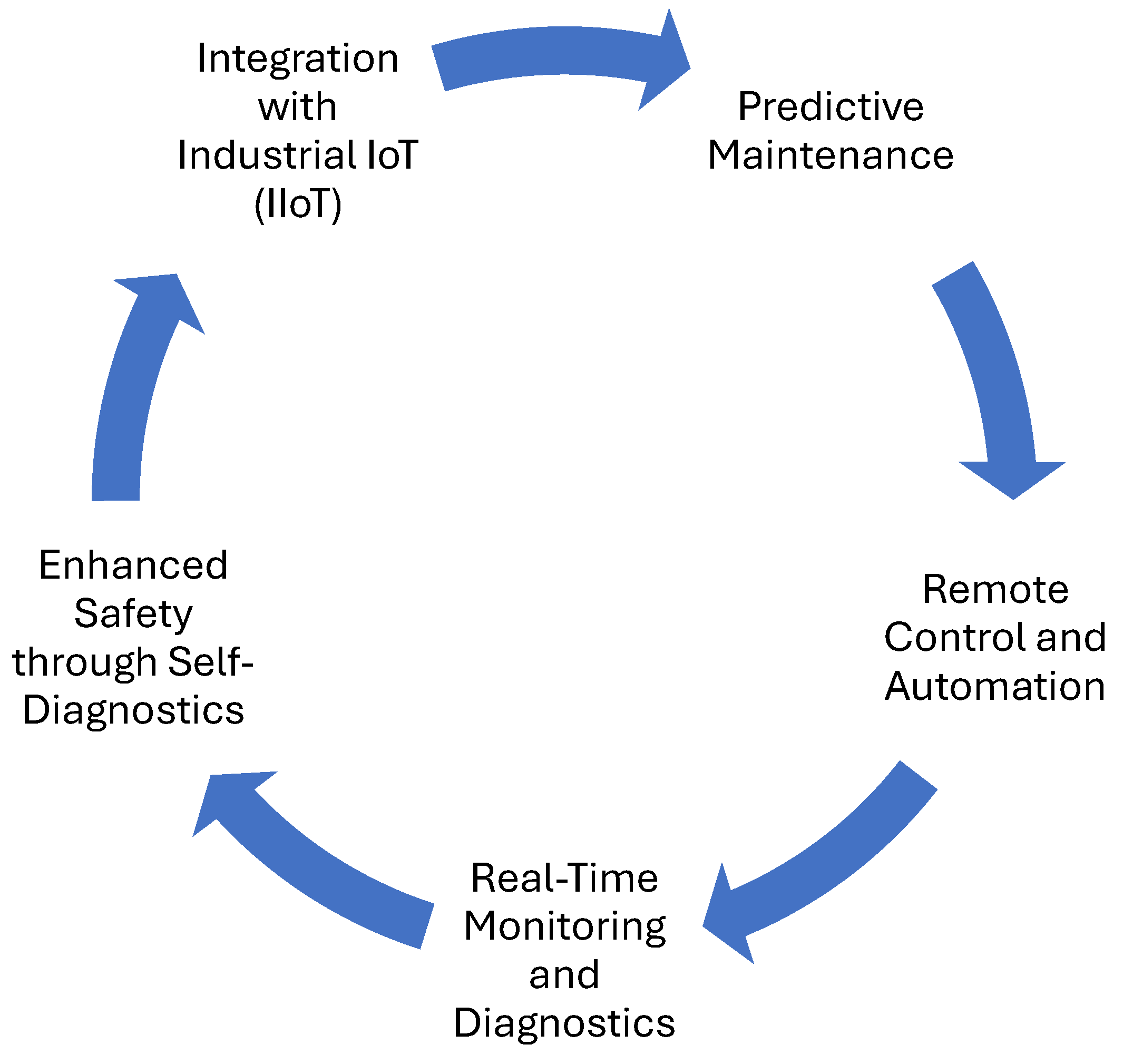
- A.
- Real-Time Monitoring and Diagnostics
- B.
- Predictive Maintenance
- C.
- Remote Control and Automation
- D.
- Enhanced Safety through Self-Diagnostics
- E.
- Integration with Industrial IoT (IIoT)
- F.
- Application Areas
- ✓
- Oil and gas industry: smart valves enhance safety in high-pressure environments, preventing leaks [78] and blowouts;
- ✓
- Chemical processing: they monitor toxic or corrosive materials, ensuring safe containment and handling;
- ✓
- Water treatment plants: smart valves help regulate water pressure and flow, optimizing resource usage;
- ✓
- Manufacturing: they support automation and quality control, ensuring precise control over production processes.
7.2. Technological Innovations and Industrial Impacts
7.3. Practical Impact of Safety Valves in Various Industries
7.4. Future Research Directions Associated with Safety Valves
- ✓
- Material innovations: investigate the development and application of advanced materials that can withstand extreme temperatures and corrosive environments, enhancing the longevity and reliability of safety valves;
- ✓
- Enhanced pressure-release mechanisms: explore innovative designs for pressure-release mechanisms that can improve response times and accuracy in high-stress situations, thereby increasing overall safety;
- ✓
- Integration of fail-safe features: study the implementation of fail-safe designs that ensure safety valves can still operate effectively even in the event of a primary system failure;
- ✓
- Agile manufacturing practices: analyze how agile manufacturing methodologies can improve the production efficiency and customization of safety valves to meet evolving industry needs;
- ✓
- Digital solutions and automation: research the impact of automation technologies and digital tools, such as IoT sensors, on monitoring safety valves’ performance, facilitating real-time data analysis, and optimizing operational efficiency;
- ✓
- Simulation and modeling advances: develop advanced computational fluid dynamics (CFDs) and modeling techniques to better predict the behavior of safety valves under varied operational conditions, enabling improved designs;
- ✓
- Predictive maintenance techniques: investigate predictive maintenance methodologies that leverage data analytics and machine learning to forecast potential failures and minimize downtime in valve operations;
- ✓
- Environmental impact assessments: conduct research into the environmental effects of safety valve materials and operations, aiming to enhance sustainability in manufacturing and product design;
- ✓
- Integration of smart technologies: explore the integration of smart technologies, such as machine learning algorithms, for adaptive control of safety valves in response to changing operational parameters;
- ✓
- Standardization of testing protocols: advocate for the development and standardization of testing protocols across manufacturers to ensure consistency in safety valve performance evaluation;
- ✓
- User training and awareness programs: develop training programs that educate users and maintenance personnel on emerging technologies and best practices for safety valve management;
- ✓
- Market trends and user needs: research market trends to align safety valve development with user needs and regulatory requirements, ensuring that innovations effectively address current industry challenges.
8. Finite Element Method and Experimental Analysis in Relief Valves Working Process
9. Conclusions
Author Contributions
Funding
Data Availability Statement
Conflicts of Interest
References
- Yuan, G.; Wang, Y.; Fang, Y.; Ma, R.; Ning, K.; Tang, Y. High-Temperature and Pressure Downhole Safety Valve Performance Envelope Curve Study. Processes 2023, 11, 2525. [Google Scholar] [CrossRef]
- Bhowmik, P.K.; Sabharwall, P. Sizing and Selection of Pressure Relief Valves for High-Pressure Thermal–Hydraulic Systems. Processes 2023, 12, 21. [Google Scholar] [CrossRef]
- Darby, R. The Dynamic Response of Pressure Relief Valves in Vapor or Gas Service, Part I: Mathematical Model. J. Loss Prev. Process Ind. 2013, 26, 1262–1268. [Google Scholar] [CrossRef]
- Hős, C.J.; Champneys, A.R.; Paul, K.; McNeely, M. Dynamic Behaviour of Direct Spring Loaded Pressure Relief Valves Connected to Inlet Piping: IV Review and Recommendations. J. Loss Prev. Process Ind. 2017, 48, 270–288. [Google Scholar] [CrossRef][Green Version]
- Makaryants, G.M. Fatigue Failure Mechanisms of a Pressure Relief Valve. J. Loss Prev. Process Ind. 2017, 48, 1–13. [Google Scholar] [CrossRef]
- Oh, K.-S.; Jeong, E.; Shim, W.S.; Baek, J.-B. The Effectiveness of Pressure Safety Valves in Chemical Supply Systems to Prevent Fire, Explosion, and Overpressure in the Korean Semiconductor Industry. Fire 2023, 6, 344. [Google Scholar] [CrossRef]
- Xing, K.; Cheng, J.; Wan, Z.; Sun, X.; Yan, W.; Lv, J.; Xue, M. Extraction and Application of Hydraulic Support Safety Valve Characteristic Parameters Based on Roof Pressure Data. Sensors 2023, 23, 8853. [Google Scholar] [CrossRef]
- Cană, P.; Ripeanu, R.G.; Pătîrnac, I.; Diniță, A.; Tănase, M. Investigating the Impact of Operating Conditions on Relief Pressure Valve Flow through CFD and Statistical Analysis. Processes 2023, 11, 3396. [Google Scholar] [CrossRef]
- Bazsó, C.; Hős, C.J. An Experimental Study on the Stability of a Direct Spring Loaded Poppet Relief Valve. J. Fluids Struct. 2013, 42, 456–465. [Google Scholar] [CrossRef]
- Hős, C.J.; Champneys, A.R.; Paul, K.; McNeely, M. Dynamic Behavior of Direct Spring Loaded Pressure Relief Valves in Gas Service: Model Development, Measurements and Instability Mechanisms. J. Loss Prev. Process Ind. 2014, 31, 70–81. [Google Scholar] [CrossRef]
- Prescott, S.L.; Ulanicki, B. Dynamic Modeling of Pressure Reducing Valves. J. Hydraul. Eng. 2003, 129, 804–812. [Google Scholar] [CrossRef]
- Tasca, E.; Besharat, M.; Ramos, H.M.; Luvizotto, E.; Karney, B. Exploring the Sensitivity of the Transient Response Following Power Failure to Air Valve and Pipeline Characteristics. Water 2023, 15, 3476. [Google Scholar] [CrossRef]
- Dossena, V.; Marinoni, F.; Bassi, F.; Franchina, N.; Savini, M. Numerical and Experimental Investigation on the Performance of Safety Valves Operating with Different Gases. Int. J. Press. Vessel. Pip. 2013, 104, 21–29. [Google Scholar] [CrossRef]
- Andreasen, A.; Borroni, F.; Zan Nieto, M.; Stegelmann, C.; Nielsen, R.P. On the Adequacy of API 521 Relief-Valve Sizing Method for Gas-Filled Pressure Vessels Exposed to Fire. Safety 2018, 4, 11. [Google Scholar] [CrossRef]
- Zaharinov, V.; Malakov, I.; Cankaya, O.; Dimitrov, L. Multi-Criteria Choosing of Material for Manufacturing a Pressure Relief Valve. In Proceedings of the International Conference on Electronics, Engineering Physics and Earth Science (EEPES 2024), Kavala, Greece, 19–21 June 2024; MDPI: Basel, Switzerland, 2024; p. 51. [Google Scholar]
- Ferrarese, G.; Fontana, N.; Gioffreda, S.; Malavasi, S.; Marini, G. Pressure Reducing Valve Setting Performance in a Variable Demand Water Distribution Network. In Proceedings of the EWaS5 International Conference: Water Security and Safety Management: Emerging Threats or New Challenges? Moving from Therapy and Restoration to Prognosis and Prevention, Naples, Italy, 12–15 July 2022; MDPI: Basel, Switzerland, 2022; p. 61. [Google Scholar]
- Griffin, D.; Kelly, J.; Bowie, G.; Hunt, D.; Fletcher, A.; Reed, G.; Hugill, P. Relief Valve Stress and Fatigue Study Using Non-Linear Analysis. In Proceedings of the Volume 1: Codes and Standards, American Society of Mechanical Engineers, Toronto, ON, Canada, 15–19 July 2012; pp. 413–422. [Google Scholar]
- Cremers, J.; Friedel, L.; Pallaks, B. Validated Sizing Rule against Chatter of Relief Valves during Gas Service. J. Loss Prev. Process Ind. 2001, 14, 261–267. [Google Scholar] [CrossRef]
- Darby, R.; Aldeeb, A.A. The Dynamic Response of Pressure Relief Valves in Vapor or Gas Service. Part III: Model Validation. J. Loss Prev. Process Ind. 2014, 31, 133–141. [Google Scholar] [CrossRef]
- Valdés, J.R.; Miana, M.J.; Núñez, J.L.; Pütz, T. Reduced Order Model for Estimation of Fluid Flow and Flow Forces in Hydraulic Proportional Valves. Energy Convers. Manag. 2008, 49, 1517–1529. [Google Scholar] [CrossRef]
- Schmidt, C.; Schmidt, J.; Denecke, J.; Seewig, J. Application of Smart Overpressure Protection Devices to Batch and Semi-Batch Processes: The Zero-Emission Mode. Process Saf. Environ. Prot. 2024, 181, 535–546. [Google Scholar] [CrossRef]
- Schmidt, C.; Schmidt, J.; Denecke, J.; Seewig, J. Advanced Overpressure Protection: A Concept for Smart Controlled Safety Pressure Relief Systems. Process Saf. Environ. Prot. 2024, 190, 506–516. [Google Scholar] [CrossRef]
- Filo, G.; Domagała, M.; Lempa, P.; Fabiś-Domagała, J.; Kwiatkowski, D.; Momeni, H. Quality Improvement of a Safety Valve with the Use of Numerical and Experimental Studies. Qual. Prod. Improv. QPI 2019, 1, 378–385. [Google Scholar] [CrossRef]
- Li, Q.; Jiang, J.; Yang, B.; Chen, Z.; Yang, L.; Jin, M.; Xia, X.; Xie, X. Research on Corrosion Behavior of Safety Valve Spring in Liquid Chlorine Tank. J. Phys. Conf. Ser. 2024, 2713, 012052. [Google Scholar] [CrossRef]
- Jha, A.K.; Sreekumar, K. Intergranular Corrosion of a Stud Used in Safety Relief Valve. Eng. Fail. Anal. 2009, 16, 1379–1386. [Google Scholar] [CrossRef]
- Publisher, V.W.A. Coatings for Valves and Actuators. Available online: https://valve-world-americas.com/coatings-for-valves-and-actuators/ (accessed on 1 November 2024).
- Kimray. How Valve Coating Can Limit Corrosion and Erosion in Control Valves & Liquid Level Floats. Available online: https://kimray.com/training/how-valve-coating-can-limit-corrosion-and-erosion-control-valves-liquid-level-floats (accessed on 1 November 2024).
- Valve Protection Coatings: Improving Safety, Reliability and Efficiency. Available online: https://www.surfacetechnology.co.uk/2017blogvalve-coating-services/ (accessed on 1 November 2024).
- Valve Special Paint & Coatings—Efsvalves. Available online: https://efsvalves.com/en/special-paint-coatings/ (accessed on 1 November 2024).
- Fuller, J.A. The History of Safety Valves Leading to the Development of British Standards for Safety Valves. Proc. Inst. Mech. Eng. Part A Power Process Eng. 1985, 199, 107–116. [Google Scholar] [CrossRef]
- Greenwood, A. Pressure Relief Valve Engineering Handbook; Emerson: St. Louis, MI, USA, 2012. [Google Scholar]
- Introduction to the Development History of Safety Valves. Available online: https://www.china-flow.com/info/introduction-to-the-development-history-of-saf-35511713.html (accessed on 23 September 2024).
- Safety Valve. Available online: https://collection.sciencemuseumgroup.org.uk/objects/co206318/safety-valve (accessed on 23 September 2024).
- Safety Valve Codes & Standards. Available online: https://www.flowstarvalveshop.com/pages/safety-valve-codes-standards (accessed on 23 September 2024).
- PED 97/23/EC; Pressure Equipment Directive-Classifies Pressure Equipment into Four Categories (I, II, III, IV). European Commission: Brussels, Belgium, 2016.
- EN ISO 4126; Safety Devices for Protection against Excessive Pressure. International Organization for Standardization: Geneva, Switzerland, 2024.
- API 520; Sizing Selection and Installation of Pressure Relieving Devices in Refineries, Part 1 Design, Part 2 Installation. American Petroleum Institute (API): Washington, DC, USA, 2015.
- API 521; Guide for Pressure Relieving and Depressurizing Systems. American Petroleum Institute (API): Washington, DC, USA, 2014.
- API 526; Flanged- Steel Pressure Relief Valves. American Petroleum Institute (API): Washington, DC, USA, 2002.
- API 527; Seat Tightness of Pressure Relief Valves. American Petroleum Institute (API): Washington, DC, USA, 2014.
- KS B 6216; Spring-Loaded Safety Valves for Steam Boilers and Pressure Vessels. Korean Agency for Technology and Standards: Maengdong-myeon, Republic of Korea, 1995.
- JIS B 8210; Steam Boilers and Pressure Vessels-Spring-Loaded Safety Valves. Japanese Standards Association: Tokyo, Japan, 2017.
- SAA AS 1271; Safety Valves, Other Valves, Liquid-Level Gauges and Other Fittings for Boilers and Unfired Pressure Vessels. Australian Standard: Sydney, Australia, 2003.
- Hellemans, M. The Safety Relief Valve Handbook Design and Use of Process Safety Valves to ASME and International Codes and Standards; Elsevier Linacre House: Amsterdam, The Netherlands, 2009; ISBN 978-1-85617-712-2. [Google Scholar]
- Schickhofer, L.; Antonopoulos, C.G. Nonlinear Dynamics and Onset of Chaos in a Physical Model of a Damper Pressure Relief Valve. Commun. Nonlinear Sci. Numer. Simul. 2023, 125, 107378. [Google Scholar] [CrossRef]
- A Deep Dive into Automated Industrial Valve Systems. Available online: https://www.plantautomation-technology.com/articles/smart-valves-a-deep-dive-into-automated-industrial-valve-systems (accessed on 6 December 2024).
- Schmidt, C.; Schmidt, J.; Denecke, J.; Seewig, J.; Henning, C. Application of Smart Overpressure Protection Devices to Batch and Semi-Batch Processes: The Smart Relief Mode. Process Saf. Environ. Prot. 2024, 188, 439–452. [Google Scholar] [CrossRef]
- Unlocking Efficiency: 6 Ways Smart Valve Automation Is Revolutionizing Industrial Operations. Available online: https://relevantsolutions.com/about-us/news/blog/relevant-solutions-blog/2023/08/25/unlocking-efficiency-6-ways-smart-valve-automation-is-revolutionizing-industrial-operations (accessed on 6 December 2024).
- Ji, X.; Ren, Y.; Tang, H.; Shi, C.; Xiang, J. An Intelligent Fault Diagnosis Approach Based on Dempster-Shafer Theory for Hydraulic Valves. Measurement 2020, 165, 108129. [Google Scholar] [CrossRef]
- Erdődi, I.; Hős, C. Prediction of Quarter-Wave Instability in Direct Spring Operated Pressure Relief Valves with Upstream Piping by Means of CFD and Reduced Order Modelling. J. Fluids Struct. 2017, 73, 37–52. [Google Scholar] [CrossRef]
- Zhang, J.; Yang, L.; Dempster, W.; Yu, X.; Jia, J.; Tu, S.-T. Prediction of Blowdown of a Pressure Relief Valve Using Response Surface Methodology and CFD Techniques. Appl. Therm. Eng. 2018, 133, 713–726. [Google Scholar] [CrossRef]
- Beune, A.; Kuerten, J.G.M.; Schmidt, J. Numerical Calculation and Experimental Validation of Safety Valve Flows at Pressures up to 600 Bar. AIChE J. 2011, 57, 3285–3298. [Google Scholar] [CrossRef]
- Soy, H.; Toy, İ. Design and Implementation of Smart Pressure Sensor for Automotive Applications. Measurement 2021, 176, 109184. [Google Scholar] [CrossRef]
- Spirax Sarco. Types of Safety Valve. Available online: https://www.spiraxsarco.com/learn-about-steam/safety-valves/types-of-safety-valve?sc_lang=en-GB (accessed on 4 December 2024).
- Reid, M. The Piper Alpha Disaster: A Personal Perspective with Transferrable Lessons on the Long-Term Moral Impact of Safety Failures. ACS Chem. Health Saf. 2020, 27, 88–95. [Google Scholar] [CrossRef]
- Sharif, A. Case Study for Bhopal Gas Tragedy; P P Savani University: Kosamba, India, 2020. [Google Scholar] [CrossRef]
- Schickhofer, L.; Wimmer, J. Fluid–Structure Interaction and Dynamic Stability of Shock Absorber Check Valves. J. Fluids Struct. 2022, 110, 103536. [Google Scholar] [CrossRef]
- ASME BPVC. Boiler and Pressure Vessel Code (BPVC); Section I & VIII; American Society of Mechanical Engineers (ASME): New York, NY, USA, 2022. [Google Scholar]
- DIN 3320-1:1984-09; Safety Valves; Safety Shut-off Valves; Definitions, Sizing, Marking. Deutsches Institut für Normung (DIN): Berlin, Germany, 1984.
- ISO 4126-10; Safety Devices for Protection Against Excessive Pressure—Part 10: Sizing of Safety Valves for Gas/Liquid Two-Phase Flow. DIN Deutsches Institut fürNormung e.V. Beuth Cerlag GmbH: Berlin, Germany, 2010.
- Yin, H.; Xu, H.; Fan, W.; Sun, F. Fault Diagnosis of Pressure Relief Valve Based on Improved Deep Residual Shrinking Network. Measurement 2024, 224, 113752. [Google Scholar] [CrossRef]
- Patel, S.; Sutaria, S.; Daga, R.; Shah, M.; Prajapati, M. A Systematic Study on Complementary Metal-Oxide Semiconductor Technology (CMOS) and Internet of Things (IOT) for Radioactive Leakage Detection in Nuclear Plant. Nucl. Anal. 2023, 2, 100080. [Google Scholar] [CrossRef]
- Dasgupta, K.; Karmakar, R. Modelling and Dynamics of Single-Stage Pressure Relief Valve with Directional Damping. Simul. Model. Pract. Theory 2002, 10, 51–67. [Google Scholar] [CrossRef]
- Production Sites. Available online: https://chemicals.basf.com/basf/chemicals/global/en/Petrochemicals/alkylene-oxides-and-glycols/production-sites (accessed on 6 December 2024).
- Safety Valves Market Size & Share, Forecast Report 2024-2032. Available online: https://www.gminsights.com/industry-analysis/safety-valves-market (accessed on 6 December 2024).
- CSB. Chevron Richmond Refinery Fire. Available online: https://www.csb.gov/chevron-richmond-refinery-fire/ (accessed on 6 November 2024).
- Hyundai Heavy Fire Accident Kills Two—Offshore Energy. Available online: https://www.offshore-energy.biz/hyundai-heavy-fire-accident-kills-two/ (accessed on 6 November 2024).
- Britannica. Deepwater Horizon Oil Spill. Summary, Effects, Cause, Clean Up, & Facts. Available online: https://www.britannica.com/event/Deepwater-Horizon-oil-spill (accessed on 6 November 2024).
- CSB. ExxonMobil Torrance Refinery Explosion. Available online: https://www.csb.gov/exxonmobil-torrance-refinery-explosion-/ (accessed on 6 November 2024).
- Chung, Y.; Jeon, B.; Bae, K.; Park, H. Validation with the MARS and TASS/SMR Codes Based on Experimental Results of a Pressurizer Safety Valve Line Break at the SMART-ITL Facility. Ann. Nucl. Energy 2020, 141, 107344. [Google Scholar] [CrossRef]
- Schmidt, J.; Stoessel, F. Sicherheits- und Rückhalteeinrichtungen für Mehrzweckanlagen. Teil 1—Sicherheitskonzept und Schutzeinrichtungen. Chem. Ing. Tech. 2011, 83, 1173–1187. [Google Scholar] [CrossRef]
- Ma, D.; Liu, Z.; Gao, Q.; Huang, T. Fault Diagnosis of a Solenoid Valve Based on Multi-Feature Fusion. Appl. Sci. 2022, 12, 5904. [Google Scholar] [CrossRef]
- Fu, Y.; Cai, L.; Zheng, G. Failure Diagnosis of Electro-Hydraulic Servo Valve Based on SA-PSO-SVM. J Mech Sci Technol 2022, 36, 5971–5976. [Google Scholar] [CrossRef]
- Taqvi, S.A.A.; Zabiri, H.; Uddin, F.; Naqvi, M.; Tufa, L.D.; Kazmi, M.; Rubab, S.; Naqvi, S.R.; Maulud, A.S. Simultaneous Fault Diagnosis Based on Multiple Kernel Support Vector Machine in Nonlinear Dynamic Distillation Column. Energy Sci. Eng. 2022, 10, 814–839. [Google Scholar] [CrossRef]
- Sim, H.Y.; Ramli, R.; Saifizul, A.; Soong, M.F. Detection and Estimation of Valve Leakage Losses in Reciprocating Compressor Using Acoustic Emission Technique. Measurement 2020, 152, 107315. [Google Scholar] [CrossRef]
- Sun, F.; Xu, H.; Zhao, Y.; Zhang, Y. Data-Driven Fault Diagnosis of Control Valve with Missing Data Based on Modeling and Deep Residual Shrinkage Network. J. Zhejiang Univ. Sci. A 2022, 23, 303–313. [Google Scholar] [CrossRef]
- Li, Z.; Wei, W.; Hu, K.; Chen, H.; Wang, Y.; Liu, Q.; Liu, S. Simulated Annealing Wrapped Generic Ensemble Fault Diagnostic Strategy for VRF System. Energy Build. 2020, 224, 110281. [Google Scholar] [CrossRef]
- Cesani, D.; Mazzoleni, M.; Previdi, F. Leak Detection for Household Pipelines Based on a Smart Valve with Single Pressure and Flow Sensors. IFAC-Pap. 2024, 58, 408–413. [Google Scholar] [CrossRef]
- Thames Water—The UK’s Largest Water and Wastewater Company. Available online: https://www.thameswater.co.uk/ (accessed on 6 December 2024).
- Fevisa—Industrial Valves. Available online: https://valtronics.ae/ (accessed on 6 December 2024).
- Ju, J.; Xie, Y.; Han, J.; Wang, Y.; Wang, H. Performance Improvement of the Self-Power Control Valve Based on Digital Twin Technology. Energy 2024, 300, 131607. [Google Scholar] [CrossRef]
- Sciatti, F.; Tamburrano, P.; Distaso, E.; Amirante, R. Digital Hydraulic Valves: Advancements in Research. Heliyon 2024, 10, e27264. [Google Scholar] [CrossRef]
- Jian, J.; Shuai, Z.-J.; Yu, T.; Wang, X.; Ren, K.-X.; Dong, L.-Y.; Li, W.-Y.; Jiang, C.-X. Research on Stability Characteristics of a Spring-Loaded Valve with Two Outlets. Ann. Nucl. Energy 2022, 175, 109250. [Google Scholar] [CrossRef]
- Scuro, N.L.; Angelo, E.; Angelo, G.; Andrade, D.A. A CFD Analysis of the Flow Dynamics of a Directly-Operated Safety Relief Valve. Nucl. Eng. Des. 2018, 328, 321–332. [Google Scholar] [CrossRef]
- Song, X.; Cui, L.; Cao, M.; Cao, W.; Park, Y.; Dempster, W.M. A CFD Analysis of the Dynamics of a Direct-Operated Safety Relief Valve Mounted on a Pressure Vessel. Energy Convers. Manag. 2014, 81, 407–419. [Google Scholar] [CrossRef]
- Li, Q.; Zong, C.; Liu, F.; Zhang, A.; Xue, T.; Yu, X.; Song, X. Numerical and Experimental Analysis of Fluid Force for Nuclear Valve. Int. J. Mech. Sci. 2023, 241, 107939. [Google Scholar] [CrossRef]
- Kim, H.-D.; Lee, J.-H.; Park, K.-A.; Setoguchi, T.; Matsuo, S. A Study of the Gas Flow through a LNG Safety Valve. J. Therm. Sci. 2006, 15, 355–360. [Google Scholar] [CrossRef]
- Moncalvo, D.; Friedel, L.; Jörgensen, B.; Höhne, T. Sizing of Safety Valves Using ANSYS CFX-Flo. Chem Eng Amp; Technol 2009, 32, 247–251. [Google Scholar] [CrossRef]
- Schmidt, J.; Peschel, W.; Beune, A. Experimental and Theoretical Studies on High Pressure Safety Valves: Sizing and Design Supported by Numerical Calculations (CFD). Chem Eng Amp; Technol 2009, 32, 252–262. [Google Scholar] [CrossRef]
- Keszthelyi, G.; Schmidt, J.; Denecke, J. Evaluation of One-Dimensional Models to Predict Chatter in Spring-Loaded Pressure Relief Valves for Gas Service. Process Saf. Environ. Prot. 2024, 182, 1097–1109. [Google Scholar] [CrossRef]
- Chen, X.; Lan, C.; Zheng, H.; Li, W.; Zhao, C.; Dang, W. Simulating Error-Opening of Pressure Relief Valves of a Station on a Continuous Undulating Oil Pipeline with Large Elevation Difference. Energy Eng. 2022, 119, 1439–1452. [Google Scholar] [CrossRef]
- Jia, T.C.; Wu, Z.Y.; Wang, J.; Feng, R.G.; Qin, Y.J. Design and Performance Analysis of Digital Pressure Relief Valve of Water-Based Hydraulic. AMM 2013, 387, 369–373. [Google Scholar] [CrossRef]
- Song, X.G.; Wang, L.; Park, Y.C. Transient Analysis of a Spring-Loaded Pressure Safety Valve Using Computational Fluid Dynamics (CFD). J. Press. Vessel Technol. 2010, 132, 054501. [Google Scholar] [CrossRef]
- Zhang, K.Q.; Karney, B.W.; McPherson, D.L. Pressure-relief Valve Selection and Transient Pressure Control. J. AWWA 2008, 100, 62–69. [Google Scholar] [CrossRef]
- Song, X.-G.; Park, Y.-C.; Park, J.-H. Blowdown Prediction of a Conventional Pressure Relief Valve with a Simplified Dynamic Model. Math. Comput. Model. 2013, 57, 279–288. [Google Scholar] [CrossRef]
- Desai, S.; Desai, A.; Karande, V. Design and Weight Optimization of Buffer Relief Valve Using FEA with Experimental Validation. Mater. Today Proc. 2020, 27, 1466–1472. [Google Scholar] [CrossRef]
- Yang, L.; Wang, Z.; Dempster, W.; Yu, X.; Tu, S.-T. Experiments and Transient Simulation on Spring-Loaded Pressure Relief Valve under High Temperature and High Pressure Steam Conditions. J. Loss Prev. Process Ind. 2017, 45, 133–146. [Google Scholar] [CrossRef]
- Dasgupta, K.; Karmakar, R. Dynamic Analysis of Pilot Operated Pressure Relief Valve. Simul. Model. Pract. Theory 2002, 10, 35–49. [Google Scholar] [CrossRef]
- Pusztai, T.; Simenfalvi, Z. CFD Analysis on a Direct Spring-Loaded Safety Valve to Determine Flow Forces. Pollack 2021, 16, 109–113. [Google Scholar] [CrossRef]

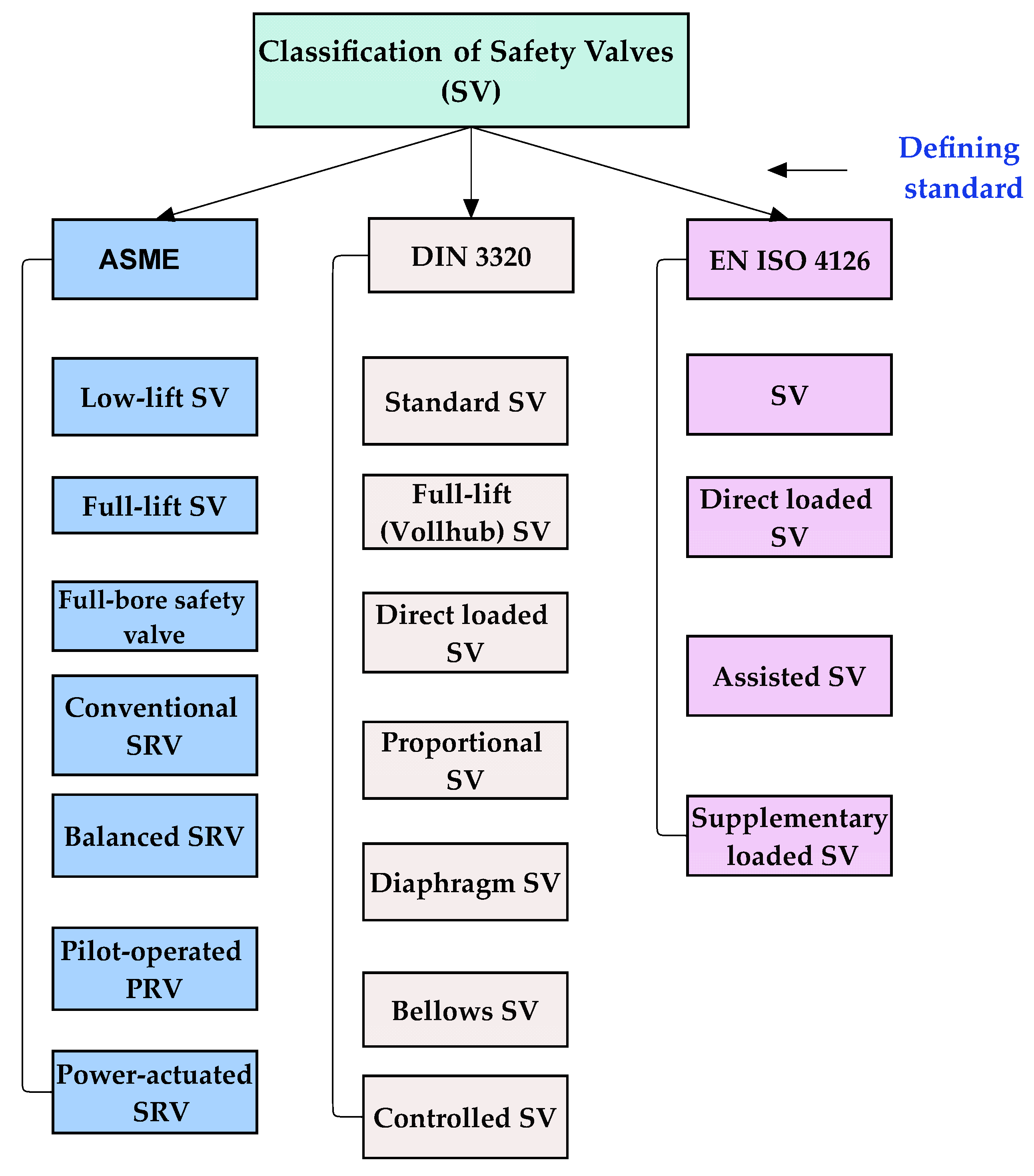


| Region/Safety Valve Standards | ||
|---|---|---|
| Europe | ||
| PED 97/23/EC—Pressure Equipment Directive—Classifies pressure equipment into four categories (I, II, III, IV) [35] | EN4126—Safety devices for protection against excessive pressure [36] | |
| USA | ||
| ASME I—Direct fired pressure vessels [37] | ASME III—Nuclear power plants [37] | ASME IV—Heating Boilers [37] |
| ASME VIII—Unfired pressure vessels [37] | ANSI/ASME PTC 25.3—Performance test codes [37] | API 520—Sizing selection and installation of pressure relieving devices in refineries, Part 1 Design, Part 2 Installation [37] |
| API 521—Guide for pressure relieving and depressurizing systems [38] | API 526—Flanged-steel pressure relief valves [39] | API 527—Seat tightness of pressure relief valves [40] |
| Others | ||
| Korea—KS B 6216 Spring-loaded safety valves for steam boilers and pressure vessels [41] | Japan—JIS B 8210—Steam boilers and pressure vessels—spring-loaded safety valves [42] | |
| Australia—SAA AS 1271—Safety valves, other valves, liquid-level gauges and other fittings for boilers and unfired pressure vessels [43] | International—ISO 4126—Safety valves—general requirements [36] | |
| Set Pressure/Tolerance | |||
|---|---|---|---|
| Pressure specification—ASME I | Pressure specification—ASME VIII | ||
| 2 psi (0.14 bar); 70 psi (4.76 bar) | 3% above 70 psi (4.76 bar) | 2 psi (0.14 bar); 70 psi (4.76 bar); 3% above 70 psi (4.76 bar) | |
| 10 psi (0.68 bar); between 300 psi (20.4 bar); and 1000 psi (68.03 bar) | 1% above 1000 psi (68.03 bar) | ||
| Blowdown | |||
| ASME I | ASME VIII | PED | |
| <67 psi (4.62 bar) = 4 psi ≥67 psi (4.62 bar) and ≤250 psi (17.24 bar) = 6% >250 psi (17.24 bar) and <375 psi (25.86 bar) = 15 psi 4% above 375 psi (25.86 bar) | Gas/vapor: 7–10% Liquid: No requirement | No code requirement but 7–10% is the industry standard | |
| Overpressure | |||
| ASME I | ASME VIII | PED | |
| 2 psi (0.14 bar) or 3%, whichever is greater | 3 psi (0.2 bar) or 10%, whichever is greater Multiple valves: 16% Fire case: 21% | 10% above accumulation | |
| Safety Valve Type | Characteristics |
|---|---|
| ASME | |
| ASME I valve | It opens within 3% overpressure and closes within 4%. |
| ASME VIII valve | It opens within 10% overpressure and closes within 7%. |
| Low-lift safety valve | The discharge area of the valve is determined by the current position of the disc. |
| Full-lift safety valve | The position of the disc does not directly determine the discharge area. |
| Full-bore safety valve | Without bore protrusions, it lifts to make the minimum area at or below the seat the controlling orifice. |
| Conventional safety relief valve | The spring housing is vented to the discharge side, meaning changes in backpressure directly impact the valve’s operational characteristics. |
| Balanced safety relief valve | It includes a mechanism to minimize the impact of backpressure on its operational characteristics. |
| Pilot-operated pressure relief valve | The primary relieving device is integrated with and controlled by a self-actuated auxiliary pressure relief device. |
| Power-actuated safety relief valve | The primary relieving device is combined with and controlled by an externally powered device. |
| DIN 3320 | |
| Standard safety valve (SV) | Upon opening, achieves the lift required to discharge the mass flow rate with a pressure rise of no more than 10%. This valve features a pop-type action and is also referred to as a high-lift valve. |
| Full-lift (Vollhub) safety valve | After starting to lift, it opens quickly to full lift within a 5% pressure rise, as limited by its design. The lift before rapid opening (proportional range) should not exceed 20%. |
| Direct loaded safety valve | The opening force beneath the valve disc is countered by a closing force, such as a spring or weight. |
| Proportional safety valve | It opens steadily in relation to pressure increases, avoiding sudden openings within a 10% lift range without a pressure rise. After opening, it reaches the necessary lift to discharge the mass flow with a pressure rise of no more than 10%. |
| Diaphragm safety valve | It uses a diaphragm to protect linear moving and rotating elements, as well as springs, from the effects of the fluid. |
| Bellows safety valve | Direct loaded safety valve. The sliding and (partially or fully) rotating elements, along with springs, are protected from fluid effects by a bellows designed to compensate for backpressure influences. |
| Controlled safety valve | Consisting of a main valve and a control device, it includes direct-acting safety valves with supplementary loading, where an additional force enhances the closing force until the set pressure is reached. |
| EN ISO 4126 | |
| Safety valve | Automatically discharges a quantity of fluid, using only the energy from the fluid itself, to prevent exceeding a predetermined safe pressure. It is designed to re-close and stop further fluid flow once normal pressure conditions are restored. The valve may exhibit either pop action (rapid opening) or open in proportion (not necessarily linear) to the pressure increase above the set point. |
| Direct loaded safety valve | the loading from fluid pressure beneath the valve disc is countered solely by a direct mechanical loading device, such as a weight, lever and weight, or spring. |
| Assisted safety valve | It can be lifted through a powered assistance mechanism at a pressure lower than the set pressure, while still meeting all safety valve requirements outlined in the standard, even if the assistance mechanism fails. |
| Supplementary loaded safety valve | It utilizes an additional force to enhance the sealing force until the pressure at the valve inlet reaches the set pressure. |
| Working Principle | Key Components | Typical Applications |
|---|---|---|
| Check Valve | ||
| Prevents backflow in a system. The valve opens when fluid flows in the desired direction and closes automatically to prevent reverse flow. | Disc, spring, seat, hinge, or lever | Water supply systems, sewage systems, pumps |
| Two-Way Valve | ||
| Controls the flow of fluid in two directions. It can switch between sources or routes within a system based on operational settings. | Actuator, valve body, stem | HVAC systems, industrial pipelines |
| Pressure Regulating Valve | ||
| Regulates downstream pressure by automatically opening or closing in response to upstream pressure changes. | Spring, diaphragm, adjustable set-point | Water distribution systems, gas distribution |
| Blow-off Valve | ||
| Automatically releases excess pressure from a system to maintain balance without manual intervention. | Actuator, set pressure adjustment mechanism | Air compressors, pneumatic systems |
| Safety Relief Valve | ||
| Combines features of relief and safety valves, opening to vent fluid when the set pressure is reached, and closes once normal pressure is restored. | Spring, disc, adjusting screw | Pressure vessels, oil and gas industries |
| Vacuum Relief Valve | ||
| Opens to allow air into a system when a vacuum condition is detected, preventing collapse of vessels or piping. | Spring, disc, intake port | Storage tanks, pipelines subjected to vacuum |
| Standard Safety Valve | ||
| Opens automatically when system pressure exceeds a set point, allowing rapid venting of fluid or gas. | Spring, disc, seat, adjustment mechanism | Boilers, pressure vessels, gas systems |
| Full Lift Safety Valve | ||
| Opens fully at the set pressure to vent large volumes of fluid quickly, typically used in high-capacity situations. | Spring, disc, full-lift mechanism | Steam boilers, large pressure vessels |
| Direct Loaded Safety Valve | ||
| Uses a direct application of pressure to overcome the spring force; the valve opens at set pressure without additional mechanisms. | Spring, disc, set lever or mechanism | High-pressure gas systems, industrial applications |
| Proportional Safety Valve | ||
| Opens in proportion to the increase in pressure, allowing controlled venting as pressure varies. | Spring, piston or diaphragm, flow control device | Process control systems, natural gas pipelines |
| Diaphragm Safety Valve | ||
| Utilizes a diaphragm to sense pressure and actuate the valve, providing good sealing and reliable performance. | Diaphragm, valve body, spring | Chemical processing, pharmaceutical industries |
| Bellows Safety Valve | ||
| Has bellows that equalize pressure on both sides of the valve disc, minimizing the effect of back pressure. | Bellows, disc, seat | High-pressure steam systems, specialized chemical processes |
| Controlled Safety Valve | ||
| Operated based on an external control signal (electrical or pneumatic) to modulate its opening and closing. | Actuator, control signals, feedback system | Automated systems, advanced manufacturing processes |
| Condition Description | Response Description |
|---|---|
| Spring-Loaded Safety Valve | |
| A pressure boiler at 620 kPa experiences a pressure surge due to heating | Valve opens within milliseconds at 827 kPa to vent steam and prevent overpressure damage |
| Relief Valve | |
| An oil processing unit at 400 kPa faces a slow pressure buildup | Relief valve opens at 482 kPa, allowing oil to escape and stabilize the system without causing sudden pressure drops |
| Pilot-Operated Safety Valve | |
| A gas pipeline at 827 kPa faces a sudden pressure spike to 1034 kPa | Pilot valve detects pressure spike and opens the main valve to vent gas rapidly, reducing pressure quickly |
| Balanced Bellows Safety Valve | |
| A steam system at 690 kPa experiences a pressure increase due to water drop | Valve opens at 690 kPa to prevent pressure fluctuations, ensuring smooth operation |
| Fusible Plug Safety Valve | |
| A refrigeration unit operates normally but experiences overheating and reaches 130 °C. | The fusible material within the plug melts at 120 °C, opening the valve and allowing excess refrigerant to escape, thereby protecting the system from potential failure due to overheating. |
| Components | Materials | Observations |
|---|---|---|
| Standard Safety Valve | ||
| Spring | Stainless steel (e.g., 302, 316), Inconel, or carbon steel | Stainless steel is preferred for corrosion resistance. |
| Disc | Stainless steel, bronze, brass, or plastic (e.g., PTFE or PVC) | Materials chosen based on fluid compatibility. |
| Seat | Machined stainless steel, bronze, or hardened carbon steel | Should provide a good sealing surface. |
| Body | Cast iron, carbon steel, or stainless steel | Selection depends on pressure rating and application. |
| Full Lift Safety Valve | ||
| Spring | Stainless steel (e.g., 316 or Inconel) | Must withstand high stress due to full lift operation. |
| Disc | Stainless steel or other alloys for high strength | High durability required due to full flow. |
| Seat | Hardened stainless steel or specialized alloys | Ensures tight sealing during operation. |
| Body | Carbon steel or forged steel | Dependent on pressure rating and environment. |
| Direct Loaded Safety Valve | ||
| Spring | Stainless steel or Inconel | High fatigue resistance. |
| Disc | Stainless steel or other high-strength materials | Must be durable. |
| Seat | Stainless steel or plastic suitable for specific media | Should resist wear and corrosion. |
| Body | Carbon steel or stainless steel | Based on pressure ranges and service conditions. |
| Proportional Safety Valve | ||
| Spring | Stainless steel or other high-grade materials | Selected for control and reliability. |
| Piston/Diaphragm | Nylon, PTFE, or rubber (e.g., EPDM, Viton) | Material depends on temperature and chemical compatibility. |
| Body | Stainless steel or brass | Chosen for strength and durability. |
| Diaphragm Safety Valve | ||
| Diaphragm | PTFE, rubber, or elastomer | Must be compatible with the fluid. |
| Spring | Stainless steel or Inconel | High strength and corrosion resistance required. |
| Body | Stainless steel or plastic | Resistant to corrosion and chemicals. |
| Bellows Safety Valve | ||
| Bellows | Stainless steel (e.g., 316) or high-nickel alloys | Must withstand pressure and thermal cycles. |
| Disc | Stainless steel or high-strength alloys | Provide reliable sealing and durability. |
| Seat | Hardened stainless steel or specialized metal | Ensures a tight seal under varying conditions. |
| Body | Carbon steel or stainless steel | Selected based on operational pressure and environment. |
| Controlled Safety Valve | ||
| Actuator | Aluminum, stainless steel, or plastic | Material choice based on application requirements. |
| Spring | Stainless steel or Inconel | Resistant to fatigue and environmental effects. |
| Body | Cast iron, carbon steel, or stainless steel | Sized for specific application needs. |
| Special Material | Applications and Notes |
|---|---|
| Special Condition: High-Temperature Environments | |
| Hastelloy, Inconel, Monel | Used for valves exposed to extreme temperatures (e.g., >400 °C). Hastelloy is known for its excellent oxidation resistance. Inconel and Monel provide high strength and corrosion resistance at elevated temperatures. |
| Special Condition: Corrosive Environments | |
| Tantalum, Zirconium, PTFE Lined | Ideal for applications involving aggressive chemicals, acids, or caustics. Tantalum and zirconium offer excellent chemical resistance, while PTFE lining provides non-stick and anti-corrosion properties. |
| Special Condition: Cryogenic Applications | |
| Austenitic Stainless Steel (e.g., 304L, 316L) | Suitable for low-temperature applications (e.g., liquefied gases) where ductility and toughness are essential at cryogenic temperatures. |
| Special Condition: Low-Pressure Applications | |
| Aluminum alloys | Used for lightweight valves in applications like air or steam systems where high strength is not as critical. |
| Special Condition: High-Wear Components | |
| Stellite, Hardened Steel | Employed in areas subject to frequent mechanical wear and erosion (e.g., valve seats, discs). Stellite is a cobalt–chromium alloy that resists wear and galling. Hardened steel provides extra toughness and wear resistance. |
| Special Condition: Severe Service Conditions | |
| Titanium, Carbon Fiber Reinforcements | Used in extreme operational conditions (e.g., high pressure combined with corrosive substances). Titanium offers a high strength-to-weight ratio and excellent corrosion resistance, while carbon fiber boosts load-bearing capabilities. |
| Special Condition: Pharmaceutical Applications | |
| 316L Stainless Steel | Ensures high purity and cleanliness. Electropolishing decreases the surface roughness, reducing contamination risk and facilitating cleaning. |
| Special Condition: Hygienic Applications | |
| Food-grade materials (e.g., 304 or 316L Stainless Steel) | Used in food and beverage processing to comply with hygiene standards and prevent contamination. Special surface finishes (e.g., 3A sanitation standards) are often applied to enhance cleanliness. |
| Purpose | Equipment | Manufacturers |
|---|---|---|
| Set Pressure Test | ||
| Verifies that the safety valve opens at the specified set pressure. | Pressure Calibration System, Hydraulic Test Pump, Pressure Gauge | Fluke (Pressure Calibrators), Ametek (Test Pumps) |
| Leakage Test | ||
| Ensures the valve does not leak when closed. | Leak Detector, Hydraulic Press, Bubbler Test Equipment | Klein Tools (Leak Detectors), Parker Hannifin (Hydraulic Test Equipment) |
| Capacity Test | ||
| Determines whether the safety valve can discharge the required flow rate. | Flow Meter, Pneumatic/Hydraulic Test Bench, Data Acquisition System | Endress + Hauser (Flow Meters), Emerson (Test Benches) |
| Re-seating Test | ||
| Confirms that the valve properly closes after venting. | Pressure Test Setup, Flow Meter, Recording Gauge | Omega Engineering (Pressure Gauges), Wika (Pressure Measurement Equipment) |
| Functional Test | ||
| Ensures the valve operates as intended under specified conditions. | Test Bench, Dynamic Pressure Controller, Data Logger | Siemens (Test Benches), National Instruments (Data Loggers) |
| Cycle Test | ||
| Assesses durability and reliability through repeated cycles. | Automated Test Rig, Pneumatic Cylinder, Cycle Counter | Honeywell (Automated Test Rigs), Festo (Pneumatic Cylinders) |
| Temperature Test | ||
| Checks valve performance at specified temperature ranges. | Environmental Chamber, Thermocouples, Temperature Data Logger | Thermo Scientific (Environmental Chambers), Omega Engineering (Thermocouples) |
| Vibration Test | ||
| Evaluates valve performance under vibrational conditions. | Vibration Testing System, Accelerometers, Dynamic Signal Analyzers | Bruel & Kjaer (Vibration Testing Equipment), PCB Piezotronics (Accelerometers) |
| Visual Inspection test | ||
| Identifies visible signs of wear, corrosion, or damage. | Magnifying Glass, Borescope, Non-destructive Testing (NDT) Equipment | X-Rite (Borescopes), General Electric (NDT Equipment) |
| Documentation and Traceability | ||
| Maintains records of tests, repairs, and maintenance history. | Quality Management Software, Document Control Systems | SAP (Quality Management Software), Seamless Docs (Document Control) |
| Calibration Check | ||
| Verifies accuracy of pressure settings and indications. | Calibrated Pressure Gauges, Multifunction Calibrator | Fluke (Calibrators), Alexander & Associates (Calibrated Equipment) |
| Dynamic Response Test | ||
| Evaluates reaction speed and effectiveness under pressure changes. | Dynamic Pressure Controller, Real-Time Data Acquisition System | Keysight Technologies (Dynamic Controllers), National Instruments (Data Acquisition Systems) |
| Machine Learning Methods | ||
|---|---|---|
| Support Vector Machine (SVM) | K-Nearest Neighbor (KNN) | Random Forest (RF) |
| Synthetized Subjects Approached | ||
| This paper proposes a non-intrusive solenoid valve fault diagnosis method that combines time–frequency and time–domain analyses of current signals for fault pattern recognition. The method uses the solenoid valve’s driving end current and its second-order rate of change to extract time–domain parameters and frequency band energy as key diagnostic features [72]. To accurately identify fault types in EHSVs and address issues in traditional diagnostic algorithms, this paper develops a fault diagnosis model based on a simulated annealing particle swarm optimization (SA-PSO)-enhanced support vector machine (SVM). The SA-PSO-optimized SVM model uses static no-load flow, pressure, and internal leakage as input data, with a designated label as the output result. Compared with standard SVM and PSO-SVM models, this model demonstrates superior performance, achieving a classification accuracy of 99.3% and high stability [73]. In the [74] work, a multiple-kernel support vector machine (MK-SVM) algorithm is proposed for diagnosing simultaneous faults in a distillation column. The developed MK-SVM algorithm employs a multilabel approach with various kernel functions to classify these concurrent faults. Data for normal and faulty operations are generated through dynamic simulation of a pilot-scale distillation column using Aspen Plus. | The [75] study applied a discrete wavelet transform for time–frequency analysis of acoustic emission (AE) signals, followed by classification of valve conditions and flow rate estimation for faulty valves at 450–750 rpm. K-nearest neighbors (KNNs) and support vector machine (SVM) classifiers identified valve conditions, with flow rate predicted through a regression model, achieving 74.5% to 98.8% accuracy. Valve leakage loss was then estimated by comparing the flow rate of the faulty valve to a baseline using AE parameters. Multiple fault time-series samples [76] of the control valve at various openings were collected for fault diagnosis to assess the effectiveness of the proposed method. The impact of this method on missing data imputation and fault diagnosis was analyzed. When compared to random imputation and k-nearest neighbor (KNN) imputation, the accuracies of the MM-based imputation were improved by 17.87% and 21.18%, respectively, with under a 20.00% missing data rate with valve openings ranging from 10% to 28%. | An intelligent fault diagnosis method utilizing Dempster–Shafer (DS) theory [49] is proposed for the detection of multiple faults in hydraulic valves. This approach falls under ensemble learning within the framework of information fusion theory. Initially, signal segments containing fault information are selected to create sample sets. These sample sets are then simultaneously input into individual classifiers, including long short-term memory networks (LSTM), convolutional neural networks (CNNs), and random forests (RFs). The paper [77] presents a simulated annealing wrapped generic ensemble fault diagnosis strategy for common VRF system faults, including refrigerant charge amount (RCA) faults, valve faults, and compressor liquid return (LF) faults. The strategy employs a simulated annealing algorithm based on random forest (SA-RF) for feature selection, identifying optimal variables that effectively characterize fault states, thereby enhancing modeling efficiency and reducing data dimensionality. |
| Specification | Application | Correlation with Industry Sectors | Renewable Energy Suitability | Environment and Safety |
|---|---|---|---|---|
| Inflow Rate (m3/h) 10–1000 | Smart valves designed for monitoring and controlling flow. | Oil and Gas: Offshore platforms, pipeline systems, refineries. Water Treatment: Chemical dosing, filtration. | Biogas Plants: Gas flow control for anaerobic digestion. Hydropower: Water flow regulation in turbines. | Compliance with environmental regulations for waste discharge (e.g., EPA for water treatment). |
| Outflow Rate (m3/h) 8–800 | Smart control of liquids, gases, and steam. | Power Plants: Steam management, cooling systems, turbine regulation. Manufacturing: Chemical processing. | Solar Thermal Power: Steam valves for energy production. Wind Farms: Gas flow in lubrication systems. | Ensure proper venting systems to avoid environmental contamination. |
| Dimensions (mm) 100 × 50 × 200 to 500 × 300 × 1000 | Smart valves in compact or large sizes based on system needs. | Aerospace: Space-constrained valves for fluid handling. Manufacturing: Custom sizes for specific applications. | Wind Turbines: Compact valves for lubrication systems. Hydropower: Large valves for water flow control. | Dimension specifications must meet regulatory standards for safety and installation space (e.g., OSHA). |
| Weight (kg) 5–150 | Light- or heavy-duty smart valves for different applications. | Oil and Gas: Heavy-duty valves for high-pressure systems. Agriculture: Lightweight valves for irrigation systems. | Solar Farms: Lightweight valves for water or cooling systems. Biomass Plants: Lightweight, durable valves for solid fuels. | Valves must be made from eco-friendly materials that comply with recycling standards. |
| Energy Consumption (kWh) 0.1–2.5 | Low-energy consumption for continuous monitoring. | Chemical Plants: Energy efficient valves for managing chemical reactions. Power Plants: Steam and heat management for optimal performance. | Solar Thermal: Energy-efficient valves for steam and heat management. Biogas: Low-energy valves for gas flow regulation. | Low energy consumption minimizes environmental impact. Compliance with energy-saving standards (e.g., ISO 50001). |
| Materials Stainless steel, brass, polymers, composites, alloys | Smart valves use advanced materials for durability, corrosion resistance, and low maintenance. | Oil and Gas: Corrosion resistant materials for harsh environments. Water Treatment: Chemicals-resistant materials. | Solar and Wind: Lightweight composites for corrosion resistance. Biogas Plants: Resistant polymers for handling corrosive gases. | Materials must meet RoHS, REACH, and sustainability standards for responsible sourcing and recyclability. |
| Suitability for Renewable Energy Smart valves designed for renewable energy infrastructure, offering efficiency and integration. | Smart valves control flow, optimize energy usage, and integrate with smart grids. | Wind Farms: Smart valves for hydraulic systems and lubrication. Solar Thermal: Steam flow control in solar thermal plants. | Geothermal: Smart control for steam and fluid regulation. Hydropower: Automated valve control for optimal water flow. | Ensures minimal environmental impact by integrating energy-efficient technology. |
| Pressure Rating (bar) 10–2000 | Smart valves optimized for high- or low-pressure systems, with real-time monitoring and adjustment. | Oil and Gas: High-pressure smart valves for upstream and downstream operations. Power Plants: Steam pressure regulation. | Hydropower: Smart high-pressure control for turbines. Geothermal: Pressure control in deep wells and steam extraction. | Compliance with safety standards for pressure systems (e.g., ASME, API). |
| Flow Control Technology Manual, pneumatic, electric, hydraulic, IoT-enabled, smart control | Technology-driven control for automated, predictive maintenance and real-time adjustments. | Manufacturing: Automated control systems for efficiency. Oil and Gas: IoT-enabled smart valves for remote monitoring. | Wind Energy: IoT or smart control for regulating air or fluid flow. Solar Thermal: Automated flow for energy optimization. | Compliance with automation and control standards (e.g., IEC, ANSI). |
| Maintenance Requirements Low maintenance, predictive analytics for failure prevention, smart diagnostics | Continuous monitoring to predict and reduce down-time and improve lifespan. | Oil and Gas: Predictive maintenance to avoid unplanned shutdowns. Water Treatment: Automated diagnostics for optimal flow control. | Wind: Predictive maintenance to ensure long operational lifespans. Solar: Smart diagnostics to reduce maintenance needs. | Reduces environmental waste by extending valve life and minimizing downtime. Promotes sustainability through IoT maintenance systems. |
| Source | Analyses | Discussion and Results |
|---|---|---|
| [51] | In this study, a quadratic model using RSM, suggested by the software Design-Expert 8.05b, was used for design and data analysis. The reference pressure over all the domains was defined as the atmospheric pressure. The initial gauge pressure in the test vessel domain was set as 7.2 MPa, which is equal to the set pressure of the NPMS PRV. The inlet condition of the test vessel was set at a constant gauge pressure of 7.26 MPa (relieving pressure). The initial pressures in the other domains were set as 0 MPa. During the dynamic simulation, the inlet to the test vessel was changed from a constant pressure (7.26 MPa) condition to a wall condition. | The PRV with the backpressure chamber started to close at 7.001 MPa, which is 0.435 MPa higher than that in the case without a backpressure chamber. This is because steam accumulates in the backpressure chamber and generates a downward force on the moving parts of the PRV during discharge. The reseating pressures for the cases without and with the backpressure chamber were 5.895 and 6.801 MPa, respectively, indicating a decrease in blowdown from 18.13% to 5.50%. Because of this decrease, the ASME III PRV setting requirements are satisfied. |
| [84] | The k−ε two-equation turbulence model uses the gradient diffusion hypothesis to relate the Reynolds stresses to the mean velocity gradients and the turbulent viscosity. The average outlet pressure is equal to 1 bar (absolute). The inlet pressure ranges from 0.3 MPa to 1.3 MPa (0.3, 0.5, 0.7, 0.9, 1.1, and 1.3 MPa). The inlet temperature is equal to the saturation temperature for the inlet working pressure. The logarithmic wall function is used, and the profile is corrected to incorporate fluid compressibility effects, using an equivalent roughness of all internal surfaces equal to 0.2 mm according to the valve design. There is a symmetry boundary condition in the xz plane. Nozzle opening ranges from 3 mm to 18 mm (3, 6, 9, 12, 15, and 18 mm). | Although this CFD study has not been validated experimentally, numerical validation has been compared to extensive experimental data and a wide range of flow conditions. The CFD simulations showed that average normal disc force is about 19% lower than theoretical ASME force, which could prevent the valve oversizing. From the total opening (18 mm) up to 9 mm, there were no large variations in the maximum deviation; however, for 6 mm, it reached 5.07%, followed by the minimum statistical value (1.64%). |
| [85] | To model the flow, the transient form of the compressible Reynolds Averaged Navier Stokes (RANS) equations was used in conjunction with the Energy Equation. Turbulence effects were modelled using a two-equation k–e transport model. Standard wall functions were used to remove the need to grid the boundary layer. Air was used as the flow medium, and ideal gas properties were assumed. In the following sections, further details are given on mesh design and the justification for using the k–e model. For the valve model, typical values of the parameters for m, k, F0, and Δt are as follows: m = 0.96 kg, k = 22.3 kN/m, F0 = 0.96 kN, and Δt = 0.0001 s. A simulation of the vessel blowdown transient process was initiated by setting the initial valve upstream pressure to 7% above the set pressure. The Mach number, pressure distribution, and the vector plots of the velocity fields in the seat region are determined at four time instants (0.005 s, 1.001 s, 1.8801 s and 2.1008 s), respectively. The four time instants represent the opening stage, maximum lift stage, closing stage, and closure, respectively. | The use of the model suggests the following conclusions can be made: a. The proposed model with a transient CFD model and a single degree of freedom model for the disc can satisfactorily capture the main dynamic events of the opening and closing processes of a SRV mounted on a pressure vessel; b. The current CFD model based on the standard k–e turbulence model can predict valve blowdown to within 11% of actual results providing some confidence in the approach; c. Examination of several design and operational parameters, including the adjusting ring position, spring stiffness, and bellows and vessel volumes, has shown the versatility and effectiveness of the approach; d. The specific SRV studied opens or pops suddenly, which releases fluid quickly and minimizes over pressurization of the vessel; e. In addition to the effect of geometry and flow conditions, the blowdown is mainly dependent on the adjusting ring position, spring stiffness, and the balanced bellows; f. The blowdown can be decreased by increasing the adjusting ring and/or spring stiffness, but each of them has a limited effect, so proper design or selection of them both is critical; g. The volume of the pressure vessel has an evident effect on the vibration characteristics and the mass flow of the valve, especially during the opening and closing periods. |
| [86] | A steady simulation with a constant inlet pressure boundary condition of 0.3 MPa and a constant outlet pressure boundary condition of 0.04 MPa is used to verify the mesh independence for the grooved valve disc. Five different thicknesses of the first boundary layer are generated depending on the size of elements, such as 0.2, 0.1, 0.05, 0.025, and 0.01 mm. The turbulence model determines the pattern of flow, which influences the fluid forces on the valve disc. Therefore, five different turbulence models (standard k-ε model, RNG k-ε model, realizable k-ε model, standard k-ω model, and SST k-ω model) are discussed to determine the optimal turbulence model. | In this paper, based on the critical engineering problem of the lack of in-depth knowledge on the fluid forces acting on the valve disc of nuclear safety valves, the characteristics of the fluid forces of the valves were investigated in detail by combining CFD methods and supervised learning algorithms. First, a high-fidelity CFD model that captures the main flow characteristics inside the valve was employed. Based on the streamlines of the CFD model, we derived that most fluids in such valves with eccentric structures flowed toward the orifice close to the outlet, more unstable vortices were generated near the orifice far from the outlet. |
| [52] | A numerical valve model was validated to predict the discharge capacity and opening characteristics of high-pressure safety valves, in line with the EN ISO 4126-1 valve sizing standards. The model was developed in ANSYS CFX with the Soave–Redlich–Kwong real-gas equation of state, enabling calculations at pressures up to 3600 bar. A custom test facility was built for valve function and capacity tests using water and nitrogen at up to 600 bar. | For gas flows, numerical and experimental mass flow rates matched within 3%, while flow force deviations averaged 12%. Including fluid–structure interaction improved flow force predictions and offered insights into valve opening dynamics. For liquid flows, a cavitation model extension reduced overpredictions in mass flow by 2–20% at low disk lifts and cut flow force deviations from 35% to 7%. At higher disk lifts, cavitation effects diminished, yielding mass flow rates within 4% and flow forces within 5% of experimental values. |
| [87] | This study investigates the flow dynamics in an LNG safety valve designed to control pressure limits in LNG transportation lines. When pressure exceeds a set value, excess LNG discharges through the gap between the nozzle exit and valve sheet, with forces generated by LNG discharge and the valve spring. The complex flow involves vortices, flow separation, and shock waves, which contribute to noise and vibration. A two-dimensional, axisymmetric, compressible Navier–Stokes computational model simulates gas flow in the gap between the nozzle exit and valve sheet. | The simulation revealed that a specific distance exists between the nozzle exit and valve sheet where the thrust coefficient on the valve sheet rises sharply. This finding is critical as it indicates an operational threshold where dynamic forces intensify, potentially influencing valve performance and contributing to system noise and vibration. The study enhances the understanding of flow physics within LNG safety valves, providing insight into factors that may impact reliability and suggesting potential improvements to reduce adverse effects. |
| [88] | This study investigates how flow volume discretization fineness and turbulence model choice affect the accuracy of air mass flow rate predictions in two safety valves using ANSYS Flo® CFD software. Various levels of grid refinement were tested, and several turbulence models were compared, including the standard k−ω model and SST Menter modification. | Results show that grid fineness is the primary factor influencing calculation accuracy, with optimal reproduction achieved using grids containing at least two cells along the smallest edge. Turbulence model choice had a comparatively minor effect on accuracy, though the highest accuracy was obtained with the standard k−ω model and SST modification of Menter. |
| [89] | This study addresses the need for a real gas flow model in high-pressure safety valves with set pressures over 200 bar, typically used in applications like polyethylene and synthesis gas. The existing ISO 4126-1 standard only provides ideal gas equations and lacks guidance for calculating real gas factors and adiabatic exponents. A new equation for real gas critical mass flow through a nozzle was developed and compared with ISO 4126-1 models and experimental data. ANSYS-CFX numerical calculations were also conducted to evaluate discharge coefficients at high pressures. | The derived real gas flow equation showed good agreement with experimental results and the EN-ISO 4126-1 model, highlighting the need for an ISO-standard update to include real gas models for nozzle flow. Initial ANSYS-CFX results suggest that discharge coefficients measured at moderate pressures can be extrapolated to higher pressures if paired with a real gas nozzle flow model. However, further experimental validation on diverse valve types is recommended, and a high-pressure test facility was established by BASF in Ludwigshafen for ongoing research. |
| [90] | This study evaluates various literature models developed over the past 30 years to mitigate instabilities in gas-service safety valves. The instability sources during valve opening were identified, leading to model classifications: balance-based and pressure wave models. A sensitivity analysis was conducted on five models, considering factors like set pressure, inlet line diameter, specific heat ratios, and moving mass. Models were also validated against experimental data using various gases and pressures. | The results show that balance-based models and pressure wave models exhibit different trends in predicting instabilities, and no single model consistently matched experimental results. The “three percent rule” for predicting inlet line length was reliable in only 2 out of 5 cases. The measured trend of decreasing permissible inlet line length with increasing pressure was not predicted accurately by any model. Findings suggest that valve instability is influenced by factors not considered in the models, such as spindle friction and lubrication. Therefore, safety valve instability remains stochastic and requires additional lifecycle parameters for accurate modeling. |
| [61] | This study addresses the need for robust fault diagnosis models for pressure relief valves, particularly when these valves operate under harsh conditions. A novel diagnostic approach was developed, integrating the Elastic Weight Consolidation (EWC) algorithm with the Deep Residual Shrinkage Network (DRSN) to enhance diagnostic accuracy and prevent catastrophic forgetting in multi-task learning scenarios. The model was tested using time-series data from pressure relief valves subjected to hydraulic media with various contaminant particles. | Results indicate that the combined EWC-DRSN model achieved an average diagnostic accuracy of 98.8% and an average loss of 0.095, demonstrating high effectiveness for identifying clamping faults in pressure relief valves. The integration of EWC with DRSN provides a robust fault diagnosis framework that maintains diagnostic performance over multiple tasks. This approach is particularly beneficial for hydraulic systems requiring consistent and reliable operation, contributing to enhanced maintenance and fault management. |
| [91] | This study investigates the risk of erroneous opening of pressure relief valves (PRVs) in high-hydrostatic-pressure oil pipelines, particularly in mountainous regions, where such errors can lead to significant oil discharges and potential spilling-over of pressure relief tanks. The research focuses on a continuous undulating oil pipeline, particularly analyzing the B station. A simulation model of the pressure relief system for the B station was created using OLGA software, with model accuracy validated against historical accident data. | The simulation revealed that the maximum discharge rate reached 8284 m3/h when the PRV mistakenly opened at the station’s inlet and outlet, aligning closely with recorded accident data indicating a filling time of 200 s for the pressure relief tanks. The analysis of discharge velocity, flow rate, accumulated discharge volume, and ventilation volume of the vent valve indicated that discharge velocities exceeded safe limits, confirming a high risk of tank spilling. Furthermore, it was determined that the existing vent valve design was inadequate for meeting ventilation requirements during PRV failures. Based on these findings, the study recommends several improvements: increasing the number of vent valves, transitioning from manual to electrically operated valves, and implementing a security control interlock protection program to enhance the safety and reliability of the pressure relief system at the B station. |
| [63] | This study employs the Bondgraph simulation technique to analyze the dynamics of a direct-operated relief valve featuring directional damping. The research begins by deriving the governing equations based on the Bondgraph model, allowing for a comprehensive understanding of the valve’s behavior. The pressure-flow characteristics of both the valve port and the damper unit are incorporated into the numerical solutions of the system equations. | The analysis identifies several key parameters influencing the valve’s dynamic response, which can be adjusted to enhance its performance. These findings provide valuable insights into optimizing valve design and operation, particularly in applications requiring precise pressure regulation. |
| [92] | This study focuses on designing a digital pressure relief valve driven by a stepper motor, establishing a mathematical model of the cavitation flow field within the valve element. Using Fluent software, the research simulates and analyzes various configurations of the valve element’s cavity volume and fillet rounding. The aim is to understand how these design parameters affect cavitation within the valve. | The simulation results demonstrate that increasing the valve element cavity volume effectively suppresses cavitation, as it correlates with a reduction in maximum turbulent kinetic energy, leading to decreased energy loss and lower pressure drops. Conversely, increasing the fillet radius of the valve element results in higher turbulent kinetic energy, increased energy loss, and a greater possibility of cavitation. |
| [93] | This paper presents the development of a three-dimensional computational fluid dynamics (CFDs) model integrated with dynamic equations to investigate the fluid characteristics and dynamic performance of a spring-loaded pressure safety valve (PSV). The model incorporates unsteady analysis and a moving mesh technique to accurately predict the flow field and assess the flow force acting on the valve disk over time. | The findings reveal that the innovative mesh generation and modeling techniques effectively enable the movement of the valve disk, thus eliminating common mesh errors associated with complex geometries in commercial CFD software (ANSYS CFX). The study systematically applied various constant inlet pressure loads to the model, producing response parameters such as disk displacement, mass flow rates through the valve, and the fluid force exerted on the disk. The response parameters were analyzed and compared against the behavior of the PSV under varying overpressure conditions. |
| [94] | This article discusses the function of pressure relief valves (PRVs) in providing surge relief and pressure protection within pipeline systems. The effectiveness of a PRV is influenced by the system’s properties, the characteristics of the pressure surge, and the configuration of the valve’s attributes and settings. | The analysis highlights the complexities associated with PRV design, emphasizing that while a well-designed PRV can safeguard systems against excessive pressures, improper application may exacerbate a system’s transient response. The article presents general principles for PRV usage and selection, complemented by a sensitivity analysis of various PRV parameters. It concludes that understanding these principles is critical for effective system design. Additionally, the selection of a PRV should involve evaluating its viability and cost-effectiveness within specific systems, utilizing numerical simulation as a tool to inform this decision-making process. |
| [13] | This study conducted a comparative analysis of the expansion effects of different gases—air, argon, and ethylene—in safety relief valves, representing a range of specific heat ratios. Experimental testing on a 1/2″ × 1″ valve with a 10 mm orifice (API 526 designation D) showed significant reductions in disc lift and mass flow rate under nominal overpressure when operated with argon. To further investigate these effects, a numerical CFD model using a discontinuous Galerkin formulation was employed, validated initially with air on a 2″ J 3″ valve and later applied to argon and ethylene as thermally perfect gases. | Results showed that gases with a specific heat ratio greater than the one used during type testing (e.g., argon vs. air) can alter safety valve performance. Specifically, argon’s lower specific heat ratio led to a reduced disc lift and mass flow rate under nominal overpressure, suggesting that gases with varying thermodynamic properties can impact valve operation differently. |
| [8] | This study employs CFDs to evaluate air/water flow behavior in a discharge valve across four seat–valve distances and three distinct nozzle positions. Parameters analyzed include velocity distribution, pressure profiles, tangential stresses, and turbulent kinetic energy (TKE) throughout the valve. | The CFD analysis highlights how different seat–valve distances and nozzle positions significantly impact fluid dynamics and valve efficiency. The observed peak velocity of 3210 m/s near the valve seat underscores the influence of seat-valve spacing on velocity profiles, potentially affecting wear rates and valve durability. High-pressure points, reaching 4.3 MPa on the valve plate, could contribute to structural stresses, emphasizing the importance of materials that withstand such extreme conditions. Tangential stress patterns, particularly on chamfered surfaces, indicate areas prone to erosion, while the randomized turbulent kinetic energy patterns suggest that nozzle positioning strongly influences flow stability. |
| [95] | This study introduces a simplified dynamic model (SDM) designed to predict the reclosing dynamics and blowdown of a conventional PRV. The SDM uses a one-degree-of-freedom motion equation, neglecting damping due to its minimal impact on reclosing time. The model uniquely integrates static CFD-derived lift force coefficients as inherent valve characteristics, enhancing accuracy. | The SDM offers a time-efficient, reliable method for predicting PRV blowdown, validated by case studies. Although it neglects oscillations and damping, the model effectively assesses blowdown and evaluates the effects of spring stiffness on the reclosing process. |
| [96] | This study emphasizes the significance of pressure safety relief valves in oil and gas production, where overpressure can lead to catastrophic failures. A buffer relief valve was designed using ANSYS, focusing on achieving optimal performance. Finite Element Analysis results were compared with experimental data to validate the model. | It was found that the valve, designed to operate at a pressure of 0.14 MPa, demonstrated a close correlation between ANSYS FEA and experimental results, achieving a response time of 4 s in simulation and 2 s experimentally. These results confirm the valve’s reliability and safety under specified conditions, showcasing the efficacy of the design process and the model’s applicability in ensuring safety and durability in pressure relief applications. |
| [97] | This study evaluates the dynamic performance of High-Temperature and High-Pressure (HTHP) PRVs, important for nuclear plant safety. Using CFD modeling, with domain decomposition (DDM) and Grid Pre-deformation (GPM) methods, the research assesses the effects of factors such as damping, superheat, and adjusting ring settings on a specific PRV (DWPRV). Experimental validation complements the CFD analysis. | Results indicated that the maximum flow rate occurs when the curtain area is 1.18 times the throat area. It was observed that superheat, up to 100 °C, has minimal impact on valve performance, despite changes in material properties. The reseating pressure rose linearly with increased distance between the upper adjusting ring and sealing face, while the lower adjusting ring had a minor impact. For the lift-to-throat diameter ratio, a value of 0.35 led to a higher blowdown, indicating specific design considerations to ensure reliable operation in nuclear settings. |
| [98] | This study presents a dynamic model for a two-stage pilot relief valve, examining how different design parameters influence system response. Non-linearities, such as orifice diameter and cone angle of the main spool, are considered. The study also analyzes the impact of pilot spring pre-compression and damping coefficients on stability. | The results highlight that modifications to the orifice diameter and cone angle significantly influence peak rise time and settling time, indicating that spool tip shape is very important for optimizing dynamic characteristics. Increasing pilot spring pre-compression was shown to extend the operating range of the valve, while damping coefficients are critical for system stability, though difficult to adjust in practice. |
| [99] | This study develops a mechanical model of a direct spring-loaded safety valve, specifically analyzing the flow force component using CFD simulations in ANSYS Fluent. The DN50/DN80 valve was tested at five fixed disc positions (1, 2, 5, 8, and 11.2 mm) with nine different inlet pressures (1.5–5.5 barg). Simulated flow force values were compared to experimental data for validation. | The results show strong alignment between simulated and measured flow forces, validating the CFD simulation method for pressures above 2 barg. |
Disclaimer/Publisher’s Note: The statements, opinions and data contained in all publications are solely those of the individual author(s) and contributor(s) and not of MDPI and/or the editor(s). MDPI and/or the editor(s) disclaim responsibility for any injury to people or property resulting from any ideas, methods, instructions or products referred to in the content. |
© 2025 by the authors. Licensee MDPI, Basel, Switzerland. This article is an open access article distributed under the terms and conditions of the Creative Commons Attribution (CC BY) license (https://creativecommons.org/licenses/by/4.0/).
Share and Cite
Cană, P.; Ripeanu, R.G.; Diniță, A.; Tănase, M.; Portoacă, A.I.; Pătîrnac, I. A Review of Safety Valves: Standards, Design, and Technological Advances in Industry. Processes 2025, 13, 105. https://doi.org/10.3390/pr13010105
Cană P, Ripeanu RG, Diniță A, Tănase M, Portoacă AI, Pătîrnac I. A Review of Safety Valves: Standards, Design, and Technological Advances in Industry. Processes. 2025; 13(1):105. https://doi.org/10.3390/pr13010105
Chicago/Turabian StyleCană, Petrică, Razvan George Ripeanu, Alin Diniță, Maria Tănase, Alexandra Ileana Portoacă, and Iulian Pătîrnac. 2025. "A Review of Safety Valves: Standards, Design, and Technological Advances in Industry" Processes 13, no. 1: 105. https://doi.org/10.3390/pr13010105
APA StyleCană, P., Ripeanu, R. G., Diniță, A., Tănase, M., Portoacă, A. I., & Pătîrnac, I. (2025). A Review of Safety Valves: Standards, Design, and Technological Advances in Industry. Processes, 13(1), 105. https://doi.org/10.3390/pr13010105