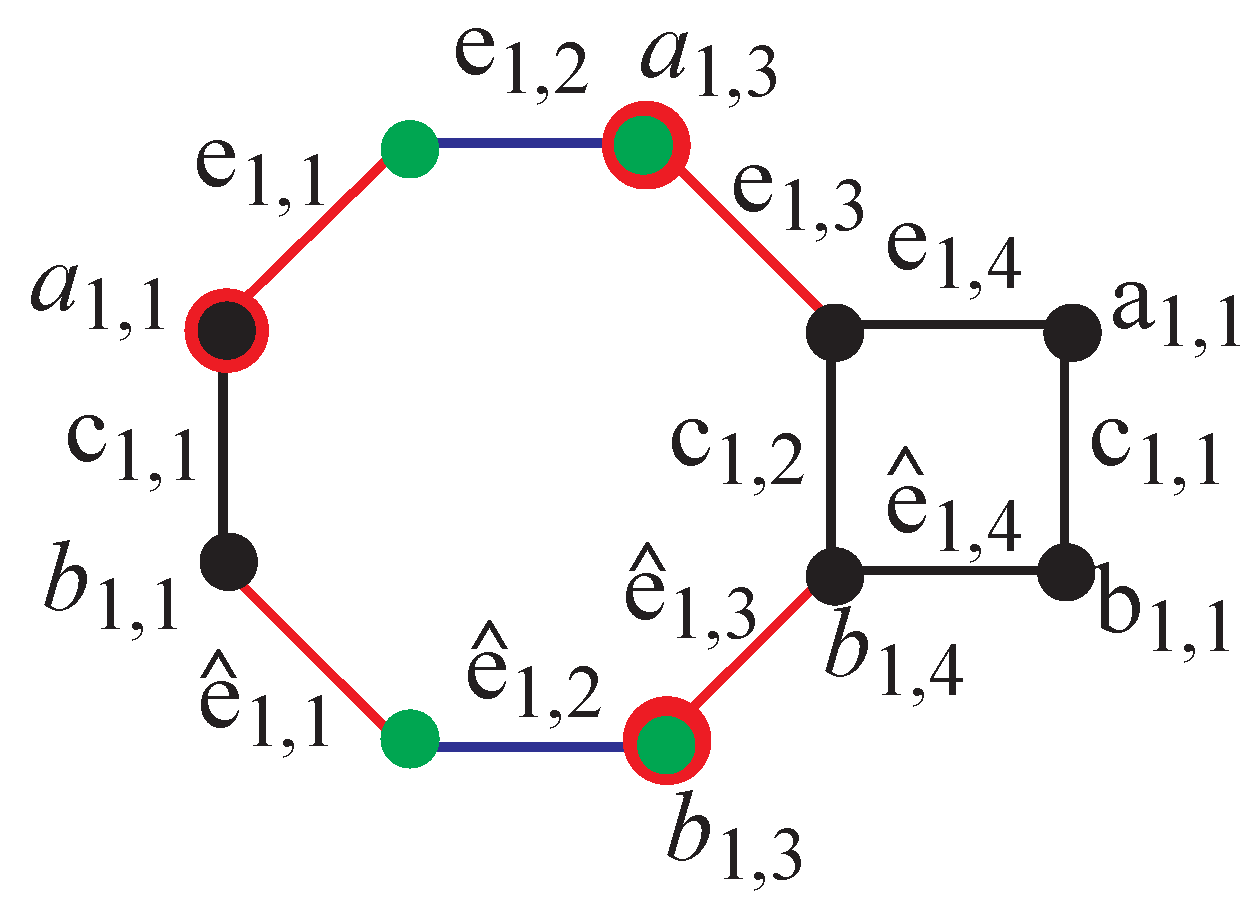
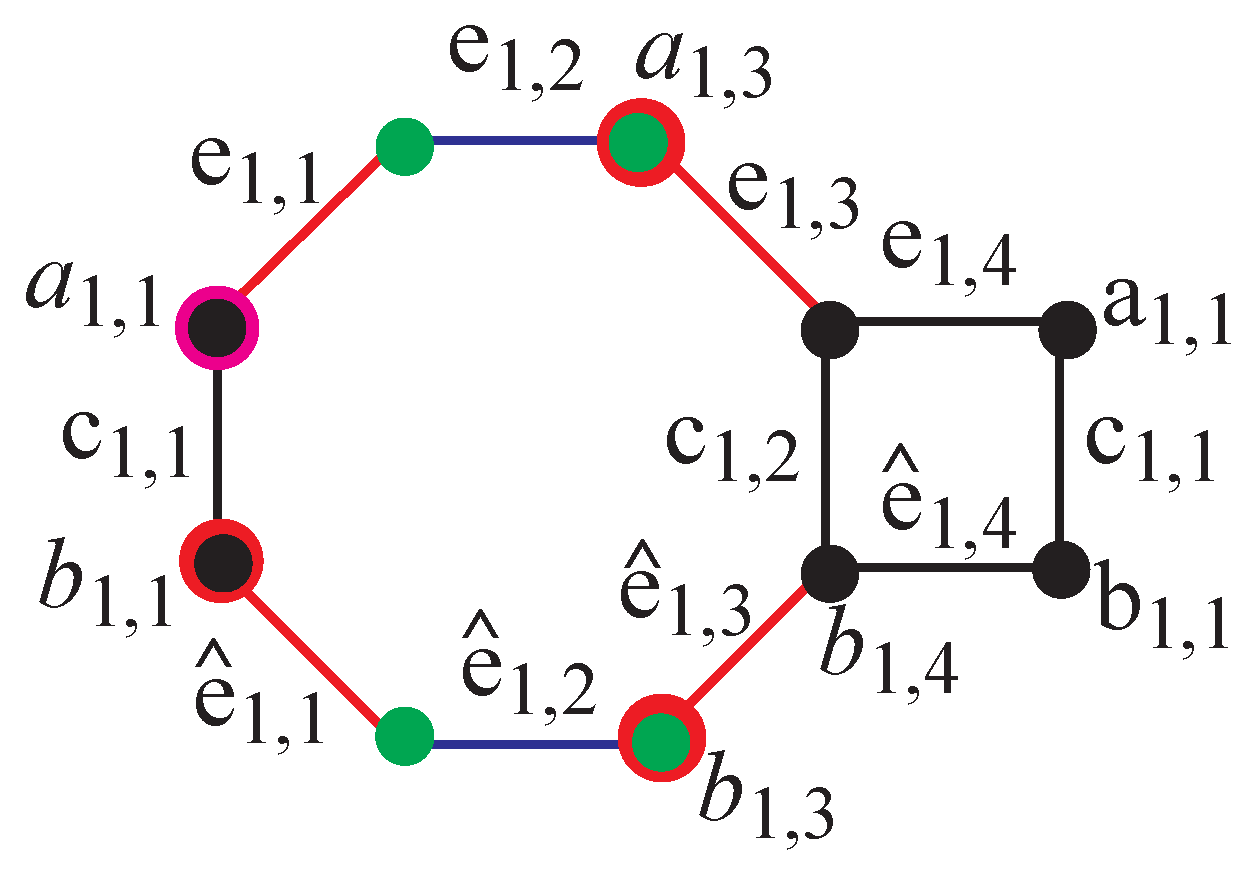
Abstract
In materials science, the open nanotube derived from an octagonal grid is one of the most important and extensively researched compounds. Finding strategies for representing a variety of chemical compounds so that different compounds can have different representations is necessary for the investigation of chemical structures. In this work, the double edge-based resolving partition is discussed and the exchange property applied. Let and be two edge-resolving partition sets and , such that . This shows that this structure has exchange property for edge partition. The exchange property in edge partitions is a novel work. It is introduced in this paper. The application of this work is to transform projects or objects to better places. The resolvability of these compounds is studied to gain an understanding of the chemical composition of the compounds. We perform this by using the terms vertex and edge-based distance and edge-resolving sets of graphs.
1. Introduction
Chemical graph theory serves as a powerful framework for analyzing chemical structures and mathematical characterization of various materials, including crystals, processes, clusters, molecules, and polymers. This method helps to describe the structural properties of these materials, and gives insight into emerging mathematical chemistry concepts [1] derived from octagonal nano-structures, which are great at materials science and are of interest. They find application in various fields like medicine, nanotechnology, etc. Understanding and characterizing these systems, and determining their peak-based metric dimensions, are important research aspects in this area [2,3,4]. For a detailed survey of mathematical chemistry associated with graph theory, you can refer to the work of Ahmed and Manzoor [5,6,7] Chemical graph theory simplifies and disconnects complex chemical systems, making them simpler to analyze and understand.
In graph theory, the concept of a solution structure plays an important role in distinguishing vertices based on their path. The vertices L of a graph G are considered as a set of solutions if any vertex in G can be uniquely identified based on its distance vector from the vertices in L [8,9,10]. This concept is important to characterize chemical structures and their smallest cardinality graph, known as the metric dimension [10,11,12]. Slater, in [13], first introduced the concept of finding a set one, and in 1976, Harari proposed a similar idea, calling it the metric dimension of a graph [14]. This idea originated in a monograph by Blumenthal who examined the use of metric spaces in a wider context in [15].
The concept of the metric dimension finds applications in various fields, and has been the subject of extensive research. Researchers have employed it in a wide range of applications, showcasing its versatility and importance. For instance, the metric dimension has been used to determine similarities between different medications [16]. Metamaterials refer to artificially designed materials and structures [17], which are crucial in the pharmaceutical industry. Other applications include solving combinatorial optimization problems [18], facilitating robot navigation [19], addressing pharmaceutical chemistry issues [20], optimizing computer networks [21], and canonically labeling graphs [22]. The utility of the metric dimension extends to solving location problems, aiding in the operation of sonar and coast guard Loran systems [13], facilitating image processing, and solving complex weighing problems [23]. Additionally, it has found applications in coding and decoding strategies for games like Mastermind [24]. For a more comprehensive understanding of the physical and chemical properties related to the metric dimension, further references [25,26] are available.
Throughout our consideration, the graph G is a simple, finite, plane, connected, and undirected graph. When two any minimal s for G are and , let a vertex and , such that is also a minimal resolving set. The exchange property in the graph is therefore said to be possessed by resolving sets (for more information, see [27]). Only finite, simple, and connected graphs are considered in this work. A graph’s exchange property also indicates its set resolution property. Nanotubes derived from octahedral networks are an exciting research area in nanotechnology. Unlike the extensively studied carbon nanotubes, which are based on a square carbon structure, these nanotubes are made of an octahedral structure The octahedral lattice structure gives these nanotubes unique properties, making them attractive for various applications, and as materials for planning.
The octagonal lattice consists of a recurring pattern of octagonal polygons, which gives rise to a different geometric structure compared to the hexagonal lattice. This octahedral structure can potentially change the electronic, mechanical, and thermal properties of carbon nanotubes. Larger portions of the octahedral have different curvatures and different possible ways in which the atoms interact with each other, affecting the overall nanotube stability and efficiency. The resources that can be used are electronic devices; the unique electronic properties of octahedral mesh-based nanotubes can be exploited in the design of new electronic devices, including transistors and sensors that require specific conductive semiconductor properties. Mechanical reinforcement: carbon nanotubes can be used as reinforcements in composite materials due to their unique mechanical properties, which can increase the strength and durability of materials. Heat conductivity: the thermal properties of these carbon nanotubes can provide advantages in terms of heat dissipation, making them suitable for use in temperature control systems [28,29] and more. The chemistry of carbon nanotubes is discussed by [30]. The use of carbon nanotubes in medicine is discussed by [31].
The partition dimensions have several applications in chemistry, and the partition dimension of different chemical systems has been studied in numerous articles. The partition dimension bounds of One Pentagonal Carbon Nanocone Structure [26] and carbon nanocone edge partitions were obtained in [32]. The partition dimension of a path graph is calculated in [33]. The partition resolvability of nanosheets and nanotubes derived from an octagonal grid is discussed in [34]. The utility of fault-tolerant partition resolvability in cycle-related graphs is determined in [35], and the partition dimension of generalized hexagonal cellular networks and its applications are mentioned in [36]. The metric dimensions of nanotubes of and H-Naphtalenic nano-tubes were studied in [10], resolving a hard and fast of silicate big name mentioned in [37]. The symmetric graphs metric dimensions were received by rooted product [38], and the metric size of crystal cubic carbon shape was determined in [39], The barycentric subdivision of the side metric dimension of Cayley graphs was carried out in [40]. Because of its applicability, the concept of the metric dimension is used to address a lot of challenging situations. Consult [41,42,43] for the resolvability parameters of different chemical systems.
In this paper, a few basic theorems are applied. The partition dimension 2, shown by , is only for path graphs, as the author of [34] shows. For , it is further proven in [35] for cycle graph .
Definition 1
([44]). Consider the basic undirected graph G, where the edges and vertices are denoted V(G) and E(G), respectively. The distance, often referred to as the geodesics, is between . The distance in G that the shortest path takes to connect two vertices, , is indicated by .
Definition 2
([36]). The distance of a vertex to a set is defined as , where are the elements of R.
In this article, we use for the edge partition resolving set, for the partition dimension, and for the exchange property.
2. Double Edge Partition Resolving Sets for Nanotube
The structures that have double edge-resolving sets or more resolving sets also have , which is very important for finding the best locations for projects.
Theorem 1.
Let be an octagonal nanotube with ; then, the double s of cardinality 4 exists.
Proof.
Let us define two sets, and , to prove the double for nanotubes. Specifically, here, we aim to demonstrate that and are both s for nanotubes. Theorem 2 contains the proof of , while Theorem 3 contains the proof of . □
3. Is an Edge Partition Resolving Set
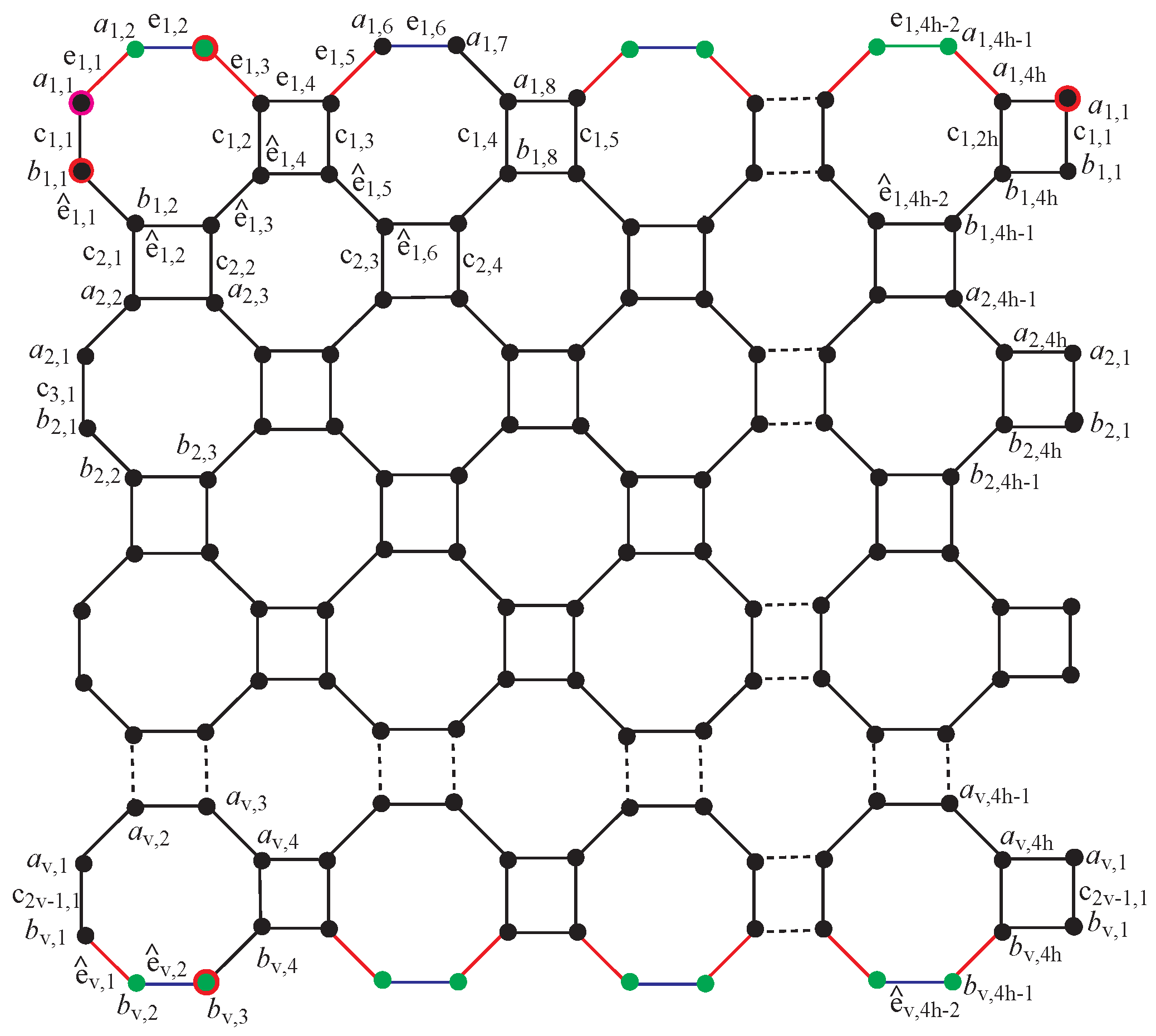
3.1. Construction of Figure 1 of for
Figure 1.
Generalize nanotube.
In Figure 1, edges with degrees of two and three endpoints are colored red. Any edges with degree 2 or degree 3 endpoints are colored blue, and all edges with degree 3 endpoints are colored black. The vertex color of a degree of two is green, and the vertex color with a degree of three is black. The vertex that constitutes the resolving set is colored double because of degree 3, and the point of resolution, , is black and red, while and are red and green due to degree 2 and the point of .
Assume that h and v represent ’s horizontal and vertical numbers. There are 2h vertices of degree 2 and 8hv-2h vertices of degree 4. The has a size of , and the order of is . In labeling, two parameters () and two indices () are utilized. I varies twice with v, and j changes four times with h.
The edges are labeled as , , and The nanotube vertices and edges sets are defined as follows:
Here is the proof that is an edge partition resolving set of cardinality 4 for nanotubes.
Theorem 2.
Let be a nanotube for . Then, is the of cardinality 4, and it is denoted by |R|.
Proof.
To prove that is the we define a partition set and then check the distances with edges of structure. Let and be the subsets of the vertices of , such that and . The set is known as if it has unique representation with all the edges of . Here, wish to demonstrate that is a minimal to demonstrate that . The distinct representations of each vertex and edge of for are shown below. be a . For this claim, follow the definition of . Let show a unique representation with edges.
The representation for is shown in Table 1.
Table 1.
Edge coding for Figure 2.
3.1.1. Generalized Results
The octagonal nanotube generalized distance formulas for all edges demonstrate that the cardinality of the minimal is 4, given that every distance is distinct. The generalized distance formulas are provided below, where is considered as distance. Let , , , and .
where
where
where
Let ,
and .
where
where
where
Let , and .
where
where
where
Let and are two random edges on nanotube . Let .
- Case I: when and , then three further cases arise.
- Case 1: if , , and without loss of generality, we can say that , then , because , where , so .
- Case 2: if , , and without loss of generality, we can say that , then , because , where , so .
- Case 3: if , , and without loss of generality, we can say that , , then , because , so .
- Case II: when and .
- Case 1: if , , and without loss of generality, we can say that , then , because , where , so .
- Case 2: if , , and without loss of generality, we can say that , then , because , where , so .
- Case 3: if , , and without loss of generality, we can say that , , then because , so .
- Case III: when and , then four further cases arise.
- Case 1: If , , then , because is at least equal to , so .
- Case 2: if , , and without loss of generality, we can say that , then because is at least equal to , so .
- Case 3: if , , and without loss of generality, we can say that , then , because is at least equal to , so .
- Case 4: if , , and without loss of generality, we can say that , , then , because is at least equal to , so .
When , , the positions of and , where , then , if at these positions , then it is clearly .
Discuss all cases in which , whatever , if , then one of these is different:
or ,
or
or
or
or .
There is no scenario when two representations are equivalent. Based on the representation discussed above, can see that every vertex provides a unique representation, satisfying the condition and demonstrating that .
3.1.2. Conversely
From the above discussion, have proved that the edge metric dimension of is less than or equal to 4. Now, we want to prove that the is not greater than 4, .
The edge is not 2 because is not a path graph. is not three, so here, we cite an article in which the metric of this this structure is 3, so is not possible [28]. If its metric dimension is 3, then its edge metric dimension is not less than 3, so its is not 3. Hence, we prove that the has cardinality 4. □
4. Is Also an Edge Partition Resolving Set of Nanotube
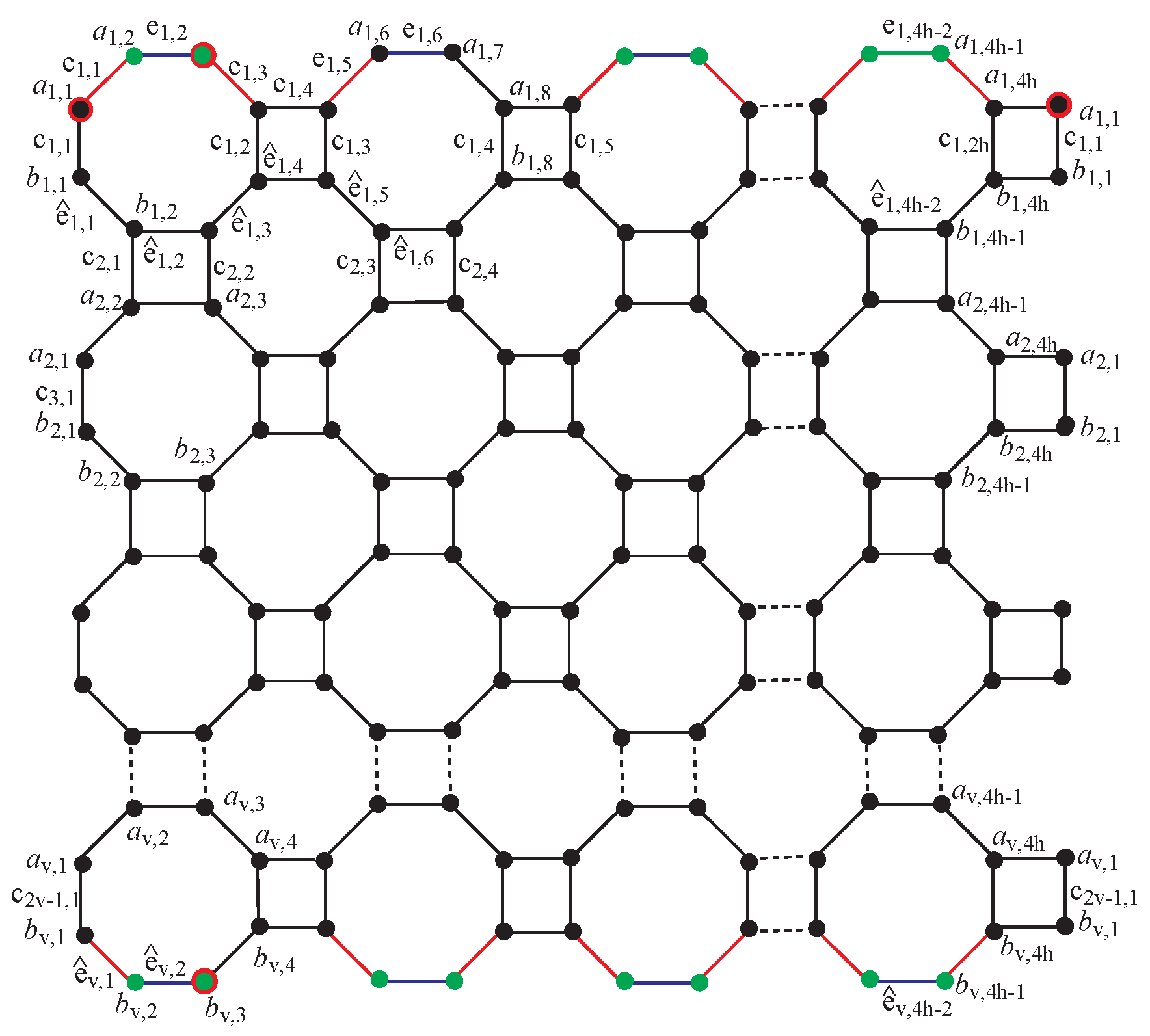
4.1. Construction Figure 3 of for
Figure 3.
Generalized nanotube derived by octagonal grid.
In Figure 3, the edges of the second and third ends are red. is colored red and black because is a three-point location; are green and red because 2 is the degree of the case. The pink color vertex is exchangeable.
Theorem 3.
Let be a nanotube for . Then, is also edge partition resolving set of cardinality 4 for .
Proof.
To prove that is also , we define a partition set. Let , and be the subsets of the vertices of , such that and . The set is known as if it has unique representation with all the edges of . Now, we wish to demonstrate that is a minimal to demonstrate that . The distinct representations of each vertex and edge of for are shown below. be a . For this claim, follow the definition of . Let show a unique representation with edges.
The representation for is shown in Table 2.
Table 2.
Edge coding of Figure 4.
4.1.1. Generalized Results
The octagonal nanotube generalized distance formulas for all edges demonstrate that the cardinality of the minimal is 4, given that every distance is distinct. The generalized distance formulas are provided below, where is considered as distance. Let , , , and .
The generalized formulas of and are given in the proof of , and the remaining are here.
where
Let , and .
The generalized formulas of and are give in the proof of , and the remaining are here.
where
Let , and .
The generalized formulas of and are give in the proof of , and the remaining are here.
where
Let and are two arbitrary edges on nanotube. . Let
- Case I: when and , then three further cases arise.
- Case 1: if , and without loss of generality, we can say that , then because , where , so .
- Case 2: if , and without loss of generality, we can say that , then , because , where , so .
- Case 3: if , and without loss of generality, we can say that , then , because , so .
- Case II: when and .
- Case 1: if , and without loss of generality, we can say that , then , because , where , so .
- Case 2: if , and without loss of generality, we can say that , then , because , where , so .
- Case 3: if , and without loss of generality, we can say that , , then , because , so .
- Case III: when and , then four further cases arise.
- Case 1: if , , then because is at least equal to , so .
- Case 2: if , and without loss of generality, we can say that , then , because is at least equal to , so .
- Case 3: if , and without loss of generality, we can say that , then , because is at least equal to , so .
- Case 4: if , and without loss of generality, we can say that , , then , because is at least equal to , so .
When , the positions of and where , then if at these positions , then it is clearly .
Discuss all cases in which , whatever , , , if , then one of these is different
or
or
or
or
or .
There is no scenario where two representations are equal. As can be seen from the representational discussion above, every vertex provides a unique representation, which satisfies the requirement of , and which shows that .
4.1.2. Contrary Case
From the above discussion, we proved that the edge metric dimension of is less than or equal to 4. Now, we want to prove that the is not greater than 4, .
The edge is not 2 because is not a path graph. The partition dimension is not 3 because its metric dimension is 3 (see [28]). If its metric dimension is 3, then its edge metric dimension is not less than 3, so its is not 3. Hence, we prove that the has cardinality 4. □
5. Exchange Property
A strong tool for material substitution while maintaining crucial characteristics like structural integrity, identification ability, and distance metrics is the exchange property in the mixed metric dimension framework for hexagonal nano-networks. This novel feature improves the fault tolerance, optimization, and design flexibility of nano-networks, which is a noteworthy development in the field. As we have seen, a subset of vertices W in a graph G is , such that any vertex in the graph G can be uniquely identified by its distance from the vertices of the subset W between them, which acts like a basis in the vector space because each vertex in the graph is related to vertices in these sets. It is known to be unique. Although the vector space of has many basis-like features, it may not always have the exchange feature from linear algebra. In this case, is such that if S and are the minimum for G, then and , such that ( is the minimum for the G. The of graph G inside all have the same size when satisfying ; this makes algorithmic methods for finding the metric dimension of G more practical. Therefore, to show that the does not hold in a given graph, one only needs to show two minimal of different sizes. Note that the contrary is not true: the lack of the exchange condition does not entail the presence of minimal of different sizes. The following deductions about the for were made in [27].
Theorem 4.
([27]). In trees for resolving sets, the is valid.
Theorem 5.
([27]). Wheels and for resolving sets do not have the .
The for solving sets of necklace graphs does not hold, as has recently been demonstrated.
Theorem 6.
([45]). The is absent from the of the necklace graph for .
Theorem 7.
([46]). For , the quasi-flower snarks do not satisfy the for minimum .
Theorem 8.
([47]). For , the for minimal edge resolving sets holds in nanosheet derived from the octagonal grid.
Theorem 9.
The exchange properties with applications were discussed in [48].
Here, we prove that the holds for of octagonal nanotube in the following theorem.
Theorem 10.
The (exchange property) for holds in the structure of an octagonal nanotube.
Now, we use the definition of to support our claim. Let and and , then is a minimal as well. Suppose . Here, we need to demonstrate that Q is a minimal , as well for . Because and , thus , because , and the representation of is same. is the proved in Theorem 3, which proved that is a minimal . Thus, we demonstrated the validity of the in . are common points in and . So, and exchange u and v sets with each other.
6. Limitations and Future Work
The research presented in this article primarily offers a theoretical study of edge-partition resolving sets. The studies presented in this article broadly offer a theoretical observation of edge-partition resolving sets and their houses within systems derived from octagonal grids, including nanotubes. While the theoretical findings are promising, and advise capacity programs in various fields, they lack an experimental method to validate these principles in real-world settings. To show the applicability and practical use of these theoretical constructs, future work has to include experimental research that checks and affirms the effectiveness of edge-PRSs in real networks. By enforcing these ideas in actual-world situations, we can better recognize their realistic implications, discover potential barriers, and refine the theoretical fashions to higher in shape sensible applications. Experimental validation may even offer concrete evidence of the blessings and demanding situations related to edge-PRSs, thereby strengthening the overall impact and reliability of these studies.
7. Conclusions and Future Scope
In this work, two structures derived from the octagonal grid are discussed, focusing on nanotube configuration, specifically. With two partition resolving sets (PRSs) in nanotubes, each with a cardinality of four, it is confirmed that the holds for these structures, which enhances their application in community optimization, taking into account green placement modifications. The change in belongings is especially useful for addressing place problems, because it permits the moving of elements to more gold-standard positions based on resolvability parameters. The concept of has numerous sensible programs throughout diverse fields. In telecommunications networks, partition size aids in fault diagnosis by efficiently finding and figuring out complex sections. It also allows for network optimization by way of enhancing routing and useful resource allocation, thereby enhancing normal network overall performance. In sensor networks, partition measurements permit green tracking and management by way of organizing sensor nodes into partitions. This enables higher data series, and minimizes redundant transmissions, which optimizes verbal exchange paths and increases the community’s operational lifetime. Smart grids also have advantages ranging from partition size through to progressed load management and fault isolation. By efficiently distributing masses, the partition dimension prevents overloads and complements grid balance. It additionally assists in speedy setting apart of faults, allowing faster repairs and lowering downtime. In urban visitor networks, the partition size optimizes traffic to go with the flow with the aid of improving visitors’ signal timings and course-making plans. This reduces congestion and complements normal traffic efficiency. Additionally, it aids in designing the most effective emergency response routes, ensuring the timely arrival of emergency services.
Author Contributions
Conceptualization, S.A. and M.K.J.; Methodology, A.S.A.; Validation, S.A.; Formal analysis, S.A.; Writing—original draft, A.S.A. and S.A.; Writing—review & editing, A.S.A. and M.K.J.; Visualization, M.K.J.; Supervision, M.K.J. All authors have read and agreed to the published version of the manuscript.
Funding
This research received no external funding.
Data Availability Statement
The datasets used and/or analyzed during the current study are available from the corresponding author upon reasonable request.
Acknowledgments
The authors extend their appreciation to Princess Nourah Bint Abdulrahman University for funding this research under Researchers Supporting Project number (PNURSP2024R231), Princess Nourah Bint Abdulrahman University, Riyadh, Saudi Arabia.
Conflicts of Interest
The authors declare that they have no conflicts of interest.
References
- Nadeem, M.F.; Hassan, M.; Azeem, M.; Khan, S.U.D.; Shaik, M.R.; Sharaf, M.A.F.; Abdelgawad, A.; Awwad, E.M. Application of Resolvability Technique to Investigate the Different Polyphenyl Structures for Polymer Industry. J. Chem. 2021, 2021, 8. [Google Scholar] [CrossRef]
- Siddiqui, H.M.A.; Imran, N. Computation of metric dimension and partition dimension of nanotubes. J. Comput. Theor. Nanosci. 2015, 12, 199–203. [Google Scholar] [CrossRef]
- Hussain, Z.; Kang, S.M.; Rafique, M.; Munir, M.; Ali, U.; Zahid, A.; Saleem, M.S. Bounds for partition dimension of m-wheels. Open Phys. 2019, 17, 340–344. [Google Scholar] [CrossRef]
- Shabbir, A.; Azeem, M. On the Partition dimension of tri-hexagonal alpha-boron nanotube. mEEE Access 2021, 9, 55644–55653. [Google Scholar] [CrossRef]
- Alshehri, H.; Ahmad, A.; Alqahtani, Y.; Azeem, M. Vertex metric-based dimension of generalized perimantanes diamondoid structure. mEEE Access 2022, 4, 43320–43326. [Google Scholar]
- Ahmad, A.N.A.H.; Ahmad, A. Generalized perimantanes diamondoid structure and their edge-based metric dimensions. AIMS Math. 2022, 7, 11718–11731. [Google Scholar] [CrossRef]
- Manzoor, S.; Siddiqui, M.K.; Ahmad, S. On entropy measures of polycyclic hydroxychloroquine used for novel Coronavirus (COVID-19) treatment. Polycycl. Aromat. Compd. 2020, 42, 2947–2969. [Google Scholar] [CrossRef]
- Alatawi, M.S.; Ahmad, A.; Koam, A.N.A.; Husain, S.; Azeem, M. Computing vertex resolvability of benzenoid tripod structure. AIMS Math. 2022, 7, 6971–6983. [Google Scholar] [CrossRef]
- Siddiqui, H.M.A.; Arshad, M.A.; Nadeem, M.F.; Azeem, M.; Haider, A.; Malik, M.A. Topological properties of a supramolecular chain of different complexes of N-salicylidene-L-Valine. Polycycl. Aromat. Compd. 2021, 42, 6185–6198. [Google Scholar] [CrossRef]
- Siddiqui, M.K.; Imran, M. Computing the metric and partition dimension of H-Naphtalenic and VC5C7 nanotubes. J. Optoelectron. Adv. Mater. 2015, 17, 790–794. [Google Scholar]
- Mehreen, N.; Farooq, R.; Akhter, S. On partition dimension of fullerene graphs. AIMS Math. 2018, 3, 343–352. [Google Scholar] [CrossRef]
- Yang, B.; Rafiullah, M.; Siddiqui, H.M.A.; Ahmad, S. On Resolvability parameters of some wheel related graphs. J. Chem. 2019, 2019, 9259032. [Google Scholar] [CrossRef]
- Slater, P.J. Leaves of trees, Proceeding of the 6th southeastern conference on combinatorics, Graph Theory, and computing. Congr. Numer. 1975, 14, 549–559. [Google Scholar]
- Harary, F.; Melter, R.A. On the metric dimension of graphs. Ars Comb. 1976, 2, 191–195. [Google Scholar]
- Blumenthal, L.M. Theory and Applications of Distance Geometry; Clarendon: Oxford, UK, 1953. [Google Scholar]
- Johnson, M.A. Structure-activity maps for visualizing the graph variables arising in drug design. J. Biopharm. Stat. 1993, 3, 203–236. [Google Scholar] [CrossRef]
- Wang, W.; Jin, Y.; Mu, Y.; Zhang, M.; Du, J. A novel tubular structure with negative Poisson’s ratio based on gyroid-type triply periodic minimal surfaces. Virtual Phys. Prototyp. 2023, 18, e2203701. [Google Scholar] [CrossRef]
- Ahmad, A.; Koam, A.N.A.; Siddiqui, M.H.F.; Azeem, M. Resolvability of the starphene structure and applications in electronics. Ain Shams Eng. J. 2021, 13, 101587. [Google Scholar] [CrossRef]
- Khuller, S.; Raghavachari, B.; Rosenfeld, A. Landmarks in graphs. Discret. Appl. Math. 1996, 70, 217–229. [Google Scholar] [CrossRef]
- Chartr, G.; Eroh, L.; Johnson, M.A.O.; Ortrud, R. Resolvability in graphs and the metric dimension of a graph. Discret. Appl. Math. 2000, 105, 99–113. [Google Scholar] [CrossRef]
- Manuel, P.; Bharati, R.; Rajasingh, I.; Monica, M.C. On minimum metric dimension of honeycomb networks. J. Discret. Algorithms 2008, 6, 20–27. [Google Scholar] [CrossRef]
- Piperno, A. Search Space CNTraction in Canonical Labeling of Graphs. arXiv 2008, arXiv:0804.4881. [Google Scholar]
- Söderberg, S.; Shapiro, H. A combinatory detection problem. Am. Math. Mon. 1963, 70, 1066–1070. [Google Scholar] [CrossRef]
- Chvatal, V. Mastermind. Combinatorica 1983, 3, 125–129. [Google Scholar] [CrossRef]
- Javaid, I.; Shokat, S. On the partition dimension of some wheel related graphs. J. Prime Res. Math. 2008, 4, 154–164. [Google Scholar]
- Koam, A.N.A.; Ahmad, A.; Azeem, M.; Nadeem, M.F. Bounds on the partition dimension of one pentagonal carbon nanocone structure. Arab. J. Chem. 2022, 15, 103923. [Google Scholar] [CrossRef]
- Boutin, D.L. Determining set, resolving sets, and the exchange property. Graphs Comb. 2009, 25, 789–806. [Google Scholar] [CrossRef]
- Koam, A.N.A.; Ali, S.; Ahmad, A.; Azeem, M.; Jamil, M.K. Double resolving set and exchange property in nanotube. AIMS Math. 2023, 8, 20305–20323. [Google Scholar] [CrossRef]
- Ali, S.; Jamil, M.K. Exchange Property in Double Edge Resolving Partition Sets and Its Use in City Development. Spec. Deci. Making Appl. 2024, 1, 84–97. [Google Scholar] [CrossRef]
- Tong, L.; Vardhan, B.; Liming, J.T.D. Chemistry of Carbon Nanotubes. Aust. J. Chem. 2003, 56, 635–651. [Google Scholar] [CrossRef]
- Anzar, N.; Hasan, R.; Tyagi, M.; Yadav, N.; Narang, J. Carbon nanotube-A review on Synthesis, Properties and plethora of applications in the field of biomedical science. Sens. Int. 2020, 1, 100003. [Google Scholar] [CrossRef]
- Sharma, S.K.; Singh, M.; Bhat, V.K. Vertex-Edge Partition Resolvability for Certain Carbon Nanocones. Polycycl. Aromat. Compd. 2023, 44, 1745–1759. [Google Scholar] [CrossRef]
- Ramdhani, V.; Rahmi, F. The Partition Dimension of a Path Graph. Sainstek J. Sains Dan Teknol. 2021, 13, 66–72. [Google Scholar] [CrossRef]
- Khabyah, A.A.; Koam, A.N.A.; Ahmad, A. Partition Resolvability of Nanosheet and Nanotube Derived from Octagonal Grid. J. Math. 2024, 2024, 6222086. [Google Scholar] [CrossRef]
- Azhar, K.; Zafar, S.; Kashif, A.; Aljaedi, A.; Albalawi, U. The Application of Fault-Tolerant Partition Resolvability in Cycle-Related Graphs. Appl. Sci. 2022, 12, 9558. [Google Scholar] [CrossRef]
- Bhatti, R.; Jamil, M.K.; Azeem, M.; Poojary, P. Partition Dimension of Generalized Hexagonal Cellular Networks and Its Application. IEEE Access 2024, 12, 12199–12208. [Google Scholar] [CrossRef]
- Simonraj, F.; George, A. on the metric Dimension of silicate stars. Arpn J. Eng. Appl. Sci. 2015, 5, 2187–2192. [Google Scholar]
- Imran, S.; Siddiqui, M.K.; Imran, M.; Hussain, M. On metric dimensions of symmetric graphs obtained by rooted product. Mathematics 2018, 6, 15. [Google Scholar] [CrossRef]
- Zhang, X.; Naeem, M. Metric dimension of crystal cubic carbon structure. J. Math. 2021, 2021, 3438611. [Google Scholar] [CrossRef]
- Koam, A.N.A.; Ahmad, A. Barycentric subdivisions of Cayley graphs with constant edge metric dimension. IEEE Access 2020, 8, 80624–80628. [Google Scholar] [CrossRef]
- Ahmad, A.; Bača, M.; Sultan, M.S. Computing the metric dimension of kayak paddle graph and cycles with chord. Proyecciones J. Math. 2020, 39, 287–300. [Google Scholar] [CrossRef]
- Krishnan, S.; Rajan, B. Fault-tolerant resolvability of certain crystal structures. Appl. Math. 2016, 7, 599–604. [Google Scholar] [CrossRef]
- Hussain, Z.; Munir, M.; Choudhary, M.; Kang, S.M. Computing metric dimension and metric basis of the 2D lattice of alpha-boron nanotubes. Symmetry 2018, 10, 300. [Google Scholar] [CrossRef]
- Ismail, R.; Ali, S.; Azeem, M.; Zahid, M.A. Double Resolvability Parameters of Fosmidomycin Anti-Malaria Drug and Exchange Property. Heliyon 2024, 10, e33211. [Google Scholar] [CrossRef] [PubMed]
- Tomescu, I.; Imran, M. R-sets and the metric dimension of necklace graphs, Applied Mathematics and Information Sciences. Appl. Math. Inf. Sci. 2015, 9, 63–67. [Google Scholar] [CrossRef]
- Naeem, R.; Imran, M. Metric Dimension and Exchange Property for Resolving sets in Rotationally-Symmetric Graphs. Appl. Math. Inf. Sci. 2014, 8, 1665–1674. [Google Scholar] [CrossRef]
- Koam, A.N.A.; Ahmad, A.; Ali, S.; Jamil, M.K.; Azeem, M. Double edge resolving set and exchange property for nanosheet. Heliyon Open Access 2024, 5, E26992. [Google Scholar] [CrossRef]
- Ali, S.; Azeem, M.; Zahid, M.A.; Usman, M.; Pal, M. Novel resolvability parameter of some well-known graphs and exchange properties with applications. J. Appl. Math. Comput. 2024. [Google Scholar] [CrossRef]
Disclaimer/Publisher’s Note: The statements, opinions and data contained in all publications are solely those of the individual author(s) and contributor(s) and not of MDPI and/or the editor(s). MDPI and/or the editor(s) disclaim responsibility for any injury to people or property resulting from any ideas, methods, instructions or products referred to in the content. |
© 2024 by the authors. Licensee MDPI, Basel, Switzerland. This article is an open access article distributed under the terms and conditions of the Creative Commons Attribution (CC BY) license (https://creativecommons.org/licenses/by/4.0/).