


Abstract
Advanced agronomic methods, urbanisation, and industrial expansion contaminate air, water and soil, globally. Agricultural and industrial activities threaten living biota, causing biodiversity loss and serious diseases. Strategies such as bioremediation and physiochemical remediation have not been effectively beneficial at treating pollutants. Metal-based nanoparticles (NPs) such as copper, zinc, silver, gold, etc., in various nanoformulations and nanocomposites are used more and more as they effectively resist the uptake of toxic compounds via plants by facilitating their immobilisation. According to studies, bio-based NP synthesis is a recent and agroecologically friendly approach for remediating environmental waste, which is effective against carcinogens, heavy metal contamination, treating marine water polluted with excessive concentrations of phosphorus, nitrogen and harmful algae, and hazardous dye- and pesticide-contaminated water. Biogenic resources such as bacteria, fungi, algae and plants are extensively used for the biosynthesis of NPs, particularly metallic NPs. Strategies involving green synthesis of NPs are nontoxic and could be employed for commercial scale production. Here, the focus is on the green synthesis of NPs for reduction of hazardous wastes to help with the clean-up process.
1. Introduction
The combination of two sciences, i.e., nanotechnology and biotechnology, is gradually expanding its roots in almost all the sectors involving biology, engineering, cosmetics, remediation, biomedical, agriculture, food, etc. Numerous nanoscale (below 100 nm) materials show remarkable features in contrast to their bulk elements and components. With progressive studies, researchers have developed nano-based composites and materials, and found their effective application in almost every field including waste remediation, solar applications, and nano-sensors [1,2,3].
Economic development and accelerated industrial growth have overall resulted in higher environmental pollution through more energy expenditure, release of hazardous wastes, emission of toxic gases [4], and exhaust emissions from the automobile industry [5]. Hazardous wastes include various dyes (Azure-B, Disperse orange I, Disperse Red I, Crystal Violet, Basic Red 9, Sudan I) eluted from textile industries [6], toxic heavy metals [7,8], pesticides [9,10], and polyaromatic hydrocarbons (chrysene, pyrene, fluoranthene, anthracene, naphthalene etc.) [11], which all are carcinogenic and mutagenic in nature [12].
Metallic nanoparticles (NPs) have been used in the past few years, as many metals such as copper (Cu), silver (Ag), gold (Au), platinum (Pt), zinc (Zn) and titanium (Ti) show promising results once utilised in nanosized composites compared to bulk materials [3]. Metallic NPs have various exceptional properties such as magnetic, electronic, optical, catalysing, anti-cancer, and antimicrobial activities in contrast with their respective elements. Conventionally, metal NPs have been synthesised using physicochemical procedures [13]. These various synthesis procedures include chemical vapor deposition, microemulsion synthesis, thermal decomposition, sol-gel method, hydrothermal process, stream transport synthesis, mechanochemical process, spray pyrolysis, co-precipitation, spark discharge method, liquid infiltration, inert gas condensation and biological synthesis [14,15].
Due to drawbacks such as the use of extreme conditions and hazardous reagents, the synthesis procedures have shifted towards eco-friendly approaches involving living entities, either using unicellular or multicellular organisms. Biological constituents, as depicted in Figure 1, serve to be a great platform for their non-toxic and economic synthesis [16], which not only include various microorganisms and plants but also their products and components such as extracts, isolates, enzymes, etc. These have been effectively utilised in polymer preparation, catalysis, sensor technology, disease management, and labelling of optoelectronic recorded media [13].

Figure 1.
Various biological resources used for nanoparticle synthesis via green approach.
Pollution and contamination of the environment is a big issue to tackle. Numerous solutions have been identified and worked upon, and the use of nanotechnology is one of them. Nanoformulations such as nanomembranes, nanotubes, nanopolymers, graphene-based NPs, and metal-, carbon-, and silicon-based NPs have been extensively used in the remediation of environmental toxic elements [17]. As they are obtained from natural sources, NPs have been found to be effective in reducing pollutants in the environment with negligible effects on ecosystems. The green approach of NP synthesis is eco-friendly and does not interfere with other living organisms [1]. Their phyto- and cytotoxic effects are notably low, indicating that they are safe to use for broader practices [18].
The current review focuses on various research activities with reference to the green biosynthesis of metal-based NPs, their reducing sources, and mechanisms of action. It discusses various biological sources of NPs and their contribution to the remediation process for mitigating hazardous wastes from environment.
2. Nanoparticles and Approaches to Green Synthesis
Based on nature, size, morphology, and chemical characteristics, NPs have been briefly categorised in five groups as stated below and depicted in Figure 2 [19,20,21,22,23].
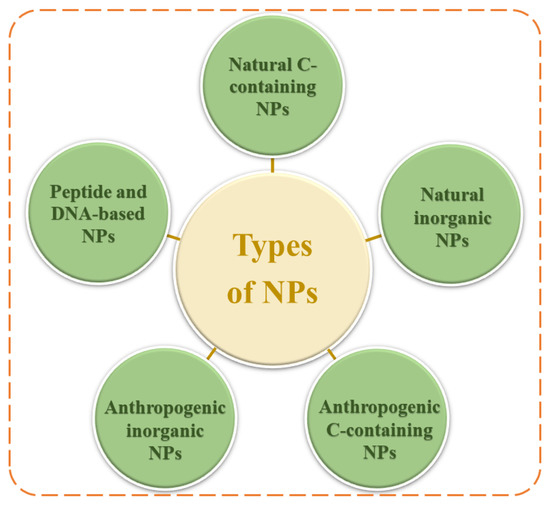
Figure 2.
Brief categorisation of nanoparticles.
- Natural carbon-containing NPs: Fullerene, chitosan NPs etc.;
- Anthropogenic carbon-containing NPs: Carbon nanotubes/nanofibers, graphene NPs etc.;
- Natural inorganic NPs: Iron oxide/sulfides, silver, gold, manganese, aluminosilicates NPs etc.;
- Anthropogenic inorganic NPs: Quantum dots, titanium dioxide, silicon dioxide, ceramics NPs etc.;
- Peptide- and DNA-based NPs: Gelatine, albumin, silk sericin NPs etc.
The methods involved in the synthesis of NPs are categorised into two classes, namely the top-down approach and bottom-up approach, based on differences in the starting materials, as depicted in Figure 3.

Figure 3.
Biological, chemical, and physical methods of NP synthesis are categorized as bottom-up and top-down approaches.
2.1. Top-Down Approach
The base material is exploited in bulk to reduce the size to nanoscale in top-down approaches, which can be achieved by both physical and chemical techniques [23]. These methods include photochemical and chemical reduction as well as electrochemical changes using various techniques such as laser and thermal ablation and mechanical milling, which yield stabilised NPs. These are easier to implement but might induce changes in properties and surface chemistry of the prepared NPs [3].
Laser ablation involves the application of high-powered lasers onto metal plates, yielding ablated NPs in the liquid medium. This method is suitable for NP fabrication and is affected by ablation time, wavelength and energy of the laser, and absorption by the liquid medium. This technique has been used for the synthesis of Cu, Au, and Ag NPs [24]. Mechanical milling involves the reduction of coarse particles into the desired smaller size. It is achieved by using an agitator at the speed of 75–500 rpm as per the requirements. The size of the vial in which the operation is carried out, the speed, time, temperature, and environment (dry or wet) of milling, and the usage of inert or reactive gases affect the particle size and homogeneity of the prepared NPs [25].
2.2. Bottom-Up Approach
On the other hand, bottom-up approaches involve the assembly of atoms or molecules to form nanostructured building units which eventually form the desired NPs. It can be achieved via both chemical and biological techniques. Studies have clearly shown that biological methods for NP synthesis have the fewest drawbacks compared with the other methods. Physical methods have high expenditures in time, energy and cost, as well as low production rate. Chemical synthesis is attained by involvement of toxic chemicals and solvents and results in noxious derivatives and byproducts [23].
In contrast with various alternatives, the solid-state method of NP synthesis is cost effective and convenient to use. The stages involved are milling, calcination, and sintering [26]. Particles produced using this method are unlikely to aggregate and are highly stable. Secondly, the preparation process involves the removal of solvents, which facilitates simpler handling and large-scale synthesis of the NPs, for example, AgNPs [27]. One of the liquid-state methods, i.e., synthesis via sol-gel technique, provides economic production of metal-oxide NPs with various other advantages. In addition to being a simple and fast technique, the method is suitable for the synthesis of high quality and complex nanocomposites with low processing temperature and higher purity. Various metal-oxide NPs such as zinc oxide (ZnO), tungsten oxide (WO3), tin oxide (SnO2), and titanium dioxide (TiO2) have been prepared using this method [28]. This chemical technique involves the formation of a gel-like phase which comprises both a solid and liquid phase. The organic solvents used in the procedure might be toxic for human beings, which is a major drawback of this process [5].
The gas-phase method of synthesis involves magnetron-sputtering using gas-phase condensation and inert-gas cooling which provides high cluster yield under the controlling parameters including temperature, pressure, and vapor concentration [20]. The technique offers an advantage in yielding NPs of desired size and is controlled by the flow rate of the inert gas, which could be argon or helium. Another approach called biological synthesis or green synthesis is subsequently gaining attention as it involves exploitation of microorganisms for the synthesis of NPs [14], which will be specifically discussed in detail in the following sections.
3. Green Synthesis of Nanoparticles
Formation of NPs using green synthesis is currently growing as an emerging approach combining both biotechnology and nanotechnology. This technique involves production of NPs using biological resources, which effectively overcomes the drawbacks imposed by physical and chemical methods [29]. A few examples include Cu NPs from seeds of Illicium vercium (star anise) and Mysristica fragrans (nutmeg) [30], Ag NPs from agricultural wastes [31] and extracts of red currant and bilberry wastes [32]. Being eco-friendly, this approach does not require the involvement of noxious chemicals and extreme conditions. It is cost effective and could be useful for large-scale production [29,33]. The green synthesis approach serves various advantages of being simple, reproducible, biocompatible, eco-friendly, and economic. Different biological agents have their own mechanisms to acknowledge metal ions for the synthesis of respective NPs. Major advantages of using biological resources over non-biological means is obtained via biomolecules present in the biological system which maintains the properties of NPs and therefore stabilizing or capping agents are not required [13].
Extraction from plants includes drying and downsizing of the plant component, leading to increased surface area [34]. Green synthesis involves heating and boiling for preparation of plant extracts. Powdered peels of Punica granatum (pomegranate) for copper oxide (CuO) NPs [35], Cucurbita pepo (pumpkin) seeds for TiO2 NPs [36], Chromolaena odorata roots for smart nanocomposites [37], and Basella alba leaves for Ag NPs [38] were boiled in distilled water for 30 min at 55 °C, 2 h at 90 °C, 2 h at 85 °C, 20 min at 60 °C, respectively. Nepeta leucophylla roots were boiled in methanol for 8 h to synthesize Ag NPs [39]. Alternatively, various other methods such as sonication, maceration, autoclaving etc., have also been employed. Ground kernels of Caesalpina bonducella were sonicated for 30 min [40], fruits of Solanum mammosum [41] and Crateagus pentagyna [42] were macerated, roots of Scutellaria biacalensis [43] were autoclaved at 100 °C for 30 min for green synthesis of CuO, Ag, (Fe/Si/Cu-Ag), and ZnO NPs, respectively. Another technique called co-precipitation has been used to synthesize ferric sulfate (Fe2SO3) NPs from marine alga (Turbinaria ornate) [44]. Cube-shaped ferroso ferric oxide (Fe3SO4) NPs were synthesised using Fenton process from extracts of Rhamnidium elaeocarpum and therefore could be regarded as a green chemical approach [45]. In another study, the biogenic deposition precipitation approach has been used for biogenic preparation of Ag-ZnO nanocomposites via extracts of fennel seeds, which were found to degrade chlorpyrifos pesticide and rhodamine dye [46].
Cyanobacteria, regarded as ‘cell factories’, are the most appropriate biological resource for synthesis of metal-based NPs. In one study [47], they employed Haloleptolyngbya alcalis KR2005/106 cyanobacterial extract as a reducing agent acting upon silver ions to yield Ag NPs of size < 50 nm when exposed to photosynthetically active radiation (PAR). The synthesised Ag NPs were shown to possess ammonia-sensing properties which could be used to monitor water quality. In another study, Ag NPs were biologically synthesised using Bacillus brevis (NCIM 2533). The prepared NPs showed potential antibacterial activity against various pathogenic bacteria such as Staphylococcus aureus and Salmonella typhi which could further be used in disease management [48]. Another advantage of green synthesised NPs includes generation of no by-products in the process. Additionally, various phytochemicals and natural compounds present in biological extracts stabilize and enhance various physico-chemical properties of the NPs without needing any other external agent [49].
4. Mechanisms Involved in Green Synthesis
The mechanism in biosynthesis simply involves the reduction of metal ions into the respective NPs. Ref. [50] synthesised Ag/TiO2 nanocomposites (NCs) of sizes ranging from 25–50 nm using leaf extract of Origanum majorana, serving as reducing agent, under ultrasound irradiation. Ref. [51] employed Cleistocalyx operculatus extract as reductant to synthesize Ag/TiO2 NCs of size ranging from 20–40 nm, which was found to be 91.4% efficient in photocatalytic degradation of Rhodamine B dye. The basic procedure makes use of biological resources which might be carried out both intra- and extracellularly as depicted in Figure 4. This can be done using cell free extracts, supernatants of bacterial cultures, and bacterial biomass. The complex down-streaming process in intra-cellular synthesis is the reason that an extracellular process is preferred [13].
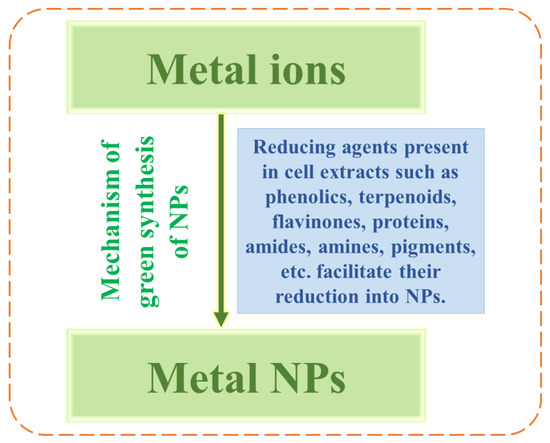
Figure 4.
Mechanism of nanoparticle synthesis via reduction of metal ions.
The ion transport system present in microbial cells facilitates intracellular production. Positively charged metal ions are attracted to the negatively charged bacterial cell wall where they are reduced by the embedded enzymes to respective metallic NPs. Reductases are secreted by the microbial cells in case of extracellular production and stabilisation where metal ions are reduced into NPs in the medium, which could be easily retrieved. As for an example, green synthesised ligninase-dependent Au NPs have been produced using fungus Phanerochaete chrysosporium intracellularly and was found to be highly stable [52]. Other examples with details are mentioned in Table 1.

Table 1.
Various nanoparticles via different biological resources.
Besides enzymes, various cofactors such as NADH, compounds such as quinones and glutathione [13] and biomolecules such as vitamins, tannins, steroids, flavonoids, amino acids and peptides, and carboxylic acids are also responsible for the reduction of the metal ions [73]. Other compounds such as phytochemicals and secondary metabolites found in medicinal plants such as saponins, alkaloids, terpenes, phenols, alcohols and extracellular enzymes and metabolites such as hemicellulose, acetyl xylem asterase, glucosidase, paracelsin, and cell wall lytic enzymes are excreted by several fungal species and aid in the reduction of metal ions [74]. Comprehensively, the overall mechanism and the biomolecules used in NP synthesis are summarized in Figure 5.

Figure 5.
Brief mechanisms of nanoparticle synthesis.
5. Green Synthesised Nanoparticles in Remediation for Degrading Toxic Substances
Remediation processes involving the exploitation of biological resources, or their components and extracts, are referred to as ‘bioremediation’, which is achieved by the breakdown of toxic components into less toxic ones [75] as shown in Figure 6.

Figure 6.
Concept of bioremediation using green nanoparticles.
Nanoformulations are great alternatives to get rid of contaminants present in the environment. They are actively used in remediation processes for treating and eliminating hazardous wastes. Heavy metals and dye contaminants cause serious issues for both land and aquatic biota by restraining uptake and consumption of dissolved oxygen and diminishing photosynthetic capability. Fe-based NPs possess properties required not only to disinfect water but also for removal of heavy metals from soil [1].
5.1. Bacterial Nanoparticles in Remediation
Bacterial cells are suitable options for the production of NPs as they contain biomolecules required for the reduction of metal ions, and NPs can be synthesised both intra- and extracellularly in the medium and display a large number of applications [15] such as green synthesised ZnO nanoflower from Bacillus licheniformis MTCC 9555 [76], which possesses the capability of photocatalytic degradation of pollutant dye methylene blue (C16H18N3SCl). Bacterial cells secrete stabilising enzymes that prevent the agglomeration of NPs. Photocatalysis is a helpful technology, regarded as an advanced oxidation process, which requires direct application of solar energy for elimination of numerous organic pollutants [77]. ZnO NPs are most extensively studied as photocatalysts in remediating aquatic wastewater [78]. Various other studies have been cited in Table 2.
5.2. Fungal Nanoparticles in Remediation
Mycosynthesised NPs have gained tremendous importance as they are cost effective and their yield is relatively good. Among other biological agents, fungi are considered to be the most suitable because they possess a large number of mycelia and fruiting bodies [79], and contain an ample amount of biomolecules required for NP synthesis [80,81]. Therefore, the amount of mycosynthesised NPs are sufficient and quick as compared with other biological agents [82]. Numerous fungal species have been exploited for biosynthesis of NPs employed for remediation. In one study, the waste substrate of Lentinula edodes was used to synthesise ferroferric oxide NPs which were found to be effective in the reduction of pollutants such as Cr, NH4-N, Pb, Ni, and Cu [83]. Various studies have been cited and elaborated on in Table 2.
5.3. Algal Nanoparticles in Remediation
Algae have been considered as ‘bio-nano factories’ as they actively absorb metal ions from their surroundings, resulting in their reduction and the synthesis of respective NPs in both living and dry dead form [15]. The controlled growth rate and energy of forming NPs are conventionally achieved by using suitable capping agents or surfactants. Due to being non-biodegradable in nature, these chemicals are present as remnants which are difficult to remove completely. In order to circumvent this issue, naturally occurring biomolecules found in variety of algae are employed for the stabilisation and synthesis of NPs [84] as they have a huge capacity for metal-binding. Ag NPs are the most studied and prevalent among the others. In one study, AgNO3 was exposed to extracts of seaweed Enteromorpha flexusa [85] and Chaetomorpha linum. Reduction of metal ions was facilitated by the water-soluble components found in the extract, such as terpenoids, flavonoids, amines, and peptides, which resulted in the formation of Ag NPs [86]. Prasiola crispa, a freshwater alga, was employed for green synthesis of Au NPs carried out by reduction of aqueous solution of chloroauric acid [87]. Toxicity issues are important to consider as they must not harm living biota. Algal synthesis serves to provide no or negligible toxicity hence it is a safer and green approach. Additionally, they are considered as ‘nano-reserves’ and could be cultured conveniently with less effort [88].
Many algal species have been employed in remediation processes for the degradation of hazardous dyes and chemicals as earlier methods such as redox treatment, UV degradation, activated carbon sorption etc., were inefficient [84]. Ag NPs were green synthesised using seaweed Ulva lactuca [89] and Hypnea musciformis [90], which have been very efficient in degrading methyl orange dye. Green synthesised iron oxide NPs via Spirulina were found to be very effective in adsorbing crystal violet. NPs when treated with water containing dyes results in decolorisation of the solution, which was reaffirmed via analytical techniques hence could be used in treating wastewater [91]. Various other studies have been cited and discussed in Table 2.
5.4. Plant Nanoparticles in Remediation
Synthesis of NPs using plant extracts have been used for a long time. Cinnamomum camphora sun-dried leaves were employed for the biosynthesis of Ag and Au NPs of sizes ranging from 55 nm to 80 nm [92]. Utilising plant extracts is beneficial compared to microbes because they are non-pathogenic and this is a one-step process [15]. Synthetic dyes are majorly found in wastewaters, mainly via industrial effluents, inflict a serious threat to the environment, causing severe health issues and imbalances in nature [93]. CoO NPs were biosynthesised via Vitis rotundifolia, commonly named Jumbo Mascadine, using co-precipitation, which was found effective in degrading Acid Blue-74 (AB-74) [94].
Water treatment tools and techniques are now more refined, eco-friendly, and inexpensive. Salvia rosmarinus extract-mediated TiO2 NPs were found effective in degrading Rhodamine B, Methyl orange, and Methylene blue [95]. FeO NPs were firstly biosynthesised using Ruellia tuberosa leaf extract and were shown to possess antimicrobial activity against various pathogenic bacteria such as Klebsiella pneumonia, Staphylococcus aureus, etc., and have the ability to degrade toxic dyes [96]. In one study, the synthesis of iron oxide (FeO, Fe3O4, and Fe2O3) particles was mediated by plant extracts of Petlophorum pterocarpum, which were found to be effective in elimination of rhodamine from wastewater [97]. Various other studies have been considered in Table 2.
Table 2.
Several biologically derived nanoparticles in environmental remediation.
Table 2.
Several biologically derived nanoparticles in environmental remediation.
| Biological Resource | Name of Organism | Synthesised Nanoparticles | Size of Nanoparticles (nm) | Source of Metal Ion | Applications | References |
|---|---|---|---|---|---|---|
| BACT ERIA | Bacillus amyloliquefaciens | Ag | 20–40 | AgNO3 | Photocatalytic degradation of p-nitrophenol | [98] |
| Bacillus cereus | Ag | 51 | AgNO3 | Remediation of Pb and Cr | [99] | |
| Shewanella oneidensis | Pd-Pt | 13.2 | Mixed salt solution of Pd(II) and Pt(IV) | Degradation of azo dyes and nitrophenol | [57] | |
| FUNGI | Saccharomyces cerevisiae | Pd | 32 | C4H6O4Pd | Degradation of a textile dye named direct blue 71 | [100] |
| Acaulospora mellea | Nano-zero-valent iron | 69.5 | - | Remediation of soil contaminated with Zn, Pb and Cd | [101] | |
| Ganoderma applanatum | Au | 18.70 | HAuCl4 | Reduction of methylene blue dye | [79] | |
| Aspergillus tamarii | Fe3O4 | 16.5 | FeSO4·7H2O and FeCl3·6H2O | Remediation of wastewater containing textile dyes | [102] | |
| ALGAE | Padina pavonica | Fe3O4 | 23.45 | FeCl3 | Removal of Pb from wate water | [103] |
| Sargassum acinarium | Fe3O4 | 24.5 | FeCl3 | Removal of Pb from wate water | [103] | |
| Chlorella sp. | ZnO | 19.44 | ZnC4H6O4 | Degradation of dibenzothiophene | [104] | |
| Chlorella pyrenoidosa | CdSe quantum dots | 6 | CdCl2, Cd(NO3)2· 4H2O, Na2SeO3 | Recycling of toxic cadmium metal | [105] | |
| Scenedesmus obliquus | ||||||
| Chlorella vulgaris | Ag | 55.06 | AgNO3 | Degradation of methylene blue dye | [106] | |
| Spirulina platensis | CdS | 8.4 | Cd(NO3)2 | Degradation of malachite green dye and detoxification Cd(II) | [107] | |
| PLANTS | Amomum longiligulare | ZnO | 50 | Zn(NO3)2· 6H2O | Degradation of malachite green and methylene blue dye | [108] |
| Anthophalus cadamba | ZnO | 167 | ZnC4H6O4· 2H2O | Removal of Cr from soil | [109] | |
| Catharanthus roseus | Ag | 58.4–97.4 | AgNO3 | Remediation of Cr and Cd | [110] | |
| Catunaregam spinosa | SnO2 | 47 | SnCl2 | Degradation of Congo red dye | [111] | |
| Citrus reticulata | FeO | 50 | FeCl2·4H2O, FeCl3 | Co+2 heavy metal removal | [112] | |
| Cynometra ramiflora | Fe2O3 | 58.5 | FeCl2, FeCl3 | Degradation of methylene blue dye | [113] | |
| Eucalyptus globulus | FeO | 4.17 | Fe(NO3)3· 9H2O | Remediation of Cr and Cd | [114] | |
| Eucalyptus spp. | ZnO | 20–40 | Zn(NO3)2· 6H2O | Degradation of malachite green and Congo red dye | [115] | |
| Ficus benjamina | Ag | 60–105 | AgNO3 | Remediation of Cd | [116] | |
| Jatropha curcas | TiO2 | 13 | TiCl4 | Remediation of effluent from tannery industry and Cr | [117] | |
| Madhuca longifolia | CuO | 30 | Cu(NO3)2· 3H2O | Degradation of methylene blue dye | [118] | |
| Ocimum tenuiflorum | Ag | 32.58 | AgNO3 | Degradation of turquoise blue dye | [119] | |
| Parthenium | Fe | 100 | FeSO4·7H2O | Degradation of crystal violet dye | [120] | |
| Phoenix dactylifera | FeS | 68 | FeSO4·7H2O | Removal of ciprofloxacin and Cr(VI) heavy metal | [121] | |
| Piliostigma thonningii | Ag | 50–114 | AgNO3 | Remediation of Fe, Pb, Cu, and Mg heavy metals | [122] | |
| Pimpinella tirupatiensis | Pd | 15.4 | PdCl2 | Degradation of Congo red dye | [123] | |
| Plumbago zeylanica | Ag | 55 | AgNO3 | Degradation of methylene blue, methyl red, phenol red dye | [124] | |
| Psidium guajava | Fe2O3-Ag | 50–90 | Fe(NO3)3 and AgNO3 | Remediation of Cr(VI) heavy metal | [125] | |
| Sapium sebiferum | Pd | 5 | PdCl2 | Degradation of methylene blue dye | [126] | |
| Sphagneticola trilobata | ZnO | 65–80 | ZnC4H6O4 | Remediation of Cr heavy metal | [127] | |
| Verbascum thapsus | Nano-zero-valent iron | 40–50 | FeCl3 | Remediation of Cd | [128] | |
| Vitex agnus-castus | SnO2 | 8 | SnCl2 | Degradation of rhodamine B and Co+2 heavy metal removal | [129] | |
| Zingiber zerumbet | ZnO | 10 | ZnC4H6O4· 2H2O | Adsorptive removal of Pb(II) | [130] |
6. Factors Affecting Synthesis of Nanoparticles
Toxicity and environmental safety are crucial points to note when synthesising and using NPs in remediation. Few studies have describes health hazards imposed by NPs where the degree of severity depends upon its shape and size. Sometimes their properties are unpredictable once they are introduced to the human body [131]. Morphological characteristics and biological activities of NPs are governed by various factors involving temperature, pH, concentration of reactants, reaction time [124], the metallic precursor [132] and the type of extract utilized, and are optimized for green synthesis. Studies have depicted that larger volumes of extracts yield larger amounts of and more stabilized NPs [15].
The types and morphology of the synthesised NPs depends on the precursor and methodology used. For Cu-based NPs, CuCl2 [133], copper nitrate [Cu(NO3)2] [134], Copper acetate [Cu(OAc)2] [135], and CuSO4 [136] have been used as precursors in various studies. Furthermore, its concentration defines the NP formation and particle size. Increased amounts of Cuminum cyminum (cumin) extract [137] and Syzygium aromaticum (clove) [138] resulted in increased size of Ag NPs. In one study, the concentration of the precursor molecule was optimized to obtain larger NP size from root extract of Senna didymobotrya (Popcorn Cassia) [139]. Additionally, when precursors are added in combined form, a blended nanocomposite is formed. For example, the combination of ZnO and AgNO3 yield an Ag-ZnO nanocomposite [46] and a mixture of Fe3SO4, SiO2, Cu2O, and Ag salt yield a (Fe/Si/Cu-Ag) nanocomposite [42].
Studies have reported that plant-mediated NP synthesis is directly dependent on temperature, which ranges from 25 to 100 °C. Higher temperature facilitates increased reduction of metal ions into their respective NPs. Additionally, with the gradual increase in temperature and conversion rate, the size of NPs decreases [34]. pH values ranging from 7–9 yield maximum NPs [140] whereas acidic pH leads to inactivation of phytochemicals required for the reduction of metal ions [141]. Parameters such as temperature, pH, reactants etc., decides the reaction time and duration of the process accordingly in order to obtain maximum product [34]. Another important factor is the preparation cost of NPs. Due to cost-effectiveness, biogenic synthesis is a more adaptable approach and could be carried out on a larger scale [142].
7. Conclusions
With increases in urbanisation, population, and industrial growth, environmental issues are increasing day by day. Ecological pollution remains an unsolved issue, leading to contamination at every atmospheric level. These contaminants impose severe threats on plants, aquatic, and terrestrial lifeforms. Modern problems require modern solutions and nanobiotechnology serves to be a great platform for this. The domain has grown rapidly in the past ten years as the technologies and approaches are becoming more advanced day by day in an eco-friendly direction. There is a need to develop sustainable and pollution-free routes for NP synthesis as chemical and physical methods are harmful and, hence, green synthesis came into being. This review showed insights into remediation of hazardous wastes using NPs obtained via numerous biological resources. Nanobioremediation strategies are future solutions which are time and energy efficient and economical. Their by-products are nontoxic and biodegradable in nature, and do not impose any threat to the ecological balance as well as living biota. Many studies carried out up to now have confirmed the sustainable execution of NPs in maintaining a healthier agro-environment.
Author Contributions
All the authors actively contributed to manuscript drafting. A.S. and P.T.; wrote the manuscript, and R.R., S.N.S., T.M., V.D.R. and M.B. edited the manuscript for further refinement. All authors have read and agreed to the published version of the manuscript.
Funding
This research received no external funding.
Data Availability Statement
Not applicable.
Acknowledgments
A.S., P.T. and R.R. are grateful to the Director, Dayalbagh Educational Institute for providing kind support and facilities. V.D.R., S.S. and T.M. acknowledge support by the laboratory «Soil Health» of the Southern Federal University with the financial support of the Ministry of Science and Higher Education of the Russian Federation, agreement No. 075-15-2022-1122. M.B. would recognize Grant of the Ministry of Education and Science of the Russian Federation for the development of youth laboratories, within the framework of the implementation of the Tula State Lev Tolstoy Pedagogical University program “Priority 2030” under Agreement No. 073-03-2022-117/7.
Conflicts of Interest
The authors declare no conflict of interest.
References
- Samuel, M.S.; Ravikumar, M.; John, J.A.; Selvarajan, E.; Patel, H.; Chander, P.S.; Soundarya, J.; Vuppala, S.; Balaji, R.; Chandrasekar, N. A Review on Green synthesis of Nanoparticles and Their Diverse Biomedical and Environmental Applications. Catalysts 2022, 12, 459. [Google Scholar] [CrossRef]
- Rajput, V.D.; Minkina, T.; Upadhyay, S.K.; Kumari, A.; Ranjan, A.; Mandzhieva, S.; Sushkova, S.; Singh, R.K.; Verma, K.K. Nanotechnology in the Restoration of Polluted Soil. Nanomaterials 2022, 12, 769. [Google Scholar] [CrossRef]
- Jamkhande, P.G.; Ghule, N.W.; Bamer, A.H.; Kalaskar, M.G. Metal nanoparticles synthesis: An overview on methods of preparation, advantages and disadvantages, and applications. J. Drug Deliv. Sci. Technol. 2019, 53, 101174. [Google Scholar] [CrossRef]
- Thangavelu, L.; Veeraragavan, G.R.; Mallineni, S.K.; Devaraj, E.; Parameswari, R.P.; Syed, N.H.; Bhawal, U.K. Role of Nanoparticles in Environmental Remediation: An Insight into Heavy Metal Pollution from Dentistry. Bioinorg. Chem. Appl. 2022, 2022, 1946724. [Google Scholar] [CrossRef] [PubMed]
- Adeleye, A.S.; Conway, J.R.; Garner, K.; Huang, Y.; Su, Y.; Keller, A.A. Engineered nanomaterials for water treatment and remediation: Costs, benefits, and applicability. Chem. Eng. J. 2016, 286, 640–662. [Google Scholar] [CrossRef]
- Lellis, B.; Fávaro-Polonio, C.Z.; Pamphile, J.A.; Polonio, J.C. Effects of textile dyes on health and the environment and bioremediation potential of living organisms. Biotechnol. Res. Innov. 2019, 3, 275–290. [Google Scholar] [CrossRef]
- Briffa, J.; Sinagra, E.; Blundell, R. Heavy metal pollution in the environment and their toxicological effects on humans. Heliyon 2020, 6, e04691. [Google Scholar] [CrossRef]
- Roy, A.; Bharadvaja, N. Efficient removal of heavy metals from artificial wastewater using biochar. Environ. Nanotechnol. Monit. Manag. 2021, 16, 100602. [Google Scholar] [CrossRef]
- Hwang, J.I.; Zimmerman, A.R.; Kim, J.E. Bioconcentration factor-based management of soil pesticide residues: Endosulfan uptake by carrot and potato plants. Sci. Total Environ. 2018, 627, 514–522. [Google Scholar] [CrossRef]
- Hassaan, M.A.; El Nemr, A. Pesticides pollution: Classifications, human health impact, extraction and treatment techniques. Egypt. J. Aquat. Res. 2020, 46, 207–220. [Google Scholar] [CrossRef]
- Pandey, R.; Masood, F.; Singh, H.P.; Batish, D.R. Polycyclic aromatic hydrocarbons as environmental pollutants: A review. Int. J. Adv. Res. Sci. Eng. Technol. 2017, 6, 1361–1369. [Google Scholar]
- Roy, A.; Sharma, A.; Yadav, S.; Jule, L.T.; Krishnaraj, R. Nanomaterials for remediation of environmental pollutants. Bioinorg. Chem. Appl. 2021, 2021, 1764647. [Google Scholar] [CrossRef] [PubMed]
- Ovais, M.; Khalil, A.; Ayaz, M.; Ahmad, I.; Nethi, S.; Mukherjee, S. Biosynthesis of Metal Nanoparticles via Microbial Enzymes: A Mechanistic Approach. Int. J. Mol. Sci. 2018, 19, 4100. [Google Scholar] [CrossRef]
- Rane, A.V.; Kanny, K.; Thomas, A.S. Methods for Synthesis of Nanoparticles and Fabrication of Nanocomposites. In Synthesis of Inorganic Nanomaterials: Advances and Key Technologies; Elsevier: Amsterdam, The Netherlands, 2018; pp. 121–139. [Google Scholar] [CrossRef]
- Pandit, C.; Roy, A.; Ghotekar, S.; Khusro, A.; Islam, M.N.; Emra, T.B.; Lam, S.E.; Khandaker, M.U.; Bradley, D.A. Biological agents for synthesis of nanoparticles and their applications. J. King Saud Univ.-Sci. 2022, 34, 101869. [Google Scholar] [CrossRef]
- Gul, M.Z.; Karuna, R.; Rao, B.S. Nanobioremediation: A novel application of green nanotechnology in environmental cleanup. In Microbes and Microbial Biotechnology for Green Remediation; Elsevier: Amsterdam, The Netherlands, 2022; pp. 823–841. [Google Scholar] [CrossRef]
- Hussain, A.; Rehman, F.; Rafeeq, H.; Waqas, M.; Asghar, A.; Afsheen, N.; Rahdar, A.; Bilal, M.; Hafiz, M.N. In-situ, Ex-situ, and nano-remediation strategies to treat polluted soil, water, and air- A review. Chemosphere 2022, 289, 133252. [Google Scholar] [CrossRef] [PubMed]
- Shankar, S.; Jaiswal, L.; Rhim, J.W. New insight into sulfur nanoparticles: Synthesis and applications. Crit. Rev. Environ. Sci. Technol. 2021, 51, 2329–2356. [Google Scholar] [CrossRef]
- Elzoghby, A.O.; Elgohary, M.M.; Kamel, N.M. Implications of Protein- and Peptide-Based Nanoparticles as Potential Vehicles for Anticancer Drugs. Adv. Protein Chem. Struct. Biol. 2015, 98, 169–221. [Google Scholar] [CrossRef]
- Jeevanandam, J.; Barhoum, A.; Chan, Y.S.; Dufresne, A.; Danquah, M.K. Review on nanoparticles and nanostructured materials: History, sources, toxicity, and regulations. Beilstein J. Nanotechnol. 2018, 3, 1050–1074. [Google Scholar] [CrossRef]
- Khan, I.; Saeed, K.; Khan, I. Nanoparticles: Properties, applications and toxicities. Arab. J. Chem. 2019, 12, 908–931. [Google Scholar] [CrossRef]
- Maiti, D.; Tong, X.; Mou, X.; Yang, K. Carbon-based nanomaterials for biomedical applications: A recent study. Front. Pharmacol. 2019, 9, 1401. [Google Scholar] [CrossRef]
- Pathak, J.; Ahmed, H.; Singh, D.K.; Pandey, A.; Singh, S.P.; Sinha, R.P. Recent developments in green synthesis of metal nanoparticles utilizing cyanobacterial cell factories. In Nanomaterials in Plants, Algae, and Microorganisms; Academic Press: Cambridge, MA, USA, 2019; pp. 237–265. [Google Scholar]
- Sadrolhosseini, A.R.; Mahdi, M.A.; Rashid, F.A. Laser Ablation Technique for Synthesis of Metal Nanoparticle in Liquid. In Laser Technology and its Applications; Ma, Y., Ed.; IntechOpen: London, UK, 2018. [Google Scholar] [CrossRef]
- El-Eskandarany, M.S.; Al-Hazza, A.; Al-Hajji, L.A.; Ali, N.; Al-Duweesh, A.A.; Banyan, M.; Al-Ajmi, F. Mechanical Milling: A Superior Nanotechnological Tool for Fabrication of Nanocrystalline and Nanocomposite Materials. Nanomaterials 2021, 11, 2484. [Google Scholar] [CrossRef] [PubMed]
- Jalalian-Khakshour, A.; Phillips, C.O.; Jackson, L. Solid-state synthesis of NASICON (Na3Zr2Si2PO12) using nanoparticle precursors for optimisation of ionic conductivity. J. Mater. Sci. 2020, 55, 2291–2302. [Google Scholar] [CrossRef]
- Abdelgawad, A.M.; El-Naggar, M.E.; Eisa, W.H.; Rojas, O.J. Clean and high-throughput production of silver nanoparticles mediated by soy protein via solid state synthesis. J. Clean. Prod. 2017, 144, 501–510. [Google Scholar] [CrossRef]
- Parashar, M.; Shukla, V.K.; Singh, R. Metal oxides nanoparticles via sol gel method: A review on synthesis, characterization and applications. J. Mater. Sci. Mater. Electron. 2020, 31, 3729–3749. [Google Scholar] [CrossRef]
- Grammatikopoulos, P.; Stephan, S.; Jerome, V.; Singh, V.; Sowwan, M. Nanoparticle design by gas-phase synthesis. Adv. Phys. X 2016, 1, 81–100. [Google Scholar] [CrossRef]
- Vijayakumar, G.; Kesavan, H.; Kannan, A.; Arulanandam, D.; Kim, J.H.; Kim, K.J.; Song, H.J.; Kim, H.J.; Rangarajulu, S.K. Phytosynthesis of Copper Nanoparticles Using Extracts of Spices and Their Antibacterial Properties. Processes 2021, 9, 1341. [Google Scholar] [CrossRef]
- Wolny-Koładka, K.; Malina, D.; Suder, A.; Pluta, K.; Wzorek, Z. Bio-Based Synthesis of Silver Nanoparticles from Waste Agricultural Biomass and Its Antimicrobial Activity. Processes 2022, 10, 389. [Google Scholar] [CrossRef]
- Zuorro, A.; Iannone, A.; Natali, S.; Lavecchia, R. Green Synthesis of Silver Nanoparticles Using Bilberry and Red Currant Waste Extracts. Processes 2019, 7, 193. [Google Scholar] [CrossRef]
- Patel, M. Green Synthesis of Nanoparticles: A Solution to Environmental Pollution. In Handbook of Solid Waste Management; Springer: Berlin/Heidelberg, Germany, 2022; pp. 1965–1993. [Google Scholar]
- Vincent, J.; Lau, K.S.; Evyan, Y.C.-Y.; Chin, S.X.; Sillanpää, M.; Chia, C.H. Biogenic Synthesis of Copper-Based Nanomaterials Using Plant Extracts and Their Applications: Current and Future Directions. Nanomaterials 2022, 12, 3312. [Google Scholar] [CrossRef]
- Siddiqui, V.U.; Ansari, A.; Chauhan, R.; Siddiqi, W.A. Green Synthesis of Copper Oxide (CuO) Nanoparticles by Punica Granatum Peel Extract. Mater. Today Proc. 2019, 36, 751–755. [Google Scholar] [CrossRef]
- Abisharani, J.M.; Devikala, S.; Dinesh Kumar, R.; Arthanareeswari, M.; Kamaraj, P. Green Synthesis of TiO2 Nanoparticles Using Cucurbita pepo Seeds Extract. Mater. Today Proc. 2019, 14, 302–307. [Google Scholar] [CrossRef]
- Nnadozie, E.C.; Ajibade, P.A. Green Synthesis and Characterization of Magnetite (Fe3O4) Nanoparticles Using Chromolaena odorata Root Extract for Smart Nanocomposite. Mater. Lett. 2020, 263, 127145. [Google Scholar] [CrossRef]
- Mani, M.; Pavithra, S.; Mohanraj, K.; Kumaresan, S.; Alotaibi, S.S.; Eraqi, M.M.; Gandhi, A.D.; Babujanarthanam, R.; Maaza, M.; Kaviyarasu, K. Studies on the Spectrometric Analysis of Metallic Silver Nanoparticles (Ag NPs) Using Basella alba Leaf for the Antibacterial Activities. Environ. Res. 2021, 199, 111274. [Google Scholar] [CrossRef]
- Singh, J.; Dhaliwal, A.S. Novel Green Synthesis and Characterization of the Antioxidant Activity of Silver Nanoparticles Prepared from Nepeta leucophylla Root Extract. Anal. Lett. 2019, 52, 213–230. [Google Scholar] [CrossRef]
- Sukumar, S.; Rudrasenan, A.; Padmanabhan Nambiar, D. Green-Synthesized Rice-Shaped Copper Oxide Nanoparticles Using Caesalpinia bonducella Seed Extract and Their Applications. ACS Omega 2020, 5, 1040–1051. [Google Scholar] [CrossRef]
- Pilaquinga, F.; Morejón, B.; Ganchala, D.; Morey, J.; Piña, N.; Debut, A.; Neira, M. Green Synthesis of Silver Nanoparticles Using Solanum mammosum L. (Solanaceae) Fruit Extract and Their Larvicidal Activity against Aedes aegypti L. (Diptera: Culicidae). PLoS ONE 2019, 14, e0224109. [Google Scholar] [CrossRef]
- Ebrahimzadeh, M.A.; Mortazavi-Derazkola, S.; Zazouli, M.A. Eco-Friendly Green Synthesis and Characterization of Novel Fe3O4/SiO2/Cu2O–Ag Nanocomposites Using Crataegus pentagyna Fruit Extract for Photocatalytic Degradation of Organic Contaminants. J. Mater. Sci. Mater. Electron. 2019, 30, 10994–11004. [Google Scholar] [CrossRef]
- Chen, L.; Batjikh, I.; Hurh, J.; Han, Y.; Huo, Y.; Ali, H.; Li, J.F.; Rupa, E.J.; Ahn, J.C.; Mathiyalagan, R.; et al. Green Synthesis of Zinc Oxide Nanoparticles from Root Extract of Scutellaria baicalensis and Its Photocatalytic Degradation Activity Using Methylene Blue. Optik 2019, 184, 324–329. [Google Scholar] [CrossRef]
- Prerna, D.I.; Govindaraju, K.; Tamilselvan, S.; Kannan, M.; Vasantharaja, R.; Chaturvedi, S.; Shkolnik, D. Influence of nanoscale micro-nutrient α-Fe2O3 on seed germination, seedling growth, translocation, physiological effects and yield of rice (Oryza sativa) and maize (Zea mays). Plant Physiol. Biochem. 2021, 162, 564–580. [Google Scholar] [CrossRef]
- Jacinto, M.J.; Souto, R.S.; Silva, V.C.P. Biosynthesis of Cube-Shaped Fe3O4 Nanoparticles for Removal of Dyes Using Fenton Process. Water Air Soil Pollut. 2021, 232, 270. [Google Scholar] [CrossRef]
- Choudhary, M.K.; Kataria, J.; Bhardwaj, V.K.; Sharma, S. Green biomimetic preparation of efficient Ag–ZnO heterojunctions with excellent photocatalytic performance under solar light irradiation: A novel biogenic-deposition-precipitation approach. Nanoscale Adv. 2019, 1, 1035–1044. [Google Scholar] [CrossRef] [PubMed]
- Tomer, A.K.; Rahi, T.; Neelam, D.K. Cyanobacterial extract-mediated synthesis of silver nanoparticles and their application in ammonia sensing. Int. Microbiol. 2019, 22, 49–58. [Google Scholar] [CrossRef] [PubMed]
- Saravanan, M.; Barik, S.K.; MubarakAli, D.; Prakash, P.; Pugazhendhi, A. Synthesis of silver nanoparticles from Bacillus brevis (NCIM 2533) and their antibacterial activity against pathogenic bacteria. Microb. Pathog. 2018, 116, 221–226. [Google Scholar] [CrossRef] [PubMed]
- Kurhade, P.; Kodape, S.; Choudhury, R. Overview on green synthesis of metallic nanoparticles. Chem. Pap. 2022, 75, 5187–5222. [Google Scholar] [CrossRef]
- Bhardwaj, D.; Singh, R. Green biomimetic synthesis of Ag–TiO2 nanocomposite using Origanum majorana leaf extract under sonication and their biological activities. Bioresour. Bioprocess 2021, 8, 1. [Google Scholar] [CrossRef]
- Nguyen, T.H.; Hoang, N.H.; Van Tran, C.; Nguyen, P.T.M.; Dang, T.D.; Chung, W.J.; La, D.D. Green synthesis of a photocatalyst Ag/TiO2 nanocomposite using Cleistocalyx operculatus leaf extract for degradation of organic dyes. Chemosphere 2022, 306, 135474. [Google Scholar] [CrossRef]
- Sanghi, R.; Verma, P.; Puri, S. Enzymatic formation of gold nanoparticles using Phanerochaete chrysosporium. Adv. Chem. Eng. Sci. 2011, 1, 154. [Google Scholar] [CrossRef]
- Aritonang, H.F.; Onggo, D.; Ciptati, C.; Radiman, C.L. Synthesis of Platinum Nanoparticles from K2PtCl4 Solution Using Bacterial Cellulose Matrix. J. Nanopart. 2014, 2014, 285954. [Google Scholar] [CrossRef]
- Ahmed, T.; Shahid, M.; Noman, M.; Niazi, M.B.K.; Mahmood, F.; Manzoor, I.; Zhang, Y.; Li, B.; Yang, Y.; Yan, C.; et al. Silver Nanoparticles Synthesized by Using Bacillus cereus SZT1 Ameliorated the Damage of Bacterial Leaf Blight Pathogen in Rice. Pathogens 2020, 9, 160. [Google Scholar] [CrossRef]
- Eramabadi, P.; Masoudi, M.; Makhdoumi, A.; Mashreghi, M. Microbial cell lysate supernatant (CLS) alteration impact on platinum nanoparticles fabrication, characterization, antioxidant, and antibacterial activity. Mater. Sci. Eng. C 2020, 117, 111292. [Google Scholar] [CrossRef]
- Ahmad, A.; Senapati, S.; Khan, M.I.; Kumar, R.; Ramani, R.; Srinivas, V.; Sastry, M. Intracellular synthesis of gold nanoparticles by a novel alkalotolerant actinomycete, Rhodococcus species. Nanotechnology 2003, 14, 824–828. [Google Scholar] [CrossRef]
- Xu, H.; Xiao, Y.; Xu, M.; Cui, H.; Tan, L.; Feng, N.; Liu, X.; Qiu, G.; Dong, H.; Xie, J. Microbial synthesis of Pd-Pt alloy nanoparticles using Shewanella oneidensis MR-1 with enhanced catalytic activity for nitrophenol and azo dyes reduction. Nanotechnology 2018, 30, 065607. [Google Scholar] [CrossRef] [PubMed]
- Sriramulu, M.; Shanmugam, S.; Ponnusamy, V.K. Agaricus bisporus mediated biosynthesis of copper nanoparticles and its biological effects: An in-vitro study. Colloid Interface Sci. Commun. 2020, 35, 100254. [Google Scholar] [CrossRef]
- Salvadori, M.R.; Ando, R.A.; Oller, N.C.A.; Corrêa, B. Extra and Intracellular Synthesis of Nickel Oxide Nanoparticles Mediated by Dead Fungal Biomass. PLoS ONE 2015, 10, e0129799. [Google Scholar] [CrossRef] [PubMed]
- Owaid, M.N.; Rabeea, M.A.; Aziz, A.A.; Jameel, M.S.; Dheyab, M.A. Mushroom-assisted synthesis of triangle gold nanoparticles using the aqueous extract of fresh Lentinula edodes (shiitake), Omphalotaceae. Environ. Nanotechnol. Monit. Manag. 2019, 12, 100270. [Google Scholar] [CrossRef]
- Kathiraven, T.; Sundaramanickam, A.; Shanmugam, N.; Balasubramanian, T. Green synthesis of silver nanoparticles using marine algae Caulerpa racemosa and their antibacterial activity against some human pathogens. Appl. Nanosci. 2015, 5, 499–504. [Google Scholar] [CrossRef]
- Annamalai, J.; Nallamuthu, T. Characterization of biosynthesized gold nanoparticles from aqueous extract of Chlorella vulgaris and their anti-pathogenic properties. Appl. Nanosci. 2015, 5, 603–607. [Google Scholar] [CrossRef]
- Dağlıoğlu, Y.; Yılmaz, O.B. A novel intracellular synthesis of silver nanoparticles using Desmodesmus sp. (Scenedesmaceae): Different methods of pigment change. Rend. Fis. Acc. Lincei 2019, 30, 611–621. [Google Scholar] [CrossRef]
- Venkatesan, J.; Manivasagan, P.; Kim, S.K. Marine algae-mediated synthesis of gold nanoparticles using a novel Ecklonia cava. Bioprocess Biosyst. Eng. 2014, 37, 1591–1597. [Google Scholar] [CrossRef]
- Parial, D.; Pal, R. Biosynthesis of monodisperse gold nanoparticles by green alga Rhizoclonium and associated biochemical changes. J. Appl. Phycol. 2015, 27, 975–984. [Google Scholar] [CrossRef]
- Senapati, S.; Syed, A.; Moeez, S.; Kumar, A.; Ahmad, A. Intracellular synthesis of gold nanoparticles using alga Tetraselmis kochinensis. Mater. Lett. 2012, 79, 116–118. [Google Scholar] [CrossRef]
- Jain, A.; Bhaskaran, S.; Daniel, L.S.; Sanagala, R.; Krishnamurthy, S.; Sahi, V.S. Role of Fe-responsive genes in bioreduction and transport of ionic gold to roots of Arabidopsis thaliana during synthesis of gold nanoparticles. Plant Physiol. Biochem. 2014, 84, 189–196. [Google Scholar] [CrossRef] [PubMed]
- Saim, A.K.; Kumah, F.N.; Oppong, M.N. Extracellular and intracellular synthesis of gold and silver nanoparticles by living plants: A review. Nanotechnol. Environ. Eng. 2020, 6, 1. [Google Scholar] [CrossRef]
- Parker, H.L.; Rylott, E.L.; Hunt, A.J.; Dodson, J.R.; Taylor, A.F.; Bruce, N.C.; Clark, J.H.; Marr, A.C. Supported Palladium Nanoparticles Synthesized by Living Plants as a Catalyst for Suzuki- Miyaura Reactions. PLoS ONE 2014, 9, e87192. [Google Scholar] [CrossRef]
- Raju, D.; Paneliya, N.; Mehta, U.J. Extracellular synthesis of silver nanoparticles using living peanut seedling. Appl. Nanosci. 2014, 4, 875–879. [Google Scholar] [CrossRef]
- Ali, M.A.; Mosa, K.A.; El-Keblawy, A.; Alawadhi, H. Exogenous Production of Silver Nanoparticles by Tephrosia apollinea Living Plants under Drought Stress and Their Antimicrobial Activities. Nanomaterials 2019, 9, 1716. [Google Scholar] [CrossRef] [PubMed]
- Shabnam, N.; Pardha-Saradhi, P.; Sharmila, P. Phenolics Impart Au3+-Stress Tolerance to Cowpeaby Generating Nanoparticles. PLoS ONE 2014, 9, e85242. [Google Scholar] [CrossRef] [PubMed]
- Elsakhawy, T.; Omara, A.D.; Abowaly, M.; El-Ramady, H.; Badgar, K.; Llanaj, X.; Törős, G.; Hajdú, P.; Prokisch, J. Green Synthesis of Nanoparticles by Mushrooms: A Crucial Dimension for Sustainable Soil Management. Sustainability 2022, 14, 4328. [Google Scholar] [CrossRef]
- Ovais, M.; Khalil, A.T.; Islam, N.U.; Ahmad, I.; Ayaz, M.; Saravanan, M.; Shinwari, Z.K.; Mukherjee, S. Role of plant phytochemicals and microbial enzymes in biosynthesis of metallic nanoparticles. Appl. Microbiol. Biotechnol. 2018, 102, 6799–6814. [Google Scholar] [CrossRef]
- Jayaprakash, K.; Govarthanan, M.; Mythili, R.; Selvankumar, T.; Chang, Y.C. Bioaugmentation and Biostimulation Remediation Technologies for Heavy Metal Lead Contaminant. In Microbial Biodegradation of Xenobiotic Compounds; CRC Press: Boca Raton, FL, USA, 2019; pp. 24–36. [Google Scholar]
- Tripathi, R.M.; Singh, A.B.; Gupta, R.K.; Singh, P.; Shrivastava, A.; Shrivastava, B.R. ZnO nanoflowers: Novel biogenic synthesis and enhanced photocatalytic activity. J. Photochem. Photobiol. B Biol. 2014, 141, 288–295. [Google Scholar] [CrossRef]
- Wang, H.; Li, X.; Zhao, X.; Li, C.; Song, X.; Zhang, P.; Huo, P.; Li, X. A review on heterogeneous photocatalysis for environmental remediation: From semiconductors to modification strategies. Chin. J. Catal. 2022, 43, 178–214. [Google Scholar] [CrossRef]
- Liu, Y.; Zhang, Q.; Xu, M.; Yuan, H.; Chen, Y.; Zhang, J.; Luo, K.; Zhang, J.; Biao, Y. Novel and efficient synthesis of Ag-ZnO nanoparticles for the sunlight-induced photocatalytic degradation. Appl. Surf. Sci. 2019, 476, 632–640. [Google Scholar] [CrossRef]
- Abdul-Hadi, S.Y.; Owaid, M.N.; Rabeea, M.A.; Aziz, A.A.; Jameel, M.S. Rapid mycosynthesis and characterization of phenols-capped crystal gold nanoparticles from Ganoderma applanatum, Ganoderma taceae. Biocatal. Agric. Biotechnol. 2020, 27, 101683. [Google Scholar] [CrossRef]
- Owaid, M.N.; Al-Saeedi, S.S.; Abed, I.A. Biosynthesis of gold nanoparticles using yellow oyster mushroom Pleurotus cornucopiae var. citrinopileatus. Environ. Nanotechnol. Monit. Manag. 2017, 8, 157–162. [Google Scholar] [CrossRef]
- Sudheer, S.; Bai, R.G.; Muthoosamy, K.; Tuvikene, R.; Gupta, V.K.; Manickam, S. Biosustainable production of nanoparticles via mycogenesis for biotechnological applications: A critical review. Environ. Res. 2022, 204, 111963. [Google Scholar] [CrossRef] [PubMed]
- Khandel, P.; Shahi, S.K. Mycogenic nanoparticles and their bio-prospective applications: Status and future challenges. J. Nanostruct. Chem. 2018, 8, 369–391. [Google Scholar] [CrossRef]
- Wang, C.; Tan, H.; Liu, H.; Wu, B.; Xu, F.; Xu, H. A nanoscale ferroferric oxide coated biochar derived from mushroom waste to rapidly remove Cr (VI) and mechanism study. Bioresour. Technol. Rep. 2019, 7, 100253. [Google Scholar] [CrossRef]
- Sharma, D.; Kanchi, S.; Bisetty, K. Biogenic synthesis of nanoparticles: A review. Arab. J. Chem. 2019, 12, 3576–3600. [Google Scholar] [CrossRef]
- Yousefzadi, M.; Rahimi, Z.; Ghafori, V. The green synthesis, characterization and antimicrobial activities of silver nanoparticles synthesized from green alga Enteromorpha flexuosa (wulfen). J. Agardh Mater. Lett. 2014, 137, 1–4. [Google Scholar] [CrossRef]
- Kannan, R.R.; Arumugam, R.; Ramya, D.; Manivannan, K.; Anantharaman, P. Green synthesis of silver nanoparticles using marine macroalga Chaetomorpha linum. Appl. Nanosci. 2013, 3, 229–233. [Google Scholar] [CrossRef]
- Sharma, B.; Purkayastha, D.D.; Hazra, S.; Gogoi, L.; Bhattacharjee, C.R.; Ghosh, N.N.; Rout, J. Biosynthesis of gold nanoparticles using a freshwater green alga, Prasiola crispa. Mater. Lett. 2014, 116, 94–97. [Google Scholar] [CrossRef]
- Baker, S.; Harini, B.P.; Rakshith, D.; Satish, S. Marine microbes: Invisible nanofactories. J. Pharm. Res. 2013, 6, 383–388. [Google Scholar] [CrossRef]
- Kumar, P.; Govindaraju, M.; Senthamilselvi, S.; Premkumar, K. Photocatalytic degradation of methyl orange dye using silver (Ag) nanoparticles synthesized from Ulva lactuca. Colloids Surf. B Biointerfaces 2013, 103, 658–661. [Google Scholar] [CrossRef] [PubMed]
- Selvam, G.G.; Sivakumar, K. Phycosynthesis of silver nanoparticles and photocatalytic degradation of methyl orange dye using silver (Ag) nanoparticles synthesized from Hypnea musciformis (Wulfen) J.V. Lamouroux. Appl. Nanosci. 2015, 5, 617–622. [Google Scholar] [CrossRef]
- Bhukal, S.; Sharma, A.; Kumar, S.; Deepak, B.; Pal, K.; Mona, S. Spirulina Based Iron Oxide Nanoparticles for Adsorptive Removal of Crystal Violet Dye. Top. Catal. 2022, 65, 1675–1685. [Google Scholar] [CrossRef]
- Huang, J.; Li, Q.; Sun, D.; Lu, Y.; Su, Y.; Yang, X.; Wang, H.; Wang, Y.; Shao, W.; He, N. Biosynthesis of silver and gold nanoparticles by novel sundried Cinnamomum camphora leaf. Nanotechnology 2007, 18, 105104. [Google Scholar] [CrossRef]
- Wahab, A.; Imran, M.; Ikram, M. Dye degradation property of cobalt and manganese doped iron oxide nanoparticles. Appl Nanosci. 2019, 9, 1823–1832. [Google Scholar] [CrossRef]
- Samuel, M.S.; Selvarajan, E.; Mathimani, T.; Santhanam, N.; Phuong, T.N.; Brindhadevi, K.; Pugazhendhi, A. Green synthesis of cobalt-oxide nanoparticle using jumbo Muscadine (Vitis rotundifolia): Characterization and photo-catalytic activity of acid Blue-74. J. Photochem. Photobiol. B Biol. 2020, 211, 112011. [Google Scholar] [CrossRef]
- Silva-Osuna, E.R.; Vilchis-Nestor, A.R.; Villarreal-Sanchez, R.C.; Castro-Beltran, A.; Luque, P.A. Study of the optical properties of TiO2 semiconductor nanoparticles synthesized using Salvia rosmarinus and its effect on photocatalytic activity. Opt. Mater. 2022, 124, 112039. [Google Scholar] [CrossRef]
- Vasantharaj, S.; Sathiyavimal, S.; Senthilkumar, P.; LewisOscar, F.; Pugazhendhi, A. Biosynthesis of iron oxide nanoparticles using leaf extract of Ruellia tuberosa: Antimicrobial properties and their applications in photocatalytic degradation. J. Photochem. Photobiol. B Biol. 2019, 192, 74–82. [Google Scholar] [CrossRef]
- Shah, Y.; Maharana, M.; Sen, S. Peltophorum pterocarpum leaf extract mediated green synthesis of novel iron oxide particles for application in photocatalytic and catalytic removal of organic pollutants. Biomass Conv. Bioref 2022, 1–14. [Google Scholar] [CrossRef]
- Samuel, M.S.; Jose, S.; Selvarajan, E.; Mathimani, T.; Pugazhendhi, A. Biosynthesized silver nanoparticles using Bacillus amyloliquefaciens; Application for cytotoxicity effect on A549 cell line and photocatalytic degradation of p-nitrophenol. J. Photochem. Photobiol. B Biol. 2019, 202, 111642. [Google Scholar] [CrossRef] [PubMed]
- Kumari, V.; Tripathi, A.K. Remediation of heavy metals in pharmaceutical effluent with the help of Bacillus cereus-based, green-synthesized silver nanoparticles supported on alumina. Appl. Nanosci. 2020, 10, 1709–1719. [Google Scholar] [CrossRef]
- Sriramulu, M.; Sumathi, S. Biosynthesis of palladium nanoparticles using Saccharomyces cerevisiae extract and its photocatalytic degradation behaviour. Adv. Nat. Sci. Nanosci. Nanotechnol. 2018, 9, 025018. [Google Scholar] [CrossRef]
- Cheng, P.; Zhang, S.; Wang, Q.; Feng, X.; Zhang, S.; Sun, Y.; Wang, F. Contribution of Nano-Zero-Valent Iron and Arbuscular Mycorrhizal Fungi to Phytoremediation of Heavy Metal-Contaminated Soil. Nanomaterials 2021, 11, 1264. [Google Scholar] [CrossRef]
- El-Sharkawy, R.M.; Swelim, M.A.; Hamdy, G.B. Aspergillus tamarii mediated green synthesis of magnetic chitosan beads for sustainable remediation of wastewater contaminants. Sci. Rep. 2022, 12, 9742. [Google Scholar] [CrossRef]
- El-Kassas, H.Y.; Aly-Eldeen, M.A.; Gharib, S.M. Green synthesis of iron oxide (Fe3O4) nanoparticles using two selected brown seaweeds: Characterization and application for lead bioremediation. Acta Oceanol. Sin. 2016, 35, 89–98. [Google Scholar] [CrossRef]
- Khalafi, T.; Buazar, F.; Ghanemi, K. Phycosynthesis and Enhanced Photocatalytic Activity of Zinc Oxide Nanoparticles Toward Organosulfur Pollutants. Sci. Rep. 2019, 9, 6866. [Google Scholar] [CrossRef]
- Zhang, Z.; Chen, J.; Yang, Q.; Lan, K.; Yan, Z.; Chen, J. Eco-friendly intracellular microalgae synthesis of fluorescent CdSe QDs as a sensitive nanoprobe for determination of imatinib. Sens. Actuators B Chem. 2018, 263, 625–633. [Google Scholar] [CrossRef]
- Rajkumar, R.; Ezhumalai, G.; Gnanadesigan, M. A green approach for the synthesis of silver nanoparticles by Chlorella vulgaris and its application in photocatalytic dye degradation activity. Environ. Technol. Innov. 2020, 21, 101282. [Google Scholar] [CrossRef]
- Mandal, R.P.; Sekh, S.; Sen, S.N.; Chattopadhyay, D.; De, S. Algae mediated synthesis of cadmium sulphide nanoparticles and their application in bioremediation. Mater. Res. Express 2016, 3, 055007. [Google Scholar] [CrossRef]
- Liu, Y.C.; Li, J.F.; Ahn, J.C.; Pu, J.Y.; Rupa, E.J.; Huo, Y.; Yang, D.C. Biosynthesis of zinc oxide nanoparticles by one-pot green synthesis using fruit extract of Amomum longiligulare and its activity as a photocatalyst. Optik 2020, 218, 165245. [Google Scholar] [CrossRef]
- Mathin, S.A.; Raju, M.D.; Reddy, D.S. Function of ZnO Nanoparticles in the Remediation of the Toxic Metal, Seed Germination, and Seedling Growth of the Plant, Synthesized by Stem Extracts of Anthophalus cadamba. Lett. Appl. NanoBiosci. 2022, 12, 23. [Google Scholar] [CrossRef]
- Verma, A.; Bharadvaja, N. Plant-Mediated Synthesis and Characterization of Silver and Copper Oxide Nanoparticles: Antibacterial and Heavy Metal Removal Activity. J. Clust. Sci. 2022, 33, 1697–1712. [Google Scholar] [CrossRef]
- Haritha, E.; Roopa, S.M.; Madhavi, G.; Elango, G.; Al-Dhabi, N.A.; Arasu, M.S. Green chemical approach towards the synthesis of SnO2 NPs in argument with photocatalytic degradation of diazo dye and its kinetic studies. J. Photochem. Photobiol. B Biol. 2016, 162, 441–447. [Google Scholar] [CrossRef] [PubMed]
- Ehrampoush, M.H.; Mohammad, M.; Mohammad, H.M.; Mahvi, A.H. Cadmium removal from aqueous solution by green synthesis iron oxide nanoparticles with tangerine peel extract. J. Environ. Health Sci. Eng. 2015, 13, 84. [Google Scholar] [CrossRef]
- Bishnoi, S.; Kumar, A.; Selvaraj, R. Facile synthesis of magnetic iron oxide nanoparticles using inedible Cynometra ramiflora fruit extract waste and their photocatalytic degradation of methylene blue dye. Mater. Res. Bull. 2018, 97, 121–127. [Google Scholar] [CrossRef]
- Andrade-Zavaleta, K.; Chacon-Laiza, Y.; Asmat-Campos, D.; Raquel-Checca, N. Green Synthesis of Superparamagnetic Iron Oxide Nanoparticles with Eucalyptus globulus Extract and Their Application in the Removal of Heavy Metals from Agricultural Soil. Molecules 2022, 27, 1367. [Google Scholar] [CrossRef]
- Chauhan, A.K.; Kataria, N.; Garg, V.K. Green fabrication of ZnO nanoparticles using Eucalyptus spp. leaves extract and their application in wastewater remediation. Chemosphere 2020, 247, 125803. [Google Scholar] [CrossRef]
- Al-Qahtani, K.M. Cadmium removal from aqueous solution by green synthesis zero valent silver nanoparticles with Benjamina leaves extract. Egypt. J. Aquat. Res. 2017, 43, 269–274. [Google Scholar] [CrossRef]
- Goutam, S.P.; Saxena, G.; Singh, V.; Yadav, A.K.; Bharagava, R.N.; Thapa, K.B. Green synthesis of TiO2 nanoparticles using leaf extracts of Jatropha curcas L. for photocatalytic degradation of tannery wastewater. Chem. Eng. J. 2018, 336, 386–396. [Google Scholar] [CrossRef]
- Das, P.; Ghosh, S.; Ghosh, R.; Dam, S.; Baskey, M. Madhuca longifolia plant mediated green synthesis of cupric oxide nanoparticles: A promising environmentally sustainable material for waste water treatment and efficient antibacterial agent. J. Photochem. Photobiol. B Biol. 2018, 189, 66–73. [Google Scholar] [CrossRef] [PubMed]
- Banerjee, P.; Sau, S.; Das, P.; Mukhopadhyay, A. Green synthesis of silver-nanocomposite for treatment of textile dye. Nanosci. Technol. 2014, 1, 1–6. [Google Scholar]
- Rawat, S.; Khadija, S.; Nayak, A.S.; Singh, J.; Koduru, J.R. Fabrication of iron nanoparticles using Parthenium: A combinatorial eco-innovative approach to eradicate crystal violet dye and phosphate from the aqueous environment. Environ. Nanotechnol. Monit. Manag. 2021, 15, 100426. [Google Scholar] [CrossRef]
- Bhattacharjee, S.; Habib, F.; Darwish, N.; Shanableh, A. Iron sulfide nanoparticles prepared using date seed extract: Green synthesis, characterization and potential application for removal of ciprofloxacin and chromium. Powder Technol. 2021, 380, 219–228. [Google Scholar] [CrossRef]
- Shittu, K.O.; Ihebunna, O. Purification of simulated wastewater using green synthesized silver nanoparticles of Piliostigma thonningii aqueous leave extract. Adv. Nat. Sci. Nanosci. Nanotechnol. 2017, 8, 045003. [Google Scholar] [CrossRef]
- Narasaiah, P.; Kumar, M.B.; Sarada, N.C. Green synthesis of Pd NPs from Pimpinella tirupatiensis plant extract and their application in photocatalytic activity dye degradation. IOP Conf. Ser. Mater. Sci. Eng. 2017, 263, 022013. [Google Scholar] [CrossRef]
- Roy, A.; Bharadvaja, N. Silver Nanoparticles Synthesis from Plumbago zeylanica and its Dye Degradation Activity. Bioinspired Biomim. Nanobiomater. 2019, 8, 130–140. [Google Scholar] [CrossRef]
- Biswal, S.K.; Panigrahi, G.K.; Sahoo, S.K. Green synthesis of Fe2O3-Ag nanocomposite using Psidium guajava leaf extract: An eco-friendly and recyclable adsorbent for remediation of Cr (VI) from aqueous media. Biophys. Chem. 2020, 263, 106392. [Google Scholar] [CrossRef]
- Tahir, K.; Nazir, S.; Li, B.; Ahmad, A.; Nasir, T.; Khan, A.U.; Shah, A.A.; Khan, Z.; Yasin, G.; Hameed, M.U. Sapium sebiferum leaf extract mediated synthesis of palladium nanoparticles and in vitro investigation of their bacterial and photocatalytic activities. J. Photochem. Photobiol. B Biol. 2016, 164, 164–173. [Google Scholar] [CrossRef]
- Shaik, M.; David, R.M.; Reddy, R.S. Green synthesis of zinc oxide nanoparticles using aqueous root extract of Sphagneticola trilobata Lin and investigate its role in toxic metal removal, sowing germination and fostering of plant growth. Inorg. Nano-Met. Chem. 2020, 50, 569–579. [Google Scholar] [CrossRef]
- Saleh, M.; Isik, Z.; Aktas, Y.; Arslan, H.; Yalvac, M.; Dizge, N. Green synthesis of zero valent iron nanoparticles using Verbascum thapsus and its Cr (VI) reduction activity. Bioresour. Technol. Rep. 2021, 13, 100637. [Google Scholar] [CrossRef]
- Ebrahimian, N.; Mohsennia, M.; Khayatkashani, M. Photocatalytic-degradation of organic dye and removal of heavy metal ions using synthesized SnO2 nanoparticles by Vitex agnus-castus fruit via a green route. Mater. Lett. 2020, 263, 127255. [Google Scholar] [CrossRef]
- Azizi, S.; Shahri, M.M.; Mohamad, R. Green Synthesis of Zinc Oxide Nanoparticles for Enhanced Adsorption of Lead Ions from Aqueous Solutions: Equilibrium, Kinetic and Thermodynamic Studies. Molecules 2017, 22, 831. [Google Scholar] [CrossRef] [PubMed]
- Amiri, M.; Masoud, S.N.; Ahmad, A. Magnetic nanocarriers: Evolution of spinel ferrites for medical applications. Adv. Colloid Interface Sci. 2019, 265, 29–44. [Google Scholar] [CrossRef] [PubMed]
- Li, S.N.; Wang, R.; Ho, S.H. Algae-mediated biosystems for metallic nanoparticle production: From synthetic mechanisms to aquatic environmental applications. J. Hazard. Mater. 2021, 420, 126625. [Google Scholar] [CrossRef]
- Jasrotia, T.; Chaudhary, S.; Kaushik, A.; Kumar, R.; Chaudhary, G.R. Green Chemistry-Assisted Synthesis of Biocompatible Ag, Cu, and Fe2O3 Nanoparticles. Mater. Today Chem. 2020, 15, 100214. [Google Scholar] [CrossRef]
- Maulana, I.; Fasya, D.; Ginting, B. Biosynthesis of Cu Nanoparticles Using Polyalthia longifolia Roots Extracts for Antibacterial, Antioxidant and Cytotoxicity Applications. Mater. Technol. 2022, 37, 2517–2521. [Google Scholar] [CrossRef]
- Hemmati, S.; Mehrazin, L.; Hekmati, M.; Izadi, M.; Veisi, H. Biosynthesis of CuO Nanoparticles Using Rosa canina Fruit Extract as a Recyclable and Heterogeneous Nanocatalyst for C-N Ullmann Coupling Reactions. Mater. Chem. Phys. 2018, 214, 527–532. [Google Scholar] [CrossRef]
- Letchumanan, D.; Sok, S.P.M.; Ibrahim, S.; Nagoor, N.H.; Arshad, N.M. Plant-Based Biosynthesis of Copper/Copper Oxide Nanoparticles: An Update on Their Applications in Biomedicine, Mechanisms, and Toxicity. Biomolecules 2021, 11, 564. [Google Scholar] [CrossRef]
- Choudhary, M.K.; Kataria, J.; Sharma, S. Evaluation of the kinetic and catalytic properties of biogenically synthesized silver nanoparticles. J. Clean. Prod. 2018, 198, 882–890. [Google Scholar] [CrossRef]
- Sangar, S.; Sharma, S.; Vats, V.K.; Mehta, S.K.; Singh, K. Biosynthesis of silver nanocrystals, their kinetic profile from nucleation to growth and optical sensing of mercuric ions. J. Clean. Prod. 2019, 228, 294–302. [Google Scholar] [CrossRef]
- Sadia, B.O.; Cherutoi, J.K.; Achisa, C.M. Optimization, Characterization, and Antibacterial Activity of Copper Nanoparticles Synthesized Using Senna didymobotrya Root Extract. J. Nanotechnol. 2021, 2021, 5611434. [Google Scholar] [CrossRef]
- Waris, A.; Din, M.; Ali, A.; Ali, M.; Afridi, S.; Baset, A.; Ullah Khan, A. A Comprehensive Review of Green Synthesis of Copper Oxide Nanoparticles and Their Diverse Biomedical Applications. Inorg. Chem. Commun. 2021, 123, 108369. [Google Scholar] [CrossRef]
- Nagar, N.; Devra, V. Green Synthesis and Characterization of Copper Nanoparticles Using Azadirachta indica Leaves. Mater. Chem. Phys. 2018, 213, 44–51. [Google Scholar] [CrossRef]
- Patra, J.K.; Baek, K. Green Nanobiotechnology: Factors Affecting Synthesis and Characterization Techniques. J. Nanomater. 2014, 2014, 417305. [Google Scholar] [CrossRef]
Disclaimer/Publisher’s Note: The statements, opinions and data contained in all publications are solely those of the individual author(s) and contributor(s) and not of MDPI and/or the editor(s). MDPI and/or the editor(s) disclaim responsibility for any injury to people or property resulting from any ideas, methods, instructions or products referred to in the content. |
© 2023 by the authors. Licensee MDPI, Basel, Switzerland. This article is an open access article distributed under the terms and conditions of the Creative Commons Attribution (CC BY) license (https://creativecommons.org/licenses/by/4.0/).