


Abstract
Dry dust collectors are a typical dust and gas coexistence space. Dust explosion risk assessments should be performed for effective prevention and control of dust explosion accidents. In this paper, a dust explosion risk assessment index system for dust removal systems was constructed following the dust characteristics and the actual operation of a dry dust collector. The proposed system consisted of three first-level indexes (dust explosion characteristic parameters, environmental parameters in the dust collector box, use state of explosion prevention and control device) and seven second-level indexes (dust explosion sensitivity, dust explosion severity, temperature in the dust collector box, pressure difference between inlet and outlet, operating state of spark detection, operating the explosion venting disc, and operating state of the lock gas ash discharge valve). The analytic hierarchy process was adapted to calculate the weight of each index. Additionally, a dust explosion risk assessment model for the dust removal system was constructed using the fuzzy comprehensive evaluation method to form a set of dust explosion risk assessment methods suitable for dry dust collectors. The risk of explosion was assessed at level II through the use of paper powder with a particle size of 75 m, which means this method is reliable.
1. Introduction
Dust-explosion-proofing is a crucial field in China’s industry and trade industry to prevent and curb major accidents. Dry dust collectors, as a typical dust and gas coexistence space, are prone to dust explosion accidents. In recent years, many dust explosion accidents have occurred and caused heavy casualties and property losses. Particularly, the “8.2” special major aluminum powder explosion accident in Jiangsu Kunshan Zhongrong Metal Products Co., Ltd., in 2014 is noteworthy because the dust removal system did not clean up in accordance with the regulations, resulting in aluminum dust accumulation. After the system was turned on, a dust cloud was formed above the dust collector barrel of the dust collector, and the aluminum powder was dampened by the corrosion of the dust collector barrel. Due to the rusting of the dust collection barrel, the aluminum powder was damped and oxidized under a release of heat, igniting the dust cloud and inducing a series of explosions in the dust collection system and workshop. The accident caused 146 deaths, 114 injuries, and a direct economic loss of CNY 351 million [1]. Thus, the risk of dust explosions in dust collectors must be assessed to take preventive and control measures for effectively avoiding similar accidents.
To date, relevant research has been conducted on dust explosion risk assessments. To determine the dust explosion risk in a wood flooring processing workshop, Xiuling [2] constructed a dust explosion risk assessment index system using the structural equation method, established a Bayesian network evaluation model, realized a quantitative calculation of the dust explosion risk level with the fuzzy comprehensive evaluation method. The field application results demonstrated the feasibility of this evaluation method. Sun Yan [3] designed a risk assessment index system containing five first-level indicators (personnel, materials, equipment and facilities, environment, and management) and 19 secondary indicators for the safety risk of additive manufacturing in metal powder beds. The weight was calculated based on the structural entropy weight method, and the risk assessment model was constructed by the fuzzy comprehensive evaluation method. The empirical analysis results suggested that the explosion characteristics and process characteristics of metal powder significantly impacted the evaluation results. Jin Jianghong et al. [4] investigated dust explosion risk assessment methods and established an index system with the probability and severity of dust explosions as the first-level indicators, personnel distribution/building layout/equipment and facilities as the second-level indicators, and safety management measures as compensation indicators. The combination weighting was performed using an analytic hierarchy process and the entropy method. The practical application results unveiled that the division and classification of evaluation indicators directly influenced the risk assessment results for dust explosions and that safety compensation measures effectively weakened the risk of dust explosions. Xie Peng et al. [5] built a risk assessment index system with five first-level indicators (people, dust characteristics, equipment and facilities, environmental layout, and management system) and 24 related characteristics as second-level indicators to determine the safety risk of explosion-related dust enterprises. The interval analytic hierarchy process was adopted to determine the weight of each index, and a probability degree was introduced to correct the weight results. Based on an integrated calculation of the improved cloud merge algorithm, the evaluation of a metal processing enterprise implied that this method overcame the defects of data randomness and ambiguity of the traditional evaluation method. The evaluation results were more consistent with objective reality. In response to the characteristics of the ignition sources of coal dust explosion accidents, Chen Yongjie et al. [6] constructed a three-level coal dust explosion ignition source risk assessment index system with 3 factors and 13 indicators and employed interval analytic hierarchy processes to calculate and evaluate the weights. They summarized that the illegal use of explosives, equipment short circuits, impact sparks, and leakage of mechanical equipment were the four main ignition sources with the highest frequency. Wang Qiuhong et al. [7] calculated the dust explosion risk for an aluminum–magnesium alloy polishing factory with human, machine, environment, and management factors as the first-level indicators, and 15 factors (such as safety awareness, dust collection equipment, and plant design) as second-level indicators. The explosion risk assessment index system adopted the analytic hierarchy process and objective weighting method of coupling subjective and objective factors to calculate the index weight and employed the mutation series method to determine the risk level. The evaluation results were in line with the actual situation. It was pointed out that the equipment and technology level should be boosted, the ventilation situation in the plant area should be improved, and the safety awareness of enterprise leaders should be strengthened. Duo Yingquan et al. [8] analyzed the characteristics of dust explosion accidents in China between 2003 and 2019, revealing that three types of accidents, with factors such as poor production environment, violation of operating procedures or labor discipline, and defective equipment, facilities, and tools, accounted for the highest proportion with 29.7%, 21.6%, and 18.9% of accidents, respectively. Zalosh et al. [9] performed a dust explosion risk assessment for bag-type dust collectors. An example verification implied that the safety protection of dust collectors was necessary for preventing and controlling dust explosion accidents. Li Zengjie et al. [10] measured the operating parameters of the hood, ventilation ducts, dust collectors, and fans to determine the risk of the ventilation and dust removal system and utilized a fuzzy comprehensive evaluation method to evaluate and verify the risk of the ventilation and dust removal system. To reduce the risk of dust explosion, Yuan et al. [11] investigated an optimal safety strategy with the dust removal system as an example and effectively lessened the risk of dust explosions under a limited budget condition.
The current research on risk assessments for dust explosions focuses on establishing evaluation models with personnel, materials, equipment and facilities, and environment and management factors as indicators. Risk assessments are generally conducted for enterprises, production plants, and powder-related processes, while there are few dust explosion risk assessments purely for dust collectors. Although some researchers have explored the operating parameters of equipment for dust removal systems, dust concentration, and explosion pressure in dust removal boxes, they have not fully considered the impact of the dust explosion characteristics and the operating status of the explosion prevention and control equipment on the risk of dust explosion accidents in dust collectors. There is insufficient research on the risk of dust explosions during the actual operation of dust collectors, restricting the effective prevention and control of dust explosion accidents. Therefore, a dust explosion risk evaluation index system is constructed in this study with the dry dust collector used in powder-related processes as an example. The main contributions in this article are as follows:
(1) The dust explosion characteristic parameters, the environmental parameters of the dust collector box, and the use status of the explosion prevention and control device are adopted as first-level indicators, while the dust explosion sensitivity and dust explosion severity, the temperature in the dust collector box and the pressure difference between the inlet and outlet, the operating status of the spark detector, the operating of the explosion venting disc, and the operating state of the lock gas ash discharge valve are utilized as second-level indicators.
(2) The weight of each index is determined using the analytic hierarchy process (AHP). The fuzzy comprehensive evaluation method is employed to construct a dust explosion risk assessment model for a dust removal system and quantitatively evaluate and classify the dust explosion risk. Moreover, this system lays a foundation for the prevention and control of dust explosion accidents in a dust collector.
2. Construction of the Risk Assessment Index System of a Dust Collector
In recent years, dust explosion accidents have occurred frequently, making effective dust cleaning a critical measure for preventing dust explosion accidents. Dry-type dust collectors are widely used in powder-related enterprises. The dust removal effect is achieved by collecting dust generated during production processes. During the operation of a dust collector, however, combustible dust is generally formed inside it. Once ignited by an ignition source, it is very likely to explode and cause casualties and property losses. Thus, safety protection measures must be taken for the dust collector. In this study, a dust explosion risk assessment index system for dry dust collectors comprising 3 primary indicators and 7 secondary indicators is constructed considering factors such as the self-explosion characteristics of dust, the operation mode of dry dust collectors, and the selection of dust explosion prevention and control equipment, as illustrated in Figure 1.

Figure 1.
Risk assessment index system for dry dust collector.
2.1. Characteristic Parameters of Dust Explosion
Combustible dust, one of the necessary conditions for dust explosions, constitutes one of the five elements necessary for dust explosions; the others are an ignition source, oxidant, dust cloud, and limited space. The characteristics of dust explosions comprise dust explosion sensitivity and severity. Among them, dust explosion sensitivity is the sensitivity of the dust to temperature, ignition energy, and other factors, reflecting the barrier to an explosion. This factor mainly consists of the minimum ignition temperature of the dust cloud (), the minimum ignition temperature of the dust layer (), and the minimum ignition energy (MIE). It is necessary to elucidate the sensitivity of dust explosions to effectively prevent dust explosion accidents. The severity of a dust explosion is the intensity of the explosion, which directly impacts the severity of the accidents caused by the dust explosion, primarily involving the maximum explosion pressure () and explosion index (). The explosion characteristics of dust determine the energy released after an explosion. Specifically, the higher the explosion energy of dust, the greater the explosion pressure and explosion index. The severity level [12] is majorly determined by the maximum explosion pressure () and the explosion index (). In this paper, the sensitivity and severity indexes of dust explosions were used as the characteristic parameters of a dust explosion. The minimum ignition temperature () of a dust cloud, the minimum ignition temperature () of a dust layer, and the minimum ignition energy (MIE) were measured by experiments. With respect to other research results (such as from a literature search, dust explosion databases, and standard specifications [13,14,15,16]), the dust’s (), (), and MIE risk classifications were obtained, as listed in Table 1. Additionally, a three-dimensional risk matrix of dust explosion sensitivity was established. The three-dimensional risk matrix was divided into five parallel levels, as exhibited in Figure 2. The sensitivity level for a dust explosion in the dust collector was determined under the consideration of corresponding risks of the dust cloud’s minimum ignition temperature (), the dust layer’s minimum ignition temperature (), and the minimum ignition energy (MIE) in a three-dimensional risk matrix (Figure 2) [17]. Furthermore, the maximum explosion pressure () and explosion index () data of the dust were measured by experiments, and the corresponding risk levels were obtained by comparing the severity levels of the dust explosion, as presented in Table 2 [18].

Table 1.
Dust’s , , and MIE risk classifications.
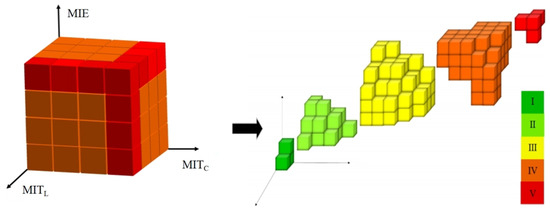
Figure 2.
Three-dimensional risk matrix of dust explosion self-sensitivity classification.
Table 2.
Classification of dust explosion self-sensitivity.
2.2. Environmental Parameters in the Dust Collector Box
The operation of a dust collector, which is a typically closed space, frequently leads to the formation of a dust cloud environment. By monitoring the temperature, the temperature in the dust collector box can be guaranteed not to reach the minimum ignition temperature of the dust cloud, and the dust cloud in the high-temperature ignition box will avoid dust explosion accidents. Additionally, the performance status of the dust collector can be obtained by monitoring the pressure difference between the inlet and outlet of the dust collector. The pressure difference range is about 1000 Pa when the dust collector works normally; the filter element is leaking or breaking when the pressure difference suddenly decreases. A sudden increase in the pressure difference implies that the cleaning system has stopped running, or the material discharge device has been unable to operate normally. The EN 1127-1:2019 standard mentions 13 possible ignition sources, including (1) hot surfaces, (2) flames and hot gases, (3) mechanically generated impact, friction and abrasion, (4) electrical equipment and components, (5) stray electric currents, cathodic corrosion protection, (6) static electricity, (7) lightning, (8) radiofrequency (RF) electromagnetic waves from 10 Hz to 3 × 10 Hz, (9) Electromagnetic waves from 3 × 10 Hz to 3 × 10 Hz, (10) ionizing radiation, (11) ultrasonic waves, (12) adiabatic compression and shock waves, and (13) exothermic reactions, including self-ignition of dusts; the focus of this article is on the monitoring of the daily operation of the dust box, involving ignition sources such as hot surfaces flames and hot gases, mechanically generated impact, friction and abrasion. Monitoring sparks through spark detection is performed to monitor two ignition sources, flames and hot gases, and mechanically generated impact, friction and abrasion, which can be extinguished in the first instance to prevent explosions from occurring. Monitoring hot surfaces through temperature sensors is important because a dust explosion occurs when combustible dust reaches the minimum ignition temperature, so monitoring the temperature inside the dust box not only prevents dust from reaching the minimum ignition temperature but also protects the dust collector from receiving temperature damage. According to the requirements of the “Safety regulations for dust explosion prevention and protection” GB 15577-2018 and “Safety specifications for dedusting system used in dust explosion hazardous area” AQ 4273-2016 on the settings of the pressure difference monitoring and alarm devices and the temperature monitoring and alarm devices for the inlet and outlet of a dust collector, the temperature in the dust collector box and the pressure difference between the inlet and the outlet were selected as the environmental parameters of the dust collector box in this paper. The temperature risk level in the dust collector box and the risk level of the pressure difference at the inlet and outlet were determined following a literature search [19,20,21] and the requirements of the “Safety specifications for dedusting system used in dust explosion hazardous area” AQ 4273-2016, respectively, as provided in Table 3 and Table 4. In this study, temperature and differential pressure sensors were utilized to collect experimental data, and the corresponding risk levels were acquired by comparing Table 3 and Table 4.
Table 3.
Classification of temperature risk grade in the dust collector box.
Table 4.
Classification of pressure difference risk levels between inlet and outlet.
2.3. Use Status of Explosion Prevention and Control Device
The installation of dust explosion prevention and control facilities can effectively prevent dust explosion accidents during the operation of a dry dust collector. The “Guide for pressure of dust explosions” GB/T 15605-2008 suggests that after the venting door opens the venting hole during an explosion, the venting hole is either kept open or closed again as needed. Explosion venting discs, as commonly used explosion venting devices for dust collectors, can effectively reduce explosion transmission and possible hazards [22]. AQ 4273-2016 demonstrates that the lower part of the ash hopper of a dust collector must be equipped with an air-locking ash unloading device, and the design of the ash unloading work cycle should ensure no dust accumulation in the ash hopper. The requirements of “Safety management specification for dust explosion prevention and protection” DB11/T 1827-2021 imply that a spark detector alarm and an elimination device should be set up for the dust transportation pipeline, which is prone to sparks and other ignition sources. The dust transportation pipeline should at least have an interlock shutdown for the spark detection alarm and the dust transportation system when it does not have the requisite installation conditions for a spark elimination device due to reasons such as being too short. Installing spark detectors, explosion venting discs, and airlock and ash discharge valves can effectively prevent and control dust explosion accidents in accident-prone areas, such as dust collectors and dust removal pipelines. The spark detection operating state, explosion venting disc operation state, and airlock and ash discharge valve operating state were selected as state indicators for the explosion prevention and control device in this study. The risk level was set to level I when the spark detector, the explosion venting disc, and the lock gas discharge valve configured by the dust collector were in normal operation. If a certain equipment was missing or faulty, the risk level was set to level V.
3. Indicator System Weight Calculation
AHP [23,24] is a computational method combining subjective and objective assessments. In the case of a considerable number of indicators, it can divide each factor of a complex problem into related orderly levels, accurately calculate the weight of each indicator, reduce the computational workload, and improve the accuracy of the results. Therefore, the analytic hierarchy process was selected in this paper to determine the weight of each evaluation index of the dust explosion risk of the dry dust removal system.
3.1. Principles of Analytic Hierarchy Process
The principle of the hierarchical analysis method is to find out the factors influencing each other in the system, decompose the decision layer by layer, form a multilayer structure model, and evaluate the relationship between the indicators in the system using the method of mathematical analysis to obtain the weight of each indicator. The specific steps are described as follows.
(1) Construct the judgment matrix according to the scaling method in Table 5. Generally, the 1–9 scaling method proposed by Saaty is adopted to form a judgment matrix by subjectively judging the importance of each index. A represents the target; and denote the factors. With the judgment matrix scaling method in Table 5, the relative importance of to is determined as . All form the A-U judgment matrix P [25].
Table 5.
Judgment matrix scaling method (1–9).
(2) Calculate the importance ranking. According to the judgment matrix, the eigenvector w corresponding to its maximal eigenvalue is obtained, expressed as:
The required feature vector w is normalized, namely, the weight of each evaluation factor.
(3) Consistency check. Whether the weight distribution obtained above is reasonable should be determined by conducting a consistency test on the judgment matrix. The test formula is:
where denotes the random consistency ratio of the judgment matrix; represents the consistency index of the judgment matrix, which is calculated by Equation (4); and indicates the average random consistency index of the judgment matrix, where the RI values of the judgment matrix of orders 1–9 are listed in Table 6 [26].
Table 6.
RI value table judgment matrix of orders 1–9.
When the judgment matrix P has or = n and , P has satisfactory consistency; otherwise, the elements in the A-U judgment matrix P should be adjusted to pass the consistency check [27].
3.2. Indicator Weight Calculation
Using the investigated index system, a questionnaire survey was used to choose 7 experts (university professors and enterprise specialists engaged in dust-explosion-related), and the expert scoring approach was utilized to grade the indexes in the index system. The significance of the indicators at each level was then calculated by comparing any two indicators on a scale of 1 to 9. Table 7, Table 8, Table 9 and Table 10 exhibit examples of the judgment matrix and consistency test results for each assessment indication evaluated by one of the experts. As indicated in Table 11, the weights of each first-level index and second-level index are calculated by adding the arithmetic mean of the scoring weights of all experts who pass the consistency test.
Table 7.
Examples of experts’ judgment matrix and consistency test results for the evaluation indicators among the first-level indicators.
Table 8.
Examples of experts’ judgment matrix and consistency test results for evaluation indexes between secondary indexes of dust explosion characteristic parameters.
Table 9.
Examples of experts’ judgment matrix and consistency test results for the evaluation indicators between the secondary indicators of environmental parameters in the dust collector box.
Table 10.
Examples of experts’ judgment matrix and consistency test results for the evaluation indicators between the secondary indicators of the use status of explosion-proof devices.
Table 11.
The weight of each primary and secondary indicator.
4. Construction of Evaluation Model
Fuzzy comprehensive evaluation, an evaluation method based on fuzzy mathematics, was first proposed by Professor Wang Peizhuang to express the influence of fuzzy-related factors in a quantitative manner [28]. This method introduces the membership degree in fuzzy mathematics into the object to be evaluated, contributing to transforming the qualitative evaluation into a quantitative evaluation and obtaining a comprehensive evaluation result for the object to be evaluated. In this paper, the fuzzy comprehensive evaluation method was employed to evaluate the dust explosion risk of a dry dust collector. The main steps are described as follows [29]:
(1) Establishment of a factor set:
The index set U has m factor subsets, and the formula is expressed as . Each factor subset has n indicators, and the formula is .
(2) Establishment of an evaluation set V:
The formula is and the dust explosion risk evaluation set for dry dust collectors is divided into 5 levels: very safe (I), relatively safe (II), general (III), more dangerous (IV), and very dangerous (V). The total score is 5 points, and the specific corresponding scores are presented in Table 12.
Table 12.
Evaluation grade classification.
(3) According to the calculation results of the analytic hierarchy process, the distribution of each level is determined:
(4) Under a comparison of the experimental data of the secondary factors and the index risk level table of each factor set, the risk level of each index is obtained, and the evaluation matrix is constructed:
(5) The evaluation vector Bi of the first-level indicator is:
This equation determines the overall evaluation matrix:
(6) The evaluation vector C is:
(7) Based on the total target assessment vector C, the relative assessment score of the target level is obtained per the maximum membership principle. The target level score is obtained, and the risk assessment level is determined through the comparison in Table 9.
5. Empirical Research
A fuzzy comprehensive evaluation was conducted with the dry pulse bag filter of TBLMa4 in a factory as an example. Following a comprehensive consideration of the relevant standards and industrial production, the risk factor set was constructed as = {dust explosion characteristic parameters, environmental parameters in the dust collector box, use status of explosion prevention and control device}. Specifically, = {dust explosion sensitivity, dust explosion severity}; = {temperature in the dust collector box, pressure difference between inlet and outlet}; = {spark detection operation state, operating of explosion venting disc, operating state of lock gas ash discharge valve}.
Paper powder with a particle size of 75 μm was selected as an experimental sample. The results demonstrated that the , , and MIE of the explosive sensitivity parameters of the paper powder were 440 °C, 340 °C, and 380–390 mJ, respectively, as listed in Table 13. The dust explosion severity parameters were 0.51 MPa and 5.52 MPa, respectively, as presented in Table 14. As revealed by comparing Table 1, Figure 2, and Table 2, the explosion sensitivity risk level of paper powder was grade V, and the explosion severity risk level was grade II. The experiment using a dry pulse bag dust collector suggested that the temperature of the dust collector in the box was 18 °C, and the pressure difference between the inlet and outlet was 673 Pa (Table 15). The comparison of Table 3 and Table 4 unveiled that the temperature risk level in the dust collector box was grade I, and the risk level of the pressure difference between the inlet and the outlet was grade I. The dry pulse dust collector of TBLMa4 is equipped with spark detection, an explosion venting disc, and an airlock and ash discharge valve in the normal operation state. Therefore, the risk level of the spark detection operation state, operating of the explosion venting disc, operating state of lock gas ash discharge valve was grade I. Given the weights of the indicators of all levels in Table 11, , , and were determined as:
Table 13.
Experimental data on dust explosion sensitivity.
Table 14.
Experimental data on dust explosion severity.
Table 15.
Example experimental data.
As demonstrated by comparing , , and with the evaluation grade division in Table 12, the risk level of the first-level index dust explosion characteristic parameters was grade III, while the risk level of the environmental state and the equipment operation parameters was grade I. The total target vector U could be obtained as:
It could be determined by comparing the calculated value U with the evaluation grade in Table 12 that the dust explosion risk grade of the dust collector in the factory was grade II, which was a relatively safe level. Furthermore, it was consistent with the evaluation results of experts in the field of dust explosion, implying that the established dust explosion risk assessment method for the dust removal system was accurate.
6. Conclusions
(1) Considering the characteristics of dust and the actual operation of dry dust collectors, a dust explosion risk assessment index system for dry-type dust collectors was constructed to effectively prevent and control dust explosion accidents in dry dust collectors. The proposed system consisted of three first-level indexes (dust explosion characteristic parameters, environmental parameters in the dust collector box, and use state of explosion prevention and control devices) and seven second-level indexes (dust explosion sensitivity, dust explosion severity, temperature in the dust collector box, pressure difference between inlet and outlet, operating state of spark detection, operating of the explosion venting disc, and operating state of lock gas ash discharge valve).
(2) The analytic hierarchy process was adopted to calculate the weights of the risk assessment indicators, and the fuzzy comprehensive evaluation method was employed to construct the dust explosion risk assessment model for a dry dust collector, so as to establish a set of dust explosion risk assessment methods suitable for dry dust collectors. A combination of quantitative calculations and a qualitative analysis verified that the evaluation results were practical.
(3) Using paper powder with a particle size of 75 m and applying an established dust explosion risk assessment method for dry dust collectors, the risk level for dust explosion of a dry pulse bag dust collector was evaluated as grade II in the examples, consistent with the risk level results obtained by experts. Thus, the established risk assessment method for dust explosion was feasible and accurate.
Author Contributions
Conceptualization, S.S. and T.M.; methodology, S.S. and P.L.; software, L.P.; validation, T.M. and P.L.; formal analysis, S.S.; investigation, S.S.; resources, T.M.; data curation, T.M. and P.L.; writing—original draft preparation, S.S.; writing—review and editing, S.S.; visualization, L.P. and P.L.; supervision, L.P.; project administration, T.M.; funding acquisition, L.P. All authors have read and agreed to the published version of the manuscript.
Funding
The authors appreciate the financial support from the Beijing Nova Program Interdisciplinary Cooperation Project (No. Z2111000021211), the Beijing Science and Technology Nova Program (No. Z181100006218092), the Training Funded Project of the Beijing Youth Top-Notch Talents of China (No. 2016000026833ZK05), General Items of Science and Technology Plan of Beijing Municipal Commission of Education (No. KM202210017003).
Institutional Review Board Statement
Not applicable.
Informed Consent Statement
Not applicable.
Conflicts of Interest
The authors declare no conflict of interest.
Abbreviations
The following abbreviations are used in this manuscript:
| minimum ignition temperature of the dust cloud | |
| minimum ignition temperature of the dust layer | |
| MIE | minimum ignition energy |
References
- Wu, F.; Tao, X. Analysis on tertiary care of kunshan“8·2”explosive accident victims during emergency relief period. Chin. J. Disaster Med. 2014, 2, 429–432. [Google Scholar]
- Zhang, X. Risk Assessment of Dust Explosion in Wood Floor Processing Works Hop Based on SEM-BN; Wuhan University of Science and Technology: Wuhan, China, 2020; pp. 1–8. [Google Scholar]
- Sun, L.Y. Research on Risk Assessment Method of Metal Powder Bed Additive Manufacturing Technology; Beijing Institute of Petrochemical Technology: Beijing, China, 2021; pp. 1–8. [Google Scholar]
- Jin, J.; Li, X.; Wang, Q. Study on risk assessment method of dust explosion and its application. China Saf. Sci. J. 2019, 29, 164–169. [Google Scholar]
- Xie, P.; Lv, P. Assessment on safety risk of enterprises involved in explosive dust based on im-proved cloud model and IAHP. J. Saf. Sci. Technol. 2018, 14, 187–192. [Google Scholar]
- Chen, Y.; Qin, X.; Niu, G. Risk assessment of coal dust explsion ignition sources based on interval analytic hierarchy process. Zhongzhou Coal 2016, 8, 1–4. [Google Scholar]
- Wang, Q.; Wang, X.; Jun, D. Explosion risk analysis of aluminum- magnesium alloy polishing site based on combination weighting and catastrophe progression method. J. Saf. Environ. 2021, 125, 2107–2113. [Google Scholar]
- Duo, Y.; Liu, Y.; Hu, X. Statistical analysis on dust explosion accidents occurring in China during 2009-2013. J. Saf. Sci. Technol. 2015, 11, 186–190. [Google Scholar]
- Zalosh, R. Dust collector explosions. A quantitative hazard evaluation method. J. Loss Prev. Process. Ind. 2015, 36, 258–265. [Google Scholar] [CrossRef]
- Li, Z.; Bai, J. The evaluation of ventilation and dust removal system based on fuzzy comprehensive analysis. J. Chongqing Univ. Sci. Technol. (Nat. Sci. Ed.) 2013, 15, 29–32. [Google Scholar]
- Zhi, Y.; Khakzad, N.; Khan, F. Risk-based optimal safety measure allocation for dust explosions. Saf. Sci. 2015, 74, 79–92. [Google Scholar]
- ISO 6184-1-1985; Explosion Protection Systems—Part 1: Determination of Explosion Indices of Combustible Dusts in Air. International Organization for Standardization: Geneva, Switzerland, 1985.
- Janes, A.; Chaineaux, J.; Carson, D. MIKE 3 versus HARTMANN apparatus: Comparison of measured minimum ignition energy (MIE). J. Hazard. Mater. 2008, 152, 32–39. [Google Scholar] [CrossRef]
- GB3836.1-2000; Electrical Equipment for Explosive Gas Environments Part 1: General Requirements. China Planning Press: Beijing, China, 2020.
- Nallusamy, S.; Ganesan, M.; Balakannan, K.; Shankar, C. Environmental Sustainability Evaluation for an Automobile Manufacturing Industry Using Multi-Grade Fuzzy Approach. JERA 2015, 19, 123–129. [Google Scholar] [CrossRef]
- Bi, H.; Xie, X.; Wang, K.; Cao, Y.; Shao, H. A risk assessment methodology of aluminum dust explosion for polishing process based on laboratory tests. J. Risk Reliab. 2021, 235, 627–636. [Google Scholar] [CrossRef]
- Ogle, R.A.; Cox, B.L. Dust explosions: Risk assessment. Methods Chem. Process. Saf. 2019, 3, 167–192. [Google Scholar]
- Wang, Q.; Wang, X. Explosion risk analysis of aluminum-magnesium alloy polishing site based on combinatorial weighting-mutation progression. J. Saf. Environ. 2022, 22, 2313–2321. [Google Scholar]
- Pang, L.; Cao, J.; Ma, R.; Hua, Y. Risk assessment method of polyethylene dust explosion based on explosion parameters. J. Loss Prev. Process. Ind. 2021, 69, 104397. [Google Scholar] [CrossRef]
- Xie, C. Diagnosis and treatment of pressure difference of reverse blowing bag filter. Gansu Metall. 2007, 99–100. [Google Scholar]
- Ou, J. Analysis on chamber pressure difference of impulse bag filter. Tianjin Metall. 2017, 67–69. [Google Scholar]
- Pang, Z.; Zhu, S. Analysis and prevention of aluminum powder dust explosion in dust removal process. In Proceedings of the 2019 Annual Scientific and Technical Conference of China Fire Protection Association, Detroit, MI, USA, 18–21 March 2019; pp. 197–199. [Google Scholar]
- Tang, B.; Zhang, Z.; Tian, G. A risk assessment of city gas network based on fuzzy analytic hierarchy process. J. Shandong Jianzhu Univ. 2008, 23, 478–481. [Google Scholar]
- Saaty, T.L. The Analytic Hierarchy Process; McGraw-Hill Company: New York, NY, USA, 1980; pp. 1–5. [Google Scholar]
- Tang, Y.; Hu, Q.; Luo, Y. Ghoneim, A new scale of the analytic hierarchy process. J. Ezhou Univ. 2005, 6, 40–41. [Google Scholar]
- Chang, J.; Jiang, T. Research on the weight of coefficient through analytic hierarchy process. J. Wuhan Univ. Technol. 2007, 29, 153–156. [Google Scholar]
- Zhao, H.; Xiao, Y.; Zeng, G. AHP method in heap leaching evaluation and optimization at copper oxide mine. J. Wenshan Univ. 2015, 28, 45–48. [Google Scholar]
- Li, R.; Shi, S.; Peng, X. Adaptive Second-Order Sliding-Mode Observer for PMSM Sensorless Control Considering VSI Nonlinearity. IEEE Trans. Power Electron. 2008, 18, 112–118. [Google Scholar]
- Li, X.; Xie, Z. Research on risk evaluation of construction project based on entropy weight-fuzzy comprehensive evaluation method. Saf. Health 2022, 6, 58–62. [Google Scholar]
Publisher’s Note: MDPI stays neutral with regard to jurisdictional claims in published maps and institutional affiliations. |
© 2022 by the authors. Licensee MDPI, Basel, Switzerland. This article is an open access article distributed under the terms and conditions of the Creative Commons Attribution (CC BY) license (https://creativecommons.org/licenses/by/4.0/).