Synthesis of Integrated Flower Waste Biorefinery: Multi-Objective Optimisation with Economic and Environmental Consideration

 , ,
, , 
Abstract
1. Introduction
1.1. Valorisation of Flower Waste
1.2. Synthesis of Sustainable Integrated Biorefinery
Environmental Assessment on Integrated Flower-Waste Biorefinery
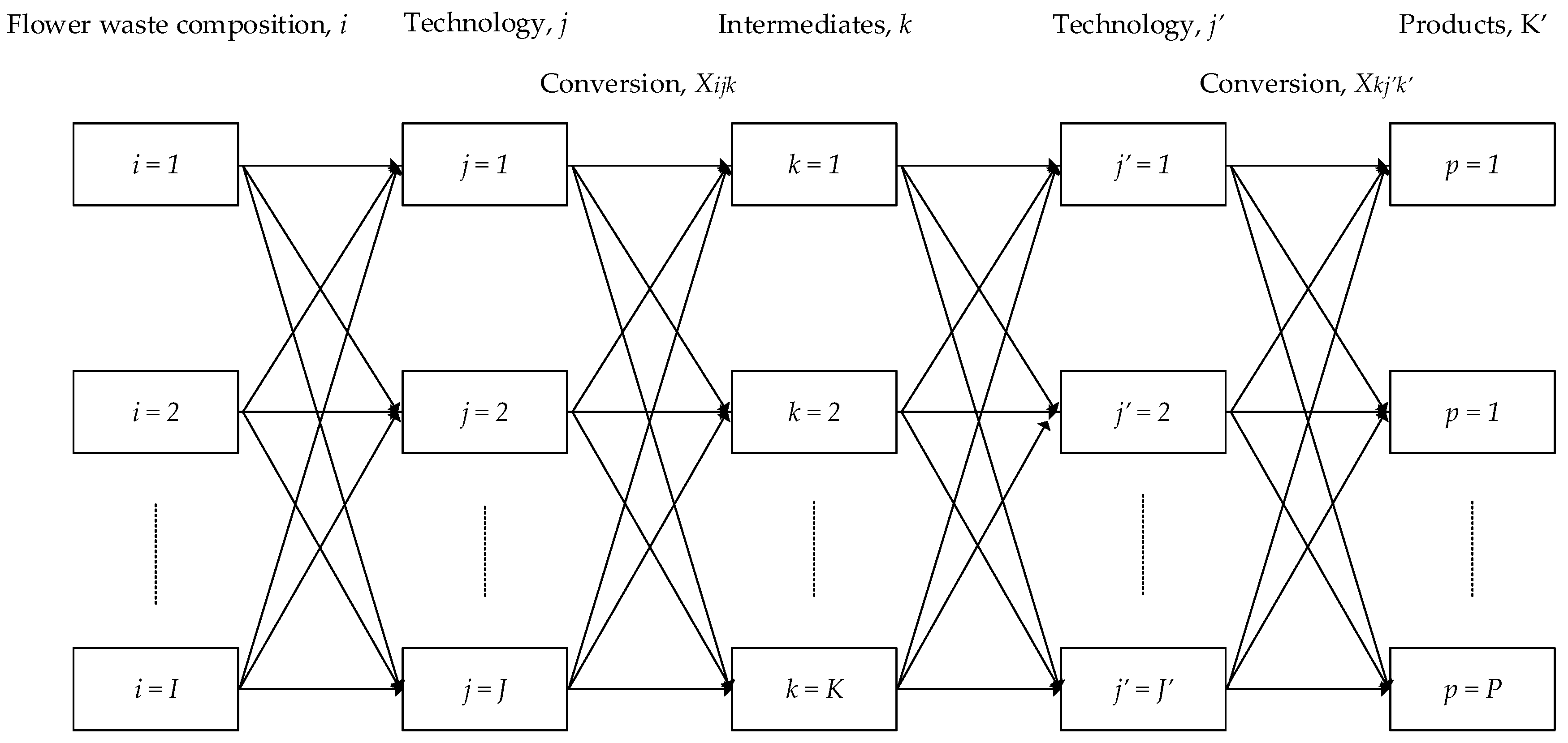
2. Problem Statement
3. Mathematical Optimisation Model
Model Formulation
4. Case Study
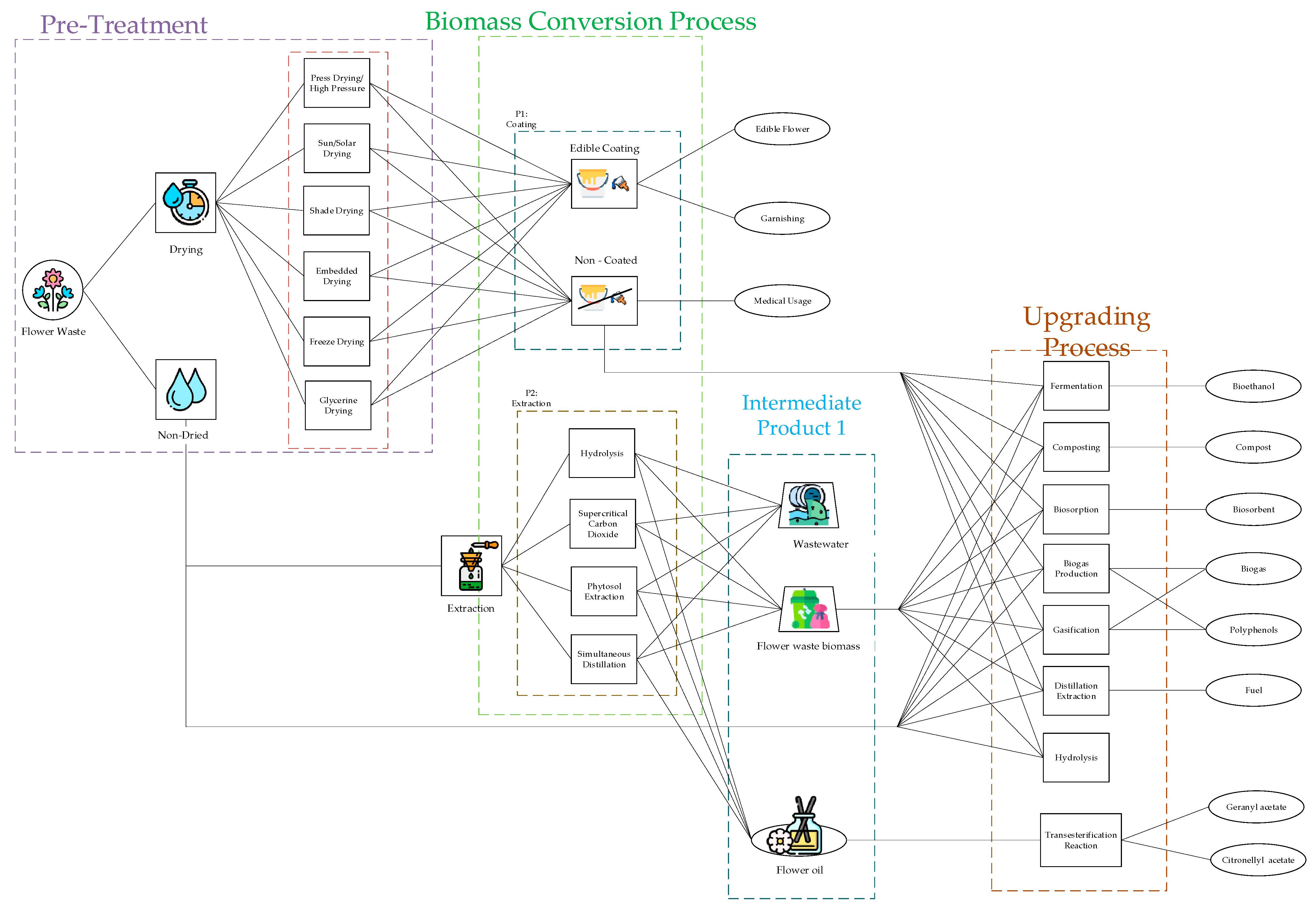
4.1. Superstructure
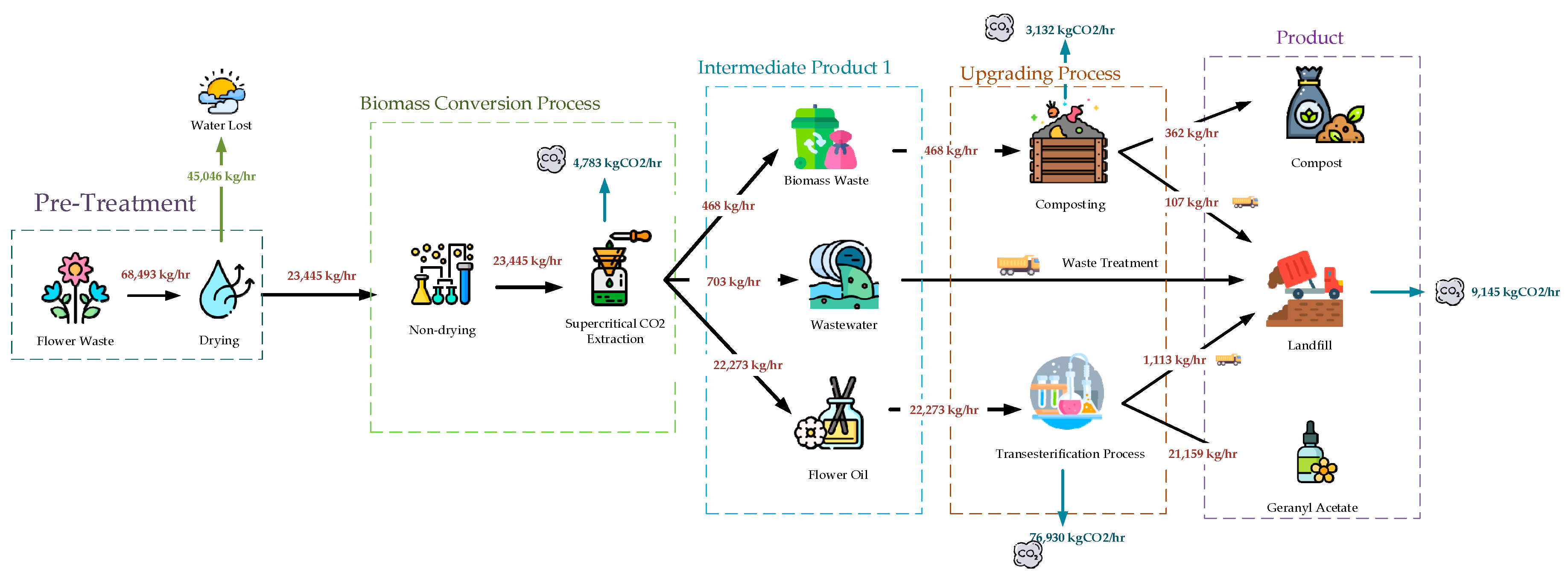
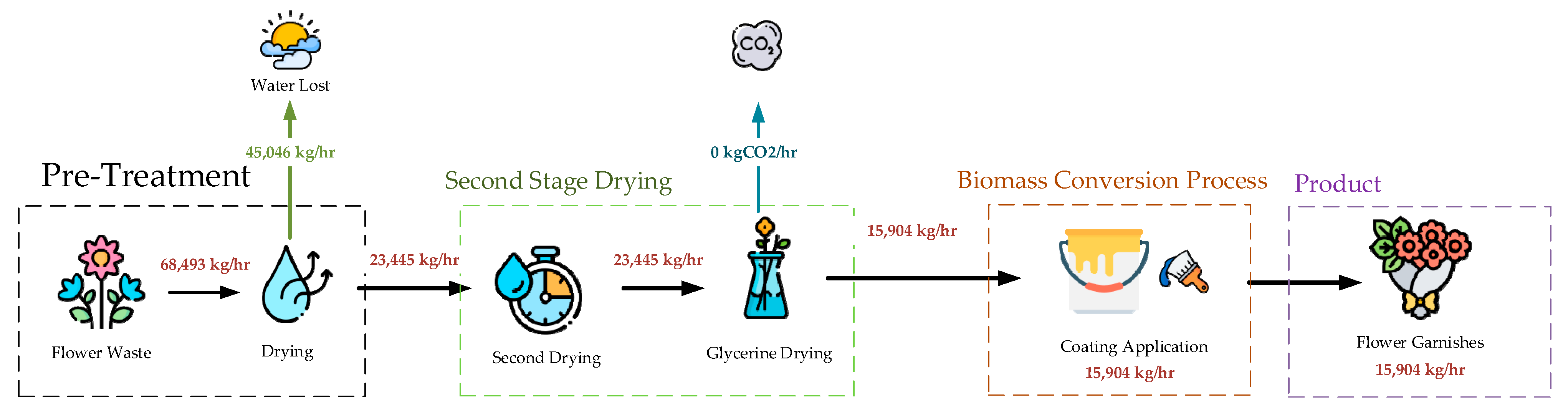
4.2. Result Analysis
- (i)
- Maximum economic performance,
- (ii)
- Minimum environmental impact,
- (iii)
- Multi-objective optimisation with maximum economic performance and minimum environmental impact.
5. Conclusions
Author Contributions
Funding
Acknowledgments
Conflicts of Interest
References
- Statista Research Department. Production Volume of Flowers in India Between Financial Year 2016 and 2020, with an Estimate for 2021. 2021. Available online: https://www.statista.com/statistics/1036938/india-production-of-flowers/ (accessed on 30 November 2021).
- Menon, S. Why Do We Offer Flowers to Gods? 2018. Available online: https://www.boldsky.com/yoga-spirituality/faith-mysticism/2018/why-do-we-offer-flowers-to-god-121808.html (accessed on 30 November 2021).
- Frost, R. Waste from Worship: Solving India’s Unique River Pollution Problem. 2020. Available online: https://www.euronews.com/green/2020/02/26/waste-from-worship-solving-india-s-unique-river-pollution-problem (accessed on 30 November 2021).
- Kabongo, J.D. Waste Valorization. In Encyclopedia of Corporate Social Responsibility; Springer: Berlin/Heidelberg, Germany, 2013; pp. 2701–2706. [Google Scholar]
- Rivas-Garcia, L.; Navarro-Hortal, M.; Romero- Marquez, J.M.; Forbes-Hernandez, T.Y.; Varela-Lopez, A.; Llopis, J.; Sanchez-Gonzalez, C.; Quiles, J.L. Edible Flowers as a Health Promoter: An Evidence-Based Review. Trends Food Sci. Technol. 2021, 117, 46–59. [Google Scholar] [CrossRef]
- Vidhya, C.; Senthilkumar, S.; Manivannan, S. Recent Trends in Production of Dry Flowers and Foliages. Pharma Innov. J. 2021, SP-10, 2135–2139. [Google Scholar]
- Prasad, V.J.K.; Pal, R.K.; Voleti, S.R. Drying of Flowers: An Upcoming Industry. Dry Flower Ind. Floric. Today 1997, 4, 20–23. [Google Scholar]
- Purohit, S.R.; Rana, S.S.; Idrishi, R.; Sharma, V.; Ghosh, P. A Review on Nutritional, Bioactive, Toxicological Properties and Preservation of Edible Flowers. Future Foods 2021, 4, 100078. [Google Scholar] [CrossRef]
- Slavov, A.; Vasileva, I.; Stefanov, L.; Stoyanova, A. Valorization of Wastes from the Rose Oil Industry. Rev. Environ. Sci. Biotechnol. 2017, 16, 309–325. [Google Scholar] [CrossRef]
- Dutta, S.; Kumar, M.S. Potential of Value-Added Chemicals Extracted from Floral Waste: A Review. J. Clean. Prod. 2021, 294, 126280. [Google Scholar] [CrossRef]
- Kamm, B.; Kamm, M.; Soyez, K. The Green Biorefinery, Concept of Technology. In Proceedings of the First International Symposium on Green Biorefinery, Society of Ecological Technology and System Analysis, Berlin, Germany, 1997; Available online: https://www.handboekbodemenbemesting.nl/upload_mm/7/d/b/71d063bb-c719-4815-8f94-e67b4a76637c_12.%20Kamm%20Green%20Biorefinery.pdf (accessed on 11 August 2022).
- Ng, D.K.S. Automated Targeting for Synthesis of An Integrated Biorefinery. Chem. Eng. J. 2010, 162, 67–74. [Google Scholar] [CrossRef]
- Gravitis, J.; Zandersons, J.; Vedernikov, N.; Kurma, L.; Ozols-Kalnins, V. Clustering of Bioproducts Technologies for Zero Emissions and Eco-Efficiency. Ind. Crops Prod. 2004, 20, 169–180. [Google Scholar] [CrossRef]
- Ng, D.; Pham, V.; Jiménez-Gutiérrez, A.; Spriggs, H. A Hierarchical Approach to the Synthesis and Analysis of Integrated Biorefineries. In Design Energy and the Environment: Proceedings of the Seventh International Conference on the Foundations of Computer-Aided Process Design; CRC Press: Boca Raton, FL, USA, 2009; pp. 425–432. [Google Scholar]
- Tey, S.-Y.; Wong, S.S.; Lam, J.A.; Ong, N.Q.; Foo, D.C.; Ng, D.K. Extended hierarchical decomposition approach for the synthesis of biorefinery processes. Chem. Eng. Res. Des. 2020, 166, 40–54. [Google Scholar] [CrossRef]
- Benjamin, M.F.D.; Cayamanda, C.D.; Tan, R.R.; Razon, L.F. P-graph approach to criticality analysis in integrated bioenergy systems. Clean Technol. Environ. Policy 2017, 19, 1841–1854. [Google Scholar] [CrossRef]
- Yeo, J.Y.J.; How, B.S.; Teng, S.Y.; Leong, W.D.; Ng, W.P.; Lim, C.H.; Ngan, S.L.; Sunarso, J.; Lam, H.L. Synthesis of Sustainable Circular Economy in Palm Oil Industry Using Graph-Theoretic Method. Sustainability 2020, 12, 8081. [Google Scholar] [CrossRef]
- Bao, B.; Ng, D.K.; Tay, D.H.; Jiménez-Gutiérrez, A.; El-Halwagi, M.M. A Shortcut Method for the Preliminary Synthesis of Process-Technology Pathways: An Optimization Approach and Application for The Conceptual Design of Integrated Biorefineries. Comput. Chem. Eng. 2011, 35, 1374–1383. [Google Scholar] [CrossRef]
- Ng, R.T.L.; Ng, D.K. Systematic Approach for Synthesis of Integrated Palm Oil Processing Complex. Part 1: Single Owner. Ind. Eng. Chem. Res. 2013, 52, 10206–10220. [Google Scholar] [CrossRef]
- Rizwan, M.; Almansoori, A.; Elkamel, A. An Overview on Synthesis and Design of Microalgal Biorefinery Configurations by Employing Superstructure-Based Optimization Approach. Energy Syst. 2019, 10, 941–966. [Google Scholar] [CrossRef]
- Dickson, R.; Liu, J.J. Optimization of Seaweed-Based Biorefinery with Zero Carbon Emissions Potential. Comput.-Aided Chem. Eng. 2019, 46, 247–252. [Google Scholar]
- Chemmangattuvalappil, N.G.; Ng, D.K.S.; Ng, L.Y.; Ooi, J.; Chong, J.W.; Eden, M.R. A Review of Process Systems Engineering (PSE) Tools for the Design of Ionic Liquids and Integrated Biorefineries. Processes 2020, 8, 1678. [Google Scholar] [CrossRef]
- Romero-García, J.M.; Gutiérrez, C.D.B.; Toro, J.C.S.; Alzate, C.A.C.; Castro, E. Environmental Assessment of Biorefineries. In Biosynthetic Technology and Environmental Challenges; Varjani, S., Parameswaran, B., Kumar, S., Khare, S., Eds.; Energy, Environment, and Sustainability; Springer: Berlin/Heidelberg, Germany, 2017; pp. 377–401. [Google Scholar]
- Muralikrishna, I.V.; Manickam, V. Life Cycle Assessment. In Environmental Management; Butterworth-Heinemann: Oxford, UK, 2017; pp. 57–75. [Google Scholar]
- Russo, G.; Buttol, P.; Tarantini, M. LCA (Life Cycle Assessment) of Roses and Cyclamens in Greehouse Cultivation. Acta Hortic. 2008, 801, 359–366. [Google Scholar] [CrossRef]
- Shale, A.; Potting, J. Environmental Life Cycle Assessment of Ethiopian Rose Cultivation. Sci. Total Environ. 2013, 443, 163–172. [Google Scholar] [CrossRef]
- Saraiva, A.B. System Boundary Setting in Life Cycle Assessment of Biorefineries: A Review. Int. J. Environ. Sci. Technol. 2017, 14, 435–452. [Google Scholar] [CrossRef]
- Alig, M.; Frischknecht, R. Life Cycle Assessment Cut Roses; Treeze Ltd.: Uster, Switzerland, 2018. [Google Scholar]
- Tay, D.H.S.; Ng, D.K.S. Fuzzy Optimization Approach for the Synthesis of a Sustainable Integrated Biorefinery. Ind. Eng. Chem. Res. 2011, 50, 1652–1665. [Google Scholar] [CrossRef]
- Bressanin, J.M.; Geraldo, V.C.; Assis Magalhães Gomes, F.; Klein, B.C.; Chagas, M.F.; Watanabe, M.D.B.; Bonomi, A.; Morais, E.R.d.; Cavalett, O. Multiobjective Optimization of Economic and Environmental Performance of Fischer-Tropsch Biofuels Production Integrated to Sugarcane Biorefineries. Ind. Crops Prod. 2021, 170, 113810. [Google Scholar] [CrossRef]
- Solis, C.A.; Mayol, A.P.; San Juan, J.G.; Ubando, A.T.; Culaba, A.B. Multi-objective Optimal Synthesis of Algal Biorefineries Toward A Sustainable Circular Bioeconomy. IOP Conf. Ser. Earth Environ. Sci. 2020, 463, 012051. [Google Scholar] [CrossRef]
- Andiappan, V.; Ko, A.S.Y.; Lau, V.W.S.; Ng, L.Y.; Ng, R.T.L.; Chemmangattuvalappil, N.G.; Ng, D.K.S. Synthesis of Sustainable Integrated Biorefinery via Reaction Pathway Synthesis: Economic, Incremental Burden and Energy Asssessments with Multi-Objective Optimisation. AIChE J. 2015, 61, 132–146. [Google Scholar] [CrossRef]
- Geraili, A.; Romagnoli, J.A. A Multiobjective Optimization Framework for Design of Integrated Biorefineries Under Uncertainty. AIChE J. 2015, 61, 3208–3222. [Google Scholar] [CrossRef]
- Ng, L.Y.; Andiappan, V.; Chemmangattuvalappil, N.G.; Ng, D.K.S. Novel Methodology for the Synthesis of Optimal Biochemicals in Integrated Biorefineries via Inverse Design Techniques. Ind. Eng. Chem. Res. 2015, 54, 5722–5735. [Google Scholar] [CrossRef]
- Ng, R.T.L.; Ng, D.K.S.; Hassim, M.H. Process Synthesis and Optimization of a Sustainable Integrated Biorefinery via Fuzzy Optimization. AIChE J. 2013, 59, 4212–4227. [Google Scholar] [CrossRef]
- Dilta, B.S.; Sharma, B.P.; Baweja, H.S.; Kashyap, B. Flower Drying Techniques—A Review. Int. J. Arm Sci. 2011, 1, 1–16. [Google Scholar]
- Chen, C.; Gast, K.L.B.; Smithey, S. The Effect of Different Freeze-Drying Processes on the Moisture Content, Colour, and Physical Strength of Roses and Carnations. Sci. Hortic. 1999, 84, 321–332. [Google Scholar] [CrossRef]
- Handa, S.S.; Khanuja, S.P.S.; Longo, G.; Rakesh, D.D. Extraction Technologies for Medicinal and Aromatic Plants; International Centre for Science and High Technology: Trieste, Italy, 2008. [Google Scholar]
- Doda, S.; Sahu, O. Production of Bioethanol from Biomass (Marigold flower). Mater. Today Proc. 2021, 48, 932–937. [Google Scholar] [CrossRef]
- Vazquez, M.A.; Soto, M. The Efficiency of Home Composting Programmes and Compost Quality. Waste Manag. 2017, 64, 39–50. [Google Scholar] [CrossRef]
- Ryckebosch, E.; Drouillon, M.; Vervaeren, H. Techniques for Transformation of Biogas to Biomethane. Biomass Bioenergy 2011, 35, 1633–1645. [Google Scholar] [CrossRef]
- Kamal, I. Edible Films and Coatings: Classification, Preparation, Functionality and Applications—A Review. Arc. Org. Inorg. Chem. Sci. 2019, 4, 501–510. [Google Scholar]
- Shivaprasad, P. Methods of Extracting Essential Oils from Discarded Flower Petals in India. 2018. Available online: https://www.bath.ac.uk/announcements/student-start-up-to-tackle-indias-flower-waste/ (accessed on 31 March 2022).
- ReportLinker. ReportLinker. In-Depth Analysis and Data-Driven Insights on the Impact of COVID-19 Included in This U.S. Essential Oils Market Report. 2020. Available online: https://www.globenewswire.com/news-release/2020/12/17/2146704/0/en/United-States-Essential-Oils-Market-Industry-Outlook-and-Forecast-2021-2026-with-In-depth-Analysis-and-Data-driven-Insights-on-the-Impact-of-COVID-19.html (accessed on 31 March 2022).
- Waghmode, M.S.; Gunjal, A.B.; Nawani, N.N.; Patil, N.N. Management of Floral Waste by Conversion to Value-Added Products and Their Other Applications. Waste Biomass Valorization 2016, 9, 33–43. [Google Scholar] [CrossRef]
- Reed, S.D.; Armstrong, P.R.; Brusewitz, G.H.; Stone, M.L. Resistance od Marigold Flower to Airflow. Am. Soc. Agric. Eng. 2001, 449, 639–642. [Google Scholar]
- Awan, M.O.U.; Khan, N.; Ali, M.; Junaid, M.; Sohail; Nawaz, F.; Khan, R.; Shah, J.A.; Ali, A.; Mehmood, N.; et al. Response of Cut Rose Cv. Cardinal to Sucrose and NaOCL Concentration. Pure Appl. Biol. 2017, 6, 171–179. [Google Scholar] [CrossRef]
- Kaiser, C.S.; Rompp, H.; Schmidt, P.C. Supercritical Carbon Dioxide Extraction of Chamomile Flowers: Extraction Efficiency, Stability, and In-line Inclusion of Chamomile-Carbon Dioxide Extract in β-cyclodextrin. Phytochem. Anal. 2004, 15, 249–256. [Google Scholar] [CrossRef]
- Chen, Y.; Jiang, X.Y.; Tong, X.; Chen, X.Q. Comparison on Volatile Components from Marchantia Convoluta Obtained by Microwave Extraction and Phytosol Extraction. J. Chil. Chem. Soc. 2008, 53, 1518–1522. [Google Scholar]
- Pollien, P.; Chaintreau, A. Simultaneous Distillation−Extraction: Theoretical Model and Development of a Preparative Unit. Anal. Chem. 1997, 69, 3285–3292. [Google Scholar] [CrossRef]
- Mohanty, S.K.; Behera, S.; Swain, M.R.; Ray, R.C. Bioethanol Production from Mahula (Madhuca latifolia L.) Flowers by Solid-State Fermentation. Appl. Energy 2009, 86, 640–644. [Google Scholar] [CrossRef]
- Kanamarlapudi, S.L.R.K.; Chintalpudi, V.K.; Muddada, S. Application of Biosorption for Removal of Heavy Metals from Wastewater. In Biosorption; IntechOpen: London, UK, 2018. [Google Scholar]
- Ribeiro, B.S.; Ferreira, M.d.F.; Moreira, J.L.; Santos, L. Simultaneous Distillation–Extraction of Essential Oils from Rosmarinus officinalis L. Cosmetics 2021, 8, 117. [Google Scholar] [CrossRef]
- Geitner, F.K.; Bloch, H.P. Chapter 12—Life-cycle cost analysis, Practical Machinery Management for Process Plants. Gulf Prof. Publ. 2006, 5, 201–228. [Google Scholar]
- Junckers. What Is “Press Drying”, and Why Did Junkers Invent it? Available online: https://www.junckers.com/about/blogposts/technical-bulletins/what-is-press-drying-and-why-did-junckers-invent-it (accessed on 31 March 2022).
- FirstDayofHome. How to Dry Flowers with Silica Gel: An Amazing Technique. 2022. Available online: https://www.firstdayofhome.com/drying-flowers-with-silica-gel/ (accessed on 31 March 2022).
- Flower Forever & Bellabeads. Freeze Dried Flowers: Freeze Dried Floral Preservation. Available online: https://myflowersforeverjewelry.com/pages/freeze-dried-flowers#:~:text=FREEZE%20DRIED%20FLORAL%20PRESERVATION,of%2010%20to%2015%20days (accessed on 31 March 2022).
- Deyin. Price for Edible Flowers. 2022. Available online: https://www.alibaba.com/product-detail/Flower-Edible-Bulk-Wholesale-Natural-Quality_1600589019831.html?spm=a2700.galleryofferlist.normal_offer.d_title.22a44a30CHNIfx&s=p (accessed on 28 March 2022).
- Liaoning. Price for Flower Garnishing. 2022. Available online: https://www.alibaba.com/product-detail/Factory-Supply-Amazon-Custom-Package-Biodegradable_1600466871476.html?spm=a2700.galleryofferlist.normal_offer.d_title.1a795056AUHTif (accessed on 28 March 2022).
- AMAZY. Price for Medical Flower. 2022. Available online: https://www.alibaba.com/product-detail/Bulk-Wholesale-Bulk-Natural-Tea-Golden_1600428372790.html?spm=a2700.galleryofferlist.topad_classic.d_title.5eb8a6553FhrnD (accessed on 28 March 2022).
- GlobalPetraolPrices. Ethanol and Fuel Prices. 2022. Available online: https://www.globalpetrolprices.com/ethanol_prices/ (accessed on 28 March 2022).
- Weifang. Price for Organic Compost. 2022. Available online: https://www.alibaba.com/product-detail/New-High-Quality-Compost-Accelerator-Bacteria_1600479322856.html?spm=a2700.galleryofferlist.normal_offer.d_title.5f717edfQTFqC3&s=p (accessed on 28 March 2022).
- Model N0.1, Price for Biosorbent and Biogas. Available online: https://web.iitd.ac.in/~vkvijay/files/biogas%20entrepreneurship.pdf (accessed on 28 March 2022).
- Lau, S. Price for Polyphenols. 2022. Available online: https://joysun-group.en.made-in-china.com/product/CdgTwzLEbtpv/China-Best-Price-Natural-Green-Tea-Extract-Green-Tea-Polyphenols-25-98-.html (accessed on 28 March 2022).
- Cano, M.E.; García-Martin, A.; Comendador Morales, P.; Wojtusik, M.; Santos, V.E.; Kovensky, J.; Ladero, M. Production of Oligosaccharides from Agrofood Wastes. Fermentation 2020, 6, 31. [Google Scholar] [CrossRef]
- VINEVIDA. Price for Essential Oil. 2022. Available online: https://www.vinevida.com/?gclid=CjwKCAjwqJSaBhBUEiwAg5W9p3fo0MLWq59vF6EHTGXniKcoBB4_7SHNVGQpdiV995Y0whg_V_-FohoCO8kQAvD_BwE (accessed on 28 March 2022).
- VIGON. Price for Geranyl Acetate. 2022. Available online: https://www.vigon.com/product/geranyl-acetate-natural/ (accessed on 28 March 2022).
- Mech Extrmeme Design with Innovation. Energy Required for Press Drying. 2017. Available online: https://mechextreme.blogspot.com/p/manufacturing.html (accessed on 20 March 2022).
- Huang, L.; Zhang, M.; Mujumdar, A.S.; Sun, D.; Tan, G.; Tang, S. Studies on Decreasing 549 Energy Consumption for a Freeze-Drying Process of Apple Slices. Dry. Technol. 2009, 27, 938–946. [Google Scholar] [CrossRef]
- Fraunhofer, IFAM. Energy Required for Simultaneous Distillation. 2022. Available online: https://www.ifam.fraunhofer.de/en/Aboutus/Locations/Dresden/HydrogenTechnology/hydrolysis.html (accessed on 28 March 2022).
- Fiori, L. Supercritical Extraction of Grape Seed Oil at Industrial-scale: Plant and Process Design, Modeling, Economic Feasibility. Chem. Eng. Process. Process Intensif. 2010, 49, 866–872. [Google Scholar] [CrossRef]
- Suarez Garcia, E.; Van Leeuwen, J.; Safi, C.; Sijtsma, L.; Eppink, M.H.M.; Wijffels, R.H.; van den Berg, C. Selective and Energy Efficient Extraction of Functional Proteins from Microalgae for Food Applications. Bioresour. Technol. 2018, 268, 197–203. [Google Scholar] [CrossRef]
- Tzen, E.; Zaragoza, G.; Padilla, E.A. Comprehensive Renewable Energy (Second Edition)—Solar Desalination; Elsevier: Amsterdam, The Netherlands, 2022; Volume 3, pp. 590–637. [Google Scholar]
- Ranieri, E.; Giuliano, S.; Ranieri, A.C. Energy Consumption in Anaerobic and Aerobic Based Wastewater Treatment in Plants in Itali. Water Pract. Technol. 2021, 16, 851–863. [Google Scholar] [CrossRef]
- Fertilizer Institute. Energy Required for Composting and Biosorbent. Available online: https://www.tfi.org/our-industry/state-of-industry/environment-energy (accessed on 20 March 2022).
- Ntihuga, J.; Senn, T.; Gschwind, P.; Kohlus, R. Estimating Energy- and Eco-Balances for Continuous Bio-Ethanol Production Using a Blenke Cascade System. Energies 2013, 6, 2065–2083. [Google Scholar] [CrossRef]
- Minowa, T.; Hanaoka, T.; Yokoyama, S. Process Evaluation of Biomass to Liquid Fuel Production System with Gasification and Liquid Fuel Synthesis. Stud. Surf. Sci. Catal. 2004, 153, 79–84. [Google Scholar] [CrossRef]
- Office of Energy Efficiency & Renewable Energy. Energy Required for Hydrolysis Process. Available online: https://www.energy.gov/eere/fuelcells/hydrogen-production-electrolysis (accessed on 20 March 2022).
- Pradhan, A.; Shrestha, D.S.; Van Gerpen, J.; Duffield, J. The Energy Balance of Soybean Oil 578 Biodiesel Production: A Review of Past Studies. Trans. ASABE 2008, 51, 185–194. [Google Scholar] [CrossRef]
- World Benchmarking Alliance. Greenhouse Gases Emission Based on per Unit of Electricity 581 Used. 2019. Available online: https://www.worldbenchmarkingalliance.org/publication/electric-utilities/companies/tenaga-nasional/ (accessed on 15 March 2022).



| Application | Technology/Biorefinery | Description | Final Product |
|---|---|---|---|
| Food | Drying [7] | Removal of water from flower and retain the medical constituents | Edible flower and flower for garnishing purpose |
| Pharmaceutical | Extraction [8] | Secure biological active compound in flower | Flower for medical purpose |
| Agricultural application | Composting [9] | Utilised for soil replenishment after composting | Bio-fertilizers |
| Environmental remediation | Biosorption [9] | Heavy metals from wastewater are accumulated | Removal of dyes, wastewater treatment |
| Bioenergy application | Gasification and fermentation [9] | Turn waste into source of energy | Biogas and bioethanol |
| Parameters | Consideration | |
|---|---|---|
| Direct environment impacts | Input-related emission | Greenhouse gases emissions from crop production |
| Transportation of feedstock | Furl use for feedstock collection and transportation of residues and by-product | |
| Direct land-use change | Soil quality changes made by above-ground biomass in terms of carbon sequestration | |
| Indirect environmental impacts | Indirect land-use change | Substitution of one feed into another feed will affect greenhouse gases emission (this section is not elaborated further in journal review) |
| Technology/Biorefinery | Description | |
|---|---|---|
| Drying | Press Drying [36] | Apply pressure while drying |
| Sun Drying [8] | Natural drying with the aid of sun | |
| Shade Drying [37] | Natural drying without direct sunlight | |
| Embedded Drying [7] | Silica gel as desiccants for dying | |
| Freeze Drying [7] | Sublimation process in low temperature | |
| Glycerine Drying [7] | Glycerol solution as medium to absorb water | |
| Extraction | Hydrodistillation [38] | Extraction process involving direct heat boiling |
| Hydrolysis [38] | Chemical reaction to form acid and alcohol | |
| Supercritical Carbon Dioxide [38] | Carbon dioxide extraction in supercritical state | |
| Phytosol Extraction [38] | Cold extraction without heat | |
| Simultaneous Distillation [38] | Extraction with gas chromatography with two flasks | |
| Membrane Extraction [38] | Extraction involves partitioning in a membrane | |
| Fermentation [39] | Chemical breakdown of flower waste | |
| Bioenergy Generation and Transesterification Reaction | Composting [40] | Utilised for soil replenishment after composting |
| Biosorbent [41] | Heavy metals from wastewater are accumulated | |
| Gasification [42] | Convert flower waste into gas in high temperature | |
| Transesterification [43] | Convert into geranyl acetate and citronellyl acetate | |
| Flower Composition | Petals | Leaves |
|---|---|---|
| Density, kg/m3 [46] | 276 | 276 |
| Weight distribution, % [47] | 38 | 62 |
| Technology/Biorefinery | Final Moisture Content, % | Intermediates/Product | |
|---|---|---|---|
| Drying | Press Drying [36] | 11.55 | Edible flower/garnishing |
| Sun Drying [36] | 11.55 | ||
| Shade Drying [36] | 11.55 | ||
| Embedded Drying [36] | 11.55 | ||
| Freeze Drying [37] | 24.56 | ||
| Glycerine Drying [37] | 11.55 | ||
| Technology/Biorefinery | Conversion, % | Intermediates/Product | |
|---|---|---|---|
| Extraction | Hydrolysis [43] | 80 | Wastewater, Biomass, and Flower Essential Oil |
| Supercritical Carbon Dioxid [48] | 95 | ||
| Phytosol Extraction [49] | 87 | ||
| Simultaneous Distillation [50] | 60 | ||
| Bioenergy generation | Fermentation [51] | 77 | Bioethanol |
| Composting [40] | 77 | Compost | |
| Biosorbent [52] | 63 | Biosorbent | |
| Biogas Production and Gasification [41] | 65 | Biogas/Polyphenols | |
| Distillation Extraction [53] | 60 | Fuel | |
| Hydrolysis [43] | 70 | Pectin Oligosaccharide | |
| Flower oil further process | Transesterification Reaction [43] | 95 and 70 | Geranyl Acetate and Citronellyl Acetate |
| Drying Process | Time Required, h/Batch | Product Cost, USD/kg |
|---|---|---|
| Press drying/High pressure [55] | 2 | 0.50 |
| Sun/Solar drying [36] | 48 | 0.02 |
| Shade drying [36] | 72 | 0.01 |
| Embedded drying [56] | 48 | 0.02 |
| Freeze drying [7] | 240 | 0.004 |
| Glycerine drying [57] | 4 | 0.25 |
| Element | Price, USD/kg | Element | Price, USD/kg |
|---|---|---|---|
| Edible flower [58] | 1.45 | Polyphenols [59] | 9.50 |
| Flower for garnishing [60] | 20.00 | Fuel [61] | 2.60 |
| Medical flower [62] | 85.30 | Pectin oligosaccharide [63] | 5.00 |
| Bioethanol [64] | 1.64 | Flower oil [65] | 35.00 |
| Compost [66] | 9.00 | Geranyl acetate [67] | 372.00 |
| Biosorbent [63] | 0.30 | Citronellyl acetate [67] | 311.00 |
| Biogas [63] | 0.33 |
| Biorefinery/Technology | Energy Required, kWh/kg | Carbon Emission, kg CO2/kg Feed | |
|---|---|---|---|
| Drying | Press drying [68] | 3.70 | 1.89 |
| Sun drying | N/A | N/A | |
| Shade drying | N/A | N/A | |
| Embedded drying | N/A | N/A | |
| Freeze drying [69] | 1.60 | 0.82 | |
| Glycerine drying | N/A | N/A | |
| Extraction | Hydrolysis [70] | 1.90 | 0.97 |
| Supercritical CO2 [71] | 0.40 | 0.20 | |
| Phytosol extraction [72] | 0.60 | 0.30 | |
| Simultaneous distillation [73] | 1.50 | 0.002 | |
| Bioenergy generation | Fermentation [74] | 0.43 | 0.001 |
| Composting [75] | 13.14 | 6.70 | |
| Biosorption [75] | 0.43 | 0.22 | |
| Biogas production [76] | 0.32 | 0.0006 | |
| Gasification [77] | 0.30 | 0.15 | |
| Distillation extraction [71] | 1.50 | 0.003 | |
| Hydrolysis [78] | 44.70 | 22.8 | |
| Flower oil further process | Transesterification [79] | 6.77 | 3.45 |
| Total Revenue | Total Carbon Emission |
|---|---|
| USD 7,874,455 | 93,999 kgCO2/h |
| Product Selling Price | Treatment Cost |
|---|---|
| USD 7,874,474 | 1924 $ |
| Total Revenue | Total Carbon Emission |
|---|---|
| USD 11,927 | 0.01 kg CO2/h |
| Carbon Emission, kg CO2/h |
|---|
| Landfill |
| 0.01 |
| Total Revenue | Parameters | Total Carbon Emission | Parameters | |
|---|---|---|---|---|
| Scenario 1 | USD 7,874,474 | XU | 93,999 kg CO2/h | YU |
| Scenario 2 | USD 11,927 | XL | 0.01 kg CO2/h | YL |
| Total Revenue | Total Environmental Impact |
|---|---|
| USD 4,009,320 | 46,209 kg CO2/h |
Publisher’s Note: MDPI stays neutral with regard to jurisdictional claims in published maps and institutional affiliations. |
© 2022 by the authors. Licensee MDPI, Basel, Switzerland. This article is an open access article distributed under the terms and conditions of the Creative Commons Attribution (CC BY) license (https://creativecommons.org/licenses/by/4.0/).
Share and Cite
Chong, E.H.Y.; Andiappan, V.; Ng, L.Y.; Shivaprasad, P.; Ng, D.K.S. Synthesis of Integrated Flower Waste Biorefinery: Multi-Objective Optimisation with Economic and Environmental Consideration. Processes 2022, 10, 2240. https://doi.org/10.3390/pr10112240
Chong EHY, Andiappan V, Ng LY, Shivaprasad P, Ng DKS. Synthesis of Integrated Flower Waste Biorefinery: Multi-Objective Optimisation with Economic and Environmental Consideration. Processes. 2022; 10(11):2240. https://doi.org/10.3390/pr10112240
Chicago/Turabian StyleChong, Emily Hau Yan, Viknesh Andiappan, Lik Yin Ng, Parimala Shivaprasad, and Denny K. S. Ng. 2022. "Synthesis of Integrated Flower Waste Biorefinery: Multi-Objective Optimisation with Economic and Environmental Consideration" Processes 10, no. 11: 2240. https://doi.org/10.3390/pr10112240
APA StyleChong, E. H. Y., Andiappan, V., Ng, L. Y., Shivaprasad, P., & Ng, D. K. S. (2022). Synthesis of Integrated Flower Waste Biorefinery: Multi-Objective Optimisation with Economic and Environmental Consideration. Processes, 10(11), 2240. https://doi.org/10.3390/pr10112240